


Abstract
This paper investigates the optimal control problem of orbital rendezvous for spacecraft in near-circular orbits with a low-thrust propulsion system. Two optimality criteria are considered: time-optimal and motor-time-optimal control. A linearized mathematical model of relative motion between the active and passive spacecraft is employed, which is formulated in dimensionless variables that characterize secular, periodic, and lateral motion components of the relative motion. By applying Pontryagin’s Maximum Principle, the equations governing the optimal relative motion of the spacecraft are derived. To address the discontinuities associated with the bang–bang switching function inherent in the motor-time-optimal problem, and the lack of a suitable initial guess, a homotopy method is adopted, in which the solution to the rendezvous time-optimal problem is used as an initial guess and is gradually deformed into the motor-time-optimal control. Considering the errors introduced by the linearization of the relative motion model, the obtained control law is validated via numerical simulations based on the original nonlinear dynamics of the system. Simulation results demonstrate that the proposed trajectory optimization methodology achieves high success rates and rapid convergence, providing valuable theoretical support and practical guidance for mission scenarios with similar trajectory design requirements.
Keywords:
relative motion; secular; periodic; and lateral motion components; Pontryagin’s maximum principle; homotopy method MSC:
49M05
1. Introduction
In the scientific literature, relative motion refers to the motion of a maneuvering spacecraft in close vicinity of a passive spacecraft. Control of relative motion is associated with several key mission scenarios, including spacecraft rendezvous [1,2,3], formation flying, station-keeping at a designated geostationary orbital slot, and trajectory optimization for debris removal missions employing a dedicated spacecraft—commonly referred to as a space debris collector.
Modern spacecraft can be equipped with various types of propulsion systems—high-thrust chemical (impulsive) engines and low-thrust electric propulsion systems, which enable prolonged transfer operations with high energy efficiency. The use of low-thrust electric propulsion systems as the primary propulsion units onboard spacecraft necessitates a thorough investigation of thrust-vector orientation control laws. Such a control law must both closely approximate the optimal solution with respect to a specified performance criterion and must remain consistent with practical feasibility constraints imposed by real spacecraft during maneuver execution [4,5]. Zhou, Lin, and Duan [6] employed a Lyapunov differential-equation-based strategy to solve the optimal control problem for rendezvous with control constraints within the Tschauner–Hempel (T–H) model, by transforming the Riccati differential equation in the Linear Quadratic Regulator (LQR) method into a linear equation. Breger and How [7] investigated optimal safe low-thrust rendezvous trajectories, i.e., they sought an optimal rendezvous strategy under collision-avoidance constraints. Wang Hua et al. [8] used piecewise polynomials to discretize the optimal control problem and studied thrust-direction-constrained rendezvous by solving nonlinear programming problems.
In this paper, the optimization of relative spacecraft motion equipped with a low-thrust propulsion system is addressed with respect to the time-optimal and motor-time-optimal criterion.
To solve optimization problems, methods based on the application of Pontryagin’s maximum principle, Bellman’s dynamic programming, the necessary conditions for optimality of basis vector theory, and the method of uncertain Lagrange multipliers are used. There are also optimization methods based on reducing the initial optimization problem to a finite-dimensional parametric and more modern methods based on the application of genetic algorithms, evolutionary algorithms, and their combinations. In the work of Ulybyshev [9], a solution to the optimal continuous-thrust rendezvous trajectory problem was obtained by discretizing the spacecraft’s segmented trajectory and optimizing each segment using a pseudo-impulsive method. Wall and Conway [10] developed a method based on an approximate low-thrust trajectory solution that can serve as an initial guess for solving orbital optimal rendezvous problems; this approach is applicable to both free-time and fixed-time-of-flight scenarios. In the works of Salmin V. V. [11,12], a three-step algorithm for transferring a spacecraft to a geostationary orbit station-keeping point was developed using Bellman’s dynamic programming method [13]. In the studies by Baranov A. A. [14,15,16], a non-degenerate six-impulse optimal control solution for the rendezvous problem was obtained based on the theory of basis vectors. Papers [17,18] provide a detailed comparison and description of low-thrust rendezvous trajectory optimization using Pontryagin’s maximum principle. Hargraves et al. presented an application of the collocation method to solve a time-optimal control problem, illustrated through an orbital interception example [19]. Greenwood employed the indirect shooting method to solve a two-point boundary value problem and addressed the minimum-fuel optimal transfer problem for the coplanar rendezvous case [20]. Miele and Weeks [21] derived optimal finite-thrust rendezvous strategies under various conditions (e.g., fixed or free rendezvous time, fixed or free fuel consumption) using the Sequential Gradient-Restoration Algorithm (SGRA); however, this method is applicable only to circular reference orbits. In the works of Voiskovskiy A. P., Krasilshchikova M. N. et al. [5], multi-objective optimization of relative motion trajectories was performed using a hybrid approach that combines indirect and direct methods.
The contributions of this paper are as follows:
- Based on the linearization of the equations of motion in the orbital cylindrical coordinate system, the relative motion is decomposed into secular, periodic, and lateral components by introducing new variables. This establishes a linearized relative motion model that is independent of both the spacecraft’s design characteristics and the reference orbital altitude.
- Employing Pontryagin’s maximum principle, an optimal control scheme for spatial relative motion is formulated under time-optimal and motor-time-optimal criteria. Homotopy methods are applied to solve boundary value problems, enhancing computational efficiency.
- Characteristics of optimal control structures under various typical boundary conditions are investigated, concluding that engine shutdown at specific moments is justified.
The rest of this article is organized as follows. Section 2 presents the dynamic model of spacecraft relative motion with secular, periodic, and lateral components on near-circular orbits. Following this, Section 3 is dedicated to analytical solutions optimal control for both the time-optimal and motor-time-optimal problems based on Pontryagin’s maximum principle. Section 4 presents optimal control schemes for three distinct types of boundary conditions and analyses the characteristics of their optimal control structures. Finally, Section 5 concludes this article.
2. Mathematical Model of Relative Motion
The relative motion of an active spacecraft (SC2) in the close vicinity of a passive spacecraft (SC1) is considered. The nonlinearized equations of motion for SC2 are given as follows [22,23]:
where denotes the radial deviation from the reference trajectory, is the angular deviation; represents the out-of-plane (lateral) deviation; represent the differences in velocity in the radial, transverse, and lateral directions, respectively; represent the radius vector, radial velocity, and transverse velocity of SC1; are the accelerations from the thrust of SC2 in the transverse, radial, and lateral directions; μ—gravitational parameter.
The following assumptions are made to analyze the characteristics of their relative motion dynamics.
Assumption 1.
The initial distance between the centers of mass of SC2 and SC1 is small enough compared to the radius vector of SC1.
Assumption 2.
The orbit of SC1 is circular or only slightly elliptical.
Assumption 3.
The thrust acceleration of SC2 is assumed to be constant, and the consumption of its propellant is neglected.
Assumption 4.
Relative motion is considered in a central gravitational field, and perturbing forces are neglected.
On this basis, the system of Equation (1) can be further simplified:
where ΔL = Δu∙r1, λ—angular velocity of SC1.
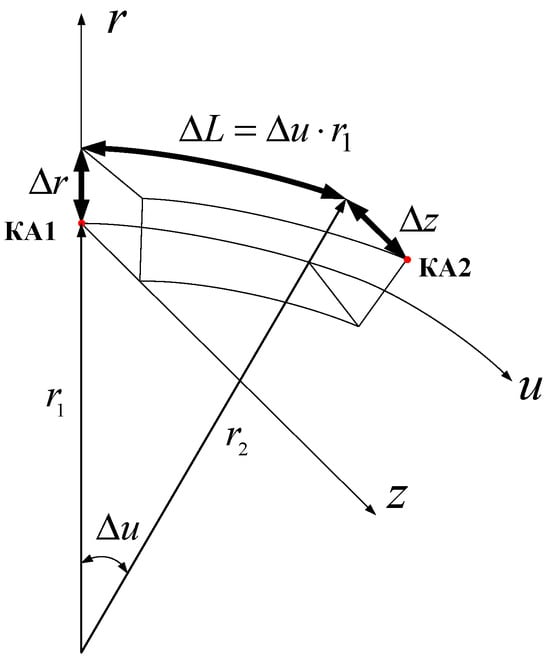
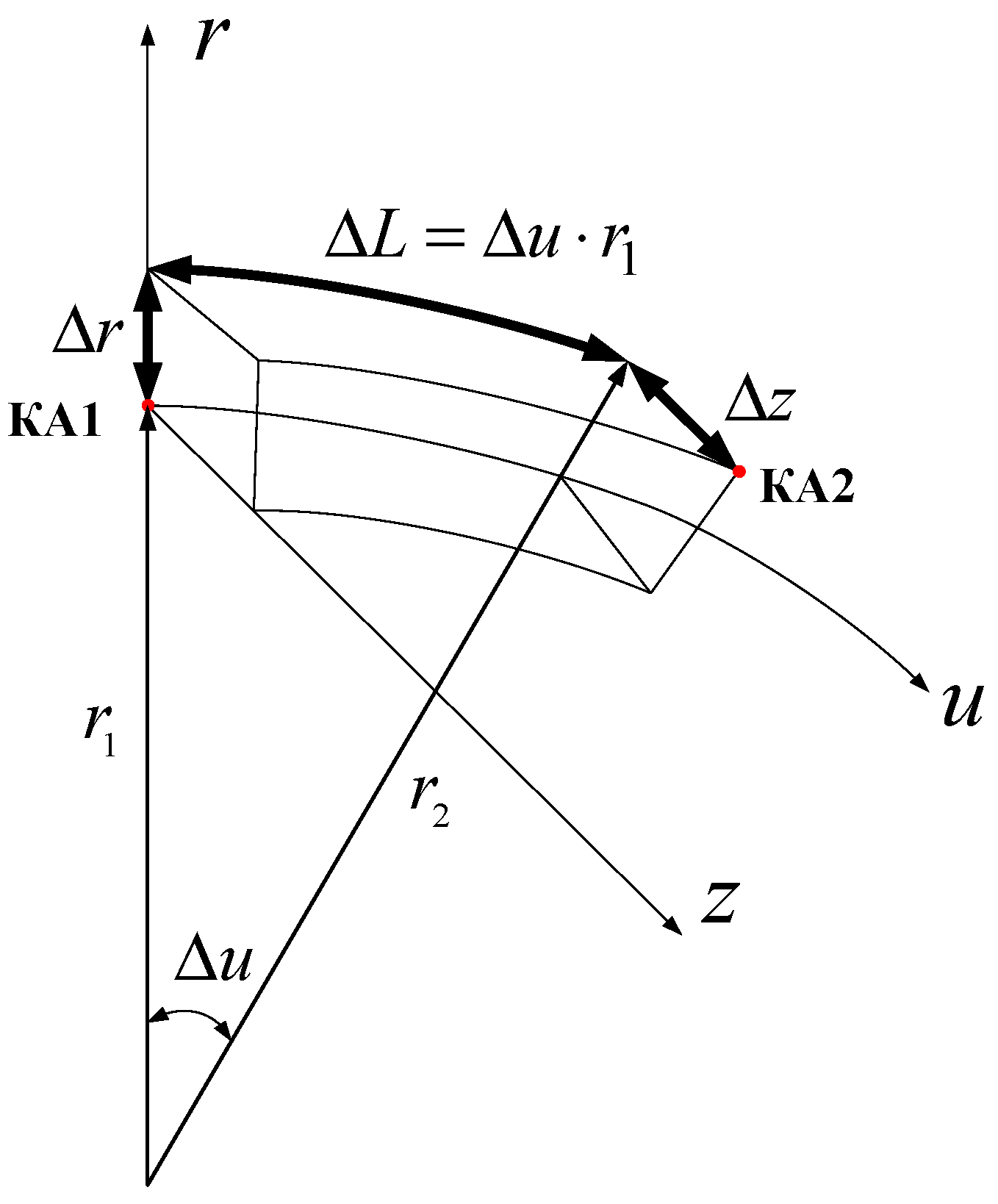
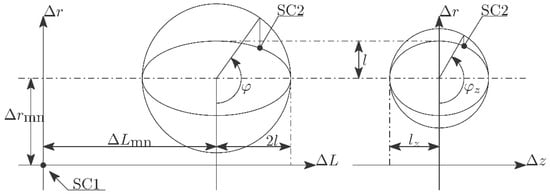
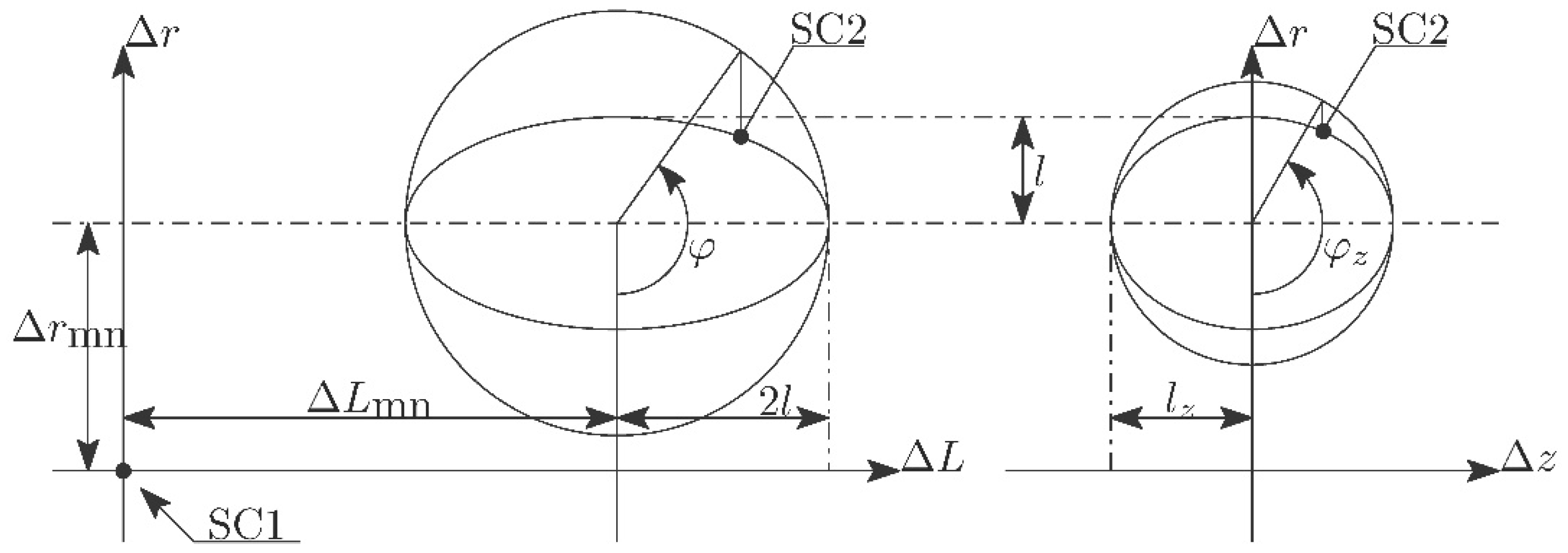
In the longitudinal relative motion, secular and periodic parameters [5,22,23] of the relative motion are distinguished in Figure 1. The following variables are introduced [24] and illustrated in Figure 2:
where secular longitudinal parameters of relative motion are as follows: means radial offset; means orbital offset; is amplitude of longitudinal oscillations. Secular parameter of lateral motion: is amplitude of lateral oscillations; and are oscillation phases—periodic longitudinal and lateral parameters, respectively. The amplitude of longitudinal oscillations is also known as the “semi-minor axis of the relative motion ellipse” [21].
Figure 1.
A schematic of the cylindrical coordinate system.
Figure 2.
Parameters of relative motion between SC1 and SC2.
The differential equations for the variables in Equation (3) are expressed as follows:
Analysis of Equation (4) shows that for small and , a numerical singularity arises in the equations for and due to division by a small parameter. To avoid these difficulties, new variables are introduced:
And the final system of relative motion equations, free from numerical singularities, is obtained as follows:
Considering that the control scenario and assuming no constraints on the thrust vector orientation, in this case, the expression for the thrust vector is given as follows:
where α is the angle between the thrust vector and the transverse direction; β is the angle between the thrust vector and the orbital plane; a is the thrust acceleration of SC2.
Equation (6) is written in dimensionless form as follows:
where is the thrust switch function, which determines the optimal thrust magnitude.
The transformation from dimensional to dimensionless variables is performed using the following formulas , where is the state vector.
The dimensionless system of Equation (8) is independent of the orbital altitude of SC1 and the magnitude of the thrust acceleration of SC2. Hereafter, the overbar symbol “–” is omitted.
3. Formulation of Optimal Control of Relative Motion
Optimal control of relative motion is constructed without constraints on the control inputs. The problem is formulated as determining the optimal control programs and that satisfy the following boundary conditions:
Generally, the optimal control problem is to minimize the total rendezvous time (the time-optimal problem), or to minimize the motor operating time during rendezvous (the motor-time-optimal problem) through minimizing the following performance index:
- (1)
- For the time-optimal problem:
- (2)
- For the motor-time-optimal problem:
To provide a more detailed description of relative motion, it’s necessary to incorporate a formula describing the motor time into system (8):
In accordance with the general algorithm of Pontryagin’s maximum principle [25], the Hamiltonian of the system (8) is written as follows:
where are the vector of conjugate variables, whose equations are given by:
This system (14) admits an analytical solution:
The optimal control program for and is determined from the Hamiltonian maximization condition [26]:
where For the time-optimal problem, the thrust switching function of the propulsion system is identically equal to unity; for the minimum motor-time problem, it takes the following form:
where , for the time-optimal problem .
The second derivatives of the Hamiltonian (13) with respect to control program in Equations (16) and (17) are equal to:
According to theory, if ac − b2 > 0 and a < 0, then the Hamiltonian (13) function reaches its maximum control value at any given moment. In the case under consideration, terms a and c can only take negative values, while their product is only positive; therefore, control (16) and (17) deliver the maximum Hamiltonian (13) at any given moment.
In the time-optimal problem, the application of Pontryagin’s maximum principle reduces the variational problem to a two-point boundary value problem for the system of differential Equation (8), supplemented by equations for the conjugate variables (14) and the thrust direction (16) and magnitude (17), which boils down to selecting a vector of conjugate variables at the initial time and unknown final time that satisfy the boundary conditions of the flight and the condition H = 0.
In the motor-time-optimal problem, due to the discontinuity inherent in bang–bang control, a direct solution of the two-point boundary value problem (TPBVP) often fails to converge. Therefore, a homotopy method is employed to smooth the thrust switching function. The modified performance index then becomes:
The corresponding thrust switching function is given by:
where .
By introducing the homotopy parameter , the originally discontinuous thrust switching function is smoothed. The solution of the time-optimal problem is used as the initial guess, and is gradually decreased. When , the obtained solution can be considered as the solution to the motor-time-optimal problem.
4. Numerical Solutions to Optimal Control Problems
When solving boundary value problems, the primary challenge is the difficulty in guessing appropriate initial values conjugate variables , which often leads to poor convergence of numerical solutions. Commonly used methods include collocation, shooting, and least-squares techniques [26,27]. The shooting method can rapidly converge to a neighborhood of the solution, but its convergence rate slows significantly with each subsequent iteration. By combining the shooting method with a gradient-based optimization approach, the final solution can be obtained by descending along the fastest descent direction. To this end, the following discrepancy function is constructed:
For the time-optimal problem, the optimal control can be obtained by minimizing the discrepancy function F. For the motor-time-optimal problem, the optimal control can be obtained by the aforementioned homotopy method.
A series of typical boundary value problems were solved, and the optimal control was determined for the three typical boundary conditions presented in Table 1:
Table 1.
Typical initial boundary conditions for orbital rendezvous.
- Dominance of the requirement for the correction of periodic motion (Initial conditions 1);
- Dominance of the requirement for the correction of lateral motion (Initial conditions 2);
- Dominance of the requirement for the correction of longitudinal motion (Initial conditions 3).
For all three options, the final conditions of movement are zero and all parameters in Table 1 are dimensionless.
4.1. Numerical Solutions to the Time-Optimal Control Problems
Table 2 presents the results of solving the time-optimal control problems for the typical boundary conditions using shooting method.
Table 2.
The results of the time-optimal control problem solutions.
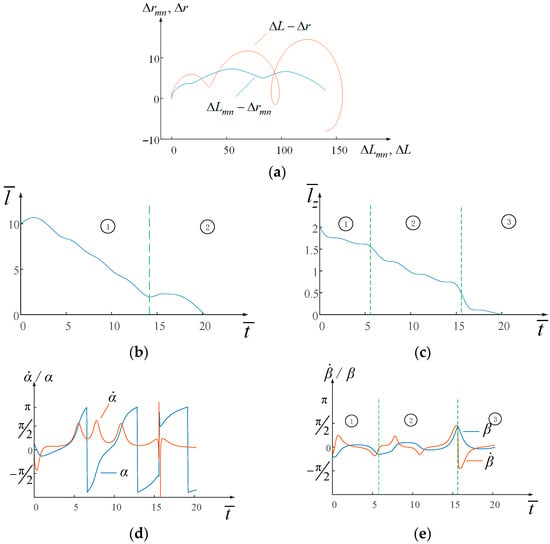
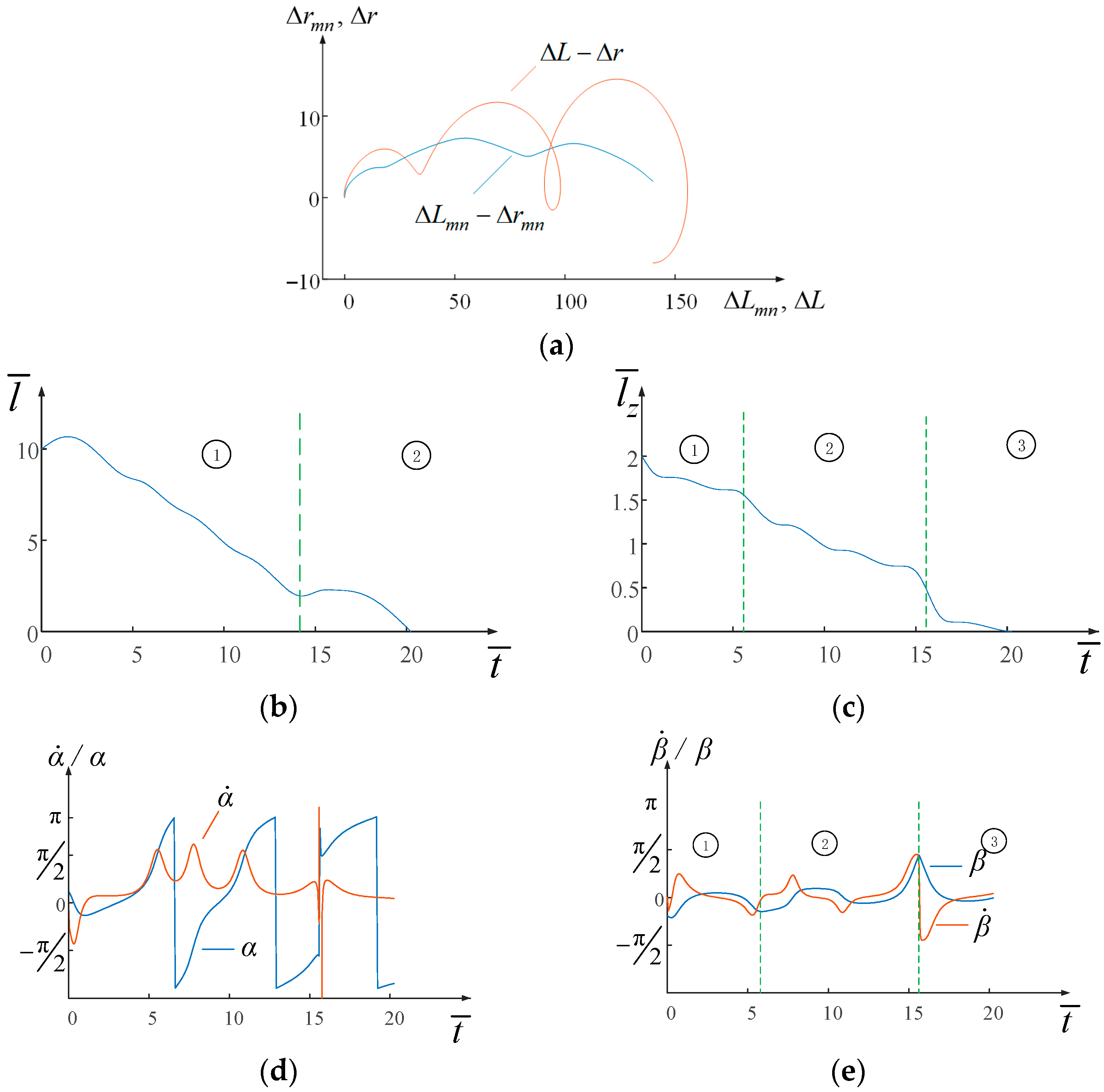
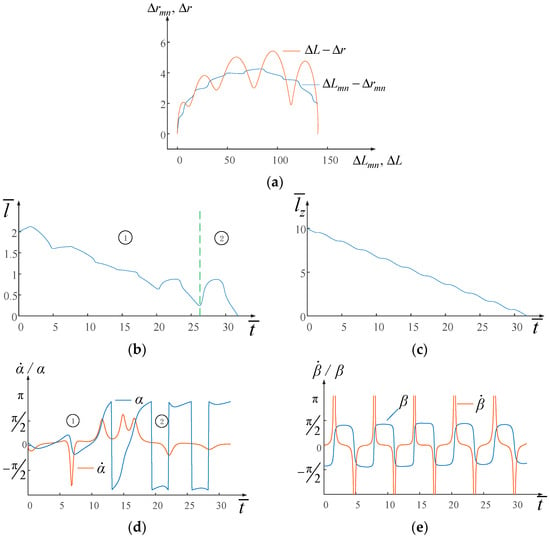
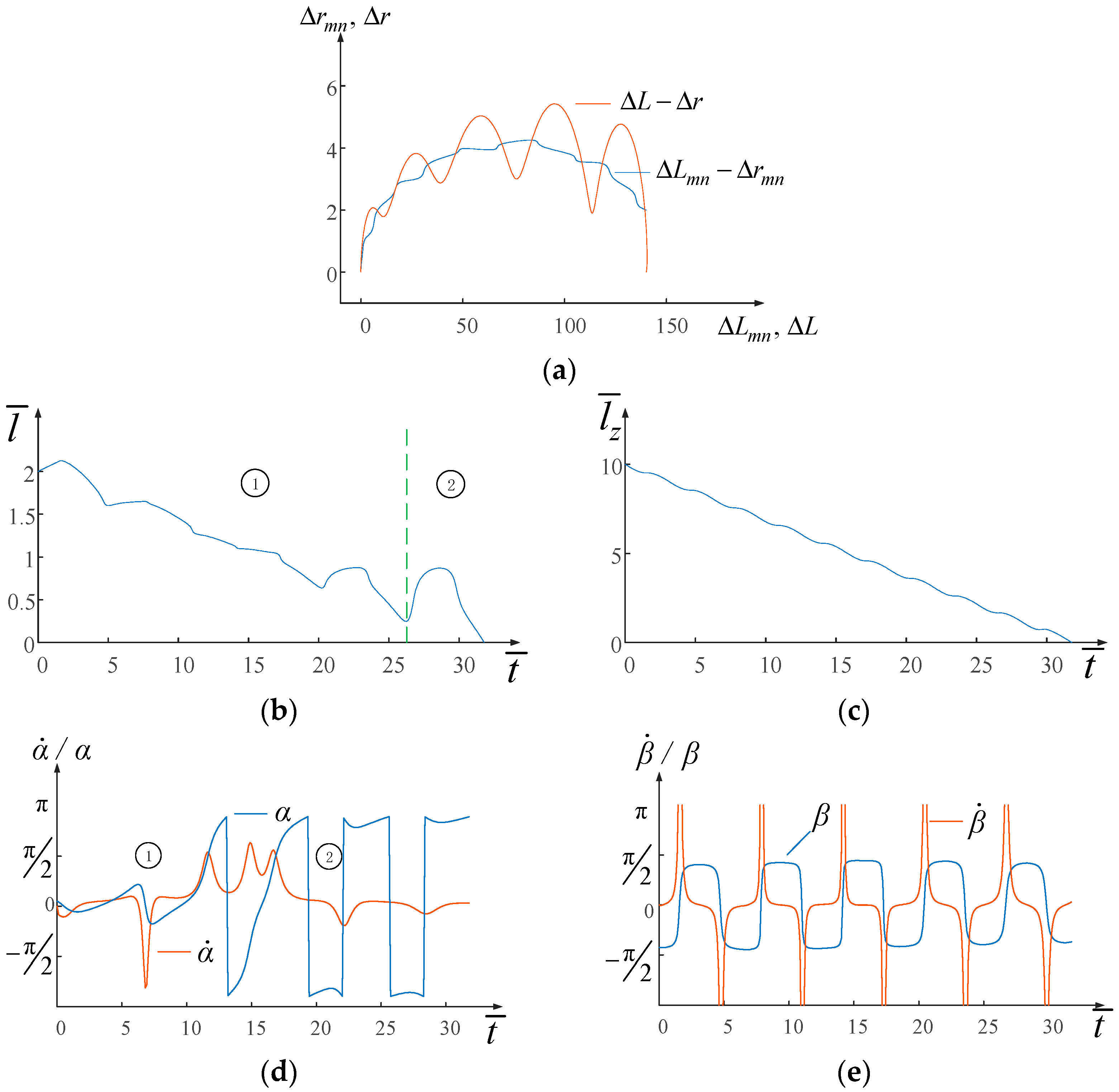
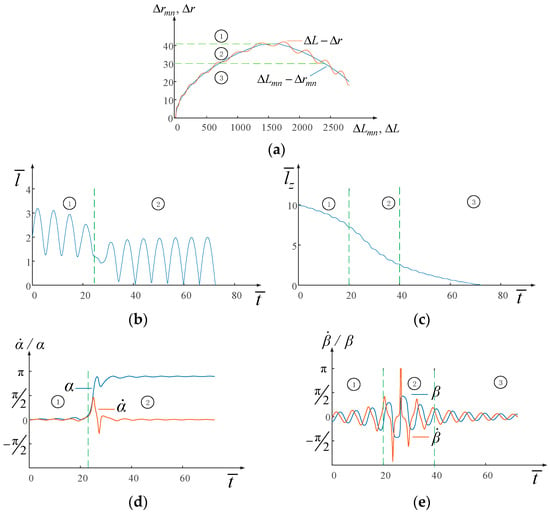
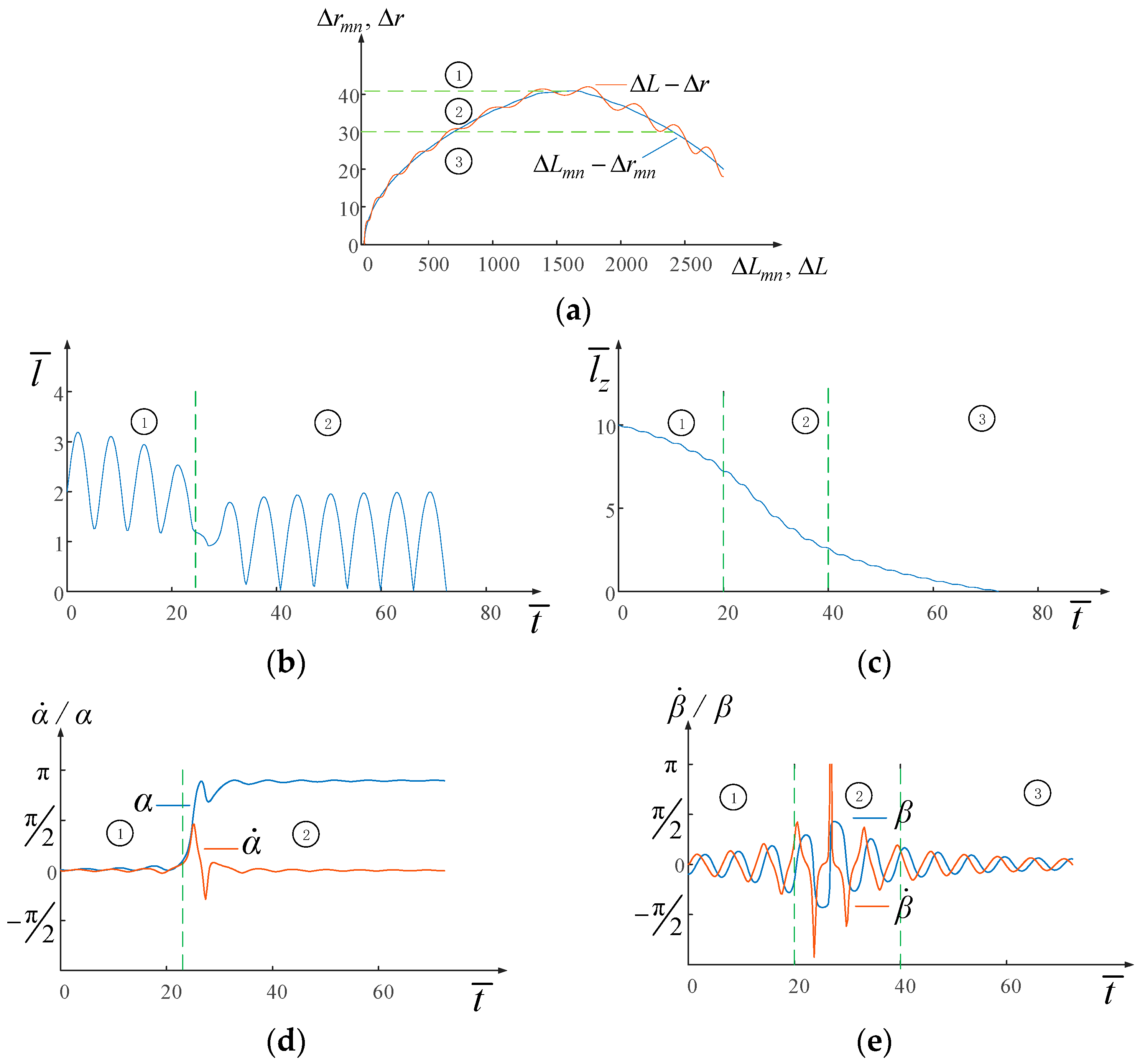
Figure 3, Figure 4 and Figure 5 show the trajectories and control profiles in the time-optimal control problems for the boundary conditions given in Table 1. The figures display the optimal trajectory in the coordinates, the time histories of the amplitudes of longitudinal and lateral oscillations, and the time dependence of the optimal control inputs along with their time derivatives.
Figure 3.
Example of trajectory in coordinates for initial conditions 1 in Table 1 (dominance of the requirement for correction of periodic motion). (a) The trajectory of the longitudinal motion; (b) dependence of the minor axis of the ellipse od relative motion on time; (c) dependence of the amplitude of lateral oscillations on time; (d) dependence of the thrust deflection angle on the transverse direction in the orbital plane and its derivative on time; (e) dependence of the thrust deflection angle on the orbital plane β and its derivative on time.
Figure 4.
Example of trajectory in coordinates for initial conditions 2 in Table 1 (dominance of the requirement for correction of periodic motion). (a) The trajectory of the longitudinal motion; (b) dependence of the minor axis of the ellipse od relative motion on time; (c) dependence of the amplitude of lateral oscillations on time; (d) dependence of the thrust deflection angle on the transverse direction in the orbital plane and its derivative on time; (e) dependence of the thrust deflection angle on the orbital plane β and its derivative on time.
Figure 5.
Example of trajectory in coordinates for initial conditions 3 in Table 1 (dominance of the requirement for correction of periodic motion). (a) The trajectory of the longitudinal motion; (b) dependence of the minor axis of the ellipse od relative motion on time; (c) dependence of the amplitude of lateral oscillations on time; (d) dependence of the thrust deflection angle on the transverse direction in the orbital plane α and its derivative on time; (e) dependence of the thrust deflection angle on the orbital plane β and its derivative on time.
As can be seen from Figure 3, the optimal program for the angle of deviation of the thrust vector from the radius vector (angle α) on the turn varies from minus 180 to plus 180 degrees. Such control is characteristic of the correction of the minor axis of the ellipse relative to the movement, which decreases monotonically over practically the entire time interval. Violation of this principle occurs at times greater than 15 radians, where simultaneous ‘fitting’ of periodic and secular motion takes place. The greatest decrease in the amplitude of lateral oscillations occurs when the maneuvering spacecraft passes the apogee of the orbit at equal to 120, 70 and 20, which corresponds to a time of 5, 10 and 15 radians, at these same moments in time, the angle of deviation of the thrust vector from the orbital plane (angle β) reaches its maximum values in magnitude. At these same moments in time, ‘jerks’ in the reduction in the amplitude of lateral oscillations are observed. Of interest is the break in the derivative of angle α at the moment of time 15 radians. It is caused by the switching of the mode of the specified angle from correction of periodic motion to correction of secular motion. At the moment of time 15 radians, the rate of change in angle β is large but finite.
As can be seen from Figure 4, the optimal program for the angle of deviation of the thrust vector from the radius vector (angle α) has two characteristic regions. The first is located in the dimensionless time interval 0–12 radians (or from 140 to 120) and 20–31.7952 radians (or from 40 to 0), and the second is located in the time interval 12–20 radians. In the first region, the angle of deviation of the thrust from the radius vector is initially close to 0 degrees, then to 180 degrees. In the second region, it varies from minus to plus 180 degrees. This control structure is characteristic of a comparable change in the minor axis of the ellipse relative to the motion and the orbital motion. In the first region, the change in the orbital components of the motion is close to monotonic, while the change in the minor axis of the ellipse relative to the motion is oscillatory. In the second region, the change in the orbital motion is oscillatory, and the change in the minor axis of the relative motion is monotonic. Throughout the maneuver, the angle of deviation of the thrust vector from the orbital plane β fluctuates between amplitude values from minus to plus 90 degrees, and the nature of the change in the amplitude of lateral oscillations is monotonous, unlike the previously considered case, close to uniform, without ‘jerks’ when the maneuvering spacecraft passes the apogee of the orbit. The discontinuity of the derivative of angle α at time 6 radians is due to the switching of angle α mode from correction of secular motion to correction of periodic motion. It is important to note the discontinuities of the derivative of angle β.
As can be seen from Figure 5, angle α contains two characteristic regions. The first is in the dimensionless time interval from 0 to 25, where angle α is close to 0 degrees. The second region is in the dimensionless time interval from 25 to 71.3974, where the angle α is close to 180 degrees. This type of control is characteristic of the dominance of the requirement for the correction of the secular motion. In these regions, the change in the minor axis of the ellipse relative to the motion is oscillatory, while the change in the secular motion is monotonic. The amplitude of lateral oscillations decreases to a given value almost monotonically, with the fastest change occurring in the dimensionless time interval from 20 to 40, when the angle β reaches its maximum values. At the same time, the dimensionless quantity changes from 30 to 42, where the greatest distance of KA2 from the center of the Earth is passed, and KA2 has the minimum speed, respectively. The change in angle β over time is similar to the case of initial conditions 2 (dominance of the requirement for lateral motion correction) but differs in that here, the angle β does not reach amplitude values.
Based on the calculation results, it can be concluded that it is advisable to introduce passive sections on the trajectory at the following moments in time:
- When switching the angle α deviation mode from correction of secular motion to correction of periodic motion;
- At the moments of switching the angle β between amplitude values with a comparable or dominant requirement for lateral motion correction relative to other boundary conditions;
- The introduction of passive sections at the specified moments will reduce the requirements for the spacecraft’s turning speed to orient the thrust in the required direction and will allow for the use of simpler angular motion control equipment for the spacecraft in question.
4.2. Numerical Solutions to the Motor-Time-Optimal Control Problems
The optimal trajectories are calculated based on the criterion of minimum motor time on the linear model (8) with a fixed terminal flight time and initial conditions shown in Table 1 in dimensionless form.
As shown in Table 3, compared to the results of the time-optimal control problem, adding a passive section can reduce the motor flight time for any typical boundary conditions.
Table 3.
The results of the motor-time-optimal control problem solutions.
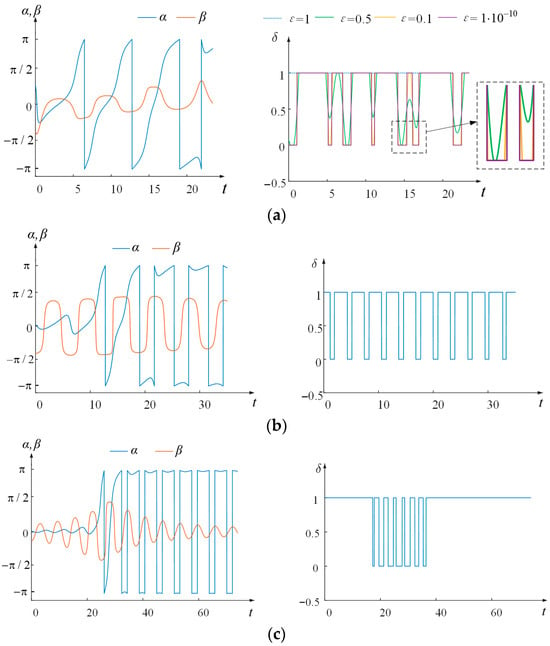
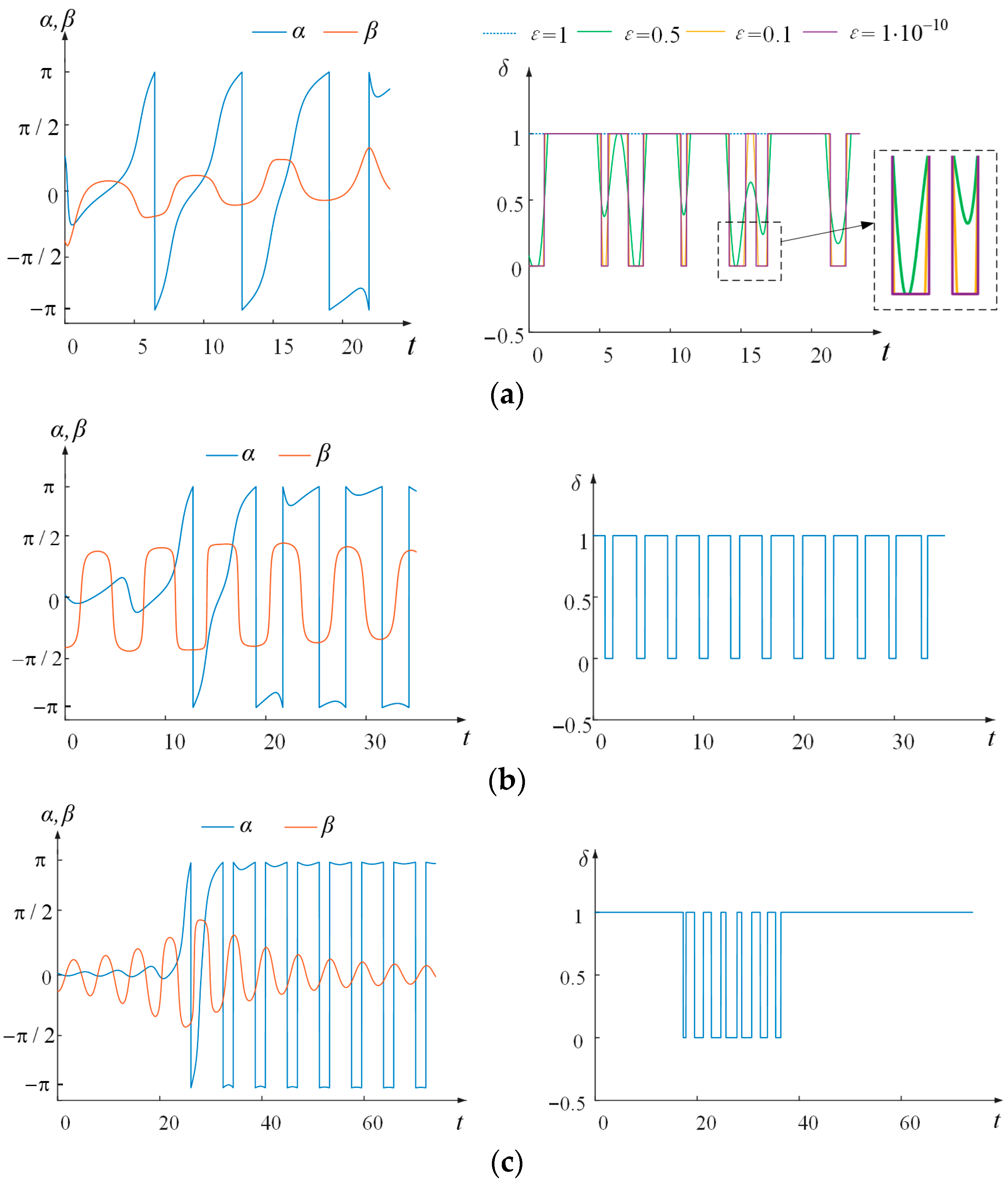
Figure 6 shows the results of the solution using the homotopy method. The optimal controls for initial conditions 1–3 are shown in Figure 6a–c. An illustration of the application of the homotopy method is shown in Figure 6a.
Figure 6.
Optimal control and illustration of the application of the homotopy method for the following: (a) Initial conditions 1 (dominance of the requirement for correction of the minor axis of the ellipse); (b) initial conditions 2 (dominance of the requirement for lateral movement correction); (c) initial conditions 3 (dominance of the requirement for correction of secular motion).
Figure 6a shows that as the homotopy parameter decreases from 1 to 10−10, the switching function gradually approaches the standard thrust switching function with the form [0, 1], i.e., the thrust switching function gradually transitions from a smooth linear function to a nonlinear discrete function. Numerical calculations show that the homotopy method has good convergence in the minimum motor time criterion, which lays the foundation for further research. The addition of a passive section mainly affects the control structure of the angle β.
5. Conclusions
This paper investigates the optimal control problem for spacecraft relative motion with low-thrust propulsion. By applying Pontryagin’s maximum principle, the optimal control problem is transformered into a two-point boundary value problem. Optimal control schemes are derived for both time-minimization and motor-time-minimization control objectives. The motion trajectories are calculated for different types of boundary conditions: dominance of secular motion, dominance of periodic motion in the plane of the orbit or in the lateral plane. The results show that the type of boundary conditions has a significant effect on the nature of optimal control. Taking the solution to the time-optimal control problem as an initial guess, the trajectory is subsequently optimized through iterative adjustments, which progressively converge towards the motor-time-optimal control problem until the target optimal control is attained. Notably, this computational approach to optimal control exhibits an exceptionally high success rate and rapid convergence speed, thus providing a valuable solution for tasks involving similar orbital rendezvous challenges.
Author Contributions
Conceptualization, X.Z.; Methodology, X.Z., H.D. and Y.L.; Software, H.D. and Y.L.; Investigation, X.Z. and H.D.; Resources, X.Z., H.D. and Y.G.; Data curation, Y.G. All authors have read and agreed to the published version of the manuscript.
Funding
This research was funded by National Natural Science Foundation of China, grant number 62572044. And The APC was funded by National Natural Science Foundation of China.
Data Availability Statement
The original contributions presented in this study are included in the article. Further inquiries can be directed to the corresponding author.
Conflicts of Interest
The authors declare no conflict of interest.
References
- Dzesov, R.A.; Zhukov, V.N.; Melnikov, E.K.; Pavlov, V.P. Ballistic analysis of fast scheme for rendezvous between transport vehicles and the international space station. Aerosp. MAI J. 2014, 21, 73–79. [Google Scholar]
- Ma, H.; Xu, S. Global optimization of fuel consumption in rendezvous scenarios by the method of interval analysis. Adv. Space Res. 2015, 55, 1687–1704. [Google Scholar] [CrossRef] [Scilit]
- Li, J. Revisiting the fuel-optimal four-impulse rendezvous problem near circular orbits. Adv. Space Res. 2017, 60, 2181–2194. [Google Scholar] [CrossRef] [Scilit]
- Krasil’shchikov, M.N.; Malyshev, V.V.; Fedorov, A.V. Autonomous implementation of dynamic operations in a geostationary orbit. I. Formalization of control problem. J. Comput. Syst. Sci. Int. 2015, 54, 916–930. [Google Scholar] [CrossRef] [Scilit]
- Voiskovskii, A.P.; Krasil’shchikov, M.N.; Malyshev, V.V.; Fedorov, A.V. Autonomous implementation of dynamic operations in a geostationary orbit. II. Synthesis of control algorithms. J. Comput. Syst. Sci. Int. 2016, 55, 948–968. [Google Scholar] [CrossRef] [Scilit]
- Zhou, B.; Lin, Z.; Duan, G.R. Lyapunov Differential Equation Approach to Elliptical Orbital Rendezvous with Constrained Controls. J. Guid. Control Anddynamics 2011, 34, 345–358. [Google Scholar] [CrossRef] [Scilit]
- Breger, L.; How, J.P. Safe Trajectories for Autonomous Rendezvous of Spacecraft. J. Guid. Control Dyn. 2008, 31, 1478–1489. [Google Scholar] [CrossRef] [Scilit]
- Wang, H.; Tang, G.; Lei, Y. The framework of distributed interactive simulation for space projects. AIAA Model. Simul. Technol. Conf. Exhib. 2003, 5608, 375–380. [Google Scholar]
- Ulybyshev Yu, P. Optimisation of multi-mode rendezvous trajectories with constraints. Space Res. 2008, 46, 135–147. [Google Scholar]
- Wall, B.J.; Conway, B.A. Shape-Based Approach to Low-Thrust Rendezvous Trajectory Design. J. Guid. Control. Dyn. 2009, 32, 95–101. [Google Scholar] [CrossRef] [Scilit]
- Salmin, V.V. Optimisation of Low-Thrust Space Flights: Problems of Joint Control of Trajectory and Angular Engines; Mashinostroenie: Moscow, Russia, 1987; 208p. [Google Scholar]
- Salmin, V.V.; Chetverikov, A.S. Control of flat parameters of the orbit of a geostationary spacecraft using a low-thrust engine. Bulletin of Samara University. Aerosp. Eng. Technol. Mach. Build. 2015, 14, 92–101. [Google Scholar]
- Bellman, R. Dynamic Programming; Bellman, R., Translator; Foreign Literature Publishing House: Moscow, Russia, 1960; 400p. [Google Scholar]
- Baranov, A.A.; Roldugin, D.S. Six-pulse manoeuvres for rendezvous of spacecraft in near-circular non-coplanar orbits. Space Res. 2012, 50, 472–480. [Google Scholar]
- Baranov, A.A. Maneuvering in the Vicinity of a Circular Orbit; Sputnik Publishing House: Moscow, Russia, 2016; 512p. [Google Scholar]
- Baranov, A.A.; Terekhova, E.O. Optimal four-impulse rendezvous in coplanar near-circular orbits. Space Res. 1995, 33, 420–425. [Google Scholar]
- Li, J.; Baoyin, H.; Jiang, F. Dynam Ics and Control of Interplanetary Flight; Tsinghua University Press: Beijing, China, 2014. [Google Scholar]
- Li, J.; Jiang, F. Survey of low-thrust trajectory optimization methods for deep space exploration. Mech. Eng. 2011, 33, 1–6. [Google Scholar]
- Hargraves, C.R.; Paris, S.W. Direct trajectory optimization using nonlinear programming and collocation. J. Guid. Control Dyn. 1987, 10, 338–342. [Google Scholar] [CrossRef] [Scilit]
- Greenwood, D.T.; Kern, E.A. Minimum-fuelthrust limited transfer trajectories between coplanar elliptic orbits. AIAA J. 1970, 8, 1772–1779. [Google Scholar]
- Miele, A.; Weeks, M.W.; Ciarcia, M. Optimal Trajectories for Spacecraft Rendezvous. J. Optim. Theory Appl. 2007, 132, 353–376. [Google Scholar] [CrossRef] [Scilit]
- Konstantinov, M.S.; Kamenkov, E.F.; Perelygin, B.P.; Bezverbyi, V.K. Mekhanika Kosmicheskogo Poleta (Mechanics of Space Flight); Mashinostroenie: Moscow, Russia, 1989; 408p. [Google Scholar]
- Appazov, R.F.; Sytin, O.G. Metody Proektirovaniya Traektorii Nositelei i Sputnikov Zemli (Methods of Designing Trajectories of Carriers and Earth Satellites); Nauka: Moscow, Russia, 1987; 440p.
- El’yasberg, P.E. Introduction to the Theory of Flight of Artificial Earth Satellites; Nauka: Moscow, Russia, 1965; 540p.
- Levskii, M.V. Pontryagin’s maximum principle in optimal control problems of orientation of a spacecraft. J. Comput. Syst. Sci. Int. 2008, 47, 974–986. [Google Scholar] [CrossRef] [Scilit]
- Filatyev, A.S.; Petukhov, V.G. Through Optimization of Aerospace Vehicle Trajectories by the Pontryagin Maximum Principle; Springer Nature: Berlin/Heidelberg, Germany, 2025. [Google Scholar]
- Fabris, M.; Cenedese, A.; Hauser, J. Optimal Time-Invariant Formation Tracking for a Second-Order Multi-Agent System. In Proceedings of the 2019 18th European Control Conference (ECC), Naples, Italy, 25–28 June 2019; pp. 1556–1561. [Google Scholar] [CrossRef] [Scilit]

Disclaimer/Publisher’s Note: The statements, opinions and data contained in all publications are solely those of the individual author(s) and contributor(s) and not of MDPI and/or the editor(s). MDPI and/or the editor(s) disclaim responsibility for any injury to people or property resulting from any ideas, methods, instructions or products referred to in the content. |
© 2026 by the authors. Licensee MDPI, Basel, Switzerland. This article is an open access article distributed under the terms and conditions of the Creative Commons Attribution (CC BY) license.