Article

Electromagnetic Sources Teleparallel Robertson–Walker F(T)-Gravity Solutions

Department of Mathematics and Statistics, Dalhousie University, Halifax, NS B3H 3J5, Canada
Mathematics 2026, 14(1), 48; https://doi.org/10.3390/math14010048
Submission received: 25 November 2025 / Revised: 16 December 2025 / Accepted: 20 December 2025 / Published: 23 December 2025
(This article belongs to the Special Issue Applied Mathematics in Astrophysics and Space Science)

Abstract

We investigate the teleparallel Robertson–Walker (TRW) F ( T ) -gravity solutions for a cosmological electromagnetic source in the current paper. We use and solve the TRW F ( T ) -gravity field equations (FEs) for each value of the k-parameter ( 1 , 0 , + 1 ) and the electromagnetic equivalent of the equation of state (EoS), leading to new teleparallel F ( T ) solutions. For the k = 0 cosmological case, we find new teleparallel F ( T ) solutions for any scale factor n. For k = ± 1 cosmological cases, we find exact and far-future approximated new teleparallel F ( T ) solutions for slow, linear, fast and infinitely fast universe expansion summarized by analytical functions. All the new solutions are relevant for future cosmological applications, implying any electromagnetic source processes, such as the cosmological plasma models.

1. Introduction

The teleparallel F ( T ) -gravity is a frame-based alternative theory to general relativity (GR) defined in terms of a coframe/spin-connection pair ( h a ω b c a pair) [1,2,3,4,5,6,7]. The two last quantities define the torsion tensor T b c a and torsion scalar T. We remind you that GR is defined by the metric g μ ν and the spacetime curvatures R b μ ν a , R μ ν , and R. We can determine the symmetries for any independent h a ω b c a pairs, and then spacetime curvature and torsion are defined as geometric objects [4,5,6,7,8,9]. Any geometry described by such a pair is a null curvature and non-metricity ( R b μ ν a = 0 and Q a μ ν = 0 conditions), and is considered as a teleparallel gauge-invariant geometry (for any gauge metric g a b ). The fundamental pairs will satisfy two Lie derivative-based relations, and by using the Cartan–Karlhede algorithm, we can solve the two fundamental equations for any teleparallel geometry. For a pure teleparallel F ( T ) -gravity solution, we solve the R b μ ν a = 0 condition and find a Lorentz transformation-based definition of ω b μ a . There is a direct equivalent to GR in teleparallel gravity: the teleparallel equivalent to GR (TEGR) generalizing to the teleparallel F ( T ) -gravity [7,9,10,11,12]. All the previous considerations are also valid for the new general relativity (NGR) (refs. [13,14,15] and refs. therein), and the symmetric teleparallel F ( Q ) gravity (refs. [16,17,18,19] and refs. therein) and other theories like F ( T , Q ) -type, F ( R , Q ) -type, F ( R , T ) -type, and other ones (refs. [20,21,22,23,24,25,26,27,28,29] and refs. therein). Therefore, the current study will be restricted to the pure teleparallel F ( T ) -gravity framework.
There are a huge amount of papers on spherically symmetric teleparallel F ( T ) -gravity solutions using a number of approaches, energy–momentum sources, and proceeding by various purposes [30,31,32,33,34,35,36,37,38,39,40,41,42,43,44,45,46,47,48,49,50,51,52,53,54,55,56]. There is a special class of teleparallel spacetime in which the field equations (FEs) are purely symmetric: the teleparallel Robertson–Walker (TRW) spacetime [55,56,57,58]. The TRW spacetime is defined in terms of the cosmological k-parameter, where k = 0 is a flat spacetime and k = ± 1 are, respectively, positive and negative space curvature [59,60,61,62]. A TRW geometry is described by a G 6 Lie algebra group, where the 4th to 6th Killing Vectors (KVs) are specific to this spacetime [56,57]. The main consequence of additional KVs is the trivial antisymmetric parts of FEs. The TRW spacetime structure is also defined for a teleparallel F ( T , B ) gravity extension [63,64,65,66,67]. We found teleparallel F ( T ) and F ( T , B ) solutions for perfect fluid (PF) and scalar field (SF) sources. The SF-based teleparallel F ( T ) and F ( T , B ) solutions are scalar potential independent and only SF dependent [55,63]. There are non-linear fluid teleparallel F ( T ) solutions for polytropic and Chaplygin fluids leading to similar results [58]. But there are further possible sources of energy–momentum which might lead to new teleparallel solutions in F ( T ) -type and some extensions. We can also add recent papers on static radial-dependent, time-dependent, and cosmological teleparallel F ( T ) and F ( T , B ) type solutions suitable for universe and astrophysical models [48,49,50,51,52,55,56,63].
However, for electromagnetic teleparallel solutions, there are a limited number of recent contributions. There are some interesting papers on magnetic teleparallel BH solutions, especially from G.G.L. Nashed [68,69,70,71,72,73]. These papers focus essentially on typical BH solutions and usual electromagnetic situations by solving in TEGR and some preliminary cases of teleparallel gravity at the astrophysical scale. Therefore, there are no really direct papers using the TRW-based frame approach leading to electromagnetic-based cosmological teleparallel solutions using the coframe/spin-connection pair approach. This last missing piece is the key point justifying new development in this way in cosmological teleparallel F ( T ) -type gravity. By this, we mean we will become able to study cosmological systems with electromagnetism in the teleparallel gravity framework and apply new solutions to some concrete physical problems.
Ultimately we want to study in detail the electromagnetic TRW cosmological solutions with the physical impacts. Therefore, at the current stage, we need to find the possible electromagnetic source-based teleparallel F ( T ) -gravity solutions in a Robertson–Walker spacetime (TRW). We had found the TRW geometry and solved the TRW FEs and conservation laws (CL) for PF and SF solutions in teleparallel F ( T ) and F ( T , B ) gravities [55,56,57,58,63]. But we can do further and aim to solve for electromagnetic teleparallel F ( T ) solutions as the most suitable next step of development. We ultimately want to study the impacts of electromagnetic sources in the universe on its evolution and determine the contributions of electromagnetic sources to the universe’s expansion for flat and non-flat scenarios. For example, we will also study a special case of cosmological plasma-based electric field source. We will use the same TRW geometry and FEs as defined in Section 2.1 and Section 2.2, adapt the CLs for electromagnetic field (EMF) in Section 2.3, and then find the new teleparallel F ( T ) solutions and graphical comparisons in Section 3. We will then discuss the impacts of new teleparallel solutions in terms of electromagnetic fields in Section 4.1, and then make guidelines for experimental data-based comparison studies in Section 4.2 before concluding in Section 5.

2. Summary of Teleparallel Gravity and Field Equations

2.1. Teleparallel F ( T ) -Gravity Theory Field Equations and Torsional Quantities

The teleparallel F ( T ) -gravity action integral with gravitational sources is written as follows [2,3,5,7,47,48,49,50,51,52,55,58]:
S F ( T ) = d 4 x h 2 κ F ( T ) + L S o u r c e ,
where h is the coframe determinant, κ is the coupling constant, and L S o u r c e is the gravitational source terms. The first term of Equation (1) containing the F ( T ) function determines the exact spacetime geometry structure type of the physical system where a gravitational source is located and evolving. We will apply the least-action principle on Equation (1) to find the symmetric and antisymmetric parts of FEs as follows [47,48,49,50,51,52,55,58]:
κ Θ a b = F T T G a b + F T T T S a b μ μ T + g a b 2 F T T F T T ,
0 = F T T T S a b μ μ T ,
with G a b as the Einstein tensor, Θ a b the energy–momentum, g a b the gauge metric and κ the coupling constant. The torsion tensor T μ ν a , the torsion scalar T and the super-potential S a μ ν are defined as follows [5]:
T μ ν a = μ h ν a ν h μ a + ω b μ a h ν b ω b ν a h μ b ,
S a μ ν = 1 2 T a μ ν + T a ν μ T a μ ν h a ν T λ λ μ + h a μ T λ λ ν ,
T = 1 2 T μ ν a S a μ ν .
Equation (4) can be expressed in terms of the three irreducible parts of torsion tensor as follows:
T a b c = 2 3 t a b c t a c b 1 3 g a b V c g a c V b + ϵ a b c d A d
where,
V a = T b a b , A a = 1 6 ϵ a b c d T b c d , t a b c = 1 2 T a b c + T b a c 1 6 g c a V b + g c b V a + 1 3 g a b V c .
We usually solve for teleparallel F ( T ) -gravity in Equations (2) and (3). Therefore, in refs. [55,56,57], we showed that Equation (3) is trivially satisfied despite a non-zero spin-connection, because the teleparallel geometry is purely symmetric. Only Equation (2) is non-trivial and will be explicitly solved in details.

2.2. Teleparallel Robertson–Walker Spacetime Geometry

Any frame-based geometry in teleparallel gravity on a frame bundle is defined by a h a ω b c a pair and a field X , and then must satisfy the Lie Derivative-based equations [5,6,55,56,57,58]:
L X h a = λ a b h b   a n d   L X ω b c a = 0 ,
where ω b c a is defined in terms of the differential coframe h a and λ a b is the linear isotropy group component. For the teleparallel F ( T ) -gravity case, we must satisfy the R a b c a = 0 condition. For TRW spacetime geometries on an orthonormal frame, the h a ω b c a pair solutions are as follows [55,56,57,58]:
h μ a = D i a g 1 , a ( t ) 1 k r 2 1 / 2 , a ( t ) r , a ( t ) r sin θ , ω 122 = ω 133 = ω 144 = W 1 ( t ) , ω 234 = ω 243 = ω 342 = W 2 ( t ) ,
ω 233 = ω 244 = 1 k r 2 a ( t ) r , ω 344 = cot ( θ ) a ( t ) r ,
where W 1 and W 2 are defined in terms of k-parameters:
1.
k = 0 : W 1 = W 2 = 0 ,
2.
k = + 1 : W 1 = 0 and W 2 ( t ) = ± k a ( t ) ,
3.
k = 1 : W 1 ( t ) = ± k a ( t ) and W 2 = 0 .
For any W 1 and W 2 , we will obtain the same symmetric FEs set to solve for each k-parameter subcases. The Equations (10) and (11) were found by solving Equation (9) and the R b μ ν a = 0 condition as defined in ref. [5]. These solutions were used in several TRW spacetime-based works [55,56,57,58,63]. This spacetime structure is still explainable by a G 6 Lie algebra group. From Equations (10) and (11) spin-connection pair and previously defined irreducible torsion tensor parts, we can find that the torsion scalar construction is defined in terms of W 1 and W 2 as follows (see refs. [56,57] for detailed derivations):
T ( t ) = 6 H + W 1 + W 2 H + W 1 W 2 ,
where H = a ˙ a is the Hubble parameter. The torsion scalar T ( t ) and the TRW FEs are defined for each k-parameter cases, leading to new additional teleparallel F ( T ) solutions. The FEs are purely symmetric and valid on proper frames as shown in Equations (2) and (3) and in refs. [55,56,57,58]. The Equation (3) is trivially satisfied, and we will solve Equation (2) for each k-parameter case.

2.3. Einstein–Maxwell Conservation Law Solutions and Energy Conditions

The energy–momentum and the GR CLs are derived from the L S o u r c e term of Equation (1) as follows [3,7]:
Θ a μ = 1 h δ L S o u r c e δ h μ a , ν Θ μ ν = 0 ,
where ν the covariant derivative and Θ μ ν the conserved energy–momentum tensor. The antisymmetric and symmetric parts of Θ a b are written as follows [47,48,49,50,51,52,55]:
Θ [ a b ] = 0 , Θ ( a b ) = T a b ,
where T a b is the symmetric part of Θ μ ν . Equation (13) forces the symmetry of Θ μ ν and then Equation (14) condition. Equation (14) is valid for a matter field interacting with a metric g μ ν defined by the coframe h μ a and the gauge g a b , and is not directly coupled to the F ( T ) -gravity function. This consideration is only valid for the null hypermomentum case (i.e., T μ ν = 0 ) as discussed in refs. [48,49,50,51,52,54,55]. This condition is defined from Equations (2) and (3) as follows [54]:
T a b = κ Θ a b F T T G a b F T T T S a b μ μ T g a b 2 F T T F T T = 0 .
There are more general teleparallel T μ ν definitions and T μ ν 0 CLs, but it does not affect the current teleparallel F ( T ) -gravity situation [54,74,75,76].
For a TRW spacetime geometry defined by Equations (10) and (11), Equation (13) for ρ = ρ e m , P r = P e m r and P t = P e m t fluid equivalent for electromagnetic source is as follows [50,55,56,57]:
ρ ˙ e m + H 3 ρ e m + P e m r + 2 P e m t = 0 , and 2 P e m r P e m t + r r P e m r = 0 .
The Einstein–Maxwell Lagrangian and then the energy–momentum tensor are defined as follows [77,78,79,80]:
L s o u r c e = 1 4 F μ ν F μ ν Θ μ ν = F μ α F ν α 1 4 g μ ν F 2 ,
where F μ ν = μ A ν ν A μ is the electromagnetic tensor defined in terms of quadripotential A μ . In terms of electric E and magnetic B fields, Equation (17) is defined as follows:
Θ μ ν = E 2 + B 2 2 S T S σ i j ,
where S = E × B is the Poynting vector and σ i j = E i E j δ i j 2 E 2 + B i B j δ i j 2 B 2 . The Equation (18) is diagonalizable and can be expressed in terms of density–pressure equivalent expressions. The diagonal form is written as follows:
Θ μ a D i a g ρ e m , P e m r , P e m t , P e m t .
For any EoS and/or equivalent relationship, there are energy conditions (ECs) to satisfy for any physical system based on a PF [81]:
  • Weak Energy Condition (WEC): ρ 0 , P r + ρ 0 and P t + ρ 0 .
  • Strong Energy Condition (SEC): P r + 2 P t + ρ 0 , P r + ρ 0 and P t + ρ 0 .
  • Null Energy Condition (NEC): P r + ρ 0 and P t + ρ 0 .
  • Dominant Energy Condition (DEC): ρ | P r | and ρ | P t | .
By this way, we will verify the physical consistency of all CL solutions found in the current paper.
There are three main cases:
1.
General electromagnetic universe: For any E 0 and B 0 , Equation (18) becomes the following:
Θ μ ν = E 2 + B 2 2 S 1 S 2 S 3 S 1 σ 11 σ 12 σ 13 S 2 σ 12 σ 22 σ 23 S 3 σ 13 σ 23 σ 33 .
By setting E 2 = E 3 = E t and B 2 = B 3 = B t , we find that S 1 = S r = 0 , S 2 = S 3 = S t = 0 leading to E r B t = E t B r for consistency. By using the last constraint and then by diagonalisation, we find that P e m t = P e m r = ρ e m = E 2 2 1 + B r 2 E r 2 and the WEC, SEC, NEC and DEC are all satisfied by the E 2 0 , E r 2 0 and B r 2 0 conditions for any teleparallel F ( T ) solution. Then Equation (16) becomes the following:
ρ ˙ e m + 4 H ρ e m = 0 , and 4 ρ e m + r r ρ e m = 0 ,
From the 2nd CL, we will find that ρ e m ( t , r ) = ρ e m ( t , 0 ) r 4 . Then the 1st CL solution in terms of torsion scalar T is exactly the following:
ρ e m ( t ( T ) , r ( T ) ) = ρ e m ( T ) = ρ e m ( 0 ) r 4 ( T ) a 4 ( T ) .
2.
Pure electric universe | B | | E | limit: Equation (18) becomes the following:
Θ μ ν = E 2 2 0 0 δ i j 2 E 2 E i E j .
By diagonalization techniques applied on Equation (23) and setting E 2 = E 3 = E t , we find that P e m t = P e m r = ρ e m = E 2 2 , and then the ECs are trivially satisfied by the E 2 0 condition for any teleparallel F ( T ) solution. The Equations (21) and (22) will still be applicable for a pure electric universe.
3.
Pure magnetic universe | B | | E | limit: Equation (18) becomes the following:
Θ μ ν = B 2 2 0 0 δ i j 2 B 2 B i B j .
Still by using diagonalization techniques on Equation (24) and setting B 2 = B 3 , we find that P e m t = P e m r = ρ e m = B 2 2 , and then the ECs are trivially satisfied by the B 2 0 condition for any teleparallel F ( T ) solution. The Equations (21) and (22) will still be applicable for a pure magnetic universe.

3. Electromagnetic Teleparallel Field Equations Solutions

The general FEs system for TRW cosmological spacetimes are written as follows [55,56,57,58]:
1.
k = 0  flat or non-curved:
κ ρ e m = F 2 + 6 H 2 F T ,
κ ( ρ e m + P e m , r + 2 P e m , t ) = F 6 H ˙ + 2 H 2 F T 6 H F T T T ˙ ,
T = 6 H 2 .
The Equation (27) yields to H = T 6 and from Section 2.3 results, we will find that κ ( ρ e m + P e m , r + 2 P e m , t ) = 2 κ ρ e m . In this case, Equations (25) and (26) become the following:
2 κ ρ e m = F + 2 T F T ,
2 κ ρ e m = F 6 H ˙ + 2 T F T 6 T F T T T ˙ .
By merging Equations (28) and (29), we find the unified FE, written as follows:
0 = F 3 H ˙ + 2 T F T 3 2 T F T T T ˙ .
The pure vacuum solution ( ρ e m = 0 ) to Equation (28) is F ( T ) = F 0 T . However, for ρ e m 0 , we can set a ( t ) = a 0 t n as cosmological scale and consider the radial coordinate r = r ( T ) as a complementary function allowing P e m , r P e m , t situations. Equation (30) and solutions are written as follows:
0 = n F + 1 4 n 2 T F T + T 2 F T T ,
F ( T ) = F 0 T + F 1 T 2 n , n 1 4 ,
= F 0 T + F 1 T ln ( T ) , n = 1 4 .
Equations (32) and (33) are double power-law teleparallel solution very similar to those found in some recent teleparallel Robertson–Walker based papers [55,56,58,63].
2.
k = 1  negative curved:
κ ρ e m ( T ) = F 2 + 6 H H + δ k a F T ,
κ ( ρ e m + P e m , r + 2 P e m , t ) = F 6 H ˙ + H 2 + H + δ k a 2 F T 6 H + δ k a F T T T ˙ ,
T = 6 H + δ k a 2 .
From Equation (36) and using a ( t ) = a 0 t n ansatz, we find a characteristic equation yielding to t ( T ) solutions, written as follows:
0 = δ k a 0 t n + n t 1 δ 1 T 6 .
By substitution of the κ ( ρ e m + P e m , r + 2 P e m , t ) = 2 κ ρ e m relation and merging Equations (34) and (35), we find the unified FE, written as follows:
0 = F 3 n ( n 1 ) t 2 ( T ) + 2 n δ 1 t ( T ) T 6 + T 6 F T + T n t 2 ( T ) + n δ k a 0 t n 1 ( T ) F T T .
The possible solutions for Equation (37) are by using the far-future approximation, written as follows ( t ( T ) 1 as in ref. [58], except for n = 1 subcase):
(a)
n = 1 2 (slow expansion and + solution):
t 1 ( T ) = δ k a 0 ± k a 0 2 + δ 1 2 T 3 2 a 0 2 6 ( k ) T .
By substitution, Equation (38) is found by neglecting a 0 4 24 ( k ) 2 T terms, written as follows:
0 F + 1 2 A 4 4 T A T 1 / 2 1 T F T + A 12 A T 1 / 2 + 1 T 5 / 2 F T T , F ( T ) = 1 T 1 + A T 2 [ F 1 3 A 3 T 3 2 + 10 A 2 T + 11 A T + 4 exp 12 A T + F 2 ( exp 12 1 + A T A T A 3 T 3 2 + 10 A 2 T 3 + 11 A T 3 + 4 3 × Ei 1 12 1 + A T A T + 119 A 3 T 3 2 1296 + 11 A 2 T 54 + A T 9 ) ] ,
where A = δ 1 a 0 2 6 ( k ) . For the very-far-future approximation: Equation (40) becomes 0 F T 2 F T and the solution is F ( T ) F 1 T 2 .
(b)
n = 1 (linear expansion):
t 1 ( T ) = δ 1 δ k a 0 + 1 T 6 .
By substitution, Equation (38) becomes the following:
0 = F 1 δ k a 0 + 1 + 1 2 T F T + 1 6 δ k a 0 + 1 T 2 F T T , F ( T ) = F 1 T r + + F 2 T r ,
where r ± = 5 + 3 δ k 2 a 0 ± 19 + 9 δ k a 0 9 k 4 a 0 2 .
(c)
n = 2 (fast expansion and + solution):
t 1 ( T ) = δ a 0 k ± a 0 2 k + δ 1 δ a 0 T 6 k δ 1 T 24 .
By substitution, Equation (38) becomes the following:
0 F 7 4 T F T + 1 12 T 2 F T T , F ( T ) = F 1 T 11 + 109 + F 2 T 11 109 .
(d)
n (very fast expansion limit):
t 1 ( T ) δ 1 n T 6 0 .
By substitution, Equation (38) becomes F = 2 T F T and then F ( T ) = F 0 T . The Equation (34) leads to ρ e m ( T ) F 0 δ 1 1 2 T = 0 for a positive Equation (45) (i.e., δ 1 = 1 ), the cosmological vacuum solution, where no EM subsists.
3.
k = + 1  positive curved:
κ ρ e m ( T ) = F 2 + 6 H 2 F T ,
κ ( ρ e m + P e m , r + 2 P e m , t ) = F 6 H ˙ + 2 H 2 k a 2 F T 6 H F T T T ˙ ,
T = 6 H 2 k a 2 .
From Equation (48) and using a ( t ) = a 0 t n ansatz, we find the characteristic equation for t 1 ( T ) :
k a 0 2 t 2 n n 2 t 2 + T 6 = 0 .
We simplify and unify by substitution of κ ( ρ e m + P e m , r + 2 P e m , t ) = 2 κ ρ e m the Equations (46) and (47):
0 = 2 F 6 n ( 3 n 1 ) t 2 ( T ) + T F T + 12 n 2 t 2 ( T ) T 6 n ( n 1 ) t 2 ( T ) F T T .
The possible solutions of Equation (49) are with the far-future approximation ( t ( T ) 1 as in ref. [58], except for n = 1 subcase):
(a)
n = 1 2 (slow expansion and − solution):
t 1 ( T ) = 2 k a 0 2 ± 4 k 2 a 0 4 + 2 T 3 a 0 2 6 k T .
By substitution, Equation (50) becomes the following:
0 2 F 1 + a 0 4 24 k 2 T T F T + a 0 4 12 k 2 1 + a 0 4 24 k 2 T T 3 F T T , F ( T ) = exp 12 k 2 a 0 4 T HeunC 1 2 , 1 , 1 , 1 2 , 0 , 24 k 2 a 0 4 T × F 1 + F 2 exp 12 k 2 a 0 4 T d T HeunC 1 2 , 1 , 1 , 1 2 , 0 , 24 k 2 a 0 4 T 2 .
For the very-far-future approximation: Equation (52) becomes 0 F T 2 F T leading to F ( T ) F 1 T 2 as for the k = 1 case.
(b)
n = 1 (linear expansion):
t 2 ( T ) = T 6 1 k a 0 2 .
By substitution, Equation (50) becomes the following:
0 = 2 F 2 1 k a 0 2 + 1 T F T + 2 1 k a 0 2 T 2 F T T , F ( T ) = F 1 T 2 + F 2 T 1 2 1 k a 0 2 .
(c)
n = 2 (fast expansion and − solution):
t 2 ( T ) = 2 a 0 2 k ± 4 a 0 4 k 2 a 0 2 T 6 k T 24 .
By substitution, Equation (50) becomes the following:
0 2 F 7 2 T F T + T 2 F T T , F ( T ) = F 0 T + F 1 T 4 .
(d)
n (very fast expansion limit):
t 2 ( T ) T 6 n 2 0 .
By substitution, Equation (50) becomes F = 2 T F T , leading to F ( T ) = F 0 T and then Equation (46) becomes κ ρ e m ( T ) = 0 as for the k = 1 case, a pure electromagnetic vacuum.
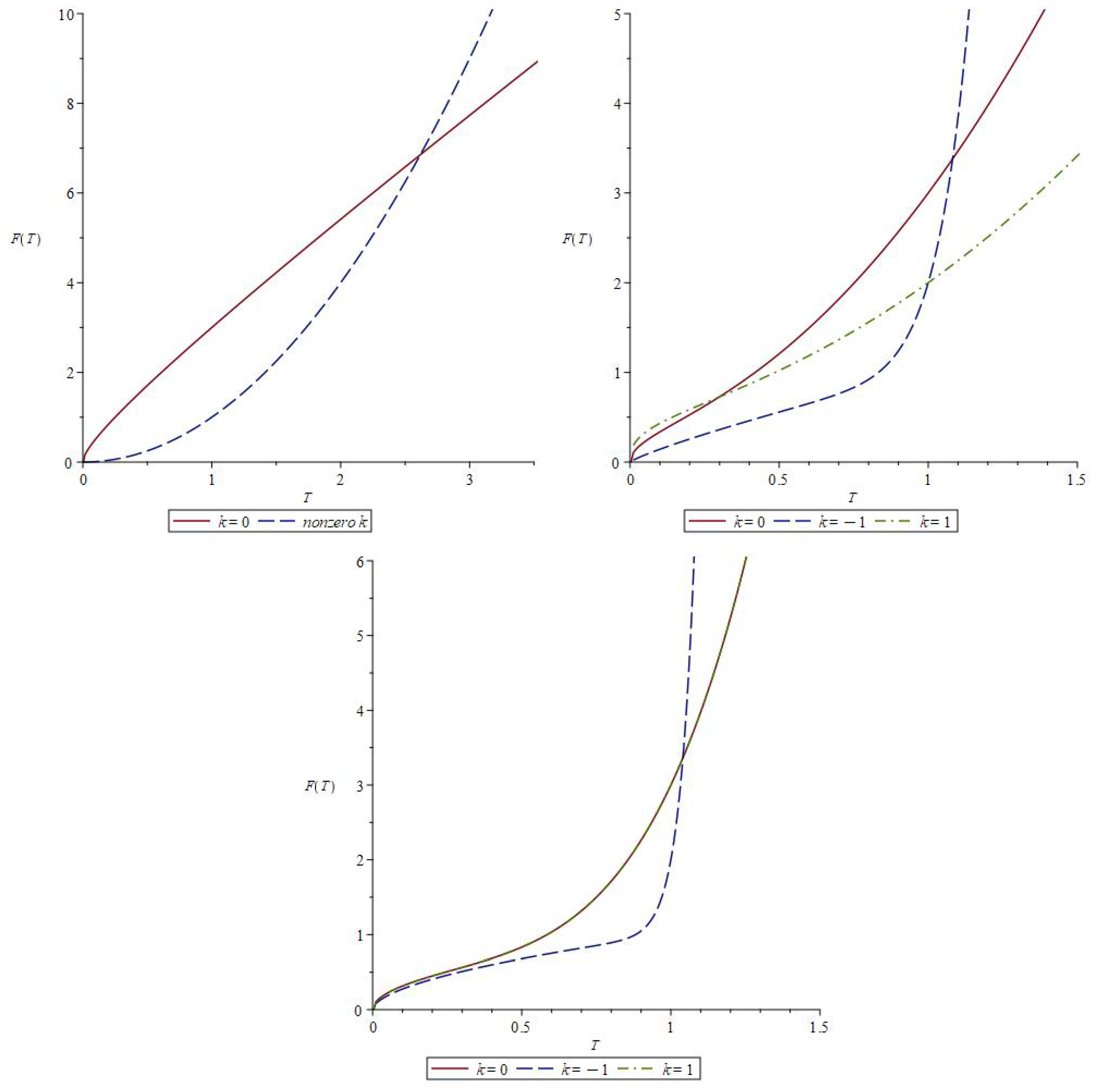
In Figure 1, we compare the new teleparallel F ( T ) solutions for highlighting the main common points between typical k = 1 , 0 + 1 solutions. We want to highlight the impacts of the k-parameter on new EMF-based teleparallel solutions. For n = 1 2 subcase (slow universe expansion), we find that the k = ± 1 cases lead to the same quadratic F ( T ) limit for the very-far-future limit ( t ( T ) 1 approximation), while the k = 0 case leads to the superposition of the TEGR-like term with the large n limit T term. For the n = 1 (linear universe expansion) subcase, we find three different curves of teleparallel F ( T ) solutions. For n = 2 subcase (fast universe expansion), we find that the k = 0 and + 1 cases have the same superposed curves and k = 1 is different. However, we have obtained in the current section new simple analytical EMF source-based teleparallel F ( T ) solutions suitable for any electromagnetic-based universe models. From the teleparallel F ( T ) solutions, we can find the ρ e m ( T ) expression and then the related E ( T ) and/or B ( T ) EMF solutions. We will then have to verify the Maxwell equations as stated below in Section 4.1.

4. Physical Interpretations and Experimental Data Comparisons

4.1. Electromagnetic Field Interpretations

From the CLs solutions as found in Equation (22), we can find for each new teleparallel F ( T ) solution the corresponding EMF E and/or B. By using the same a ( t ) = a 0 t n ansatz, the Equation (22) is written as follows:
ρ e m ( T ) = ρ ˜ e m ( 0 ) t n ( T ) r ( T ) 4 ,
where ρ ˜ e m ( 0 ) = ρ e m ( 0 ) a 0 4 . We find from Equation (58) that any EMF will be described by E ( T ) = E 0 a ( T ) r ( T ) 2 , a Coulombian field, and/or B ( T ) = B 0 a ( T ) r ( T ) 2 , a magnetic dipole field, with an expanding universe term. In the far future, we find that the electromagnetic fields will be decreasing and then becoming more negligible. But the EMF as a CL solution also needs to satisfy the Maxwell equations as follows [77,78,79,80]:
μ F μ ν = J ν , and κ F μ ν + ν F κ μ + μ F ν κ = 0 .
We are in principle able to find the four-current J ν and the four-potential A ν averaged expressions of the universe from the first Equation (59), F μ ν definition, and using the E ( T ) and/or B ( T ) expressions found from Equation (58). The result will depend on the situation: a pure electric (or magnetic) or a general EMF of universe. In principle, each teleparallel F ( T ) solution of each cosmological case and subcase will lead to different J ν and A ν expressions. We also need to consider that J ν is also a conserved current satisfying ν J ν = 0 and to set the electromagnetic gauge for A ν . All for satisfying the gauge-invariance fundamental principle for electromagnetic fields [77,78,79,80]. We can do this type of development for each teleparallel solutions, F ( T ) , and also for extensions.
For example, we will find the corresponding EMF of the k = 0 case teleparallel solution described by Equations (32) and (33). By using the first FE described by Equation (25), we find the the following:
ρ e m ( T ) = ( 4 n 1 ) 2 κ F 1 T 2 n , n 1 4 ,
= F 1 κ T , n = 1 4 .
Equations (60) and (61) lead to the ρ e m ( T ) = ρ e m ( 0 ) T 2 n . Using CLs of Section 2.3, we find that E ( T ) = E 0 T n and/or B ( T ) = B 0 T n . From Equation (58) and finding that a 2 ( T ) = a ˜ 0 T n , we will find that r ( T ) = r 0 = constant. The current cosmological system does not depend on the radial coordinate and only depends on the time coordinate. We confirm that T = T ( t ) and then E = E ( t ) and/or B = B ( t ) , an induction-based EMF.
We can also find the potential A μ and J μ from Equation (59), but there are several possible solutions according to the gauge invariance principle. By using the vectorial form of Maxwell’s equations, we will find that the magnetic field is B = 0 , and then an induced time-dependent electric current J i n d = t E = J ˜ 0 T n + 1 2 . We find a pure electric field case solution satisfying all Maxwell equations stated by Equation (59).
As a good application, we can assume a plasma-based universe model where J i n d = σ p l E leads to the Maxwell equation σ p l E p l = t E p l [77,78,79,80,82]. From this last equation, we search for a k = 0 cosmological solution:
E p l ( T ) = E 0 exp σ p l t ( T ) = E 0 exp 6 n σ p l T , = E 0 n = 0 6 n σ p l n n ! T n / 2 .
Such k = 0 flat cosmological plasma models can be seen as a large superposition of power-law term solutions. We just constrain the induced current to be proportional to the plasma electric field E p l . We can also proceed with the same type of development for the non-flat cosmological solutions ( k = ± 1 cases). We can also see in Equation (62) that a high conductivity will lead to a weak electric field for satisfying the Maxwell equations.

4.2. Experimental Data Comparison Guidelines

The new electromagnetic teleparallel F ( T ) solutions need to be compared and tested with existing experimental data sets from experiments such as Dark Energy Spectroscopic Instrument (DESI), and other Baryonic Data (BAO) and any other cosmological redshift measurements ( H ( z ) -based measurements) [83,84,85,86,87,88,89]. The far-future teleparallel solution for k = 0 cases can be compared to the baryonic-based cosmological background data sets. The k = ± 1 teleparallel F ( T ) solutions for the far-future universe need to be compared with data for determining the suitable non-flat cosmological models with EMF contributions. We can now determine the most realistic solution for universe models and explanations in terms of electromagnetic averaged contributions.
Therefore, this paper primarily aims to find by a mathematical–physics approach the main relevant teleparallel F ( T ) solutions for usual electromagnetic sources. We find in Section 3 the most relevant and verifiable new teleparallel F ( T ) solutions to be tested and compared with experimental data sets. We specifically find that the k = 0 case leads to a pure electric field source expressible as a power-law in torsion scalar, i.e., | E | T 2 n . We have then shown that the same solution is generalizable to an exponential cosmological plasma electric field source solution. We can propose future works aiming to compare, by data fitting, the new teleparallel F ( T ) solutions with background measurements, as those made by the DESI collaboration [83,84,85,86,87]. We have seen that a number of new teleparallel F ( T ) solutions are close to those of refs. [90,91,92]. These results will allow us to make good comparisons with data sets in future data-fitting-based works for determining which of the new solution classes are the most realistic for the EMF contribution of universe models.
We will be able to better confirm and/or adapt the Λ CDM models to the data sets by determining the most suitable new teleparallel F ( T ) solution models in terms of electromagnetic contributions. Some recent similar studies using data comparison have been performed for more simple universe models using redshift H ( z ) , BAO, and other similar data sets (see refs. [93,94,95] and refs. within). It is possible to use the scale factor a and determine the n-parameter possible values for the comparison with redshift measurements. Some data analysis techniques used in the mentioned works are reusable for future comparative works for the new electromagnetic source teleparallel F ( T ) solutions found here. But the data comparison goes beyond the aims and scopes of the theoretical and mathematical physics-based approach of the current paper. But the data fitting based studies need to be performed in a near future, as suggested in some recent works for teleparallel F ( T ) and F ( T , B ) type solutions [58,63]. We have all the ingredients to achieve a possible future full data-based EMF contribution study of universe models.
Reusing the same Section 4.1 example, we should illustrate how we can compare redshift data with the flat cosmological ( k = 0 case) teleparallel F ( T ) solution. If H ( T ) = T 6 and 1 + z = t n ( T ( z ) ) = T 6 n 2 n / 2 , we then find H ( z ) = n 1 + z 1 / n . From any redshift data z measurement set and any teleparallel cosmological solution, we are able to find the H ( z ) , T ( z ) and then data suitable teleparallel F ( T ) solutions [96,97]. We also find as a relative density with the electric field Ω e m ( z ) = ρ e m ( z ) ρ 0 = | E ( z ) | 2 | E 0 | 2 T 2 n ( z ) 1 + z 4 (and/or | B ( z ) | 2 | B 0 | 2 for non-flat cosmology). We can do a similar development for k = ± 1 cases under the same principle, but we will find some more elaborated expressions. We can really make the link between the data sets and teleparallel solution source terms in this manner.

5. Concluding Remarks

We will first conclude this paper by the flat cosmological k = 0 teleparallel F ( T ) solutions, which are described by double power-law functions. We also find that a power-law electric field ( | E ( T ) | T n ) constitutes the only possible energy–momentum source term satisfying the Maxwell equations. This last solution can be generalized by superposition to a cosmological plasma solution. We have also found that we can link any redshift z data set to scale factor a ( z ) , Hubble parameter H ( z ) , torsion scalar T ( z ) , and then the new teleparallel F ( T ) solutions in Section 4 developments.
For the spatially curved cosmological k = ± 1 teleparallel F ( T ) solutions are described by various forms. For n = 1 2 , the general solutions are described by special function but go to the same quadratic term F ( T ) T 2 in the very-far-future limit for k = ± 1 . However, for n = 1 and 2 (faster universe expansion), the double polynomial function form describes the teleparallel F ( T ) solutions. Under these considerations, we claim that non-flat k = ± 1 teleparallel F ( T ) solutions also have some common points with several cosmological teleparallel F ( T ) and F ( T , B ) solutions of refs. [55,56,58,63], because using the same coframe/spin-connection pair and ansatz. However, the current paper will allow us to verify, test, and determine the most suitable teleparallel F ( T ) solutions on recent experimental data sets as performed in some studies [93,94,95]. We need, in a near future and by using experimental data analysis approaches, to compare the new solutions with BAO and redshift experimental data sets for determining the electromagnetic averaged contribution to universe models. This will allow us to select the most suitable classes of teleparallel F ( T ) solutions useful for determining the averaged EMF contributions to the universe evolution models. The k = 0 case-based example used in Section 4 illustrates the feasibility of such a process for any teleparallel cosmological F ( T ) solution with an electromagnetic source, including for a plasma-based universe model by the superposition principle. We can then repeat the same type of development for k = ± 1 teleparallel cosmological F ( T ) solutions.
There are some perspectives on future works with electromagnetic-based sources for KS and static SS teleparallel spacetimes for new additional classes of solutions using the same process and coframe ansatz approaches as in refs. [48,49,51,52]. We also need to study in the near future the anti-deSitter (AdS) spacetimes in teleparallel gravity, including the electromagnetic influence on this spacetime structure. The new electromagnetic teleparallel solutions found in the paper will allow us to investigate some elaborated physical systems and processes in the teleparallel gravity context. These suggestions are really feasible in the near future and will contribute to the study of the charged AdS wormholes and BHs solutions in teleparallel gravity under a right teleparallel cosmological background.

Funding

This research received no external funding.

Data Availability Statement

The original contributions presented in this study are included in the article. Further inquiries can be directed at the corresponding author.

Conflicts of Interest

The author declares no conflicts of interest.

Abbreviations

The following abbreviations are used in this manuscript:
AdSAnti-deSitter
BHBlack Holes
CLConservation Law
DEDark Energy
EMElectromagnetic
EMFElectromagnetic Field
EqnEquation
FEField Equation
GRGeneral Relativity
KSKantowski–Sachs
NGRNew General Relativity
PFPerfect Fluids
SFScalar Field
SSSpherically Symmetric
TdSTeleparallel deSitter
TEGRTeleparallel Equivalent of General Relativity
TRWTeleparallel Robertson–Walker
Λ CDMLambda Cold Dark Matter

References

  1. Lucas, T.G.; Obukhov, Y.; Pereira, J.G. Regularizing role of teleparallelism. Phys. Rev. D 2009, 80, 064043. [Google Scholar] [CrossRef]
  2. Krššák, M.; van den Hoogen, R.J.; Pereira, J.G.; Boehmer, C.G.; Coley, A.A. Teleparallel Theories of Gravity: Illuminating a Fully Invariant Approach. Class. Quantum Gravity 2019, 36, 183001. [Google Scholar] [CrossRef]
  3. Bahamonde, S.; Dialektopoulos, K.F.; Escamilla-Rivera, C.; Farrugia, G.; Gakis, V.; Hendry, M.; Hohmann, M.; Said, J.L.; Mifsud, J.; Di Valentino, E. Teleparallel Gravity: From Theory to Cosmology. Rep. Prog. Phys. 2023, 86, 026901. [Google Scholar] [CrossRef] [PubMed]
  4. Krssak, M.; Pereira, J.G. Spin Connection and Renormalization of Teleparallel Action. Eur. Phys. J. C 2015, 75, 519. [Google Scholar] [CrossRef]
  5. Coley, A.A.; van den Hoogen, R.J.; McNutt, D.D. Symmetry and Equivalence in Teleparallel Gravity. J. Math. Phys. 2020, 61, 072503. [Google Scholar] [CrossRef]
  6. McNutt, D.D.; Coley, A.A.; van den Hoogen, R.J. A frame based approach to computing symmetries with non-trivial isotropy groups. J. Math. Phys. 2023, 64, 032503. [Google Scholar] [CrossRef]
  7. Aldrovandi, R.; Pereira, J.G. Teleparallel Gravity, An Introduction; Springer: Dordrecht, The Netherlands, 2013. [Google Scholar]
  8. Olver, P. Equivalence, Invariants and Symmetry; Cambridge University Press: Cambridge, UK, 1995. [Google Scholar]
  9. Krššák, M.; Saridakis, E.N. The covariant formulation of f (T) gravity. Class. Quantum Gravity 2016, 33, 115009. [Google Scholar] [CrossRef]
  10. Ferraro, R.; Fiorini, F. Modified teleparallel gravity: Inflation without an inflation. Phys. Rev. D 2007, 75, 084031. [Google Scholar] [CrossRef]
  11. Ferraro, R.; Fiorini, F. On Born-Infeld Gravity in Weitzenbock spacetime. Phys. Rev. D 2008, 78, 124019. [Google Scholar] [CrossRef]
  12. Linder, E. Einstein’s Other Gravity and the Acceleration of the Universe. Phys. Rev. D 2010, 81, 127301, Erratum in Phys. Rev. D 2010, 82, 109902. https://doi.org/10.48550/arXiv.1005.3039.. [Google Scholar] [CrossRef]
  13. Hayashi, K.; Shirafuji, T. New general relativity. Phys. Rev. D 1979, 19, 3524. [Google Scholar] [CrossRef]
  14. Jimenez, J.B.; Dialektopoulos, K.F. Non-Linear Obstructions for Consistent New General Relativity. J. Cosmol. Atroparticle Phys. 2020, 2020, 018. [Google Scholar] [CrossRef]
  15. Bahamonde, S.; Blixt, D.; Dialektopoulos, K.F.; Hell, A. Revisiting Stability in New General Relativity. Phys. Rev. D 2024, 111, 064080. [Google Scholar] [CrossRef]
  16. Heisenberg, L. Review on f (Q) Gravit. Phys. Rep. 2023, 1066, 1–78. [Google Scholar] [CrossRef]
  17. Heisenberg, L.; Hohmann, M.; Kuhn, S. Cosmological teleparallel perturbations. J. Cosmol. Astropart. Phys. 2024, 03, 063. [Google Scholar] [CrossRef]
  18. Flathmann, K.; Hohmann, M. Parametrized post-Newtonian limit of generalized scalar-nonmetricity theories of gravity. Phys. Rev. D 2022, 105, 044002. [Google Scholar] [CrossRef]
  19. Hohmann, M. General covariant symmetric teleparallel cosmology. Phys. Rev. D 2021, 104, 124077. [Google Scholar] [CrossRef]
  20. Jimenez, J.B.; Heisenberg, L.; Koivisto, T.S. The Geometrical Trinity of Gravity. Universe 2019, 5, 173. [Google Scholar] [CrossRef]
  21. Nakayama, Y. Geometrical trinity of unimodular gravity. Class. Quantum Gravity 2023, 40, 125005. [Google Scholar] [CrossRef]
  22. Xu, Y.; Li, G.; Harko, T.; Liang, S.-D. f (Q, T) gravity. Eur. Phys. J. C 2019, 79, 708. [Google Scholar] [CrossRef]
  23. Maurya, D.C.; Myrzakulov, R. Exact Cosmology in Myrzakulov Gravity. Eur. Phys. J. C 2024, 84, 625. [Google Scholar] [CrossRef]
  24. Harko, T.; Lobo, F.S.N.; Nojiri, S.; Odintsov, S.D. f (R, T) gravity. Phys. Rev. D 2011, 84, 024020. [Google Scholar] [CrossRef]
  25. Momeni, D.; Myrzakulov, R. Myrzakulov Gravity in Vielbein Formalism: A Study in Weitzenböck Spacetime. Nucl. Phys. B 2025, 1015, 116903. [Google Scholar] [CrossRef]
  26. Maurya, D.C.; Yesmakhanova, K.; Myrzakulov, R.; Nugmanova, G. Myrzakulov F(T,Q) gravity: Cosmological implications and constraints. Phys. Scr. 2024, 99, 10. [Google Scholar] [CrossRef]
  27. Maurya, D.C.; Yesmakhanova, K.; Myrzakulov, R.; Nugmanova, G. FLRW Cosmology in Metric-Affine F(R,Q) Gravity. Chin. Phys. C 2024, 48, 125101. [Google Scholar] [CrossRef]
  28. Maurya, D.C.; Myrzakulov, R. Transit cosmological models in Myrzakulov F(R,T) gravity theory. Eur. Phys. J. C 2024, 84, 534. [Google Scholar] [CrossRef]
  29. Mandal, S.; Myrzakulov, N.; Sahoo, P.K.; Myrzakulov, R. Cosmological bouncing scenarios in symmetric teleparallel gravity. Eur. Phys. J. Plus 2021, 136, 760. [Google Scholar] [CrossRef]
  30. Golovnev, A.; Guzman, M.-J. Approaches to spherically symmetric solutions in f (T)-gravity. Universe 2021, 7, 121. [Google Scholar] [CrossRef]
  31. Golovnev, A. Issues of Lorentz-invariance in f (T)-gravity and calculations for spherically symmetric solutions. Class. Quantum Gravity 2021, 38, 197001. [Google Scholar] [CrossRef]
  32. DeBenedictis, A.; Ilijić, S.; Sossich, M. On spherically symmetric vacuum solutions and horizons in covariant f (T) gravity theory. Phys. Rev. D 2022, 105, 084020. [Google Scholar] [CrossRef]
  33. Bahamonde, S.; Camci, U. Exact Spherically Symmetric Solutions in Modified Teleparallel gravity. Symmetry 2019, 11, 1462. [Google Scholar] [CrossRef]
  34. Awad, A.; Golovnev, A.; Guzman, M.-J.; El Hanafy, W. Revisiting diagonal tetrads: New Black Hole solutions in f (T)-gravity. Eur. Phys. J. C 2022, 82, 972. [Google Scholar] [CrossRef]
  35. Bahamonde, S.; Golovnev, A.; Guzmán, M.-J.; Said, J.L.; Pfeifer, C. Black Holes in f (T, B) Gravity: Exact and Perturbed Solutions. J. Cosmol. Atroparticle Phys. 2022, 1, 037. [Google Scholar] [CrossRef]
  36. Bahamonde, S.; Faraji, S.; Hackmann, E.; Pfeifer, C. Thick accretion disk configurations in the Born-Infeld teleparallel gravity. Phys. Rev. D 2022, 106, 084046. [Google Scholar] [CrossRef]
  37. Nashed, G.G.L. Quadratic and cubic spherically symmetric black holes in the modified teleparallel equivalent of general relativity: Energy and thermodynamics. Class. Quantum Gravity 2021, 38, 125004. [Google Scholar] [CrossRef]
  38. Pfeifer, C.; Schuster, S. Static spherically symmetric black holes in weak f (T)-gravity. Universe 2021, 7, 153. [Google Scholar] [CrossRef]
  39. El Hanafy, W.; Nashed, G.G.L. Exact Teleparallel Gravity of Binary Black Holes. Astrophys. Space Sci. 2016, 361, 68. [Google Scholar] [CrossRef]
  40. Aftergood, J.; DeBenedictis, A. Matter Conditions for Regular Black Holes in f (T) Gravity. Phys. Rev. D 2014, 90, 124006. [Google Scholar] [CrossRef]
  41. Bahamonde, S.; Doneva, D.D.; Ducobu, L.; Pfeifer, C.; Yazadjiev, S.S. Spontaneous Scalarization of Black Holes in Gauss-Bonnet Teleparallel Gravity. Phys. Rev. D 2023, 107, 104013. [Google Scholar] [CrossRef]
  42. Bahamonde, S.; Ducobu, L.; Pfeifer, C. Scalarized Black Holes in Teleparallel Gravity. J. Cosmol. Atroparticle Phys. 2022, 2022, 018. [Google Scholar] [CrossRef]
  43. Iorio, L.; Radicella, N.; Ruggiero, M.L. Constraining f (T) gravity in the Solar System. J. Cosmol. Atroparticle Phys. 2015, 2015, 021. [Google Scholar] [CrossRef]
  44. Pradhan, S.; Bhar, P.; Mandal, S.; Sahoo, P.K.; Bamba, K. The Stability of Anisotropic Compact Stars Influenced by Dark Matter under Teleparallel Gravity: An Extended Gravitational Deformation Approach. Eur. Phys. J. C 2025, 85, 127. [Google Scholar] [CrossRef]
  45. Mohanty, D.; Ghosh, S.; Sahoo, P.K. Charged gravastar model in noncommutative geometry under f (T) gravity. Phys. Dark Universe 2025, 46, 101692. [Google Scholar] [CrossRef]
  46. Calza, M.; Sebastiani, L. A class of static spherically symmetric solutions in f (T)-gravity. Eur. Phys. J. C 2024, 84, 476. [Google Scholar] [CrossRef]
  47. Coley, A.A.; Landry, A.; van den Hoogen, R.J.; McNutt, D.D. Spherically symmetric teleparallel geometries. Eur. Phys. J. C 2024, 84, 334. [Google Scholar] [CrossRef] [PubMed]
  48. Landry, A. Static spherically symmetric perfect fluid solutions in teleparallel F(T) gravity. Axioms 2024, 13, 333. [Google Scholar] [CrossRef]
  49. Landry, A. Kantowski-Sachs spherically symmetric solutions in teleparallel F(T) gravity. Symmetry 2024, 16, 953. [Google Scholar] [CrossRef]
  50. van den Hoogen, R.J.; Forance, H. Teleparallel Geometry with Spherical Symmetry: The diagonal and proper frames. J. Cosmol. Astrophys. 2024, 11, 033. [Google Scholar] [CrossRef]
  51. Landry, A. Scalar field Kantowski-Sachs spacetime solutions in teleparallel F(T) gravity. Universe 2025, 11, 26. [Google Scholar] [CrossRef]
  52. Landry, A. Scalar Field Static Spherically Symmetric Solutions in Teleparallel F(T) Gravity. Mathematics 2025, 13, 1003. [Google Scholar] [CrossRef]
  53. Coley, A.A.; Landry, A.; van den Hoogen, R.J.; McNutt, D.D. Generalized Teleparallel de Sitter geometries. Eur. Phys. J. C 2023, 83, 977. [Google Scholar] [CrossRef]
  54. Golovnev, A.; Guzman, M.-J. Bianchi identities in f (T)-gravity: Paving the way to confrontation with astrophysics. Phys. Lett. B 2020, 810, 135806. [Google Scholar] [CrossRef]
  55. Landry, A. Scalar field source Teleparallel Robertson-Walker F(T)-gravity solutions. Mathematics 2025, 13, 374. [Google Scholar] [CrossRef]
  56. Coley, A.A.; Landry, A.; Gholami, F. Teleparallel Robertson-Walker Geometries and Applications. Universe 2023, 9, 454. [Google Scholar] [CrossRef]
  57. Coley, A.A.; van den Hoogen, R.J.; McNutt, D.D. Symmetric Teleparallel Geometries. Class. Quantum Gravity 2022, 39, 22LT01. [Google Scholar] [CrossRef]
  58. Landry, A. Chaplygin and Polytropic gases Teleparallel Robertson-Walker F(T) gravity solutions. Mathematics 2025, 13, 3143. [Google Scholar] [CrossRef]
  59. Aldrovandi, R.; Cuzinatto, R.R.; Medeiros, L.G. Analytic solutions for the Λ-FRW Model. Found. Phys. 2006, 36, 1736–1752. [Google Scholar] [CrossRef]
  60. Casalino, A.; Sanna, B.; Sebastiani, L.; Zerbini, S. Bounce Models within Teleparallel modified gravity. Phys. Rev. D 2021, 103, 023514. [Google Scholar] [CrossRef]
  61. Capozziello, S.; Luongo, O.; Pincak, R.; Ravanpak, A. Cosmic acceleration in non-flat f (T) cosmology. Gen. Relativ. Gravit. 2018, 50, 53. [Google Scholar] [CrossRef]
  62. Bahamonde, S.; Dialektopoulos, K.F.; Hohmann, M.; Said, J.L.; Pfeifer, C.; Saridakis, E.N. Perturbations in Non-Flat Cosmology for f (T) gravity. Eur. Phys. J. C 2023, 83, 193. [Google Scholar] [CrossRef]
  63. Gholami, F.; Landry, A. Cosmological solutions in teleparallel F(T, B) gravity. Symmetry 2025, 17, 60. [Google Scholar] [CrossRef]
  64. Hohmann, M.; Järv, L.; Krššák, M.; Pfeifer, C. Modified teleparallel theories of gravity in symmetric spacetimes. Phys. Rev. D 2019, 084002. [Google Scholar] [CrossRef]
  65. Cai, Y.-F.; Capozziello, S.; De Laurentis, M.; Saridakis, E.N. f (T) teleparallel gravity and cosmology. Rep. Prog. Phys. 2016, 79, 106901. [Google Scholar] [CrossRef]
  66. Dixit, A.; Pradhan, A. Bulk Viscous Flat FLRW Model with Observational Constraints in f (T, B) Gravity. Universe 2022, 8, 650. [Google Scholar] [CrossRef]
  67. Chokyi, K.K.; Chattopadhyay, S. Cosmological Models within f (T, B) Gravity in a Holographic Framework. Particles 2024, 7, 856. [Google Scholar] [CrossRef]
  68. Nashed, G.G.L. Exact charged black-hole solutions in the D-dimensional teleparallel equivalent of general relativity. Prog. Theor. Exp. Phys. 2016, 4, 043E01. [Google Scholar] [CrossRef]
  69. Nashed, G.G.L. Charged and Non-Charged Black Hole Solutions in Mimetic Gravitational Theory. Symmetry 2018, 10, 559. [Google Scholar] [CrossRef]
  70. Nashed, G.G.L. Regular Charged Solutions in Teleparallel Theory of Gravity. arXiv 2006. [Google Scholar] [CrossRef]
  71. Nashed, G.G.L. General regular charged space-times in teleparallel equivalent of general relativity. Eur. Phys. J. C 2007, 51, 377. [Google Scholar] [CrossRef]
  72. Mourad, M.F.; Abdelgaber, M. Gravitational entropy of stringy charged black holes in teleparallel gravity. Indian J. Phys. 2023, 97, 4503. [Google Scholar] [CrossRef]
  73. Yasrina, A.; Uddarojad, A.A.R.; Hermanto, A.; Rosyid, M.F. On Teleparallel Gravitational Description of Electric and Magnetic Black HOLES: Covariant Formulation. 2024. Available online: https://hal.science/hal-04731286v1 (accessed on 19 December 2025).
  74. Iosifidis, D. Cosmological Hyperfluids, Torsion and Non-metricity. Eur. Phys. J. C 2020, 80, 1042. [Google Scholar] [CrossRef]
  75. Heisenberg, L.; Hohmann, M.; Kuhn, S. Homogeneous and isotropic cosmology in general teleparallel gravity. Eur. Phys. J. C 2023, 83, 315. [Google Scholar] [CrossRef]
  76. Heisenberg, L.; Hohmann, M. Gauge-invariant cosmological perturbations in general teleparallel gravity. Eur. Phys. J. C 2024, 84, 462. [Google Scholar] [CrossRef]
  77. Misner, C.W.; Thorne, K.S.; Wheeler, J.A. Gravitation; W. H. Freeman: San Francisco, CA, USA, 1973. [Google Scholar]
  78. Landau, L.D.; Lifshitz, E.M. Classical Theory of Fields, 4th Revised English ed.; Pergamon: Oxford, UK, 1973. [Google Scholar]
  79. Feynman, R.P.; Moringo, F.B.; Wagner, W.G. Feynman Lectures on Gravitation; Addison-Wesley: Boston, MA, USA, 1995. [Google Scholar]
  80. Thorne, K.P.; Macdonald, D. Electrodynamics in curved spacetime: 3 + 1 formulation. Mon. Not. R. Astron. Soc. 1982, 198, 339. [Google Scholar] [CrossRef]
  81. Kontou, E.-A.; Sanders, K. Energy conditions in general relativity and quantum field theory. Class. Quantum Gravity 2020, 37, 193001. [Google Scholar] [CrossRef]
  82. Perrat, A.L. Electric Fields in Cosmic Plasma. In Physics of the Plasma Universe; Springer: New York, NY, USA, 1992; pp. 137–170. [Google Scholar]
  83. DESI Collaboration. The Dark Energy Survey: Cosmology Results With 1500 New High-redshift Type Ia Supernovae Using The Full 5-year Dataset. Astrophys. J. Lett. 2024, 973, L14. [Google Scholar] [CrossRef]
  84. DESI Collaboration. DESI 2024 VI: Cosmological Constraints from the Measurements of Baryon Acoustic Oscillations. J. Cosmol. Astropart. Phys. 2025, 2, 021. [Google Scholar] [CrossRef]
  85. DESI Collaboration. Dark Energy Survey: Implications for cosmological expansion models from the final DES Baryon Acoustic Oscillation and Supernova data. arXiv 2025. [Google Scholar] [CrossRef]
  86. DESI Collaboration. DESI DR2 Results II: Measurements of Baryon Acoustic Oscillations and Cosmological Constraints. arXiv 2025. [Google Scholar] [CrossRef]
  87. DESI Collaboration. DESI DR2 Results I: Baryon Acoustic Oscillations from the Lyman Alpha Forest. Phys. Rev. D 2025, 112, 083514. [Google Scholar] [CrossRef]
  88. Notari, A.; Redi, M.; Tesi, A. BAO vs. SN evidence for evolving dark energy. J. Cosmol. Astropart. Phys. 2025, 4, 048. [Google Scholar] [CrossRef]
  89. Berti, M.; Bellini, E.; Bonvin, C.; Kunz, M.; Viel, M.; Zumalacarregui, M. Reconstructing the dark energy density in light of DESI BAO observations. Phys. Rev. D 2025, 112, 023518. [Google Scholar] [CrossRef]
  90. Myrzakulov, R. Accelerating universe from F(T) gravity. Eur. Phys. J. C 2011, 71, 1752. [Google Scholar] [CrossRef]
  91. Myrzakulov, R.; Saez-Gomez, D.; Tsyba, P. Cosmological solutions in F(T) gravity with the presence of spinor fields. Int. J. Geom. Methods Mod. Phys. 2015, 12, 1550023. [Google Scholar] [CrossRef]
  92. Paliathanasis, A. F(T) Cosmology with Nonzero Curvature. Mod. Phys. Lett. A 2021, 36, 2150261. [Google Scholar] [CrossRef]
  93. Escamilla-Rivera, C.; Sandoval-Orozco, R. f (T) gravity after DESI Baryon acoustic oscillation and DES supernovae 2024 data. J. High Energy Astrophys. 2024, 42, 217–221. [Google Scholar] [CrossRef]
  94. Aguilar, A.; Escamilla-Rivera, C.; Said, J.L.; Mifsud, J. Non-fluid like Boltzmann code architecture for early times f (T) cosmologies. arXiv 2024. [Google Scholar] [CrossRef]
  95. Sandoval-Orozco, R.; Escamilla-Rivera, C.; Briffa, R.; Said, J.L. Testing f (T) cosmologies with HII Hubble diagram and CMB distance priors. Phys. Dark Universe 2024, 46, 101641. [Google Scholar] [CrossRef]
  96. Said, J.L.; Mifsud, J.; Sultana, J.; Adami, K.Z. Reconstructing teleparallel gravity with cosmic structure growth and expansion rate data. J. Cosmol. Astropart. 2021, 6, 015. [Google Scholar] [CrossRef]
  97. Fankhauser, J.; Read, J. Gravitational redshift revisited: Inertia, geometry, and charge. Stud. Hist. Philos. Sci. 2024, 108, 19. [Google Scholar] [CrossRef]
Figure 1. Plot of teleparallel F ( T ) solutions for k = 0 and ± 1 (left: n = 1 2 , right: n = 1 , and bottom: n = 2 . Curves are for F 1 = F 2 = 2 F 0 setting).
Mathematics 14 00048 g001
Disclaimer/Publisher’s Note: The statements, opinions and data contained in all publications are solely those of the individual author(s) and contributor(s) and not of MDPI and/or the editor(s). MDPI and/or the editor(s) disclaim responsibility for any injury to people or property resulting from any ideas, methods, instructions or products referred to in the content.