1. Introduction
Water pollution has emerged as one of the most critical environmental challenges of the 21st century, with profound implications for ecosystem stability and public health. The dispersion of pollutants in aquatic systems involves complex interactions between chemical contaminants and biological species, often leading to cascading effects throughout the food web. A particularly concerning scenario arises when pollutants accumulate in host organisms, triggering physiological responses that subsequently contribute to further environmental contamination. This feedback mechanism creates a self-sustaining cycle of pollution that can persist long after the initial contamination events [
1,
2]. Understanding these dynamics requires sophisticated mathematical frameworks that can capture the nonlinear interactions, time delays, and multi-scale processes inherent in environmental pollution systems.
Classical approaches to water quality management have often relied on simplified models that neglect critical temporal aspects of pollutant transport and biological response [
3,
4,
5]. However, real-world systems exhibit significant time lags between exposure, biological uptake, and subsequent contamination effects. These delays arise from various processes, including pollutant transport through watersheds, incubation periods within host organisms, and maturation times for biological responses [
6,
7]. The incorporation of such temporal complexities is essential to developing accurate predictive models and effective intervention strategies for dispersed water pollutants.
Mathematical modeling has played a central role in environmental and ecological risk assessment. Foundational compartmental models [
1] provided the first systematic frameworks for representing interactions among populations and their environments. Subsequent research introduced time delays to model biological gestation, maturation, and transmission processes, and the modern theory of functional differential equations [
2,
6]. Mathematical models in epidemiology with dual targets represent a sophisticated framework designed to simultaneously track two distinct but interconnected populations or outcomes within a disease system, for example, a mathematical model that describes the dynamics of two different beehives sharing a common space [
8] and a dual-target HIV model [
9]. An other classic application is the guinea worm disease [
10], where the model explicitly simulates the infection dynamics of two different host populations, represented by two patches, sharing a common water source. The interactions between these two targets are crucial to predicting outbreak trajectories and evaluating the efficacy of intervention strategies, for instance, vaccination campaigns [
11]. Similarly, in the context of diseases with an environmental reservoir, such as cholera, dual-target models couple the dynamics of the infected human population with the concentration of the pathogen in a water reservoir [
12]. This approach allows public health officials to assess the synergistic impact of sanitation improvements alongside oral rehydration therapy, providing a more holistic and effective tool for epidemic control and prevention planning.
Distributed delays, in particular, are more realistic than discrete delays, as they capture variability in incubation times and pollutant transport durations. Such formulations have been successfully applied in nutrient–plankton systems [
7], environmental contamination models, and waterborne disease dynamics [
13]. In environmental contexts, Guo and Ma [
14] demonstrated how distributed delays affect nutrient–plankton interactions, while Guo et al. [
15] explored delay effects in nutrient–plankton models. An example of discrete delays can be found in [
16], which studied the delayed model for the dynamics of lumpy skin disease.
In epidemiological modeling, the next-generation matrix approach formalized in [
17,
18,
19] established a rigorous methodology for deriving the basic reproduction number
. This threshold quantity has since become standard in ecological and environmental systems as well, determining persistence or eradication of harmful agents. Lyapunov functional techniques, developed extensively in [
20,
21,
22], provide powerful tools for establishing global stability of equilibria in systems with nonlinearities and delays. This framework has been successfully adapted to environmental contexts by [
23], providing robust thresholds for pollution control interventions. Lyapunov stability theory, with its foundations in [
24] and subsequent developments by [
2,
25], has proven essential to establishing global dynamics in nonlinear systems with delays.
Despite these advances, a comprehensive framework addressing multiple distributed delays in water pollutant systems with multi-population interactions remains underdeveloped. Existing models often consider only a single population, include a single delay mechanism, or treat pollutant transport and infection exposure separately. Few integrate multiple sources of pollution, multiple host populations, and multiple distributed delays in a unified framework. Such an approach is essential to capturing multi-pathway contamination and feedback effects in real-world aquatic environments, where different populations (e.g., agricultural and urban) contribute differentially to pollution and experience variable exposure risks.
This paper aims to fill this gap by developing and analyzing a novel integro-differential equation model that describes the behavior of dispersed water pollutants that interact with two host populations. Individuals in each population are divided into susceptible and affected classes, where “infection” corresponds to pollutant ingestion and subsequent shedding back into the environment. Pollutant accumulation within hosts occurs over a distributed incubation period, and pollutant transport from shedding sources to the water body is also distributed over time to reflect hydrological and environmental processes. In the system developed in this paper, two distinct host populations interact with a waterborne contaminant. The model uses distributed delays to capture realistic time lags in both infection and pollutant transport. The survival terms incorporate losses during these processes such as decay, mortality, or environmental attenuation. Our main contributions are as follows:
Model Formulation: We propose a novel multi-population, multi-delay integro-differential framework.
Biological Well-Posedness: We prove non-negativity, boundedness of solutions, and the existence of a positively invariant feasible region.
Threshold Dynamics: We derive the basic reproduction number and show it serves as a sharp threshold for persistence or eradication.
Global Stability: We establish the global asymptotic stability of both the infection-free and endemic equilibria using carefully constructed Lyapunov functionals for both ODE and distributed-delay systems.
Sensitivity and Control Analysis: We identify the most influential parameters affecting and investigate the impact of control measures and delay durations.
The remainder of the paper is organized as follows: In
Section 2, we present the model formulation with detailed biological interpretation of variables and parameters.
Section 3 analyzes the non-delayed system, deriving equilibria, threshold conditions, and global stability results.
Section 4 extends the analysis to the distributed-delay system, establishing well-posedness, deriving the delayed reproduction number, and proving global stability by using Lyapunov functionals.
Section 5 provides numerical simulations, sensitivity analysis, and control scenarios illustrating the impact of intervention strategies and delay effects. Finally,
Section 6 summarizes the findings, discusses environmental and policy implications, and proposes future research directions.
3. Analysis of the Non-Delayed System
This section analyzes the foundational version of the model in (
1)–(
5) by considering the system in (
7)–(
11) in the absence of time delays. This simplification, where the delay kernels
are effectively Dirac delta functions centered at zero, provides a crucial baseline understanding of the system’s core dynamics. We begin by establishing the biologically feasible region
, proving that the system is mathematically well-posed and epidemiologically meaningful. The existence and local stability of the infection-free equilibrium
and the endemic equilibrium
are then characterized through the basic reproduction number
. Most significantly, we employ Lyapunov function methods to establish the global asymptotic stability of both equilibria, demonstrating that
serves as a sharp threshold that completely determines the system’s long-term behavior. The insights gained from this non-delayed case form an essential foundation for the subsequent analysis of the more complex distributed-delay system.
with initial condition
.
3.1. Biologically Feasible Domain for the Non-Delayed System
Before proceeding with the dynamical analysis, it is essential to establish the biological plausibility of the model by identifying a positively invariant region where all state variables retain their physical meaning. This subsection defines and proves the existence of the feasible set
for the non-delayed system in (
7)–(
11). We demonstrate that solutions initiating with non-negative initial conditions remain non-negative for all future time, ensuring that population densities and pollutant concentrations cannot become negative. Furthermore, we establish the ultimate boundedness of these solutions, showing that the total host populations in each patch are conserved and that the pollutant concentration remains below a calculable upper limit. The positive invariance of
confirms that the model is mathematically well-posed and produces trajectories that are consistent with biological reality.
Let us define the feasible set for the model’s variables, denoted by .
Lemma 1. Dynamics (7)–(11) admit a positively invariant set Proof. According to the system in (
7)–(
11), we can easily obtain
Therefore,
is invariant by Dynamics (
7)–(
11). Let us define
and
to be the sizes of Populations 1 and 2, respectively. From Dynamics (
7)–(
11), we obtain
Therefore, we have
if
. Similarly,
Therefore, we get
if
. Furthermore, we get
Therefore, we deduce that
if
. Hence, we deduce that the set
is positively invariant with respect to Dynamics (
7)–(
11). □
Let us now discuss the existence of equilibrium points of the system in (
7)–(
11).
3.2. Equilibria and Basic Reproduction Number for the Non-Delayed System
This subsection identifies the long-term steady states of the non-delayed system in (
7)–(
11) and establishes the fundamental threshold governing the transition between these states. We determine the existence and explicit forms of the infection-free equilibrium
, representing a pristine environment devoid of pollution and infection, and the endemic equilibrium
, characterizing a scenario of persistent pollution and disease. Utilizing the next-generation matrix method [
17], we derive the basic reproduction number
, where
for
. This threshold quantity
biologically represents the average number of new infections generated by a single affected individual in a completely susceptible population over the course of its infectious period. The analysis confirms that
acts as a sharp threshold: the infection-free equilibrium is the only steady state when
, while a unique endemic equilibrium emerges when
.
In order to define the next-generation matrix, we define the matrix
that contains the rates determining the emergence of new infections, whereas
consists of the transition rates that regulate the movement of individuals into and out of the affected compartments. The matrices
and
are given hereafter:
Therefore, the basic reproduction number is expressed as follows:
where
The terms and represent the basic reproduction numbers specific to patch 1 and patch 2, respectively, and their biological interpretation elucidates the contribution of each population to the overall epidemic. The expression for can be decomposed into three fundamental biological processes:
: The rate at which susceptible individuals in patch i become affected, proportional to the maximum susceptible population and the exposure rate.
: The rate at which an affected individual from patch i contributes a pollutant to the environment.
: The average lifetime of the pollutant in the environment.
Thus, quantifies the total number of new infections generated in a fully susceptible population that can be attributed to a single affected individual from patch i over the entire duration of the pollutant’s infectious period. A value of indicates that the infection can sustain itself within patch i alone, while suggests that patch i cannot maintain the infection independently. The total basic reproduction number reflects the combined epidemic potential from both patches, highlighting the multi-source nature of the dispersed pollution problem.
Lemma 2. Dynamics (7)–(11) admit an infection-free steady-state, . If , then Dynamics (7)–(11) admit an endemic steady-state, .
Proof. By setting the time derivatives to zero, we obtain
We obtain two cases:
If
, Dynamics (
7)–(
11) admit an infection-free steady-state
.
If
, we obtain
where
C is the solution of
We define a function
by
Therefore,
when
. We have
whenever
. Moreover,
Thus,
is a strictly decreasing function; hence, if
, there exists a unique
such that
. Hence,
,
,
, and
, where
is the solution of a quadratic equation
which can be written as
where
Clearly,
if
. Equation (
12) admits a positive solution
.
We get an endemic steady state given by , provided that . □
In conclusion, the analysis in this subsection has fully characterized the long-term steady states of the non-delayed system and established as the pivotal threshold governing the system’s behavior. We have demonstrated that the infection-free equilibrium is always present, while the endemic equilibrium exists uniquely if and only if . The decomposition of provides crucial biological insight, revealing the individual contribution of each population patch to the overall epidemic potential. This clear threshold condition, for disease eradication and for endemic persistence, establishes a foundational result upon which the stability analysis and subsequent extensions to the delayed model will be built.
3.3. Global Stability for the Non-Delayed System
This subsection establishes the global asymptotic stability of the equilibrium points for the non-delayed system, providing a comprehensive understanding of its long-term dynamics beyond local behavior. While the existence and local stability of the infection-free equilibrium and the endemic equilibrium are determined by the basic reproduction number , global stability guarantees convergence to these equilibria from any biologically feasible initial condition. We employ the direct Lyapunov method, constructing suitable candidate functions to analyze the system’s behavior. Specifically, we prove that is GAS when , ensuring global eradication of the infection, and that is GAS when , confirming the global persistence of the endemic state. These results solidify as a universal threshold that governs the system’s global dynamics. We define the function .
Theorem 1. The infection-free steady state is GAS when .
Proof. Let us define the function
as follows:
We calculate
along the trajectories of Dynamics (
7)–(
11) as
Therefore, for all
we have
when
. Furthermore,
when
,
, and
. According to [
26], solutions of the system in (
7)–(
11) limit to the largest invariant subset of
, which contains elements with
,
, and
Let us consider two cases:
If
, then from Equation (
13), we obtain
. Since
is invariant, we obtain
. From Equation (
11), we have
Hence,
If
, we have
,
, and then
. From Equation (
10), we have
Equation (
14)
for all
. Hence,
.
According to the Lyapunov–LaSalle asymptotic stability theorem [
20,
21,
22], the infection-free steady state
is GAS when
. □
Theorem 2. If the endemic steady state exists (), then it is GAS.
Proof. Let us define the function
as follows:
By calculating
along the trajectories of dynamics (
7)–(
11), we get
By applying the steady state equalities
we get
We use the relation between the arithmetical mean and geometrical mean
to get
We deduce that . Furthermore, if . The Lyapunov–LaSalle asymptotic stability theorem indicates that is GAS when . □
In conclusion, the global stability analysis for the non-delayed system has been rigorously established through the construction of appropriate Lyapunov functions. The proof confirms that the basic reproduction number acts as a definitive threshold that completely determines the system’s long-term behavior, regardless of initial conditions. When , the infection-free equilibrium is globally asymptotically stable, guaranteeing the eventual eradication of the pollutant and the associated infection from the system. Conversely, when , the endemic equilibrium is globally asymptotically stable, indicating that the infection and pollutant will persist indefinitely. These results provide a strong theoretical foundation, confirming the model’s robustness and the critical role of in predicting the system’s fate.
4. Analysis of the Distributed Delay System
This section extends the analysis to the full integro-differential equation system in (
1)–(
5), which incorporates multiple distributed delays to more realistically capture the temporal dynamics of waterborne pollutant transmission. Unlike the simplified ordinary differential equation model, this formulation accounts for variable time lags in the infection process (through delay kernels
and
) and pollutant transport (through
), where individuals or pollutants may experience different delay durations according to specified probability distributions. We establish the biological well-posedness of the system by proving the non-negativity and ultimate boundedness of solutions. Furthermore, we derive the corresponding basic reproduction number
and analyze the global stability of both the infection-free equilibrium
and the endemic equilibrium
, demonstrating how distributed delays quantitatively influence the epidemic threshold while preserving the qualitative threshold dynamics observed in the non-delayed case.
4.1. Biologically Feasible Domain
Establishing the biological feasibility of the distributed-delay model is a fundamental prerequisite for its meaningful analysis. This subsection demonstrates that the system of integro-differential equations in (
1)–(
5), governed by the initial conditions in (
6), preserves the essential biological properties of its states. We prove that solutions starting with non-negative initial data remain non-negative for all future time, ensuring that population densities and pollutant concentrations do not attain unrealistic negative values. Furthermore, we establish the ultimate boundedness of all state variables, showing that the total populations and the pollutant concentration remain within finite, biologically plausible limits. These results collectively confirm the existence of a positively invariant set
, which defines the biologically feasible domain wherein the model’s dynamics are physically meaningful and its long-term analysis is valid.
Lemma 3. Dynamics (1)–(5) with the initial condition in (6) admit non-negative and ultimately bounded trajectories. Proof. Clearly, Equations (
1) and (
3) of the model in (
1)–(
5) give
and
, which implies that
and
for all
. Moreover, for
, we have
for any
. Hence, by recursive argumentation, we deduce that
for any
.
According to Equation (
1), we have
. Concerning,
, we define
Thus, we obtain
, hence
. From Equation (
4), we have
. Similarly, concerning,
, we define
This gives
, hence
. Furthermore, we have
Consequently,
. Therefore, the set
is positively invariant with respect to Dynamics (
1)–(
5). □
4.2. Equilibria and Basic Reproduction Number
This subsection characterizes the long-term steady states of the distributed-delay system in (
1)–(
5) and establishes the critical epidemic threshold governing the system’s behavior. We determine the existence and expressions for the infection-free equilibrium
and the endemic equilibrium
. Utilizing the next-generation matrix approach [
17], we derive the basic reproduction number
for the delayed system, which incorporates the delay kernels through the terms
,
, and
. This threshold quantity, given by
, explicitly quantifies how the distributed delays in infection development and pollutant transport influence the overall potential for disease spread and persistence. The analysis confirms that the delay-modified reproduction number maintains its role as a sharp threshold parameter, determining the stability of the equilibria and the system’s eventual fate.
The matrices
(rates of new infections) and
(transition rates) are given by
reflects the average number of new infections in Population 1, while reflects the number of new infections in Population 2.
Lemma 4. Dynamics (1)–(5) admit an infection-free steady state, . If , then the dynamics admit an endemic steady state, .
Proof. By setting the time derivatives to zero, we get
We have the following cases:
If , the dynamics admit an infection-free steady state .
If
, we obtain
,
,
,
, where
C satisfies
Let us define the function
as follows:
Thus,
when
. Moreover, we have
whenever
. Furthermore,
Thus,
is strictly decreasing; hence, if
, there exists a unique
satisfying
. Hence,
,
,
, and
, where
satisfies
which can be written as
where
It is easy to see that
if
. Therefore, Equation (
15) admits a positive solution
. We get an endemic steady state
. Therefore,
exists when
. □
In conclusion, the analysis of equilibria and the derivation of the basic reproduction number for the distributed-delay system provide a complete characterization of its potential long-term states. The infection-free equilibrium always exists, while the endemic equilibrium exists uniquely if and only if . The explicit form of quantitatively integrates the effects of the distributed delays through the factors , demonstrating that delays in infection development and pollutant transport inherently reduce the epidemic potential. This establishes as a crucial threshold parameter whose value categorically determines whether the pollutant and infection will be eradicated or become endemic in the system.
4.3. Global Stability
This subsection establishes the global asymptotic stability of the equilibrium points for the distributed-delay system, providing a comprehensive understanding of its long-term dynamics regardless of the initial conditions. We construct sophisticated Lyapunov functionals that explicitly incorporate the distributed-delay structure, allowing us to analyze the system’s behavior across its entire history. For the case where , we prove that the infection-free equilibrium is GAS, demonstrating that the pollutant and associated infection will be eradicated over time. Conversely, when , we show that the endemic equilibrium is GAS, confirming that the system will persistently maintain positive levels of infection and pollutant concentration. These results extend the stability properties from the non-delayed case to the more biologically realistic delayed framework, reinforcing the critical role of as a universal threshold governing the system’s global behavior.
Theorem 3. The infection-free steady state is globally asymptotically stable (GAS) when .
Proof. Let us define the function
as follows:
By calculating
along the trajectories of Dynamics (
1)–(
5), we get
Therefore, for all
we have
when
. Moreover,
when
,
, and
. According to [
26], solutions of Dynamics (
1)–(
5) asymptotically approach the largest invariant subset of
, which consists of elements satisfying
,
and
Let us consider two cases:
If
and from Equation (
16), we obtain
. Since
is invariant we obtain
. From Equation (
5), we have
Hence,
If
, we have
,
, and then
. From Equation (
3), we obtain
Equation (
17) implies that
. Hence,
.
The Lyapunov–LaSalle asymptotic stability theorem [
20,
25] reveals that
is GAS when
. □
Theorem 4. If the endemic steady state exists (), then it is GAS.
Proof. Let us define the candidate Lyapunov function
given by
By calculating
along the trajectories of Dynamics (
1)–(
5), we obtain
According to the equilibrium conditions, we get
Using the fact that
we obtain
It follows that . Moreover, if . According to the Lyapunov–LaSalle asymptotic stability theorem, we deduce that is GAS when . □
In conclusion, the global stability analysis for the distributed-delay system has been rigorously established. The construction of appropriate Lyapunov functionals, which successfully incorporate the memory effects of the system, has enabled the proof that the basic reproduction number serves as a sharp threshold governing the global dynamics. The infection-free equilibrium is globally asymptotically stable when , ensuring the eventual eradication of the pollutant and infection. Conversely, when , the endemic equilibrium is globally asymptotically stable, indicating the persistent circulation of the pollutant and the disease within the host populations. These results confirm that the introduction of distributed delays, while quantitatively altering the threshold value, does not change the qualitative, threshold-driven behavior of the system, thereby solidifying the robustness of the model’s predictive power.
5. Numerical Simulations and Sensitivity Analysis
This section presents numerical simulations to illustrate the analytical results and explore the dynamical behavior of the model in various scenarios. We begin by converting the distributed-delay system into a discrete-delay formulation using Dirac delta functions, which facilitates numerical implementation. The stability of equilibria is then verified through time-series plots, demonstrating both disease eradication and endemic persistence corresponding to the basic reproduction number
. Sensitivity analysis is conducted to identify key parameters influencing
, and the impact of control measures, such as treatment efficacy and maturation delays, is investigated to assess their effectiveness in reducing disease spread. All simulations are performed using parameter values consistent with biological realism, as summarized in
Table 1.
The distributed-delay system in (
1)–(
5) can be converted into a discrete-delay one by using a Dirac delta function
. Let us consider
. In the case where
,
, we have
, and
. Then,
Hence, Dynamics (
1)–(
5) will be written as follows:
Note that the discrete system (
18)–(
22) is close to the one considered in [
27] modeling a within-host dual-target HIV dynamics.
The basic reproduction number of the model in (
18)–(
22) is provided hereafter:
The numerical simulations presented in
Section 5.1,
Section 5.2,
Section 5.3 and
Section 5.4 were performed using a (2,3)-order Runge–Kutta scheme (RK(2,3)) for time integration. The distributed-delay system (
1)–(
5) was first converted into an equivalent system of discrete-delay equations by assuming the delay kernels
to be Dirac delta functions
, as described previously. This yields the discrete-delay system in (
18)–(
22). The resulting delay differential equations (DDEs) were solved using the RK(2,3) method with a fixed time step
. All simulations were coded in MATLAB R2022b, using custom scripts for the RK(2,3)-DDE solver (dde23). The initial conditions were taken as constants on
consistent with (
6).
5.1. Stability of Equilibria
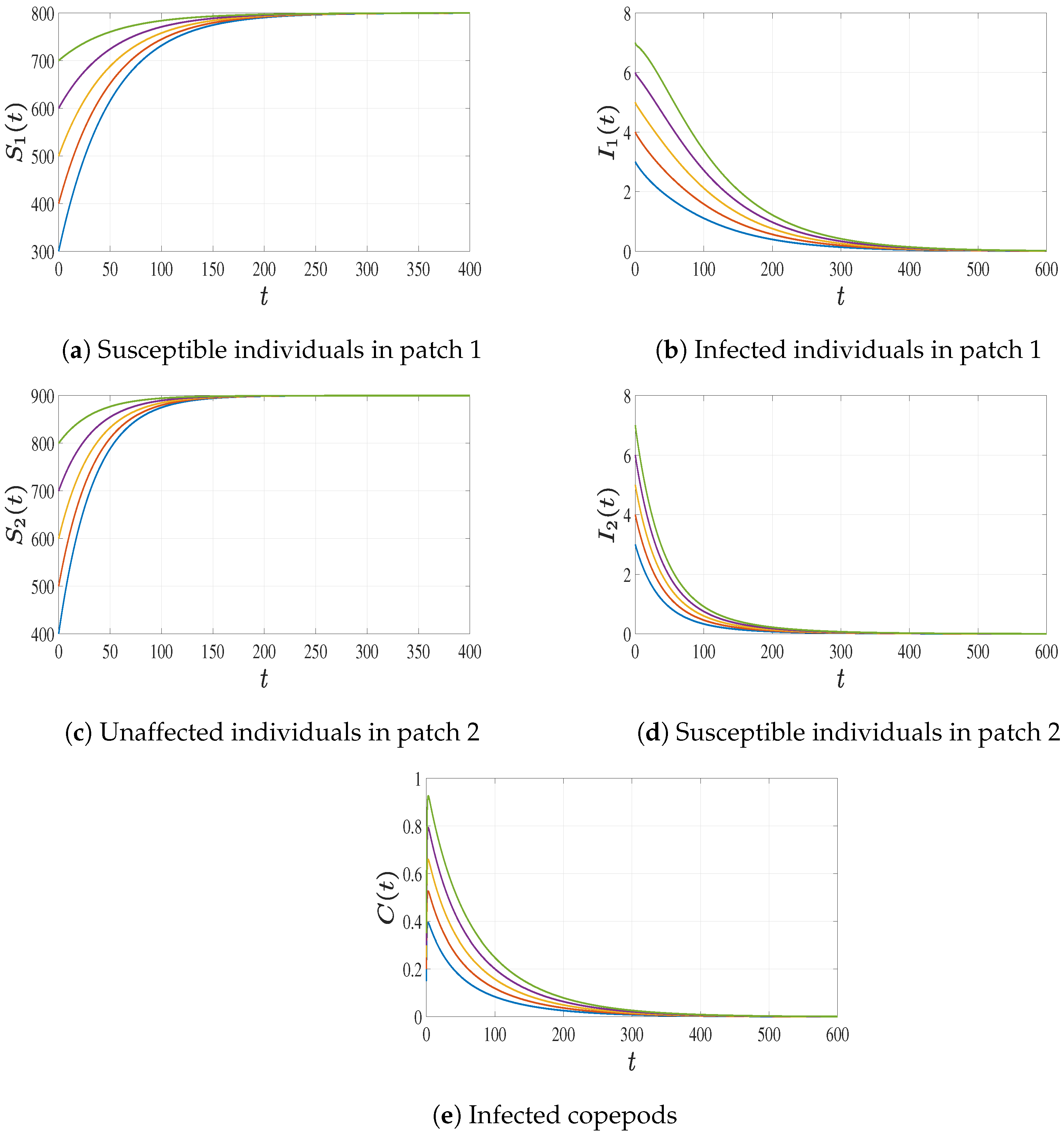
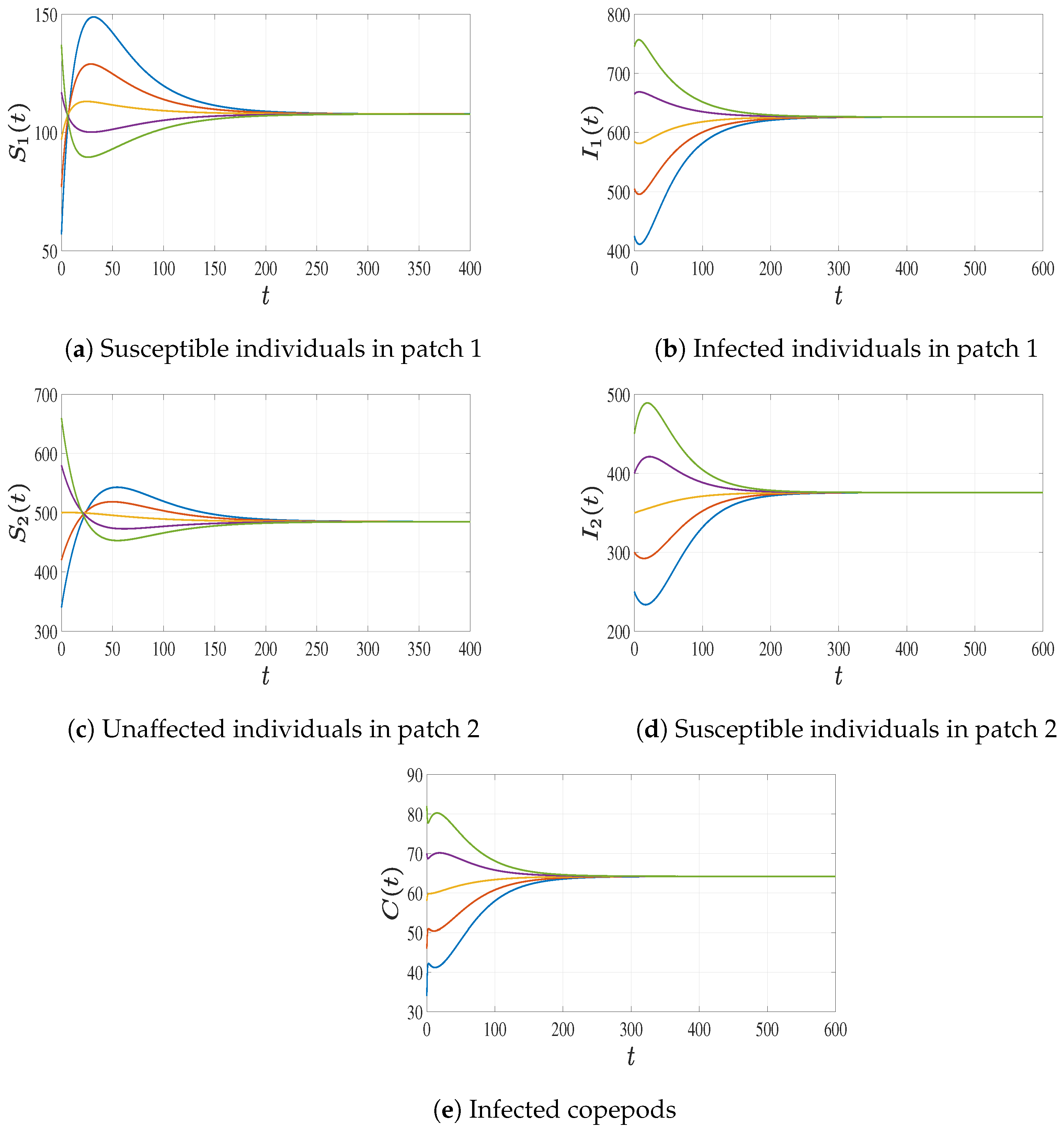
This subsection validates the analytical stability results established in Theorems 1–4 through numerical simulations. The time-series plots presented in
Figure 1 and
Figure 2 demonstrate the global asymptotic stability of the infection-free and endemic equilibria, contingent upon the threshold value of the basic reproduction number
.
Figure 1 corresponds to a parameter set yielding
, illustrating the convergence of all state variables to the disease-free equilibrium
. Conversely,
Figure 2 depicts the dynamics for
, where solutions asymptotically approach the endemic equilibrium
. These simulations confirm the theoretical findings that the system’s long-term behavior is entirely determined by this critical threshold.
The numerical simulations presented in
Figure 1 and
Figure 2 illustrate the critical role of the basic reproduction number
in determining the long-term dynamics of the waterborne pollutant system. When
(Disease Eradication Scenario), the system converges to the infection-free equilibrium
. Biologically, this represents a controlled environment where the following apply:
Susceptible populations in both patches ( and ) stabilize at their maximum recruitment levels, indicating no ongoing infection to deplete these compartments.
Infected populations ( and ) and pollutant concentration (C) decline to zero, demonstrating that initial contamination events naturally die out over time.
The pollutant and associated health impacts are effectively managed, with the system naturally returning to a clean state without persistent infection.
When (Endemic Persistence Scenario), the system stabilizes at the endemic equilibrium . This represents a challenging public health situation where the following apply:
Susceptible populations settle below their maximum capacities due to continuous conversion to the affected class through pollutant exposure.
Infected populations and pollutant concentration maintain positive steady-state levels, indicating a self-sustaining cycle of infection and contamination.
The system reaches an equilibrium where new infections and pollutant shedding are balanced by natural mortality and decay rates.
These results highlight the epidemiological threshold behavior of the system and emphasize that intervention strategies must aim to reduce below unity to achieve effective pollution and disease control.
5.2. Sensitivity Analysis
To identify the most influential parameters governing the spread and persistence of waterborne pollutants, we perform a sensitivity analysis on the basic reproduction number
. This analysis quantifies the relative change in
in response to a small variation in each parameter, thereby pinpointing key targets for intervention strategies. The normalized forward sensitivity index of
with respect to a parameter
is calculated as
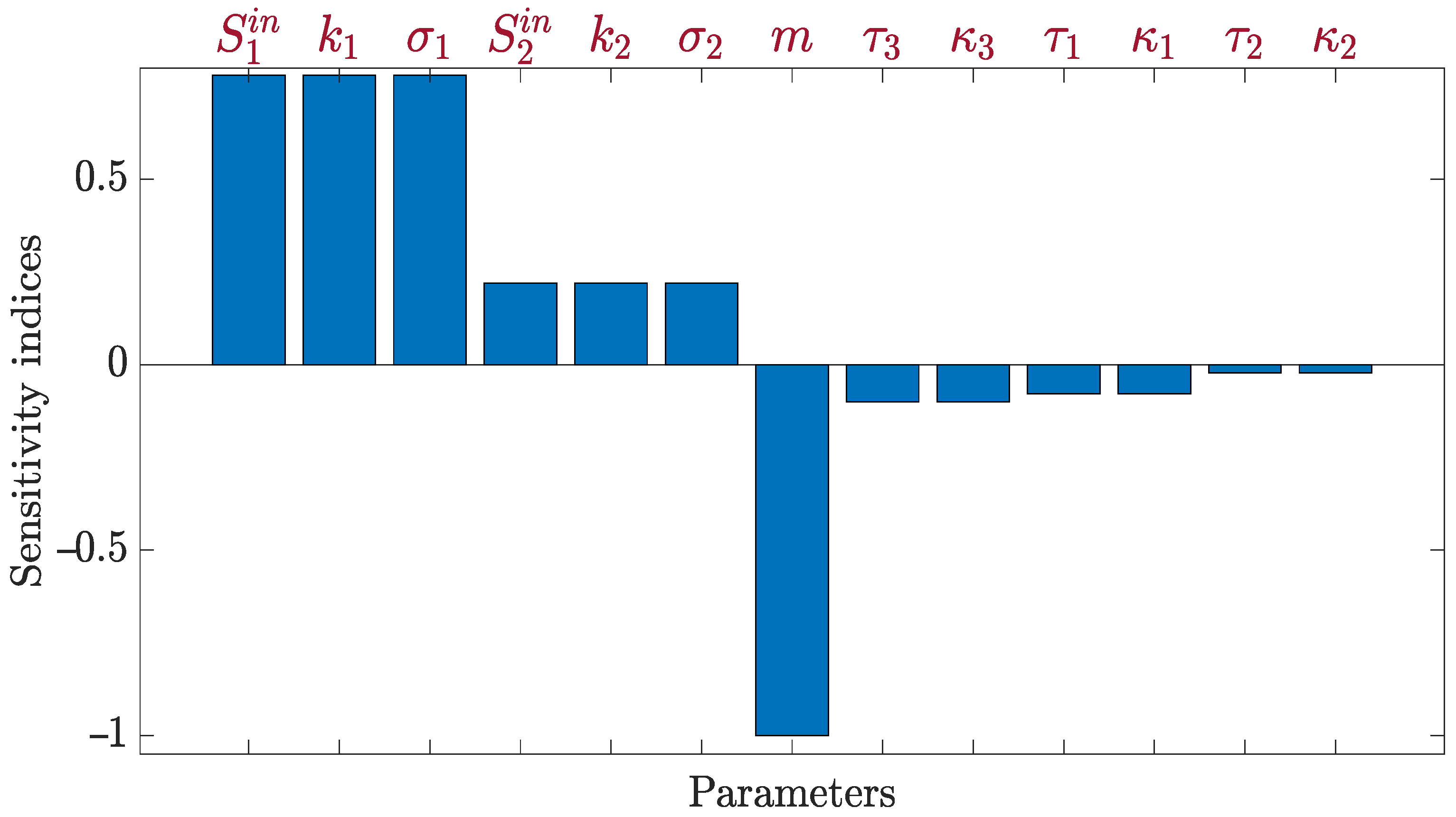
. The results, summarized in
Table 2 and visualized in
Figure 3, reveal which parameters, when manipulated, would have the greatest effect on reducing
below the critical threshold of unity.
The normalized sensitivity index of
with respect to a given parameter
is given as follows [
28]:
A simple calculus gives as
The sensitivity analysis presented in
Table 2 and
Figure 3 provides crucial insights for designing effective intervention strategies against the dispersed water pollutant. The results identify which parameters most significantly influence the basic reproduction number
, thereby highlighting the most efficient control levers.
Parameters with positive sensitivity indices (, , , , , ) act as amplifiers of the outbreak. Biologically, this indicates that the system is most sensitive to the following:
The recruitment rate of susceptible individuals (), as a larger pool of susceptible individuals facilitates wider transmission.
The exposure/ingestion rates (), which directly govern how quickly susceptible individuals become affected upon contact with the pollutant.
The pollutant contribution rates from affected individuals (), which determine the environmental contamination load.
Notably, parameters from patch 1 have a substantially higher impact (≈0.78) than those from patch 2 (≈0.22), suggesting that control efforts should be prioritized in patch 1 for maximum effect.
Conversely, parameters with negative sensitivity indices naturally suppress the outbreak. The most influential one is the pollutant decay rate m (=), indicating that enhancing the natural removal or degradation of the pollutant (e.g., through water treatment) would be highly effective. The delay parameters () and associated mortality rates () also have negative effects, as longer delays and higher mortality during these periods reduce the number of individuals that survive to contribute to the infection chain. This underscores the role of natural time lags and mortality in mitigating outbreak severity.
5.3. Impact of Treatment on the Dynamics
This subsection investigates the impact of therapeutic or preventive interventions on the system’s dynamics by introducing a treatment efficacy parameter . The model is modified such that the exposure terms are reduced by a factor of , representing an intervention that lowers the probability of infection upon contact with the pollutant. We analyze how this treatment alters the basic reproduction number, now denoted , and determine the critical treatment efficacy required to drive the system from an endemic state to a disease-free equilibrium. Numerical simulations are presented to illustrate the transition in system behavior as treatment efficacy increases, demonstrating the potential for intervention strategies to achieve disease control.
The treatment-modified model considering an efficacy parameter
is given as follows:
By calculating the basic reproduction number in the presence of treatment as the one defined in
Section 4 (
), the modified reproduction number is computed as follows:
If then , thereby guaranteeing that the disease-free equilibrium, , is globally asymptotically stable. The minimum, or critical, drug efficacy necessary for viral eradication is obtained by solving the aforementioned inequalities: , which ensures that for all .
By using model parameters including
,
, and
, along with values from
Table 1, we compute the following thresholds:
.
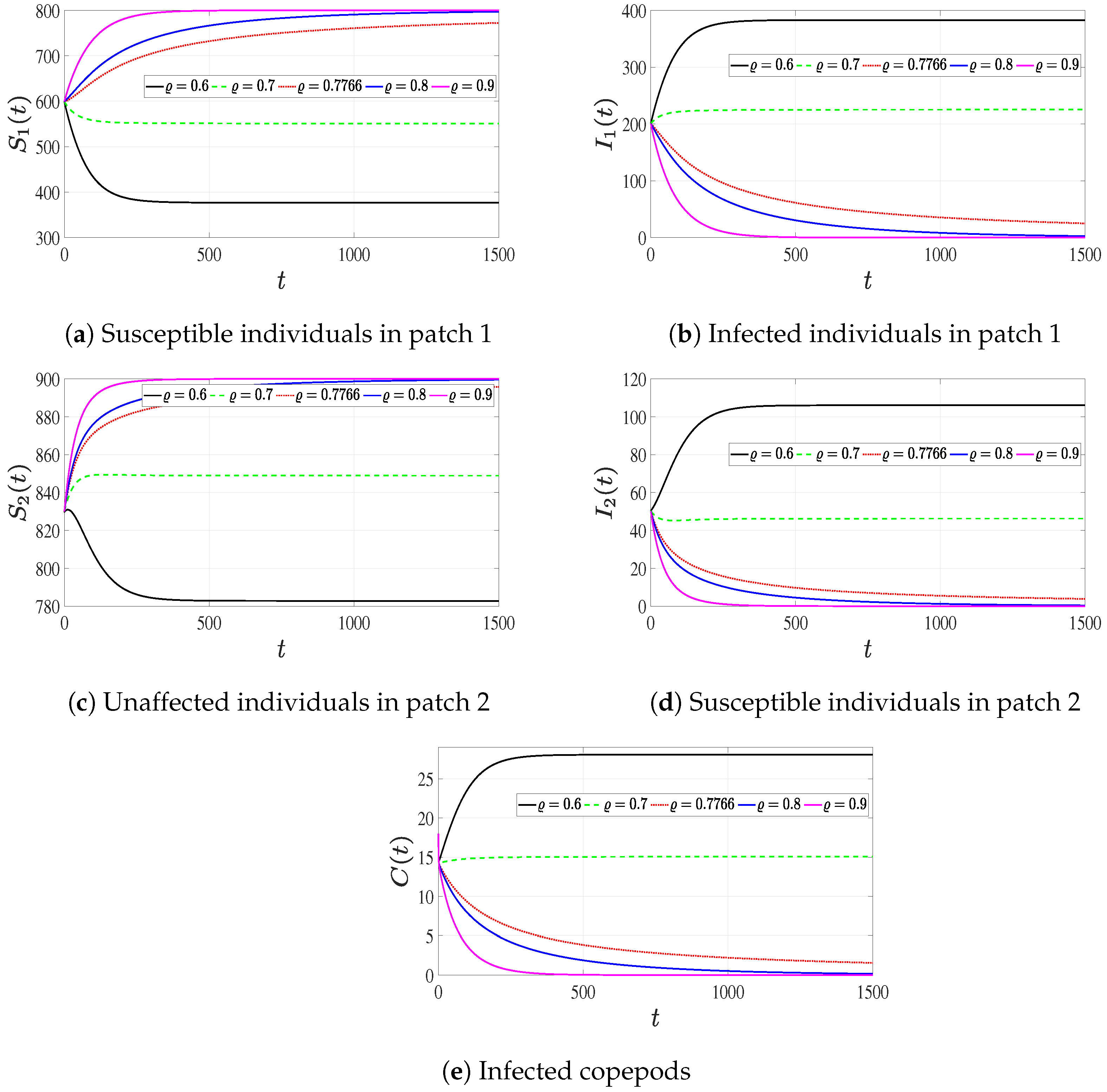
The results in
Table 3 and
Figure 4 demonstrate the critical role of treatment efficacy
in controlling the waterborne pollutant system. Biologically, the treatment represents an intervention that reduces the exposure rate of susceptible individuals to the pollutant, for instance, through protective measures, vaccination, or water purification.
Table 3 quantifies the direct relationship between treatment efficacy and the controlled reproduction number
. The data show That as efficacy increases from
to
, the reproduction number decreases from 1.7903 to 0.4476. The critical threshold occurs at
, where
. This value represents the minimum efficacy required to ensure pathogen elimination. Biologically, this means that the intervention must block at least approximately 77.7% of potential infection events to drive the system towards the disease-free state.
Figure 4 provides a dynamic visualization of this transition. For treatment efficacies below
(sub-figures likely showing endemic persistence), the infection continues to circulate, maintaining positive levels of affected individuals and pollutant concentration. However, for efficacies at or above
, the simulations would show all affected compartments and the pollutant concentration decaying to zero, while susceptible populations recover to their maximum levels. This illustrates that sufficiently effective intervention can break the cycle of infection and pollution, leading to long-term environmental and public health recovery.
5.4. Influence of Maturation Delay on the Dynamics
This subsection examines the role of the maturation delay
on the system’s threshold dynamics. The delay
represents the time required for the pollutant contributed by affected individuals to become mature or biologically active in the water environment. We analyze its explicit influence on the basic reproduction number, given by
, which shows an exponential decay with increasing delay. A critical delay value
is derived, such that for
, the reproduction number falls below unity, ensuring global stability of the infection-free equilibrium. Numerical simulations explore this transition, demonstrating how prolonging the maturation period can inherently suppress the outbreak, even in the absence of direct control measures.
To guarantee that
, we compute the critical values
as
The approximated critical value of is given by . If , then , and we have the global stability of . However, if , exceeds 1, destabilizing .
The results in
Table 4 and
Figure 5 elucidate the significant role of the maturation delay
in regulating the persistence of the waterborne pollutant system. Biologically,
represents the time lag between the shedding of the pollutant by affected individuals and its maturation into an infectious form in the aquatic environment.
Table 4 demonstrates the inverse relationship between delay duration and the basic reproduction number
. As the delay increases from
to
, the reproduction number decreases from 1.2198 to 0.8176. The critical threshold occurs at
, where
. This indicates that a maturation period longer than approximately 1.6 time units is sufficient to naturally suppress the outbreak, even without additional interventions.
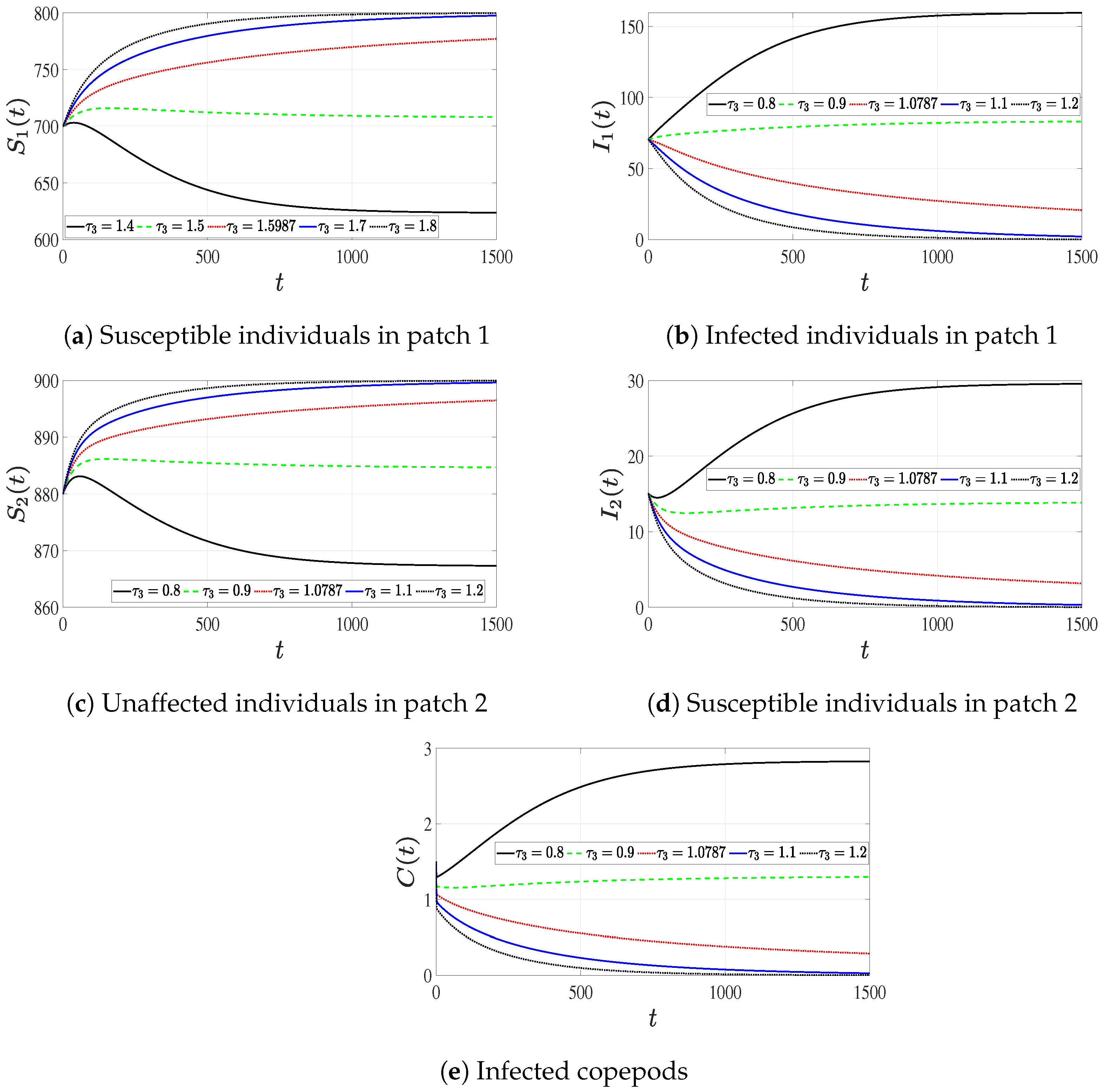
Figure 5 provides the dynamic visualization of this phenomenon. For delays shorter than
(e.g.,
), the system stabilizes at an endemic equilibrium, with persistent levels of infection and pollutant concentration. In contrast, for delays exceeding
(e.g.,
or
), the solutions converge to the disease-free equilibrium, where infections are cleared and the pollutant concentration decays to zero. This highlights the natural regulatory effect of prolonged maturation periods, where increased delay allows for greater natural decay of the pollutant during transport, effectively reducing its infectious potential upon reaching the water body.
6. Discussion and Conclusions
This study has presented a comprehensive mathematical analysis of a novel compartmental model describing the dynamics of dispersed water pollutants and their interaction with two distinct host populations. The model’s key innovation lies in the incorporation of multiple distributed delays, which realistically account for time lags in the infection process and pollutant transport. Our investigation, encompassing both delayed and non-delayed systems, provides significant theoretical insights and practical implications for environmental management and public health policy.
The analysis established the existence of a biologically feasible domain and derived the basic reproduction number as a critical threshold governing the system’s behavior. For the model without delays, we proved the global asymptotic stability of the infection-free equilibrium when and of the endemic equilibrium when . These results were rigorously extended to the distributed-delay model, demonstrating that the introduction of time lags, characterized by the probability kernels and survival probabilities , scales the reproduction number but does not alter the fundamental threshold dynamics. The global stability proofs, constructed using sophisticated Lyapunov functionals, confirm that the long-term fate of the pollutant and the associated infection is determined solely by whether is above or below unity.
Numerical simulations validated these theoretical findings and provided deeper insights. The sensitivity analysis identified the most influential parameters, revealing that the system is the most sensitive to the recruitment rate of susceptible individuals (), the exposure rate (), and the pollutant shedding rate (), with parameters from patch 1 exerting a dominant influence. This offers a clear prioritization for intervention strategies, suggesting that efforts should focus on reducing exposure and contamination at the most sensitive source. Furthermore, the exploration of control measures showed that treatment efficacy exceeding a critical value is sufficient to eradicate the pollutant-driven infection. Finally, the analysis of the maturation delay revealed its inherent mitigating effect, demonstrating that a delay longer than a critical value can naturally drive the system to a disease-free state by increasing the decay of the pollutant before it becomes infectious.
In summary, this work provides a robust mathematical framework for understanding and managing dispersed water pollution. The model highlights the critical roles of multi-source contributions, time delays, and targeted interventions. The findings offer valuable guidance for policymakers and environmental managers, emphasizing that effective control requires a multi-pronged strategy: reducing exposure and shedding rates, enhancing natural pollutant decay, and accounting for the temporal dynamics of pollution transport. Future work could extend this model to include spatial heterogeneity, stochastic effects, and optimal control theory to design cost-effective intervention schedules.