Article

Decision Evolution and Governance Optimization in Duty-Free Quota Abuse Smuggling: A Multi-Agent Risk Avoidance Perspective


1
School of Management Science and Engineering, Beijing Information Science & Technology University, Beijing 100192, China
2
Beijing Key Lab of Green Development Decision Based on Big Data, Beijing 100192, China
3
Research Center for Knowledge Management, Beijing 100192, China
*
Author to whom correspondence should be addressed.
Mathematics 2026, 14(1), 160; https://doi.org/10.3390/math14010160
Submission received: 9 November 2025 / Revised: 25 December 2025 / Accepted: 29 December 2025 / Published: 31 December 2025

Abstract

The pervasive misuse of Duty-Free Quota Abuse Smuggling has seriously undermined fiscal and market order. This study breaks through the traditional model’s assumption of complete rationality and establishes a Multi-Phase Dynamic Decision-Making Model for Duty-Free Quota Abuse Smuggling Chain System, incorporating the risk avoidance preference of illegal actors to analyze strategic interactions within the smuggling chain system. Through theoretical deduction and simulation experiments, the evolution of the system during the decision-making phases of Decentralized Profit-Seeking, Localized Collusive, and Collaborative Profit-Seeking was analyzed, and key intervention points were identified. The study results indicate that smuggling chains will continuously gravitate toward localized collusive; the risk avoidance of illegal actors suppresses local alliance benefits and shortens accumulation cycles; strengthening cost constraints reduces the overall level of smuggling in the system, with Quota Sellers being the most sensitive. Therefore, we propose hierarchical regulation, credit supervision, and differentiated law enforcement to precisely target smuggling chains.

1. Introduction

The off-island duty-free policy is implemented in special areas such as islands and border regions, expanding the duty-free shopping quota from international travelers to all departing travelers, thereby promoting local economic growth and open tax incentive policies, as shown in Table 1. However, the expansion of duty-free product categories and quotas has also fueled the rise of smuggling activities that abuse duty-free quotas: Duty-Free Quota Abuse Smuggling. This new type of smuggling has become increasingly rampant in places such as Okinawa in Japan, Jeju Island in South Korea, certain areas in Taiwan, China, and Hainan Island, China. Duty-Free Quota Abuse Smuggling affects tax order and market fairness and threatens national fiscal security, with Hainan being particularly impacted due to its high duty-free quotas and large consumer base. Existing research mainly focuses on law enforcement, neglecting the effect of heterogeneity in risk perception among perpetrators. This study establishes a Multi-Phase Dynamic Decision-Making Model for Duty-Free Quota Abuse Smuggling Chain System to analyze the decision-making evolution process from the perspectives of organizational structure and illegal profit distribution. By incorporating the risk avoidance preferences of perpetrators, this model overcomes the traditional differential game assumption of complete rationality and is conducive to addressing governance delays caused by ignoring the heterogeneity in perpetrators’ risk perception. The research results provide structured recommendations for implementing targeted, phased intervention measures to curb such smuggling activities and maintain tax order and market fairness.
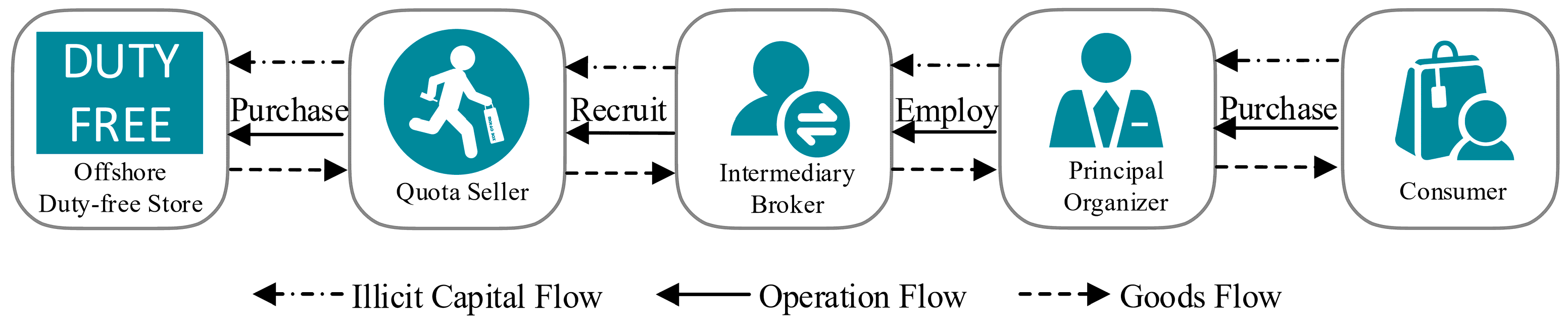
Two types of illegal activities constitute Duty-Free Quota Abuse Smuggling: exploitative purchasing and surrogate purchasing. Exploitative purchasing refers to the illegal practice of using someone else’s offshore duty-free allowance to buy duty-free products, while surrogate purchasing involves individuals using their own duty-free quotas to buy goods for others in exchange for benefits [1]. As shown in Figure 1, Violators can be categorized into three types: Principal Organizers, Intermediary Brokers, and Quota Sellers. Principal Organizers are responsible for directing operations, using others’ quotas to purchase goods, and reselling them at a profit below market prices. Intermediary Brokers cooperate with main organizers by recruiting Quota Sellers and coordinating purchases in exchange for compensation. Quota Sellers rent out their personal duty-free quotas to earn illegal commissions. Duty-Free Quota Abuse Smuggling is difficult to regulate due to its organized structure, the challenge of identifying participants, and its dynamic complexity. It disrupts the fairness of the domestic duty-free market, causes significant losses to national revenue, undermines product traceability, and seriously threatens the normativity and security of global cross-border duty-free trade. Therefore, formulating effective countermeasures is an urgent priority.
Duty-Free Quota Abuse Smuggling is a new type of smuggling behavior, and relevant research remains in the preliminary stage. Existing studies primarily approach the topic from a law enforcement perspective, using qualitative research methods such as case analysis and inductive reasoning to examine the causes of Duty-Free Quota Abuse Smuggling [2], governance strategies, sentencing standards [1,3], and other aspects. However, analyses of the complex interest relationships and strategic interaction mechanisms within the Duty-Free Quota Abuse Smuggling chain remain insufficiently in-depth. Game theory provides a research framework for strategic interactions in smuggling governance [4]. Yet, past studies in this field mainly use static models, which are not suitable for analyzing smuggling activities like Duty-Free Quota Abuse Smuggling, where both the external environment and internal organizational structure are continuously changing. In addition, existing research often treats regulatory agencies and smugglers as equal, rational actors, which may distort the models due to asymmetrical power dynamics among the participants.
The differential game theory is a tool of continuous dynamic game theory [5] that can establish state feedback mechanisms within decision-making systems, providing a powerful analytical framework for addressing the issue of Duty-Free Quota Abuse Smuggling. Traditional differential game models usually assume that game participants are fully rational and focus only on cost-benefit relationships, overlooking the heterogeneous risk perceptions of the participants. With the continuous improvement of the Off-Island Duty-Free Policy, the growing legal risk awareness among consumers, and the dynamic changes in the illegal goods market, smugglers’ risk perception also adjusts accordingly. Preliminary studies indicate that decision-makers’ risk avoidance preferences are closely linked to their strategy choices [6,7]. In the context of Duty-Free Quota Abuse Smuggling, the risk perception of illegal participants is a key factor in their decision-making process, affecting the organizational structure of the smuggling chain and the growth rate of smuggling activities, and serves as a crucial entry point for managing and preventing Duty-Free Quota Abuse Smuggling.
This study makes threefold theoretical contributions. First, it develops a dynamic decision-making model “decentralized profit-seeking→localized collusive coalitions→collaborative profit-seeking” from the perspective of illegal agents. The model addresses the limitations of traditional law enforcement-oriented studies, which fail to capture the progressive nature of smuggling chains and the evolution of their organizational structures. Second, by integrating a risk avoidance preference coefficient into the reconstructed objective function, it reveals the micro-interaction mechanism between illegal agents’ risk avoidance preferences and their strategic adjustments, laying a theoretical foundation for embedding adaptive countermeasures into governance strategies. Third, it proposes a closed-loop optimized governance strategy incorporating hierarchical management, credit supervision, and differentiated law enforcement, which will transform the law enforcement against cross-border shopping smuggling from a reactive response to precision prevention and control.
This study comprises seven sections as follows: Section 1 is the Introduction, covering the research background, significance, research questions, and innovative contributions. Section 2 presents the Theoretical Framework and Literature Review, summarizing existing research on Duty-Free Quota Abuse Smuggling governance, risk avoidance theory, and differential game theory, while identifying limitations and offering insights. Section 3 describes the problem and model assumptions, establishing the framework for model construction based on an analysis of the interests among key actors. Section 4 details model construction and solution, developing a dynamic decision-making model for the smuggling chain system, encompassing the dispersed profit-seeking phase, local alliance decision phase, and coordinated profit-seeking decision phase. Section 5 presents simulation examples. Parameters are assigned based on real-world case data, and MATLAB R2021b software is used to explore the evolutionary path of the smuggling chain system and the influence of key variables. Section 6 offers conclusions and insights. Section 7 addresses research gaps and future directions.

2. Literature Review

2.1. Related Research on the Governance of Duty-Free Quota Abuse Smuggling

The Off-Island Duty-Free Policies implemented in Okinawa, Jeju, Hainan, and parts of Taiwan have led to Duty-Free Quota Abuse Smuggling, a new type of smuggling activity closely linked to policy [1,2,3]. Research on managing this smuggling behavior is still at an embryonic stage, mainly limited to qualitative analyses of domestic cases, focusing on the causes of the crime, regulatory strategies, and sentencing decisions [1,2,3]. The core mechanism of this smuggling activity is to exploit arbitrage opportunities created by the differences between liberalized duty-free systems and stricter regulations in the mainland source regions. Although direct research is limited, a large amount of international academic research has explored similar illegal flows driven by regulatory gaps. Previous studies, such as analyses of medieval wool smuggling [8], the circulation of gold among displaced populations in Peru [9], and structural policy gaps [10], consistently emphasize that localized enforcement alone is insufficient. These studies stress the urgent need for regional coordination and a unified legal incentive structure to combat highly spatially adaptive illegal networks, which is relevant to the governance of Duty-Free Quota Abuse Smuggling but has not been adequately explored.
Duty-Free Quota Abuse Smuggling involving smuggling for exploitative purchasing and surrogate purchasing positions it as a hybrid of tax incentive abuse and cross-border illegal arbitrage. Research on global tax incentive abuse usually adopts a law enforcement perspective, analyzing policy design flaws and compliance strategies, primarily recommending against hasty enforcement, advocating targeted measures to minimize social costs [11], uncovering legal loopholes in profit shifting [12], and demonstrating that broadly applied incentives (such as fuel tax rebates) may fail to curb illegal activities [13]. Research on gray market arbitrage, on the other hand, mostly uses economic models to analyze how price elasticity and regulatory differences drive illegal flows [14]. While these studies establish basic governance principles: targeted policy design and disrupting arbitrage incentives, they do not deconstruct the internal collaborative decision-making structure of smuggling networks.
The above studies all take law enforcement as the entry point, lacking a microscopic internal analysis of smuggling behavior. Risk avoidance is a core concept in decision-making theory, involving strategies to reduce uncertainty [15], and it profoundly affects decisions across various fields, from entrepreneurship [16] and resource allocation [17] to agricultural production [18] and supply chain management [19]. Most importantly, Gong et al. [19] demonstrated the practicality of incorporating risk avoidance preferences theory into differential game models for analyzing the dynamics of closed-loop supply chain decisions, confirming that considering risk preferences can change strategic outcomes and profit distribution. This provides important methodological insights for the microscopic study of smuggling governance.
Existing research on smuggling governance mainly relies on data-driven, technological, or case study approaches, such as artificial intelligence platforms used for detecting trafficked goods [20], NLP analysis of smuggling aggregation [21], or deep learning frameworks for intelligence mining [22]. Although these studies are valuable for enhancing investigations, they largely overlook the theoretical basis for incorporating the behavioral characteristics of smugglers’ risk avoidance into governance strategy design. As demonstrated in various fields, individual decision-makers are not entirely rational or risk-neutral actors; their strategic choices are influenced by personal risk preferences [15,16,17,18,19]. Smuggling activities themselves carry high risks, and participants’ risk perception and avoidance behavior are likely decisive factors affecting the formation, stability, and adaptability of the smuggling network under law enforcement pressure. Therefore, integrating risk avoidance theory into the analytical framework of smuggling governance is not merely supplementary but crucial for developing realistic models and effective anticipatory policies.

2.2. Related Research on Game Theory in the Field of Smuggling Governance

Although game theory has been widely used to analyze smuggling governance, current research mainly utilizes static and evolutionary game models. These methods have been applied to study multi-party regulatory dynamics, such as curbing anti-competitive behavior on digital platforms [23], incorporating complex factors like asymmetric information into multi-phase smuggling scenarios [24], or assessing the credibility of deterrence threats in cases such as nuclear smuggling [25]. However, these frameworks show significant limitations when modeling smuggling through Duty-Free Quota Abuse Smuggling. Static models cannot capture the continuity and temporal evolution of smuggling chains, while evolutionary models often assume symmetrical rationality and power among participants [26,27], neglecting the power dynamics and information asymmetry between regulators and smugglers. Additionally, Duty-Free Quota Abuse Smuggling exhibits complex characteristics such as constantly changing internal and external environments and continuously extending smuggling chains, requiring a theoretical framework capable of simulating ongoing strategic adjustments.
Differential games are a continuous-time dynamic game theory framework capable of establishing a state feedback mechanism for decision-making systems. They can analyze the strategic interactions of multiple participants in a dynamic system over continuous time [28]. Their advantage in simulating the co-evolution of strategies and system states has been proven valuable in fields such as innovation cooperation [29], environmental policy [30], and supply chain management [31], particularly in capturing dynamic scenarios of competition and cooperation [32,33]. This makes them a powerful analytical tool for examining ongoing strategic adjustments within duty-free smuggling chains. However, traditional differential game studies related to smuggling governance usually rely on the assumptions of risk neutrality and fully rational behavior [34]. These studies treat game participants as homogeneous optimizers, focusing only on expected cost-benefit calculations, thereby ignoring the heterogeneous risk perceptions of participants, which are key factors influencing smugglers’ decisions in the real world. This neglect limits the model’s ability to explain how smuggling networks organically form, stabilize, or disband under perceived risks.

2.3. Gaps and Insights in the Existing Literature

Presently, research endeavors aimed at combating Duty-Free Quota Abuse Smuggling are still in their nascent exploratory phase, with limited systematic outcomes to date. The existing literature relies predominantly on qualitative analyses of domestic cases, and the exploration of governance logic remains superficial. Despite the substantial body of international research that has yielded insights into areas such as tax incentive abuse and cross-border smuggling governance, these studies have seldom focused on the hierarchical relationships, division of labor patterns, and profit-sharing mechanisms within Duty-Free Quota Abuse Smuggling chains. Additionally, there is a paucity of understanding regarding their dynamic evolution. Concurrently, extant studies generally operate under risk-neutral and fully rational assumptions, concentrating on data-driven or algorithm-optimized regulatory technology explorations while overlooking the behavioral attributes of smuggling participants as risk avoidance decision-makers. International studies have endeavored to introduce game theory frameworks to analyze smuggling governance. However, the extant literature predominantly employs static or evolutionary game models. These models frequently presuppose symmetrical rights and consistent rationality among the parties involved, yet they are often inapposite in accurately reflecting the complex constraints inherent in the multi-party dynamic game of Duty-Free Quota Abuse Smuggling. Such constraints include asymmetric rights, incomplete information, and heterogeneous risk preferences. Consequently, the explanatory power of these models and the practical effectiveness of governance strategies remain limited.
In summary, existing research still has limitations in terms of theoretical construction and methodological choices. Specifically, current studies have failed to reveal, from a micro perspective, the structural evolution and strategic adjustment mechanisms of the Duty-Free Quota Abuse Smuggling chain at multiple stages. Furthermore, existing research overlooks incorporating risk avoidance preferences into dynamic game analyses, making it difficult to explain the responses of offenders in real-world governance scenarios as policies, markets, and risk perceptions change. Therefore, from both a theoretical and innovative perspective, constructing a multi-stage dynamic game model based on risk avoidance theory, and approaching it from the perspective of offenders to align with real-world decision-making psychology, can help systematically analyze the evolutionary paths and stable equilibrium points in the structure of the smuggling chain.

3. Problem Description and Modeling Hypotheses

3.1. Problem Description

This study examines the Duty-Free Quota Abuse Smuggling chain system involving Principal Organizers ( Z ), Intermediary Brokers ( H ), and Quota Sellers ( P ). The model is founded on the principles of criminal economics, encompassing a comprehensive assessment of crime costs that includes opportunity costs and direct criminal costs. It is noteworthy that the model accounts for the heterogeneity in risk perception among illegal actors. The model posits that these actors are bounded rational agents with risk avoidance preferences, whose decision-making dynamically adjusts according to their individual risk perceptions. The parameter definitions in the model are shown in Table 2.

3.2. Modeling Hypotheses

Hypothesis 1.
This study employs smuggling effort levels, as measured by prior research [35], to assess the smuggling activities of illegal actors in cross-border purchasing. This hypothesis posits that the aggregate smuggling effort level of the smuggling chain is positively correlated with the smuggling effort levels of each illegal actor. Specifically, the smuggling effort level of the smuggling chain is positively correlated with the smuggling effort levels  E Z ( t )  of the Principal Organizers,  E H ( t ) of the Intermediary Brokers, and  E P ( t ) of the Quota Sellers, where  E Z ( t ) , E H ( t ) , and  E P ( t ) > 0. In the long term, due to the threat of legal sanctions stemming from the illegality and high risk of Duty-Free Quota Abuse Smuggling, as well as conflicts of interest among illegal agents within the smuggling chain, the level of smuggling effort  x ( t )  will naturally diminish over time. The state transition equation can be expressed as follows:
x ˙ ( t ) = α E Z ( t ) + β E H ( t ) + γ E P ( t ) δ x ( t ) .
In Equation (1), x ˙ ( t ) represents the rate at which smuggling effort levels change within the smuggling chain over time t . α , β , γ > 0 denote the smuggling efficiency coefficients for Principal Organizers, Intermediary Brokers, and Quota Sellers, respectively. Higher values indicate greater influence of these illegal actors’ smuggling effort levels on the chain’s overall effort level. δ > 0 represents the decay rate of the chain’s smuggling effort level. x ( 0 ) = x 0 0 denotes the chain’s initial overall effort level.
Hypothesis 2.
The Principal Organizers, Intermediary Brokers, and Quota Sellers within the Duty-Free Quota Abuse Smuggling Chain System relinquish legitimate economic benefits and potential positive social recognition when committing criminal acts. In the field of economics, this component of the cost is referred to as the opportunity cost [36]. The study’s findings, which are based on the convexity assumption of general expenses [37], indicate a positive correlation between the levels of smuggling effort exerted by the Principal Organizers, Intermediary Brokers, and Quota Sellers and the resulting smuggling costs. An increase in the level of smuggling activities invariably leads to elevated marginal opportunity costs. At time  t , the opportunity costs for the Principal Organizers, Intermediary Brokers, and Quota Sellers are, respectively,
C τ Z ( t ) = 1 2 τ Z E Z 2 ( t ) ,   C τ H ( t ) = 1 2 τ H E H 2 ( t ) ,   C τ P ( t ) = 1 2 τ P E P 2 ( t ) .
In Equation (2), τ Z , τ H and τ P represent the opportunity cost coefficients for the Principal Organizers, Intermediary Brokers, and Quota Sellers, respectively, during the smuggling process.
Hypothesis 3.
Principal Organizers, Quota Sellers, and Intermediary Brokers incur direct criminal costs—including organizational, logistical, human resource, and loss expenses—when implementing Duty-Free Quota Abuse Smuggling. Drawing on the convexity assumption for general costs [37], the smuggling effort levels of Principal Organizers, Intermediary Brokers, and Quota Sellers are positively correlated with direct criminal costs. Moreover, higher smuggling effort levels yield higher marginal direct criminal costs. Thus, at time  t , the direct criminal cost for Principal Organizers, Intermediary Brokers, and Quota Sellers is, respectively,
C k Z ( t ) = 1 2 k Z E Z 2 ( t ) ,   C k H ( t ) = 1 2 k H E H 2 ( t ) ,   C k P ( t ) = 1 2 k P E P 2 ( t ) .
In Equation (3), k Z , k H and k P represent the direct criminal cost committed by the Principal Organizers, Intermediary Brokers, and Quota Sellers, respectively, during the smuggling process.
Hypothesis 4.
It is hypothesized that the smuggling chain’s marginal profit from illegally reselling duty-free goods is closely related to the amount of duty-free quotas it exploits from Quota Sellers. The exploited quota amount demonstrates a positive correlation with the smuggling chain’s level of smuggling effort, denoted by  x ( t ) . As  x ( t )  increases, the number of tax-exempt quotas applied by the smuggling chain system increases, thereby increasing the marginal benefit gained by the smuggling chain. Consequently, this rise in appropriation results in a boost to the marginal profit obtained by the smuggling chain. At a given moment in time, the illicit profits earned by the Principal Organizers, Intermediary Brokers, and Quota Sellers can be expressed, respectively, as follows:
R Z ( t ) = π Z [ N 0 + ε x ( t ) ] ,   R H ( t ) = π H [ N 0 + ε x ( t ) ] ,   R P ( t ) = π P [ N 0 + ε x ( t ) ] .
In Equation (4), π Z , π H and π P represent the marginal profit from illegally obtained tax-exempt quotas for the Principal Organizers, Intermediary Brokers, and Quota Sellers, respectively. Given the Principal Organizers’ status as the primary organizing agent within the smuggling chain system, it is reasonable to assume that π Z > π H , π P > 0 . N = N 0 + ε x ( t ) represents the total number of tax-exempt quotas obtained by the Intermediary Brokers from the Quota Sellers, while N 0 signifies the Intermediary Brokers’ own tax-exempt quota allocation. ε denotes the smuggling effort-to-quota conversion rate, which represents the coefficient of influence that the overall smuggling effort level x ( t ) exerts on acquiring others’ tax-exempt quotas. A larger ε indicates that x ( t ) exerts a greater influence on acquiring the Quota Sellers’ tax-exempt quotas.
Hypothesis 5.
From the economic perspective, risk avoidance is often associated with the convexity of the utility function. In essence, when confronted with options that offer equivalent expected returns but vary in terms of risk, individuals often opt for the option with lower risk, thereby seeking to optimize their utility [38]. Given the illegality and high risk of smuggling activities, it is assumed that Principal Organizers, Intermediary Brokers, and Quota Sellers all exhibit risk avoidance preferences in their decision-making. The risk avoidance preferences of offenders in Duty-Free Quota Abuse Smuggling are directly shaped by the certainty, swiftness, and severity of punishment imposed by customs enforcement [39,40].
The “Hainan Free Trade Port Anti-Smuggling Regulations (Provisional)” clarify the core logic of supervising Duty-Free Quota Abuse Smuggling [41]. Specifically, enforcement agencies focus on detecting abnormal fluctuations in overall trade flows for situational awareness and comprehensive analysis. Investigative actions target not isolated individual acts but implement a piercing, full-chain accountability, where penalizing one illegal agent implicates all participants within the chain. This determines that an agent’s punishment risk is not primarily driven by its own level of effort but is intrinsically tied to the aggregate effort level of the entire smuggling chain, manifesting a systemic risk characteristic of “sinking or swimming together.” Duty-Free Quota Abuse Smuggling is, in essence, a networked illegal activity coordinated by the Principal Organizer, Intermediary Broker, and Quota Seller [1]. An individual’s actions cannot exist independently of the chain and lack the capacity to trigger risk alone—even if an agent reduces its own smuggling effort, it may still face accountability due to the chain’s exposure as long as the chain’s overall effort level does not decrease. Conversely, if an agent individually increases its effort without breaching the regulatory alert threshold, its risk does not rise in isolation. The core of the risk avoidance preferences utility lies in the anticipation of risk costs [42]. For Duty-Free Quota Abuse Smuggling, these risk costs, distinct from direct criminal costs and opportunity costs, exhibit a pronounced collective-sharing feature. They depend on the overall scale of the smuggling chain and are not directly linked to the intensity of individual behavior. Consequently, this model specifies the risk avoidance term as a linear risk avoidance utility function of the aggregate effort level of the smuggling chain x ( t ) .
Utilizing the extant literature [38,43,44], the risk avoidance utility functions for the Principal Organizers, Intermediary Brokers, and Quota Sellers can be expressed, respectively, as follows:
U Z ( t ) = Π Z ( t ) λ Z x ( t ) ,   U H ( t ) = Π H ( t ) λ H x ( t ) ,   U P ( t ) = Π P ( t ) λ P x ( t ) .
In Equation (5), Π Z ( t ) = π Z [ N 0 + ε x ( t ) ] 1 2 τ Z E Z 2 ( t ) 1 2 k Z E Z 2 ( t ) , Π H ( t ) = π H [ N 0 + ε x ( t ) ] 1 2 τ H E H 2 ( t ) 1 2 k H E H 2 ( t ) , Π P ( t ) = π P [ N 0 + ε x ( t ) ] 1 2 τ P E P 2 ( t ) 1 2 k P E P 2 ( t ) .
In the Duty-Free Quota Abuse Smuggling Chain System, the Principal Organizers, as the initiator and primary beneficiary of smuggling activities, faces the greatest economic losses and severe legal penalties upon smuggling failure, exhibiting the highest risk avoidance preference; the Intermediary Brokers, operating under the Principal Organizers’ direction and generally classified as an accomplice [3], exhibits a slightly lower risk avoidance preference than the Principal Organizers. The Quota Sellers, who receive negligible illicit gains while confronting elevated sentencing thresholds, manifest the least pronounced risk avoidance preference. Consequently, risk avoidance preferences among the Principal Organizers, Intermediary Brokers, and Quota Sellers within the smuggling chain exhibit a distinct decreasing trend. The risk avoidance coefficients for the Principal Organizers, Intermediary Brokers, and Quota Sellers are represented by λ Z > λ H > λ P > 0 , respectively. Higher values of λ Z , λ H and λ P indicate stronger risk avoidance preferences among these actors. In terms of utility, this suggests that lower levels of smuggling effort within the chain better satisfy their risk avoidance preferences, thereby increasing their utility values.
Hypothesis 6.
Assuming that the Principal Organizers, Intermediary Brokers, and Quota Sellers have established a discount rate  ρ  over an infinite time horizon, the following analysis will proceed, thus  ρ > 0
Furthermore, all model parameters previously mentioned are time-independent constants.

4. Dynamic Decision-Making Model for Duty-Free Quota Abuse Smuggling Chain

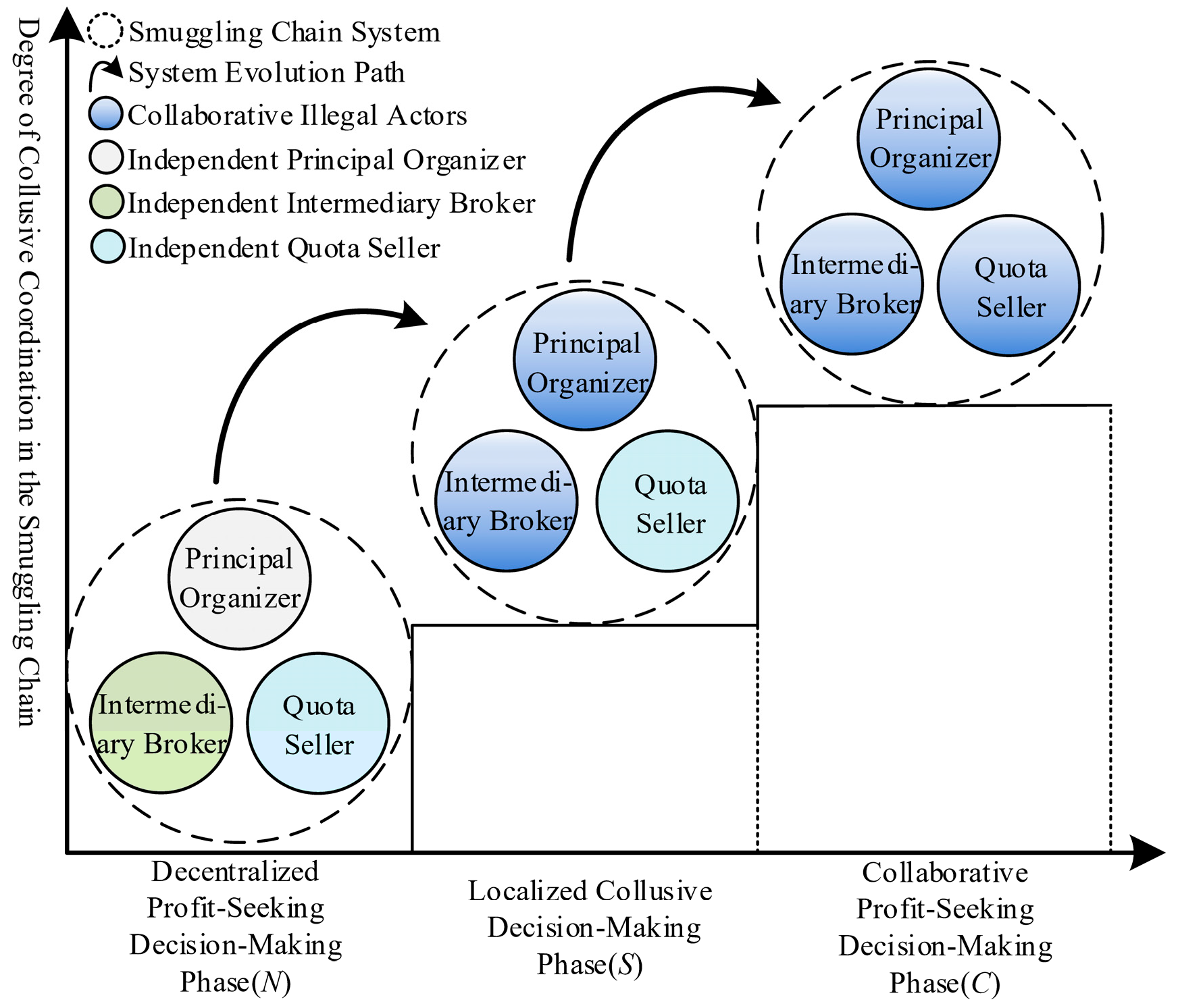
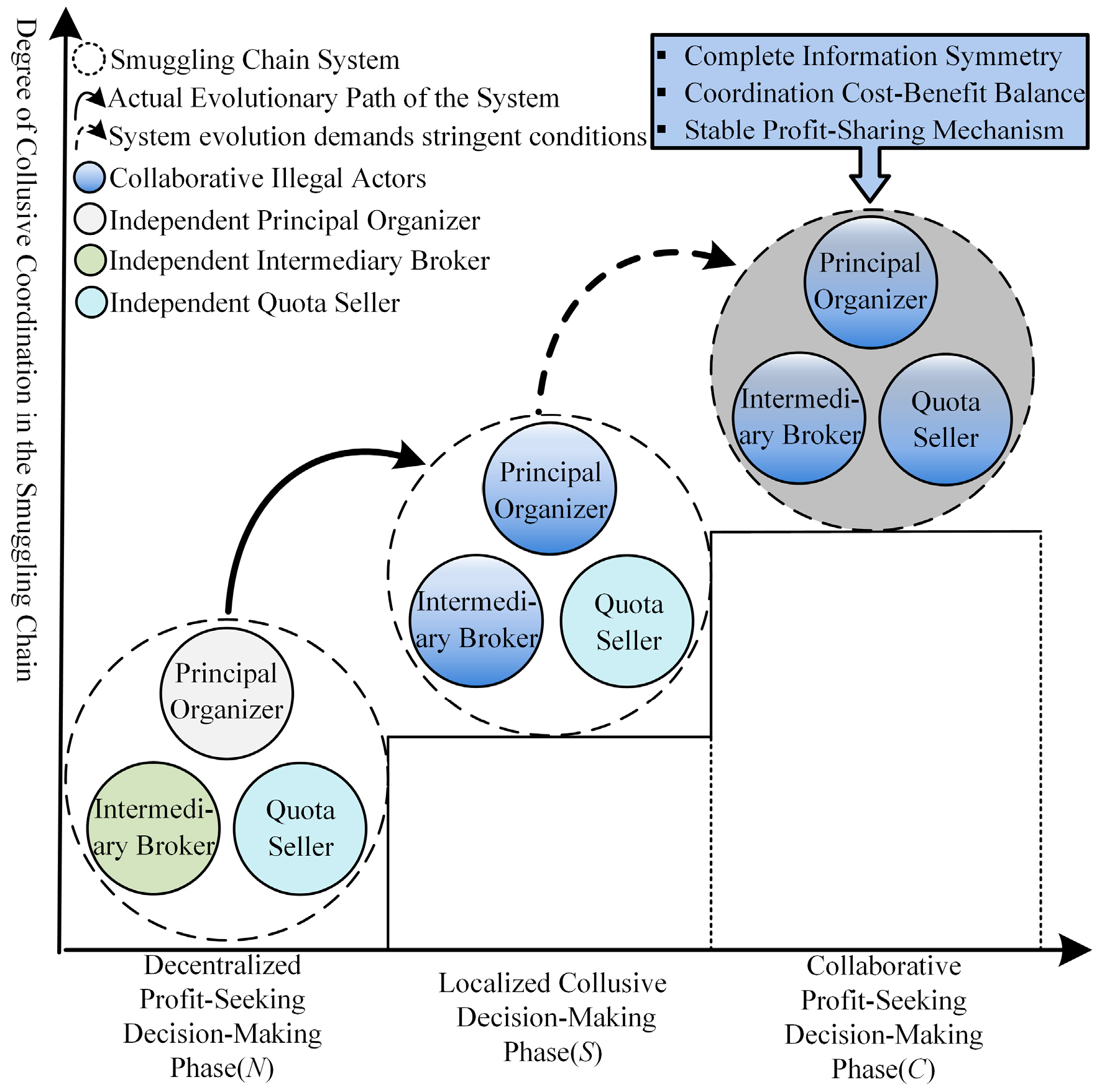
Based on the progressive contractual ties and coordination levels of illegal agents in the Duty-Free Quota Abuse Smuggling Chain System, this study constructed its Dynamic Decision-Making Model, which divides the chain’s decision-making into three phases: Decentralized Profit-Seeking, Localized Collusive and Collaborative Profit-Seeking Decision-Making Phases, as shown in Figure 2.
The Decentralized Profit-Seeking phase features autonomous decisions by the Principal Organizers, Intermediary Brokers, and Quota Sellers. Each illegal agent selects an optimal smuggling effort level under the dynamic constraint of the chain’s total smuggling effort to maximize individual smuggling gains. In the Localized Collusive phase, the Principal Organizers form localized alliances with Intermediary Brokers through cost-sharing—such as covering part of recruitment costs, supporting logistics channels for cargo consolidation and shipping, or subsidizing logistics fees. As Quota Sellers are numerous, geographically scattered, and non-core illegal agents, they are excluded from the cost-sharing scheme.
The Collaborative Profit-Seeking Decision-Making Phase shows that Quota Sellers exhibit significant similarities with the proxy smugglers identified in earlier smuggling governance studies when actually carrying out smuggling activities [2]. With the increase in duty-free allowances for departing passengers and the relaxation of shopping conditions, former proxy smugglers may be tempted to abuse duty-free quotas to smuggle for illegal profits, evolving into professional Quota Sellers or even Intermediary Brokers [2]. According to the principle of time consistency, partial alliances between Principal Organizers and Intermediary Brokers tend to stabilize over time, thus entering the cooperative profit-seeking decision stage. In this model, all illegal intermediaries optimize the collective profit of the smuggling network under the dynamic constraints of the overall smuggling effort level.
In summary, the decision-making behaviors and objectives of various illegal agents differ across distinct decision-making phases. The Dynamic Decision-Making Model for Duty-Free Quota Abuse Smuggling Chain System simulates the progression of illegal agents’ decision-making patterns from lower to higher levels and the upgrading of smuggling chain systems from loose to tightly integrated structures. This model systematically deconstructs the dynamic game characteristics of smuggling to enable phased, precision governance.

4.1. Decentralized Profit-Seeking Decision-Making Phase (N-Phase)

At this phase (where the superscript N denotes this phase), the illegal agents make independent decisions. The objective function for each agent is as follows (for analytical convenience, time t is omitted below):
max E Z J Z N = 0 e ρ t [ π Z ( N 0 + ε x ) 1 2 τ Z E Z 2 1 2 k Z E Z 2 λ Z x ] d t ,
max E H J H N = 0 e ρ t [ π H ( N 0 + ε x ) 1 2 τ H E H 2 1 2 k H E H 2 λ H x ] d t ,
max E P J P N = 0 e ρ t [ π P ( N 0 + ε x ) 1 2 τ P E P 2 1 2 k P E P 2 λ P x ] d t .
Proposition 1.
The optimal smuggling effort level of the Principal Organizers during the Decentralized Profit-Seeking Decision-Making Phase is:
E Z N * = ( π Z ε λ Z ) α ( τ Z + k Z ) ( ρ + δ ) .
The optimal smuggling effort level for the Intermediary Brokers is:
E H N * = ( π H ε λ H ) β ( τ H + k H ) ( ρ + δ ) .
The optimal smuggling effort level for the Quota Sellers is:
E P N * = ( π P ε λ P ) γ ( τ P + k P ) ( ρ + δ ) .
The optimal trajectory for the smuggling effort level within the smuggling chain is:
x N * = x N + ( x 0 x N ) e δ t .
In Equation (12),  x N = ( π Z ε λ Z ) α 2 ( τ Z + k Z ) δ ( ρ + δ ) + ( π H ε λ H ) β 2 ( τ H + k H ) δ ( ρ + δ ) + ( π P ε λ P ) γ 2 ( τ P + k P ) δ ( ρ + δ ) .
The optimal profit for the Principal Organizers is:
V Z N * = π Z ε λ Z ρ + δ x N * + π Z N 0 ρ + ( π Z ε λ Z ) 2 α 2 2 ( τ Z + k Z ) δ ( ρ + δ ) + ( π Z ε λ Z ) ( π H ε λ H ) β 2 ( τ H + k H ) δ ( ρ + δ ) + ( π Z ε λ Z ) ( π P ε λ P ) γ 2 ( τ P + k P ) δ ( ρ + δ ) .
The optimal profit for the Intermediary Brokers is:
V H N * = π H ε λ H ρ + δ x N * + π H N 0 ρ + ( π H ε λ H ) ( π Z ε λ Z ) α 2 ( τ Z + k Z ) δ ( ρ + δ ) + ( π H ε λ H ) 2 β 2 2 ( τ H + k H ) δ ( ρ + δ ) + ( π H ε λ H ) ( π P ε λ P ) γ 2 ( τ P + k P ) δ ( ρ + δ ) .
The optimal profit for the Quota Sellers is:
V P N * = π P ε λ P ρ + δ x N * + π P N 0 ρ + ( π P ε λ P ) ( π Z ε λ Z ) α 2 ( τ Z + k Z ) δ ( ρ + δ ) + ( π P ε λ P ) ( π H ε λ H ) β 2 ( τ H + k H ) δ ( ρ + δ ) + ( π P ε λ P ) 2 γ 2 2 ( τ P + k P ) δ ( ρ + δ ) .
The proof of Proposition 1 can be found in Appendix A.1. Proposition 1 reveals the dynamic equilibrium outcomes of illegal agents of Duty-Free Quota Abuse Smuggling during the Decentralized Profit-Seeking Decision-Making Phase. As the initial stage in the evolution of the smuggling chain’s decisions, this phase establishes a benchmark analytical framework for the non-cooperative game among illegal actors. Each illegal actor makes independent decisions to maximize personal benefits, with no coordination mechanism and structural obstacles to information exchange. This represents the behavioral logic of the early evolution of the smuggling chain.

4.2. Localized Collusive Decision-Making Phase (S-Phase)

At this phase (where the superscript S denotes this phase), the Principal Organizers and the Intermediary Brokers enter into a cost-sharing agreement for direct criminal cost, thereby forming a Localized Collusive Coalition. The cost-sharing ratio is θ , and the objective function for each agent is as follows:
max E Z J Z S = 0 e ρ t [ π Z ( N 0 + ε x ) 1 2 τ Z E Z 2 1 2 k Z E Z 2 θ 2 k H E H 2 λ Z x ] d t ,
max E H J H S = 0 e ρ t [ π H ( N 0 + ε x ) 1 2 τ H E H 2 1 θ 2 k H E H 2 λ H x ] d t ,
max E P J P S = 0 e ρ t [ π P ( N 0 + ε x ) 1 2 τ P E P 2 1 2 k P E P 2 λ P x ] d t .
Proposition 2.
The optimal smuggling effort level of the Principal Organizers during the Localized Collusive Decision-Making Phase is: 
E Z S * = ( π Z ε λ Z ) α ( τ Z + k Z ) ( ρ + δ ) .
The optimal smuggling effort level for the Intermediary Brokers is:
E H S * = ( π Z ε λ Z ) β ( τ H + k H ) ( ρ + δ ) + ( π H ε λ H ) β 2 ( τ H + k H ) ( ρ + δ ) .
The optimal proportion of cost-sharing provided by the Principal Organizers to the Intermediary Brokers is:
θ = ( 1 + τ H k H ) 2 ( π Z ε λ Z ) ( π H ε λ H ) 2 ( π Z ε λ Z ) + ( π H ε λ H ) .
The optimal smuggling effort level for the Quota Sellers is:
E P S * = ( π P ε λ P ) γ ( τ P + k P ) ( ρ + δ ) .
The optimal trajectory for the smuggling effort level within the smuggling chain is:
x S * = x S + ( x 0 x S ) e δ t .
In Equation (23),  x S = ( π Z ε λ Z ) α 2 ( τ Z + k Z ) δ ( ρ + δ ) + ( π Z ε λ Z ) β 2 ( τ H + k H ) δ ( ρ + δ ) + ( π H ε λ H ) β 2 2 ( τ H + k H ) δ ( ρ + δ ) + ( π P ε λ P ) γ 2 ( τ P + k P ) δ ( ρ + δ ) .
The optimal profit for the Principal Organizers is:
V Z S * = π Z ε λ Z ρ + δ x S * + π Z N 0 ρ + ( π Z ε λ Z ) 2 α 2 2 ( τ Z + k Z ) δ ( ρ + δ ) + ( π Z ε λ Z ) 2 β 2 2 ( τ H + k H ) δ ( ρ + δ ) + ( π H ε λ H ) 2 β 2 8 ( τ H + k H ) δ ( ρ + δ ) + ( π Z ε λ Z ) ( π H ε λ H ) β 2 2 ( τ H + k H ) δ ( ρ + δ ) + ( π Z ε λ Z ) ( π P ε λ P ) γ 2 ( τ P + k P ) δ ( ρ + δ ) .
The optimal profit for the Intermediary Brokers is:
V H S * = π H ε λ H ρ + δ x S * + π H N 0 ρ + ( π H ε λ H ) ( π Z ε λ Z ) α 2 ( τ Z + k Z ) δ ( ρ + δ ) + ( π H ε λ H ) ( π Z ε λ Z ) β 2 2 ( τ H + k H ) δ ( ρ + δ ) + ( π H ε λ H ) 2 β 2 4 ( τ H + k H ) δ ( ρ + δ ) + ( π H ε λ H ) ( π P ε λ P ) γ 2 ( τ P + k P ) δ ( ρ + δ ) .
The optimal profit for the Quota Sellers is:
V P S * = π P ε λ P ρ + δ x S * + π P N 0 ρ + ( π P ε λ P ) ( π Z ε λ Z ) α 2 ( τ Z + k Z ) δ ( ρ + δ ) + ( π P ε λ P ) ( π Z ε λ Z ) β 2 ( τ H + k H ) δ ( ρ + δ ) + ( π P ε λ P ) ( π H ε λ H ) β 2 2 ( τ H + k H ) δ ( ρ + δ ) + ( π P ε λ P ) 2 γ 2 2 ( τ P + k P ) δ ( ρ + δ ) .
The proof of Proposition 2 can be found in Appendix A.2. Proposition 2 reveals the dynamic equilibrium outcomes of illegal agents during the Localized Collusive Decision-Making Phase. This phase arises when the Principal Organizers, as the core coordinator of the smuggling chain, proactively initiate collusion to enhance chain stability and expand illicit profits. To sustain the coordinated operation of the smuggling network and ensure continuous profit growth, the Principal Organizers provide the Intermediary Brokers with a subsidy covering θ of the direct criminal costs. By reducing the Intermediary Brokers’ direct criminal costs and sharing their illegal risks, this incentivizes the Intermediary Brokers to expand the scale of smuggling operations and broaden channel coverage. Proposition 2 precisely delineates the “leader-follower” collusive logic within the smuggling chain, reflecting the strategic choice of illegal organizations to strengthen coordination through profit alignment.

4.3. Collaborative Profit-Seeking Decision-Making Phase (C-Phase)

At this phase (where the superscript C denotes this phase), the illegal agents engage in a collaborative profit-seeking decision to maximize overall profits. The decision objective of each agent is as follows:
max E Z , E H , E P J O C = 0 e ρ t [ ( π Z + π H + π P ) ( N 0 + ε x ) 1 2 ( τ Z + k Z ) E Z 2 1 2 ( τ H + k H ) E H 2 1 2 ( τ P + k P ) E P 2 ( λ Z + λ H + λ P ) x ] d t .
Proposition 3.
The optimal smuggling effort level of the Principal Organizers during the Collaborative Profit-Seeking Decision-Making Phase is:
E Z C * = [ ( π Z + π H + π P ) ε ( λ Z + λ H + λ P ) ] α ( τ Z + k Z ) ( ρ + δ ) .
The optimal smuggling effort level for the Intermediary Brokers is:
E H C * = [ ( π Z + π H + π P ) ε ( λ Z + λ H + λ P ) ] β ( τ H + k H ) ( ρ + δ ) .
The optimal smuggling effort level for the Quota Sellers is:
E P C * = [ ( π Z + π H + π P ) ε ( λ Z + λ H + λ P ) ] γ ( τ P + k P ) ( ρ + δ ) .
The optimal trajectory for the smuggling effort level within the smuggling chain is:
x C * = x C + ( x 0 x C ) e δ t .
In Equation (31),  x C = ( π Z + π H + π P ) ε ( λ Z + λ H + λ P ) δ ( ρ + δ ) ( α 2 τ Z + k Z + β 2 τ H + k H + γ 2 τ P + k P ) .
The optimal profit for the smuggling chain is:
V O C * = ( π Z + π H + π P ) ε ( λ Z + λ H + λ P ) ( ρ + δ ) x C * + ( π Z + π H + π P ) N 0 ρ + [ ( π Z + π H + π P ) ε ( λ Z + λ H + λ P ) ] 2 2 ρ ( ρ + δ ) 2 ( α 2 τ Z + k Z + β 2 τ H + k H + γ 2 τ P + k P ) .
The proof of Proposition 3 can be found in Appendix A.3. Proposition 3 reveals the dynamic equilibrium outcomes of Duty-Free Quota Abuse Smuggling during the Collaborative Profit-Seeking Decision-Making Phase. It assumes that the Principal Organizers, Intermediary Brokers, and Quota Sellers all aim to maximize overall illegal profits, forming a theoretically fully coordinated profit distribution and risk-sharing arrangement. This stage demonstrates the upper limit of illegal profits that can be achieved under ideal cooperative conditions in the smuggling chain. At the same time, by contrasting with the Decentralized Profit-Seeking Decision-Making Phase and the Localized Collusive Decision-Making Phase, it highlights the inherent constraints and organizational costs that smuggling organizations face in achieving coordination in the real world.
Inference 1.
Only when the marginal illegal profit  π j  of the law-breaking entity, the marginal conversion rate of smuggling effort into the exploited duty-free quotas  ε , and the risk avoidance coefficient  λ i  satisfy  π i ε λ i > 0  can the optimal smuggling effort level  E j i *  of the law-breaking entity at each phase satisfy, thereby ensuring  x j  > 0. At this point, the optimal trajectory  x j * ( t )  of smuggling efforts along the smuggling chain is non-negative and converges to  x j  at an exponential rate  δ . The proof of Inference 1 can be found in Appendix B.1.
Inference 2.
During the Localized Collusive Decision-Making Phase, only when  2 ( π Z ε λ Z ) > π H ε λ H  it occurs will the Principal Organizers share the direct criminal cost with the Intermediary Brokers, thereby establishing the cost-sharing agreement that guarantees  θ > 0 . The proof of Inference 2 can be found in Appendix B.2.
Inference 1 reveals the core logic behind illicit actors’ smuggling decisions: smuggling behavior fundamentally involves balancing potential profits against risk avoidance. Only when the marginal net profit potential π i ε covers the risk avoidance cost λ i will illicit actors engage in smuggling. Inference 2 further indicates that the key condition for the evolution of the smuggling chain from the Decentralized Profit-Seeking Decision-Making Phase to the Localized Collusive Decision-Making Phase is 2 ( π Z ε λ Z ) > π H ε λ H , which is essentially a dynamic rebalancing of risks and rewards within the chain [45]. During the Localized Collusive Decision-Making Phase, decision-making among actors adheres to the risk premium compensation principle. When the Principal Organizers’ marginal profit significantly exceeds that of the Intermediary Brokers, the former will share part of the direct criminal costs with the latter to compensate for the Intermediary Brokers’ risk premium gap, thereby maintaining the stability of the smuggling chain.
Inference 3.
At all decision-making phases, the level of optimal smuggling effort  E i j *  exerted by each illegal agent is negatively correlated with its opportunity cost coefficient  τ i  and direct crime cost coefficient  k i , and positively correlated with the smuggling effort to quota conversion rate  ε . The proof of Inference 3 can be found in Appendix B.3.
Inference 4.
The level of optimal smuggling effort  E i j *  undertaken by each agent during the Decentralized Profit-Seeking Decision-Making Phase is negatively correlated with its own risk avoidance coefficient  λ i . In the Localized Collusive Decision-Making Phase, the optimal smuggling effort level  E H j *  of the Intermediary Brokers is negatively correlated with their risk avoidance coefficient  λ H  and the Principal Organizers’ risk avoidance coefficient  λ Z . In the Collaborative Profit-Seeking Decision-Making Phase, the optimal smuggling effort level  E i j *  of each illegal agent is jointly influenced by the risk avoidance coefficients  λ i  of all agents, meaning it is negatively correlated with  λ i . The proof of Inference 4 can be found in Appendix B.4.
Inferences 3 and 4 reveal the multidimensional mechanism by which illegal agents of Duty-Free Quota Abuse Smuggling determine the optimal level of smuggling effort. At each decision-making stage, the smuggling effort level of each actor is negatively correlated with the opportunity cost coefficient and the direct criminal cost coefficient, while positively correlated with the smuggling effort conversion efficiency, as shown in Table 3. This reflects the central constraining role of cost-benefit factors in smuggling behavior. Simultaneously, the influence of the risk avoidance coefficient exhibits phased differentiation: in the Decentralized Profit-Seeking Decision-Making Phase, it is solely influenced by the subject itself; in the Localized Collusive Decision-Making Phase, the Intermediary Brokers are influenced by both itself and the Principal Organizers; while in the Collaborative Profit-Seeking Decision-Making Phase, it is jointly constrained by the risk attitudes of all subjects.

4.4. Comparative Analysis of Equilibrium Outcomes

A comparative analysis of the equilibrium results for the Dynamic Decision-Making Model for Duty-Free Quota Abuse Smuggling Chain Systems can yield the following inferences:
Inference 5.
Comparing the three decision-making stages, the overall smuggling effort levels of the smuggling chain are ranked as  x N * < x S * < x C * , the highest level occurs during the Collaborative Profit-Seeking Decision-Making Phase; relative to the Decentralized Profit-Seeking Decision-Making Phase, the overall smuggling effort level within the chain is higher during the Localized Collusive Decision-Making Phase. The proof of Inference 5 can be found in Appendix B.5.
Inference 6.
Comparing the three decision-making phases, the relationship among the smuggling effort levels of the Principal Organizers is  E Z N * = E Z S * < E Z C * , that of the Intermediary Brokers is  E H N * < E H S * < E H C * , and that of the Quota Sellers is  E P N * = E P S * < E P C * . That is, during the Collaborative Profit-Seeking Decision-Making Phase, all illegal agents exert maximum effort to carry out smuggling activities. Compared to the Decentralized Profit-Seeking Decision-Making Phase, during the Localized Collusive Decision-Making Phase, the smuggling effort levels of the Principal Organizers and Quota Sellers did not significantly increase, but the smuggling effort level of the Intermediary Brokers did rise. The proof of Inference 6 can be found in Appendix B.6.
Inference 7.
Comparing the Decentralized Profit-Seeking Decision-Making Phase and the Localized Collusive Decision-Making Phase, the optimal profit relationship for the Principal Organizers is  V Z S * > V Z N * , for the Intermediary Brokers is  V H S * > V H N * , and for the Quota Sellers is  V P S * > V P N * . Comparing the three decision phases, the overall optimal profit relationship for the smuggling chain is  V O C * > V O S * > V O N * . Therefore, in the Localized Collusive Decision-Making Phase, all entities within the smuggling chain can achieve a Pareto improvement in profits; in the Collaborative Profit-Seeking Decision-Making Phase, the overall optimal profit of the smuggling chain reaches its maximum. The proof of Inference 7 can be found in Appendix B.7.
According to Inferences 5~7, the evolution of the smuggling chain from the Decentralized Profit-Seeking Decision-Making Phase to the Localized Collusive Decision-Making Phase and further to the Collaborative Profit-Seeking Decision-Making Phase drives a stepped increase in smuggling efforts and illegal profits of all agents, with the Collaborative Profit-Seeking Decision-Making Phase reaching the peak of smuggling harm. As a key node in the chain’s upgrading, the Localized Collusive Decision-Making Phase has achieved a Pareto improvement in the profits of all agents, and the increased efforts of the Intermediary Brokers in this phase serve as the core driver of this evolution. There is a clear positive correlation between the degree of collusion among illegal agents, illegal profits, and the intensity of their activities. To effectively combat the misuse of Duty-Free Quota Abuse Smuggling, it is necessary to block the evolutionary path of this chain from decentralization to collusion and cooperation, particularly by strengthening mutual intervention during the Localized Collusive Decision-Making Phase to curb the escalation of smuggling activities and the expansion of illegal profits.

5. Numerical Simulation

To provide a more intuitive analysis of the equilibrium outcomes of decision-making systems across different decision stages, this study employs MATLAB software for case analysis. The simulation experiments in this study utilize actual data from Hainan, China, as the benchmark parameter source. By searching the China Judgments Online database using the keywords “Duty-Free Quota Abuse Smuggling” and “Criminal Case Reason,” a total of 50 criminal judgment documents were retrieved as of September 30, 2024. Further filtering with the keyword “tax evasion amount exceeding 100,000 CNY” ultimately identified 19 criminal judgment documents. Text analysis and data collation of these 19 criminal judgments yielded Table 4.
This study sets the maximum illegal profit margin for Duty-Free Quota Abuse Smuggling as the average tax-free rate for frequently smuggled goods, based on the following logic: The illegal profits from Duty-Free Quota Abuse Smuggling originate from tax exemptions under the Off-Island Duty-Free Policy. Therefore, the total tax rate for off-island duty-free purchases of each frequently smuggled commodity must first be calculated, followed by determining its expected tax-free rate. The illegal profit margin for Duty-Free Quota Abuse Smuggling must remain below this expected value—if the margin exceeds this threshold, the resale price of smuggled goods would surpass market rates, rendering transactions unfeasible. As shown in Table 5, Hainan’s duty-free policy exempts imported goods from import tariffs, import-stage VAT, and consumption tax. The duty-free product categories include 45 types, such as cosmetics and consumer electronics. Among these, perfumes and cosmetics, alcoholic beverages, and luggage are high-risk categories for Duty-Free Quota Abuse Smuggling [46]. The average duty-free rate for perfumes and cosmetics, alcoholic beverages, and luggage is 175.18%. The detailed calculation process is presented in Appendix C.1.
r a t e ¯ = 1 11 h = 1 11 ( r a t e h O r d i n a r y   T a r i f f + r a t e h I m p o r t   V A T + r a t e h C o n s u m p t i o n   T a x ) = 175.18 % .
Here, r a t e ¯ denotes the average duty-free rate for goods frequently smuggled via Duty-Free Quota Abuse Smuggling, while r a t e h O r d i n a r y   T a r i f f , r a t e h I m p o r t   V A T and r a t e h C o n s u m p t i o n   T a x ( h { 1 , 2 , , 11 } ) represent the Ordinary Tariff, Ordinary Tariff, and Import VAT, respectively, for the duty-free goods frequently smuggled via Duty-Free Quota Abuse Smuggling listed in Table 5.
( π Z + π H + π P ) ( N 0 + ε x ) ( π Z + π H + π P ) ( N 0 + ε x ) ( 1 2 k Z E Z 2 + 1 2 k H E H 2 + 1 2 k P E P 2 ) × 100 % < 175.18 % .
Based on Table 5 and Equation (34), this study sets the benchmark parameters as ρ = 0.1 , π Z = 2 , π H = 1.1 , π P = 0.5 , N 0 = 3 , τ Z = 0.3 , τ H = 0.12 , τ P = 0.08 , k Z = 0.5 , k H = 0.35 , k P = 0.15 , ε = 0.7 , α = 0.7 , β = 0.5 , γ = 0.3 , δ = 0.2 , x 0 = 15 . From Propositions 1~3, it follows that π i ε λ i > 0. Calculating the risk avoidance coefficient λ i using the aforementioned benchmark parameters yields the following value ranges: λ Z [0, 1], λ H [0, 0.77], and λ P [0, 0.35]. Therefore, λ Z = 0.35 , λ H = 0.2 , and λ P = 0.1 are set accordingly.
To clearly illustrate the dynamic relationships and comparative outcomes between key variables under different parameter sets, all quantities presented in the following figures are dimensionless and normalized relative to their baseline or equilibrium values. This treatment facilitates a generic analysis of system behavior and trend comparisons, without loss of generality in the qualitative insights.

5.1. Analysis of the Decision-Making Evolutionary Path with the Smuggling Chain System

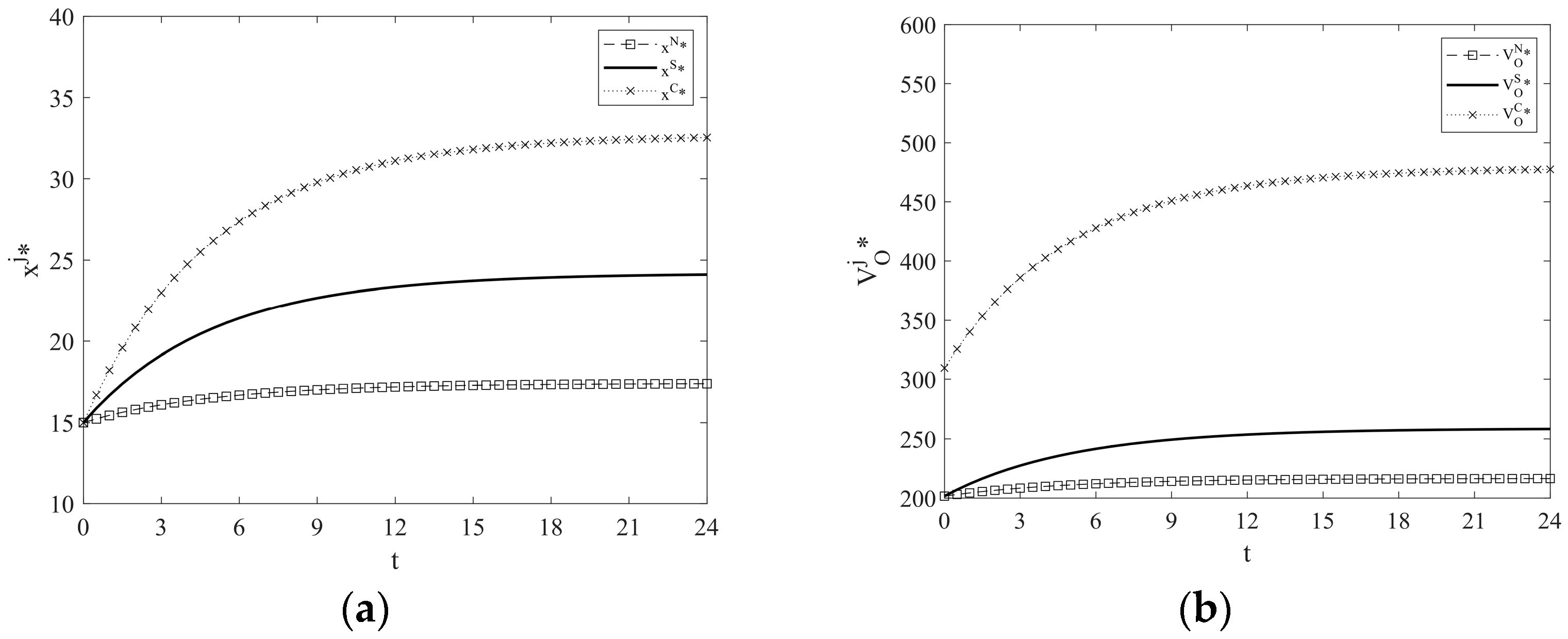
As shown in Figure 3, over time t , the optimal trajectories of the overall smuggling effort level x j * and overall profit V O j * for the Duty-Free Quota Abuse Smuggling Chain across three decision phases exhibit an increasing trend and gradually stabilize. This indicates that once Duty-Free Quota Abuse Smuggling commences, driven by substantial illicit gains, the smuggling chain progressively commits greater smuggling effort. However, constrained by legal sanctions stemming from the illegality and high risk of surrogate smuggling, as well as conflicts of interest among illegal agents, the overall smuggling effort level and optimal profit of the smuggling chain gradually converge. During the Collaborative Profit-Seeking Decision-Making Phase, the overall optimal profit V O C * and overall smuggling effort level x C * consistently exceed those of the other two decision-making phases. Comparing the Decentralized Profit-Seeking Decision-Making Phase with the Localized Collusive Decision-Making Phase, the overall optimal profit V O S * and overall smuggling effort level x S * in the Localized Collusive Decision-Making Phase consistently surpass the overall optimal profit V O N * and overall smuggling effort level x N * in the Decentralized Profit-Seeking Decision-Making Phase, consistent with Inferences 4 and 6. This indicates that both the overall optimal profit V O j * and the overall smuggling effort level x j * of the smuggling chain are significantly and positively correlated with the coordination strength of the smuggling chain system.
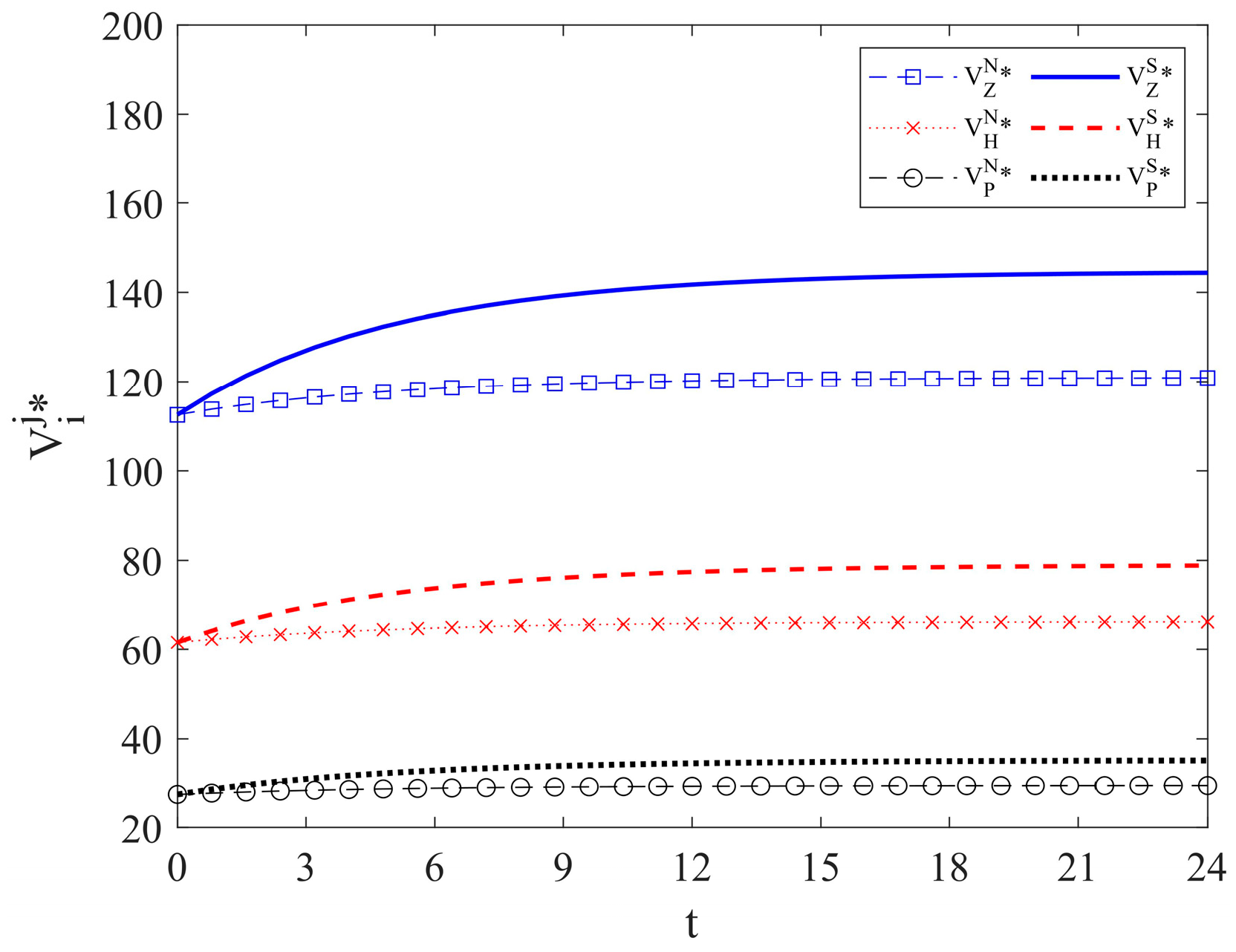
Figure 4 illustrates the optimal profit trajectories over time t for each agent in the smuggling chain during the Decentralized Profit-Seeking Decision-Making Phase and the Localized Collusive Decision-Making Phase. It shows that the Principal Organizers, as the orchestrators of smuggling activities, achieve the highest illicit profits, followed by the Intermediary Brokers. The Quota Sellers, positioned at the lowest tier of the smuggling chain, experience the lowest profit levels. The optimal profit V i j * for each illegal agent under localized collusive decision-making consistently exceeds the optimal profit V i j * under decentralized profit-seeking decision-making. This demonstrates that all illegal agents achieve a Pareto improvement in profits under localized collusive decision-making, consistent with Inference 7. Even the Quota Sellers, who do not directly participate in the cost-sharing contract, experience an increase in optimal profit compared to decentralized profit-seeking. The localized collusive alliance between the Principal Organizers and Intermediary Brokers generates a positive externality for the Quota Sellers’ optimal profit.
In reality, the primary participants in Duty-Free Quota Abuse Smuggling predominantly consist of unemployed individuals, farmers, students, and self-employed persons [2]. These key offenders exhibit high mobility and low levels of coordination. Simultaneously, since the optimal profit level for Quota Sellers is significantly lower than that for Principal Organizers and Intermediary Brokers, the internal organizational structure of the smuggling chain remains unstable. The large-scale supply of “professional Quota Sellers” is unsustainable, with most participants still being temporary, discrete ordinary tourists [46]. Consequently, the duty-free quota abuse smuggling chain rarely evolves into a stable, coordinated profit-seeking structure, C-phase, in practice.
As shown in Figure 5, the implementation of the C-phase depends on a series of stringent and highly idealized conditions. First, it requires complete information symmetry among all participants [47,48], ensuring consistent access to key operational data such as quota supply, inspection systems, market demand, and allocation rules. Due to the widespread dispersion of information and deliberate concealment, such transparency is inherently low in illegal transactions [49]. Second, the coordination costs, including communication, organization, and supervision, must be significantly lower than the marginal gains derived from centralized cooperation [50]. However, given the high mobility and geographic dispersion of typical participants such as tourists and informal labor, this economic threshold is difficult to achieve. Finally, the architecture of C-phase relies on a stable and enforceable profit-sharing mechanism that can adequately compensate the Quota Sellers for their relatively low baseline profits. The informality and illegality of the industry chain rule out legally binding contracts, making a credible commitment to such a mechanism impossible. In the absence of these fundamental preconditions, the system’s actual evolution is unlikely to reach the theoretically optimal C-phase (Collaborative Profit-Seeking Decision-Making Phase) but will instead converge to the locally collusive S-phase (Localized Collusive Decision-Making Phase). By drawing on the methodological approach adopted in the authoritative game theory literature for addressing such discrepancies [51,52], we derive Inference 8.
Inference 8.
In reality, the decision-making model of Duty-Free Quota Abuse Smuggling Chain evolves gradually from the Decentralized Profit-Seeking Decision-Making Phase to the Localized Collusive Decision-Making Phase, ultimately stabilizing at the Localized Collusive Decision-Making Phase.
The simulation results in this section indicate that it is difficult for the smuggling chain system to achieve a fully coordinated profit-maximizing decision state in practice. Its decision-making pattern mainly manifests in two distinct phases: the Decentralized Profit-Seeking Decision-Making Phase and the Localized Collusive Decision-Making Phase. Ultimately, the system stabilizes at the Localized Collusive Decision-Making Phase. According to Inference 2, the mechanism for the formation of local alliances originates from the dynamic rebalancing of risk and reward within the smuggling chain, manifested as risk premium compensation provided by the Principal Organizers to Intermediary Brokers to maintain system stability. Based on Inference 8, the subsequent simulation experiments in this study will focus on analyzing the Decentralized Profit-Seeking Decision-Making Phase and the Localized Collusive Decision-Making Phase.

5.2. Analysis of the Impact of Crime Cost Correlation Coefficients on Smuggling Effort Levels Among Different Agents

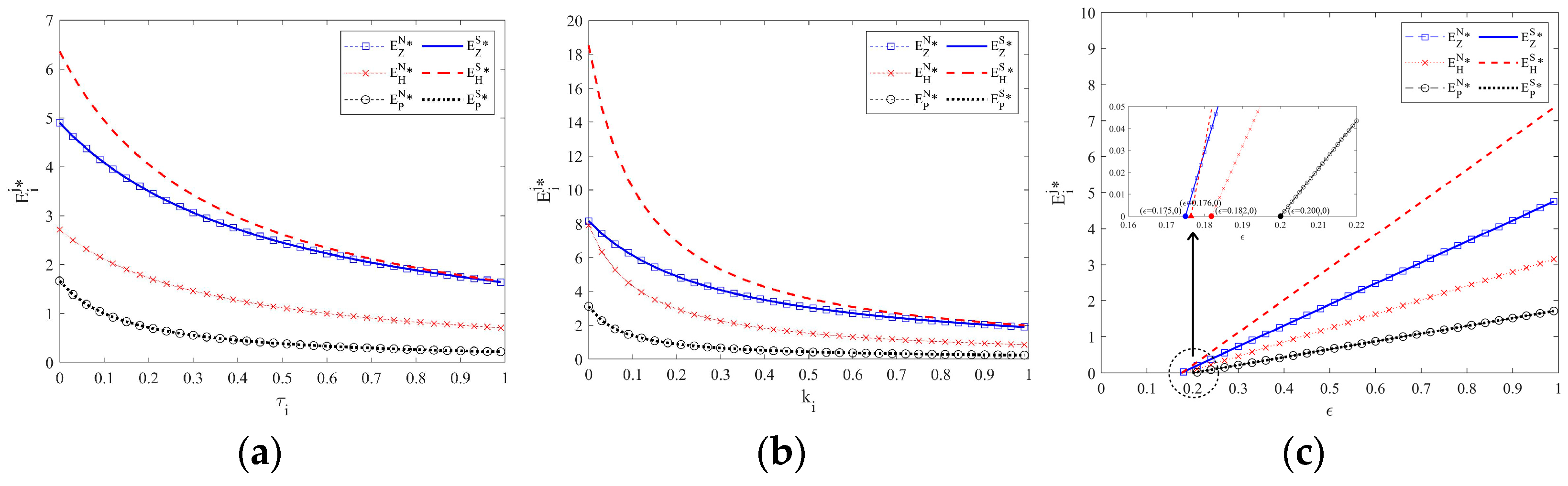
The opportunity cost coefficient τ i , direct crime cost coefficient k i , and smuggling effort conversion rate ε are all related to crime costs, directly influencing the smuggling effort levels E i j * of illegal agents and serving as critical considerations when designing governance strategies. Figure 6a–c, respectively, illustrate how the smuggling effort levels E i j * of various agents within the proxy purchasing smuggling chain system vary with changes in τ i , k i , and ε .
As shown in Figure 6, the opportunity cost coefficient τ i and the crime cost coefficient k i exert similar effects on the smuggling effort level E i j * of each agent. As τ i and k i increase, E i j * exhibits an exponential and monotonically decreasing trend. Conversely, as the conversion rate of smuggling effort ε increases, the smuggling effort level E i j * of each agent shows a linear and monotonically increasing trend, consistent with Inference 3.
Further examination of Figure 6c reveals that when ε < 0.175, the smuggling effort levels of the Principal Organizers under both decentralized profit-seeking and local coalition decisions are zero. When ε < 0.176, the smuggling effort level of the Intermediary Brokers under the local coalition decision is zero. When ε < 0.182, the smuggling effort level of the Intermediary Brokers under the decentralized profit-seeking decision is zero. When ε < 0.2, the smuggling effort levels of the Quota Sellers under both decentralized profit-seeking and local coalition decisions are both 0. Therefore, the Quota Sellers at the downstream end of the smuggling chain are the most sensitive individuals to the smuggling effort conversion rate ε . When ε falls below the critical value, the Quota Sellers exit the smuggling chain, leading to the collapse of the entire smuggling chain. Under the baseline simulation parameters of this study, the critical threshold for the collapse of the smuggling chain is ε = 0.2.
Figure 6 also illustrates the comparative results of smuggling effort levels across different decision-making phases. Compared to the Decentralized Profit-Seeking Decision-Making Phase, the smuggling effort level E H j * of the Intermediary Brokers during the Localized Collusive Decision-Making phase significantly increases, even surpassing that of the Principal Organizers. Meanwhile, the smuggling effort levels of both the Principal Organizers and the Quota Sellers show no significant change, indicating that their smuggling efforts remain unaffected by the Localized Collusive Coalition—consistent with Inference 6. From the perspective of smuggling effort levels, the Localized Collusive Coalition between the Principal Organizers and the Intermediary Brokers not only incentivizes the Intermediary Brokers to increase smuggling effort but also enables the Principal Organizers and Quota Sellers to achieve profit growth without requiring additional smuggling effort. Therefore, compared to fully coordinated decision-making, Localized Collusive Coalition more readily achieves Pareto improvements in profits and better aligns with actual smuggling practices, further validating the validity of Inference 8.
This section’s simulation experiments demonstrate that illegal actors exhibit high sensitivity to potential costs, with their behavior displaying distinct self-restraint characteristics. As cost constraints tighten, illegal investments across all actors within the system exhibit a systematic decline. However, the stability of this self-restraint mechanism is context-dependent and may be compromised under specific conditions. The mechanism can be undermined by the lure of exorbitant profits, which distorts conventional risk-reward calculations. It may also degrade in the presence of systemic enforcement loopholes or corruption, which lowers the perceived certainty of costs. While local coalition decisions enhance the Intermediary Brokers’ ability to cope with uncertainty in smuggling effort conversion rates, the entire smuggling chain tends to collapse when conversion rates fall below a critical threshold, due to the withdrawal of the Quota Sellers at the chain’s downstream end. The study further reveals that the sensitivity of illegal actors’ smuggling effort levels across different decision-making stages follows identical patterns, indicating that their smuggling efforts exhibit generalizability and remain unaffected by the intensity of system coordination.
The discount factor ρ determines the value of future returns relative to current returns. To ensure our findings are not attributable to specific time preference assumptions, we rigorously tested their robustness under varying ρ values. Specifically, we selected three representative ρ values—0.05, 0.10, and 0.12—and analyzed their impact on key static outcomes of the game system. Table 6 demonstrates that while the absolute levels and convergence rates of core variables—including the optimal overall effort level x j * , overall optimal profit V O j * , optimal profit V i j * , and enforcement effort V O j * —undergo quantitative adjustments, the equilibrium comparison results (Inference 5~7) maintain consistent validity across all tested values.

5.3. Analysis of the Impact of Risk Avoidance Preferences on Dynamic Decision-Making in the Smuggling Chain System

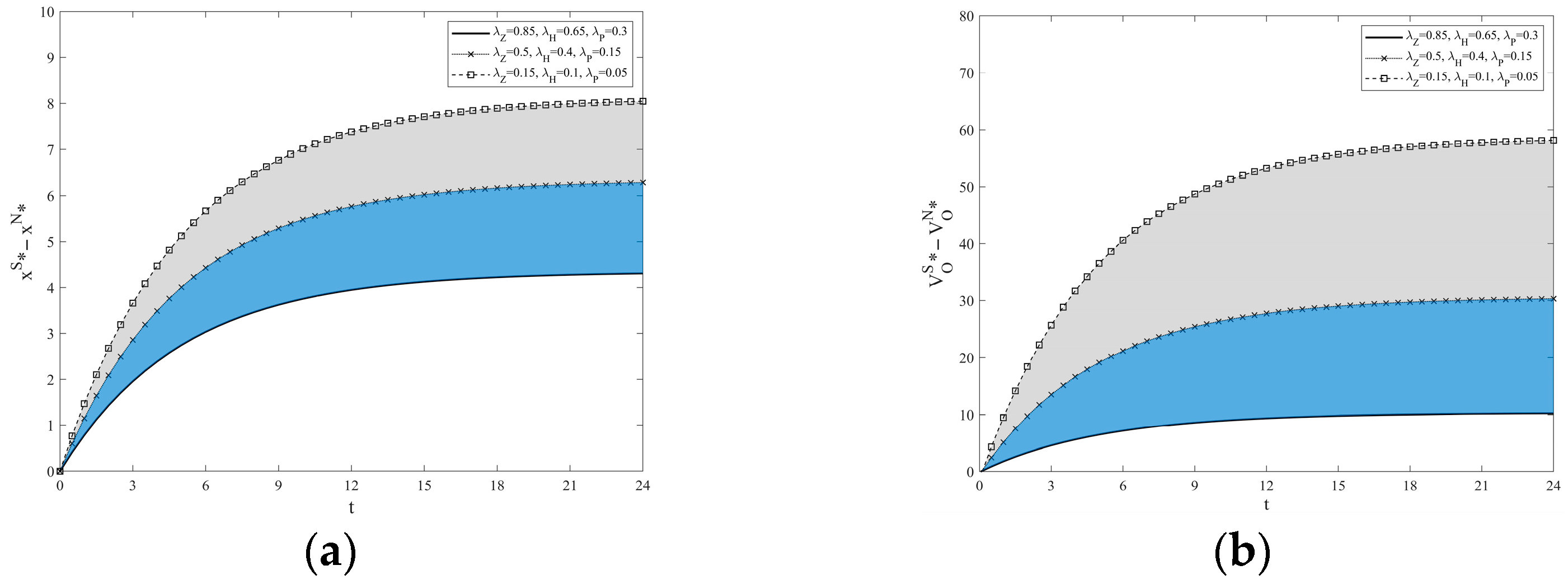
Risk avoidance preferences reflect how illegal agents adjust their decisions when confronting uncertainties such as smuggling environments and regulatory measures. To examine the impact of risk avoidance preferences on the decision evolution of the smuggling chain system and the strategy selection of illegal actors, this study defines the incremental smuggling effort x S * x N * and the alliance smuggling dividend V O S * V O N * for the Decentralized Profit-Seeking Decision-Making Phase and the Localized Collusive Decision-Making Phase. Drawing on Araujo et al., extremely high risk avoidance preferences are set as the risk aversion scenario, while extremely low risk avoidance preferences are set as the risk loving scenario [53]. The moderate risk avoidance preference was set as the risk-neutral scenario, referencing Zhu et al. [54]. The parameter settings for the risk avoidance preferences are as shown in Table 7, except for the risk avoidance coefficient, all other baseline parameters remained consistent with the preceding model.
Figure 7 illustrates how two variables change over time t A under different risk avoidance scenarios. It shows that, given a specific risk avoidance preference, both the incremental smuggling effort x S * x N * and the smuggling dividend V O S * V O N * increase as time t progresses. The gray area depicts the transition from risk loving scenario to risk neutrality scenario, illustrating changes in the incremental smuggling effort and smuggling dividend. The blue area shows the transition from the risk neutrality scenario to the risk aversion scenario. As risk avoidance increases, both the incremental smuggling effort and the smuggling dividend decline significantly. Further observation of the trend in Figure 7 reveals that as risk avoidance increases, the incremental coalition smuggling effort x S * x N * and the coalition smuggling dividend V O S * V O N * converge toward the steady state at a faster rate.
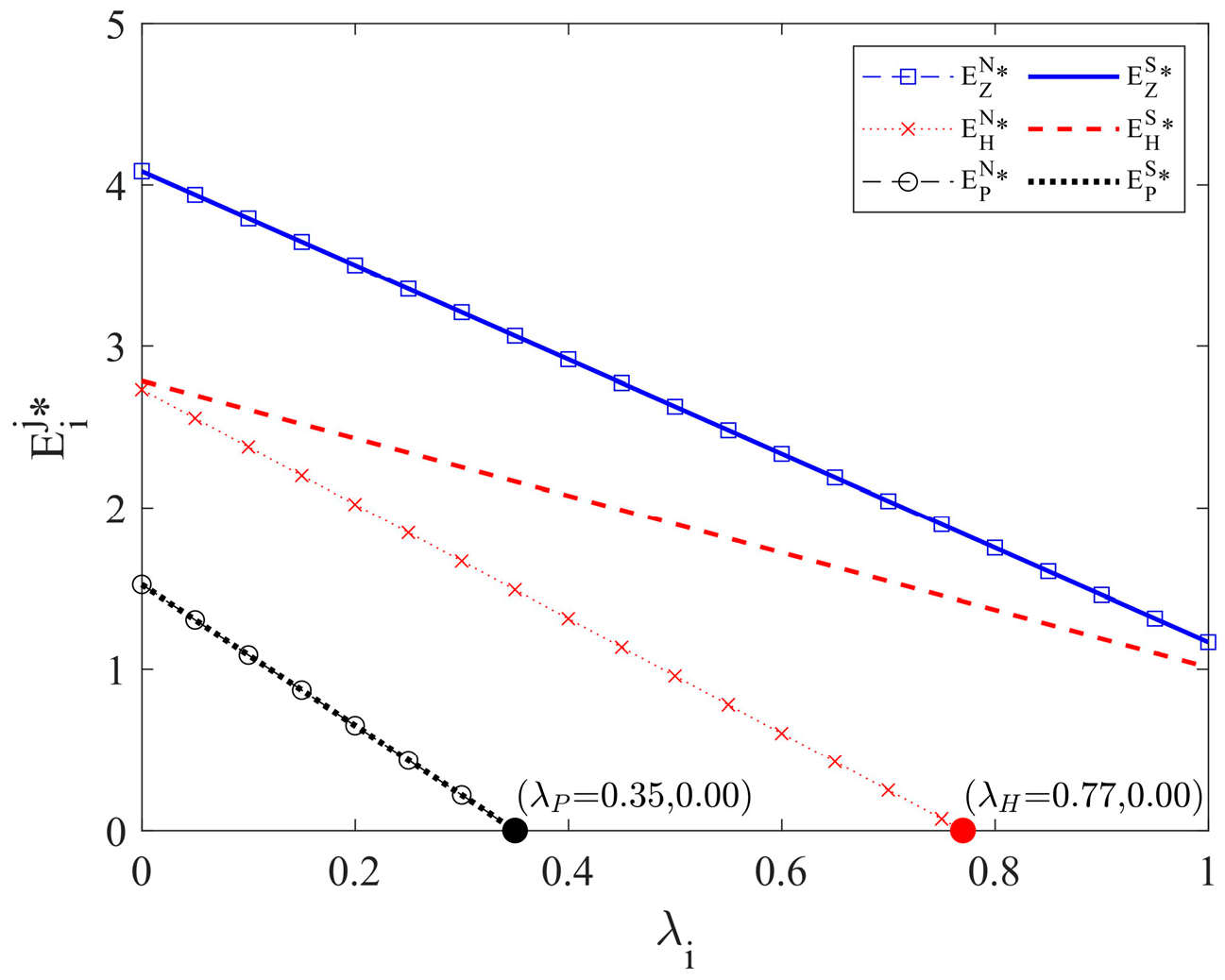
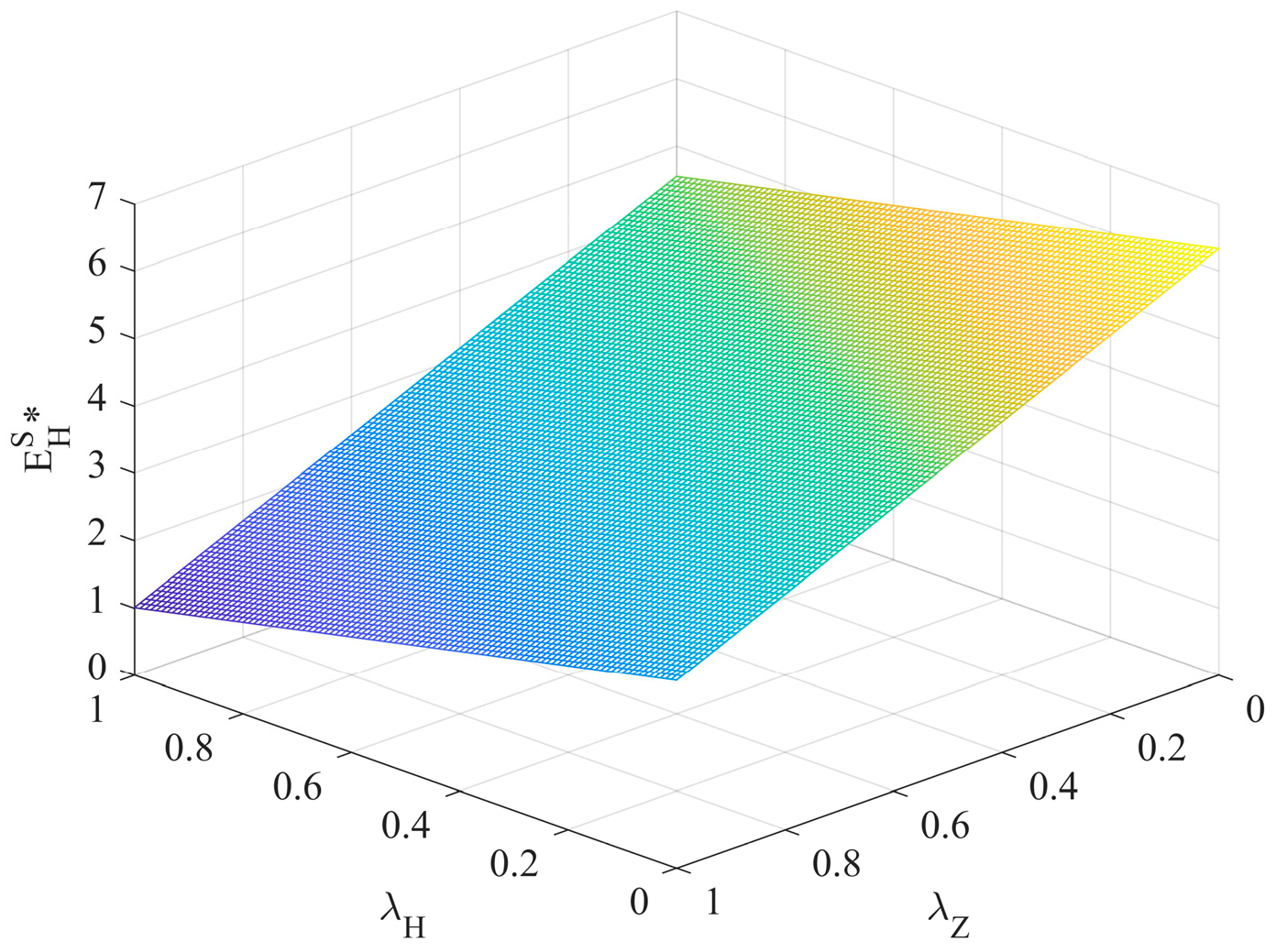
Figure 8 and Figure 9 illustrate the impact of risk avoidance preference λ i on the smuggling effort level E i j * of each agent under different decision-making phases. Figure 9 indicates that the smuggling effort level E H S * of each agent is significantly negatively correlated with its risk avoidance preference A. Figure 9 reveals that during the local coalition phase, the smuggling effort level λ H of the Intermediary Brokers is not only negatively correlated with its own risk avoidance preference A but is also negatively influenced by the Principal Organizers’ risk avoidance preference λ Z , exhibiting higher sensitivity to the latter. This aligns with Inference 4.
Further examination of Figure 8 reveals that the Quota Sellers exhibit the lowest risk avoidance threshold among all agents. When the risk avoidance coefficient equals 0.35, the Quota Sellers’ smuggling effort drops to zero during both the Decentralized Profit-Seeking Decision-Making Phase and Localized Collusive Decision-Making Phase, effectively exiting the smuggling chain. In contrast, the formation of a local coalition enhances the Intermediary Brokers’ risk resilience, enabling it to continue operating at higher risk avoidance thresholds—consistent with Inference 2. As the organizational core and primary beneficiary of Duty-Free Quota Abuse Smuggling, the Principal Organizers exhibit the highest risk avoidance threshold, demonstrating greater risk tolerance.
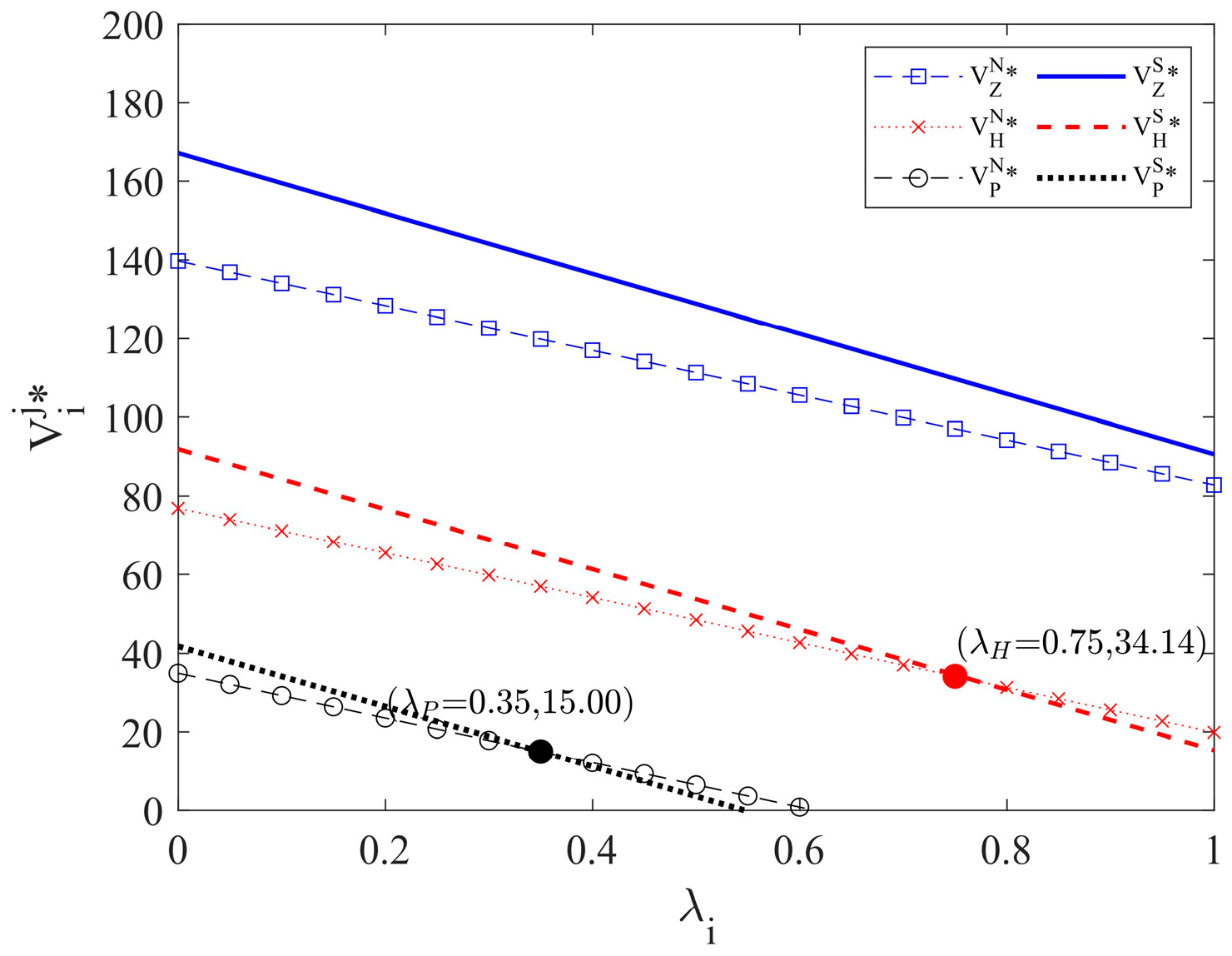
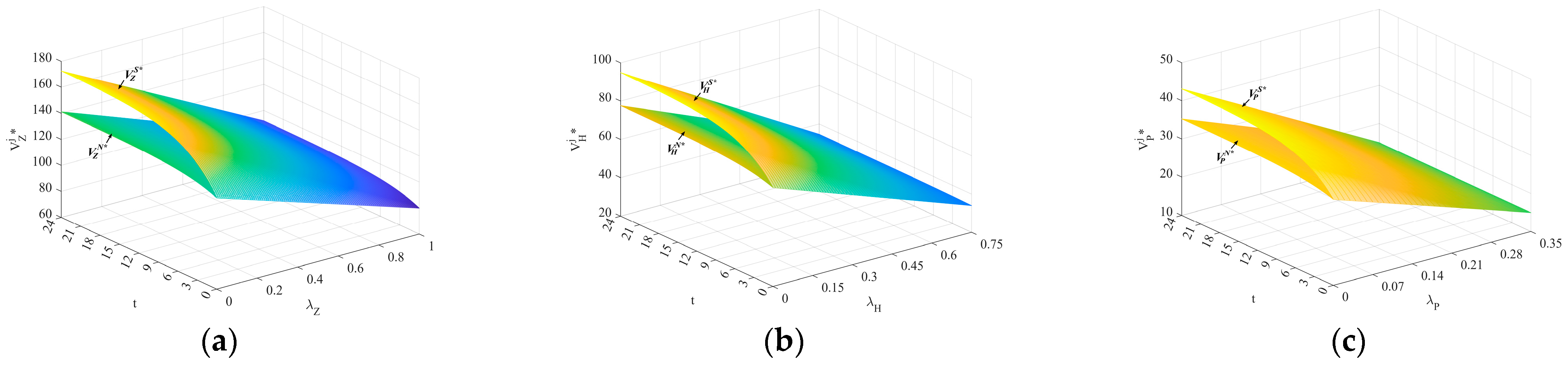
Figure 10 illustrates how the optimal profit of each agent varies with the risk avoidance coefficient λ i . To prevent multiple solutions, we fixed t = 6. As shown in Figure 10, regardless of whether during the Decentralized Profit-Seeking Decision-Making Phase or the Localized Collusive Decision-Making Phase, the optimal profit V i j * of each agent monotonically decreases linearly with the risk avoidance coefficient λ i . When the Quota Sellers risk avoidance preference coefficient λ P = 0.35, since its value exceeds the range [0, 0.35], the V P S * < V P N * paradox occurs, validating the rationality of the benchmark parameter settings established earlier. This validates the rationality of the benchmark parameter settings established earlier. When the risk avoidance coefficient λ H of the Intermediary Brokers exceeds 0.75, it fails to meet the critical condition 2 ( π Z ε λ Z ) > π H ε λ H for the formation of the Localized Collusive Coalition as stated in Inference 2. At this point, V H S * < V H N * and the Localized Collusive Coalition between the Principal Organizers and the Intermediary Brokers breaks down, validating the reasonableness of Inference 2. As shown in Figure 11, removing the time t constraint reveals the same trend at every time point.
This section’s simulation experiments demonstrate that the risk avoidance preferences of illegal agents significantly reduce their optimal profits and smuggling effort levels. This negative impact does not diminish over time, with Quota Sellers exhibiting the lowest tolerable risk avoidance threshold among all agents. Localized Collusive Coalition enhances the risk resilience of Intermediary Brokers, yet their smuggling efforts are simultaneously constrained by both their own and the Principal Organizers’ risk avoidance preferences. They also exhibit heightened sensitivity to the Principal Organizers’ risk preferences. Increased risk avoidance not only diminishes the profits gained through alliances but also accelerates the system’s convergence to a steady state, thereby shortening the accumulation cycle of illicit profits.

6. Conclusions and Implications

Incorporating the risk avoidance preferences of illegal agents, this research develops a dynamic decision-making model targeting the Quota-Exploiting Surrogate Smuggling Chain System. It conducts an analytical exploration of the equilibrium states of this smuggling chain system during three distinct phases, namely the Decentralized Profit-Seeking Decision-Making Phase, Localized Collusive Decision-Making Phase, and Collaborative Profit-Seeking Decision-Making Phase. Subsequently, relying on computational simulations, the study examines the evolutionary trajectory of the internal organizational structure and profit distribution mechanisms within the smuggling chain as it transitions from decentralization to coordination. Additionally, it explores the effects of risk avoidance preferences on both the collective and individual smuggling strategies and illegal profits of the chain’s participants, and provides relevant implications.
(1) The decision-making structure of the smuggling chain system ultimately converges to a localized collusive pattern. This convergence arises from the risk premium compensation provided by the Principal Organizers to the Intermediary Brokers to sustain systemic stability. The simulation identifies a precise condition for this coalition’s stability 2 ( π Z ε λ Z ) > π H ε λ H . Therefore, countermeasures must disrupt this financial compensation to invalidate the stability condition. Regulatory actions should directly target and asymmetrically increase the risk avoidance of Principal Organizers and Intermediary Brokers ( λ Z , λ H ). Enhanced monitoring of illicit fund flows and stringent penalties for financial violations are predicted to increase, pushing it toward the risk avoidance of Principal Organizers λ Z > 0.75. By disrupting the risk premium channel, this approach directly attacks the foundation of the coalition, leading to its collapse.
(2) Faced with heightened cost constraints, all illegal agents exhibit a systemic decline in smuggling effort levels, with Quota Sellers being the most sensitive to risk costs and criminal costs. Quota Sellers’ optimal effort drops to zero when the smuggling effort conversion rate ε falls below 0.2, triggering a complete chain collapse. This demonstrates the Quota Sellers’ extreme sensitivity to effective cost parameters. The policy combination centered on differentiated cost constraints should be implemented, prioritizing enhanced marginal deterrence against Quota Sellers. Firstly, dynamically escalate penalties by linking fines to case value and incorporating participation frequency as a sentencing multiplier, thereby sharpening marginal cost perception. Secondly, leverage data collaboration between ports and e-commerce platforms to build behavioral profiles, enabling real-time interception and targeted audits of suspicious transactions to increase detection rates. Thirdly, establish a smuggling “blacklist” integrated with cross-departmental credit punishment, restricting listed individuals’ high-consumption activities and cross-border travel to impose lasting social costs.
(3) The risk avoidance preferences of illegal agents significantly curb smuggling profits derived from localized alliances and shorten the accumulation cycle of illicit gains. Risk warnings and public opinion guidance should be strengthened, implementing policy interventions centered on risk intensification to precisely leverage offenders’ risk avoidance preferences and dismantle their cooperative alliances. First, enhance intelligence-driven precision enforcement by utilizing big data analysis to identify and monitor dynamic networks of potential Localized Collusive Coalitions, conducting high-intensity, unscheduled surprise inspections and administrative penalties on core nodes. Simultaneously, implement a differentiated enforcement strategy. For peripheral participants within alliances (such as first-time or passive participants), apply the leniency system for guilty pleas and publicize typical cases. This creates divergent risk expectations within the group, thereby undermining the trust foundation and cooperative stability between coalitions.

7. Research Gaps and Prospects

This study carries theoretical value and practical significance for addressing the governance challenges posed by Duty-Free Quota Abuse Smuggling triggered by the Off-Island Duty-Free Policy, offering valuable insights for relevant policy formulation. It should be clarified that the simulations and policy recommendations proposed in this article are not intended to predict or encourage illegal activities, but merely to provide theoretical and analytical support for developing targeted anti-smuggling governance strategies.
The research also has certain limitations. First, the specification of the risk avoidance utility function is designed for the novel Duty-Free Quota Abuse Smuggling chain, effectively incorporating its systemic risk characteristics and collective risk-sharing attributes. However, this specification does not account for individual differences in risk avoidance or incorporate more complex risk dimensions, such as outcome uncertainty and variance. While these simplifications ensure the model’s conciseness and interpretability, they may somewhat weaken the nuanced depiction of heterogeneous individual risk decision-making. Second, the model assumes a simplified real-world context, focusing mainly on interactions between illegal agents, while not sufficiently incorporating the potential impact of other key stakeholders outside the smuggling chain on governance outcomes. Third, the study primarily analyzes policy and legal aspects, with relatively limited exploration of the socio-cultural context and consumer behavior motivations.
Looking to the future, it is necessary to combine behavioral ecological economics and international consumption theory to analyze how cultural differences, international pricing strategies, and the global consumption environment influence smuggling behaviors; explore mechanisms for cross-border data sharing and cooperative governance, and develop strategies with greater international adaptability and regional coordination. Additionally, future research could extend the analysis by adopting more diversified forms of risk functions to further verify the generalizability and robustness of the conclusions.

Author Contributions

Conceptualization, methodology, software, writing—original draft preparation, Y.G.; conceptualization, methodology, writing—review and editing, project administration, M.L.; writing—review and editing, supervision, project administration, J.Z. and Y.N. All authors have read and agreed to the published version of the manuscript.

Funding

This research was funded by the National Key R&D Program, grant number: 2021YFC3340501; Beijing Philosophy and Social Science Foundation, grant number: 24DTR032.

Data Availability Statement

The datasets and code generated and analyzed for this study can be found in the Zenodo repository: https://doi.org/10.5281/zenodo.18052696 (accessed on 25 December 2025). The repository contains the following: (1) Aggregated Research Dataset: An empirical dataset constructed from 19 publicly available criminal judgment documents on Duty-Free Quota Abuse Smuggling, obtained from the China Judgments Online database after applying the filter of “tax evasion amount > 100,000 CNY”. (2) Simulation Code: The complete MATLAB code/scripts used for the differential game simulations, which model the multi-agent dynamics across three decision-making phases (Decentralized, Local Alliance, and Coordinated). Detailed instructions for reproducing the main computational experiments and findings are provided within the repository.

Conflicts of Interest

The authors declare no conflicts of interest.

Appendix A

Appendix A.1

Proof of Proposition 1.
At time t , the optimal value functions for each illegal agent are denoted as J Z N * = e ρ t V Z N , J H N * = e ρ t V H N , and J P N * = e ρ t V P N . For any x ≥ 0, V Z N , V H N and V P N satisfy the Hamilton–Jacobi–Bellman (HJB) equation, namely:
ρ V Z N = max [ π Z ( N 0 + ε x ) 1 2 τ Z E Z 2 1 2 k Z E Z 2 λ Z x + V Z N ( α E Z + β E H + γ E P δ x ) ] ,
ρ V H N = max [ π H ( N 0 + ε x ) 1 2 τ H E H 2 1 2 k H E H 2 λ H x + V H N ( α E Z + β E H + γ E P δ x ) ] ,
ρ V P N = max [ π P ( N 0 + ε x ) 1 2 τ P E P 2 1 2 k P E P 2 λ P x + V P N ( α E Z + β E H + γ E P δ x ) ] .
Taking the partial derivatives with respect to E Z , E H and E P of the right-hand sides of Equations (A1)–(A3), respectively, and setting them equal to zero, we can obtain:
E Z = V Z N α τ Z + k Z ,   E H = V H N β τ H + k H ,   E P = V P N γ τ P + k P .
Substituting Equation (A4) into Equation (A1)–(A3), and simplifying yields:
ρ V Z N = ( π Z ε λ Z V Z N δ ) x + [ π Z N 0 ( V Z N ) 2 α 2 2 ( τ Z + k Z ) ] + V Z N ( V Z N α 2 τ Z + k Z + V H N β 2 τ H + k H + V P N γ 2 τ P + k P ) ,
ρ V H N = ( π H ε λ H V H N δ ) x + [ π H N 0 ( V H N ) 2 β 2 2 ( τ H + k H ) ] + V H N ( V Z N α 2 τ Z + k Z + V H N β 2 τ H + k H + V P N γ 2 τ P + k P ) ,
ρ V P N = ( π P ε λ P V P N δ ) x + [ π P N 0 ( V P N ) 2 γ 2 2 ( τ P + k P ) ] + V P N ( V Z N α 2 τ Z + k Z + V H N β 2 τ H + k H + V P N γ 2 τ P + k P ) .
Based on the structure of Equations (A5)–(A7), the linear analytical expressions of optimal value functions V Z N , V H N and V P N with respect to x are, respectively,
V Z N = f 1 N x + f 2 N ,   V H N = m 1 N x + m 2 N ,   V P N = n 1 N x + n 2 N .
In Equation (A8), f 1 N = V Z N , f 2 N , m 1 N = V H N , m 2 N , n 1 N = V P N and n 2 N are all unknown constants. Substituting Equation (A8) and its derivative with respect to x into Equations (A5)–(A7) yields solutions for f 1 N , f 2 N , m 1 N , m 2 N , n 1 N and n 2 N . Substituting V Z N , V H N and V P N into Equation (A4) yields E Z N * , E H N * and E P N * . Substituting E Z N * , E H N * and E P N * into Equation (1) yields x S * . Substituting f 1 N , f 2 N , m 1 N , m 2 N , n 1 N , n 2 N and x N * into Equation (A8) yields V Z N * , V H N * and V P N * . □

Appendix A.2

Proof of Proposition 2.
At time t , the optimal value functions for each illegal agent are denoted as J Z S * = e ρ t V Z S , J H S * = e ρ t V H S and J P S * = e ρ t V P S . For any x ≥ 0, V Z S , V H S and V P S satisfy the Hamilton–Jacobi–Bellman (HJB) equation, namely:
ρ V Z S = max [ π Z ( N 0 + ε x ) 1 2 τ Z E Z 2 1 2 k Z E Z 2 θ 2 k H E H 2 λ Z x + V Z S ( α E Z + β E H + γ E P δ x ) ] ,
ρ V H S = max [ π H ( N 0 + ε x ) 1 2 τ H E H 2 1 θ 2 k H E H 2 λ H x + V H S ( α E Z + β E H + γ E P δ x ) ] ,
ρ V P S = max [ π P ( N 0 + ε x ) 1 2 τ P E P 2 1 2 k P E P 2 λ P x + V P S ( α E Z + β E H + γ E P δ x ) ] .
Taking the partial derivatives with respect to E Z , E H and E P of the right-hand sides of Equations (A9)–(A11), respectively, and setting them equal to zero, we can obtain:
E Z = V Z S α τ Z + k Z ,   E H = V H S β τ H + ( 1 θ ) k H ,   E P = V P S γ τ P + k P .
Substituting E H into Equation (A9), taking the derivative with respect to on the right-hand side of Equation (A9), and setting it equal to zero yields:
θ = ( τ H + k H ) ( 2 V Z S V H S ) k H ( 2 V Z S + V H S ) .
Substituting Equations (A12)–(A13) into Equations (A9)–(A11), and simplifying yields:
ρ V Z S = ( π Z ε λ Z V Z S δ ) x + [ π Z N 0 + ( V Z S ) 2 α 2 2 ( τ Z + k Z ) + ( V Z S ) 2 β 2 2 ( τ H + k H ) + ( V H S ) 2 β 2 8 ( τ H + k H ) + V Z S V H S β 2 2 ( τ H + k H ) + V Z S V P S γ 2 τ P + k P ] ,
ρ V H S = ( π H ε λ H V H S δ ) x + [ π H N 0 + V H S V Z S α 2 τ Z + k Z + V H S V Z S β 2 2 ( τ H + k H ) + ( V H S ) 2 β 2 4 ( τ H + k H ) + V H S V P S γ 2 τ P + k P ] ,
ρ V P S = ( π P ε λ P V P S δ ) x + [ π P N 0 + V P S V Z S α 2 τ Z + k Z + V P S V Z S β 2 τ H + k H + V P S V H S β 2 2 ( τ H + k H ) + ( V P S ) 2 γ 2 2 ( τ P + k P ) ] .
Based on the structure of Equations (A14)–(A16), the linear analytical expressions of optimal value functions V S N , V S N and V S N with respect to x are, respectively,
V Z S = f 1 S x + f 2 S ,   V H S = m 1 S x + m 2 S ,   V P S = n 1 S x + n 2 S .
In Equation (A17), f 1 S = V Z S , f 2 S , m 1 S = V H S , m 2 S , n 1 S = V P S and n 2 S are all unknown constants. Substituting Equation (A17) and its derivative with respect to x into Equations (A14)–(A16) yields solutions for f 1 S , f 2 S , m 1 S , m 2 S , n 1 S and n 2 S . Substituting V Z S , V H S and V P S into Equations (A13) and (A14) yields E Z S * , E H S * , E P S * and θ . Substituting E Z S * , E H S * and E P S * into Equation (1) yields x S * . Substituting f 1 S , f 2 S , m 1 S , m 2 S , n 1 S , n 2 S and x S * into Equation (A17) yields V Z S * , V H S * and V P S * . □

Appendix A.3

Proof of Proposition 3.
At time t , the optimal value functions for the smuggling chain is denoted as J O C * = e ρ t V O C . For any x ≥ 0, V O C satisfies the Hamilton–Jacobi–Bellman (HJB) equation, namely:
ρ V O C = max [ ( π Z + π H + π P ) ε ( λ Z + λ H + λ P ) ( ρ + δ ) x C * + ( π Z + π H + π P ) N 0 ρ + [ ( π Z + π H + π P ) ε ( λ Z + λ H + λ P ) ] 2 2 ρ ( ρ + δ ) 2 ( α 2 τ Z + k Z + β 2 τ H + k H + γ 2 τ P + k P ) + V O C ( α E Z + β E H + γ E P δ x ) ] .
Taking the partial derivatives with respect to E Z , E H and E P of the right-hand side of Equation (A18), respectively, and setting them equal to zero, we can obtain:
E Z = V O C α τ Z + k Z ,   E H = V O C β τ H + k H ,   E P = V O C γ τ P + k P .
Substituting Equation (A19) into Equation (A20), and simplifying yields:
ρ V Z N = [ ( π Z + π H + π P ) ε ( λ Z + λ H + λ P ) V O C δ ] x + ( π Z + π H + π P ) N 0 + ( V O C ) 2 α 2 2 ( τ Z + k Z ) + ( V O C ) 2 β 2 2 ( τ H + k H ) + ( V O C ) 2 γ 2 2 ( τ P + k P ) .
Based on the structure of Equation (A20), the linear analytical expressions of optimal value function V O C with respect to x are, respectively,
V O C = r 1 C x + r 2 C .
In Equation (A21), r 1 C = V O C and r 2 C are all unknown constants. Substituting Equation (A21) and its derivative with respect to x into Equation (A20) yields solutions for r 1 C = V O C and r 2 C . Substituting V O C into Equation (A19) yields E Z C * , E H C * and E P C * . Substituting E Z C * , E H C * and E P C * into Equation (1) yields x C * . Substituting r 1 C = V O C and x C * into Equation (A21) yields V O C * . □

Appendix B

Appendix B.1

Proof of Inference 1.
From Equations (9)–(11), Equations (19), (20) and (22), and Equations (28)–(30), it follows that to satisfy E j i * > 0 , it is necessary to satisfy E Z N * = ( π Z ε λ Z ) α ( τ Z + k Z ) ( ρ + δ ) > 0 , E H N * = ( π H ε λ H ) β ( τ H + k H ) ( ρ + δ ) > 0 , E P N * = ( π P ε λ P ) β ( τ P + k P ) ( ρ + δ ) > 0 , E Z S * = ( π Z ε λ Z ) α ( τ Z + k Z ) ( ρ + δ ) > 0 , E H S * = ( π Z ε λ Z ) β ( τ H + k H ) ( ρ + δ ) + ( π H ε λ H ) β 2 ( τ H + k H ) ( ρ + δ ) > 0 , E P S * = ( π P ε λ P ) γ ( τ P + k P ) ( ρ + δ ) > 0 , E Z C * = [ ( π Z + π H + π P ) ε ( λ Z + λ H + λ P ) ] α ( τ Z + k Z ) ( ρ + δ ) > 0 , E H C * = [ ( π Z + π H + π P ) ε ( λ Z + λ H + λ P ) ] β ( τ H + k H ) ( ρ + δ ) > 0 , E P C * = [ ( π Z + π H + π P ) ε ( λ Z + λ H + λ P ) ] γ ( τ P + k P ) ( ρ + δ ) > 0 . From Hypothesis 1, we know δ > 0 , α , β , γ > 0 . From Hypothesis 2, we know τ i > 0 . From Hypothesis 3, we know k i > 0 . From Hypothesis 4, we know ε > 0 . From Hypothesis 6, we know ρ > 0 , thus ( τ i + k i ) ( ρ + δ ) > 0 is easily derived. Therefore, to ensure E j i * > 0 , we must ensure π Z ε λ Z > 0 , π H ε λ H > 0 , π P ε λ P > 0 , ( π Z + π H + π P ) ε ( λ Z + λ H + λ P ) > 0 . When π Z ε λ Z > 0 , π H ε λ H > 0 , π P ε λ P > 0 holds, we can infer ( π Z + π H + π P ) ε ( λ Z + λ H + λ P ) > 0 . Therefore, to ensure E j i * > 0 , we need only ensure π Z ε λ Z > 0 , π H ε λ H > 0 , π P ε λ P > 0 .
When π i ε λ i > 0 , under the optimal control strategy, the smuggling effort levels of each agent E Z j * , E H j * , E P j * > 0. At this point, the state transition equation Equation (1) simplifies to x ˙ j * = C δ x j * , where C = α E Z j * + β E H j * + γ E P j * > 0 . Equation (1) is a first-order linear ordinary differential equation, whose general solution is x j * = ( x 0 C / δ ) e δ t + C / δ . For any t 0 , there exists e δ t ( 0 , 1 ] such that x 0 0 and C / δ > 0 . If x 0 C / δ , then x j * [ C / δ , x 0 ] ; if x 0 C / δ , then x j * [ x 0 , C / δ ] , hence x j * min { x 0 , C / δ } 0 , thus x j * is non-negative. Given x ˙ = 0 , the unique equilibrium point is x j * = C / δ .
From the general solution x j * = ( x 0 C / δ ) e δ t + C / δ , we obtain x j * x j = x 0 x j e δ t . Therefore, x j * converges globally asymptotically to δ at an exponential rate x j . □

Appendix B.2

Proof of Inference 2.
The precondition for the Principal Organizers and Intermediary Brokers to accept the cost-sharing agreement is that their optimal profits under this agreement are no less than their respective optimal profits during the Decentralized Profit-Seeking Decision-Making Phase. We can obtain:
V Z S * V Z N * = ( 1 e δ t ) ( π Z ε λ Z ) β 2 2 ( τ H + k H ) δ ( ρ + δ ) 2 2 ( π Z ε λ Z ) ( π H ε λ H ) + β 2 8 ( τ H + k H ) ρ ( ρ + δ ) 2 [ 2 ( π Z ε λ Z ) ( π H ε λ H ) ] 2 > 0 V H S * V H N * = ( 1 e δ t ) ( π H ε λ H ) β 2 2 ( τ H + k H ) δ ( ρ + δ ) 2 + ( π H ε λ H ) β 2 4 ( τ H + k H ) ρ ( ρ + δ ) 2 2 ( π Z ε λ Z ) ( π H ε λ H ) > 0 V P S * V P N * = ( 1 e δ t ) ( π P ε λ P ) β 2 2 ( τ H + k H ) δ ( ρ + δ ) 2 + ( π P ε λ P ) β 2 2 ( τ H + k H ) ρ ( ρ + δ ) 2 2 ( π Z ε λ Z ) ( π H ε λ H ) > 0 .
From Inference 1, we know that π Z ε λ Z > 0 , π H ε λ H > 0 and π P ε λ P > 0 . It follows that 2 ( π Z ε λ Z ) ( π H ε λ H ) > 0 is easily obtained, meaning that only when 2 ( π Z ε λ Z ) > π H ε λ H holds will the Principal Organizers share the direct criminal costs with the Intermediary Brokers, thereby guaranteeing θ > 0 . □

Appendix B.3

Proof of Inference 3.
Taking partial derivatives with respect to τ Z and k Z on both sides of Equation (9) yields E Z N * τ Z = ( π Z ε λ Z ) α ( τ Z + k Z ) 2 ( ρ + δ ) , E Z N * k Z = ( π Z ε λ Z ) α ( τ Z + k Z ) 2 ( ρ + δ ) and E Z N * ε = π Z α ( τ Z + k Z ) ( ρ + δ ) .
From Hypotheses 1~6, we know that α , ε , π Z , λ Z , τ Z and k Z are all positive numbers. Furthermore, from Inference 1, we know that π Z ε λ Z > 0 . It follows readily that E Z N * τ Z < 0 , E Z N * k Z < 0 , and E Z N * ε > 0 . Similarly, we can obtain: E Z S * τ Z < 0 , E Z S * k Z < 0 , E Z S * ε > 0 ; E Z C * τ Z < 0 , E Z C * k Z < 0 , E Z C * ε > 0 ; E H N * τ H < 0 , E H N * k H < 0 , E H N * ε > 0 ; E H S * τ H < 0 , E H S * k H < 0 , E H S * ε > 0 ; E H C * τ H < 0 , E H C * k H < 0 , E H C * ε > 0 ; E P N * τ P < 0 , E P N * k P < 0 , E P N * ε > 0 ; E P S * τ P < 0 , E P S * k P < 0 , E P S * ε > 0 ; E P C * τ P < 0 , E P C * k P < 0 , E P C * ε > 0 . □

Appendix B.4

Proof of Inference 4.
Taking partial derivatives on both sides of Equation (9) yields E Z N * λ Z = α ( τ Z + k Z ) ( ρ + δ ) . Given Hypotheses 1~6, it follows that α , ε , π Z , λ Z , τ Z , and k Z are all positive numbers, so we easily obtain E Z N * λ Z < 0 . Similarly, we can obtain that E H N * λ H < 0 , E P N * λ P < 0 ; E Z S * λ Z < 0 , E H S * λ Z < 0 , E H S * λ H < 0 , E P S * λ P < 0 ; E Z C * λ Z < 0 , E Z C * λ H < 0 , E Z C * λ P < 0 , E H C * λ Z < 0 , E H C * λ H < 0 , E H C * λ P < 0 , E P C * λ Z < 0 , E P C * λ H < 0 , E P C * λ P < 0 . □

Appendix B.5

Proof of Inference 5.
By Propositions 1~3, there is x S * x N * = β 2 [ 2 ( π Z ε λ Z ) ( π H ε λ H ) ] 2 ( τ H + k H ) δ ( ρ + δ ) . From Inference 2, we can obtain 2 ( π Z ε λ Z ) > π H ε λ H so that x S * x N * > 0 , that is to say x S * > x N * . Furthermore, since x C * x S * = [ ( π H ε λ H ) + ( π P ε λ P ) ] α 2 ( τ Z + k Z ) δ ( ρ + δ ) + [ ( π H ε λ H ) + 2 ( π P ε λ P ) ] β 2 2 ( τ H + k H ) δ ( ρ + δ ) + [ ( π Z ε λ Z ) + ( π H ε λ H ) ] γ 2 ( τ P + k P ) δ ( ρ + δ ) , and π Z ε λ Z > 0 , π H ε λ H > 0 and π P ε λ P > 0 , it follows easily that x C * x S * > 0 . Hence, we can obtain x N * < x S * < x C * . □

Appendix B.6

Proof of Inference 6.
From Propositions 1~3, we can obtain that for the Principal Organizers, there is E Z N * = E Z S * = ( π Z ε λ Z ) α ( τ Z + k Z ) ( ρ + δ ) and E Z C * E Z S * = [ ( π H ε λ H ) + ( π P ε λ P ) ] α ( τ Z + k Z ) ( ρ + δ ) . Furthermore, since π Z ε λ Z > 0 , π H ε λ H > 0 and π P ε λ P > 0 , we can obtain E Z C * E Z S * > 0 , it follows that E Z N * = E Z S * < E Z C * . For the Intermediary Brokers, there is E H S * E H N * = [ 2 ( π Z ε λ Z ) ( π H ε λ H ) ] β 2 ( τ H + k H ) ( ρ + δ ) . As can be seen from Inference 2, 2 ( π Z ε λ Z ) ( π H ε λ H ) > 0 , so that E H S * E H N * > 0 , that is to say E H S * > E H N * ; since E H C * E H S * = [ ( π H ε λ H ) + 2 ( π P ε λ P ) ] β 2 ( τ H + k H ) ( ρ + δ ) , furthermore π Z ε λ Z > 0 , π H ε λ H > 0 and π P ε λ P > 0 , we can obtain E H C * E H S * > 0 , so that E H N * < E H S * < E H C * . For the Quota Sellers, there is E P N * = E P S * = ( π P ε λ P ) γ ( τ H + k H ) ( ρ + δ ) and E P C * E P S * = [ ( π Z ε λ Z ) + ( π H ε λ H ) ] γ ( τ P + k P ) ( ρ + δ ) . Since π Z ε λ Z > 0 , π H ε λ H > 0 and π P ε λ P > 0 , it can be obtained E P C * E P S * > 0 , that is to say E P N * = E P S * < E P C * . □

Appendix B.7

Proof of Inference 7.
From Proposition 1, we see that when θ > 0, there is V Z S * V Z N * > 0 , V H S * V H N * > 0 , and V P S * V P N * > 0 , that is to say V Z S * > V Z N * , V H S * > V H N * and V P S * > V P N * . From Propositions 1~3, we can obtain:
V O S * V O N * = β 2 { [ ( π Z ε λ Z ) + ( π H ε λ H ) + ( π P ε λ P ) 2 ( τ H + k H ) δ ( ρ + δ ) 2 ( 1 e δ t ) + π P ε λ P 2 ( τ H + k H ) ρ ( ρ + δ ) 2 ] [ 2 ( π Z ε λ Z ) ( π H ε λ H ) ] + ( π Z ε λ Z ) 2 2 ( τ H + k H ) ρ ( ρ + δ ) 2 + ( π H ε λ H ) 2 8 ( τ H + k H ) ρ ( ρ + δ ) 2 } , V O C * V O S * = [ ( π Z ε λ Z ) + ( π H ε λ H ) + ( π P ε λ P ) δ ( ρ + δ ) 2 ( 1 e δ t ) ] [ ( π H ε λ H ) + ( π P ε λ P ) τ Z + k Z α 2 + ( π H ε λ H ) + 2 ( π P ε λ P ) 2 ( τ H + k H ) β 2 + ( π Z ε λ Z ) + ( π H ε λ H ) τ P + k P γ 2 ] + [ ( π H ε λ H ) ( π P ε λ P ) ] 2 2 ( τ Z + k Z ) ρ ( ρ + δ ) 2 α 2 + ( π P ε λ P ) 2 + ( π P ε λ P ) ( π H ε λ H ) 2 ( τ H + k H ) ρ ( ρ + δ ) 2 β 2 + [ 2 ( π Z ε λ Z ) ( π H ε λ H ) ] [ 2 ( π Z ε λ Z ) + ( π H ε λ H ) ] 8 ( τ H + k H ) ρ ( ρ + δ ) 2 β 2 + [ ( π Z ε λ Z ) ( π H ε λ H ) ] 2 2 ( τ P + k P ) ρ ( ρ + δ ) 2 γ 2
In the above equations, V O N * = V Z N * + V H N * + V P N * , V O S * = V Z S * + V H S * + V P S * . Furthermore, since π Z ε λ Z > 0 , π H ε λ H > 0 , π P ε λ P > 0 , and 2 ( π Z ε λ Z ) > π H ε λ H , it follows that V O S * > V O N * and V O C * > V O S * , that is V O C * > V O S * > V O N * . □

Appendix C

Appendix C.1

Product NamePerfume and Eau de CologneLip CosmeticsEye CosmeticsNail CosmeticsPowder, Whether Compacted or NotOther Beauty and Cosmetic ProductsSmall-Packaged Vermouth and Similar WinesDistilled SPIRITS Made from WineWhiskeyOther Luggage and Bags with Leather or Recycled Leather SurfacesOther Luggage and Bags with Plastic or Textile Surfaces
Ordinary Tariff
(%)
150150150150150150180180180100100
Import VAT
(%)
1317131313131313131313
Consumption Tax
(%)
15151515151510202000
Total
(%)
178182178178178178203213213113113
Average
(%)
175.1818182

References

  1. Li, J.N. A qualitative analysis of smuggling through offshore duty-free channels in terms of criminal law. J. Cust. Trade 2024, 45, 56–72. (In Chinese) [Google Scholar]
  2. Chen, L. Causes and Prevention Measures of Organized Smuggling Crime Through Duty-Free Channels Under the Offshore Duty-Free Policy: From the Perspective of Criminal Economics. In Criminology Research; Beijing Criminology Research Association, Ed.; School of Law, Chinese Academy of Social Sciences University: Beijing, China, 2023; Volume 2, pp. 496–504. [Google Scholar] [CrossRef]
  3. Chen, H. The identification and handling of Duty-Free Quota Abuse Smuggling—Understanding and applying the guiding opinions on criminal cases of smuggling utilizing Hainan’s offshore duty-free policy for tourists. Cust. Law Rev. 2023, 00, 369–377. (In Chinese) [Google Scholar]
  4. Bakker, C.; Webster, J.B.; Nowak, K.E.; Chatterjee, S.; Perkins, C.J.; Brigantic, R. Multi-game modeling for counter-smuggling. Reliab. Eng. Syst. Saf. 2020, 200, 106958. [Google Scholar] [CrossRef]
  5. Petrosian, O.; Tur, A.; Wang, Z.; Gao, H. Cooperative differential games with continuous updating using Hamilton–Jacobi–Bellman equation. Optim. Methods Softw. 2020, 36, 1099–1127. [Google Scholar] [CrossRef]
  6. Brown, A.O.; Tang, C.S. The impact of alternative performance measures on single period inventory policy. J. Ind. Manag. Optim. 2006, 2, 297–318. [Google Scholar] [CrossRef]
  7. Schweitzer, M.E.; Cachon, G.P. Decision bias in the newsvendor problem with a known demand distribution: Experimental evidence. Manag. Sci. 2000, 46, 404–420. [Google Scholar] [CrossRef]
  8. Raven, M. Wool smuggling and the royal government in mid-fourteenth century Northumberland. North. Hist. 2023, 60, 2–27. [Google Scholar] [CrossRef]
  9. Cortes-McPherson, D. Peru: Curtailing smuggling, regionalizing trade. In Global Gold Production Touching Ground; Verbrugge, B., Geenen, S., Eds.; Palgrave Macmillan: Cham, Switzerland, 2020; pp. 135–149. [Google Scholar] [CrossRef]
  10. Haryaningsih, S. Implementation of Jagoi Babang cross-border postal policy in arrangement of cross-border trading between Indonesia-Malaysia. In Proceedings of the Global Conference on Business and Social Sciences, Bangkok, Thailand, 11–12 December 2020; Volume 11, p. 157. [Google Scholar] [CrossRef]
  11. Becker, J.; Wilson, J.D. Tax competition with two tax instruments—and tax base erosion. J. Public Econ. 2023, 225, 104965. [Google Scholar] [CrossRef]
  12. Gaćeša, D.; Milošević, M.; Zima, P. Selected issues of abuse of rights in the tax system of the Republic of Croatia. Zb. Rad. Prav. Fak. Split. 2022, 59, 159–172. [Google Scholar] [CrossRef]
  13. Roca, S.; Simabuko, L. Informality and tax refund in Peru’s intercity passenger ground transport market: An empirical appraisal. Transportation 2023, 50, 1103–1123. [Google Scholar] [CrossRef]
  14. Lu, Y.; Foropon, C.R.H.; Wang, D.D.; Xu, S.S. Arbitrage in gray markets and its impact on supply chain decisions. J. Enterp. Inf. Manag. 2021, 34, 382–398. [Google Scholar] [CrossRef]
  15. Feldman, B. A Conceptual Foundation for the Theory of Risk Aversion. Working Paper. 2015. Available online: https://api.semanticscholar.org/CorpusID:38462860 (accessed on 15 July 2025).
  16. Zhou, C.; Sadowski, B.M.; Fang, C.; Ruan, M. The impact of risk aversion on serial entrepreneurs’ intentions for reentry: A quantitative analysis across 85 countries. Int. Entrep. Manag. J. 2025, 21, 96. [Google Scholar] [CrossRef]
  17. Heyhat, S.; Rahmani, D.; Shahparvari, S. Enhancing ‘disease x’ responsiveness: A risk-averse distributionally robust optimization approach for resource allocation under infectious disease transmission variability. Int. J. Prod. Res. 2025, 63, 5528–5554. [Google Scholar] [CrossRef]
  18. Chen, S.; Li, G.S. How can grain price support policies enhance stable and increased wheat production? A risk aversion and cost saving perspective. Front. Sustain. Food Syst. 2025, 9, 1570962. [Google Scholar] [CrossRef]
  19. Gong, B.; Li, Z.; Cheng, J.; Zhang, X. Closed-loop supply chain decisions considering carbon tax policy under the recycler’s risk aversion. Ann. Oper. Res. 2025, 355, 1851–1876. [Google Scholar] [CrossRef]
  20. Malinverni, E.S.; Abate, D.; Agapiou, A.; Di Stefano, F.; Felicetti, A.; Paolanti, M.; Pierdicca, R.; Zingaretti, P. A Significant Deep Learning-Based Platform to Combat Illicit Trafficking of Cultural Heritage Goods. Sci. Rep. 2024, 14, 15081. [Google Scholar] [CrossRef] [PubMed]
  21. Aziani, A.; Jofre, M.; Mancuso, M. Convergence between migrant smuggling and trafficking of goods: Text analysis of open-source data. Int. Migr. Rev. 2025, 59, 1259–1292. [Google Scholar] [CrossRef]
  22. Yang, Z.; Wang, X.; Qiu, M.; Hou, S.; Wu, Y. Account of spatio-temporal characteristics in customs anti-smuggling intelligence acquisition: A combined LSTM+CRF model using TF-IDF and Levenshtein. Int. J. Data Warehous. Min. 2024, 20, 1–20. [Google Scholar] [CrossRef]
  23. Huang, H.X.; Wang, Z. Research on the Governance form Mechanism of Platform Enterprise Monopoly Behavior Based on Evolutionary Game Theory. Appl. Math. Nonlinear. Sci. 2024, 9. Available online: https://api.semanticscholar.org/CorpusID:269433451 (accessed on 15 July 2025).
  24. Hohzaki, R.; Masuda, R. A smuggling game with asymmetrical information of players. J. Oper. Res. Soc. 2012, 63, 1434–1446. [Google Scholar] [CrossRef]
  25. Shan, X.G.; Zhuang, J. Modeling credible retaliation threats in deterring the smuggling of nuclear weapons using partial inspection: A three-stage game. Decis. Anal. 2014, 11, 43–62. [Google Scholar] [CrossRef]
  26. Hohzaki, R.; Kudoh, D.; Komiya, T. An inspection game: Taking account of fulfillment probabilities of players’ aims. Naval Res. Logist. 2006, 53, 761–771. [Google Scholar] [CrossRef]
  27. Bagchi, A.; Paul, J.A. Espionage and the optimal standard of the Customs-Trade Partnership against Terrorism (C-TPAT) program in maritime security. Eur. J. Oper. Res. 2017, 262, 89–107. [Google Scholar] [CrossRef]
  28. Bather, J.A. Differential Games: A Mathematical Theory with Applications to Warfare and Pursuit, Control and Optimization. J. R. Stat. Soc. Ser. A. 1966, 129, 474–475. [Google Scholar] [CrossRef]
  29. Jia, F.; Wang, D. Research on innovation decisions in industry-university-research cooperation based on differential games. Technol. Anal. Strateg. Manag. 2023, 37, 841–860. [Google Scholar] [CrossRef]
  30. Leng, J.; Ding, W. Sustainable strategies for marine plastic waste remanufacturing systems under diverse carbon reduction policies. Mar. Pollut. Bull. 2025, 220, 118350. [Google Scholar] [CrossRef]
  31. Yu, L.; Yang, M.; Zhang, Z. Introducing blockchain into low-carbon e-commerce supply chains: A differential game analysis in monopoly and oligopoly markets. Int. J. Prod. Res. 2025, 63, 5263–5291. [Google Scholar] [CrossRef]
  32. Nikooeinejad, Z.; Heydari, M. Generalized Model of a Stochastic Common Property Fishery Differential Game: A Numerical Study. Dyn. Games Appl. 2025, 15, 1–36. [Google Scholar] [CrossRef]
  33. Huang, Q.; Shi, J.T. Mixed leadership stochastic differential game in feedback information pattern with applications. Automatica 2024, 160, 111425. [Google Scholar] [CrossRef]
  34. Jose, V.R.R.; Zhuang, J. Incorporating risk preferences in stochastic noncooperative games. IISE Trans. 2017, 50, 1–13. [Google Scholar] [CrossRef]
  35. Yang, Y.; Yang, S.W.; Zhang, J.H. Pollution control mechanism of national water network with water quality differences based on differential game and case study. Sci. Rep. 2025, 15, 5588. [Google Scholar] [CrossRef]
  36. Mykrantz, J.L.; Bozic, M. Opportunity cost: An economic concept that may improve the functioning of federal milk marketing orders and the U.S. dairy industry. J. Agric. Appl. Econ. 2022, 54, 606–620. [Google Scholar] [CrossRef]
  37. Caulkins, J.P.; Feichtinger, G.; Grass, D.; Hartl, R.F.; Kort, P.M.; Seidl, A. Interaction of Pricing, Advertising and Experience Quality: A Dynamic Analysis. Eur. J. Oper. Res. 2017, 256, 877–885. [Google Scholar] [CrossRef]
  38. Choi, T.-M.; Ma, C.; Shen, B.; Sun, Q. Optimal pricing in mass customization supply chains with risk-averse agents and retail competition. Omega 2019, 88, 150–161. [Google Scholar] [CrossRef]
  39. Schreck, C.J. The Value of Understanding the Human Side of Precautionary Behavior for Criminology and Crime Control Policy: The 2021 Bruce Smith Sr. Award Address to the Academy of Criminal Justice Sciences. Just. Eval. J. 2021, 4, 163–175. [Google Scholar] [CrossRef]
  40. Newsome, J.; Cullen, F. The Risk-Need-Responsivity Model Revisited: Using Biosocial Criminology to Enhance Offender Rehabilitation. Crim. Justice Behav. 2017, 44, 1030–1049. [Google Scholar] [CrossRef]
  41. Hainan Provincial People’s Government. Policies and Regulations on the Governance of Duty-Free Quota Abuse Smuggling Under Hainan’s Offshore Duty-Free Policy [Z/OL]. Available online: https://www.hnftp.gov.cn/zczdtx/hxzc/lzzymyg/zcfg/202508/t20250801_3906295.html (accessed on 31 July 2025). (In Chinese)
  42. Peter, R.; Hofmann, A. Precautionary risk-reduction and saving decisions: Two sides of the same coin? Insur. Math. Econ. 2024, 118, 175–194. [Google Scholar] [CrossRef]
  43. Almen, A.; Dentcheva, D. On Risk Evaluation and Control of Distributed Multi-agent Systems. J. Optim. Theory Appl. 2024, 203, 2025–2054. [Google Scholar] [CrossRef]
  44. Rustagi, P.; Saisubramanian, S. Mitigating Side Effects in Multi-Agent Systems Using Blame Assignment. arXiv 2024, arXiv:2405.04702. [Google Scholar] [CrossRef]
  45. Herb, P. The treasury auction risk premium. J. Bank. Financ. 2025, 170, 107316. [Google Scholar] [CrossRef]
  46. Ji, Y.S.; Du, X.P. A Study on the Governance of Smuggling Crimes of “Purchasing through Agents” under the Tax Exemption Policy in Hainan Outlying Islands. J. Beijing Polic. Coll. 2024, 04, 76–84. (In Chinese) [Google Scholar] [CrossRef]
  47. Leuprecht, C.; Ferrill, J.; Ozga, M.; Tiwari, M.; Karunakaran, J. Detecting, disrupting and deterring sexual exploitation of trafficked persons: Leveraging beneficial ownership registries to reduce criminogenic information asymmetry and raise public expectations. Curr. Issues Crim. Just. 2025, 37, 264–286. [Google Scholar] [CrossRef]
  48. Mirzaei, M.; Mirzapour Al-e-hashem, S.M.J.; Akbarpour Shirazi, M. A maximum-flow network interdiction problem in an uncertain environment under information asymmetry condition: Application to smuggling goods. Comput. Ind. Eng. 2021, 162, 107708. [Google Scholar] [CrossRef]
  49. Hamill, H. Transnational Criminal Enterprise: A Qualitative Social Network Analysis of the Production and Trade in Falsified Medicines. Eur. J. Sociol. 2025, 66, 229–255. [Google Scholar] [CrossRef]
  50. Van Elteren, C.; Vasconcelos, V.V.; Lees, M. Criminal organizations exhibit hysteresis, resilience, and robustness by balancing security and efficiency. Sci. Rep. 2024, 14, 17678. [Google Scholar] [CrossRef]
  51. Meng, X.L.; Yang, J.; Wu, Y.F. A qualitative analysis of optimal control of crowdsourced logistics service quality considering reward-punishment mechanism and cost-sharing. J. Chin. Manag. Sci. 2022, 30, 182–195. (In Chinese) [Google Scholar]
  52. Kwiatkowska, M.; Norman, G.; Parker, D.; Santos, G. Expectation vs. Reality: Towards Verification of Psychological Games. In Principles of Verification: Cycling the Probabilistic Landscape; Lecture Notes in Computer Science; Jansen, N., Junges, S., Kaminski, B.L., Matheja, C., Noll, T., Quatmann, T., Stoelinga, M., Volk, M., Eds.; Springer: Berlin/Heidelberg, Germany, 2025; Volume 15261. [Google Scholar] [CrossRef]
  53. Araujo, A.; Gama, J.P.; Kehoe, T.J. Risk-loving and fat tails in the wealth distribution. Econ. Theory 2025, 80, 515–540. [Google Scholar] [CrossRef]
  54. Zhu, L.; Yang, X.; Cao, J. Research on Collaborative Emergency Reserve between Government and Enterprises Considering Different Risk Preferences under Government Subsidies. Chin. J. Manag. Sci. 2025, 1–20. (In Chinese) [Google Scholar] [CrossRef]
Figure 1. Duty-Free Quota Abuse Smuggling Chain.
Mathematics 14 00160 g001
Figure 2. The Dynamic Decision-Making Model for Duty-Free Quota Abuse Smuggling Chain System.
Mathematics 14 00160 g002
Figure 3. Overall Decision Evolution Trends of the Smuggling Chain System Across Different Phases. (a) The time trajectory of the optimal overall effort level x j * . (b) Time Trajectory of Overall Optimal Profit V O j * .
Mathematics 14 00160 g003
Figure 4. The time trajectory of optimal profit V i j * for each agent in the Decentralized Profit-Seeking Decision-Making Phase and the Localized Collusive Decision-Making Phase.
Mathematics 14 00160 g004
Figure 5. Actual decision-making evolutionary path of the smuggling chain system.
Mathematics 14 00160 g005
Figure 6. The Impact of Crime Cost Correlation Coefficients on Smuggling Effort Level E i j * Among Various Agents. (a) Opportunity Cost Coefficient τ i . (b) Crime Direct Cost Coefficient k i . (c) Smuggling Effort Quota Conversion Rate ε .
Mathematics 14 00160 g006
Figure 7. The Impact of Risk Avoidance Preferences on Overall Decision-Making in the Smuggling Chain System Over a Given Time Period. (a) Impact on the increment x S * x N * of the overall effort level. (b) Impact on the overall optimal profit increment V O S * V O N * .
Mathematics 14 00160 g007
Figure 8. The Impact of Risk Avoidance Preferences Among Different Agents on Their Smuggling Efforts.
Mathematics 14 00160 g008
Figure 9. The Impact of Risk Avoidance Preferences on the Smuggling Effort Level of Intermediary Brokers under Partial Alliance Formation.
Mathematics 14 00160 g009
Figure 10. The Impact of Risk Avoidance Coefficient λ i on the Optimal Profit V i j * of Each Agent at a Fixed Time.
Mathematics 14 00160 g010
Figure 11. The Impact of Risk Avoidance Coefficient λ i on the Optimal Profit V i j * of Each Agent Over Time. (a) The Impact on the Principal Organizers’ Optimal Profit V Z j * . (b) The Impact on the Intermediary Brokers’ Optimal Profit V H j * . (c) The Impact on the Quota Sellers’ Optimal Profit V P j * .
Mathematics 14 00160 g011
Table 1. Implementation Status of Global Off-Island Duty-Free Policies.
Implementation
Region
Okinawa Island, JapanJeju Island, South KoreaCertain Regions of Taiwan, ChinaHainan Island, China
Off-Island
Duty-Free Policies
Duty-Free Shop SetupDFS, the internationally renowned duty-free operator, operatesOperated by two state-owned enterprises, JDC and JTOEstablished through joint investment by the government and private capitalDetermining the operating agent through bidding
Island Departure MethodBy planeBy plane or by shipBy plane or by shipBy plane, ship, or train
Types of Duty-Free GoodsAll imported goods (except tobacco products)15 categories of goods, including alcoholic beverages, tobacco, cosmetics, and perfumesAll imported goods (must be carried off the island personally)45 categories of imported goods, including cosmetics and consumer electronics
Taxes are exempt from taxationTariffCustoms duties, value-added tax, excise taxes on alcoholic beverages, excise taxes on tobacco products, and excise taxes on specific consumer goodsCustoms duties, excise taxes, business taxes, and tobacco and alcohol taxesCustoms duties, import value-added tax, and consumption tax
Purchase frequency and purchase amount limitsThe annual expenditure on shopping shall be capped at 200,000 JPY per capita, while no restriction is imposed on the frequency of transactions.Purchase restrictions primarily apply to tobacco and alcoholic beverages, with a spending limit of 600 USD per transaction and a maximum of six purchases per year.Purchase restrictions apply differently by category: tobacco and alcohol face limits on both quantity and total value, while other goods, though unlimited in transaction frequency, must not exceed 60,000 NTD per transaction. Individuals making frequent purchases are subject to separate limitations on both quantity and amount.Implement single-purchase limits on cosmetics, mobile phones, and alcoholic beverages; Set an annual spending cap of 100,000 CNY per person, with no restrictions on the number of purchases.
Table 2. Parameters and descriptions.
State VariablesDescription
x ( t ) Smuggling effort level of the smuggling chain at time t
Decision variablesDescription
E i j ( t ) Smuggling effort level of the illegal agent i at time t during the decision-making phase j
Objective functionsDescription
V i j ( t ) Optimal profit of the illegal agent i at time t during the decision-making phase j
ParametersDescription
x 0 Overall smuggling effort level of the initial smuggling chain
α , β , γ Smuggling efficiency coefficient for Principal Organizers, Intermediary Brokers, and Quota Sellers α , β and γ > 0
δ Natural decay coefficient of the overall smuggling effort level in the smuggling chain, δ > 0
π i The marginal benefit from the resale of illicit gains obtained by the illegal agent i through the exploitation of a single duty-free quota under the Off-Island Duty-Free Policy
ε The marginal conversion rate of smuggling effort into the exploited duty-free quotas
τ i The opportunity cost coefficient of the illegal agent i , τ i > 0
k i The direct criminal cost coefficient of the illegal agent i , k i > 0
λ i The risk avoidance preference coefficient of the illegal agent i , λ i > 0
ρ Discount rate, ρ > 0
θ The proportion of cost-sharing by the Principal Organizers to the Intermediary Brokers
Model indexDescription
i i Z , H , P , O ,   where   i = Z   for   Principal   Organizers ,   i = H   for   Intermediary   Brokers ,   i = P   for   Quota   Sellers ,   and   i = O for the smuggling chain
j j N , S , C ,   where   j = N   for   the   Decentralized   Profit-Seeking   Decision-Making   Phase ,   j = S   for   the   Localized   Collusive   Decision-Making   Phase ,   j = C for the Collaborative Profit-Seeking Decision-Making Phase
*Indicates that this variable is in its optimal state
Table 3. Sensitivity Analysis of Optimal Smuggling Effort Levels.
  λ Z λ H λ P τ Z τ H τ P k Z k H k P ε
E Z N * Mathematics 14 00160 i001 1- 2-Mathematics 14 00160 i001--Mathematics 14 00160 i001--Mathematics 14 00160 i001
E H N * -Mathematics 14 00160 i001--Mathematics 14 00160 i001--Mathematics 14 00160 i001-Mathematics 14 00160 i001
E P N * --Mathematics 14 00160 i001--Mathematics 14 00160 i001--Mathematics 14 00160 i001Mathematics 14 00160 i001
E Z S * Mathematics 14 00160 i001--Mathematics 14 00160 i001--Mathematics 14 00160 i001--Mathematics 14 00160 i001
E H S * Mathematics 14 00160 i001Mathematics 14 00160 i001--Mathematics 14 00160 i001--Mathematics 14 00160 i001-Mathematics 14 00160 i001
E P S * --Mathematics 14 00160 i001--Mathematics 14 00160 i001--Mathematics 14 00160 i001Mathematics 14 00160 i001
E Z C * Mathematics 14 00160 i001Mathematics 14 00160 i001Mathematics 14 00160 i001Mathematics 14 00160 i001--Mathematics 14 00160 i001--Mathematics 14 00160 i001
E H C * Mathematics 14 00160 i001Mathematics 14 00160 i001Mathematics 14 00160 i001-Mathematics 14 00160 i001--Mathematics 14 00160 i001-Mathematics 14 00160 i001
E P C * Mathematics 14 00160 i001Mathematics 14 00160 i001Mathematics 14 00160 i001--Mathematics 14 00160 i001--Mathematics 14 00160 i001Mathematics 14 00160 i001
Note: 1.Mathematics 14 00160 i001” indicates that E i j * is negatively correlated with the corresponding parameter, meaning that the first-order partial derivative of E i j * with respect to that parameter is less than zero. 2 “-” indicates that the variable is independent of the parameter.
Table 4. Statistical Data on Criminal Sentencing Documents Related to Quota Exploitation Agents and Smuggling.
Variable NameValue RangeUnit
The average monthly number of duty-free quotas applicable to the smuggling chain[1, 20]units/month
Commission Amount for Quota Sellers[100, 400]CNY/capita
Principal Organizers’ average monthly total commission amount paid to Quota Sellers[0.2, 0.8]104 CNY/month
Principal Organizers’ average monthly commission amount paid to the Intermediary Brokers[1.0, 1.6]104 CNY/month
Table 5. Statistics on Duty-Free Tax Rates for High-Risk Smuggled Goods via Hainan’s Duty-Free Quota Abuse Smuggling Scheme 2.
Serial NumberTypes of Duty-Free Goods Prone to SmugglingProduct NameOrdinary Tariff
(%)
Import VAT
(%)
Consumption Tax
(%)
Purchase Limit per Person per Transaction
1PerfumePerfume and Eau de Cologne1501315
(When the dutiable value is ≥10 CNY/mL)
Unlimited
2CosmeticsLip cosmetics1501715
(When the dutiable value is ≥10 CNY per milliliter or gram)
30 pieces
3Eye cosmetics15013
4Nail cosmetics15013
5Powder, whether compacted or not1501315
(Customs value ≥ 10 CNY per milliliter (gram) or 15 CNY per tablet (sheet))
6Other Beauty and Cosmetic Products15013
7Alcoholic beveragesSmall-packaged vermouth and similar wines1801310Total volume not exceeding 1500 milliliters
8Distilled spirits made from wine1801320
(An additional tax of 0.912 CNY per liter based on quantity)
9Whiskey18013
10LuggageOther luggage and bags with leather or recycled leather surfaces100130Unlimited
11Other luggage and bags with plastic or textile surfaces10013
2 Source of Information: http://gszgs.customs.gov.cn.
Table 6. Equilibrium Comparison Results at Different ρ Values.
Phase ρ x j * V O j * V Z j * V H j * V P j * E Z j * E H j * E P j *
N-Phase0.0520.88402.53222.88123.7955.863.672.431.30
0.0818.65286.60158.4788.2939.843.282.171.16
0.1216.31209.03115.3964.5129.132.871.891.02
S-Phase0.0529.02470.87260.18144.6666.033.675.681.30
0.0825.91341.80188.50105.1548.153.285.071.16
0.1222.67252.02138.6877.6535.692.874.441.02
C-Phase0.0557.441504.86 
0.0851.28905.60
0.1244.87570.74
Table 7. Parameter Settings for Different Risk Avoidance Preferences.
 Principal Organizers Risk Avoidance λ Z Intermediary Brokers Risk Avoidance λ H Quota Sellers Risk Avoidance λ P
Risk aversion scenario0.850.650.3
Risk neutrality scenario0.50.40.15
Risk loving scenario0.150.10.05
Disclaimer/Publisher’s Note: The statements, opinions and data contained in all publications are solely those of the individual author(s) and contributor(s) and not of MDPI and/or the editor(s). MDPI and/or the editor(s) disclaim responsibility for any injury to people or property resulting from any ideas, methods, instructions or products referred to in the content.