1. Introduction
In recent decades, chaotic dynamical systems have evolved from theoretical curiosities into cornerstones of modern engineering and applied science [
1]. Their defining features—ergodicity, pseudo-randomness, and extreme sensitivity to initial conditions—are now exploited to solve complex problems across diverse fields. In information security, chaotic maps are essential for image encryption and secure communications, leveraging their unpredictability to protect data [
2,
3,
4,
5]. In computational intelligence, chaos-based optimization algorithms use chaotic dynamics to escape local optima and improve convergence speeds in global search problems [
6,
7]. In robotics, particularly in autonomous path planning and area coverage, deterministic yet non-repetitive trajectories generated by chaotic attractors offer significant advantages [
7,
8,
9]. This broad range of applications highlights the need for precise tools to characterize and distinguish chaotic behaviors.
Historically, the study of chaotic dynamical systems has profoundly shaped our understanding of complexity in nature through the study of nonlinear dynamics. It provides a deep understanding of the complex systems’ intricate and often unpredictable behavior and shows that even deterministic systems can exhibit these properties. The origins of chaos theory date back to the early 20th century, when pioneers such as Henri Poincaré recognized the sensitivity of the three-body problem to initial conditions [
10,
11].
The limitations of analytical techniques hampered early explorations of chaotic dynamics, but the advent of modern computers made it possible to study complex systems numerically. The work of Edward Lorenz in the 1960s, which uncovered the
butterfly effect in atmospheric models, marked a paradigm shift as it showed how deterministic systems can exhibit seemingly random behavior [
12,
13,
14,
15]. Subsequent experimental and theoretical developments, including Robert May’s studies of logistic maps and the universality of periodic bifurcations demonstrated by Mitchell Feigenbaum, have further established chaos as a universal phenomenon in nature and technology [
16].
The development of methods to study chaotic behavior includes the identification of strange attractors, the development of ergodic theory, and formalizing measures such as Lyapunov exponents and fractal dimensions that quantify the chaos and geometry of dynamical systems [
17,
18,
19,
20,
21,
22]. The Lyapunov exponent, for example, is a fundamental metric for sensitivity to initial conditions, a hallmark of chaos. Fractal dimensions, such as the box-counting or correlation dimension, capture the self-similar geometric structure of strange attractors and reflect the complexity of trajectories in phase space. Poincaré sections and return maps provide visual tools to reduce the high-dimensional dynamics to simpler, more manageable representations that reveal periodic trajectories and their bifurcations.
In addition to these classical approaches, the development of entropy measures, recurrence plots, and advanced numerical techniques such as the Grassberger–Procaccia algorithm, a method of estimating the correlation dimension using nearest neighbors, has further enriched the tools for characterizing chaos [
23]. These methods allow us to quantify the divergence rate of temporal behavior, complexity, and self-organization in chaotic systems. Each of these measures extracts different information: Lyapunov exponents quantify sensitivity, fractal dimensions reveal geometric complexity, and entropy-based indices assess the degree of order (or disorder) in the system’s information content.
In recent years, fractional chaotic systems, in which derivative operators of arbitrary order are used to model the temporal dynamics of systems, have attracted considerable attention. These systems inherently exhibit memory and inheritance properties that enrich their dynamical behavior and often lead to more complex attractor structures [
24,
25]. Although classical tools such as Lyapunov exponents and fractal dimensions are still applicable to fractional-order systems, the non-local nature of fractional derivatives poses new challenges in their numerical estimation [
26]. Consequently, adapting and validating these methods for fractional-order dynamics has become an active research area [
27,
28].
Traditional measures used to study chaotic dynamical systems describe important aspects and allow differentiation of the chaotic dynamics based on studying the system’s time series (temporal behavior). However, they do not always capture subtle changes in the overall geometry of the attractor. They can be expensive to compute or very sensitive to the quality and length of the time series. In addition, they are not always comparable between systems with topologically similar attractors. A promising approach to better understand chaotic attractors, especially when a parametric or fractional-order variation has been made, is to use convex hull techniques. By constructing the convex hull of the projection of an attractor onto the phase space, geometric variations can be captured, reflecting differences in the dynamical responses of the system. The area or volume of the convex hull provides a global quantitative descriptor for the spatial extent of the attractor, providing a complementary metric to conventional measurements. This quantification enables direct comparisons between dynamical regimes or system parameter configurations. Facilitates understanding how fractional-order operators and system parameters influence the overall chaotic behavior. Using this technique, it has been shown that fractional-order chaotic systems exhibit significant geometric variations, as in the case of the Rössler and Álvarez-Curiel attractors that reduce their size by up to 90%. These variations are not considered when characterizing these systems using techniques such as the Lyapunov exponent or the fractal dimension [
29].
In this paper, we extend geometric techniques to quantify and compare chaotic dynamics, shifting the focus from time series analysis to studying the chaotic attractor as a geometric object. This approach addresses critical questions, such as whether geometric changes in chaotic systems are negligible and how to effectively compare systems that share a standard structure but differ in nonlinearities or parameters. It also provides a framework to enrich the study of chaotic systems, with emphasis on developing chaos-selection criteria based on geometric properties. Consequently, the main contributions and significance of this work are summarized as follows:
A novel geometric framework: We propose a new perspective that treats chaotic attractors as spatial objects, enabling the extraction of properties based on their shape rather than only on temporal statistics.
Application of topological tools: We introduce the use of -sphere methods to robustly quantify the spatial extent (area and volume) of attractors, providing a direct metric for structural variability.
Quantification of geometric discrepancies: Our results show that systems with visually and dynamically similar behaviors can exhibit geometric variations of up to 80%, a nuance often overlooked by classical metrics.
Efficiency and complementarity: We present a computationally efficient metric that complements classical tools such as Lyapunov exponents, offering a new criterion for selecting chaotic systems in engineering applications where geometric footprint is a constraint.
The remainder of this article is organized as follows:
Section 2 presents the preliminaries and defines the problem statement.
Section 3 describes the convex hull and
-shape methodology for calculating the attractor’s projection area and volume, and presents the results obtained for the studied systems. Finally,
Section 4 provides the discussion and conclusions of this work.
2. Preliminaries
Chua’s circuit is one of the best-known chaotic attractors and it is linked to a simple electronic circuit with complex nonlinear dynamics proposed by Leon O. Chua in 1983 [
30]. In contrast to earlier chaotic systems (such as Lorenz or Rössler), Chua’s attractor was the first to be realized in hardware, bridging the gap between theory and experiment in non-linear dynamics [
31]. The attractor is generated by a simple electrical circuit containing the following: two capacitors, an inductor, a linear resistor, and a nonlinear resistor (called Chua’s diode) that have a piecewise linear voltage-current characteristic. The nonlinear resistor is the key to non-linear and chaotic behavior.
The Chua attractor has gained great popularity for many reasons, as it was one of the first physical systems in which chaos was mathematically demonstrated [
32,
33]. In addition, unlike Lorenz or Rössler, Chua’s attractor uses non-smooth nonlinearity, making it analytically tractable, yet chaotic. Chua’s attractor remains a cornerstone of chaos theory due to its simplicity, robustness, and rich dynamics. For this reason, various versions and approximations of the same attractor have been described in the literature, such as replacing the nonlinear Chua function with a cubic term [
34,
35].
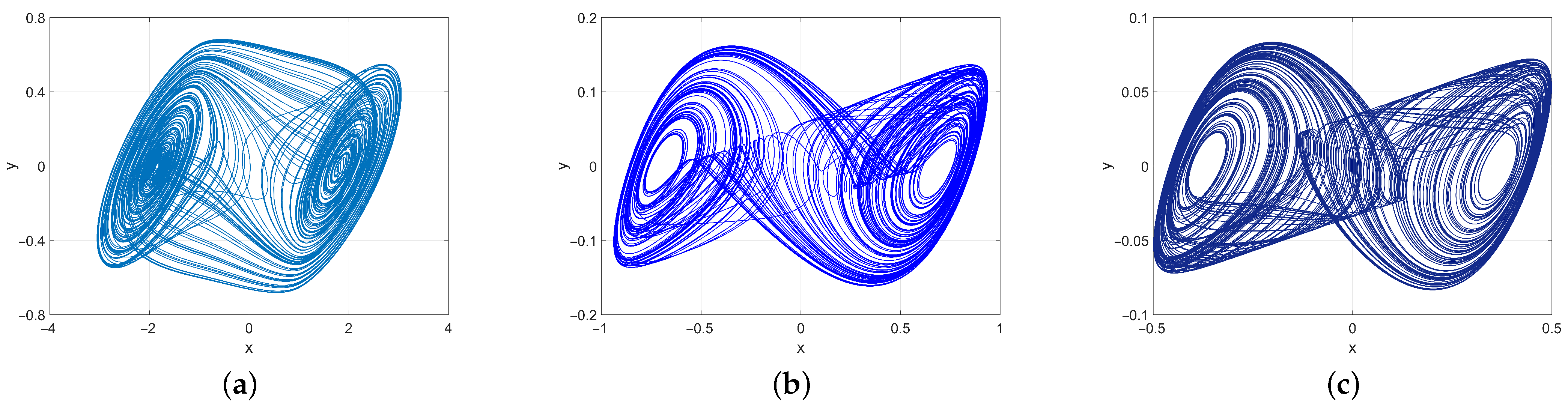
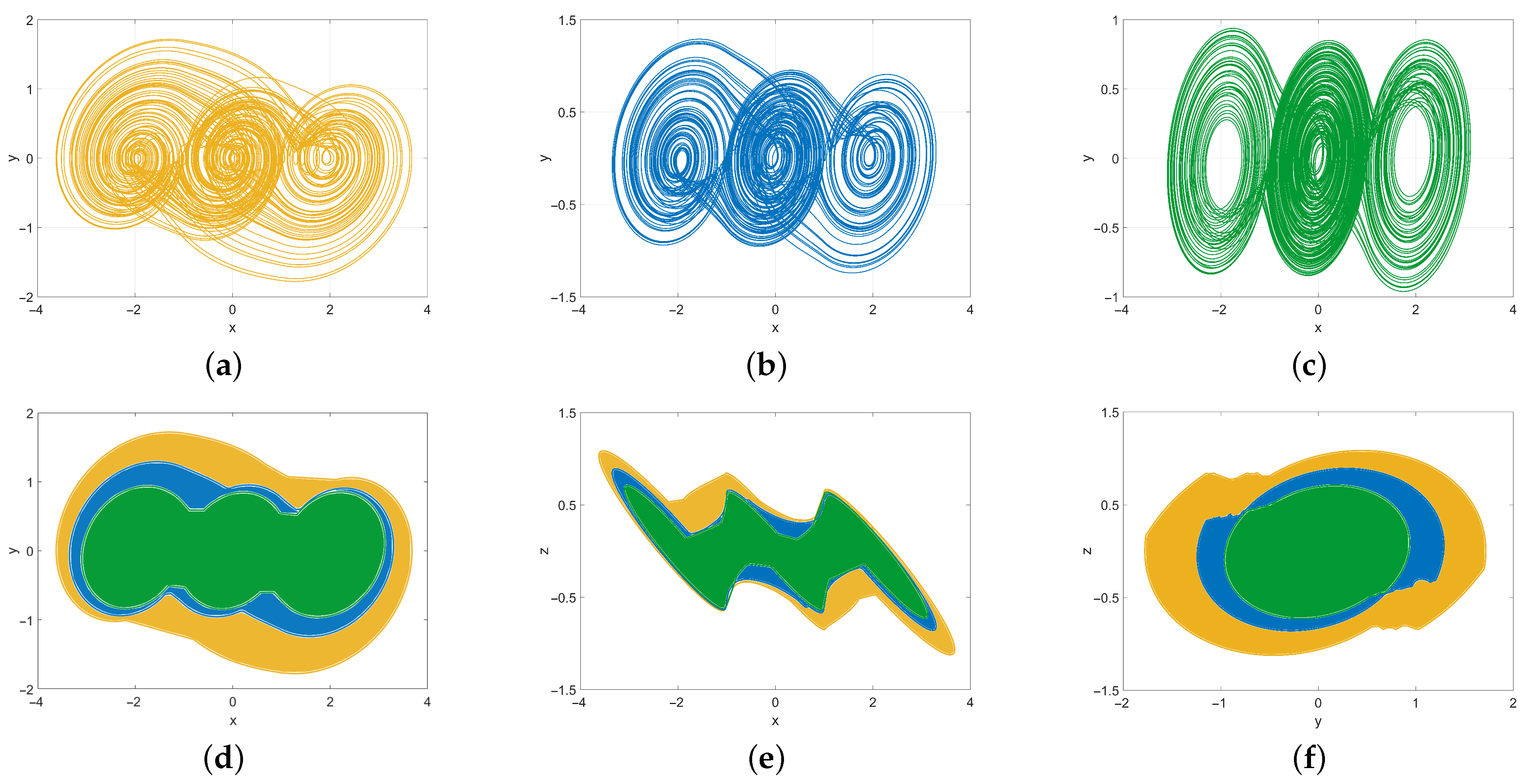
The different systems and attractors described in
Table 1 and
Figure 1 have a similar shape (values used are described in
Table 2), while the characteristic double-scroll attractor of the Chua circuit is preserved. In turn, the systems exhibit similar values in the classical metrics for chaotic systems based on the study of the time series: A positive Lyapunov exponent (close to 0.11), a Kaplan-Yorke dimension around 2.2, and a fractal dimension close to 2.1 [
32,
33,
34,
35,
36]. The values may vary between the systems if the parameters or resolution methods are changed but are similar, confirming that the different systems exhibit qualitatively similar chaotic behaviors.
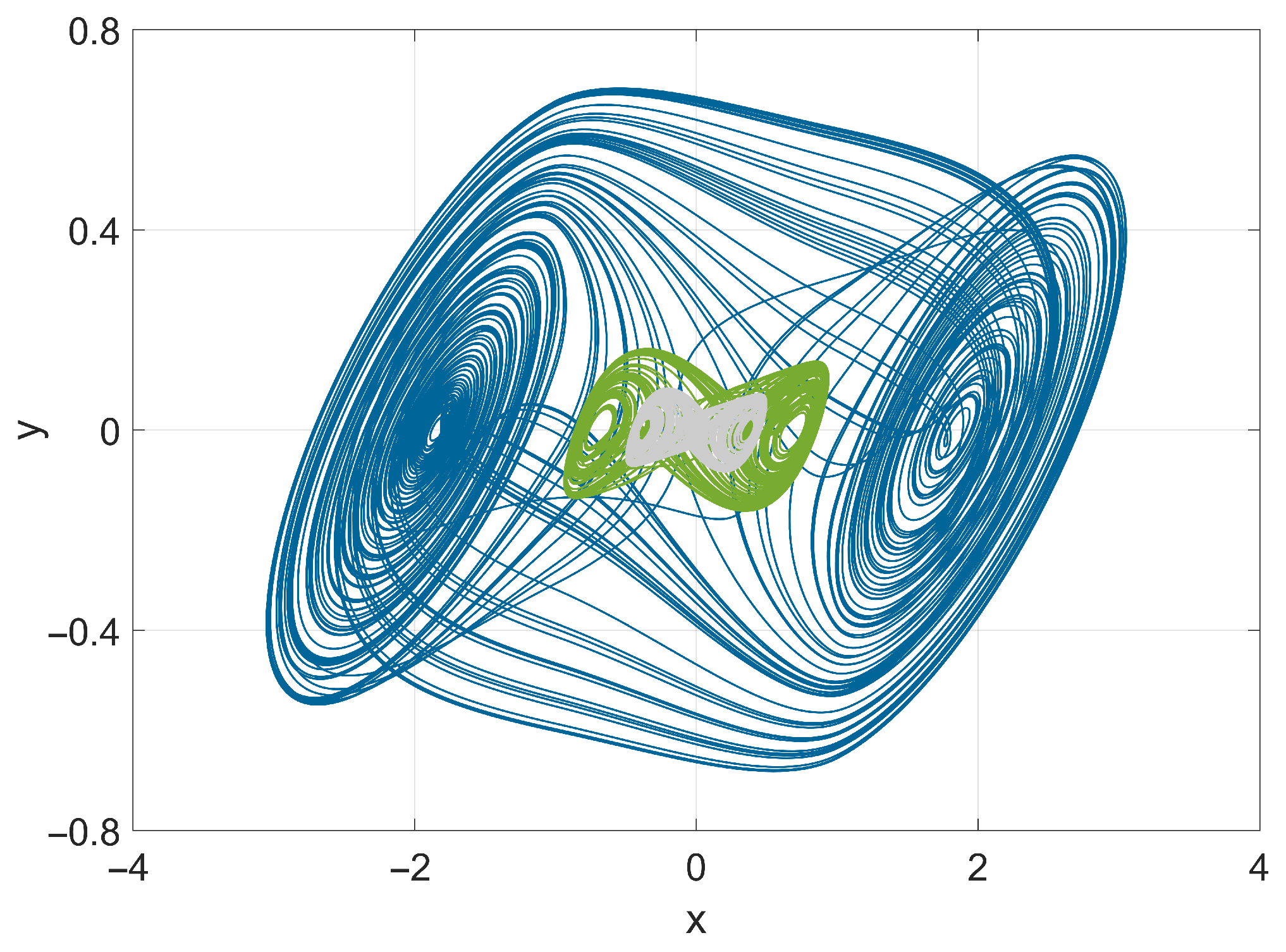
However, a look at the axes in
Figure 1 reveals considerable variations in the amplitudes of the different attractors. These changes are overlooked by the classical metrics used to study chaotic systems, but are clearly visible when the three attractors are plotted simultaneously, as seen in
Figure 2. The questions arises:
Are the geometric changes in chaotic systems insignificant? Do classical metrics for studying chaotic dynamics allow comparisons between systems that share a standard structure but differ in their nonlinearities or parameters? This work addresses these questions by studying the geometric variations in the
-sphere of different chaotic systems from three perspectives: (i) variations that occur in “similar”systems, three different Chua systems, and two versions of the Rössler oscillator are analyzed. (ii) We also study the effects of a jerky system that generates multiple scrolls when its parameters remain fixed, but derivative order with which it is modeled varies. (iii) The variations that exhibit the Rössler attractor under a parametric bifurcation.
In recent years, the application of chaotic dynamics has increased; it has even been used as a physical object to demonstrate complex dynamics to the general public [
37]. Under this premise (considering a chaotic attractor as a physical object), this work aims to visualize the dynamical changes that chaotic systems undergo (visible when studying their shape variations) and that are generally omitted or invisible when using classical metrics for chaotic systems, such as the Lyapunov exponent or the fractal dimension. Furthermore, geometric studies are proposed as a standard for complementing the study of dynamical systems and enabling comparisons of the dynamics of chaotic systems. It is suitable for quantifying the changes in systems due to changes in their equations and parametric modifications in dynamical systems, as well as for exploring the dynamical effects due to the use of fractional-order operators.
3. Methodology and Results
This study focuses on analyzing geometric variations in chaotic attractors. Using convex hulls, we can enclose the smallest possible convex shape around a 2D projection of an attractor or approximate its volume in a 3D space. This approach provides a quantitative measure of changes in both the projected area and the total volume of the system.
Definition 1. The convex hull of a set of k points in a Euclidean space is the smallest convex region that encloses all points. Mathematically, for a set in , the convex hull is given by [38]:where consists of a set of points, denotes individual points with coordinates in , and is weighting coefficients satisfying: (i) Non-negativity property (), and (ii) Normalization (), ensuring the combination lies within the convex set . The convex hull is calculated using integrated software functions that evaluate both the area (for 2D projections) and the volume (for 3D spaces) [
39,
40,
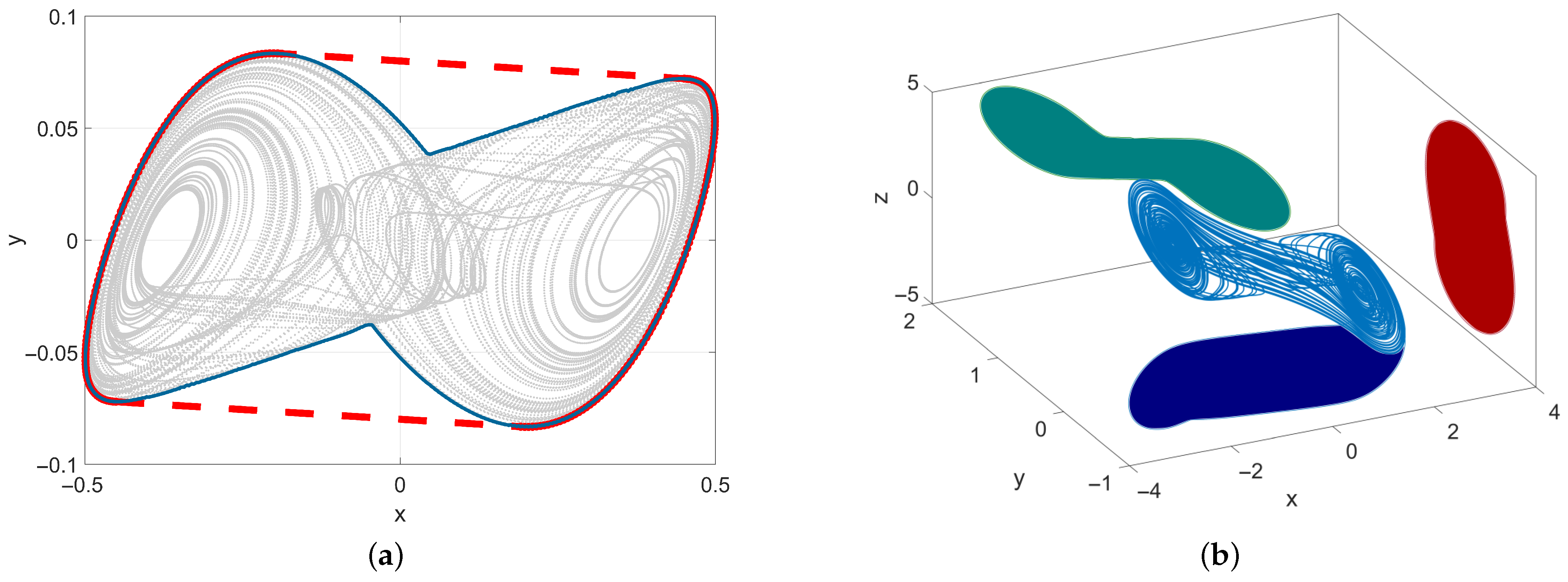
41]. The procedure for obtaining a convex hull is as follows (see
Figure 3):
Data structuring: The phase space points of the attractor are organized in a coordinate matrix.
Hull construction: The convex hull algorithm is applied to extract the geometric properties of the enclosing shape.
Area calculation: The projected area of the attractor is calculated for each 2D plane. The result is given in arbitrary square units.
Volume estimation: The total volume that the attractor occupies in the state space is determined. The results are given in arbitrary cubic units.
Remark 1. Accurate calculation of the convex hull requires careful exclusion of transient states from the oscillator’s dynamics. Including transient states can inflate area and volume estimates, resulting in artificially larger values. All analyses in this work were performed after discarding transient periods to ensure reliable results, with a rigorous transient removal period of the first 10,000 integration steps. Stationarity was further verified by monitoring the envelope of the state variables, ensuring that the variation in local maxima remained below a 10% tolerance threshold before data collection began.
Another possible tool for characterizing geometric variations is the -shape. This powerful topological construct generalizes the convex hull to provide a multiscale, topology-preserving boundary for discrete observations. It is particularly well suited to capturing nonconvex features and the intrinsic morphology of the data. Unlike the convex hull, which serves as a coarse envelope that bridges over gaps, the -shape distinguishes between occupied space and internal voids (lacunarity) typical of strange attractors. This yields a strictly tighter estimate of the volume effectively visited by the trajectories, revealing structural details that a convex assumption would obscure.
Definition 2. For a finite set of k points in a Euclidean space and a real parameter , the α-shape, denoted , is defined by the Delaunay triangulation of . The α-shape is then the union of all α-exposed simplices contained in . The boundary of the α-shape, , is the set of all -dimensional simplices within that are facets of exactly one n-dimensional α-exposed simplex. This boundary forms a piecewise linear -dimensional manifold (possibly with boundaries) enclosing the region of interest. Mathematically, the α-shape is given by:where denotes individual points with . The parameter α controls the level of detail: With () converges to the standard convex hull ; being R the radius of the sphere of σ.
For more negative values of α, the boundary recovers finer details and cavities of the point set.
The
-shape is calculated with integrated software functions that evaluate both the area (for 2D projections) and the volume (for 3D spaces) [
39,
40,
41]. The procedure is as follows: A simplex
(e.g., an edge, a triangle, a tetrahedron) within
is said to be
-exposed if it satisfies the following condition of the empty circumsphere:
The sphere of (the only sphere that passes through all its vertices) has a radius R.
The open circumference contains no points of in its interior.
The radius satisfies the inequality .
Remark 2. The boundary facilitates the calculation of the n-dimensional content of the enclosed region. The boundary is a closed polygonal chain in . The area of the enclosed region is calculated by applying the shoelace formula to the ordered sequence of vertices that defines : Otherwise, the volume enclosed by this surface can be calculated by decomposing the shape into tetrahedra originating from a fixed interior point, or more efficiently via the divergence theorem by adding the signed volumes of the tetrahedra formed by each triangular surface and the origin:where the boundary is a triangular surface in (tetrahedra). The sum of all volumes of the triangle T on the boundary and are the vector coordinates of the vertices of the tetrahedra T. Using the attractors shown in
Figure 1, the following metrics were calculated: (a) the Kaplan–Yorke dimension (D
KY), (b) the fractal dimension (D
f) via dimensional reduction in the Poincaré map, and (c) both the volume and the projected areas using the
-sphere method.
Specifically, these geometric values were calculated using a shrinkage parameter . In this framework, setting yields the convex hull (maximum envelope), while produces the tightest possible boundary enclosing the point cloud (minimum volume). To ensure consistency and reproducibility across all comparisons, a fixed value of was used for all simulations. This choice prioritizes capturing non-convex features and cavities (lacunarity) intrinsic to strange attractors, ensuring that the calculated volume represents the effective phase-space occupancy rather than a convex approximation.
The results are summarized in
Table 3, where A
jk denotes the area in the
projection and V represents the total volume. The data show that the original Chua system exhibits the largest dimensions, with projections up to 43
larger than other versions of the same attractor, and occupying a phase space volume 380
greater than its cubic nonlinearity counterparts.
Remark 3. The estimated fractal dimension results from reducing the system dimension using the Poincaré section, which leads to the dimension , as described in [42]. The results in this article already consider the summation factor, which corresponds to the reduction of the system dimension. The Kaplan–Yorke dimension corresponds to the values given in the literature and is validated by the estimated fractal dimension. It is important to note that, unlike topological invariants, geometric metrics such as volume and projected area are not invariant under coordinate transformations; their absolute values depend on the scale of the state variables. Therefore, to enable an objective comparison between dynamical systems with different scales, the state variables of the three oscillators were normalized and the geometric analysis was repeated. The state variables of all oscillators were mapped to a dimensionless range of
centered at zero. For a given time series
X, the normalized series
is defined as
. The areas of the three planar projections and the volume were then calculated for these normalized attractors. Using the original Chua system as the benchmark, a geometric comparison was performed. For each metric, a relative difference
was computed (as defined in Equation (
8)), and the absolute values of these differences were summed to yield the cumulative similarity index
, shown in the last column of
Table 4.
The subscript R, for both area and volume, indicates the values for the Reference system, in this case, the original Chua attractor, while the subscript C refers to the system under Comparison. The m index corresponds to the possible 2D state space projections. Note that both the factors and can be negative or positive; they represent the standard relative error. A negative value indicates that the system has contracted relative to the reference system, while a positive value indicates an expansion in one of the projections or in the system’s volume. The aggregate index quantifies the total geometric deviation; a value of implies identical normalized spatial occupancy.
3.1. Rössler and Rössler-like System: “Same Attractor”, Different Model
The Rössler attractor was introduced in 1976 by the German biochemist Otto Rössler as a conceptual model of continuous-time chaos [
43]. In contrast to the Lorenz system, which emerged from atmospheric modeling, the Rössler system was proposed primarily to demonstrate chaotic behavior in a more straightforward and more analytically accessible structure with a single nonlinear term, making it a fundamental model for studying chaos in low-dimensional systems. Since then, it has become a canonical system in the study of dynamical systems and chaos, described by Equation (9). A classical parameter set that generates chaos is
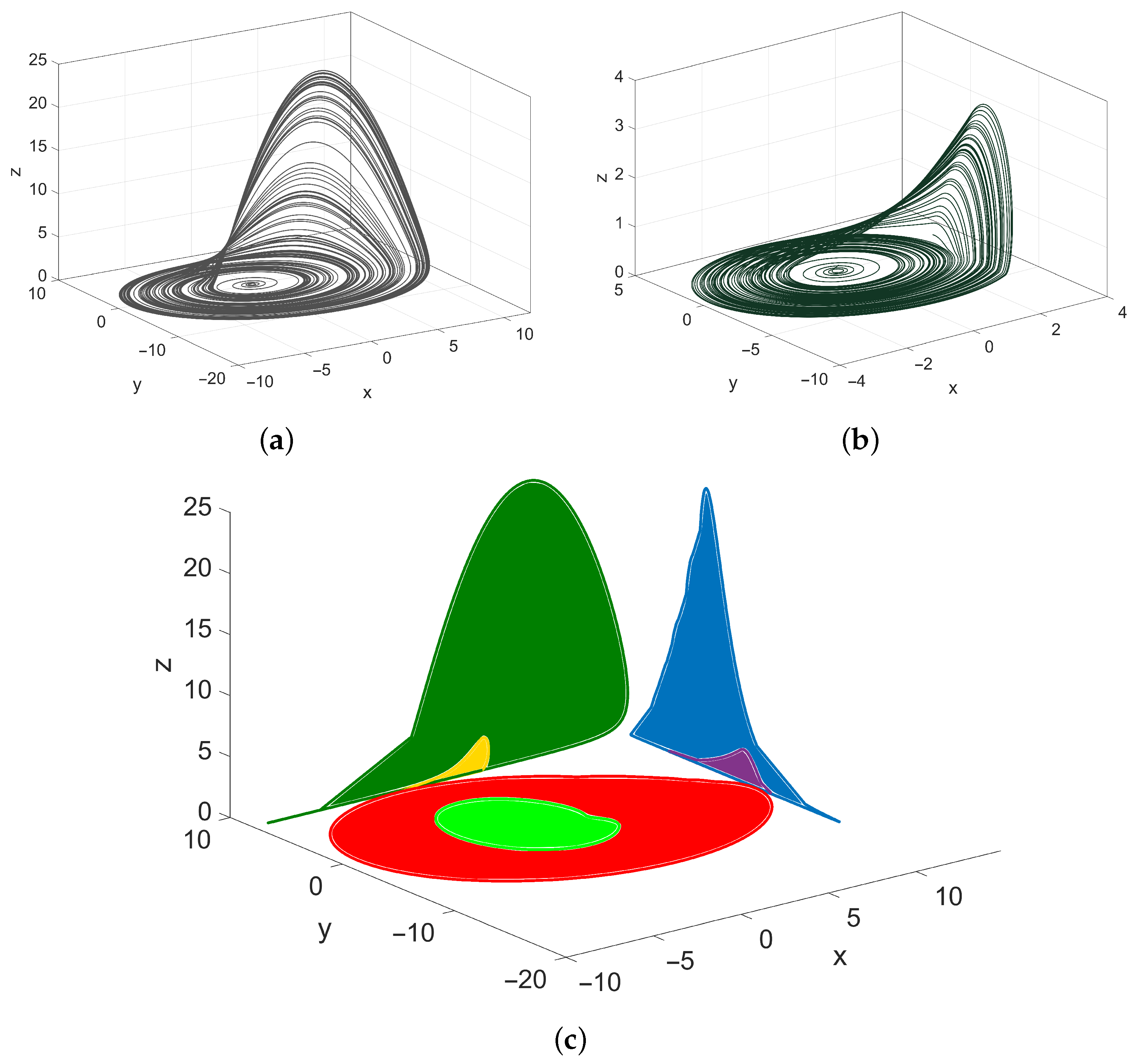
; under these values, the system exhibits a strange attractor with continuous-time chaotic dynamics, as shown in
Figure 4a.
However, there is also an alternative version of the Rössler system in which the nonlinear term of the original system (a multiplication of variables) is replaced by a piecewise nonlinear function, introduced in [
44] and described by Equation (10). The primary motivation for this modification was to obtain a more cost-effective electronic circuit by converting it into an op-amp implementable system without multipliers. In this system (Rössler-PWL, also known as Rössler-like), the chaotic attractor occurs typically at
(see
Figure 4b).
Table 5.
Different representations of Rössler attractor.
Table 5.
Different representations of Rössler attractor.
| Rössler System | Equations | |
|---|
| Original [43] | | (9) |
| Rössler PWL [44] | | (10) |
The two Rössler systems shown in
Figure 4 have similar values for their Kaplan–Yorke and fractal dimensions, as described in
Table 6. Visual inspection reveals that, although the PWL system shares some geometric similarities with the original attractor, it does not fully correspond, as confirmed by calculating the areas of the projections and the volume each system occupies in phase space. While the Rössler system reaches a volume of up to 1556.11 u
3, the system with a piecewise nonlinear function only reaches 50.2228 u
3, about 31 times smaller than the original. Replicating the methodology used with Chua systems, the results for Rössler systems under the normalization described in Equation (
8) are also presented in
Table 7. Both systems are placed in the same space, allowing geometric comparison without scaling bias. The difference in the systems’ dimensions confirms that metrics such as the Lyapunov exponent (used to calculate the Kaplan–Yorke dimension) or the fractal dimension of an attractor cannot fully describe the systems’ behavior quantitatively. However, combining these methodologies with geometric techniques such as the
-sphere or convex hull allows for quantification of dynamic differences and provides a foundation for a more comprehensive comparison of attractors.
3.2. Multi-Scroll Attractor: Fractional-Order Modification
The jerky equation, also known as the jerk system, refers to a class of third-order autonomous differential equations in which the third derivative of a state variable (i.e., the “jerk”) is expressed in terms of lower-order derivatives and the variable itself. In contrast to common chaotic systems such as Lorenz or Rössler attractors (first-order ODE systems), jerk dynamics explicitly includes the third derivative. It gained attention in studying nonlinear dynamics because it can generate complex, chaotic behavior with a single scalar equation of relatively simple form, making it useful for theoretical studies.
A multiscroll attractor is a chaotic attractor that, unlike Chua’s classical double-scroll attractor, generates multiple scrolls (or “wings”) in phase space generated by nonlinear chaotic systems with trajectories that fold and unfold over multiple scrolls. Typically, they are constructed with stair-like, hysteresis, or saturated nonlinearities, while the number of scrolls can be systematically increased (e.g., 3-scroll, 4-scroll, grid-scroll attractors) [
45,
46,
47,
48]. These attractors are of interest due to their rich geometric complexity, potential applications in secure communication, and usefulness in chaos-based signal processing.
In this case, we consider the jerky system that results in a 3-scroll attractor. The system was analyzed using the fractional order calculus approach, where the authors found that changing the order of the derivative leads to changes in the statistical properties of the system [
49,
50]. Using the system described by Equation (
11), the geometric properties of the attractors shown in
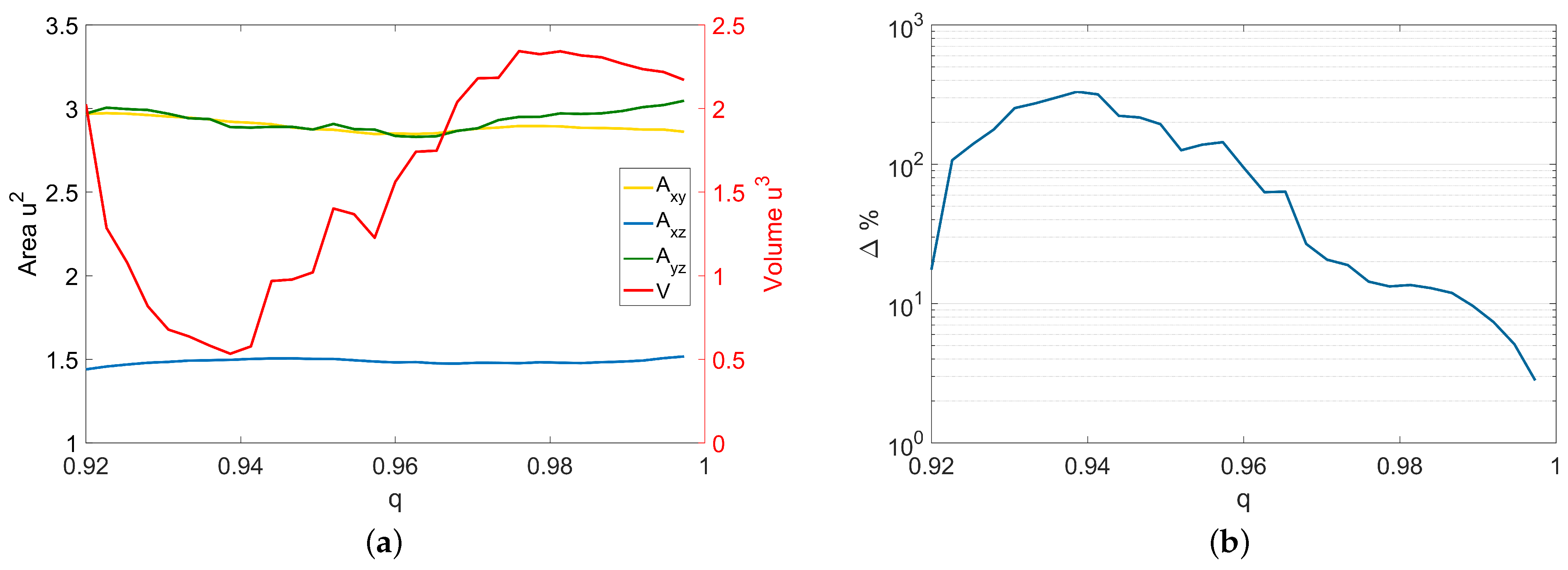
Figure 5 are analyzed. These attractors are generated for different values in the order of the derivative that models the system, with
Table 8 showing the values obtained for the raw dynamics.
Remark 4. The system described by Equation (11) is solved numerically using the Adams–Bashforth– Moulton (ABM) method [24,25,51,52] with a sufficiently small integration step size () to ensure numerical convergence and preserve the topological integrity of the attractor, so that the observed geometric variations result from the intrinsic memory effects of the fractional operators rather than numerical instability. Furthermore, given the slow, power-law decay of transients characteristic of fractional-order systems, special care was taken to ensure convergence to the attractor (as detailed in Remark 1), selecting initial conditions within known basins of attraction to minimize transient excursions. In Equation (11), q denotes the derivative order used, while a is the dynamic parameter of the system (). The results presented are based on . Table 9 presents the results obtained by normalizing the state variables of the multi-scroll system for each analyzed derivative order. As with the previous oscillators, a small variation in the derivative order causes significant changes in the dynamics of the fractional system compared to the integer-order system. Furthermore, an interesting phenomenon is observed as
q decreases: the systems appear to tend toward constant contraction (similar to the observed in [
49]). To analyze this in detail,
Figure 6 plots the curves of the geometric characterization of the system described by Equation (
11).
Figure 6a shows the behavior of the areas in each of the state projections, along with the volumetric variation.
Figure 6b shows the behavior of the index
. Note that this last result shows a decreasing trend, which is due to the fact that the reference dynamics used to calculate this metric correspond to the integer-order system (a value excluded from the graph, since it is zero).
3.3. Rössler System: Parametric Modification
Finally, the proposed method is also useful for comparing systems of equations and geometric changes observed in the same system due to parameter changes. For example, consider the original Rössler system under a modification of the parameter
b [
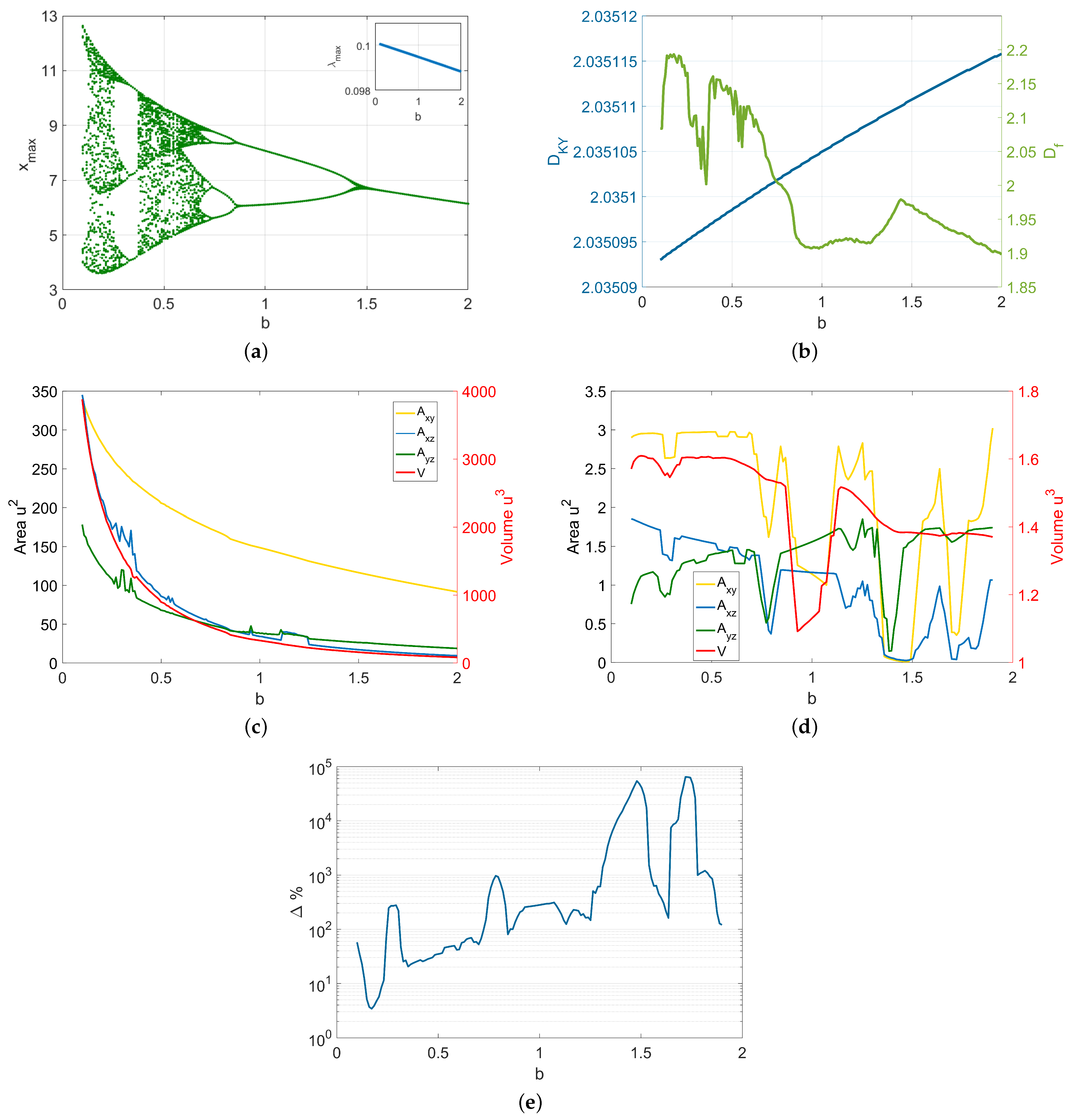
53]. Usually, this analysis is summarized by constructing a bifurcation diagram as shown in
Figure 7. This type of analysis allows visualization of possible chaotic regions, which are usually verified a posteriori by Lyapunov exponents, the Kaplan–Yorke dimension, or the fractal dimension.
The study of the bifurcation diagram shows that the system exhibits a decrease in its amplitudes and shows several windows of possible chaotic behavior, which are verified using the Kaplan–Yorke or fractal dimension (
Figure 7a,b). Moreover, these chaotic properties are practically the same in both windows of the parameter
b. However, based on geometric analysis of the raw data (
Figure 7c), we can observe that the system exhibits an almost exponential volume decay rate with respect to the bifurcation parameter, where the volume difference between the first chaotic window
and the second window, located at
, is more than 30%.
When the oscillator dynamics are normalized, significant changes are observed in both the state projections and the volume occupied by the system, as shown in
Figure 6d, with a loss of up to 75% of the volume compared to the dynamics with the highest proportion. Although the geometric variations shown in
Figure 6d may appear small, when their sum is calculated as described in Equation (
8), this value always increases. Thus, the dynamics, although similar, become increasingly different from the comparison behavior, which by convention was the Rössler system for the typical parameter values a = 0.5, b = 0.2, c = 5.7, corresponding to the initial point of the exploration shown in
Figure 6.
4. Discussion and Conclusions
Precise characterization of chaotic dynamical systems is essential for their effective application in engineering fields, including secure communications and circuit design. However, a significant gap remains in traditional analysis: standard metrics such as Lyapunov exponents and fractal dimensions primarily address temporal behavior and complexity, often overlooking the spatial and geometric properties of the attractor. To address this, we propose a geometric framework based on the -sphere method to quantify the shape, projection area, and volumetric extent of chaotic attractors. We validated this approach across diverse scenarios, including variations of Chua’s system, the Rössler system (both original and piecewise-linear versions), and fractional-order multi-scroll oscillators, demonstrating the method’s applicability to topologically complex structures and well-known chaotic systems.
Our findings show that geometric characterization offers unique insights not captured by classical metrics. Specifically, we demonstrated that systems with similar dynamical signatures, such as identical Lyapunov exponents, can display substantial geometric differences. For Chua’s system variants, we observed global differences of up to 40% despite their spectral similarities. In the fractional-order multiscroll system, the fractional modification leads to up to 20% variability compared with the integer-order dynamics. This confirms that while dynamical properties may remain invariant under certain transformations, the physical footprint of the attractor in phase space can vary significantly.
Importantly, this study clarifies the necessity of geometric measurements for both fundamental research and engineering, establishing a clear criterion for their combined use. Theoretically, this framework provides a quantitative standard for evaluating the novelty of new chaotic attractors; by comparing geometric signatures, researchers can distinguish true topological innovation from mere parametric variations of existing families, a distinction that spectral metrics often miss. Practically, these differences determine the cost of implementation. The proposed criterion is as follows: traditional metrics should be prioritized for verifying chaotic nature and security strength (unpredictability), while geometric metrics should be preferred when physical constraints—such as dynamic range in circuits or coverage area in robotics—are the limiting factors. Thus, our framework enables the selection of models that are both dynamically complex and spatially efficient [
54,
55,
56].
Despite the advantages of this geometric approach, certain limitations must be acknowledged. The method is sensitive to the stationarity of the system; just as Lyapunov exponents depend on asymptotic behavior, the estimated geometry requires the system to reach a steady state. In systems exhibiting intermittency or hidden attractors, the observation window must be carefully chosen to ensure that the quantified shape accurately represents the global dynamics. For systems with multistability or nested (“matryoshka”) attractors [
57,
58,
59,
60], it is important to emphasize that geometric characterization must be applied to each isolated attractor individually. Treating the entire set of coexisting trajectories as a single entity yields an incorrect convex hull that merges distinct dynamical regimes. Therefore, as with the calculation of Lyapunov exponents, identifying basins of attraction is a prerequisite for this analysis to ensure that the computed volume corresponds to a single stationary dynamical object. While the
-shape technique successfully captures macroscopic non-convexities and voids, extremely fine hierarchical wrinkling patterns arising from complex nonlinear interactions may require complementary local metrics for full resolution. Thus, this geometric analysis serves as a powerful complement to, rather than a replacement for, traditional chaos detection metrics.
Future research will focus on extending this framework to systems with multiple interacting nonlinearities that generate highly asymmetric attractors and higher-dimensional hyperchaotic oscillators. Additionally, we aim to investigate the application of these geometric descriptors for detection of hidden attractors and to explore their reliability in noisy experimental environments, further bridging the gap between theoretical chaos analysis and practical engineering constraints.




 ,
,