Abstract
We introduce a new and a faster iterative method for the approximation of the fixed point of multivalued nonexpansive mappings in the setting of uniformly convex Banach spaces. We prove some stability and data-dependence results for this novel iterative scheme. A series of numerical illustrations and examples was constructed to validate our results. As an application, we propose a novel method for solving a certain fractional differential equation using our newly developed iterative scheme. Our results extend, unify, and improve several of the known results in the literature.
Keywords:
IA-iterative scheme; stability results; rate of convergence; data dependence; fixed-point iterative scheme; applications to HIV model of fractional order MSC:
47H09; 47H10
1. Introduction
Well-known mathematicians have extensively studied multivalued nonlinear mappings and proved some interesting fixed-point theorems in the framework of Banach spaces. Consequently, many problems in some areas of mathematics such as game theory and market economy, among others, can be transformed into fixed-point problems of multivalued nonlinear mathematical models. It is well known that if the fixed point of a given multivalued nonlinear map T exists, then finding the value of the fixed point p of the multivalued nonlinear map T is demanding. As a remedy to this task, mathematicians developed a fruitful way of solving this problem by using the fixed-point iteration method. An important way in determining the choice of a fixed-point iteration scheme to be used for the approximation of the fixed point of a given multivalued nonlinear mapping is the rate of convergence of the iteration process under consideration. For instance, for a comparison of two iterative processes in a one-dimensional case, we refer the reader to Rhoades [1]. Several mathematicians have developed certain iterative processes for the approximation of the fixed point of some nonlinear mappings in the literature (see, e.g., Agarwal [2,3,4], Mann [5], Ishikawa [6], Noor [7], Okeke [8], and Khan [9,10,11], among others). Next, we present some well-known fixed-point iterative schemes in the literature. The Picard [12] or successive iterative process is defined by the sequence as follows:
The Mann [5] iterative process is defined by the sequence as follows:
where
The Ishikawa [6] iterative process is given by the sequence defined as follows:
where and are real sequences in
The Krasnosel’skii [13] iterative process is defined by the sequence as follows:
where is a real sequences in (0, 1).
Ullah and Arshad [14] introduced the iterative sequence defined by
where are real sequences in (0, 1). They established that this iterative scheme converges faster than several existing iterative processes.
Noor [7] introduced the iterative process defined by
where , and are sequences in (0, 1).
Okeke [8] developed a novel iterative process called the Picard–Ishikawa hybrid scheme, defined by the sequence as follows:
where and are real sequences in . The author established that this iterative process converges faster than several existing iterative schemes. Next, we pose the following crucial question.
Problem 1.
Is it possible to develop an iteration process whose rate of convergence is even faster than those defined above?
The essence of this paper is to propose a faster and more efficient iterative process for approximating the fixed point of some classes of generalized nonlinear mappings. This novel iterative scheme converges faster than some of the iterative schemes listed above in the sense of Berinde [15]. To answer this natural question, as posed in Problem 1 above, we introduce the following iterative method, called the IA-iterative scheme and defined by the sequence as follows:
where , , and are real sequences in and
Several mathematical models for addressing the issue of infection disease especially HIV transmission disease have been developed (see [16,17]). As a result of this, several fractional derivatives in the sense of Caputo were developed as one of the novel formulations that have found widespread usage in the simulation of many kinds of infection models. It was suggested as part of the method of preventing and treating infection disease. One of the differential equations was developed by Caputo–Fabrizio and was named the Caputo–Fabrizio fractional differential equation. Consequently, the Krasnoselskii’s and Banach’s fixed-point approach, in combination with the kernels, were part of the methods adopted in solving the Caputo–Fabrizio fractional differential equation (CFFD) [16]. Readers interested in studies involving Riemann–Liouville fractional differential equations, Delta fractional differential equations, and conformable fractional differential equations may consult [18,19,20] and the references therein. Several works of literature involve several other methods for solving fractional differential equations, such as the Laplace differential transform method, hyperbolic non-polynomial spline method, homotopy perturbation method, fractional non-polynomial spline method, and Pade differential transform method, among others.
In the present paper, we prove that our newly developed fixed-point iterative process, called the IA-iterative scheme, is highly efficient in solving the Caputo–Fabrizio fractional differential equation (CFFD). We present several numerical experiments to validate our results. Our results generalize and extend several known results.
2. Preliminaries
Throughout this paper, we denote as the set of all fixed points of the mapping A point p is called a fixed point of T if
The following definitions will be useful in this study.
Definition 1
([21]). Suppose E is a Banach space. A subset K is said to be proximinal if for every there exists a such that
It has been proven in the literature that every closed convex subset of a uniformly convex Banach space is proximinal. We denote as the family of a nonempty bounded proximinal subset of K.
Definition 2
([21]). The Hausdorff distance on is defined by
where and
Definition 3
([21]). Suppose K is a nonvoid convex subset of normed space E. A mapping is said to be a contraction if for every there exists a such that
Definition 4
([21]). A multivalued mapping is said to be nonexpansive if for each we have
Definition 5
([15]). Suppose that E is a Banach space and is self mapping on E. Then, is said to be approximate mapping of T if for each and for fixed , we have
Definition 6
([15]). Let and be two sequences of real numbers converging to x and y, respectively. The sequence is said to converge faster than the sequence if
Definition 7
([15]). Let and be two fixed-point iteration schemes that converge to a certain fixed point p of a given operator T. Suppose that the error estimates
exist, where and are two sequences of nonnegative numbers converging to 0. If converges faster than , then converges faster than to
Lemma 1
([22]). Let be a positive sequence, such that there exist , such that for all satisfying the inequality
where for all and for all Then, the inequality below holds
Lemma 2
([23]). Let be a sequence of nonnegative real numbers, including zero, satisfying
If and then
Lemma 3
([24]). Let , , and be real sequences, such that
- (i)
- , and
- (ii)
- , as
Let be a positive real sequence, such that is bounded. Then, has a subsequence which converges to zero.
Lemma 4.
Suppose that E is a Banach space. Then, E is uniformly convex if for any given number , there exists a continuous strictly increasing function with , such that for each we have the following:
Lemma 5
([16]). For and we have:
- (1)
- (2)
- (3)
- (4)
3. Convergence Analysis
We begin this section by proving the following results.
Theorem 1.
Suppose that K is a nonvoid compact convex subset of a uniformly convex Banach space E and the map is a nonexpansive mapping with . Let , , and be four sequences in (0, 1). Suppose is the sequence defined by (8), satisfying
- (i)
- (ii)
- and
- (iii)
Then, the sequence converges strongly to fixed point
Proof.
Let and . Using the fact that and is such that , we obtain
Secondly, let , where and are such that and Therefore, considering (14), we obtain
Considering that where , such that and, using (15), we have the following:
Thus, where , such that and, using (16), we have the following:
From (17), we have
Hence, we obtain the following
Consequently, it implies that
Using Lemma 4, there exists a subsequence of such that by considering the continuity and strictly increasing property of . By the compactness of K, we assume that for some , Therefore,
Furthermore,
Consequently, q is a fixed point of mapping T. Now, replacing q with p, we obtain , which is a decreasing sequence by (19). Since as , it then follows that decreases to 0. □
4. Rate of Convergence
In this section, we show that the IA-iterative scheme converges better than some other iterative processes mentioned above.
Proposition 1.
Suppose K is a nonvoid closed convex subset of a normed space E and is a contraction map satisfying (11) with . Suppose that each of the iterative schemes (1)–(7) converge to the same fixed point p of T, where , , , and are four sequences in (0, 1). Then, the IA-iterative process (8) converges faster than iterative schemes (1)–(7).
Proof.
Suppose p is a fixed point of T and also that . Using (11) and the Picard iterative scheme (1), we have the following
Now, let
Considering Mann iterative scheme (2) and (3), we obtain the following
Therefore, consider
Considering Picard–Mann (5) and (11), we obtain
Secondly, we obtain
Combining (25) and (26), we have the following
Moreover, take
Now, we consider the new explicit iterative process named the IA-iterative scheme. Also, using (11) and (8)
Using (11), (8), and (29), we have
Moreover, considering (11), (8), and (30), we obtain
Now, we have
We now justify the rate of convergence of our iterative process (8) as follows:
- (i)
as . This implies that IA-iterative process (8) converges faster to p than the Picard iterative process (1).
- (ii)
as . This implies that IA-iterative process (8) converges faster to p than the Mann iterative process (2).
- (iii)
as . This implies that IA-iterative process (8) converges faster to p than the Picard–Mann iterative process (5). Similarly, from (3)–(7), following the same method as above, the IA-iterative process (8) then converges faster to p than from (3)–(7).
as . This implies that IA-iterative process (8) converges faster to p than from (3)–(7). □
5. Data-Dependence Results
In this section, we establish some data dependence results for the newly introduced IA-iterative scheme (8).
Theorem 2.
Let be an approximate operator of T satisfying (11). Let be an iterative sequence generated by the new explicit iterative process named the IA-iterative scheme (8) for mapping T and define an iterative sequence as follows
where and are real sequences in (0,1) satisfying the following conditions:
- (i)
- (ii)
- for all and
- (iii)
- .
If and such that as , then we have where is fixed number.
Proof.
Using (8), (11), (13), and (33), we obtain
However, considering (8), (11), (13), (33) and (34) we have the following:
Using (8), (11), (13), (33) and (35), we obtain
From the conditions (i) and (ii), we observe that gives
Let , ,
Moreover, using Lemma (1), it shows that
Therefore,
Considering the results of Theorem 1, we know that . Using the above, together with the conditions that , we obtain
The proof of Theorem 2 is completed. □
6. Stability Results
In this section, we prove some stability results of our novel iterative process.
Theorem 3.
Let be an arbitrary Banach space and be a contraction mapping defined by (11). Suppose there exists such that the IA-iterative process (8) satisfies and for each , converges to . Then, the IA-iterative process (8) is T-stable.
Proof.
Suppose that is an arbitrary sequence; put
where
Therefore, with the IA-iterative scheme (8), and using contractive condition (11) with , we have
Using (8), (11) and (40)
Using (8), (11) and (41), we have
Inserting (42) into (41), we obtain
Putting (43) into (40), we obtain
Considering that for all . It follows by Lemma 2 and (44) that
Conversely, let . Using (11), (39) and (40), we obtain
Therefore, we have
So,
It implies that IA-iterative process (8) is T-stable. □
7. Application to Disease Model
Many interested models have been developed to obtain the solutions of infectious diseases. These models have actually become various differential equations and the case remains how to solve the various differential equations. In this application, we study a special case of infection disease model, i.e, the mathematical modeling of acquired immune deficiency syndrome (AIDS). Consequently, comprehending the dynamics of acquired immune deficiency syndrome (AIDS) and evaluating prospective methods of preventing and treatment have both outstandingly benefited from the use of mathematical modeling. Based on this, a fractional differential equation emanated from the mathematical modeling of the prevention and treatment of AIDS, which was developed by Caputo–Fabrizio and was named the Caputo–Fabrizio fractional differential equation [16]. Moreover, solving the Caputo–Fabrizio differential equation is taxing, and many authors have suggested ways of solving the Caputo–Fabrizio differential equation. Krasnoselskii’s and Banach’s fixed-point approach in combination with the kernels were part of the methods adopted in solving the Caputo–Fabrizio fractional differential equation (CFFD). In this study, we suggest that the best approach is to use our newer and faster fixed-point iterative process called the IA-iterative scheme (8) in solving the Caputo–Fabrizio fractional differential equation (CFFD). Furthermore, this novel iterative scheme can be applied in solving wider classes of diseases models, such as diseases with direct transmission among individuals, as in the case of HIV with long latency phases. The scheme can also be applied in solving models of diseases with indirect transmission via vectors (see, e.g., [25]).
Consider the following Caputo–Fabrizio fractional differential equation.
The solution to Equation (48) is provided by Lemma 5 if and only if the right side vanishes at 0, i.e.,
where and
Moreover, define the Banach space and the norm of on by
Assume that the following assumptions are met.
- Let be a constant, then
- Assume that .
We now prove the next theorem as follows
Theorem 4.
Assume that the conditions are met. Then, problems (48) and (49) have a unique solution; say in , then the new and faster iterative process named IA-iterative scheme (8) with , , and are real sequences in , such that and converges to
Proof.
We consider the Banach space , where is the norm of . Let be an iterative sequence generated by a newer and a faster iterative process named the IA-iterative scheme for an operator defined by
Consequently, we will show that converges to the solution as n tends to Now, using (8), (50), and , we have the following
Let ; then, using (8), (50), (51), and , we obtain
Since and considering (8), (50), (52), and , we have
Considering (8), (50), (53), and , we have
Therefore, we have the following from (54)
From (55) and considering Lemma 2, we take
and ; then, the conditions of Lemma 2 are satisfied.
Hence,
It follows that the proof of Theorem 4 is completed. □
8. Numerical Examples
Numerically, we compare our iteration process with seven existing iteration schemes. In Table 1 and Table 2 below, we compare the speed of convergence of various iterative schemes, viz: Picard, Mann, Ishikawa, Kransel’kii, Ullah and Arshad, Noor, Picard–Ishikawa, and the IA-iterative scheme. Choose with the initial value and the operator , where . Using Python 3.7, we obtain the following numerical results:
Table 1.
A comparison of the speed of convergence among various iterative processes.
Table 2.
A comparison of the speed of convergence among various iterative processes.
Moreover, the Table 1 and Table 2 show the numerical data obtained from the operator T defined above with the initial value . Clearly, we use the numerical data to compare the rate of convergence of the IA-iterative process among other existing iterative schemes viz: Picard, Ishikawa, Kransel’skii, Ullah & Arshad, Noor, and Picard–Ishikawa.
Remark 1.
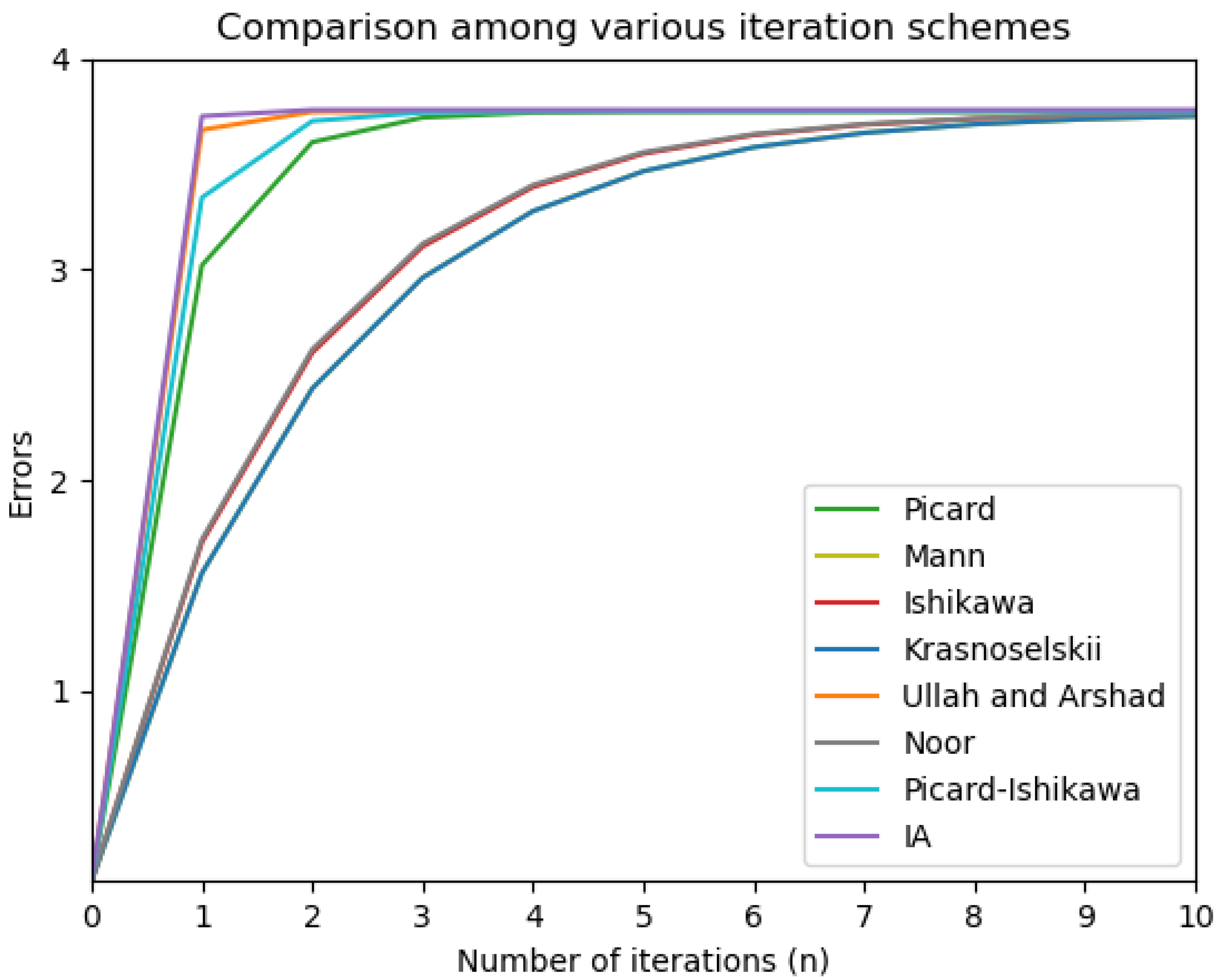
Furthermore, we provide a graphical representation of the numerical data in Table 1 and Table 2 above as follows.
Remark 2.
Clearly, from Table 1 and Table 2 and Figure 1, we see that the IA-iteration process converges faster than Picard, Mann, Ishikawa, Kransel’skii, Ullah & Arshad, Noor, and Picard–Ishikawa to the fixed point of which is 3.75.
Figure 1.
Comparison of rate of convergence among various iteration schemes.
9. Conclusions
In this paper, we introduced a new and a faster iterative scheme. Moreover, we then proved that the constructed IA-type iterative process converges strongly to the fixed point of multivalued nonexpansive mapping T in uniformly convex Banach spaces. Consequently, we showed that the IA-iterative process is stable and data dependent. We showed that the newly iterative method converges faster and is more efficient than some of the iterative processes in the literature, i.e., Picard, Mann, Ishikawa, Kranselskii, Picard–Mann, Kranselskii, and Picard–Ishikawa, among others. In terms of application, we suggested a newer and faster method for solving one of the Caputo’s derivatives that emanated from the infection disease models, named the Caputo–Fabrizio fractional differential equation. Our results extend, unify, and improve several of the known results in the literature.
Author Contributions
Conceptualization, G.A.O. and C.I.U.; methodology, R.T.A. and C.I.U.; software, G.A.O. and C.I.U.; validation, R.T.A., G.A.O. and C.I.U.; formal analysis, R.T.A. and G.A.O.; investigation, R.T.A., G.A.O. and C.I.U.; resources, R.T.A.; data curation, C.I.U.; writing—original draft preparation, G.A.O. and C.I.U.; writing—review and editing, R.T.A. and G.A.O.; visualization, R.T.A. and G.A.O.; supervision, G.A.O.; project administration, R.T.A.; funding acquisition, R.T.A. All authors have read and agreed to the published version of the manuscript.
Funding
This work was supported and funded by the Deanship of Scientific Research at Imam Mohammad Ibn Saud Islamic University (IMSIU) (grant number IMSIU-DDRSP2501).
Data Availability Statement
The original contributions presented in this study are included in the article. Further inquiries can be directed to the corresponding author.
Acknowledgments
This work was supported and funded by the Deanship of Scientific Research at Imam Mohammad Ibn Saud Islamic University (IMSIU) (grant number IMSIU-DDRSP2501). The authors wish to thank the editor and the reviewers for their useful comments and suggestions.
Conflicts of Interest
The authors declare that they have no conflicts of interest.
References
- Rhoades, B.E. Comments on two fixed point iteration methods. J. Math. Anal. Appl. 1976, 56, 741–750. [Google Scholar] [CrossRef]
- Agarwal, R.P.; O’Regan, D.; Sahu, D.R. Iteration construction of fixed points of nearly asymptotically nonexpansive mappings. J. Nonlinear Convex Anal 2007, 8, 61–79. [Google Scholar]
- Chugh, R.; Kumar, V.; Kumar, S. Strong convergence of a new step iterative scheme in Banach spaces. Am. J. Comput. Math. 2012, 2, 345–357. [Google Scholar] [CrossRef]
- Karahan, I.; Ozdemir, M. A general iterative method for approximation of fixed points and their applications. Adv. Fixed Point Theory 2013, 3, 510–526. [Google Scholar]
- Mann, W.R. Mean Value methods in iteration. Proc. Am. Math. Soc. 1953, 4, 506–510. [Google Scholar] [CrossRef]
- Ishikawa, S. Fixed points by a new iteration method. Proc. Am. Math. Soc. 1974, 44, 147–150. [Google Scholar] [CrossRef]
- Noor, M.A. New approximation scheme for general variation inequalities. J. Math. Anal. Appl. 2000, 251, 217–229. [Google Scholar] [CrossRef]
- Okeke, G.A. Convergence analysis of the Picard-Ishikawa hybrid iteration process with application. Afr. Math. 2019, 30, 817–835. [Google Scholar] [CrossRef]
- Khan, S.H. A Picard-Mann hybrid iterative process. Fixed Point Theory Appl. 2013, 2013, 69. [Google Scholar] [CrossRef]
- Sarivastava, V.; Rai, K.N. A multi-term fractional diffusion equation for oxygen delivery a capillary to tissues. Math. Comput. Model. 2010, 51, 616–624. [Google Scholar] [CrossRef]
- Tan, K.K.; Xu, H.K. Approximating fixed points of nonexpansive mappings by Ishikawa iteration process. J. Math. Anal. Appl. 1993, 178, 301–308. [Google Scholar] [CrossRef]
- Picard, E. Memoire sur la theorie des equations aux derivees partielles et la methode des approximations successives. J. Math. Pures Appl. 1890, 6, 145–210. [Google Scholar]
- Kransel, M.A. Two observations about the method of successive approximations. Uspekhi Mat. Nauk. 1957, 10, 131–140. [Google Scholar]
- Ullah, K.; Arshad, M. Numerical reckoning fixed points for Suzuki’s generalized nonexpansive mappings via new iteration process. Filomat 2018, 32, 187–196. [Google Scholar] [CrossRef]
- Berinde, V. Iterative Approximation of Fixed Points; Efemeride: Baia Mare, Romania, 2002. [Google Scholar]
- Alshehry, A.S.; Mukhtar, S.; Khan, H.S.; Shah, R. Fixed-point theory and numerical analysis of an epidemic model with fractional calculus: Exploring dynamical behavior. Open Phys. 2023, 21, 20230121. [Google Scholar] [CrossRef]
- Baleanu, D.; Arshad, S.; Jajarmi, A.; Shokat, W.; Ghassabzade, F.A.; Wali, M. Dynamical behaviors and stability analyzis of a generalied fractional model with a real case study. J. Adv. Res. 2023, 48, 157–173. [Google Scholar] [CrossRef] [PubMed]
- Agarwal, R.; Hristova, S.; O’Regan, D. Basic concepts on Riemann-Liouville fractional differential equations with non-instantaneous impulses. Symmetry 2019, 11, 614. [Google Scholar] [CrossRef]
- Kajouni, A.; Chafiki, A.; Hilal, K.; Oukessou, M. A new conformable fractional derivative and applications. Int. J. Differ. Equ. 2021, 2021, 6245435. [Google Scholar] [CrossRef]
- Vivas-Cortez, M.; Mohammed, P.O.; Guirao, J.L.G.; Yousif, M.A.; Ibrahim, I.S.; Chorfi, N. Improved fractional differences with kernels of delta Mittag-Leffler and exponential functions. Symmetry 2024, 16, 1562. [Google Scholar] [CrossRef]
- Okeke, G.A.; Abbas, M.; De la Sen, M. Approximation of the fixed point of multivalued quasi-nonexpansive mappings via a faster iterative process with applications. Discret. Dyn. Nat. Soc. 2020, 2020, 8634050. [Google Scholar] [CrossRef]
- Grosan, T.; Soltuz, S.M. Data dependence for Ishikawa iteration when dealing with contractive-like operators. Fixed Point Theory Appl. 2008, 2008, 242916. [Google Scholar]
- Soltuz, S.M.; Otrocol, D. Classical results via Mann-Ishikawa iteration. Rev. D’analyse Numer. L’approximation 2007, 36, 193–197. [Google Scholar]
- Shukka, D.P.; Tiwari, V.; Singh, R. Noor iterative processes for multivalued mappings in Banach Spaces. Int. J. Math. Anal. 2014, 8, 649–657. [Google Scholar] [CrossRef]
- Granger, T.; Michelitsch, T.M.; Bestehorn, M.; Riascos, A.P.; Collet, B.A. Stochastic compartment model with mortality and its application to epidemic spreading in complex networks. Entropy 2024, 26, 362. [Google Scholar] [CrossRef]
Disclaimer/Publisher’s Note: The statements, opinions and data contained in all publications are solely those of the individual author(s) and contributor(s) and not of MDPI and/or the editor(s). MDPI and/or the editor(s) disclaim responsibility for any injury to people or property resulting from any ideas, methods, instructions or products referred to in the content. |
© 2025 by the authors. Licensee MDPI, Basel, Switzerland. This article is an open access article distributed under the terms and conditions of the Creative Commons Attribution (CC BY) license (https://creativecommons.org/licenses/by/4.0/).