You are currently on the new version of our website. Access the old version .
MathematicsMathematics
  • Article
  • Open Access

23 November 2025

On the Number of Spanning Trees in Augmented Triangular Prism Graphs

and
1
Department of Mathematics, Applied College at Mahail Aseer, King Khalid University, Abha 62521, Saudi Arabia
2
Department of Mathematics, Faculty of Science, Taibah University, Al-Madinah Al-Nunawara 41411, Saudi Arabia
3
Department of Mathematics and Computer Sciences, Faculty of Science, Menoufia University, Shebin El Kom 32511, Egypt
*
Author to whom correspondence should be addressed.

Abstract

In computer science and graph theory, prism and antiprism graphs are crucial for network modeling, optimization, and network connectivity comprehension. Applications such as social network analysis, fault-tolerant circuit design, and parallel and distributed computing all make use of them. Their structured nature makes them important, since it offers a framework for researching intricate characteristics, including resilient design, communication patterns, and network efficiency. This work uses the electrically equivalent transformations technique to compute the explicit formulas for the number of spanning trees of three novel families of graphs that have been produced using triangular prisms with their distinctive iteration feature. Additionally, the relationship between these graphs’ average degree and entropy is examined and contrasted with the entropy of additional graphs that share the same average degree as these previously studied graphs.

1. Introduction

A subgraph of a connected, undirected graph G with n vertices that contains all the vertices and n 1 edges without creating any cycles is called a spanning tree. The number of spanning trees in graph G , denoted by τ ( G ) , is also referred to as the complexity of G [1]. This is an important and well-studied quantity with a wide range of applications. Listing specific chemical isomers [2], counting the number of Eulerian circuits in a graph [3], solving computationally difficult problems like the wandering salesman and Steiner tree problems [4], and deriving formulas for different graph types can be helpful in figuring out which graphs have the most spanning trees and are the most notable application domains.
Spanning trees are used in network reliability to evaluate a network’s performance, improve its fault resistance, and understand its structure. They form the foundation for protocols like the Spanning Tree Protocol (STP), which provide redundancy, prevent network loops, and determine how to add new links for optimal reliability [5].
A traditional Kirchhoff matrix from 1847 can be used to determine the number of spanning trees for a connected graph G = ( V , E ) with n vertices [6]. The Kirchhoff matrix L is an n × n characteristic matrix L = D A , where A is the adjacency matrix of G and D is the diagonal matrix of the degrees of G , such that L = [ a i j ] , defined as follows:
L = [ a i j ] = deg ( v i ) if   i = j 1 if i j   and ( v i , v j ) E ( G ) 0 if i j   and ( v i , v j ) E ( G )
Each co-factor of L corresponds to the number of spanning trees in a graph G .
Another way to determine the number of spanning trees is to assume that the eigenvalues of the Kirchhoff matrix L of a graph G with n vertices are μ 1 μ 2 μ n = 0 .
In 1974, Kelmans and Chelnokov [7] demonstrated the following:
τ ( G ) = 1 n i = 1 n 1 μ i .
This method has been used to calculate the number of spanning trees of cartesian and composition products of two graphs [8].
The deletion–contraction strategy is a popular technique for determining the number of spanning trees τ ( G ) . The number of spanning trees in a multigraph can be reliably determined using this method. This method uses the following formula:
τ G = τ G e + τ G / e ,
where G e is the graph that results from removing an arbitrary edge e and G / e is the graph that results from contracting an arbitrary edge [9].

1.1. Electrically Equivalent Transformations

The technique of reducing a complicated electrical circuit to a simpler, equivalent one without altering its overall electrical behavior is known as electrical equivalent transformation. Kirchhoff was inspired by the study of graph theory, which concerns the possibility of representing an electrical network as a graph with edge weights corresponding to connectivity.
The ratio of weighted spanning trees to weighted thickets, where a thicket is a particular kind of spanning forest, can be used to determine the effective conductance between two vertices u and v [10]. That is the effect conductance between two vertices u and v , which can be expressed as the quotient of the (weighted) number of spanning trees and the (weighted) number of thickets.
We list the impact of a few basic modifications on the quantity of spanning trees below.
Let G represent the weighted number of spanning trees and let H be the associated electrically equivalent graph. Let τ ( G ) be the weighted number of spanning trees of G and τ ( H ) be the weighted number of spanning trees of H .
  • Parallel edges: When two parallel edges in G with conductances u and v are joined to form a single edge in H with a conductance of u + v , the number of spanning trees in H , τ ( H ) , remains equal to τ G .
  • Serial edges: If two serial edges in G with conductances u and v are linked to generate a single edge in H with a conductance of u v / ( u + v ) , the number of spanning trees in H , τ ( H ) , can be calculated as ( 1 / ( u + v ) ) multiplied by τ G .
  • Δ-Y Transformation: When a triangle in G with conductances u ,   v , and w is transformed into an electrically equivalent star graph in H with conductances x = ( u v + v w + w u ) / u ,   y = ( u v + v w + w u ) / v , and z = ( u v + v w + w u ) / w , the number of spanning trees in H , τ ( H ) , can be computed as 1 / ( u + v + w ) multiplied by τ ( G ) .
  • Y-Δ Transformation: One may obtain the number of spanning trees in H , τ ( H ) , by multiplying τ G by 1 / ( u + v + w ) , when an electrically equivalent triangle in H with conductances x = v w / ( u + v + w ) ,   y = u w / ( u + v + w ) and z = u v / ( u + v + w ) is created from a star graph in G with conductances u ,   v , and w .
This method has been used to calculate the number of spanning trees in specific graph sequences generated by a Johnson skeleton graph [11]. Johnson graph 63, also known as the six-tetrahedral graph, is a highly symmetric graph with unique properties that make it a subject of interest in graph theory and related fields.
The “63 Johnson skeleton graph” is a particular example of a graph from the larger family of Johnson graphs, which are defined by subsets and intersections rather than by the structure of a polyhedron.

1.2. Some Types of Triangular Prism Graphs

The constant goal in mathematics is to create a new structure from an old one. This is also true for graphs, where a given set of graphs can be used to construct a huge number of new graphs.
We will begin by introducing three new categories of triangular prism graphs. The number of trees that extend into each of the three augmented families that these three graphs establish will then be determined, along with their entropy, in the next section.
The triangular prism graph’s use as a model for technical and physical systems, including those in network science, engineering, and optics, makes it significant. It illustrates the dispersion of light principles in optics. In engineering, it depicts the stable triangular construction utilized in building frames and bridges. The triangular prism graph is used in graph theory and network research to examine the intricacy of structures and network characteristics like connection and signal transmission.
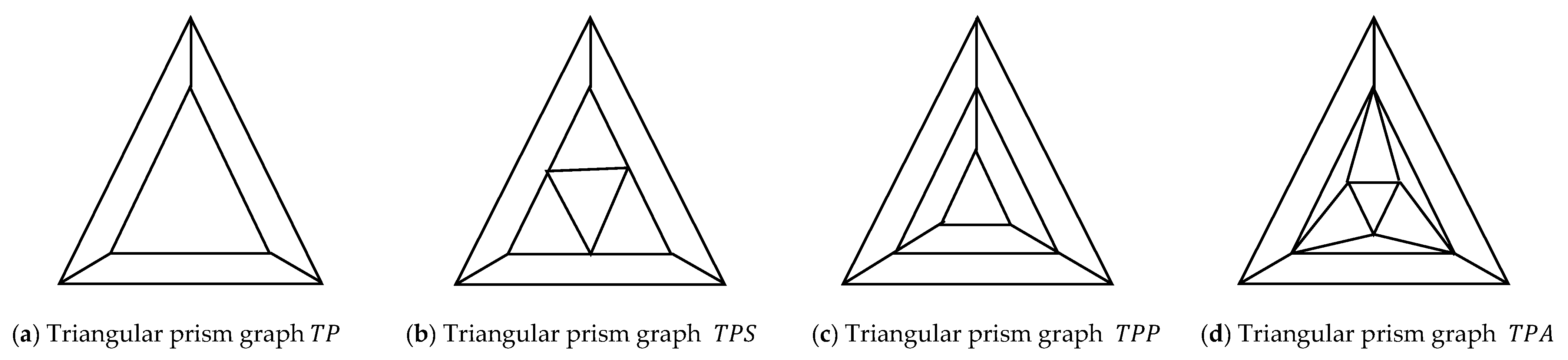
In this work, we use the electrically equivalent transformations to determine the number of spanning trees for three new graph families based on a triangular prism graph, or T P , as illustrated below in Figure 1:
Figure 1. Triangular prism graphs T P ,   T P P , T P S , and T P A .
(1)
The triangular prism graph, or T P S , is a graph that is made by substituting a star 3,3 -gon graph for the middle triangle of a triangular prism, T P . See Figure 1b.
(2)
The triangular prism graph, or T P P , is a graph that is made by substituting another triangular prism for the middle triangle of a triangular prism, T P . See Figure 1c.
(3)
The triangular prism graph, or T P A , is a graph that is made by substituting a triangular antiprism graph for the middle triangle of a triangular prism, T P . See Figure 1d.
A triangular prism graph is a graph that depicts the vertices and edges of a three-dimensional triangle prism. On the other hand, a Johnson graph is a family of graphs made from set systems in which the edges join subsets of a given size and the vertices are subsets of a particular size. Their origins are crucially different: a Johnson graph is defined algebraically from combinations of sets, while a triangular prism graph is directly based on geometric geometry.

2. Main Results

2.1. Complexity of the Graph Family Generated by Triangular Prism Graph, T P S

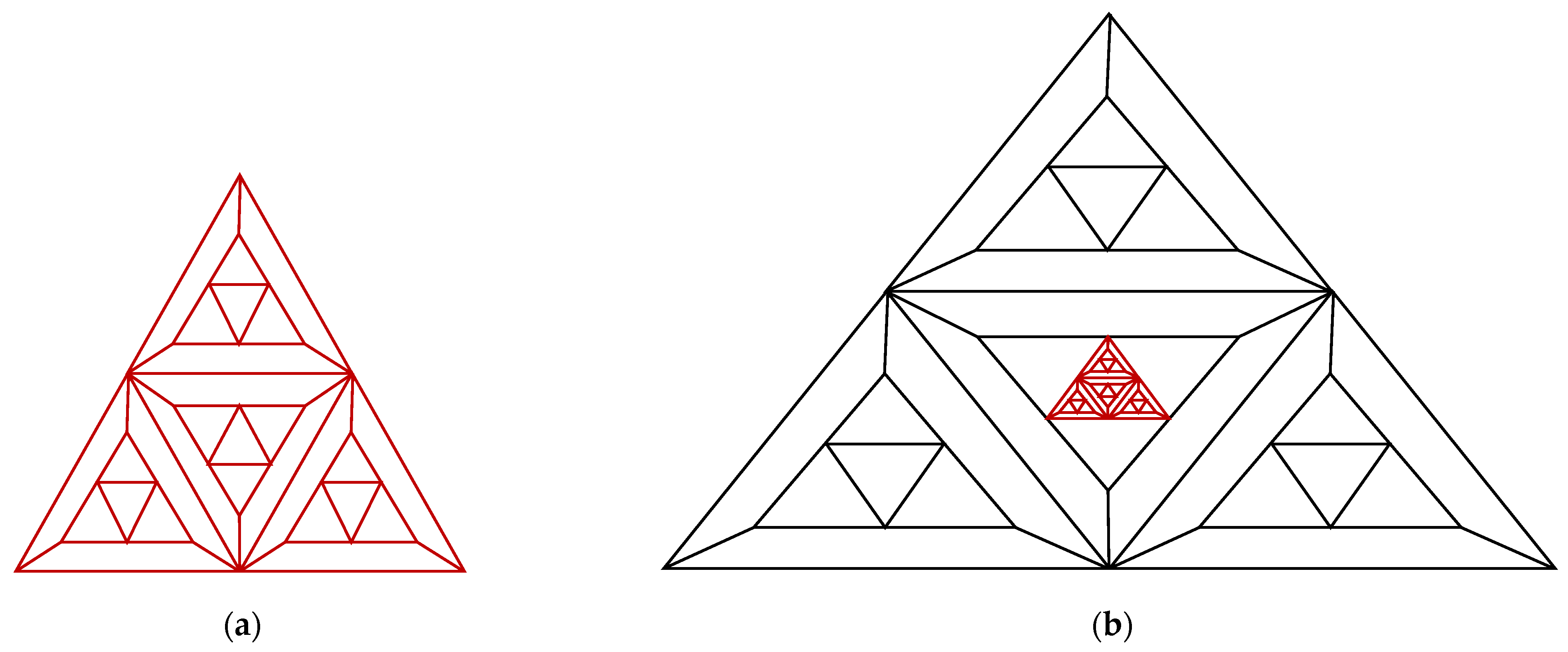
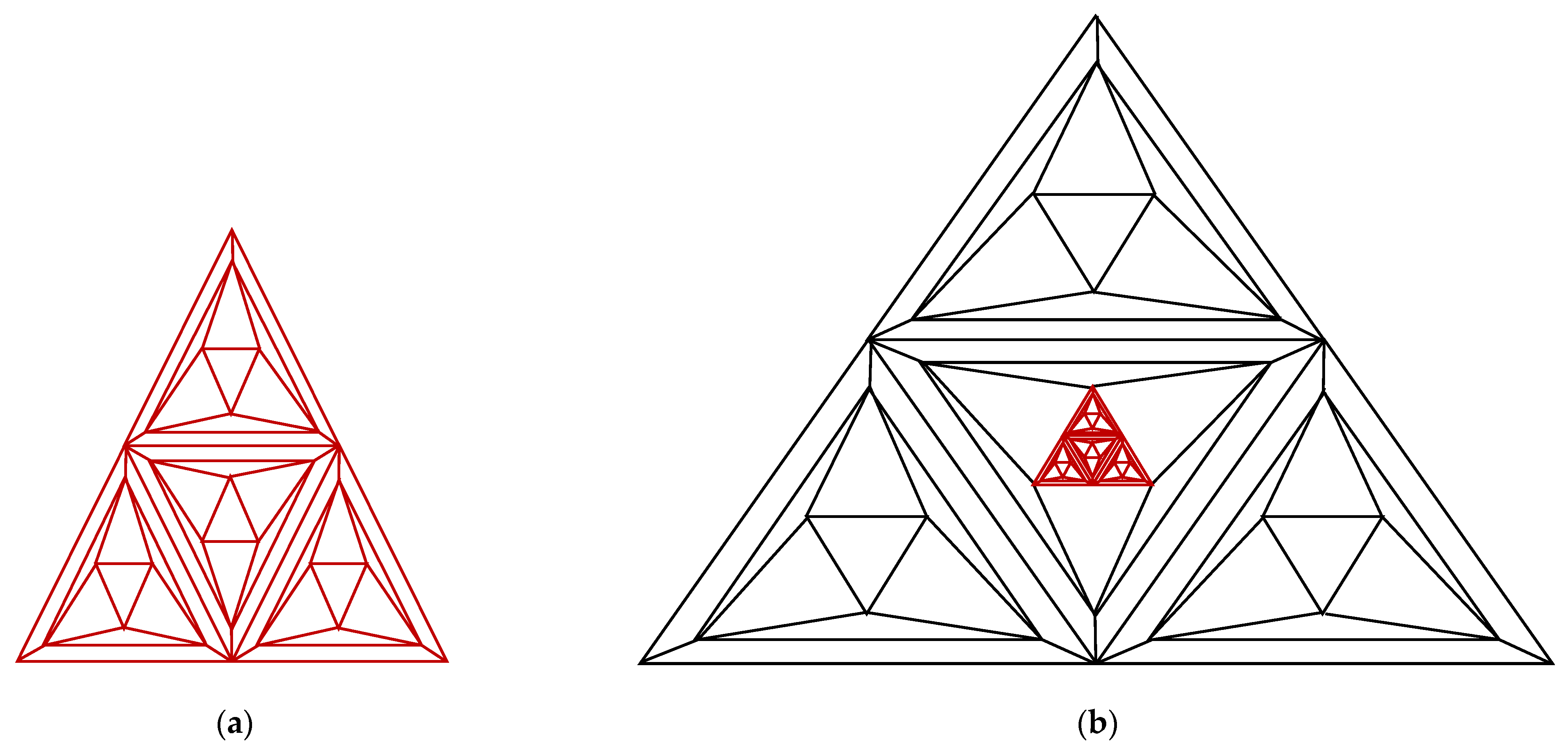
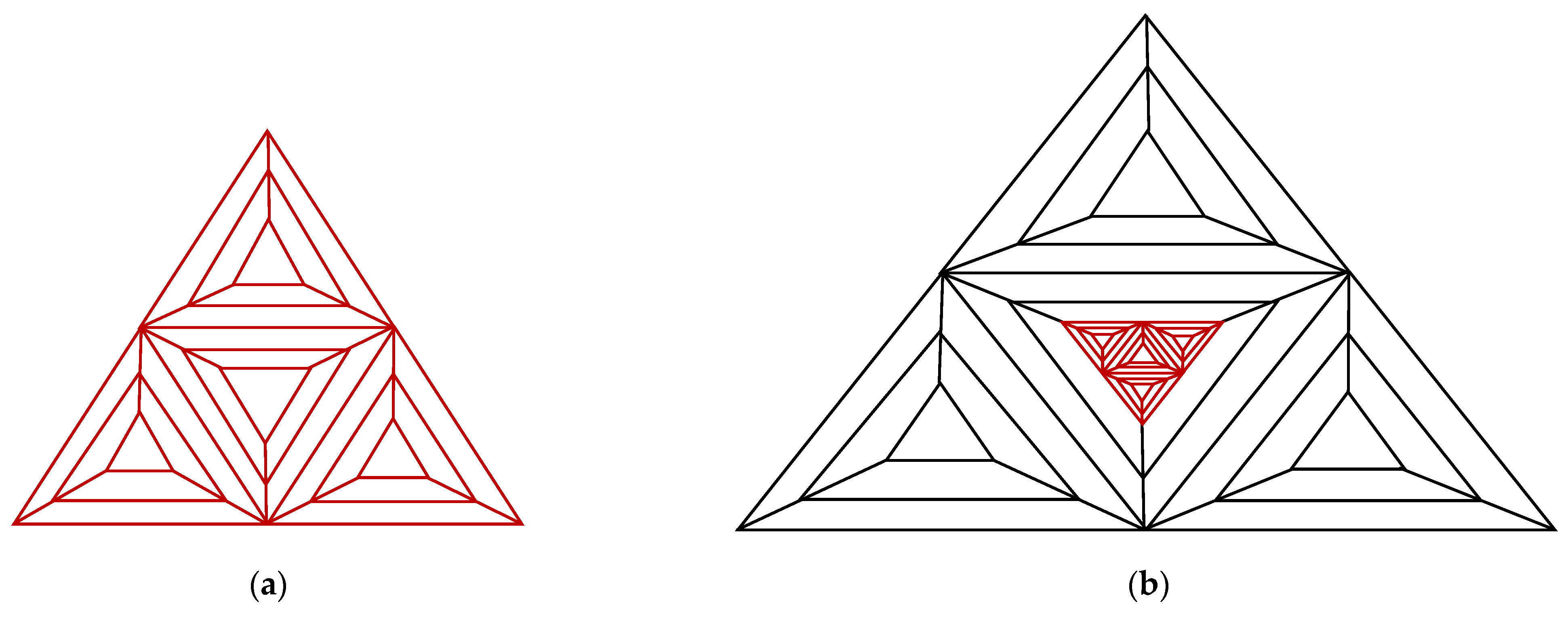
The graph family generated by the triangular prism graph T P S and denoted by F T P S ( n ) is a recursive definition using the graphs F T P S ( 2 ) and F T P S ( 1 ) (triangle or K 3 ): a replica of F T P S ( 2 ) is used in place of the middle triangle of F T P S ( 2 ) to create the graph F T P S ( 3 ) . The middle triangle in the graph F T P S ( n 1 ) is typically swapped out for F T P S ( 2 ) to make F T P S ( n ) , as shown in Figure 2. V ( F T P S ( n ) ) = 27 n 24 and E ( F T P S ( n ) ) = 54 n 51 , n = 1 , 2 , are the total vertices and edges of F T P S ( n ) , respectively. According to this architecture in the large n limit, the average degree of F T P S ( n ) is 4 .
Figure 2. (a) The graph F T P S ( 2 ) . (b) The graph F T P S ( 3 ) .
Theorem 1.
For  n 1 , the number of spanning trees in the graph family,  F T P S ( n ) , generated by the triangular prism graph,  T P S , is given by the following:
3 × 8208 n 1 × z 1 2 × λ   ρ 1 n 2 + μ   ρ 2 n 2 2
where  z 1 = 233762561 + 15293 233649273 113288 n 1 863673 + 59 233649273 408072 2217 233649273 23772 233762561 + 15293 233649273 113288 n 1 116377883 + 7185 233649273 38494792 1 ,
ρ 1 = 15293 + 233649273 2 , ρ 2 = 15293 233649273 2 ,
λ = 717459034292 + 46940824 233649273 77883091 , and  μ = 717459034292 46940824 233649273 77883091 .
Proof. 
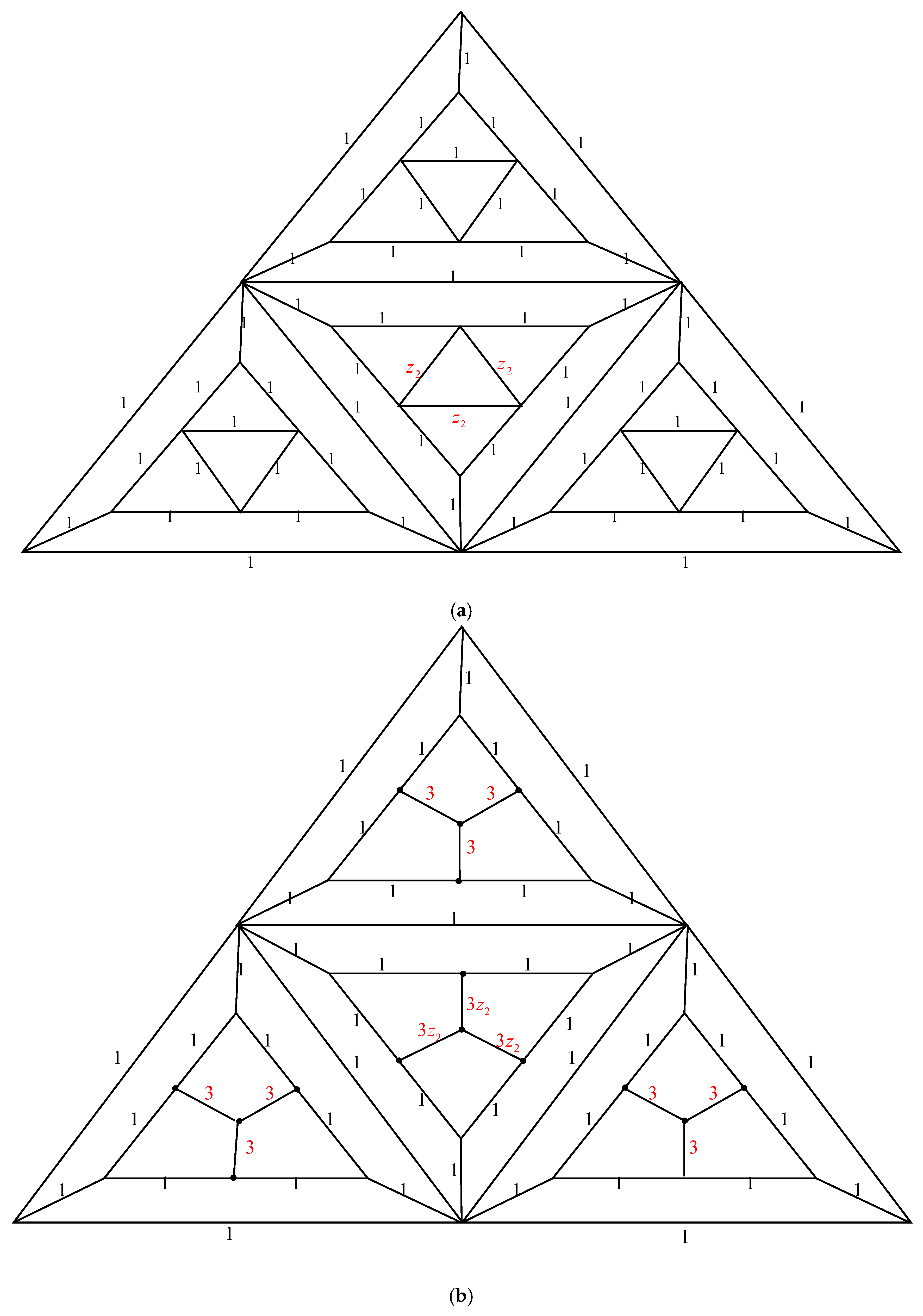
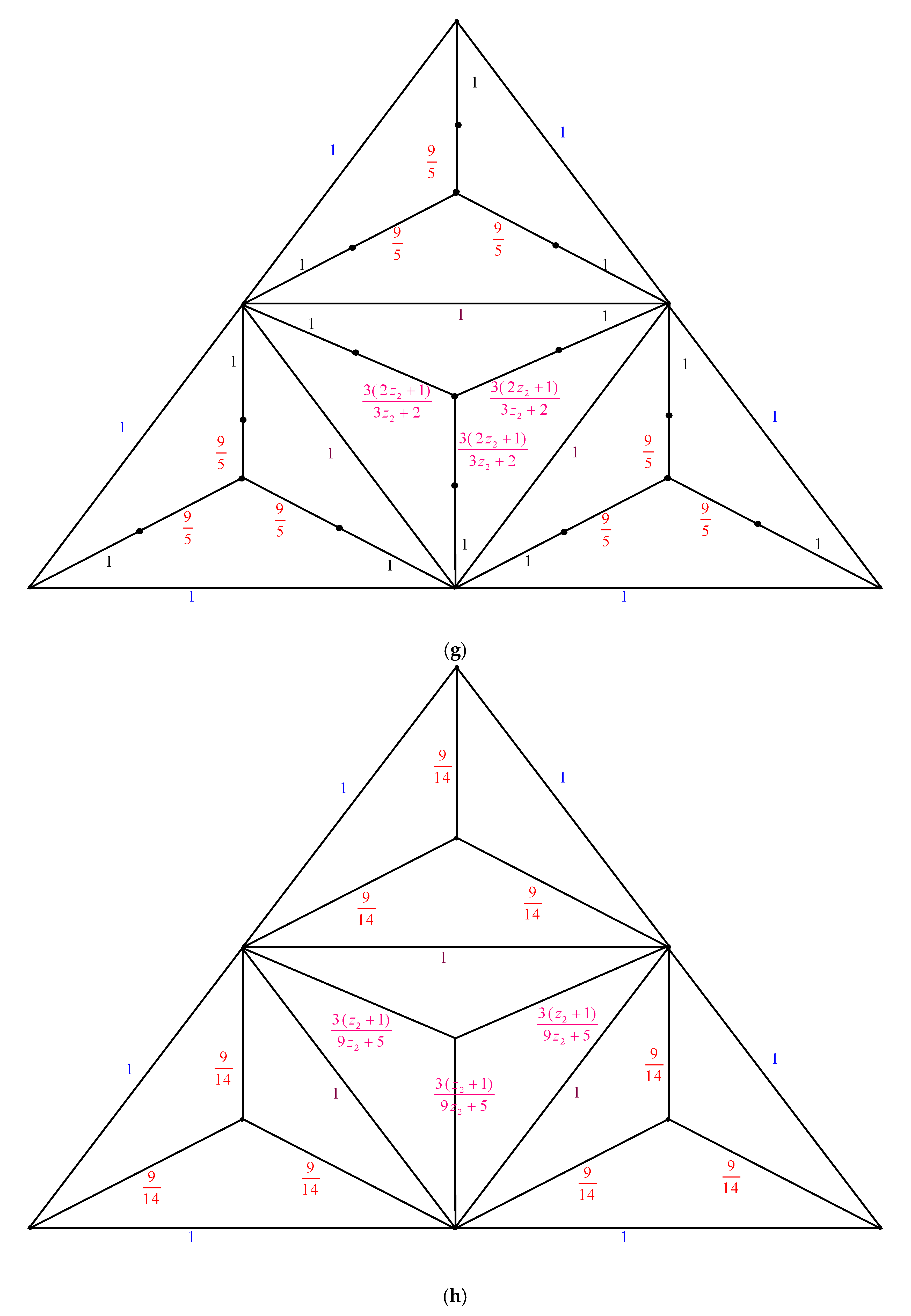
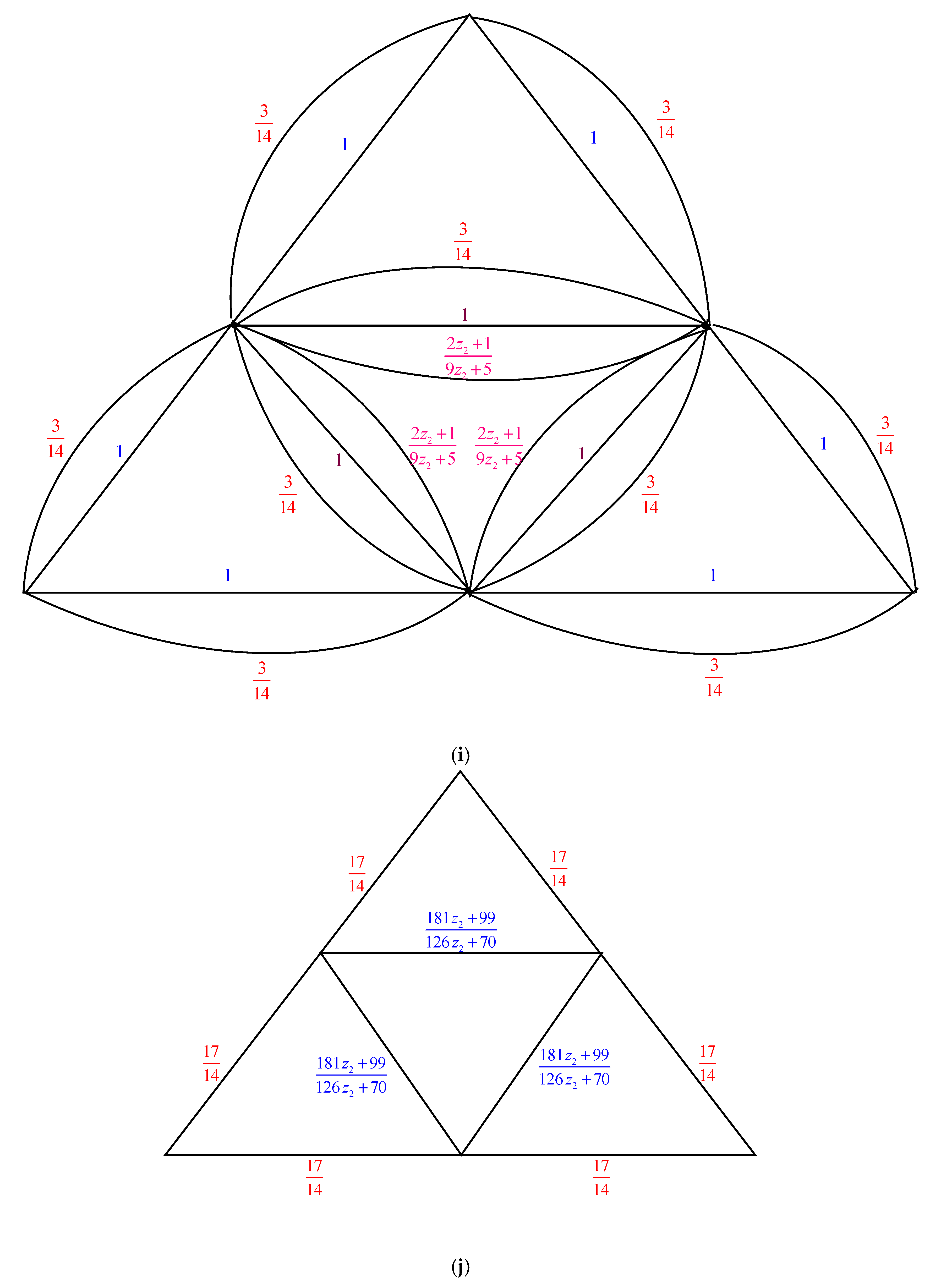
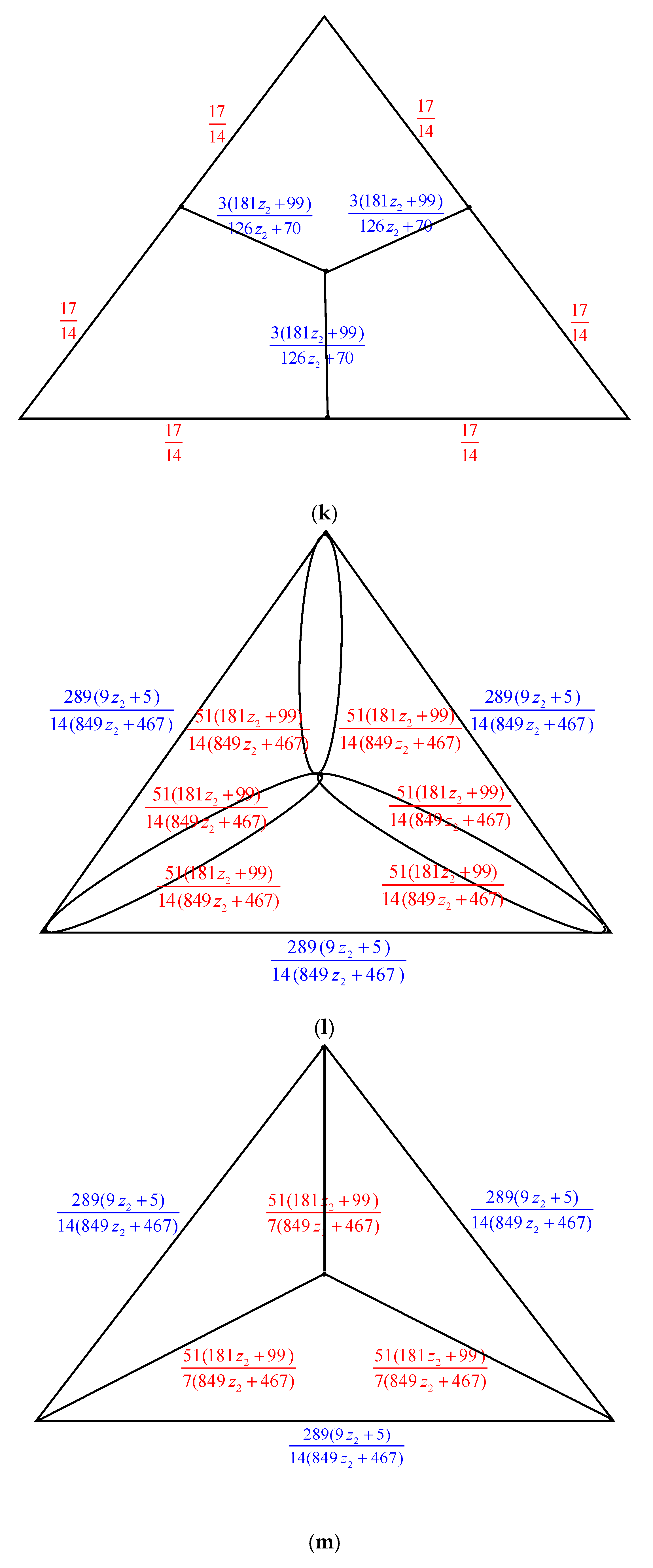
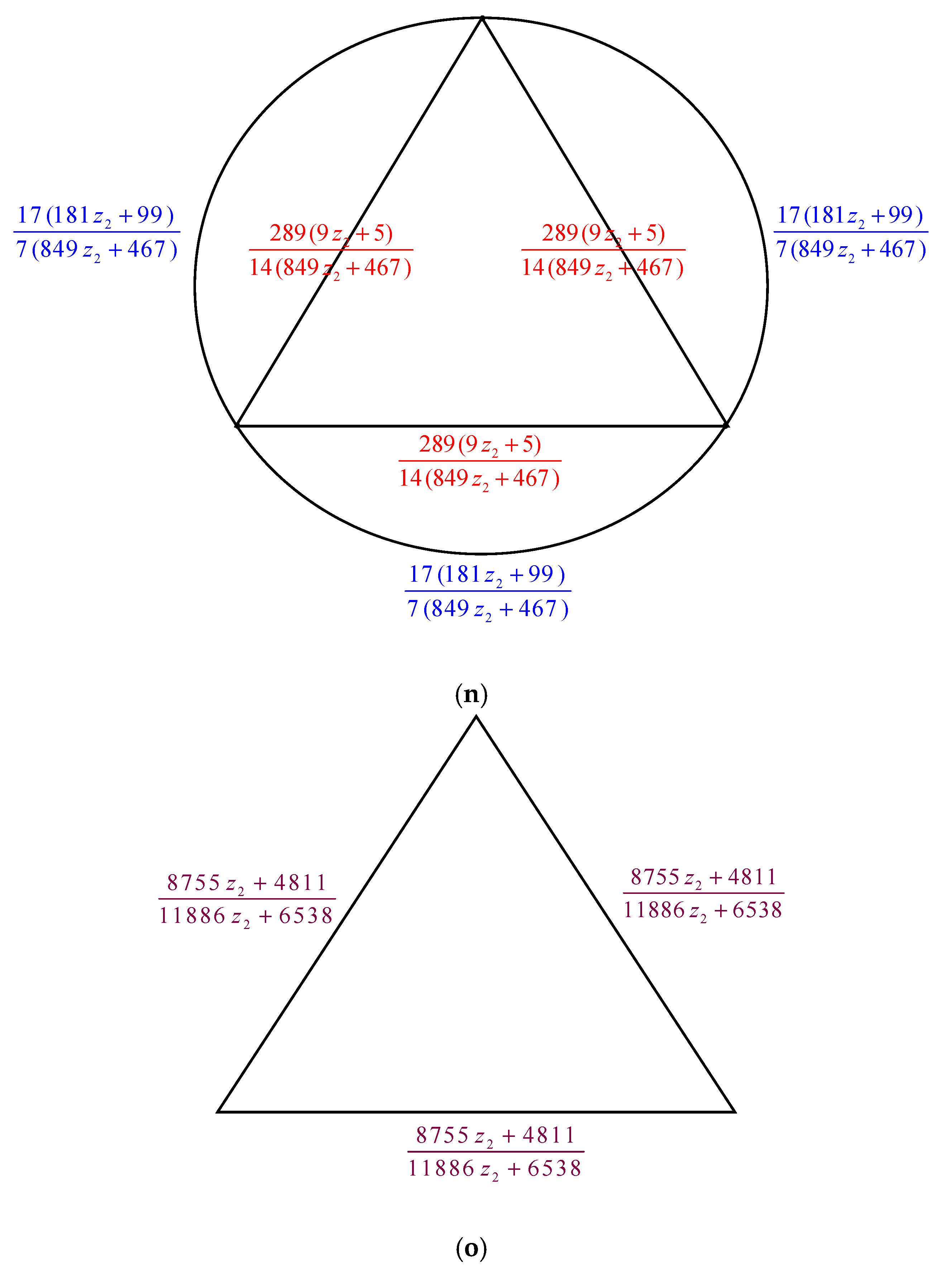
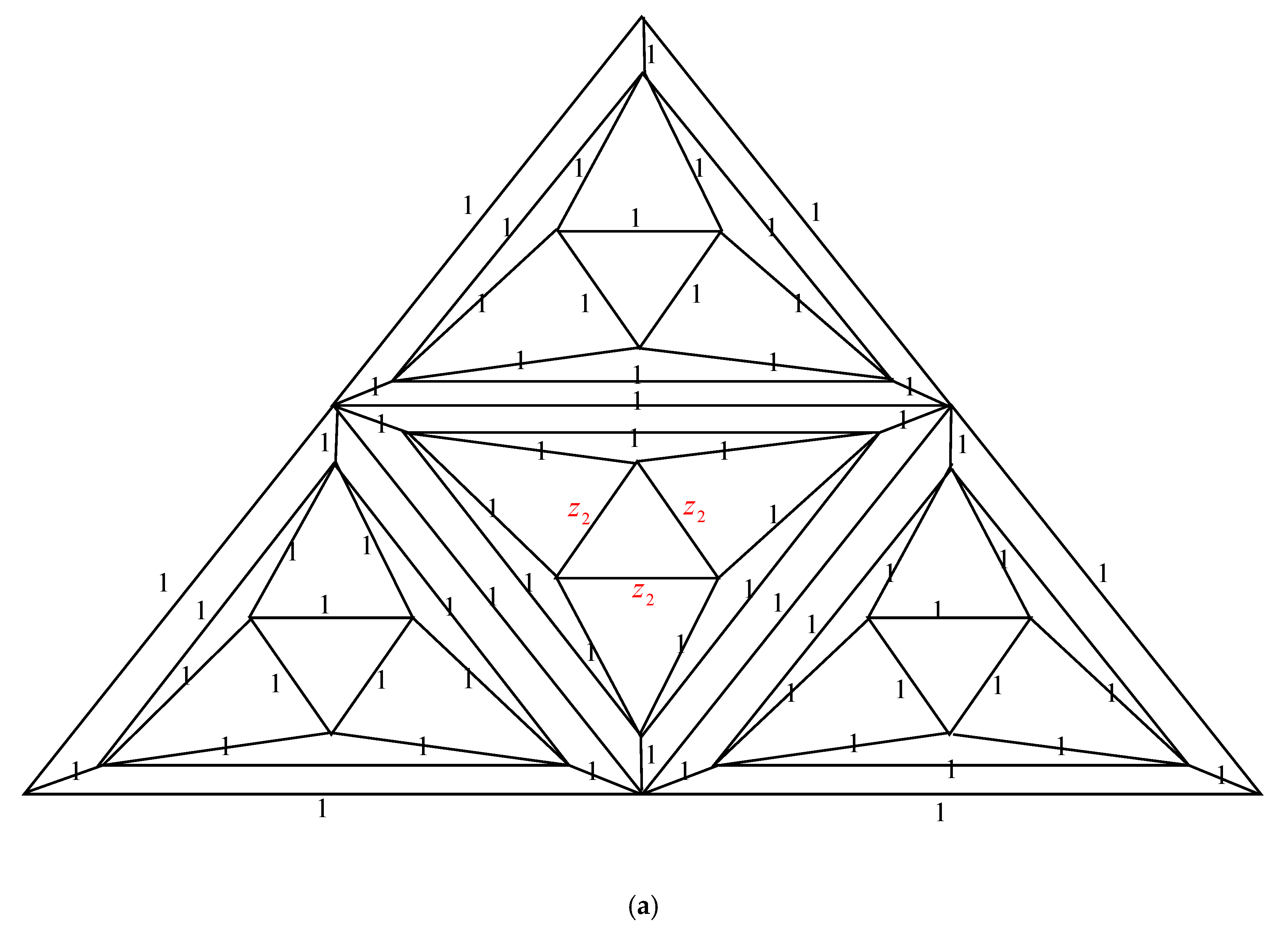
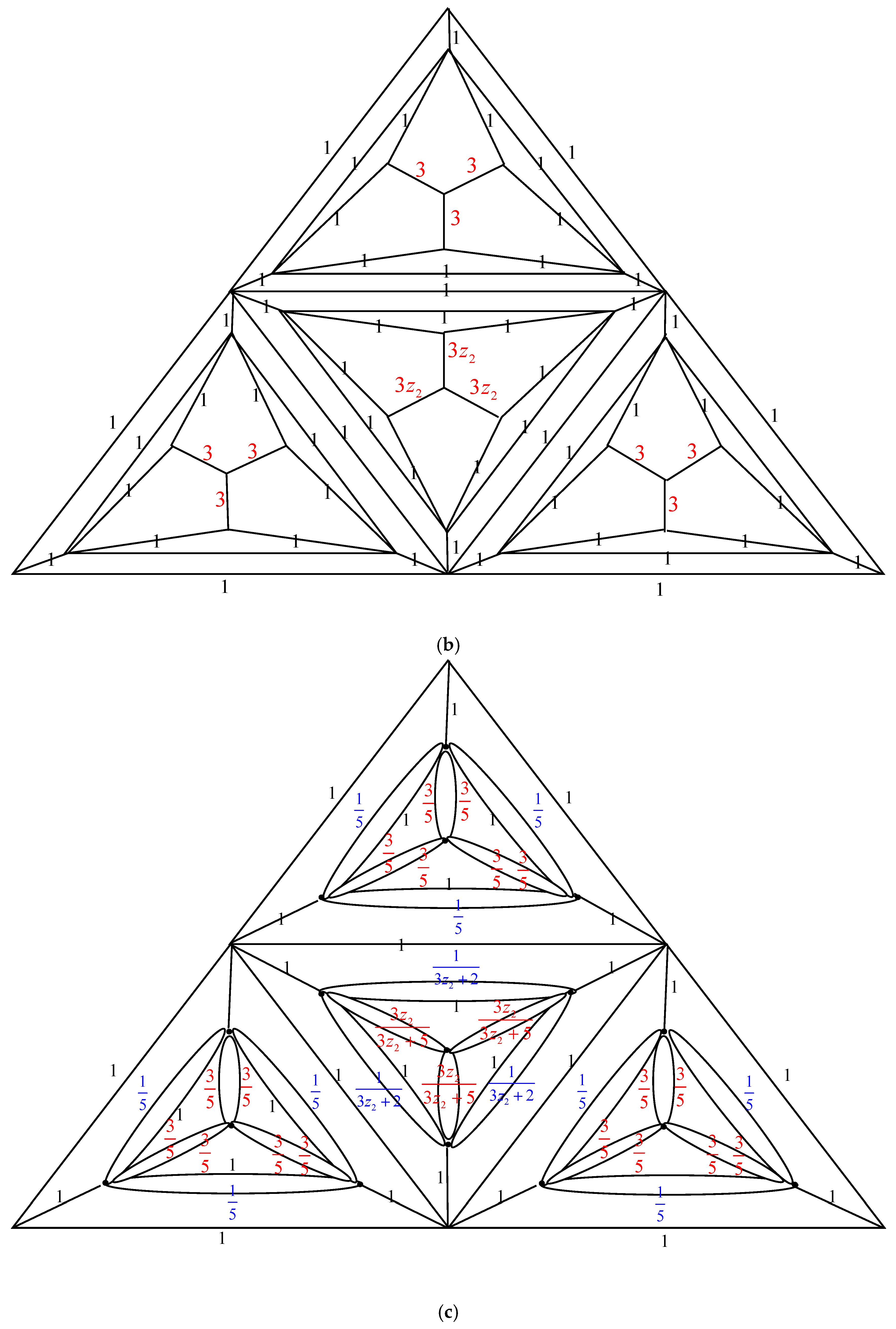
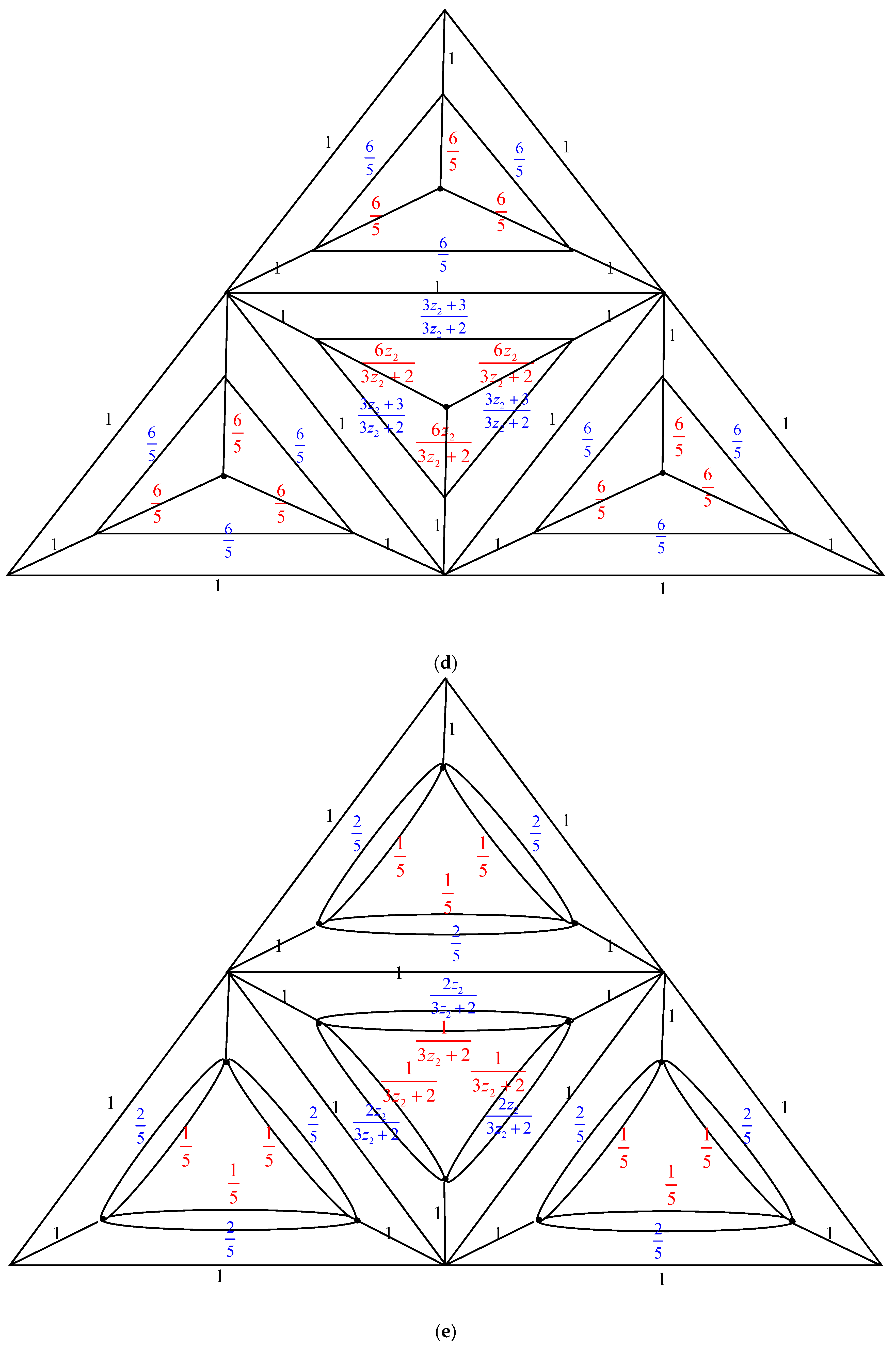
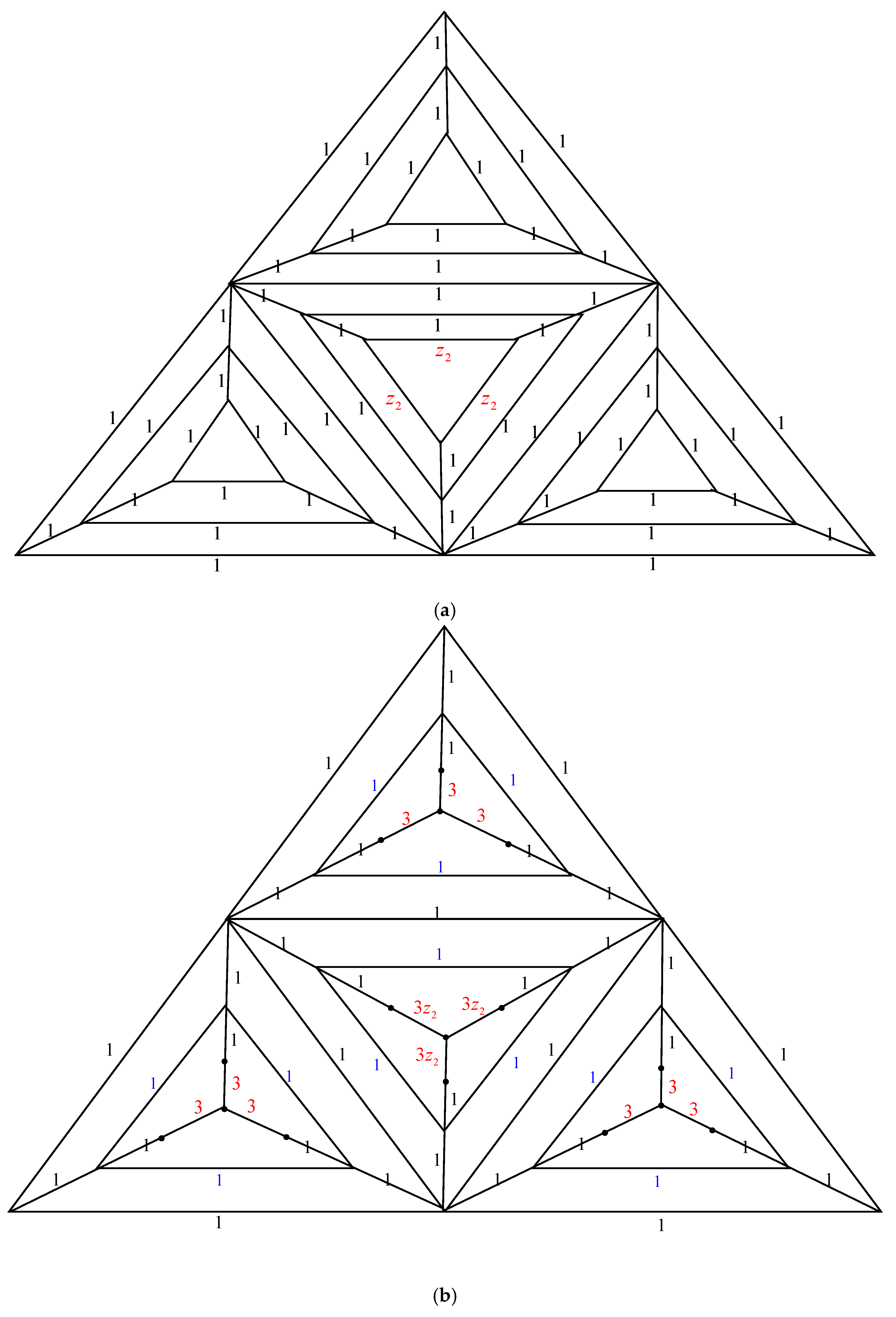
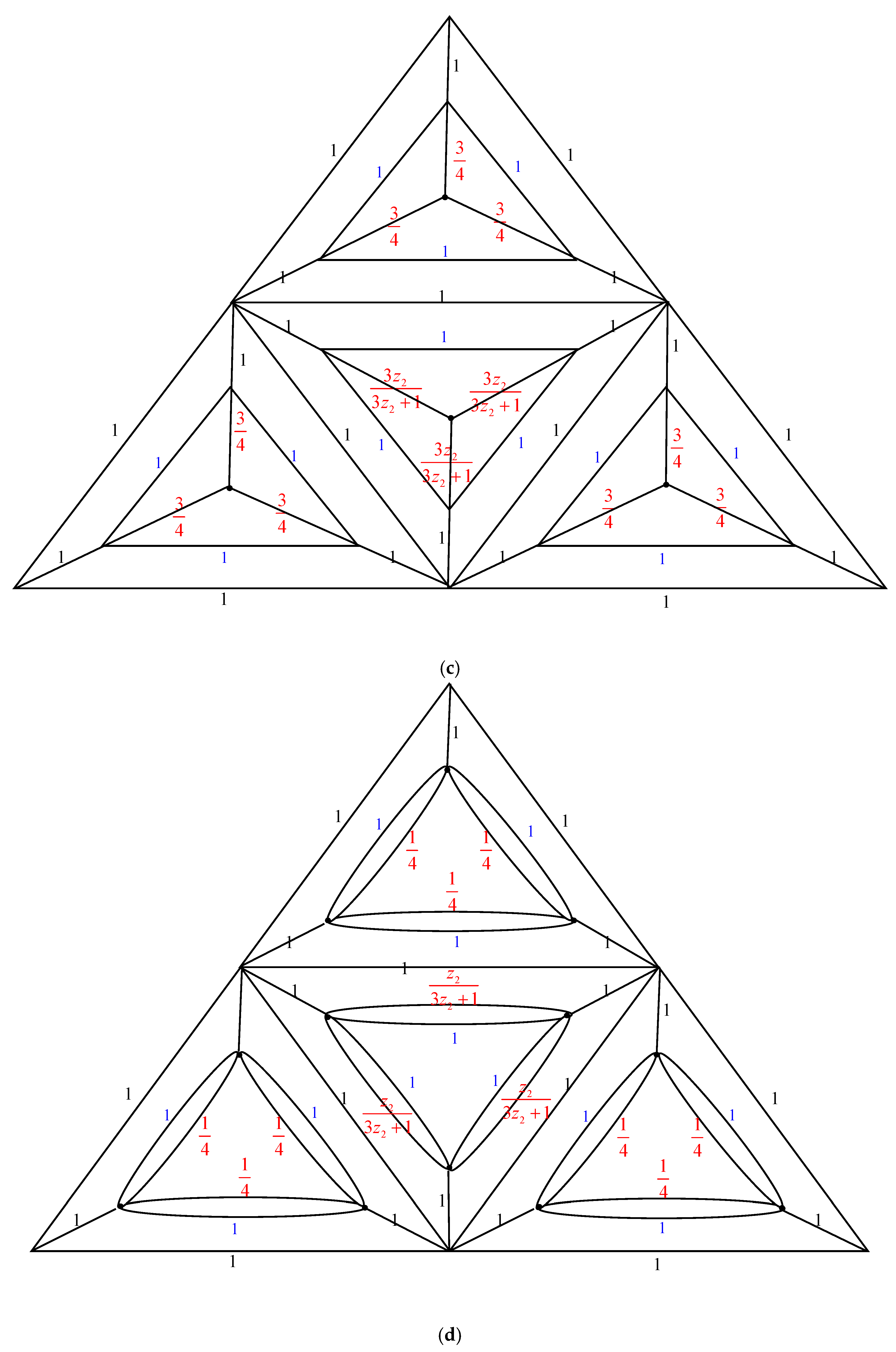
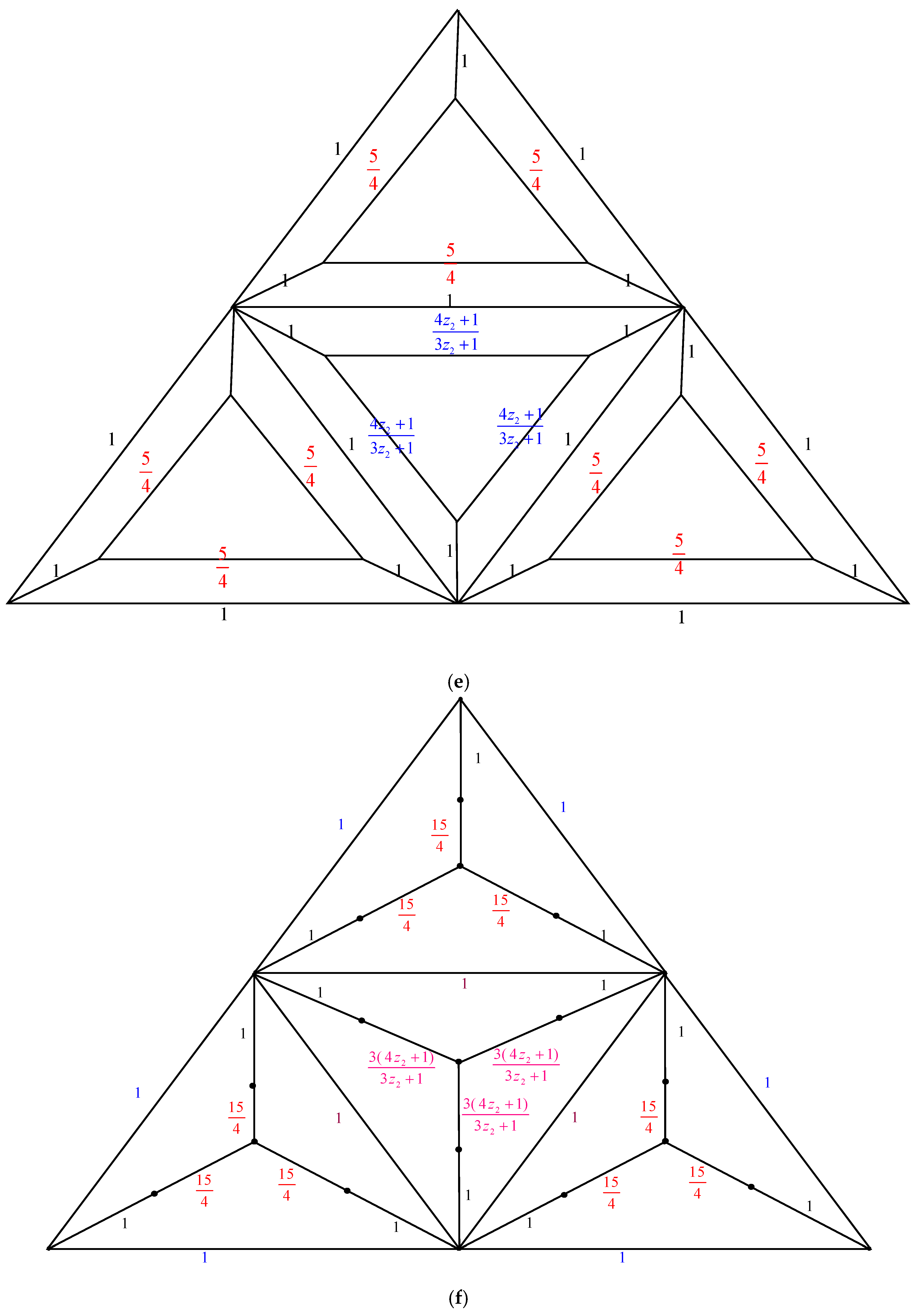
The electrically equivalent transformation is used to convert F T P S ( i ) to F T P S ( i 1 ) . The process of transforming F T P S ( 2 ) into F T P S ( 1 ) is shown in Figure 3.
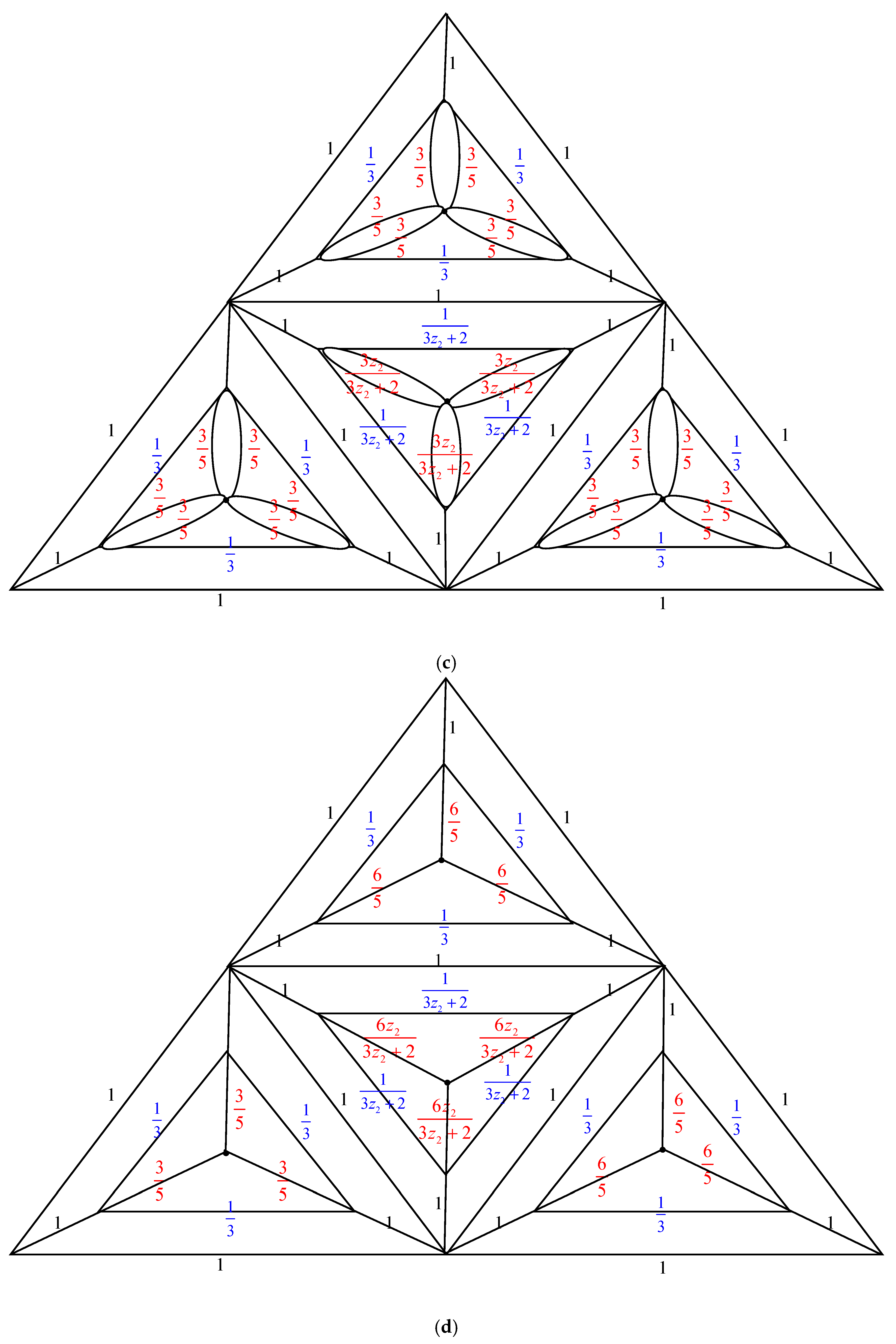
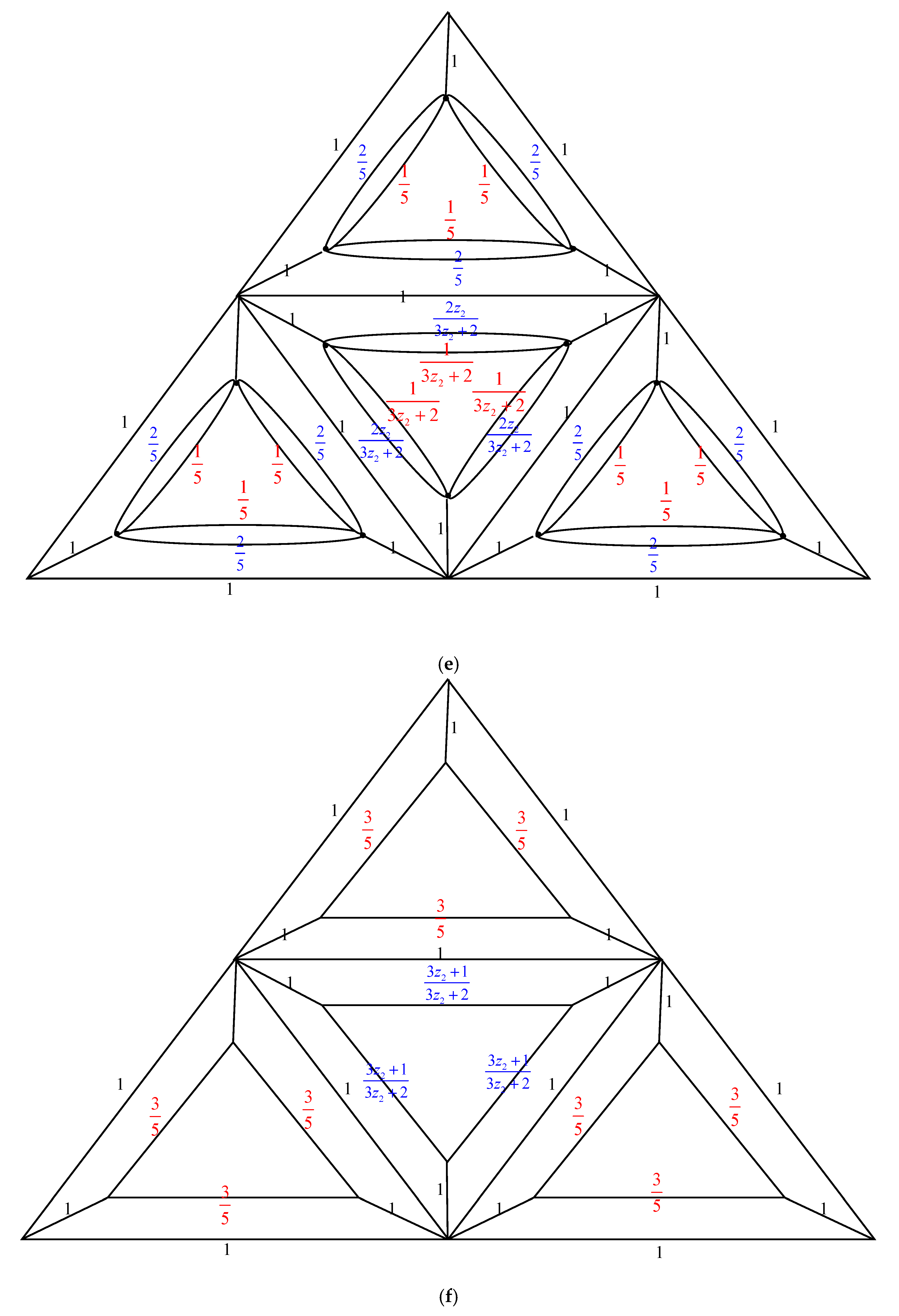
Figure 3. The transformations from F T P S ( 2 ) to F T P S ( 1 ) . (a) The graph F T P S ( 2 ) . Utilizing the Δ-Y Transformation method, we obtain τ H 1 = 9 4   z 2   τ F T P S 2 . (b) The graph H 1 . The Y-Δ Transformation technique is used to obtain τ H 2 = 1 5 9   1 3   Z 2 + 2   3 τ H 1 . (c) The graph H 2 . The parallel edge rule is used to obtain τ H 3 = τ H 2 . (d) The graph H 3 . Utilizing the Y-Δ Transformation method, we obtain τ H 4 = 5 18 3 3 Z 2 + 2 18 Z 2 τ H 3 . (e) The graph H 4 . By applying the parallel edge rule, we obtain τ H 5 = τ H 4 . (f) The graph H 5 . The Δ-Y Transformation method gives us τ H 6 = 9 3 5 3 9 2 Z 2 + 1 3 Z 2 + 2 τ H 5 . (g) The graph H 6 . By applying the Y-Δ Transformation method, we obtain τ ( H 7 ) = 5 14 9 ( 3 Z 2 + 2 9 Z 2 + 5 ) 3 τ H 6 . (h) The graph H 7 . The serial edge rule is used to obtain τ H 8 = 14 27 3 9 Z 2 + 5 9 2 Z 2 + 1 τ H 7 . (i) The graph H 8 . Applying the rule of parallel edges, we arrive at τ H 9 = τ H 8 . (j) The graph H 9 . The Δ-Y Transformation rule gives us τ H 10 = 9 181 Z 2 + 99 126   Z 2 + 70 τ H 9 . (k) The graph H 10 . The Y-Δ Transformation rule gives us τ H 11 = 14 9 Z 2 + 5 849   Z 2 + 467 3 τ H 10 . (l) The graph H 11 . When we use the parallel edge rule, we obtain τ H 12 = τ H 11 . (m) The graph H 12 . Applying the Y-Δ Transformation rule, we obtain τ H 13 = 7 849 z 2 + 467 153 181 z 2 + 99 τ ( H 12 ) . (n) The graph H 13 . The parallel edge rule is applied, and we obtain τ H 14 = τ H 13 . (o) The graph H 14 = F T P S ( 1 ) .
The result of combining these fourteen transformations is the following:
τ ( F T P S ( 2 ) ) = 1 9 4   z 2 × 5 9 × ( 3 z 2 + 2 ) 3 × ( 18 5 ) 3 × 18 z 2 ( 3   z 2 + 2 ) × ( 5 3 3 11 ) × 3   z 2 + 2 ( 2   z 2 + 1 ) × ( 14 5 ) 9 × ( 9   z 2 + 5 3   z 2 + 2 ) 3 × ( 27 14 ) 3 × 9 ( 2   z 2 + 1 ) 9   z 2 + 5   × 126 z 2 + 70 9 ( 181   z 2 + 99 ) × ( 849   z 2 + 467 14 ( 9   z 2 + 5 ) ) 3 × 153 ( 181   z 2 + 99 ) 7 ( 849   z 2 + 467 ) τ ( F T P S ( 1 ) ) .
Thus, we have
τ F T P S 2 = 7616 ( 11886   z 2 + 6538 ) 2 τ ( F T P S ( 1 ) ) .
Moreover,
τ F T P S n = i = 2 n 7616 ( 11886   z i + 6538 ) 2   τ ( F T P S 1 ) = 3 × 761 6 n 1 z 1 2 [ i = 2 n 11886   z i + 6538 ] 2 .
where z i 1 = 8755   z i + 4811 11886   z i + 6538 ,   i = 2 , 3 , , n .
Its characteristic equation is 11886 ω 2 2217   ω 4811 = 0 , with the following roots:
ω 1 = 2217 233649273 23772   and   ω 2 = 2217 + 233649273 23772 .
These two roots can be subtracted from both sides of z i 1 = 8755   z i   + 4811 11886   z i   + 6538 to obtain the following:
z i 1 ω 1 = z i 1 2217 233649273 23772 = 8755   z i + 4811 11886   z i + 6538 2217 233649273 23772 = 15293 + 233649273 × z i 2217 233649273 23772 2 11886   z i + 6538 ,
z i 1 ω 2 = z i 1 2217 + 233649273 23772 = 8755 z i + 4811 11886   z i + 6538 2217 + 233649273 23772 = ( 15293 233649273 ) × z i 2217 + 233649273 23772 2 ( 11886 z i + 6538 )   .
Let t i = z i 2217 233649273 23772 z i 2217 + 233649273 23772 , then t i 1 = z i 1 2217 233649273 23772 z i 1   2217 + 233649273 23772   t i
Then, by Equations (5) and (6), we obtain the following:
t i 1 = 15293 + 233649273 15293 233649273 t i   or   t i 1 = ( 233672561 + 15293 233649273 113288 )   t i .
Therefore,
t i = ( 233672561 + 15293 233649273 113288 ) n i   t n
From the expression t i = z i 2217 233649273 23772 z i 2217 + 233649273 23772 , we have the following:
t i z i 2217 + 233649273 23772   = z i   2217 233649273 23772 ,
Then,
z i = ( 233672561 + 15293 233649273 113288   ) n i × 2217 + 233649273 23772     t n ( 2217 233649273 23772 ) (   233672561 + 15293 233649273 113288   ) n i   t n 1 .
Therefore,
z 1 = ( 233672561 + 15293 233649273 113288 ) n 1 ×   2217 + 233649273 23772   t n ( 2217 233649273 23772 ) ( 233672561 + 15293 233649273 113288 ) n 1   t n 1 .
If z n = 1 , we obtain the following:
t n = 1 2217 233649273 23772 1 2217 + 233649273 23772   =   21555 + 233649273 21555 233649273 = 116377883 + 7185 233649273 38494792 .
Thus, we obtain the following:
z 1 = 233762561 + 15293 233649273 113288 n 1 863673 + 59 233649273 408072 2217 233649273 23772   233762561 + 15293 233649273 113288 n 1 116377883 + 7185 233649273 38494792 1 ,   n 1
With the expression z n 1 = 8755   z n + 4811 11886   z n + 6538 and the coefficients of 8755   z n + 4811 and 11886   z n + 6538 , represented as α n and β n , respectively, we obtain the following:
11886   z n + 6538 = α 0 ( 8755   z n + 4811 ) + β 0 ( 11886   z n + 6538 ) , 11886   z n 1 + 6538 = α 1 ( 8755   z n + 4811 ) + β 1 ( 11886   z n + 6538 ) α 0 ( 8755   z n + 4811 ) + β 0 ( 11886   z n + 6538 ) , 11886   z n 2 + 6538 = α 2 ( 8755   z n + 4811 ) + β 2 ( 11886   z n + 6538 ) α 1 ( 8755   z n + 4811 ) + β 1 ( 11886   z n + 6538 ) , 11886   z n i + 6538 = α i ( 8755   z n + 4811 ) + β i ( 11886   z n + 6538 ) α i 1 ( 8755   z n + 4811 ) + β i 1 ( 11886   z n + 6538 ) ,
11886   z n ( i + 1 ) + 6538 = α i + 1 ( 8755   z n + 4811 ) + β i + 1 ( 11886   z n + 6538 ) α i ( 8755   z n + 4811 ) + β i ( 11886   z n + 6538 ) 11886   z 2 + 6538 = α n 2 ( 8755   z n + 4811 ) + β n 2 ( 11886   z n + 6538 ) α n 3 ( 8755   z n + 4811 ) + β n 3 ( 11886   z n + 6538 ) ,
So, we obtain the following:
τ ( F T P S n ) = 3 × 761 6 n 1 z 1 2 [ α n 2 ( 8755   z n + 4811 ) + β n 2 ( 11886   z n + 6538 ) ] 2
Using the expression z n 1 = 8755   z n + 4811 11886   z n + 6538 with Equations (8) and (9), we obtain the following:
α i + 1 = 15293   α i 56644   α i 1 ;   β i + 1 = 15293   β i 56644   β i 1
Equation (11) has the characteristic equation ρ 2 15293 ρ + 56644 = 0 , with the roots ρ 1 = 15293 + 233649273 2 and ρ 2 = 15293 233649273 2 .
The general solutions of Equation (11) are α i = a 1 ρ 1 i + a 2 ρ 2 i ;   β i = b 1 ρ 1 i + b 2 ρ 2 i .
Using the initial conditions α 0 = 0 ,   β 0 = 1 and α 1 = 11886 ,   β 1 = 6538 yields the following:
α i = 11886 233649273 233649273 ( 15293 + 233649273 2 ) i 11886 233649273 233649273 ( 15293 233649273 2 ) i ; β i = ( 233649273 2217 233649273 467298546 ) ( 15293 + 233649273 2   ) i   + ( 233649273 + 2217 233649273 467298546 ) ( 15293 233649273 2 ) i
If z n = 1 , F T P S ( n ) is devoid of any electrically equivalent transformation. By entering Equation (12) into Equation (10), we obtain the following:
τ F T P S ( n ) = 3 × 7616 n 1   z 1 2   ×   7717459034292 + 46,940,824   233649273 77883091   15293 + 233649273 2   n 2 +   7717459034292 46,940,824   233649273 77883091     15293 233649273 2   n 2 2 , n 2 .
Equation (13) is satisfied for n = 1 , and τ ( F T P S ( 1 ) ) = 3 . Thus, the number of spanning trees in the graph family F T P S n generated by triangular prism graph T P S is determined by the following:
τ F T P S ( n ) = 3 × 7616 n 1 z 1 2   × 7717459034292 + 46,940,824   233649273 77883091 15293 + 233649273 2 n 2 + 7717459034292 46,940,824   233649273 77883091 15293 233649273 2 n 2 2 , n 1 .
By substituting Equation (7) into Equation (14), we achieve the intended outcome. □

2.2. Complexity of the Graph Family Generated by Triangular Prism Graph, T P A

The graph family generated by triangular prism graph T P A and denoted by F T P A ( n ) is a recursive definition using the graphs F T P A ( 2 ) and F T P A ( 1 ) (triangle or K 3 ): a replica of F T P A ( 2 ) is used in place of the middle triangle of F T P A ( 2 ) to create the graph F T P A ( 3 ) . The middle triangle in the graph F T P A ( n 1 ) is typically swapped out for F T P A ( 2 ) to make F T P A ( n ) , as shown in Figure 4. V ( F T P A ( n ) ) = 27 n 24 and E ( F T P A ( n ) ) = 66 n 63 , n = 1 , 2 , are the total vertices and edges of F T P A ( n ) , respectively. According to this architecture in the large n limit, the average degree of F T P A ( n ) is 4.89 .
Figure 4. (a) The graph F T P A ( 2 ) . (b) The graph F T P A ( 3 ) .
Theorem 2.
For  n 1 , the number of spanning trees in the graph family,  F T P A ( n ) ,  generated by the triangular prism graph  T P A  is given by the following:
3 × 34336 n 1 × z 1 2 × λ   ρ 1 n 2 + μ   ρ 2 n 2 2
where
z 1 = 11435617471 + 453,720   635248119 1151329 n 1 131015223 + 5360   635248119 47917657 3012 635248119 36395 11435617471 + 453,720   635248119 1151329 n 1 ( 3485404 + 133   635248119 954535 ) 1 , ρ 1 = 75620 + 3 635248119 ,   ρ 2 = 75620 3 635248119 , λ = 889696626522 + 17650067 635248119 10123476   and   μ = 889696626522 17650067 635248119 10123476 .
Proof. 
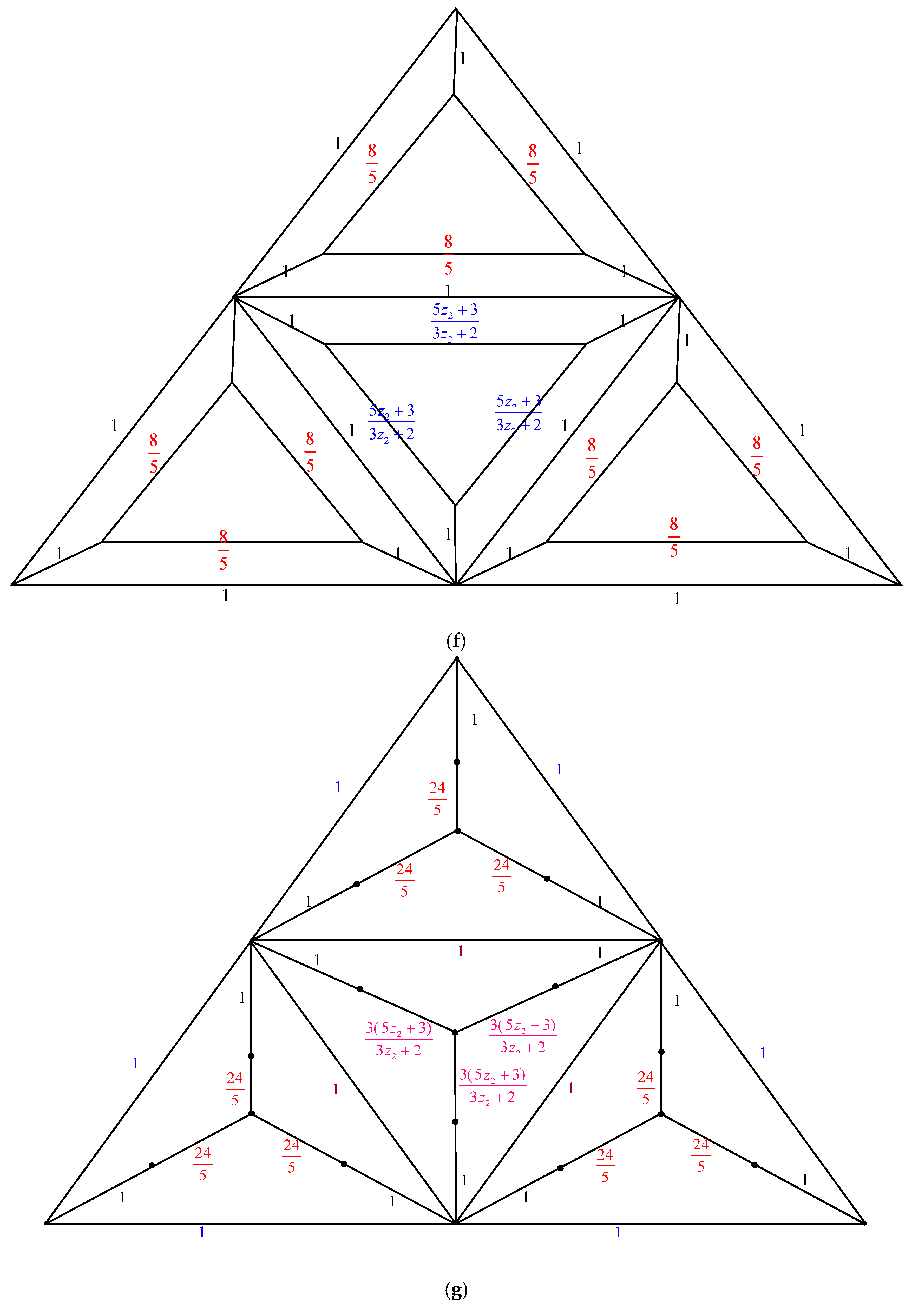
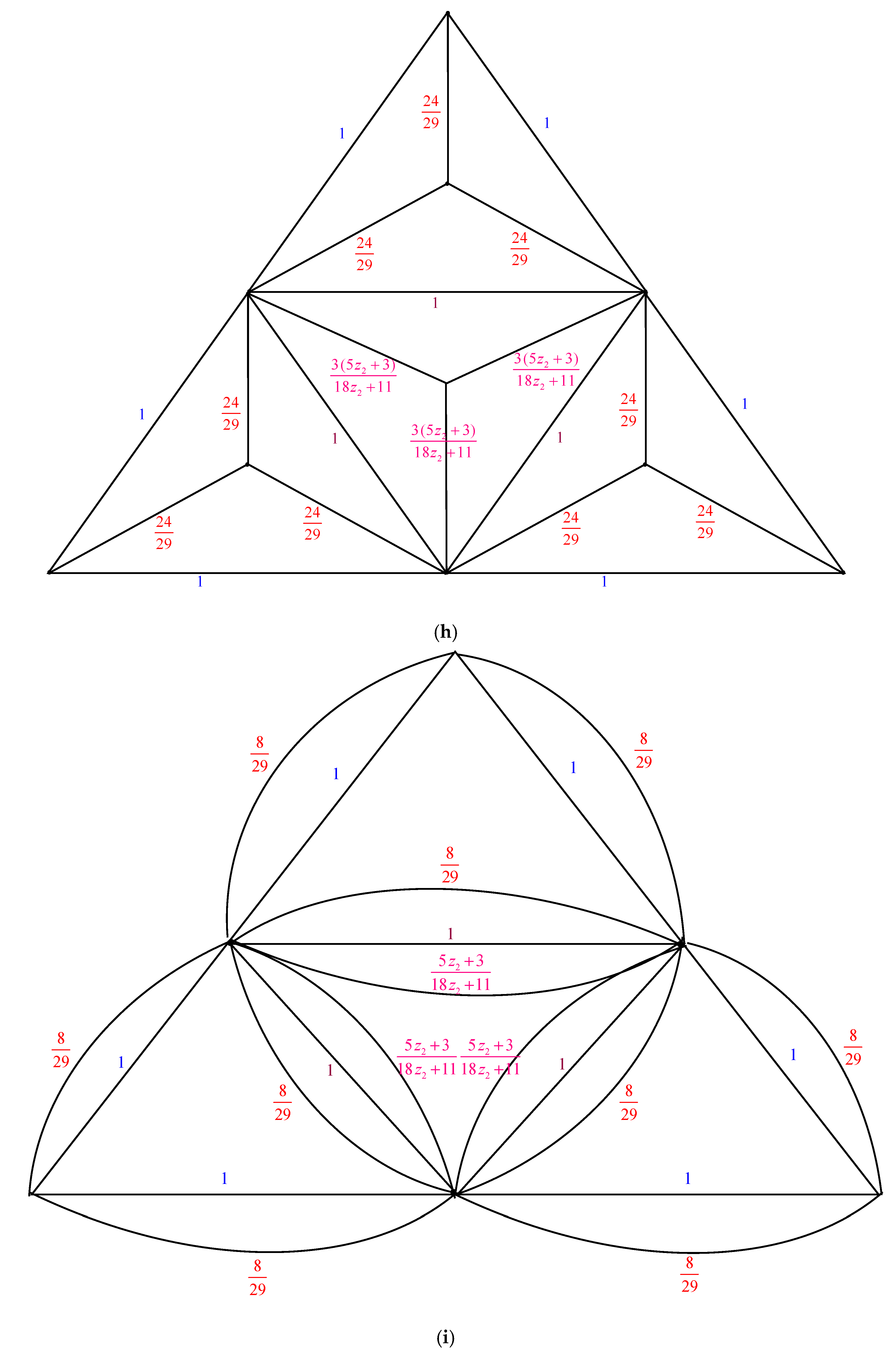
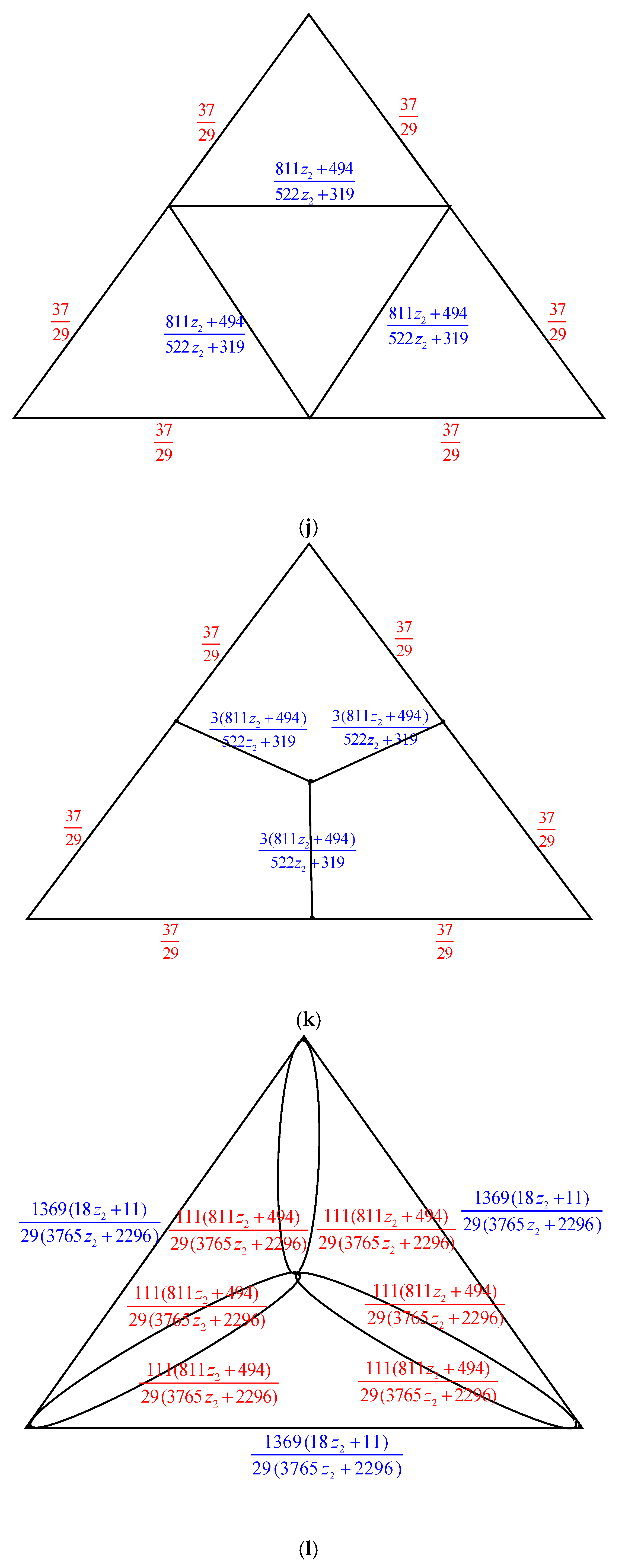
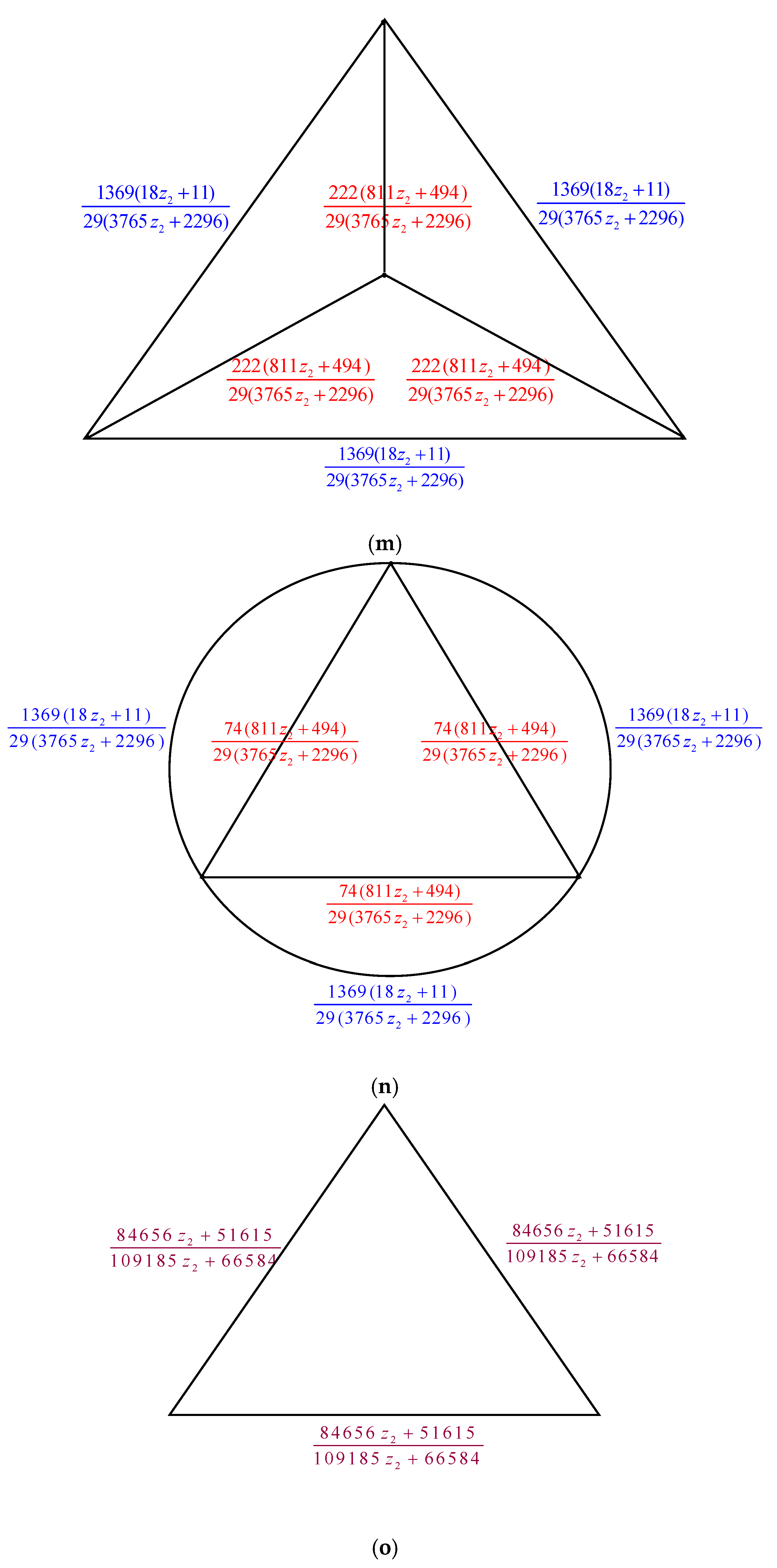
The electrically equivalent transformation is used to convert the graph F T P A ( i ) to the graph F T P A ( i 1 ) . The process of transforming the graph F T P A ( 2 ) into the graph F T P A ( 1 ) is shown in Figure 5.
Figure 5. The transformations from F T P A ( 2 ) to F T P A ( 1 ) . (a) The graph F T P A ( 2 ) . Using the Δ-Y Transformation technique, we obtain τ H 1 = 9 4   z 2   τ F T P A 2 . (b) The graph H 1 . Applying the Y-Δ Transformation rule yields τ H 2 = 1 5 9 1 3   Z 2 + 1 3 τ H 1 . (c) The graph H 2 . The parallel edge rule is applied, and the result is τ H 3 = τ H 2 . (d) The graph H 3 . We obtain the following by using the Y-Δ Transformation rule: τ H 4 = 5 18 3 3   Z 2 + 2 18   Z 2 τ H 3 . (e) The graph H 4 . The parallel edge rule is applied, and the result is τ H 5 = τ H 4 . (f) The graph H 5 . From the Δ-Y Transformation rule, we obtain τ H 6 = 9   8 5 3 9 5   Z 2 + 3 3   Z 2 + 2 τ H 5 . (g) The graph H 6 . The serial edge rule is applied, and the result is τ H 7 = 5 29 9 3 Z 2 + 2 18 Z 2 + 11 3 τ H 6 . (h) The graph H 7 . When we apply the Y-Δ Transformation rule, we obtain τ H 8 = 29 72 3 18 z 2 + 11 9 5 z 2 + 3 τ H 7 . (i) The graph H 8 . The parallel edge rule is used to obtain τ H 9 = τ H 8 . (j) The graph H 9 . By applying the Δ-Y Transformation rule, we obtain τ H 10 = 9 811 Z 2 + 494 522   Z 2 + 319 τ H 9 . (k) The graph H 10 . The Y-Δ Transformation rule gives us τ H 11 = 522 Z 2 + 319 3765   Z 2 + 2296 3 τ H 10 . (l) The graph H 11 . By utilizing the parallel edge rule, we arrive at τ H 12 = τ H 11 . (m) The graph H 12 . Applying the Y-Δ Transformation rule, we obtain τ H 13 = 29 3765   z 2 + 2296 666 811   z 2 + 494 τ H 12 . (n) The graph H 13 . The parallel edge rule is applied, and we obtain τ ( H 14 ) = τ ( H 13 ) . (o) The graph H 14 = F T P A ( 1 ) .
These fourteen transformations are combined to produce the following:
τ ( F T P A 2 ) = 1 9 4   z 2 × 5 9 × 3   z 2 + 2 3 × 18 5 3 × ( 18   z 2 3   z 2 + 2 ) × 5 8 3 × 1 9 4 × 3   z 2 + 2 5   z 2 + 3 × 29 5 9 × 18   z 2 + 11 3   z 2 + 2 3 × 72 29 3   × ( 9 5   z 2 + 3 18   z 2 + 11 ) × ( 522   z 2 + 319 9 811   z 2 + 494 ) × 3765   z 2 + 2296 522   z 2 + 319 3 × 666 811   z 2 + 494 29 3765   z 2 + 2296 τ F T P A 1 .
Thus, we have the following:
τ ( F T P A 2 ) = 34336 ( 109185   z 2 + 66584 ) 2 τ F T P A 1 .
Furthermore,
τ ( F T P A ( n ) ) = i = 2 n 34336   ( 109185   z i + 66584 ) 2 τ ( F T P A ( 1 ) ) = 3 × 3433 6 n 1 z 1 2 [   i = 2 n ( 109185   z i + 66584 ) ] 2   .
where z i 1 = 84656   z i + 51615 109185   z i + 66584 ,   i = 2 , 3 , , n .
Its characteristic equation is 109,185   ω 2 18072   ω 51615 = 0 , having the following roots:
ω 1 = 3012 635248119 36395   and   ω 2 = 3012 + 635248119 36395 .
When we subtract these two roots from each side of z i 1 = 84656   z i + 51615 109185   z i + 66584 , we obtain the following:
z i 1 ω 1 = z i 1 3012 635248119 36395 = 84656   z i + 51615 109185   z i + 66584 3012 635248119 36395 = ( 75620 + 3 635248119 ) × z i   3012 635248119 36395 109185   z i + 66584 ,
z i 1 ω 2 = z i 1 3012 + 635248119 36395 = 84656   z i + 51615 109185   z i + 66584 3012 + 635248119 36395 = ( 75620 3 635248119 ) × z i   3012 + 635248119 36395 109185   z i + 66584 .
Let t i = z i 3012 635248119 36395 z i 3012 + 635248119 36395 ; then, t i 1 = z i 1 3012 635248119 36395 z i 1 3012 + 635248119 36395   t i .
Then, using Equations (17) and (18), we obtain the following:
t i 1 = 75620 + 635248119 75620 635248119 t i   or   t i 1 = ( 11435617471 + 453720 635248119 1151329   )   t i .
Therefore,
t i = ( 11435617471 + 453720 635248119 1151329   ) n i   t n
From the expression t i = z i 3012 635248119 36395 z i 3012 + 635248119 36395 , we have the following:
t i z i 3012 + 635248119 36395   = z i   3012 635248119 36395 ,
Then,
z i = ( 11435617471 + 453,720   635248119 1151329   ) n i ×   3012 + 635248119 36395     t n ( 3012 635248119 36395 ) ( 11435617471 + 453,720   635248119 1151329   ) n i   t n 1 .
Therefore,
z 1 = ( 11435617471 + 453,720   635248119 1151329   ) n 1 3012 + 635248119 36395   t n ( 3012 635248119 36395 ) ( 11435617471 + 453,720   635248119 1151329 ) n 1   t n   1 .
If z n = 1 , we obtain the following:
t n = 1 3012 635248119 36395 1 3012 + 635248119 36395   =   33383 + 635248119 33383 + 635248119 = 3485404 + 133 635248119 954535 .
Thus, we obtain the following:
z 1 = 11435617471 + 453720   635248119 1151329 n 1 ( 131015223 + 5360   635248119 47917657 ) 3012 635248119 36395 11435617471 + 453720   635248119 1151329 n 1 ( 3485404 + 133 635248119 954535 ) 1 .
Utilizing the expression z n 1 = 84656   z i + 51615 109185   z i + 66584 and designating α n and β n as the coefficients of 84656 z i + 51615 and 109,185   z i + 66584 , we obtain the following:
109185 z n + 66584 = α 0 ( 84656 z n + 51615 ) + β 0 ( 109185   z n + 66584 ) , 109185 z n 1 + 66584 = α 1 ( 84656   z n + 51615 ) + β 1 ( 109185   z n + 66584 ) α 0 ( 84656   z n + 51615 ) + β 0 ( 109185   z n + 66584 ) , 109185 z n 2 + 66584 = α 2 ( 84656   z n + 51615 ) + β 2 ( 109185   z n + 66584 ) α 1 ( 84656   z n + 51615 ) + β 1 ( 109185   z n + 66584 ) , 109185   z n i + 66584 = α i 84656   z n + 51615 + β i ( 109185   z n + 66584 ) α i 1 ( 84656   z n + 51615 ) + β i 1 ( 109185   z n + 66584 ) .
109185   z n ( i + 1 ) + 66584 = α i + 1 ( 84656   z n + 51615 ) + β i + 1 ( 109185   z n + 66584 ) α i   ( 84656   z n + 51615 ) + β i   ( 109185   z n + 66584 ) . 109185   z 2 + 66584 = α n 2 ( 84656   z n + 51615 ) + β n 2 ( 109185   z n + 66584 ) α n 3 ( 84656   z n + 51615 ) + β n 3 ( 109185   z n + 66584 )
Thus, we obtain the following:
τ ( F T P A ( n ) ) = 3 × 3433 6 n 1 z 1 2 [ α n 2 ( 84656 z n + 51615 ) + β n 2 ( 109185   z n + 66584 ) ] 2
Utilizing Equations (20) and (21) and the expression z n 1 = 84656   z i + 51615 109185   z i + 66584 , we obtain the following:
α i + 1 = 151240   α i 1151329   α i 1 ; β i + 1 = 151240   β i 1151329   β i 1
Its characteristic equation is ρ 2 151240 ρ + 1151329 = 0 , with the following roots:
ρ 1 = 75620 + 3 635248119   and   ρ 2 = 75620 3 635248119 .
Equation (23) has general solutions that are α i = a 1 ρ 1 i + a 2 ρ 2 i ;   β i = b 1 ρ 1 i + b 2 ρ 2 i .
Using the initial conditions α 0 = 0 ,   β 0 = 1 and α 1 = 109185 ,   β 1 = 66584 , we obtain the following:
α i = 36395   635248119 1270496238 ( 75620 + 3 635248119 ) i 36395   635248119 1270496238 ( 75620 3 635248119 ) i ; β i = ( 635248119 3012   635248119 1270496238 ) ( 75620 + 3 635248119 ) i   + ( 635248119 +   3012   635248119 1270496238 ) ( 75620 3 635248119 ) i .
If z n = 1 , then F T P A ( n ) has no electrically equivalent transformation. By entering Equation (24) into Equation (23), we obtain the following:
τ F T P A ( n ) = 3 × 34336 n 1 z 1 2   ×   889696626522   +   17650067 635248119 10123476   ( 75620 + 3 635248119 ) n 2 +   889696626522     17650067 635248119 10123476   ( 75620 3 635248119 ) n 2 2 , n 2 .
When n = 1 , Equation (25) is satisfied, since τ ( F T P A ( 1 ) ) = 3 . Consequently, the number of spanning trees in the graph family F T P A n generated by triangular prism graph T P A is determined by the following:
τ F T P A ( n ) = 3 × 34336 n 1 z 1 2   ×   889696626522   +   17650067 635248119 10123476   ( 75620 + 3 635248119 ) n 2 +   889696626522     17650067 635248119 10123476   ( 75620 3 635248119 ) n 2 2 , n 1 .
Equation (19) can be inserted into Equation (26), yielding the desired outcome. □

2.3. Complexity of the Graph Family Generated Triangular Prism Graph, T P P

The graph family generated by the triangular prism graph T P P and denoted by F T P P ( n ) , is a recursive definition using the graphs F T P P ( 2 ) and F T P P ( 1 ) (triangle or K 3 ): a replica of F T P P ( 2 ) is used in place of the middle triangle of F T P P ( 2 ) to create the graph F T P P ( 3 ) . The middle triangle in the graph F T P P ( n 1 ) is typically swapped out for F T P P ( 2 ) to make F T P P ( n ) , as shown in Figure 6. V ( F T P P ( n ) ) = 27 n 24 and E ( F T P P ( n ) ) = 54 n 51 , n = 1 , 2 , are the total vertices and edges of F T P P ( n ) , respectively. According to this architecture in the large n limit, the average degree of F T P P ( n ) is 4 .
Figure 6. (a) The graph F T P P . ( 2 ) (b) The graph F T P P ( 3 ) .
Theorem 3.
For  n 1 , the number of spanning trees in the graph family,  F T P P ( n ) ,  generated by the triangular prism graph  T P P  is given by the following:
3 × 8208 n 1 × z 1 2 × λ   ρ 1 n 2 + μ   ρ 2 n 2 2
where
z 1 =   175701841 + 13257 175655633 46208   n 1 50015497 + 3863 175655633 24281582   6455 175655633 25688 175701841 + 13257 175655633 46208   n 1 272781961 + 19233 175655633 97126328 1 , ρ 1 = 13257 + 175655633 2 ,   ρ 2 = 13257 175655633 2 , λ = 5707051516170 + 430,627,514   175655633 702622532 ,   μ = 5707051516170 430627514 175655633 702622532 .
Proof. 
The electrically equivalent transformation is used to convert the graph F T P P ( i ) to the graph F T P P ( i 1 ) . The process of transforming the graph F T P P ( 2 ) into the graph F T P P ( 1 ) is shown in Figure 7.
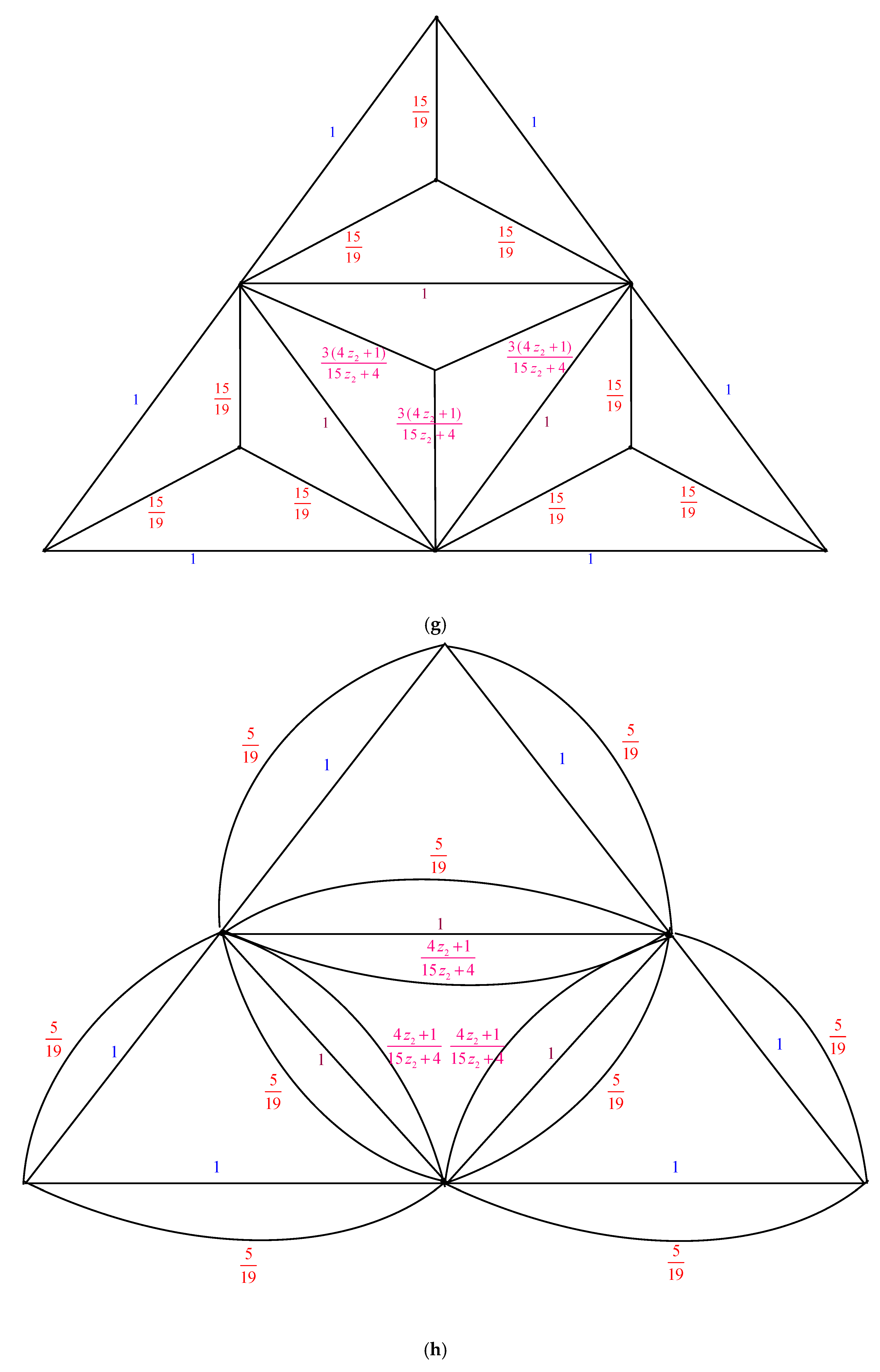
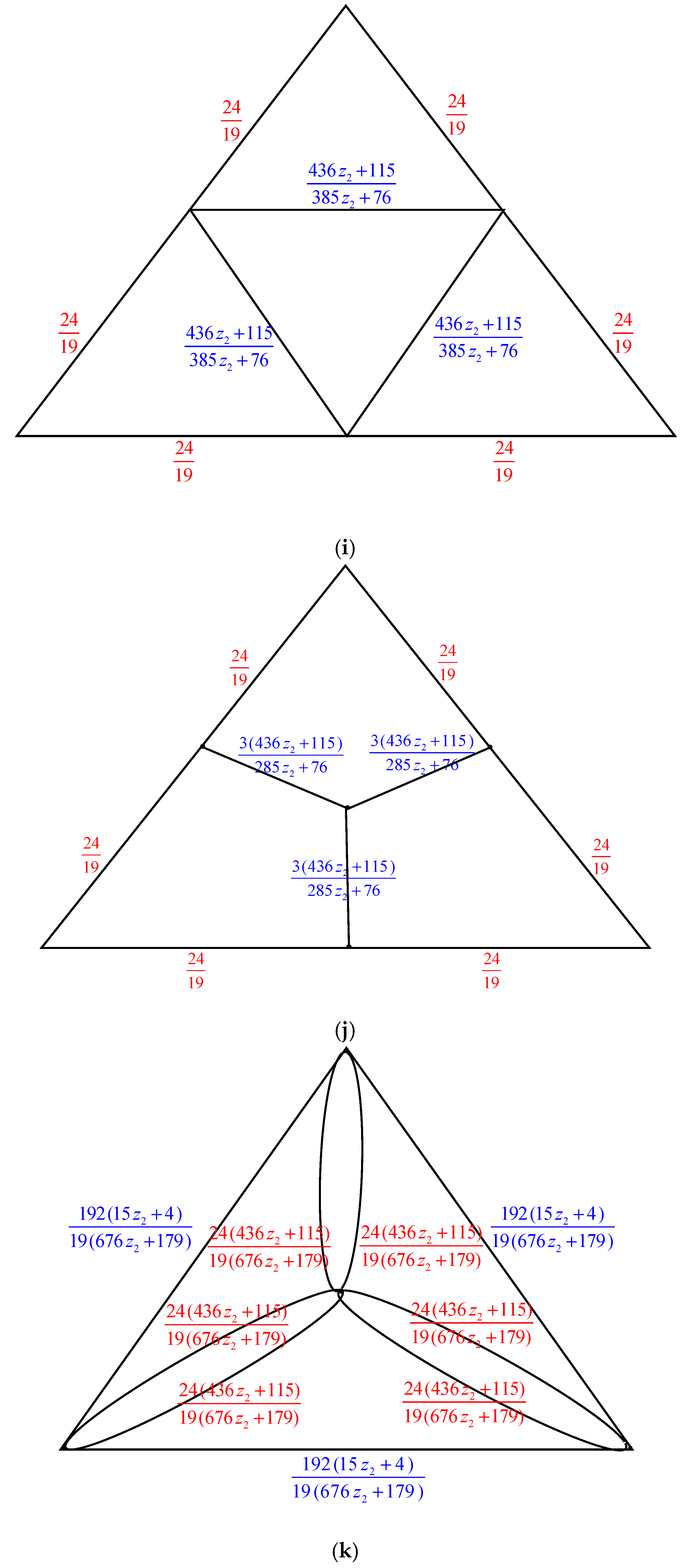
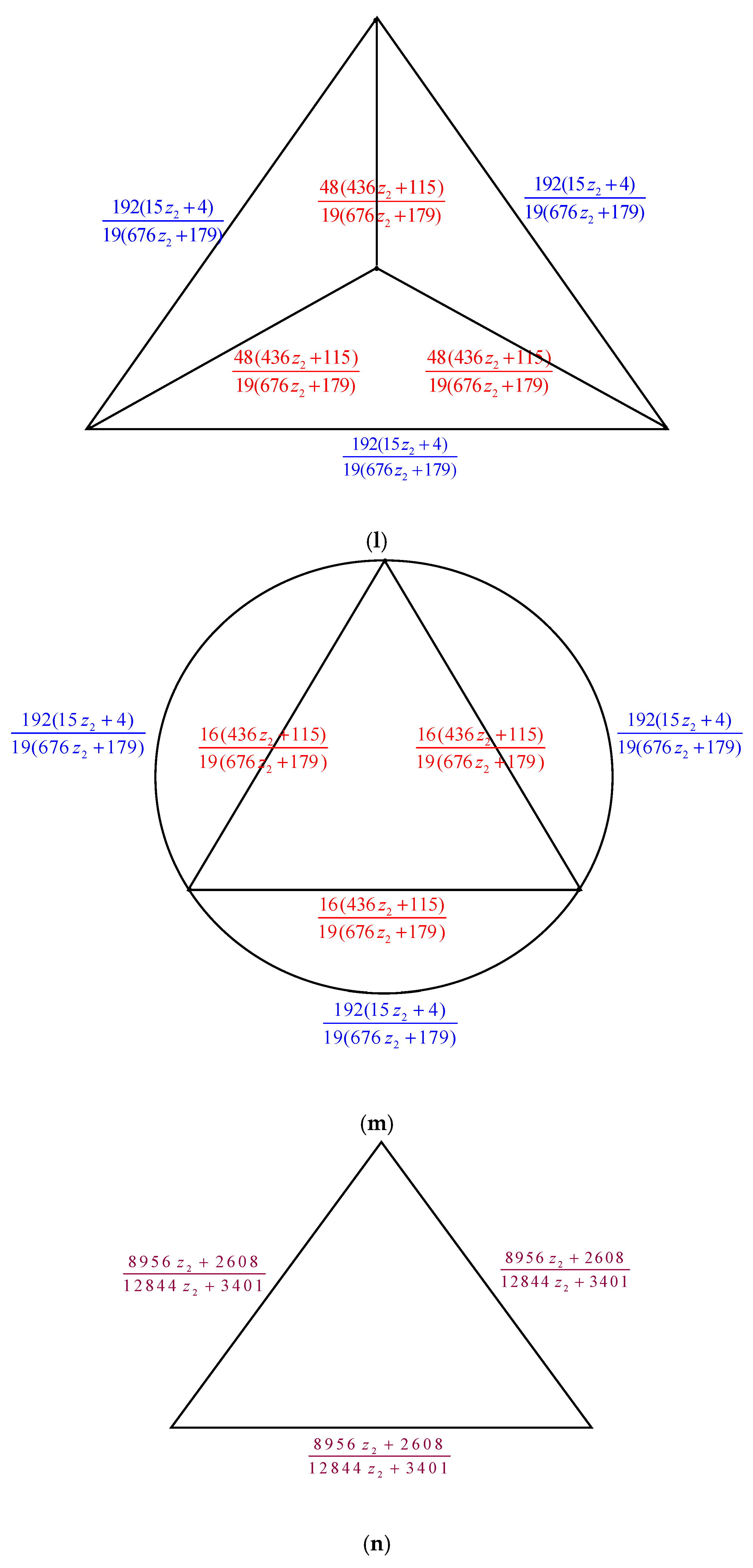
Figure 7. The transformations from F T P P ( 2 ) to F T P P ( 1 ) . (a) The graph F T P P ( 2 ) . By applying the Δ-Y Transformation rule, we obtain τ H 1 = 9 4   Z 2   τ H 1 . (b) The graph H 1 . Using the serial edge rule, we obtain τ H 2 = 1 4 9 1 3   Z 2 + 1 3 τ H 1 . (c) The graph H 2 . When the Y-Δ Transformation rule is applied, we obtain τ H 3 =   4 9   3 3   Z 2 + 1 9   Z 2 τ H 2 . (d) The graph H 3 . By utilizing the parallel edge rule, we arrive at τ ( H 4 ) = τ ( H 3 ) . (e) The graph H 4 . Using the rule of Δ-Y Transformation, we obtain τ H 5 = 9 5 4 3 9 4   Z 2 + 1 3   Z 2 + 1 τ H 4 . (f) The graph H 5 . By applying the serial edge rule, we arrive at τ H 6 = 4 19 9 3   Z 2 + 1 15   Z 2 + 4 3 τ H 5 . (g) The graph H 6 . Applying the rule of Y-Δ Transformation, we obtain τ H 7 = 19 45 3 15   Z 2 + 4 9 4   Z 2 + 1 τ H 6 . (h) The graph H 7 . The parallel edge rule yields the following results: τ H 8 = τ H 7 . (i) The graph H 8 . By applying the Δ-Y Transformation rule, we obtain τ H 9 = 9 436   Z 2 + 115 285   Z 2 + 76 τ H 8 . (j) The graph H 9 . The Y-Δ Transformation rule gives us τ H 10 = 285   Z 2 + 76 2028   Z 2 + 537 3 τ H 9 . (k) The graph H 10 . The parallel edge rule allows us to obtain τ H 11 = τ H 10 . (l) The graph H 11 . When the Y-Δ Transformation rule is applied, we obtain τ H 12 = 19 676   Z 2 + 179 144 436   Z 2 + 115 τ H 11 . (m) The graph H 12 . By using the parallel edge rule, we obtain τ H 13 = τ H 12 . (n) The graph H 13 = F T P P ( 1 ) .
These thirteen transformations are combined to produce the following:
τ F T P P n = 1 9 4   z 2 × 4 9 × 3 z 2 + 1 3 × 9 4 3 × 9   z 2 3   z 2 + 1 × 4 5 3 × 1 9 4 × 3   z 2 + 1 4   z 2 + 1 × 19 4 9 × 15   z 2 + 4 3   z 2 + 1 3 × 45 19 3   × 9 4   z 2 + 1 15   z 2 + 4 × 285   z 2 + 76 9 436   z 2 + 115 × 2028   z 2 + 537 285   z 2 + 76 3 × 144 436   z 2 + 115 19 676   z 2 + 179 τ F T P P 1 .
Thus, we have the following:
τ ( F T P P 2 ) = 8208 ( 12844 z 2 + 3401 ) 2   τ ( F T P P ( 1 ) ) .
Furthermore,
τ ( F T P P ( n ) ) = i = 2 n 8208 ( 12844   z i + 3401 ) 2   τ ( F T P P ( 1 ) ) = 3 × 820 8 n 1   z 1 2 [ i = 2 n ( 12844 z i + 3401 ) ] 2   .
where z i 1 = 9856   z i + 2608 12844   z i + 3401 ,   i = 2 , 3 , , n .
Its characteristic equation is 12844   ω 2 6455   ω 2608 = 0 , with the following roots:
ω 1 = 6455 175655633 25688   and   ω 2 = 6455 + 175655633 25688 .
These two roots can be subtracted from both sides of z i 1 = 9856   z i + 2608 12844   z i + 3401 to obtain the following:
z i 1 ω 1 = z i 1 6455 175655633 25688 = 9856 z i + 2608 12844 z i + 3401 6455 175655633 25688 = ( 13257 + 175655633 ) × z i   6455 175655633 25688 2 ( 12844   z i + 3401 ) .
z i 1 ω 1 = z i 1 6455 + 175655633 25688 = 9856 z i + 2608 12844 z i + 3401 6455 + 175655633 25688 = ( 13257 175655633 ) × z i   6455 + 175655633 25688 2 ( 12844   z i + 3401 ) .
Let t i = z i 6455 175655633 25688 z i 6455 + 175655633 25688 . Then, t i 1 = z i 1 6455 175655633 25688 z i 1 6455 + 175655633 25688   t i .
Thus, using Equations (29) and (30), we obtain the following:
t i 1 = 13257 + 175655633 13257 + 175655633 t i   or   t i 1 = ( 175701841 + 13257 175655633 46208   )   t i .
Therefore, t i = ( 175701841 + 13257 175655633 46208   ) n i   t n .
From the expression t i = z i 6455 175655633 25688 z i 6455 + 175655633 25688 , we have the following:
t i z i 6455 + 175655633 25688   = z i   6455 175655633 25688 ,
Then,
z i = ( 175701841 + 13257 175655633 46208 ) n i     6455 + 175655633 25688   t n ( 6455 175655633 25688 ) ( 175701841 + 13257 175655633 46208   ) n i   t n 1 .
Thus,
z 1 = ( 175701841 + 13257 175655633 46208   ) n 1 6455 + 175655633 25688   t n ( 6455 175655633 25688 ) ( 175701841 + 13257 175655633 46208   ) n 1   t n 1 .
If z n = 1 , we obtain the following:
t n = 1 6455 175655633 25688 1 6455 + 175655633 25688   =   19233 + 175655633 19233 175655633 = 272781961 + 19233 175655633 97126328 .
Thus, we obtain the following:
z 1 =   175701841 + 13257 175655633 46208   n 1 50015497 + 3863 175655633 24281582   6455 175655633 25688 175,701,841 + 13257 175655633 46208   n 1 272781961 + 19,233 175655633 97126328 1 .
Using expression z n 1 = 9856   z n + 2608 12844   z n + 3401 and designating α n and β n as the coefficients of 9856   z n + 2608 and 12844   z n + 3401 , respectively, we obtain the following:
12844   z n + 3401 = α 0 ( 9856   z n + 2608 ) + β 0 ( 12844 z n + 3401 ) , 12844   z n 1 + 3401 = α 1 ( 9856   z n + 2608 ) + β 1 ( 12844   z n + 3401 ) α 0 ( 9856   z n + 2608 ) + β 0 ( 12844   z n + 3401 ) , 12844   z n 2 + 3401 = α 2 ( 9856   z n + 2608 ) + β 2 ( 12844   z n + 3401 ) α 1 ( 9856   z n + 2608 ) + β 1 ( 12844   z n + 3401 ) , 12844   z n i + 3401 = α i ( 9856   z n + 2608 ) + β i   ( 12844   z n + 3401 ) α i 1 ( 9856   z n + 2608 ) + β i 1 ( 12844   z n + 3401 ) ,
12844   z n ( i + 1 ) + 3401 = α i + 1 ( 9856   z n + 2608 ) + β i + 1 ( 12844   z n + 3401 ) α i ( 9856   z n + 2608 ) + β i ( 12844   z n + 3401 ) , 12844 z 2 + 3401 = α n 2 ( 9856   z n + 2608 ) + β n 2 ( 12844   z n + 3401 ) α n 3 ( 9856   z n + 2608 ) + β n 3 ( 12844   z n + 3401 ) ,
Thus, we obtain the following:
τ ( F T P P n ) = 3 × 820 8 n 1 z 1 2 [ α n 2 9856   z n + 2608 + β n 2 12844   z n + 3401 ] 2 .
Using Equations (32) and (33) and the expression z n 1 = 9856   z n + 2608 12844   z n + 3401 , we obtain the following:
α i + 1 = 13257 α i 23104   α i 1 ;   β i + 1 = 13257 β i 23104   β i 1
The characteristic equation of Equation (35) is ρ 2 13257 ρ + 23104 = 0 , with the following roots:
ρ 1 = 13257 + 175655633 2   and   ρ 1 = 13257 175655633 2 .
The general solutions of Equation (35) are α i = a 1   ρ 1 i + a 2   ρ 2 i ;   β i = b 1   ρ 1 i + b 2   ρ 2 i .
Using the initial conditions α 0 = 0 ,   β 0 = 1 and α 1 = 11886 ,   β 1 = 6538 yields the following:
α i = 12844 175655633 175655633 ( 13257 + 175655633 2 ) i 12844 175655633 175655633 ( 13257 175655633 2 ) i ; β i = 175655633 6455 175655633 351311266 ( 13257 + 175655633 2 ) i   + ( 175655633 + 6455 175655633 351311266 ) ( 13257 175655633 2   ) i
F T P P n is devoid of any electrically equivalent transformation if z n = 1 . When Equation (36) is entered into Equation (34), we obtain the following:
τ F T P P n = 3 × 8208 n 1 z 1 2   × ( 5707051516170   +   430,627,514   175655633 702622532 ) ( 13257 + 175655633 2 ) n 2 + ( 5707051516170     430,627,514   175655633 702622532 ) ( 13257 175655633 2 ) n 2 ) 2 , n 2 .
When n = 1 , τ ( F T P P 1 ) = 3 , which is in accordance with Equation (37). Consequently, the number of spanning trees in the graph family F T P P n generated by the triangular prism graph T P P is determined by the following:
τ F T P P n = 3 × 8208 n 1 z 1 2   × ( 5707051516170   +   430,627,514   175655633 702622532 ) ( 13257 + 175655633 2 ) n 2 + ( 5707051516170     430,627,514   175655633 702622532 ) ( 13257 175655633 2 ) n 2 ) 2 , n 1 .
The required outcome is obtained by inserting Equation (31) into Equation (38). □

3. Numerical Results

The next three Table 1, Table 2 and Table 3 display the values of the number of spanning trees in the three graph families F T P S n , F T P A n , and F T P P n .
Table 1. A portion of the spanning tree count for the graph family F T P S n .
Table 2. A portion of the spanning tree count for the graph family F T P A n .
Table 3. A portion of the spanning tree count for the graph family F T P P n .

4. Spanning Tree Entropy

After obtaining precise formulas for the number of spanning trees in each of the three graph families,   F T P S n , F T P A n , and F T P P n , we can calculate the spanning tree entropy Z , a finite number and an intriguing metric that defines the network topology. This is described in [12] as follows: Consider graph G ,
Z ( G ) = l i m n ln τ ( G ) V ( G ) .
Z F T P S n = 1 27 l n 1904 + 2 l n 15293 + 233649273   = 1.04 , Z F T P A n = 1 27 l n 34336 + 2 l n 75620 + 3 635248119   = 1.27 , Z F T P P n = 1 27 l n 2052 + 2 l n 13257 + 175655633   = 1.04 .
From these results, we observe the following: graph families F T P S n and F T P P n , which have the same average degree 4 , have the same entropy (1.040), while the graph family F T P A n has more edges and average degrees than the graph families F T P S n and F T P P n ; its entropy is higher (1.27).
Additionally, the apollonian graph [13], which has an average degree of 5 (entropy 1.354), has a higher entropy than all graph families F T P S n , F T P A n , and F T P P n . In addition, the entropy of the fractal scale free lattice [14], which has the entropy 1.04 and average degree 4, is the same entropy of the graph families F T P S n and F T P P n , while the entropies of the graph families F T P S n and F T P P n are smaller than the entropy of the two-dimensional Sierpinski gasket [15], which has an entropy 1.166 of the same average degree 4. Finally, the entropy of graph families F T P S n and F T P P n is higher than the entropy of graph sequences J S n and R 1 J S n , constructed on the Johnson skeleton graph, which have the same mean score of 4 but an entropy value of 1.02 [11].

5. Conclusions

In this study, we calculated the number of spanning trees for three new and huge families of graphs that resulted from three new triangular prism graphs using the electrically equivalent transformation approach. The number of spanning trees for such families of graphs cannot be determined using Kirchhoff’s determinant method or the laborious computation of Laplace spectra. Thus, this is where this method’s strength is found. Additionally, we investigated the entropy of these graph families and how it related to the entropy of other graph families with average degrees that were identical or nearly equal.

Author Contributions

Conceptualization, A.A. and S.N.D.; methodology, A.A. and S.N.D.; software, A.A. and S.N.D.; validation, A.A. and S.N.D.; formal analysis, A.A. and S.N.D.; investigation, A.A. and S.N.D.; resources, A.A. and S.N.D.; data curation, A.A. and S.N.D.; writing—original draft, A.A. and S.N.D.; writing—review and editing, A.A. and S.N.D.; visualization, A.A. and S.N.D.; supervision, A.A. and S.N.D.; project administration, A.A. and S.N.D.; funding acquisition, A.A. All authors have read and agreed to the published version of the manuscript.

Funding

This research was funded by the Deanship of Scientific Research at King Khalid University grant number RGP.2/229/46.

Data Availability Statement

The original contributions presented in this study are included in the article. Further inquiries can be directed to the corresponding author.

Acknowledgments

The authors extend their appreciation to the Deanship of Scientific Research at King Khalid University for funding this work through Larg Groups (Project under grant number RGP.2/229/46).

Conflicts of Interest

The authors declare no conflicts of interest. The funders had no role in the design of the study; in the collection, analyses, or interpretation of data; in the writing of the manuscript; or in the decision to publish the results.

References

  1. Biggs, N.L. Algebraic Graph Theory, 2nd ed.; Cambridge University Press: Cambridge, UK, 1993; p. 205. [Google Scholar]
  2. Kirby, E.C.; Klein, D.J.; Mallion, R.B.; Pollak, P.; Sachs, H. A theorem for counting spanning trees in general chemical graphs and its application to toroidal fullerenes. Croat. Chem. Acta 2004, 77, 263–278. [Google Scholar]
  3. Zhang, F.; Yong, X. Asymptotic enumeration theorems for the number of spanning trees and Eulerian trail in circulant digraphs & graphs. Sci. China Ser. A 1999, 43, 264–271. [Google Scholar]
  4. Applegate, D.L.; Bixby, R.E.; Chvátal, V.; Cook, W.J. The Traveling Salesman Problem: A Computational Study; Princeton University Press: Princeton, NJ, USA, 2006. [Google Scholar]
  5. Boesch, F.T.; Satyanarayana, A.; Suffel, C.L. A survey of some network reliability analysis and synthesis results. Networks 2009, 54, 99–107. [Google Scholar] [CrossRef]
  6. Kirchhoff, G. Über die Auflösung der Gleichungen auf welche man bei der Untersucher der linearen Verteilung galuanischer Strome gefhrt wird. Ann. Phys. Chem. 1847, 72, 497–508. [Google Scholar] [CrossRef]
  7. Kelmans, A.K.; Chelnokov, V.M. A certain polynomial of a graph and graphs with an extremal number of trees. J. Comb. Theory B 1974, 16, 197–214. [Google Scholar] [CrossRef]
  8. Daoud, S.N. Number of Spanning trees of cartesian and composition products of graphs and Chebyshev polynomials. IEEE Access 2019, 7, 71142–71157. [Google Scholar] [CrossRef]
  9. Daoud, S.N. The Deletion—Contraction Method for Counting the Number of Spanning Trees of Graphs. Eur. J. Phys. Plus 2015, 130, 217. [Google Scholar] [CrossRef]
  10. Teufl, E.; Wagner, S. On the number of spanning trees on various lattices. J. Phys. A 2010, 43, 415001. [Google Scholar] [CrossRef]
  11. Asiri, A.; Daoud, S.N. Finding the number of spanning trees in specific graph sequences generated by a Johnson skeleton graph. Mathematics 2025, 13, 3036. [Google Scholar] [CrossRef]
  12. Lyons, R. Asymptotic enumeration of spanning trees. Combin. Probab. Comput. 2005, 14, 491–522. [Google Scholar] [CrossRef]
  13. Zhang, Z.; Wu, B.; Comellas, F. The number of spanning trees in Apollonian networks. Discret. Appl. Math. 2014, 169, 206–213. [Google Scholar] [CrossRef]
  14. Zhang, Z.; Liu, H.; Wu, B.; Zou, T. Spanning trees in a fractal scale—Free lattice. Phys. Rev. E 2011, 83, 016116. [Google Scholar] [CrossRef] [PubMed]
  15. Chang, S.; Chen, L.; Yang, W. Spanning trees on the Sierpinski gasket. J. Stat. Phys. 2007, 126, 649–667. [Google Scholar] [CrossRef]
Disclaimer/Publisher’s Note: The statements, opinions and data contained in all publications are solely those of the individual author(s) and contributor(s) and not of MDPI and/or the editor(s). MDPI and/or the editor(s) disclaim responsibility for any injury to people or property resulting from any ideas, methods, instructions or products referred to in the content.

Article Metrics

Citations

Article Access Statistics

Multiple requests from the same IP address are counted as one view.