Given a unitary operator
U on a Hilbert space
, and given an element
, can one find an auxiliary unitary operator
and two elements
such that the following asymptotic estimates hold:
Equivalently , these conditions also read
Thus, if the limits exist in the sense mentioned above, we set
where
stands for a strong limit and corresponds to the limit defined in (
1). Note that other notations are also used for
in the literature, and even the convention for the ± sign depends on the authors. We then infer that the following relations hold:
These equalities mean that the evolution
can be approximated by the evolution
for
if and only if
f belongs to the range of the so-called wave operators
. Clearly, this approach is interesting only if
is simpler than
U. In particular,
is often assumed to be an operator with an absolutely continuous spectrum.
Let us also emphasize that not only the ranges of the wave operators are of interest, but their orthocomplement also contains interesting information. Indeed, any element of orthogonal to the range of cannot be described asymptotically by the evolution defined by . This means that these elements either do not scatter, or scatter with an asymptotic evolution which is not well approximated by . Both situations can take place, as we shall see in the models introduced below.
2.1. Initial Model
In this and the following two subsections, we introduce the models (initially inspired by [
4] (Ex. 5.12)) and provide the main results relevant to scattering theory. The configuration space for our models is the discrete half-space
, with
. Accordingly, the description takes place in the complex Hilbert space
, endowed with the standard orthonormal basis
defined by
if
and
, and
otherwise. For any
, the scalar product of these two elements is given by
while the norm on this Hilbert space is defined by
.
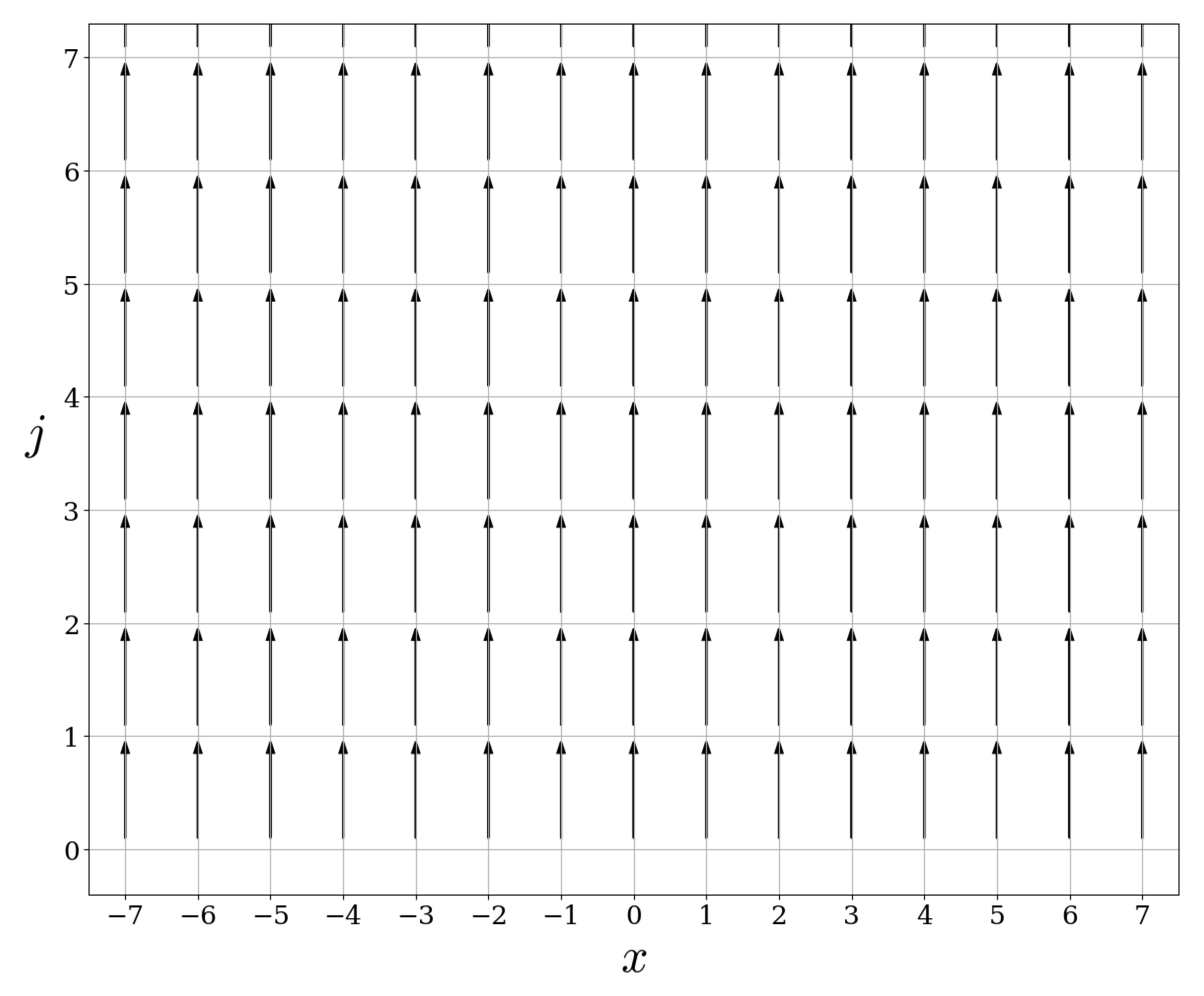
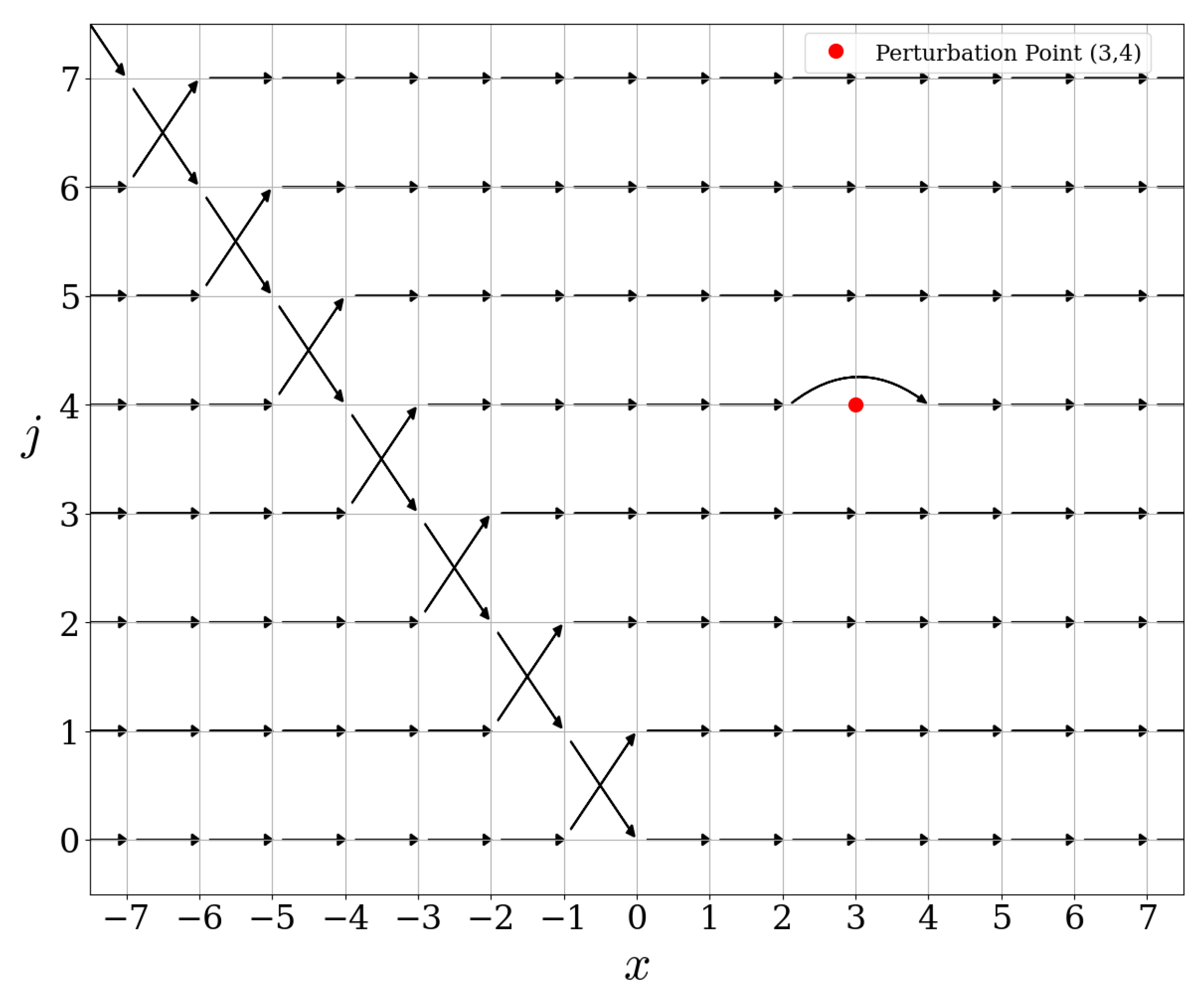
We consider two unitary operators
and
defined by their action on the standard basis, namely
and
We refer to
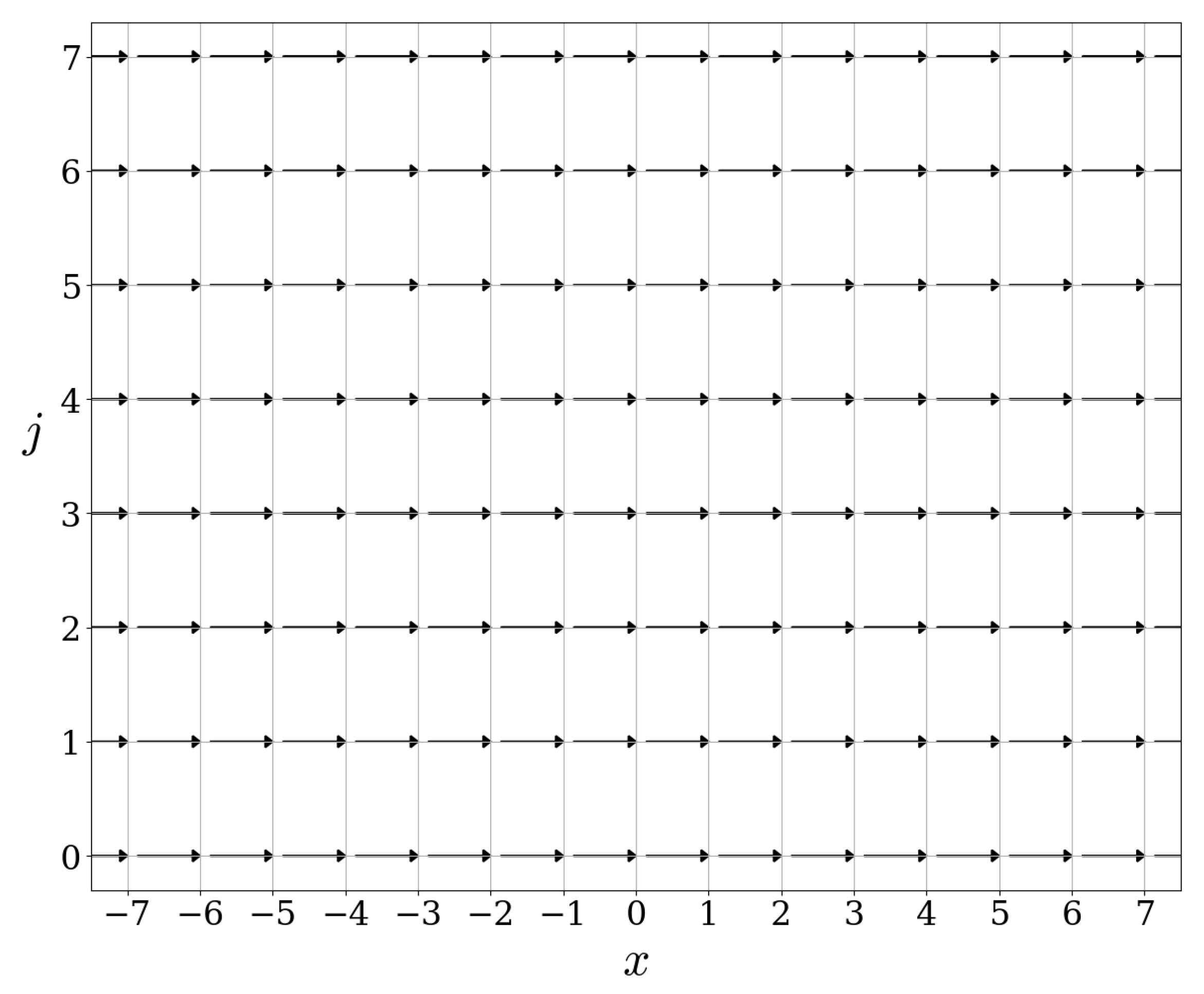
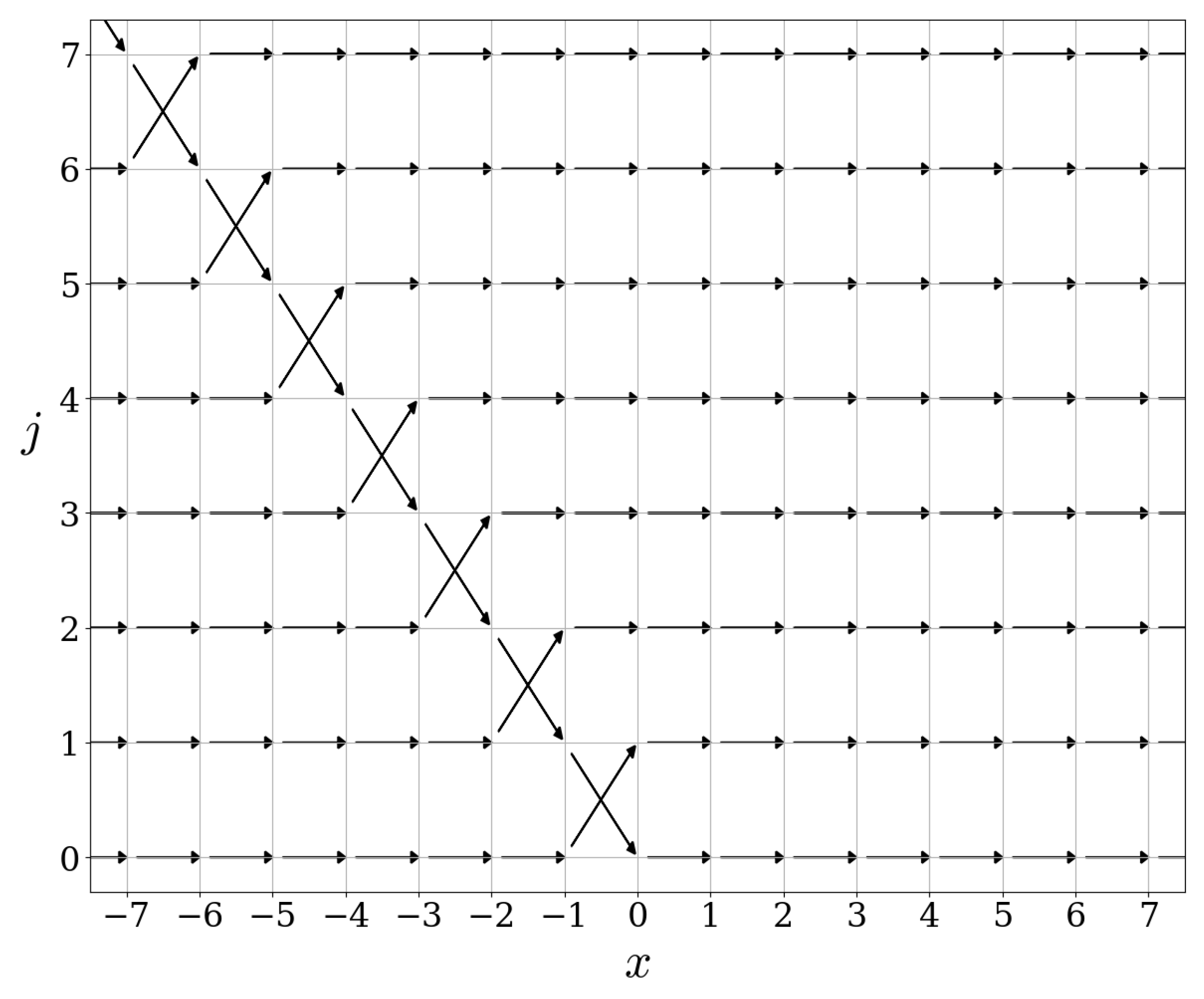
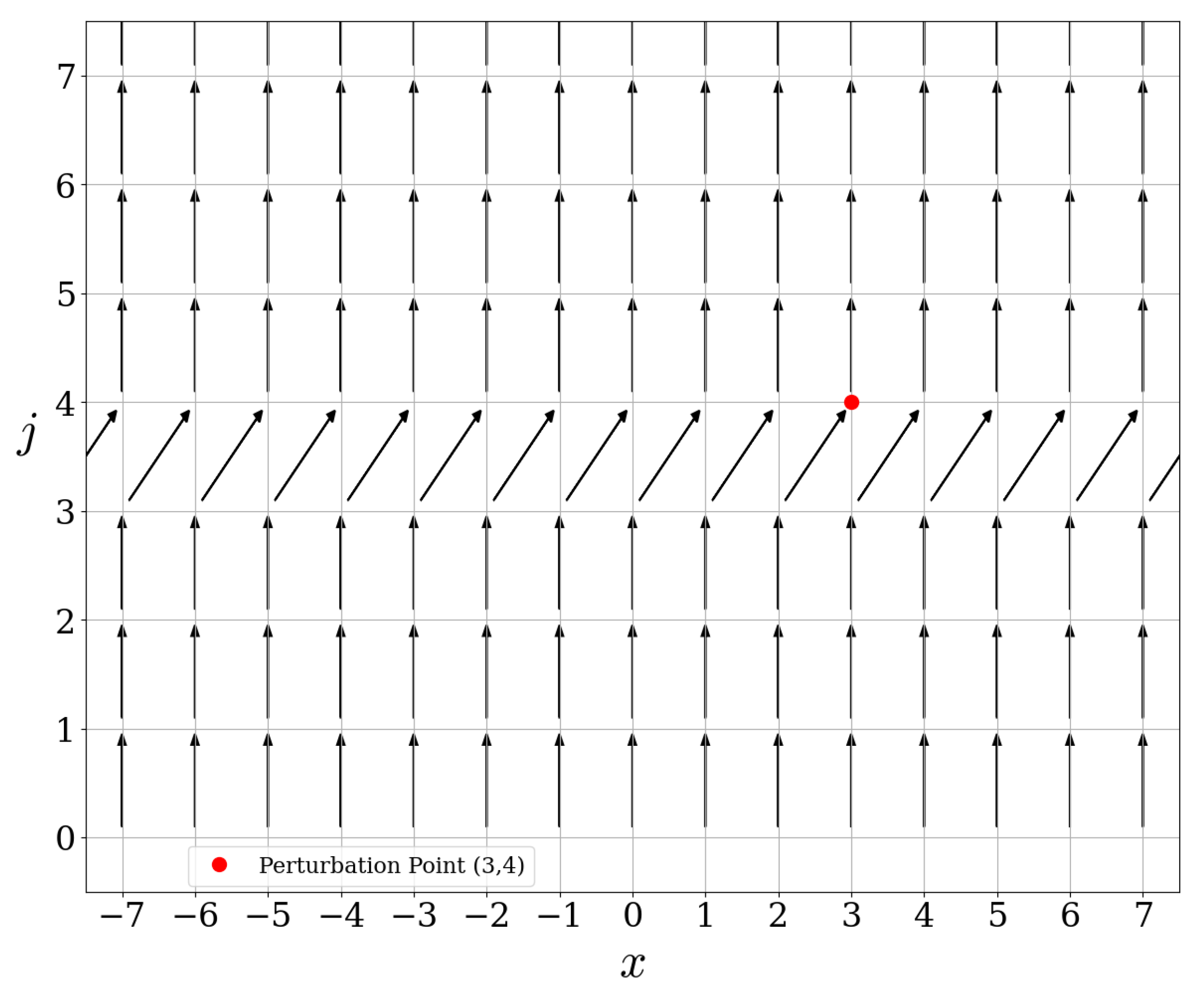
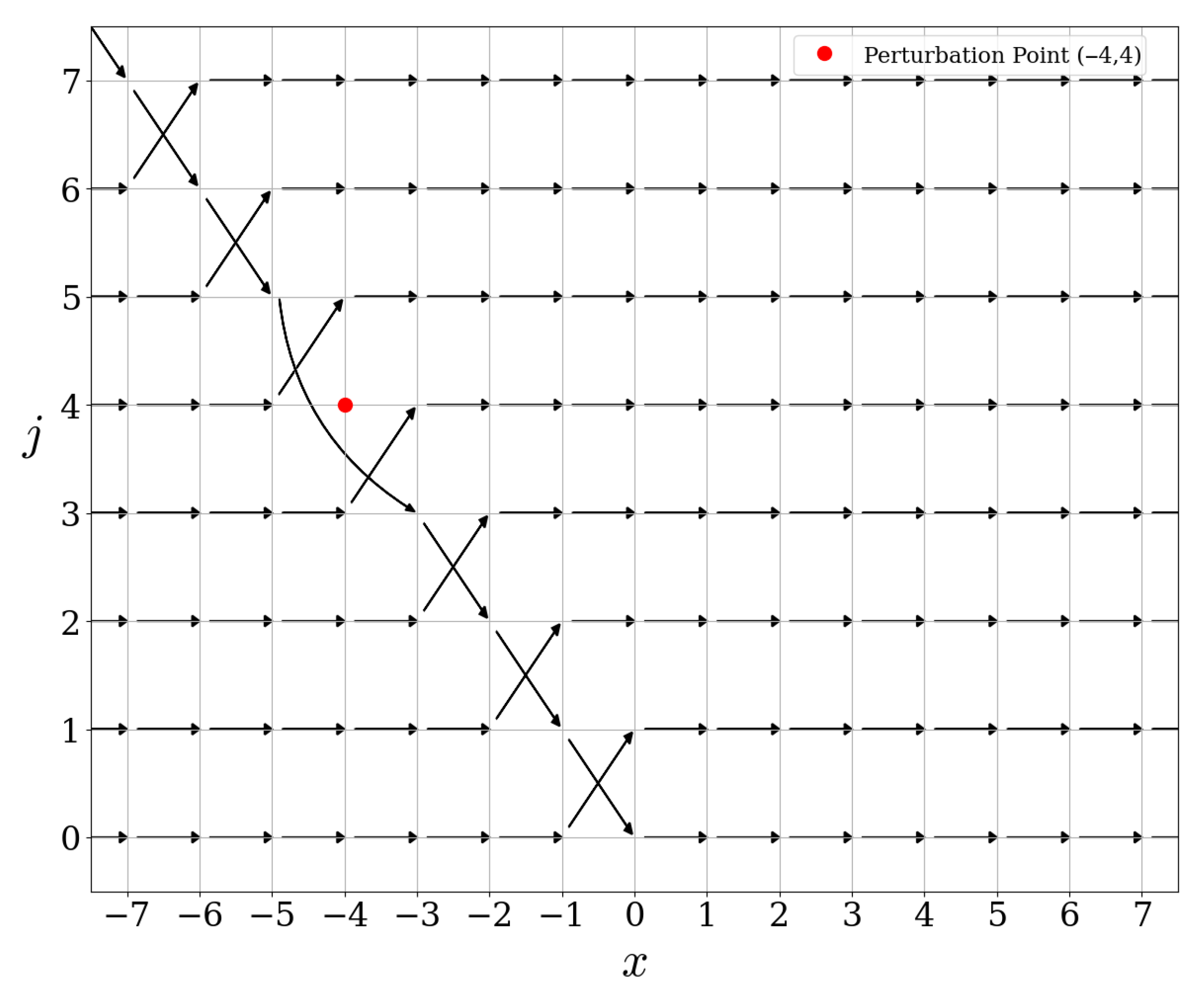
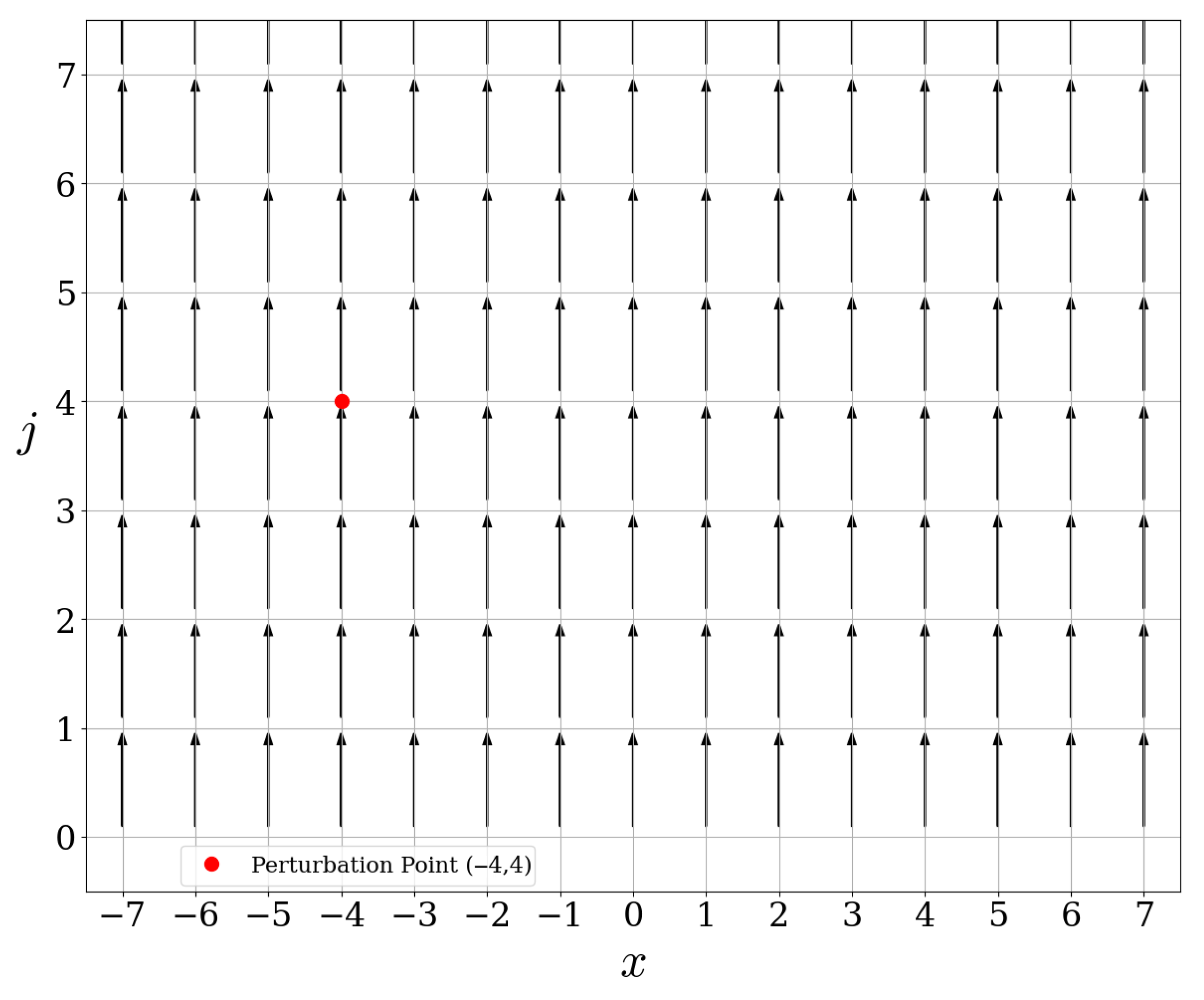
Figure 1 and
Figure 2 for graphical representations of the actions of these operators.
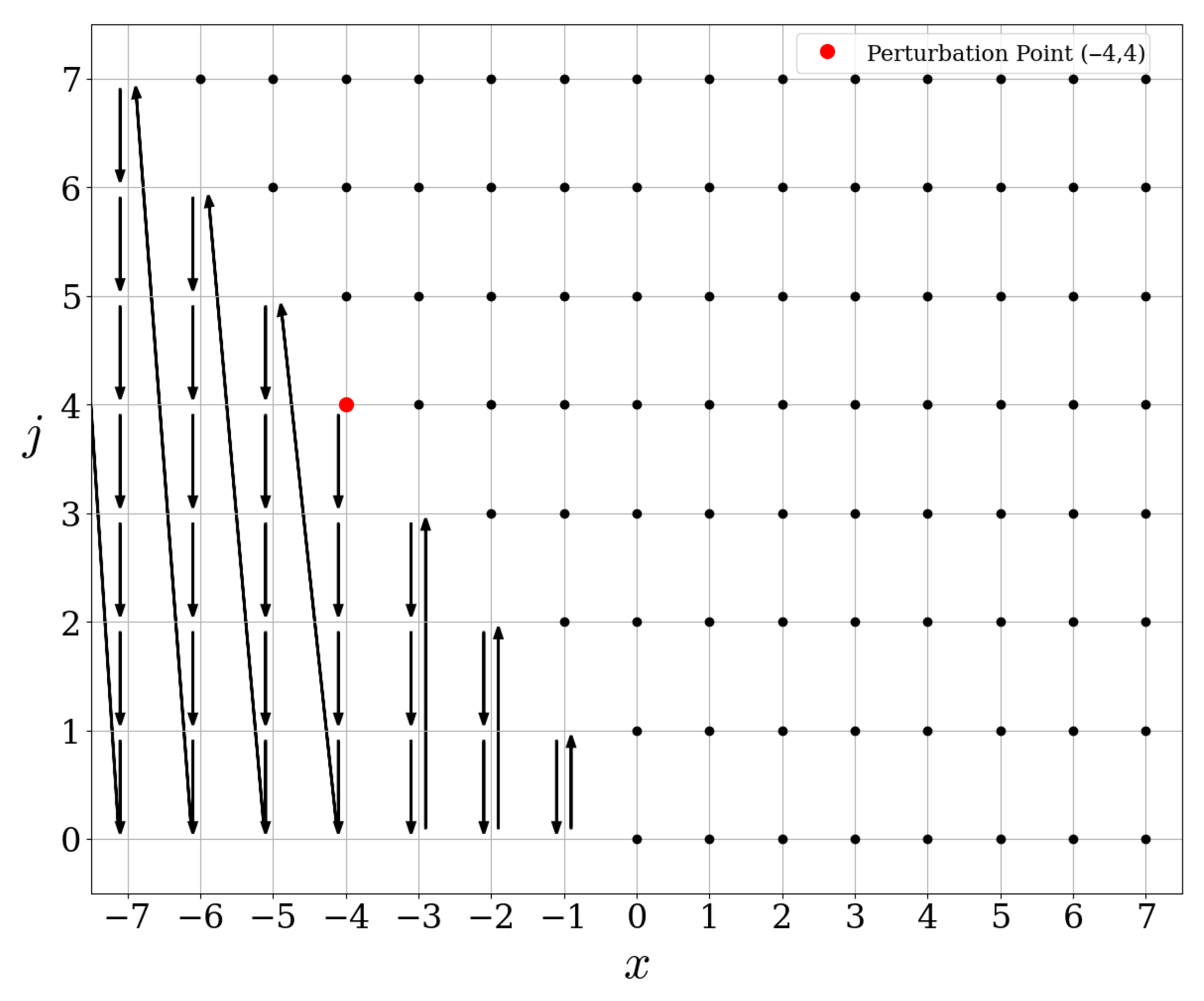
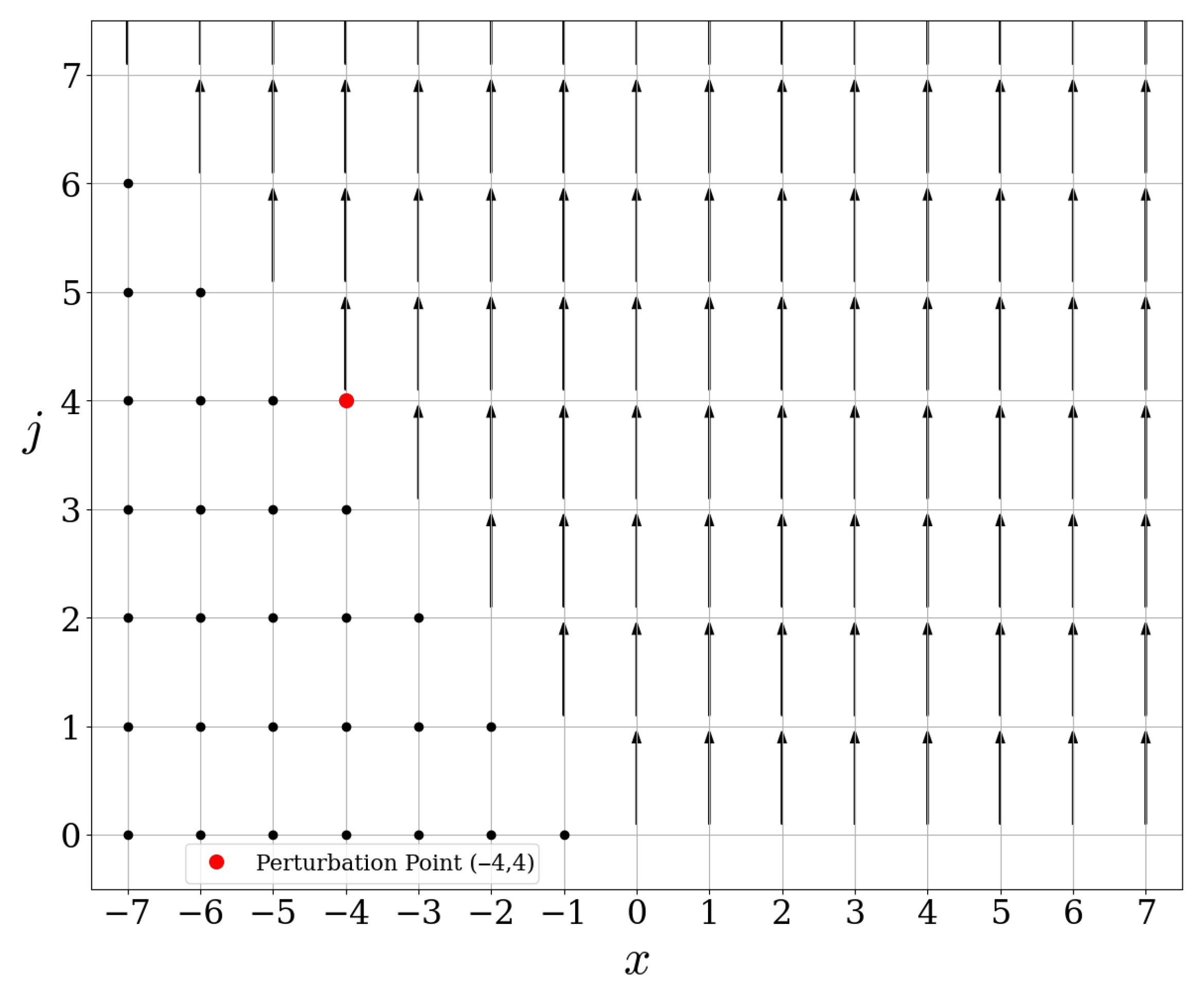
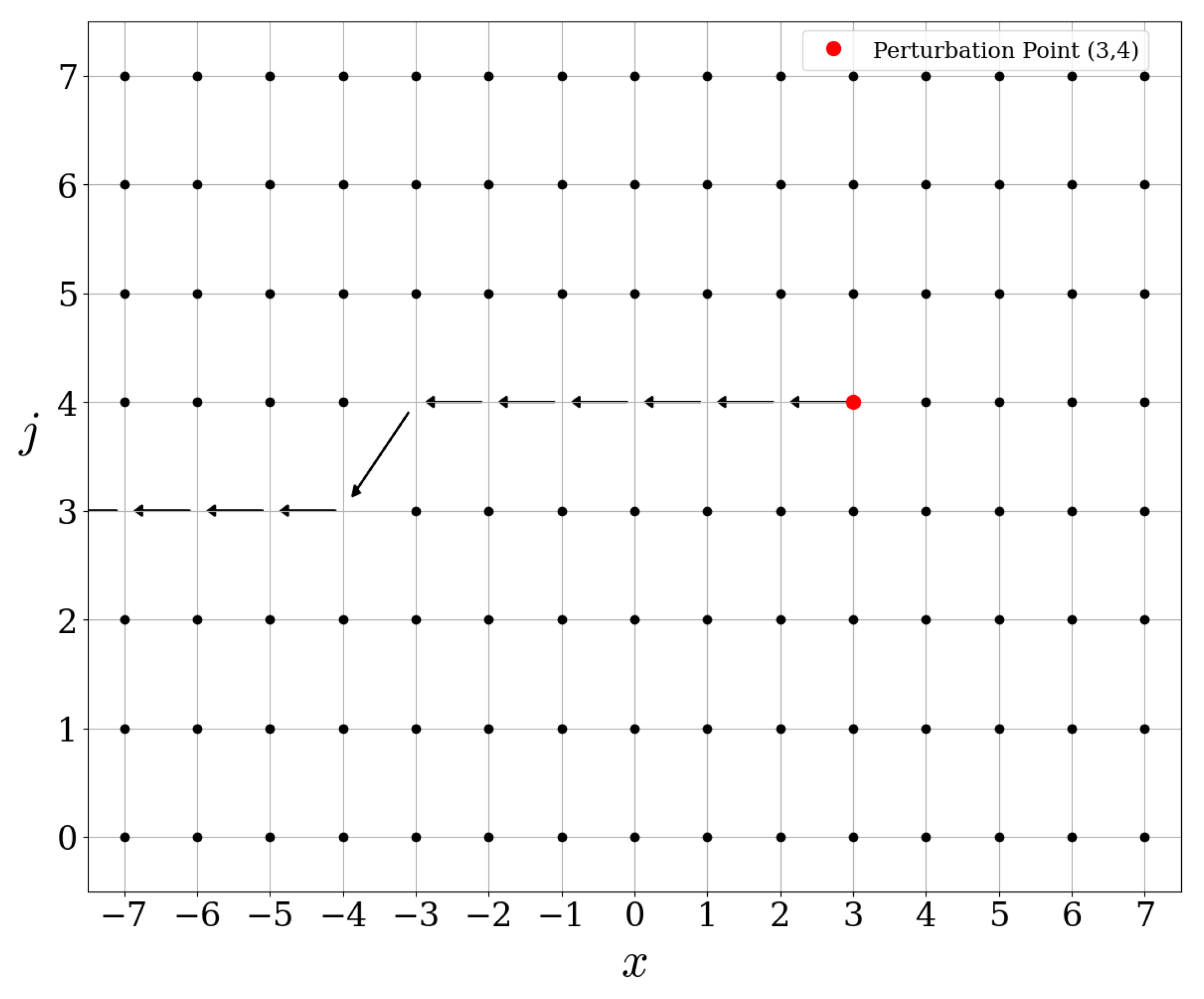
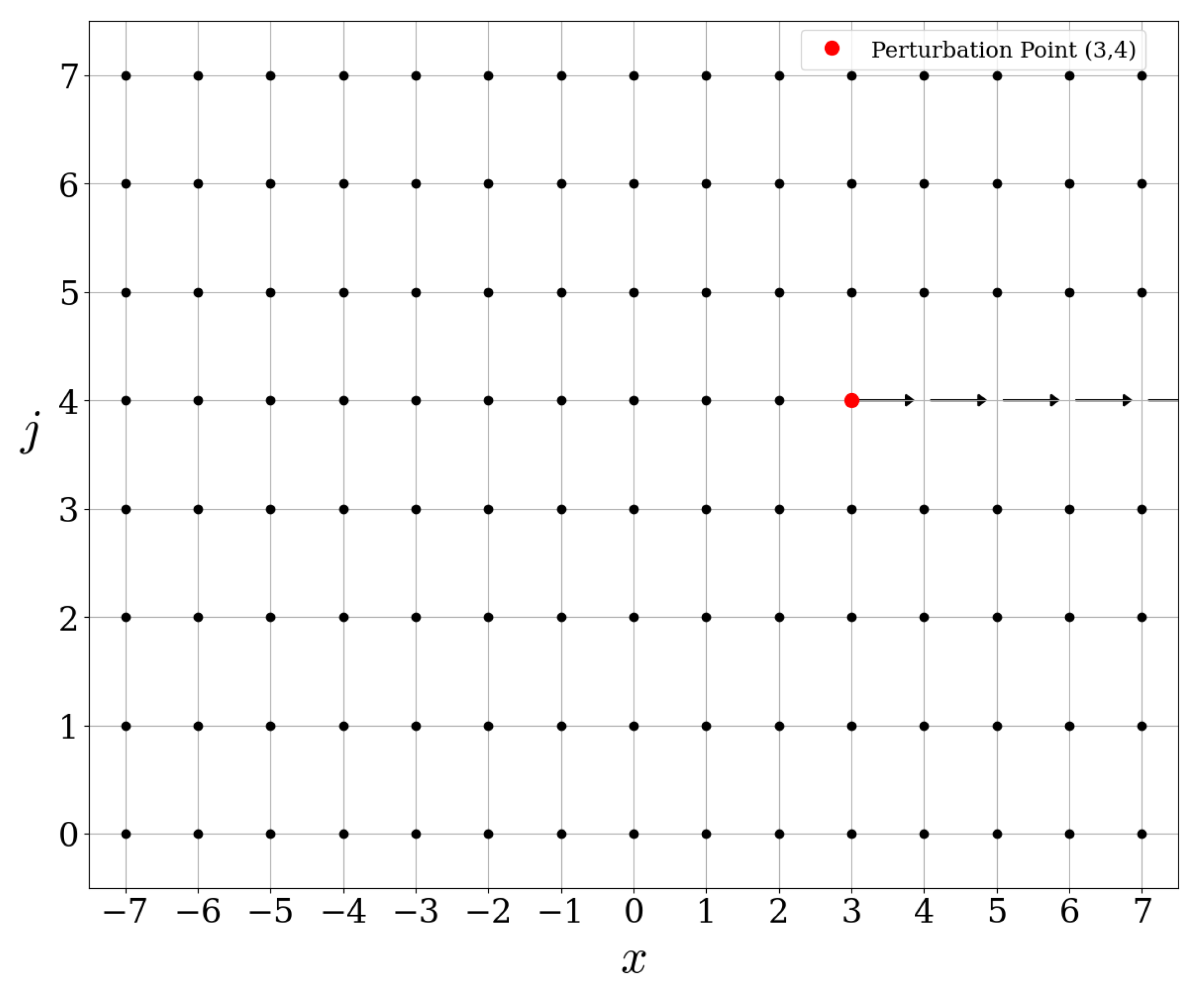
Remark 1. Let us explain how to read the figures provided in this paper: each point on the lattice can be associated to an element of the basis introduced in (2). If A corresponds to the operator represented in a figure, then an arrow starting at and ending at means . A black dot at means that , or in other words the operator A acts as the identity on the element of the basis of . By using the scalar product on
and the relations
and
it follows that
while
Given
and
, let us consider the wave operators defined by
By linearity, it is enough to consider the limits
, which can be computed explicitly by using
Figure 1 and
Figure 2. One then gets:
and
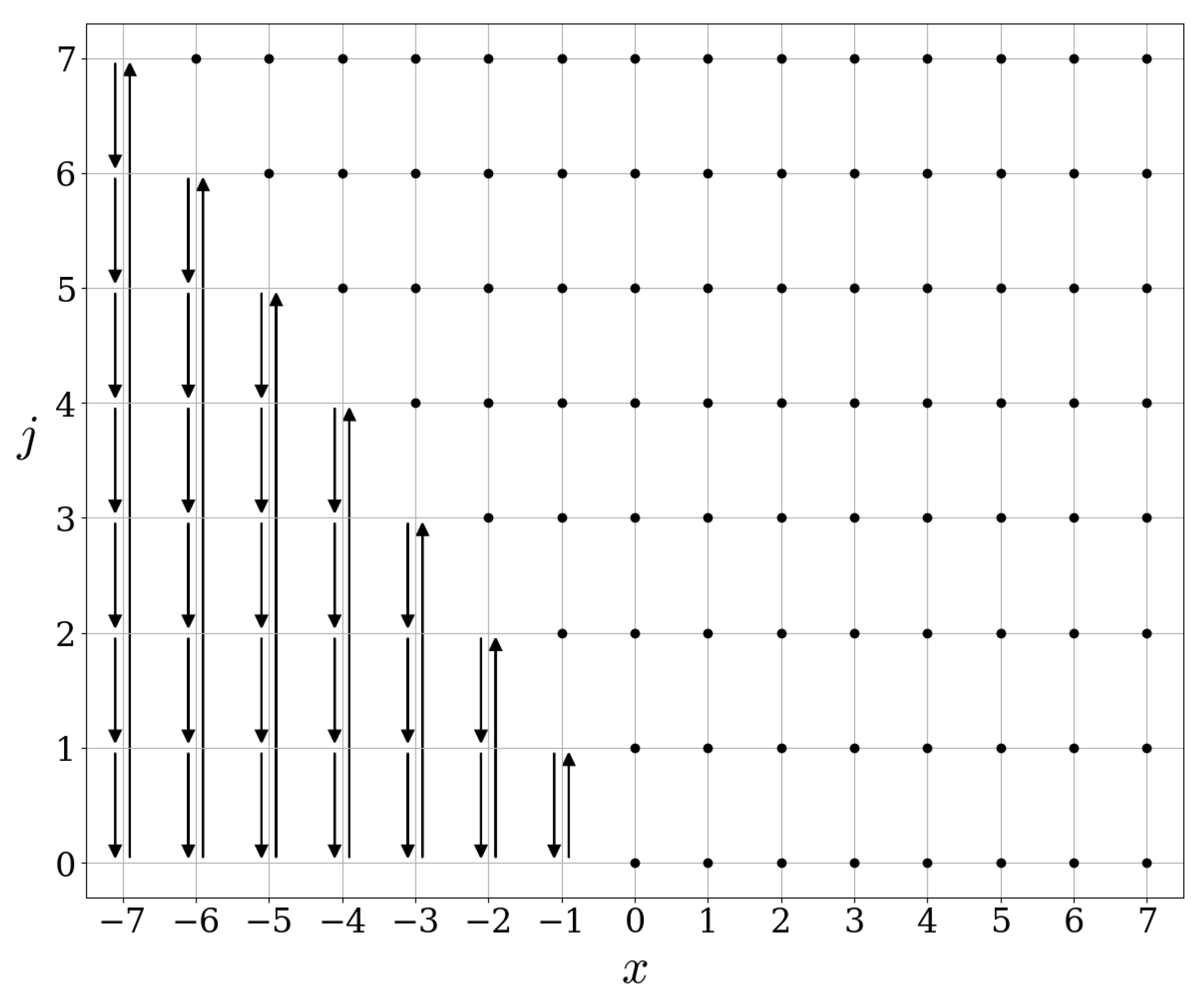
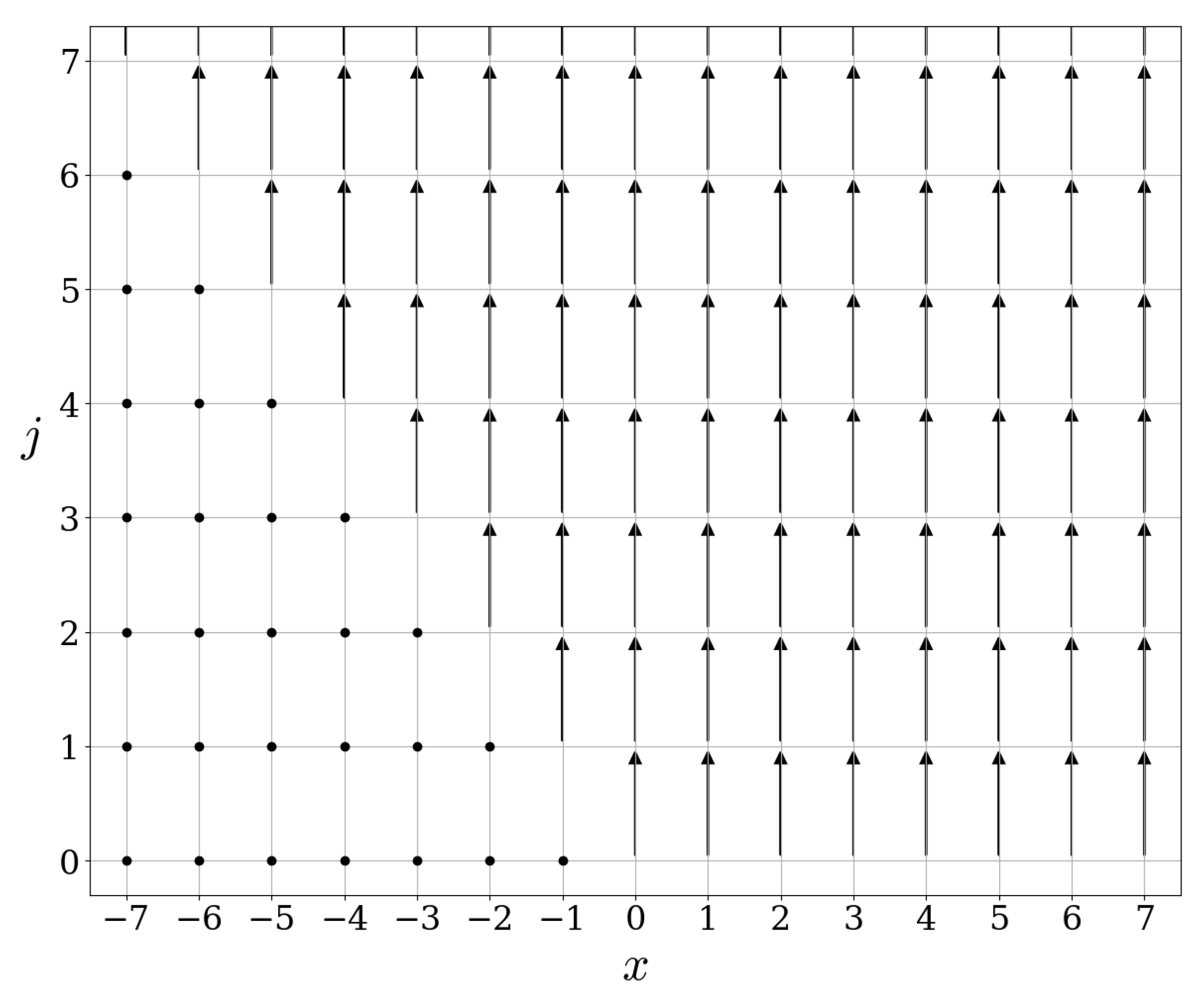
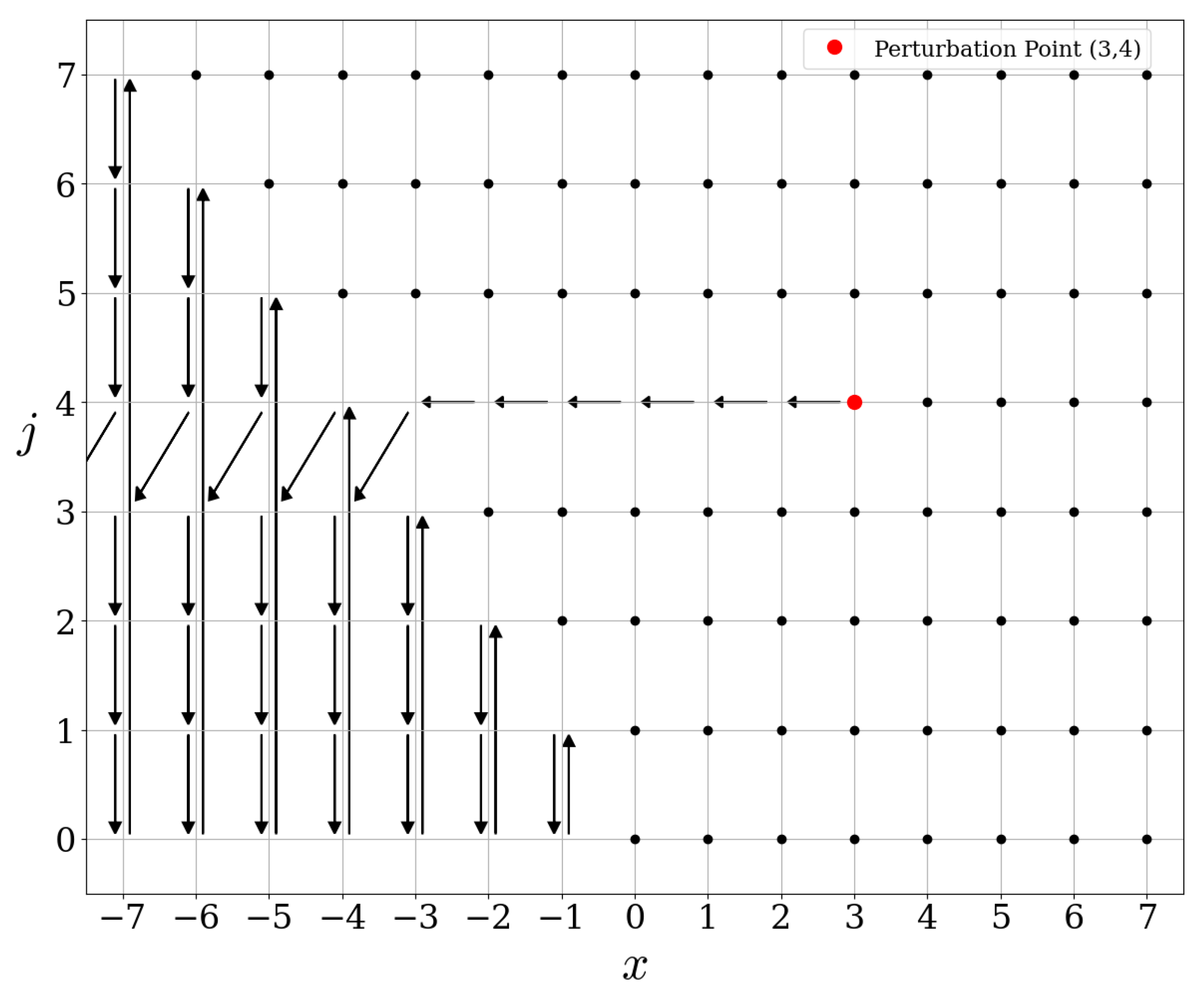
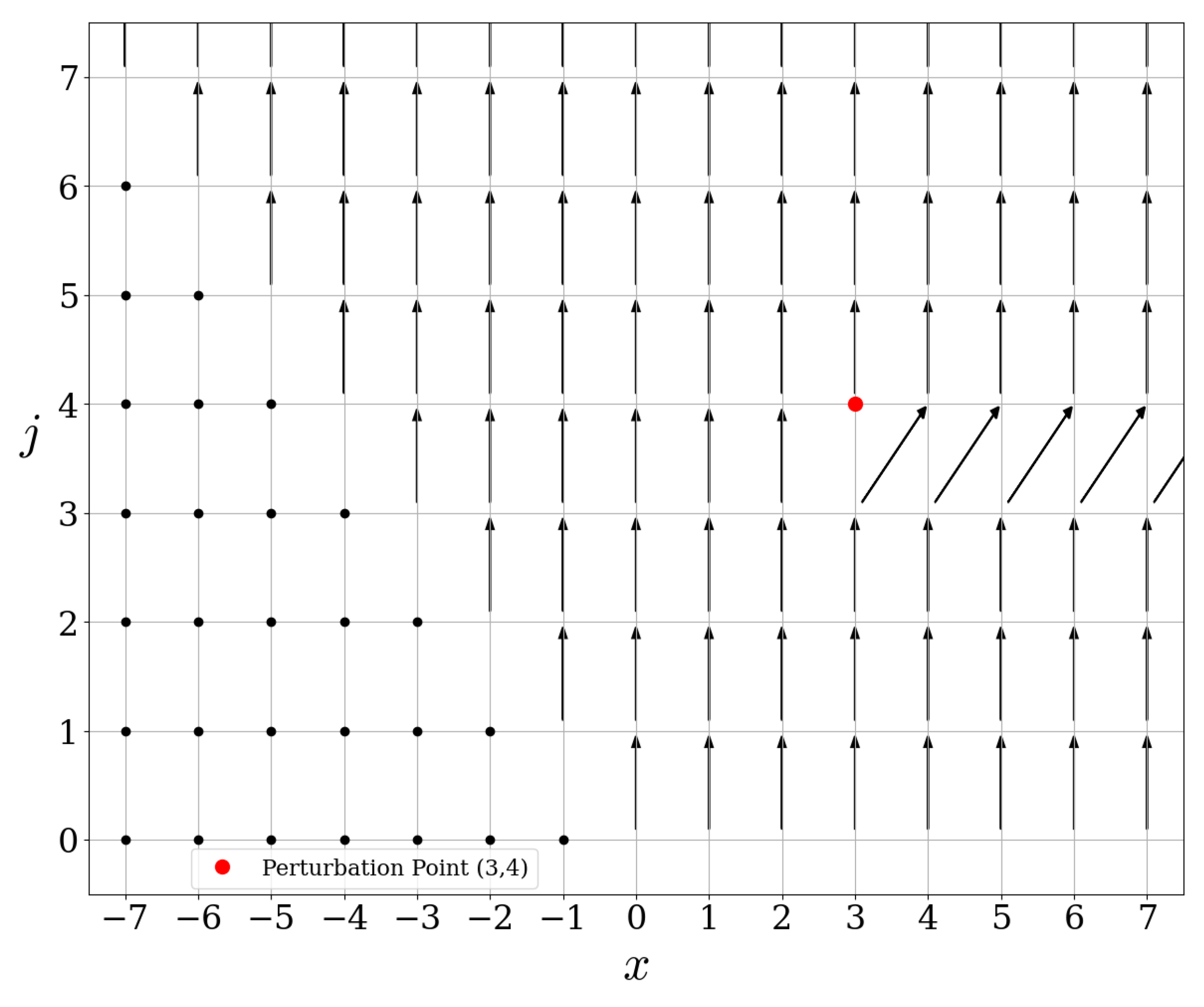
We refer to
Figure 3 and
Figure 4 for graphical representations of the actions of these operators.
Note that that the existence of the operators
and their precise expressions can be inferred rather informally. However, for completeness we provide a precise proof in Lemma A1, which has been transferred to
Appendix A in order to retain the flow of the presentation.
Recall now that the range of these operators is defined by
The method for deducing the range from a figure is explained in the following remark:
Remark 2. On a figure representing an operator A, the range of the operator A corresponds to the ending points of all arrows together with the black dots. The cokernel of A can be identified with the points that are neither the ending point of any arrow nor a black dot.
By taking this remark into account one readily observes that
while
. The orthocomplement of the range is called the cokernel. By a closer inspection at these subspaces one obtains
and
with
Here,
means the subspace of
generated by the mentioned elements.
Note that for these operators, their kernel and their cokernel can also be obtained by analytic formulas, namely (see for example [
4] (Prop. 2.9))
and
where the adjoint can be computed from the equality
In order to use the above formulas, we firstly deduce from (
3), (
4), and (
8) that
and that
Based on these expressions we can then confirm the following:
Lemma 1. One has , , and The proof of this statement is provided in
Appendix A. Now, with the already computed expressions for
and
, the next object of scattering theory to be introduced is the scattering operator
. It is defined by the product
Note that the product of two operators can be computed according to the following remark:
Remark 3. If A and B correspond to operators represented in two figures, the action of the product on the element can be obtained by looking at the action of B on where is given by the relation . The resulting element represents the image of by the product .
Based on this remark, one can obtain the action of the scattering operator on the orthonormal basis, namely
By a direct computation, one observes that this operator is not unitary and that
As for the wave operators, the scattering operator is only an isometry (this fact is discussed in
Section 3). The action of
is represented in
Figure 5.
2.2. Perturbed Model 1
We now introduce a perturbation to the model studied in the previous section. For that purpose, we use the bra-ket notation, namely for any
we set
The perturbation is localized around the position
in the configuration space, on the right of the diagonal
.
We fix
with
and
. The new unitary operator
is defined by
We refer to
Figure 6 for the graphical representation of the action of this operator.
By a direct computation, one gets
and
We refer to
Figure 7 and
Figure 8 for the actions of these operators.
From these results, one observes that the cokernels of these two operators are given by
and
, with
defined in (
5). For the adjoint of
we find
Then, the scattering operator
is given by
As before, one observes that
The action of
is represented in
Figure 9.