Abstract
The study of linear codes over local rings, particularly non-chain rings, imposes difficulties that differ from those encountered in codes over chain rings, and this stems from the fact that local non-chain rings are not principal ideal rings. In this paper, we present and successfully establish a new approach for linear codes of any finite length over local rings that are not necessarily chains. The main focus of this study is to produce generating characters, MacWilliams identities and generator matrices for codes over singleton local Frobenius rings of order To do so, we first start by characterizing all singleton local rings of order 32 up to isomorphism. These rings happen to have strong connections to linear binary codes and codes, which play a significant role in coding theory.
Keywords:
MacWiliams relations; Frobenius rings; coding over rings; generating character; local rings MSC:
94B05; 94B60; 16L30; 16P20
1. Introduction
All rings considered in this article are finite commutative and have an identity. A ring R is defined to be local if it has a unique maximal ideal, denoted or simply J, called the Jacobson radical. Furthermore, it is well established that all finite commutative Frobenius rings can be decomposed as a product of local Frobenius rings. Thus, studying codes over local rings is essential, as most structural coding theory findings have been transferred to such rings. The idea that the class of Frobenius rings is the appropriate class to describe codes is well known, and this is largely due to the fulfilment of both MacWilliams theorems. For more details on the theory of rings, we refer to [1,2,3,4] and the references therein.
Linear codes of length N over R correspond to subsets of which are R-submodules of When N is divisible by the characteristic of the residue field then these codes are called repeated-root codes; otherwise, they are simple codes. Using Gray maps, linear codes over fields were related to those over chain rings. While codes over chain rings have been extensively investigated, codes over local non-chain rings have not gained as much attention. The main reason for this disparity is because chain rings are principle ideal rings (PIRs), and as PIRs are characterized as direct sums of chain rings, many conclusions on chain rings may also be applied to PIRs. However, to fully determine codes over Frobenius rings, it is essential to consider local rings which are not chains, even though this imposes challenges, since the rings are not PIRs. We recommend references [5,6,7,8,9,10,11,12,13,14,15] to readers.
This paper mainly concentrates on determining fundamental coding results over local Frobenius rings, with a specific focus on rings of order to clarify the significance of general results. The study of singleton local rings was accomplished in [2], and their relevance in coding theory was demonstrated through connections to linear binary and codes, see [16]. We proceed to investigate, in this article, two crucial tools in coding theory: MacWilliams relations and generator matrices. In [17], the authors discussed these tools over local Frobenius rings with small order, i.e., based on the classification of local Frobenius rings with order 16 provided in [18]. Thus, we aim to concentrate on rings of order 32 and utilize them as examples. First, we present a constructive approach to finding a generating character associated with any singleton local Frobenius ring with invariants Given such an , determining the MacWilliams relations when working with rings of order 32 becomes straightforward.
On the other hand, generator matrices are highly advantageous for linear codes because they not only generate the code but also make it easier to compute the code size. Chain rings have a well-established standard form that satisfies this purpose, but this however cannot be said for codes with alphabets of local (non-chain) rings. In this regard, we introduce a natural generalization to local non-chain Frobenius rings whose orders are We also demonstrate, through several numerical examples, why such a generator matrix does not necessarily result in determining the code size.
Following the preliminary definitions and results presented in Section 2, the classification of singleton local Frobenius rings with invariants is described in Section 3, with special attention to giving the full details of characterizing rings of order The method for finding, in general, generating characters for singleton Frobenius rings is given in Section 4. Additionally, specific generating characters are determined for all singleton local Frobenius rings of order Subsequently, the matrix associated with the weight enumerator is obtained. Section 5 focuses on the results concerning generator matrices for linear codes over such rings of order
2. Preliminaries
Throughout this section, we introduce some notations and basic facts which will be utilized later in our discussion. From now on, suppose that R is a finite commutative singleton local ring with identity, and J denotes its Jacobson radical. We will rely on the following well-established results from the theory of finite rings and coding theory (see [2,3,6,8,15,19]).
First, we define Jacobson radical J of R as the maximal ideal of R. The order of is where p is a prime number, and that of J is under the condition . The additive order of 1 in R (characteristic) is of the form such that and Moreover, R has a coefficient subring S of the form , known as the maximal Galois subring of R. It has been shown that there exists in J such that
A chain ring is a ring for which its J is principal. When then R is commutative, and J is generated by the element p. Moreover, R can be constructed over as a Galois extension,
where a has a multiplicative order of and is a monic basic polynomial (irreducible modulo p) of degree r over Elements of R can be uniquely expressed (p-adic expression) as a sum of terms involving
Suppose t is the additive order of . We characterize the integers and t as the invarints of The group of units of R, , is decomposed as
where is called the one group.
We define the socle of as the sum of all minimal ideals of As the rings under consideration are commutative rings, then the socle coincides with the annihilator of In the literature, there are several equivalent definitions of Frobenius rings. However, in our discussion, we will focus on a specific definition that is most relevant to our subsequent analysis.
Definition 1
([4]). We call R a Frobenius ring if soc considered as F-vector spaces.
Finite Frobenius rings have a very simple charaterization due to the work in [1]. A character of is an element of the character group of We call a generating character if ker contains no left ideals of R which are not trivial.
Theorem 1
(Wood [1]). A finite ring R is a Frobenius ring if and only if it has a generating character
Corollary 1
([1]). A finite ring R is a Frobenius ring if and only if it has a unique minimal ideal.
Theorem 2
(Honold [4]). A finite ring R is a Frobenius ring if and only if its soc is cyclic.
A subset of is called a code C of length N over and if C is a submodule, then it is called a linear code. Furthermore, we can incorporate the inner-product in and thus we can define the dual code of C as
where · denotes an inner product in
All symbols and notations mentioned above will be maintained throughout the manuscript.
3. Singleton Local Frobenius Rings
From now on, R will denote a finite commutative local ring with a singleton basis and invariants Moreover, let always be defined as
where and By the results of [2], R is structured as
For the purpose of simplicity, we need to agree on the following notations
The following theorem establishes a powerful tool in characterizing singelton local Frobenius rings based just on their invariants When the case is trivial, so we assume, in the theorem, that
Theorem 3.
If R is a singleton local ring, then R is Frobenius if and only if
Proof.
Suppose that R is Frobenius, then is the minimal ideal which is unique. Furthermore, is cyclic by Theorem 2, and thus we can write In this case, we have As it is clear that and and hence
where but they are not both equal to This means that But since then Therefore, To finish the proof, we consider two cases. If then and since annihilates then which means that On the other hand, suppose that Since by Equation (7), and , implying that Therefore, and For the converse, assume that As and then clearly This means R is Frobenius according to Theorem 2. The case when and will lead to and again, by the same reasoning, R is Frobenius. □
Corollary 2.
Suppose that R is a chain ring, then R is Frobenius. In particular, if R is Frobenius.
Proof.
The result follows from Theorem 3 since or and □
Remark 1.
For any singleton local Frobenius ring R with invariants and then
The following proposition is useful for the next section.
Proposition 1.
Let I be any non-zero ideal of a singleton local Frobenius ring Then, soc is contained in
Proof.
Assume that I is an ideal of If I is minimal, then because is the unique minimal ideal of R by Corollary 1. Now, suppose I is not minimal ideal, then I contains an ideal which is minimal, and thus contains □
Remark 2.
The number of singleton local rings (up to isomorphism) with and invariants is
Full Characterization of Singleton Local Frobenius and Non-Frobenius Rings of Order 32
The following theorem plays a crucial role in our subsequent discussion as it provides a comprehensive classification of all local rings with a singleton basis of order
Theorem 4.
Suppose R is a singleton local ring of order Then, R is isomorphic to a unique ring among those listed in Table 1.
Table 1.
Classification of all singleton local Frobenius and non-Fobenius rings of order 32.
Proof.
Since , we have two possible cases: either and , or and . However, the first case does not result in a singleton ring. Therefore, we consider the case where and n can be either 3 or 4.
Case a: Let us assume , which implies . In this case, e can take values of 1 or 2, and d can take values of 1, 2, or 3.
Case a1. Considering the sub-case where , then . Hence,
As then mod Then, the correspondence between and defined by is an isomorphism. In addition, the same can be imposed on the rings and This concludes that there are two rings (up to isomorphism) of type which are of the form and Now, we classify rings of type Because then the last term of determines the classes of such rings; i.e., there is only one class that represents these rings, which is
Case a2. Now consider the option where d takes the values of 2 or 3. In this case, the construction and properties of such rings can be further explored and analyzed.
Based on Remark 2, there is exactly one ring of the form . With respect to rings of type there exists a unique class up to isomorphism. Furthermore, there is only one class of each singleton local ring and by the same discussion as the previous case.
Case b. Let us consider the case where , which imposes . In this case, we have and d can take values of 3 or 4. Therefore, we list all such rings as
The class of rings consists of one element, and additionally, there is only one ring of type in light of Remark 2.
We finally employ Theorem 3 to classify all singleton local rings of order 32. They are divided into two categories: chain and non-chain rings. □
Example 1.
The ring is not Frobenius because which does not satisfy the condition of Theorem 3. Note that soc which is not cyclic; This ring is not a chain ring and is not the only non-Frobenius singleton local ring, as shown in Table 1.
Remark 3.
For non-chain and Frobenius rings, On the other hand, for non-Frobenius rings, if we denote then the index of nilpotency of J is Thus, simple calculations will lead to and where runs through all rings in the third column.
Remark 4.
By utilizing the results in our prior publication [2], we successfully classified singleton local rings of order 32. It is worthy to highlight the original contribution of distinguishing between Frobenius and non-Frobenius singleton local rings, as this distinction carries substantial significance in the construction of generating characters discussed in the subsequent section. Furthermore, this new approach has the potential to be extended for the purpose of studying codes over rings with higher orders.
4. Generating Characters and MacWilliams Identities
Let R be a singleton local Frobenius ring with invariants and associated polynomial The following theorem describes an approach to construct a generating character for any singleton local Frobenius ring. In Table 2, we list the resulting generating characters for singleton local Frobenius rings of order 32.
Theorem 5.
Suppose that R is a singleton local Frobenius ring with invariants Then, there exists an integer such that
is a generating character of where is a -root of unity and for each
Proof.
Since R has a characteristic number there are that satisfy and so are additive groups,
This means that there are generators satisfying the condition for Thus, every element of R is factorized uniquely (in an additive sense) as
where As R is Frobenius, then by Proposition 1, any nontrivial ideal encompasses soc Therefore, in order for to be a generating character, it is enough to illustrate that a character is nontrivial on soc Let us define the following map by
where is a th root of unity in for each One can see that is in Hom that is, it is a character. Suppose that the image of under is not ; then, will be a generating character for On the contrary, assume that Suppose that As soc is a cyclic of order then in the additive structure, we can identify soc by From group theory, there exists a unique such that is a subgroup of This imposes for all and hence is a non-trivial character on Therefore, is a generating character. □
Table 2.
for singleton Frobenius local rings of order 32.
The following table presents generating characters for singleton Frobenius local rings of order 32. In the table, and are th root and th root of unity, respectively.
MacWilliams Relations
Now, we completely determine MacWilliams identities of various versions for singleton local Frobenius rings with In fact, these relations can hold for a broader class of finite rings, namely the class of all Frobenius rings. These identities play a vital role in coding theory as they establish a crucial link between the weight enumerator of a code and its dual.
Let C be a code over The complete weight enumerator is known as
where means the number of occurrences of in c.
Suppose that A is a matrix with Then,
The Hamming weight enumerator is defined as
where First, note that Now, we introduce the MacWilliam identity for the Hamming weight enumerator as
We define ∼ on R as if and only if where It can be easily justified that ∼ is an equivalence relation. Suppose that are its equivalence classes, and the symmetrized weight enumerator is hence defined by
where is the number of occurrences of elements of in the codeword c. Now, assume that
Denote the matrix by B. Then, we define the MacWiliams identity for the SWE (symmetrized weight enumerator) of a linear code C as
It is easy to obtain the matrix A in (13) once we have However, computing B in Equation (17) requires more computational steps, as we need to determine This process involves more effort but is vital for constructing The following theorem gives us a detailed scheme of building B for a more general case.
Theorem 6.
If R is a singleton local Frobenius ring with then and B is a matrix of of the form
Proof.
The additive structure of is Then, the generating character is defined on as
where is the root of unity in . The equivalence classes are and Therefore, it is clear that and Also, and , which is 0 or according to whether p is odd or even, respectively. Finally, □
Remark 5.
Theorem 6 can be generalized to a broader class of rings, namely , . In this case, the associated matrix B will have dimensions of .
Example 2.
If R is with invariants , then the order of R is and
Next, we proceed to illustrate these computations through practical demonstration of the steps involved for examples of singleton local Frobenius rings of order Our attention will be focused on understanding the equivalence classes under ∼ and then constructing Table 3 presents the associated B of each ring, and also provides all equivalent classes.
Table 3.
MacWilliams SWE matrices for singleton local Frobenius rings of order 32.
From now onwards, the order of R is First, we investigate B of chain rings.
Example 3.
Suppose that Let us assume the elements of R have the following order:
Now, define for where i and j are the indexes of a and respectively. Thus, set of size over Note that this matrix is easy to calculate but it is too large. Next, we compute the matrix B which needs extensive computations. We need to obtain on R which are listed as
To demonstrate the computations, we introduce a few cases, noting that and
Therefore,
Remark 6.
If α is a unit, then where Thus, if the index of α is then for all
Remark 7.
From Example 3, all chain rings have an equivalent matrix
The following example will involve the case when R is a non-chain ring. There are only unique rings of this type, which are In this ring, , which is of order 16 and its index of nilpotency is and finally
Example 4.
Consider the non-chain ring which has as invariants. Assume the order of elements of R as follows: if then i is before j if as integers, and before if i precedes Thus, the equivalence classes are
Thus, using the associated generating character in Table 2 and after appropriate calculations as in Example 3,
Note that and
5. Generator Matrices
In coding theory, one of the essential techniques is creating a generator matrix in standard form for a linear code over finite rings. In this section, we determine generator matrices for linear codes over singleton local Frobenuis rings with invariants and Compared to codes over chain rings, constructing a generator matrix is more challenging when studying codes over singleton local Frobenius rings that are non-chains. Although a basic set of generators can still be found, such a generator matrix may not provide simple information on the code size or amount of codewords. This is not the case with codes across chain rings, where a generator matrix may be used to easily compute the code size.
Let C be a linear code over Then, C has a generator matrix with standard form [11],
where denotes the identity matrix. A linear code which has a generator matrix of this form is called a code of type and therefore its size is equal to
Definition 2.
We call the vectors modular independent if no nontrivial linear combination of the vectors exists with coefficients from J that equals the zero vector. A generator matrix G over the ring R is considered as such if the rows of G are modularly independent and they generate the code
The remainder of this section deals with singleton local Frobenius rings of order
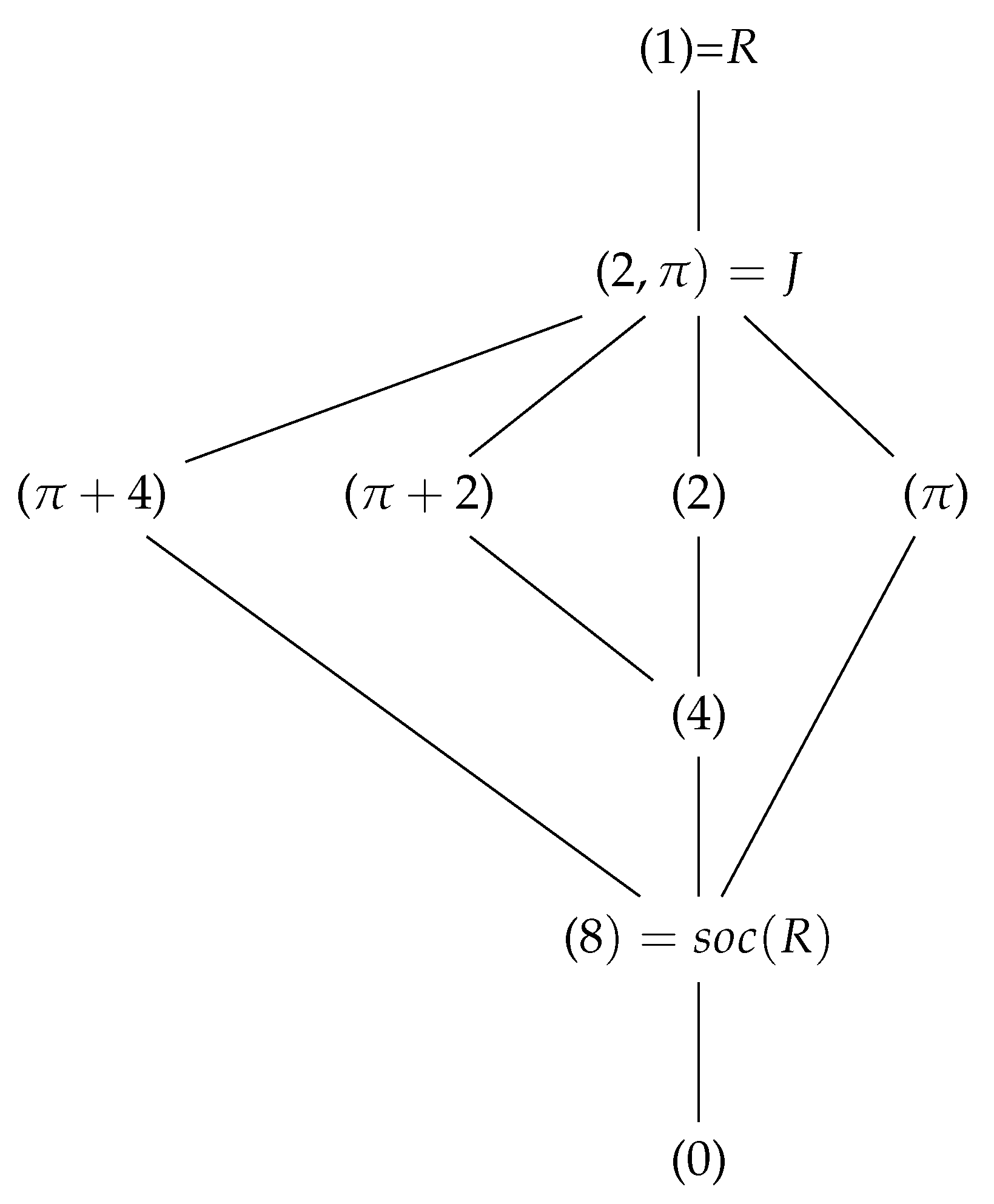
Figure 1 below shows the ideal lattice of As we know that and Therefore, our aim, in this section, is to create a set of modularly independent elements which serve as the rows of a generator matrix for a given code. The subsequent theorem provides a full representation of the structure of a generator matrix.
Theorem 7.
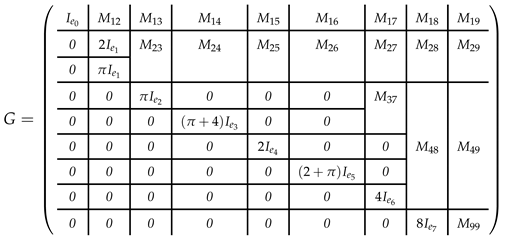
Suppose C is a linear code over with arbitrary length N. Then, any generator matrix for C is equivalent to
where Mij are matrices over R.
Proof.
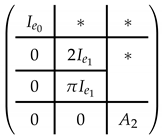
Suppose that G is a matrix whose rows generate C as an R-module. We move all columns that have a unit in them to the left of By performing row reduction on those columns, we get a matrix of the form
Now, all elements of A are not units. We again move all columns that have elements in to the left, and impose the main row operations to transfer the matrix to a form of the following.
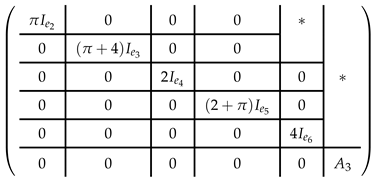
We proceed with this algorithm, ensuring that the matrix is constructed by arranging columns with elements that form a pair , and we repeat this process until the matrix is in the desired form.
where the entries of columns of the matrix are elements of only one ideal of the ideals , and So, now we proceed with the matrix In order to create a unique representation of the matrix, we select a specific ordering for the four ideals: and . This chosen order will be used consistently when constructing the matrix. Let u be a unit of we first continue with columns whose entries are of the form then with columns of and next with columns that have elements of the form Finally, we deal with columns of the form In each step, we perform row reduction in the usual manner. Note that the ideal is contained in both and and thus we repeat the same procedure with this ideal, since all remaining entries of the columns will be from the ideal
Finally, all elements of A3 are from the ideal generated by 8. By eliminating any rows containing only zeros and performing a final round of row reduction, we ultimately obtain a matrix that precisely matches the desired form we were aiming for. □
Proposition 2.
Suppose that is a vector in Let be a cyclic R-submodule of Then,
Proof.
Assume that I is an ideal generated by coordinates of the vector Let T be the set of all annihilators of in which is an ideal of Thus,
According to Figure 1, we have six possibilities for the order of . The result follows. □
Theorem 8.
Suppose that are R-submodules such that their coordinates contain no units. Then,
Proof.
By Proposition 2, we have Since then □
Example 5.
To obtain a linear code over of order let and Therefore, If we want a code of order we put such that and Thus, Consider and Hence, Moreover, C is a decomposable module, i.e.,
Figure 1.
Ideals lattice of .
The last example illustrates that it is possible for a code over a singleton local Frobenius (non-chain) ring to not have a minimal set of generators in standard form, making it difficult to determine the code size. In other words, it illustrates the distinction between codes over local non-chain rings and codes over chain rings.
Example 6.
Assume C is a linear code over with a generator matrix of the form
If is the R-submodule generated by the first and second row of and is the R-submodule generated by the third row of then is always non-trivial. This means C is an indecomposable module.
6. Conclusions
In conclusion, we have successfully classified all singleton local Frobenius rings (up to isomorphism) with respect to fixed invariants and determined the MacWilliams relations and generator matrices for linear codes of arbitrary length over these rings. While MacWilliams relations and generator matrices are well known and significant for codes over chain rings, such a case may not be reachable for codes over local non-chain rings. The challenge lies in the fact that local non-chain rings are not principal ideal rings, which complicates the determination of a minimal set of generators and the enumeration of the code size. This limitation suggests that alternative approaches or techniques are needed to handle codes over local non-chain rings effectively.
Author Contributions
Conceptualization, S.A. and A.A.A.; methodology, S.A. and A.A.A.; formal analysis, S.A. and N.A.A.; investigation, S.A. and A.A.A.; writing—original draft, S.A. and N.A.A.; writing—review & editing, S.A., A.A.A. and N.A.A. All authors have read and agreed to the published version of the manuscript.
Funding
This research was supported by the Researchers Supporting Project number (RSPD2024R871), King Saud University, Riyadh, Saudi Arabia.
Data Availability Statement
No new data were created or analyzed in this study.
Conflicts of Interest
The authors declare no conflicts of interest.
References
- Wood, J.A. Duality for modules over finite rings and applications to coding theory. Am. J. Math. 1999, 121, 555–575. [Google Scholar] [CrossRef]
- Alkhamees, Y.; Alabiad, S. The structure of local rings with singleton basis and their enumeration. Mathematics 2022, 10, 4040. [Google Scholar] [CrossRef]
- Raghavendran, R. Finite associative rings. Compos. Math. 1969, 21, 195–229. [Google Scholar]
- Honold, T. Characterization of finite Frobenius rings. Arch. Math. 2001, 76, 406–415. [Google Scholar] [CrossRef]
- Martínez-Moro, E.; Szabo, S.; Yildiz, B. Linear codes over ℤ4[x]/(x2 + 2x). Int. Inf. Coding Theory 2015, 3, 78–96. [Google Scholar]
- Sriwirach, W.; Klin-Eam, C. Repeated-root constacyclic codes of length 2ps over Fpm + uFpm + u2Fpm. Cryptogr. Comm. 2021, 13, 27–52. [Google Scholar] [CrossRef]
- Laaouine, J.; Charkani, M.E.; Wang, L. Complete classification of repeated-root-constacyclic codes of prime power length over Fpm[u]/(u3). Discrete Math. 2021, 344, 112325. [Google Scholar] [CrossRef]
- Yildiz, B.; Karadeniz, S. Self-dual codes over F2 + uF2 + vF2 + uvF2. J. Frankl. Inst. 2010, 347, 1888–1894. [Google Scholar] [CrossRef]
- Aydin, N.; Karadeniz, S.; Yildiz, B. Some new binary quasi-cyclic codes from codes over the ring F2 + uF2 + vF2 + uvF2. Appl. Algebra Eng. Commun. Comput. 2013, 24, 355–367. [Google Scholar] [CrossRef]
- Greferath, M. Cyclic codes over finite rings. Discrete Math. 1997, 177, 273–277. [Google Scholar] [CrossRef]
- Norton, G.; Salagean, A. On the structure of linear cyclic codes over finite chain rings. Appl. Algebra Eng. Commun. Comput. 2000, 10, 489–506. [Google Scholar] [CrossRef]
- Shi, M.; Wu, R.; Krotov, D. On ZpZpk-additive codes and their duality. IEEE Trans. Inform. Theory 2018, 65, 3842–3847. [Google Scholar]
- Shi, M.; Ozbudak, F.; Xu, L.; Sol’e, P. LCD codes from tridiagonal Toeplitz matrices. Finite Fields Their Appl. 2021, 75, 101892. [Google Scholar] [CrossRef]
- Shi, M.; Zhu, S.; Yang, S. A class of optimal p-ary codes from one-weight codes over Fp[u]/<um>. J. Frankl. Inst. 2013, 350, 929–937. [Google Scholar] [CrossRef]
- Yildiz, B.; Karadeniz, S. Linear codes over ℤ4 + uℤ4: MacWilliams identities, projections, and formally self-dual codes. Finite Fields Their Appl. 2014, 27, 24–40. [Google Scholar] [CrossRef]
- Dougherty, S.T.; Saltürk, E.; Szabo, S. Codes over local rings of order 16 and binary codes. Adv. Math. Commun. 2016, 10, 379–391. [Google Scholar] [CrossRef]
- Dougherty, S.T.; Saltürk, E.; Szabo, S. On codes over Frobenius rings: Generating characters, MacWilliams identities and generator matrices. Appl. Algebra Eng. Commun. Comput. 2019, 30, 193–206. [Google Scholar] [CrossRef]
- Martínez-Moro, E.; Szabo, S. On codes over local Frobenius non-chain rings of order 16. In Noncommutative Rings and Their Applications; Contemporary Mathematics; Dougherty, S., Facchini, A., Leroy, A., Puczylowski, E., Solé, P., Eds.; American Mathematical Society: Providence, RI, USA, 2015; Volume 634, pp. 227–241. [Google Scholar]
- Alabiad, S.; Alkhamees, Y. Constacyclic codes over finite chain rings of characteristic p. Axioms 2021, 10, 303. [Google Scholar] [CrossRef]
Disclaimer/Publisher’s Note: The statements, opinions and data contained in all publications are solely those of the individual author(s) and contributor(s) and not of MDPI and/or the editor(s). MDPI and/or the editor(s) disclaim responsibility for any injury to people or property resulting from any ideas, methods, instructions or products referred to in the content. |
© 2024 by the authors. Licensee MDPI, Basel, Switzerland. This article is an open access article distributed under the terms and conditions of the Creative Commons Attribution (CC BY) license (https://creativecommons.org/licenses/by/4.0/).