Abstract
An involution refers to a function that acts as its own inverse. In this paper, our focus lies on exploring two-dimensional involutive maps defined by rational functions. These functions have denominators represented by polynomials of degree one and numerators by polynomials of a degree of, at most, two, depending on parameters. We identify the sets in the parameter space of the maps that correspond to involutions. The investigation relies on leveraging algorithms from computational commutative algebra based on the Groebner basis theory. To expedite the computations, we employ modular arithmetic. Furthermore, we showcase how involution can serve as a valuable tool for identifying reversible and integrable systems within families of planar polynomial ordinary differential equations.
MSC:
16R50; 34C14
1. Introduction
Let be either or and be a vector from . An automorphism defined on the non-empty domain D in is an involution on D, if
for all . Clearly, if the above equality holds, then . If the coordinate functions of the map are rational functions; that is, they can be expressed as a ratio of two polynomials, we are speaking about rational involutions.
Involutions are valuable tools in the study of ordinary differential equations due to their ability to analyze the structure of the equations and provide insights into the behavior of solutions. They play an important role in reducing complexity, finding solutions, and uncovering underlying symmetries, making them essential for researchers in the field of ordinary differential equations (ODEs) and for practitioners (see, e.g., [1] and the references therein). Furthermore, they can help to identify invariant solutions of ODEs—solutions that remain unchanged under certain transformations. Invariant solutions can reveal crucial information about the behavior of ODEs and their geometric properties [2,3]. Involutions are closely related to Lie symmetry, a powerful method for studying ODEs. They are often used to construct these symmetries, which can then be employed to find solutions, conservation laws, and other properties of ODEs (see, e.g., [4]).
In this paper, we first consider a family of rational maps, where both the numerators and denominators are polynomials of degree one. More precisely, let
and be the set
When , the rational involutions of the form
where the parameters are real numbers and were studied in [5]. In Theorems 1 and 2 of [5], the authors found all involutions in family (1), in the case where at least one of the coordinate functions of (1) is a polynomial, and in Theorem 3, they claim to have given the list of all involutions in family (1), in the case where
It is claimed in Theorem 3 of [5] that the map is an involution if and only if , where
Theorems 1 and 2 of [5] are correct, but Theorem 3 does not hold. Direct calculations show that substituting either condition or into (1) results in a map, which is not an involution. The main aim of our work is to provide the true set of involutive maps in family (1). Using an approach that is different from the one used in [5], we first find all involutions in family (1) defined on with , correcting the result of [5]. Then, we search for involutions of form (1) defined on for .
In Section 4, we consider the family of rational maps
and find involutive maps in the family.
We also provide an application of the found involutions to cubic planar differential systems. Such systems, which are two-dimensional systems with polynomials of degree three on the right-hand side, play a significant role in the qualitative theory of ordinary differential equations. They often exhibit rich and diverse dynamical behavior, making them valuable for studying the qualitative aspects of ODEs. Two important open problems in the studies of cubic systems are finding all analytically integrable systems (see, e.g., [6,7,8] and the references given there) in the full family of cubic systems and determining an upper bound for the number of limit cycles in the family. The latter problem is an important part of the still unresolved Hilbert’s 16th problem (see, e.g., [9,10,11]). These two problems are closely related since most methods for estimating the number of limit cycles rely on perturbations of integrable systems. In Section 5, we demonstrate how rational involutions can be utilized to identify integrable systems in families of planar polynomial systems of ODEs and find two new families of analytically integrable planar cubic systems.
The novelty of our paper lies in introducing an efficient computational approach based on algorithms of commutative algebra for determining involutions in parametric families of rational maps, finding new families of rational involutions, and correcting the results of the rational involutions presented in [5]. Using rational involution as a tool to identify time-reversible systems, our work also provides a novel approach to tackle the problem of integrability for polynomial systems of ODEs.
2. Preliminaries
We will reduce our search for involutions to finding the set of solutions to systems of polynomials, so we recall some basics on polynomial ideals and their varieties (see, e.g., [8,12] for more details).
Let be a finite set of polynomials with coefficients in the field . The ideal, I, of the polynomial ring generated by the set F is denoted . It is defined as the set of all possible linear combinations of polynomials with the coefficients being polynomials of ,
The set, F, is called the basis of I.
The variety of the ideal, I, is the set of all common zeros of polynomials of I,
Clearly, is the same as the set of solutions to the system
Often, the set of solutions to system (3) is infinite, so “to solve” system (3) means to find a decomposition of the variety of the ideal, I, into irreducible components. More precisely, a variety is irreducible if for affine varieties and , only if either or The variety, V, of a given ideal, I, can be represented as a union of irreducible components,
where each is irreducible. The radical of I, denoted by , is the set
It is an intersection of prime ideals,
where in decomposition (4) is the variety of . Ideals are called the minimal associate primes of I. At present, there exist a few algorithms for computing the minimal associate primes [13,14]. They use Groebner basis computations and are, therefore, extremely time- and memory-consuming when the calculations are performed over the field of rational numbers. In our work, we use the routine minAssGTZ [15] of the computer algebra system Singular [16]. It is based on the algorithm of [13]. To speed up the computation, we apply the modular approach (see [17,18]).
To perform the elimination of variables, we employ a result from the computational commutative algebra called the elimination theorem, which is as follows.
Let I be an ideal in and ℓ be a fixed number from the set . The ℓth elimination ideal of I is the ideal . According to the elimination theorem (see, for example, [8,12]), to compute (for any ) the ℓth elimination ideal of an ideal, I, of , one can choose the lexicographic term order on the ring with and compute a Groebner basis G for the ideal, I, with respect to this order. Then, by the elimination theorem, the set is a Groebner basis for the ℓth elimination ideal .
In the computer algebra system, Singular, the routine eliminate performs the elimination using an algorithm based on the elimination theorem.
To finish this section, we recall the notion of time-reversible vector fields. Let U be an open set in , and
be a smooth differential system on U. We denote the vector field (5) by .
Let be an involution of class , be a vector field of class , and be a continuous function. It is said that is time-reversible if
In Section 5, we deal with a generalization of the time-reversible systems proposed in [3].
3. Involutions in Family (1)
We note that if is an involution, then the map obtained after the transformation is also an involution. This implies that if is an involution, then is also an involution. We refer to such involutions as conjugate.
Observe that map (1) can be an involution only in the case when both fractions in (1) are irreducible in ; that is,
A map of form (1) is an involution for a fixed value of the vector of parameters if
Computing for map (1), and then substituting the result into (7), we see that (7) holds for the values of parameters , such that all polynomials
- vanish on these values.
That is, map (1) is an involution if the parameters satisfy the system
and condition (6) holds. As pointed out in [5], in the case when all parameters are real, condition (6) can be written in the polynomial form as follows:
where and are new variables, and and are defined as follows:
We denote
Theorem 1.
Real map (1) is an involution if and only if its parameters belong to one of the following sets:
- (1)
- (2)
- (3)
- (4)
- (5)
- (6)
where
Proof.
Let G be the ideal of the polynomial ring generated by polynomials ,
Using the routine eliminate of the computer algebra system Singular [16], we compute the second elimination ideal of J, which we denote by I,
Employing the routine minAssGTZ [15], we look for the minimal associate primes of I obtaining the ideals given in the statement of the theorem. It leads to the conclusion that
However, the projection of the variety on the affine space
is not necessarily the variety . Generally speaking, . Thus, to prove the theorem, we will show that all points from correspond to maps (1) that are involutions.
For each , the variety after the setminus sign in the k-th condition of the statement of Theorem 1 is the restriction of on . To prove the theorem, we have to check that the parameters of map (1) belonging to one of the six sets given in the statement of the theorem corresponding maps (1) are involutions.
(1) The variety of is the set defined by the equations
Solving this system for and , we obtain the involution
Under condition (11) the expression is equivalent to the expression . Therefore, if condition (1) of the theorem holds, then the corresponding maps are involutions.
Similarly, we see that conditions (2) and (3) of the theorem yield the involutions
and
respectively. Clearly, these involutions are conjugate. Condition (4) gives the identity map.
(5) To obtain the involutions related to the ideal, , we have to look for parametrizations of the set of solutions of the polynomial system
If we obtain the involution
If we have equations , , and . From these equations, we see that must be zero; otherwise, we have which is not possible because is not defined for such values of the parameters. Substituting into the equations, we proceed further by expressing the remaining parameters. If then we have the expressions and giving us an involution of form (12), where If then it follows that , so we obtain involution (12) with .
(6) Let . Using the fifth polynomial of the list defining the ideal, , and solving the corresponding equation for we have . If , we have
The parametrization yields the involution
Using the rational implicitization theorem (see, e.g., [12]), we can easily verify that this parametrization covers almost all variety in the sense that the Zariski closure of the set covered by the parametrization is precisely . For the points not covered by the parametrization, we now show that the corresponding maps are involutions as well.
When , we have , yielding . Now, we have two cases: or . In we obtain the involution
For the other cases, we either have involutions that are conjugate to the ones given above or polynomial involutions provided by Theorem 1 of [5]. □
It is clear that all involutions listed in the proof of Theorem 1 can also be considered as involutions in with complex coefficients.
Proof.
We only need to prove that there are no additional complex involutions beyond those given by the expressions in Theorem 1 (which are considered as maps with complex parameters). The involutions of Theorem 1 were obtained using the claim that condition (6) is equivalent to the condition However, this claim is valid only for real maps. Assuming that the ideal is from the ring and using minAssGTZ of Singular, we compute the minimal associate primes of F and obtain the ideals listed in the statement of Theorem 1 and, additionally, the ideals
For the values of parameters from corresponding maps (1) are either undefined or not involutions. To establish the same for the parameters in it is sufficient to show that (6) does not hold for such parameter values. In this case, we show that the vectors and are linearly dependent; in other words, for each point of , there exists a number k such that
In the case when solving the first equation in (15) for k yields . Substituting this into the other two equations of (15), we obtain
which holds on , as both polynomials written above are in the ideal, . This implies that vectors and are linearly dependent for the values of parameters in . If then the ideal, , contains the polynomials and . However, this yields , making the first equation in (15) trivially true (). Solving the second equation of (15) in the case when , we have . The last equation of (15) gives which is true on . Thus, and are linearly dependent on . If , then contains polynomial , implying . But if , then map (1) cannot be an involution. □
4. Involutions with Quadratic Numerators
Theorem 1 gives all involutions in family (1). In a similar way, we search for rational involutions with a polynomial of degree two in the numerator, which are of form (2) (the case of rational maps where both numerators and denominators are polynomials of degree two is computationally unfeasible).
We denote by the vector of parameters of map (2), so
and by , the ring of polynomial in parameters of (2) with the coefficients in .
Theorem 3.
The maps listed below and their conjugates are involutions from family (2):
- 1.
- 2.
- 3.
- 4.
- 5.
- 6.
- 7.
- 8.
- 9.
- 10.
- 11.
- 12.
- 13.
- 14.
- 15.
- 16.
- 17.
- 18.
- 19.
- 20.
- 21.
- 22.
- 23.
- 24.
- 25.
Proof.
Taking the coefficients of powers of in the numerator of
we obtain a set of polynomials dependent on Let I be the ideal in generated by these polynomials.
We were unable to compute the irreducible decomposition of the variety of the ideal, I, working in the field of rational numbers. Instead, we computed the minimal associate primes of I using minAssGTZ in the field of characteristic 32003, and obtained 17 ideals listed in Appendix A. Performing the rational reconstruction with the algorithm of [19], we obtain ideals from which we derive the corresponding involutions listed in the statement of the theorem.
For instance, consider the 8th ideal in Appendix A (). Using the algorithm for the rational reconstruction from [19] we lift the numbers of to the rational numbers and obtain the ideal
It is easily seen that the variety of is parameterized by where is not equal to zero. It yields the map
which is the 11th map listed in the statement of the theorem. A direct check shows that it is an involution.
We lift the ideal of Appendix A to the ideal over the field of rational numbers similarly.
In the statement of theorem, we list only involutions with quadratic polynomials in the numerator. From the analysis of we also obtain involutions for which the numerator is linear or a constant. However, we do not write them down here since they are among the ones presented in Theorem 1 or in Theorems 1 and 2 of [5]. □
5. Reversible Systems
We recalled the definition of time-reversibility in Section 2. Recently, the following generalization of the notion of time-reversibility was introduced in [3].
Definition 1.
Let be an involution of class , be a vector field of class , and be a continuous function. It is said that is F-factor φ-reversible if
The case corresponds to the classical notion of time-reversibility.
Consider the following cubic system with a resonant singular point at the origin
where are complex parameters.
An important problem in the qualitative theory of polynomial differential systems is the classification of analytically integrable systems in family (17). It is known that analytic integrability is closely related to reversibility (see, e.g., [3,8,20,21]).
To look for systems in family (17), which are F-factor -reversible with respect to a given involution , in (17), we perform the substitution
obtaining the system
As an example of applying involutions to identifying reversible and integrable systems in a given polynomial family of ODEs, we consider involution (13). To complete the computations, we set so the involution is
and the fixed points set Fix of the involution contains the origin.
By performing in (17) the substitution (18) with the map given by (19), we obtain an ideal J in . Since all polynomials of the generating set of J contain as a factor, we divide them by and, in order to complete the computations, we set and . By computing the minimal associate primes of the obtained ideal in the field of characteristic 32003 (since computations in characteristic zero are infeasible), we obtain five ideals. Then, we perform the rational reconstruction using the algorithm proposed in [19]. It results in ideals , with their varieties parametrized as follows:
The corresponding systems are F-factor -reversible.
As shown in [3], the generalized reversibility can lead to the local analytic integrability of the system (the existence of a center in the real case; see [8]). We discuss the analytic integrability within the found families.
The systems corresponding to and become quadratic after a rescaling of time. Therefore, we do not consider them here, as the family of quadratic systems is classified in [22].
The system corresponding to is
Using the computational procedure described above, we found that
and involution (19) has the following expression:
Using the lines, we obtain the Darboux integrating factor:
where
yielding that system (20) is Darboux-integrable. Since the integrating factor is analytic in a neighborhood of the origin, system (20) has an analytic first integral near the origin.
For involution (21), the set of fixed points is
For points p on the line , we see that . This means that and calculating , one obtains for any value of the parameters. Theorem 1.2 from [3] tells us that the origin, which is in Fix , is a saddle point of the system.
In the case of , we have the system
Computations give
and
The system has two invariant lines
and
yielding the Darboux first integral , which is analytic in a neighborhood of the origin.
Thus, using involution (21) and looking for the generalized reversibility, we find two new families of locally analytically integrable cubic systems.
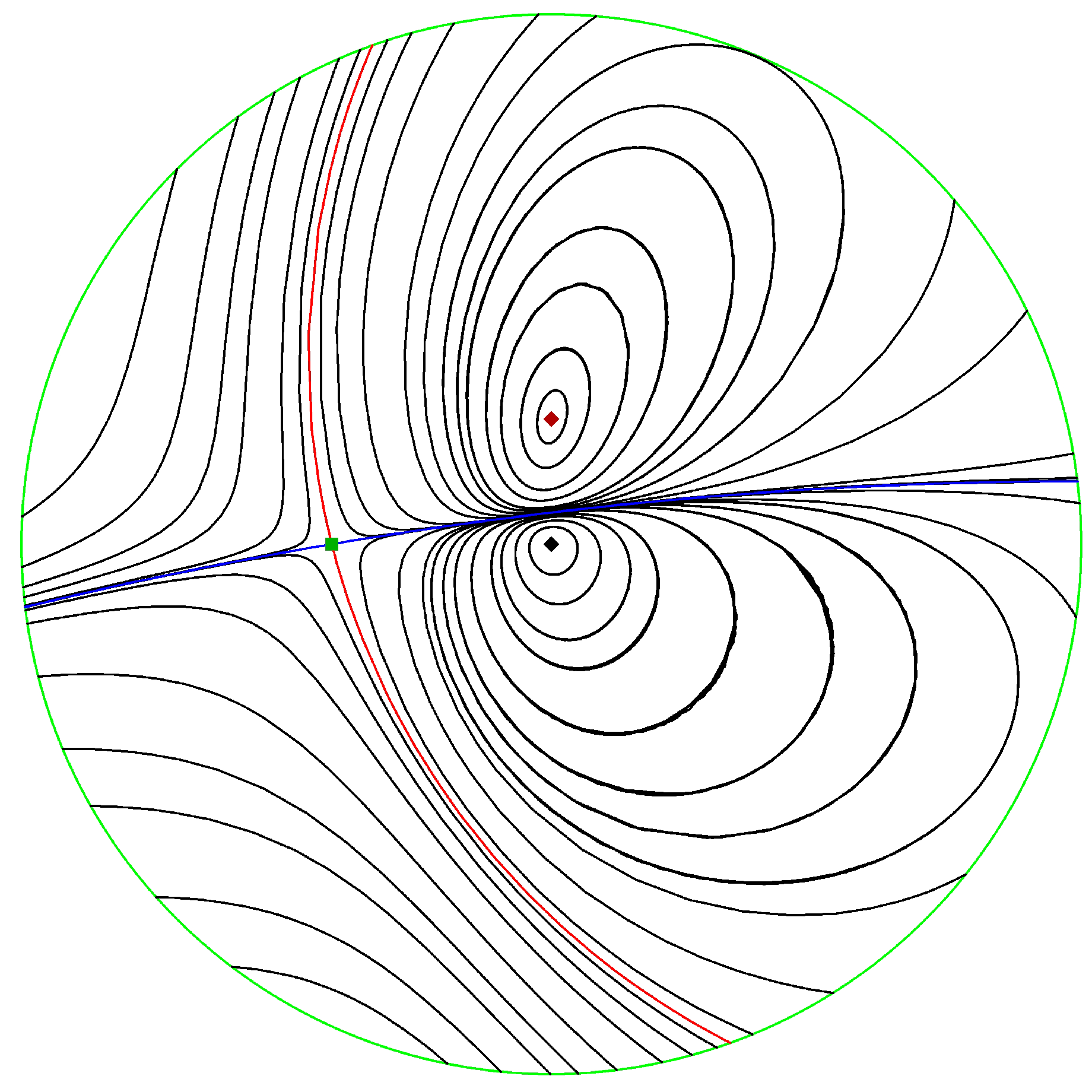
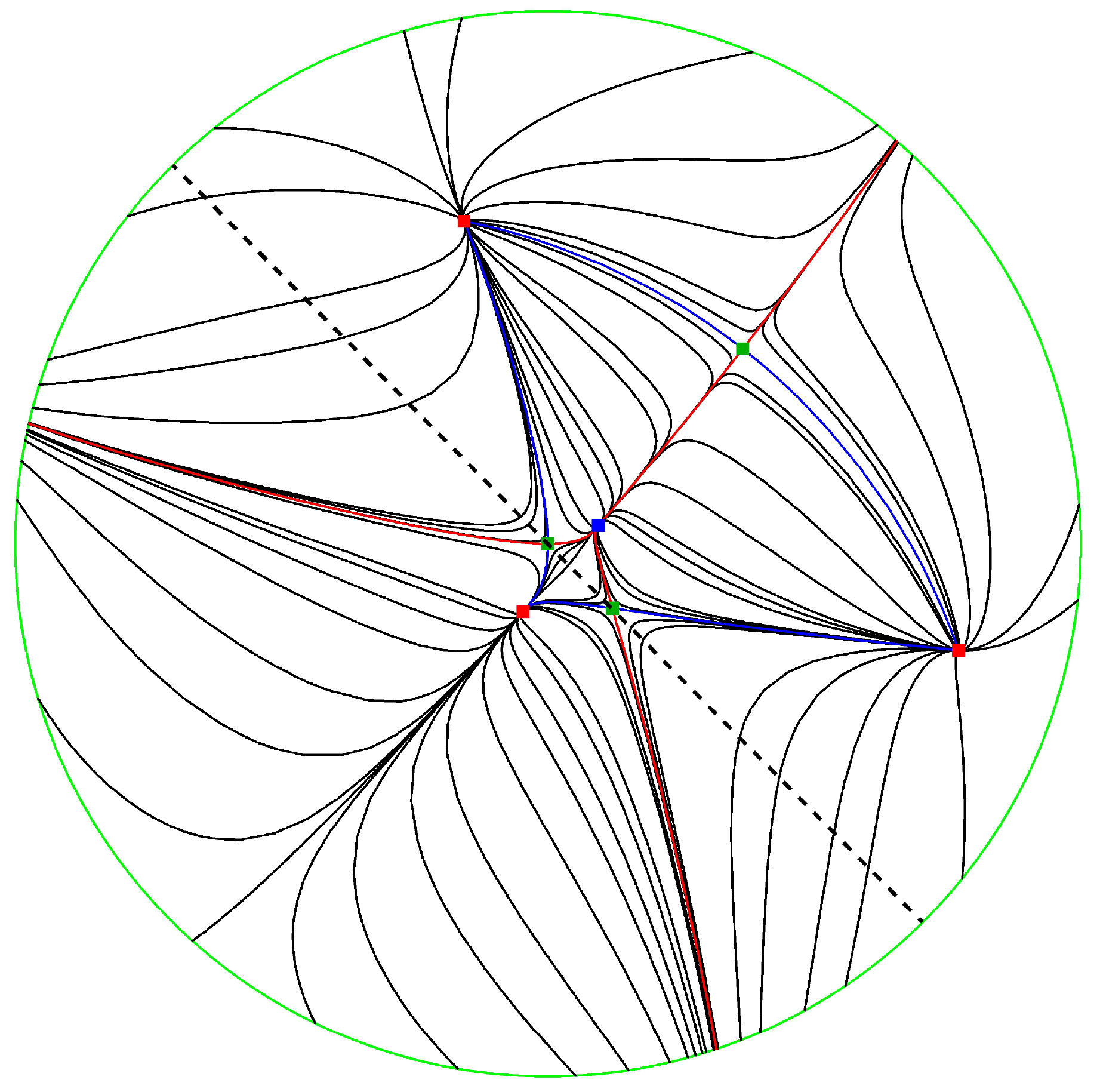
We provide two examples of phase portraits of the generalized reversible systems.
Example 1.
Using the P4 program [23] we draw the phase portrait of system (20) for fixed values of parameters. We set . Then, the system is
This system is orbitally F-factor φ-reversible with
and
The curve of fixed point Fix φ of the map is the line . The only points that belong to Fix φ and are stationary are and We already know that whereas straightforward calculations show that . Using Theorem 1.2 in [3] and looking at the phase portrait of the system, we see that both the origin and the point , which are on the line (the dashed line), are saddle points (see Figure 1). It is evident from the picture that two other singular points of the system are nodes.
Figure 1.
Phase portrait of (23).
In Example 1, we treated a real system from family (20). In the next example, we deal with a complex system from the family.
Example 2.
We can consider (20) as the complexification of a real system ([8], Chapter 3). To recover the real system embedded into (20), we multiply both equations of (20) by and make the substitution
Then, from (20), we obtain the real system
Under condition (24), the complex line is invariant for system (20). Viewing as a two-dimensional hyperplane in , the flow on is the flow of system (25) on ; that is, the phase portrait of the real system (25) is embedded in an invariant set in the phase portrait of the complex system obtained from (20) after the multiplication by i.
The choice of the parameters
gives us the system
It has two centers (which correspond to the saddles of the complex system). One center is located at the origin and the other one is at the point The point is a saddle point (see Figure 2).
Figure 2.
Phase portrait of (26).
6. Conclusions
Our study delves into the intriguing realm of rational involutions, which are ratios of polynomials of a degree of, at most, two. For two families of such rational maps, we successfully identified the sets in the parameter space that give rise to the involutive maps. This exploration has been made possible through the application of algorithms from computational commutative algebra, particularly the ones based on the Groebner basis theory. To enhance computational efficiency, modular arithmetic was employed.
Our findings not only contribute to the understanding of rational involutions but also unveil their potential as a powerful tool for identifying reversible and integrable systems within families of planar polynomial ordinary differential equations. Our work underscores the significance of rational involutions in shedding light on the intricate interconnections between algebraic properties and the qualitative aspects of differential equations.
We note that studying rational involutions , where and their relationship to the integrability of higher-dimensional systems of ODEs, represents an interesting and important problem.
Author Contributions
Investigation, writing original draft: I.M. and Y.T.; supervision, review, and editing: V.G.R. All authors have read and agreed to the published version of the manuscript.
Funding
Ivan Mastev and Valery Romanovski acknowledge the support of the Slovenian Research and Innovation Agency (core research program P1-0306). Yun Tian is supported by the National Natural Science Foundation of China (NSFC No. 12371175). The work was also supported by the bilateral China–Slovenia grant 5100-24/2019-86.
Data Availability Statement
Data are contained within the article.
Conflicts of Interest
The authors declare no conflicts of interest.
Appendix A
- (1)
- (2)
- (3)
- (4)
- (5)
- (6)
- (7)
- (8)
- (9)
- (10)
- (11)
- (12)
- (13)
- (14)
- (15)
- (16)
- (17)
References
- Cabada, A.; Tojo, F.A.F. Differential Equations with Involutions; Atlantis Press: Amsterdam, The Netherlands; Paris, France; Beijing, China, 2015. [Google Scholar]
- Arcet, B.; Romanovski, V.G. On Some Reversible Cubic Systems. Mathematics 2021, 9, 1446. [Google Scholar]
- Bastos, J.L.R.; Buzzi, C.A.; Torregrosa, J. Orbitally symmetric systems with application to planar centers. Commun. Pure Appl. Anal. 2021, 20, 3319–3346. [Google Scholar]
- Seiler, W.M. Involution and symmetry reductions. Math. Comput. Model. 1997, 25, 63–73. [Google Scholar]
- Lesniak, Z.; Shi, Y.-G. One class of planar rational involutions. Nonlinear Anal. Theory Methods Appl. 2011, 74, 6097–6104. [Google Scholar]
- Algaba, C.; García, J.; Giné, J. Nondegenerate and Nilpotent Centers for a Cubic System of Differential Equations. Qual. Theory Dyn. Syst. 2019, 18, 333–345. [Google Scholar]
- Dukarić, M. On integrability and cyclicity of cubic systems, Electron. J. Qual. Theory Differ. Equ. 2020. [Google Scholar] [CrossRef]
- Romanovski, V.G.; Shafer, D.S. The Center and Cyclicity Problems: A Computational Algebra Approach; Birkhäuser: Boston, MA, USA, 2009. [Google Scholar]
- Li, C.; Liu, C.; Yang, J. A cubic system with thirteen limit cycles. J. Differ. Equ. 2009, 246, 3609–3619. [Google Scholar]
- Li, J. Hilbert’s 16th problem and bifurcations of planar vector fields. Int. J. Bifurc. Chaos 2003, 13, 47–106. [Google Scholar]
- Li, J.; Liu, Y. New results on the study of Zq-equivariant planar polynomial vector fields. Qual. Theory Dyn. Syst. 2010, 9, 167–219. [Google Scholar]
- Cox, D.; Little, J.; O’Shea, D. Ideals, Varieties, and Algorithms; Springer: New York, NY, USA, 2007. [Google Scholar]
- Gianni, P.; Trager, B.; Zacharias, G. Gröbner bases and primary decomposition of polynomials. J. Symb. Comput. 1988, 6, 146–167. [Google Scholar]
- Shimoyama, T.; Yokoyama, K. Localization and primary decomposition of polynomial ideals. J. Symb. Comput. 1996, 22, 247–277. [Google Scholar]
- Decker, W.; Laplagne, S.; Pfister, G.; Shönemann, H. primedecGTZ—A Singular 4-3-1 Library for Computing the Prime Decomposition and Radical of Ideals. 2022. Available online: https://www.singular.uni-kl.de (accessed on 3 January 2024).
- Decker, W.; Greuel, G.-M.; Pfister, G.; Schönemann, H. Singular 4-3-1—A Computer Algebra System for Polynomial Computations. 2022. Available online: https://www.singular.uni-kl.de (accessed on 3 January 2024).
- Arnold, E.A. Modular algorithms for computing Gröbner bases. J. Symb. Comput. 2003, 35, 403–419. [Google Scholar]
- Romanovski, V.G.; Prešern, M. An approach to solving systems of polynomials via modular arithmetics with applications. J. Comput. Appl. Math. 2011, 236, 196–208. [Google Scholar]
- Wang, P.S.; Guy, M.J.T.; Davenport, J.H. P-adic reconstruction of rational numbers. SIGSAM Bull. 1982, 16, 2–3. [Google Scholar]
- Algaba, A.; García, C.; Giné, J. Orbital reversibility of planar vector fields. Mathematics 2021, 9, 14. [Google Scholar]
- Llibre, J.; Pantazi, C.; Walcher, S. First integrals of local analytic differential systems. Bull. Sci. Math. 2012, 136, 342–359. [Google Scholar]
- Artés, J.C.; Llibre, J.; Schlomiuk, D.; Vulpe, N. Geometric Configurations of Singularities of Planar Polynomial Differential Systems. A Global Classification in the Quadratic Case; Birkhäuser: Boston, MA, USA, 2021. [Google Scholar]
- Dumortier, F.; Llibre, J.; Artés, J.C. Qualitative Theory of Planar Differential Systems; Universitext; Springer: Berlin, Germangy, 2006. [Google Scholar]
Disclaimer/Publisher’s Note: The statements, opinions and data contained in all publications are solely those of the individual author(s) and contributor(s) and not of MDPI and/or the editor(s). MDPI and/or the editor(s) disclaim responsibility for any injury to people or property resulting from any ideas, methods, instructions or products referred to in the content. |
© 2024 by the authors. Licensee MDPI, Basel, Switzerland. This article is an open access article distributed under the terms and conditions of the Creative Commons Attribution (CC BY) license (https://creativecommons.org/licenses/by/4.0/).