1. Introduction
The distributed online optimization problem for multi-agent systems has received considerable attention in the past few decades [
1,
2]. The objective is to minimize a global time-varying cost function, written as the sum of local convex functions, under the constrict that each individual agent has only knowledge of the local convex functions.
Recently, some researchers have focused on distributed online aggregative optimization, which is a special class of online optimization problems. In distributed online aggregative optimization, the local cost functions include some aggregative terms motivated by many real applications. These aggregative terms make the design and analyses of the online optimization algorithm more challenging. Some tracking methods were presented to solve distributed online aggregative optimization problems. For example, a distributed aggregative gradient tracking algorithm is proposed and analyzed in [
3] to solve a distributed online aggregative optimization problem. It is shown that convergence to the optimal variable is linear. Different from [
3], a set constraint is considered in [
4], where an online distributed gradient tracking algorithm is proposed to solve a distributed online aggregative optimization problem with exact gradient information and stochastic/noisy gradients, respectively. The upper boundary of dynamic regret is analyzed and given, and some simulations on the target surrounding problem are provided to verify the effectiveness of the designed algorithm. The authors of [
5] considered the distributed online aggregative optimization without the assumption of boundedness of the gradients and the feasible sets. In particular, a projected aggregative tracking algorithm was presented in [
5], and the authors showed that the dynamic regret is bounded by a constant term and a term related to time variations.
Dynamic environments are common in the real applications of online optimization [
6,
7,
8,
9,
10,
11]. For example, the authors of [
6] showed that many online learning problems, including the dynamic texture analysis, solar flare detection, sequential compressed sensing of a dynamic scene, traffic surveillance, tracking self-exciting point processes, and network behavior in the Enron email corpus, can benefit from the incorporation of a dynamic environment. In [
7], the tracking problem of a time-varying parameter with unknown dynamics was studied as an online optimization in a dynamic environment. The distributed tracking and tracking of dynamic point processes on network problems were solved in [
8,
9] using mirror descent methods with dynamical environments, respectively. The localization of sensor networks problem was solved in [
10] by using a distributed online bandit learning algorithm over a multi-agent network with a dynamical environment. Note that the dynamic environments were assumed to be known in [
6,
7,
8,
9,
10]. In contrast with [
6,
7,
8,
9,
10], an unknown dynamic environment was considered in [
11], where the dynamic regret was shown to be bounded.
Based on the above discussions, the distributed online aggregative optimization with a dynamic environment is motivated by many real applications. The problem has many applications, especially under the condition that the dynamic environment is unknown. Therefore, this paper considers a class of distributed online aggregative optimization problems with an unknown dynamic environment. The main contributions are as follows. Some aggregative terms and an unknown dynamic environment are simultaneously considered in this paper for an online optimization problem. The problem formulation comes from some real applications, e.g., the cooperative control problem for a multi-robot system in the simulation section. Compared with [
3,
4,
5,
6,
7,
8,
9,
10,
11], the dynamic environment was not considered in [
3,
4,
5], and the aggregative terms were not considered in [
6,
7,
8,
9,
10,
11], respectively. Therefore, the design and analyses of the optimization algorithm in this paper are more challenging than in [
3,
4,
5,
6,
7,
8,
9,
10,
11]. In particular, some averaged tracking methods estimate the dynamic environment and the gradient. Based on the estimations, an online optimization algorithm is designed via a dynamic mirror descent method. It is shown that the dynamic regret is bounded in the order of
, and some simulations are proposed to verify the effectiveness of the designed algorithm.
The remaining parts of this paper are organized as follows. In
Section 2 and
Section 3, some preliminaries and problem formulation are presented. The main results are proposed in
Section 4. In
Section 5, the performance of the designed algorithm is verified by some simulations.
Section 6 concludes the paper.
2. Preliminaries
2.1. Notations
denotes the n-dimensional Euclidean space. denotes the 2-norm of a vector x. with positive integer T denotes the set . denotes the inner product of vectors and , i.e., where denotes the transpose of x. For a function , denotes the gradient of with respect to a vector x. denotes the second-largest singular value of matrix W.
2.2. Graph Theory
For a multi-agent system, we use a directed graph to describe the information exchange within it, where is the node set and is the edge set. represents that agent i can obtain information from agent j. The self-loop is unconsidered, i.e., . denotes the in-neighbor set of node i. If for every , there exists , then the graph is an undirected graph. A path between nodes i and j is a sequence of edges in the graph where are some distinct nodes. An undirected graph is connected if there is a path between each pair of nodes.
2.3. Bregman Divergence
The mirror descent algorithm based on Bregman divergence is frequently used and effective in online optimization [
8]. The Bregman divergence is defined as follows. Let
be a strongly convex function which satisfies
and define the Bregman divergence
as
3. Problem Formulation
Considering a network system composed of
N agents, and there exists a sequence of time-varying convex function
over the network composed of
. Considering the following optimization problem,
where
,
,
,
, and
is the aggregative variable defined by
. The function
is convex and assigned to agent
i. Supposing there exists a sequence of unknown stable non-expansive mapping
, i.e.,
, such that
where
and
is an unstructured and unknown noise. Assuming that agent
i independently observes the mapping
, and
denotes the observed value in time
t. Moreover, assuming that
is the optimal observed value for all agents and
is the optimal solution to the following optimization problem:
It follows from (4) and (5) that
where
.
Distributed Online Aggregative Optimization Problem:
The objective is to generate a sequence
to minimize the following dynamic regret,
where
is the optimal solution to (3) which satisfies constraint (6), i.e.,
while
satisfies constraint (6).
Remark 1. The online aggregative optimization problems have been studied in [
4,
5].
However, this paper considers an unknown dynamic environment, which is more challenging than [
4,
5],
i.e., the mapping . Let , and denote , and , respectively. Let be the adjacency matrix of network , and be the global step-size which will be used to design an online optimization algorithm in the next section. Let and be some convex sets which will be defined in the next section. Some necessary assumptions are as follows.
Assumption 1. Graph is undirected and connected, and W is doubly stochastic, i.e.,and there exists a constant such that when , and for all . Assumption 2. For , , and , the functions , , , , and are Lipschitz continuous, and the functions , and are bounded, i.e.,where L is the Lipschitz constant, and . Assumption 3. There existswhere , is on the N-dimensional simplex, and K and are some Lipschitz constants. Assumption 4. There exists positive constants and M, such that , and , where is the global step sequence. Moreover, , holds for and .
Remark 2. Assumptions 1, 3, and 4 come from [
6,
7,
8,
11]
. They are common in mirror descent algorithms for distributed online optimization. Assumption 2 is also common in online aggregation optimization [
4].
4. Main Result
Inspired by [
11], consider the following online algorithm:
where
,
,
,
is the global step sequence,
,
,
,
and
are some auxiliary variables, and
is the designed sequence. In (8), the initial states are chosen such that
,
,
and
.
It follows from (8) that the states in (8) are bounded. Let sets
and
satisfy
,
,
and
. Let
,
,
, and
Remark 3. We have provided a comparative analysis of problem formulation of online optimization in Table 1, where denotes distributed average tracking. It follows that the problem considered in this paper is more challenging than [
3,
4,
5,
6,
7,
8,
9,
10,
11]
. Algorithms (8a)–(8d) come from [
11]
. In fact, algorithms (8a)–(8d) have been used in [
11]
to solve a class-distributed online optimization problem with an unknown mapping. However, the aggregative variable is not considered in [
11]
. This makes the design and analyses of the optimization algorithm more challenging. In particular, it follows from (3) that, for agent i, the gradient of the function with respect to x is . But and are unknown for agent i due to the topology constraint. Therefore, the algorithms (8e) and (8f) are added by using the distributed average tracking method to estimate and . Based on (8e) and (8f), the new gradient is introduced in algorithm (8b). Hence, algorithms (8e) and (8f) are used to achieve aggregative gradient tracking via . A strict analysis of dynamic regret of algorithm (8) will be presented as follows. Lemma 1. Consider the mapping (5) and the algorithm (8a), and supposing that Assumptions 1 and 4 hold. Then for all and , there existswhere . Lemma 2. Considering algorithm (8f), and supposing that Assumptions 1 and 2 hold, then for all and , there exists,where , , , and . Lemma 3. Considering algorithms (8a)–(8d), and supposing that Assumptions 1–4 hold, then for all and , there exists,where . Lemma 4. Considering algorithm (8), and supposing that Assumptions 1–3 hold, then for all and , there exists,where , , and . Lemma 5. Considering algorithm (8), and supposing that Assumptions 1, 3 and 4 hold, then for all and , there exists,where . Lemma 6. Considering algorithm (8), and supposing that Assumptions 1–3 hold, then for all and , there exists, The main result of this paper is as follows.
Theorem 1. Considering the optimization problem (3), constraint (6), and algorithm (8), and supposing that Assumptions 1–4 hold. Let and . Then there existswhere , , and . Remark 4. The condition is reasonable since a sufficiently small is chosen by decreasing . It follows from the boundary in Theorem 1 that a proper step is with . In such a case, the regret is bounded in the order of for any arbitrary .
5. Simulations
Inspired by [
5,
8], considering a cooperative control problem for a multi-robot system in a plant
, in particular, a moving target with state
is modeled as
where
and
is the noise. Moreover, there is a multi-robot network composed of
N robots aiming to protect the target, while there are
N intruders aiming to capture the target. Let
denote the state of the
ith intruder at time
t, which is assigned to robot
i. Supposing that the formation of a multi-robot network is defined by a virtual leader–follower formation method, let
denote the leader’s state which is unknown for all robots. In particular, let
denote the estimated value of
by robot
i at time
t, and the state of robot
i is given by
, where
and
represent an offset of robot
i to the virtual leader
.
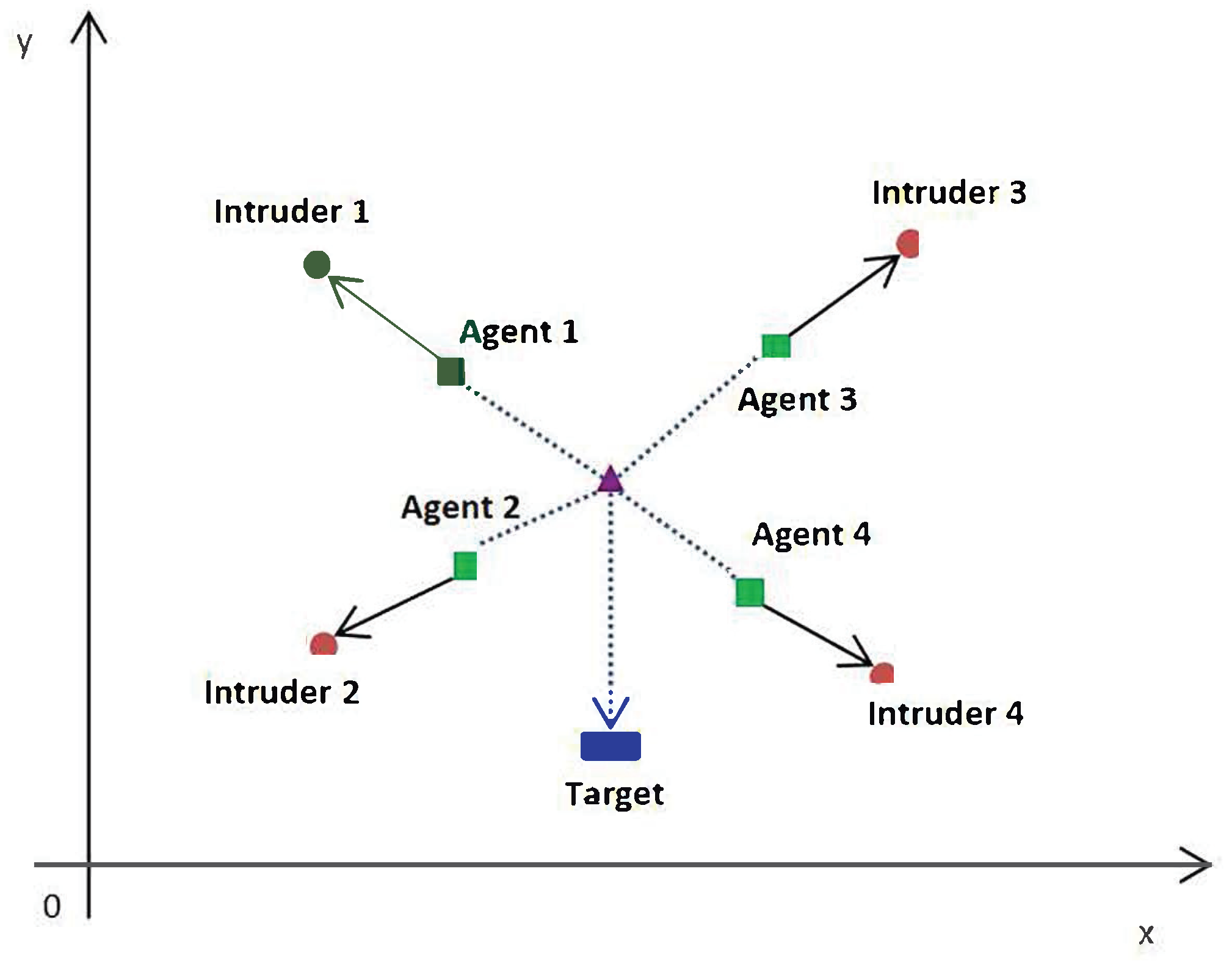
The multi-robot network is used to protect the moving target by choosing an optimal virtual leader such that the average state of all the robots is close to the target. Meanwhile, each robot is simultaneously close to the associated intruder, referring to
Figure 1. Let
denote the averaged state of robots where
. Then, the cooperative control problem can be modeled as the following optimization problem:
where
, and
. In fact, the objective is to cooperate in seeking an optimal virtual leader, which is the optimal solution to the problem (13).
It is worth pointing out that the estimated virtual leader should be consensus. Therefore, let
be the consensus solution to problem (13). Then
should be the solution to the following online optimization problem:
where
and
. In addition, it follows from (12) that
should also have the mapping
, i.e.,
satisfies the following constraint:
where
is an unknown and unstructured noise. Note that
is unknown for all robots. Hence,
denotes the observed mapping of
at time
t for robot
i. Problem (14) and constraint (15) take the form of problem (3) and constraint (6), so Algorithm 1 can be used to solve problem (14) with constraint (15).
Let , , , is a random vector chosen from a normal distribution with zero mean and standard deviation , , , , , , the unknown noise satisfies , and where is a random number chosen from a normal distribution with zero mean and standard deviation .
Choosing
,
and
, and supposing that an arbitrary doubly stochastic
W is given, it can be verified that Assumptions 1–4 and the condition
hold. The simulations are performed on a computer equipped with AMD Ryzen 9 5950X 16-core CPU, 64G RAM, and Nvidia RTX 3080Ti GPU.
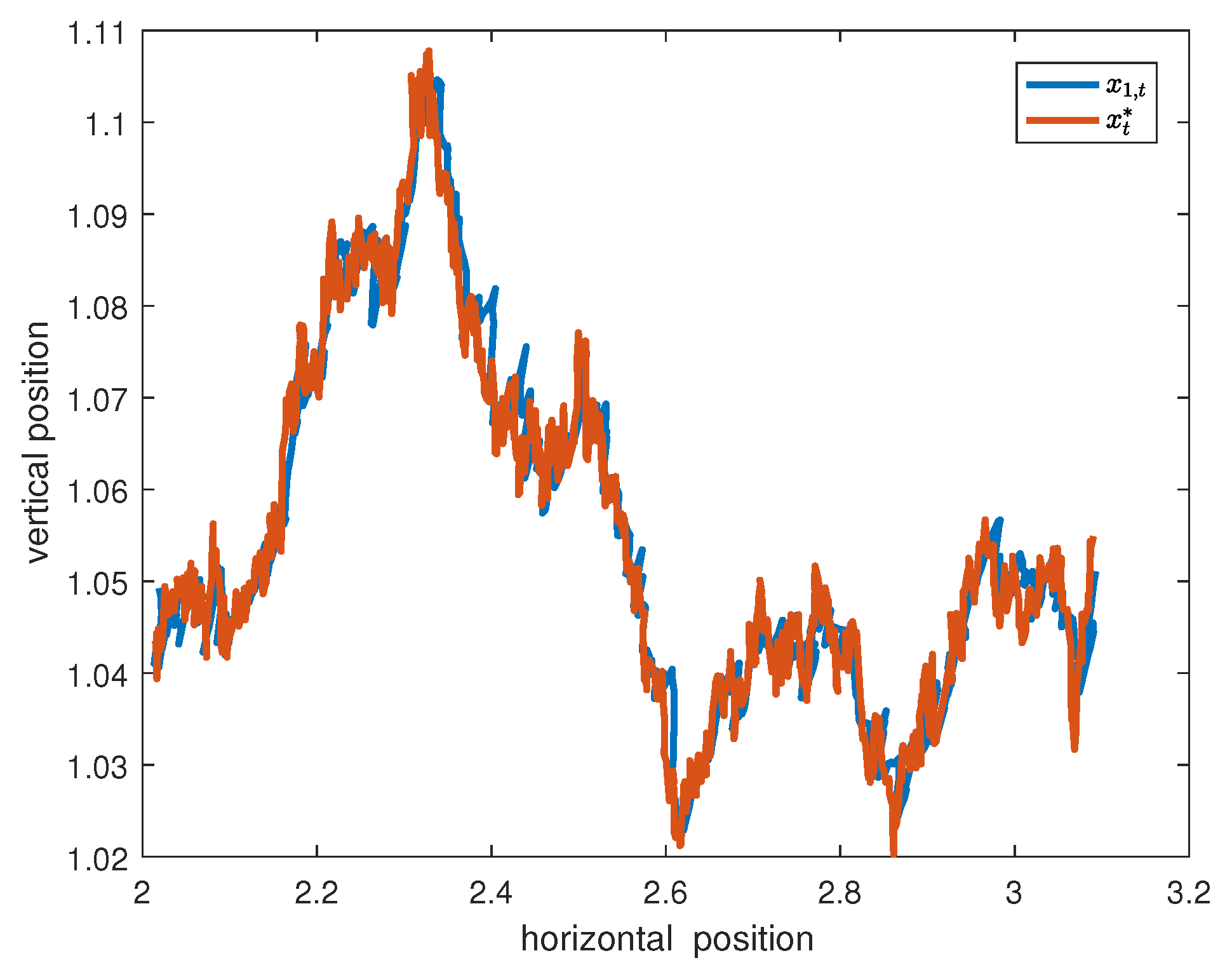
Figure 2 shows the trajectory
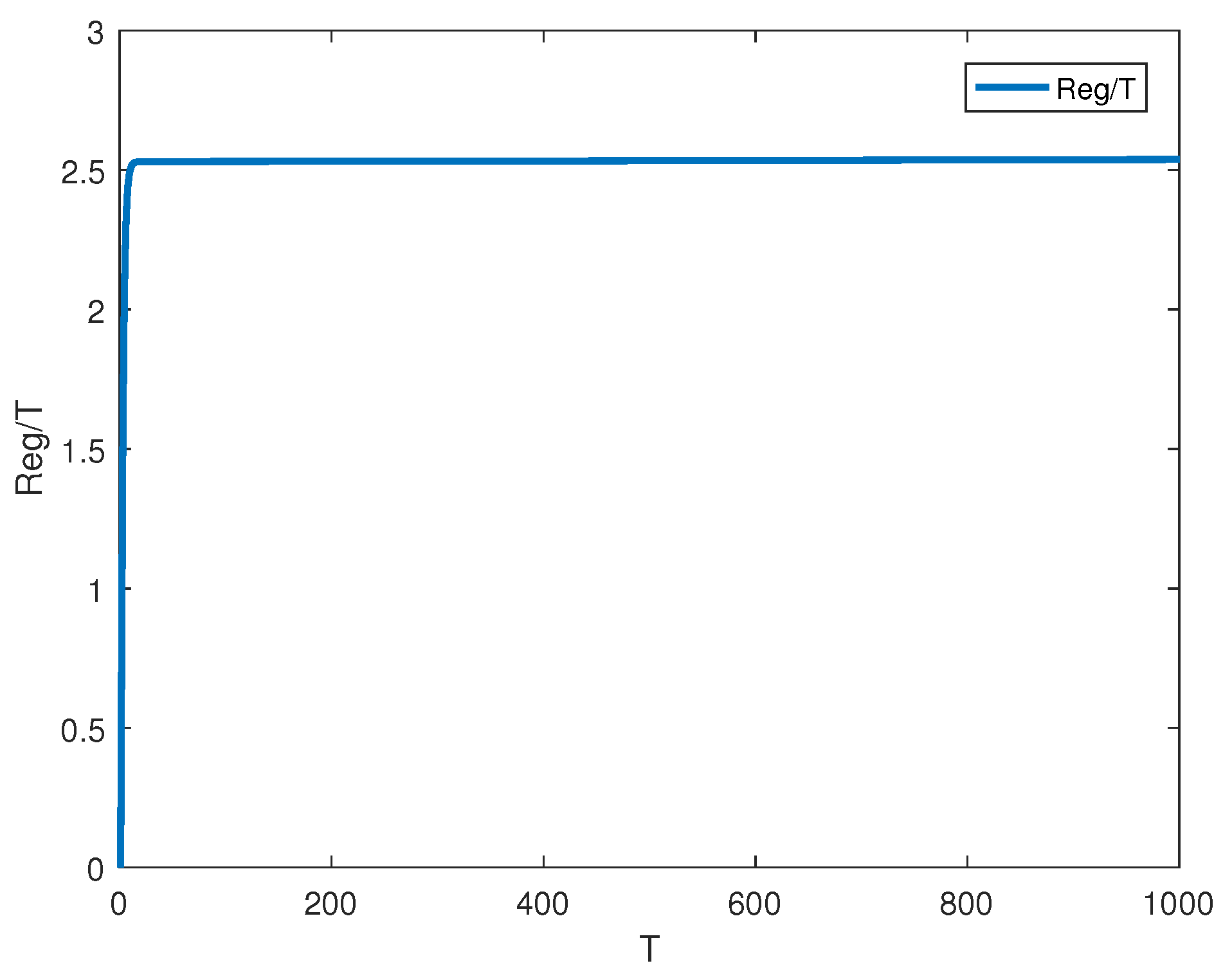
of robot 1 by using Algorithm 1. The dynamic regret of Algorithm 1 is indicated in
Figure 3, and the regret
in
Figure 3 is bounded. Therefore, Theorem 1 is verified by
Figure 2 and
Figure 3.