Novel Automatic Classification of Human Adult Lung Alveolar Type II Cells Infected with SARS-CoV-2 through the Deep Transfer Learning Approach



Abstract
1. Introduction and Related Work
- (1)
- Unlike the existing studies that aim to detect lungs infected with SARS-CoV-2 using different imaging modalities (e.g., CT and X-rays), to the best of our knowledge, this is the first study to investigate the feasibility of DTL in lungs infected with SARS-CoV-2 at the cellular level within alveoli in human lungs using transmission electron microscopy (TEM) images.
- (2)
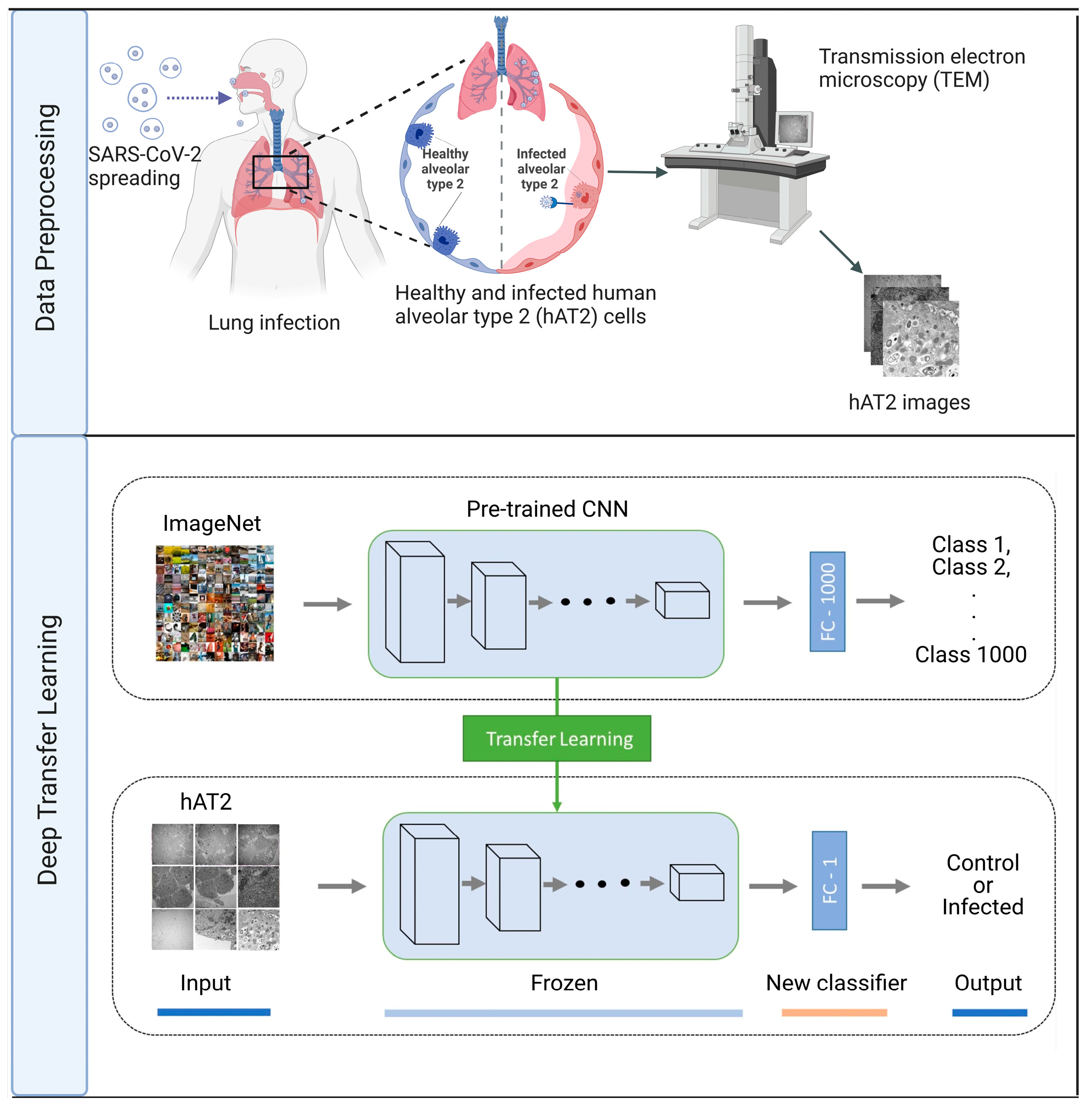
- The images generated via TEM unveiled the detailed structures of hAT2 cells and other characteristics of SARS-CoV-2, including viral particles dispersed inside the cell cytoplasm. We downloaded and processed 286 images pertaining to infected and healthy (control) human alveolar type II (hAT2) cells in alveoli from the electron microscopy public image archive (EMPIAR) at https://www.ebi.ac.uk/empiar/EMPIAR-10533/ (accessed on 13 March 2023).
- (3)
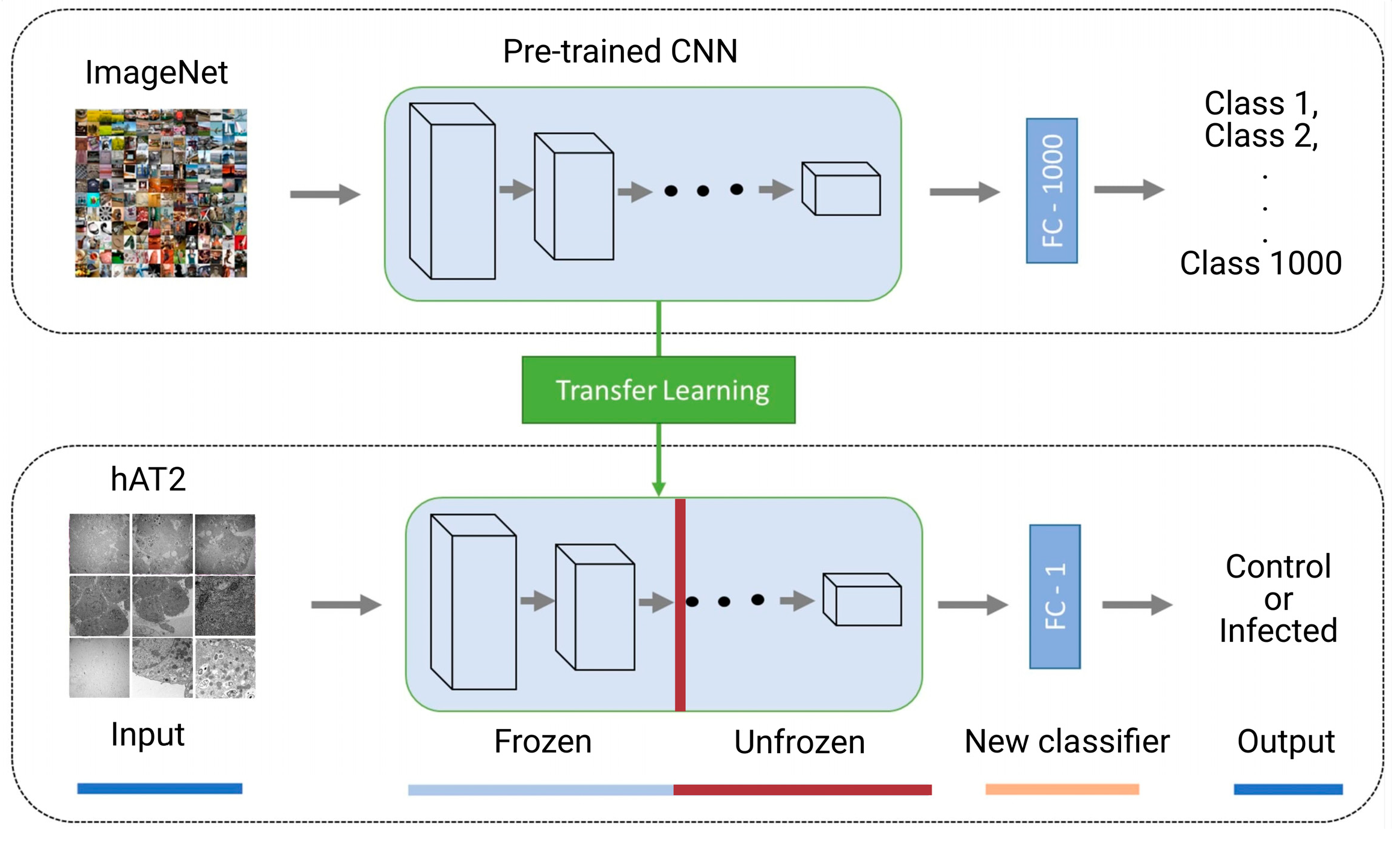
- We formulated the problem as a binary class classification problem and induced ten DTL models using two DTL computations [15], where in the first DTL computation, we applied five pre-trained models (DenseNet201 [16], NasNetMobile [17], ResNet152V2 [18], VGG19 [19], and Xception [20]) to extract features from hAT2 images, followed by flattening the extracted features into feature vectors provided as inputs to train a densely connected classifier of three layers, including two dense layers and one dropout layer. We refer to the induced models via the first DTL computation as TFeDenseNet201, TFeNasNetMobile, TFeResNet152V2, TFeVGG19, and TFeXception. For the second DTL computation, we froze the first layers in the pre-trained models while unfreezing and jointly training the next layers, including a densely connected classifier. The induced models via such DTL computation are referred to as TFtDenseNet201, TFtNasNetMobile, TFtResNet152V2, TFtVGG19, and TFtXception.
- (4)
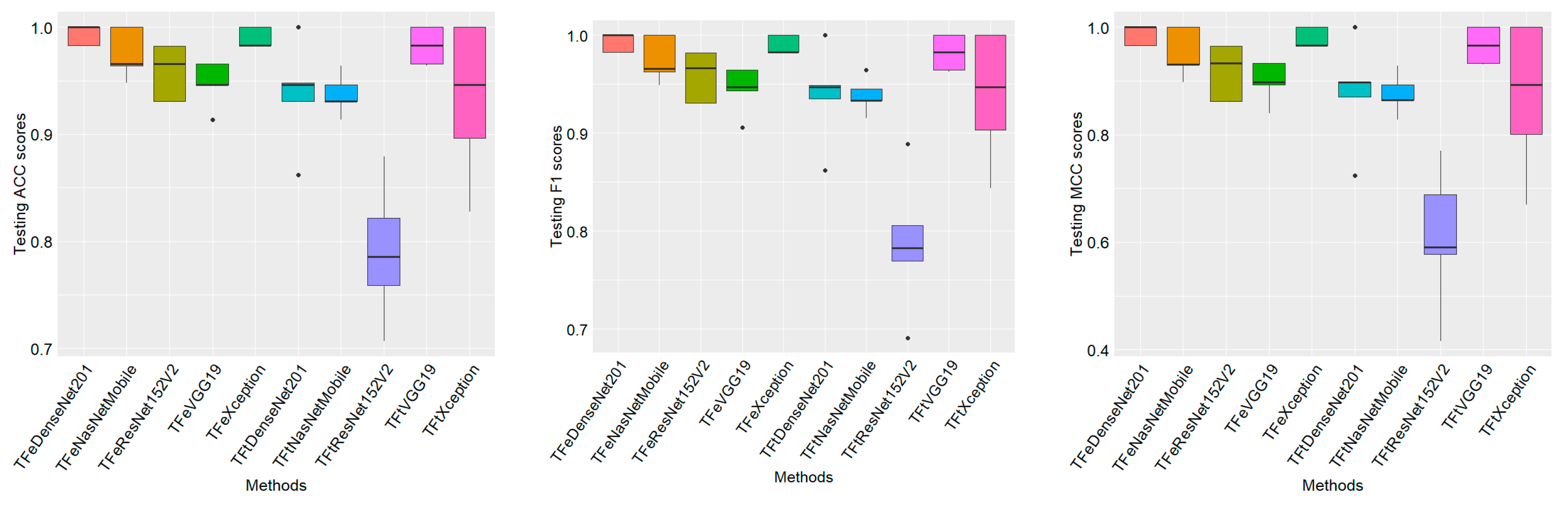
- For fairness of performance comparisons among the ten studied DTL models, we evaluated the performance on the whole dataset of 286 images using five-fold cross-validation, in which we provided the same training and testing images in each run to each model. Then, we reported the average performance results of the five runs on testing folds and reported the standard deviation.
- (5)
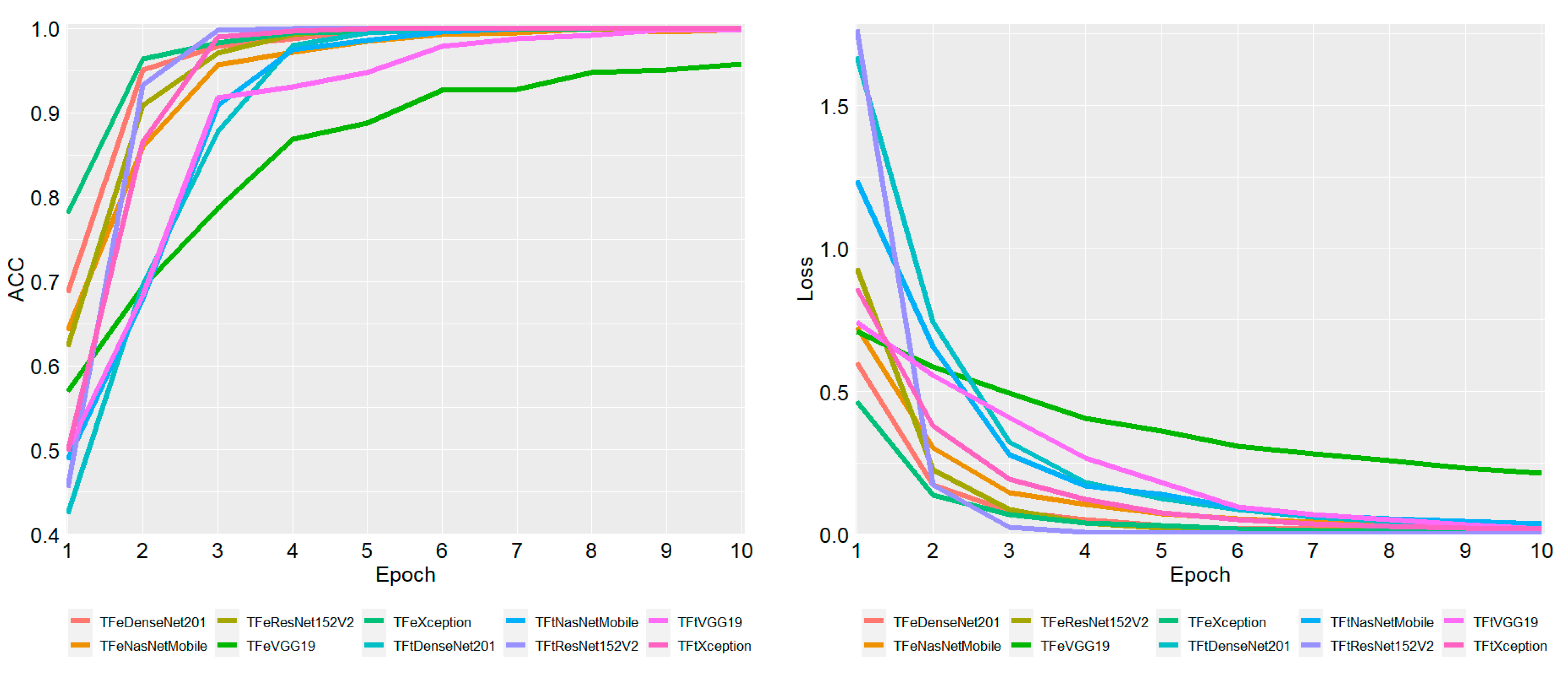
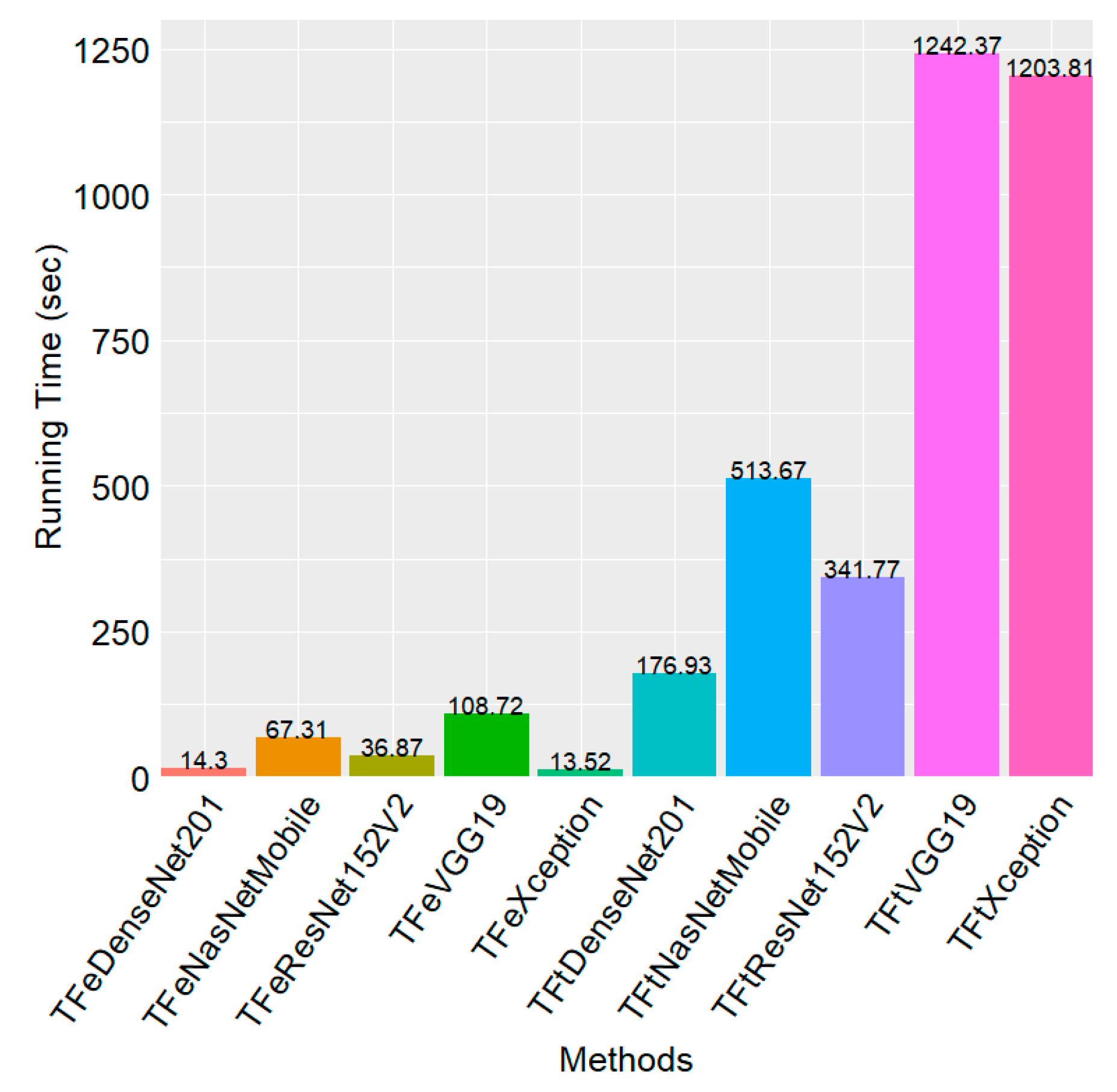
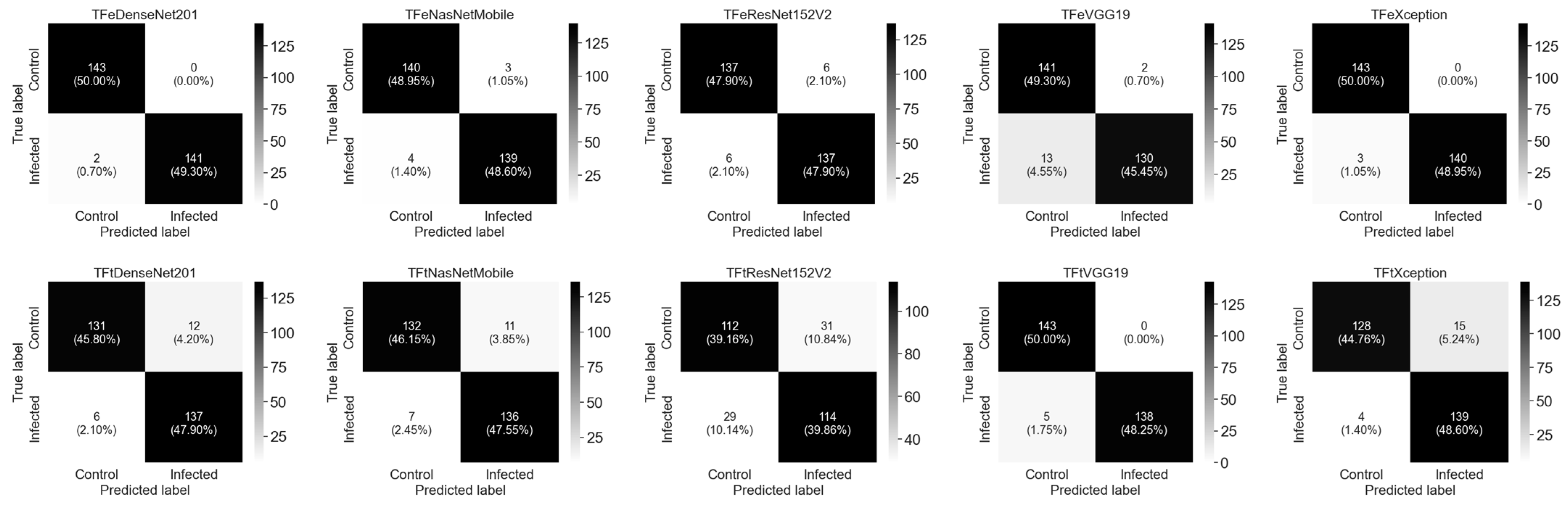
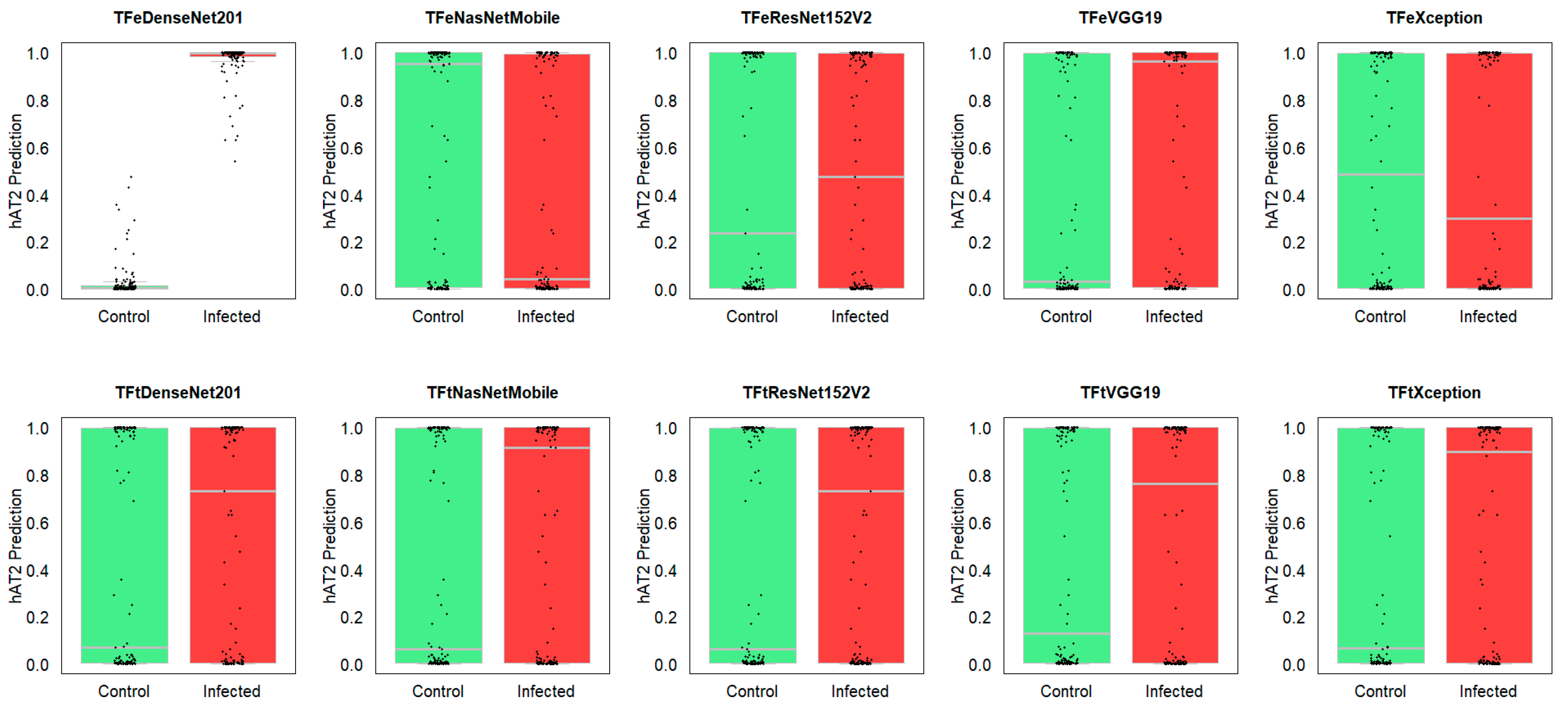
- Our experimental study demonstrated that TFeDenseNet201 achieved the highest average ACC of 0.993, the highest F1 of 0.992, and the highest MCC of 0.986 when utilizing five-fold cross-validation. Moreover, these performance results were statistically significant (, obtained from a t-test), demonstrating the generalization ability of TFeDenseNet201. In terms of measuring the training running time, TFeDenseNet201 was 12.37× faster than its peer, TFtDenseNet201, induced via the second DTL method. These high-performance results demonstrate that our DTL models can act as (1) an assisting AI tool in diagnostic pathology and (2) a reliable AI tool for automatic annotation when used with TEM. We provide details about the experimental study, including the processed datasets, in the Supplementary Materials.

| Year | Study | Scanning | Cell Type | Best Architecture | Class | Evaluation Using | Results |
|---|---|---|---|---|---|---|---|
| 2022 | Oğuz et al. [21] | CT | - | ResNet-50+SVM | 2-class (COVID-19, normal) | Test set | ACC (0.96); F1 (0.95); AUC (0.98) |
| 2022 | Haghanifar et al. [22] | X-ray | - | COVID-CXNet | 3-class (COVID-19, normal, pneumonia) | Test set | ACC (0.8788); F1 (0.97) |
| 2022 | Bhattacharyya et al. [23] | X-ray | - | VGG19-BRISK-RF | 3-class (COVID-19, normal, pneumonia) | Test set | ACC (0.966) |
| 2022 | Chouat et al. [24] | X-ray; CT | - | VGGNet-19 | 2-class (COVID-19, normal) | Test set | ACC (0.905) |
| 2022 | Asif et al. [25] | X-ray | - | Shallow CNN | 2-class (COVID-19, normal) | Test set | ACC (0.9968) |
| 2022 | Ullah et al. [26] | X-ray | - | CovidDetNet | 3-class (COVID-19, normal, pneumonia) | Test set | ACC (0.9840) |
| 2022 | Zouch et al. [27] | X-ray; CT | - | VGG19 | 2-class (COVID-19, normal) | Test set | ACC (0.9935) |
| 2023 | Haennah et al. [9] | CT | - | DETS-ResNet101 | 2-class (COVID-19, normal) | Five-fold CV | ACC (0.967); F1 (0.969) |
| 2023 | Salama et al. [13] | CT | - | Hybrid DL+ML | 2-class (COVID-19, normal) | Three test sets | Average ACC (0.9869) |
| 2023 | Ayalew et al. [28] | X-ray | - | CNN+SVM | 2-class (COVID-19, normal) | Test set | ACC (0.991) |
| 2023 | Constantinou et al. [29] | X-ray | - | ResNet101 | 3-class (COVID-19, non-COVID-19, normal) | Test set | ACC (0.96) |
| 2023 | Patro et al. [30] | X-ray | - | SCovNet | 2-class (COVID-19, normal) | Test set | ACC (0.9867) |
| 2023 | Zhu et al. [31] | X-ray | - | CovC-ReDRNet | 3-class (COVID-19, normal, pneumonia) | Five-fold CV | ACC (0.9756); F1 (0.9584) |
| 2023 | Chakraborty et al. [32] | X-ray | - | WAE | 3-class (COVID-19, normal, VP) | Test set | ACC (0.9410); F1 (0.9404) |
| 2-class (COVID-19, non-COVID-19) | ACC (0.9725); F1 (0.9665) | ||||||
| 3-class (COVID-19, normal, VP) | Five-fold CV | ACC (0.8605) | |||||
| 2-class (COVID-19, non-COVID-19) | ACC (0.861) | ||||||
| 2023 | Gaur et al. [33] | X-ray | - | EfficientNetB0 | 3-class (COVID-19, normal, VP) | Test set | ACC (0.9293); F1 (0.88) |
| 2023 | Kathamuthu et al. [34] | CT | - | VGG16 | 2-class (COVID-19, normal) | Test set | ACC (0.98) |
| 2024 | Hussein et al. [5] | X-ray | - | Custom-CNN | 3-class (COVID-19, non-COVID-19, VP) 2-class (COVID-19, non-COVID-19) | Test set | ACC (0.981); F1(0.973) |
| ACC (0.998); F1 (0.998) | |||||||
| 2024 | Abdulahi et al. [6] | X-ray; CT | - | PulmoNet | 4-class (COVID-19, healthy, BP, VP) | CV on a random test sets | ACC (0.940) |
| 3-class (COVID-19, healthy, BP) | ACC (0.954) | ||||||
| 2-class (COVID-19, healthy) | ACC (0.994) | ||||||
| 2-class (pneumonia, healthy) | ACC (0.983) | ||||||
| 2024 | Talukder et al. [7] | X-ray | - | EfficientNetB4 | 4-class (COVID-19, normal, LO, VP) | Test set | ACC (0.9917); F1 (0.9914) |
| 2-class (COVID-19, normal) | ACC (1.00) | ||||||
| 2024 | Abdullah et al. [8] | X-ray | - | Hybrid DL-NN | 2-class (COVID-19, normal) | Test set | ACC (0.920; MCC (0.814) |
| 2024 | Proposed | TEM | AT2 | TFeDenseNet201 | 2-class (infected, control) | Five-fold CV | ACC (0.993); F1 (0.992); MCC (0.986) |
2. Materials and Methods
2.1. Data Preprocessing
2.2. Deep Transfer Learning
3. Results
3.1. Classification Methodology
3.2. Implementation Details
3.3. Classification Results
3.3.1. Training Results
3.3.2. Testing Results
4. Discussion
5. Conclusions and Future Work
Supplementary Materials
Author Contributions
Funding
Institutional Review Board Statement
Informed Consent Statement
Data Availability Statement
Conflicts of Interest
Abbreviations
| DL | Deep Learning |
| DTL | Deep Transfer Learning |
| DenseNet | Dense Convolutional Network |
| NasNet | Neural Architecture Search Network |
| ResNet | Residual Neural Network |
| VGG | Visual Geometry Group |
| Xception | Extreme Inception |
| CNN | Convolutional Neural Network |
| hAT2 | Human Alveolar Type II |
| SARS-CoV-2 | Severe Acute Respiratory Syndrome Coronavirus 2 |
| COVID-19 | Coronavirus Disease 19 |
| Adam | Adaptive Moment Estimation |
| EMPIAR | Electron Microscopy Public Image Archive |
| CT | Computerized Tomography |
| TEM | Transmission Electron Microscopy |
| ACC | Accuracy |
| MCC | Matthews Correlation Coefficient |
References
- Van Slambrouck, J.; Khan, M.; Verbeken, E.; Choi, S.; Geudens, V.; Vanluyten, C.; Feys, S.; Vanhulle, E.; Wollants, E.; Vermeire, K. Visualising SARS-CoV-2 infection of the lung in deceased COVID-19 patients. EBioMedicine 2023, 92, 104608. [Google Scholar] [CrossRef] [PubMed]
- Gerard, L.; Lecocq, M.; Bouzin, C.; Hoton, D.; Schmit, G.; Pereira, J.P.; Montiel, V.; Plante-Bordeneuve, T.; Laterre, P.-F.; Pilette, C. Increased angiotensin-converting enzyme 2 and loss of alveolar type II cells in COVID-19–related acute respiratory distress syndrome. Am. J. Respir. Crit. Care Med. 2021, 204, 1024–1034. [Google Scholar] [CrossRef] [PubMed]
- Taguchi, Y.; Turki, T. A new advanced in silico drug discovery method for novel coronavirus (SARS-CoV-2) with tensor decomposition-based unsupervised feature extraction. PLoS ONE 2020, 15, e0238907. [Google Scholar] [CrossRef] [PubMed]
- Kathiriya, J.J.; Wang, C.; Zhou, M.; Brumwell, A.; Cassandras, M.; Le Saux, C.J.; Cohen, M.; Alysandratos, K.-D.; Wang, B.; Wolters, P. Human alveolar type 2 epithelium transdifferentiates into metaplastic KRT5+ basal cells. Nat. Cell Biol. 2022, 24, 10–23. [Google Scholar] [CrossRef] [PubMed]
- Hussein, A.M.; Sharifai, A.G.; Alia, O.M.d.; Abualigah, L.; Almotairi, K.H.; Abujayyab, S.K.; Gandomi, A.H. Auto-detection of the coronavirus disease by using deep convolutional neural networks and X-ray photographs. Sci. Rep. 2024, 14, 534. [Google Scholar] [CrossRef]
- Abdulahi, A.T.; Ogundokun, R.O.; Adenike, A.R.; Shah, M.A.; Ahmed, Y.K. PulmoNet: A novel deep learning based pulmonary diseases detection model. BMC Med. Imaging 2024, 24, 51. [Google Scholar] [CrossRef] [PubMed]
- Talukder, M.A.; Layek, M.A.; Kazi, M.; Uddin, M.A.; Aryal, S. Empowering COVID-19 detection: Optimizing performance through fine-tuned efficientnet deep learning architecture. Comput. Biol. Med. 2024, 168, 107789. [Google Scholar] [CrossRef]
- Abdullah, M.; Kedir, B.; Takore, T.T. A Hybrid Deep Learning CNN model for COVID-19 detection from chest X-rays. Heliyon 2024, 10, e26938. [Google Scholar] [CrossRef]
- Haennah, J.J.; Christopher, C.S.; King, G.G. Prediction of the COVID disease using lung CT images by deep learning algorithm: DETS-optimized Resnet 101 classifier. Front. Med. 2023, 10, 1157000. [Google Scholar] [CrossRef]
- Celik, G. Detection of COVID-19 and other pneumonia cases from CT and X-ray chest images using deep learning based on feature reuse residual block and depthwise dilated convolutions neural network. Appl. Soft Comput. 2023, 133, 109906. [Google Scholar] [CrossRef]
- Park, D.; Jang, R.; Chung, M.J.; An, H.J.; Bak, S.; Choi, E.; Hwang, D. Development and validation of a hybrid deep learning–machine learning approach for severity assessment of COVID-19 and other pneumonias. Sci. Rep. 2023, 13, 13420. [Google Scholar] [CrossRef] [PubMed]
- Okada, N.; Umemura, Y.; Shi, S.; Inoue, S.; Honda, S.; Matsuzawa, Y.; Hirano, Y.; Kikuyama, A.; Yamakawa, M.; Gyobu, T.; et al. “KAIZEN” method realizing implementation of deep-learning models for COVID-19 CT diagnosis in real world hospitals. Sci. Rep. 2024, 14, 1672. [Google Scholar] [CrossRef] [PubMed]
- Salama, G.M.; Mohamed, A.; Abd-Ellah, M.K. COVID-19 classification based on a deep learning and machine learning fusion technique using chest CT images. Neural Comput. Appl. 2024, 36, 5347–5365. [Google Scholar] [CrossRef]
- Ju, H.; Cui, Y.; Su, Q.; Juan, L.; Manavalan, B. CODE-NET: A deep learning model for COVID-19 detection. Comput. Biol. Med. 2024, 171, 108229. [Google Scholar] [CrossRef] [PubMed]
- Chollet, F. Deep Learning with Python; Simon and Schuster: New York, NY, USA, 2021. [Google Scholar]
- Huang, G.; Liu, Z.; Van Der Maaten, L.; Weinberger, K.Q. Densely connected convolutional networks. In Proceedings of the IEEE Conference on Computer Vision and Pattern Recognition, Honolulu, HI, USA, 21–26 June 2017; pp. 4700–4708. [Google Scholar]
- Zoph, B.; Vasudevan, V.; Shlens, J.; Le, Q.V. Learning transferable architectures for scalable image recognition. In Proceedings of the IEEE Conference on Computer Vision and Pattern Recognition, Salt Lake City, UT, USA, 18–23 June 2018; pp. 8697–8710. [Google Scholar]
- He, K.; Zhang, X.; Ren, S.; Sun, J. Identity mappings in deep residual networks. In Proceedings of the Computer Vision–ECCV 2016: 14th European Conference, Amsterdam, The Netherlands, 11–14 October 2016; Proceedings, Part IV 14. pp. 630–645. [Google Scholar]
- Simonyan, K.; Zisserman, A. Very Deep Convolutional Networks for Large-Scale Image Recognition. In Proceedings of the 3rd International Conference on Learning Representations, San Diego, CA, USA, 7–9 May 2015. [Google Scholar]
- Chollet, F. Xception: Deep learning with depthwise separable convolutions. In Proceedings of the IEEE Conference on Computer Vision and Pattern Recognition, Honolulu, HI, USA, 21–26 July 2017; pp. 1251–1258. [Google Scholar]
- Oğuz, Ç.; Yağanoğlu, M. Detection of COVID-19 using deep learning techniques and classification methods. Inf. Process. Manag. 2022, 59, 103025. [Google Scholar] [CrossRef] [PubMed]
- Haghanifar, A.; Majdabadi, M.M.; Choi, Y.; Deivalakshmi, S.; Ko, S. Covid-cxnet: Detecting COVID-19 in frontal chest X-ray images using deep learning. Multimed. Tools Appl. 2022, 81, 30615–30645. [Google Scholar] [CrossRef] [PubMed]
- Bhattacharyya, A.; Bhaik, D.; Kumar, S.; Thakur, P.; Sharma, R.; Pachori, R.B. A deep learning based approach for automatic detection of COVID-19 cases using chest X-ray images. Biomed. Signal Process. Control 2022, 71, 103182. [Google Scholar] [CrossRef]
- Chouat, I.; Echtioui, A.; Khemakhem, R.; Zouch, W.; Ghorbel, M.; Hamida, A.B. COVID-19 detection in CT and CXR images using deep learning models. Biogerontology 2022, 23, 65–84. [Google Scholar] [CrossRef]
- Asif, S.; Zhao, M.; Tang, F.; Zhu, Y. A deep learning-based framework for detecting COVID-19 patients using chest X-rays. Multimed. Syst. 2022, 28, 1495–1513. [Google Scholar] [CrossRef]
- Ullah, N.; Khan, J.A.; Almakdi, S.; Khan, M.S.; Alshehri, M.; Alboaneen, D.; Raza, A. A novel CovidDetNet deep learning model for effective COVID-19 infection detection using chest radiograph images. Appl. Sci. 2022, 12, 6269. [Google Scholar] [CrossRef]
- Zouch, W.; Sagga, D.; Echtioui, A.; Khemakhem, R.; Ghorbel, M.; Mhiri, C.; Hamida, A.B. Detection of COVID-19 from CT and Chest X-ray Images Using Deep Learning Models. Ann. Biomed. Eng. 2022, 50, 825–835. [Google Scholar] [CrossRef]
- Ayalew, A.M.; Salau, A.O.; Tamyalew, Y.; Abeje, B.T.; Woreta, N. X-Ray image-based COVID-19 detection using deep learning. Multimed. Tools Appl. 2023, 82, 44507–44525. [Google Scholar] [CrossRef]
- Constantinou, M.; Exarchos, T.; Vrahatis, A.G.; Vlamos, P. COVID-19 classification on chest X-ray images using deep learning methods. Int. J. Environ. Res. Public Health 2023, 20, 2035. [Google Scholar] [CrossRef]
- Patro, K.K.; Allam, J.P.; Hammad, M.; Tadeusiewicz, R.; Pławiak, P. SCovNet: A skip connection-based feature union deep learning technique with statistical approach analysis for the detection of COVID-19. Biocybern. Biomed. Eng. 2023, 43, 352–368. [Google Scholar] [CrossRef]
- Zhu, H.; Zhu, Z.; Wang, S.; Zhang, Y. CovC-ReDRNet: A Deep Learning Model for COVID-19 Classification. Mach. Learn. Knowl. Extr. 2023, 5, 684–712. [Google Scholar] [CrossRef]
- Chakraborty, G.S.; Batra, S.; Singh, A.; Muhammad, G.; Torres, V.Y.; Mahajan, M. A Novel Deep Learning-Based Classification Framework for COVID-19 Assisted with Weighted Average Ensemble Modeling. Diagnostics 2023, 13, 1806. [Google Scholar] [CrossRef]
- Gaur, L.; Bhatia, U.; Jhanjhi, N.; Muhammad, G.; Masud, M. Medical image-based detection of COVID-19 using Deep Convolution Neural Networks. Multimed. Syst. 2023, 29, 1729–1738. [Google Scholar] [CrossRef]
- Kathamuthu, N.D.; Subramaniam, S.; Le, Q.H.; Muthusamy, S.; Panchal, H.; Sundararajan, S.C.M.; Alrubaie, A.J.; Zahra, M.M.A. A deep transfer learning-based convolution neural network model for COVID-19 detection using computed tomography scan images for medical applications. Adv. Eng. Softw. 2023, 175, 103317. [Google Scholar] [CrossRef]
- Youk, J.; Kim, T.; Evans, K.V.; Jeong, Y.-I.; Hur, Y.; Hong, S.P.; Kim, J.H.; Yi, K.; Kim, S.Y.; Na, K.J. Three-dimensional human alveolar stem cell culture models reveal infection response to SARS-CoV-2. Cell Stem Cell 2020, 27, 905–919.e10. [Google Scholar] [CrossRef]
- Clark, A. Pillow (pil fork) documentation, readthedocs. 2015.
- Alghamdi, S.; Turki, T. A novel interpretable deep transfer learning combining diverse learnable parameters for improved T2D prediction based on single-cell gene regulatory networks. Sci. Rep. 2024, 14, 4491. [Google Scholar] [CrossRef]
- Turki, T.; Wei, Z. Boosting support vector machines for cancer discrimination tasks. Comput. Biol. Med. 2018, 101, 236–249. [Google Scholar] [CrossRef] [PubMed]
- Fatica, M. CUDA toolkit and libraries. In Proceedings of the 2008 IEEE Hot Chips 20 Symposium (HCS), Stanford, CA, USA, 24–26 August 2008; pp. 1–22. [Google Scholar]
- Chetlur, S.; Woolley, C.; Vandermersch, P.; Cohen, J.; Tran, J.; Catanzaro, B.; Shelhamer, E. cuDNN: Efficient primitives for deep learning. arXiv 2014, arXiv:1410.0759. [Google Scholar]
- Abadi, M.; Barham, P.; Chen, J.; Chen, Z.; Davis, A.; Dean, J.; Devin, M.; Ghemawat, S.; Irving, G.; Isard, M. TensorFlow: A system for Large-Scale machine learning. In Proceedings of the 12th USENIX Symposium on Operating Systems Design and Implementation (OSDI 16), Savannah, GA, USA, 2–4 November 2016; pp. 265–283. [Google Scholar]
- Granger, B.E.; Pérez, F. Jupyter: Thinking and storytelling with code and data. Comput. Sci. Eng. 2021, 23, 7–14. [Google Scholar] [CrossRef]
- Perez, F.; Granger, B.E. Project Jupyter: Computational narratives as the engine of collaborative data science. Retrieved Sept. 2015, 11, 108. [Google Scholar]
- McKinney, W. Python for Data Analysis; O’Reilly Media, Inc.: Sebastopol, CA, USA, 2022. [Google Scholar]
- Pedregosa, F.; Varoquaux, G.; Gramfort, A.; Michel, V.; Thirion, B.; Grisel, O.; Blondel, M.; Prettenhofer, P.; Weiss, R.; Dubourg, V. Scikit-learn: Machine learning in Python. J. Mach. Learn. Res. 2011, 12, 2825–2830. [Google Scholar]
- Wickham, H.; Chang, W.; Wickham, M.H. Package ‘ggplot2’. Create elegant data visualisations using the grammar of graphics. Version 2016, 2, 1–189. [Google Scholar]
- Suganyadevi, S.; Pershiya, A.S.; Balasamy, K.; Seethalakshmi, V.; Bala, S.; Arora, K. Deep Learning Based Alzheimer Disease Diagnosis: A Comprehensive Review. SN Comput. Sci. 2024, 5, 391. [Google Scholar] [CrossRef]


| Model | No. Layers | Frozen | Unfrozen | No. Params | Trainable | Non-Trainable |
|---|---|---|---|---|---|---|
| TFeDenseNet201 | 710 | 707 | 3 | 31,457,793 | 31,457,793 | 0 |
| TFeNasNetMobile | 772 | 769 | 3 | 13,246,977 | 13,246,977 | 0 |
| TFeResNet152V2 | 567 | 564 | 3 | 33,554,945 | 33,554,945 | 0 |
| TFeVGG19 | 25 | 22 | 3 | 8,389,121 | 8,389,121 | 0 |
| TFeXception | 135 | 132 | 3 | 33,554,945 | 33,554,945 | 0 |
| Model | No. Layers | Frozen | Unfrozen | No. Params | Trainable | Non-Trainable |
|---|---|---|---|---|---|---|
| TFtDenseNet201 | 709 | 649 | 60 | 49,779,777 | 33,605,633 | 16,174,144 |
| TFtNasNetMobile | 771 | 734 | 37 | 17,516,693 | 13,587,361 | 3,929,332 |
| TFtResNet152V2 | 566 | 528 | 38 | 91,886,593 | 48,525,825 | 43,360,768 |
| TFtVGG19 | 24 | 17 | 7 | 28,413,505 | 17,828,353 | 10,585,152 |
| TFtXception | 134 | 129 | 5 | 54,416,425 | 36,718,593 | 17,697,832 |
| Model | ACC | F1 | MCC |
|---|---|---|---|
| TFeDenseNet201 | 0.993 (0.008) | 0.992 (0.009) | 0.986 (0.018) |
| TFeNasNetMobile | 0.975 (0.020) | 0.975 (0.023) | 0.951 (0.046) |
| TFeResNet152V2 | 0.958 (0.023) | 0.958 (0.025) | 0.917 (0.052) |
| TFeVGG19 | 0.947 (0.018) | 0.944 (0.023) | 0.899 (0.038) |
| TFeXception | 0.989(0.008) | 0.989 (0.009) | 0.979 (0.018) |
| TFtDenseNet201 | 0.937 (0.044) | 0.938 (0.049) | 0.877 (0.099) |
| TFtNasNetMobile | 0.937 (0.016) | 0.938 (0.018) | 0.875 (0.037) |
| TFtResNet152V2 | 0.790 (0.058) | 0.787 (0.071) | 0.608 (0.133) |
| TFtVGG19 | 0.982 (0.015) | 0.981 (0.018) | 0.966 (0.033) |
| TFtXception | 0.934 (0.065) | 0.938 (0.066) | 0.872 (0.140) |
Disclaimer/Publisher’s Note: The statements, opinions and data contained in all publications are solely those of the individual author(s) and contributor(s) and not of MDPI and/or the editor(s). MDPI and/or the editor(s) disclaim responsibility for any injury to people or property resulting from any ideas, methods, instructions or products referred to in the content. |
© 2024 by the authors. Licensee MDPI, Basel, Switzerland. This article is an open access article distributed under the terms and conditions of the Creative Commons Attribution (CC BY) license (https://creativecommons.org/licenses/by/4.0/).
Share and Cite
Turki, T.; Al Habib, S.; Taguchi, Y.-h. Novel Automatic Classification of Human Adult Lung Alveolar Type II Cells Infected with SARS-CoV-2 through the Deep Transfer Learning Approach. Mathematics 2024, 12, 1573. https://doi.org/10.3390/math12101573
Turki T, Al Habib S, Taguchi Y-h. Novel Automatic Classification of Human Adult Lung Alveolar Type II Cells Infected with SARS-CoV-2 through the Deep Transfer Learning Approach. Mathematics. 2024; 12(10):1573. https://doi.org/10.3390/math12101573
Chicago/Turabian StyleTurki, Turki, Sarah Al Habib, and Y-h. Taguchi. 2024. "Novel Automatic Classification of Human Adult Lung Alveolar Type II Cells Infected with SARS-CoV-2 through the Deep Transfer Learning Approach" Mathematics 12, no. 10: 1573. https://doi.org/10.3390/math12101573
APA StyleTurki, T., Al Habib, S., & Taguchi, Y.-h. (2024). Novel Automatic Classification of Human Adult Lung Alveolar Type II Cells Infected with SARS-CoV-2 through the Deep Transfer Learning Approach. Mathematics, 12(10), 1573. https://doi.org/10.3390/math12101573