Abstract
Estimating covering functionals of convex bodies is an important part of Chuanming Zong’s program to attack Hadwiger’s covering conjecture, which is a long-standing open problem from convex and discrete geometry. In this paper, we transform this problem into a vertex p-center problem (VPCP). An exact iterative algorithm is introduced to solve the VPCP by making adjustments to the relaxation-based algorithm mentioned by Chen and Chen in 2009. The accuracy of this algorithm is tested by comparing numerical and exact values of covering functionals of convex bodies including the Euclidean disc, simplices, and the regular octahedron. A better lower bound of the covering functional with respect to 7 of 3-simplices is presented.
Keywords:
Hadwiger’s covering problem; covering functional; vertex p-center problem; relaxation algorithm MSC:
52C17; 90B80; 90C90
1. Introduction
Let be the n-dimensional Euclidean space and be the standard orthogonal basis of . A compact convex subset K of having interior points is called a convex body. The set of extreme points of K is denoted by . Let be the set of convex bodies in . For each , we denote by the smallest number of translates of (the interior of K) needed to cover K. Concerning the least upper bound of in , there is a long-standing conjecture:
Conjecture 1
(Hadwiger’s covering conjecture). For each , we have
and the equality holds if and only if K is a parallelotope.
Classical results concerning this conjecture can be found in the monograph [1] and the survey [2]. See also the monograph [3] and the survey [4]. Although many in-depth studies have been conducted, this conjecture is completely solved only in the two-dimensional case (cf. [5]). M. Lassak proved that holds for each centrally symmetric three-dimensional convex body in [6]. I. Papadoperakis showed that holds for each (cf. [7]). A. Prymak and V. Shepelska obtained (cf. [8])
Clearly, we are still far away from the complete solution of Conjecture 1 even in the three-dimensional situation.
By Theorem 34.3 in [1] or [9], equals the least number of smaller homothetic copies of K (i.e., a set of the form with and ) needed to cover K. Therefore, for some if and only if
where . The map
is called the covering functional with respect to p. For each , is an affine invariant. More precisely, holds for each non-degenerate affine transformation T on . For and , a set C of p points satisfying
is called a p-optimal configuration of K.
Estimating for special convex bodies plays an important role in Chuanming Zong’s quantitative program to attack Conjecture 1 (cf. [10]), which is the first attempt at a computer-based resolution of Conjecture 1, and is theoretically feasible if this conjecture admits an affirmative answer. Motivated by Zong’s program, many results concerning the estimation of appeared in the literature. For example, it is shown that (cf. [11]); covering functionals of convex polytopes and of convex hulls of compact sets are estimated in [12,13]. However, known results are still insufficient for choosing a suitable , where
The main difficulty in estimating is finding a p-optimal configuration of K, which is not easy even for the Euclidean disk (cf. Figure 6 in [4]). It is the aim of this paper to design a feasible algorithm for finding approximate p-optimal configurations.
For each , let be a subset of that contains at least one p-optimal configuration of K. In Section 2, we show that when S and V are fine discretizations of K and , respectively, the solution of a vertex p-center problem (VPCP) will provide a good approximation of . In such a problem, S and V are viewed as the set of demand points (clients) and the set of candidate centers (candidate facilities), respectively; the dissimilarity between and is the least non-negative number such that ; the problem, which is denoted by VPCP(), looks for a p-element subset of V such that the maximum dissimilarity between every point in S and its closest center in is minimized, i.e.,
Optimal value and optimal set are synonyms of optimal dissimilarity and optimal center set of VPCP, respectively. The combination of the optimal value and optimal set is called an optimal solution of VPCP.
As one of the first to study VPCP, Hakimi suggested that VPCP is NP-hard (cf. [14,15]). Minieka proposed an iterative algorithm in 1970 to solve VPCP, each iteration of the algorithm solves a set covering problem (SCP): for a fixed number > 0, find the minimum number of facilities such that the dissimilarity from each demand point to its nearest facility is less than or equal to (cf. [16]). Daskin [17] limited the set of candidate centers to the set of vertices of a graph and solved the VPCP about a graph by Binary Search (BS) algorithm in 1995. In 2001, Ilhan and Pınar proposed a restricted set covering problem (R-SCP) that limits the cardinality of the optimal center set of SCP to less than or equal to p, and VPCP is solved by solving a sequence of R-SCPs (cf. [18]). In order to reduce the number of iterations, Al-Khedhairi and Salhi improved the results of [17] and [18] in [19].
As shown in Section 2, better estimation of needs finer discretizations of K and , which will lead to large-scale VPCPs. In 1987, Chen and Handler put forward a relaxation-based iterative algorithm that approaches an optimal solution of a VPCP step by step by solving some subproblems which only consider a subset of the demand point set (cf. [20]). In 2009, Chen and Chen improved this algorithm and proposed three new relaxation algorithms (cf. [21]). Irawan et al. adopted the idea of simplified subproblem in 2015. By gathering the set of demand points and solving the result of the aggregation via a heuristic algorithm, a VPCP with up to 71,009 demand points (see [22]) is solved. In [23], Claudio Contardo et al. introduced a scalable exact algorithm that can solve a VPCP with up to one million demand points when p is very small.
In Section 2, the problem of estimating is transformed to a VPCP, and an error estimation is provided. Using ideas mentioned in [21], a relaxation-based algorithm for solving such a VPCP is designed in Section 3. Results of computational experiments showing the effectiveness of our algorithm are presented in Section 4.
2. Covering Functional and the Optimal Value of a VPCP
Let , , and be a set with . Put
For and , if the dissimilarity of VPCP() is defined by
then equals the optimal value of VPCP().
Theorem 1.
Let , , , be a set containing a p-optimal configuration of K, and . If there exist two numbers , such that and , then
Proof.
Theorem 1 shows that, when S and V are fine discretizations of K and , respectively, then the optimal value of VPCP() with the dissimilarity defined by (1) is a good approximation of . When the dimension is high, such discretizations of K and will produce S and V with large cardinality. Consequently, we have to solve a large-scale VPCP efficiently.
A suitable choice of is important to reduce the computational complexity of the corresponding VPCP. When there is less information about p-optimal configurations of K, we can use the set
as . Since always contains a p-optimal configuration of K, we have
Since , we also have
Theorem 2.
Let , , and V be a set with . Then,
and the equality holds if and only if there exists a set of p points satisfying
3. A Relaxation-Based Algorithm for VPCP()
Relaxation-based algorithms are useful to attack a large-scale location problem (see [21] for a clear description of relaxation-based algorithms). An algorithm of this type tries to solve the original problem by solving a series of subproblems. In each of these subproblems, only a subset of the set of demanding points is taken into consideration. Thus, the optimal value of a subproblem provides a lower bound of the optimal value of the original problem. Moreover, if the optimal set of a subproblem is feasible for the original one, then it is also optimal to the original problem (cf. Theorem 2). Otherwise, it is necessary to find a suitable subset of the violated points, add them in, and solve the new subproblem. The worst situation is that we do not obtain the optimal value until the subproblem expands to the original one.
3.1. The Relaxation-Based Algorithm about VPCP
Let , , be a set containing at least one p-optimal configuration of K and S and V be suitable discretizations of K and , respectively. Let , be a sequence of sets such that
and and be positive real numbers satisfying and , respectively.
Let U be a subset of (also a subset of ) with small cardinality. Choose an initial lower bound (take, e.g., ) for VPCP() and an initial upper bound (take, e.g., ) for VPCP(). As the first step, the procedure BS_SolveVPCP() (see Algorithm 1) is invoked to solve VPCP() and yields the optimal value and an optimal set . Put
where . If , then VPCP() is solved. Otherwise, we can update by (by Theorem 2, is a lower bound of ), select some points from W to update U by SelectPointsFromW () (see Algorithm 2), and invoke BS_SolveVPCP() again. The iteration continues until () is a feasible solution of VPCP().
| Algorithm 1 A binary search algorithm BS_SolveVPCP() |
|
| Algorithm 2 -separated sequence algorithm SelectPointsFromW() |
|
Subsequently, suppose that, for some , and have been obtained. By Theorem 1, we have
So update of with . Let
If , then and are also optimal for VPCP(), see Theorem 2 again. Otherwise, select a subset of W to update U by applying the procedure SelectPointsFromW() and then solve VPCP() with the new U. This process, as described in Algorithm 3, stops after we obtain an optimal solution of VPCP().
3.2. Sub-Routine BS_SolveVPCP: A Binary Search Algorithm for VPCP
The procedure BS_SolveVPCP() solves VPCP() by a binary search, which is based on whether a R-SCP has a feasible solution. Given U, V, p, and a positive number , the restricted set covering problem R-SCP() asks whether it is possible to find a subset of V with cardinality less than or equal to p such that . Let I and J be the index sets of U and V, respectively. Put, for each pair ,
Then, R-SCP() can be transformed to the following integer linear programming (ILP):
It can be verified that for some if and only if is used as a center (cf. [23]). The objective function (8a) minimizes the number of centers. The constraint (8b) ensures that each demand point in U is covered by at least one center. The constraint (8c) means that the number of centers does not exceed p. Note that if is too small, the problem (8a)–(8d) might be infeasible.
| Algorithm 3 A relaxation-based algorithm to solve VPCP() |
|
If R-SCP() has a feasible solution , then and are returned. Otherwise, we set and to be a feasible solution of R-SCP(). Put
If R-SCP() is feasible, then update and with , and with the feasible solution. Otherwise, update with . Subsequently, replace by (9) and try to solve R-SCP() again. As Algorithm 1 illustrates, this procedure continues whenever .
Let be the optimal solution of VPCP() and be an approximate optimal solution obtained by Algorithm 1. Then,
If () is also a feasible solution of VPCP() for , then
Therefore, by (2), we have
3.3. Sub-Routine SelectPointsFromW: An -Separated Sequence Generating Algorithm
The rule for choosing and updating U is critical to the efficiency of Algorithm 3. One can randomly or uniformly select some points from S to be the initial U. After several iterations, the cardinality of U might be large, which will lead to high computational complexity. To avoid this situation, Chen and Handler selected a single node in W which is most dissimilar to and added it to U (cf. [20]). This method cannot ensure the increasing of lower bounds of in the next iteration (cf. [23]). Other methods for updating U can be found in [21,23].
Let be a positive number,
u be a point in W such that is maximal and . If there exists a point satisfying , then we update with . Repeat this process until no point in W can be added into . See Algorithm 2. Note that
and holds for any two distinct points x and y in .
4. Computational Experiments
All algorithms were coded in Python 3.8. ILPs involved in Algorithm 1 were solved by Gurobi 9.1.2.
4.1. Covering Functionals of the Euclidean Unit Disc
Let D be the Euclidean unit disc. For each , is the Euclidean distance between x and y. For positive integers i and j, set
Let be a positive number. For two points x and y in satisfying , we denote by the minor arc of connecting x and y. Let
is a circular sector when , and a circular ring sector when . Each point in
is called a vertex of .
Theorem 3.
Let i and j be two positive integers. Then,
where
Proof.
Let . Clearly, D is divided into a collection of circular sectors
and a set of circular ring sectors
For , there are two possible cases.
Case 1: x lies in a circular ring sector , where
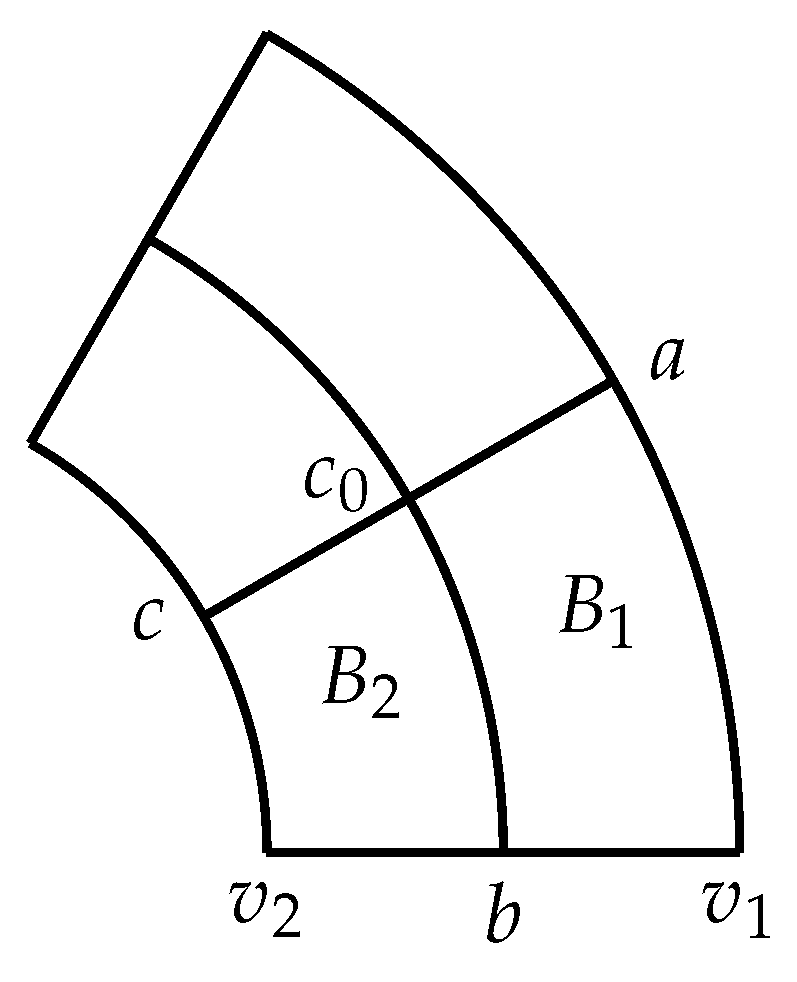
To show that , we only need to prove that there exists a vertex v of such that . It suffices to consider the case when . We divide B into four circular ring sectors, see Figure 1. By symmetry, we only need to consider the case when , where
Let
Clearly, . First, we show that when . It suffices to consider the case when . If , then ; if , then ; if , then ; if , then . Thus
Figure 1.
A circular ring sector is divided into four circular rings sectors.
For , if , then o, , x, and are vertices of a convex quadrilateral wuth and as diagonals. Therefore,
which implies . Using similar arguments as above, one can show that , , where . Since
we have .
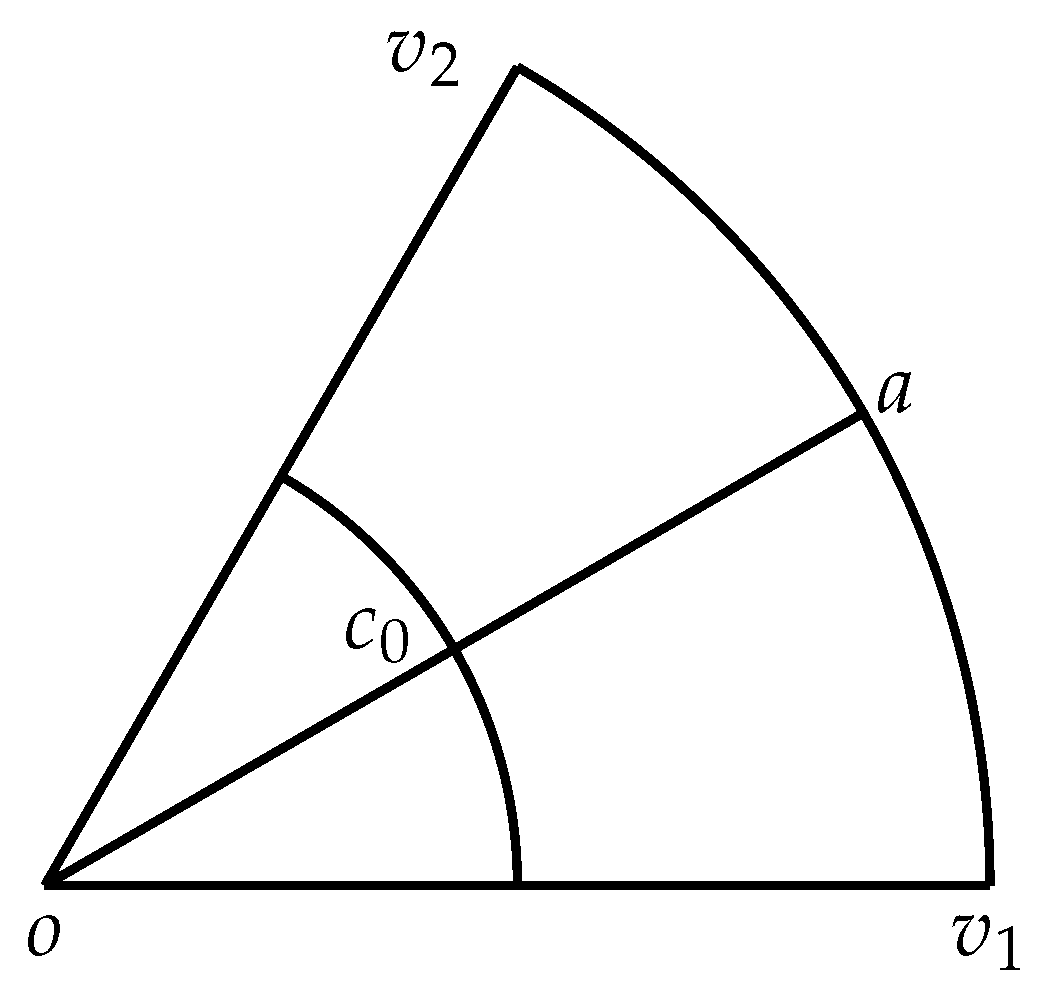
Case 2. x lies in a circular sector (see Figure 2). We only need to consider the case when . Set
Then,
Clearly, . It follows that . □
Figure 2.
A circular sector is divided into two circular sectors and two circular ring sectors.
By Lemma 13 in [24], we can choose D as . Let and . If is the optimal value of VPCP() obtained by our algorithm, then, by Theorem 3 and Equation (10), we have
where, for each ,
Computational results providing estimations of are summarized in Table 1. In Table 1, column 6 provides an interval which contains .
Table 1.
The estimation results of .
4.2. Covering Functionals of the Simplex
The convex hull of affinely independent vectors in is called an n-simplex, which is denoted by . Without loss of generality, let
where
We denote the i-th coordinate of x in by . Let x and c be two points in and . By Lemma 3 in [26], it can be proved that if and only if
Therefore, the dissimilarity between a demand point x and a candidate center c is defined as
For each , , and , where , set
Theorem 4.
For each and , we have
Proof.
We only need to prove that
Clearly,
Let and . Then,
For each , there exists such that . Let
and be the point in that corresponds to the maximum value for (11). Hence, . Moreover,
Otherwise, since , we have
and
Therefore, , a contradiction to the choice of k. Since, for each , , , and , we have
and
Hence, . Consequently, . □
Let be a set satisfying . By Lemma 3 in [26], it can be proved that there exists a set such that and . Then, there exists a p-optimal configuration of in . It follows that can be seen as since , where is a lower bound . Let , , and be the optimal value obtained by Algorithm 3 of VPCP(). By Theorem 4 and Equation (10),
Estimations of via our algorithm are summarized in Table 2.
Table 2.
Estimations of .
Remark 5.
Let and . It can be verified that
where . Consequently, if , then . Based on this fact, we can estimate covering functionals of n-simplices by adding a binary search to Algorithm 3. More precisely, we can obtain firstly an estimation of by Algorithm 3. Subsequently, update by and return to the previous step. This procedure ends when is less than a given positive number and an estimation of is obtained. Note that the scale of demand point set involved in the adjusted algorithm is smaller than the one in Algorithm 3.
4.3. Covering Functionals of the Regular Octahedron
Let
Thus, is a regular octahedron. For a demand point x and a candidate center c, the dissimilarity between x and c is defined as
For each , it is clear that
Example 1.
Let . Then,
In the following, we want to find the smallest positive number and satisfying
The problem can be transformed to the following optimization problem:
This problem is solved by Lingo 18.0 and the optimal value is . It shows that there exists no point such that . Therefore, we are not sure whether can be chosen as in the same way as simplices.
For and an upper bound of , we use as . Let and , where . By (10) and (13), we have
where is the optimal value obtained by Algorithm 3 of VPCP(). Estimations of are summarized in Table 3.
Table 3.
The estimation results of .
Remark 6.
Let , , and . We can prove that if , then
Put . It can be also verified that
where . Consequently, if , then . Similar to the situation of n-simplices, one can use this observation to reduce the computational complexity.
5. Conclusions
This paper transforms the problem of estimating covering functionals of convex bodies to a VPCP and presents an exact algorithm to obtain an approximate p-optimal configuration and calculate the corresponding covering functional. The theoretical accuracy of our algorithm is given by (10). When the cardinality of the candidate center set is large or the dimension is high, the large-scale VPCP is hard to solve. Future research could be conducted to find better methods to update the subset to reduce the number of iterations. In addition, our algorithm can also be optimized by combining with heuristic algorithms.
Our algorithm can be adjusted to estimate covering functionals of an arbitrary three-dimensional convex polytope. One just needs to measure the dissimilarity with the gauge function (or the Minkowski functional) of a suitable convex polytope containing the origin in its interior. To continue with Chuanming Zong’s program to attack Conjecture 1 in the three-dimensional situation, we need to choose a suitable , to construct an -net of consisting of convex polytopes, and to show that
In this sense, we are now closer to the complete solution of Conjecture 1 when .
Author Contributions
Conceptualization, S.W.; methodology, M.Y., Y.L. and S.W.; software, M.Y. and Y.L.; validation, S.W., C.H. and Y.Z.; writing—original draft preparation, M.Y.; writing—review and editing, S.W., C.H. and Y.L.; funding acquisition, S.W. and C.H. All authors have read and agreed to the published version of the manuscript.
Funding
This research was funded by the [National Natural Science Foundation of China] grant numbers [12071444, 12201581] and the [Fundamental Research Program of Shanxi Province of China] grant numbers [201901D111141, 20210302124657, 202103021223191].
Data Availability Statement
Data sharing not applicable to this article as no datasets were generated or analyzed during the current study.
Acknowledgments
We acknowledge Gurobi for providing a free-of-charge academic license for Gurobi version 9.1.2, which was used in the computations presented in this paper.
Conflicts of Interest
The authors declare no conflict of interest.
References
- Boltyanski, V.; Martini, H.; Soltan, P.S. Excursions into Combinatorial Geometry, Universitext; Springer: Berlin/Heidelberg, Germany, 1997. [Google Scholar]
- Martini, H.; Soltan, V. Combinatorial problems on the illumination of convex bodies. Aequationes Math. 1999, 57, 121–152. [Google Scholar] [CrossRef]
- Brass, P.; Moser, W.; Pach, J. Research Problems in Discrete Geometry; Springer: New York, NY, USA, 2005. [Google Scholar]
- Bezdek, K.; Khan, M.A. The geometry of homothetic covering and illumination. In Discrete Geometry and Symmetry; Springer: Cham, Switzerland, 2018; Volume 234, pp. 1–30. [Google Scholar]
- Levi, F.W. Überdeckung eines Eibereiches durch Parallelverschiebung seines offenen Kerns. Arch. Math. 1955, 6, 369–370. [Google Scholar] [CrossRef]
- Lassak, M. Solution of Hadwiger’s covering problem for centrally symmetric convex bodies in E3. J. Lond. Math. Soc. 1984, 30, 501–511. [Google Scholar] [CrossRef]
- Papadoperakis, I. An estimate for the problem of illumination of the boundary of a convex body in E3. Geom. Dedicata 1999, 75, 275–285. [Google Scholar] [CrossRef]
- Prymak, A.; Shepelska, V. On the Hadwiger covering problem in low dimensions. J. Geom. 2020, 111, 42. [Google Scholar] [CrossRef]
- Soltan, P.S. On the illumination of the boundary of a convex body from within. Mat. Sb. 1962, 99, 443–448. [Google Scholar]
- Zong, C. A quantitative program for Hadwiger’s covering conjecture. Sci. China Math. 2010, 53, 2551–2560. [Google Scholar] [CrossRef]
- He, C.; Martini, H.; Wu, S. On covering functionals of convex bodies. J. Math. Anal. Appl. 2016, 437, 1236–1256. [Google Scholar] [CrossRef]
- Li, X.; Meng, L.; Wu, S. Covering functionals of convex polytopes with few vertices. Arch. Math. 2022, 119, 135–146. [Google Scholar] [CrossRef]
- Wu, S.; Zhang, K.; He, C. Homothetic covering of convex hulls of compact convex sets. Contrib. Discret. Math. 2022, 17, 31–37. [Google Scholar]
- Hakimi, S.L. Optimum locations of switching centers and the absolute centers and medians of a graph. Oper. Res. 1964, 12, 450–459. [Google Scholar] [CrossRef]
- Kariv, O.; Hakimi, S.L. An algorithmic approach to network location problems I: The p-centers. SIAM J. Appl. Math. 1971, 37, 513–538. [Google Scholar] [CrossRef]
- Minieka, E. The m-center problem. SIAM Rev. 1970, 12, 138–139. [Google Scholar] [CrossRef]
- Daskin, M. Network and Discrete Location: Models, Algorithms, and Applications; Wiley: New York, NY, USA, 1995. [Google Scholar]
- Ilhan, T.; Pınar, M.C. An Efficient Exact Algorithm for the Vertex p-Center Problem. 2001. Available online: http://www.optimization-online.org/DB_HTML/2001/09/376.html (accessed on 15 April 2023).
- Al-khedhairi, A.; Salhi, S. Enhancements to two exact algorithms for solving the vertex p-center problem. J. Math. Modell. Algo. 1995, 4, 129–147. [Google Scholar] [CrossRef]
- Chen, R.; Handler, G.Y. Relaxation method for the solution of the minimax location-allocation problem in Euclidean space. Nav. Res. Logist. 1987, 34, 775–788. [Google Scholar] [CrossRef]
- Chen, D.; Chen, R. New relaxation-based algorithms for the optimal solution of the continuous and discrete p-center problems. Comput. Oper. Res. 2009, 36, 1646–1655. [Google Scholar] [CrossRef]
- Irawan, C.A.; Salhi, S.; Drezner, Z. Hybrid meta-heuristics with VNS and exact methods: Application to large unconditional and conditional vertex p-centre problems. J. Heurist 2015, 22, 507–537. [Google Scholar] [CrossRef]
- Contardo, C.; Iori, M.; Kramer, R. A scalable exact algorithm for the vertex p-center problem. Comput. Oper. Res. 2019, 103, 211–220. [Google Scholar] [CrossRef]
- He, C.; Lv, Y.; Martini, H.; Wu, S. A branch-and-bound approach for estimating covering functionals of convex bodies. J. Optim. Theory Appl. 2023, 196, 1036–1055. [Google Scholar] [CrossRef]
- Fejes Tóth, G. Thinnest covering of a circle by eight, nine, or ten congruent circles. In Combinatorial and Computational Geometry; Mathematical Sciences Research Institute Publications, Cambridge University Press: Cambridge, UK, 2005; Volume 52, pp. 361–376. [Google Scholar]
- Yu, M.; Gao, S.; He, C.; Wu, S. Estimations of covering functionals of simplices. Math. Inequalities Appl. 2023; preprint submitted. [Google Scholar]
- Lian, Y.; Zhang, Y. Covering the crosspolytope with its smaller homothetic copies. arXiv 2021, arXiv:2103.10004v2. [Google Scholar]
Disclaimer/Publisher’s Note: The statements, opinions and data contained in all publications are solely those of the individual author(s) and contributor(s) and not of MDPI and/or the editor(s). MDPI and/or the editor(s) disclaim responsibility for any injury to people or property resulting from any ideas, methods, instructions or products referred to in the content. |
© 2023 by the authors. Licensee MDPI, Basel, Switzerland. This article is an open access article distributed under the terms and conditions of the Creative Commons Attribution (CC BY) license (https://creativecommons.org/licenses/by/4.0/).