Abstract
Massive multiple-input and multiple-output (MIMO) networks with higher throughput rates, where a base station (BS) with a large-scale antenna array serves multiple users, have been widely employed in next-generation wireless communication test systems. Massive MIMO-enabled dense heterogeneous networks (HetNets) have also emerged as a promising architecture to increase the system spectrum efficiency and improve the system reliability. Massive MIMO-enabled HetNets have been successfully exploited in sustainable Internet of Thing networks (IoTs). In order to facilitate the testing and performance estimation of IoTs communication systems, this paper studies the achievable rate performance of massive MIMO and HetNets. Differing from the existing literature, we first consider an interference power model for massive MIMO-enabled HetNets. We next obtain an expression for the signal-to-interference-plus-noise ratio (SINR) by introducing an interference power. Furthermore, we derive a new closed-form lower bound expression for the achievable rate. The proposed closedform expression shows that the achievable rate is an explicit expression of the number of transmit antennas. In simulation results, the impact of the number of transmit antennas on the achievable rate performance is investigated.
MSC:
37M25
1. Introduction
Heterogeneous networks (HetNets), where small cells are deployed within a macrocell coverage area, have been widely applied to offload data traffic and reduce network power consumption [1,2]. To further improve performance, massive multiple-input and multiple-output (MIMO)-enabled dense HetNets have emerged as a promising architecture to increase the system spectrum efficiency and improve the system reliability for the next-generation wireless networks [3].
Research works on the achievable rate and resource allocation schemes in massive MIMO-enabled HetNets have been published [4,5,6,7,8,9,10,11]. For example, the authors of [4] analyzed the downlink performance of a cell-free massive MIMO system with finite-capacity fronthaul links between the centralized baseband units and the access point. In [5], the authors investigated the tradeoff between energy efficiency and spectral efficiency in massive MIMO-enabled heterogenous networks, where user association and power coordination are jointly considered. In [6], the authors discussed the joint use of user association and resource allocation to maximize the fairness network utility for massive MIMO-enabled HetNets with backhaul capacity constraints. The authors of [7] studied the joint design of user association and power allocation with load constraint and transmit power constraint for massive MIMO HetNets. The authors of [8] investigated the energy-efficient user-association problem in massive MIMO-enabled HetNets, and formulated the network logarithmic utility maximization problem. The authors in [9] considered the metaheuristic algorithms for the power allocation issue, and a series of state-of-the-art stochastic algorithms are compared with the benchmark algorithm at network scales. The authors in [10] derived the statistical properties of a cellular network equipping a cylindrical array by considering the link blockage and other network parameters. In [11], the authors stuided an optimal solution for energy-efficiency in the downlink operation in the industrial internet based on cell-free massive MIMO systems with distributed operations, and a theoretical analysis of energy efficiency was presented. Additionally, the authors in [12] investigated the per-tier outage probability of multiuser MIMO transmissions in HetNets with joint interference constraint, and derived the closed-form expression of outage probability of downlink multiuser MIMO transmissions. Most of the aforementioned literature neglected the interference power constraint when designing system models. However, to the best of our knoweledge, the interference power constraint has a significant impact on the performance of network system; this is because the harmful transmission of strong interference sources will result in a low achievable rate. This motivated us to derive the performance bound of the achievable rate in massive MIMO-enabled HetNets by establishing an interference power constraint.
In this paper, we first provide an interference power model for a massive MIMO-enabled HetNet. A new expression of lower bound for the achievable rate is also developed. By taking some algebraic manipulations, a closed-form of lower bound, which can be used to assess the achievable rate performance, is derived. The simulation results provide some insights into the effect of the interference power constraint on the massive MIMO-enabled HetNets.
2. System Model
We consider a two-tier downlink massive MIMO HetNet. This network consists of a macro BS (MBS) and multiple pico BSs (PBSs). There are K single-antenna user terminals (UTs) that are uniformly deployed at the same time and bandwidth. This assumption is reasonable from the perspectives of the size and portability of the receiving user. We denote the set of PBSs by and the set of all BSs by , where the index 0 is introduced to indicate the MBS. We define as the number of transmit antennas at the jth BS. Let be the maximum number of downlink data streams that BS j can transmit simultaneously. is denoted as the index for each UT, where is the set of UTs.
In our work, the channel vector is , where and represent the large-scale fading and small-scale fading from the jth BS to the kth UT, respectively. We assume that all channels are quasi-static fading channels. This means that is assumed to be constant over each resource block but change independently between different resource blocks. is modeled as a complex Gaussian random vector, and elements of are independent and identically distributed random variables (RV) with zero mean and unit variance.
The perfect CSI is supposed to be available at all BSs, and the MRT precoding is adopted. Therefore, the received signal of the kth UT associated with the jth BS can be expressed as
where is the transmit power from the jth BS, and denotes the transmit power at the MBS; denotes the downlink channel gain between the jth BS and the kth UT; denotes the MRT precoding beamforming vector; is the transmitted information symbol from BS j to UT k with and ; the noise term is the additive white Gaussian noise (AWGN) with zero-mean and unit variance.
Next, we introduce an interference power to avoid the transmission from harmful interference. In general, the interference power at all UTs inflicted by the jth BS must not exceed the maximal peak interference level . Therefore, we can obtain the transmit power at the jth BS, which is given as
where ; is the maximum transmit power at the jth BS. According to (1), the receive signal-to-interference-plus-noise ratio (SINR) of the downlink can be expressed as
where , with ; , and where , with .
3. Performance Bound
In this section, we will show a tight lower bound on the achievable rate and further derive the closed-form of the lower bound. First, the exact achievable rate for the kth UT associated with the jth BS can be written as . By utilizing Jensen’s inequality [13], the achievable rate can be lower-bounded as
where .
Obviously, we can obtain the closed-form expression of the proposed lower bound by deriving the expression of , as shown in Theorem 1.
Theorem 1.
A new closed-form of lower bound on the achievable rate can be expressed as , where
where
where is the digamma function; is the cardinality of the union of ; is the exponential integral function; , with ; , with ; is the number of distinct diagonal elements of ; are the distinct diagonal elements in decreasing order; is the multiplicity of ; is the th characteristic coefficient of [14].
Proof of Theorem 1.
In order to obtain the closed-form, we need to calculate the expectations for and separately.
Since is a complex Gaussian RV, we can learn the cumulative density function (CDF) of , which is given by
where is the cardinality of the union of . Therefore, denote the variables, respectively, in the summation calculation.
Furthermore, the probability density function (PDF) of can be expressed as
Inspired by [15], the PDF of is given by
Now, we will compute the CDF of U, which is expressed as
where is the CDF of . By taking the derivative of (10), we have
As a result, we can calculate as
where the first definite integrals of (12) can be simplified as (4.352) in [16]
The second definite integrals of (12) can be simplified as
Next, we focus on the expectation in (4). The expression of V can be written as a single summation, i.e., , where , and with . Thus, we have , where is the exponential distribution; . Therefore, the PDF of V is given by Theorem 2 in [17]
As such, we can obtain
where (a) is obtained by replacing x with ; (b) is obtained by using Equation (4.337) in [16].
4. Simulation Results
In this section, we present the performance and effectiveness of the massive MIMO HetNet system. We consider the number of PBSs as , the number of UTs as , and the maximum number of downlink data streams is , . Moreover, the large-scale fading between BSs and UT is modeled as [18] , where d is the distance between each BS and UT in kilometers; is a log-normal Gaussian distribution with standard deviation . The other parameters are shown in Table 1.
Table 1.
Simulation Parameters.
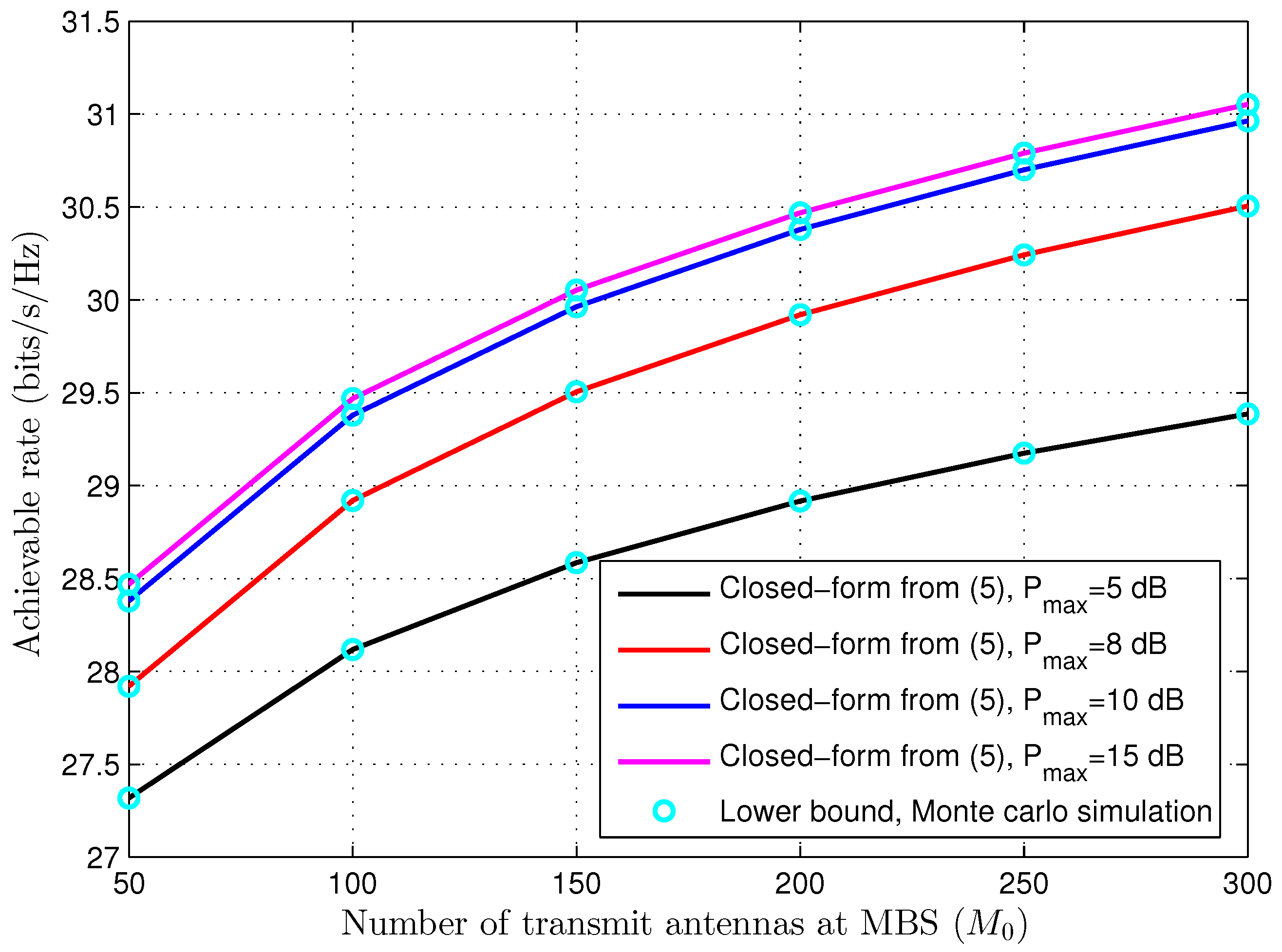
Figure 1 plots the achievable rate with different maximum transmit power versus the number of transmit antennas at MBS, where the closed-form curves of the lower bound on the achievable rate are obtained from (5), and the curves of the lower bound are simulated using the Monte Carlo (MC) method in (4). For a given , the achievable rate will increase with the number of transmit antennas at MBS. We can also observe from Figure 1 that the proposed closed-form expression of the lower bound is tight in terms of achievable rate. Additionally, for a fixed number of transmit antennas, the growth rate of the achievable rate becomes slower as the maximum transmit power continues to grow. This is because the numerator of the SINR expression in (3) has the interference power constraint. For example, when , the achievable rate with dB is about more than that with dB, is about more than that with dB, and is about more than that with dB.
Figure 1.
Achievable rate versus the number of transmit antennas at MBS.
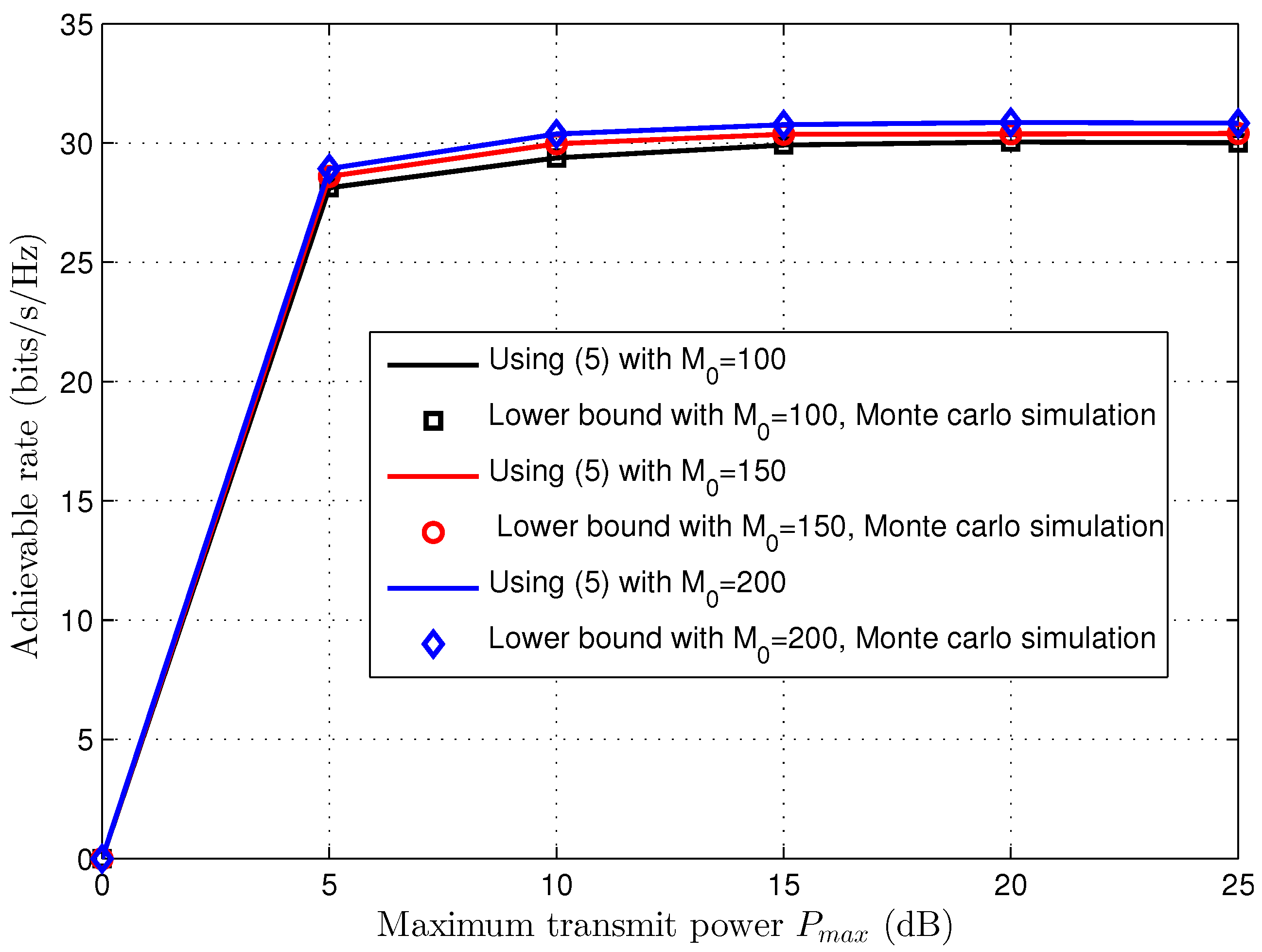
In Figure 2, the performance of achievable rate is simulated versus the maximum transmit power . As expected, the achievable rate first increases when increases. However, as the maximum transmit power continues to grow, the achievable rate will reach a certain level due to the interference power constraints. This result is consistent with the conclusion presented in Figure 1.
Figure 2.
Achievable rate versus the maximum transmit power.
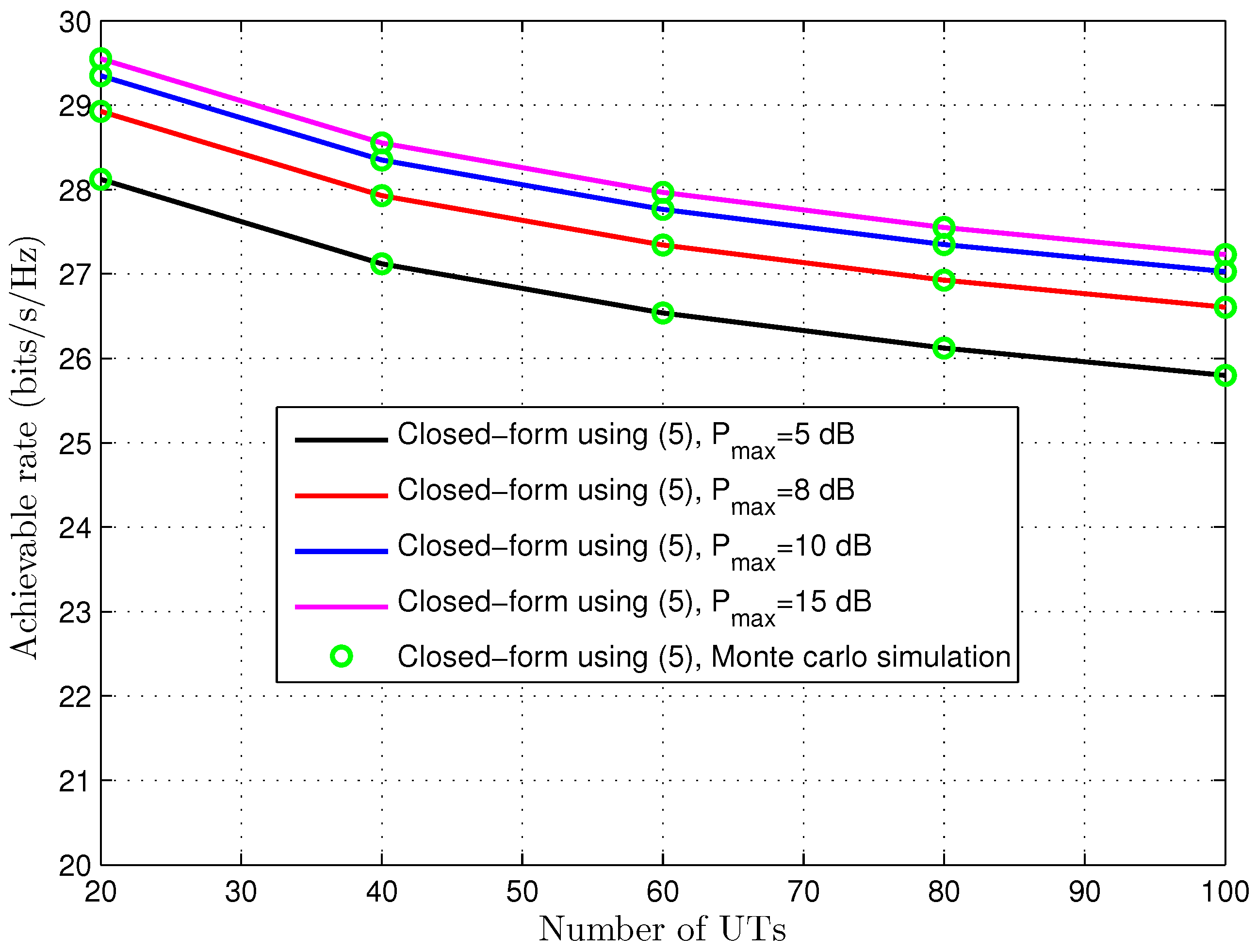
Figure 3 shows the achievable rate using (5) with versus the number of UTs, under the case of different maximum transmit power levels. We can see that the achievable rate will decrease with the number of UTs for a fixed transmit power. This is because all UTs are evenly distributed to different BSs, and we can further improve the achievable rate by studying user allocation schemes in future work [19,20]. Moreover, with the maximum transmit power increase, the achievable rate will increase for a fixed number of UTs. For example, when the number of UTs is 60, the achievable rate with dB is about more than that with dB, is about more than that with dB, and is about more than that with dB.
Figure 3.
Achievable rate versus the number of UTs.
5. Conclusions
In this paper, we studied the performance bound of the massive MIMO HetNets by introducing an interference power model. A new analytical expression of the lower bound on the achievable rate was derived in closed-form. The proposed closed-form expression shows that the achievable rate is an explicit expression of the number of transmits antennas. In the simulation results, the impacts of the number of transmit antennas on the achievable rate performance were investigated.
Author Contributions
Methodology, H.L.; software, G.L.; validation, J.C.; formal analysis, Z.W.; investigation, Z.W.; resources, H.W.; data curation, J.C.; writing—original draft preparation, H.L.; writing—review and editing, H.L.; visualization, H.W.; supervision, H.W.; project administration, Z.W.; funding acquisition, H.L. All authors have read and agreed to the published version of the manuscript.
Funding
This research was funded by China Postdoctoral Science Foundation grant number 2021M700707, and funded by Natural Science Foundation of Sichuan Province grant number 2022NSFSC0905.
Data Availability Statement
No new data were created.
Conflicts of Interest
The authors declare no conflict of interest.
References
- Zhang, H.; Chu, X.; Guo, W.; Wang, S. Coexistence of Wi-Fi and Heterogeneous Small Cell Networks Sharing Unlicensed Spectrum. Commun. Mag. IEEE 2015, 53, 158–164. [Google Scholar] [CrossRef]
- Zhang, H.; Jiang, C.; Cheng, J.; Leung, V. Cooperative Interference Mitigation and Handover Management for Heterogeneous Cloud Small Cell Networks. IEEE Wirel. Commun. 2015, 22, 92–99. [Google Scholar] [CrossRef]
- Li, B.; Dai, Y.; Dong, Z.; Panayirci, E.; Jiang, H. Energy-Efficient Resources Allocation with Millimeter-Wave Massive MIMO in Ultra Dense HetNets by SWIPT and CoMP. IEEE Trans. Wirel. Commun. 2021, 20, 4435–4451. [Google Scholar] [CrossRef]
- Parida, P.; Dhillon, H.S. Cell-Free Massive MIMO with Finite Fronthaul Capacity: A Stochastic Geometry Perspective. IEEE Trans. Wirel. Commun. 2022, 22, 1555–1572. [Google Scholar] [CrossRef]
- Hao, Y.; Ni, Q.; Li, H.; Hou, S. Energy and spectral efficiency tradeoff with user association and power coordination in massive MIMO enabled HetNets. IEEE Commun. Lett. 2016, 20, 2091–2094. [Google Scholar] [CrossRef]
- Ma, H.; Zhang, H.; Wang, X.; Cheng, J. Backhaul-Aware User Association and Resource Allocation for Massive MIMO-Enabled HetNets. IEEE Commun. Lett. 2017, 21, 2710–2713. [Google Scholar] [CrossRef]
- Lin, Y.; Wang, Y.; Li, C.; Huang, Y.; Yang, L. Joint Design of User Association and Power Allocation With Proportional Fairness in Massive MIMO HetNets. IEEE Access 2017, 5, 6560–6569. [Google Scholar] [CrossRef]
- Liu, D.; Wang, L.; Chen, Y.; Zhang, T.; Chai, K.K.; Elkashlan, M. Distributed energy efficient fair user association in massive MIMO enabled HetNets. IEEE Commun. Lett. 2015, 19, 1770–1773. [Google Scholar] [CrossRef]
- Sun, Q.; Wu, H.; Petrosian, O. Optimal Power Allocation Based on Metaheuristic Algorithms in Wireless Network. Mathematics 2022, 10, 3336. [Google Scholar] [CrossRef]
- Ayoubi, R.A.; Spagnolini, U. Performance of Dense Wireless Networks in 5G and beyond Using Stochastic Geometry. Mathematics 2022, 10, 1156. [Google Scholar] [CrossRef]
- Chen, X.; Zhao, T.; Sun, Q.; Hu, Q.; Xu, M. Cell-Free Massive MIMO with Energy-Efficient Downlink Operation in Industrial IoT. Mathematics 2022, 10, 1687. [Google Scholar] [CrossRef]
- Zhang, W.; Jiang, S. Performance Evaluation of MU-MIMO Transmissions with Joint Interference Constraint in HetNet. Math. Probl. Eng. 2021, 2021, 2397803. [Google Scholar] [CrossRef]
- Li, H.; Cheng, J.; Wang, Z.; Wang, H. Joint Antenna Selection and Power Allocation for an Energy-efficient Massive MIMO System. Wirel. Commun. Lett. IEEE 2019, 8, 257–260. [Google Scholar] [CrossRef]
- Shin, H.; Win, M.Z. MIMO diversity in the presence of double scattering. IEEE Trans. Inf. Theory 2008, 54, 2976–2996. [Google Scholar] [CrossRef]
- Da Costa, D.B.; Aïssa, S. Cooperative dual-hop relaying systems with beamforming over Nakagami-m fading channels. IEEE Trans. Wirel. Commun. 2009, 8, 3950–3954. [Google Scholar] [CrossRef]
- Gradshteyn, I.S.; Ryzhik, I.M. Table of Integrals, Series, and Products; Academic Press: Cambridge, MA, USA, 2014. [Google Scholar]
- Bletsas, A.; Shin, H.; Win, M.Z. Cooperative communications with outage-optimal opportunistic relaying. IEEE Trans. Wirel. Commun. 2007, 6, 3450–3460. [Google Scholar] [CrossRef]
- Van Chien, T.; Björnson, E.; Larsson, E.G. Joint Power Allocation and User Association Optimization for Massive MIMO Systems. IEEE Trans. Wirel. Commun. 2016, 15, 6384–6399. [Google Scholar] [CrossRef]
- Khawam, K.; Lahoud, S.; Helou, M.E.; Martin, S.; Feng, G. Coordinated Framework for Spectrum Allocation and User Association in 5G HetNets with mmWave. IEEE Trans. Mob. Comput. 2020, 21, 1226–1243. [Google Scholar] [CrossRef]
- Hamdi, R.; Said, A.B.; Erbad, A.; Mohamed, A.; Guizani, M. Hierarchical Federated Learning over HetNets enabled by Wireless Energy Transfer. In Proceedings of the IEEE Global Communications Conference (GLOBECOM), Madrid, Spain, 7–11 December 2021. [Google Scholar]
Disclaimer/Publisher’s Note: The statements, opinions and data contained in all publications are solely those of the individual author(s) and contributor(s) and not of MDPI and/or the editor(s). MDPI and/or the editor(s) disclaim responsibility for any injury to people or property resulting from any ideas, methods, instructions or products referred to in the content. |
© 2023 by the authors. Licensee MDPI, Basel, Switzerland. This article is an open access article distributed under the terms and conditions of the Creative Commons Attribution (CC BY) license (https://creativecommons.org/licenses/by/4.0/).