


Abstract
This paper deals with the alternative mathematical modeling of the two-side platform. Two-sided platforms are specific multi-sided platforms that bring together two distinct groups of a model. The stochastic modeling by adapting various innovative mathematical methods including the first exceed theory and the stochastic pseudo-game theory has been applied for describing a two-sided platform more properly. A stochastic pseudo-game model is newly introduced to solve the two-sided platform more effectively. Analytically tractable results for operation thresholds for maximizing profits are provided and it also delivers the optimal balance of a two-sided platform. The paper includes how these innovative models are applied into various two-sided market situations. Additionally, users could conduct these multi-sided models to real business developments and the case practices of these unique models shall help the readers who want to find recommendations of their business situations easily even without having any mathematical background.
Keywords:
two-sided platform; pseudo-game; stochastic model; fluctuation theory; nightclub; appstore; case teaching MSC:
60C55; 60K10; 90B15; 90B5
1. Introduction
Multi-sided platforms (or multi-side markets) are an important business phenomenon that has proliferated not only with classic business such as nightclubs and cable television but also with the rise of information technology and the Internet. Multi-sided markets bring together two or more distinct but business groups of customers [1,2,3,4]. Two-sided platforms are specific multi-sided platforms that bring together two distinct but interdependent groups of customers which are the consumed (i.e., the customer side) and the supplied customers (the supplier side). A two-sided platform has proliferated rapidly with the Internet and this has led to the development of new business models to monetize innovative value propositions not only in online but also offline markets [2,5,6,7]. Two different customer groups whose interactions are usually enabled over the platform. These two sides of the market represent the two primary sets of economic agents in the platform [8,9,10]. Both categories of economic agents have to be present on the platform in right proportions to create enough value to both sides and thereby accelerate and sustain the platform. In such market systems, participation from one side depends on the value created by presence of the other side over the platform [11,12]. Theoretical and mathematical approaches for the two-side platform models have been have widely studied by various contributors [13,14,15,16,17]. Additionally, the concept of the two-sided markets has been adapted for solving the specific situations [18,19,20,21,22,23]. Although there are several researches to use mathematical models to describe multi-sided platform, the stochastic modeling by adapting various innovative mathematical methods including the first exceed theory and the pseudo-stochastic game theory are never been studied before. This unique method enables to obtain analytically tractable solutions which determine the decision making factors including the moment of overflowing a platform capacity, one step prior to a platform overflow and optimum of a two-sided platform system.
This paper is constructed as follows: The stochastic pseudo-game model is newly introduced in Section 2. This section presents the stochastic models for two-sided markets. The original model has a limited resource and the open platform model, in the other hand, has an unlimited resource which indicates large enough to handle customers. The payoff function for the two-side platform has been constructed in Section 3. The visualization of a payoff function for a two-sided market is demonstrated in this section. Two practical application cases are introduced on Section 4. This section is written in a different style which is called case teaching materials which provide managerial questions to choose proper strategic decision. This section shall be even helpful for whom does not have a mathematical background to implement this two-sided model into their business domain. The conclusion of this paper is lastly provided on Section 5.
2. Stochastic Modelling for Two-Sided Platform
The innovative stochastic model has been adapted into the two-sided platform to analyze the behaviors of both sides. This analytical model consists of two sides (i.e., the customer and the supplier sides). This explicit function (Theorem–VTSP) gives the predicted moment of one step prior to hit the platform capacity by customers (simply called player A). The game theory framework makes complicated game types of problems simple to understand situations more clearly. Therefore, stochastic models with a game framework have been widely studied [24,25] and these models are applied for various areas including the blockchain [25,26,27] and the business strategy [28,29,30]. The recent game based stochastic model is adapted into the stock market exchanges [31]. A stochastic pseudo-game is not a stochastic game model but only adapts the stochastic game framework. The stochastic model in this research is a stochastic pseudo-game because this model does not describe a game type of situation but adapts the stochastic game framework for designing the two-sided platform more effectively because a stochastic pseudo-game makes the two-sided platform model solvable by using the mathematically proven processes from various research [24,32,33,34].
2.1. Stochastic Pseudo-Game
The antagonistic two-person pseudo-game (called “A” and “B”) describes the behavior of a two-sided platform between a customer (player A) and supplier (player B) sides. Both input flows to fill the capacity of the platform from either from a customer or a supplier sides. Let (, , be probability space be independent -subalgebras. The processes represent the customer flow of player A (a customer side) and the number of suppliers of player B (a supplier side) . Player A checks the number of customer input at times and sustain respective customers formalized by the process as follows:
and the number of suppliers to player B is similarly described by the process as follows:
The numbers of supplier input at each epoch are with respective suppliers for player B are . Both processes are -measurable marked Poisson processes ( is a point mass at w) with respective intensities and which are related with the input behaviors of both sides in the two-sided platform. Basically, player B counts the number of suppliers (or contents) to cover the customers in the platform. The processes and are specified by their transforms
The two-sided platform is monitored at random times in accordance with the point processin the two-side platform:
which is assumed to be delayed renewal process. If
then
forms an observation process upon embedded over with respective increments
and
The observation process could be formalized as
where
and it is with position dependent marking and with and being dependent with the notation
and
The setup of these processes from (1)–(4) are commonly used on various studies and the multi-variate processes from (5)–(8) have been conventionally used for antagonistic stochastic modeling and these processes haven been fully used confirmed from the various research [24,32,33,34]. It is noted the two-dimensional process (9) is not a simple process because each player contains the combination of several processes. For player A, the process from (3) is a Poisson counting process with the continuous time parameter s; the process from (1) is a compound Poisson process which counts the values when the process is increased at the moment of ; the process from (9) is a compound Poisson process which counts the values at the moment of when the process is monitored by the observation process from (4). By using the double expectation,
and
where
are the magical transform of increments . The stochastic process describes the status of the two-sided platform which has a connection between both sides and the supplier side is usually a dominant side. The attraction factor is newly proposed which indicates the power of the dominant side to seduce the customers in the submissive side. Since we consider a supplier side is dominant which impacts on the input of customers, the customer input rate becomes the function based on the given number of suppliers b and it could be assigned as follows:
where and is the ratio between a supplier and a customer sides and this ratio is called the attraction factor which depends on the status of the dominant side. This value is typically greater than 1 (i.e., ). The stochastic process is completed when on the k-th observation epoch , the collateral customers to player A exceeds the capacity of the platform M. To further formalize the game, the exit index is introduced:
Since the platform shall be terminated at the time the number of customers may reach the capacity of the platform M. We shall be targeting the confined game in the view point of player A. The first passage time is the associated exit time from the confined game and the formula (7) will be modified as
which the path of the game from , which gives an exact definition of the model observed until The joint functional of the two-sided platform is as follows:
where M indicates the platform capacity. This functional shall represent the status of the two-sided platform upon the exit time . The latter is of particular interest, we are interested in not only the prediction of the moment of full but also one observation prior to this. The Theorem–VTSP: establishes an explicit formula from (12)–(14). The -operator and its inverse operator from the first exceed model [35,36] have been adapted as follows:
then
where is a sequence, with the inverse
Theorem–VTSP: The functional of the process of (20) satisfies following expression:
Proof.
We find the explicit formula of the joint function . The joint functional (20) of player A is as following:
and, applying the operator to random family , we arrive at
and, from the previous research [24,26,27,28],
where
and
Adding up yields 1 due to [24,25] and summing constructs:
Finally, we have
□
From (20) and (40), we can find the PGFs (probability generating functions) of and the exit index:
The mean for the number of customers in the platform could be found from (40), (42) and (43):
where
and
where, from (33)–(38),
2.2. Open Two-Sided Platform Model
This innovative two-sided platform model could have several variants. One of variants is the two-sided platform has an unlimited capacity. Practically speaking, it is not possible that a real system has unlimited capacity or resource of the platform. Unlike the original stochastic two-sided platform model, the capacity of an open two-sided platform is relatively a large number and both sides are not interrelated. Recalling from (1)–(15), the initial setup of the open model is the same as the previous section. The open two-sided platform means that the capacity of the platform is almost unlimited and the joint functional of the two-sided platform becomes:
Since the customer flow in a two-sided platform is given by the supplier flow from (16), the joint functional is modified only for the customer side to represent the open two-sided platform as follows:
which is given by the flows from the supplier side. From (42)–(44), the PGFs (Probability Generating Functions) of , are as follows:
where
and the exit index of the customer side is:
( is assumed as the fixed value ). It is noted that all index values and are almost the same (i.e., ) when the resource of the supplier is almost unlimited (i.e., and ). The mean number of customers in the two-sided platform could be found as follows:
where, from (16) and (57),
From (57) and (59), we have
and
Although the open platform model is relatively simple and easy to be analytically solvable, the open case is very practical for some specific cases. The practical real-world case for the open two-sided platform shall be provided on Section 4.2.
2.3. Memoryless Two-Sided Platform
It is assumed that the observation process has the memoryless properties which might be a special condition but very practical for actual implementation for analyzing the two-sided platform. It implies that the flow of suppliers does not contain any past information of the supplier side. We can find explicit solutions of and to build a proper payoff function for the optimization. Recall from (21), the -operator for single variable is defined as follows:
then
where are a sequence, with the inverse (101) and
and
The -operator is defined on the space of all analytic functions at 0 and this operator satisfies:
and the formulas (12)–(15) and (65) could be rewritten as follows:
and
from (33)–(38),
The function is the PGF (Probability Generating Function) of the number of suppliers at the prior moment of exceeding more than the platform capacity M. The probability distribution of could be found from (45) after obtaining the PGF from (43):
where
3. Stochastic Optimizations for Two-Sided Platform
The optimization practice in a two-sided platform is provided in this section. The best strategy for maximizing the payoff is determined by an attraction factor. Additionally, the optimization practice for an open two-sided platform is also introduced in this section because there are some special characteristics of this open platform.
3.1. Two-Sided Platform Payoff Function Design
The input ratio between two sides is a vital factor for a cost related function which includes the cost, the revenue and the payoff functions. The payoff function (i.e., a revenue function or a profit function) could be constructed based on the attraction factor that indicates the customer coverage (i.e., the submissive side) by the supplier side (i.e., the dominant side). Practically, a typical range of the attraction factor is up to 10 (i.e., [1,10]) although it could reach up to the infinity (). The optimal value of towards to maximize the payoff function of the two-sided platform and the payoff function is:
and the best value could be found as follows:
where is the unit sales price from the customer side and is the unit cost price based on the suppliers. If and , the platform earns the money from both sides. If and , the platform spend the money from both sides. Although a payoff function could be constructed based on the attract factor in this section, other variables besides of the attraction factor could also construct payoff functions in different perspectives.
3.2. Two-Sided Platform Optimization Setup and Visualization
The several parameters shall be determined after constructing the payoff function (101) and the details of the setup for the payoff function are required to make an optimization problem solvable. Some of factors such as a platform capacity M and an attraction factor are fixed and some of them are calculated (i.e., ). The summary of all required parameter sets is shown in Table 1.

Table 1.
The parameters for Two-sided platform Setup.
The payoff function from (101) could be computationally implemented after all required parameters which are explained on Table 1 and these parameters are determined by actual data gathering. The practical real-world case (i.e., nightclub) shall be introduced on the next section. Although the payoff function in this section is constructed based on the attraction factor and the platform capacity, the payoff function could be designed in a different way.
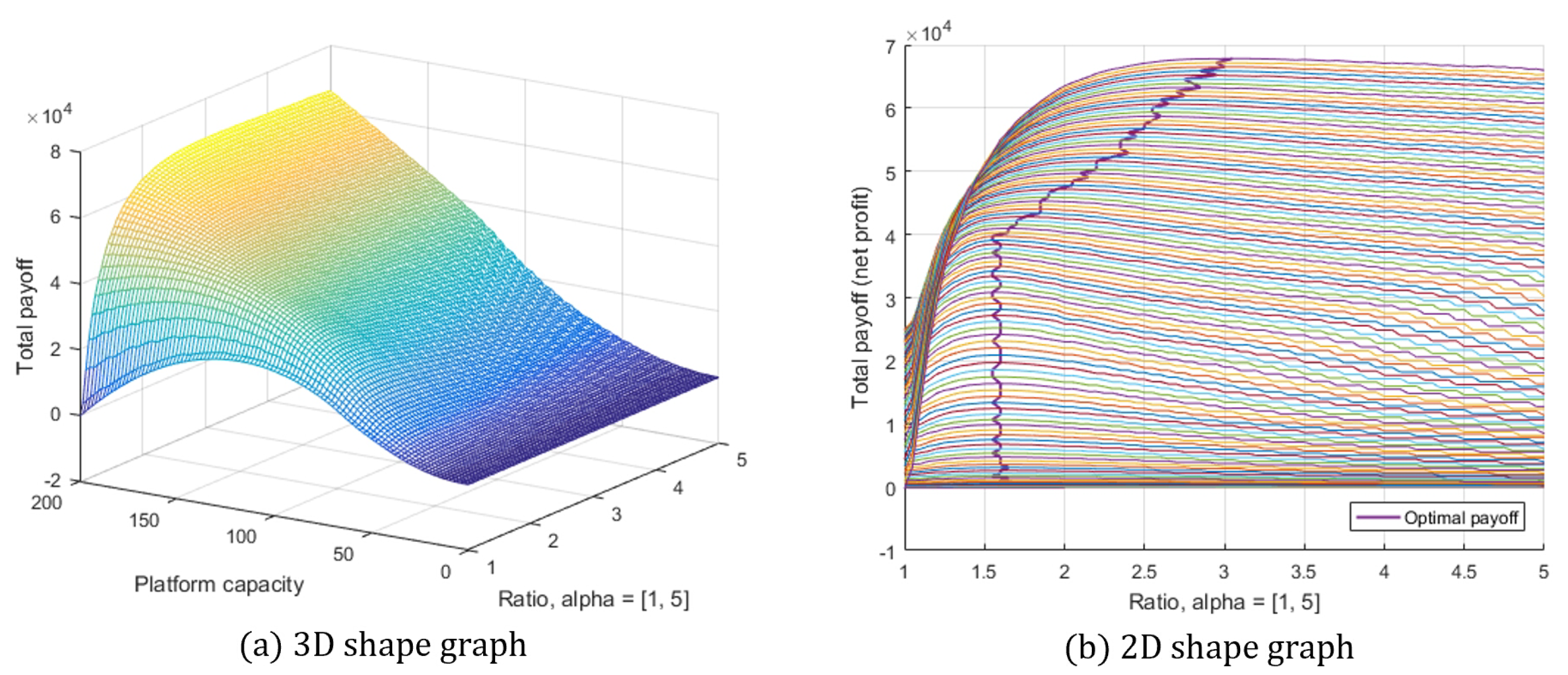
The visualization of the payoff function for a two-sided platform model is shown in Figure 1. The payoff (i.e., reward) function from (101) is a two-variable function which could be maximized based on two variables which are the attraction factor (i.e., the ratio between a supplier and a customer sides) and the platform capacity. It is noted that a two-variable function such as a payoff function of a two-sided platform could be visualized either as a 3D shape (a) or a 2D shape (b) in Figure 1. A proper shape depends on the visualization objectives of a payoff function.
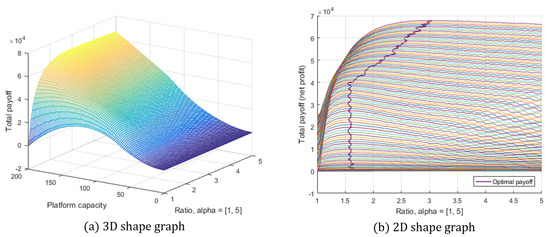
Figure 1.
Visualizations of two-sided platform optimizations.
3.3. Properties of Open Two-Sided Platforms
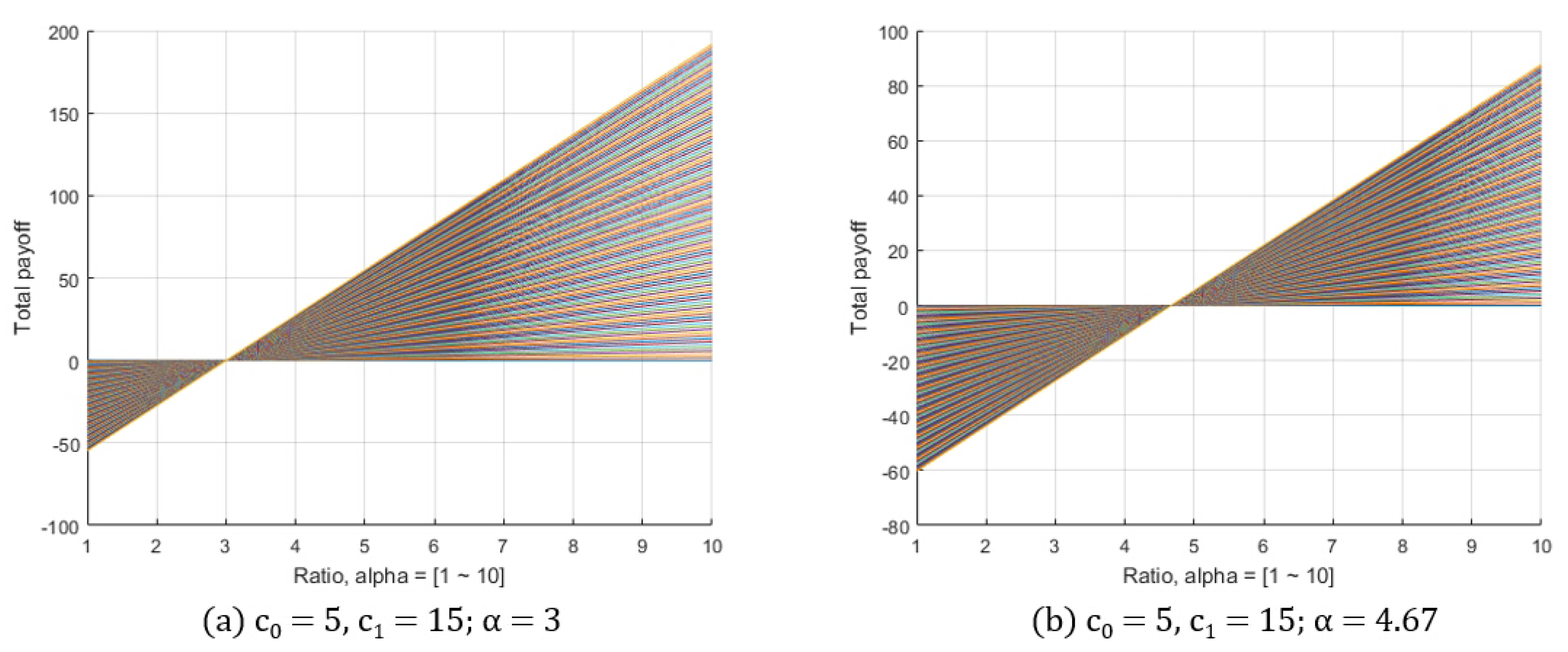
As it has been mentioned on Section 2, an open two-sided platform is the two-sided platform (almost) without the limitation of the capacity. From (101) the payoff function is revised as follows:
where
Due to unlimited capacity, more suppliers attract more customers and more profits. It indicates that there are no turning points of the payoff function but the attract factor should be greater than a certain value to start making the profit of the two-sided platform. Hence, the optimized attraction factor of an open two-sided platform could be terminated as follows:
From (104) and (105), we have
which indicates that the platform starts making benefits when the attraction factor is greater than . It is noted that the moment of making benefits depends on the cost ratio between the cost and the reward (i.e., ).
One of interesting properties of an open two-sided platform is that an attraction factor only depends on the ratio between the cost/reward between two sides (see Figure 2). Additionally, there is no optimal value for maximizing profits because the resources for operating a two-sided platform are unlimited. In other words, the cost for operating the open platform is (almost) zero.
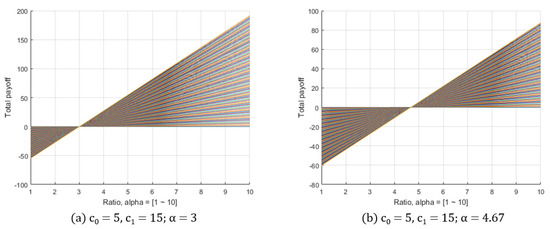
Figure 2.
Open two-sided platform optimization examples.
4. Applications Cases
In this section, two practical business cases are introduced which are classic and old situations of a two-sided platform model. Each subsection describes a specific situation and a versatile two-sided platform provides strategic recommendations to make proper decisions. First case is operating a nightclub which is a classic two-sided market: the supplier side is women and customer side is men because women are attracted by men and gather more men to come in a nightclub. Hence, nightclubs even recruit beautiful women to get more customers to come. The other case is constructing an application store (e.g., Google Play, App Store (Apple) Microsoft Apps) which mainly handles huge number of subscribers (i.e., customer side) and developers (i.e., supplier side). This case is suitable for an open two-sided platform because both sides are handling relatively large number of customers and suppliers. The open two-sided platform model is also applicable for OTT (Over-The-Top) services (e.g., Netflex, Amazon Prime, Disney+ and so on) because of the same reason. Unlike other parts of the paper, this section is written as a case method material for MBA students rather than a typical article style. Hence, the readers who only have business background without any mathematical background could even understand the situations and their recommendations more easily.
4.1. Khaos Nightclub
The Khaos (This nightclub is not real but the real one has been referenced to make this case more realistic (https://manilaclubbing.com/page/2/, accessed on 31 August 2022)) was one of most famous nightclubs in Manila which was capable up to 2000 people at once. Before grand opening, Mr. Bean who is a CEO of the Khaos, decided to do the soft launch for 1 month. The club charges 100 USD (5600 PHP) as an entrance fee and give the free for ladies with one free beverage which is equivalent with 1 USD (50 PHP). The guard of the club started monitoring 4 h before opening the club and checking every hour during the club operations. The Khaos found the following information during 1 month: Around 40 men are waiting on the queue before starting the club. And 8 men and 6 women had entered the club after opening the club (see Table 2). Additionally, average number of occupation of each monitoring time is full (2000 clubers) and 70 percent in the club is men.
Table 2.
Initial conditions of the Khaos nightclub.
After 1 month later, the Khaos needs to make proper strategies for better operations of the club. Hence, there are couple of managerial questions to be answered before the grand opening:
- Based on the data during the soft launch (see Table 1 for details), the club is operating good enough for the grand opening?
- How many ladies should be needed to maximize the profit with same number of clubers (2000 clubers)?
- What will be the proper managerial actions to improve the operation of the nightclub?
- The information (or data) for this nightclub case is reliable enough for making proper decision?
Regarding first question, we could get the current ratio between customers and suppliers (i.e., attraction factor) from the available data (Table 1). From (104), the attraction factor of the current status is as follows:
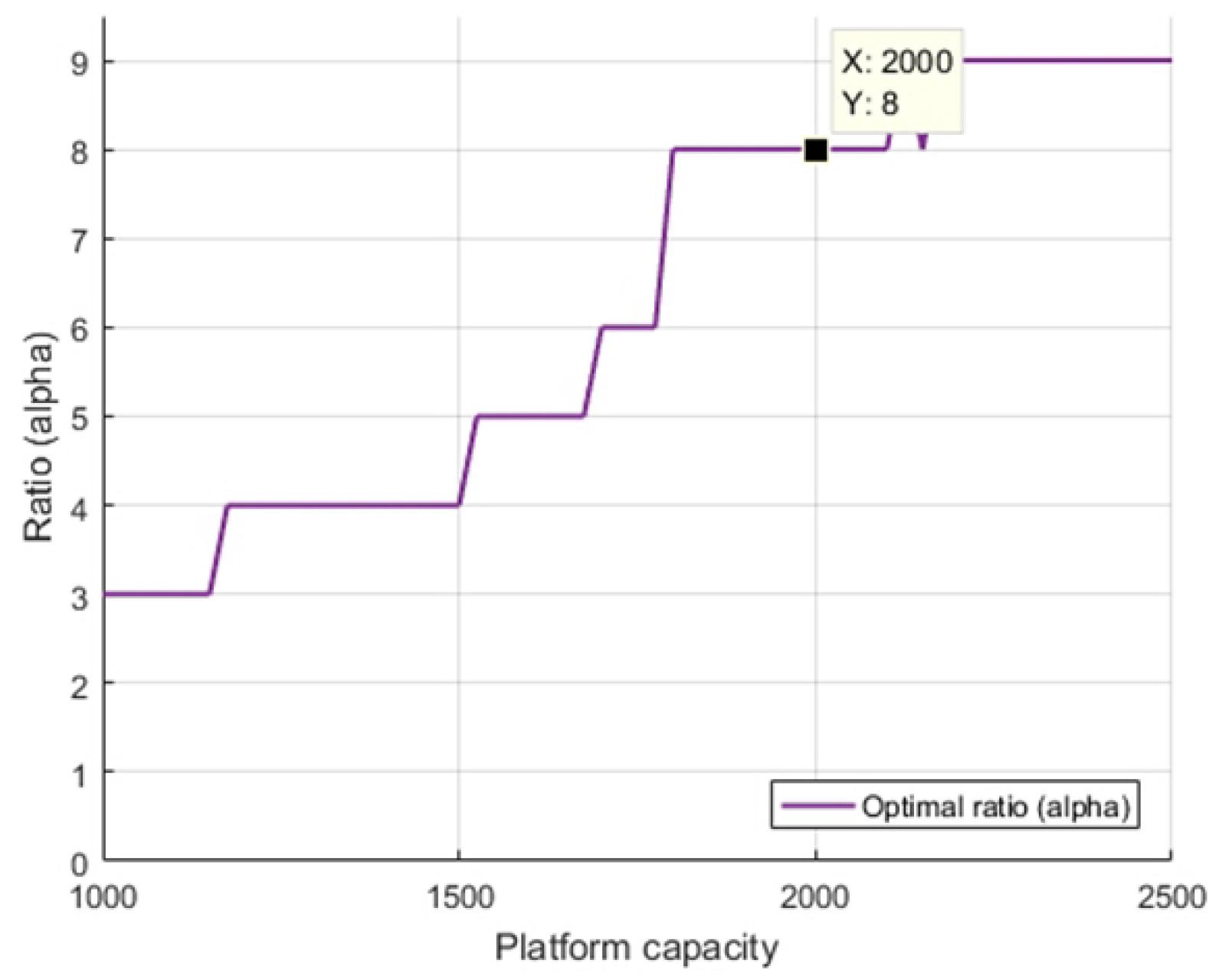
In the other hand, the optimal attraction factor could be found from (101) and (102) with but it requires massive calculations. Hence, a numerical approach by coding is more suitable than an analytical approach. The result of a numerical approach for the Khaos nightclub is shown in Figure 3.
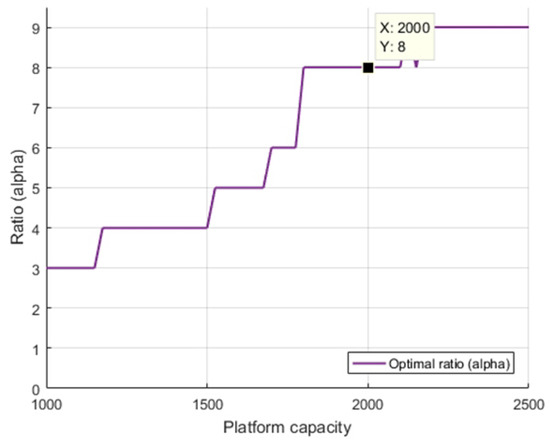
Figure 3.
The attraction factor relation with the club capacity.
As illustrated on Figure 3, the optimal attraction factor is when the number of people in the club is 2000 (i.e., ) during the soft launch. Compare to (107), the operation of the nightclub is not efficient enough to maximize the profit. Based on the information from Table 1 (and description of the Khaos nightclub in this section), we could find the proper number of ladies to optimize the profit as follows:
where x is the number of required women who are supplied by the club and the optimal value becomes 222 (ladies) after doing simple algebra. In the managerial point of view, the Khaos should maintain around 222 ladies instead of 570 girls during the soft launch (i.e., 11 percent of 2000 clubers as an average). There are several ways to achieve the target (222 women from 570 women) as managerial actions. One of actions could be making more solid screening for girls at the gate. It is noted that all analysis in this section is valuable only if the data that gathered from the nightclub is reliable. The last managerial question shall remain unanswered for the readers to find answers themselves.
4.2. Omnia AppStore
The Omnia AppStore has been considered for the Android platform and the company who wants to launch the application store has gathered the data from the famous application store (The famous store is the Google Play of which the related data are publicly available from the following websites: https://buildfire.com/app-statistics/; https://42matters.com/google-play-statistics-and-trends; https://www.businessofapps.com/data/app-statistics/; https://www.appbrain.com/stats/android-app-downloads, accessed on 31 August 2022) and extract the information as seen in Table 3.
Table 3.
Initial conditions of the Omnia Appstore.
The Omnia AppStore want to make the threshold to ban applications on the Omnia AppStore if applications are not popular. The managerial issue of the Omnia as follows:
- What is a proper threshold for optimizing this application store?
This issue is about the attraction factor for an open two-sided platform. Hence, we can easily find the proper attraction factor from (106) and the ratio between downloders and developers (i.e., uploaders) is as follows:
which indicates that the attraction factor should be more than 5.63 to keep applications on the Omnia AppStore.
5. Conclusions
The new types of stochastic two-sided platform models are studied. A stochastic pseudo-game model is newly introduced to solve the two-sided platform more effectively. The players in a pseudo-game are the customer and the supplier sides of a two-sided market and a joint functional of the standard stopping game was designed to determine to analyze operation parameters which indicates the best strategies of a two-sided platform under a hybrid stochastic game framework which has been widely adapted in various applications [28,31,37]. The analytical approach enables to obtain analytically tractable solutions which determine the decision making factors including the moment of overflowing a platform capacity, one step prior to a platform overflow and optimum of a two-sided platform system. This unique method by applying the stochastic pseudo-game into the most practical cases was fully described as case method materials for teaching even in business and management classes. Furthermore, each application case provides key managerial questions to be faced by managers who could adapt the models even without mathematical knowledge. Variations of the versatile stochastic two-sided platform models are currently working as future research topics.
Funding
This research received no external funding.
Institutional Review Board Statement
Not applicable.
Informed Consent Statement
Not applicable.
Data Availability Statement
There are no available data to be stated.
Acknowledgments
Special thanks to the reviewers who provides valuable advice to improve this paper.
Conflicts of Interest
The author declares no conflict of interest.
References
- Muzellec, L.; Ronteau, S.; Lambkin, M. Two-sided Internet platforms: A business model lifecycle perspective. Ind. Mark. Manag. 2015, 45, 139–150. [Google Scholar] [CrossRef]
- Eisenmann, T.; Parker, G.; Van Alstyne, M.W. Strategies for two-sided markets. Harv. Bus. Rev. 2006, 84, 92–101. [Google Scholar]
- Osterwalder, A.; Pigneur, Y.; Smith, A. Business Model Generation; Wiley & Sons: Hoboken, NJ, USA, 2010; p. 288. [Google Scholar]
- Hagiu, A. Strategic Decisions for Multi-sided Platforms. MIT Sloan Manag. Rev. 2014, 55, 4–13. [Google Scholar]
- Evans, D.S.; Schmalensee, R.; Noel, M.D.; Chang, H.H.; Garcia-Swartz, D.D. Platform Economics: Essays on Multi-Sided Businesses. 2011. Available online: https://ssrn.com/abstract=1974020 (accessed on 31 August 2022).
- Rochet, J.-C.; Tirole, J. Platform Competition in Two-Sided Markets. J. Eur. Econ. ASSN 2003, 1, 990–1029. [Google Scholar] [CrossRef]
- Trabucchi, D.; Buganza, T. Landlords with no lands: A systematic literature review on hybrid multi-sided platforms and platform thinking. Eur. J. Innov. Manag. 2022, 25, 64–96. [Google Scholar] [CrossRef]
- Evans, D.S. Some empirical aspects of multi-sided platform industries. Rev. Netw. Econ. 2003, 2, 19. [Google Scholar] [CrossRef]
- Parker, G.G.; Van Alstyne, M.W. Two-sided network effects: A theory of information product design. Manag. Sci. 2005, 51, 1494–1504. [Google Scholar] [CrossRef]
- Rysman, M. The economics of two-sided markets. J. Econ. Perspect. 2009, 23, 125–143. [Google Scholar] [CrossRef]
- Jocevski, M.; Ghezzi, A.; Arvidsson, N. Exploring the growth challenge of mobile payment platforms: A business model perspective. Electron. Commer. Res. Appl. 2020, 40, 100908. [Google Scholar] [CrossRef]
- Staykova, K.S.; Damsgaard, J. The race to dominate the mobile payments platform: Entry and expansion strategies. Electron. Commer. Res. Appl. 2015, 14, 319–330. [Google Scholar] [CrossRef]
- Gawer, A. Platforms, Markets and Innovation; Edward Elgar Publishing: Cheltenham, UK, 2009. [Google Scholar]
- Sinha, K.; Colombo, E.F.; Shougarian, N.R.; de Weck, O.L. A Simplified Mathematical Model for Two-Sided Market Systems With an Intervening Engineered Platform. In Proceedings of the 41st Design Automation Conference, Boston, MA, USA, 2–5 August 2015. [Google Scholar]
- Kirpalani, R.; Philippon, T. Data Sharing and Market Power with Two-Sided Platforms; National Bureau of Economic Research Working Paper Series; National Bureau of Economic Research: Cambridge, MA, USA, 2020; p. 28023. [Google Scholar]
- Choi, J.P.; Jeon, D.-S. Two-Sided Platforms and Biases in Technology Adoption; CESifo Working Paper; Munich Society for the Promotion of Economic Research: Munich, Germany, 2020; p. 8559. [Google Scholar]
- Armstrong, M. Competition in Two-Sided Markets. RAND J. Econ. 2006, 37, 668–691. [Google Scholar] [CrossRef]
- Gale, D.; Lloyd, S.S. College admissions and the stability of marriage. Am. Math. Mon. 1962, 69, 9–15. [Google Scholar] [CrossRef]
- Gusfield, D. Three fast algorithms for four problems in stable marriage. SIAM J. Comput. 1987, 16, 111–128. [Google Scholar] [CrossRef]
- Kelso, A.S., Jr.; Crawford, V.P. Job matching, coalition formation, and gross substitutes. Econom. J. Econom. Soc. 1982, 50, 1483–1504. [Google Scholar] [CrossRef]
- Irving, R.W.; Leather, P. The complexity of counting stable marriages. SIAM J. Comput. 1986, 15, 655–667. [Google Scholar] [CrossRef]
- Xu, J. A Two-Sided Market Model of Optimal Price Structure for Instant Messenger. J. Appl. Math. 2013, 2013, 768168. [Google Scholar] [CrossRef]
- Kojima, F. School choice: Impossibilities for affirmative action. Games Econ. Behav. 2012, 75, 685–693. [Google Scholar] [CrossRef]
- Dshalalow, J.H.; Ke, H.-J. Layers of noncooperative games. Nonlinear Anal. 2009, 71, e283–e291. [Google Scholar] [CrossRef]
- Kim, S.-K. Blockchain Governance Game. Comp. Indust. Eng. 2019, 136, 373–380. [Google Scholar] [CrossRef]
- Kim, S.-K. Strategic Alliance for Blockchain Governance Game. Probab. Eng. Inf. Sci. 2022, 36, 184–200. [Google Scholar] [CrossRef]
- Kim, S.-K. Enhanced IoV Security Network by Using Blockchain Governance Game. Mathematics 2021, 9, 109. [Google Scholar] [CrossRef]
- Kim, S.-K. A Versatile Stochastic Duel Game. Mathematics 2020, 8, 678. [Google Scholar] [CrossRef]
- Kim, S.-K. Antagonistic One-To-N Stochastic Duel Game. Mathematics 2020, 8, 1114. [Google Scholar] [CrossRef]
- Kim, S.-K. Robust Pairwise n-Person Stochastic Duel Game. Mathematics 2021, 9, 825. [Google Scholar] [CrossRef]
- Kim, S.-K. Shifted Brownian Fluctuation Game. Mathematics 2022, 10, 1735. [Google Scholar] [CrossRef]
- Dshalalow, J.H.; Ke, H.-J. Multilayers in a modulated stochastic game. J. Math. Anal. Appl. 2009, 353, 553–565. [Google Scholar] [CrossRef]
- White, R.T.; Dshalalow, J.H. On Reliability of Stochastic Networks. Neural Parallel Sci. Comp. 2013, 21, 141–160. [Google Scholar]
- White, R.T.; Dshalalow, J.H. Characterizations of random walks on random lattices and their ramifications. Stoch. Anal. Appl. 2020, 38, 307–342. [Google Scholar] [CrossRef]
- Dshalalow, J.H. First excess levels of vector processes. J. Appl. Math. Stoch. Anal. 1994, 7, 457–464. [Google Scholar] [CrossRef][Green Version]
- Dshalalow, J.H. First excess level process. In Advances in Queueing; CRC Press: Boca Raton, FL, USA, 1995; pp. 244–261. [Google Scholar]
- Kim, S.-K. Advanced Mathematical Business Strategy Formulation Design. Mathematics 2020, 8, 1642. [Google Scholar] [CrossRef]
Disclaimer/Publisher’s Note: The statements, opinions and data contained in all publications are solely those of the individual author(s) and contributor(s) and not of MDPI and/or the editor(s). MDPI and/or the editor(s) disclaim responsibility for any injury to people or property resulting from any ideas, methods, instructions or products referred to in the content. |
© 2022 by the author. Licensee MDPI, Basel, Switzerland. This article is an open access article distributed under the terms and conditions of the Creative Commons Attribution (CC BY) license (https://creativecommons.org/licenses/by/4.0/).