Abstract
Equiform geometry is considered an extension of other geometries. Furthermore, an equiform frame is a generalization of the Frenet frame. In this study, we begin by defining the term “equiform parameter (EQP)”, “equiform frame”, and “equiform formulas (EQF)” in regard to the Minkowski three-space. Second, we define spacelike normal curves (SPN) in Minkowski three-space and present a variety of descriptions of these curves with equiform spacelike (EQS) or equiform timelike (EQN) principal normals in Minkowski three-space. Third, we discuss the implications of these findings. Finally, an example is given to illustrate our theoretical results.
Keywords:
Minkowski three-space; equiform frame; equiform equations; equiform curvatures; equiform normal curves MSC:
53A35; 53C50
1. Introduction
Numerous mathematicians, including [1,2,3,4], have designed and analyzed curves in Minkowski space during the past 20 years. It is well known that an arc-length-parameterized differentiable curve in Minkowski three-space has orthonormal Frenet frames which are the tangent (), principal normal (), and binormal vectors (), respectively. Moreover, the Minkowski three-space has three distinct planes that are the rectifying plane (), the osculating plane (), and the normal plane (), respectively, [5]. The term “normal curve” refers to a unit-speed curve in space, whose position vector always resides in its normal plane, in other words, if can be written as for some differentiable functions f and g of s in . The definition of a normal curve suffices [6,7] for a few descriptions of timelike, spacelike, and null normal curves that occupy the Minkowski 3-space.
The equiform frame is more useful and general than the Frenet frame. The equiform geometry of space curves and surfaces has been the subject of a significant amount of attention and investigation from a large number of mathematicians. This is due to the fact that it is thought that equiform geometry is an extension of other geometries. This is because of the significant amount of attention that it has garnered in the area of mathematics. As a consequence of this, a significant number of studies have been carried out on the equiform geometry in many spaces [8,9,10]. The authors in [11] defined the equiform differential geometry of curves in G4-space.
This paper aims to study the normal curves with regard to the equiform frame and describe the EQS normal curves with principal normals that are also EQS or EQT. The article is structured as follows: In Section 2, we provide context for the topic by introducing the Frenet frame and Frenet equations along a spacelike unit-speed curve in Minkowski three-space. In Section 3, for spacelike curves with either a spacelike or a timelike principal normal vector in Minkowski space , we provide the EQP as well as the EQF for EQS curves in Minkowski space . In Section 4, we describe some EQS normal curves with principal normals that are also EQS or EQT.
2. Preliminaries
The Lorentz–Minkowski space is the Euclidean three-space with the metric determined by
such that the coordinate system for is . It is said that a vector v in is spacelike if or , timelike if , and null (lightlike) if and . For instance, a nonlightlike vector v’s norm may be calculated using the formula . The vector v is referred to as a unit vector if . If , two vectors are said to be orthogonal. Any has the Lorentzian vector product of u and v described in [2,6,7,12] by
If all of the velocity vectors on an arbitrary curve in are timelike, spacelike, or null (lightlike), the curve is said to be timelike, spacelike, or null (lightlike). The non-null curve is said to be unit speed, if . The tangent, principal normal, and binormal vectors are labeled as , , and , respectively. The moving Frenet frame along the curve is denoted by , and . Frenet’s formulas depend on the curve’s causal character. The following Frenet formulas are provided in [2,3,6] for an arbitrary curve in the space .
The Frenet equations in the case where is a spacelike curve with a spacelike or a timelike principal normal are defined by
such that and
The Frenet equations in the case where is a spacelike curve with a null (lightlike) principal normal are given by
such that , and .
The only two potential values for in this situation are . In all other cases and whenever is a straight line, . If is parameterized by s, then
The pseudo-Riemannian cone, pseudo-Riemannian lightlike sphere, and pseudo-Riemannian hyperbolic space are each provided, respectively, as
such that is a constant and m is a fixed point in [6,7].
3. EQF for EQS Curves in
In this section, we first introduce the equiform geometry in Minkowski space . Next, we present the EQF in the case of EQS curves.
Definition 1
([8,9,10]). Let be a unit-speed curve in Minkowski space. The EQP of is defined by
such that the radius of the curvature of the curve .
Then, we obtain
Let us write the equiform frame for the curve in terms of the equiform invariant parameter in the space. The vector
is known as the curve’s equiform tangent vector. From Equation (3), we get
The equiform principal normal vector and the equiform binormal vector are defined by
Then, we quickly demonstrate that each of , and is not an orthonormal frame of the curve but rather an equiform invariant orthogonal frame.
(I) Using Equations (1), (3), and (4), if has a principal normal that is either EQS or EQT, then
Similarly,
Definition 2
([8,9,10]). The curve’s first equiform curvature of ϱ is described by , which is defined by
Definition 3
([8,9,10]). The curve’s second equiform curvature of ϱ is described by the function , which is defined by
The total curvature, the EQP for closed curves, is crucial to the global differential geometry of Euclidean space. Additionally, is a canonical curvature that has a fascinating geometric meaning. By definitions (1) and (2), the EQF in case (I) become
such that and
Corollary 1.
If is an EQS curve and is either an EQS or EQT principal normal, then the equiform curvatures are provided, respectively, by
(II) If is an equiform null principal normal and is an EQS, there are only two possible values for in this situation: when is a straight line and in all other circumstances. The uniform parameter is not specified when is a straight line. Consequently, if is not a straight line, , and will apply. Hence, the EQF for nonstraight line curves are identical to Equation (2). Accordingly, the research results in [6] hold when the space is uniform, and the principal normal curve is uniformly null.
4. Main Results
The concept of an equiform normal curve (EQN) in Minkowski space is presented in this section, along with certain characterization theorems for EQS normal curves in . Along this section, we assume that is an EQS curve and is either an EQS or EQT principal normal in .
Definition 4.
If the position vector always resides on the equiform normal plane spanned by , then we say that the curve is an equiform normal curve (EQN) in Minkowski three-space.
Theorem 1.
If and , ∀, and is an EQN, the following outcomes are therefore satisfied:
(i) The equiform curvatures and have the following relation:
(ii) The equiform binormal with the position vector of the curve and the component of the equiform principal normal are each provided by
(iii) If the position vector of is a lightlike vector, then ϱ is located on , and and satisfy
On the other hand, if has equiform curvatures , , ∀ and one of the requirements (i), (ii), or (iii) is satisfied, then ϱ is either an EQN or congruent to one.
Proof.
Assume is an EQN in . Then,
With the use of (6) and by differentiation in the light of , we get
We get the following from the first and second relation of (7):
Thus,
Furthermore, we get the following equation from the third relation of (9) and using (8):
The equality is thus satisfied by the equiform curvatures.
Thus, we have established (i). Next, by substituting (13) into (11), we get
Therefore, we can simply see that from (14).
As a result, we have established (ii).
Now, consider that has an equiform null (lightlike) position vector and is a spacelike normal curve. Then, is obtained. When we substitute (15), we get
When we substitute into (13), we get
Thus,
Contrarily, let us take a look at the vector
By differentiating this with respect to and using the related EQF (8) with Equation (12), then it follows: and hence constant. Therefore,
This indicates that is located on . As a result, we have established (iii).
Conversely, suppose that statement (i) is satisfied. Therefore, the equiform curvatures satisfy the equality
Next, we have
By using EQF (8), we obtain
As a result, is congruent with an EQN.
Let us assume (ii) is satisfied. After that,
By differentiating the equation in light of we have
Therefore,
which indicates that and that is an EQN.
Let us suppose that statement (iii) is satisfied. Consequently, is located on the lightlike cone , whose vertex is at m, m is constant, and whose equiform curvatures and satisfy . This implies that
Using Equation (8) and a three-time differentiation of the above equation in light of , we have
Consequently,
This indicates that curve is congruent to an EQN up to a translation for vector m. Set , the proof is therefore complete since was quickly discovered using . □
Theorem 2.
Assume that with equiform curvatures , , ∀, with a non-null equiform principal normal and with a non-null position vector. Then, (i) The position vector ϱ must be an EQS vector in order for the curve ϱ to be on and satisfy
(ii) The position vector ϱ must be an EQT vector in order for the curve ϱ to be on and satisfy
Proof.
First, let us assume that , . When we substitute Equation (13), we get
Thus
When we change (13) for (19), we get
Take a look at the vector m,
Using the related (8), we differentiate this in light of and and therefore m is constant. Then,
Then, is on , which has m as its center and as its radius.
On the other hand, suppose (18) is true and that lies on . Consequently, , . Using the EQF and differentiating this in light of three times, we have
Consequently, up to a vector m translation, a normal curve with an equal slope, , is congruent. Specifically, let us set . Therefore, (18) yields . Statement (i) is proved.
(ii) is similar to (i). □
5. An Example
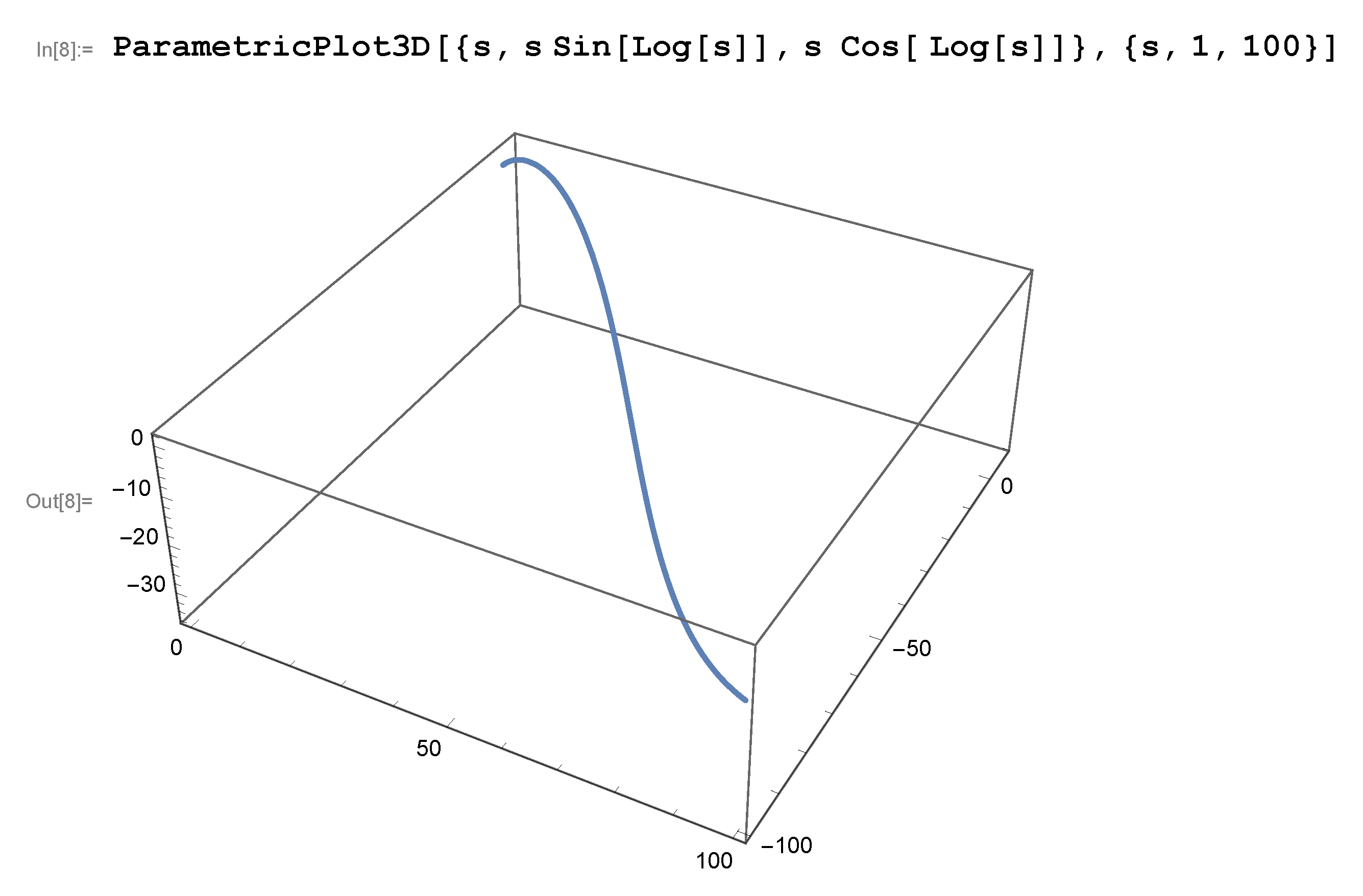
Let be a unit-speed spacelike curve with a spacelike normal vector in as in Figure 1.
Figure 1.
An EQS curve with an EQS normal satisfying the results.
The Frenet frame of the curve is given by:
Thus, the first and the second curvatures are, respectively, given by
Therefore, the equiform parameter is given by
Furthermore, the first and the second equiform curvatures are, respectively, given by:
Further,
Here, the equiform frame of is given by:
Since and , is an EQS with an EQS principal normal . Furthermore, . Therefore, is an EQS normal curve with an EQS normal vector .
By finding , we obtain:
Hence, Equation (13) is satisfied.
Moreover,
Thus, Equations (16) and (17) are satisfied.
Thus, Equation (18) is satisfied and therefore, all results in Theorem 1 are satisfied.
6. Conclusions
In this paper, we defined the “equiform parameter (EQP)”, “equiform frame” and “equiform formulas (EQF)” in Minkowski three-space. Further, we defined spacelike normal curves (SPN) in Minkowski three-space and presented a variety of descriptions of these curves with equiform spacelike (EQS) or equiform timelike (EQN) principal normals in Minkowski three-space. Furthermore, we gave some characterizations of these curves in Minkowski three-space.
Author Contributions
Conceptualization, Y.T., W.E., C.C., M.M.A.E.-R. and A.E.; Data curation, C.C., M.M.A.E.-R. and A.E.; Formal analysis, Y.T., W.E. and A.E.; Investigation, Y.T., W.E. and A.E.; Methodology, C.C., M.M.A.E.-R. and A.E. All authors have read and agreed to the published version of the manuscript.
Funding
This work was supported by Researchers Supporting Project (number RSP2022R488), King Saud University, Riyadh, Saudi Arabia.
Data Availability Statement
Not applicable.
Conflicts of Interest
The authors declare no conflict of interest.
References
- Ucum, A.; Nesovic, E.; Ilarslan, K. On generalized timelike Mannheim curves in Minkowski space-time. J. Dyn. Syst. Geom. Theor. 2015, 13, 71–94. [Google Scholar]
- Grbovic, M.; Ilarslan, K.; Nesovic, E. On null pseudo null Mannheim curves in Minkowski 3-space. J. Geom. 2014, 105, 177–183. [Google Scholar] [CrossRef]
- Kiziltug, S.; Yayli, Y. Bertrand Curves of AW(k)-type in the Equiform Geometry of the Galilean Space. Abstr. Appl. Anal. 2014, 2014, 1–6. [Google Scholar] [CrossRef][Green Version]
- Walrave, J. Curves and Surfaces in Minkowski Space. Doctoral Thesis, K. U. Leuven, Faculty of Science, Leuven, Belgium, 1995. [Google Scholar]
- ONeill, B. Semi-Riemannian Geometry with Applications to Relativity; Academic Press: New York, NY, USA, 1983. [Google Scholar]
- Ilarslan, K. Spacelike Normal Curves in Minkowski Space. Turkish J. Math. 2005, 29, 53–63. [Google Scholar]
- Ilarslan, K.; Nesovic, E. Timelike and null normal curves in Minkowski space. Indian J. Pure Appl. Math. 2004, 35, 881–888. [Google Scholar]
- Elsayied, H.K.; Elzawy, M.; Elsharkawy, A. Equiform spacelike normal curves according to equiform-Bishop frame in E13. Math. Meth. Appl. Sci. 2018, 41, 5754–5760. [Google Scholar] [CrossRef]
- Elsayied, H.K.; Elzawy, M.; Elsharkawy, A. Equiform timelike normal curves in Minkowski spac E13. Far East J. Math. Sci. 2017, 101, 1619–1629. [Google Scholar]
- Elsharkawy, A. Generalized involute and evolute curves of equiform spacelike curves with a timelike equiform principal normal in E13. J. Egypt. Math. Soc. 2020, 28, 1–10. [Google Scholar] [CrossRef]
- Aydın, M.; Ergüt, M. The equiform differential geometry of curves in 4-dimensional Galilean space G4. Stud. Univ. Babeș-Bolyai Math. 2013, 58, 399–406. [Google Scholar]
- Ozturk, U.; Ozturk, E.B.K.; Ilarslan, K. On the involute-Evolute of the Pseudonull Curve in Minkowski 3-Space. J. Appl. Math. 2013, 2013, 1–6. [Google Scholar] [CrossRef]
Publisher’s Note: MDPI stays neutral with regard to jurisdictional claims in published maps and institutional affiliations. |
© 2022 by the authors. Licensee MDPI, Basel, Switzerland. This article is an open access article distributed under the terms and conditions of the Creative Commons Attribution (CC BY) license (https://creativecommons.org/licenses/by/4.0/).