


Abstract
We consider a fully pseudo-bosonic Swanson model and we show how its Hamiltonian H can be diagonalized. We also deduce the eigensystem of , using the general framework and results deduced in the context of pseudo-bosons. We also construct, using different approaches, the bi-coherent states for the model, study some of their properties, and compare the various constructions.
MSC:
46N50; 81R30
1. Introduction
In the standard literature on quantum mechanics, one of the main axioms of any well-established approach to the analysis of the microscopic world is that the observables of a physical system, , are represented by self-adjoint operators. This is, in particular, what is required by the Hamiltonian of . For a few decades, however, it has become more evident that this is only a sufficient condition to require, but it is not also necessary. This (apparently) simple remark is on the basis of thousands of papers, and many monographs. Here, we only cite some of the latter [1,2,3,4,5], where many other references can be found.
The use of non-self-adjoint Hamiltonians opens several lines of research, both for its possible implications in physics, and mathematical issues raised by this extension. In particular, in a series of papers and the book [6,7], a particular class of non-self-adjoint Hamiltonians has been analyzed in detail, together with their connections with a special class of coherent states. These Hamiltonians are constructed in terms of pseudo-bosonic operators, which are, essentially, suitable deformations of the bosonic creation and annihilation operators. These deformations are again ladder operators, and this is why we were (and still are) interested in finding the eigenstates of these new annihilation operators. Several examples have been constructed over the years, by us and by other authors [8,9,10,11,12,13]. In particular, one Hamiltonian that has become very famous in the literature on -quantum mechanics is related to what is now called the Swanson model [13,14,15]. The Hamiltonian for this model is , where and where . Of course, since c and are unbounded, the above expressions for and are simply formal. To make them rigorous, we should add, in particular, details on their domains of definitions. A more mathematical approach to , closer to what is relevant for us here, can be found in [6,7,15]. In particular, we have shown that can be rewritten in a diagonal form in terms of pseudo-bosonic operators, and this has been used to analyze in detail its spectrum and its eigenvectors. In particular, we have shown that the set of these eigenvectors is complete in , but it is not a basis. There are many papers devoted to the Swanson model, in various expressions. Other papers on this model include the following: [16,17,18,19,20].
In this paper, we focus on a particular version of a fully pseudo-bosonic extension of , i.e., on a version in which the pair of bosonic operators are replaced, from the very beginning, by operators satisfying certain properties, see Section 2. Moreover, to simplify the general treatment, and without any particular loss of generality, we choose . Notice that, while this choice trivializes the original model, in the sense that , it does not change the lack of self-adjointness of the Hamiltonian H we introduce later, see (20).
The paper is organized as follows: after a review of pseudo-bosons, in Section 2, we propose our fully pseudo-bosonic Swanson model, and we find the eigenvalues and the eigenvectors of the Hamiltonian of the system, and its adjoint. We prove that the sets of these eigenvectors are complete and bi-orthonormal in , while they are not bases. This will be presented in Section 3. Section 4 focuses on bi-coherent states and their properties. Section 5 presents our conclusions, and plans for the future.
2. Preliminaries
This section is devoted to some preliminary definitions and results on pseudo-bosons (PBs). This will be needed in the following sections, where the modified Swanson Hamiltonian will be introduced and analyzed.
Let a and b be two operators on , with domains and , respectively, and their adjoints, and let be a dense subspace of , stable under the action of a, b and their adjoints. It is clear that and , where , and that for all . Then both and are well-defined, .
Definition 1.
The operators are -pseudo-bosonic (-pb) if, for all , we have
Sometimes, to simplify the notation, rather than (1), one writes . It is not surprising that neither a nor b are bounded by . This is why the role of is so relevant (here and in the rest of these notes).
Our working assumptions for dealing with these operators are as follows:
- Assumption -pb 1.—there exists a non-zero , such that .
- Assumption -pb 2.—there exists a non-zero , such that .
Notice that, if , then these two assumptions collapse into a single one and (1) becomes the well-known canonical commutation relation (CCR), for which the existence of a vacuum belongs to an invariant set (, for instance) and is guaranteed. Then, for CCR, Assumptions -pb 1 and -pb 2 are automatically true.
In [7], the authors widely discussed the possibility that can be extended outside . This gives rise, as we briefly comment later in Section 2, to the so-called weak PBs (WPBs), in which a central role is no longer played by , but by other functional spaces.
In the present situation, the stability of under the actions of b and implies that, in particular, and that . Here, is the domain of all the powers of the operator X. Hence,
, are well-defined vectors in and, therefore, they belong to the domains of , and , where and is the adjoint of N. We introduce next the sets and .
It is now simple to deduce the followinglowering andraising relations:
as well as the eigenvalue equations and , , where, more explicitly, . Incidentally, we observe that this last equality should be understood, here and in the following, on : , .
As a consequence of these equations, choosing the normalization of and in such a way , it is easy to show that
for all . Therefore, the conclusion is that and are bi-orthonormal sets of eigenstates of N and , respectively. Notice that these latter operators, which are manifestly non-self-adjoint if and have both non-negative integer eigenvalues; thus, they are called number-like (or simply number) operators. The properties we deduced for and , in principle, do not allow us to conclude that they are (Riesz) bases (or not for ). This is not always the case, Ref. [7], even if sometimes (for regular PBs, see below), this is exactly what happens. With this in mind, let us introduce the following assumption:
- Assumption -pb 3.— is a basis for .
This is equivalent to assuming that is a basis as well [21,22]. While Assumption -pb 3, is not always satisfied, in most of the concrete situations considered so far in the literature, it is true that and are total in . For this reason, it is more reasonable to replace Assumption -pb 3 with this weaker version:
- Assumption -pbw 3.— and are -quasi bases, for some subspace dense (Notice that does not need to coincide with , even if sometimes this happens.) in .
This means that , the following identities hold
It is obvious that, while Assumption -pb 3 implies (5), the reverse is false. However, if and satisfy (5), we still have some (weak) form ofresolution of the identity, and, from a physical and mathematical point of view, this is enough to deduce interesting results. For instance, if is orthogonal to all the ’s (or to all the ’s), then f is necessarily zero: and are total in . Indeed, using (5) with , we find since (or ) for all n. However, since , then .
For completeness we briefly discuss the role of two intertwining operators which are intrinsically related to our -PBs. We only consider the regular case here. More details can be found in [6].
In the regular case, Assumption -pb 3 holds in a strong form: and are bi-orthonormal Riesz bases, so that we have
- . Looking at these expansions, it is natural to ask if sums, such as or also make some sense, or for which vectors they do converge, if any. In our case, since and are Riesz bases, we know that an orthonormal basis exists, together with a bounded operator R with bounded inverse, such that and , . It is clear that, if , all these sums collapse and converge to f. However, what if ?
The first result follows from the bi-orthonormality of and , which easily implies that
for all . These equalities, which are true for biorthogonal bases non necessarily of the Riesz type, together imply that and , for all . These formulas, in principle, cannot be extended to all of except when and are bounded. If this is the case, then we deduce that
In other words, both and are invertible and one is the inverse of the other. This is what happens, in particular, for regular -PBs. In this situation, it is possible to relate and with the operator R connecting with and : let , which for the moment we do not assume to be coincident with . Then
where we have used the facts that is an orthonormal basis and that R is bounded and, therefore, continuous. Of course is bounded as well and the above equality can be extended to all of . Therefore we conclude that . In a similar way we can deduce that , which is also bounded. Using the C*-property for , we deduce that and . It is also clear that and are positive operators, and it is interesting to check that they satisfy the following intertwining relations:
Indeed we have, recalling that and , , as well as . The second equality in (9) follows from the first one, simply by left-multiplying with , and using (7). These relations are not surprising, since intertwining relations can be often established between operators having the same eigenvalues.
The situation is mathematically much more complicated for -PBs which are not regular. This is mainly because there is no reason for and to be bounded, or for the series and (which are those used to define these operators) to be convergent, at least on some dense set. We refer to [6,7] for more results on this and other aspects of PBs. It is also useful to stress that these operators are connected to what, mostly in the physical literature, are called the metric operators, often appearing in connection with -symmetric Hamiltonians, [4,23,24].
Leaving
Moreover, in view of what will be discussed later in this paper, we are interested now in considering first order differential operators of the form
for some suitable functions and , [25], where we have shown that these operators produce, using the strategy outlined before, two families of functions, and , which may, or may not, be square-integrable. More results on this particular class of PBs are also given in [7,26,27].
We first compute on some sufficiently regular function , not necessarily in . For what we need, it is sufficient to assume to be at least . Of course, this requirement could be relaxed if we interpret as the weak derivative, but this will not be done here. An easy computation shows that, under this mild condition on , does make sense, and if and , , satisfy the equalities
In particular, the first equality is always true if and are both constant, as it will be the case for our model, see (27). In general, it is convenient to assume that they are never zero: , , .
Under this assumption, it is easy to find the vacua of a and of , as required in Assumptions -pb1 and -pb2. Here
The vacua of a and are the solutions of the equations and , which are easily found:
and are well-defined under our assumptions on and . Here and are normalization constants which will be fixed later. If we now introduce and as in (2),
, we can prove, Ref. [25], the following:
Proposition 1.
Calling we have
, where and are defined recursively as follows:
and
.
In particular, if and , both non zero, we have
Here is the n-th Hermite polynomial, and the square root of the complex quantities are taken to be their principal determinations. The proof of (19) is also contained in [25].
The functions in (13), for and , turn out to be
where and , in view of the second equation in (11), are only required to satisfy the condition . Then we find that , for all [25]. The proof is based on the fact that is the product of a polynomial of degree times the following exponential
where is an integration constant (which is usually fixed to zero). Notice that this is a Gaussian term whenever . In this case, therefore, it is possible to compute the integral of , and this integral is what, with a little abuse of language, we call the scalar product between and . We refer to [25] for more results and details concerning the biorthogonality (in this extended sense) of and , both in the case of constant , , and when and are non-trivial functions of x. Moreover, in [25] it is discussed the validity of Assumption -pbw 3, as well as a possible way to introduce the weak bi-coherent states for the operators in (10). What is discussed in [25] is relevant, in particular, when or are not in . However, as we see in the next section, this is not the case here. For this reason we end here our review on WPBs, suggesting the reading of [7,25,27] for more details, and we move to the explicit model we want to discuss in this paper.
3. The Model
The Hamiltonian we are interested in here is
in which a and b satisfy (1), for some suitable , dense in , which we identify later. Here and are positive real parameters such that . As we have discussed in the Introduction, H is a particular version of the Swanson Hamiltonian, [14], , where and , in which the bosonic operators are replaced by their pseudo-bosonic counterparts, , and where coincides with . It is clear that both and H are manifestly non-self-adjoint, (the latter if ). H is not self-adjoint as far as , as will be the case here. The operator H can be diagonalized by means of a simple transformation. Let us introduce a new pair of operators as follows:
Then are pseudo-bosonic operators, at least formally (at this stage), meaning with this that they also satisfy, as a and b, the commutation rule . we see later how to make this commutator rigorous, according to our preliminary discussion in Section 2. Now, if we fix , H can be rewritten as
where and . Now, to be more concrete, we assume that a and b are shifted PBs, i.e.,
where , , and where and are the usual bosonic operators, densely defined on . In fact, and both contain , the set of the Schwartz functions. This implies that a and b in (23) are densely defined, too. Moreover, this is also true for operators A and B in (21), which can be rewritten as follows:
where we introduced the following quantities:
and
It is clear then that A and B are of the form in (10), with
so that the equalities in (11) are both satisfied. From (24) we have
since and are all real. Hence,
In particular, this last equality shows that if and only if , which is surely true if , see (26). However, this would imply also that , which is not interesting for us since we would go back to ordinary bosonic operators.
The vacua of A and are the following
with and normalization constants still to be fixed. Since , which is always positive, we conclude that . We also observe that coincides with , by replacing with . Using Proposition 1 and (19), we deduce that
and
where
Incidentally, we observe that the argument of the Hermite polynomials can be rewritten as , and that, extending what was already found for the vacua, coincides with replacing with , also for . It is clear that , for all so that, in agreement with what we have seen in Section 2, , for all . Restricting to real values of and , and taking
we deduce that the sets and are bi-orthonormal:
In the following we choose
With this choice, returns , replacing with . The norm of these functions can be easily deduced by adopting to the present case similar computations as those given, for instance, in [6], and which will not be repeated here. In particular, we find
where is a Laguerre polynomial. It is clear that can be deduced from (36) by replacing with .
We see that the argument of is strictly negative, for all , so that we can use the following asymptotic (in n) formula [28],
which is true if . Then, since , a standard argument shows that are bi-orthonormal sets, but neither set is a basis [6,29]. However, Ref. [30], these two sets are both complete in . Hence, and , the linear spans of the functions and of , are dense in . Moreover, they are -quasi bases, see (5), where is the following set:
This set is dense in , since it contains , the set of all the compactly supported functions, which are dense in . To check Formula (5), we first observe that, using (31), with the change of variable ,
where
It is well known that is the orthonormal basis of eigenstates of the quantum harmonic oscillator [31,32]. As for , this is a square integrable function since : . With the same change of variable, if , we can check that
where
which is also in . Now, using the closure relation of the set , we obtain
Next, with the change of variable , we find that , which is clearly well-defined since . Using (35), it is easy to conclude that . The proof of the other identity in (5) is analogous, and will not be repeated. The conclusion is the following: the families and , made of square integrable eigenvectors of, respectively, and , and , are: (i) complete in ; (ii) bi-orthonormal; (iii) not bases for ; (iv) -quasi bases.
The results deduced in this section allow us to conclude that the pair in (24) are indeed -pb operators in the sense of Definition 1, where . Indeed, is also dense in , and, . Moreover, is stable under the action of A, B, and of their adjoint, and both A and admit vacua in , see (30). Finally, Assumption -pbw 3 is satisfied on (the larger set) .
4. Bi-Coherent States
In Ref. [7], and in some of the references therein, the construction of a special class of coherent states, the so-called bi-coherent states, was discussed in detail for several classes of pseudo-bosonic operators, and with different techniques. In this section, we consider three of such constructions, and compare the respective results.
The first approach we consider is based on a theorem first given in [33], which can be found in its most recent form in [7]. We present this result without proof.
Let us consider two biorthogonal families of vectors, and , which are -quasi bases for some dense subset of , as in (5). Consider an increasing sequence of real numbers satisfying the inequalities , and let be the limit of for n diverging. We further consider two operators, and , which act as lowering operators, respectively, on and in the following way:
for all , with . These are the lowering equations, which replace those in (3), which can be recovered if and if and obey (1). Then
Theorem 1.
Assume that four strictly positive constants , , and exist, together with two strictly positive sequences and , for which
where and could be infinity, and such that, for all ,
Then, putting and , , the following series:
are all convergent inside the circle in centered in the origin of the complex plane and of radius . Moreover, for all ,
Suppose further that a measure does exist, such that
for all . Then, putting and calling , we have
for all .
We refer to [7] for several comments on this theorem. Here, we just show how to apply this result to our particular operators A and B in (24), and to the vectors and in (31) and (32). In this particular situation, of course, .
Using (35) and (37), it is possible to check that
where we have introduced the (inessential) constant
Hence, and . Then, for our operators A and B, the series in (42) and (43) converge in all of . Moreover, in this case the moment problem in (45) can be solved, and . Since in this case , we write (43) as follows
where we put in evidence the role of both x and z in the definition of the states. Theorem 1 guarantees that these vectors exist in , , and produces a resolution of the identity on the set in (38), see (46), and eigenstates of A and , respectively, with eigenvalue z, see (44).
It is possible to find a more compact expression for and . For that we need the well-known formula of the generating function for the Hermite polynomials:
Here, , and we separated the phase of from the rest of the function. In a similar way, we find
which coincides with with the usual exchange (We remind that k is invariant under this exchange, see (33), and so are , see (25).) .
We can now check that the same states, apart from the phases, can be found if we look for the solutions of the eigenvalue equations of the type given in (44). In particular, if we call the eigenvalue of the operator A in (24), i.e., the solution of
we easily find
while the solution of is
where and are (partly) fixed by the condition . A possible (non-unique) solution can be obtained using standard Gaussian integration:
If we now compare with , they coincide. Analogously, . Then the procedure proposed by Theorem 1 is equivalent to solving a simple (first order) differential equation, as it should.
This is not yet the end of the story. Indeed, it is also possible to rewrite our bi-coherent states by making use of certain displacement-like operators. Using the results given in [7], which are based on the estimates in (47), it is possible to check that the series and are both convergent for all possible complex and . This means that we can introduce two densely defined operators, and , as follows:
and . For obvious reasons, it is natural to write
for the same f and g as above. Now, see [7], our bi-coherent states above can be rewritten in terms of these operators. In particular,
which is still a third way to express the bi-coherent states for our extended Swanson model. In other words, and play here the role of the unitary displacement operator for ordinary coherent states.
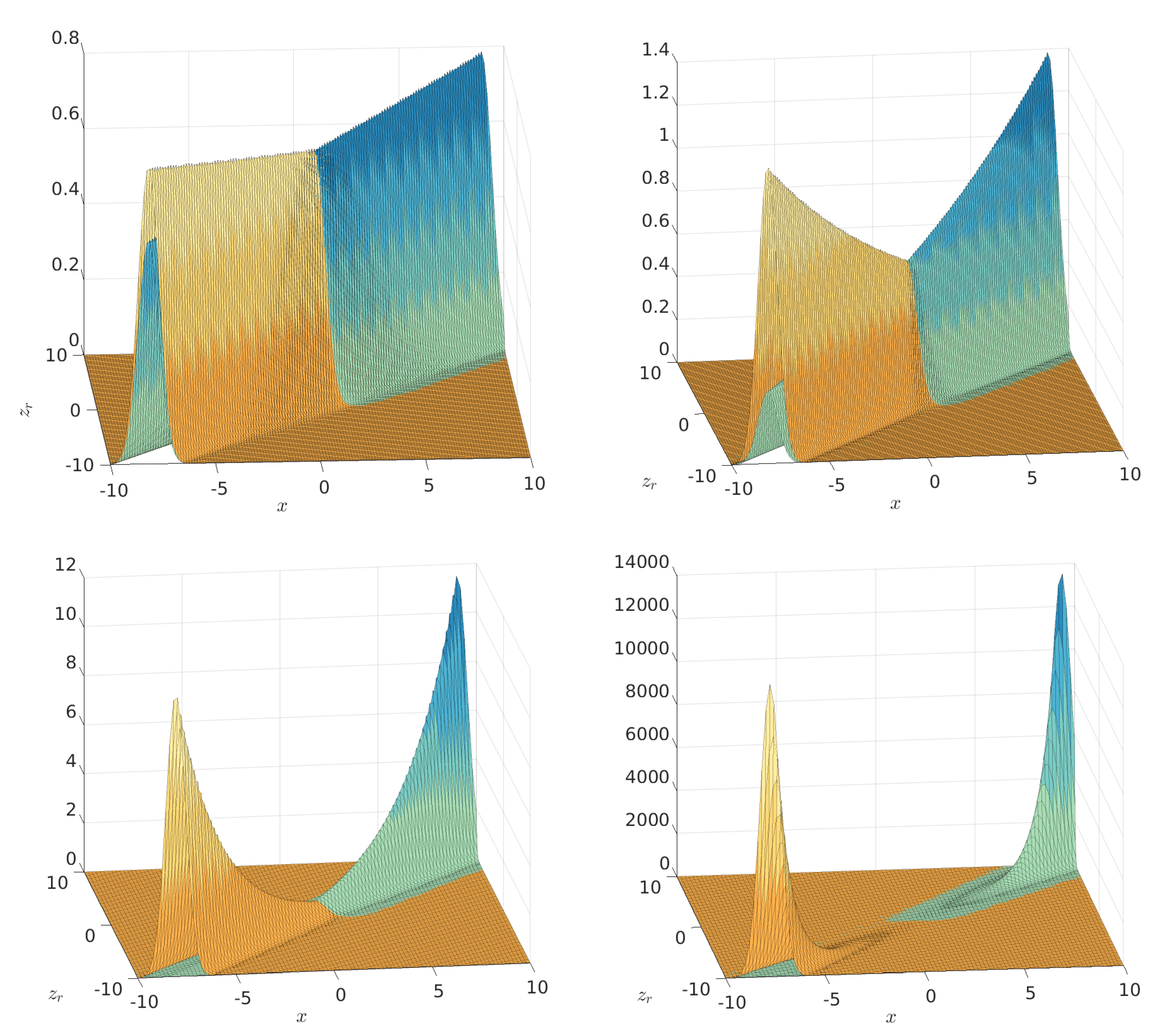
We plot in Figure 1 the square moduli of and for and and for different choices of and . We observe that our choice of and satisfies the constraint given at the beginning of Section 3, . We further observe that the different choices of and considered in the figure correspond, see (23), to operators a and , which are more different. This increasing difference is reflected in the plots of the bi-coherent states, which tend to move away more one from the other when increases. This is essentially the same behavior we have already observed in several other concrete examples of bi-coherent states, see [7].
5. Conclusions
In this paper, we discussed how a particular fully pseudo-bosonic Swanson model can be introduced and how its Hamiltonian H can be diagonalized. We also found the eigensystem of , using the general framework and results deduced in the context of PBs. We constructed (using different approaches) the bi-coherent states for the model, we compared the results, and we deduced some of their properties.
Several extensions of the model proposed here could be considered: first, rather than the Hamiltonian H in (20), one could consider the more general, but still quadratic, operator . Further, one could analyze the role, if any, of the WPBs, attempting to see how much of the results given here can be extended to a distributional settings, as proposed in [25,26]. Moreover, it would be interesting to apply the results deduced here in the computation of a propagator, by making use of the properties of bi-coherent states of the model, in the same line as in [7,34]. These are part of our programs for the future.
Funding
This research received no external funding.
Data Availability Statement
Not applicable.
Conflicts of Interest
The author declare no conflict of interest.
References
- Bender, C.M.; Fring, A.; Guenther, U.; Jones, H. Special issue on quantum physics with non-Hermitian operators. J. Phys. Math. Theor. 2012, 45, 030201. [Google Scholar] [CrossRef] [Scilit]
- Bagarello, F.; Gazeau, J.P.; Szafraniec, F.H.; Znojil, M. (Eds.) Non-Selfadjoint Operators in Quantum Physics: Mathematical Aspects; John Wiley and Sons: Hoboken, NJ, USA, 2015. [Google Scholar]
- Bagarello, F.; Passante, R.; Trapani, C. Non-Hermitian Hamiltonians in Quantum Physics. In Proceedings of the 15th International Conference on Non-Hermitian Hamiltonians in Quantum Physics, Palermo, Italy, 18–23 May 2015; Springer: Berlin/Heidelberg, Germany, 2016. [Google Scholar]
- Bender, C.M. PT Symmetry in Quantum and Classical Physics; World Scientific: Singapore, 2019. [Google Scholar]
- Bender, C.M.; Fring, A.; Correa, F. Proceedings for “Pseudo-Hermitian Hamiltonians in Quantum Physics”. J. Phys. Conf. Ser. 2021, 2038, 012001. [Google Scholar]
- Bagarello, F. Deformed canonical (anti-)commutation relations and non hermitian Hamiltonians. In Non-Selfadjoint Operators in Quantum Physics: Mathematical Aspects; John Wiley and Sons: Hoboken, NJ, USA, 2015; pp. 121–188. [Google Scholar]
- Bagarello, F. Pseudo-Bosons and Their Coherent States; Springer: Berlin/Heidelberg, Germany, 2022. [Google Scholar]
- Trifonov, D.A. Pseudo-Boson Coherent and Fock States. In Proceedings of the 9th International Workshop on Complex Structures, Integrability and Vector Fields, Sofia, Bulgaria, 25–29 August 2008; pp. 241–250. [Google Scholar]
- Jones, H.F. On pseudo-hermitian hamiltonians and their hermitian counterparts. J. Phys. A 2005, 38, 1741. [Google Scholar] [CrossRef] [Scilit]
- Jones, H.F. The metric operator and the functional integral formulation of pseudo-hermitian quantum mechanics. Acta Polytech. 2007, 47, 36–39. [Google Scholar] [CrossRef] [Scilit]
- Tavassoly, M.K. New nonlinear coherent states associated with inverse bosonic and f-deformed ladder operators. J. Phys. A 2008, 41, 285305. [Google Scholar] [CrossRef] [Scilit]
- Bender, C.M.; Mannheim, P.D. Exactly solvable PT -symmetric Hamiltonian having no Hermitian counterpart. Phys. Rev. D 2008, 78, 025022. [Google Scholar] [CrossRef] [Scilit]
- da Providencia, J.; Bebiano, N.; da Providencia, J.P. Non hermitian operators with real spectrum in quantum mechanics. arXiv 2010, arXiv:0909.3054. [Google Scholar]
- Swanson, M.S. Transition elements for a non-Hermitian quadratic hamiltonian. J. Math. Phys. 2004, 45, 585. [Google Scholar] [CrossRef] [Scilit]
- Bagarello, F. Examples of Pseudo-bosons in quantum mechanics. Phys. Lett. A 2010, 374, 3823–3827. [Google Scholar] [CrossRef] [Scilit]
- Sinha, A.; Roy, P. Generalized Swanson Models and their solutions. J. Phys. A Math. Theor. 2007, 40, 10599. [Google Scholar] [CrossRef] [Scilit]
- Sinha, A.; Roy, P. Continuum states in generalized Swanson models. J. Phys. A Math. Theor. 2009, 42, 052002. [Google Scholar] [CrossRef] [Scilit]
- Graefe, E.-M.; Korsch, H.J.; Rush, A.; Schubert, R. Classical and quantum dynamics in the (non-Hermitian) Swanson oscillator. J. Phys. A Math. Theor. 2015, 48, 055301. [Google Scholar] [CrossRef] [Scilit]
- Fring, A.; Moussa, M.H.Y. The non-Hermitian Swanson model with a time-dependent metric. Phys. Rev. A 2016, 94, 042128. [Google Scholar] [CrossRef] [Scilit]
- Bagarello, F. A Swanson-like Hamiltonian and the inverted harmonic oscillator. J. Phys. A 2022, 55, 225204. [Google Scholar] [CrossRef] [Scilit]
- Christensen, O. An Introduction to Frames and Riesz Bases; Birkhäuser: Boston, MA, USA, 2003. [Google Scholar]
- Young, R.M. On complete biorthogonal bases. Proc. Am. Math. Soc. 1981, 83, 537–540. [Google Scholar] [CrossRef]
- Yeşiltaş, O.; Kaplan, N. Metric Operator For The Non-Hermitian Hamiltonian Model and Pseudo-Supersymmetry. Phys. Scr. 2013, 87, 045013. [Google Scholar] [CrossRef] [Scilit]
- Mostafazadeh, A. Metric Operators for Quasi-Hermitian Hamiltonians and Symmetries of Equivalent Hermitian Hamiltonians. J. Phys. A Math. Theor. 2008, 41, 055304. [Google Scholar] [CrossRef] [Scilit]
- Bagarello, F. A class of weak pseudo-bosons and their bi-coherent states. JMAA 2022, 516, 126531. [Google Scholar] [CrossRef] [Scilit]
- Bagarello, F. Weak pseudo-bosons. J. Phys. A 2020, 53, 135201. [Google Scholar] [CrossRef] [Scilit]
- Bagarello, F. Pseudo-bosons and bi-coherent states out of L2(R). J. Phys. Conf. Ser. 2021, 2038, 012001. [Google Scholar] [CrossRef] [Scilit]
- Szegö, G. Orthogonal Polynomials; AMS: Ann Arbor, MI, USA, 1939. [Google Scholar]
- Davies, E.B.; Kuijlaars, B.J. Spectral asymptotics of the non-self-adjoint harmonic oscillator. J. London Math. Soc. 2004, 70, 420–426. [Google Scholar] [CrossRef] [Scilit]
- Kolmogorov, A.; Fomine, S. Eléments de la Théorie des Fonctions et de l’Analyse Fonctionnelle; Mir: Moscow, Russia, 1973. [Google Scholar]
- Merzbacher, E. Quantum Mechanics; Wiley: New York, NY, USA, 1970. [Google Scholar]
- Messiah, A. Quantum Mechanics; North Holland Publishing Company: Amsterdam, The Netherlands, 1962; Volume 2. [Google Scholar]
- Bagarello, F.; Gargano, F.; Spagnolo, S. Two-dimensional non commutative Swanson model and its bicoherent states. In Geometric Methods in Physics, XXXVI; Kielanowski, P., Odzijewicz, A., Previato, E., Eds.; Trends in Mathematics; Birkhäuser: Basel, Switzerland, 2019; pp. 9–19. [Google Scholar]
- Bagarello, F.; Feinberg, J. Bicoherent-state path integral quantization of a non-Hermitian Hamiltonian. Ann. Phys. 2020, 422, 168313. [Google Scholar] [CrossRef] [Scilit]

Publisher’s Note: MDPI stays neutral with regard to jurisdictional claims in published maps and institutional affiliations. |
© 2022 by the author. Licensee MDPI, Basel, Switzerland. This article is an open access article distributed under the terms and conditions of the Creative Commons Attribution (CC BY) license (https://creativecommons.org/licenses/by/4.0/).