1. Introduction
A generalized intersection matrix (GIM) is a matrix
with integer entries, 2’s along the diagonal, and either
or
if
. Slodowy [
1] used these matrices to define the GIM Lie algebras that encompassed all Kac–Moody Lie algebras.
Definition 1 ([
1,
2])
. Given a GIM
. The GIM
Lie algebra is a Lie algebra over generated by the elementssubject to the generating relations Slodowy [
1] and, later, Berman [
3] showed that every GIM Lie algebra is isomorphic to the fixed point subalgebra of involution on some larger Kac–Moody Lie algebra.
The GIM Lie algebras play important roles in the classification of the root-graded Lie algebras (see [
4,
5,
6,
7]) and are closely related to the representations of tilted algebras via Ringel–Hall algebras (see [
8,
9]). Their quantized analogues are isomorphic to the Hopf co-ideals of some Kac–Moody quantum groups (see [
10,
11,
12,
13]).
For any
, let
be the GIM whose entries are given by
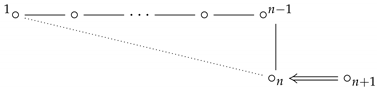
which corresponds to the Dynkin diagram:
For convenience, we denote the GIM Lie algebra
by
, and we say that it is of type
.
should be the simplest oriented GIM Lie algebra because it is the fixed point subalgebra of affine Kac–Moody Lie algebra
. Roughly, a GIM Lie algebra is called oriented if it is not a Kac–Moody Lie algebra. In [
14], all finite dimensional simple modules over
are constructed and classified.
For
, let
be the GIM Lie algebra defined via the structural matrix
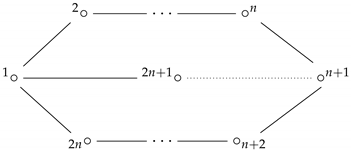
We say that is of type . As in the definition above, we assume that is generated by the ’s, ’s, ’s. Then, is identified as the Lie subalgebra generated by . In particular, the Dynkin diagram of is
In this paper, our main purpose is to classify all finite dimensional simple modules over for all . As a surprised byproduct, we also obtain the classification of all finite dimensional simple modules over a class of ‘larger’ oriented GIM Lie algebras (see Definition 2 below).
We use the word larger with quotation marks, because seems to be isomorphic to some fixed-point subalgebra of . However, we can only give an epimorphism from to . Quite fortunately, this epimorphism is sufficient for our purpose.
Throughout the paper, we denote the set of complex numbers, the set of integers, the set of positive integers and the set of non-negative integers using , respectively.
3. Basics and Main Results
Lemma 4 (see [
14])
. Let V be a finite dimensional vector space and a GIM
Lie algebra. Then, V is a simple -module if, and only if, there exists an ideal I of such that is finite dimensional semi-simple, and V is a simple -module. Note that, for a general Lie algebra, the quotient perhaps contains a one dimensional direct summand. However, this situation doesn’t happen for GIM Lie algebras (of course, for Kac–Moody Lie algebras).
Let
denote the Lie subalgebra of
generated by the elements
Similar to the above, we say that is of type . In particular, .
Lemma 5. For , the Lie algebra has no nontrivial finite dimensional module.
Proof. The Dynkin diagram of is a subdiagram of . It is sufficient to prove it for .
Note that the subalgebra
generated by the elements
, is of type
. So
is the fundamental central element of
(see Table Aff1 and §6.2 in [
15]). Let
V be a finite dimensional module over
, then it is a module over
. This implies
. However,
. It forces
. Then
. □
Define the loop Lie algebra
which has the bracket
The following two lemmas are well-known for all loop Lie algebras.
Lemma 6. If for some , the quotient has a nontrivial nilpotent ideal.
Proof. It is straightforward. For example, let , it is clearly an ideal, and . However, . □
Lemma 7. Suppose for pairwise different constants , we have Proof. Since
has no multiple root, any common divisor of all
, must be a constant. Then there exist some constants
such that
Due to the fact that
for each
i, we have
□
Lemma 8. Let V be a finite dimensional vector space.
(1) For , the Lie algebra has no nontrivial finite dimensional simple module.
(2) V is a simple module over if, and only if, it is a module over for some .
(3) V is a simple module over if, and only if, it is a module over for some .
(4) V is a simple module over if, and only if, it is a module over for some .
Proof. By Lemma 5, has no nontrivial finite dimensional simple module for .
For
, let
I be the ideal such that
is finite dimensional semi-simple. It is easy to find some monic polynomial
with
such that
. By Lemma 6, we may assume
such that
for all
.
For , we have by Lemma 7.
For , we have by Lemma 7.
For , we have by Lemma 7. Moreover, each summand is the untwisted affine Lie algebra. It is known that its semi-simple quotient is a multiple of .
The lemma follows. □
Next, we list our main results as follows.
Theorem 1. - (1)
For , has some nontrivial finite dimensional simple modules.
- (2)
A finite dimensional vector space V is a simple -module if, and only if, it is a simple -module for some .
- (3)
A finite dimensional vector space V is a simple -module if, and only if, it is a simple -module for some .
- (4)
A finite dimensional vector space V is a simple -module if, and only if, it is a simple -module for some .
Theorem 2. - (1)
For , has some nontrivial finite dimensional simple modules.
- (2)
A finite dimensional vector space V is a simple module over if, and only if, it is a simple module over for some and .
- (3)
A finite dimensional vector space V is a simple module over if, and only if, it is a simple module over for some .
Immediately, from above theorems we can get the following result directly.
Corollary 1. - (1)
Let I be a maximal ideal of the finite co-dimension of . Then - (2)
Let I be a maximal ideal of finite co-dimension of . Then
4. Proof of Theorem 1
Let
,
and
. It is easy to check that
Lemma 9. There exists an epimorphism of Lie algebrasdefined by Proof. First, the elements
generate the loop algebra
.
It is sufficient to check the serre relations involving
. Explicitly, we have
and
□
Corollary 2. Any simple -module is a simple -module.
Lemma 10. Any finite dimensional simple -module must be a simple -module.
Proof. Assume that I is an ideal of such that is finite dimensional and semi-simple. Let , then . In particular, is a central element, and . For convenience, we can regard as the map defined over . For this situation, is injective.
Due to the the fact that
is finite dimensional, there exists a polynomial
such that
Let , then is an ideal of S. In addition, is the direct summand of S, since S is semi-simple. Let be the canonical projection. Then implies . In other words, has an ideal such that and . It is easy to get and . So . Moreover, .
By Lemma 4, we have finished the proof. □
Construction 1. Let J be the ideal ofgenerated by a polynomialwith pairwise distinct constants. Then, by Lemma 8, Letbe the natural projection and letbe a finite dimensional simple representation. Thendefines a simple finite dimensional representation. In particular, the image ofis as described in Theorem 1.
Proof of Theorem 1. Corollary 2 and Lemma 10 imply that a finite vector space V is a simple module over if, and only if, it is a simple module over . Then Theorem 1 holds by Lemma 8 and Construction 1. □
5. Proof of Theorem 2
Similar to the previous section, we regard as the map defined over . It is easy to see that , so is still injective.
Lemma 11. Any finite dimensional simple module over is a simple module over .
Proof. Suppose that
I is an ideal, such that
is finite dimensional and semi-simple. Let
. Then
is an ideal of
. Moreover, there exists
such that
For details, one is referred to page 4806 of [
14].
Similar to the proof of Lemma 10, we have
Moreover,
S is isomorphic to some quotient of
, and hence some quotient of
. □
Corollary 3. Let V be a finite dimensional vector space. Then V is a simple -module if, and only if, it is a simple -module.
Corollary 4. Suppose that I is an ideal, such that is finite dimensional and semi-simple. Then S is a subquotient of .
Proof. It follows from the fact that is a subalgebra of . □
Lemma 12. If for some , then the quotient has a nontrivial nilpotent ideal.
Lemma 13. Suppose for some positive integer p and pairwise distinct constants , we havefor some and . Proof . (i) .
By the main result of [
14], we have
for some
and
.
Moreover, if
, we infer that
the quotient Lie algebra
.
If
, the quotient Lie algebra
If
, the quotient Lie algebra
(ii) .
By the main result of [
14], we have
for some
and
.
If
, the quotient Lie alpha
If
, the quotient Lie algebra
If
, the quotient Lie algebra
□
Lemma 14. - (1)
A finite dimensional vector space V is a simple module over if, and only if, it is a simple module over for some and .
- (2)
A finite dimensional vector space V is a simple module over if, and only if, it is a simple module over for some .
Proof . (1) holds by Lemma 13.
Notice that any semi-simple quotient of is a multiple of , any semi-simple quotient of is a multiple of , and the semi-simple quotient of is a multiple of . Thus (2) also holds by Lemma 13. □
Construction 2. Consider the map in Construction 1, let I be the kernel of the mapas in Theorem 2 for.
Then any finite dimensional simple modules overcan be constructed directly. Those are simple-modules in the natural way. Proof of Theorem 2. For
,
contains a Lie subalgebra
generated by the elements
which is of type
. In particular,
is a central element. If
V is a finite dimensional module over
, we have
. Due to the fact that
, we have
, and
. It is easy to obtain
.
Assume . Then it holds by Corollary 3, Lemma 14, and Construction 2. The theorem is proved. □