Article

Collaboration and Challenges in School Social Work Within South African Public Schools: A Case of the Gauteng Province

Centre for General Education, Durban University of Technology, Durban 4001, South Africa
Educ. Sci. 2026, 16(3), 446; https://doi.org/10.3390/educsci16030446
Submission received: 20 January 2026 / Revised: 3 March 2026 / Accepted: 12 March 2026 / Published: 16 March 2026

Abstract

In collaboration with various stakeholders, including learners, parents, teachers, district administrators, and community organizations, school social workers (SSWs) can positively influence the school ethos, reduce risks and barriers to learning, and increase learners’ resilience. This collaboration is particularly crucial in low- and middle-income countries, where psychosocial well-being support structures are lacking, significantly affecting learners’ well-being. This exploratory qualitative study aimed to explore the nature of collaboration in the practice of school social work in South African public schools in Gauteng province. Semi-structured interviews were conducted with 17 SSWs who provided informed consent. Reflexive thematic analysis confirms that SSWs actively promote and participate in interdisciplinary and inter-organizational collaboration to support learners. These collaborations were crucial for addressing complex issues such as child protection, substance abuse, mental health, and poverty. However, the identified challenges include limited participation by experts, key stakeholders, and parents, as well as poor coordination between the social development and education departments. These challenges hinder SSWs’ ability to address learners’ diverse needs effectively. Therefore, the study argues for a shift toward more formalized, uniform partnerships and proposes operational strategies to strengthen collaboration and the practice of school social work within the broader school system.

1. Introduction

In the wake of a global mental health crisis and escalating socio-economic disparities, the traditional academic mission of schools is now inseparably linked to the psychosocial well-being of learners. Research increasingly shows that instructional time is effectively lost when non-academic barriers to learning remain unaddressed (Adelman & Taylor, 2017). This necessitates a shift toward a collaborative model in which the teachers and psychosocial support services, such as school social workers (SSWs), operate as a unified team. Despite the recognized importance of collaborative roles in supporting learners (Berzin et al., 2011; Mahwai & Ross, 2023), the specific dynamics of how these professionals work together remain under-researched. Specific to the South African context, the school system is currently facing a rising tide of school violence, victimization, and mental health challenges (Khumalo, 2023; Mokgaola et al., 2022; Ntombela et al., 2022). These issues are broadly addressed through multidisciplinary and interdepartmental collaborations, with SSWs as significant role players. Therefore, the article aims to examine the nature of collaboration in school social work practice in South African public schools.
Research worldwide indicates that non-academic factors affecting learners include substance use, which can harm social experiences and potentially lead to criminal behavior (Mohasoa & Mokoena, 2017). Other issues encompass mental health problems such as depression and anxiety (Ajaero et al., 2018), teenage pregnancy (Mekonen, 2024), bullying, and school violence (Khumalo et al., 2025a). These issues can result in cognitive difficulties, behavioral problems, and lower school attendance (Lloyd, 2018) and can greatly hinder a learner’s engagement and success in school, often necessitating targeted support and interventions (Merga, 2019). Furthermore, these issues may vary by learners’ developmental stage and are influenced by their family background, social and life experiences, gender, socioeconomic status, and personal characteristics (Barboza et al., 2021; Khan et al., 2019; Mensah et al., 2024).
Studies by Khan et al. (2019) and Mensah et al. (2024) show that home factors, such as parental involvement, unhealthy relationships, and poverty, significantly influence learners’ educational and developmental challenges and successes. Parental involvement, including creating a supportive environment and engaging in learning activities, lays the groundwork for academic achievement (Paul et al., 2021; Li & Qiu, 2018). Conversely, a lack of parental support, common in underdeveloped and developing communities due to factors such as low income, inflexible work hours, and multiple jobs, negatively impacts children’s progress (Chen et al., 2024; Khumalo & Pretorius, 2024). These socioeconomic constraints reduce the time and energy parents can dedicate to their children’s education (Adelman & Taylor, 2017; Li & Qiu, 2018). Families with low socioeconomic backgrounds often face challenges that hinder children’s academic performance and overall educational outcomes (Khumalo & Pretorius, 2024). Within school environments, factors such as violence significantly impact learners’ psychosocial development, school ethos, and educational quality. Studies (Lumadi, 2024; Khumalo et al., 2025a; Mosito & Sitoyi, 2024) highlight that school violence in Sub-Saharan Africa, including South Africa, is widespread, involving bullying, physical and sexual violence, corporal punishment, and gang-related incidents. International studies within contexts such as the United Kingdom and Brazil reflect similar conclusions and highlight school violence as a prevalent issue (Beserra et al., 2019; Nation et al., 2023). Contributing factors within Southern Africa include interactions with teachers, ineffective disciplinary methods, notions of masculinity, and intolerance to differences (Khumalo et al., 2025a). Ultimately, children who experience violence, directly and indirectly, in schools suffer a variety of negative educational impacts, including lower test scores and higher rates of absenteeism (BenYishay et al., 2024).
Mental health issues are a significant challenge in schools worldwide. Polanczyk et al. (2015) found that 11% to 16% of children and adolescents across 27 countries suffer from at least one mental health disorder. In the United States, Danielson et al. (2024) identified ADHD and anxiety as the most common, affecting about 9.4% to 9.8% of school-aged children. An Australian study reported 34.7% of adolescents had a mental health disorder, with 7.9% experiencing suicidal thoughts (Islam et al., 2020). In sub-Saharan Africa, prevalence rates are higher; in Kenya, 45.9% of high school learners showed depressive symptoms, while a Nigerian study found 21.2% with depression, varying from moderate to severe (Fatiregun & Kumapayi, 2014). In South Africa, an estimated 20% of adolescent learners face mental health challenges annually, including depression and stress-related conditions (Ajaero et al., 2018).
Psychosocial support plays a crucial role in addressing these challenges and is often provided through multidisciplinary efforts involving different role players such as parents, teachers, SSWs, psychologists, special needs education specialists, nurses, police, and local organizations (Bolin et al., 2017; D’Agostino, 2013). The role of SSWs is broad as they support learners in developing their social, emotional, and intellectual abilities while addressing issues such as school attendance and absenteeism, sexual orientation and substance abuse, and learners’ behavioral problems (Kelly et al., 2015). In collaboration with key stakeholders, SSWs can influence a positive school ethos, reduce risks and barriers to learning, and increase learners’ resilience, nurturing interactions among learners and their different systems (i.e., individual self, family, school, community) (Beck, 2017; Thompson et al., 2018). For instance, collaboration with teachers involves teachers identifying and referring learners experiencing learning barriers to SSWs, SSWs providing skills training in school discipline, and responding to immediate school crises (Nguyen et al., 2022). Collaboration with parents involves SSWs facilitating parental guidance programs and conducting home visits (Khumalo et al., 2025b; Csók & Pusztai, 2022). Moreover, SSWs collaborate with mental health specialists to address gaps in the delivery of school-based mental health services (Bolin et al., 2017; Kjellgren et al., 2022; Ruth & O’Connor, 2020).
To understand the nature of collaboration in school social work practice within South African education, this study draws on two theoretical frameworks, namely, social constructionism and critical social theory. Social constructionism recognizes that human beings create their understanding of the world through interactions, emphasizing that people come to know reality by engaging with others, organizations, and institutions within their environment (Lee & Greene, 2001; Sahin, 2013). As a result, these social encounters and interactions shape one’s knowledge or reality. Social constructionism helps explore the social workers’ experiences and perspectives about the practice of school social workers. Practitioners actively shape and negotiate their roles and responsibilities in response to learners’ contextual needs and their relationships and partnerships with school staff and other professionals interested in school wellbeing. Critical social theory serves as a mode of scientific inquiry that explicates the distortions and constraints that hinder free, equal, and unconstrained societal participation (Fulton, 1997; Leonardo, 2009). The theory provides a framework for comprehending the political and social agendas that shape, restrict, and impact individuals’ lives and is essential for analyzing how discourses within society shape perceptions of individuals and institutions, and examining processes of marginalization. Critical social theory provides a critical lens for examining power structures and systemic barriers in the school systems that influence this construction. These powerful and systematic barriers can contribute to the marginalization of SSWs in collaborative roles and reinforce existing inequalities in public schools. In this study, these theoretical frameworks served as guiding concepts during the data analysis phase. While the interview guide was broadly exploratory, social constructionism informed the coding process by focusing on how SSWs negotiate and co-construct their professional identities through interaction. This framework is further used to interpret data, moving beyond surface-level reporting to reveal how reality is socially constructed between SSWs and others in collaborative partnerships. Critical social theory guided the interpretation of the findings, specifically helping to identify how institutional discourses and power imbalances between the DSD and GDE shape and often restrict collaborative practice.
While existing literature extensively documents the diverse psychosocial challenges facing learners and the general roles of SSWs (e.g., Khumalo et al., 2025b; Nguyen et al., 2022; Ntombela et al., 2022; Thompson et al., 2018), there is a significant research gap regarding how collaboration manifests within the South African public schools. What is currently known is that multidisciplinary teams are essential for holistic learner support (Makhalemele & Nel, 2016; Mpanza & Govender, 2022); however, what remains unknown is how these collaborative partnerships, specifically within school social work practice, are navigated, maintained, or hindered within the unique educational landscape of South African schools. This study addresses this gap by moving beyond a description of school social work roles to an analysis of the critical role of collaboration, exploring how partnerships with various stakeholders are essential to effectively address the complex challenges learners face, and factors that hinder such efforts. The study makes three primary contributions to the field of school social work. First, it provides an empirical account of specific collaboration, reflecting significant interorganizational and interdepartmental initiatives, as well as the dynamics and friction encountered by DSD social workers operating within public schools. Second, it identifies systemic and structural barriers affecting school social work services. Third, it offers new perspectives on why collaborative learner support initiatives remain fragmented despite national policy mandates. The primary intent of this study is descriptive and exploratory; it aims to explore existing forms of collaboration and identify perceived challenges to collaboration in the practice of school social work in South African public schools. It does not seek to provide an evaluative measure of the objective effectiveness of these partnerships. Therefore, the study is specifically led by the research questions below:
  • What forms of collaboration exist in the practice of school social work in Gauteng public schools?
  • Which challenges hinder effective collaboration in the practice of school social work in Gauteng public schools?

2. Materials and Methods

2.1. Context and Research Design

The nature and practice of school social work in South Africa are unstructured and differ within the country’s nine provinces (Khumalo et al., 2025b; Vergottini & Weyers, 2025). Nevertheless, this study was conducted in Gauteng Province, South Africa’s economic hub. Gauteng is characterized by high levels of urbanization, the country’s highest child population close to 5 million (Hall & Hendricks, 2025), and is burdened with school absenteeism, out-of-school children, and over-aged learners (Erasmus & Fourie, 2025). Within the province, SSWs are employed independently by (i) Gauteng Department of Education (GDE), (ii) Department of Social Development (DSD), (iii) specific public schools by the School Governing Body (SGB), and (iv) Non-Governmental Organizations (NGOs) specializing in psychosocial support of learners (Khumalo et al., 2025b; Makholwa & Muleya, 2025). Those employed by GDE are stationed at provincial offices, and some are assigned to special needs schools. DSD SSWs are stationed at DSD regional offices and specific education districts. NGO SSWs are placed within the NGOs, and SGB SSWs are placed in the specific schools. The roles of DSD SSWs are supported by a Memorandum of Understanding (MOU) between DSD and GDE, which outlines an initiative for coordinated, holistic social work services for high-risk schools. Although this MOU is an internal departmental document not currently in the public domain, it serves as the primary institutional guide defining the collaborative mandate in Gauteng (Gauteng Department of Social Development, 2022). The MOU states that SSWs will provide support to learners and their families in managing social issues affecting learners in schools and in reducing social obstacles that can impede learners’ quality of social functioning. Moreover, it outlines a framework for ‘coordinated, holistic social work services’ where resource commitments are split between departments, where the Gauteng DSD is mandated to provide the human resources (SSWs) and ‘tools of trade’, while the GDE is responsible for providing the physical infrastructure, including office space and IT equipment. Overall, this MOU serves as a collaborative model in Gauteng and is not uniform across other South African provinces.
This study adopted a qualitative, exploratory case study design to explore the nature of collaboration in the practice of school social work in South African public schools, focusing on who SSWs collaborate with and the challenges they encounter in these collaborations. By defining the study as a case study, the research focuses on a single geographical region, Gauteng province, to develop an in-depth, more contextualized analysis of school social work practice (Yin, 2014). This study is part of a larger doctoral study examining the state of school social work practice in public schools in Gauteng Province. It was approved by the University of KwaZulu-Natal’s Humanities and Social Sciences Research Ethics Committee (HSSREC/00006346/2023), and GDE and DSD as gatekeepers.

2.2. Population, Sampling, and Data Collection Processes

The study population comprises all social workers registered with the South African Council for Social Service Professions (SACSSP) who are practicing in Gauteng Province. Within this group, the target population, defined by Alvi (2016) as the subset meeting the specific criteria for investigation, comprises social workers providing school social work services within the Gauteng public schools, serving as SSWs, supervisors, and managers.
Purposive sampling was used to identify and recruit twenty-two social workers employed in school social work services by DSD (n = 17), school governing bodies at specific schools (n = 3), and GDE (n = 2). However, to ensure a cohesive analysis and to avoid the risk of overgeneralization across different employment structures, this manuscript focuses exclusively on the seventeen participants employed by DSD. The data from social workers employed by the school governing bodies and the GDE were limited and insufficient, prompting a deliberate narrowing of the research scope to the DSD perspective. Of the 17 DSD social workers, seven were SSWs, nine were social work supervisors, and one was a provincial social work manager responsible for the school social work program. By concentrating on this specific participant group, the study ensures that the findings and thematic conclusions are rigorously supported by the data and accurately reflect the collaborative dynamics and systemic challenges unique to DSD-employed social workers operating in Gauteng public schools. The final number of participants was influenced by data saturation (Lincoln & Guba, 1985), which was operationalized through an iterative process of preliminary data analysis conducted alongside data collection. During the final few interviews, it became evident that participants consistently reported on collaboration initiatives and challenges that had already been documented in previous sessions, suggesting the data had reached a point of redundancy. These final interviews confirmed that further data collection would yield no new information, ideas, or insights.
Data were collected during November 2023 and June 2024. The social work managers in the school social work programs assisted with the recruitment process by sharing the study details with social workers providing school social work services in the province. Details of social workers who showed interest in voluntarily participating in this study and met the inclusion criteria were shared with the author. The inclusion criteria were (i) social workers employed at the GDE, DSD, or SGB to provide school social work support (direct and indirect) to learners and schools, (ii) registered with the South African Council for Social Services Profession, and (iii) over 6 months of experience in school social work services. Thereafter, the author contacted the social workers via email, sharing details about the study (i.e., its purpose and ethical considerations).
Data were collected through semi-structured interviews using an interview schedule developed by the author, aligned with the research objectives. The guide consisted of open-ended questions broadly exploring collaboration partnerships within school social work (Creswell & Poth, 2017). The interviews were conducted in English and lasted 45 min to 1 h. To enhance instrument rigor, a pre-testing of the interview schedule (Hurst et al., 2015) was conducted with one participant who met the inclusion criteria but was excluded from the final sample. Following the pre-test, the interview guide was refined to ensure that the questions were clear, and the interview duration was verified. Each interview was audio-recorded and transcribed verbatim into a Microsoft Word document, and field notes were kept for contextual observations and initial reflections of the data.

2.3. Data Analysis

For data management and analysis, the transcripts were imported into NVIVO (Version 14), a qualitative analysis programme used to help researchers manage data, organize ideas, query data, visualize data, and generate reports (Bazeley & Jackson, 2019). Reflexive thematic analysis (Braun & Clarke, 2023) was used to identify themes and patterns in the data. As such, the analysis process involved (i) the author familiarizing themselves with the data by reviewing the verbatim transcripts alongside field notes and recording initial impressions and potential biases within the data in a reflexive journal, (ii) generating initial codes by identifying and labeling meaningful segments of data with codes that capture the essence of the data, (iii) searching for themes by grouping the initial codes into potential themes, (iv) reviewing themes, a phase supported by peer debriefing through doctoral supervision sessions to check whether the themes work in relation to the coded data extracts and the overall dataset, (v) defining and naming themes by refining each theme’s content and giving it a descriptive name that accurately reflects the data, and finally, (vi) writing up the findings by presenting a narrative account of the data. Thus, ensuring reflexivity in the analysis process meant maintaining a reflexive journal, conducting peer debriefing sessions with the author’s research doctoral supervisors, and recognizing the author’s subjective interests in the topic of school social work.

2.4. Ethical Considerations

All participants provided formal consent to participate after being briefed on the study (i.e., aim, risks, benefits, voluntary participation, right to withdraw, and research process). To ensure participant comfort and autonomy, the choice of interview mode (online or in-person) was determined by the participant. To mitigate the risk of lost professional time, the interviews were scheduled according to participants’ availability, minimizing disruption to their day-to-day duties. Participants were assured of the confidentiality of the information they shared, as all raw data without participants’ identifying information was kept in a password-protected computer. Anonymity was ensured by using pseudonyms (false names) representing the narrative quotations from the participants in this manuscript. While the interviews focused on professional collaboration rather than the traumatic details, such as working on child protection cases, ethical safeguards were maintained by informing participants that they could skip any question or terminate the session if they felt uncomfortable.

2.5. Trustworthiness

To ensure trustworthiness, this study adhered to the criteria established by Lincoln and Guba (1985), namely credibility, transferability, dependability, and confirmability. Credibility was established through source variation, incorporating multiple social worker perspectives (SSWs, supervisors, and managers), while ensuring that the research findings accurately reflect participants’ initial points of view and are grounded in the original data. Through source variation, the inclusion of participants from different hierarchical roles enabled a more comprehensive understanding of collaboration. Transferability was addressed by providing in-depth descriptions of the study’s context, participants, and the specific DSD school social work employment framework, thereby enabling other researchers to assess the applicability of the findings to similar settings. To ensure dependability, data verification was maintained through an audit trail, in which the research design and analytical processes were meticulously documented. Confirmability was established through reflexivity and independent peer review during doctoral supervision, where the author’s influence on the research process was critically acknowledged. The author’s perspective in this study is shaped by their professional background as a social worker with a specialized interest in school-based services. This professional identity informs the study’s focus on the field’s collaborative nature. By acknowledging this positionality, the author intentionally highlights the critical role of interprofessional partnerships in school social work, emphasizing that collaboration among stakeholders is essential to effectively address the complex, multi-layered challenges faced by learners and their families. Moreover, the findings are presented through direct quotations from the participants, demonstrating that they emerged from the collected data.

3. Results

The analysis yielded two themes, each with subthemes, as outlined in Table 1. These themes are not intended as an exhaustive categorization of all forms of collaborative practices but rather represent the dominant patterns emerging from this specific dataset.

3.1. Theme 1: Collaboration as a Mechanism for Holistic Intervention

This theme reveals collaboration as the fundamental framework through which SSWs address learners’ multifaceted challenges, thereby ensuring holistic support services. The subthemes presented in this theme reflect that SSWs do not work in isolation, but rather mobilise networks and resources with government departments, police services, NGOs, community organisations, and health experts. Collectively, the subthemes demonstrate how these partnerships shift school social work from individual casework to a holistic response, ensuring that learners are supported across the nexus of home, school, and community.

3.1.1. Subtheme 1: Ensuring Safety and Child Protection

SSWs partnered with the police services to respond to sexual abuse cases, removing children from unsafe environments and domestic abuse cases:
“We partner and also keep in contact with colleagues from the police department, especially the child protection unit, which assists social workers when it comes to these sexual offence cases… Sometimes when SSWs go do home visits and have to remove the child, they will have to have a police escort to assist them.”
(Linda, Supervisor, DSD)
The collaboration with police services and Teddy Bear Clinic (i.e., specialising in sexual child abuse) was also evident in school programmes facilitated by the SSWs. When school programmes were conducted, they would invite police services to engage learners on how they could protect themselves from being victims of trafficking, talking about sexual abuse, and reporting sexual abuse:
“When I do school programs, I invite SAPS to come and help me with the program and they address their role. For example, when it comes to human trafficking, I ask SAPS to explain to learners and present to them what you do and provide some tips on how the learners can be careful and how the learners can take care of themselves.”
(Uthando, SSW, DSD)
“[Learners] have 72 h to report rape and do the rape kit. If the 72 h lapse, it becomes a challenge in terms of having evidence. So when SSWs partner with SAPS, they emphasise that the learners need to report [rape] immediately and they mustn’t wait.”
(Wendy, Supervisor, DSD)
“We invite the Teddy Bear clinic, especially when we do sexual abuse programs, and we need to talk to the learners about sexual abuse”
(Emelda, SSW)
In addition to the collaboration with police, SSWs collaborated with the crime units when implementing programs like the bullying prevention initiative. This collaboration meant working in partnerships to conduct awareness sessions that inform learners about school violence (i.e., bullying and gangsterism), their role and consequences:
“With internal collaboration in our department, we collaborate with the Social Crime and Prevention unit for when we are doing programs such as the bullying program.”
(Enhle, SSW, DSD)
“If there is bullying at the school, we work with the officials from SAPS. We normally do an awareness together in which they explain to the learners their role and that bullying is a criminal offence and a case can be opened against the perpetrator. If there is gangsterism at school, then they are also involved for the protection of learners.”
(Sarah, SSW, DSD)

3.1.2. Subtheme 2: Addressing Socio-Economic Issues and Strengthening Families

Other collaborations focused on addressing issues related to families’ low socioeconomic status and family relationships. SSWs collaborate with other social development units to address issues identified in learners’ circumstances, such as the lack of school uniforms and the lack of food:
“We collaborate with the Sustainable Livelihoods Unit only if maybe we need a school uniform… So children won’t be able to get those uniforms. But they also assist with food parcels. If there is a food parcel at the food bank, we also issue food parcels to those learners who need food parcels.”
(Emelda, SSW, DSD)
“In some of the cases that I have, maybe when I do a home visit, I pick it up that the situation at home is not okay. And there’s no food, or food is there, but it’s not enough for everyone. I then write to the food parcel unit. I recommend the families and write the total number of families, addresses, and phone numbers. Then, the food parcel unit will deliver the food to the family.”
(Uthando, SSW, DSD)
“[If] it’s a case of a learner who is struggling, or who is faced with poverty, we’ve got Sustainable Livelihood programs. We refer the clients or the case to them for the provision of food parcels. Let’s say maybe it’s a house that has been burnt down, and the learners or the family doesn’t have clothing, doesn’t have food, or anything at all.”
(Naledi, Supervisor, DSD)
Collaboration between SSWs and FAMSA, a non-profit organisation, to comprehensively provide support and services to learners and their families:
“Most of our children come from dysfunctional families with domestic issues and families that are unable to properly communicate and discipline kids in inappropriate measures. FAMSA is one of those organisations that we partner up with that have good programs that provide parenting and mediation services, such as skills for parents to be better and improve the family function.”
(Linda, Supervisor, DSD)
“I refer the learners for long-term counselling to one of the NGOs that I’m working with, called FAMSA. So, I would refer to either the learner or the whole family. FAMSA has its own structure; they will see the learner privately, see the family members privately, and sometimes combine the whole family and do family counselling.”
(Uthando, SSW, DSD)
“If there is a need to link the child or the family with other relevant stakeholders like FAMSA, they will have to do that, liaise, and then send a request for that particular family or learner to be seen while continuing to provide support when necessary… I would say to mom, would go to FAMSA to get information regarding the parenting skills they provide.”
(Ayanda, Supervisor, DSD)

3.1.3. Subtheme 3: Addressing Substance Use and Mental Health Challenges

Many participants reflected on the collaboration between SSWs and other professionals and organisations for supporting learners struggling with substance abuse use, teenage pregnancy, and mental health challenges. These partnerships for addressing substance abuse were specifically with NPOs specialising in substance abuse and the DSD Substance Abuse unit, the local rehabilitation centre, and social workers specifically dealing with substance abuse services, and were carried out through referral interventions and school awareness programmes:
“Another thing that makes this child is not coping well, these issues of substances, that’s where we involve our NPOs who are dealing with substance abuse or we involve the social development Substance Abuse unit to be able to assist this child.”
(Ursula, Supervisor, DSD)
“Or maybe there are cases whereby a learner is addicted to drugs and as a result of that there are behavioural problems and so we also refer internally to the Substance Abuse unit for further intervention.”
(Naledi, Supervisor, DSD)
“The SSWs also partner up with Westview Clinic, which supports learners who have substance problems. The clinic provides a rehabilitation centre and also outpatient services. So the SSWs would refer the learners there for support.”
(Linda, Supervisor, DSD)
“The school social worker will come in as a psychosocial support and then the substance abuse social worker will come in and address substance abuse issues. So what happens is with our collaboration, maybe when social workers from the substance abuse program come into an awareness and some cases arise after that engagement with learners, the social worker will then be able to take over and provide the one-on-ones or group work after the awareness was provided, which is very difficult if the school social worker does it alone.”
(Ayanda, Supervisor, DSD)
The SSWs collaborated with various health-related stakeholders, allowing the SSWs to leverage the expertise of health professionals in addressing the health-related aspects of sexual and reproductive health challenges faced by learners, such as teenage pregnancy:
“Collaboration with the Department of Health includes addressing issues such as teenage pregnancy and the reproductive system because as a social worker, you don’t know the depth in terms of the health part of it. We only provide services related to the effects and social consequences of it and the Department of Health will be addressing such as teenage pregnancy and reproduction.”
(Martha, SSW, DSD)
“Then we also collaborate with health promoters such as nurses whereby we invite them especially when we are doing teenage pregnancy programs.”
(Emelda, SSW, DSD)
Furthermore, several participants acknowledged that suicide was prevalent in the Gauteng province, and collaboration partnerships between SSWs, the Department of Health, and other mental health organisations such as SADAG (South African Depression and Anxiety Group) and Lifeline were evident:
“We also involved the psychologists as well as health experts, the nurses, because now particularly, in the Gauteng province, we are having learners who attempt to commit suicide and those who commit”
(Eleanor, SSW, DSD)
“With the mental health awareness programs, we invite people like psychologists from clinics and the Department of Health because recently we have been having so many challenges on suicide.”
(Nnaketsi, Supervisor, DSD)
“We involve an educational psychologist when dealing with mental health. When we identify that the problem is more related to mental health like the child threatening to kill himself, then that is when we involve our nurses, and clinical psychologist from the clinics.”
(Thobile, Supervisor, DSD)
“We also have just right now established a partnership with one of the organisations that helps with mental issues for suicide cases. So whenever we want to do programs in terms of suicide awareness, we contact SADAG.”
(Linda, Supervisor, DSD)
“We also invite Lifeline, because this year they say to us their focus is more on suicide because we are receiving a lot of cases of suicide. So they requested to collaborate with us as SSWs so that they can spread this information to learners about suicide.”
(Emelda, SSW, DSD)

3.2. Theme 2: Coordination and Collaboration Difficulties

Some participants described the challenges they experienced while attempting to form collaborative partnerships. These challenges manifest across multiple levels, such as the systemic level between the Departments of Social Development and the Department of Education (i.e., difference in understanding high-risk schools, lack of support from GDE and the ‘us vs. them’ mentality), the interprofessional level with other professionals and experts (i.e., lack of participation in collaborations), and at the family level with parents (i.e., lack of participation and involvement).

3.2.1. Difference in Understanding High-Risk Schools

Several participants reported on the lack of a clear and consistent definition of “high-risk” schools, which seems to lead to differences in the prioritisation and allocation of resources with the departments of education and social development. Some participants explained that GDE regards a “high-risk” school as one that has low academic performance, and the DSD regards it as one with social issues and challenges affecting learners:
“We prioritise the high-risk schools. High-risk schools’ definition, according to the Department of Education, will be schools that underperform academically. And then, as social workers, when we talk about high-risk schools, we expect to discuss more social ills… Yeah, that’s the way we always find ourselves having some differences there. To say if you’re saying we should focus on the high-risk schools maybe, then you go to those schools, you’ll find that they don’t have those learners, they don’t have the psychosocial issues: it’s all about performance, it’s academic.”
(Grace, Supervisor, DSD)
“Some regions are servicing schools that we classified as high risk, which high risk is not described in the same way by the Department of Education and Social Development. Social Development is about several social ills, yet education is about work performance. So, we don’t even have uniformity as to how we think to say this is how we want school social work to be done. Although there have been meetings, there have been no standardized every single thing.”
(Wendy, Supervisor, DSD)
“We are social development and focus on social ills as social workers. The education department focuses on the pass rate of the schools. So if, most of the time, they see a particular school that did not do very well in terms of the pass rate, they regard it as high risk.”
(Ayanda, Supervisor, DSD)

3.2.2. Lack of Support from GDE

Considering that the majority of school social work services are provided by DSD SSWs in Gauteng, some participants highlighted that the GDE did not provide sufficient resources and support to the practice of school social work, with most of the resources coming from the DSD:
“Most of the areas we were concerned about are about what the Department of Education is not bringing on board… everything and most of the manpower comes from social development resources… So if the Department of Education can also provide these resources”
(Nnaketsi, Supervisor, DSD)
“We’ve had engagement with people from education, especially around the issues of offices and transport, but so far, we are not getting any positive feedback from them…. So generally, the GDE only gives 10%, and DSD only gives 90%.”
(Wendy, Supervisor, DSD)
“In a case where there’s an emergency needing transport, GDE doesn’t assist. I’ve shouted, I’ve screamed.”
(Ursula, Supervisor, DSD)

3.2.3. Us vs. Them Mentality

Some participants were of the view and experience that lack of collaboration and togetherness between GDE and DSD, with a sense of an ‘us’ vs. ‘them’ mentality: Ayanda (Supervisor, DSD) expressed that: “[With] us being DSD and them being GDE, there’s always that ‘we are education, you are DSD’. We have our ways of doing things. You cannot come to our space, even when they know that we have an MOU in place, but still, they don’t seem to understand that we are here for the learner’s interest. We all see each other as them and us”. While Ursula (Supervisor, DSD), whose school social work services were provided from a GDE district, was of a similar view as stated:
“I feel that the regions where the social workers are not based in districts, it’s sort of, there isn’t, that the relationship with GDE is not as close. It’s still that us and them.”

3.2.4. Lack of Participation from Some Service Delivery Partners

SSWs were reported to be faced with numerous challenges in their effective collaboration with other stakeholders and service providers to support learners by some participants, noting a lack of participation and engagement from stakeholders:
“When collaborating with other stakeholders, sometimes they just don’t pitch and then you have to sort of improvise and provide whatever information that you can regarding that specific issue… such as issues related to crime.”
(Martha, SSW, DSD)
“We are still trying to work well with other professions. Because we are busy currently in the community, a huge challenge when it comes to working with other professions because we need their expertise, but we seem to be working in silos, and everybody is doing their things.”
(Nnaketsi, Supervisor, DSD)

3.2.5. Lack of Parental Support and Involvement

Other participants echoed challenges regarding the lack of parental involvement and engagement on issues that affect their children:
“…most of the time, the parents of the learners are not supportive. We’re being rejected as we try to engage with them on the particular issues that they are faced by their children, and those issues will affect the learners at the school level.”
(Enhle, SSW, DSD)
“The challenge with parents is they sometimes don’t want to sign consent forms, they don’t want to engage, to be part and parcel of what is happening with their children and to take responsibility.”
(Thabile, Supervisor, DSD)

4. Discussion

The aim of this study was to explore the nature of collaboration in the practice of school social work in South African public schools. The findings reveal that the SSWs do not operate in a vacuum; rather, they serve as a pivotal primary link between the school environment and a complex network of external resources. In this section, the findings are discussed, focusing on the overall theme of collaboration as a mechanism for holistic intervention, challenges experienced in collaboration partnerships, and recommended strategies to strengthen these partnerships.
The overarching theme identified in the findings is that holistic intervention is impossible in isolation and that it requires collaborative partnerships. As such, partnerships were established with police services, social workers, nurses, psychologists, and organizations for mental health support and family counselling. The partnership with police services is perhaps the most critical identified in this study, as it is significant for the protection and safety of learners. The findings suggest that SSWs play a vital role as the first responders in cases of sexual and domestic abuse, while the police services have the ultimate role of investigating the crime, arresting perpetrators, and supporting social workers in removing the child from immediate, unsafe environments. From a statutory perspective, this partnership is not merely a choice but a procedural mandate to ensure that the rights of children, as enshrined in the Children’s Act (Sections 150–152), are protected through immediate action. This is consistent with the Department of Social Development (2019), which states that when there are grounds for believing that the child is in immediate danger and that their safety and rights are being violated, social workers and police officials have a non-negotiable collaborative role. This child protection role, fulfilled through home visits undertaken by SSWs is consistent with practice in other regions such as the United States (Barboza et al., 2021; Brook et al., 2012; Winter & Cree, 2015), where practitioners are expected to visit the learners’ home when child abused or neglect at home is suspected (Allen & Tracy, 2004; Ochocki et al., 2024).
Additionally, the findings highlighting the need for police escorts during home visits suggest the high-risk nature of school social work in volatile environments. This partnership with the police ensures that the safety of the child and the SSWs is prioritized during removals and investigations. The role of police services in this regard is consistent with previous literature that recognizes that the world is becoming dangerous and violent, and social workers, in most cases, are visiting homes and communities confronted with violence, exposing them to physical threats and verbal abuse (Kim & Hopkins, 2017). Police services were found to have another significant role to play in the partnership with SSWs during school awareness campaigns, where they explain their protection roles, engage learners on ways to protect themselves from falling victim to human trafficking, and the need to report sexual abuse within the 72 h window, the rape kit. SSWs also partnered with the Teddy Bear clinic when conducting sexual abuse programs. This particular partnership is significant as this agency is an NGO specializing in child sexual abuse cases, offering holistic, integrated services to children who have been abused (Rashid et al., 2021).
The findings regarding school violence (i.e., bullying and gangsterism) indicate that SSWs use collaboration as a tool for both prevention and deterrence. These findings are confirmed by Pretorius (2020), who argues that SSWs can lead and facilitate the collaboration processes addressing learners’ behavioral issues, such as bullying. By inviting police services and crime prevention units into the school during awareness programs, SSWs reinforce the legal weight of the school’s code of conduct and advocate for safe schools. This partnership, understood through social constructionism, suggests the conscious intention to co-construct learners’ understanding of bullying and violence within the school environment to mitigate the prevalence of school violence. Moreover, the collaborative awareness ensures that learners understand the real-world consequences of violence as a serious transgression. Consequently, these inter-professional supports may contribute to a shift in school culture, moving away from an environment of perceived impunity toward one of greater accountability. Proponents of school-based law enforcement support the involvement of police services, arguing that law enforcement is best suited to address threats and prevent crime, thereby creating safe learning environments (Ghavami et al., 2021). Patterson’s (2007) study supports these findings by offering recommendations for school social workers on developing and implementing collaborations with police officers to address youth crime and violence in schools.
However, this reliance on law enforcement also introduces the risk of criminalization within the educational environment. While police involvement provides a clear deterrent, it may inadvertently shift the school climate from one of therapeutic support to one of surveillance and punishment. Consequently, the SSW must navigate these partnerships with caution to ensure that the pursuit of legal accountability does not overshadow the restorative, psychosocial, and supportive nature of school social work. Nevertheless, this collaborative role is of significant value, given data from the Global School-based Student Health Survey and the Health Behaviour in School-aged Children reports indicating that bullying is prevalent among school-aged children, with 48% of children in sub-Saharan Africa having experienced it (UNESCO, 2019).
The findings further revealed that socio-economic deprivation, specifically the lack of school wear and food security, remains a significant barrier to education in Gauteng public schools, directly impacting a learner’s confidence, academic performance, and overall development. As such, school social work services play a crucial role in facilitating access to these essential resources through partnerships with programs such as the Sustainable Livelihoods program. From the perspective of critical social theory, this collaborative role is an essential response to systemic inequality, in which collaborative interventions aim to mitigate the socio-economic barriers that would otherwise exclude marginalized learners from the educational process. A study by Khumalo (2023) among South African adolescents found an apparent need for school wear support in some South African township schools, arguing that school wear promotes a favorable school environment, which impacts academic success, by encouraging visual equality, minimizing distractions, and lowering absenteeism. Contextually, the significance of this specific partnership, as reported in the findings, is recognized by the Integrated School Health Policy (Department of Health & Department of Basic Education, 2012), as different professionals and systems are urged to contribute to ensuring that learners from poor or underprivileged school contexts affected by poverty are supported. Strydom (2014) supports the findings, indicating that social workers usually provide concrete help by delivering food parcels. This collaboration is significant, as it enables SSWs to identify and respond to learners’ immediate needs, ensuring they receive the necessary support from the Sustainable Livelihood programme in times of hardship (e.g., house fires). Social constructionism (Sahin, 2013) emphasizes that these collaborations help reconstruct the school environment as a space of equity, ensuring that a learner’s socio-economic status does not define their identity or academic potential.
Additionally, the findings suggest that learners’ struggles are often a symptom of home-based dysfunction. Gu et al. (2024) note that negative family environments, such as high levels of family conflict and poor parent–child relationships, are a risk factor for learners’ poor academic achievement. Therefore, it is important that support services for families be channeled into school social work services. The collaboration with organizations such as Families South Africa (FAMSA), a non-profit organization specializing in family relationships, provides counselling for parents, parenting skills training, and family mediation services. The SSWs pointed out that providing counselling to a learner is often insufficient if the home environment remains toxic. By referring families to FAMSA for mediation and long-term counselling, SSWs address the root cause of the learner’s behavioral or emotional distress, thereby strengthening the mesosystem, the connection between home and school. Kelly et al. (2015) and Paul et al. (2021) explain that such family intervention services, which support parents in creating safe and nurturing environments, are likely to increase learners’ well-being and positively impact their perceptions of school.
A significant finding was the reliance on specialized health experts to address teenage pregnancy and substance abuse. The participants appeared self-aware of the limits to their scope of practice and ensured that the information provided to learners was clinically accurate. The collaborative partnerships involved SSWs inviting nurses to discuss teenage pregnancy and reproductive health, and specialized social workers to handle drug addiction. This multidisciplinary approach may prevent the silo effect, in which different departments work in isolation, and instead creates a comprehensive safety net for learners. The partnership to address substance abuse is imperative, as previous research by Mohale and Mokwena (2020) with 308 learners in four South African schools suggests prevalence rates as high as 31%. While Mokwena and Setshego (2021) studied 629 high school learners, they found the substance use prevalence to be 47% and often involved alcohol, cigarettes, and dagga.
Regarding teenage pregnancy, South African statistics from the 2024 General Household Survey show that 3.8% of adolescent girls aged 14–19 were pregnant in 2023 (Statistics South Africa, 2024). While this percentage reflects a specific demographic proportion, the absolute scale of the issue remains a significant national concern. For instance, in the 2024/25 financial year, 117,195 girls between the ages of 10 and 19 gave birth in South Africa (SA Government News Agency, 2025). These figures underscore that teenage pregnancy is a persistent crisis. The study’s qualitative findings indicate that the prioritization of teenage pregnancy is also driven by the severe social consequences, such as school dropout and health risks. Consequently, collaborating with health professionals (Skobi & Makofane, 2017) ensures that learners receive specialized reproductive health support that extends beyond the psychosocial scope of the SSW, bridging the gap between national prevalence and local school-based needs.
Furthermore, the collaboration with mental-health support organizations such as SADAG, Lifeline, nurses, and psychologists to address the suicide crisis in Gauteng schools is a significant highlight of the findings. The findings suggest that mental health challenges among learners have escalated beyond the capacity of school-based staff. This is consistent with Shilubane et al. (2013) and Mahlangu et al. (2021), who found that a plethora of suicide cases were reported amongst school-aged children, which they linked to complex circumstances such as household socioeconomic standing, family crises, loss of loved ones, bullying and humiliation, child abuse, and so on. Using data from 195 countries compiled by the UN Inter-agency Group for Child Mortality Estimation, Masquelier et al. (2021) found that of the 90% children and youth, aged 15 to 24-year-olds, living in low- and middle-income countries, suicide is the second-leading cause of their death. In South Africa, the World Health Organization reports that 9% of deaths per 100,000 population amongst 15–19-year-olds are caused by suicide (Pongweni, 2024). As such, collaborative partnerships may allow for a tiered response in which the SSWs identify the risk and provide immediate psychosocial support, while specialized organizations and experts provide the intensive psychiatric or clinical intervention required to prevent loss of life amongst learners. Ruth and O’Connor (2020) support the roles of SSWs in mental health support, noting that social work practitioners are better suited to strengthen the linkage between formal and informal mental health care within the school and local community contexts. Kjellgren et al. (2022) add that in situations such as suicidal thoughts, the learners should be referred to professional mental health services. In terms of South African legislation and policies, the collaborative roles between SSWs and other mental health experts is support by the Screening, Identification, Assessment and Support policy (SIAS) (Department of Basic Education, 2014), which provides a framework for schools to standardize procedures for identifying learners with barriers to learning, assess their needs, and provide appropriate support to ensure their inclusion and participation in quality education, shifting focus from individual problems to systemic support programs within the National Curriculum.
Challenges exist in collaborating with key stakeholders, including the departments of social development and education, service delivery partners, and parents. Firstly, the lack of a standardized definition and outline of high-risk schools between the DSD and GDE may hamper the effectiveness of school social work services. The participants’ narratives suggest that GDE’s focus on academic performance as the primary indicator of risk contrasts sharply with the DSD’s focus on social ills and psychosocial issues. The findings indicate that SSWs are then requested to support schools that do not always fall within the parameters of high risk for psychosocial issues, and they may divert attention from schools in serious need of social services for their learners. This discrepancy appears to extend beyond the linguistic level; it could potentially lead to misaligned priorities and may have significant implications for resource allocation across both departments, possibly making it challenging to effectively respond to learners’ and schools’ needs. A unified understanding of high-risk schools should be established to improve the situation and ensure alignment with social services (Lesesa, 2022), reflecting aspects of social ills needing school social work intervention and academic impact. SSWs should actively profile schools to ensure that social services are needed.
The second challenge highlights the perceived lack of support from GDE regarding resources. Participants expressed frustration that, while SSWs operate within schools managed by the GDE, most resources, such as manpower, transport, and administrative support, are provided by the DSD. While this is somewhat reflective of the MOU between the two departments, DSD’s responsibilities include manpower, transportation, and other tools of trade, while GDE is responsible for day-to-day resources such as stationery, office furniture, IT infrastructure, and office space. As such, the perceived 90% (DSD) and 10% (GDE) resource split among some participants illustrates the disproportionate burden borne by the DSD under the agreement. When the GDE fails to provide basic infrastructure, such as the office space promised in the MOU, the effectiveness of the collaboration as a functional partnership may be compromised. Moreover, research by Khumalo and Pretorius (2024) and Vergottini and Weyers (2025) acknowledges these challenges, including a lack of human resources, vehicles for school visits, and tools of trade within school social work practice across South Africa’s nine provinces. These findings contradict the Framework for Social Welfare Services (Department of Social Development, 2013), which mandates that the Department of Basic Education “commit resources” and acknowledge social service professionals as “crucial” to learner support.
Moreover, some of the participants reflected on a deep-seated institutional rivalry, which they referred to as a ‘us’ vs. ‘them’ mentality. This was particularly referenced by the DSD SSWs, who were not placed with an education district but rather operated from the DSD regional offices. These findings are significant because no prior empirical research in South Africa has examined perceived and experienced interdepartmental rivalry; prior research has often highlighted collaboration issues between SSWs and other professionals (Marais & Adlem, 2024; Vergottini & Weyers, 2025). As such, the findings likely reflect what Pretorius (2020) refers to as a difference in ‘cultures’ between the GDE and DSD, where differing social, political, and economic mandates may create friction. Using critical social theory, the findings can be interpreted as manifestations of systemic power struggles and bureaucratic silos that may prioritize departmental identity and culture over learners’ holistic needs. Therefore, relationship-building strategies and valuing one another’s contributions may help bridge these systemic silos by fostering mutual trust and clarifying the distinct professional contributions of DSD and GDE staff (Selsky & Parker, 2005).
While the findings clearly evidence collaboration initiatives between SSWs and other stakeholders, they also suggest that some stakeholders did not actively participate in agreed-upon partnerships, worked in silos, and showed a general lack of participation. As such, there is a need for better collaboration and coordination among different professions and service providers, as the SSWs require the expertise of other stakeholders to support learners effectively. Balli (2016) supports these findings, recognizing the lack of collaboration between social workers and other specialists and suggesting that this may be due to their insufficient knowledge about school social work services in assisting with diverse educational activities, training, and socialization of learners in extracurricular environments. The purpose and vision of the collaboration must be clear, as the lack of these can impede their ability to effectively and successfully support learners, leading to a duplication of services in some areas, and aligning all stakeholders towards shared collaboration goals of serving the learners’ best interests is crucial (Nguyen et al., 2022).
The final challenge reported a lack of parental support, as the parents of some children were experienced and perceived as unsupportive and were less involved in the interventions provided by SSWs. In some instances, findings suggest that parents did not want to cooperate or grant permission for their children to participate in social services programs, thereby creating a practical barrier to the SSWs’ ability to engage effectively with the learners. Parental support and engagement play a critical role in the effectiveness of school social work practice and interventions (Barboza et al., 2021; Csók & Pusztai, 2022). Without parental support, SSWs may face significant obstacles in addressing learners’ complex needs. This collaborative role is supported by Kemp (2014), who states that SSWs are responsible for involving parents in activities involving their children. However, as evidenced in this study, this collaboration can be challenging due to parents’ absence or lack of support in activities such as discussing the learners’ issues (Paul et al., 2021). It may be argued that the lack of support and involvement from parents may be due to various factors, including the parents residing in marginalized communities and life demands, such as being burdened by low-income, inflexible work hours, multiple employments, and negative experiences with school administrators (Sunbal & Jabeen, 2021).
The findings highlight a critical issue in the social construction of collaboration. As such, applying social construction and critical social theory to the findings reveals that the collaboration challenges between GDE and DSD not only hinder logistics but may also perpetuate power imbalances, stalling transformative social change and the creation of more equitable and supportive education environments for all learners. The GDE’s perceived lack of support for school social work services in public schools may contribute to the marginalization of the profession and can be seen as a form of systemic oppression that leaves complex learner needs unaddressed. From a social constructionist lens, the siloed working conditions reported by participants suggest a breakdown in the co-construction of knowledge. The difficulty in establishing a shared language and communicative framework can prevent stakeholders from negotiating a common reality, resulting in a fragmented system that undermines the pursuit of educational equity.
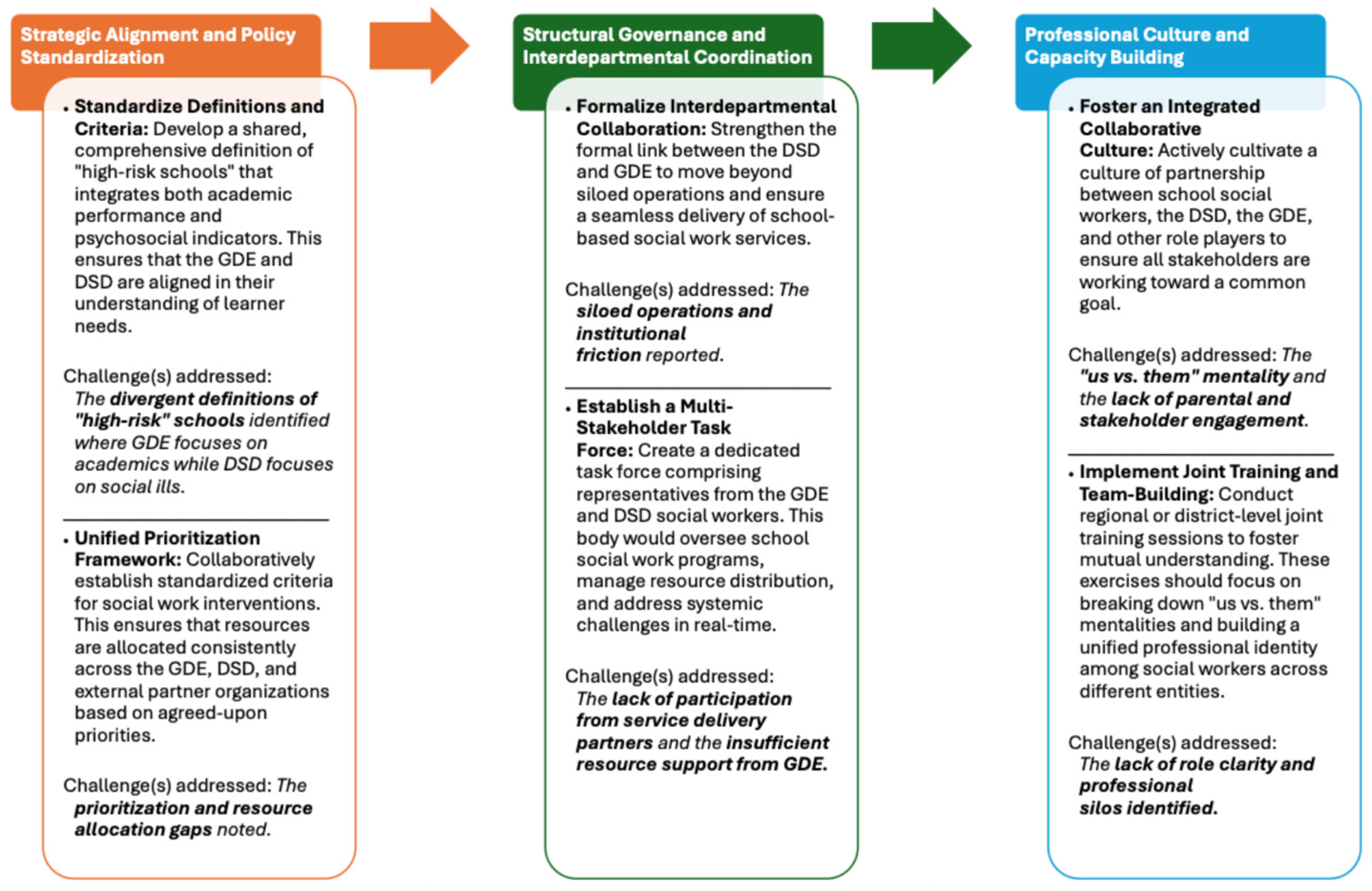
To address the coordination and collaboration challenges identified in the findings, the following recommendations to optimize school social work interventions and collaboration are categorized into three strategic pillars (see Figure 1): (i) strategic alignment and policy standardization, (ii) structural governance and interdepartmental coordination, and (iii) professional culture and capacity building. First, strategic alignment and policy standardization are operationalized through the GDE and DSD, aligning their understanding of learner needs by developing a shared, comprehensive definition of “high-risk schools” and collaboratively establishing standardized criteria for social work support in schools and with learners in need. This will ensure that services and resources are allocated consistently across the GDE, DSD, and external partner organizations based on agreed-upon priorities. Implementation indicators for this strategic pillar should include a definition of “high-risk schools” that incorporates academic performance (e.g., failure rates) and psychosocial indicators (e.g., reported child protection incidents and socioeconomic vulnerability indices). Second, structural governance and interdepartmental coordination are operationalized through formalized collaboration agreements (e.g., strengthened MOUs), the establishment of a multi-stakeholder task team with defined roles and reporting lines, and routine cross-departmental planning forums to oversee implementation, address challenges, and monitor service-delivery outcomes. The implementation of this pillar would be indicated by the establishment of joint interdepartmental committees at the provincial and district levels to monitor specific success metrics (e.g., referral turnaround time and referral success rates) and actively support school-based initiatives. Third, professional culture and capacity building are operationalized through joint training initiatives, cross-departmental team-building processes, and structured platforms for ongoing professional dialogue. The implementation of this pillar would be indicated by the rollout of prioritized training modules focusing on interprofessional role-boundary navigation, conflict resolution, and trauma-informed educational support. To monitor the shift from an “us vs. them” mentality to a unified professional identity, success would be measured by the establishment of a district-level community of practice where departments meet regularly to share knowledge, rather than just fix or respond to a crisis. Overall, these initiatives should aim to foster shared norms, clarify role expectations, and strengthen collaborative practice among SSWs, education personnel, and other significant stakeholders.
Implementation of these strategic pillars requires joint ownership by DSD and GDE, specifically at the provincial and district management levels. To promote accountability, progress should be tracked through agreed Key Performance Indicators (KPIs) such as the number of quarterly interdepartmental meetings, the rate of successfully closed cross-departmental referrals, and the development of a unified data-sharing platform. Furthermore, the effectiveness of the professional culture pillar can be assessed through annual collaborative surveys with DSD and GDE staff to monitor improvements in role clarity and reductions in reported institutional friction.
Several limitations must be considered when interpreting the study’s findings. First, the study was conducted exclusively in Gauteng province, an urban area where collaboration services investigated are provided under the MOU between DSD and GDE. Therefore, the results may not be fully transferable to school social work practice in more rural or under-resourced provinces in South Africa, or in settings with unstructured service delivery methods. Second, the participant sample was entirely female. While this reflects the gender demographics of the social work profession in South Africa, it excludes potential male perspectives on collaboration in schools. Furthermore, the findings rely solely on the perspectives of DSD-employed social workers and supervisors. The absence of data from GDE staff, teachers, parents, or learners prevents the triangulation of these findings, and the challenges reported here by the participants reflect a one-sided institutional experience. Consequently, a full interdepartmental comparison is not possible, and the collaboration challenges identified should be understood as barriers perceived through the DSD’s operational lens rather than a definitive account of interdepartmental friction. Moreover, the study is subject to potential recruitment bias and social desirability, as participants were recruited through the managers, which may have influenced who agreed to participate and encouraged responses that present departmental dynamics or collaborative efforts in a more favorable light. Despite these limitations, the study offers analytical generalizability by identifying services offered in collaboration with other stakeholders and systemic barriers that likely affect inter-departmental and multidisciplinary collaboration across similar urban school contexts.

5. Conclusions

In summary, these findings reveal that collaboration is the backbone of school social work. Whether it is ensuring a rape kit is completed within the 72 h window period, providing a food parcel to a destitute family, or preventing a suicide through referrals, the SSWs’ efficacy is directly proportional to the strength of their professional network. These partnerships ensure a holistic, 360-degree approach to learner well-being, proving that while the SSWs are the primary advocates for learners, they cannot achieve holistic intervention alone. Difficulties in coordination and collaboration pose a significant threat to the effectiveness of school social work, with common challenges including a lack of GDE support, divergent departmental goals, and parental resistance. This study, therefore, serves as a call to action for DSD and GDE department heads and policymakers to reevaluate the agreements on school social work services in Gauteng, ensuring that collaboration remains a functional and practical partnership.
To improve collaboration in school social work practice, DSD and GDE should consider the recommended three strategic pillars, which provide a structured pathway to transition from fragmented, siloed operations to a unified workforce. These pillars may also be applied in other similar contexts or in South African provinces where collaboration challenges have been noticed between SSWs, departments of social development and education, teachers, parents, and other key stakeholders. Implementing these pillars would foster role clarity and resource support, ensuring that institutional boundaries no longer hinder the delivery of essential psychosocial services. While this study highlights the perspectives of DSD social workers, the collaborative relationship is a multi-sided phenomenon. Therefore, future research should also explore in-depth the relationship between DSD and GDE to provide a more balanced institutional map of collaboration. Additionally, the research may also investigate the experiences of teachers and parents when working with SSWs to support learners.

Funding

This research was funded by the Centre for Excellence in Learning and Teaching (CELT) at Durban University of Technology, and the South African National Research Foundation (NRF), Thuthuka PhD Track, grant number TTK240418214904.

Institutional Review Board Statement

The study was conducted in accordance with the Declaration of Helsinki and approved by the Humanities and Social Sciences Research Ethics Committee of the University of KwaZulu-Natal (protocol code 00006346/2023; date: 30 October 2023).

Informed Consent Statement

Informed consent was obtained from all subjects involved in the study.

Data Availability Statement

The qualitative interview data presented in this study are not publicly available due to ethical restrictions and concerns related to participant confidentiality and privacy. However, supporting materials such as the interview guide are available from the corresponding author upon reasonable request.

Acknowledgments

The author would like to express gratitude to Nolwazi Ngcobo and Mbongeni Sithole for their research supervision during the completion of his PhD studies.

Conflicts of Interest

The author declares no conflicts of interest.

Abbreviations

The following abbreviations are used in this manuscript:
DSDDepartment of Social Development
GDEGauteng Department of Education
SGBSchool Governing Body
MOUMemorandum of Understanding

References

  1. Adelman, H. S., & Taylor, L. L. (2017). Addressing barriers to learning: In the classroom and schoolwide. University of California. Available online: https://escholarship.org/content/qt55w7b8x8/qt55w7b8x8.pdf?t=q41vn1 (accessed on 20 January 2026).
  2. Ajaero, C. K., Nzeadibe, C. T., & Igboeli, E. E. (2018). Rural-urban differences in the prevalence and predictors of depression among adolescents in South Africa. South African Journal of Child Health, 12(2b), 71. [Google Scholar] [CrossRef]
  3. Allen, S. F., & Tracy, E. M. (2004). Revitalizing the role of home visiting by school social workers. Children and Schools, 26(4), 197–208. [Google Scholar] [CrossRef]
  4. Alvi, M. (2016). A manual for selecting sampling techniques in research. Munich Personal RePEc Archive. Available online: https://mpra.ub.uni-muenchen.de/70218/1/MPRA_paper_70218.pdf (accessed on 20 January 2026).
  5. Balli, D. (2016). Role and challenges of school social workers in facilitating and supporting the inclusiveness of children with special needs in regular schools. Academicus International Scientific Journal, 14, 148–157. [Google Scholar] [CrossRef]
  6. Barboza, M., Marttila, A., Burström, B., & Kulane, A. (2021). Contributions of preventive social services in early childhood home visiting in a disadvantaged area of Sweden: The practice of the parental advisor. Qualitative Health Research, 31(8), 1380–1391. [Google Scholar] [CrossRef]
  7. Bazeley, P., & Jackson, K. (2019). Qualitative data analysis with NVivo. SAGE Publications. [Google Scholar]
  8. Beck, K. F. (2017). The diversity of school social work in Germany: A systematic review of the literature. International Journal of School Social Work, 2(1), 1. [Google Scholar] [CrossRef]
  9. BenYishay, A., Sayers, R., & Wells, J. (2024). Prevalence of school related violence in seven countries: A cross-sectional survey. PLoS ONE, 19(5), e0301833. [Google Scholar] [CrossRef] [PubMed]
  10. Berzin, S. C., O’Brien, K. H. M., Frey, A., Kelly, M. S., Alvarez, M. E., & Shaffer, G. L. (2011). Meeting the social and behavioral health needs of students: Rethinking the relationship between teachers and school social workers. Journal of School Health, 81(8), 493–501. [Google Scholar] [CrossRef]
  11. Beserra, M. A., Carlos, D. M., Da Cruz Leitão, M. N., & Ferriani, M. D. G. C. (2019). Prevalence of school violence and use of alcohol and other drugs in adolescents. Revista Latino-Americana De Enfermagem, 27, e3110. [Google Scholar] [CrossRef] [PubMed]
  12. Bolin, S. J., Rueda, H. A., & Linton, K. F. (2017). Grand challenges in school social work: Collaboration and constraint in school social workers’ sexuality support for children with disabilities. Children and Schools, 40(1), 25–34. [Google Scholar] [CrossRef]
  13. Braun, V., & Clarke, V. (2023). Toward good practice in thematic analysis: Avoiding common problems and be(com)ing a knowing researcher. International Journal of Transgender Health, 24(1), 1–6. [Google Scholar] [CrossRef]
  14. Brook, J., McDonald, T. P., & Yan, Y. (2012). An analysis of the impact of the strengthening families’ program on family reunification in child welfare. Children and Youth Services Review, 34(4), 691–695. [Google Scholar] [CrossRef]
  15. Chen, F., Wang, J., Zhang, W., Li, P., Zeng, Y., & Zou, H. (2024). The relationship between parental educational involvement and learning engagement among Chinese middle school students: The mediating effect of gratitude and hope. Behavioral Sciences, 14(8), 687. [Google Scholar] [CrossRef]
  16. Creswell, J., & Poth, C. (2017). Qualitative inquiry and research design: Choosing among five approaches. Sage. [Google Scholar]
  17. Csók, C., & Pusztai, G. (2022). Parents’ and teachers’ expectations of school social workers. Social Sciences, 11(10), 487. [Google Scholar] [CrossRef]
  18. D’Agostino, C. (2013). Collaboration as an essential school social work skill. Children and Schools, 35(4), 248–251. [Google Scholar] [CrossRef]
  19. Danielson, M. L., Claussen, A. H., Bitsko, R. H., Katz, S. M., Newsome, K., Blumberg, S. J., Kogan, M. D., & Ghandour, R. (2024). ADHD prevalence among U.S. children and adolescents in 2022: Diagnosis, severity, co-occurring disorders, and treatment. Journal of Clinical Child and Adolescent Psychology, 53(3), 343–360. [Google Scholar] [CrossRef] [PubMed]
  20. Department of Basic Education. (2014). Screening, identification, assessment and support (SIAS) policy. Government of South Africa.
  21. Department of Health & Department of Basic Education. (2012). Integrated school health policy (ISHP). Government of South Africa.
  22. Department of Social Development. (2013). Framework for social welfare services. Pretoria, South Africa: Government printer. Available online: https://socialserviceworkforce.org/wp-content/uploads/2024/03/Framework-for-Social-Welfare-Services-2013.pdf (accessed on 20 January 2026).
  23. Department of Social Development. (2019). National child care and protection policy: Working together to advance the rights of all children to care and protection. Department of Social Development, Republic of South Africa. Available online: https://www.gov.za/sites/default/files/gcis_document/202102/national-child-care-and-protection-policy.pdf (accessed on 20 January 2026).
  24. Erasmus, G., & Fourie, J. V. (2025). Over-aged learners burden school resources: An analysis of a Gauteng education district. Journal of Education, 99, 28–50. [Google Scholar] [CrossRef]
  25. Fatiregun, A., & Kumapayi, T. (2014). Prevalence and correlates of depressive symptoms among in-school adolescents in a rural district in southwest Nigeria. Journal of Adolescence, 37(2), 197–203. [Google Scholar] [CrossRef]
  26. Fulton, Y. (1997). Nurses’ views on empowerment: A critical social theory perspective. Journal of Advanced Nursing, 26(3), 529–536. [Google Scholar] [CrossRef]
  27. Gauteng Department of Social Development. (2022). GDSD Annual performance plan: 2022/23. Gauteng Department of Social Development. Available online: https://www.gpl.gov.za/wp-content/uploads/2022/05/GDSD-2022-23-APP.pdf (accessed on 20 January 2026).
  28. Ghavami, N., Thornton, B. E., & Graham, S. (2021). School police officers’ roles: The influence of social, developmental and historical contexts. Journal of Criminal Justice, 72, 101724. [Google Scholar] [CrossRef] [PubMed]
  29. Gu, X., Hassan, N. C., & Sulaiman, T. (2024). The relationship between family factors and academic achievement of junior high school students in rural China: Mediation effect of parental involvement. Behavioral Sciences, 14(3), 221. [Google Scholar] [CrossRef] [PubMed]
  30. Hall, K., & Hendricks, S. (2025). Demography of South Africa’s children. South African Child Gauge, 1, 178–183. [Google Scholar]
  31. Hurst, S., Arulogun, O. S., Owolabi, A. O., Akinyemi, R., Uvere, E., Warth, S., & Ovbiagele, B. (2015). Pretesting qualitative data collection procedures to facilitate methodological adherence and team building in Nigeria. International Journal of Qualitative Methods, 14, 53–64. [Google Scholar] [CrossRef]
  32. Islam, M. I., Khanam, R., & Kabir, E. (2020). The use of mental health services by Australian adolescents with mental disorders and suicidality: Findings from a nationwide cross-sectional survey. PLoS ONE, 15(4), e0231180. [Google Scholar] [CrossRef] [PubMed]
  33. Kelly, M. S., Frey, A., Thompson, A., Klemp, H., Alvarez, M., & Berzin, S. C. (2015). Assessing the national school social work practice model: Findings from the second national school social work survey. Social Work, 61(1), 17–28. [Google Scholar] [CrossRef]
  34. Kemp, M. (2014). The development of management guidelines for school social work in the Western Cape [Ph.D. thesis, University of the Western Cape]. [Google Scholar]
  35. Khan, F. N., Begum, M., & Imad, M. (2019). Relationship between students’ home environment and their academic achievement at secondary school LEVEL. Pakistan Journal of Distance and Online Learning, 5(2), 223–234. [Google Scholar]
  36. Khumalo, G. (2023). Exploring the psychosocial challenges of adolescent learners: Opportunities for school-based psychosocial support in public schools. The International Journal of Health Wellness and Society, 14(2), 1–19. [Google Scholar] [CrossRef]
  37. Khumalo, G., Makhakhe, N. F., & Lipholo, B. N. (2025a). A scoping review of contextual factors contributing to school violence in the Southern African Development Community (SADC) region. Youth, 5(1), 30. [Google Scholar] [CrossRef]
  38. Khumalo, G., Ngcobo, N., & Sithole, M. S. (2025b). Supporting children and their families in Gauteng public schools: The roles of school social workers. Social Sciences, 14(7), 407. [Google Scholar] [CrossRef]
  39. Khumalo, G., & Pretorius, E. (2024). Teachers and school social workers collaborating to support South African adolescents with psychosocial challenges. The International Journal of Learner Diversity and Identities, 32(1), 1–25. [Google Scholar] [CrossRef]
  40. Kim, H., & Hopkins, K. M. (2017). Child welfare workers’ home visit risks and safety experiences in the USA: A qualitative approach. International Journal of Social Work and Human Services Practice, 5(1), 1–8. [Google Scholar] [CrossRef]
  41. Kjellgren, M., Lilliehorn, S., & Markström, U. (2022). The counselling practice of school social workers in Swedish elementary schools. A focus group study. Nordic Social Work Research, 14(1), 18–31. [Google Scholar] [CrossRef]
  42. Lee, M. Y., & Greene, G. (2001). The social construction of empowerment. In Pathways to power: Readings in contextual social work practice. Allyn and Bacon. [Google Scholar]
  43. Leonardo, Z. (2009). Critical social theory: An introduction. In Race, whiteness, and education. Routledge. [Google Scholar] [CrossRef]
  44. Lesesa, D. (2022). Guidelines for social work services in high risk schools in the Gauteng province [Master’s dissertation, University of Northwest]. [Google Scholar]
  45. Li, Z., & Qiu, Z. (2018). How does family background affect children’s educational achievement? Evidence from contemporary China. The Journal of Chinese Sociology, 5(1), 13. [Google Scholar] [CrossRef]
  46. Lincoln, Y. S., & Guba, E. G. (1985). Naturalistic inquiry. SAGE. [Google Scholar]
  47. Lloyd, M. (2018). Domestic violence and education: Examining the impact of domestic violence on young children, children, and young people and the potential role of schools. Frontiers in Psychology, 9, 2094. [Google Scholar] [CrossRef]
  48. Lumadi, R. I. (2024). Impact of school violence on learner participation in South African Secondary Schools: A qualitative study. Perspectives in Education, 42(1), 39–52. [Google Scholar] [CrossRef]
  49. Mahlangu, P., Chirwa, E., Machisa, M., Sikweyiya, Y., Shai, N., & Jewkes, R. (2021). Prevalence and factors associated with experience of corporal punishment in public schools in South Africa. PLoS ONE, 16(8), e0254503. [Google Scholar] [CrossRef]
  50. Mahwai, L. P., & Ross, E. (2023). Life orientation teachers’ experiences of providing psychosocial support to high school learners in the Johannesburg West district. South African Journal of Education, 43(4), 1–10. [Google Scholar] [CrossRef]
  51. Makhalemele, T., & Nel, M. (2016). Challenges experienced by district-based support teams in the execution of their functions in a specific South African province. International Journal of Inclusive Education, 20(2), 168–184. [Google Scholar] [CrossRef]
  52. Makholwa, F., & Muleya, E. (2025). Examining the challenges faced by school social workers in selected township schools in city of Johannesburg Metropolitan municipality. TWIST, 20(2), 213–224. [Google Scholar]
  53. Marais, N. J., & Adlem, A. G. (2024). Navigating challenges: Perspectives of school-based social workers in supporting youth sexual minorities through intervention services. Child Abuse Research in South Africa, 25(2), 33–52. [Google Scholar]
  54. Masquelier, B., Hug, L., Sharrow, D., You, D., Mathers, C., Gerland, P., & Alkema, L. (2021). Global, regional, and national mortality trends in youth aged 15–24 years between 1990 and 2019: A systematic analysis. The Lancet Global Health, 9(4), e409–e417. [Google Scholar] [CrossRef]
  55. Mekonen, E. G. (2024). Pooled prevalence and associated factors of teenage pregnancy among women aged 15 to 19 years in sub-Saharan Africa: Evidence from 2019 to 2022 demographic and health survey data. Contraception and Reproductive Medicine, 9(1), 26. [Google Scholar] [CrossRef] [PubMed]
  56. Mensah, R. O., Acquah, A., & Mensah, D. Y. (2024). Investigating the impact of home factors on junior high school girls’ academic performance in peri-urban areas: A case study of Dome cluster of schools. Cogent Education, 11(1), 2329416. [Google Scholar] [CrossRef]
  57. Merga, M. K. (2019). “Fallen through the cracks”: Teachers’ perceptions of barriers faced by struggling literacy learners in secondary school. English in Education, 54(4), 371–395. [Google Scholar] [CrossRef]
  58. Mohale, D., & Mokwena, K. E. (2020). Substance use amongst high school learners in the south of Johannesburg: Is this the new norm? South African Family Practice, 62(4), a5122. [Google Scholar] [CrossRef] [PubMed]
  59. Mohasoa, I., & Mokoena, S. (2017). Factors contributing to substance (drug) abuse among male adolescents in South African public secondary schools. International Journal of Social Sciences and Humanity Studies, 9(1), 108–120. [Google Scholar]
  60. Mokgaola, I. O., Gause, G., Sehularo, L. A., Molato, B. J., Meno, O. F., & Sepeng, N. V. (2022). The status of integrating children and adolescents’ mental health care services into primary health care in South Africa: Scoping review. The Open Public Health Journal, 15(1), e187494452211240. [Google Scholar] [CrossRef]
  61. Mokwena, K. E., & Setshego, N. J. (2021). Substance abuse among high school learners in a rural education district in the Free State province, South Africa. South African Family Practice, 63(1), a5302. [Google Scholar] [CrossRef]
  62. Mosito, C., & Sitoyi, Z. M. (2024). School violence and its impact on teachers’ well-being. Perspectives in Education, 42(1), 131–147. [Google Scholar] [CrossRef]
  63. Mpanza, L. P., & Govender, S. (2022). Primary school-based support teams’ experiences and practices when supporting teachers. Multicultural Education, 8(2), 272–285. [Google Scholar] [CrossRef]
  64. Nation, A., Pacella, R., Monks, C., Mathews, B., & Meinck, F. (2023). Prevalence of violence against children in the United Kingdom: A systematic review and meta-analysis. Child Abuse and Neglect, 146, 106518. [Google Scholar] [CrossRef]
  65. Nguyen, B. T. N., Vo-Thi, T., Nguyen-Vu, N., & Tran-Chi, V. (2022). Collaboration between social workers and educational forces in schools: Advantages, objectives, content, and form. Journal for Educators Teachers and Trainers, 13(5), 170–180. [Google Scholar] [CrossRef]
  66. Ntombela, N. H., Tshuma, C., & Van Wijk, H. C. (2022). Problems experienced by school going children: A school social work perspective. Gender and Behaviour, 20(1), 18691–18706. [Google Scholar]
  67. Ochocki, S., Stalnecker, D., & Paschall, L. (2024). Home visits in school social work practice: History, best practices, and future considerations. Children and Schools, 46(3), 166–174. [Google Scholar] [CrossRef]
  68. Patterson, G. T. (2007). The role of police officers in elementary and secondary schools: Implications for police-school social work collaboration. School Social Work Journal, 31(2), 82–99. [Google Scholar]
  69. Paul, R., Rashmi, R., & Srivastava, S. (2021). Does lack of parental involvement affect school dropout among Indian adolescents? Evidence from a panel study. PLoS ONE, 16(5), e0251520. [Google Scholar] [CrossRef]
  70. Polanczyk, G. V., Salum, G. A., Sugaya, L. S., Caye, A., & Rohde, L. A. (2015). Annual research review: A meta-analysis of the worldwide prevalence of mental disorders in children and adolescents. Journal of Child Psychology and Psychiatry, 56(3), 345–365. [Google Scholar] [CrossRef] [PubMed]
  71. Pongweni, T. (2024). Teenage suicide on the rise in SA, warns Sadag—Here’s how to get help. Daily Maverick. Available online: https://www.dailymaverick.co.za/article/2024-02-16-teenage-suicide-on-the-rise-in-sa-warns-sadag-heres-how-to-get-help/ (accessed on 20 January 2026).
  72. Pretorius, E. (2020). A collaborative partnership between school social workers and educators: A vehicle to address the social contexts of learners and quality of education in South Africa. Social Work/Maatskaplike Werk, 56(2), 139–156. [Google Scholar] [CrossRef]
  73. Rashid, A. A., Cheong, A. T., Shamsuddin, N. H., Roslan, D., & Hisham Shunmugam, R. (2021). Healthcare professionals’ views for the content of the teddy bear hospital for a child sexual abuse prevention module. Journal of Child Sexual Abuse, 30(4), 442–460. [Google Scholar] [CrossRef] [PubMed]
  74. Ruth, T., & O’Connor, K. (2020). The role of social work in integrating mental health students in traditional school settings: Community care approach. Journal of Mental Health and Social Behaviour, 2(2), JMHSB-119. [Google Scholar] [CrossRef]
  75. SA Government News Agency. (2025). SA faces teenage pregnancy crisis. Government Communication and Information System (GCIS).
  76. Sahin, F. (2013, May 24–25). Social constructionism and social work: Implications for social work. The 1st International Conference on “Research and Education—Challenges Towards the Future” (ICRAE2013), Shkodër, Albania. Available online: https://konferenca.unishk.edu.al/icrae2013/icraecd2013/doc/2014.pdf (accessed on 20 January 2026).
  77. Selsky, J. W., & Parker, B. (2005). Cross-sector partnerships to address social issues: Challenges to theory and practice. Journal of Management, 31(6), 849–873. [Google Scholar] [CrossRef]
  78. Shilubane, H. N., Ruiter, R. A., Van Den Borne, B., Sewpaul, R., James, S., & Reddy, P. S. (2013). Suicide and related health risk behaviours among school learners in South Africa: Results from the 2002 and 2008 national youth risk behaviour surveys. BMC Public Health, 13(1), 926. [Google Scholar] [CrossRef]
  79. Skobi, F., & Makofane, M. (2017). Reflections of social workers on the experiences of pregnant teenagers during group work sessions. Social Work/Maatskaplike Werk, 53(2), 224–249. [Google Scholar] [CrossRef]
  80. Statistics South Africa. (2024). General household survey. Statistics South Africa. Available online: https://www.statssa.gov.za/publications/P0318/P03182024.pdf (accessed on 20 January 2026).
  81. Strydom, M. (2014). Family preservation services: Types of services rendered by social workers to at-risk families. Social Work/Maatskaplike Werk, 48(4), 435–455. [Google Scholar] [CrossRef][Green Version]
  82. Sunbal, M., & Jabeen, T. (2021). Parental involvement in children’s schooling: A case for role of school social work. Pakistan Journal of Social Research, 3(3), 234–244. [Google Scholar] [CrossRef]
  83. Thompson, A. M., Frey, A. J., & Kelly, M. S. (2018). Factors influencing school social work practice: A latent profile analysis. School Mental Health, 11(1), 129–140. [Google Scholar] [CrossRef]
  84. UNESCO. (2019). Behind the numbers: Ending school violence and bullying [Report]. United Nations Educational, Scientific and Cultural Organization. Available online: https://www.unicef.org/media/66496/file/Behind-the-Numbers.pdf (accessed on 20 January 2026).
  85. Vergottini, M., & Weyers, M. (2025). School social work in South Africa: Roles, responsibilities, and challenges in the Free State province. The Journal of Practice Teaching in Health and Social Work, 23(1), 57–75. [Google Scholar] [CrossRef]
  86. Winter, K., & Cree, V. E. (2015). Social work home visits to children and families in the UK: A Foucauldian perspective. The British Journal of Social Work, 46(5), 1175–1190. [Google Scholar] [CrossRef]
  87. Yin, R. K. (2014). Case study research design and methods. Sage. [Google Scholar]
Figure 1. Recommended strategic pillars for strengthening collaboration between school social work services and key stakeholders.
Education 16 00446 g001
Table 1. Emerged themes and subthemes.
ThemesSubthemes
Theme 1: Collaboration as a Mechanism for Holistic Intervention
  • Ensuring Safety and Child Protection
  • Addressing Socio-Economic Issues and Strengthening Families
  • Addressing Substance Use and Mental Health Challenges
Theme 2: Coordination and Collaboration Difficulties
  • Difference in Understanding High-Risk Schools
  • Lack of Support from GDE
  • Us vs. Them Mentality
  • Lack of Participation from Some Service Delivery Partners
  • Lack of Parental Support and Involvement
Disclaimer/Publisher’s Note: The statements, opinions and data contained in all publications are solely those of the individual author(s) and contributor(s) and not of MDPI and/or the editor(s). MDPI and/or the editor(s) disclaim responsibility for any injury to people or property resulting from any ideas, methods, instructions or products referred to in the content.