


“Dear Math, I’m Not a Fan of You”: Shifting Middle School Girls’ Perceptions of Mathematics

Abstract
1. Introduction
2. Materials and Methods
- What influence does participation in a five-day, out-of-school-time mathematics program have on middle school girls’ perceptions of mathematics?
- What influence does participation in a five-day, out-of-school-time mathematics program have on middle school girls’ perceptions of their relationship with mathematics?
- Dear Mathematics,
3. Results
3.1. Dominant Changes in Themes
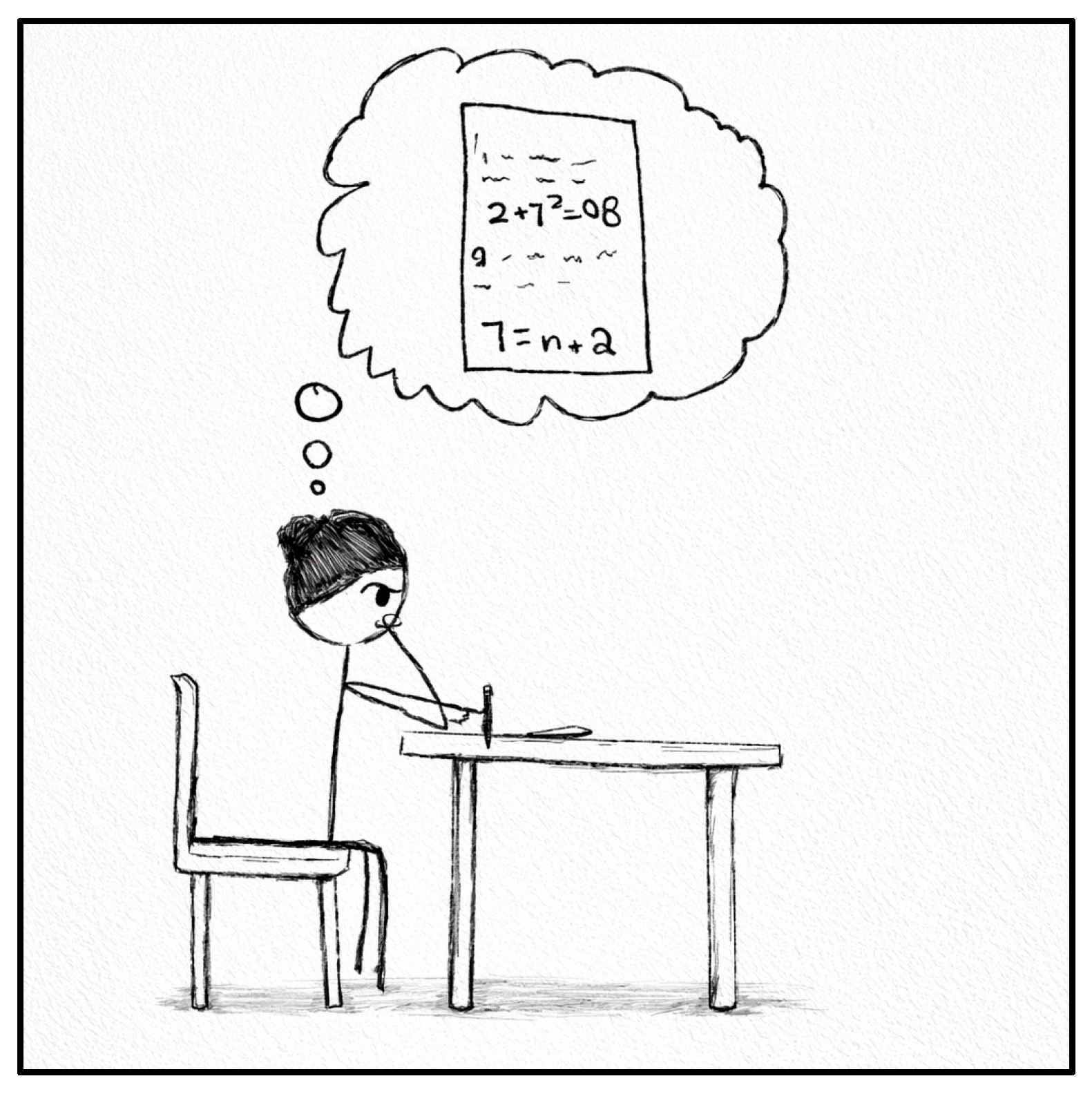
- Pre-letter and Drawing
- Dear Math,

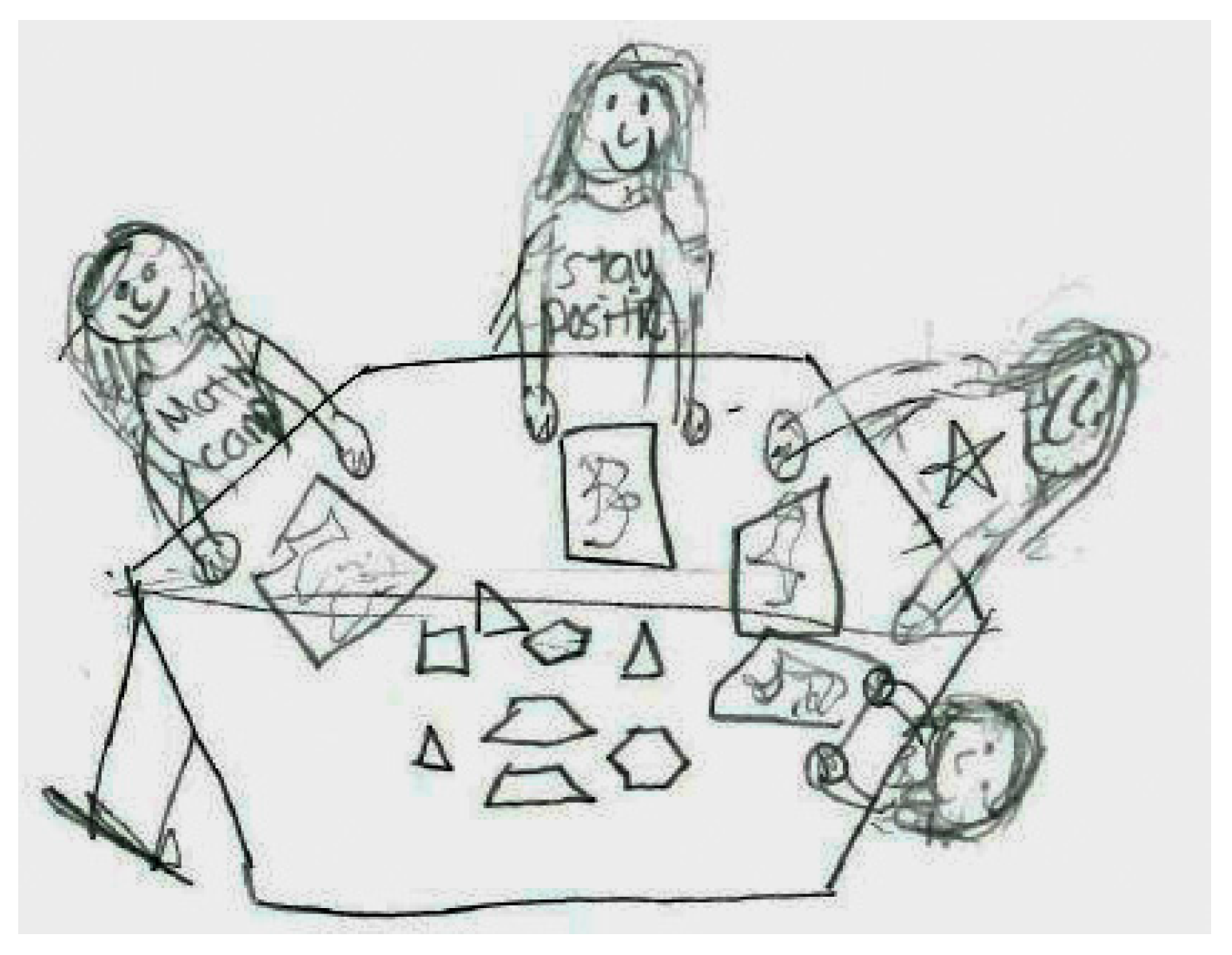
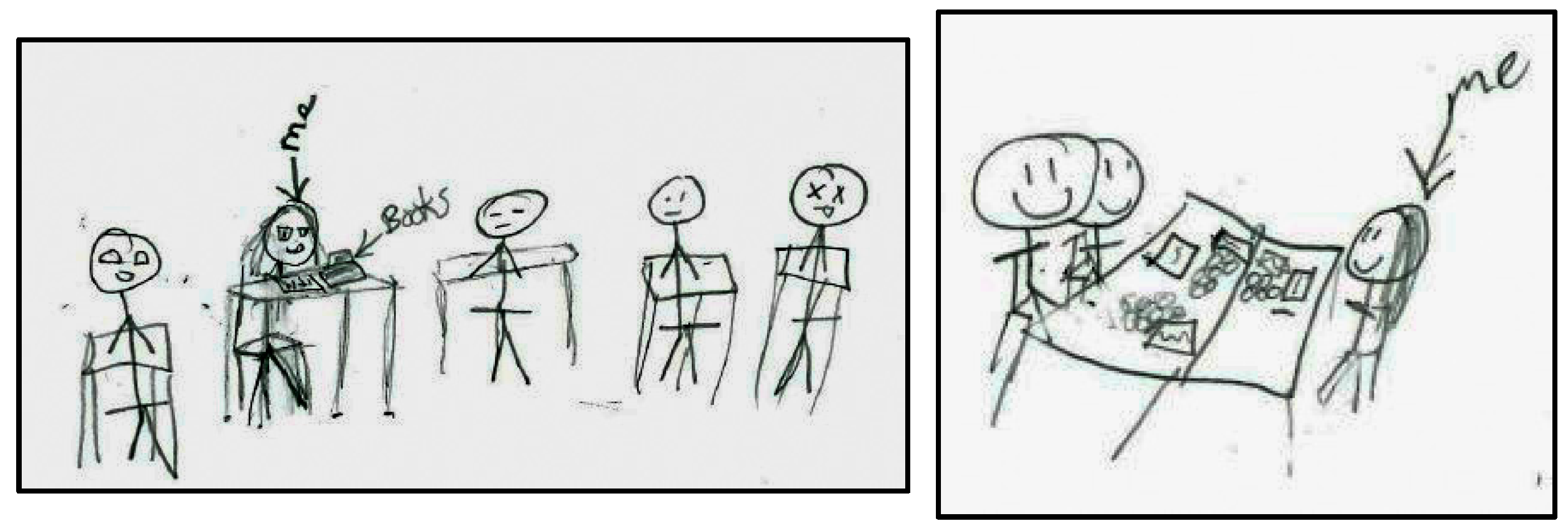
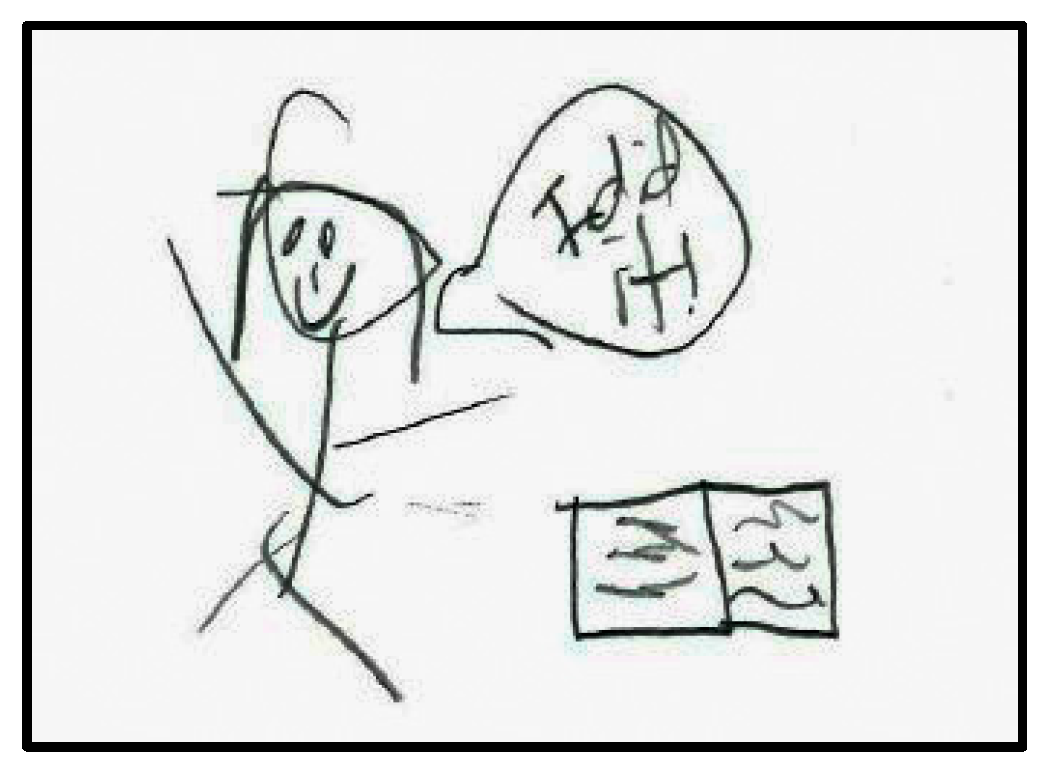
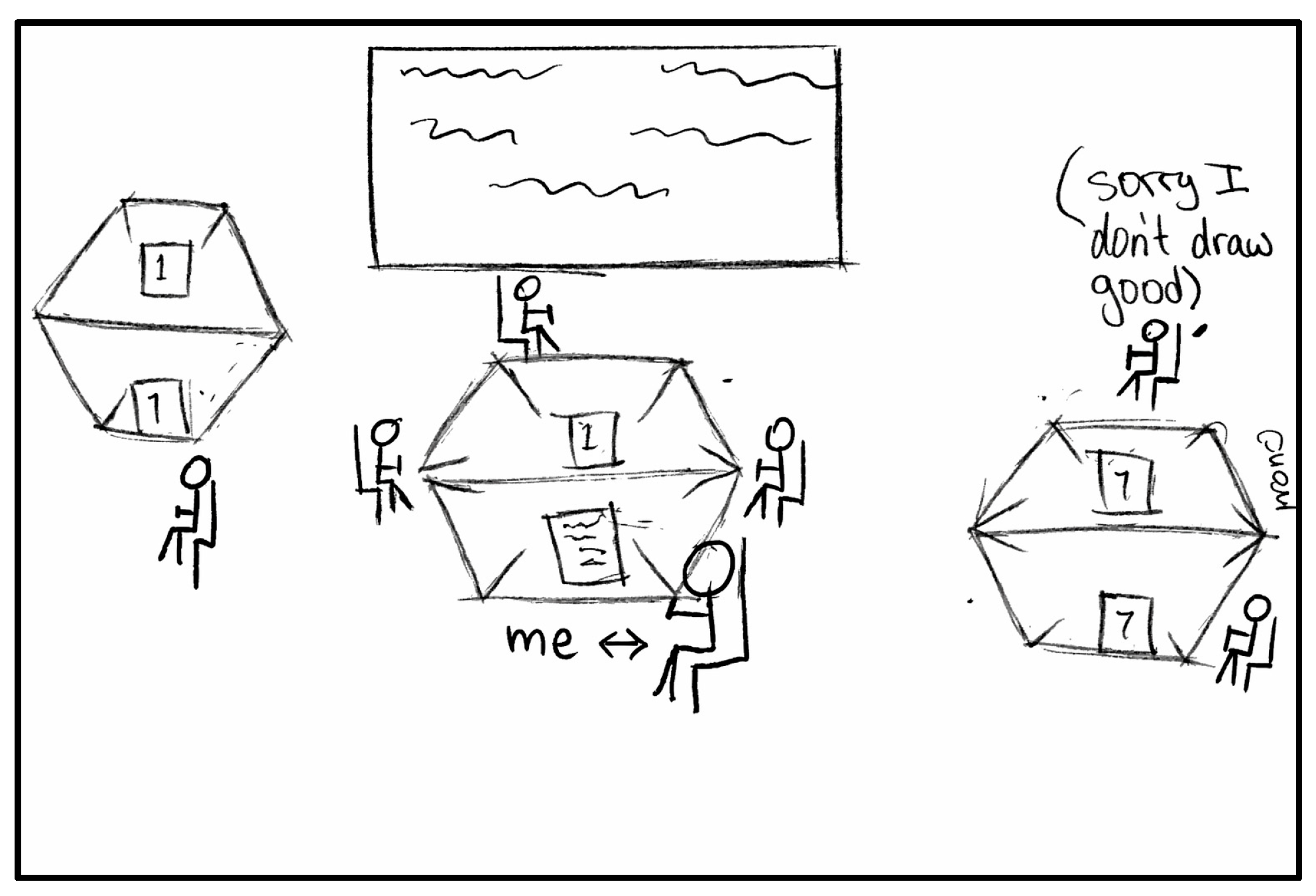
- Post-letter and Drawing
- Dear Math,
3.2. Perceptions of Mathematics
3.2.1. Math Doers and Thinkers
3.2.2. Relationship with Mathematics
3.3. Engagement in Mathematics Learning
4. Discussion
Author Contributions
Funding
Institutional Review Board Statement
Informed Consent Statement
Data Availability Statement
Conflicts of Interest
Appendix A
 Math? Has Math helped you? Has Math frustrated you? Explain to Math how you feel.
Appendix B
|
|
|
|
|
|
|
|
|
|
|
|
|
|
|
|
|
|
|
|
|
|
| Note. #16 is missing because it was a code for a tentative theme that was later combined with another. |
Appendix C
| Pre Draw | Post Draw | Change | Codes |
| 6 | 6 | 0 | 1A. Positive affect in written caption. |
| 6 | 4 | −2 | 1B. Positive affect in picture (e.g., smiling). |
| 7 | 5 | −2 | 2. Math as utilitarian (useful/practical/helpful/important) |
| 0 | 1 | 1 | 3. Expanded view of math (more modern: multiple solutions, use of learning aids, activity-oriented, spatial tasks, coding) |
| 1 | 6 | 5 | 4. Group/peer work in doing math (any work with others) |
| 1 | 2 | 1 | 5. Hands-on approach to doing math (manipulatives, constructing things, baking…) |
| 2 | 2 | 0 | 6. Math as understandable/easy/makes sense |
| 1 | 1 | 0 | 7. Math as empowering/confidence-building |
| 3 | 0 | −3 | 8. Perseverance in doing math |
| 1 | 1 | 0 | 9A. Communicative in written description(s). |
| 1 | 1 | 0 | 9B. Communicative in picture |
| 2 | 2 | 0 | 10. Good performance |
| 2 | 3 | 1 | 11. Improved performance |
| 3 | 1 | −2 | 12. Math as challenging: good |
| 3 | 2 | −1 | 13A. Negative affect in written description(s). |
| 1 | 0 | −1 | 13B. Negative affect in picture (e.g., sad, frustrated). |
| 10 | 7 | −3 | 14. Constrictive view of math (traditional: procedural, computational, symbolic, prescriptive, one approach, always right…) |
| 0 | 1 | 1 | 15. Math as confusing/hard to understand/doesn’t make sense |
| 1 | 0 | −1 | 17. Math as frustrating (inc. unexplained comment) |
| 4 | 3 | −1 | 18. Math as confusing/frustrating, but (qualifies w/ a more positive view of self or math: persevered, grew to like, teacher was bad…) |
| 9 | 5 | −4 | 19. Solitary approach to doing math (working separately in some manner) |
| 2 | 0 | −2 | 20. Teacher-oriented approach |
| 0 | 0 | 0 | 21. Poor performance |
| Pre-Letter | Post-Letter | Change | Codes |
| 35 | 28 | −7 | 1A. Positive affect in written description(s). |
| 0 | 2 | 2 | 1B. Positive affect in picture (e.g., smiling). |
| 0 | 0 | 0 | 2. Math as utilitarian (useful/practical/helpful/important) |
| 2 | 9 | 7 | 3. Expanded view of math (more modern: multiple solutions, use of learning aids, activity-oriented, spatial tasks, coding) |
| 2 | 18 | 16 | 4. Group/peer work in doing math (any work with others) |
| 1 | 4 | 3 | 5. Hands-on approach to doing math (manipulatives, constructing things, baking…) |
| 0 | 2 | 2 | 6. Math as understandable/easy/makes sense |
| 0 | 2 | 2 | 7. Math as empowering/confidence-building |
| 13 | 2 | −11 | 8. Perseverance in doing math |
| 3 | 6 | −3 | 9A. Communicative in written description(s). |
| 3 | 3 | 0 | 9B. Communicative in picture |
| 6 | 3 | −3 | 10. Good performance |
| 0 | 6 | 6 | 11. Improved performance |
| 0 | 0 | 0 | 12. Math as challenging: good |
| 0 | 0 | 0 | 13A. Negative affect in written description(s). |
| 4 | 0 | −4 | 13B. Negative affect in picture (e.g., sad, frustrated). |
| 28 | 16 | −12 | 14. “Straightforward” view of math (traditional: procedural, computational, symbolic, prescriptive, one approach, always right…) |
| 3 | 0 | −3 | 15. Math as confusing/hard to understand/doesn’t make sense |
| 0 | 0 | 0 | 17. Math as frustrating (inc. unexplained comment) |
| 1 | 1 | 0 | 18. Math as confusing/frustrating, but (qualifies w/ a more positive view of self or math: persevered, grew to like, teacher was bad…) |
| 41 | 19 | −22 | 19. Solitary approach to doing math (working separately in some manner) |
| 5 | 4 | −1 | 20. Teacher-oriented approach |
| 0 | 0 | 0 | 21. Poor performance |
| 0 | 1 | 1 | 22. View of math varies by math topic |
| 0 | 0 | 0 | 23. Expression of hope for future success in math or excitement about future math learning |
References
- Aguilar, J. J. (2021). High school students’ reasons for disliking mathematics: The intersection between teacher’s role and student’s emotions, belief and self-efficacy. International Electronic Journal of Mathematics Education, 16(3), em0658. [Google Scholar] [CrossRef] [PubMed]
- Almeda, M. V. Q., & Baker, R. S. (2020). Predicting student participation in STEM careers: The role of affect and engagement during middle school. Journal of Educational Data Mining, 12(2), 33–47. [Google Scholar] [CrossRef]
- Beroíza-Valenzuela, F. (2025). Implicit gender stereotypes in STEM: Measuring cognitive bias and group differences through reaction times. International Journal of STEM Education, 12, 20. [Google Scholar] [CrossRef]
- Black, S. E., Muller, C., Spitz-Oener, A., He, Z., Hung, K., & Warren, J. R. (2021). The importance of STEM: High school knowledge, skills and occupations in an era of growing inequality. Research Policy, 50(7), 104249. [Google Scholar] [CrossRef]
- Bohrnstedt, G. W., Zhang, J., Li, M., Ikoma, S., Park, B. J., & Broer, M. (2024). Mathematics motivation and mathematics performance: Does gender play a role? AERA Open, 10. [Google Scholar] [CrossRef]
- Bondurant, L., & McConchie, L. (2024). Drawing a positive math identity: Portrait of a math person. Mathematics Teacher: Learning and Teaching PK-12, 117(2), 115–120. [Google Scholar] [CrossRef]
- Booton, C. M. (2018). Using rich pictures to verify, contradict, or enhance verbal data. The Qualitative Report, 23(11), 2835–2849. [Google Scholar] [CrossRef]
- Broder, E. D., Fetrow, K. J., Murphy, S. M., Hoffman, J. L., & Tinghitella, R. M. (2023). STEM summer camp for girls positively affects self-efficacy. The American Biology Teacher, 85(8), 432–439. [Google Scholar] [CrossRef]
- Cappello, M., Wiseman, A. M., & Turner, J. D. (2019). Framing equitable classroom practices: Potentials of critical multimodal literacy research. Literacy Research: Theory, Method, and Practice, 68, 205–225. [Google Scholar] [CrossRef]
- Casanova, S., Vukovic, R. K., & Kieffer, M. J. (2021). Do girls pay an unequal price? Black and Latina girls’ math attitudes, math anxiety, and mathematics achievement. Journal of Applied Developmental Psychology, 73, 101256. [Google Scholar] [CrossRef]
- Ceballos, H., van den Bogaart, T., van Ginkel, S., Spandaw, J., & Drijvers, P. (2026). How collaborative problem solving promotes higher-order thinking skills: A systematic review of design features and processes. Thinking Skills and Creativity, 59, 102001. [Google Scholar] [CrossRef]
- Cvencek, D., Brecic, R., Gacesa, D., & Meltzoff, A. N. (2021). Development of math attitudes and math self-concepts: Gender differences, implicit–explicit dissociations, and relations to math achievement. Child Development, 92(5), e940–e956. [Google Scholar] [CrossRef]
- Dai, K. Z., Kuprasertkul, N., & Liu, D. (2021). FEMMES STEM program for girls. In L. R. Wiest, H. G. Crawford-Ferre, & J. E. Sanchez (Eds.), Out-of-school-time STEM programs for females: Implications for education research and practice (Vol. II: Short-Term Programs, pp. 7–29). Information Age Publishing. [Google Scholar]
- Davey, R., Bellen, L., Thai, T., & Kearney, S. (2025). Shifts in children’s mathematical identities during the first year of school. Mathematics Education Research Journal, 1–25. [Google Scholar] [CrossRef]
- Di Tommaso, M. L., Contini, D., De Rosa, D., Ferrara, F., Piazzalunga, D., & Ornella Robutti, O. (2024). Tackling the gender gap in mathematics with active learning methodologies. Economics of Education Review, 100, 102538. [Google Scholar] [CrossRef]
- Dobie, T. E. (2019). A sociocultural examination of utility value in mathematics: The role of interdependence in middle school students’ perceptions of usefulness. In M. Hannula, G. Leder, F. Morselli, M. Vollstedt, & Q. Zhang (Eds.), Affect and mathematics education: The role of interdependence in middle school students’ perceptions of usefulness (ICME-13 Monographs) (pp. 67–88). Springer. [Google Scholar] [CrossRef]
- Dong, L., Jia, X., & Fei, Y. (2023). How growth mindset influences mathematics achievements: A study of Chinese middle school students. Frontiers in Psychology, 14, 1148754. [Google Scholar] [CrossRef]
- Emerson, R. M., Fretz, R. I., & Shaw, L. L. (2011). Writing ethnographic fieldnotes (2nd ed.). The University of Chicago Press. [Google Scholar]
- Fernandez, F., Froschl, M., Lorenzetti, L., & Stimmer, M. (2024). Investigating the importance of girls’ mathematical identity within United States STEM programmes: A systematic review. International Journal of Mathematical Education in Science and Technology, 55(3), 650–690. [Google Scholar] [CrossRef]
- Freedman, G., Green, M. C., Kussman, M., Drusano, M., & Moore, M. M. (2023). “Dear future woman of STEM”: Letters of advice from women in STEM. International Journal of STEM Education, 10, 20. [Google Scholar] [CrossRef]
- González-Pérez, S., Mateos de Cabo, R., & Sáinz, M. (2020). Girls in STEM: Is it a female role-model thing? Frontiers in Psychology, 11, 564148. [Google Scholar] [CrossRef]
- Gracin, D. G., & Kuzle, A. (2018). Drawings as external representations of children’s fundamental ideas and the emotional atmosphere in geometry lessons. Center for Educational Policy Studies Journal, 8(2), 31–53. [Google Scholar] [CrossRef]
- Gutiérrez, R. (2018). The need to rehumanize mathematics. In I. Goffney, & R. Gutiérrez (Eds.), Rehumanizing mathematics for Black, indigenous, and Latinx students (pp. 1–10). National Council of Teachers of Mathematics. [Google Scholar]
- Hatisaru, V., & Murphy, C. (2019). “Creature” teachers “monster” mathematicians: Students’ views about mathematicians and their stated attitudes to mathematics. International Journal of Education in Mathematics, Science and Technologies, 7(3), 215–221. [Google Scholar]
- Heffernan, K., Peterson, S., Kaplan, A., & Newton, K. J. (2020). Intervening in student identity in mathematics education: An attempt to increase motivation to learn. International Electronic Journal of Mathematics Education, 15(3), em0597. [Google Scholar] [CrossRef]
- Hill, J. L., & Hunter, J. (2023). Examining the mathematics education values of diverse groups of students. International Journal of Mathematical Education in Science and Technology, 54(8), 1614–1633. [Google Scholar] [CrossRef]
- Hill, J. L., Kern, M. L., Seah, W. T., & van Driel, J. (2021). Feeling good and functioning well in mathematics education: Exploring students’ conceptions of mathematics well-being and values. ECNU Review of Education, 4(2), 349–375. [Google Scholar] [CrossRef]
- Huber, M., & Karaali, G. (2025). Rehumanizing mathematics. Journal of Humanistic Mathematics, 15(1), 1–3. [Google Scholar] [CrossRef]
- Hwang, S., & Son, T. (2021). Students’ attitude toward mathematics and its relationship with mathematics achievement. Journal of Education and e-Learning Research, 8(3), 272–280. [Google Scholar] [CrossRef]
- Ibrahim, Khalil, I. A., & Prahmana, R. C. I. (2024). Mathematics learning orientation: Mathematical creative thinking ability or creative disposition? Journal on Mathematics Education, 15(1), 253–276. [Google Scholar] [CrossRef]
- Jessup, N. A., Wolfe, J. A., & Kalinec-Craig, C. (2021). Rehumanizing mathematics education and building community for online learning. In K. Hollebrands, R. Anderson, & K. Oliver (Eds.), Online learning in mathematics education (pp. 95–113). Springer. [Google Scholar] [CrossRef]
- Kamid, K., Huda, N., Syafmen, W., Sufri, S., & Sofnidar, S. (2021). The relationship between students’ mathematical disposition and their learning outcomes. Journal of Education and Learning, 15(3), 376–382. [Google Scholar] [CrossRef]
- Levine, S. C., & Pantoja, N. (2021). Development of children’s math attitudes: Gender differences, key socializers, and intervention approaches. Developmental Review, 62, 100997. [Google Scholar] [CrossRef]
- Leyva, E., Walkington, C., Perera, H., & Bernacki, M. (2022). Making mathematics relevant: An examination of student interest in mathematics, interest in STEM careers, and perceived relevance. International Journal of Research in Undergraduate Mathematics Education, 8(3), 612–641. [Google Scholar] [CrossRef]
- Leyva, L. A. (2017). Unpacking the male superiority myth and masculinization of mathematics at the intersections: A review of research on gender in mathematics education. Journal for Research in Mathematics Education, 48(4), 397–433. [Google Scholar] [CrossRef]
- Li, Y., & Schoenfeld, A. H. (2019). Problematizing teaching and learning mathematics as “given” in STEM education. International Journal of STEM Education, 6, 1–13. [Google Scholar] [CrossRef]
- Martinez, A., & Christnacht, C. (2021). Women are nearly half of US. workforce but only 27% of STEM workers. United States Census Bureau. Available online: https://www.census.gov/library/stories/2021/01/women-making-gains-in-stem-occupations-but-still-underrepresented.html (accessed on 19 May 2025).
- McGuire, L. (2024). Finding your mathematical roots: Inclusion and identity development in mathematics. Journal of Humanistic Mathematics, 14(1), 4–39. [Google Scholar] [CrossRef]
- Milton, S., Sager, M., & Walkington, C. (2024). Exploring STEM identity and belonging at a summer camp. In R. Lindgren, T. Asino, E. Kyza, C.-K. Looi, D. T. Keifert, & E. Suárez (Eds.), Proceedings of the 18th international conference of the learning sciences. University at Buffalo. [Google Scholar]
- Morton, C., & Smith-Mutegi, D. (2022). Making “it” matter: Developing African-American girls and young women’s mathematics and science identities through informal STEM learning. Cultural Studies of Science Education, 17, 39–52. [Google Scholar] [CrossRef]
- National Science Board, National Center for Science and Engineering Statistics. (2024). The state of U.S. science and engineering 2024. Available online: https://ncses.nsf.gov/pubs/nsb20243/talent-u-s-and-global-stem-education-and-labor-force (accessed on 18 May 2025).
- Nweje, U., Amaka, N. S., & Makai, C. C. (2025). Women in STEM: Breaking barriers and building the future. International Journal of Science and Research Archive, 14(1), 202–217. [Google Scholar] [CrossRef]
- Okrent, A., & Burke, A. (2021, August). The STEM labor force of today: Scientists, engineers, and skilled technical workers. Available online: https://ncses.nsf.gov/pubs/nsb20212 (accessed on 20 January 2022).
- Parson, L., Steele, A., & Wilkins, E. (2021). A gendered “Ideal?” discourses that characterize the ideal scientist. International Journal of Gender, Science and Technology, 13(1), 64–85. Available online: https://genderandset.open.ac.uk/index.php/genderandset/article/view/735 (accessed on 18 May 2025).
- Piyakun, A., & Phusee-Orn, S. (2025). The roles of teachers’ beliefs and instructional practices in students’ mathematical mindset. Frontiers in Education, 10, 1480277. [Google Scholar] [CrossRef]
- Quane, K., Chinnappan, M., & Trenholm, S. (2023). Draw yourself doing mathematics: Developing an analytical tool to investigate the nature of young children’s attitudes towards mathematics. Mathematics Education Research Journal, 35, 445–473. [Google Scholar] [CrossRef]
- Radovic, D., Black, L., Williams, J., & Salas, C. E. (2018). Towards conceptual coherence in the research on mathematics learner identity: A systematic review of the literature. Educational Studies in Mathematics, 99, 21–42. [Google Scholar] [CrossRef]
- Ribeiro, J. S., Kossack, M. E., & Jeoh, T. (2021). STEM for girls: A One-day event to improve girls’ attitudes toward STEM. In L. R. Wiest, H. G. Crawford-Ferre, & J. E. Sanchez (Eds.), Out-of-school-time STEM programs for females: Implications for education research and practice (Vol. II: Short-Term Programs, pp. 51–70). Information Age Publishing. [Google Scholar]
- Rocklage, M. D., & Luttrell, A. (2021). Attitudes based on feelings: Fixed or fleeting? Psychological Science, 32(3), 364–380. [Google Scholar] [CrossRef]
- Starr, C. R., & Simpkins, S. D. (2021). High school students’ math and science gender stereotypes: Relations with their STEM outcomes and socializers’ stereotypes. Social Psychology of Education, 24, 273–298. [Google Scholar] [CrossRef]
- Suárez, M. I., Garvey, J. C., Dolan, C. V., & Shaheen, M. (2024). Exploring queer and trans students’ mathematics identity in relation to STEM as a white cisheteropatriarchal space. AERA Open, 10(1), 1–19. [Google Scholar] [CrossRef]
- Sullivan, A., & Bers, M. U. (2019). Investigating the use of robotics to increase girls’ interest in engineering during early elementary school. International Journal of Technology and Design Education, 29(5), 1033–1051. [Google Scholar] [CrossRef]
- Tal, M., Lavi, R., Reiss, S., & Dori, Y. J. (2024). Gender perspectives on role models: Insights from STEM students and professionals. Journal of Science Education and Technology, 33, 699–717. [Google Scholar] [CrossRef]
- Vos, P., Wiik, A., & Hernandez-Martinez, P. (2024). “Imagine, maths is used anywhere, and we don’t get to know this”—Upper secondary students and the relevance of advanced mathematics. Frontiers in Education, 9, 1338205. [Google Scholar] [CrossRef]
- Wang, L., Peng, F., & Song, N. (2022). The impact of students’ mathematical attitudes on intentions, behavioral engagement, and mathematical performance in the China’s context. Frontiers in Psychology, 13, 1037853. [Google Scholar] [CrossRef] [PubMed]
- Wieselmann, J. R., Roehrig, G. H., & Kim, J. N. (2020). Who succeeds in STEM? Elementary girls’ attitudes and beliefs about self and STEM. School Science and Mathematics, 120(5), 297–308. [Google Scholar] [CrossRef]
- Wiest, L. R., Crawford-Ferre, H. G., & Sanchez, J. E. (2021). Out-of-school-time STEM programs for females: Implications for education research and practice (Vol. II: Short-Term Programs). Information Age Publishing. [Google Scholar]
- Wiest, L. R., Sanchez, J. E., & Crawford-Ferre, H. G. (2017). Out-of-school-time STEM programs for females: Implications for education research and practice (Vol. I: Longer-Term Programs). Information Age Publishing. [Google Scholar]
- Wigfield, A., & Eccles, J. S. (2000). Expectancy–value theory of achievement motivation. Contemporary Educational Psychology, 25(1), 68–81. [Google Scholar] [CrossRef]
- Xu, Y. J., Yang, M., Zhang, S., & Muthukumar, V. (2024). How constructivist learning impacts secondary girls’ STEM career interests. Journal of Education and Training Studies, 12(2), 62–74. [Google Scholar] [CrossRef]



| Perception of Mathematics Codes | Letters | Drawings |
|---|---|---|
| 2. Math as utilitarian (useful/practical/helpful/important) | −13 | 0 |
| 3. Modern view of math (multiple solutions, use of learning aids, activity-oriented, noncomputational topics) | 0 | +7 |
| 6. Math as understandable/easy/makes sense (in general or a specific problem) | −6 | +2 |
| 12. Math as challenging in a good sense | −8 | 0 |
| 14. Traditional view of math (procedural, computational, symbolic, prescriptive, on approach, always right…) | −3 | −12 |
| 15. Math as confusing/hard to understand/doesn’t make sense | −1 | −3 |
| 17. Math as frustrating | −13 | 0 |
| 22. View of math varies by situation, teacher, or math topic | +2 | +1 |
| Relationships with Mathematics Codes | Letters | Drawings |
|---|---|---|
| 1. Positive affect (e.g., expressed or apparent pleasure) | 0 | −2 |
| 7. Math as empowering/confidence-building | −2 | 2 |
| 10. Good performance (as a general descriptor of oneself in math) | −2 | −3 |
| 11. Improved performance or understanding | 10 | 6 |
| 13. Negative affect (expressed or apparent sadness, boredom, etc.) | −1 | −1 |
| 17. Math as frustrating (inc. unexplained comments) | −13 | 0 |
| 21. Poor performance (as a general descriptor of oneself in math) | 0 | 0 |
| 23. Expression of hope for future success in math or excitement about future math learning (includes career aspirations) | −2 | 0 |
| Engagement with Mathematics Codes | Letters | Drawings |
|---|---|---|
| 4. Group/peer work in doing math (any work with others, presumed group work if at tables) | 3 | 16 |
| 5. Hands-on approach to doing math (manipulatives, constructing things, baking…) | 0 | 3 |
| 9. Communicative approaches (verbal interactions, speech bubbles…) | 0 | 0 |
| 18. Math as confusing/frustrating, but… (qualifies with/ a more positive view of self or math: persevered, grew to like, teacher was bad…trend towards positive) | 3 | 1 |
| 19. Solitary approach to doing math (working separately in some manner) | 0 | −22 |
| 20. Teacher-oriented approaches (looking at a teacher receptively as opposed to working with a teacher) | 0 | −1 |
Disclaimer/Publisher’s Note: The statements, opinions and data contained in all publications are solely those of the individual author(s) and contributor(s) and not of MDPI and/or the editor(s). MDPI and/or the editor(s) disclaim responsibility for any injury to people or property resulting from any ideas, methods, instructions or products referred to in the content. |
© 2026 by the authors. Licensee MDPI, Basel, Switzerland. This article is an open access article distributed under the terms and conditions of the Creative Commons Attribution (CC BY) license.
Share and Cite
Bertolone-Smith, C.; Wiest, L.R.; Crawford-Ferre, H.G. “Dear Math, I’m Not a Fan of You”: Shifting Middle School Girls’ Perceptions of Mathematics. Educ. Sci. 2026, 16, 308. https://doi.org/10.3390/educsci16020308
Bertolone-Smith C, Wiest LR, Crawford-Ferre HG. “Dear Math, I’m Not a Fan of You”: Shifting Middle School Girls’ Perceptions of Mathematics. Education Sciences. 2026; 16(2):308. https://doi.org/10.3390/educsci16020308
Chicago/Turabian StyleBertolone-Smith, Claudia, Lynda R. Wiest, and Heather Glynn Crawford-Ferre. 2026. "“Dear Math, I’m Not a Fan of You”: Shifting Middle School Girls’ Perceptions of Mathematics" Education Sciences 16, no. 2: 308. https://doi.org/10.3390/educsci16020308
APA StyleBertolone-Smith, C., Wiest, L. R., & Crawford-Ferre, H. G. (2026). “Dear Math, I’m Not a Fan of You”: Shifting Middle School Girls’ Perceptions of Mathematics. Education Sciences, 16(2), 308. https://doi.org/10.3390/educsci16020308