3.1. Quantitative Results
The quantitative results for RQ1, which interrogated about the student-teachers’ levels of engagement in the digital writing task at hand, indicated that their cognitive and behavioural engagement were high (
M = 4.67,
SD = 0.25;
M = 4.41,
SD = 0.36), whereas their emotional engagement was lower albeit still elevated (
M = 4.21,
SD = 0.46) (
Table 4).
Shapiro–Wilk tests indicated departures from normality for behavioural (
W = 0.93,
p = 0.035) and emotional engagement (
W = 0.90,
p = 0.004), whereas cognitive engagement did not significantly deviate from normality (
W = 0.94,
p = 0.053). Given the robustness of repeated-measures ANOVA to moderate normality violations and the absence of extreme outliers, parametric analyses were retained. The analysis revealed a significant main effect of engagement domain with a medium-to-large effect size (
F(2, 66) = 8.79,
p < 0.001, η
2p = 0.21), indicating substantial differences in engagement levels across domains (
Table 5).
Bonferroni-adjusted pairwise comparisons revealed that cognitive engagement was significantly higher than both behavioural engagement (
t(33) = −3.92,
p < 0.001,
dz = 0.67) and emotional engagement (
t(33) = −5.76,
p < 0.001,
dz = 0.99), with medium-to-large and large effect sizes, respectively. The difference between behavioural and emotional engagement did not reach statistical significance (
t(33) = 2.02,
p = 0.052) and was associated with a small-to-medium effect size (
dz = 0.35) (
Table 6). These pairwise results clarify the significant omnibus effect observed in the repeated-measures ANOVA, indicating that domain differences were primarily driven by higher levels of cognitive engagement.
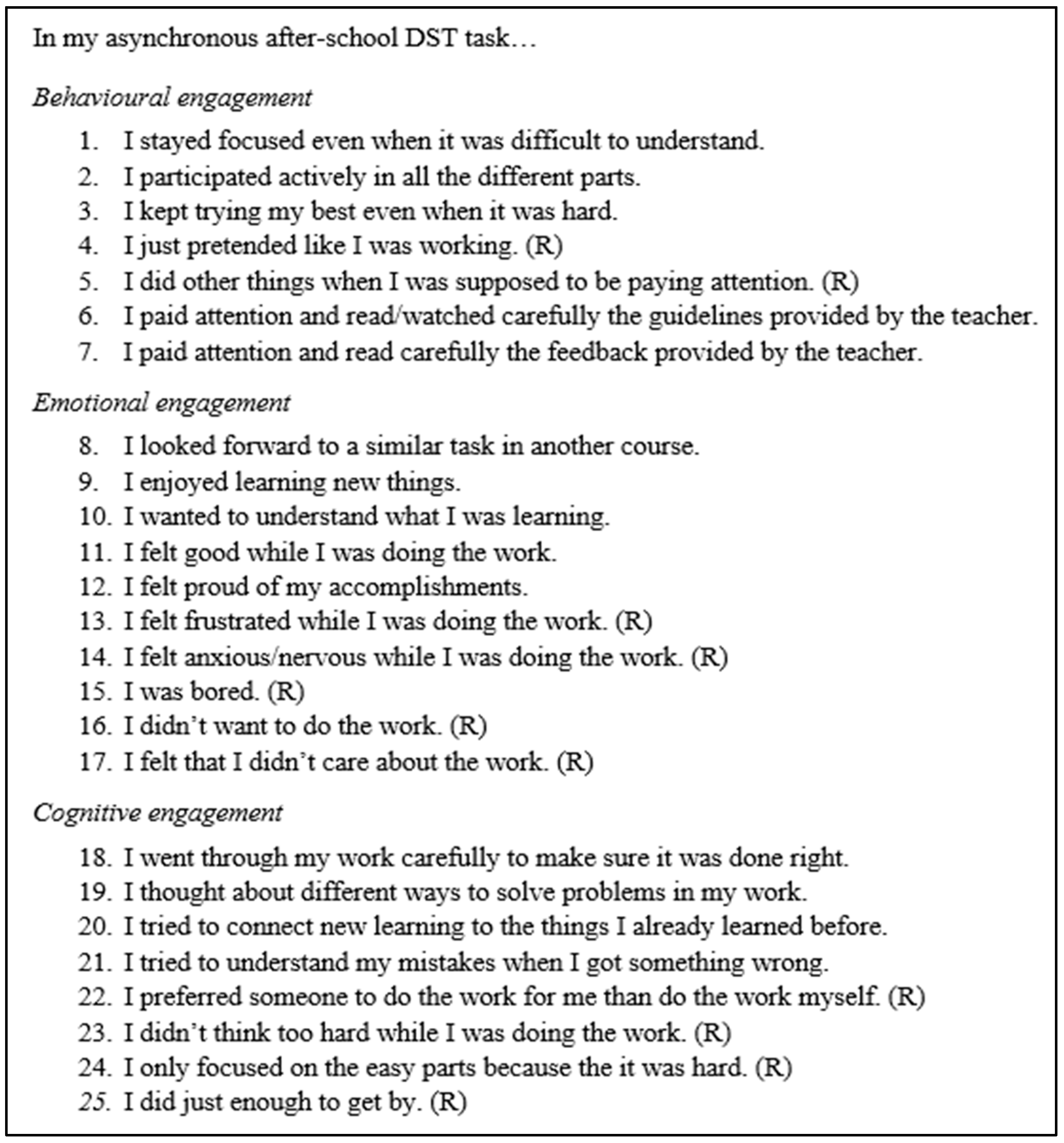
Participants attributed their behavioural engagement to their efforts to perform to the best of their ability despite difficulties (item 3;
M = 4.61;
SD = 0.49); their careful attention to the researcher’s delayed feedback (item 7;
M = 4.61;
SD = 0.60); and their active participation in all components of the task (item 2;
M = 4.58;
SD = 0.70). Reverse-coded items further indicate low levels of disengaged behaviour, such as pretending to work or attending to unrelated activities. To enhance transparency in the operationalisation of engagement dimensions, item-level descriptive statistics are reported alongside domain-level results.
Table 7 thus illustrates behavioural engagement results.
The student-teachers also reported that their levels of emotional engagement were mainly based on their desire to understand what they were learning (item 10;
M = 4.82;
SD = 0.38), which reveals their interest through their urge to learn and immerse themselves in it (see
Fredrickson, 2013). Their emotional engagement was also related to their enjoyment in what they were learning (item 9;
M = 4.64;
SD = 0.73), and how proud they felt about their achievements (item 12;
M = 4.64;
SD = 0.65) (
Table 8). Reverse-coded items further indicate low levels of disengaging emotions such as boredom, reluctance, and apathy, suggesting that participants were emotionally invested in the task. At the same time, moderate levels of challenge-related emotions, i.e., anxiety and frustration, were reported, pointing to an emotionally complex engagement profile rather than a uniformly positive affective experience.
Participants’ cognitive engagement was primarily characterised by attentive revision of their work (item 18;
M = 4.67,
SD = 0.47), efforts to understand and learn from their mistakes (item 21;
M = 4.55,
SD = 0.50), and the integration of prior knowledge with new learning during the task (item 20;
M = 4.44,
SD = 0.70) (
Table 9). High levels of cognitive engagement were further evidenced by their rejection of cognitively disengaging behaviours such as minimal-effort task completion or avoidance of the cognitively demanding parts of the task, as reflected in the high means of reverse-coded items.
3.2. Qualitative Results
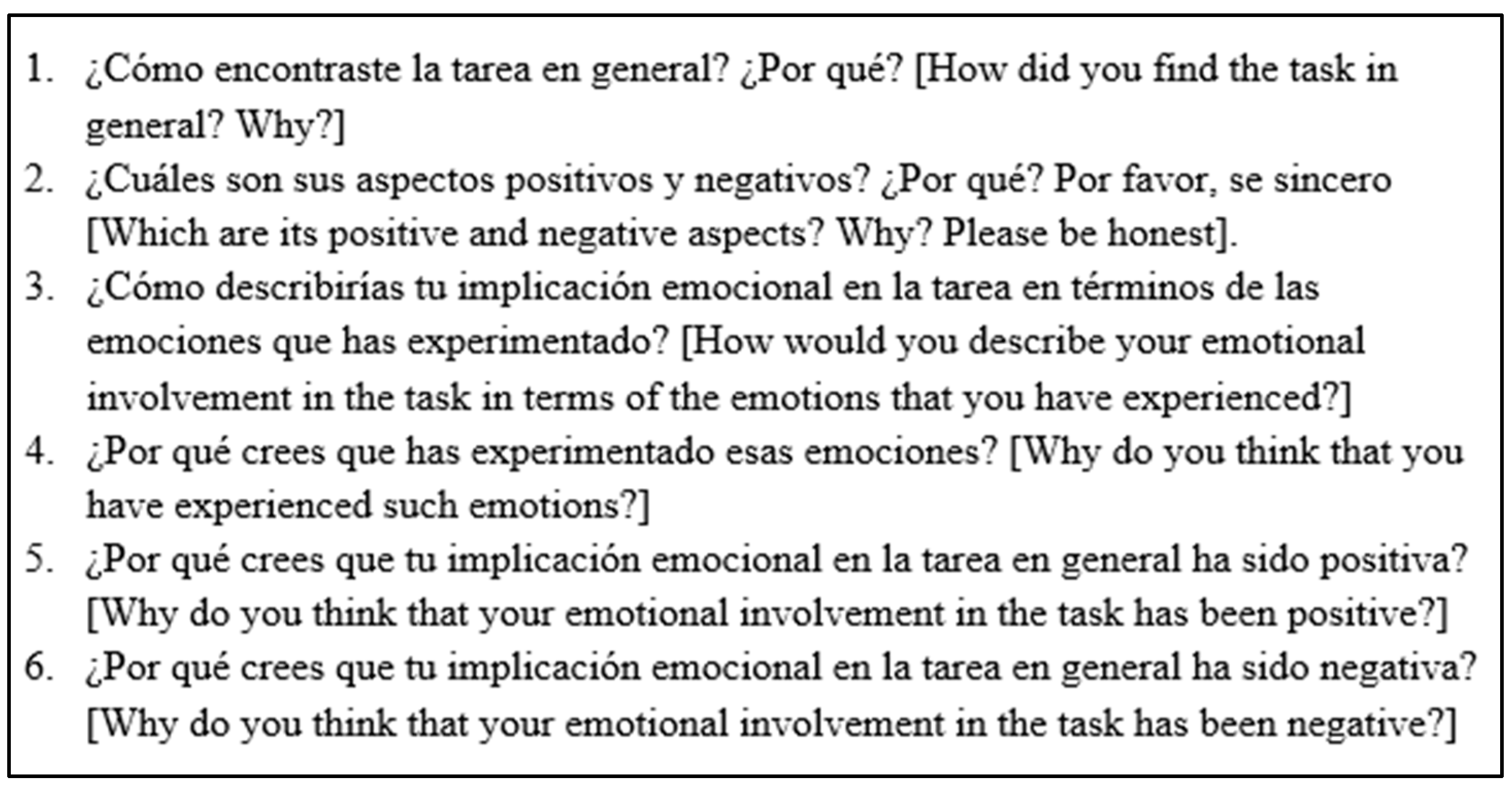
In response to RQ2, the qualitative analysis examined the features of student-teachers’ task emotional engagement in their narrated interview accounts. Fourteen emotion categories were identified (see
Table 3); however, the present section focuses on those emotions that were most salient and functionally relevant to participants’ emotional engagement, as reported in their narrations, namely enjoyment (JOY), freedom (FREE), interest (INTER), and anxiety (ANX). Other emotions such as pride, excitement and frustration showed a low incidence in participants’ depictions. Amusement, awe, gratitude, love, relief, discouragement, and sadness were identified in only one or two instances. The excerpts presented below are thus illustrative examples of recurrent patterns across the interviews rather than isolated individual experiences. Emotional engagement in the interview data was predominantly characterised by these activating positive emotions and anxiety, which functioned as an indicator of high personal investment instead of emotional disengagement. These emotions emerged from the convergence of high task value and perceived control (see
Dao, 2024;
Pekrun & Linnenbrink-García, 2012) together with the affordances of DST for multimodal self-expression (see
Oskoz & Elola, 2016a;
Oskoz, 2025). The high value attributed to the DST task stemmed from its creative and identity-oriented nature, as well as participants’ perceptions of its attainability. This perception was underpinned by a sense of control, which afforded participants autonomy over content, modes, and technological choices. All these factors contributed to the emergence of the aforementioned emotions, thereby supporting sustained emotional engagement.
Enjoyment (JOY) surfaced as one of the most frequent emotions, which participants consistently associated with their appraisals of the DST task as personally meaningful and conducive to identity work. More specifically, they related their enjoyment to the creative affordances of DST, particularly the use of multimedia elements to construct and communicate their teacher identities in an authentic manner (
García-Pastor, 2021). Therefore, enjoyment was not merely a hedonic response to task completion, but it was embedded in processes of meaning making and genuine identity expression, as suggested by certain engagement and DST research (e.g.,
Peng et al., 2024). Extract 1 illustrates this pattern:
Example 1 (IC, female, 24). Me ha encantado usar nuevas apps, páginas web, edición y fotografía para ser creativa (JOY), así que me lo he pasado muy bien en esta tarea (JOY). He podido mostrar mi pasado y las cosas en las que creo en un docente, y eso me gusta, porque he podido mostrar quien soy realmente a otras personas (JOY). (I enjoyed working with new apps, webpages, edits and photography to be creative (JOY), so I really enjoyed this task very much (JOY). I could show my past and the things that I believe in as a teacher, and I like that, because I was able to show who I really am to others (JOY).
This excerpt exemplifies the frequent emergence of enjoyment in the data, and its grounding in creative agency and authentic self-expression, two core features of DST (
Robin, 2016). Enjoyment appeared to broaden participants’ thought-action repertoires, encouraging experimentation with multimodal resources and heightened involvement in identity work (see
Fredrickson, 2013), which supported sustained emotional engagement.
Freedom (FREE) emerged as the second most commonly reported emotion in the interviews. This emotion operated as a broad affective state characterised by autonomy, choice, and control over task-related decisions (
Naderpour, 2022). Participants emphasised the freedom they experienced in selecting the content and modes of their digital stories in light of the flexibility of DST tools (
García-Pastor, 2021;
Hung, 2019;
Oskoz, 2025), and indicated that such freedom typically produced enjoyment and interest. Therefore, these positive emotions frequently co-occurred in the data, generating student-teachers’ emotional engagement as shown in Example 2:
Example 2 (CL, female, 24). Para mí ha sido un placer hacer un relato digital sobre mi identidad docente (JOY), porque me he sentido libre de elegir qué decir y cómo (FREE). (For me, making a digital story based on my teacher identity has been a pleasure (JOY), because I have felt free to choose what to say and how (FREE)).
This extract illustrates CL’s expression of freedom through explicit reference to autonomy in task decisions. Such a sense of control led her to enjoy task performance, increasing her engagement, as suggested in the engagement literature regarding autonomy and engagement (
Egbert, 2003;
Pekrun & Linnenbrink-García, 2012). These findings also resonate with DST research that emphasises learner agency and ownership as central to engagement in digital story writing (e.g.,
Bai & Xian, 2024;
Naderpour, 2022).
Interest (INTER) emerged as another salient positive emotion shaping participants’ emotional engagement. It was associated with both reflective meaning-making and audience-oriented design. Thus, it was described as arising from opportunities for self-reflection regarding one’s teacher identity, as well as from the challenge of crafting engaging multimodal narratives through the use of diverse resources. These two aspects underpinning this emotion are illustrated in Examples 3 and 4:
Example 3 (SM, female, 25). Creo que este tipo de tareas es muy interesante porque […] es agradable reflexionar con más profundidad sobre qué tipo de docentes somos o queremos ser (INTER). (I think that this type of task is very interesting because […] it is pleasant to reflect more deeply on what kind of teachers we are or we want to be (INTER)).
Example 4 (TC, male, 40). Me interesaba mucho usar distintos recursos para captar la atención de la audiencia y que estuvieran entretenidos (INTER). (I was very interested in using different resources to catch the audience’s attention and entertain them (INTER)).
Both excerpts were coded as INTER, yet they highlight complementary aspects of interest: inward-oriented reflection and outward-oriented communicative design, respectively. Whilst the learner engagement literature has commonly highlighted the introspective dimension of interest through the conceptualisation of this emotion as creating the urge to explore, learn, and immerse oneself in novelty, thereby expanding the self (
Egbert, 2003;
Fredrickson, 2013), DST research has typically underscored its outward-oriented aspect through a focus on audience awareness (
Robin, 2016).
Finally, anxiety (ANX) was the most salient negative emotion identified in the interviews; however, its functional role was not uniformly disengaging. Participants described anxiety both as a disengaging emotion that delayed task initiation and hindered video editing, as well as an engaging one linked to excitement, self-demands, and the desire to produce a high-quality digital story. Their accounts are thus consistent with
Pekrun and Linnenbrink-García’s (
2012) distinction between negative emotions that hinder engagement and those that fuel it. Example 5 illustrates anxiety as both engaging affect related to high task value and self-imposed performance standards, and disengaging affect.
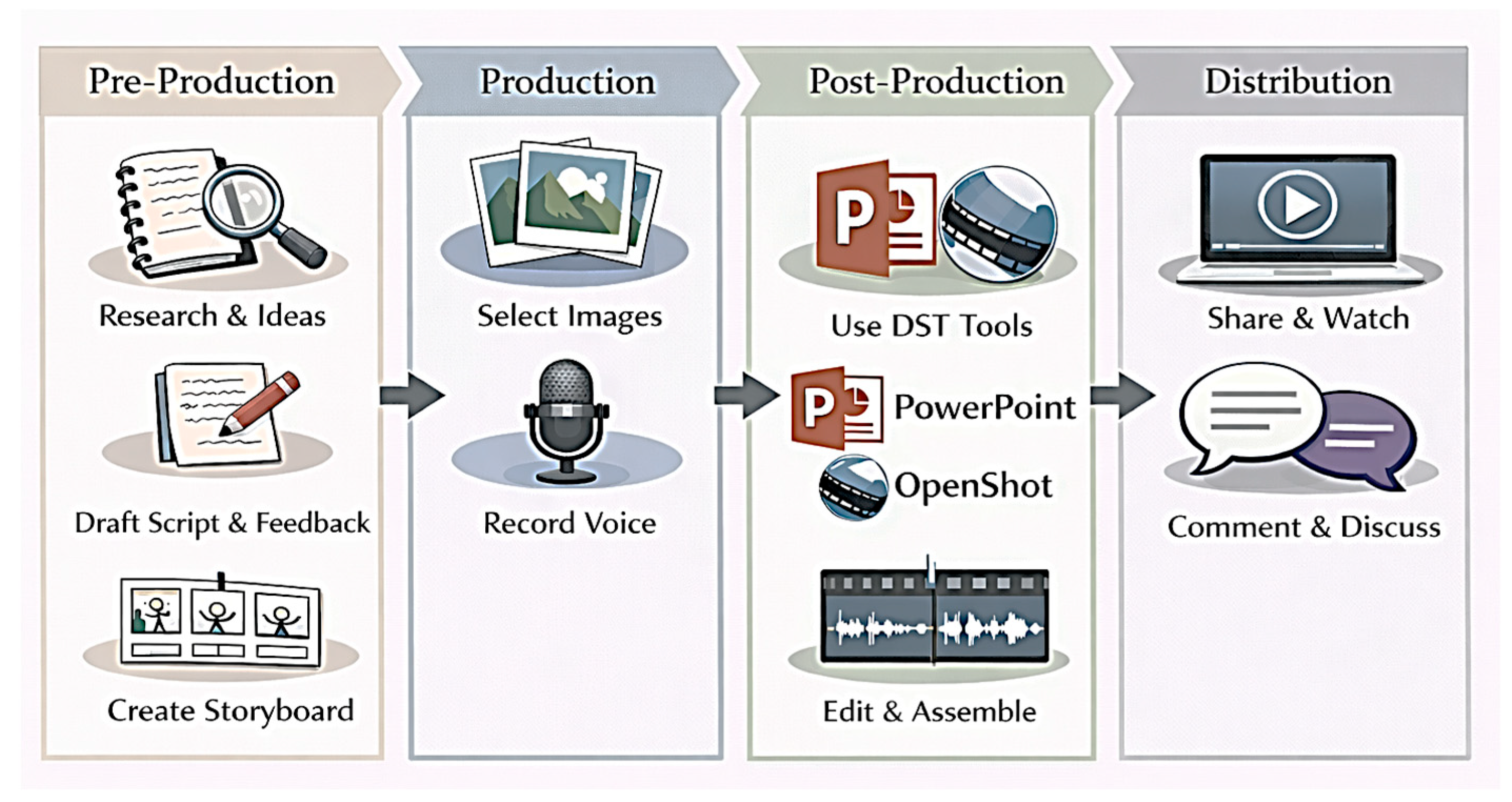
Example 5 (TC, male, 40). …hacer el video fue la parte que más me estresó, porque a veces el ordenador iba más lento y no hacía lo que querías (ANX). Así que eso me puso un poco nerviosa, porque estaba emocionada (EXC) y quería hacer un video bonito (ANX). (…video making was the most anxious part, since it was slower and sometimes the computer didn’t do what you wanted (ANX). Therefore, that made me a little nervous, because I was excited and wanted to make a nice video (ANX).
Therefore, anxiety often co-occurred with positive affect, and although temporarily disengaging, it did not undermine participants’ overall engagement, suggesting that high task value and personal investment mitigated its negative effects. This finding aligns with prior DST research showing that technical challenges that initially raise stress, ultimately support engagement and skill development (e.g.,
Chen Hsieh & Lee, 2023).
Taken together, the qualitative findings indicate that emotional engagement in the after-school asynchronous DST task was predominantly based on positive affect that was related to high task values and a sense of control in interaction with DST affordances. These appraisals promoted the use of multimodal resources and supported identity-related meaning-making, thus broadening participants’ learning experience by fostering experimentation, self-reflection, and persistence. Anxiety also played a salient but dual role, functioning both as an initial barrier and an activating emotion, also linked to task value and personal standards. These insights complement the quantitative results by clarifying the functional dynamics underlying the levels of emotional engagement observed, particularly the prominence of enjoyment and interest relative to other emotions.