1. Introduction
In 21st-century education, there is an increasing need for learning that transcends disciplinary content overload and enables students to develop a holistic and responsible view of the world. Global challenges—such as environmental crisis, digital fragmentation, social inequality, and the erosion of trust in science, art and society—demand a renewed understanding of the role of education (
Barnett-Itzhaki et al., 2025). An increasingly accepted view is that teaching should not rely solely on knowledge transmission but must foster interpretation, reflection, and ethical judgment.
In the context of global transformation processes, especially the digital and green transition accelerated by the COVID-19 pandemic, education has become a central pillar for shaping a sustainable future (
Holfelder, 2019). The 2030 Agenda for Sustainable Development emphasizes that quality education is not only a fundamental human right, but also a key driver for achieving broader sustainability goals (
UNESCO, 2021;
United Nations General Assembly [UNGA], 2015). Education enables individuals to acquire the knowledge, skills, values, and attitudes needed to address the complex environmental and social challenges of our time (
Scheie et al., 2025). In this context, integrating science and fine art into primary education is a way to cultivate a responsible worldview based not only on cognitive understanding but also on emotional and ethical engagement (
Trott et al., 2020). Interdisciplinary teaching can play a vital role in realizing this vision. The problems faced by contemporary society are complex and inherently require holistic, sustainable, and interdisciplinary solutions. According to much research (e.g.,
Beane, 1997;
Drake, 2007;
OECD, 2018a;
Vogrinc & Valenčič Zuljan, 2012), such approaches should be introduced as early as possible in education. Integrating science and fine art enables students not only to explore complex phenomena but also to express, interpret, and experience them. Scientific thinking—grounded in inquiry, observation, and explanation—and artistic expression—rooted in sensitivity, intuition, and esthetic reflection—complement each other in such a learning environment and together contribute to understanding both the natural world and contemporary society. Fine art allows students to make sense of scientific concepts through creative representations, while science provides structure, tools, and methodologies for investigating real-world phenomena.
Theoretical framework
Interdisciplinary Teaching as a Holistic Approach
Due to the nature of this paper, it is first necessary to outline the theoretical framework of interdisciplinary or integrated teaching. The research presented here considers integration as a pedagogical response to the complexity of the contemporary world. These complexities are not only cognitive and disciplinary but also reflect global sustainability challenges. As emphasized by
Rieckmann (
2018), education for sustainable development requires integrated approaches that enable learners to connect ecological, social, and technological dimensions of reality. Interdisciplinary teaching thus becomes not only a didactic necessity but also a vital pathway toward fostering sustainability competences in young learners (
Wiek et al., 2011).
In the context of elementary education, curriculum integration is conceptualized as a method of planning and implementing teaching and learning across several levels—including integration of concepts, skills, processes, and themes (
Burnaford et al., 2007;
Duh, 2011;
W. E. Eisner & Day, 2004;
Fogarty, 2009;
Beane, 1997;
Vogrinc & Valenčič Zuljan, 2012). These levels of integration guide the selection of appropriate instructional models.
Fogarty (
2009), for example, outlines ten curriculum integration models: fragmented, connected, nested, sequenced, shared, webbed, threaded, integrated, immersed, and networked. Each model reflects a specific way of bridging content areas and structuring learning experiences.
Each application of an interdisciplinary model must be grounded in sound pedagogical reasoning. The first rationale for exploring interdisciplinary teaching is its increasing recognition as a didactic necessity in contemporary education. Research such as
Bransford et al. (
2000),
Drake (
2007), and
Živkovič (
2012) emphasizes that today’s society and educational goals demand more connected and functional knowledge. Moreover, interdisciplinary learning is frequently highlighted as a curricular objective in educational policy documents (e.g.,
OECD, 2018a,
2018b;
UNESCO, 2017;
Ministrstvo za Šolstvo in Šport [Ministry of Education, Science and Sport], 2011). Current reviews of STEAM in primary schools report positive effects on attitudes, knowledge, and skills, reinforcing the case for integration as a curricular priority (
Amanova et al., 2025;
Yim et al., 2024).
Interdisciplinary teaching also emphasizes the role of process-based learning (e.g.,
Bereiter & Scardamalia, 2006;
Illeris, 2007;
Kolb, 1984), problem-solving (
Bransford et al., 2000;
OECD, 2018a;
Vygotsky, 1978), and the integration of diverse modes of thinking (
Dewey, 1938;
Gardner, 1983;
E. W. Eisner, 2002). As noted by
Illeris (
2007),
Fullan and Langworthy (
2014), and
OECD (
2018b), 21st-century education must be rooted in learning processes rather than knowledge transmission, as access to information is increasingly facilitated by technology. Nevertheless, this does not diminish the importance of content knowledge, which remains one of the three core dimensions of key competences (
OECD, 2003;
Rychen & Salganik, 2001).
Problem-solving, including inquiry-based learning, is central to both science and art education and is considered essential for developing key competences (
Yim et al., 2024;
OECD, 2003,
2018b;
European Commission, 2006;
Krek & Metljak, 2011;
Rychen & Salganik, 2003). In primary settings, integrating art within science teaching operationalizes process-based and inquiry-driven learning (
Thu et al., 2024) and is perceived by pupils themselves as meaningful and engaging (
Cook et al., 2025). Diverse modes of thinking support flexible problem engagement and multiple solution paths. However, these paths are effective only when connected into a meaningful whole that responds coherently to the problem posed (
Dewey, 1933;
Bransford et al., 2000;
Gardner, 1999;
Fischer et al., 2005). Interdisciplinary instruction explicitly promotes such integration and cannot be successful without it (
Beane, 1997;
Drake & Burns, 2004;
Fogarty, 2009;
Yim et al., 2024;
Živkovič, 2012).
At this point, it is important to distinguish between the integration of thinking and the integration of content, as these represent two distinct dimensions of interdisciplinary teaching that are often amalgamated in practice but clearly differentiated in theory.
Integration of thinking refers to the coordination of various cognitive processes such as analytical and synthetic thinking, logical and creative reasoning, verbal and visual processing, and reflection and expression. The goal is to support students in engaging multiple cognitive domains in parallel or alternation, leading to deep, holistic understanding. For instance, a student might explore a scientific phenomenon (e.g., water pollution), analyze data, and then create a visual message that reflects the societal impact and emotional resonance of the issue (
Dewey, 1933;
E. W. Eisner, 2002;
Gardner, 1999;
Kolb, 1984).
Integration of content, by contrast, involves connecting topics, concepts, and learning goals across disciplines—such as science, fine art, and language arts—under a unifying theme (e.g., water, sustainability, energy), often through project-based or thematic instruction. Such themes are also central in sustainability education, where connecting concepts across subjects allows learners to understand interdependencies between people and ecosystems (
Kostova & Atasoy, 2008). For example, water can be studied scientifically as a natural resource, represented artistically as a symbol of life, and discussed socially as part of sustainable consumption and responsibility toward future generations.
The aim is for students to identify conceptual links across subjects and build a coherent model of the world. For example, students might learn about the properties of water in science, depict water phenomena in fine art, and write poems about water in language class (
Beane, 1997;
Drake, 2007;
Fogarty, 2009;
Živkovič, 2012)—thereby engaging with sustainability as both a scientific concept and a cultural value.
Recent Slovenian research with primary teachers underscores both the integration of thinking (in the sense used in this article) and content integration between science and fine art (
Potočnik et al., 2022). This distinction serves to support the argument that the MITSFA model developed in this study incorporates not only content integration but also metacognitive and esthetic–reflective integration of thinking, which constitutes a key contribution of the model.
Beyond the emphasis on process- and problem-oriented learning and the integration of cognitive modalities, much research underscores the importance of interdisciplinary teaching in cultivating higher-order competencies such as critical thinking, creativity, responsibility, and collaboration (e.g.,
Beghetto & Kaufman, 2010;
Drake & Burns, 2004;
E. W. Eisner, 2002;
Fullan & Langworthy, 2014;
OECD, 2018a).
These complex competencies are among the core objectives of contemporary education strategies—both in Slovenia (e.g.,
Krek & Metljak, 2011;
Ministrstvo za Vzgojo in Izobraževanje [Ministry of Education], 2022;
Ministrstvo za Šolstvo in Šport [Ministry of Education, Science and Sport], 2011) and internationally (e.g.,
European Council, 2018;
OECD, 2018b;
UNESCO, 2017;
World Economic Forum, 2020).
Finally, interdisciplinary models that are grounded in the aforementioned principles offer a practical pedagogical response to these strategic visions and operational goals in education. We emphasize once more that the global challenges of our time—environmental, societal, and technological—do not respect disciplinary boundaries, whether from the perspective of school subjects or professional fields. This is particularly relevant in the context of sustainability, which by definition transcends disciplinary boundaries and calls for systemic, long-term solutions (
Rieckmann, 2018). Interdisciplinary teaching offers learners the opportunity to critically examine sustainability issues through interconnected forms of inquiry and expression. Therefore, they must be addressed in an integrated and holistic manner.
Scientific and Visual Literacy: Parallel Pathways to Understanding the World
Scientific and fine art competencies can be understood as complementary dimensions of how learners engage with and make sense of reality. In the following section, this idea is developed and substantiated through theoretical framing.
Scientific Competencies
Scientific competence is commonly defined as the ability to understand scientific concepts, processes, and methods; apply them to real-world contexts; identify key issues; draw evidence-based conclusions; and develop a reflective stance toward science and scientific issues (e.g.,
OECD, 2006,
2018a;
Bybee, 1997;
European Commission, 2006;
Roberts, 2007). These competencies are closely linked to inquiry, experimentation, observation, and reasoning. Scientific literacy plays a vital role in fostering explanatory and inferential thinking as well as rational judgment (
OECD, 2018a;
Driver et al., 1994;
Klopfer, 1973), and therefore represents an overlapping concept to the construct of competences.
Fine Art Competencies
According to
Tacol (
2003), fine art competence comprises a combination of visual knowledge, (manual) skills, and affective orientation (viewpoint). Within the MITSFA model developed in this study, the term “attitude toward fine art” was used as a more comprehensive alternative to merely referring to a viewpoint, aligning with key competency frameworks (
OECD, 2003;
Rychen & Salganik, 2001) and more recent definitions of competencies in the field of fine art (
Glaser-Henzer, 2013). In general, this competence refers to the ability to perceive, interpret, and create visual messages, along with a developed sensitivity to issues and professional fields related to art in a broader social and cultural context. It is associated with esthetic sensitivity, symbolic thinking, reflection, and emotional expression (e.g.,
E. W. Eisner, 2002;
Winner et al., 2013). Furthermore, it is important to highlight that the process of artistic creation serves not only as a technical endeavor but also as a way to construct meaning and take a position toward the world (
E. W. Eisner, 2002;
Freedman, 2003;
Rolling, 2010). This supports the relevance of including “attitude to fine art” as the third component of visual competence, in addition to knowledge and skills.
Shared Dimensions
Both sets of competences provide learners with distinct but complementary perspectives on the world. In a thoughtfully designed learning environment, one domain can support the development of the other: scientific content can serve as a foundation for artistic interpretation, and conversely, artistic expression can deepen scientific understanding (
Thu et al., 2024). Together, they create a multi-dimensional experience that engages both cognition and emotion. This supports the notion that scientific and artistic ways of thinking—although different—are compatible modes of expression and inquiry (
Uştu et al., 2022;
E. W. Eisner, 2002;
Root-Bernstein & Root-Bernstein, 1999;
Mayer, 2001). With appropriate didactic support, they enable an integrated and enriched learning experience (
Yim et al., 2024;
OECD, 2018b).
Critical Thinking, Creativity, and Sustainability Orientation in Education
It is also relevant to consider the relationship between the development of critical thinking, creativity, and sustainability orientation—three dimensions increasingly emphasized in the goals of 21st-century education (e.g.,
OECD, 2018b;
European Council, 2018;
UNESCO, 2017;
Fullan & Langworthy, 2014;
Trilling & Fadel, 2009). The concept of sustainability itself has evolved significantly since the 1980s, when it was initially focused mainly on ecological concerns and later expanded to include social and economic dimensions (
Baker, 2006;
Barnett-Itzhaki et al., 2025). Today, it is increasingly understood as a dynamic balance between human needs and the carrying capacity of ecosystems, emphasizing long-term responsibility for future generations (
UNESCO, 2017;
Veidemane, 2022). Although definitions of critical thinking vary across sources, many authors agree on some core elements. Critical thinking is commonly understood as reasoned judgment grounded in evidence, reflection, and the ability to consider multiple perspectives (e.g.,
Facione, 1990;
Ennis, 1987). Recent reviews within Education for Sustainable Development also document the conceptual diversity and classroom enactment of critical thinking (
Felix et al., 2025). Similarly, creativity—while distinct—is often viewed as complementary to critical thinking. Creativity is characterized as intentional activity occurring in specific contexts, where the outcome is not necessarily a tangible product but a meaningful cognitive or expressive process (e.g.,
Guilford, 1967;
Torrance, 1974;
Runco & Jaeger, 2012;
Craft, 2005;
Kampylis & Valtanen, 2010).
Both critical thinking and creativity become more impactful when exercised in alignment with an individual’s value system or when contributing to the development of such a system (
Facione, 1990;
Paul & Elder, 2020;
Craft, 2005;
UNESCO, 2015). One of the central aims of education for a better future is to foster a sustainability orientation (
UNESCO, 2017;
OECD, 2018b;
United Nations General Assembly [UNGA], 2015). In this context, sustainability orientation refers to a value-based, affective, and ethical attitude toward nature, society, and the future (
UNESCO, 2017;
Sterling, 2001;
Wals, 2010). Complementing this idea, we suggest that sustainability orientation can be particularly stable and effective when developed alongside critical thinking and creativity, as also proposed by
Vare and Scott (
2007),
Tilbury (
2011), and
Nolet (
2015).
In line with the concept of holistic and interdisciplinary development of scientific and fine art competencies, educational approaches that integrate inquiry (science) and creation (fine art) can foster student engagement, understanding of complex systems, and the articulation of personal perspectives (
Thu et al., 2024;
Uştu et al., 2022;
Yim et al., 2024). One key finding from the primary research supporting this paper is the importance of emotional engagement and personal relevance in achieving long-term learning effects. This is consistent with
Illeris’s (
2007) assertion that emotional and motivational factors are essential for sustainable and transformative learning. Such transformative learning is closely tied to sustainability competences, which require not only knowledge but also the capacity for ethical judgment, systemic thinking, and responsible action in everyday life (
Kostova & Atasoy, 2008). By linking scientific inquiry with artistic creation, students are encouraged to reflect on their relationship with the natural and social environment and to imagine a more sustainable way of life.
In conclusion, visual interpretation can act as a “bridge” between abstract information and internal ethical reflection. In this way, connecting science and fine art enables the development of evaluative judgment, critical awareness, and engaged action.
The research problem addressed in this study is the lack of interdisciplinary approaches in primary education that holistically connect science and fine art to cultivate sustainability competences. The central research question is how the integration of scientific inquiry and artistic expression through the MITSFA teaching model can deepen students’ understanding of complex phenomena, stimulate critical and creative thinking, and foster environmental and social responsibility as essential dimensions of education for sustainable development. According to the research problem, the following research questions were developed:
Through what processes does an interdisciplinary science–fine art model (MITSFA) cultivate learners’ higher-order thinking given the domain-specific affordances of each subject?
How and in what ways does the MITSFA model enrich students’ learning experiences and foster sustainability competencies?
Which aspects of the teacher’s role most noticeably mediate students’ engagement, higher-order thinking, and sustainability competencies within the model, and through what classroom mechanisms?
2. Materials and Methods
The study was based on the model of participatory action research (PAR), which connects theoretical approaches with teaching practice (
Eilks & Ralle, 2002;
Stokols, 2006;
Vogrinc, 2008). The paper draws on empirical data from an extended action research study conducted over multiple teaching cycles, based on the interdisciplinary teaching model MITSFA developed during the project. It focuses on specific learning activities and student artworks in which the integration of scientific exploration and visual creation supported the development of understanding, values, and readiness for action. It highlights the didactic potential of linking science and fine art to cultivate students’ holistic literacy and active engagement.
Sample
The study was conducted in a Slovenian primary school during the 2022/2023 academic year. The participants were one class of fifth-grade students (21), aged between 10 and 11 years. All students took part in five consecutive participatory action research cycles, implemented through the MITSFA interdisciplinary teaching model.
Instruments
The findings presented in this paper are based on three categories of empirical data: the teacher-researcher’s reflective journals (including direct observations and notes based on video recordings during task implementation and students’ responses), students’ visual artworks, and written and oral student reflections.
The teacher-researcher’s journals represented the primary data source. These entries were recorded systematically after each instructional unit and at the end of each PAR cycle. Given their volume, the notes were methodologically processed. As previously mentioned, they included direct classroom observations and notes based on video recordings, student reactions, and reflective notes written after each intervention.
The visual artworks were created in two ways, in line with the interdisciplinary character of the instructional model used in the action research: (1) as part of the learning process—serving as an introduction, response to, or mode of communicating scientific content—or (2) as final products submitted during the assessment of fine art competencies. The scientific content spanned the following five thematic areas: nutrition and health, matter and its properties, water and air, soil, and environmental protection.
Written and oral reflections were collected either (1) during the implementation of the MITSFA model or (2) in the evaluation phase through semi-structured interviews and short written responses from students. The first type of reflection was gathered informally during the activities themselves, as students were encouraged to assess their predictions, respond to artworks, and articulate their evolving understanding in real time.
The semi-structured interviews were conducted with selected students at the end of each PAR cycle, providing longitudinal insight into their cognitive and emotional development over time and, at the same time, contributing to an understanding of the context of the perceived changes in the research. The following examples represent two questions taken from the interviews conducted at the end of the final (fifth) PAR cycle. These questions were aimed at exploring students’ emotional responses to their own scientific findings and their personal sense of agency in relation to environmental and societal issues:
Q12: How did you feel when we discussed the results of the mini research project on the presence of microplastics in cosmetic products your family uses? How did you feel at that moment when you understood the meaning of the data collected?
Q13: What is your perceived role as an individual in society?
Research design
The research was conducted in a primary school located in a part of the city characterized by a high concentration of immigrant populations. A significant proportion of the students come from non-Slovene-speaking backgrounds, and the overall proficiency in the Slovene language across the student population was low. The school context was further shaped by a pronounced socio-economic disparity between students—some came from families with very limited financial and cultural resources, while others came from families with high socio-economic status (SES). These contextual characteristics were not seen merely as background factors but as relevant elements informing the design and implementation of the teaching model. In line with the research’s participatory and inclusive orientation, priority was given to the voices of students and the benefit to the community; academic outputs were treated as secondary, arising organically from shared processes and interests.
PAR was therefore selected as the most appropriate methodology for the following reasons: it enables the direct involvement of practitioners, allows for continuous model adjustment, bridges theory and practice, and supports the development of both student and teacher competencies. In this research, the roles of teacher and researcher were combined, with ongoing collaboration between the author and supervisors from both subject areas.
In line with the principles of participatory action research (PAR), the design phase should follow the “audiences–products–provocations” framework (
Fine & Torre, 2008), ensuring that findings would be communicated across different stakeholder groups. Dissemination outputs included an extended academic report, a policy brief for decision-makers, a toolbox for practitioners, and materials for the school community (e.g., exhibitions in situ, a digital gallery of student work, and implementation of selected activities across other classes). Each product was tailored to its intended audience and linked to relevant dissemination channels.
Provocation was conceptualized not as disruption for its own sake, but as a thoughtful challenge to established educational norms—including conventional lesson structure and disciplinary separation. Particular attention was paid to anonymity, feedback loops, and ethical authorship. Participants had the opportunity to review outputs, and interview summaries were validated in dialog with interviewees. In accordance with
Freire’s (
1982) notion of praxis, research questions and activities were developed collaboratively with participants during the research process.
The MITSFA model was developed from theoretical foundations in the didactics of science and fine art, contemporary motivational theories, and approaches that emphasize transdisciplinarity and sustainability orientation. MITSFA is a cyclical pedagogical design that integrates inquiry-based science learning with creative visual expression to foster conceptual understanding, emotional engagement, and sustainability-oriented values. MITSFA connects scientific investigation, esthetic reflection, and student agency through iterative phases of observation, experimentation, dialog, visual interpretation, and public sharing of work.
It represents a pedagogical approach that systematically integrates scientific inquiry with fine art expression in a unified instructional framework. Grounded in constructivist learning theory and participatory action research, the model is designed to promote both subject-specific competencies (scientific and artistic literacy) and transversal capacities such as critical thinking, creativity, ethical reflection, and sustainability awareness.
In practical terms, MITSFA functions as a dynamic cycle of experiential learning where students investigate natural phenomena through scientific observation and experimentation, and subsequently engage in artistic interpretation to process, communicate, and reflect upon their findings. The model emphasizes both conceptual integration (shared themes and problems across disciplines) and cognitive–affective integration (bridging rational analysis with emotional and symbolic expression). Learning tasks are designed to be open-ended, dialogic, and situated in real-world environmental and societal contexts.
The term “cognitive–affective integration” is used in this article to denote an approach that simultaneously engages students’ analytical reasoning (cognition) and their emotional, ethical, and esthetic engagement (affect). Although not consistently labeled as such in the existing literature, this conceptual synthesis builds on theories emphasizing the interplay between thought and emotion in learning (
Illeris, 2007;
E. W. Eisner, 2002;
Gardner, 1999). In the context of interdisciplinary teaching, this integration supports both deeper understanding and the development of personal meaning.
While the MITSFA model shares similarities with interdisciplinary frameworks such as STEM and STEAM, it extends beyond them in several ways. First, it places equal epistemological weight on scientific and artistic ways of knowing, not merely as complementary tools, but as co-constructive modes of understanding. Second, unlike many STEM/STEAM implementations that remain project-based but product-oriented, MITSFA emphasizes the reflective process, esthetic exploration, and personal meaning-making as core pedagogical aims. Lastly, the model is embedded in a sustained, iterative research framework (PAR), which allows for continuous refinement of practice based on student feedback, classroom observations, and teacher reflection.
This nuanced focus enables MITSFA to function not just as a didactic method, but as a framework for shaping holistic educational experiences that engage learners intellectually, emotionally, and ethically.
According to the typology of interdisciplinary teaching models by
Fogarty (
2009), the implemented model was primarily “integrated” and “immersed”, although certain elements also aligned with the “threaded” model. The integrated model combines multiple subject areas where overlapping concepts emerge, while the immersed connects past experiences and knowledge with new information. Meanwhile, the threaded model emphasizes the development of general skills through individual subject domains. The MITSFA model was thus designed to develop shared skills, concepts, and attitudes in a unified, authentic instructional framework, while subject-specific competencies were developed through accompanying activities. This ensured comprehensive curricular alignment and fulfillment of subject-specific learning standards. The focus of the research included science and fine art competences, learning motivation, attitudes toward the subjects, and classroom climate.
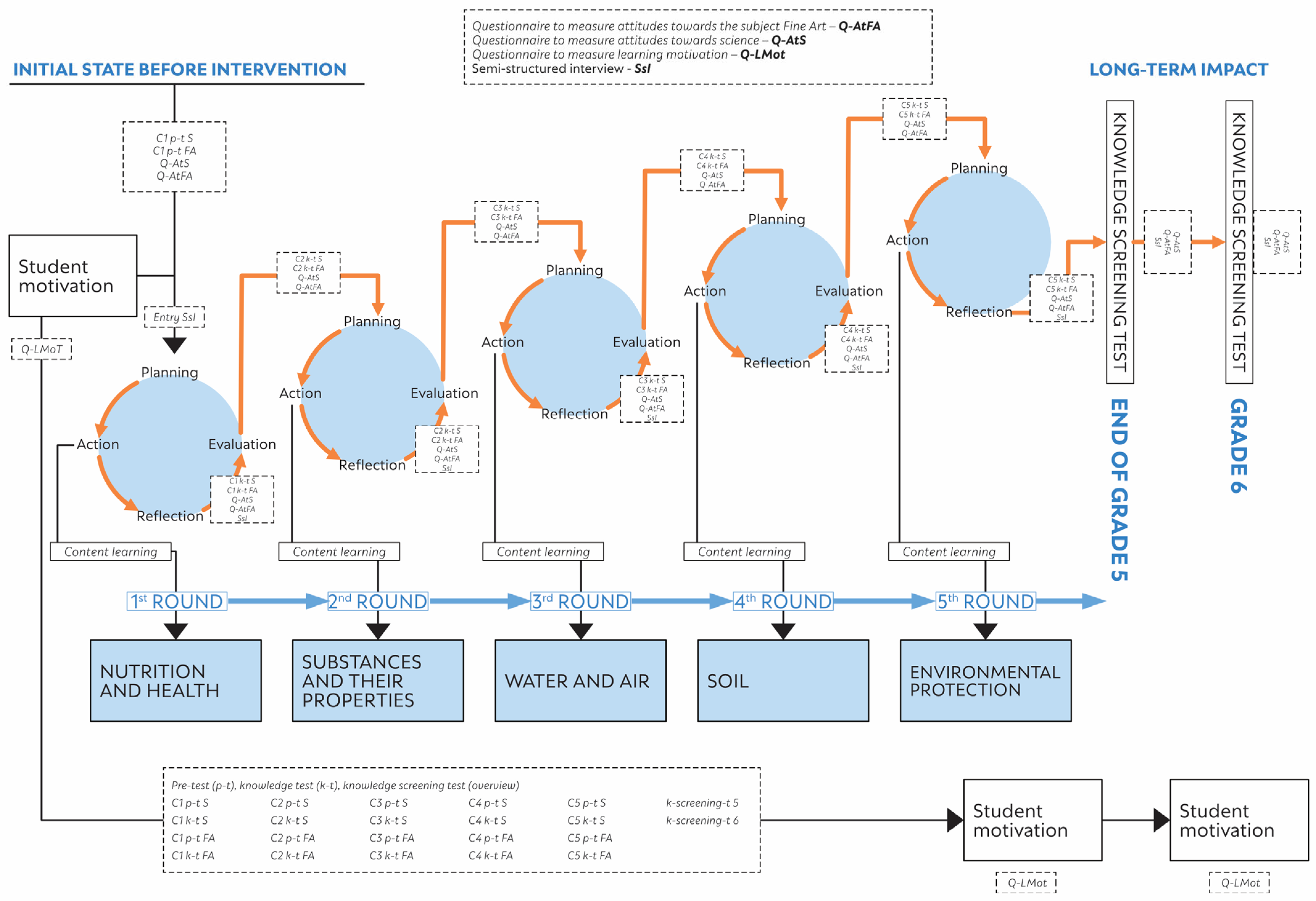
The research that this study is based on was conducted in five cycles during the 2022/2023 academic year, each comprising four phases: planning, implementation, reflection, and evaluation (
Figure 1). Prior to the first cycle, an entry-level analysis was conducted using knowledge assessments, questionnaires, and interviews. Based on this data, learner profiles were constructed, and activities were planned in accordance with the integrated interdisciplinary model (
Fogarty, 2009), ensuring both conceptual and procedural integration of science and art content.
Throughout the cycles, instruction was delivered exclusively through the MITSFA model, allowing clear observation of its effects. Each cycle involved data collection via teacher journals, video recordings, student products, knowledge assessments, questionnaires, and interviews. These data informed iterative adaptations of the model and guided the planning of subsequent cycles. The final (fifth) cycle was completed in June 2023, followed by a post-intervention analysis three weeks later. It included measuring the same parameters as the entry-level analysis—knowledge assessments, questionnaires, and interviews (as shown in
Figure 1). Data from PAR were selected following specific criteria and analyzed accordingly.
The selected combination of visual artworks, written, and oral reflective data is particularly well-suited for investigating the intersection between scientific and esthetic modes of thinking. As noted in the theoretical framework, visual interpretation can function as a bridge between abstract information and inner ethical reflection at the moment of knowledge acquisition. Moreover, this approach enables a natural connection between data collection and the cultivation of students’ capacities for evaluation, judgment, and engaged action. One of the key advantages of this data collection approach is its organic integration into the learning process—the data obtained during the implementation of the MITSFA were not artificially extracted but emerged as a natural outcome of authentic classroom instruction.
The research was therefore conceived as a way of exploring more meaningful approaches to teaching and learning, grounded in contemporary pedagogical frameworks and responsive to the specific challenges of the school context. The school’s policy actively supported such work by allowing the implementation of the model in a pilot classroom and encouraging the sharing of experiences with other teaching staff. This institutional openness created space for developing new solutions to address some of the pressing issues the school was facing, particularly those related to inclusion, equity, and differentiated learning support on one hand and the introduction of new pedagogical solutions into practice on the other.
Selection Criteria
Given the scope of the action research, which was conducted over five cycles across more than eight months (with intervals between cycles), a substantial amount of data was collected. It was therefore necessary to establish appropriate selection criteria for each data type. The primary criterion was to select activities, artworks, and records that best demonstrated and substantiated the intersection between science and fine arts.
Selection Criteria for Teaching Activities from the Reflective Journal
Two additional criteria were applied to the selection of teaching activities from the teacher-researcher’s reflective journal:
- (1)
Inclusion of examples from at least two to three different science topics;
- (2)
Inclusion of components that allowed for reflection and expression regarding personal, social, or environmental responsibility.
Selection Criteria for Students’ Visual Artworks
Further criteria for selecting students’ visual artworks were as follows:
- (1)
Emphasis on tasks that clearly demonstrated a connection between scientific inquiry and visual interpretation;
- (2)
Tasks that contextually enabled and successfully elicited a level of critical thinking and student creativity;
- (3)
Representation of a range of topics (e.g., sustainability, pollution, water);
- (4)
Artworks reflected varying levels of complexity and engagement;
- (5)
Visual tasks that enabled expression through different forms of visual communication.
Selection Criteria for Written and Oral Reflections
The selection of student written and oral reflections was guided by the following criteria:
- (1)
Articulation of a personal stance on the topic;
- (2)
Reflection on the role and meaning of visual expression;
- (3)
Connection to scientific understanding;
- (4)
Emotional response and level of engagement (e.g., in the final PAR cycle or in tasks related to environmental themes).
Analytical Procedure
The selected sample represents a purposive analytical sample, which does not aim for quantitative generalizability. Given the nature of the study, the analysis was qualitative in character, with the goal of gaining a deeper understanding of the learning process and its effects (e.g.,
Creswell & Poth, 2018;
Denzin & Lincoln, 2017;
Patton, 2002;
Sagadin, 1991). Student artworks were analyzed based on the following dimensions: (1) content relevance and connection to the scientific theme; (2) expression of attitude (ethical, emotional, critical components); and (3) use of visual elements to convey meaning. Reflections and interviews were analyzed using thematic content analysis along the following lines: (1) identification of attitudes toward science, fine art, the environment, and society; (2) evidence of metacognitive insight (awareness of learning processes); and (3) expressions of responsibility, belonging, and engagement.
To support triangulation, individual examples were contextualized with corresponding observations from the teacher’s journal (e.g., students’ reactions during creation, comments during presentations).
All data were collected with informed consent from the students’ parents, school principal, and the participating students. All students had the opportunity to withdraw from the study at any stage. To ensure student privacy, all data were anonymized using codes and descriptive identifiers. Ethical approval for this research was obtained from the Ethics Committee of the Faculty of Education, University of Ljubljana.