
Systematic Review

Reconceptualizing Quality Teaching: Insights Based on a Systematic Literature Review
Teacher Education Department, Shaanan College of Education, Haifa 2640007, Israel
Educ. Sci. 2026, 16(1), 37; https://doi.org/10.3390/educsci16010037 (registering DOI)
Submission received: 15 November 2025 / Revised: 18 December 2025 / Accepted: 24 December 2025 / Published: 27 December 2025
(This article belongs to the Special Issue Teacher Effectiveness, Student Success and Pedagogic Innovation)

Abstract

Quality Teaching is essential for preparing learners for the 21st century. This study proposes a conceptual framework for Quality Teaching embedded in three domains, identifying its focuses and characteristics. We address two questions: What are the focuses of the literature describing Quality Teaching? What are the main characteristics of Quality Teaching in the three domains? A systematic literature review involving 152 articles published between 2000 and 2025, based on the PRISMA guidelines, was conducted to identify key characteristics and theoretical constructs regarding three focuses: teachers, learners, and the education system. The thematic analysis yielded 740 themes related to Quality Teaching. Over half of the themes were related to pedagogy, approximately a quarter to technology, and less than a fifth to social–emotional learning/teaching (SEL/SET). The results suggest that Quality Teaching involves quality pedagogy and high-level socio-emotional proficiency. Professionalization in digital learning technologies also contributes positively to advancing Quality Teaching. Therefore, Quality Teaching requires ongoing training leading to high proficiency in skills, methods, and practices. This study outlines essential components for teacher education and professional development programs. Its novelty lies in systematically highlighting both the distinctive and integrative combined contributions of three professional domains—pedagogy, SEL/SET, and technology—to the enhancement of Quality Teaching in educational systems (focuses), narrowing the gap between theory and practice.

1. Introduction

This article summarizes a broad literature review conducted to characterize and conceptualize Quality Teaching (QT). Global technological innovations have impacted teaching and learning, and the need for distance teaching/learning has arisen following the COVID-19 epidemic (Fortus et al., 2023; Khong et al., 2022), followed by the breakthrough of Generative Artificial Intelligence—GAI (Ruiz Viruel et al., 2025; Singh et al., 2025). Questions have arisen regarding ways to leverage global technological changes toward QT, adapted to learners’ current needs (Fortus et al., 2023; Rao & Mokhtar, 2023).
A review of the literature revealed that there are diverse definitions of QT in the 21st century, and there is no unequivocal agreement on its components (Kim et al., 2019). Nevertheless, the concept of QT and its components must be defined consistently (Cochran-Smith, 2021; Kim et al., 2019). Therefore, this study proposes a conceptual framework for QT embedded in three domains, identifying its focuses and revealing its characteristics. Furthermore, the review suggests that relatively few empirical studies have examined the combined consideration of technology, SEL/SET, and pedagogical practices within a single analytical framework, pointing to the relevance of further investigation of this topic.
The research questions are as follows: (1) What are the focuses of the literature describing QT? (2) What are the main characteristics of QT in the three domains?

Context and Implications

This study views Quality Teaching as combining pedagogy, technology, and social–emotional teaching skills, focusing on three levels: the learners, the teachers, and the system. Furthermore, Quality Teaching promotes the skills of 21st century learners at school and work, in line with the principles of Education 4.0. Redefining Quality Teaching through pedagogy, technology, and socio-emotional teaching skills is based on the premise that the broad knowledge of an expert teacher combines an understanding of content knowledge and pedagogical knowledge, focusing on responding to learners’ social, emotional, and academic needs in the rapidly changing world of the 21st century. Practitioners, policy-makers, and educational researchers should design a professional development program to effectively implement and enhance Quality Teaching, considering the distinctive and integrative combined contributions of the three professional domains of teaching: pedagogy, socio-emotional learning/teaching, and technology. One of the essential components of this process is providing teachers with different forms of support (modeling, coaching, and expert support) while incorporating active learning, reflecting real-world classroom situations. Additionally, programs should include teacher group discussions focusing on real-life cases and practices as a means for problem-solving. This will initiate and support peer collaboration. Continuous reflection on the role of technology in teaching and education is also necessary.

2. Literature Review

2.1. Quality Teaching

In the literature, when referring to the person in their role as a teacher, “teacher quality” is considered a dynamic concept, including traits and skills such as “an effective teacher”, “teaching excellence”, and “teacher evaluation” (Sriyanto et al., 2020; Trott, 2020). In studies dealing with personality traits and their impacts on the learning process, QT also comes to the fore. These definitions conceptualize teaching as a multidimensional profession combining academic and pedagogical components (Smith, 2021; Snoek, 2021; Zagni et al., 2025). An additional multidimensional construct includes cognitive aspects—knowledge, skills, and beliefs—as well as the moral and ethical aspects related to teaching (González-Pérez & Ramírez-Montoya, 2022).
In the 21st century, the concept of QT has become an integral part of the international educational discourse. There is increasing recognition that a teacher’s professional, pedagogical, and disciplinary knowledge significantly influences the quality of student learning (Arega & Hunde, 2025; Vembye et al., 2024). Each stage of industrial development has required educational systems to adapt to its distinctive characteristics. The first three industrial revolutions gave rise to distinct educational paradigms: Education 1.0 (teacher-centered and based on frontal instruction), Education 2.0 (integrating peer assessment while maintaining teacher centrality), and Education 3.0 (collaborative and student-centered learning). Today, the concept of Education 4.0 is emerging, grounded in advanced technologies and diverse learning environments, to equip learners in meeting the demands of the Industry 4.0 labor market (Steadman & Ellis, 2021; Tikhonova & Raitskaya, 2023).
Therefore, it is not surprising that the focus on QT is becoming the guideline for improving schools’ academic success. This comes with the understanding that QT is a national resource requiring political investment and international coordination, especially considering the transition from an industrial knowledge economy to a global one in the 21st century (Cochran-Smith, 2021; Darling-Hammond & Sykes, 2003; Steadman & Ellis, 2021; Yang et al., 2018), an environment that strongly leans on technological knowledge (Z. Cai et al., 2023; Sanusi et al., 2023). The Organization for Economic Cooperation and Development (OECD) encourages research into teacher effectiveness, as well as the question of whether transparency and accountability promote planning and design and strengthen the legitimacy of the teaching profession (OECD, 2019), thus ensuring QT (Gloppen, 2023). Recognizing this impact, organizations (such as the OECD) have put the quality of teaching and teacher education on their agenda through initiatives such as the PISA tests since 2000, encouraging their member countries to re-examine their policies regarding these issues. Teachers and the quality of their teaching are the main factors determining students’ academic achievements, which will determine the quality of their country’s workforce in the future and, as a result, a nation’s ability to successfully compete in the global economy. The McKinsey Commission’s assertion that the quality of an education system cannot exceed the quality of its teachers (Barber & Mourshed, 2007; Seitzer, 2023) demonstrates that there is a need for global academic standards determining advanced cognitive skills, a competent and effective teaching force, quality training, and professional development (Cochran-Smith, 2021; Darling-Hammond & Sykes, 2003; Dutse et al., 2014).

2.2. Components of QT Adapted to the Framework of Education 4.0

The Education 4.0 model is adapted to the Fourth Industrial Revolution era, combining innovative pedagogy, advanced technologies, and the development of social–emotional skills. It aims to prepare learners for a complex, global, and rapidly changing digital world by fostering complex reasoning, creativity, independent learning, problem-solving, and innovation. This approach is grounded in the four dimensions of learning—knowledge, skills, character, and meta-learning—and is implemented in diverse physical and online learning environments, using active teaching strategies; advanced technological infrastructures; and collaboration among students, teachers, and administrators. It emphasizes personalization, lifelong learning, and the connection between theoretical knowledge and practical application (González-Pérez & Ramírez-Montoya, 2022; Tikhonova & Raitskaya, 2023).
In our review of the literature on teaching 21st century skills, we found that three essential elements of QT contribute to the development of learners with skills adapted to the needs of our changing world, both for the needs of learning in the present and their future careers (Eisenberg & Zlibansky Eden, 2019; Nir et al., 2016; Van Laar et al., 2017). The literature positions these domains as mutually reinforcing, providing active, learner-centered approaches, rooted in constructivist principles (Arega & Hunde, 2025). This review suggests that the definition of QT should include expertise in three domains: pedagogy, social–emotional learning (SEL) and teaching (SET) skills, and digital technologies for teaching/learning.
From the perspective of the pedagogical domain, QT is defined as competence in the pedagogical practices of teaching and learning, in addition to mastery of cognitive components in which humans have a relative advantage over machines in constructing significant knowledge that may increase metacognitive awareness (directed self-esteem and self-regulation of both teachers and students). Such cognitive components include, among other things, teaching practices such as disciplinary content knowledge (DCK) and pedagogical content knowledge (PCK). These are applied in pedagogical and methodological ways and means through which content will be learned (Anderson & Taner, 2023; González-Pérez & Ramírez-Montoya, 2022; Großmann & Krüger, 2024; Kaiser et al., 2017).
The literature emphasizes the importance of incorporating active pedagogies, such as project-based learning, inquiry, problem-solving, and collaborative learning, to develop higher-order thinking skills, including critical thinking, creative thinking, and self-regulated learning. These strategies are supported by intentional pedagogical planning that focuses on authentic tasks and active learner engagement. In addition, the continuous processes of feedback and assessment are essential to supporting personalized learning. These approaches are grounded in the principles of modern pedagogy, as defined within the framework of Education 4.0 (Carter et al., 2024; De Pro Chereguini & Ponce Gea, 2021; Hoffmann & Koifman, 2013; Tikhonova & Raitskaya, 2023; Wieman, 2019).
The social–emotional domain includes soft life skills that contribute to intrapersonal conduct in a changing world (Gates & Curwood, 2023). Soft skills include interpersonal abilities and personal traits, effective communication, and adaptability to change. Active learning methods, such as discussions and teamwork, are effective in developing these skills and contribute to the ability to cope with challenges and adapt to changing situations (Anosova et al., 2022). However, considering that SEL and SET are important characteristics of teaching and learning, the relevance of incorporating them into QT is growing, as they assist teachers in becoming more and more aware of the need to meet their students’ educational and emotional needs. These elements are conducive to positive feelings and achievements related to consistent satisfaction, security, calm, and encouragement (Newman & Dusenbury, 2015; McCall et al., 2023).
However, the accelerated development of ICT, alongside advanced innovations such as artificial intelligence, the internet, cloud computing, data analytics and virtual reality, has brought about significant changes not only in economic, social, and political systems but also in educational and teaching processes. QT requires technological literacy, Information and Communication Technology (ICT) mastery, and orientation to modern digital teaching/learning environments (Eisenbach & Coleman, 2024; Khosravi et al., 2022; Sanusi et al., 2023; Shafie et al., 2019).
TPACK proficiencies support QT and include three practical proficiency levels: technology-infusive (TI), technology-transitional (TR), and planning and design (PD). TI teachers demonstrate higher TPACK-practical (TPACK-P) proficiency, illustrating more learner-centered classroom practices with technology. Researchers have concluded that TPACK-P improves with experience, as demonstrated by teachers’ learner-centered ICT instruction tendencies in the TI category (Cattaneo et al., 2022; Li & Li, 2024).
The proliferation of new ICTs has created diverse technology proficiency levels among teachers and learners (Ali, 2019; Albion & Tondeur, 2018; Z. Cai et al., 2023). Often, a gap exists, where learners are digital natives fluently processing information differently than previous generations, favoring independent and self-directed learning modes. Effectively bridging this gap is critical for QT (Hernandez-de-Menendez et al., 2020; Ichsan et al., 2023; Rao & Mokhtar, 2023).
Amid the continued evolution of the digital age, people must acquire skills reflecting this new environment (Eisenbach & Coleman, 2024). The World Economic Forum has identified 16 essential future labor market skills (21st century skills), including technology literacy, communication, leadership, curiosity, and adaptability. Rapid digital evolution demands lifelong learning to support the development of learners and their future success in their careers (Chaudhry & Kazim, 2022). The breakthrough of AI seems to enhance teaching effectiveness by providing greater autonomy, improving personalized adaptive teaching and feedback (Ruiz Viruel et al., 2025).
While it is possible to examine each domain of QT separately, numerous studies have emphasized the importance of integrating its three central domains (Zagni et al., 2025). Accordingly, the PEAT model presents four dimensions that combine pedagogical, ethical, attitudinal, and technical aspects as a foundation for developing high-quality digital capacities for distance teaching (Dicte, 2019; Hathaway et al., 2024). Similarly, another model underscores the significance of the academic, social, and individual dimensions in improving the quality of education (Moghadasi & Keikavoosi-Arani, 2023). Conversely, Sanusi et al. (2023) highlight the need to integrate pedagogy, technology, and teacher professional development as a pathway to strengthening QT.
Overall, the reviewed studies agree on the importance of integrating multiple domains in conceptualizations of QT, while also reflecting diverse models that emphasize different combinations of pedagogical, social, ethical, and technological components. Together, these studies portray QT as a multi-dimensional construct.
In summary, the conceptualization of QT is rooted in three professional domains of teaching: pedagogy, SEL/SET, and technology. Thus, the novelty of this study lies in highlighting both the distinctive and integrative, combined contributions of each domain to the enhancement of QT, by systematically organizing existing research so that these contributions are made explicit within a single QT framework.

3. Materials and Methods

3.1. Review Approach

Due to the broad meaning of the term QT defined above, a systematic literature review was conducted. We aimed to identify characteristics of QT and related theoretical constructs and their components by exploring a wide variety of educational and academic domains.
To answer the research questions, the Preferred Reporting Items for Systematic Reviews and Meta-Analyses (PRISMA) guidelines were followed (Page et al., 2021; Sohrabi et al., 2021).
The search process was based on the use of related terms and combinations of terms across databases, reflecting the multidisciplinary scope of the review and allowing for iterative refinement during the screening process.
The studies in the current review were included based on the search procedure and eligibility criteria presented in Figure 1 within a PRISMA flow diagram.

3.2. Inclusion and Exclusion Criteria

To select sources, our search began with a broad survey of the term QT in the three domains: pedagogy, SEL/SET, and technology. The search procedure focused on the present century (the years 2000 through 2025). The highest percentage (42.8%) of the 152 analyzed articles was published between 2023 and 2025.
Prior to this, the COVID-19 pandemic affected the very essence of the teacher’s role by forcing the creation of new distant teaching–learning environments (Choi et al., 2023; Khong et al., 2022; Tzimiris et al., 2023), which came with their own difficulties (Tzimiris et al., 2023).
In addition to QT, the preliminary search on Google Scholar included the following related terms and combinations of terms: pedagogy—teaching theories, teaching components and competencies, teaching practice, expertise and efficiency in teaching, evaluation of QT; SEL/SET—social–emotional learning/teaching qualities; technology—digital teaching and learning. Additional databases were also searched (ERIC, Education Source, ProQuest), but this did not produce additional articles. In total, the search yielded approximately 6230 results.
The next screening identified articles that focused on education rather than on a specific discipline or topic. This step resulted in the exclusion of 5923 (n = 307) results. However, to ensure that the main focus was on classroom teaching, the next screening ruled out the teacher’s other roles. The remaining 236 results were examined according to a final set of exclusion criteria: language (other than English), chapters in books, research reports not published as articles, articles from non-peer-reviewed journals. This resulted in 161 articles. An additional nine articles were excluded, as they did not refer to QT. The final database comprised 152 articles.

3.3. Distribution of Articles by Domain

The articles were grouped into three main domains: pedagogy (88, 57.9%), technology (52, 34.2%), and SEL/SET (32, 21.1%). Some articles referred to a combination of the above, but only articles that clearly addressed two domains were coded as belonging (1) or not belonging (0) to a combination: pedagogy and SEL/SET (11, 7.2%) or pedagogy and technology (9, 5.9%). No combination of technology and SEL/SET was found in the screened articles.
Distribution of 152 articles by focus. Education and teaching in schools and higher education may be analyzed according to three focuses (Baars et al., 2023; Choi et al., 2023; Wullschleger et al., 2023): (a) the systemic focus—school as an educational institution; (b) the teacher—the agent performing the act of teaching; and (c) the learner—the object and main beneficiary of QT. Defining the role of each actor within the educational system is also referred to as the “parity of agency”; for example, regarding knowledge (Connolly et al., 2023). Table 1 presents distributions of the articles by focus.

3.4. Coding the Study’s Characteristics

Criteria for documenting articles included author/s, publication year (2000–2025), research type (quantitative, qualitative, mixed methods, review, theoretical), main domain (pedagogy, SEL/SET, technology), and main concept or theory. Analysis of QT characteristics in the three domains and their focuses was documented using dummy-coding (1 = followed criteria; 0 = did not). The author and an expert in research methods and evaluation (PhD) separately analyzed 20 articles to validate theme categorization and labeling. Any disagreements were discussed until full agreement was reached.

3.5. Research Approach

Of the 152 QT articles, 56 (36.8%) used quantitative methods, 39 (25.7%) qualitative methods, 8 (5.3%) mixed methods, 18 (11.8%) were reviews, and 8 (5.3%) were theoretical.

3.6. Thematic Analysis

Articles were documented in a two-section Excel database. Section one included article characteristics, with discrete variables described by frequencies/percentages and continuous variables by medians/means/standard deviations. Section two documented themes from the thematic analysis, theme calculations by domain/focus, and total theme scores.
Thematic analysis procedure—articles. The author reviewed article titles and abstracts for QT relevance. Systematic content analysis was used to document main themes by domain and focus, with the thematic construct defined after 45 articles. An expert rater reanalyzed the articles to verify the preliminary construct, and full agreement was reached on theme definitions and categorization. The final construct contained all 152 article themes.
Thematic analysis procedure—themes. The coding process of each theme (“unit of meaning”, quotes from the articles) was carried out by five colleagues (Ph.D.), who are professionals in education, research methods, pedagogy, SEL, and digital technologies in education. Each professional received a sample of quotes, and discussions were held to compare the chosen coding until agreement was reached. Each discussion was carried out by the researcher and each professional separately. This procedure was used because certain themes can be labeled under various sub-themes, and it was important to clearly classify them.

4. Results

4.1. Distribution of QT

The first research question was as follows: What are the focuses of the literature describing QT?
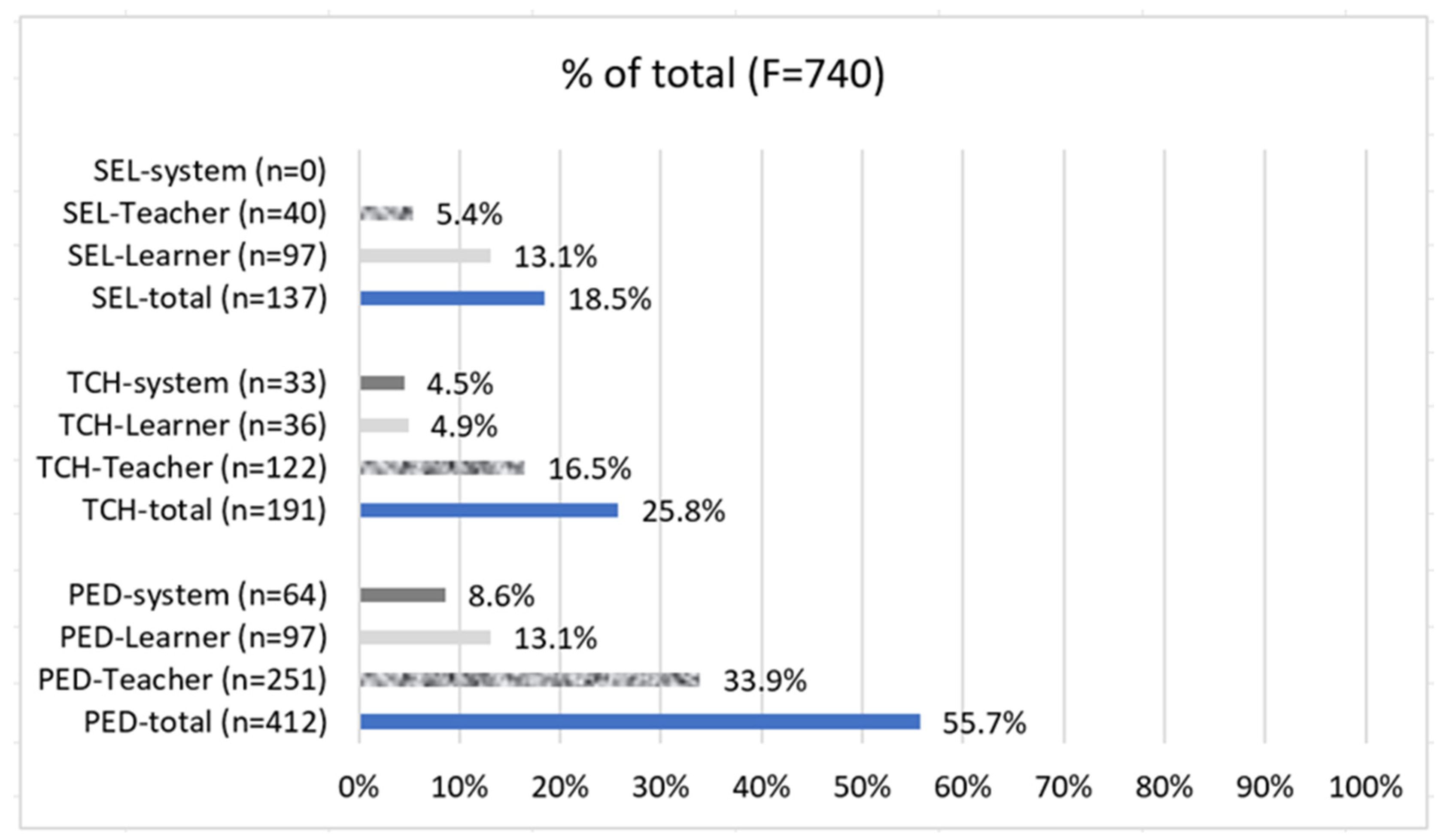
The thematic analysis revealed that the 740 themes1 regarding QT in these three domains can be cross-classified according to three focuses: teachers, learners, and the education system (Table 2 and Figure 2).
More than half of the themes (55.7%) related to pedagogy, approximately a quarter (25.8%) related to technology, and less than a fifth (18.5%) related to SEL/SET. As expected, this pattern (pedagogy–technology–SEL/SET) agrees with the percentage of articles related to each domain. In pedagogy and technology, the focus was primarily on the teacher (33.9% and 16.5%, respectively) and secondly on the learner (13.1% and 4.9%, respectively). However, in the SEL/SET domain, the most frequent focus was on the learner (13.1%), and the secondary focus was on the teacher (5.4%). None of the articles related to SEL/SET focused on the systemic level.

4.2. Characteristics of QT: Distribution of 740 Themes Related to QT by Focus

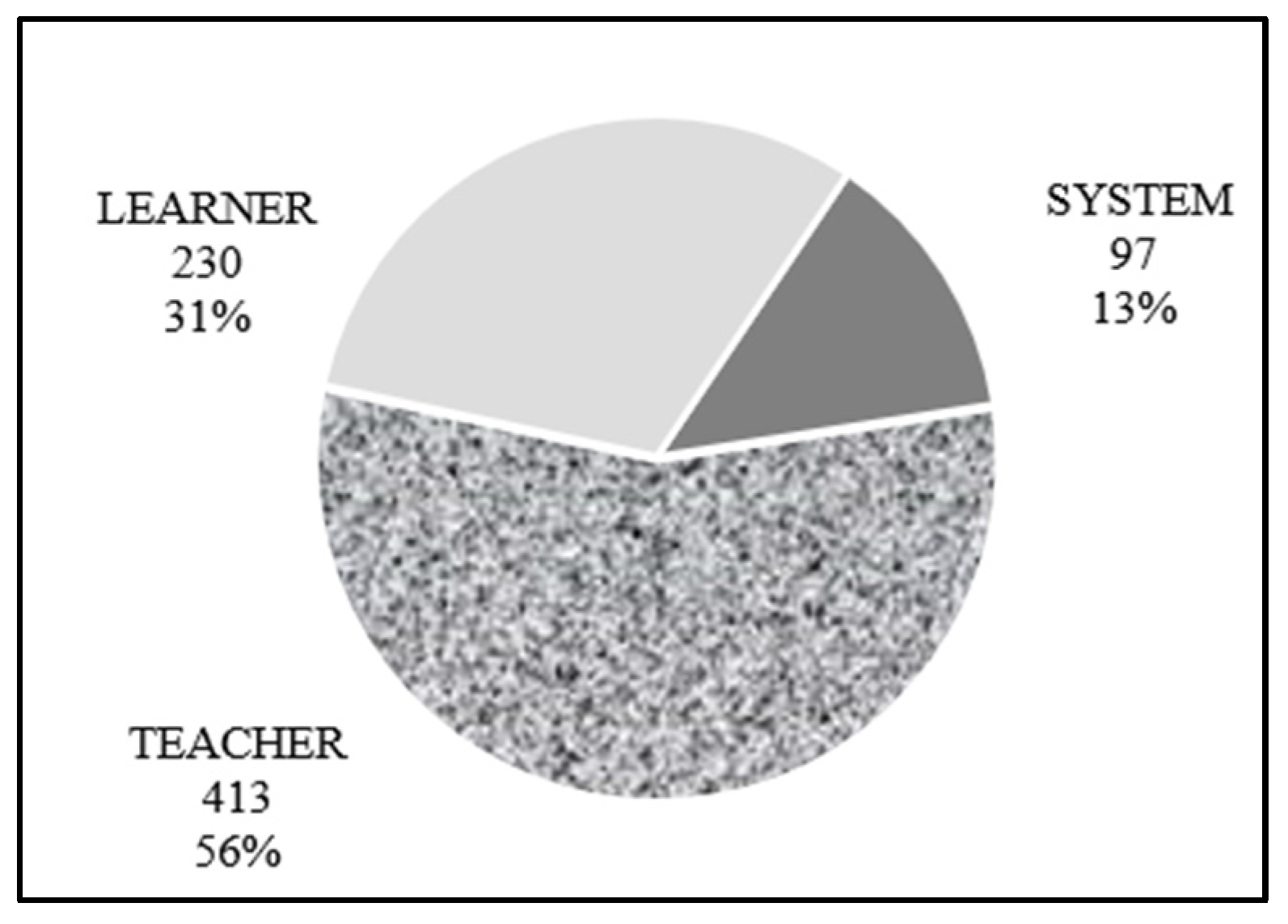
The second research question was as follows: What are the main characteristics of QT in the three domains? Three main focuses were identified in the themes related to QT: the systemic level, the teacher, and the learners. The distribution of these themes by focus is presented in Figure 3.
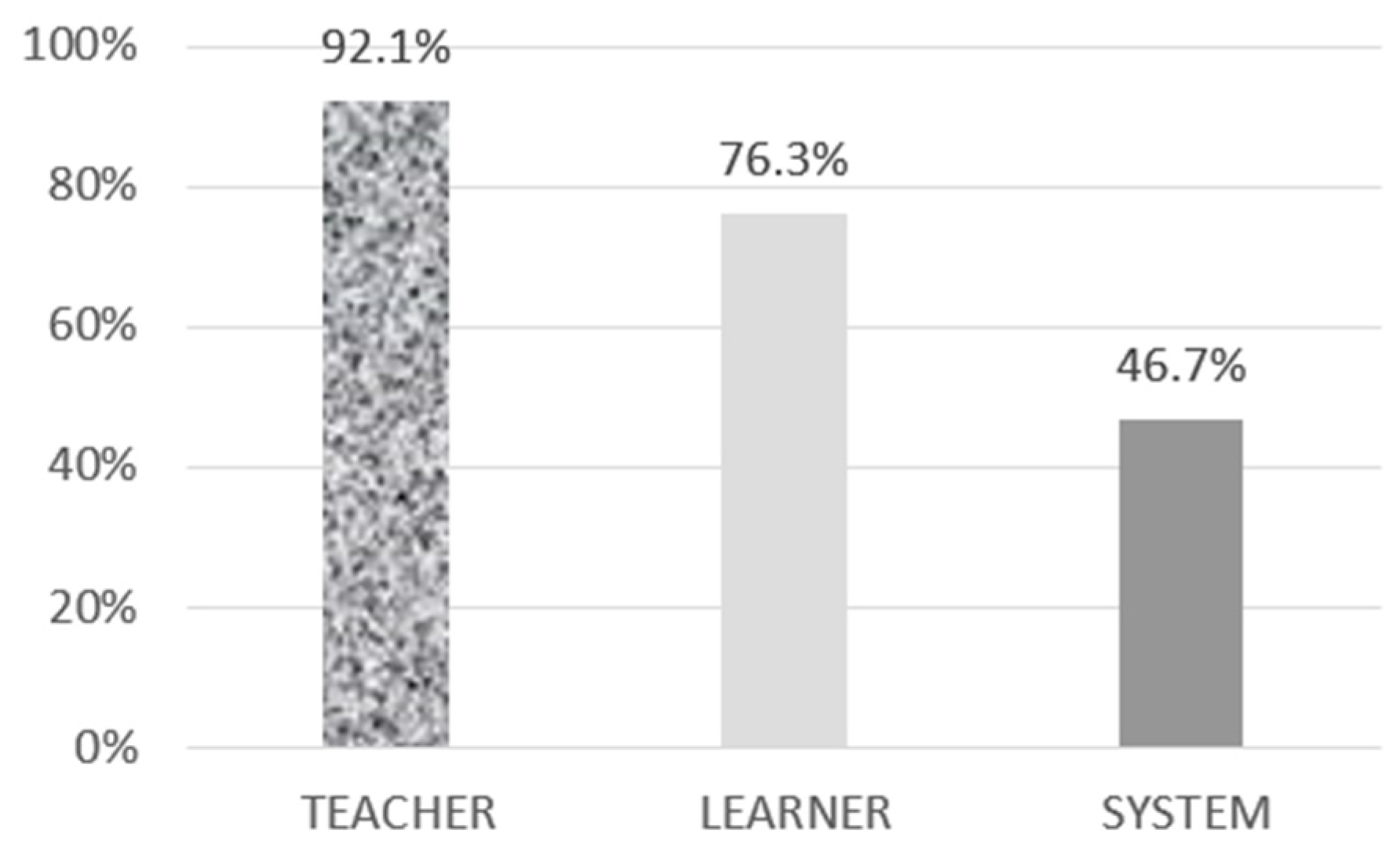
Most of the themes regarding QT focused on teachers (56%) and students (31%). The rest (13%) focused on the systemic level. In addition, several themes were derived from each article. Figure 4 presents the percentages of occurrences of each focus.
This distribution reveals a similar pattern: the highest percentage of themes related to teachers (92.1%), then learners (76.3%), and the lowest to the educational system (46.7%).

4.2.1. Pedagogy

(a)
Pedagogy: Teacher (f = 251, 33.9% of Total)
Numerous studies aim to enhance the theoretical knowledge of pedagogical expertise and develop effective techniques for diverse learners (Carter et al., 2024). QT involves high-level pedagogical skills and mastery of innovative practices (Hoffmann & Koifman, 2013; Santos et al., 2019). Five themes emerged in this category (Table 3).
Expertise and effectiveness in QT (f = 73, 9.9% of total)
The literature suggests that QT requires professional expertise, measured by quality and efficiency (Carter et al., 2024; Cochran-Smith, 2021; Jerrim et al., 2023). Anderson and Taner (2023) claimed that expert teachers are characterized by a well-developed knowledge base; effective cognitive processes; professional beliefs about teaching and learners, personal attributes that support teaching; professionalism reflected in reflection and collaboration; and flexible, learner-focused pedagogic practices.
Wieman (2019) analyzed teaching expertise among university lecturers for a future requiring complex and critical thinking skills. The author concluded that QT involves “a set of skills and knowledge that consistently achieve better learning outcomes than the traditional” (p. 47), implying that QT should focus on skills and knowledge that improve learning outcomes relevant to the learner’s future.
Expert teachers also apply adaptive expertise, balancing established instructional structures with responsive adjustments to meet learners’ needs. They develop this expertise through coaching while implementing new practices and learning to apply them across varied classroom situations (Witherspoon et al., 2021).
Regarding adaptive expertise, QT should excel in “disaster didacticism”—the ability to adjust teaching through pedagogical interventions to maintain expert instruction and prevent low achievement during crises (Schweisfurth, 2023), such as learner dropout following COVID-19. QT may lower the risk of negative outcomes during global and local crises.
Teaching skills, methods, practices, and practical training (70, 9.5% of total)
QT, as well as teaching as a profession in general, requires lifelong learning; critical thinking; and the translation of new information into improved practices, innovativeness, and leverage of new knowledge and technologies (Hoyert & O’Dell, 2019; Vermeulen et al., 2022; Vreekamp et al., 2024). Hurtado-Parrado et al. (2021) reviewed studies comparing the effectiveness of “interteaching” with traditional methods, concluding that QT should include preparation to encourage group study and collaboration, such as using a guide with questions outlining required reading.
Laird-Gentle et al. (2023) conducted a systematic quantitative literature review of dialogic pedagogy literature in school settings. They defined QT as “quality classroom talk” (p. 30), primarily utilizing dialogic over monologic talk. Teacher talk can inspire student discussion or nurture a “transmissive” classroom culture, stifling participation and shared understanding. In this context, discussion contributes to academic performance by enabling knowledge exchange among students (Brown et al., 2014). Advancing QT incorporates disciplinary ideas, crosscutting concepts, and practices (NGSS Lead States, 2013), as well as combining ambitious teaching practices across academic subjects (Lampert et al., 2011; Tekkumru-Kisa et al., 2021).
QT components (55, 7.4% of total)
QT components are driven by a solid knowledge base and strong professional identity, combining, according to the results, academic, pedagogic, technological, and social aspects (Snoek, 2021).
The academic component. Teaching requires the integration of subject matter with knowledge and pedagogy (Ball, 2000). Students perceive QT as having seven dimensions: supportive climate, structured management of learning, clear and adaptive instruction, quality interactions, cognitive activation, and formative assessment (Bijlsma et al., 2022). Therefore, QT should be supported by knowledge about learner diversity and its impacts on access, experience, pathways, and outcomes (Rowan et al., 2021). Thus, as Vidergor (2018) emphasized, QT requires the development of higher-order thinking skills. These dimensions are rooted in scientific, creative, and future thinking (the 7Cs): critical thinking, communication, collaboration, computing, career, cross-cultural, and creativity (Partnership for 21st century skills, 2009).
The pedagogic component. Cognitively oriented beliefs and self-confidence contribute to learner-centered pedagogy (Swars Auslander et al., 2024). J. Cai et al. (2023) identified QT characteristics through community interactions and professional support: differentiation, process-oriented thinking, persistent learning attitude, and positive deviance behaviors (Moghadasi & Keikavoosi-Arani, 2023). QT also involves quality communication and collaboration (Fletcher & Everatt, 2021; Georgara et al., 2023). Santos et al. (2019) reviewed innovative pedagogical practices in higher education, focusing on professional teaching features promoting active, engaging, collaborative learning, interteaching, and self-direction; i.e., learner-centered approaches (Gayman et al., 2018).
The technology component. Rachmatullah et al. (2022) discussed QT in light of self-efficacy in teaching (Bandura, 1977) and intelligent habits (Dewey, 1922/2012), including understanding quality, forward-looking instruction, and inquiry-based teaching with technology.
The social–emotional component. The SEL/SET domain includes personal and interpersonal skills (Nir et al., 2016) regarding both learning and teaching (Bierman & Sanders, 2021; Slovák & Fitzpatrick, 2015). Thus, educators must tailor their learning environments to students’ changing needs and learning styles (Burke & Fedorek, 2017), functioning as facilitators and designing self-organized processes (Connolly et al., 2023; Wiegand & Borromeo Ferri, 2023). Additionally, noise management and discipline are key challenges for QT (Fletcher & Everatt, 2021).
Qualification toward Quality Teaching (39, 5.3% of total)
Improving QT and its effectiveness requires continuous support and training aimed at enhancing proficiency and self-efficacy (Gagnon & Dubeau, 2023; Mok et al., 2023; Roofe et al., 2023; Vreekamp et al., 2024). Expert coaching helps teachers stay informed about new instructional developments and stimulates them to update their practices (Bastian et al., 2022; Mičiulienė & Kovalčikienė, 2023; Rachmatullah et al., 2022). B. L. Lee and Johnes (2022) explored England’s QT in higher education, claiming that it requires specific teaching qualifications to ensure efficiency and high-level learner outcomes. Teaching qualifications provide a way to reflect on chosen approaches and consider alternatives to meet learners’ needs in a changing environment. However, years of teaching experience also contribute to QT (Gore et al., 2024), implying that extending required learning days and practicums can lead to better QT.
Dimensions for evaluating the quality of teaching and providing feedback (14, 1.9% of total)
Evaluating QT contributes to both professional development and accountability (Gloppen, 2023). The Classroom Learning Assessment Scoring System (CLASS) assesses QT through classroom interaction qualities, including instructional support, organization, and emotional support (Robinson, 2022). Moreover, multidimensional assessment methods allow teachers to collect evidence regarding their teaching practices as feedback for improvement (Großmann & Krüger, 2024). Thus, QT may benefit from feedback identifying activities to enhance teaching practice, promoting learner achievement, rather than merely highlighting the gaps between current and desired teaching performance (Gloppen, 2023; Rodriguez et al., 2025).
Many criteria for evaluating QT were found, primarily focusing on classroom management, interaction, clarity of instructions, relying on productive student ideas, using discussion and inquiry, demanding high cognitive levels, and frequent formative assessment (Kim et al., 2019; Özdemir et al., 2023; Zhou et al., 2023). Teachers’ personal criteria for evaluation and feedback may include self-confidence and school integration (Assadi et al., 2019). Interteaching, an evidence-based method in which teachers facilitate learning with multiple opportunities for feedback, allows students to assess lesson quality, problem difficulty, and instructor feedback (Brown et al., 2014). Therefore, a teacher’s ability to provide feedback in technology-rich environments positively affects student achievement (Z. Cai et al., 2023). Measures of QT must differ based on learner demographic subgroups and academic ability (Cherng et al., 2022; Paquette-Smith et al., 2023; Scheeler, 2008).
  • (b) Pedagogy: Learner (f = 97, 13.1% of Total)
First and foremost, in the context of QT, learner-focused pedagogy considers students’ needs and abilities (Egara & Mosimege, 2024). Two themes were found in this category (Table 3).
Active, engaging, collaborative learning and self-direction (f = 69, 9.4% of total)
As a facilitating framework, QT employs innovative methods that enable learners to achieve higher levels of thinking and performance in collaborative environments while also supporting self-paced learning aligned with their natural tendencies (Bruso et al., 2020; Egara & Mosimege, 2024; Han et al., 2024; Lehrer-Knafo, 2019; Moghadasi & Keikavoosi-Arani, 2023; Sun et al., 2023; Schwarz et al., 2021); this can occur inside, beyond, or outside the physical classroom (Goagoses et al., 2024; Loewenberg Ball & Forzani, 2009). QT should convey mastery goals (Kaplan & Maehr, 2007) across seven instructional dimensions (Fortus et al., 2023): tasks, authority/autonomy, recognition, grouping, evaluation, time, and social interactions. QT also relates to interpersonal communication with learners, including well-organized lessons according to the learners’ characteristics to maintain interest, foster a positive atmosphere, and preserve values (Jõgi et al., 2015; Lehrer-Knafo, 2019). For example, in a flipped classroom, QT should be learner-centered by monitoring student perceptions and activity (Gomis et al., 2022). Outside class, students learn basic proficiencies, while inside, learning is collaborative and problem-based, with the teacher as moderator (Fidan, 2023). QT also comes to the fore during discussions and peer interactions, with the teacher being approachable and available for guidance (McLean & Attardi, 2023). A study revealing the importance of active, engaging, collaborative learning and self-direction was conducted by Sun et al. (2023). They investigated teacher scaffolding within game-based learning, highlighting strategies such as prompts, modeling, explicit instruction, and teacher-led discussion. They claimed that QT provides learners with four main types of feedback for learning, thinking, and conducting activities properly: encouragement, “just-in-time” feedback, intervention, and sufficient knowledge.
Integrating 21st century skills in learning (f = 28, 3.8% of total)
QT facilitates the development of thinking and learning skills to ensure students can demonstrate mastery of 21st-century skills for present learning and their future careers (Karaca-Atik et al., 2023; Partnership for 21st century skills, 2009; Valtonen et al., 2021). QT may be recognized as self-reliance, positive attitudes toward learning, frequent use of inquiry-based instruction, and technology in teaching (Rachmatullah et al., 2022), distinguishing between core and contextual 21st-century digital skills (Van Laar et al., 2017). Thus, in a flipped classroom, QT should focus on engaging students in lower-order individual learning, while the in-lecture stage should focus on higher-order peer learning (Jong, 2023). However, digital education within professional development and awareness of actual mastery may connect available and implemented curricula. This may be achieved by narrowing the gap between teachers’ willingness to learn innovative methods and using them, thus increasing their involvement in collaborative environments, and setting up professional networks to integrate online tools while implementing innovative practices that contribute to enhancing the students’ involvement (El-Hamamsy et al., 2024; Santos et al., 2019; M. K. Thomas et al., 2009).
  • (c) Pedagogy: System (f = 64, 8.6% of Total)
Professional development aimed at enhancing QT is implemented at the systemic and organizational levels, generating benefits for teaching staff, educational institutions, and the education system as a whole (Baars et al., 2023; Carter et al., 2024).
Systemic professional development programs promoting QT (f = 37, 5.0% of total)
Ongoing professional development is needed to achieve and maintain QT throughout teachers’ careers. QT should be based on collegial faculty development, leveraging teacher expertise to support improvement (Anderson & Taner, 2023; Esterhazy et al., 2021). The systemic level plays a significant role in designing and executing efforts to promote QT. Online professional development communities and social network sites in small, peer-organized, manageable communities can assist recruitment and sustain activity (Nelimarkka et al., 2021; Toh et al., 2022).
However, QT is also affected by the system’s expectations. Professional autonomy and a looser approach to teacher follow-up may encourage accommodation of traditional norms. Schools should communicate expectations of “a good lesson” and extend the teacher’s role beyond the classroom. From the systemic point of view, QT should be ambitious yet aware of the possible negative consequences of stress and anxiety. Systemic actions that maintain QT should empower teachers to share efforts in constructing a positive school ethos (Gloppen, 2023). Pedagogical competence may be enhanced through frequent practice with realistic problems related to everyday teaching, presented by organizations and during training (Renta-Davids et al., 2016).

4.2.2. Technology—ICT

(a)
Technology: Teacher (f = 122, 16.5% of Total)
With constantly evolving technologies in education, fine-tuning of available technological means must be ongoing (Ali, 2019). Using technology requires support for innovative pedagogical approaches and new skills to diversify teaching methods for 21st-century learning and employment. Three themes were found (Table 4).
Integrating technology into QT (f = 62, 8.4% of total)
Integrating technological tools may strengthen learning processes by providing resources not available in traditional frontal teaching (Albion & Tondeur, 2018; Gerhard et al., 2023), and customization of web-based materials may strengthen self-directed learning for both teachers and students (Gerard et al., 2022). QT benefits from professional development geared toward integrating technology (Chen et al., 2022; Labonté & Smith, 2022) and boosts effective interaction in MOOCs (Tang, 2021). Ali (2019) found that 95% of staff agreed that integrating ICT makes lessons more stimulating and offers dynamic learning applications.
QT requires routine integration of technology-related subjects into blended teaching and gamification, which should be derived from research and theory, practice, process, and continuous training in digital competence implementation (Chan & Lee, 2023; Jenßen et al., 2023; Jocius et al., 2022; Pappa et al., 2024; Sáez-López et al., 2024; Short et al., 2021). However, integration is affected by teacher age and generation. Millennial teachers are perceived as routinely integrating technology and being constantly online (Marrero Galván et al., 2023). Teacher motivation and pre-service training are the main factors in high competency levels of technology integration (Pappa et al., 2024), despite online teaching difficulties (Amedu & Hollebrands, 2022). Huang et al. (2023) found that limited online “face-to-face” communication was the main technological constraint, requiring teachers to develop strategies for instant student feedback and targeted instruction.
Teaching innovations related to technological QT (f = 35, 4.7% of total)
QT should integrate innovative technologies supporting learning (Han et al., 2024). AI-Ed can help teachers explore effective methods (Hsieh et al., 2021), which assist in gaining tech-orientation, developing analytical skills of data interpretation, and acquiring teamwork and group management skills in integrating tools efficiently (Chaudhry & Kazim, 2022; Smakman et al., 2021). Large language AI models, such as ChatGPT, can support QT by providing resources for lesson planning and content development, as well as encouraging reflection (Kasneci et al., 2023; Su & Yang, 2023). Virtual reality combines immersive and interactive features for experiential learning (Fromm et al., 2021). However, artificial intelligence (AI) models should be used cautiously, with boundaries critically evaluated and strict criteria for security, privacy, and ethics (Dwivedi et al., 2023; Khosravi et al., 2022).
Teacher characteristics and perceptions related to technological QT (f = 25, 3.4% of total)
Teachers must reinvent themselves through continuous learning to adapt QT to rapid changes (Albion & Tondeur, 2018). ICT integration impacts QT and teacher qualities (Gerhard et al., 2023), and QT requires teacher competence and confidence in integrating technology based on knowledge, clarity, training, and affective–motivational dispositions (Hershkovitz et al., 2023; Jenßen et al., 2023; Pappa et al., 2024). Generally speaking, self-efficacy relates to commitment, instructional behavior, and student engagement and achievement (Gu et al., 2013; Mok et al., 2023).
Technological–pedagogical knowledge is indirectly affected by conventional pedagogical opportunities to learn, mediated by general pedagogical knowledge (GPK). Online QT is more likely to be continued by innovative teachers (Khong et al., 2022). The digital transformation of teaching is shaped by economic and educational rationalities (Cress & Kalthoff, 2023), and the teacher’s professional identity plays a role in determining QT regarding technology positioning and use (Lai & Jin, 2021). Cattaneo et al. (2022) depict QT as having the will, skill, and tools for technology use.
  • (b) Technology: Learner (f = 36, 4.9% of total)
To acquire 21st-century skills, it is important to integrate powerful and efficient digital learning into learning processes (Ali, 2019). One theme was found in this category (Table 4).
Acquisition of digital skills and competencies of the 21st century (TPACK) (f = 36, 4.9% of total)
The rapid development of ICT and advanced technologies has had a remarkable effect on learning styles and methods. QT in online instruction programs is perceived as encouraging student progress, motivating students, and enabling individualized learning, including offering home–school links (Darragh & Franke, 2023). Concurrently, QT should relate to learners’ difficulties in staying focused or motivated during class, completing assignments, and maintaining dialog with other learners, thus affecting their engagement (Ottergren & Ampadu, 2023). QT can also advance learner comprehension through game challenges using feedback and goal clarity, while involvement and interaction affect learner comprehension (Agbo et al., 2023).
Goagoses et al. (2024) suggest that technology-enhanced environments require QT to implement practical approaches (e.g., initiating interactions outside the technology domain). This entails using multiple communication technologies to communicate with students, providing psychological, emotional, and motivational support. QT and learning with AI-driven digital tools require advanced digital competence to capitalize on AI skills; however, caution is advised given their risks and drawbacks (Kohnke et al., 2023). In this context, learning analytics include the use of AI, data-mining, and other digital technologies, vastly expanding the toolbox of learner data in an atmosphere of motivation and mutual care (H. H. Lee & Gargroetzi, 2023).
  • (c) Technology: System (f = 33, 4.5% of Total)
The development of innovative teaching and learning perceptions regarding technology integration in QT requires dedicated, organized, and purposeful action by educational institutions. One theme was found (Table 4).
Systemic support for digital learning and innovation in QT (f = 33, 4.5% of total)
At the systemic level, positive perceptions of online teaching environments support online QT (Khong et al., 2022). Institutional training and management support strengthen online QT and its effectiveness (Ahmad et al., 2022; Choi et al., 2023; Peled & Perzon, 2022). Online teaching is useful when bolstered by proper training, support, resources, and infrastructure (Khong et al., 2022). Specifically, QT involves readiness to teach machine learning, and AI relies on appropriate teacher education and resource development (Sanusi et al., 2023) and the systematic development of curriculum, technology, pedagogy, and Edtech. An up-to-date education system can achieve teacher cooperation, promoting an understanding of technology’s ethical and societal impact beyond mere tools.
To empower AI-ready educators, QT should include mastery of AI systems that students use to learn specific topics or improve skills. This can be accomplished by recognizing student perspectives and expertise as essential for effective and responsible generative AI use in education (Hazzan-Bishara et al., 2025; Luckin et al., 2022; Su & Yang, 2023).

4.2.3. SEL/SET

In the SEL/SET domain, only the learner and teacher focuses were addressed, not the systemic focus.
(a)
SEL/SET: Learner (f = 97, 13.1% of Total)
To successfully meet the challenges of the 21st century’s multicultural technological world, learners must cultivate emotional and social skills alongside cognitive and academic abilities (Chernyshenko et al., 2018). Two themes were found (Table 5).
Social learning, self-direction, and emotional–motivational learning (f = 52, 7% of total themes)
Self-directed learning, close teacher support, and SEL/SET integration are profound aspects of QT (Seery et al., 2021). Educators increasingly recognize the importance of supporting learners’ social and emotional growth and character development (Rissanen et al., 2019; C. L. Thomas et al., 2022). QT assesses learners’ emotional competencies, processes social–emotional information, and uses data to guide revisions. SE qualities include (1) shaping learners’ beliefs regarding abilities, belonging, and academic mindset; (2) supporting personalized instruction and mentoring; and (3) reinforcing social and emotional skills and mindsets (Darling-Hammond et al., 2020). High-quality and healthy teacher–learner relationships sustain character strength over time through caring, productive, respectful interactions and positive perceptions, and SEL/SET strategies contribute to traits such as hope and self-regulation (Obsuth et al., 2023; Robinson, 2022; K. J. Thomas et al., 2022).
Learner SE characteristics related to learning (f = 45, 6.1% of total)
Teachers’ Big Five personality areas are connected to QT effectiveness and learner traits (Bidjerano & Dai, 2007; Kim et al., 2019; Opoku et al., 2023). QT is based on openness, conscientiousness, and emotional stability, qualities related to lower teacher burnout and affect classroom management and learner well-being (Granger et al., 2023; Gilmour et al., 2022; Sandilos et al., 2022). Learner satisfaction can be predicted by students’ motivational beliefs and perceptions of QT (Artino, 2008), expressed in classroom practices manifesting as clear rules, support, encouragement, and positive management, affecting their emotional, behavioral, cognitive, and agentic engagement (Molinari & Grazia, 2021).
  • (b) SEL/SET: Teacher (f = 40, 5.4% of total)
Improving QT and supporting learners relates to teachers’ socio-emotional abilities and skills (Gimbert et al., 2023). One theme was found (Table 5).
Teacher SE characteristics related to QT (f = 40, 5.4% of total)
SEL/SET in QT positively impacts academic performance (i.e., teaching), engagement, and supportive relationships (Gates & Curwood, 2023; Hemi & Kasperski, 2023; Wang et al., 2022). Additionally, QT involves developing SEL/SET interventions (Vestad & Tharaldsen, 2022). Effective teacher behaviors ensure orderly lessons and engagement among all learners, for example, creating a safe, stimulating learning climate with mutual respect (Magro et al., 2023; Tas et al., 2018). Conversely, modeling problems based on teacher motivation promotes learner awareness, social development, and active participation in sustainable development (Wiegand & Borromeo Ferri, 2023).
QT’s social aspect refers to instructional activities that modify work to meet learners’ needs, considering race, class, gender, socioeconomic status, and other background elements (Philip et al., 2019). Academic enthusiasm is crucial for improving academic pedagogy (Moghadasi & Keikavoosi-Arani, 2023). From a social–emotional perspective, QT prepares future adults for 21st-century demands, developing an individualistic worldview to improve communities and adapt learning culturally and socially (Douglas-Gardner & Callender, 2023; Hillman et al., 2021; Michalec & Wilson, 2022).

4.2.4. Summary of Findings According to the Focuses of the Articles

Considering all focuses together, these findings suggest that the present review’s value does not lie in identifying new components of QT, but in clarifying how established components are differentially emphasized across domains and levels. By making these patterns explicit, this review highlights areas of convergence, as well as structural gaps, that may help explain persistent challenges in translating theoretical models of QT into coherent educational practice. This integrative perspective may support more informed alignment between teacher development, learner needs, and systemic support in future research and practice.
At the teacher level, the findings show a strong and consistent focus on pedagogical expertise, professional competence, adaptive practice, and ongoing learning, particularly within the pedagogical and technological domains (Anderson & Taner, 2023; Carter et al., 2024; Cattaneo et al., 2022). Studies in these domains emphasize effectiveness, instructional skills, and the ability to adjust teaching practices in response to changing learner needs, including through coaching and professional development (Witherspoon et al., 2021; Mok et al., 2023).
At the learner level, the findings reveal a convergence across domains around the development of competencies required for learning in the 21st century, including higher-order thinking, self-regulation, collaboration, and digital skills. However, the emphasis varies by domain: pedagogical studies primarily highlight active, collaborative, and inquiry-based learning processes (Egara & Mosimege, 2024; Sun et al., 2023); technology-related studies focus on digital competence and engagement in technology-rich environments (Fromm et al., 2021; Goagoses et al., 2024); and SEL/SET studies foreground the emotional, motivational, and interpersonal dimensions of learning and teacher–learner relationships (Magro et al., 2023; Obsuth et al., 2023). Notably, SEL/SET research places the learner at the center of QT more consistently than the other domains while offering comparatively limited attention to systemic structures that support teachers’ professional development.
At the system level, the findings point to the critical role of institutional conditions, professional development frameworks, and organizational support in sustaining QT, particularly in the pedagogical and technological domains (Esterhazy et al., 2021; Khong et al., 2022), but less in SEL/SET.

4.3. Summary of the Results

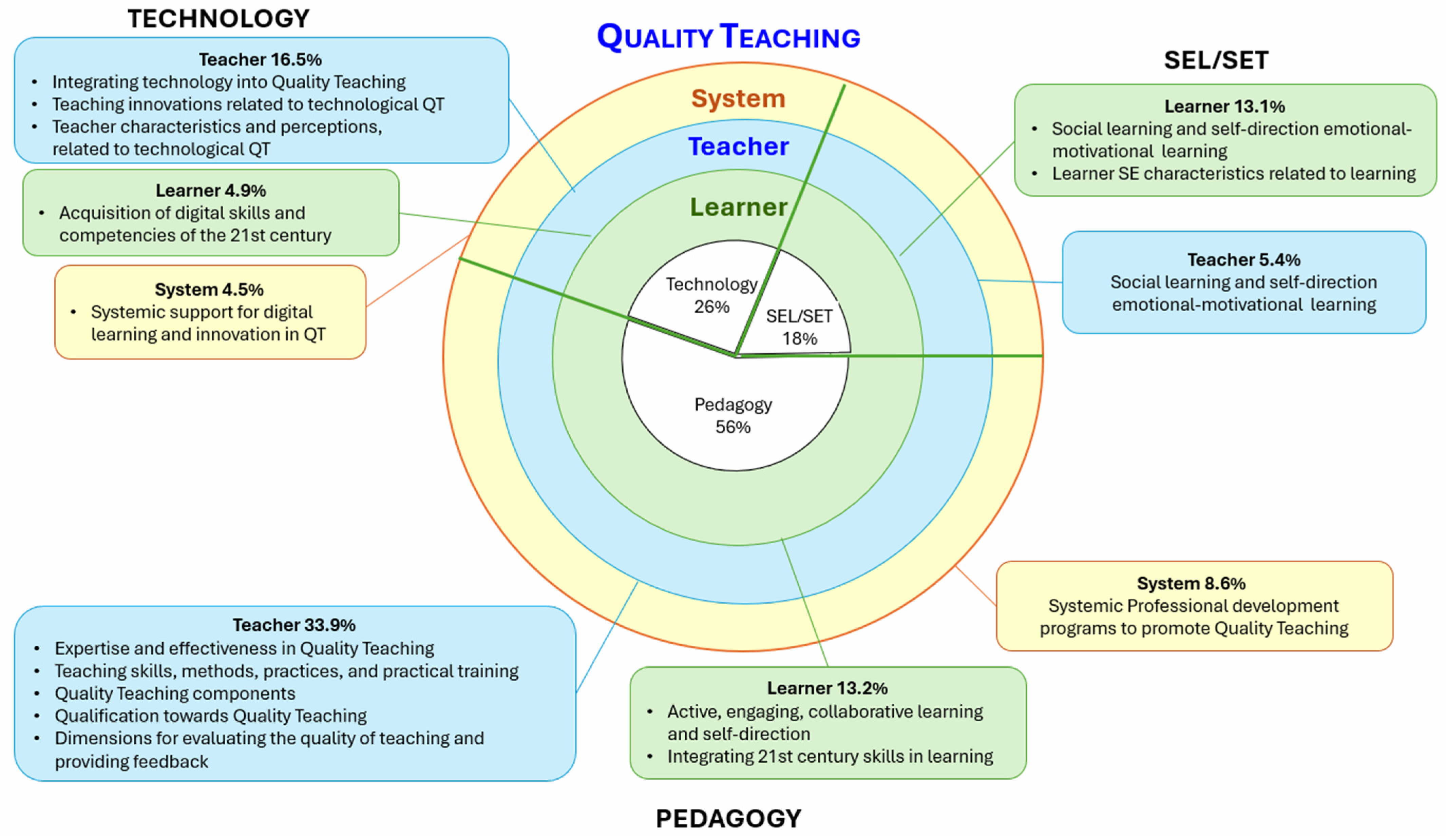
Figure 5 summarizes the 740 themes describing the characteristics of QT in the three domains (pedagogy, digital teaching/learning technologies, and SEL/SET) and three focuses (teachers, learners, and the system), presenting the combined contributions, both the distinctive and integrative, of each domain to the enhancement of QT.

5. Discussion and Conclusions

In an era of rapid technological development (especially with the rise of generative AI), along with increasingly diverse classrooms, the growing socio-emotional needs of learners, and systemic demands of Education 4.0, the need to redefine QT and its core components has become highly important.

5.1. General Discussion of the Results

This research reinforces the view that QT is shaped by the interaction of teacher expertise, learner engagement, and systemic conditions rather than being an individual teacher attribute alone. This perspective may inform the design of professional development initiatives and policy frameworks that seek to strengthen QT in the context of ongoing educational change.
QT is grounded in the integration of three unique and complementary domains: pedagogy—innovative and focused on self-directed learning, encouraging active inquiry, deep understanding, and the application of knowledge in real-life contexts; social–emotional skills—fostering emotional and social connections that promote a sense of belonging, trust, and security; cultivate empathy and mutual listening; and encourage teamwork and collaboration among learners, including in online environments; and integration of technology—a strategic investment in preparing graduates to participate in and lead within a dynamic and evolving workforce, i.e., Education 4.0 (González-Pérez & Ramírez-Montoya, 2022; Tikhonova & Raitskaya, 2023).
Conceptualizing QT as a profession requiring expertise and innovation is helpful in defining it in terms of efficiency, facilitating a focus on learning (Anderson & Taner, 2023; Cochran-Smith, 2021). Learners’ needs are considered through effective interpersonal communication (Lehrer-Knafo, 2019). Thus, improving teaching practices (QT) contributes to improved learning in a flexible environment, stimulating reflection, experience sharing, problem-solving, and discussion through reflective and critical thinking in the knowledge society of the 21st century (Agbo et al., 2023; Pow & Lai, 2021; Vermeulen et al., 2022). According to the SDT (self-determination theory; Ryan & Deci, 2020), choosing teaching stems from fulfilling relatedness needs by nurturing positive learner relationships. Significant factors shape intrinsic motivation, higher engagement/enjoyment, and lower emotional exhaustion (Robinson, 2022).
Regarding the technological domain, combining online and technology-enhanced learning environments through QT fosters social and academic relationships among learners who do not interact face-to-face outside the classroom, providing opportunities for promoting social inclusion, teamwork for collaboration, and cooperative learning (Goagoses et al., 2024; Hertz et al., 2022) also in times of emergency in which remote teaching necessary (Hershkovitz et al., 2023). Nevertheless, technology’s contribution to QT is not merely improving teaching but also enabling the establishment and operation of collaborative learning communities supporting teachers’ professional development (Pow & Lai, 2021). Thus, technology supports balanced approaches such as blended, hybrid, or half-flipped learning (Burke & Fedorek, 2017) in a flipped classroom framework (Egara & Mosimege, 2024).
Simple digital tool use is insufficient (Fletcher & Everatt, 2021). Education is expected to be profoundly transformed by AI (Nemorin et al., 2023; Singh et al., 2025), facilitating informed decision-making, enabling teacher predictions regarding learner performance, and recommending relevant content with teacher approval (Chaudhry & Kazim, 2022). Preparing for AI should involve recognizing human contextual/meta-contextual intelligence superiority and preparing educators to see AI as a bridge, including AI mastery in system learner use (Hazzan-Bishara et al., 2025; Luckin et al., 2022). AI-based systems contributing to QT in hybrid systems should enable team-based learning and teamwork skill acquisition, as well as the consideration of ethical issues (Georgara et al., 2023; Holmes et al., 2021; Ottergren & Ampadu, 2023; Pérez-Jorge et al., 2025). As a result, efforts to integrate SE into QT, as reflected in teacher–learner interactions, should be inherent to educational agendas, considering teachers’ concerns and professional development stages (Fuller & Bown, 1975; Tas et al., 2018). Moreover, Tondeur et al. (2016, 2018) claimed that as the teacher education period impacts technology integration, training for technology-incorporated QT should be included throughout, adapted to age and gender if needed.
QT is characterized by sensitivity and awareness of learners’ learning styles and emotional needs, developing consistent feelings of satisfaction, confidence, calm, and encouragement in the learner (Hoskins & Schweig, 2022; Pianta et al., 2008). Thus, QT may affect all three domains together: the personal level, teacher and learner, and the systemic level, school. This collective knowledge production form decenters the teacher, allowing other actors to become active in learning construction. Teachers have agency, with knowledge actively co-produced by a collectivity of actors: learners, teachers, and peers (Connolly et al., 2023).
Over half of the QT articles focused on teachers, and about a third focused on learners. The systemic level was addressed by the rest, which was expected, as QT primarily relates to teachers with regard to learners. However, the literature emphasized that job performance within the institution differs from within the teaching profession (Kim et al., 2019). Positive school/classroom pedagogic and social climates are important for optimal QT, beneficially impacting academic/social–emotional learner outcomes both face-to-face and online (Goagoses et al., 2024). Implementing SEL/SET interventions positively affects teachers’ classroom dynamics/organization skills (systemic level), and learner/teacher well-being (Sandilos et al., 2022). However, the teacher’s values and beliefs are beyond the systemic setting, relating to gender/experience (Molina et al., 2022).
Regarding QT analysis according to the three domains, Baars et al. (2023) theoretically analyzed the experiences of students, teachers, and staff regarding physical/psychosocial learning environments’ contributions to QT, examining how these support innovative pedagogies through the fitness, flexibility, connection, and personalization lens. They conclude that ongoing discourse regarding physical/psychosocial teaching/learning environments should involve actors both across and between school system levels.
Thus, the novelty of this article lies in highlighting both the distinctive and integrative contributions of each domain to the enhancement of QT, narrowing the gap between theoretical models and their practical implementation in educational systems (focuses) regarding QT.
In the following section, insights and conclusions for practitioners, educational researchers, and policymakers are presented.

5.2. Practical Implications

Based on the results, practical implications are presented regarding policy-makers, teacher education frameworks, and school systems.
Research on SEL/SET has merely addressed the systemic or policy level. This gap indicates the need for educational decision-makers to integrate SEL/SET considerations into systemic-level planning to support the effective functioning of educational institutions and the promotion of QT. To improve QT, policy-makers should also consider creating committees that include all levels of the educational system (national, districts, ministry of education, teacher training universities, and colleges, as well as the lecturers and teachers).
At the teacher education frameworks, effective training programs aimed at enhancing teacher self-efficacy and QT should be designed by integrating pedagogical expertise with SEL/SET competencies, in alignment with teachers’ existing approaches to teaching. QT-focused programs should promote the generalization of teaching skills and strategies, such as using immediate feedback to support skill acquisition, training toward mastery to ensure behavior maintenance, and providing performance feedback within authentic classroom settings.
In addition, ongoing professional development programs should include the following components:
  • Offering role models of effective practice that demonstrate desired skills promoting QT. These role models may serve as educational change agents who support continuous professional development.
  • Explicitly explaining the rationale underlying selected instructional practices and presenting them as problem-solving strategies.
  • Developing classroom management practices and techniques through role-playing activities.
  • Scaffolding authentic technology-based experiences to enhance teachers’ familiarity and confidence with educational technologies.
  • Encouraging continuous reflection on the role of technology in teaching and learning.
  • Facilitating active discussions addressing teachers’ perceptions and attitudes toward technology integration (including AI), rather than focusing solely on technical or operational aspects.
At the school level, addressing teachers’ specific learning and professional development needs to improve QT may include the following strategies:
  • Reducing professional isolation by providing diverse forms of support, such as modeling, coaching, and expert guidance.
  • Incorporating active learning approaches that emphasize instructional methods, didactics, and pedagogical strategies.
  • Integrating authentic tasks and activities that reflect real-world classroom situations.
  • Defining SEL/SET skills as an integral component of the teacher’s professional role, with particular emphasis on emotion regulation, empathy, interpersonal communication, and conflict management.
  • Promoting group discussions focused on real-life classroom cases, enabling teachers to reflect on challenges, anticipate potential difficulties, and effectively cope with unexpected situations.
  • Initiating and supporting peer collaboration and professional interaction among teachers, with particular attention to social–emotional dimensions, including through engagement in online professional learning communities.

5.3. Research Limitations

Despite our efforts to conduct a systematic, constructed, and rigorous literature review, readers should consider several possible limitations.
Limitations related to the sampled articles:
  • QT is researched across various disciplines (e.g., medicine and social science) beyond merely education/teaching studies.
  • Many of the articles were related to multiple fields of study, requiring careful subjective judgment on disciplinary association.
Limitations that stem from including multi-disciplinary articles:
  • The results illustrate general, non-subject-specific characteristics of QT. On the one hand, this may allow for generalization, but on the other hand, some of the conclusions may be effective only for teachers in the reviewed educational systems, including higher education.
  • The SEL/SET domain varies according to students’ ages (grade levels), and therefore generalization regarding this domain should take age differences into account.

5.4. Recommendations for Further Research

In addition to determining and describing the distinctive and the integrative contributions of each domain to the enhancement of QT, we should analyze their intersections and seek a deeper understanding of how they reinforce one another.
We recommend enlarging the corpus of articles focusing on QT in various disciplines and educational systems (primary, secondary, higher education, medical education, etc.). In addition, other cultures and countries should be investigated regarding the QT domains and the focuses that they emphasize and promote.
The term coined in this study, SET (social–emotional teaching), calls for further defining and refining. Future research is needed to construct SET both theoretically and empirically.
Additionally, specific research should be conducted to construct a quantitative instrument for measuring QT as a basis for identifying teaching strengths/weaknesses that can be improved through continuous professional development programs.

5.5. Summary

This research reinforces the view that QT is shaped through the interaction of teacher expertise, learner engagement, and systemic conditions rather than being an individual teacher attribute alone. This perspective may inform the design of professional development initiatives and policy frameworks that seek to strengthen QT in the context of ongoing educational change. Therefore, QT requires ongoing training, leading to high proficiency in skills, methods, and practices and enabling effective ICT integration into teaching, including advancements such as AI. This, combined with SEL/SET (social–emotional skills in learning and in teaching), should contribute to QT in the development of an independent, digitally skilled learner prepared for Education 4.0 and 21st-century skills.
In summary, QT in the 21st century necessitates the integration of pedagogy, technology, and social–emotional learning (SEL) and teaching (SET). When combined with digital tool integration, SEL provides a holistic framework that addresses cognitive, emotional, and social needs while also supporting the development of teachers’ professional identity and adaptability within complex educational contexts. Accordingly, QT requires continuous professional development to achieve high proficiency in innovative methods, practices, and digital integration.

Funding

This research received no external funding.

Institutional Review Board Statement

Not applicable.

Informed Consent Statement

Not applicable.

Data Availability Statement

No new data were created or analyzed in this study. Data sharing is not applicable to this article.

Conflicts of Interest

The author declares no conflicts of interest.

Note

1
Using the term “themes” in this context refers to the “quotes” from each article (i.e., “units of meaning”), which have a common “focus” and a common “domain”. We could have used the term “quotes” instead, but we assumed that this rather technical term overlooks the contextual reference that the term “theme” bears.

References

  1. Agbo, F. J., Olaleye, S. A., Bower, M., & Oyelere, S. S. (2023). Examining the relationships between students’ perceptions of technology, pedagogy, and cognition: The case of immersive virtual reality mini games to foster computational thinking in higher education. Smart Learning Environments, 10(1), 16. [Google Scholar] [CrossRef] [PubMed]
  2. Ahmad, A. S., Dănăiaţă, D., & Gavrilă, A. (2022). The role of school managers in the process of using technological means in the learning process during COVID-19 crisis. Revista de Management Comparat International, 23(1), 122–135. Available online: https://www.rmci.ase.ro/no23vol1/09.pdf (accessed on 14 March 2023).
  3. Albion, P. R., & Tondeur, J. (2018). Information and communication technology and education: Meaningful change through teacher agency. In J. Voogt, G. Knezek, R. Christensen, & K. W. Lai (Eds.), Second handbook of information technology in primary and secondary education (pp. 381–396). Springer. [Google Scholar] [CrossRef]
  4. Ali, W. (2019). The efficacy of evolving technology in conceptualizing pedagogy and practice in higher education. Higher Education Studies, 9(2), 81–95. [Google Scholar] [CrossRef]
  5. Amedu, J., & Hollebrands, K. F. (2022). Teachers’ perceptions of using technology to teach mathematics during COVID-19 remote learning. REDIMAT, 11(1), 71–85. [Google Scholar] [CrossRef]
  6. Anderson, J., & Taner, G. (2023). Building the expert teacher prototype: A metasummary of teacher expertise studies in primary and secondary education. Educational Research Review, 38, 100485. [Google Scholar] [CrossRef]
  7. Anosova, A., Horpynchenko, O., Bulavina, O., Shevchuk, H., & Valentieva, T. (2022). The use of active learning methods for lifelong education. Journal for Educators, Teachers and Trainers, 13(3), 260–273. [Google Scholar] [CrossRef]
  8. Arega, N. T., & Hunde, T. S. (2025). Constructivist instructional approaches: A systematic review of evaluation-based evidence for effectiveness. Review of Education, 13(1), e70040. [Google Scholar] [CrossRef]
  9. Artino, A. R. (2008). Motivational beliefs and perceptions of instructional quality: Predicting satisfaction with online training. Journal of Computer Assisted Learning, 24, 260–270. [Google Scholar] [CrossRef]
  10. Assadi, N., Murad, T., & Khalil, M. (2019). Training teachers’ perspectives of the effectiveness of the “Academy-Class” training model on trainees’ professional development. Theory and Practice in Language Studies, 9(2), 137. [Google Scholar] [CrossRef]
  11. Baars, S., Schellings, G. L., Joore, J. P., & van Wesemael, P. J. (2023). Physical learning environments’ supportiveness to innovative pedagogies: Students’ and teachers’ experiences. Learning Environments Research, 26(2), 617–659. [Google Scholar] [CrossRef]
  12. Ball, D. L. (2000). Bridging practices: Intertwining content and pedagogy in teaching and learning to teach. Journal of Teacher Education, 51(3), 241–247. [Google Scholar] [CrossRef]
  13. Bandura, A. (1977). Self-efcacy: Toward a unifying theory of behavioral change. Psychological Review, 84(2), 191–215. [Google Scholar] [CrossRef] [PubMed]
  14. Barber, M., & Mourshed, M. (2007). How the world’s best performing school systems come out on top. McKinsey and Company. Available online: https://www.mckinsey.com/~/media/mckinsey/industries/public%20and%20social%20sector/our%20insights/how%20the%20worlds%20best%20performing%20school%20systems%20come%20out%20on%20top/how_the_world_s_best-performing_school_systems_come_out_on_top.pdf (accessed on 14 March 2023).
  15. Bastian, K. C., Patterson, K. M., & Carpenter, D. (2022). Placed for success: Which teachers benefit from high-quality student teaching placements? Educational Policy, 36(7), 1583–1611. [Google Scholar] [CrossRef]
  16. Bidjerano, T., & Dai, D. Y. (2007). The relationship between the big-five model of personality and self-regulated learning strategies. Learning and Individual Differences, 17(1), 69–81. [Google Scholar] [CrossRef]
  17. Bierman, K. L., & Sanders, M. T. (2021). Teaching explicit social-emotional skills with contextual supports for students with intensive intervention needs. Journal of Emotional and Behavioral Disorders, 29(1), 14–23. [Google Scholar] [CrossRef]
  18. Bijlsma, H. J., Glas, C. A., & Visscher, A. J. (2022). Factors related to differences in digitally measured student perceptions of teaching quality. School Effectiveness and School Improvement, 33(3), 360–380. [Google Scholar] [CrossRef]
  19. Brown, T. W., Killingsworth, K., & Alavosius, M. P. (2014). Interteaching: An evidence-based approach to instruction. International Journal of Teaching and Learning in Higher Education, 26(1), 132–139. [Google Scholar]
  20. Bruso, J., Stefaniak, J., & Bol, L. (2020). An examination of personality traits as a predictor of the use of self-regulated learning strategies and considerations for online instruction. Educational Technology Research and Development, 68, 2659–2683. [Google Scholar] [CrossRef]
  21. Burke, A. S., & Fedorek, B. (2017). Does “flipping” promote engagement? A comparison of a traditional, online, and flipped class. Active Learning in Higher Education, 18(1), 11–24. [Google Scholar] [CrossRef]
  22. Cai, J., Wen, Q., Qi, Z., & Lombaerts, K. (2023). Identifying core features and barriers in the actualization of growth mindset pedagogy in classrooms. Social Psychology of Education, 26(2), 485–507. [Google Scholar] [CrossRef]
  23. Cai, Z., Gui, Y., Mao, P., Wang, Z., Hao, X., Fan, X., & Tai, R. H. (2023). The effect of feedback on academic achievement in technology-rich learning environments (TREs): A meta-analytic review. Educational Research Review, 39, 100521. [Google Scholar] [CrossRef]
  24. Carter, E., Hategeka, K. B., & Singal, N. (2024). Head teacher and government officials’ perceptions of teaching quality in secondary education in Rwanda. Educational Management Administration & Leadership, 52(6), 1455–1476. [Google Scholar] [CrossRef]
  25. Cattaneo, A. A., Antonietti, C., & Rauseo, M. (2022). How digitalised are vocational teachers? Assessing digital competence in vocational education and looking at its underlying factors. Computers & Education, 176, 104358. [Google Scholar] [CrossRef]
  26. Chan, C. K. Y., & Lee, K. K. (2023). The AI generation gap: Are Gen Z students more interested in adopting generative AI such as ChatGPT in teaching and learning than their Gen X and millennial generation teachers? Smart Learning Environments, 10(1), 60. [Google Scholar] [CrossRef]
  27. Chaudhry, M. A., & Kazim, E. (2022). Artificial intelligence in education (AIED): A high-level academic and industry note 2021. AI and Ethics, 2(1), 157–165. [Google Scholar] [CrossRef]
  28. Chen, C. H., Chen, K. Z., & Tsai, H. F. (2022). Did self-directed learning curriculum guidelines change Taiwanese high-school students’ self-directed learning readiness? The Asia-Pacific Education Researcher, 31(4), 409–426. [Google Scholar] [CrossRef]
  29. Cherng, H. Y. S., Halpin, P. F., & Rodriguez, L. A. (2022). Teaching bias? Relations between teaching quality and classroom demographic composition. American Journal of Education, 128(2), 171–201. [Google Scholar] [CrossRef]
  30. Chernyshenko, O. S., Kankaraš, M., & Drasgow, F. (2018). Social and emotional skills for student success and well-being: Conceptual framework for the OECD study on social and emotional skills (OECD Education Working Papers, No. 173). OECD Publishing. [Google Scholar] [CrossRef]
  31. Choi, H., Jung, I., & Lee, Y. (2023). The power of positive deviance behaviours: From panic-gogy to effective pedagogy in online teaching. Education and Information Technologies, 28(10), 12651–12669. [Google Scholar] [CrossRef] [PubMed]
  32. Cochran-Smith, M. (2021). Exploring teacher quality: International perspectives. European Journal of Teacher Education, 44(3), 415–428. [Google Scholar] [CrossRef]
  33. Connolly, C., Murray, C., Brady, B., Mac Ruairc, G., & Dolan, P. (2023). New actors and new learning spaces for new times: A framework for schooling that extends beyond the school. Learning Environments Research, 26(1), 241–253. [Google Scholar] [CrossRef]
  34. Cress, T., & Kalthoff, H. (2023). Hybrid imbalance: Collaborative fabrication of digital teaching and learning material. Qualitative Sociology, 46, 403–428. [Google Scholar] [CrossRef]
  35. Darling-Hammond, L., Flook, L., Cook-Harvey, C., Barron, B., & Osher, D. (2020). Implications for educational practice of the science of learning and development. Applied Developmental Science, 24(2), 97–140. [Google Scholar] [CrossRef]
  36. Darling-Hammond, L., & Sykes, G. (2003). Wanted, a national teacher supply policy for education: The right way to meet the “highly qualified teacher” challenge. Education Policy Analysis Archives, 11, 33. [Google Scholar] [CrossRef]
  37. Darragh, L., & Franke, N. (2023). Online mathematics programs and the figured world of primary school mathematics in the digital era. Mathematics Education Research Journal, 35(1), 33–53. [Google Scholar] [CrossRef]
  38. De Pro Chereguini, C., & Ponce Gea, A. I. (2021). Model for the evaluation of teaching competences in teaching–learning situations. Societies, 11(2), 56. [Google Scholar] [CrossRef]
  39. Dewey, J. (2012). Human nature and conduct: An introduction to social psychology. Project Gutenberg. Available online: https://www.gutenberg.org/files/41386/41386-h/41386-h.htm (accessed on 1 March 2022). (Original work published 1922).
  40. Dicte. (2019). Pedagogical, ethical, attitudinal and technical dimensions of digital competence in teacher education. Developing ICT in Teacher Education Erasmus+ Project. Available online: https://dicte.oslomet.no/dicte/ (accessed on 10 May 2022).
  41. Douglas-Gardner, J., & Callender, C. (2023). Changing teacher educational contexts: Global discourses in teacher education and its effect on teacher education in national contexts. Power and Education, 15(1), 66–84. [Google Scholar] [CrossRef]
  42. Dutse, N., Panishoara, G., & Panishoara, I. O. (2014). The profile of the teaching profession–empirical reflections on the development of the competences of university teachers procedia. Social and Behavioral Sciences, 140, 390–395. [Google Scholar]
  43. Dwivedi, Y. K., Kshetri, N., Hughes, L., Slade, E. L., Jeyaraj, A., Kar, A. K., Baabdullah, A. M., Koohang, A., Raghavan, V., Ahuja, M., Albanna, H., Albashrawi, M. A., Al-Busaidi, A. S., Balakrishnan, J., Barlette, Y., Basu, S., Bose, I., Brooks, L., Buhalis, D., … Wright, R. (2023). “So what if ChatGPT wrote it?” Multidisciplinary perspectives on opportunities, challenges and implications of generative conversational AI for research, practice and policy. International Journal of Information Management, 71, 102642. [Google Scholar] [CrossRef]
  44. Egara, F. O., & Mosimege, M. (2024). Effect of flipped classroom learning approach on mathematics achievement and interest among secondary school students. Education and Information Technologies, 29(7), 8131–8150. [Google Scholar] [CrossRef]
  45. Eisenbach, B., & Coleman, B. (2024). Online pedagogies and the middle grades: A scoping review of the literature. Education Sciences, 14(9), 1017. [Google Scholar] [CrossRef]
  46. Eisenberg, A., & Zlibansky Eden, A. (2019). Adapting the education system to the 21st century. The Israeli Democracy Institute. (In Hebrew) [Google Scholar]
  47. El-Hamamsy, L., Monnier, E. C., Avry, S., Chevalier, M., Bruno, B., Dehler Zufferey, J., & Mondada, F. (2024). Modelling the sustainability of a primary school digital education curricular reform and professional development program. Education and Information Technologies, 29(3), 2857–2904. [Google Scholar] [CrossRef]
  48. Esterhazy, R., de Lange, T., Bastiansen, S., & Wittek, A. L. (2021). Moving beyond peer review of teaching: A conceptual framework for collegial faculty development. Review of Educational Research, 91(2), 237–271. [Google Scholar] [CrossRef]
  49. Fidan, M. (2023). The effects of microlearning-supported flipped classroom on pre-service teachers’ learning performance, motivation and engagement. Education and Information Technologies, 28, 12687–12714. [Google Scholar] [CrossRef]
  50. Fletcher, J., & Everatt, J. (2021). Innovative learning environments in New Zealand: Student teachers’ perceptions. New Zealand Journal of Educational Studies, 56(1), 81–101. [Google Scholar] [CrossRef] [PubMed]
  51. Fortus, D., Lin, J., & Passentin, S. (2023). Shifting from face-to-face instruction to distance learning of science in china and israel during COVID-19: Students’ motivation and teachers’ motivational practices. International Journal of Science and Mathematics Education, 21(7), 2173–2183. [Google Scholar] [CrossRef]
  52. Fromm, J., Radianti, J., Wehking, C., Stieglitz, S., Majchrzak, T. A., & vom Brocke, J. (2021). More than experience? On the unique opportunities of virtual reality to afford a holistic experiential learning cycle. The Internet and Higher Education, 50, 100804. [Google Scholar] [CrossRef]
  53. Fuller, F. F., & Bown, O. H. (1975). Becoming a teacher. Teachers College Record, 76(6), 25–52. [Google Scholar] [CrossRef]
  54. Gagnon, N., & Dubeau, A. (2023). Building and maintaining self-efficacy beliefs: A study of entry-level vocational education and training teachers. Vocations and Learning, 16, 511–532. [Google Scholar] [CrossRef] [PubMed]
  55. Gates, E., & Curwood, J. S. (2023). A world beyond self: Empathy and pedagogy during times of global crisis. The Australian Journal of Language and Literacy, 46(2), 195–209. [Google Scholar] [CrossRef]
  56. Gayman, C. M., Hammonds, F., & Rost, K. A. (2018). Interteaching in an asynchronous online class. Scholarship of Teaching and Learning in Psychology, 4(4), 231–242. [Google Scholar] [CrossRef]
  57. Georgara, A., Kazhamiakin, R., Mich, O., Palmero Approsio, A., Pazzaglia, J. C., Rodríguez Aguilar, J. A., & Sierra, C. (2023). The AI4Citizen pilot: Pipelining AI-based technologies to support school-work alternation programmes. Applied Intelligence, 53, 24157–24186. [Google Scholar] [CrossRef]
  58. Gerard, L., Bradford, A., & Linn, M. C. (2022). Supporting teachers to customize curriculum for self-directed learning. Journal of Science Education and Technology, 31(5), 660–679. [Google Scholar] [CrossRef]
  59. Gerhard, K., Jäger-Biela, D. J., & König, J. (2023). Opportunities to learn, technological pedagogical knowledge, and personal factors of pre-service teachers: Understanding the link between teacher education program characteristics and student teacher learning outcomes in times of digitalization. Zeitschrift fur Erziehungswissenschaft, 26, 653–676. [Google Scholar] [CrossRef]
  60. Gilmour, A. F., Sandilos, L. E., Pilny, W. V., Schwartz, S., & Wehby, J. H. (2022). Teaching students with emotional/behavioral disorders: Teachers’ burnout profiles and classroom management. Journal of Emotional and Behavioral Disorders, 30(1), 16–28. [Google Scholar] [CrossRef]
  61. Gimbert, B. G., Miller, D., Herman, E., Breedlove, M., & Molina, C. E. (2023). Social emotional learning in schools: The importance of educator competence. Journal of Research on Leadership Education, 18(1), 3–39. [Google Scholar] [CrossRef]
  62. Gloppen, S. K. (2023). Enacting teacher evaluation in Norwegian compulsory education: Teachers’ perceptions of possibilities and constraints. Educational Assessment, Evaluation and Accountability, 35(3), 387–417. [Google Scholar] [CrossRef]
  63. Goagoses, N., Suovuo, T., Winschiers-Theophilus, H., Suero Montero, C., Pope, N., Rötkönen, E., & Sutinen, E. (2024). A systematic review of social classroom climate in online and technology-enhanced learning environments in primary and secondary school. Education and Information Technologies, 29(2), 2009–2042. [Google Scholar] [CrossRef]
  64. Gomis, K., Saini, M., Pathirage, C., & Arif, M. (2022). Enhancing quality of teaching in the built environment higher education, UK. Quality Assurance in Education, 30(4), 523–538. [Google Scholar] [CrossRef]
  65. González-Pérez, L. I., & Ramírez-Montoya, M. S. (2022). Components of Education 4.0 in 21st century skills frameworks: Systematic review. Sustainability, 14(3), 1493. [Google Scholar] [CrossRef]
  66. Gore, J., Rosser, B., Jaremus, F., Miller, A., & Harris, J. (2024). Fresh evidence on the relationship between years of experience and teaching quality. The Australian Educational Researcher, 51(2), 547–570. [Google Scholar] [CrossRef]
  67. Granger, K. L., Sutherland, K. S., Conroy, M. A., Dear, E., & Morse, A. (2023). Teacher burnout and supporting teachers of students with emotional and behavioral disorders. Journal of Emotional and Behavioral Disorders, 31(2), 144–153. [Google Scholar] [CrossRef]
  68. Großmann, L., & Krüger, D. (2024). Assessing the quality of science teachers’ lesson plans: Evaluation and application of a novel instrument. Science Education, 108(1), 153–189. [Google Scholar] [CrossRef]
  69. Gu, X., Zhu, Y., & Guo, X. (2013). Meeting the “digital natives”: Understanding the acceptance of technology in classrooms. Journal of Educational Technology & Society, 16(1), 392–402. Available online: http://www.jstor.org/stable/jeductechsoci.16.1.392 (accessed on 27 February 2023).
  70. Han, X., Ge, W., Wang, S., Wang, S., & Zhou, Q. (2024). Standards framework and evaluation instruments. In J. Cheng, W. Han, Q. Zhou, & S. Wang (Eds.), Handbook of teaching competency development in higher education (pp. 37–62). Springer. [Google Scholar] [CrossRef]
  71. Hathaway, D. M., Gudmundsdottir, G. B., & Korona, M. (2024). Teachers’ online preparedness in times of crises: Trends from Norway and US. Education and Information Technologies, 29(2), 1489–1517. [Google Scholar] [CrossRef] [PubMed]
  72. Hazzan-Bishara, A., Kol, O., & Levy, S. (2025). The factors affecting teachers’ adoption of AI technologies: A unified model of external and internal determinants. Education and Information Technologies, 30, 15043–15069. [Google Scholar] [CrossRef]
  73. Hemi, M. E., & Kasperski, R. (2023). Development and validation of ‘Edusel’: Educators’ socio-emotional learning questionnaire. Personality and Individual Differences, 201, 111926. [Google Scholar] [CrossRef]
  74. Hernandez-de-Menendez, M., Escobar Díaz, C. A., & Morales-Menendez, R. (2020). Educational experiences with generation Z. International Journal on Interactive Design and Manufacturing, 14, 847–859. [Google Scholar] [CrossRef]
  75. Hershkovitz, A., Daniel, E., Klein, Y., & Shacham, M. (2023). Technology integration in emergency remote teaching: Teachers’ self-efficacy and sense of success. Education and Information Technologies, 28(10), 12433–12464. [Google Scholar] [CrossRef]
  76. Hertz, B., Grainger Clemson, H., Tasic Hansen, D., Laurillard, D., Murray, M., Fernandes, L., Gilleran, A., Ruiz, D. R., & Rutkauskiene, D. (2022). A pedagogical model for effective online teacher professional development—Findings from the Teacher Academy initiative of the European Commission. European Journal of Education, 57(1), 142–159. [Google Scholar] [CrossRef]
  77. Hillman, T., Lundin, M., Rensfeldt, A. B., Lantz-Andersson, A., & Peterson, L. (2021). Moderating professional learning on social media-A balance between monitoring, facilitation and expert membership. Computers & Education, 168, 104191. [Google Scholar] [CrossRef]
  78. Hoffmann, L. M. A., & Koifman, L. (2013). The supervising look in the perspective of changing processes activation. Physis, 23(2), 573–587. [Google Scholar] [CrossRef]
  79. Holmes, W., Porayska-Pomsta, K., Holstein, K., Sutherland, E., Baker, T., Shum, S. B., Santos, O. C., Rodrigo, M. T., Cukurova, M., Ibert Bittencourt, I., & Koedinger, K. R. (2021). Ethics of AI in education: Towards a community-wide framework. International Journal of Artificial Intelligence in Education, 32, 504–526. [Google Scholar] [CrossRef]
  80. Hoskins, J. E. S., & Schweig, J. D. (2022). SEL in context: School mobility and social-emotional learning trajectories in a low-income, urban school district. Education and Urban Society, 56(2), 164–200. [Google Scholar] [CrossRef]
  81. Hoyert, M., & O’Dell, C. (2019). Developing faculty communities of practice to expand the use of effective pedagogical techniques. Journal of the Scholarship of Teaching and Learning, 19(1), 80–85. [Google Scholar] [CrossRef]
  82. Hsieh, F. P., Lin, H. S., Liu, S. C., & Tsai, C. Y. (2021). Effect of peer coaching on teachers’ practice and their students’ scientific competencies. Research in Science Education, 51, 1569–1592. [Google Scholar] [CrossRef]
  83. Huang, X., Huang, R., & Trouche, L. (2023). Teachers’ learning from addressing the challenges of online teaching in a time of pandemic: A case in Shanghai. Educational Studies in Mathematics, 112(1), 103–121. [Google Scholar] [CrossRef]
  84. Hurtado-Parrado, C., Pfaller-Sadovsky, N., Medina, L., Gayman, C. M., Rost, K. R., & Schofill, D. (2021). A systematic review and quantitative analysis of interteaching. Journal of Behavioral Education, 31, 157–185. [Google Scholar] [CrossRef]
  85. Ichsan, I., Suharyat, Y., Santosa, T. A., & Satria, E. (2023). The effectiveness of stem-based learning in teaching 21 st century skills in generation z student in science learning: A meta-analysis. Jurnal Penelitian Pendidikan IPA, 9(1), 150–166. [Google Scholar] [CrossRef]
  86. Jenßen, L., Eilerts, K., & Grave-Gierlinger, F. (2023). Comparison of pre-and in-service primary teachers’ dispositions towards the use of ICT. Education and Information Technologies, 28, 14857–14876. [Google Scholar] [CrossRef]
  87. Jerrim, J., Sims, S., & Oliver, M. (2023). Teacher self-efficacy and pupil achievement: Much ado about nothing? International evidence from TIMSS. Teachers and Teaching, 29(2), 220–240. [Google Scholar] [CrossRef]
  88. Jocius, R., O’Byrne, W. I., Albert, J., Joshi, D., Blanton, M., Robinson, R., Andrews, A., Barnes, T., & Catete, V. (2022). Building a virtual community of practice: Teacher learning for computational thinking infusion. TechTrends, 66, 547–559. [Google Scholar] [CrossRef]
  89. Jong, M. S. Y. (2023). Flipped classroom: Motivational affordances of spherical video-based immersive virtual reality in support of pre-lecture individual learning in pre-service teacher education. Journal of Computing in Higher Education, 35(1), 144–165. [Google Scholar] [CrossRef]
  90. Jõgi, L., Karu, K., & Krabi, K. (2015). Rethinking teaching and teaching practice at university in a lifelong learning context. International Review of Education, 61, 61–77. [Google Scholar] [CrossRef]
  91. Kaiser, G., Blömeke, S., König, J., Busse, A., Döhrmann, M., & Hoth, J. (2017). Professional competencies of (prospective) mathematics teachers—Cognitive versus situated approaches. Educational Studies in Mathematics, 94, 161–182. [Google Scholar] [CrossRef]
  92. Kaplan, A., & Maehr, M. L. (2007). The contributions and prospects of goal orientation theory. Educational Psychology Review, 19(2), 141–184. [Google Scholar] [CrossRef]
  93. Karaca-Atik, A., Meeuwisse, M., Gorgievski, M., & Smeets, G. (2023). Uncovering important 21st -century skills for sustainable career development of social sciences graduates: A systematic review. Educational Research Review, 39, 100528. [Google Scholar] [CrossRef]
  94. Kasneci, E., Seßler, K., Küchemann, S., Bannert, M., Dementieva, D., Fischer, F., Gasser, U., Groh, G., Günnemanna, S., Hüllermeier, E., Krusche, S., Kutyniok, G., Michaeli, T., Nerdel, C., Pfeffer, J., Poquet, O., Sailer, M., Schmidt, A., Seidel, T., … Kasneci, G. (2023). ChatGPT for good? On opportunities and challenges of large language models for education. Learning and Individual Differences, 103, 102274. [Google Scholar] [CrossRef]
  95. Khong, H., Celik, I., Le, T. T., Lai, V. T. T., Nguyen, A., & Bui, H. (2022). Examining teachers’ behavioural intention for online teaching after COVID-19 pandemic: A large-scale survey. Education and Information Technologies, 28, 5999–6026. [Google Scholar] [CrossRef] [PubMed]
  96. Khosravi, H., Shum, S. B., Chen, G., Conati, C., Tsai, Y. S., Kay, J., Knight, S., Martinez-Maldonado, R., Sadiq, S., & Gašević, D. (2022). Explainable artificial intelligence in education. Computers and Education: Artificial Intelligence, 3, 100074. [Google Scholar] [CrossRef]
  97. Kim, L. E., Jörg, V., & Klassen, R. M. A. (2019). Meta-analysis of the effects of teacher personality on teacher effectiveness and burnout. Educational Psychology Review, 31, 163–195. [Google Scholar] [CrossRef]
  98. Kohnke, L., Moorhouse, B. L., & Zou, D. (2023). ChatGPT for language teaching and learning. RELC Journal, 54(2), 537–550. [Google Scholar] [CrossRef]
  99. Labonté, C., & Smith, V. R. (2022). Learning through technology in middle school classrooms: Students’ perceptions of their self-directed and collaborative learning with and without technology. Education and Information Technologies, 27(5), 6317–6332. [Google Scholar] [CrossRef]
  100. Lai, C., & Jin, T. (2021). Teacher professional identity and the nature of technology integration. Computers & Education, 175, 104314. [Google Scholar] [CrossRef]
  101. Laird-Gentle, A., Larkin, K., Kanasa, H., & Grootenboer, P. (2023). Systematic quantitative literature review of the dialogic pedagogy literature. The Australian Journal of Language and Literacy, 46(1), 29–51. [Google Scholar] [CrossRef]
  102. Lampert, M., Boerst, T., & Graziani, F. (2011). Organizational resources in the service of school-wide ambitious teaching practice. Teachers College Record, 113(7), 1361–1400. [Google Scholar] [CrossRef]
  103. Lee, B. L., & Johnes, J. (2022). Using network DEA to inform policy: The case of the teaching quality of higher education in England. Higher Education Quarterly, 76(2), 399–421. [Google Scholar] [CrossRef]
  104. Lee, H. H., & Gargroetzi, E. (2023). “It’s like a double-edged sword”: Mentor perspectives on ethics and responsibility in a learning analytics–supported virtual mentoring program. Journal of Learning Analytics, 10(1), 85–100. [Google Scholar] [CrossRef]
  105. Lehrer-Knafo, O. (2019). How to improve the quality of teaching in higher education? The application of the feedback conversation for the effectiveness of interpersonal communication. Edukacja, 2, 31–41. Available online: http://polona.pl/item/127871010 (accessed on 14 March 2023).
  106. Li, M., & Li, B. (2024). Unravelling the dynamics of technology integration in mathematics education: A structural equation modelling analysis of TPACK components. Education and Information Technologies, 29, 23687–23715. [Google Scholar] [CrossRef]
  107. Loewenberg Ball, D., & Forzani, F. M. (2009). The work of teaching and the challenge for teacher education. Journal of Teacher Education, 60(5), 497–511. [Google Scholar] [CrossRef]
  108. Luckin, R., Cukurova, M., Kent, C., & du Boulay, B. (2022). Empowering educators to be AI-ready. Computers and Education: Artificial Intelligence, 3, 100076. [Google Scholar]
  109. Magro, S. W., Nivison, M. D., Englund, M. M., & Roisman, G. I. (2023). The quality of early caregiving and teacher-student relationships in grade school independently predict adolescent academic achievement. International Journal of Behavioral Development, 47(2), 158–168. [Google Scholar] [CrossRef]
  110. Marrero Galván, J. J., Negrín Medina, M. Á., Bernárdez-Gómez, A., & Portela Pruaño, A. (2023). The impact of the first millennial teachers on education: Views held by different generations of teachers. Education and Information Technologies, 28, 14805–14826. [Google Scholar] [CrossRef]
  111. McCall, C. S., Romero, M. E., Yang, W., & Weigand, T. (2023). A call for equity-focused social-emotional learning. School Psychology Review, 52(5), 586–607. [Google Scholar] [CrossRef]
  112. McLean, S., & Attardi, S. M. (2023). Sage or guide? Student perceptions of the role of the instructor in a flipped classroom. Active Learning in Higher Education, 24(1), 49–61. [Google Scholar] [CrossRef]
  113. Michalec, P., & Wilson, J. L. (2022). Truth hidden in plain sight: How social–emotional learning empowers novice teachers’ culturally responsive pedagogy in title i schools. Journal of Education, 202(4), 496–506. [Google Scholar] [CrossRef]
  114. Mičiulienė, R., & Kovalčikienė, K. (2023). Motivation to become a vocational teacher as a second career: A mixed method study. Vocations and Learning, 16, 395–419. [Google Scholar] [CrossRef]
  115. Moghadasi, J., & Keikavoosi-Arani, L. (2023). Investigating the factors influencing students’ academic enthusiasm for a shift of paradigm among education managers shaping academic pedagogy. BMC Medical Education, 23(1), 1–13. [Google Scholar] [CrossRef]
  116. Mok, S. Y., Rupp, D., & Holzberger, D. (2023). What kind of individual support activities in interventions foster pre-service and beginning teachers’ self-efficacy? A meta-analysis. Educational Research Review, 40, 100552. [Google Scholar] [CrossRef]
  117. Molina, A., Cahill, H., & Dadvand, B. (2022). The role of gender, setting and experience in teacher beliefs and intentions in social and emotional learning and respectful relationships education. The Australian Educational Researcher, 49(1), 63–79. [Google Scholar] [CrossRef]
  118. Molinari, L., & Grazia, V. (2021). Students’ school climate perceptions: Do engagement and burnout matter? Learning Environments Research, 28, 1–18. [Google Scholar] [CrossRef]
  119. Nelimarkka, M., Leinonen, T., Durall, E., & Dean, P. (2021). Facebook is not a silver bullet for teachers’ professional development: Anatomy of an eight-year-old social-media community. Computers & Education, 173, 104269. [Google Scholar] [CrossRef]
  120. Nemorin, S., Vlachidis, A., Ayerakwa, H. M., & Andriotis, P. (2023). AI hyped? A horizon scan of discourse on artificial intelligence in education (AIED) and development. Learning, Media and Technology, 48(1), 38–51. [Google Scholar] [CrossRef]
  121. Newman, J., & Dusenbury, L. (2015). Social and emotional learning (SEL): A framework for academic, social, and emotional success. In K. Bosworth (Ed.), Prevention science in school settings: Complex relationships and processes (pp. 287–306). Springer. [Google Scholar] [CrossRef]
  122. NGSS Lead States. (2013). Next generation science standards for states, by states. The National Academies Press. [Google Scholar]
  123. Nir, A., Ben-David, A., Bogler, R., Inbar, D., & Zohar, A. (2016). School autonomy and 21st century skills in the Israeli educational system: Discrepancies between the declarative and operational levels. International Journal of Educational Management, 30(7), 1231–1246. [Google Scholar] [CrossRef]
  124. Obsuth, I., Murray, A. L., Knoll, M., Ribeaud, D., & Eisner, M. (2023). Teacher-student relationships in childhood as a protective factor against adolescent delinquency up to age 17: A propensity score matching approach. Crime & Delinquency, 69(4), 727–755. [Google Scholar] [CrossRef]
  125. OECD. (2019). Improving school quality in Norway: The new competence Development model, implementing education policies. OECD Publishing. [Google Scholar] [CrossRef]
  126. Opoku, O. G., Adamu, A., & Daniel, O. (2023). Relation between students’ personality traits and their preferred teaching methods: Students at the university of Ghana and the Huzhou Normal University. Heliyon, 9(1), e13011. [Google Scholar] [CrossRef]
  127. Ottergren, E., & Ampadu, E. (2023). Transition to hybrid teaching of mathematics: Challenges and coping strategies of Swedish teachers. SN Social Sciences, 3(6), 91. [Google Scholar] [CrossRef] [PubMed]
  128. Özdemir, N., Kılınç, A. Ç., Polatcan, M., Turan, S., & Bellibaş, M. Ş. (2023). Exploring teachers’ instructional practice profiles: Do distributed leadership and teacher collaboration make a difference? Educational Administration Quarterly, 59(2), 255–305. [Google Scholar] [CrossRef]
  129. Page, M. J., McKenzie, J. E., Bossuyt, P. M., Boutron, I., Hoffmann, T. C., Mulrow, C. D., Shamseer, L., Tetzlaff, J. M., Akl, E. A., Brennan, S. E., Chou, R., Glanville, J., Grimshaw, J. M., Hróbjartsson, A., Lalu, M. M., Li, T., Loder, E. W., Mayo-Wilson, E., McDonald, S., … Moher, D. (2021). The PRISMA 2020 statement: An updated guideline for reporting systematic reviews. BMJ, 372, n71. [Google Scholar] [CrossRef]
  130. Pappa, C. I., Georgiou, D., & Pittich, D. (2024). Technology education in primary schools: Addressing teachers’ perceptions, perceived barriers, and needs. International Journal of Technology and Design Education, 34(2), 485–503. [Google Scholar] [CrossRef]
  131. Paquette-Smith, M., Buckler, H., & Johnson, E. K. (2023). How sociolinguistic factors shape children’s subjective impressions of teacher quality. Quarterly Journal of Experimental Psychology, 76(3), 485–496. [Google Scholar] [CrossRef] [PubMed]
  132. Partnership for 21st century skills. (2009). P21 framework definitions. Available online: https://files.eric.ed.gov/fulltext/ED519462.pdf (accessed on 14 April 2022).
  133. Peled, Y., & Perzon, S. (2022). Systemic model for technology integration in teaching. Education and Information Technologies, 27(2), 2661–2675. [Google Scholar] [CrossRef] [PubMed]
  134. Pérez-Jorge, D., González-Afonso, M. C., Santos-Álvarez, A. G., Plasencia-Carballo, Z., & Perdomo-López, C. D. L. Á. (2025). The Impact of AI-Driven Application Programming Interfaces (APIs) on Educational Information Management. Information, 16(7), 540. [Google Scholar] [CrossRef]
  135. Philip, T. M., Souto-Manning, M., Anderson, L., Horn, I., J. Carter Andrews, D., Stillman, J., & Varghese, M. (2019). Making justice peripheral by constructing practice as “core”: How the increasing prominence of core practices challenges teacher education. Journal of Teacher Education, 70(3), 251–264. [Google Scholar] [CrossRef]
  136. Pianta, R. C., La Paro, K. M., & Hamre, B. K. (2008). Classroom assessment scoring system (CLASS) manual, K–3. Paul H. Brookes. [Google Scholar]
  137. Pow, W. C. J., & Lai, K. H. (2021). Enhancing the quality of student teachers’ reflective teaching practice through building a virtual learning community. Journal of Global Education and Research, 5(1), 54–71. [Google Scholar] [CrossRef]
  138. Rachmatullah, A., Hinckle, M., & Wiebe, E. N. (2022). The role of teachers’ self-efficacy beliefs and habits in differentiating types of K–12 science teachers. Research in Science Education, 53, 337–355. [Google Scholar] [CrossRef]
  139. Rao, G. K. L., & Mokhtar, N. (2023). Dental education in the information age: Teaching dentistry to generation Z learners using an autonomous smart learning environment. In M. B. Garcia, M. V. Lopez Cabrera, & R. P. P. de Almeida (Eds.), Handbook of research on instructional technologies in health education and allied disciplines (pp. 243–264). IGI Global. [Google Scholar]
  140. Renta-Davids, A.-I., Jiménez-González, J.-M., Fandos-Garrido, M., & González-Soto, Á.-P. (2016). Organisational and training factors affecting academic teacher training outcomes. Teaching in Higher Education, 21(2), 219–231. [Google Scholar] [CrossRef]
  141. Rissanen, I., Kuusisto, E., Tuominen, M., & Tirri, K. (2019). In search of a growth mindset pedagogy: A case study of one teacher’s classroom practices in a Finnish elementary school. Teaching and Teacher Education, 77, 204–213. [Google Scholar] [CrossRef]
  142. Robinson, C. D. (2022). A framework for motivating teacher-student relationships. Educational Psychology Review, 34(4), 2061–2094. [Google Scholar] [CrossRef]
  143. Rodriguez, L. A., Nguyen, T. D., & Springer, M. G. (2025). Revisiting teaching quality gaps: Urbanicity and disparities in access to high-quality teachers across Tennessee. Urban Education, 60(2), 467–504. [Google Scholar] [CrossRef]
  144. Roofe, C., Maude, K., & Sunder, S. G. (2023). From classroom teacher to teacher educator: Critical insights and experiences of beginning teacher educators from Jamaica, England and United Arab Emirates. Power and Education, 15(1), 23–36. [Google Scholar] [CrossRef]
  145. Rowan, L., Bourke, T., L’Estrange, L., Lunn lee, J., Ryan, M., Walker, S., & Churchward, P. (2021). How does initial teacher education research frame the challenge of preparing future teachers for student diversity in schools? A systematic review of literature. Review of Educational Research, 91(1), 112–158. [Google Scholar] [CrossRef]
  146. Ruiz Viruel, S., Sánchez Rivas, E., & Ruiz Palmero, J. (2025). The role of artificial intelligence in project-based learning: Teacher perceptions and pedagogical implications. Education Sciences, 15(2), 150. [Google Scholar] [CrossRef]
  147. Ryan, R. M., & Deci, E. L. (2020). Intrinsic and extrinsic motivation from a self-determination theory perspective: Definitions, theory, practices, and future directions. Contemporary Educational Psychology, 61, 101860. [Google Scholar] [CrossRef]
  148. Sandilos, L. E., Neugebauer, S. R., DiPerna, J. C., Hart, S. C., & Lei, P. (2022). Social–emotional learning for whom? Implications of a universal SEL program and teacher well-being for teachers’ interactions with students. School Mental Health, 15, 190–201. [Google Scholar] [CrossRef] [PubMed]
  149. Santos, J., Figueiredo, A. S., & Vieira, M. (2019). Innovative pedagogical practices in higher education: An integrative literature review. Nurse Education Today, 72, 12–17. [Google Scholar] [CrossRef]
  150. Sanusi, I. T., Oyelere, S. S., Vartiainen, H., Suhonen, J., & Tukiainen, M. (2023). A systematic review of teaching and learning machine learning in K-12 education. Education and Information Technologies, 28(5), 5967–5997. [Google Scholar] [CrossRef]
  151. Sáez-López, J. M., Grimaldo-Santamaría, R. Ó., Quicios-García, M. P., & Vázquez-Cano, E. (2024). Teaching the use of gamification in elementary school: A case in spanish formal education. Technology, Knowledge and Learning, 29(1), 557–581. [Google Scholar] [CrossRef]
  152. Scheeler, M. C. (2008). Generalizing effective teaching skills: The missing link in teacher preparation. Journal of Behavioral Education, 17, 145–159. [Google Scholar] [CrossRef]
  153. Schwarz, B. B., Swidan, O., Prusak, N., & Palatnik, A. (2021). Collaborative learning in mathematics classrooms: Can teachers understand progress of concurrent collaborating groups? Computers & Education, 165, 104151. [Google Scholar] [CrossRef]
  154. Schweisfurth, M. (2023). Disaster didacticism: Pedagogical interventions and the ‘learning crisis’. International Journal of Educational Development, 96, 102707. [Google Scholar] [CrossRef]
  155. Seery, C., Andres, A., Moore-Cherry, N., & O’Sullivan, S. (2021). Students as partners in peer mentoring: Expectations, experiences and emotions. Innovative Higher Education, 46(6), 663–681. [Google Scholar] [CrossRef]
  156. Seitzer, H. (2023). More than meets the eye: Uncovering the evolution of the OECD’s institutional priorities in education. Journal of Education Policy, 38(2), 277–301. [Google Scholar] [CrossRef]
  157. Shafie, H., Majid, F. A., & Ismail, I. S. (2019). Technological pedagogical content knowledge (TPACK) in teaching 21st century skills in the 21st century classroom. Asian Journal of University Education, 15(3), 24–33. Available online: https://education.uitm.edu.my/ajue/ (accessed on 27 February 2023). [CrossRef]
  158. Short, C. R., Graham, C. R., Holmes, T., Oviatt, L., & Bateman, H. (2021). Preparing teachers to teach in K-12 blended environments: A systematic mapping review of research trends, impact, and themes. TechTrends, 65(6), 993–1009. [Google Scholar] [CrossRef]
  159. Singh, A. K., Kiriti, M. K., Singh, H., & Shrivastava, A. (2025). Education AI: Exploring the impact of artificial intelligence on education in the digital age. International Journal of System Assurance Engineering and Management, 16, 1424–1437. [Google Scholar] [CrossRef]
  160. Slovák, P., & Fitzpatrick, G. (2015). Teaching and developing social and emotional skills with technology. ACM Transactions on Computer-Human Interaction (TOCHI), 22(4), 1–34. [Google Scholar] [CrossRef]
  161. Smakman, M., Vogt, P., & Konijn, E. A. (2021). Moral considerations on social robots in education: A multi-stakeholder perspective. Computers & Education, 174, 104317. [Google Scholar] [CrossRef]
  162. Smith, K. (2021). Educating teachers for the future school-the challenge of bridging between perceptions of quality teaching and policy decisions: Reflections from Norway. European Journal of Teacher Education, 44(3), 383–398. [Google Scholar] [CrossRef]
  163. Snoek, M. (2021). Educating quality teachers: How teacher quality is understood in the Netherlands and its implications for teacher education. European Journal of Teacher Education, 44(3), 309–327. [Google Scholar] [CrossRef]
  164. Sohrabi, C., Franchi, T., Mathew, G., Kerwan, A., Nicola, M., Griffin, M., Agha, M., & Agha, R. (2021). PRISMA 2020 statement: What’s new and the importance of reporting guidelines. International Journal of Surgery, 88, 105918. [Google Scholar] [CrossRef] [PubMed]
  165. Sriyanto, S., Buchori, A., Handayani, A., Nguyen, P. T., & Usman, H. (2020). Implementation multi factor evaluation process (MFEP) decision support system for choosing the best elementary school teacher. International Journal of Control and Automation, 13(2), 97–102. [Google Scholar]
  166. Steadman, S., & Ellis, V. (2021). Teaching quality, social mobility and ‘opportunity’ in England: The case of the teaching and leadership innovation fund. European Journal of Teacher Education, 44(3), 399–414. [Google Scholar] [CrossRef]
  167. Su, J., & Yang, W. (2023). Unlocking the power of ChatGPT: A framework for applying generative AI in education. ECNU Review of Education, 6(3), 355–366. [Google Scholar] [CrossRef]
  168. Sun, L., Kangas, M., Ruokamo, H., & Siklander, S. (2023). A systematic literature review of teacher scaffolding in game-based learning in primary education. Educational Research Review, 40, 100546. [Google Scholar] [CrossRef]
  169. Swars Auslander, S., Bingham, G. E., Tanguay, C. L., & Fuentes, D. S. (2024). Developing elementary mathematics specialists as teacher leaders during a preparation program. Journal of Mathematics Teacher Education, 27(4), 665–689. [Google Scholar] [CrossRef]
  170. Tang, H. (2021). Teaching teachers to use technology through massive open online course: Perspectives of interaction equivalency. Computers & Education, 174, 104307. [Google Scholar] [CrossRef]
  171. Tas, T., Houtveen, T., van de Grift, W., & Willemsen, M. (2018). Learning to teach: Effects of classroom observation, assignment of appropriate lesson preparation templates and stage focused feedback. Studies in Educational Evaluation, 58, 8–16. [Google Scholar] [CrossRef]
  172. Tekkumru-Kisa, M., Preston, C., Kisa, Z., Oz, E., & Morgan, J. (2021). Assessing instructional quality in science in the era of ambitious reforms: A pilot study. Journal of Research in Science Teaching, 58(2), 170–194. [Google Scholar] [CrossRef]
  173. Thomas, C. L., Zolkoski, S. M., & Sass, S. M. (2022). Investigating the psychometric properties of the social-emotional learning scale. Assessment for Effective Intervention, 47(3), 127–136. [Google Scholar] [CrossRef]
  174. Thomas, K. J., da Cunha, J., & Santo, J. B. (2022). Changes in character virtues are driven by classroom relationships: A longitudinal study of elementary school children. School Mental Health, 14, 266–277. [Google Scholar] [CrossRef]
  175. Thomas, M. K., Barab, S. A., & Tuzun, H. (2009). Developing critical implementations of technology-rich innovations: A cross-case study of the implementation of quest Atlantis. Journal of Educational Computing Research, 41(2), 125–153. [Google Scholar] [CrossRef]
  176. Tikhonova, E., & Raitskaya, L. (2023). Education 4.0: The concept, skills, and research. Journal of Language and Education, 9(1), 5–11. [Google Scholar] [CrossRef]
  177. Toh, R. Q. E., Koh, K. K., Lua, J. K., Wong, R. S. M., Quah, E. L. Y., Panda, A., Ho, C. Y., Lim, N. A., Ong, Y. T., Chua, K. Z. Y., Ng, V. W. W., Wong, S. L. C. H., Yeo, L. Y. X., See, S. Y., Teo, J. J. Y., Renganathan, Y., Chin, A. M. C., & Krishna, L. K. R. (2022). The role of mentoring, supervision, coaching, teaching and instruction on professional identity formation: A systematic scoping review. BMC Medical Education, 22, 531. [Google Scholar] [CrossRef]
  178. Tondeur, J., Aesaert, K., Prestridge, S., & Consuegra, E. (2018). A multilevel analysis of what matters in the training of pre-service teacher’s ICT competencies. Computers & Education, 122, 32–42. [Google Scholar] [CrossRef]
  179. Tondeur, J., van Braak, J., Siddiq, F., & Scherer, R. (2016). Time for a new approach to prepare future teachers for educational technology use: Its meaning and measurement. Computers & Education, 94, 134–150. [Google Scholar] [CrossRef]
  180. Trott, K. D. (2020). Defining “Teacher”. Virginia English Journal, 70(1), 6. Available online: https://digitalcommons.bridgewater.edu/vej/vol70/iss1/6 (accessed on 10 May 2022).
  181. Tzimiris, S., Nikiforos, S., & Kermanidis, K. L. (2023). Post-pandemic pedagogy: Emergency remote teaching impact on students with functional diversity. Education and Information Technologies, 28, 10285–10328. [Google Scholar] [CrossRef] [PubMed]
  182. Valtonen, T., Hoang, N., Sointu, E., Naykki, P., Virtanen, A., Poysa-Tarhonen, J., Hakkinen, P., Jarvela, S., Makitalo, K., & Kukkonen, J. (2021). How pre-service teachers perceive their 21st -century skills and dispositions: A longitudinal perspective. Computers in Human Behavior, 116, 106643. [Google Scholar] [CrossRef]
  183. Van Laar, E., Van Deursen, A. J., Van Dijk, J. A., & De Haan, J. (2017). The relation between 21st -century skills and digital skills: A systematic literature review. Computers in Human Behavior, 72, 577–588. [Google Scholar] [CrossRef]
  184. Vembye, M. H., Weiss, F., & Hamilton Bhat, B. (2024). The effects of co-teaching and related collaborative models of instruction on student achievement: A systematic review and meta-analysis. Review of Educational Research, 94(3), 376–422. [Google Scholar] [CrossRef]
  185. Vermeulen, M., Kreijns, K., & Evers, A. T. (2022). Transformational leadership, leader–member exchange and school learning climate: Impact on teachers’ innovative behaviour in the Netherlands. Educational Management Administration & Leadership, 50(3), 491–510. [Google Scholar] [CrossRef]
  186. Vestad, L., & Tharaldsen, K. B. (2022). Building social and emotional competencies for coping with academic stress among students in lower secondary school. Scandinavian Journal of Educational Research, 66(5), 907–921. [Google Scholar] [CrossRef]
  187. Vidergor, H. E. (2018). Effectiveness of the multidimensional curriculum model in developing higher-order thinking skills in elementary and secondary students. The Curriculum Journal, 29(1), 95–115. [Google Scholar] [CrossRef]
  188. Vreekamp, M., Gulikers, J. T., Runhaar, P. R., & Den Brok, P. J. (2024). A systematic review to explore how characteristics of pedagogical development programmes in higher education are related to teacher development outcomes. International Journal for Academic Development, 29(4), 446–462. [Google Scholar] [CrossRef]
  189. Wang, Y., Gong, S., Cao, Y., Lang, Y., & Xu, X. (2022). The effects of affective pedagogical agent in multimedia learning environments: A meta-analysis. Educational Research Review, 28, 100506. [Google Scholar] [CrossRef]
  190. Wiegand, S., & Borromeo Ferri, R. (2023). Promoting pre-service teachers’ professionalism in steam education and education for sustainable development through mathematical modelling activities. ZDM–Mathematics Education, 55, 1269–1282. [Google Scholar] [CrossRef]
  191. Wieman, C. E. (2019). Expertise in university teaching & the Implications for teaching effectiveness, evaluation & training. Daedalus, 148(4), 47–78. [Google Scholar] [CrossRef]
  192. Witherspoon, E. B., Ferrer, N. B., Correnti, R. R., Stein, M. K., & Schunn, C. D. (2021). Coaching that supports teachers’ learning to enact ambitious instruction. Instructional Science, 49(6), 877–898. [Google Scholar] [CrossRef]
  193. Wullschleger, A., Voros, A., Rechsteiner, B., Rickenbacher, A., & Merki, K. M. (2023). Improving teaching, teamwork, and school organization: Collaboration networks in school teams. Teaching and Teacher Education, 121, 103909. [Google Scholar] [CrossRef]
  194. Yang, X., Kaiser, G., König, J., & Blömeke, S. (2018). Measuring Chinese teacher professional competence: Adapting and validating a German framework in China. Journal of Curriculum Studies, 50(5), 638–653. [Google Scholar] [CrossRef]
  195. Zagni, B., Van Ryzin, M., Ianes, D., & Scrimin, S. (2025). Advancing social and emotional skills through tech-supported cooperative learning in primary and middle schools. European Journal of Education, 60(3), e70166. [Google Scholar] [CrossRef]
  196. Zhou, J., Bao, J., & He, R. (2023). Characteristics of good mathematics teaching in China: Findings from classroom observations. International Journal of Science and Mathematics Education, 21(4), 1177–1196. [Google Scholar] [CrossRef]
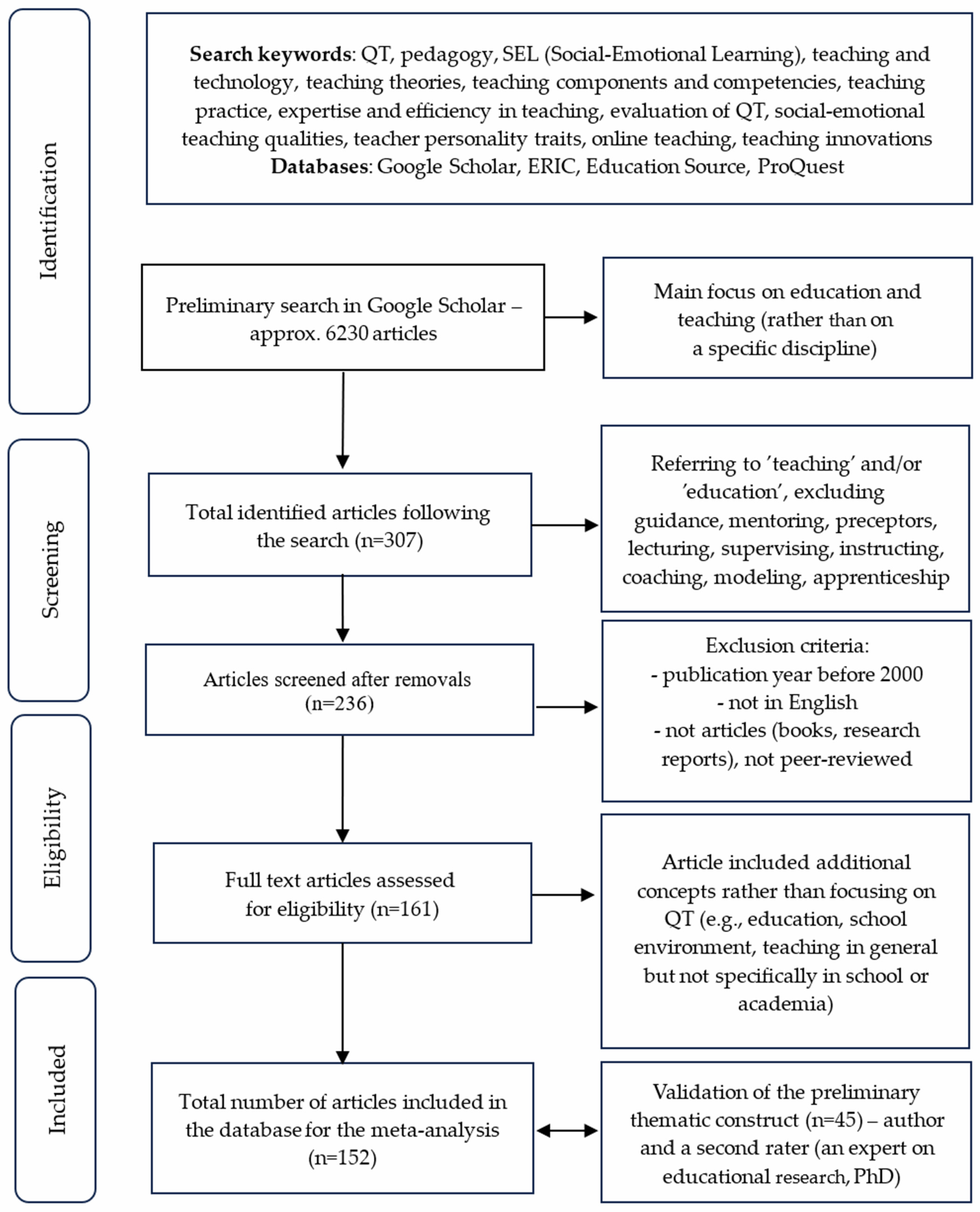
Figure 1. PRISMA flow diagram of the literature review on Quality Teaching.
Education 16 00037 g001
Figure 2. Distribution of themes related to QT by domain and focuses (F = 740).
Education 16 00037 g002
Figure 3. Distributions of the themes regarding QT articles by focus (F = 740).
Education 16 00037 g003
Figure 4. Distribution of each theme’s focus regarding QT in the articles (F = 740).
Education 16 00037 g004
Figure 5. Quality Teaching characteristics (F = 740 themes).
Education 16 00037 g005
Table 1. Distributions of the articles by focus (F = 152).
Focus:TeacherLearnerSystem
Articlesf%f%f%
0 (none)127.93623.78153.3
12315.14630.34831.6
23422.43825.02013.2
33724.32113.832.0
42717.8106.6
5138.610.7
642.6
721.3
Median3.0 1.0 0.0
Mean2.7 1.5 0.6
SD1.6 1.2 0.8
According to our search procedure emphasizing QT, most of the articles focused on the teacher (mean = 2.7), fewer on the learner (mean = 1.5), and the fewest on the system (mean = 0.6).
Table 2. Distribution of themes related to QT by domains and focuses (F 1 = 740 themes).
DomainsFocusesN% of Total% of DomainMdMeanSDMax.
Overall total themes740100.0% 54.92.413
PedagogyTotal41255.7%100.0%32.71.88
Teacher25133.9%60.9%21.71.35
Learner9713.1%23.5%00.60.83
System648.6%15.5%00.40.62
TechnologyTotal19125.8%100.0%01.31.55
Teacher12216.5%63.9%00.81.03
Learner364.9%18.8%00.20.41
System334.5%17.3%00.20.41
SEL/SETTotal13718.5%100.0%10.91.03
Learner9713.1%70.8%00.60.82
Teacher405.4%29.2%00.30.41
System0
1 F = Overall frequency of themes.
Table 3. Distribution of themes related to QT in the pedagogical domain by focus (f = 412 themes).
FocusPedagogyThemeF% of Total
(F = 740)
% of Domain
(f = 412)
MeanSDMax.
TeacherTotalPedagogy Teacher25133.9%60.9%1.71.35
ExpertiseExpertise and effectiveness in Quality Teaching739.9%17.7%0.50.51
PracticeTeaching skills, methods, practices, and practical training709.5%17.0%0.50.51
ComponentsQuality Teaching components 557.4%13.3%0.40.51
QualificationQualification towards Quality Teaching395.3%9.5%0.30.41
EvaluationDimensions for evaluating the quality of teaching and providing feedback 141.9%3.4%0.10.31
LearnerTotalPedagogy Learner9713.1%23.5%0.60.83
Collaboration/self-direction Active, engaging, collaborative learning and self-direction 699.4%16.8%0.30.41
IntegrationIntegrating 21st century skills in learning283.8%6.8%0.20.41
SystemProfessional developmentSystemic professional development programs to promote Quality Teaching 648.6%15.5%0.40.62
f = Frequency of themes in a subgroup of themes (domains/focuses).
Table 4. Distribution of themes related to QT in the technology domain by focus (f = 191).
FocusTechnologyThemeF% of Total
(F = 740)
% of Domain
(f = 191)
MeanSDMax.
Teacher Total 12216.5%63.9%0.81.03
IntegrationIntegrating technology into Quality Teaching628.4%32.5%0.40.51
InnovationsTeaching innovations related to Technological Quality Teaching354.7%18.3%0.20.41
CharacteristicsTeacher characteristics and perceptions related to technological Quality Teaching253.4%13.1%0.20.41
LearnerAcquisitionAcquisition of digital skills and competencies of the 21st century (TPACK)364.9%18.8%
SystemSupportSystemic support for digital learning and innovation in Quality Teaching334.5%17.3%0.20.41
Table 5. Distribution of themes related to QT in the SEL/SET domain by focus (f = 137 themes).
FocusSEL/SETThemeF% of Total
(F = 740)
% of Domain
(f = 137)
MeanSDMax.
Learner Total9713.1%70.8%0.60.82
SEL and self-directionSocial learning, self-direction, and emotional-motivational learning527.0%38.0%0.30.51
characteristicsLearner SE characteristics related to learning456.1%32.8%0.30.51
TeachercharacteristicsTeacher SE characteristics related to Quality Teaching405.4%29.2%
Disclaimer/Publisher’s Note: The statements, opinions and data contained in all publications are solely those of the individual author(s) and contributor(s) and not of MDPI and/or the editor(s). MDPI and/or the editor(s) disclaim responsibility for any injury to people or property resulting from any ideas, methods, instructions or products referred to in the content.