Data-Rich Science Instruction: Current Practices and Professional Learning Needs for Middle and High School Earth Science
 , , , , and
Abstract
1. Introduction
1.1. Overview
1.1.1. Earth Science as a Context for Data-Rich Learning
1.1.2. Centering Diverse Voices in Data-Rich Science Education
1.2. Theoretical Framework: Toward Community-Connected Data Science Education
1.2.1. Data Fluency
1.2.2. Funds of Knowledge and Community Data Practices
1.2.3. Technological and Pedagogical Content Knowledge
1.2.4. Integrating the Frameworks
1.3. Study Context and Objectives
2. Materials and Methods
2.1. Research Questions
2.2. Participants
2.3. Data Collection
Can you share an example of data-rich learning from your practice? How did you support this data-rich experience? What did you want your students to take away from the experience?What is an example of data-rich learning you want to try with your students but haven’t yet? What holds you back?
2.4. Data Analysis
2.4.1. Quantitative Analysis
2.4.2. Qualitative Analysis
2.4.3. Mixed-Methods Integration
2.5. Ethical Considerations
2.6. Methodological Limitations
2.7. Use of Gen AI
3. Results
3.1. Summary of Key Findings
3.2. Finding 1: Data Practices in Classrooms
3.3. Finding 2: Sources of Data Used by Students
They relate their data with the previous data collected by students in their school only. It is not [the case that] we have collected data from some other place, or we have just borrowed data from somebody. This is the real data collected by students of this school in those years. Comparing those data gives them a great idea about how temperature varies, how rainfall varies, pressure, atmospheric pressure varies, soils, moisture level, and the pH level is changing. And these things are connecting them with their community—how their community’s weather and climate is changing and how it is affecting them and their plans in their agriculture in so many ways.—Teacher B
One data-rich project that I had worked on was with our school garden. … We were trying to see if legumes were going to increase the nitrogen content in the soil. … We used three different raised bed soils, raised bed ones to create transects and planted the ones, and used some nitrogen testing strips to do it. … After doing some more research. … I think it takes a few rotations. You’re supposed to allow the right legumes to go in there and break down again, but it was a good experience for the students, I think.—Teacher C
We worked with our local watershed … [The kids] would tag tiny fish and. … enter it into the greater data system. … Then, we would come back to that same archive of data and track where our fish were. … and look at the tag numbers from years before in that wildlife cycle to see. … How many are coming back up? What could have happened? What’s not happening? Relate that back to historical weather patterns or what’s happening this spring.—Teacher D
We try to find data that can connect to everyone, especially in our community. … This is mostly research [from other scientists], not like we’re collecting the data ourselves. I think it’s a good idea that you’re collecting data with your kids. But most of the data we gather are from NASA. … I’m not so sure if you’ve been in this part of the Four Corners. … It is so dry here. And so, and plus in the reservations, our kids have very difficult getting water. Not just for drinking, but for livestock and for all of that. And they can totally relate to the data that we gather from NASA that it’s been dry, and the prediction is that it’s going to be drier. Primarily, we connect it to the climate change unit of our high school biology, which is almost at the end of the semester, but kids, they’re in awe to see that, “Oh my gosh. That’s why we need to read data. That’s why we need to analyze this data, because it affects everyone. Especially here in the Four Corners where everything is so dry.”—Teacher E
Right now, I think it’s that the data isn’t clearly aligned to a learning goal that I’m working on. … Even if it was, if they had their separate website that was organized by NGSS [Next Generation Science Standards] Learning Standard, right? If they had something like that and I could go to that and be like, okay, here’s this data that’s actually being collected, that is related to the relationship between mass and gravity, or something like that.—Teacher C
3.4. Finding 3: Technological Tools for Sensemaking with Data
3.5. Finding 4: Students’ Strengths and Assets for Working with Data
Rural youth communities are inherently problem-solvers, and out-of-classroom hands-on investigations resonate [with them]. It also provides a platform for knowledge sharing and discovery and equalizes the traditional teacher-student hierarchy. If I am working in a place where a youth community grew up in and where their family is from, they are the knowledge-holders and I am merely a guide and guest in their land.—Teacher G, referring to students’ dispositions and cultural knowledge
My students are exposed to a variety of information and so they are already good at generalizing trends from datasets and also creating models (graphs, drawings, etc. to represent data).—Teacher H, concerning students’ data-related practices
Students are naturally inquisitive and are eager to learn how to collect data “like a scientist.” It brings out their natural curiosity and brings forward their ability to take information and take meaning from it, especially when it stems from a problem that they identified.—Teacher I, regarding students’ data skills, dispositions, and interests
One of the best things about NASA is, all of the videos of the NASA experts and the actual scientists [show] that NASA has so many women and people of color in the Earth sciences—‘cause Earth science is so white. … It is impossible to find other videos that are not just white men in the Earth sciences—but we don’t want to keep it that way.—Teacher F
I’ve really been struggling with how to draw on the Indigenous traditions and their use of data. … [by] tap[ping] into oral tradition, storytelling, to draw in that cultural understanding of science and drawing on native science. … [I want to] have our kiddos see that this is not only ethnic, really solid science, but then [I] also [want them] to see themselves as science in their own Indigenous ethnic skins. … [I want my students to know that] data-based science isn’t just a white man’s gig. … data-based science is Indigenous, it is Hispanic, it is Latinx.—Teacher G
We listened to the stories from the Salish Kootenai tribes, which [has a] very similar climate to where we live. And they talk about how the climates have been shifting with climate change. So seasons are coming in earlier and then we also will dive into data of ice cores, tree cores. … And those connections have been meaningful. And then that website also has been nice for finding local data, local screen temperature data, because my kids won’t do anything unless they think it revolves around them. So the only success I had with a few kids in that whole unit was they’re like, “I don’t care, I just want to go fishing.” And so we were like, “Yes, find the river where the temperature is going to increase. You can’t go fishing anymore.” We were able to do that.—Teacher F
3.6. Finding 5: Challenges to Data-Rich Instruction
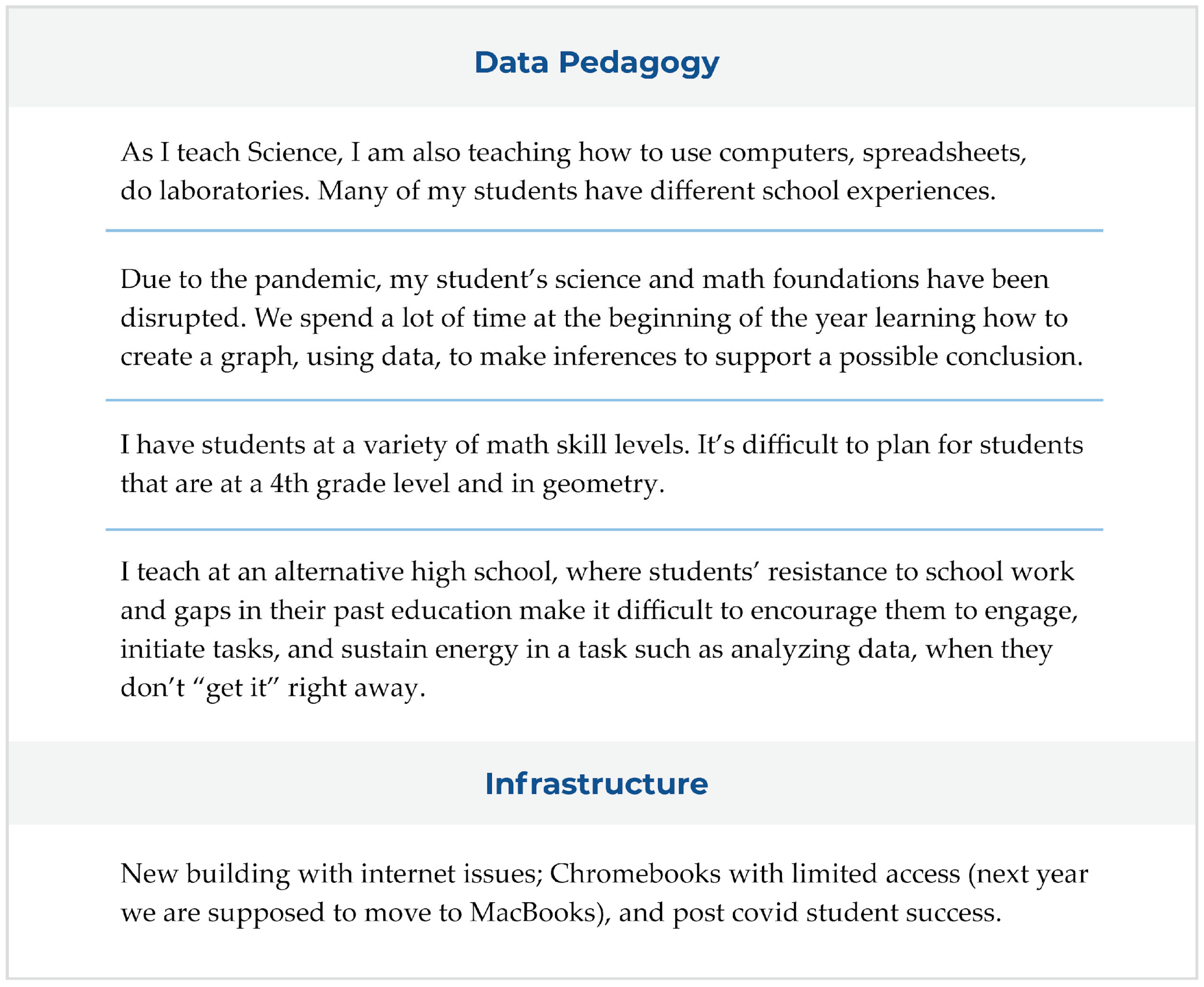
Using data in a classroom and having students work through the process takes time. And often the amount of time it takes for them to actually understand it, instead of just sprinkle it on top of a concept and play with it—for them to really understand, manipulate use and be able to apply the skill takes more time than many of our curriculum maps and schedules really allow. So you have to be very ready to—not sacrifice some subjects but multitask a lot of subjects so that you can cover what you have to cover as well as providing this application of this skill and opportunity for kiddos, time is the limit[ing] factor.—Teacher D
The biggest [challenge] is integrating data into lessons with greater frequency, which typically means for a teacher, greater ease of finding the data, is it relevant data to [the] subject or standard being taught, and that the data is authentic enough to engage students.—Teacher A
4. Discussion
4.1. Existing Assets for Data-Rich Science Learning (Research Question 1)
4.2. Barriers to Data-Rich Science Implementation (Research Question 2)
4.3. Professional Learning Needs Through Theoretical Lenses (Research Question 3)
- Data fluency components: Professional learning must address not just technical competencies but pedagogical approaches for cultivating the critical thinking and skepticism that Wild and Pfannkuch (1999) identify as essential habits of mind.
- Funds of Knowledge: Teachers recognize students’ community knowledge as valuable (See Section 4.1), but they need concrete strategies for building curricula that systematically leverage these assets.
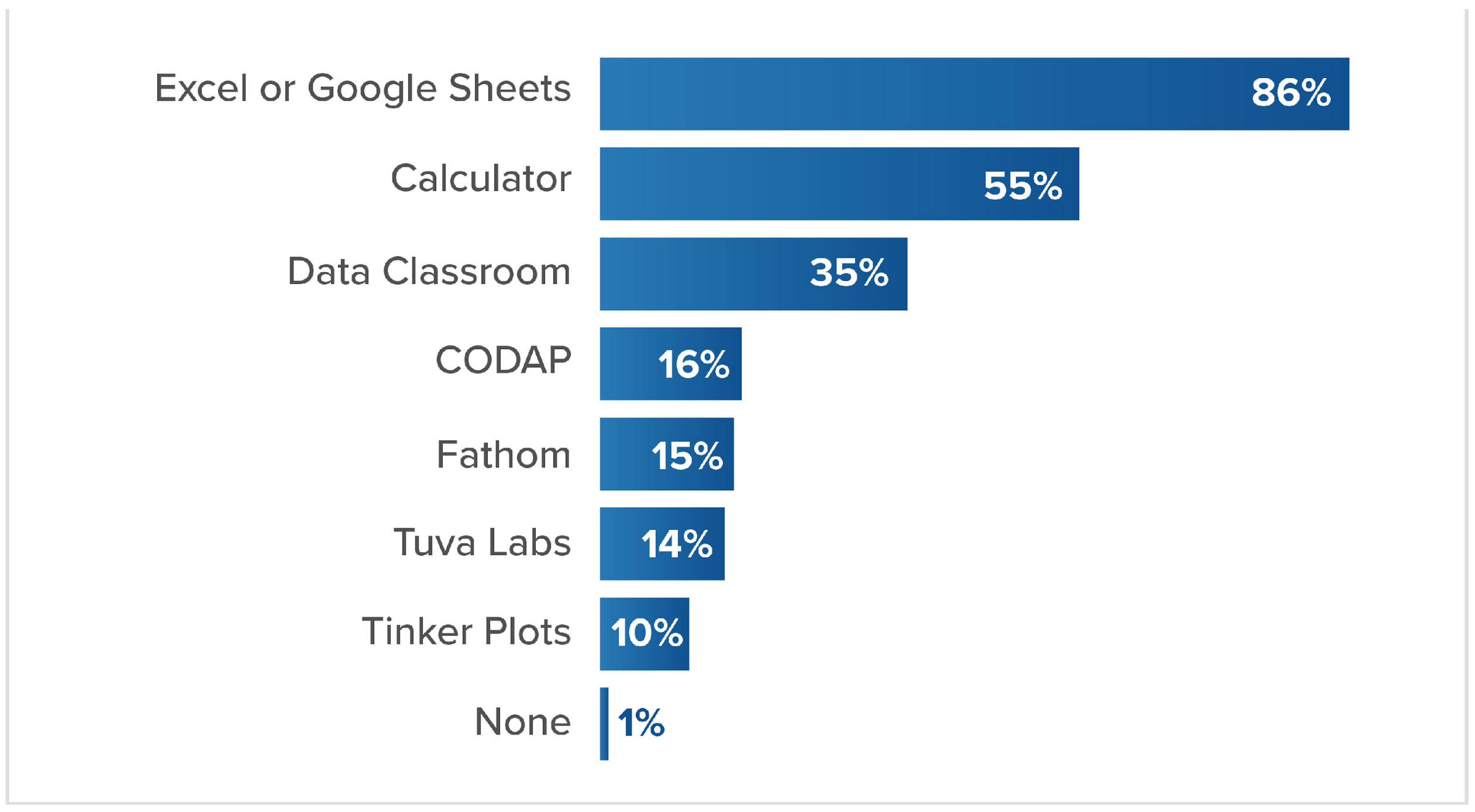
- Technological Pedagogical Content Knowledge (TPACK): The 51% of educators requesting training in specific tools reflects the need to develop integrated TPACK for data fluency. The disparity between spreadsheet use (86%) and dynamic visualization tools (45%) suggests teachers need help understanding which tools best support specific data learning objectives and how to integrate them pedagogically.
4.4. Significance of Findings for Science Education Transformation
4.5. Implications for the Future of Science Education
4.6. Limitations and Future Directions
5. Conclusions
Supplementary Materials
Author Contributions
Funding
Institutional Review Board Statement
Informed Consent Statement
Data Availability Statement
Acknowledgments
Conflicts of Interest
Abbreviations
| AI | Artificial Intelligence |
| CODAP | Common Online Data Analysis Platform |
| NASA | National Aeronautics and Space Administration |
| NGSS | Next Generation Science Standards |
| NOAA | National Oceanic and Atmospheric Administration |
| PhET | Physics Education Technology |
| PL | Professional learning |
| PLACES | Place-Based Learning to Advance Connections, Education, and Stewardship |
| TI | Texas Instruments |
| TPACK | Technological and Pedagogical Content Knowledge |
References
- Ainsworth, S. (2018). Multiple representations and multimedia learning. In F. Fischer, C. E. Hmelo-Silver, S. R. Goldman, & P. Reimann (Eds.), International handbook of the learning sciences (pp. 96–105). Routledge. [Google Scholar] [CrossRef]
- Ainsworth, S., Bibby, P., & Wood, D. (2002). Examining the effects of different multiple representational systems in learning primary mathematics. The Journal of the Learning Sciences, 11(1), 25–61. [Google Scholar]
- Arastoopour Irgens, G., Knight, S., & Wise, A. (2020). Data literacies and social justice: Exploring critical data literacies through sociocultural perspectives. In M. Gresalfi, & I. S. Horn (Eds.), The interdisciplinarity of the learning sciences, 14th international conference of the learning sciences (ICLS) 2020 (Vol. 1, pp. 406–413). International Society of the Learning Sciences. [Google Scholar]
- Bang, M., Warren, B., Rosebery, A., & Medin, D. L. (2013). Desettling expectations in science education. Human Development, 55, 302–318. [Google Scholar] [CrossRef]
- Bargagliotti, A., Franklin, C., Arnold, P., Gould, R., Johnson, S., Perez, L., & Spangler, D. A. (2020). Pre-K–12 guidelines for assessment and instruction in statistics education II (GAISE II): A framework for statistics and data science education. American Statistical Association. Available online: https://www.amstat.org/asa/files/pdfs/GAISE/GAISEIIPreK-12_Full.pdf (accessed on 14 October 2025).
- Berkes, F. (2012). Sacred ecology: Traditional ecological knowledge and resource management. Routledge. [Google Scholar]
- Braun, V., & Clarke, V. (2006). Using thematic analysis in psychology. Qualitative Research in Psychology, 3(2), 77–101. [Google Scholar] [CrossRef]
- Chen, P., Wong, N., Elsayed, R., Perez, L., & Daehler, K. R. (2025, March 23–26). Building teachers’ capacity for data-rich instruction: Impact from a professional learning course [Poster Session]. Ninety-Eighth Annual International Conference of the National Association for Research in Science Teaching, National Harbor, MD, USA. [Google Scholar]
- Cobb, G., & Moore, D. (1997). Mathematics, statistics, and teaching. American Mathematical Monthly, 104, 801–823. [Google Scholar] [CrossRef]
- Denton, M., & Borrego, M. (2021). Funds of knowledge in STEM education: A scoping review. Studies in Engineering Education, 1(2), 71–92. [Google Scholar] [CrossRef]
- D’Ignazio, C., & Klein, L. F. (2020). Data feminism. The MIT Press. [Google Scholar]
- Gal, I. (2002). Adults’ statistical literacy: Meanings, components, responsibilities. International Statistical Review/Revue Internationale de Statistique, 70(1), 1–25. [Google Scholar] [CrossRef]
- Gould, R. (2017). Data literacy is statistical literacy. Statistics Education Research Journal, 16(1), 22–25. [Google Scholar] [CrossRef]
- Kastens, K. (2015, May). Data use in the next generation science standards (revised edition) [White paper]. Oceans of Data Institute, Education Development Center, Inc. Available online: https://oceansofdata.org/sites/oceansofdata.org/files/ODI_DataUseInNGSS_Final.pdf (accessed on 14 October 2025).
- Konold, C., Finzer, W., & Kreetong, K. (2017). Modeling as a core component of structuring data. Statistics Education Research Journal, 16(2), 191–212. [Google Scholar] [CrossRef]
- Lee, H. S., Mojica, G. F., Thrasher, E., & Vaskalis, Z. (2020). The data investigation process. In Invigorating statistics teacher education through professional online learning. Friday Institute for Educational Innovation: NC State University. Available online: http://cdn.instepwithdata.org/DataInvestigationProcess.pdf (accessed on 14 October 2025).
- Lee, H. S., & Tran, D. (2015). Statistical habits of mind. In Teaching statistics through data investigations MOOC-Ed. Friday Institute for Educational Innovation: NC State University. Available online: https://www.researchgate.net/publication/381472375_Statistical_habits_of_mind (accessed on 14 October 2025).
- Lee, V. R., & Wilkerson, M. (2018). Data use by middle and secondary students in the digital age: A status report and future prospects. National Academies of Sciences, Engineering, and Medicine, Board on Science Education, Committee on Science Investigations and Engineering Design for Grades 6–12. [Google Scholar]
- Lee, V. R., Wilkerson, M. H., & Lanouette, K. (2021). A call for a humanistic stance toward K–12 data science education. Educational Researcher, 50(9), 664–672. [Google Scholar] [CrossRef]
- Macey, D., & Rycroft-Smith, L. (2022). What does research suggest about teaching statistics using rich data sets? Cambridge Mathematics Espresso, (41). Available online: https://www.cambridgemaths.org/Images/espresso_41_rich_data_sets.pdf (accessed on 11 August 2023).
- Marosi, N., Avraamidou, L., & Galani, L. (2021). Culturally relevant pedagogies in science education as a response to global migration. SN Social Sciences, 1, 147. [Google Scholar] [CrossRef]
- Mishra, P., & Koehler, M. J. (2006). Technological pedagogical content knowledge: A framework for integrating technology in teacher knowledge. Teachers College Record, 108(6), 1017–1054. [Google Scholar] [CrossRef]
- Moll, L. C., Amanti, C., Neff, D., & Gonzalez, N. (1992). Funds of knowledge for teaching: Using a qualitative approach to connect homes and classrooms. Theory into Practice, 31(2), 132–141. [Google Scholar] [CrossRef]
- National Academies of Sciences, Engineering, and Medicine. (2023). Foundations of data science for students in grades K-12: Proceedings of a workshop. The National Academies Press. [Google Scholar] [CrossRef]
- National Center for Education Statistics. (2023). Rural students’ access to the internet. In Condition of education. U.S. Department of Education, Institute of Education Sciences. Available online: https://nces.ed.gov/programs/coe/indicator/lfc (accessed on 11 December 2025).
- Nazarea, V. D. (1999). Ethnoecology: Situated knowledge/located lives. University of Arizona Press. [Google Scholar]
- NGSS Lead States. (2013). Next generation science standards: For states, by states. The National Academies Press. [Google Scholar]
- Oppenheimer, D., & Edwards, M. (2012). Democracy despite itself: Why a system that shouldn’t work at all works so well. The MIT Press. [Google Scholar] [CrossRef]
- Saldaña, J. (2016). The coding manual for qualitative researchers (3rd ed.). Sage Publications Inc. Available online: https://www.sfu.ca/~palys/Saldana-CodingManualForQualResearch-IntroToCodes&Coding.pdf (accessed on 14 October 2025).
- Smith, G. A. (2002). Place-Based education: Learning to be where we are. Phi Delta Kappan, 83(8), 584–594. [Google Scholar] [CrossRef]
- The Centering Voices Workgroup. (2018). Centering voices of those most impacted in health equity efforts. Available online: https://uwphi.pophealth.wisc.edu/wp-content/uploads/sites/316/2019/04/Centering-Voices-Principles_MATCH_Sept-2018.pdf (accessed on 29 July 2023).
- Wild, C. J., & Pfannkuch, M. (1999). Statistical thinking in empirical enquiry. International Statistical Review, 67(3), 223–248. [Google Scholar] [CrossRef]
- Wong, N., Elsayed, R., Nilsen, K., Perez, L. R., & Daehler, K. R. (2024). Centering educators’ voices in the development of professional learning for data-rich, place-based science instruction. Education Sciences, 14(4), 356. [Google Scholar] [CrossRef]
- Yarnall, L., & Ranney, M. (2017). Fostering scientific and numerate practices in journalism to support rapid public learning. Numeracy, 10(1), 3. [Google Scholar] [CrossRef][Green Version]



| Category | n | % |
|---|---|---|
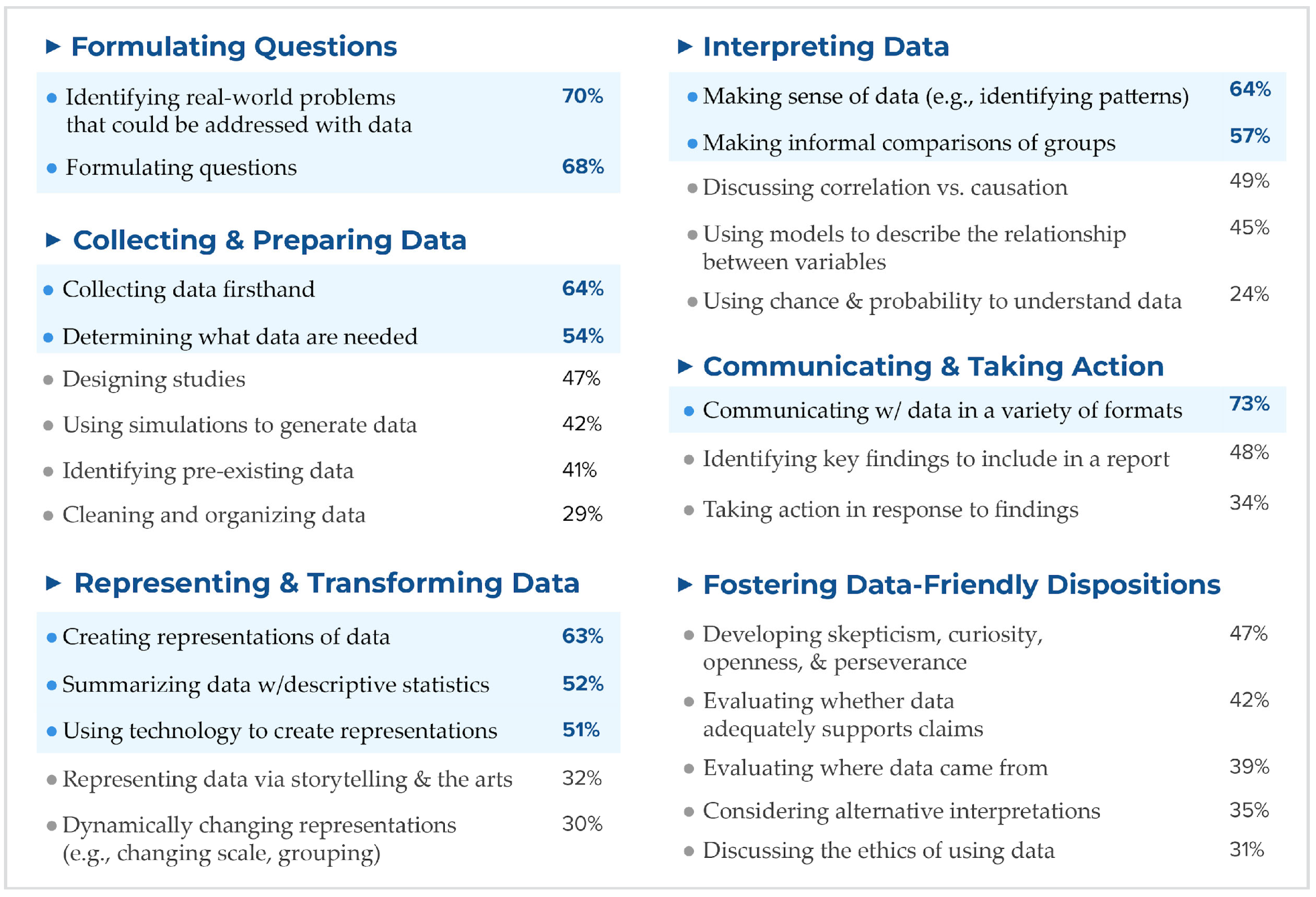
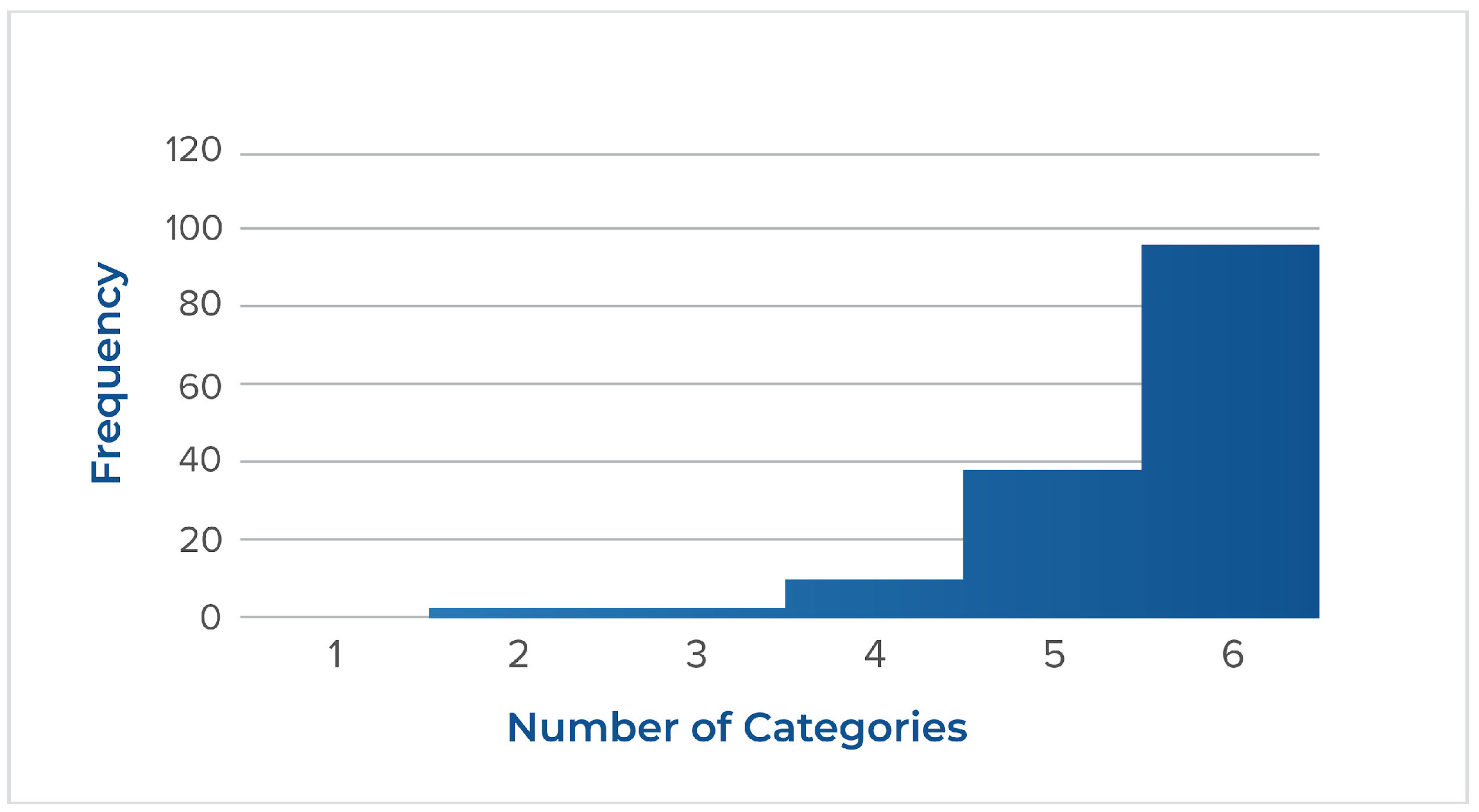
| Formulating questions | 132 | 89 |
| Collecting and preparing data | 139 | 94 |
| Representing and transforming data | 144 | 97 |
| Interpreting data | 143 | 97 |
| Communicating and taking action | 136 | 92 |
| Fostering data-friendly dispositions | 122 | 82 |
| Source | n | % |
|---|---|---|
| Data created by students through laboratory activities or other investigations | 88 | 57 |
| Data collected by students through field experiences, including citizen science opportunities | 87 | 56 |
| Data created or accessed by students through connections with their community, history, or culture | 79 | 51 |
| Full datasets that are openly accessible but without any analysis, interpretation, or questions to guide analyses or interpretation provided (e.g., Google Earth, long-term datasets, NOAA) | 78 | 50 |
| Data from online or computer-based simulations (e.g., Gizmos, PhET simulations, NetLogo simulations) | 71 | 46 |
| Data formatted and presented specifically for use by educators or consumption by the general public (e.g., Data Nuggets, Mystery Science) | 70 | 45 |
| Data from the textbook or curricular materials | 70 | 45 |
| Data published within primary scientific literature | 50 | 32 |
| Data from probeware | 28 | 18 |
| Other (please specify) | 5 | 3 |
| None | 1 | 1 |
| Category | Challenge | n | % |
|---|---|---|---|
| Data-Lesson Planning and Design | Accessing data relevant to the content area | 68 | 53 |
| Integrating data into my lesson plans | 53 | 47 | |
| Accessing data-rich lessons | 61 | 39 | |
| Data Pedagogy | Deeply understanding a dataset, so I can facilitate student learning | 54 | 42 |
| Promoting understanding of data in students of varying abilities | 42 | 40 | |
| Anticipating common student difficulties when making sense of data | 52 | 34 | |
| Facilitating student use of technologies to access data | 40 | 33 | |
| Facilitating data-based discourse among students | 44 | 33 | |
| Infrastructure | Setting aside class time to authentically engage in data-rich learning | 54 | 42 |
| Other (please specify) | 5 | 4 |
Disclaimer/Publisher’s Note: The statements, opinions and data contained in all publications are solely those of the individual author(s) and contributor(s) and not of MDPI and/or the editor(s). MDPI and/or the editor(s) disclaim responsibility for any injury to people or property resulting from any ideas, methods, instructions or products referred to in the content. |
© 2026 by the authors. Licensee MDPI, Basel, Switzerland. This article is an open access article distributed under the terms and conditions of the Creative Commons Attribution (CC BY) license.
Share and Cite
Wong, N.; Elsayed, R.; Perez, L.R.; Nilsen, K.; Daehler, K.R.; Darche, S. Data-Rich Science Instruction: Current Practices and Professional Learning Needs for Middle and High School Earth Science. Educ. Sci. 2026, 16, 171. https://doi.org/10.3390/educsci16010171
Wong N, Elsayed R, Perez LR, Nilsen K, Daehler KR, Darche S. Data-Rich Science Instruction: Current Practices and Professional Learning Needs for Middle and High School Earth Science. Education Sciences. 2026; 16(1):171. https://doi.org/10.3390/educsci16010171
Chicago/Turabian StyleWong, Nicole, Rasha Elsayed, Leticia R. Perez, Katy Nilsen, Kirsten R. Daehler, and Svetlana Darche. 2026. "Data-Rich Science Instruction: Current Practices and Professional Learning Needs for Middle and High School Earth Science" Education Sciences 16, no. 1: 171. https://doi.org/10.3390/educsci16010171
APA StyleWong, N., Elsayed, R., Perez, L. R., Nilsen, K., Daehler, K. R., & Darche, S. (2026). Data-Rich Science Instruction: Current Practices and Professional Learning Needs for Middle and High School Earth Science. Education Sciences, 16(1), 171. https://doi.org/10.3390/educsci16010171