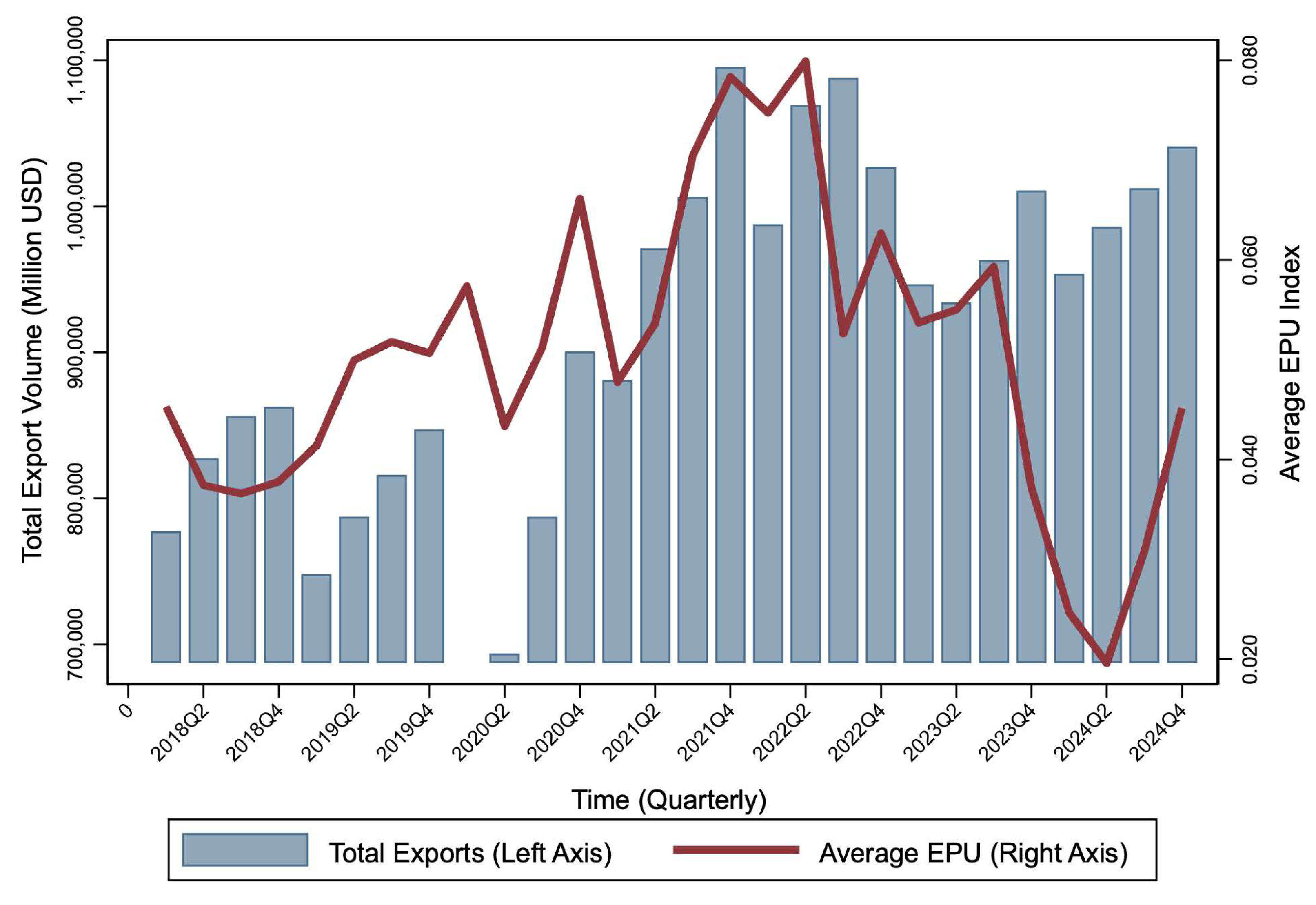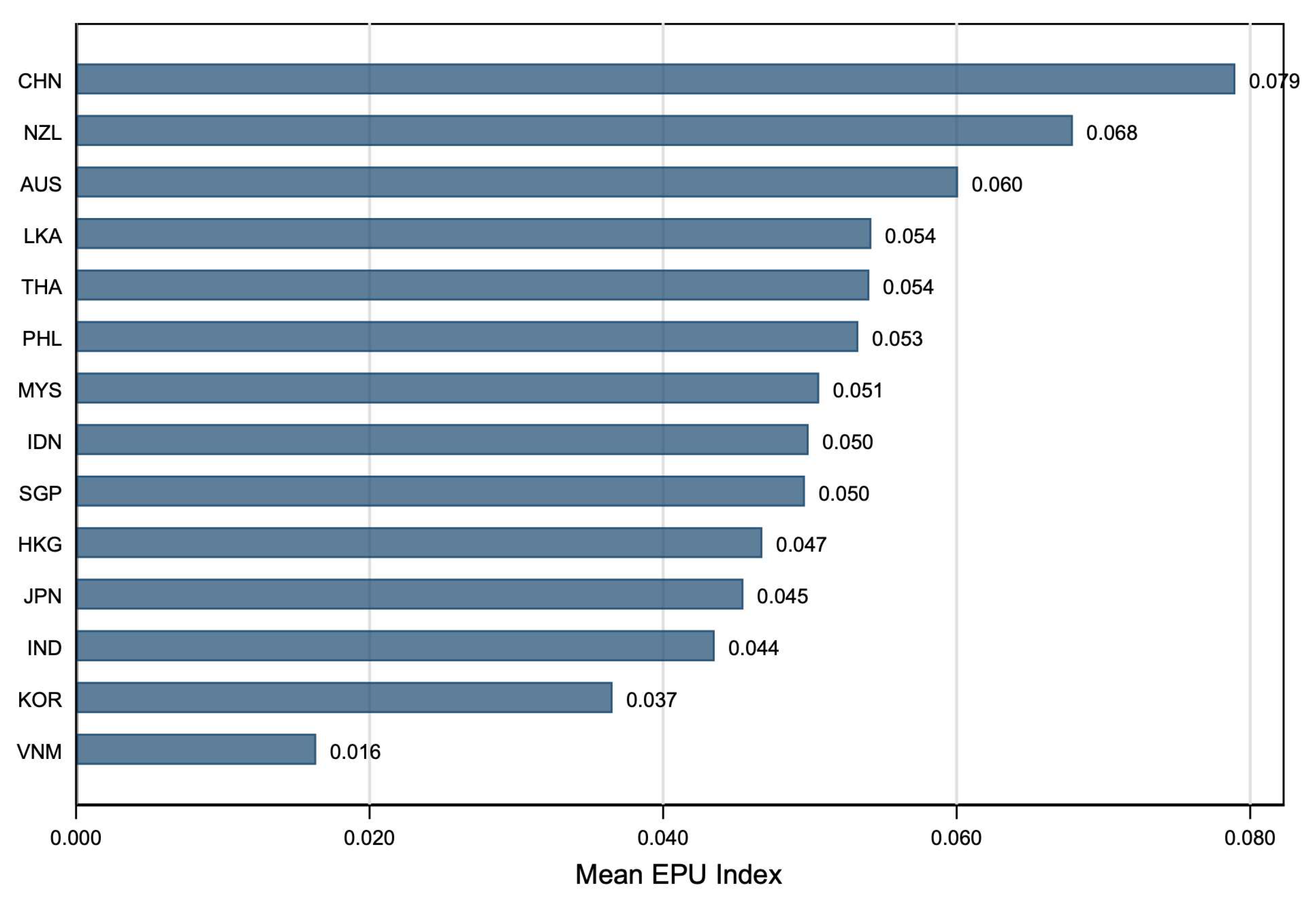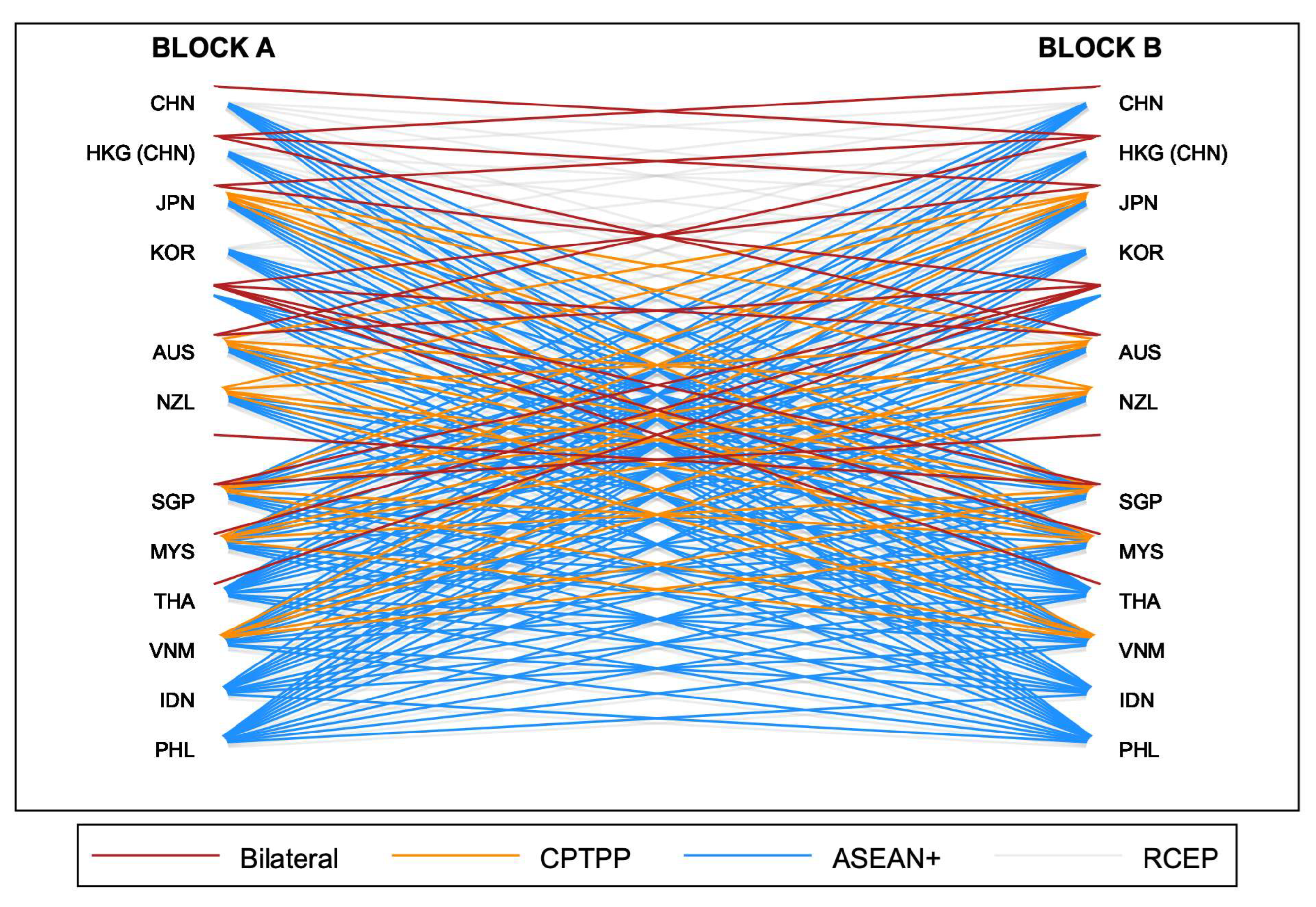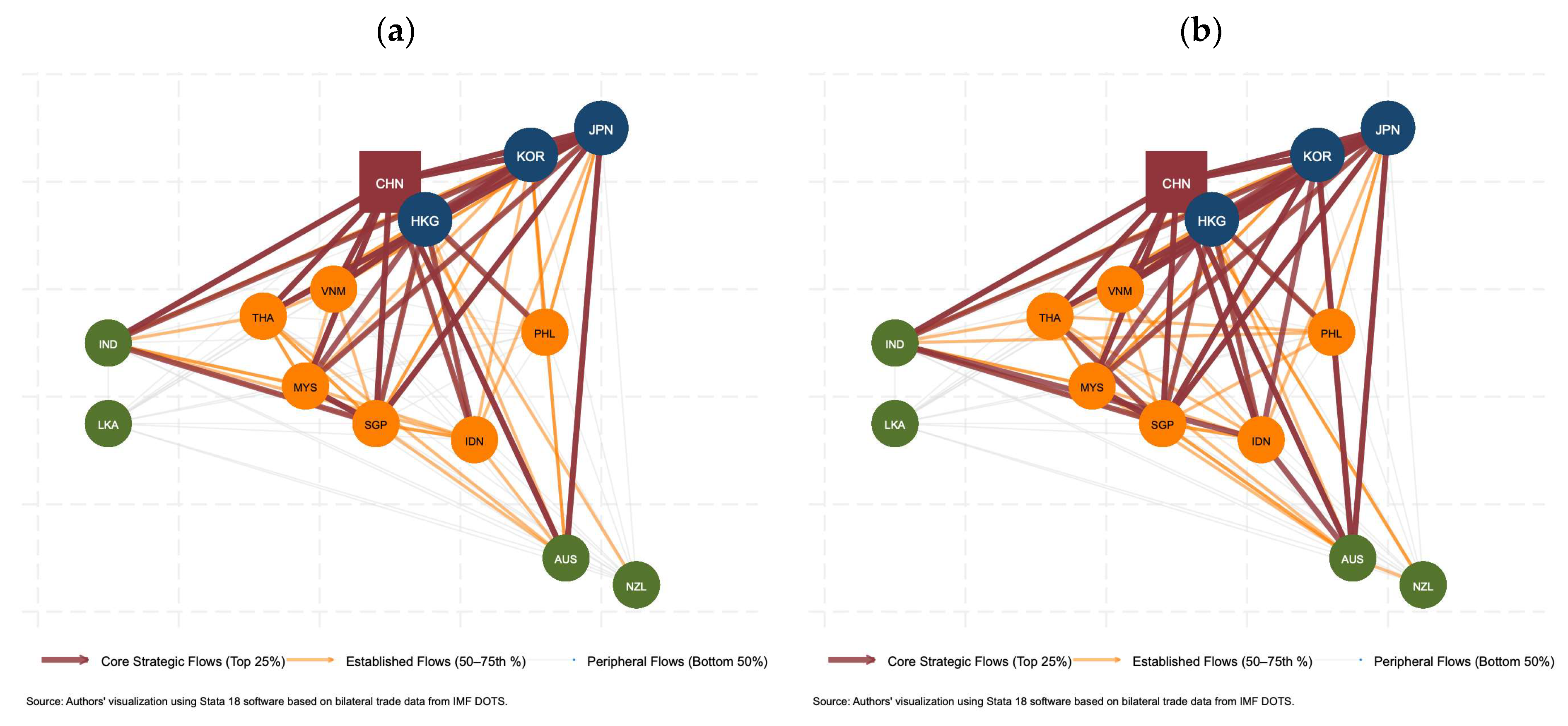

Economic Policy Uncertainty and Trade Flows: Evidence from the Asia-Pacific Region



Abstract
1. Introduction
2. Research Background: The Landscape of Uncertainty
2.1. From Tariff Turbulence to Existential Threat
2.2. Heterogeneity in Policy Uncertainty: Systemic Hubs vs. Open Peripheries
2.3. The Multi-Layered Institutional Architecture and Trade Interdependence
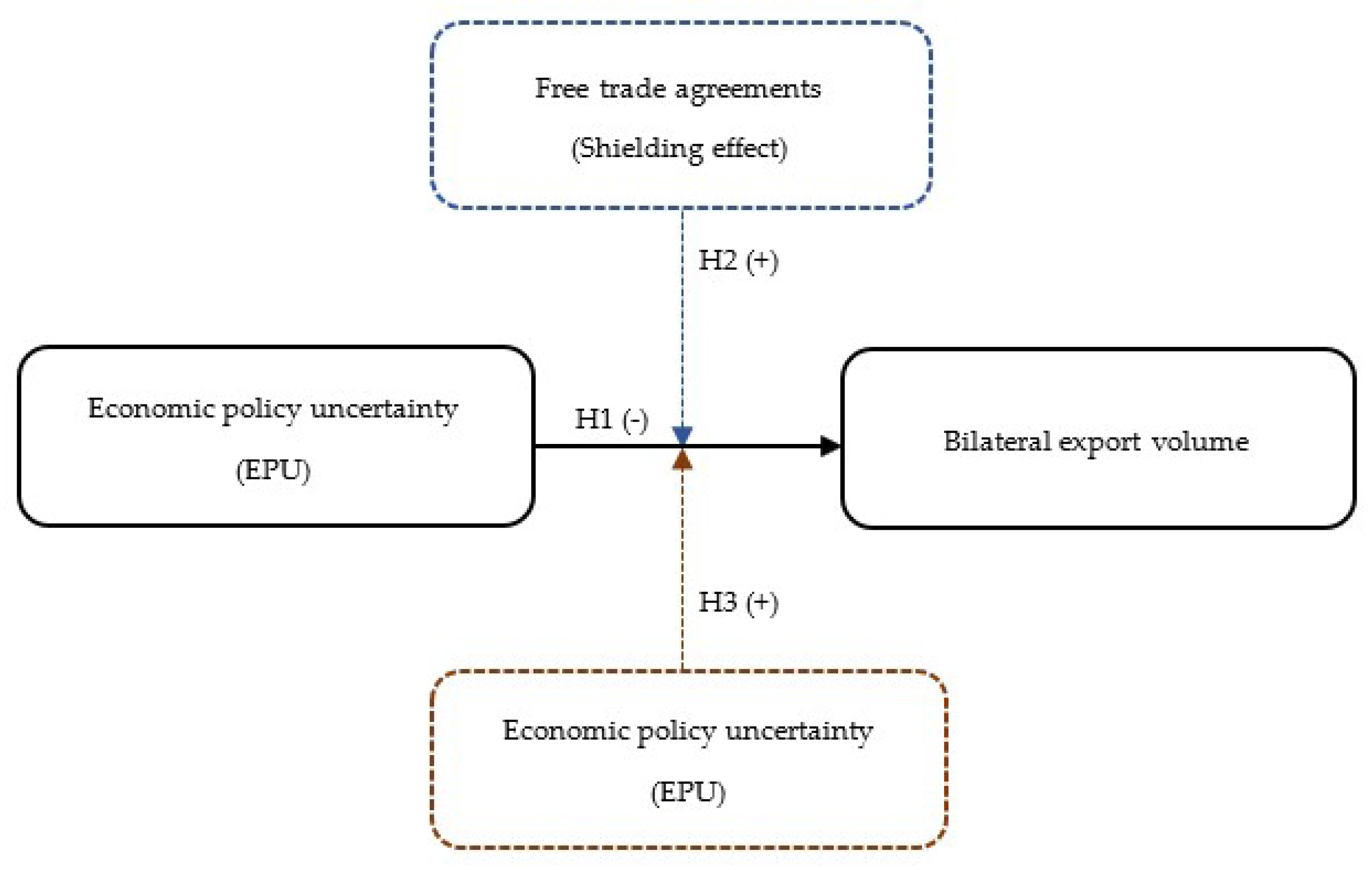
3. Theoretical Framework and Hypothesis Development
3.1. Uncertainty, Sunk Costs, and the Wait to Invest Channel
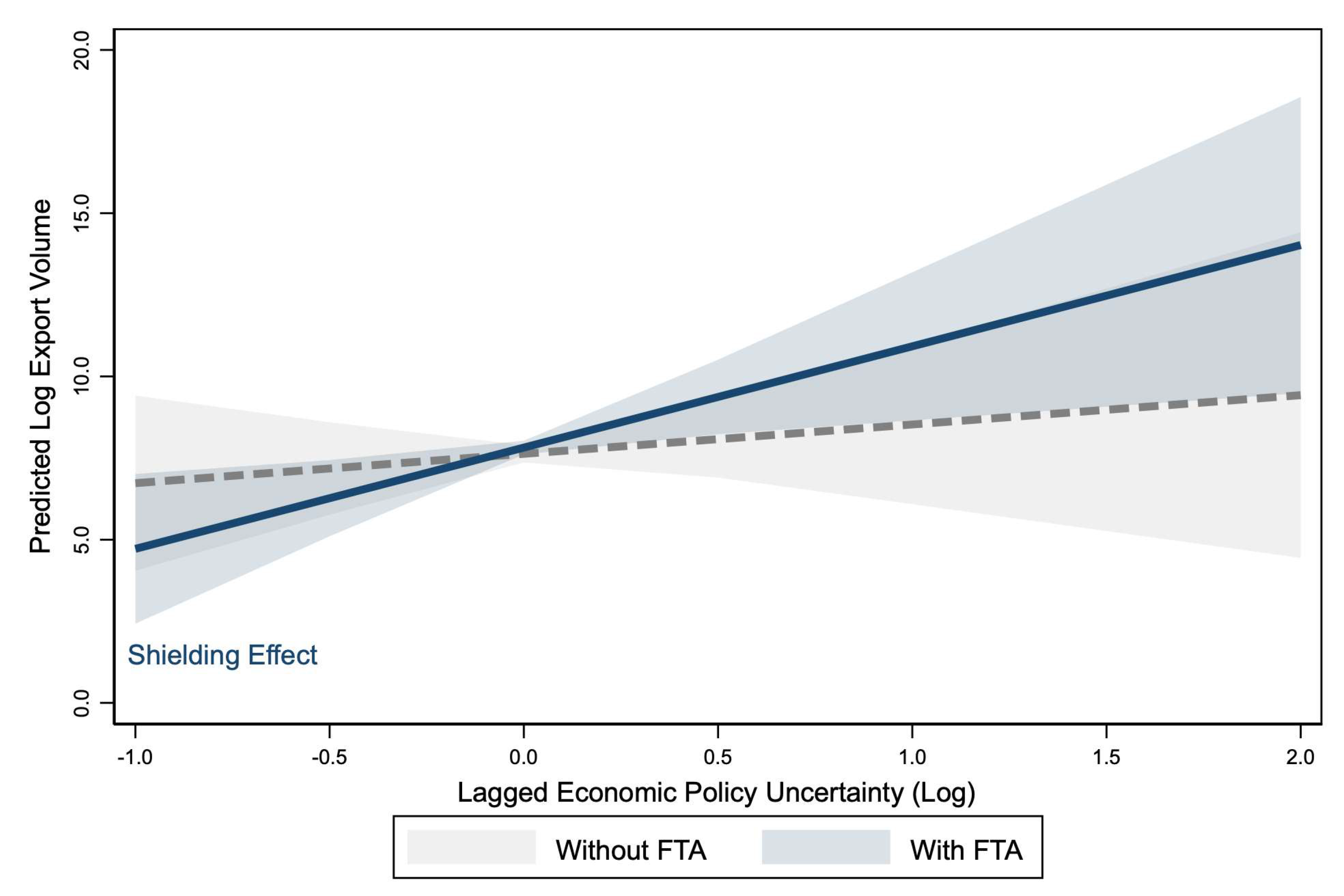
3.2. The Institutional Shield Effect: FTAs as Credibility Anchors
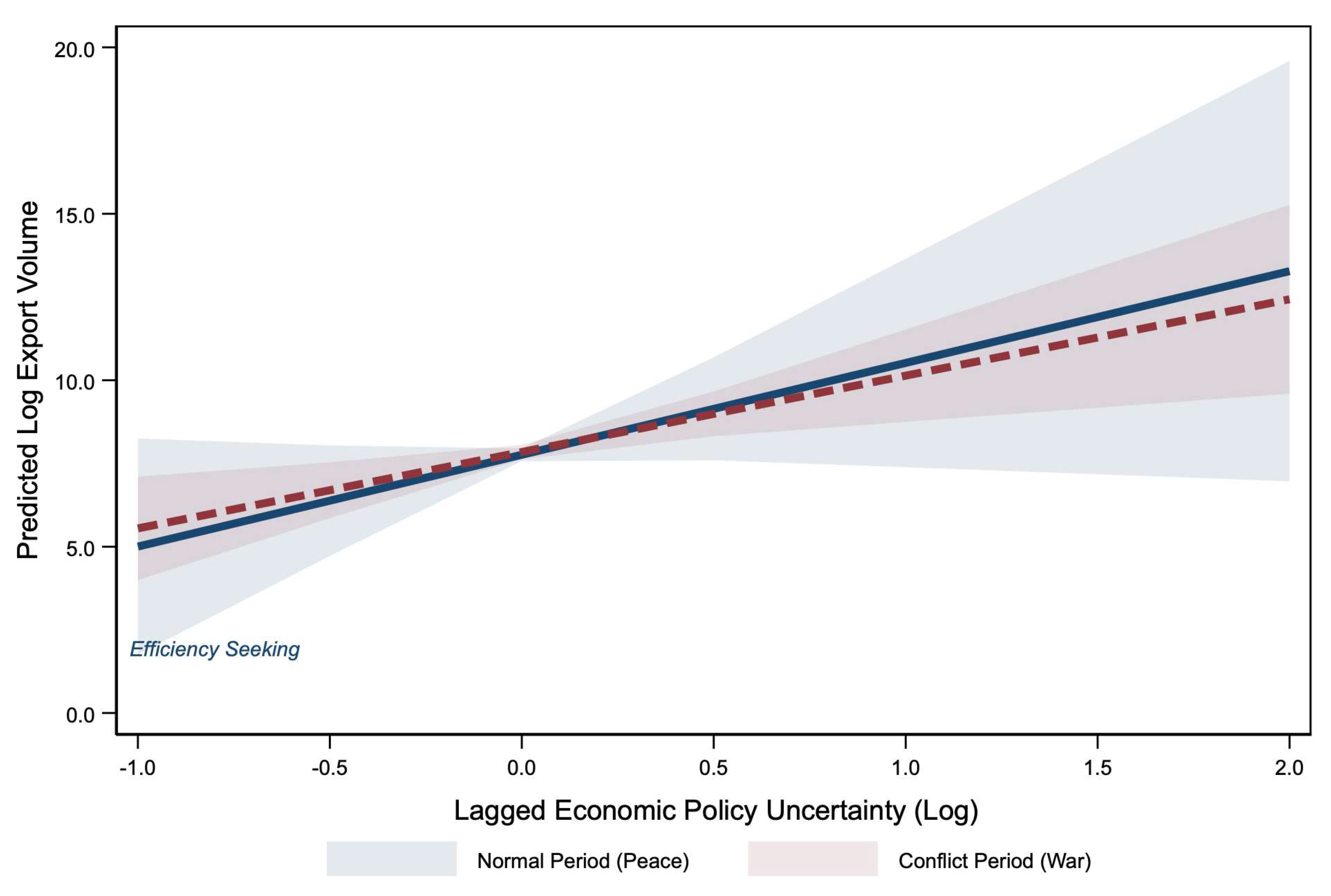
3.3. Crisis Adaptation: The Non-Linear Switching Mechanism
4. Methodology and Data
4.1. Empirical Strategy
- Yi, Yj, and YW are the GDP of the exporting country, the importing country, and the world, respectively.
- is the bilateral trade cost (the iceberg of trade costs).
- σ > 1 is the elasticity of substitution.
- are the components of Multilateral Resistance (MRT). Specifically, (Outward MRT) reflects the ease of access to the global market for the exporting country, while (Inward MRT) reflects the competitiveness in the import market.
- is the nominal export flow from country i to country j at time t.
- represent the Economic Policy Uncertainty indices for the exporter and importer. They are lagged by one quarter to mitigate simultaneity bias and account for the delay in business decision-making.
- Zij,t is a vector of standard gravity controls, including economic size (lnGDPit, lnGDPjt), bilateral exchange rates (lnERit, lnERjt), geographic distance (lnDistij), and FTA membership (FTAij,t)
- is the robust error term.
4.2. Empirical Specifications
4.3. Data and Variables
5. Empirical Results
Robustness Checks
6. Discussion
6.1. Magnification Effects and Structural Inertia
6.2. The Shielding Role of Trade Institutions
6.3. Crisis Adaptation and Supply Security
7. Conclusions & Policy Implications
Author Contributions
Funding
Institutional Review Board Statement
Informed Consent Statement
Data Availability Statement
Acknowledgments
Conflicts of Interest
Abbreviations
| ADB | Asian Development Bank |
| ASEAN | Association of Southeast Asian Nations |
| CES | Constant Elasticity of Substitution |
| CPTPP | Comprehensive and Progressive Agreement for Trans-Pacific Partnership |
| DOTS | Direction of Trade Statistics |
| EPU | Economic Policy Uncertainty |
| ER | Exchange Rate |
| FTA | Free Trade Agreement |
| GDP | Gross Domestic Product |
| GVC | Global Value Chain |
| IMF | International Monetary Fund |
| MRT | Multilateral Resistance Terms |
| OLS | Ordinary Least Squares |
| PPML | Poisson Pseudo Maximum Likelihood |
| RCEP | Regional Comprehensive Economic Partnership |
| ROO | Rules of Origin |
| ROT | Real Options Theory |
| UEB | VNU University of Economics and Business |
| UNCTAD | United Nations Conference on Trade and Development |
| VASS | Vietnam Academy of Social Sciences |
| VNU | Vietnam National University |
| WTO | World Trade Organization |
References
- ADB. (2022). Asian economic integration report 2022: Advancing digital services trade in Asia and the pacific-main report. Asian Development Bank. [Google Scholar] [CrossRef]
- ADB. (2023). ASEAN and global value chains: Locking in resilience and sustainability. Asian Development Bank. [Google Scholar] [CrossRef]
- Ahir, H., Bloom, N., & Furceri, D. (2022). The world uncertainty index (No. W29763). National Bureau of Economic Research. [Google Scholar] [CrossRef]
- Aiyar, S., Ilyina, A., Chen, J., Kangur, A., Trevino, J., Ebeke, C., Gudmundsson, T., Soderberg, G., Schulze, T., Kunaratskul, T., Ruta, M., Garcia-Saltos, R., & Rodriguez, S. (2023). Geo-economic fragmentation and the future of multilateralism. Staff Discussion Notes, 2023(001), 1. [Google Scholar] [CrossRef]
- Alessandria, G., Kaboski, J. P., & Midrigan, V. (2010). Inventories, lumpy trade, and large devaluations. American Economic Review, 100(5), 2304–2339. [Google Scholar] [CrossRef]
- Altomonte, C., Mauro, F. D., Ottaviano, G., Rungi, A., & Vicard, V. (2012). Global value chains during the great trade collapse: A bullwhip effect? CEP Discussion Paper No. 1131. Available online: https://cep.lse.ac.uk/pubs/download/dp1131.pdf (accessed on 1 January 2026).
- Amiti, M., Redding, S. J., & Weinstein, D. (2019). The impact of the 2018 trade war on U.S. prices and welfare. Working Paper 25672. National Bureau of Economic Research. Available online: http://www.nber.org/papers/w25672 (accessed on 1 January 2026).
- Anderson, J. E., & Van Wincoop, E. (2003). Gravity with gravitas: A solution to the border puzzle. American Economic Review, 93(1), 170–192. [Google Scholar] [CrossRef]
- Antràs, P., & Chor, D. (2022). 5 chapter global value chains ✩. Available online: https://www.semanticscholar.org/paper/8c73dbbd149369af87a7c34d68bb9e5d3b9f703c (accessed on 1 January 2026).
- Baker, S. R., Bloom, N., & Davis, S. J. (2016). Measuring economic policy uncertainty. Quarterly Journal of Economics, 131(4), 1593–1636. [Google Scholar] [CrossRef]
- Baldwin, R. (2005). Heterogeneous firms and trade: Testable and untestable properties of the melitz model (No. W11471). National Bureau of Economic Research. [Google Scholar] [CrossRef]
- Baldwin, R., & Freeman, R. (2021). Risks and global supply chains: What we know and what we need to know (No. W29444). National Bureau of Economic Research. [Google Scholar] [CrossRef]
- Baldwin, R., & Lopez-Gonzalez, J. (2015). Supply-chain trade: A portrait of global patterns and several testable hypotheses. The World Economy, 38(11), 1682–1721. [Google Scholar] [CrossRef]
- Baldwin, R., & Taglioni, D. (2006). Gravity for dummies and dummies for gravity equations (No. W12516). National Bureau of Economic Research. [Google Scholar] [CrossRef]
- Baldwin, R. E. (2006). Multilateralising regionalism: Spaghetti bowls as building blocs on the path to global free trade. The World Economy, 29(11), 1451–1518. [Google Scholar] [CrossRef]
- Baldwin, R. E. (2016). The great convergence: Information technology and the new globalization. The Belknap Press of Harvard University Press. [Google Scholar]
- Bernanke, B. S. (1983). Irreversibility, uncertainty, and cyclical investment. Quarterly Journal of Economics, 98(1), 85–106. [Google Scholar] [CrossRef]
- Bhattarai, S., Chatterjee, A., & Park, W. Y. (2020). Global spillover effects of US uncertainty. Journal of Monetary Economics, 114, 71–89. [Google Scholar] [CrossRef]
- Bloom, N. (2014). Fluctuations in uncertainty. Journal of Economic Perspectives, 28(2), 153–176. [Google Scholar] [CrossRef]
- Bloom, N., Bond, S., & Van Reenen, J. (2007). Uncertainty and investment dynamics. Review of Economic Studies, 74(2), 391–415. [Google Scholar] [CrossRef]
- Bonadio, B., Huo, Z., Levchenko, A. A., & Pandalai-Nayar, N. (2021). Global supply chains in the pandemic. Journal of International Economics, 133, 103534. [Google Scholar] [CrossRef] [PubMed]
- Bown, C. P. (2019). US-China trade war: The guns of august. The Peterson Institute for International Economics (PIIE). Available online: https://www.piie.com/blogs/trade-and-investment-policy-watch/us-china-trade-war-guns-august (accessed on 21 January 2026).
- Caldara, D., Iacoviello, M., Molligo, P., Prestipino, A., & Raffo, A. (2020). The economic effects of trade policy uncertainty. Journal of Monetary Economics, 109, 38–59. [Google Scholar] [CrossRef]
- Constantinescu, C., Mattoo, A., & Ruta, M. (2020). Policy uncertainty, trade and global value chains: Some facts, many questions. Review of Industrial Organization, 57(2), 285–308. [Google Scholar] [CrossRef]
- Crowley, M., Meng, N., & Song, H. (2018). Tariff scares: Trade policy uncertainty and foreign market entry by Chinese firms. Journal of International Economics, 114, 96–115. [Google Scholar] [CrossRef]
- Davis, S. (2019). Rising policy uncertainty (No. W26243). National Bureau of Economic Research. [Google Scholar] [CrossRef]
- Dixit, A. (1989). Entry and exit decisions under uncertainty. Journal of Political Economy, 97(3), 620–638. [Google Scholar] [CrossRef]
- Dixit, A. K., & Pindyck, R. S. (2012). Investment under uncertainty. Princeton University Press. [Google Scholar] [CrossRef]
- Dolgui, A., Ivanov, D., & Sokolov, B. (2018). Ripple effect in the supply chain: An analysis and recent literature. International Journal of Production Research, 56(1–2), 414–430. [Google Scholar] [CrossRef]
- Egger, P. H., & Tarlea, F. (2015). Multi-way clustering estimation of standard errors in gravity models. Economics Letters, 134, 144–147. [Google Scholar] [CrossRef]
- Escaith, H., Khorana, S., MacGregor, J. N., Vickers, B., & Ali, S. (2020). The potential impact of COVID-19 on commonwealth trade, recovery and resilience (Issue 161). The Commonwealth Secretariat. Available online: https://ssrn.com/abstract=3726149 (accessed on 31 December 2025).
- Escaith, H., Lindenberg, N., & Miroudot, S. (2010). International supply chains and trade elasticity in times of global crisis. Staff working paper ERSD-2010-08. Available online: https://papers.ssrn.com/sol3/papers.cfm?abstract_id=1548424 (accessed on 7 March 2026). [CrossRef]
- Fajgelbaum, P., Goldberg, P., Kennedy, P., & Khandelwal, A. (2019). The return to protectionism (No. W25638). National Bureau of Economic Research. [Google Scholar] [CrossRef]
- Grimes, S., & Du, D. (2024). China’s interdependent positioning in the semiconductor global value chain. Area Development and Policy, 9(4), 591–613. [Google Scholar] [CrossRef]
- Guerrieri, V., Lorenzoni, G., Straub, L., & Werning, I. (2022). Macroeconomic implications of COVID-19: Can negative supply shocks cause demand shortages? American Economic Review, 112(5), 1437–1474. [Google Scholar] [CrossRef]
- Gulen, H., & Ion, M. (2015). Policy uncertainty and corporate investment. Review of Financial Studies, 29(3), 523–564. [Google Scholar] [CrossRef]
- Handley, K. (2014). Exporting under trade policy uncertainty: Theory and evidence. Journal of International Economics, 94(1), 50–66. [Google Scholar] [CrossRef]
- Handley, K., & Limão, N. (2015). Trade and investment under policy uncertainty: Theory and firm evidence. American Economic Journal: Economic Policy, 7(4), 189–222. [Google Scholar] [CrossRef]
- Handley, K., & Limão, N. (2017). Policy uncertainty, trade, and welfare: Theory and evidence for China and the United States. American Economic Review, 107(9), 2731–2783. [Google Scholar] [CrossRef]
- Hansen, M. T. (1999). The search-transfer problem: The role of weak ties in sharing knowledge across organization subunits. Administrative Science Quarterly, 44(1), 82–111. [Google Scholar] [CrossRef]
- IMF (Ed.). (2023). A rocky recovery. International Monetary Fund. [Google Scholar]
- Ing, L. Y., Richardson, M., & Urata, S. (2019). East asian integration: Goods, services and investment (1st ed.). Routledge. [Google Scholar] [CrossRef]
- Ivanov, D. (2020). Predicting the impacts of epidemic outbreaks on global supply chains: A simulation-based analysis on the coronavirus outbreak (COVID-19/SARS-CoV-2) case. Transportation Research Part E: Logistics and Transportation Review, 136, 101922. [Google Scholar] [CrossRef]
- Jagtap, S., Trollman, H., Trollman, F., Garcia-Garcia, G., Parra-López, C., Duong, L., Martindale, W., Munekata, P. E. S., Lorenzo, J. M., Hdaifeh, A., Hassoun, A., Salonitis, K., & Afy-Shararah, M. (2022). The Russia-Ukraine conflict: Its implications for the global food supply chains. Foods, 11(14), 2098. [Google Scholar] [CrossRef]
- Javorcik, B. K. S. (2020). Global supply chains will not be the same in the post-COVID-19 world. In R. E. Baldwin, & S. J. Evenett (Eds.), COVID-19 and trade policy: Why turning inward won’t work. CEPR Press. [Google Scholar]
- Johnson, R. C., & Noguera, G. (2012). Accounting for intermediates: Production sharing and trade in value added. Journal of International Economics, 86(2), 224–236. [Google Scholar] [CrossRef]
- Kareem, S., Fehrer, J. A., Shalpegin, T., & Stringer, C. (2025). Navigating tensions of sustainable supply chains in times of multiple crises: A systematic literature review. Business Strategy and the Environment, 34(1), 316–337. [Google Scholar] [CrossRef]
- Knight, F. H. (1921). Risk, uncertainty, and profit. Houghton Mifflin. [Google Scholar]
- Krugman, P. R., Obstfeld, M., & Melitz, M. J. (2018). International economics: Theory & policy (11th ed.). Pearson. [Google Scholar]
- Lee, H. L., Padmanabhan, V., & Whang, S. (2004). Information distortion in a supply chain: The bullwhip effect. Management Science, 50, 1875–1886. [Google Scholar] [CrossRef]
- Ludema, R. D. (2007). Allies and friends: The trade policy review of the United States, 2006. World Economy, 30(8), 1209–1221. [Google Scholar] [CrossRef]
- Maggi, G., & Rodriguez-Clare, A. (1998). The value of trade agreements in the presence of political pressures. Journal of Political Economy, 106(3), 574–601. [Google Scholar] [CrossRef]
- Mattoo, A., Mulabdic, A., & Ruta, M. (2022). Trade creation and trade diversion in deep agreements. Canadian Journal of Economics, 55(3), 1598–1637. [Google Scholar] [CrossRef]
- Melitz, M. J. (2003). The impact of trade on intra-industry reallocations and aggregate industry productivity. Econometrica, 71(6), 1695–1725. [Google Scholar] [CrossRef]
- Miroudot, S. (2020). Resilience versus robustness in global value chains: Some policy implications. CEPR. Available online: https://cepr.org/voxeu/columns/resilience-versus-robustness-global-value-chains-some-policy-implications (accessed on 25 December 2025).
- Nazir, S., Sohag, K., & Mariev, O. (2025). Geopolitical risk and trade reorientation dynamics: A comparative study. Emerging Markets Finance and Trade, 61(8), 2338–2359. [Google Scholar] [CrossRef]
- Nunn, N. (2007). Relationship-specificity, incomplete contracts, and the pattern of trade*. The Quarterly Journal of Economics, 122(2), 569–600. [Google Scholar] [CrossRef]
- Obashi, A., & Kimura, F. (2016). Deepening and widening of production networks in ASEAN. ERIA Discussion Paper Series ERIA-DP-2016-09. ERIA. Available online: https://www.eria.org/ERIA-DP-2016-09.pdf (accessed on 31 December 2025).
- Osnago, A., Piermartini, R., & Rocha, N. (2015). Trade policy uncertainty as barrier to trade (Vol. 2015/05). WTO working papers No. 2015/05; WTO working papers. World Trade Organization. [Google Scholar] [CrossRef]
- Petri, P. A., & Plummer, M. G. (2020). East Asia decouples from the United States: Trade war, COVID-19, and east Asia’s new trade blocs. PIIE Working paper No WP 20-9. Available online: https://papers.ssrn.com/sol3/papers.cfm?abstract_id=3630294 (accessed on 7 March 2026). [CrossRef]
- Roberts, M. J., & Tybout, J. R. (1997). The decision to export in Colombia: An empirical model of entry with sunk costs. The American Economic Review, 20(4), 545–564. [Google Scholar]
- Rodrik, D. (2017). Populism and the economics of globalization. NBER Working Paper No. 23559. Available online: http://www.nber.org/papers/w23559 (accessed on 31 December 2025).
- Santos Silva, J. M. C., & Tenreyro, S. (2006). The log of gravity. Review of Economics and Statistics, 88(4), 641–658. [Google Scholar] [CrossRef]
- Simola, H. (2021). Trade collapse during the COVID-19 crisis and the role of demand composition. BOFIT Discussion Papers No. 12/2021. Bank of Finland, Bank of Finland Institute for Emerging Economies (BOFIT). Available online: https://hdl.handle.net/10419/249601 (accessed on 20 December 2025).
- Simola, H. (2022). Trade sanctions and Russian production. BOFIT Policy Brief No. 4/2022. Bank of Finland, Bank of Finland Institute for Emerging Economies (BOFIT). Available online: https://hdl.handle.net/10419/256796 (accessed on 31 December 2025).
- Staiger, R. W., & Tabellini, G. (1987). Discretionary trade policy and excessive protection. The American Economic Review, 77, 823–837. [Google Scholar]
- Stiglitz, J. E. (2003). Globalization, technology, and asian development. Asian Development Review, 20(2), 1–18. [Google Scholar] [CrossRef]
- Tooze, A. (2022). Welcome to the world of the polycrisis. Available online: https://www.ft.com/content/498398e7-11b1-494b-9cd3-6d669dc3de33 (accessed on 31 December 2025).
- UNCTAD. (2023). World investment report 2023: Investing in sustainable energy for all. United Nations. [Google Scholar]
- Viner, J. (2014). The customs union issue (P. Oslington, Ed.). Oxford University Press. [Google Scholar] [CrossRef]
- Wilson, J. S., Mann, C. L., & Otsuki, T. (2003). Trade facilitation and economic development: A new approach to quantifying the impact. The World Bank Economic Review, 17(3), 367–389. [Google Scholar] [CrossRef]
- World Bank (Ed.). (1993). The east asian miracle: Economic growth and public policy: Summary. World Bank. [Google Scholar]
- WTO. (2014). World trade report 2014. Trade and development: Recent trends and the role of the WTO. Available online: https://www.wto.org/english/res_e/booksp_e/world_trade_report14_e.pdf (accessed on 31 December 2025).
- WTO. (2024). Global trade outlook and statistics. Available online: https://www.wto.org/english/res_e/booksp_e/stat_10oct24_e.pdf (accessed on 25 December 2025).
- Yi, K. (2003). Can vertical specialization explain the growth of world trade? Journal of Political Economy, 111(1), 52–102. [Google Scholar] [CrossRef]
- Yotov, Y., Piermartini, R., Monteiro, J.-A., & Larch, M. (2016). An advanced guide to trade policy analysis: The structural gravity model. World Trade Organization. [Google Scholar] [CrossRef]



| Variable | Definition & Measurement | Source | Obs. | Mean | Std. Dev. |
|---|---|---|---|---|---|
| Dependent Variable | |||||
| Xij,t | Nominal bilateral export volume from country i to country j (Million USD). | IMF DOTS | 5096 | 5016.90 | 10,614.35 |
| Core Explanatory Variables | |||||
| EPUi,t−1 | EPU index of the exporter (lagged one quarter). | EPU index | 5096 | 0.05 | 0.04 |
| EPUj,t−1 | EPU index of the importer (lagged one quarter). | EPU index | 5096 | 0.05 | 0.04 |
| FTAij,t | Binary dummy variable (1 if pair i and j share an active Free Trade Agreement). | WTO RTA Database | 5096 | 0.79 | 0.41 |
| Conflictt | Binary dummy (1 for the geopolitical conflict period 2022–2024, 0 otherwise). | Authors’ construction | 5096 | 0.43 | 0.49 |
| Gravity Control Variables | |||||
| GDPi,t | Gross Domestic Product of the exporter (Million USD). | World Bank (WDI) | 5096 | 567,878.50 | 1,061,496.00 |
| Distij | Population-weighted geographic distance between pair i and j (Kilometers). | CEPII GeoDist Database | 5096 | 4488.57 | 2660.53 |
| ERi,t | Nominal exchange rate of the exporter (Domestic currency per USD). | Trading Economics/IMF | 5096 | 2856.13 | 6835.22 |
| Variables | (1) | (2) | (3) |
|---|---|---|---|
| Full Sample | ASEAN-6 | Non-ASEAN | |
| lnEPUi,t−1 | −3.371 ** | −2.098 | −5.222 ** |
| (1.374) | (2.260) | (2.216) | |
| lnEPUj,t−1 | 0.187 | −0.272 | 0.148 |
| (0.228) | (0.679) | (0.845) | |
| lnGDPi,t | 0.611 *** | −0.097 | 0.516 *** |
| (0.061) | (0.078) | (0.116) | |
| lnGDPj,t | 0.582 *** | 0.433 *** | 0.514 *** |
| (0.091) | (0.086) | (0.104) | |
| lnERi,t | 0.172 | −0.079 * | −0.132 ** |
| (0.117) | (0.044) | (0.062) | |
| lnERj,t | 0.395 | −0.027 | −0.077 |
| (0.247) | (0.031) | (0.057) | |
| lnDistij | −0.370 *** | −0.561 *** | −0.780 *** |
| (0.102) | (0.138) | (0.207) | |
| lnEPUi,t−1 FTAij,t | 3.396 ** | −0.357 | 6.524 ** |
| (1.678) | (2.884) | (2.636) | |
| lnEPUi,t−1 Conflictt | 1.375 ** | 3.330 ** | −0.086 |
| (0.538) | (1.563) | (1.395) | |
| lnEPUi,t−1 COVIDt | 0.998 *** | ||
| (0.271) | |||
| Constant | −5.361 *** | 8.461 *** | 2.583 |
| (1.619) | (1.098) | (2.807) | |
| Observations | 4914 | 2106 | 2808 |
| Pseudo R2 | 0.897 | 0.897 | 0.897 |
| Log Likelihood | −2,656,837.138 | −1,554,700.246 | −5,648,973.578 |
| Variables | (1) | (2) | (3) | (4) |
|---|---|---|---|---|
| Dynamic Model | High GVC (Factory Asia) | Low GVC (Others) | Non-Linear EPU | |
| lnExportij,t−1 | 0.961 *** | |||
| (0.006) | ||||
| lnEPUi,t−1 | −0.118 | 1.012 | −8.363 *** | −3.519 *** |
| (0.121) | (0.829) | (2.384) | (1.256) | |
| lnEPUi,t−1 FTAij,t | 0.127 * | −0.963 | 10.021 *** | 3.499 ** |
| (0.075) | (1.193) | (2.577) | (1.644) | |
| lnGDPi,t | 0.101 *** | 0.616 *** | 0.833 *** | 0.581 *** |
| (0.032) | (0.081) | (0.217) | (0.070) | |
| lnGDPj,t | 0.048 ** | 0.348 *** | 0.063 | 0.458 *** |
| (0.020) | (0.080) | (0.179) | (0.122) | |
| lnDistij | −0.010 ** | −0.349 *** | −0.962 *** | −0.370 *** |
| (0.004) | (0.087) | (0.175) | (0.102) | |
| (lnEPUi,t−1)2 | 8.206 ** | |||
| (4.089) | ||||
| Constant | −1.504 *** | −0.621 | 6.097 | −1.360 |
| (0.493) | (1.292) | (4.326) | (1.885) | |
| Observations | 4914 | 2457 | 2457 | 4914 |
| Pseudo R2 | 0.993 | 0.926 | 0.911 | 0.899 |
| Variables | (1) | (2) | (3) | (4) |
|---|---|---|---|---|
| Alt. Measure | No US–China Pair | No Year 2020 | Lag 2 (Cluster Exp) | |
| lnEPUj,t−1 | 0.194 | 0.275 | −0.006 | |
| (0.129) | (0.199) | (0.194) | ||
| lnGDPi,t | 0.615 *** | 0.568 *** | 0.571 *** | 0.562 *** |
| (0.081) | (0.069) | (0.075) | (0.111) | |
| lnGDPj,t | 0.355 *** | 0.450 *** | 0.443 *** | 0.417 *** |
| (0.066) | (0.119) | (0.109) | (0.086) | |
| lnDistij | −0.380 *** | −0.370 *** | −0.369 *** | −0.371 *** |
| (0.112) | (0.102) | (0.102) | (0.114) | |
| lnEPUi,t−1 | −2.373 * | −2.147 | ||
| (1.396) | (1.480) | |||
| lnEPUi,t−1 FTAij,t | 3.492 ** | 2.985 * | 2.296 | |
| (1.657) | (1.735) | (1.453) | ||
| lnEPUi,t−2 | −0.823 | |||
| (0.947) | ||||
| Constant | −0.393 | −1.123 | −1.044 | −0.627 |
| (1.663) | (1.854) | (1.729) | (2.299) | |
| Observations | 4914 | 4914 | 4186 | 4732 |
| Pseudo R2 | 0.896 | 0.899 | 0.896 | 0.898 |
Disclaimer/Publisher’s Note: The statements, opinions and data contained in all publications are solely those of the individual author(s) and contributor(s) and not of MDPI and/or the editor(s). MDPI and/or the editor(s) disclaim responsibility for any injury to people or property resulting from any ideas, methods, instructions or products referred to in the content. |
© 2026 by the authors. Licensee MDPI, Basel, Switzerland. This article is an open access article distributed under the terms and conditions of the Creative Commons Attribution (CC BY) license.
Share and Cite
Nguyen, M.H.; Tran, T.M.T.; Pham, S.A. Economic Policy Uncertainty and Trade Flows: Evidence from the Asia-Pacific Region. Economies 2026, 14, 99. https://doi.org/10.3390/economies14030099
Nguyen MH, Tran TMT, Pham SA. Economic Policy Uncertainty and Trade Flows: Evidence from the Asia-Pacific Region. Economies. 2026; 14(3):99. https://doi.org/10.3390/economies14030099
Chicago/Turabian StyleNguyen, Manh Hung, Thi Mai Thanh Tran, and Sy An Pham. 2026. "Economic Policy Uncertainty and Trade Flows: Evidence from the Asia-Pacific Region" Economies 14, no. 3: 99. https://doi.org/10.3390/economies14030099
APA StyleNguyen, M. H., Tran, T. M. T., & Pham, S. A. (2026). Economic Policy Uncertainty and Trade Flows: Evidence from the Asia-Pacific Region. Economies, 14(3), 99. https://doi.org/10.3390/economies14030099