Article

Economic Policy Uncertainty and Trade Flows: Evidence from the Asia-Pacific Region

1
Ho Chi Minh National Academy of Politics, Hanoi 100000, Vietnam
2
Faculty of International Business and Economics, VNU University of Economics and Business, Hanoi 100000, Vietnam
3
Vietnam Academy of Social Sciences, Hanoi 100000, Vietnam
*
Author to whom correspondence should be addressed.
Economies 2026, 14(3), 99; https://doi.org/10.3390/economies14030099
Submission received: 10 February 2026 / Revised: 8 March 2026 / Accepted: 8 March 2026 / Published: 19 March 2026
(This article belongs to the Section International, Regional, and Transportation Economics)

Abstract

Amidst the polycrisis of 2018–2024, Asia-Pacific trade flows exhibited a structural resilience that contrasts with traditional theoretical predictions of severe trade contraction under high uncertainty. This study investigates these resilience dynamics using a structural gravity model estimated via the Poisson Pseudo Maximum Likelihood (PPML) approach. The analysis utilizes a balanced panel of 14 key regional economies (N = 4914), explicitly disaggregated into geographic (ASEAN-6 vs. non-ASEAN) and global value chain (high vs. low GVC intensity) subgroups to capture heterogeneous responses. The empirical results confirm that economic policy uncertainty (EPU) acts as a significant trade friction (β = −3.371), consistent with the wait-to-invest mechanism of real options theory. However, this effect is heterogeneous and significantly mitigated by institutional frameworks. We identify a robust institutional shield effect, where participation in trade agreements effectively neutralizes the adverse transmission of policy shocks (interaction coefficient = 3.396). Furthermore, this study uncovers a structural break during periods of extreme geopolitical conflict, characterized by a convex U-shaped relationship between uncertainty and trade. This pattern provides macro-level evidence of a behavioral shift in regional supply chains from a just-in-time cost-efficiency optimization model to a just-in-case security maximization paradigm, consistent with precautionary inventory accumulation. These findings underscore the critical role of modern trade pacts as institutional credibility anchors and the necessity of adaptive strategies in navigating heightened macroeconomic volatility.

1. Introduction

Over the past four decades, the export-led growth model has driven rapid industrialization in the Asia-Pacific region, transforming it into a global manufacturing hub (ADB, 2022; Stiglitz, 2003; World Bank, 1993). By participating extensively in global value chains (GVCs), economies from Northeast Asia to the Association of Southeast Asian Nations (ASEAN) have leveraged trade to accumulate capital and transfer technology (R. E. Baldwin, 2016; Ing et al., 2019; Krugman et al., 2018). However, this structure of deep integration has created a paradox of success: the higher the degree of trade openness, the more sensitive the economy becomes to exogenous shocks (R. Baldwin & Freeman, 2021; Rodrik, 2017). This vulnerability became particularly evident during the 2018–2024 period, an era of polycrisis, a term conceptualizing the simultaneous occurrence and complex interaction of multiple global shocks (e.g., pandemics, geopolitical conflicts, and trade disputes) that amplify each other’s impacts (Aiyar et al., 2023; Nazir et al., 2025; Tooze, 2022). While economic crises have occurred historically, this specific timeframe represents an unprecedented convergence of distinct, overlapping shocks that fundamentally disrupted the global trade structure.
At the core of this systemic disruption is the qualitative transformation of Economic Policy Uncertainty (EPU). Unlike typical cyclical macroeconomic fluctuations, EPU in the period 2018–2024 evolved into a persistent structural shock characterized by Knightian uncertainty, where firms are fundamentally unable to assign precise probabilities to future trade scenarios (Baker et al., 2016; Bloom, 2014; Knight, 1921). This uncertainty is closely tied to the strategic deployment of trade barriers, ranging from punitive tariffs imposed by the US on China and intermittent pandemic lockdowns to financial sanctions in the Russia–Ukraine conflict, which has severely challenged the fundamental principles of the WTO (Aiyar et al., 2023; Bown, 2019; Tooze, 2022). Quantitative studies indicate that such elevated EPU acts as a critical non-tariff barrier in modern trade (Baker et al., 2016; Handley & Limão, 2017). Under the real options mechanism, a sudden surge in policy uncertainty significantly increases the option value of waiting; because market entry and supply chain operations involve high sunk costs, firms rationally postpone unrecoverable export and investment commitments (Bernanke, 1983; A. K. Dixit & Pindyck, 2012; Gulen & Ion, 2015). Furthermore, the transmission of these shocks is exacerbated by the bullwhip effect in GVC networks, where small policy uncertainties at downstream demand centers (such as the US or EU) are progressively amplified upstream, causing disproportionate inventory and production disruptions for supplier countries like Vietnam or Thailand (Altomonte et al., 2012; Constantinescu et al., 2020; Osnago et al., 2015). Ultimately, EPU acts as a substantial friction that severely dampens trade flows and erodes regional trade competitiveness (IMF, 2023; Osnago et al., 2015).
Nevertheless, empirical data from 2018 to 2024 reveal a challenging resilience puzzle. According to Real Options theory, the increase in EPU combined with institutional complexity should have led to a collapse or contraction of trade as businesses delayed investment to avoid sunk costs (Bernanke, 1983; Bloom, 2014; A. K. Dixit & Pindyck, 2012; Handley, 2014). However, contrary to pessimistic forecasts, intra-regional trade flows have continued to grow strongly (ADB, 2023; IMF, 2023; WTO, 2014). This contrast between theory and practice raises three core research questions. First, in a context of deep interdependence, does EPU truly act as a waiting-to-invest barrier to exports, or will strong supply chain linkages (structural lock-in) make these economies immune to shocks (Bernanke, 1983; Handley, 2014)? Second, can engagement in FTAs (especially some mega-FTAs like RCEP and CPTPP) overcome the limitations of the old noodle bowl to function as effective institutional shields, and how do the levels of protection offered by these two models differ (Handley & Limão, 2017; Ludema, 2007)? Third, will trade behaviour undergo a structural break in the face of extreme geopolitical shocks such as military conflict (Javorcik, 2020; Simola, 2022)?
Against this backdrop, this paper makes three distinct scientific contributions. First, it provides robust empirical evidence to decode the structural resilience puzzle in the Asia-Pacific region, quantifying how regional trade withstood the unprecedented polycrisis. Second, it isolates and validates the institutional shield effect, demonstrating that modern FTAs serve not merely as tariff-reduction tools but as critical credibility anchors that neutralize policy uncertainty. Third, it uncovers a structural break in trade behavior, providing macro-level evidence of a strategic shift in regional supply chains from a just-in-time efficiency model to a just-in-case security-driven stockpiling mechanism.
To address the above questions, an empirical approach based on the structural gravity model with the PPML estimation method was applied. As proposed by (Santos Silva & Tenreyro, 2006), the PPML method offers significant econometric advantages over the traditional log-linear Ordinary Least Squares (OLS) approach primarily because it provides consistent and unbiased estimates in the presence of heteroskedasticity, a common issue in gravity datasets, while also naturally accommodating any zero-trade observations without sample selection bias. This method also fully accounts for multilateral resistance through a system of multidimensional fixed effects (Anderson & Van Wincoop, 2003; Santos Silva & Tenreyro, 2006; Yotov et al., 2016). Furthermore, to mitigate potential endogeneity and simultaneity bias, we employ a one-quarter lag for the EPU variables. A special feature of the study’s identification strategy is the combination of threshold analysis and non-linear specifications. Specifically, high-dimensional interaction terms are employed to isolate the institutional shield effect and test for a convex U-shaped relationship between uncertainty and trade, thereby capturing structural breaks in adaptive behavior (Egger & Tarlea, 2015; Hansen, 1999; Kareem et al., 2025). The study data include 14 economies in the Asia-Pacific region during the period 2018–2024, a deliberately selected sample designed to reflect the structural heterogeneity between developed and developing countries, as well as the differentiation in the intensity of GVC participation (R. Baldwin & Lopez-Gonzalez, 2015; Melitz, 2003; UNCTAD, 2023).
This paper is organized as follows: Section 2 provides the research context on the dynamics of the EPU and the institutional landscape of RCEP/CPTPP. Section 3 establishes the theoretical framework and develops research hypotheses. Section 4 presents the methodology and data. Section 5 reports the main empirical results. Section 6 provides an in-depth discussion of the economic mechanisms. Finally, Section 7 concludes and provides policy implications.

2. Research Background: The Landscape of Uncertainty

2.1. From Tariff Turbulence to Existential Threat

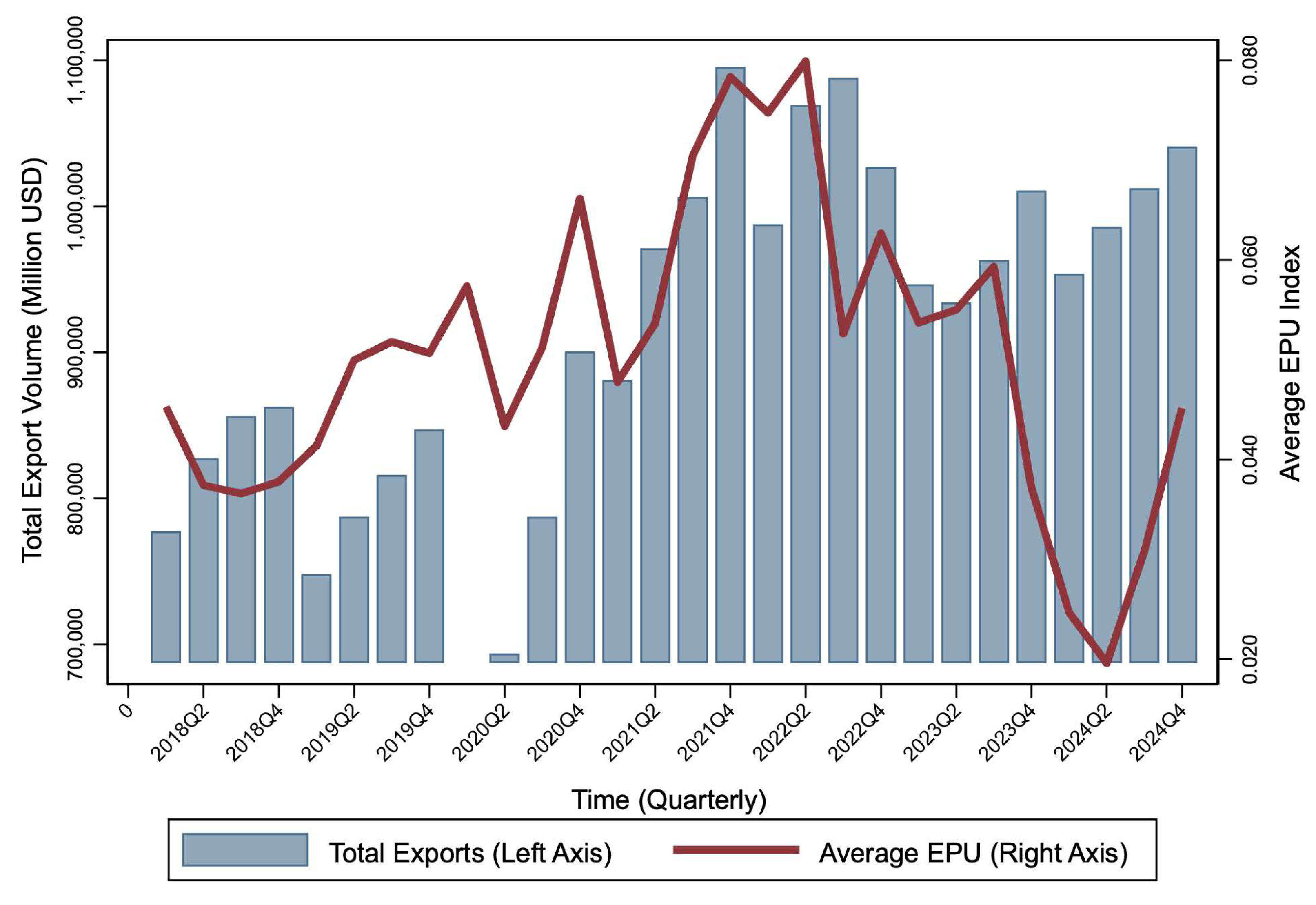
The era of polycrisis from 2018 to 2024 has shaken the global trade structure (UNCTAD, 2023) and pushed the EPU to unprecedented levels (Aiyar et al., 2023; Tooze, 2022). Aggregated data from 14 Asia-Pacific economies (Aggregated EPU-14) clearly illustrate three waves of uncertainty with completely different intensities and natures (Figure 1).
The initial phase of 2018–2019 was triggered by the escalation of the US–China trade war, marking a shift from a rules-based order to unilateral protectionism (Amiti et al., 2019). The imposition of a series of punitive US Section 301 tariffs, along with corresponding retaliatory tariffs, created a significant shock to input costs for supply chains (Fajgelbaum et al., 2019). During this phase, uncertainty was primarily driven by tariff risk, which increased business hesitation to enter new markets or scale up production (Caldara et al., 2020; Crowley et al., 2018).
From 2020 to 2021, the COVID-19 pandemic transformed the nature of uncertainty from policy risk to physical disruption of global supply chains (Bonadio et al., 2021; Guerrieri et al., 2022). Border closures and social distancing measures not only severely constrained supply-side networks but also caused substantial fluctuations on the demand side, creating a severe bullwhip effect along production networks (Ivanov, 2020; Simola, 2021). EPU during this period reflected uncertainty about the resilience of logistics and the sustainability of the Just-in-Time model (Javorcik, 2020; Miroudot, 2020).
The current wave (2022–2024) was fueled by the Russia–Ukraine conflict and represents a severe systemic risk: geoeconomic fragmentation. Uncertainty is no longer limited to tariffs or epidemics, but extends to critical structural challenges, including energy security, financial sanctions, and the weaponization of supply chains (Jagtap et al., 2022). Unprecedented sanctions and the fragmentation of trade blocs have pushed the EPU to a historical peak, creating what is known as Knightian Uncertainty, in which businesses cannot predict the likelihood of future scenarios (Ahir et al., 2022).
However, a notable phenomenon emerging in the 2022–2024 data is the divergence anomaly. Despite EPU remaining at record highs, intra-Asia-Pacific export volumes not only avoided collapse but also recorded a strong recovery (ADB, 2023; WTO, 2024). This decoupling between macroeconomic risk levels and actual trade performance is the empirical premise for the Paradox of Resilience that this study aims to decipher.

2.2. Heterogeneity in Policy Uncertainty: Systemic Hubs vs. Open Peripheries

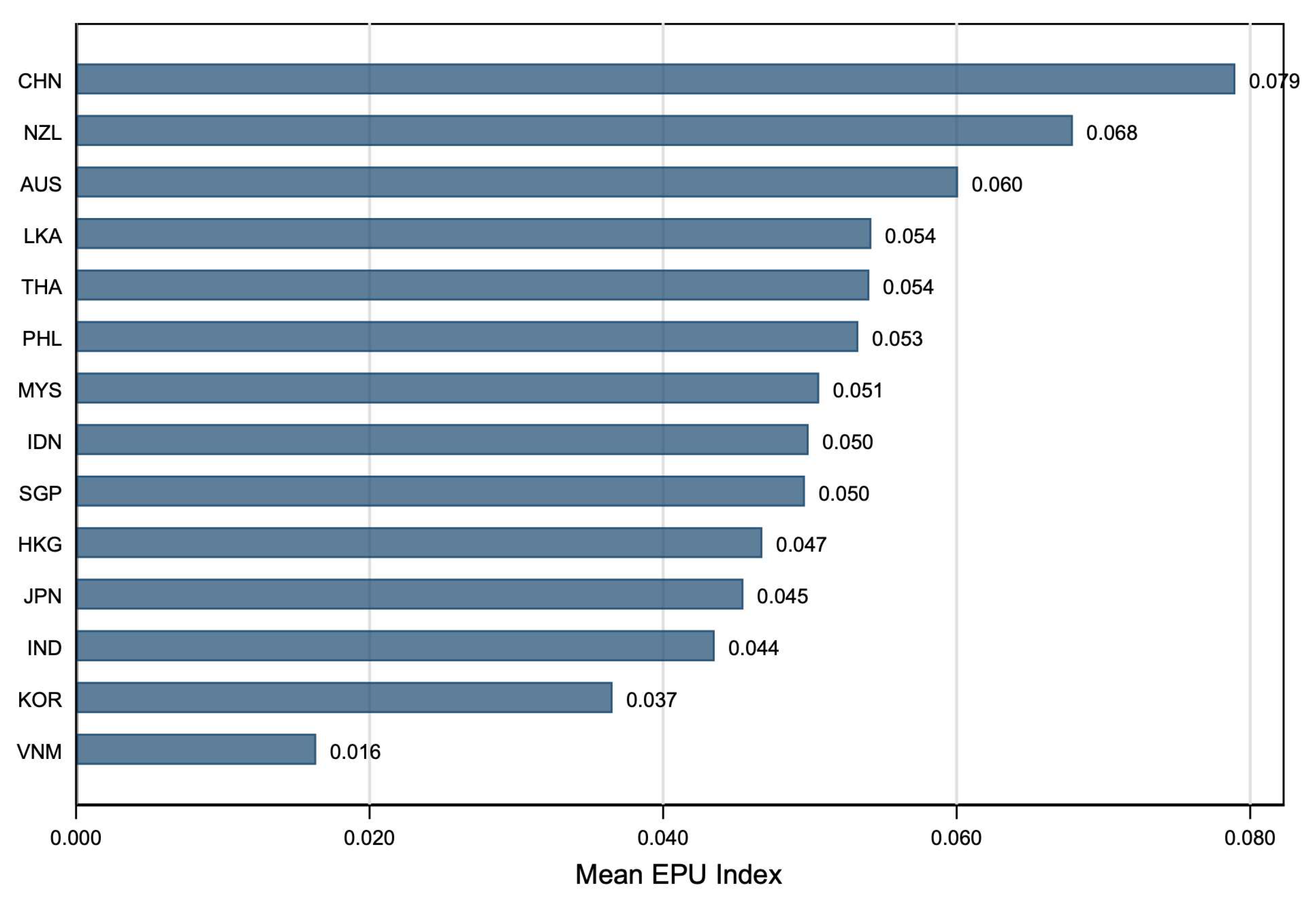
Although uncertainty is a global phenomenon, its distribution within the Asia-Pacific geoeconomic space exhibits a distinct Core-Periphery structure (Baker et al., 2016; Davis, 2019). Observational data from 2018 to 2024 reveal a significant divergence between two groups of economies, posing a direct challenge to the estimation of trade impacts (Figure 2).
Firstly, the systemic shock-makers group is driven by major geopolitical poles. This includes external systemic drivers (such as the United States) and internal regional hubs (specifically China). These actors not only record the highest average EPU but also act as the primary sources of volatility (Baker et al., 2016; Caldara et al., 2020). As geopolitical poles, policy changes from these two countries create strong spillover effects, directly impacting the global business environment (Bhattarai et al., 2020).
Secondly, the Shock-takers group: Conversely, small open economies, such as those in ASEAN, New Zealand, or South Korea, are in a passive position. Although their internal EPU may be low, these countries are highly exposed to import shocks due to their deep involvement in intermediate production networks (ADB, 2023; Constantinescu et al., 2020).
This structural heterogeneity raises a crucial empirical question: In such an asymmetric network, how do regional institutions effectively intervene in the transmission mechanism to insulate shock recipients from the volatility generated by shock makers?

2.3. The Multi-Layered Institutional Architecture and Trade Interdependence

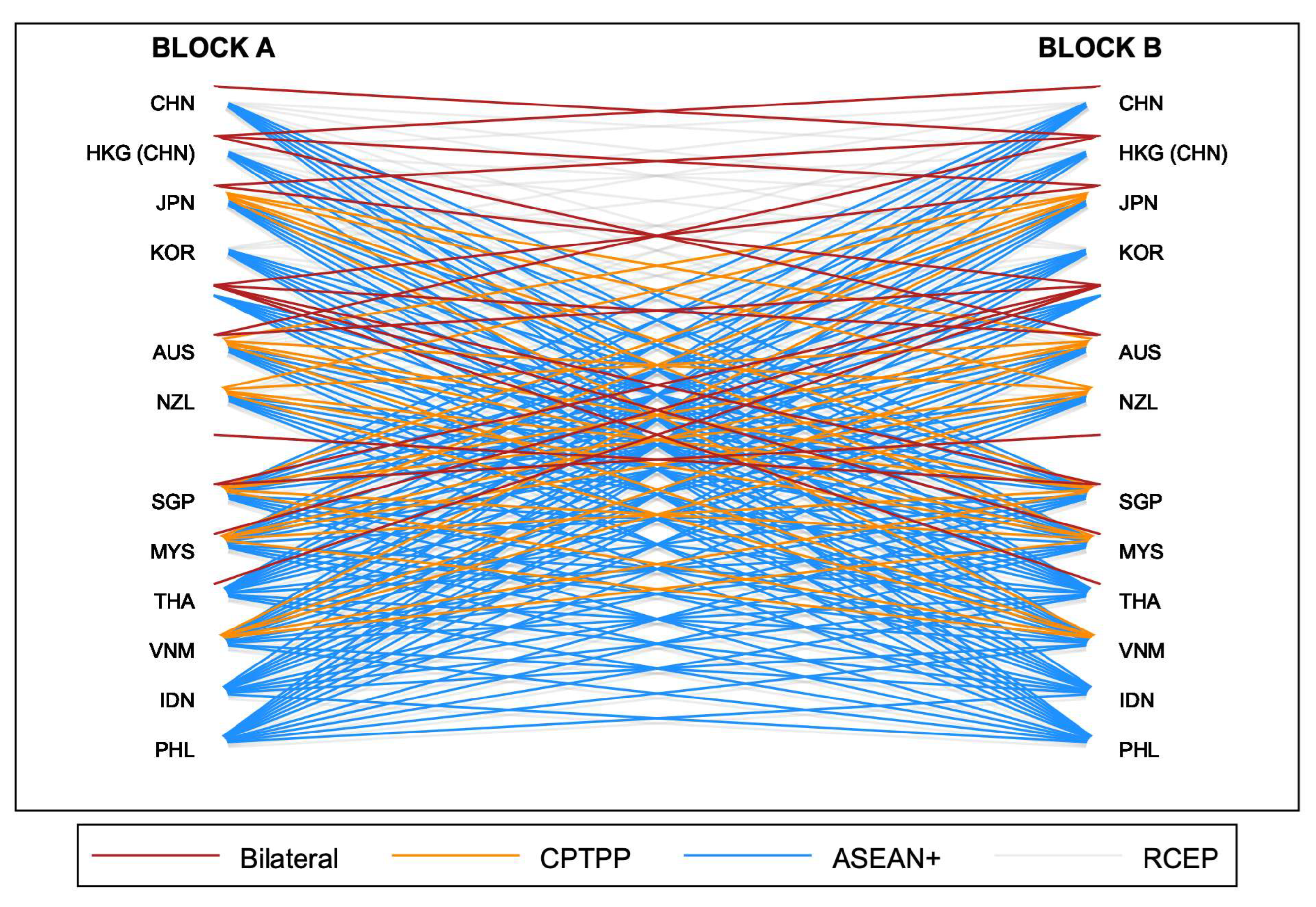
The economic architecture of the Asia-Pacific region is no longer a collection of separate agreements; rather, it has evolved into a multi-layered institutional matrix with high levels of overlap and interdependence. Figure 3 illustrates this reality through the mechanism of institutional bundling, in which trade flows between the 12/14 economies in the sample are coordinated by multiple layers of legal commitments, from traditional bilateral FTAs to modern Mega-FTAs (Petri & Plummer, 2020).
This intertwining reflects two complementary protectionist philosophies aimed at addressing systemic risk. On the one hand, agreements like the CPTPP act as institutional anchors focused on deep integration. By establishing stringent standards for post-border governance, the CPTPP creates a lock-in effect, preventing policy reversals by governments during periods of uncertainty (Mattoo et al., 2022). On the other hand, the RCEP acts as a scale transaction reducer, focusing on harmonizing the differing rules of origin (ROO) of the Asian Noodle Bowl phenomenon (R. E. Baldwin, 2016). The emergence of RCEP from 2022 not only fills institutional gaps in Northeast Asia but also creates a unified tariff corridor for the Factory Asia production network (Obashi & Kimura, 2016).
However, this dense cluster of wire structures (as shown by the symmetrical multicolored connecting lines in Figure 3) creates an empirical paradox. In the era of polycrisis, will possessing multiple layers of institutional shields simultaneously help absorb the shocks of uncertainty (EPU), or will the complexity of overlapping regulatory systems increase compliance costs and undermine the effectiveness of the agreement defences?
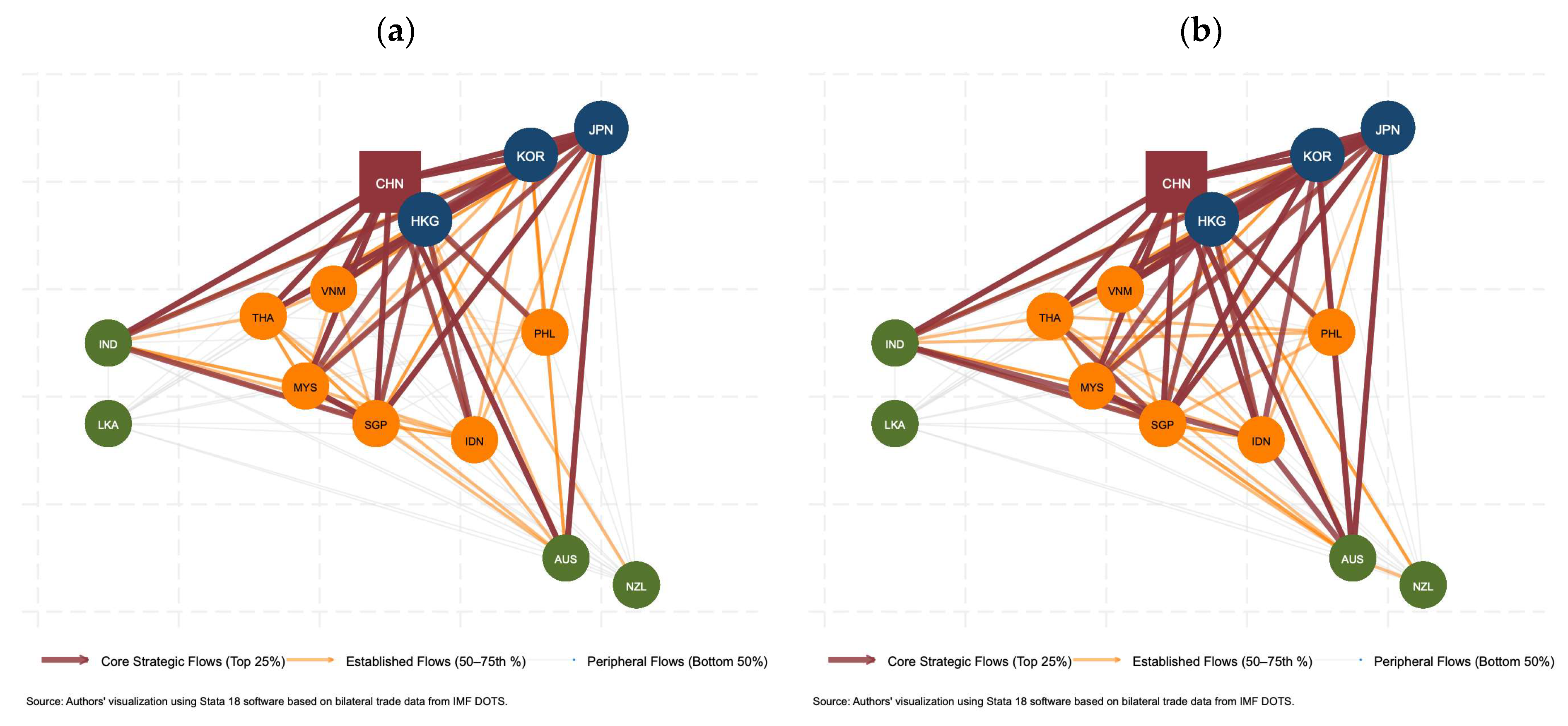
This paradox becomes even more apparent when placed in the context of the deep interdependence of regional value chains. The network structure reflects a tight Hub-and-Spoke scheme, in which FTAs serve as a legal framework to protect supply chain links. However, this dense interconnectedness is a double-edged sword: it optimizes resource use, but also serves as a channel for the contagion of cross-border policy risks (Wilson et al., 2003). The highly uncertain interaction between pressure from the EPU and the risk-filtering capacity of the multi-tiered FTA system is a crucial premise for this study to delve into the moderating role of institutions in the following sections. Preliminary visual evidence from Figure 4 supports this premise, indicating a shift from monocentric hub dependence prior to the crisis in 2018 (Figure 4a), polycentric network anchored by ASEAN in the post-RCEP era of 2024 (Figure 4b). This evolution suggests that instead of creating friction, the institutional shield has successfully channeled trade flows into secure trust corridors, effectively neutralizing the centrifugal forces of the polycrisis.

3. Theoretical Framework and Hypothesis Development

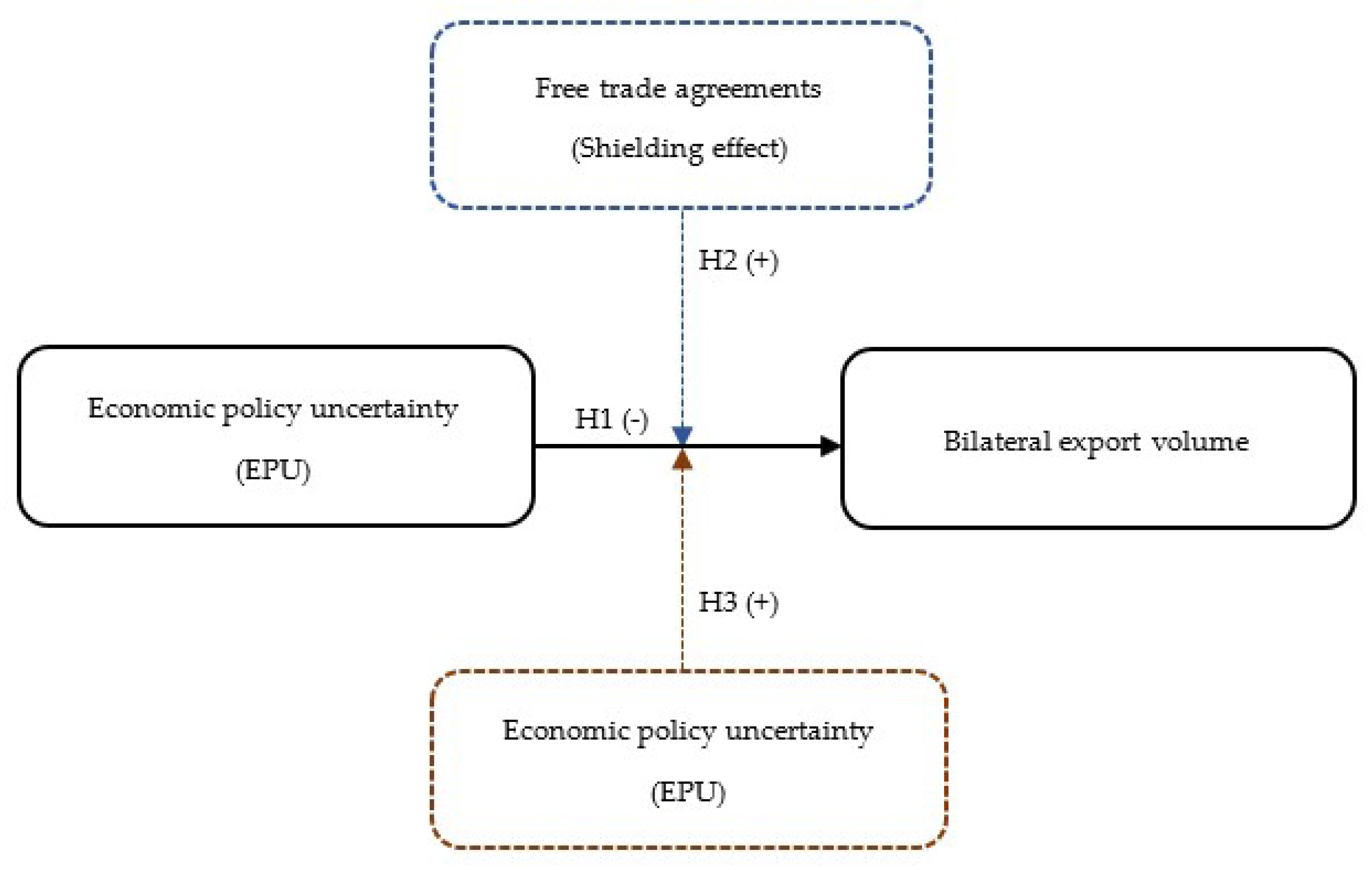
To decipher the complex interaction mechanisms among policy uncertainty, trade institutions, and goods flows within the GVC network, this study constructs an integrated analytical framework that synthesises real options theory (ROT), policy commitment theory, and new approaches to supply chain resilience (Figure 5).

3.1. Uncertainty, Sunk Costs, and the Wait to Invest Channel

To theoretically frame the dampening impact of EPU, we draw upon the new international trade theory, which posits that export activities are not frictionless transactions but require substantial sunk costs to enter markets, establish distribution channels, and comply with regulations (R. Baldwin, 2005; Roberts & Tybout, 1997; Melitz, 2003). Because these market entry and global supply chain operations involve high, unrecoverable costs, the dampening effect of uncertainty can be primarily explained through the real options theory (ROT). The ROT posits that when the macroeconomic environment becomes uncertain, the option value of waiting increases. Consequently, firms, acting as rational investors, will postpone export and investment commitments until the uncertainty is resolved (Bernanke, 1983; Bloom et al., 2007; A. K. Dixit & Pindyck, 2012; Gulen & Ion, 2015).
This wait-to-invest mechanism is particularly pronounced within global value chain (GVC) networks through two amplifying channels. First, according to the magnification effect hypothesis, because goods must cross borders multiple times during production, a small increase in upstream tariffs or policy risk will accumulate and amplify into a large downstream cost (Johnson & Noguera, 2012; Yi, 2003). Second, as introduced earlier, the transmission of these policy shocks is exacerbated by the bullwhip effect, where downstream volatility is progressively amplified as it travels upstream, causing disproportionate disruptions for regional suppliers (Altomonte et al., 2012; Constantinescu et al., 2020; Osnago et al., 2015).
Together, these mechanisms illustrate how EPU acts as an invisible non-tariff barrier, increasing risk hedging costs and severely contracting bilateral trade flows (Baker et al., 2016; Handley, 2014). However, the magnitude of this negative impact may be heterogeneous. According to the Hysteresis hypothesis (A. Dixit, 1989), in deeply integrated production networks where relationship-specific investments are high, firms may endure temporary uncertainty due to prohibitive switching costs, creating a structural lock-in or inertia effect. Therefore, the first hypothesis is proposed:
Hypothesis 1 (H1):
EPU exerts a significant negative impact on bilateral export flows due to the waiting-to-invest effect.

3.2. The Institutional Shield Effect: FTAs as Credibility Anchors

Going beyond the traditional approach of tariff reduction (Viner, 2014), policy commitment theory argues that the true value of new-generation FTAs lies in their ability to act as credibility anchors (Staiger & Tabellini, 1987). By binding themselves to international commitments, governments limit their ability to respond to future protectionist temptations, thereby reducing the likelihood of policy reversal (Handley & Limão, 2017). The study separates two distinct protection mechanisms corresponding to two FTA models in Asia: (i) the deep integration mechanism (such as CPTPP) can minimize risks through the harmonization of regulations and institutional transparency, thereby creating long-term legal stability (Mattoo et al., 2022; Petri & Plummer, 2020) while the entanglement reduction mechanism (such as RCEP) can reduce compliance costs through cumulative rules of origin (cumulative ROO), allowing for businesses to flexibly redirect supply sources when faced with shocks (R. E. Baldwin, 2016). The presence of these agreements is expected to reduce the sensitivity of exports to the EPU, creating a positive interaction effect.
Hypothesis 2 (H2):
FTAs significantly neutralize the negative elasticity of trade flows to policy uncertainty.

3.3. Crisis Adaptation: The Non-Linear Switching Mechanism

Although H1 predicts the negative impact of uncertainty, empirical observations during the polycrisis phase suggest a structural break in trade behavior. The new literature on resilient supply chains indicates that when uncertainty escalates to extreme levels (such as war or global lockdowns), business behavior shifts from a Just-in-Time strategy (optimizing efficiency, reducing inventory) to a Just-in-Case strategy (maximizing security, increasing redundancy) (Javorcik, 2020; Miroudot, 2020; Simola, 2022).
In this scenario, the relationship between uncertainty and trade may reverse. Instead of cutting, businesses will increase imports to stockpile goods (precautionary hoarding) to hedge against future supply disruptions (Alessandria et al., 2010; Escaith et al., 2020). In addition to hoarding, geopolitical conflicts may trigger a substitution effect, where global demand shifts from conflict-affected zones to politically stable manufacturing hubs, effectively treating them as safe havens to secure supply continuity (Miroudot, 2020; Simola, 2022).
This phenomenon of precautionary stockpiling at the national level creates a short-term paradox: the greater the crisis, the (temporary) increase in trade flows, as security needs outweigh efficiency needs.
Hypothesis 3 (H3):
The trade-uncertainty relationship exhibits a convex U-shaped nonlinearity, in which extreme crises trigger a regime shift from efficiency-driven to security-driven stockpiling behaviour.

4. Methodology and Data

4.1. Empirical Strategy

To accurately quantify the impact of policy uncertainty on trade flows, this study applies the Structural Gravity Model framework. This is a standard approach in international trade, grounded in a solid microeconomic foundation of behavioural optimization and enabling thorough control over multilateral resistance terms (MRTs), which are often biased in traditional estimates. Assume that consumers in country j maximize the CES (constant elasticity of substitution) utility function over goods from country i. The nominal export value Xij from i to j is determined by the following market equilibrium condition (Anderson & Van Wincoop, 2003):
x i j = Y i Y j Y w   τ i j π i P j 1 σ
where
  • Yi, Yj, and YW are the GDP of the exporting country, the importing country, and the world, respectively.
  • τ i j is the bilateral trade cost (the iceberg of trade costs).
  • σ > 1 is the elasticity of substitution.
  • π i   a n d   P j   are the components of Multilateral Resistance (MRT). Specifically, π i (Outward MRT) reflects the ease of access to the global market for the exporting country, while P j (Inward MRT) reflects the competitiveness in the import market.
Equation (1) shows that the method of trade does not depend on bilateral factors (such as distance, FTA) but is still affected by the relative position of countries in the global trade structure ( π i ,   P j ). Ignoring unobservable variables leads to omitted-variable bias (R. Baldwin & Taglioni, 2006).
To translate theoretical models into practical methods, traditional methods often logarithmize both sides (log-linearization) and use OLS. However, (Santos Silva & Tenreyro, 2006) demonstrated that this method suffers from two major econometric flaws. First, it automatically eliminates zero trade flows, inevitably leading to sample selection bias. Second, it violates Jensen’s inequality (E l n ( y )     l n ( E y ) ) in the presence of heteroskedasticity, which results in heavily biased and inconsistent estimates.
To quantify the impact of policy uncertainty on trade flows while addressing the zero trade problem and heteroskedasticity, this study employs the PPML estimator, as proposed by (Santos Silva & Tenreyro, 2006). By estimating the model in its multiplicative form, the PPML approach provides consistent and unbiased estimates even in the presence of heteroskedasticity, where log-linearized OLS would be heavily biased, while also robustly accommodating any zero-trade observations.
Formally, we estimate the gravity equation in its multiplicative form:
X i j t =   e x p β 0 + β 1 l n E P U i ,   t 1 + β 2 l n E P U j ,   t 1 + Γ Z i j , t + π i + χ j + λ t ×   ε i j , t  
In which
  • X i j ,   t is the nominal export flow from country i to country j at time t.
  • E P U i ,   t 1   and   E P U j ,   t 1 represent the Economic Policy Uncertainty indices for the exporter and importer. They are lagged by one quarter to mitigate simultaneity bias and account for the delay in business decision-making.
  • Zij,t is a vector of standard gravity controls, including economic size (lnGDPit, lnGDPjt), bilateral exchange rates (lnERit, lnERjt), geographic distance (lnDistij), and FTA membership (FTAij,t)
  • ε i j ,   t is the robust error term.
To control for unobserved heterogeneity and multilateral resistance, we employ a robust set of fixed effects. Specifically, Exporter (πi) and Importer (χj) Fixed Effects are included to control for time-invariant country-specific characteristics (e.g., culture, geography, institutional quality) that may influence average bilateral trade levels. Time Fixed Effects (λt) are incorporated to absorb global macroeconomic shocks common to all countries in each quarter (e.g., global inflation, pandemic waves).
While recent structural gravity literature (Anderson & Van Wincoop, 2003; Yotov et al., 2016) suggests using time-varying country fixed effects (πit, χjt) to fully control for multilateral resistance terms, doing so would perfectly collinearize with our key variables of interest (EPU and GDP), making it impossible to estimate their direct elasticities. Therefore, following the approach of (Osnago et al., 2015) and (Handley, 2014) in uncertainty literature, we opt for the standard specification with separate country (πi, χj) and time (λt) fixed effects. This strategic choice allows us to identify the specific partial-equilibrium impact of EPU and economic size while controlling for invariant country characteristics and global shocks.
However, we explicitly acknowledge that, while this comprehensive system of fixed effects effectively controls for time-invariant characteristics and global shocks, it cannot perfectly eliminate endogeneity arising from time-varying, pair-specific unobserved factors. Nonetheless, combining this fixed-effects structure with a one-quarter lag in EPU provides a highly robust baseline to mitigate omitted-variable and simultaneity biases.

4.2. Empirical Specifications

Based on the PPML framework above, the study constructs three specific models to test hypotheses H1, H2, and H3.
Model 1: Baseline Impact (Testing H1) Testing the Waiting-to-Invest hypothesis through the coefficient β1:
X i j t =   e x p α + β 1 l n E P U i ,   t 1 + Γ Z i j , t + π i + χ j + λ t   ×   ε i j , t  
Expectation: β1 < 0, indicating that uncertainty acts as a barrier to trade.
Model 2: Institutional Shield Mechanism (Testing H2) To test the protective effect of FTA, the model adds an interaction variable between EPU and the dummy variable FTA (FTAijt):
X i j t =   e x p + β 1 l n E P U i ,   t 1 + δ ( l n E P U i ,   t 1   × F T A i j t ) +
Expectation: δ > 0. If δ is significant, it confirms that FTAs serve as an institutional shield, offsetting the negative impact of EPU.
Model 3: Crisis Adaptation (Testing H3) To capture behavioral changes during the multiple crisis phase, the model uses an interaction variable with a dummy war variable (WARt), taking the value 1 for the period 2022–2024:
X i j t =   e x p + β 1 l n E P U i ,   t 1 + θ ( l n E P U i ,   t 1 × W A R t ) +
Additionally, we test for non-linearity by including the squared term of EPU (lnEPUi,t−1)2 in separate specifications.

4.3. Data and Variables

To ensure the robustness of the structural gravity estimates, this study constructs a balanced panel dataset comprising 14 economies in the Asia-Pacific region from Q1 2018 to Q4 2024. The sample includes Australia, China, India, Indonesia, Hong Kong (China), Japan, South Korea, Malaysia, New Zealand, the Philippines, Singapore, Sri Lanka, Thailand, and Vietnam. The initial balanced panel consists of 5096 observations (14 exporters × 13 importers × 28 quarters). However, because one-quarter lagged variables (EPUt−1) are utilized to mitigate simultaneity bias and capture decision-making delays, the effective sample size for estimation is 4914 observations.
To enhance transparency and replicability, detailed variable definitions, data sources, and descriptive statistics are systematically summarized in Table 1.
Furthermore, to analyze structural heterogeneity in depth, the research sample is divided into strategic sub-groups based on two distinct criteria. First, geographically, the sample is divided into the ASEAN-6 group (Indonesia, Malaysia, Philippines, Singapore, Thailand, and Vietnam) and the non-ASEAN group. Second, based on their functional role in the global value chain (GVC), the sample is reclassified into the High-GVC group (Factory Asia Core: China, Japan, South Korea, Singapore, Malaysia, Thailand, and Vietnam) and the Low-GVC group (Periphery Economies) covering the remaining entities.

5. Empirical Results

The empirical results are structured to systematically test the theoretical hypotheses: the baseline impact of policy uncertainty (H1), the moderating role of trade agreements (H2), and the structural break during the conflict period (H3). Table 2 reports the PPML estimation results for the full sample (Column 1) and two geographic sub-groups: ASEAN-6 (Column 2) and Non-ASEAN (Column 3).
Across all specifications, standard gravity covariates behave consistently with theoretical expectations. Economic size (lnGDPi,t and lnGDPj,t) exerts a strong positive pull (p < 0.01), while geographic distance (lnDisij) acts as a significant trade friction. Crucially, by employing the PPML estimator, the model successfully retains zero-trade observations, avoiding the sample selection bias inherent in traditional log-linearized OLS models.
Testing H1, the full sample (Column 1) reveals that the elasticity of export flows to Exporter EPU (lnEPUi,t−1) is negative and statistically significant (β = −3.371, p < 0.05). This magnitude indicates that a 1% increase in domestic policy uncertainty is associated with a 3.37% contraction in bilateral exports, ceteris paribus. Disaggregating the data uncovers significant structural heterogeneity. For the ASEAN-6 group (Column 2), the direct impact of uncertainty is statistically insignificant (p > 0.1). Conversely, the non-ASEAN group (Column 3) exhibits a heightened sensitivity (β = −5.222, p < 0.05).
Testing H2, we examine the interaction between EPU and FTA membership. In the full sample (Column 1), the interaction coefficient is positive and statistically significant (δ = 3.396, p < 0.05). To quantify the protective mechanism of FTAs, we compute the net effect:
Net Effect = βEPU + δFTA = −3.371 + 3.396 = +0.025
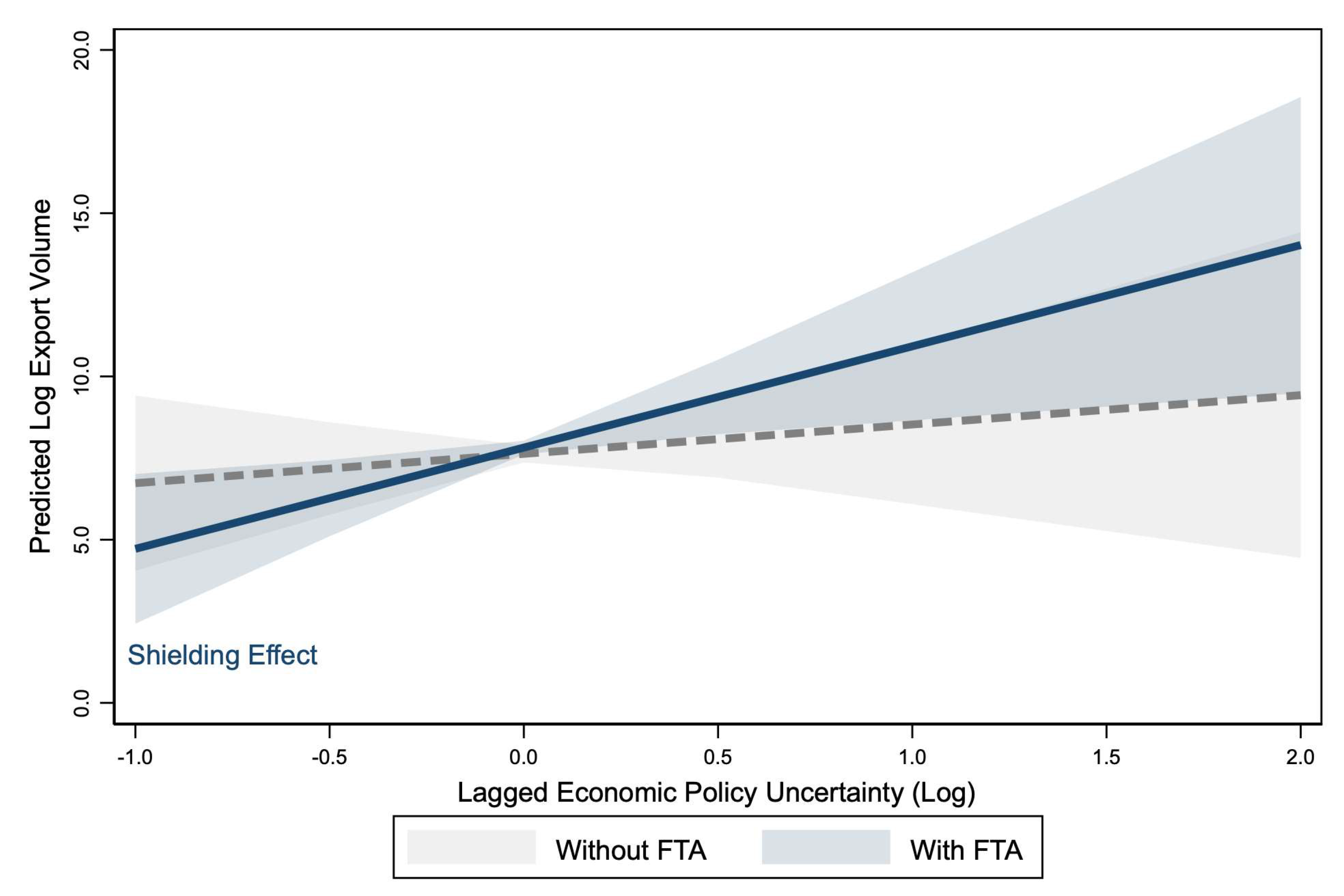
This statistical offsetting demonstrates that FTA membership effectively neutralizes the baseline negative elasticity. Sub-sample analysis shows that this shielding effect is strictly concentrated in the non-ASEAN group (δ = 6.524, p < 0.05), fully counteracting their severe baseline negative elasticity (5.222). This distributional divergence is visually confirmed in Figure 6, where the “With FTA” trajectory remains flat despite rising EPU.
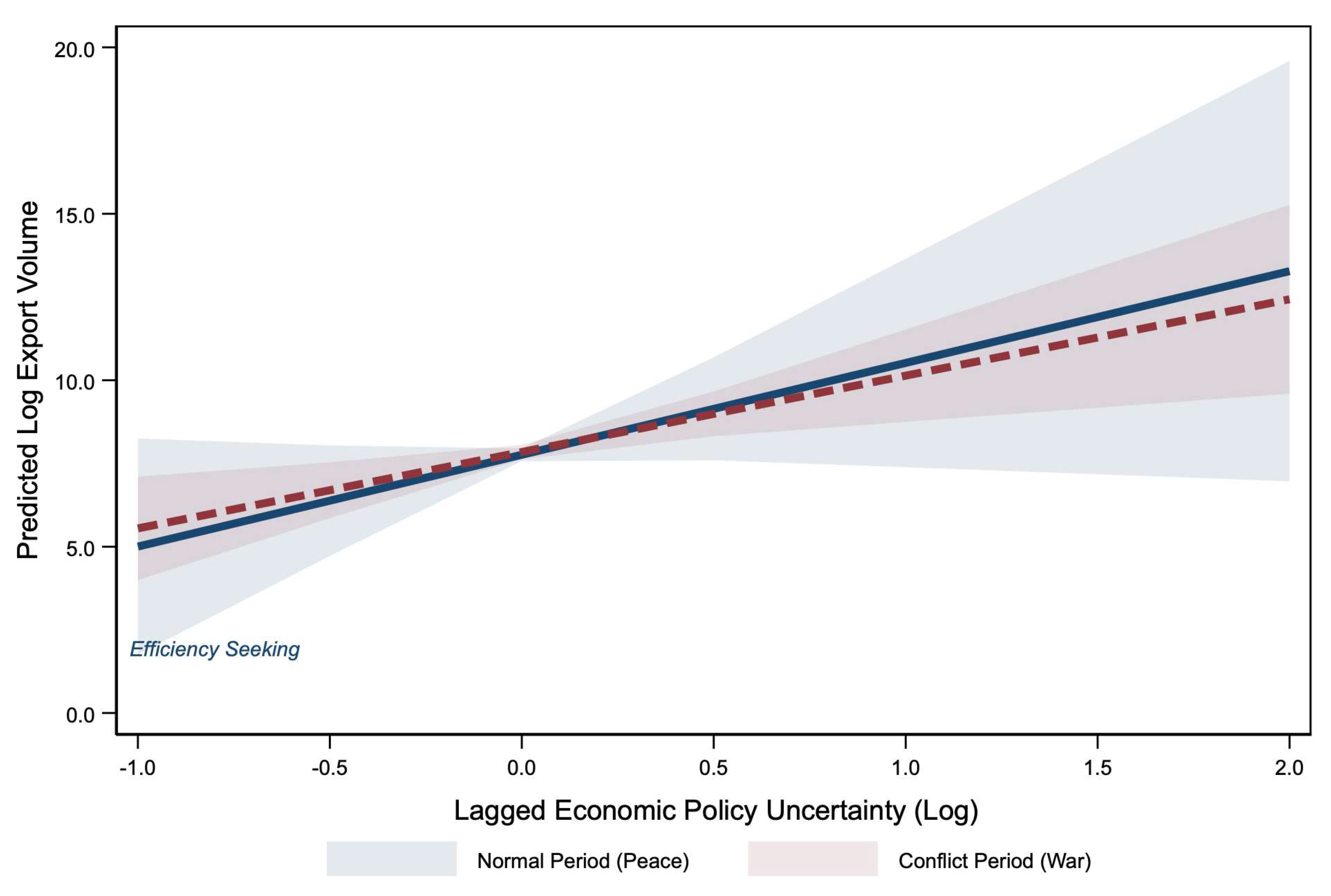
Testing H3, the interaction between EPU and the Conflict dummy (lnEPUi,t−1 × Conflictt) in Table 2 (Column 1) is positive and significant (γ = 1.375, p < 0.05). This statistical significance confirms a structural break in trade dynamics during the 2022–2024 geopolitical tension. Furthermore, the non-linear specification in Table 3 (Column 4) validates a convex U-shaped relationship: the first-order term is negative (−3.519), while the second-order term is positive and significant (8.206, p < 0.05) (Figure 7).
Finally, the GVC-based sample splitting in Table 3 reveals a dichotomy in transmission mechanisms. The High-GVC group (Column 2) shows an insignificant response to EPU, whereas the Low-GVC group (Column 3) is highly sensitive (β = −8.363, p < 0.01), although this extreme sensitivity is strongly mitigated by FTA membership (δ = 10.021, p < 0.01).

Robustness Checks

To ensure the rigorousness and reliability of our baseline estimates, a comprehensive series of sensitivity analyses was conducted employing alternative empirical specifications and subsample divisions. These tests were purposefully designed to verify the stability of our primary findings against potential measurement biases, and the influence of outliers. The detailed robustness estimation results are systematically reported in Table 4.
First, we test the sensitivity to demand-side shocks in Column 1 by substituting the exporter uncertainty with the importer metric (lnEPUj,t−1). A statistically insignificant coefficient is obtained (p > 0.1). This result reinforces the baseline finding that the observed trade-dampening effect primarily stems from supply-side risks in the exporting country’s policy environment.
Second, we exclude the US–China bilateral pair in Column 2 to control for potential bias introduced by major-power geopolitical tensions. The coefficients for the main variables of interest, lnEPUi,t−1 (negative), and the FTA interaction term (positive), retain their signs and statistical significance levels, consistent with the baseline model.
Third, we omit observations covering the four quarters of the pandemic year (2020) in Column 3 to eliminate the confounding effect of physical supply chain disruptions. While the main effect of EPU loses its strict statistical significance, the mitigating role of the FTA interaction term remains robust (β = 2.985, p < 0.1). This nuances the baseline findings, suggesting that the most severe trade-inhibiting effects were heavily driven by the extreme physical disruptions of COVID-19; nonetheless, the institutional shield effect persists.
Finally, we examine the temporal dynamics in Column 4 by introducing the second-quarter lag (lnEPUi,t−2). The coefficient for this variable is statistically insignificant. This result confirms that the restrictive impact of policy uncertainty is concentrated in the first quarter immediately following the shock (t − 1), rather than persisting into subsequent quarters.
While the structural gravity framework, using multidimensional fixed effects and the PPML estimator, addresses major econometric concerns, such as multilateral resistance and heteroskedasticity, we acknowledge inherent limitations regarding endogeneity. The strict use of a one-quarter lagged EPU variable (EPUt−1) mitigates simultaneity bias by ensuring that current trade flows do not retrospectively influence past policy uncertainty. However, this temporal separation cannot completely rule out anticipatory behavior, in which firms might adjust current trade based on expected future policies. Furthermore, while the exporter, importer, and time fixed effects effectively absorb time-invariant institutional characteristics and global macro-shocks, they cannot capture unobserved firm-level heterogeneity. Aggregated bilateral data masks micro-level dynamics, such as differences in managerial capabilities or firm size, which might dictate how individual enterprises respond to systemic shocks. Consequently, the coefficients represent macro-level average effects and should be interpreted with this structural boundary in mind.

6. Discussion

6.1. Magnification Effects and Structural Inertia

Empirical results from the overall sample provide robust quantitative evidence consistent with the wait-to-invest mechanism. In the context of policy uncertainty that shifts from short-term disturbances to sustained structural shocks (Baker et al., 2016; Bloom, 2014), the option value of delaying commitment increases significantly. As theorized by Bernanke (1983) and A. K. Dixit and Pindyck (2012), and later empirically verified by Gulen and Ion (2015), when export decisions require unrecoverable sunk costs to establish distribution channels (Roberts & Tybout, 1997; Melitz, 2003), uncertainty will act as an invisible drag that dampens investment flows and new orders (Handley, 2014; IMF, 2023).
However, a deeper analysis of the microstructure of trade flows reveals a notable divergence in risk transmission mechanisms, reflecting heterogeneity in GVCs. For economies with low GVC participation or those outside of deeply integrated blocs (non-ASEAN), the estimated coefficients are substantially negative and statistically significant. This result aligns with predictions of the magnification effect in sequential supply chains (Yi, 2003). According to the theory of production fragmentation and the bullwhip effect, multiple crossings of intermediate goods translate small upstream policy risks into disproportionate downstream transaction costs (Johnson & Noguera, 2012). (Escaith et al., 2010) and (Constantinescu et al., 2020) also warned that this characteristic causes trade in loosely linked chains to decline more sharply than GDP does when hit by shocks from demand hubs. This volatility model appears consistent with empirical observations (Altomonte et al., 2012; Osnago et al., 2015), which indicate that arms-length trade links are often the first to break when transaction costs exceed tolerable levels.
In contrast, for the ASEAN-6 group and the High-GVC group (Asian factories), the model provides insufficient statistical evidence of a negative impact of EPU on export flows (the coefficient is not statistically significant).
It is essential to note that this result does not necessarily imply the absence of risk exposure, but rather illustrates a strong hysteresis effect in which structural barriers mask immediate negative impacts. In high-GVC production networks, relationship-specific investments create a structural lock-in state (Antràs & Chor, 2022; Nunn, 2007). According to (R. E. Baldwin, 2016) and (Ing et al., 2019), linkages in Factory Asia are not merely spot-market commodity transactions, but rather deep process integrations and customized technological sharing. Therefore, when switching costs exceed the cost of insuring against risk, firms tend to maintain the status quo rather than relocate or exit the market (Constantinescu et al., 2020). Furthermore, a regional study by (Grimes & Du, 2024) emphasizes that trust-based governance in Asia is a key factor that makes decoupling structurally challenging in the short term. This stickiness, combined with high commercial inertia (as indicated by the lagged variable coefficient in the dynamic model), creates an endogenous structural buffer that helps the core maintain relative stability even during a polycrisis period.

6.2. The Shielding Role of Trade Institutions

While EPU acts as a structural drag on expanding supply chains, empirical results from the interaction variable have provided compelling evidence of the positive regulatory role of trade institutions. We identify a robust institutional shield effect, where participation in trade agreements effectively mitigates the adverse transmission of policy shocks. This result lends support to policy commitment theory, which asserts that the core value of modern integration lies not only in static tariff preferences (Viner, 2014), but in the ability to create credibility anchors (Maggi & Rodriguez-Clare, 1998; Staiger & Tabellini, 1987).
Specifically, by binding themselves to international commitments, governments implement a strategy that ties their hands against future protectionist temptations. (Handley & Limão, 2015, 2017) and (Mattoo et al., 2022) argue that this mechanism helps anchor expectations against arbitrary policy reversals, thereby significantly mitigating Knightian uncertainty and establishing a more predictable trade environment. For businesses in vulnerable sectors, this legal stability serves as a form of non-financial insurance, reducing the incentive to postpone irreversible investments or withdraw capital during volatility.
Placed within the specific context of the Asia-Pacific region, the effectiveness of this shield also reflects progress in mitigating the fragmentation of the Asian noodle bowl phenomenon, a term describing the complex and often conflicting proliferation of overlapping bilateral trade agreements and their disparate rules of origin (R. E. Baldwin, 2006). The estimation results are consistent with the findings of (Petri & Plummer, 2020), who suggest that the emergence of mega-FTAs, such as RCEP and CPTPP, has helped streamline this regulatory landscape through a rule-consolidation mechanism.
In particular, the cumulative rules of origin mechanism enables businesses to switch supply sources between member countries flexibly without losing tariff preferences (R. E. Baldwin, 2016; Obashi & Kimura, 2016). This flexibility makes FTAs an effective tool for managing supply chain risks. Furthermore, as (Ahir et al., 2022) have shown, countries with high-quality trade institutions and high openness are generally better equipped to absorb exogenous shocks due to transparency in policy processes. Therefore, the positive impact of the FTA interaction variable extends beyond static market-access benefits to serve a strategic function: not only as instruments of liberalization but also as institutional stabilizers of volatility, helping maintain trade momentum even during periods of overlapping global crises.

6.3. Crisis Adaptation and Supply Security

Although traditional trade theories and baseline results (H1) predict a negative impact from uncertainty, empirical evidence of a structural break during the 2022–2024 period reveals a heterogeneous pattern of structural adjustment. The positive interaction coefficient during the conflict period and the non-linear estimation results (confirming a convex U-shaped relationship) suggest a dynamic in which trade flows become resilient, and even temporarily surge, when risk exceeds critical tolerance thresholds.
These findings provide robust quantitative evidence consistent with recent discussions on the shift in global value chain management from just-in-time strategies (efficiency optimization) to just-in-case strategies (security maximization). (Javorcik, 2020) and (Miroudot, 2020) argue that, in the context of frequent and severe shocks (such as pandemics or wars), the top priority for businesses shifts from cost savings to ensuring the continuity of supply.
(Alessandria et al., 2010) and (Escaith et al., 2010) point out that, for complex GVC goods (such as electronics in Asia), the high cost of substitution incentivizes firms to build precautionary inventories. This phenomenon is particularly severe in upstream production centres, such as those in ASEAN, due to the Bullwhip Effect. According to (Lee et al., 2004), small demand-side fluctuations in consumer perceptions of scarcity can be amplified into disproportionate upstream order expansions on the producer side. (Dolgui et al., 2018) note that this surge represents a strategic hedge, where firms accept higher carrying costs to mitigate Knightian uncertainty regarding future supply availability.
However, this adaptive increase is not evenly distributed but is strongly concentrated within the ASEAN group (as indicated by the large positive interaction coefficient in Table 2), suggesting the parallel presence of strong trade and investment diversion effects. (Simola, 2022) analyzes that sanctions and geopolitical risks in conflict zones (such as Eastern Europe) have prompted global importers to seek alternative sources of supply in more politically stable regions. With its diversified production base and dense network of FTAs, ASEAN appears to have emerged as a viable alternative hub and a regional safe haven. Following this logic, the sustained trade volume is driven not only by micro-level precautionary stockpiling but by macro-level trade diversion. This restructuring provides an endogenous impetus that helps maintain export performance, contributing to the observed resilience of regional trade flows during the crisis.

7. Conclusions & Policy Implications

Amid the polycrisis of 2018–2024, the Asia-Pacific region demonstrated resilience that contrasted with traditional economic predictions of severe trade contraction. Our structural gravity analysis confirms that, while policy ambiguity exerts substantial friction on trade flows, consistent with the wait-to-invest mechanism in real options theory, this effect is heterogeneous. Empirical evidence indicates that the region’s dense network of trade agreements serves as a critical institutional shield. Rather than being stagnated by uncertainty, export flows between FTA partners remained robust, suggesting that legally binding commitments serve as credible anchors that neutralize external volatility.
Most notably, the region exhibited a nonlinear crisis-adaptation pattern during periods of geopolitical conflict. Instead of contracting as expected, trade flows in several corridors temporarily expanded. This deviation signals a structural behavioral shift among global value chain participants, transitioning from pure cost-efficiency optimization (just-in-time) to security maximization (just-in-case). This pattern is consistent with precautionary inventory accumulation strategies, allowing regional supply chains to absorb shocks rather than severing linkages. From a comparative perspective, this resilience was particularly pronounced in the ASEAN-6 ecosystem, which acted as a regional safe haven benefiting from trade diversion. Looking forward, the evolution of trade dynamics indicates a pivot toward regionalization and polycentric supply networks, structurally underpinned by the cumulative effects of long-standing integration and firms’ adaptive capacity.
Based on these quantitative results, the study proposes several key macroeconomic policy implications:
First, regarding regional integration strategies, the mitigating role of FTAs suggests that negotiation efforts should prioritize strengthening transparency and binding commitments against policy reversals. In an uncertain context, the value of these agreements lies not only in tariff preferences but also in their ability to provide institutional insurance, helping to position the region as a reliable destination for long-term supply chains.
Second, in supply chain risk management, to mitigate market overreactions (such as the precautionary hoarding phenomenon suggested by the convex U-shaped results), the role of the state should focus on minimizing information noise. Building an early warning system and publicly disclosing operational roadmaps are necessary to prevent risk amplification (the bullwhip effect), helping businesses make data-driven decisions rather than resorting to suboptimal herding behavior.
Third, beyond macroeconomic aggregates, these findings hold tangible implications for ordinary citizens. By acting as institutional shields, FTAs help sustain factory operations and supply chain continuity during global crises. This translates directly into protecting manufacturing jobs from sudden layoffs and stabilizing the prices of essential consumer goods against the inflationary pressures caused by global disruptions.
Finally, it is worth noting that the above conclusions are based on aggregate bilateral trade data. Therefore, this study observes only macro-level behavioural consequences and cannot fully capture unobserved firm-level heterogeneity, such as varying managerial risk aversion, firm size, and credit constraints. The increase in trade during a crisis, while consistent with hoarding theory, may also be influenced by other confounding factors such as price volatility or contract lags. Future studies should combine this macro data with micro-level firm data to more thoroughly examine the micro-foundations of the strategic shifts discussed. Third, while our gravity specification employs Exporter, Importer, and Time fixed effects to retain key time-invariant variables like geographic distance, it does not incorporate Country-Pair fixed effects. Consequently, the coefficients of FTAs should be interpreted with caution regarding potential endogeneity arising from unobserved bilateral affinities.

Author Contributions

Conceptualization, M.H.N., T.M.T.T. and S.A.P.; methodology, T.M.T.T. and S.A.P.; software, T.M.T.T.; validation, M.H.N., T.M.T.T. and S.A.P.; formal analysis, M.H.N., T.M.T.T. and S.A.P.; investigation, M.H.N.; resources, T.M.T.T.; data curation, S.A.P.; writing—original draft preparation, M.H.N., T.M.T.T. and S.A.P.; writing—review and editing, M.H.N., T.M.T.T. and S.A.P.; visualization, T.M.T.T. All authors have read and agreed to the published version of the manuscript.

Funding

This research received no external funding.

Institutional Review Board Statement

Not applicable.

Informed Consent Statement

Not applicable.

Data Availability Statement

The data that support the findings of this study are available from the corresponding author, Thi Mai Thanh Tran, at maithanh@vnu.edu.vn, upon reasonable request. The dataset was compiled from publicly available sources, including the IMF DOTS, the Economic Policy Uncertainty index, and the World Bank WDI database.

Acknowledgments

During the preparation of this work, the authors utilized Gemini 1.5 Pro (Google) and Grammarly Premium to enhance the readability and language quality of the manuscript. After using these tools, the authors reviewed and edited the content as needed and took full responsibility for the publication’s content.

Conflicts of Interest

The authors declare no conflicts of interest.

Abbreviations

The following abbreviations are used in this manuscript:
ADBAsian Development Bank
ASEANAssociation of Southeast Asian Nations
CESConstant Elasticity of Substitution
CPTPPComprehensive and Progressive Agreement for Trans-Pacific Partnership
DOTSDirection of Trade Statistics
EPUEconomic Policy Uncertainty
ERExchange Rate
FTAFree Trade Agreement
GDPGross Domestic Product
GVCGlobal Value Chain
IMFInternational Monetary Fund
MRTMultilateral Resistance Terms
OLSOrdinary Least Squares
PPMLPoisson Pseudo Maximum Likelihood
RCEPRegional Comprehensive Economic Partnership
ROORules of Origin
ROTReal Options Theory
UEBVNU University of Economics and Business
UNCTADUnited Nations Conference on Trade and Development
VASSVietnam Academy of Social Sciences
VNUVietnam National University
WTOWorld Trade Organization

References

  1. ADB. (2022). Asian economic integration report 2022: Advancing digital services trade in Asia and the pacific-main report. Asian Development Bank. [Google Scholar] [CrossRef]
  2. ADB. (2023). ASEAN and global value chains: Locking in resilience and sustainability. Asian Development Bank. [Google Scholar] [CrossRef]
  3. Ahir, H., Bloom, N., & Furceri, D. (2022). The world uncertainty index (No. W29763). National Bureau of Economic Research. [Google Scholar] [CrossRef]
  4. Aiyar, S., Ilyina, A., Chen, J., Kangur, A., Trevino, J., Ebeke, C., Gudmundsson, T., Soderberg, G., Schulze, T., Kunaratskul, T., Ruta, M., Garcia-Saltos, R., & Rodriguez, S. (2023). Geo-economic fragmentation and the future of multilateralism. Staff Discussion Notes, 2023(001), 1. [Google Scholar] [CrossRef]
  5. Alessandria, G., Kaboski, J. P., & Midrigan, V. (2010). Inventories, lumpy trade, and large devaluations. American Economic Review, 100(5), 2304–2339. [Google Scholar] [CrossRef]
  6. Altomonte, C., Mauro, F. D., Ottaviano, G., Rungi, A., & Vicard, V. (2012). Global value chains during the great trade collapse: A bullwhip effect? CEP Discussion Paper No. 1131. Available online: https://cep.lse.ac.uk/pubs/download/dp1131.pdf (accessed on 1 January 2026).
  7. Amiti, M., Redding, S. J., & Weinstein, D. (2019). The impact of the 2018 trade war on U.S. prices and welfare. Working Paper 25672. National Bureau of Economic Research. Available online: http://www.nber.org/papers/w25672 (accessed on 1 January 2026).
  8. Anderson, J. E., & Van Wincoop, E. (2003). Gravity with gravitas: A solution to the border puzzle. American Economic Review, 93(1), 170–192. [Google Scholar] [CrossRef]
  9. Antràs, P., & Chor, D. (2022). 5 chapter global value chains ✩. Available online: https://www.semanticscholar.org/paper/8c73dbbd149369af87a7c34d68bb9e5d3b9f703c (accessed on 1 January 2026).
  10. Baker, S. R., Bloom, N., & Davis, S. J. (2016). Measuring economic policy uncertainty. Quarterly Journal of Economics, 131(4), 1593–1636. [Google Scholar] [CrossRef]
  11. Baldwin, R. (2005). Heterogeneous firms and trade: Testable and untestable properties of the melitz model (No. W11471). National Bureau of Economic Research. [Google Scholar] [CrossRef]
  12. Baldwin, R., & Freeman, R. (2021). Risks and global supply chains: What we know and what we need to know (No. W29444). National Bureau of Economic Research. [Google Scholar] [CrossRef]
  13. Baldwin, R., & Lopez-Gonzalez, J. (2015). Supply-chain trade: A portrait of global patterns and several testable hypotheses. The World Economy, 38(11), 1682–1721. [Google Scholar] [CrossRef]
  14. Baldwin, R., & Taglioni, D. (2006). Gravity for dummies and dummies for gravity equations (No. W12516). National Bureau of Economic Research. [Google Scholar] [CrossRef]
  15. Baldwin, R. E. (2006). Multilateralising regionalism: Spaghetti bowls as building blocs on the path to global free trade. The World Economy, 29(11), 1451–1518. [Google Scholar] [CrossRef]
  16. Baldwin, R. E. (2016). The great convergence: Information technology and the new globalization. The Belknap Press of Harvard University Press. [Google Scholar]
  17. Bernanke, B. S. (1983). Irreversibility, uncertainty, and cyclical investment. Quarterly Journal of Economics, 98(1), 85–106. [Google Scholar] [CrossRef]
  18. Bhattarai, S., Chatterjee, A., & Park, W. Y. (2020). Global spillover effects of US uncertainty. Journal of Monetary Economics, 114, 71–89. [Google Scholar] [CrossRef]
  19. Bloom, N. (2014). Fluctuations in uncertainty. Journal of Economic Perspectives, 28(2), 153–176. [Google Scholar] [CrossRef]
  20. Bloom, N., Bond, S., & Van Reenen, J. (2007). Uncertainty and investment dynamics. Review of Economic Studies, 74(2), 391–415. [Google Scholar] [CrossRef]
  21. Bonadio, B., Huo, Z., Levchenko, A. A., & Pandalai-Nayar, N. (2021). Global supply chains in the pandemic. Journal of International Economics, 133, 103534. [Google Scholar] [CrossRef] [PubMed]
  22. Bown, C. P. (2019). US-China trade war: The guns of august. The Peterson Institute for International Economics (PIIE). Available online: https://www.piie.com/blogs/trade-and-investment-policy-watch/us-china-trade-war-guns-august (accessed on 21 January 2026).
  23. Caldara, D., Iacoviello, M., Molligo, P., Prestipino, A., & Raffo, A. (2020). The economic effects of trade policy uncertainty. Journal of Monetary Economics, 109, 38–59. [Google Scholar] [CrossRef]
  24. Constantinescu, C., Mattoo, A., & Ruta, M. (2020). Policy uncertainty, trade and global value chains: Some facts, many questions. Review of Industrial Organization, 57(2), 285–308. [Google Scholar] [CrossRef]
  25. Crowley, M., Meng, N., & Song, H. (2018). Tariff scares: Trade policy uncertainty and foreign market entry by Chinese firms. Journal of International Economics, 114, 96–115. [Google Scholar] [CrossRef]
  26. Davis, S. (2019). Rising policy uncertainty (No. W26243). National Bureau of Economic Research. [Google Scholar] [CrossRef]
  27. Dixit, A. (1989). Entry and exit decisions under uncertainty. Journal of Political Economy, 97(3), 620–638. [Google Scholar] [CrossRef]
  28. Dixit, A. K., & Pindyck, R. S. (2012). Investment under uncertainty. Princeton University Press. [Google Scholar] [CrossRef]
  29. Dolgui, A., Ivanov, D., & Sokolov, B. (2018). Ripple effect in the supply chain: An analysis and recent literature. International Journal of Production Research, 56(1–2), 414–430. [Google Scholar] [CrossRef]
  30. Egger, P. H., & Tarlea, F. (2015). Multi-way clustering estimation of standard errors in gravity models. Economics Letters, 134, 144–147. [Google Scholar] [CrossRef]
  31. Escaith, H., Khorana, S., MacGregor, J. N., Vickers, B., & Ali, S. (2020). The potential impact of COVID-19 on commonwealth trade, recovery and resilience (Issue 161). The Commonwealth Secretariat. Available online: https://ssrn.com/abstract=3726149 (accessed on 31 December 2025).
  32. Escaith, H., Lindenberg, N., & Miroudot, S. (2010). International supply chains and trade elasticity in times of global crisis. Staff working paper ERSD-2010-08. Available online: https://papers.ssrn.com/sol3/papers.cfm?abstract_id=1548424 (accessed on 7 March 2026). [CrossRef]
  33. Fajgelbaum, P., Goldberg, P., Kennedy, P., & Khandelwal, A. (2019). The return to protectionism (No. W25638). National Bureau of Economic Research. [Google Scholar] [CrossRef]
  34. Grimes, S., & Du, D. (2024). China’s interdependent positioning in the semiconductor global value chain. Area Development and Policy, 9(4), 591–613. [Google Scholar] [CrossRef]
  35. Guerrieri, V., Lorenzoni, G., Straub, L., & Werning, I. (2022). Macroeconomic implications of COVID-19: Can negative supply shocks cause demand shortages? American Economic Review, 112(5), 1437–1474. [Google Scholar] [CrossRef]
  36. Gulen, H., & Ion, M. (2015). Policy uncertainty and corporate investment. Review of Financial Studies, 29(3), 523–564. [Google Scholar] [CrossRef]
  37. Handley, K. (2014). Exporting under trade policy uncertainty: Theory and evidence. Journal of International Economics, 94(1), 50–66. [Google Scholar] [CrossRef]
  38. Handley, K., & Limão, N. (2015). Trade and investment under policy uncertainty: Theory and firm evidence. American Economic Journal: Economic Policy, 7(4), 189–222. [Google Scholar] [CrossRef]
  39. Handley, K., & Limão, N. (2017). Policy uncertainty, trade, and welfare: Theory and evidence for China and the United States. American Economic Review, 107(9), 2731–2783. [Google Scholar] [CrossRef]
  40. Hansen, M. T. (1999). The search-transfer problem: The role of weak ties in sharing knowledge across organization subunits. Administrative Science Quarterly, 44(1), 82–111. [Google Scholar] [CrossRef]
  41. IMF (Ed.). (2023). A rocky recovery. International Monetary Fund. [Google Scholar]
  42. Ing, L. Y., Richardson, M., & Urata, S. (2019). East asian integration: Goods, services and investment (1st ed.). Routledge. [Google Scholar] [CrossRef]
  43. Ivanov, D. (2020). Predicting the impacts of epidemic outbreaks on global supply chains: A simulation-based analysis on the coronavirus outbreak (COVID-19/SARS-CoV-2) case. Transportation Research Part E: Logistics and Transportation Review, 136, 101922. [Google Scholar] [CrossRef]
  44. Jagtap, S., Trollman, H., Trollman, F., Garcia-Garcia, G., Parra-López, C., Duong, L., Martindale, W., Munekata, P. E. S., Lorenzo, J. M., Hdaifeh, A., Hassoun, A., Salonitis, K., & Afy-Shararah, M. (2022). The Russia-Ukraine conflict: Its implications for the global food supply chains. Foods, 11(14), 2098. [Google Scholar] [CrossRef]
  45. Javorcik, B. K. S. (2020). Global supply chains will not be the same in the post-COVID-19 world. In R. E. Baldwin, & S. J. Evenett (Eds.), COVID-19 and trade policy: Why turning inward won’t work. CEPR Press. [Google Scholar]
  46. Johnson, R. C., & Noguera, G. (2012). Accounting for intermediates: Production sharing and trade in value added. Journal of International Economics, 86(2), 224–236. [Google Scholar] [CrossRef]
  47. Kareem, S., Fehrer, J. A., Shalpegin, T., & Stringer, C. (2025). Navigating tensions of sustainable supply chains in times of multiple crises: A systematic literature review. Business Strategy and the Environment, 34(1), 316–337. [Google Scholar] [CrossRef]
  48. Knight, F. H. (1921). Risk, uncertainty, and profit. Houghton Mifflin. [Google Scholar]
  49. Krugman, P. R., Obstfeld, M., & Melitz, M. J. (2018). International economics: Theory & policy (11th ed.). Pearson. [Google Scholar]
  50. Lee, H. L., Padmanabhan, V., & Whang, S. (2004). Information distortion in a supply chain: The bullwhip effect. Management Science, 50, 1875–1886. [Google Scholar] [CrossRef]
  51. Ludema, R. D. (2007). Allies and friends: The trade policy review of the United States, 2006. World Economy, 30(8), 1209–1221. [Google Scholar] [CrossRef]
  52. Maggi, G., & Rodriguez-Clare, A. (1998). The value of trade agreements in the presence of political pressures. Journal of Political Economy, 106(3), 574–601. [Google Scholar] [CrossRef]
  53. Mattoo, A., Mulabdic, A., & Ruta, M. (2022). Trade creation and trade diversion in deep agreements. Canadian Journal of Economics, 55(3), 1598–1637. [Google Scholar] [CrossRef]
  54. Melitz, M. J. (2003). The impact of trade on intra-industry reallocations and aggregate industry productivity. Econometrica, 71(6), 1695–1725. [Google Scholar] [CrossRef]
  55. Miroudot, S. (2020). Resilience versus robustness in global value chains: Some policy implications. CEPR. Available online: https://cepr.org/voxeu/columns/resilience-versus-robustness-global-value-chains-some-policy-implications (accessed on 25 December 2025).
  56. Nazir, S., Sohag, K., & Mariev, O. (2025). Geopolitical risk and trade reorientation dynamics: A comparative study. Emerging Markets Finance and Trade, 61(8), 2338–2359. [Google Scholar] [CrossRef]
  57. Nunn, N. (2007). Relationship-specificity, incomplete contracts, and the pattern of trade*. The Quarterly Journal of Economics, 122(2), 569–600. [Google Scholar] [CrossRef]
  58. Obashi, A., & Kimura, F. (2016). Deepening and widening of production networks in ASEAN. ERIA Discussion Paper Series ERIA-DP-2016-09. ERIA. Available online: https://www.eria.org/ERIA-DP-2016-09.pdf (accessed on 31 December 2025).
  59. Osnago, A., Piermartini, R., & Rocha, N. (2015). Trade policy uncertainty as barrier to trade (Vol. 2015/05). WTO working papers No. 2015/05; WTO working papers. World Trade Organization. [Google Scholar] [CrossRef]
  60. Petri, P. A., & Plummer, M. G. (2020). East Asia decouples from the United States: Trade war, COVID-19, and east Asia’s new trade blocs. PIIE Working paper No WP 20-9. Available online: https://papers.ssrn.com/sol3/papers.cfm?abstract_id=3630294 (accessed on 7 March 2026). [CrossRef]
  61. Roberts, M. J., & Tybout, J. R. (1997). The decision to export in Colombia: An empirical model of entry with sunk costs. The American Economic Review, 20(4), 545–564. [Google Scholar]
  62. Rodrik, D. (2017). Populism and the economics of globalization. NBER Working Paper No. 23559. Available online: http://www.nber.org/papers/w23559 (accessed on 31 December 2025).
  63. Santos Silva, J. M. C., & Tenreyro, S. (2006). The log of gravity. Review of Economics and Statistics, 88(4), 641–658. [Google Scholar] [CrossRef]
  64. Simola, H. (2021). Trade collapse during the COVID-19 crisis and the role of demand composition. BOFIT Discussion Papers No. 12/2021. Bank of Finland, Bank of Finland Institute for Emerging Economies (BOFIT). Available online: https://hdl.handle.net/10419/249601 (accessed on 20 December 2025).
  65. Simola, H. (2022). Trade sanctions and Russian production. BOFIT Policy Brief No. 4/2022. Bank of Finland, Bank of Finland Institute for Emerging Economies (BOFIT). Available online: https://hdl.handle.net/10419/256796 (accessed on 31 December 2025).
  66. Staiger, R. W., & Tabellini, G. (1987). Discretionary trade policy and excessive protection. The American Economic Review, 77, 823–837. [Google Scholar]
  67. Stiglitz, J. E. (2003). Globalization, technology, and asian development. Asian Development Review, 20(2), 1–18. [Google Scholar] [CrossRef]
  68. Tooze, A. (2022). Welcome to the world of the polycrisis. Available online: https://www.ft.com/content/498398e7-11b1-494b-9cd3-6d669dc3de33 (accessed on 31 December 2025).
  69. UNCTAD. (2023). World investment report 2023: Investing in sustainable energy for all. United Nations. [Google Scholar]
  70. Viner, J. (2014). The customs union issue (P. Oslington, Ed.). Oxford University Press. [Google Scholar] [CrossRef]
  71. Wilson, J. S., Mann, C. L., & Otsuki, T. (2003). Trade facilitation and economic development: A new approach to quantifying the impact. The World Bank Economic Review, 17(3), 367–389. [Google Scholar] [CrossRef]
  72. World Bank (Ed.). (1993). The east asian miracle: Economic growth and public policy: Summary. World Bank. [Google Scholar]
  73. WTO. (2014). World trade report 2014. Trade and development: Recent trends and the role of the WTO. Available online: https://www.wto.org/english/res_e/booksp_e/world_trade_report14_e.pdf (accessed on 31 December 2025).
  74. WTO. (2024). Global trade outlook and statistics. Available online: https://www.wto.org/english/res_e/booksp_e/stat_10oct24_e.pdf (accessed on 25 December 2025).
  75. Yi, K. (2003). Can vertical specialization explain the growth of world trade? Journal of Political Economy, 111(1), 52–102. [Google Scholar] [CrossRef]
  76. Yotov, Y., Piermartini, R., Monteiro, J.-A., & Larch, M. (2016). An advanced guide to trade policy analysis: The structural gravity model. World Trade Organization. [Google Scholar] [CrossRef]
Figure 1. Aggregate exports and policy uncertainty trends in Asia-Pacific (2018–2024). Source: Authors’ calculation and visualization using Stata 18 software based on data from IMF Direction of Trade Statistics (DOTS) and the EPU index.
Economies 14 00099 g001
Figure 2. Average economic policy uncertainty by country. Source: Authors’ calculation and visualization using Stata 18 software based on the EPU Index.
Economies 14 00099 g002
Figure 3. Reciprocal institutional connectivity matrix. Source: Authors’ elaboration and visualization using Stata 18 software based on the WTO Regional Trade Agreements Database and RCEP/CPTPP legal texts.
Economies 14 00099 g003
Figure 4. Intra-regional trade network morphology. (a). Pre-crisis/Pre-RCEP (2018Q1); (b). Polycrisis Era/Post-RCEP (2024Q4). Source: Authors’ visualization using Stata 18 software based on bilateral trade data from IMF DOTS.
Economies 14 00099 g004
Figure 5. Conceptual Framework. Source: Proposed by authors and visualized using Stata software based on real options theory (Bernanke, 1983) and policy commitment theory (Maggi & Rodriguez-Clare, 1998).
Economies 14 00099 g005
Figure 6. Shielding effect of FTAs. Source: Authors’ estimation based on Model 2 (Table 2) and visualized using Stata 18 software.
Economies 14 00099 g006
Figure 7. Crisis adaptation effect (war interaction). Source: Authors’ estimation based on Model 3 (Table 2) and visualized using Stata 18 software.
Economies 14 00099 g007
Table 1. Variable Definitions, Sources, and Descriptive Statistics.
VariableDefinition & MeasurementSourceObs.MeanStd. Dev.
Dependent Variable
Xij,tNominal bilateral export volume from country i to country j (Million USD).IMF DOTS50965016.9010,614.35
Core Explanatory Variables
EPUi,t−1EPU index of the exporter (lagged one quarter).EPU index50960.050.04
EPUj,t−1EPU index of the importer (lagged one quarter).EPU index50960.050.04
FTAij,tBinary dummy variable (1 if pair i and j share an active Free Trade Agreement).WTO RTA Database50960.790.41
ConflicttBinary dummy (1 for the geopolitical conflict period 2022–2024, 0 otherwise).Authors’ construction50960.430.49
Gravity Control Variables
GDPi,tGross Domestic Product of the exporter (Million USD).World Bank (WDI)5096567,878.501,061,496.00
DistijPopulation-weighted geographic distance between pair i and j (Kilometers).CEPII GeoDist Database50964488.572660.53
ERi,tNominal exchange rate of the exporter (Domestic currency per USD).Trading Economics/IMF50962856.136835.22
Note: The minimum and maximum values for EPU are 0.00 and 0.17, respectively. The export value ranges from a minimum of 1.63 to a maximum of 111,696.65 million USD. Source: Authors’ estimation.
Table 2. Regression Results.
Variables(1)(2)(3)
Full SampleASEAN-6Non-ASEAN
lnEPUi,t−1−3.371 **−2.098−5.222 **
(1.374)(2.260)(2.216)
lnEPUj,t−10.187−0.2720.148
(0.228)(0.679)(0.845)
lnGDPi,t0.611 ***−0.0970.516 ***
(0.061)(0.078)(0.116)
lnGDPj,t0.582 ***0.433 ***0.514 ***
(0.091)(0.086)(0.104)
lnERi,t0.172−0.079 *−0.132 **
(0.117)(0.044)(0.062)
lnERj,t0.395−0.027−0.077
(0.247)(0.031)(0.057)
lnDistij−0.370 ***−0.561 ***−0.780 ***
(0.102)(0.138)(0.207)
lnEPUi,t−1  ×  FTAij,t3.396 **−0.3576.524 **
(1.678)(2.884)(2.636)
lnEPUi,t−1  ×  Conflictt1.375 **3.330 **−0.086
(0.538)(1.563)(1.395)
lnEPUi,t−1  ×  COVIDt0.998 ***
(0.271)
Constant−5.361 ***8.461 ***2.583
(1.619)(1.098)(2.807)
Observations491421062808
Pseudo R20.8970.8970.897
Log Likelihood−2,656,837.138−1,554,700.246−5,648,973.578
Standard errors in parentheses. Standard errors clustered by country-pair. * p < 0.1, ** p < 0.05, *** p < 0.01. Source: Authors’ estimation.
Table 3. Mechanisms and extensions.
Variables(1)(2)(3)(4)
Dynamic ModelHigh GVC (Factory Asia)Low GVC (Others)Non-Linear EPU
lnExportij,t−10.961 ***
(0.006)
lnEPUi,t−1−0.1181.012−8.363 ***−3.519 ***
(0.121)(0.829)(2.384)(1.256)
lnEPUi,t−1  ×  FTAij,t0.127 *−0.96310.021 ***3.499 **
(0.075)(1.193)(2.577)(1.644)
lnGDPi,t0.101 ***0.616 ***0.833 ***0.581 ***
(0.032)(0.081)(0.217)(0.070)
lnGDPj,t0.048 **0.348 ***0.0630.458 ***
(0.020)(0.080)(0.179)(0.122)
lnDistij−0.010 **−0.349 ***−0.962 ***−0.370 ***
(0.004)(0.087)(0.175)(0.102)
(lnEPUi,t−1)2 8.206 **
(4.089)
Constant−1.504 ***−0.6216.097−1.360
(0.493)(1.292)(4.326)(1.885)
Observations4914245724574914
Pseudo R20.9930.9260.9110.899
Standard errors in parentheses. Note: Model 1 includes a lagged dependent variable. Models 2 & 3 split sample based on GVC participation. Model 4 tests non-linearity. * p < 0.10, ** p < 0.05, *** p < 0.01. Source: Authors’ estimation.
Table 4. Robustness checks.
Variables(1)(2)(3)(4)
Alt. MeasureNo US–China PairNo Year 2020Lag 2 (Cluster Exp)
lnEPUj,t−10.1940.275−0.006
(0.129)(0.199)(0.194)
lnGDPi,t0.615 ***0.568 ***0.571 ***0.562 ***
(0.081)(0.069)(0.075)(0.111)
lnGDPj,t0.355 ***0.450 ***0.443 ***0.417 ***
(0.066)(0.119)(0.109)(0.086)
lnDistij−0.380 ***−0.370 ***−0.369 ***−0.371 ***
(0.112)(0.102)(0.102)(0.114)
lnEPUi,t−1 −2.373 *−2.147
(1.396)(1.480)
lnEPUi,t−1  ×  FTAij,t 3.492 **2.985 *2.296
(1.657)(1.735)(1.453)
lnEPUi,t−2 −0.823
(0.947)
Constant−0.393−1.123−1.044−0.627
(1.663)(1.854)(1.729)(2.299)
Observations4914491441864732
Pseudo R20.8960.8990.8960.898
Standard errors in parentheses. Note: Models 1 & 4 clustered by Exporter. Model 2 excludes only the US–China trade. Model 3 excludes the year 2020. * p < 0.10, ** p < 0.05, *** p < 0.01. Source: Authors’ estimation.
Disclaimer/Publisher’s Note: The statements, opinions and data contained in all publications are solely those of the individual author(s) and contributor(s) and not of MDPI and/or the editor(s). MDPI and/or the editor(s) disclaim responsibility for any injury to people or property resulting from any ideas, methods, instructions or products referred to in the content.