Article

Integration into Global Value Chains: Evidence from Mexico, 1995–2020

by
Luisa Rivera-Basques
1,* and
María Fernanda Higuera-Cota
2
1
Department of Economics, Universidad de Sonora, Hermosillo 83000, Mexico
2
Department of Economics and Business Administration, Universidad Autónoma de Occidente, International Highway Mexico 15, Km 5, Los Mochis 81200, Mexico
*
Author to whom correspondence should be addressed.
Economies 2026, 14(1), 30; https://doi.org/10.3390/economies14010030
Submission received: 20 November 2025 / Revised: 9 January 2026 / Accepted: 15 January 2026 / Published: 21 January 2026
(This article belongs to the Section International, Regional, and Transportation Economics)

Abstract

This paper examines Mexico’s integration into Global Value Chains (GVCs) and its implications for structural change over the period 1995–2020. Using a multiregional input–output framework, the analysis decomposes gross exports into domestic and foreign value added and combines these indicators with weighted forward and backward production linkages to assess the relationship between sectoral GVC participation patterns and sectors’ roles within the domestic production structure. The results show that Mexico’s integration into GVCs has been characterized by strong and persistent backward participation, reflecting a high dependence on imported intermediate inputs, alongside comparatively lower and more stable forward participation. Multi-stage integration has been particularly relevant in a limited number of manufacturing activities—most notably in the automotive sector—both in terms of its contribution to domestic value added and its dynamism. However, this form of integration has remained highly concentrated, and changes in sectoral GVC participation have not translated into generalized shifts in the dynamic hierarchy of sectors. Sectoral roles within the production structure exhibit a high degree of persistence over time, with only a small number of nongeneralized cases of upgrading. By jointly examining GVC participation typologies and sectoral linkage dynamics, the paper contributes to bridging trade-in-value-added analyses and structuralist approaches to productive change. From a policy perspective, while the results do not establish causal relationships, they point to differentiated structural patterns with relevant implications for industrial policy. Overall, the analysis suggests that deeper integration into GVCs, in the absence of targeted industrial policies, does not by itself guarantee structural transformation or sustained gains in domestic value added.

1. Introduction

Mexico’s integration into Global Value Chains (GVCs) has been widely examined in relation to its implications for long-term economic development. Early assessments assumed that a manufacturing-export-led growth model would promote modernization, stimulate technological innovation, and ultimately support convergence with developed economies (Moreno-Brid et al., 2005; Moreno Brid, 2016; Murillo Villanueva et al., 2022). From this perspective, participation in the international fragmentation of production was expected to facilitate integration into GVCs and to foster the expansion of internationally competitive sectors. However, a substantial body of literature has emphasized that the developmental outcomes of such integration depend critically on countries’ functional positions within value chains and on chain-governance arrangements, which shape the scope for domestic value-added generation and structural transformation (Kaplinsky, 2000; Gereffi, 2019; Schteingart et al., 2017).
Since 1986, integration into GVCs has been actively promoted by national governments and supported by international organizations such as the Organisation for Economic Co-operation and Development (OECD), the Economic Commission for Latin America and the Caribbean (ECLAC), and the World Bank. This strategy was grounded in the exploitation of comparative and competitive advantages—particularly Mexico’s geographic location, natural resource endowments, and manufacturing-oriented labor force—and aimed to consolidate an export-led, labor-intensive industrial structure (Contreras Montellano, 2000; Moreno-Brid et al., 2005, 2009; Cadestin et al., 2016; Garrido, 2022). To support this transition, a set of orthodox reforms—including trade and financial liberalization, exchange-rate liberalization, deregulation, and privatization—was implemented to accelerate the shift from state-led industrialization toward growth driven by global demand for manufactured goods (Pacheco-López & Thirlwall, 2004; Williamson, 2008; Calva, 2019).
Mexico’s integration into GVCs accelerated after the entry into force of the North American Free Trade Agreement (NAFTA), consolidating the country’s position as a strategic node within “Factory North America” in a context of increasing competition from manufacturing platforms in Asia and Europe (Baldwin & López-González, 2015). During the 1990s and 2000s, a growing body of empirical work documented the dynamism of this integration process, particularly within manufacturing activities (Blyde, 2014; De Backer & Miroudot, 2014; Cadestin et al., 2016). Several studies highlight the role of technology-intensive manufacturing segments associated with relatively higher value added, drawing parallels with the experiences of Brazil and Costa Rica (Blyde, 2014; Rivera-Basques, 2022; Pérez Akaki et al., 2023). Nevertheless, Mexico’s trajectory differs from that of most Latin American economies, where GVC participation has tended to remain concentrated in primary, extractive, or low-processing activities, reflecting distinct patterns of specialization and functional integration (Cadestin et al., 2016; Zaclicever, 2017).
By the late 2000s, Mexico’s integration into GVCs began to exhibit signs of relative weakening, reflecting both the rise of competing manufacturing hubs—particularly China and South Korea—and the cumulative effects of major external shocks, including the 2008 global financial crisis, subsequent U.S.–China trade tensions, and, more recently, the COVID-19 pandemic (Chiquiar & Tobal, 2019; Murillo-Villanueva, 2022; Dussel Peters, 2022; Pérez-Santillán & Arriaga Navarrete, 2024). The Mexican experience thus reveals a pattern of GVC participation marked by strong sectoral concentration in processing and assembly activities with limited domestic value-added content, alongside a high dependence on imported intermediate inputs. This configuration has been reinforced by the expansion of U.S.-owned firms, positioning Mexico within manufacturing segments oriented toward the assembly of higher-value final goods, albeit within production stages that remain functionally constrained and weakly articulated with the domestic productive structure.
From a value-added perspective, Mexico’s participation in GVCs has involved persistently high levels of foreign value added and comparatively lower domestic value added, reflecting structural constraints in the domestic generation and supply of intermediate inputs to third markets (Chiquiar & Tobal, 2019). These features underscore the limited effectiveness of industrial policy in fostering technological capabilities and deeper domestic production linkages (Dussel Peters, 2018). More broadly, four decades after the onset of liberalization, outcomes in terms of economic growth, domestic value-added generation, and progress toward structural transformation have fallen short of the optimistic expectations that prevailed in the early 2000s (Cadestin et al., 2016; Dussel Peters, 2018; Garrido, 2022; Vidal & Pandiella, 2024). GVC participation has not translated into higher growth rates than those observed during the period of state-led industrialization (Calva, 2019). Overall, the evidence suggests that GVC integration, in the absence of active industrial policy, does not guarantee convergence or a reduction in productive heterogeneity; rather, it may reproduce specialization patterns marked by technological dependence, exposure to external shocks, and limited scaling capacity.
Against this backdrop, this paper examines Mexico’s sectoral integration into GVCs and its relationship with changes in sectors’ roles as drivers of the production structure over the period 1995–2020. The central hypothesis is that, despite deepening integration into GVCs, Mexico’s productive structure has exhibited a high degree of persistence, with limited and non-generalized transitions in sectors’ dynamic roles, reflecting structural constraints in domestic value-added generation and production linkages.
This paper makes three specific contributions to the literature on GVCs and structural change. First, from a methodological perspective, it integrates trade-in-value-added indicators derived from a MRIO framework with a Rasmussen-type classification of sectoral forward and backward linkages. While existing studies typically analyze GVC participation or production linkages in isolation, this paper combines both dimensions within a unified analytical framework, enabling an explicit assessment of whether changes in GVC participation patterns are associated with shifts in sectors’ roles within the domestic production structure.
Second, the paper contributes analytically by moving beyond the measurement of GVC participation intensity to examine the structural implications and quality of integration. Specifically, it evaluates whether sectoral trajectories of forward, backward, or multi-stage integration are linked to upward transitions in sectoral dynamism—such as shifts toward key or driver positions—or whether integration tends to reproduce existing productive hierarchies. In doing so, the study directly engages with the debate on whether GVC participation fosters structural transformation or instead reinforces enclave-type integration patterns.
Third, the paper provides new long-run empirical evidence for Mexico over the period 1995–2020, encompassing the consolidation of NAFTA, the rise of China as a global manufacturing hub, the 2008 global financial crisis, and the initial impact of the COVID-19 shock. By systematically tracking sectoral integration patterns and dynamic roles over this extended horizon, the analysis documents a high degree of structural persistence alongside a small number of notable but non-generalized cases of upgrading, most prominently in the automotive sector.
Accordingly, the main research question guiding the empirical analysis is as follows: To what extent are the intensity and evolution of Mexico’s sectoral integration into GVCs associated with changes in the dynamic hierarchy of sectors within the national production structure over the period 1995–2020?
Methodologically, the analysis proceeds in three steps. First, it examines the intensity and evolution of sectoral GVC integration, distinguishing four integration patterns: multi-stage integration, dominant backward integration, dominant forward integration, and low integration. Second, it establishes the hierarchy of sectoral dynamism using weighted forward and backward linkages and identifies changes in sectoral roles over time. Finally, it assesses whether observed integration trajectories are systematically associated with transitions in sectors’ positions as drivers of the production structure.
The remainder of the paper is organized as follows: Section 2 reviews the relevant literature and presents the MRIO framework and the indicators used to characterize sectoral participation in GVCs and dynamic production linkages. Section 3 reports and discusses the empirical results, focusing on aggregate trends, sectoral patterns of GVC integration, and the relationship between integration trajectories and changes in sectors’ roles within the Mexican production structure over the period 1995–2020. Section 4 summarizes the main findings, discusses the limitations of the analysis, and outlines the main implications for industrial policy.

2. Methodology

2.1. Literature Review

Fragmented production at the global level is organized through GVCs, which allocate specific functions—such as design, manufacturing, assembly, logistics, and after-sales services—across countries (Sturgeon, 2001; Gereffi & Fernández-Stark, 2011). Analytically, the GVCs framework represents a shift in the analytical unit from entire industries to the functions and tasks that constitute distinct production stages (Feenstra, 1998).
GVCs-based analysis makes it possible to identify not only where value is produced, but also how it is generated and appropriated across the different segments of the value chain (Phillips, 2016). In this regard, Gereffi and Fernández-Stark (2011) propose four key dimensions for examining GVCs: (i) the structure of inputs and outputs across intermediate and final goods; (ii) the geographical distribution of production stages; (iii) governance structures and power relations within the chains; and (iv) the institutional framework that support the international fragmentation of production. From this perspective, the functional position of national economies within GVCs is not neutral; rather, it is shaped by comparative advantages, productive capabilities, and—crucially—the governance exercised by lead firms (Gereffi et al., 2005).
Building on this logic, Kaplinsky (2000) argues that upgrading within GVCs depends on institutional conditions and national capacities for technological absorption. In the absence of active industrial policies and stronger endogenous capabilities (Cimoli et al., 2019), GVCs integration may foster technological dependence and reinforce structural heterogeneity, a pattern widely documented in Latin America (Cimoli, 2005). This interpretation is consistent with the Latin American structuralist tradition, which emphasizes that international integration based on primary activities or low-value-added manufacturing tends to reproduce productive and technological asymmetries and to concentrate the gains from integration among external actors.
Fröbel et al. (1980) early highlighted that the new international division of labor entailed the relocation of labor-intensive manufacturing processes to developing countries, thereby positioning these economies in subordinate roles within production systems governed by lead firms based in advanced economies. Subsequent empirical research has shown that the developmental outcomes of integration into GVCs have been highly heterogeneous and critically mediated by the presence—or absence—of active industrial policy.
In several Asian economies, including South Korea, Taiwan, and China, integration into GVCs has been strategically leveraged to consolidate domestic innovative capabilities and advance toward activities of greater technological complexity and higher value added (Pahl & Timmer, 2020). By contrast, Latin American countries have tended to integrate into natural-resource-intensive chains and, in some cases, into manufacturing segments centered on the processing and assembly of intermediate and final goods, with limited effects on productive upgrading and structural transformation (Blyde, 2014; Rivera-Basques, 2022). Moreover, continued reliance on primary exports has exposed these economies to international price volatility, often shaped by transnational actors, thereby reinforcing external vulnerability (Morett-Sánchez & Cosío Ruiz, 2023).
These contrasting trajectories become particularly evident in sector-specific comparisons. For instance, Lowe and Kenney (1999) show that while Mexico specialized in the assembly of electronic devices, Taiwan succeeded in developing domestic supplier networks and innovation capabilities within the same industry, thereby reconfiguring electronics GVCs and relocating higher-value-added production stages away from Mexico. A similar pattern is observed in the textile and apparel industry, where Mexico’s participation weakened over time as coordination, design, and branding functions shifted to the United States and China, while cutting and assembly activities remained domestically. This configuration suggests that Mexico’s position within these chains has largely involved embodying foreign value added rather than generating it domestically (Rodil-Marzábal et al., 2022).
Overall, evidence on the distribution of gains and losses from GVCs integration reinforces the view that countries combining coherent industrial policies with effective coordination among firms are better positioned to scale up within production chains (Kaplinsky, 2000). By contrast, economies characterized by passive forms of integration tend to remain confined to low-value-added segments, as documented by Giuliani et al. (2005) and Fernández-Stark and Gereffi (2011). In a similar vein, Kowalski et al. (2015) caution against assuming automatic development gains from GVCs participation, particularly in low-income economies where structural constraints persist.
In the case of Mexico, GVCs integration has been examined through a variety of theoretical and methodological lenses. A growing body of research based on multiregional input–output frameworks has focused on identifying the country’s functional position within GVCs (De La Cruz et al., 2013; Boundi Chraki, 2016; Murillo Villanueva et al., 2022; Pérez-Santillán & Arriaga Navarrete, 2024). Related work by Fuentes Flores et al. (2023) analyzes productive linkages between Mexico and U.S. border states such as Texas and California, highlighting a high density of interregional connections. In addition, sector-specific studies—covering agri-food activities, mining, manufacturing, and selected services—confirm Mexico’s significant degree of GVCs integration while also documenting a persistent reliance on imported intermediate inputs and limited domestic value-added generation (Medina Chamorro & De La Peña Cárdenas, 2020; Cairó-i-Céspedes & Cortés Torres, 2022).
In addition, econometric approaches have been employed to analyze Mexico’s participation in GVCs, incorporating factors such as tariffs, foreign direct investment flows, labor costs, and other determinants; examples include studies focused on the textile industry (Rodil-Marzábal et al., 2022). At the microeconomic level, Moreno et al. (2020) identify firm-level characteristics—such as size and technological capabilities—that facilitate the development of local suppliers within household-appliance production chains. Looking ahead, simulation-based analyses have also been applied to assess the economic and environmental implications of developing upstream stages in strategic sectors, including photovoltaic energy (Birlain-Escalante et al., 2023).
Overall, the literature on Mexico’s integration into GVCs converges around three central findings. First, participation has been concentrated in low-value-added segments, with scaling processes limited to a narrow set of activities and reflecting constrained decision-making capabilities within chains. Second, integration has reinforced a production pattern characterized by strong dependence on imported intermediate inputs, limited domestic value-added generation, and a weak capacity to activate broader domestic production linkages. Third, while Mexico’s participation in GVCs has been relatively intense compared with that of most Latin American economies—positioning the country as a major exporter of automobiles and electronic and electrical goods—it continues to lag Asian economies in higher-value-added segments related to design, innovation, and technological development.
Taken together, these contributions underscore the need to examine not only the intensity of Mexico’s integration into GVCs, but also its quality, functional configuration, and implications for domestic productive structures—an analytical gap that this study aims to address.
From a methodological perspective, existing studies on Mexico’s integration into GVCs can be broadly grouped into three strands. A first group of MRIO-based analyses focuses primarily on aggregate or sectoral measures of domestic and foreign value added, providing detailed descriptions of Mexico’s position within international production networks but without explicitly examining how such integration relates to changes in the domestic production structure. A second strand consists of sector-specific or case-study approaches—particularly in automotive, electronics, and agri-food industries—which offer rich institutional and historical insights but are not designed to assess economy-wide structural dynamics. A third group relies on econometric or firm-level approaches to identify determinants of GVC participation, often abstracting from intersectoral production linkages and multiplier effects.
While these contributions have significantly advanced the understanding of Mexico’s GVC integration, they do not directly address whether changes in the intensity and configuration of GVC participation have been associated with systematic transformations in sectoral hierarchies and domestic production linkages over time. By jointly examining sectoral GVC participation patterns and Rasmussen-type forward and backward linkages within a unified MRIO framework, this study bridges trade-in-value-added analyses and structuralist approaches to productive change. In doing so, it contributes to adjudicating between interpretations that emphasize export dynamism and those that stress structural persistence by explicitly assessing whether integration into GVCs has translated into changes in sectors’ roles as drivers of the Mexican production structure.

2.2. Multiregional Input-Output Model

Mexico’s participation in GVCs is analyzed using a MRIO framework (Leontief & Strout, 1963; Miller & Blair, 2009), which is widely adopted in empirical research on the international fragmentation of production and is compatible with different theoretical perspectives. The MRIO framework allows the decomposition of gross exports into their domestic and foreign value-added components and provides a consistent basis for tracing intersectoral and cross-country production linkages (Johnson & Noguera, 2012; Koopman et al., 2014; Timmer et al., 2013, 2015). The starting point of the analysis is the standard input–output relationship between output, intermediate inputs, and final demand:
x = A x + y
where x denotes the vector of gross output, A is the technical coefficient matrix, and y represents final demand. Solving for output yields
L = I A 1
where L is the Leontief inverse, capturing the total (direct and indirect) production required to satisfy a unit of final demand. So that
x = L y
In an MRIO framework with multiple countries and sectors, the Leontief inverse is partitioned into country–sector blocks, allowing production linkages to be traced across national boundaries. Accordingly, the elements α i j r s of the Leontief inverse L, in a setting with m countries and n sectors, represent the total (direct and indirect) output of sector i in country r embodied in one unit of final demand for the output of sector j in country s. Equation (3) therefore captures the total effect of a unit increase in final demand on the production structure, quantifying the additional output required along the value chain to satisfy that demand. Value added is subsequently mapped onto final demand through the following matrix:
Ω = V ^ L Y ^
where V ^ is a diagonal matrix of value-added coefficients, and Y ^ is a diagonal matrix of final demand. The elements ω i j r s of Ω measure the value added generated by sector i in country r embodied in the production of sector j in country s to satisfy final demand. This matrix underpins the mapping of total value added embodied in international trade and is organized in n × n blocks, each representing relationships between a pair of countries (including the domestic case).
More explicitly, V ^ consists of m diagonal blocks v ^ r (each of size n × n), and Y ^ has the same structure, with diagonal blocks y ^ r . The Leontief inverse can be written in block form as L = L r s r , s = 1 m , where each L r s is an n × n matrix that captures the link from producer country r to purchasing country s. Thus, value-added flows through trade can be traced as
Ω = V ^ L Y ^ = V ^ 1 L 1,1 Y ^ 1 V ^ 1 L 1,2 Y ^ 2 V ^ 1 L 1 , m Y ^ m V ^ 2 L 2,1 Y ^ 1 V ^ 2 L 2,2 Y ^ 2 V ^ 2 L 2 , m Y ^ m V ^ m L m , 1 Y ^ 1 V ^ m L m , 2 Y ^ 2 V ^ m L m , m Y ^ m
The partitioned blocks of the matrix Ω allow the disaggregation of value added generated by sector i in country r and embodied in the final demand of sector j in country s. Let 1n be an n-vector of ones. Then country-r value added embodied in its own final demand (domestic component) and in other countries’ final demand (foreign component) can be summarized as
Ω d r = 1 n V ^ r L r r Y ^ r 1 n ,
Ω f r = s r 1 n V ^ r L r s Y ^ s 1 n ,
so that total value added generated by country r is Ω r = Ω d r + Ω f r . In matrix form,
Ω = V ^ L Y ^ d + V ^ L Y ^ f
This decomposition quantifies the value added generated in each economy to satisfy both domestic and international final demand (Timmer et al., 2013, 2015). In short, Ω provides the architecture of GVCs and their country-sector breakdown, facilitating the tracking of the origin and destination of total value added embodied in final demand.
From Mexico’s perspective, GVC participation is summarized using Domestic Value Added (DVA) and Foreign Value Added (FVA) shares, normalized by gross exports (Er). Forward participation (DVA share) captures the domestic value added embodied in other countries’ final demand, while backward participation (FVA share) measures the foreign value added embodied in Mexico’s exports. The DVA of country r embodied in other countries’ final demand is
D V A r   S h a r e = s r i = 1 n j = 1 n ω i j r s E r × 100
while the FVA embodied in country r’s exports is
F V A r   S h a r e = s r i = 1 n j = 1 n ω i j s r E r × 100
where Er denotes the gross exports of country r (Mexico). Mexico’s degree of GVC integration is assessed by comparing forward and backward participation with the corresponding world averages (DVAW and FVAW shares). This comparison allows sectors to be classified into four GVC participation patterns: multi-stage integration, dominant backward integration, dominant forward integration, and low integration. Table 1 presents the classification criteria by degree of integration, which allow for the identification of Mexico’s relative position in GVCs at both the aggregate and sectoral levels over the study period.
These indicators describe Mexico’s forward and backward participation relative to world averages. Dominant forward integration indicates a position in upstream stages, as a supplier of inputs, raw materials, or components that other countries use and re-export. Dominant backward integration indicates a position in midstream or downstream stages (assembly and final production), characterized by a strong dependence on imported intermediate inputs. In summary, combining dominant forward and backward integration reveals the country’s relative position and the predominant type of integration in GVCs.
From a structural perspective, and complementing the analysis of GVC integration, the analysis relies on Rasmussen’s (1956) forward and backward linkage indicators to assess the role of sectors within the domestic production structure, computed from the Mexico-specific block of the Leontief inverse. Based on this framework, sectors are classified as key, driver, strategic, and non-key. First, unit backward linkages (BL) for industry j are defined as the column sum of the Mexico block of L :
BL j = i = 1 n i j
Unit forward linkages (FL) for industry i are defined as the row sum:
FL j = j = 1 n j i
Relative indicators are then obtained as
B L r J = i = 1 n i j 1 n j = 1 n i = 1 n i j , F L r i = j = 1 n i j 1 n j = 1 n i = 1 n i j
Next, indicators are weighted by Mexico’s final demand y ¯ i (Rasmussen, 1956; Duarte Pac et al., 2011):
B L R j = i = 1 n i j y ¯ j 1 n j = 1 n i = 1 n i j y ¯ j , F L R i = j = 1 n i j y ¯ i 1 n j = 1 n i = 1 n i j y ¯ i
Weighted versions of these indicators—using sectoral final demand—are used to classify sectors as key, driver, strategic, or non-key (See Table 2). This classification captures the extent to which sectors generate multiplier effects through their demand for intermediate inputs (backward linkages) and their supply of inputs to other sectors (forward linkages).
By applying this framework consistently over the period 1995–2020, the analysis identifies changes in GVC participation patterns and sectoral roles over time. Importantly, transitions in sectoral classifications are interpreted as indicators of shifts in relative structural importance, rather than as evidence of causal upgrading processes.
Finally, the empirical application draws on the OECD Inter-Country Input–Output tables covering the period 1995–2020 (11 benchmark years), including 76 countries plus the Rest of the World (RoW) and 45 sectors (See Appendix A Table A1 and Table A2). The analysis ends in 2020 because the OECD Inter-Country Input–Output tables available at the time this study was conducted provide benchmark years up to 2020.

2.3. Methodological Limitations and Scope of Interpretation

While the combined MRIO–linkage framework is well suited to describing patterns of GVC participation and intersectoral production linkages, several methodological limitations should be acknowledged when interpreting the results (Miller & Blair, 2009; Wiedmann, 2009; Wiedmann et al., 2011).
First, the MRIO approach is inherently descriptive and static. It relies on fixed technical coefficients and linear production relationships, capturing average intersectoral dependencies at each point in time (Miller & Blair, 2009). As a result, the analysis does not identify causal mechanisms underlying changes in GVC participation or sectoral roles, nor does it capture firms’ strategic behavior, price dynamics, or governance structures within value chains. The findings should therefore be interpreted as evidence of structural patterns and associations, rather than as estimates of causal effects.
Second, the classification of sectoral roles based on weighted forward and backward linkages depends on relative thresholds derived from national averages (Wiedmann, 2009; Wiedmann et al., 2011). Although this methodology provides a transparent and internally consistent basis for identifying key, driver, strategic, and non-key sectors, classifications may be sensitive to marginal variations around these thresholds. Consequently, observed changes in sectoral roles—particularly those occurring over short subperiods or involving small deviations—should be interpreted with caution.
Third, the typology of GVC participation based on sectoral DVA and FVA shares relative to world averages offers a useful comparative benchmark but does not capture qualitative dimensions of integration, such as learning processes, technological upgrading, or the nature of governance relations within specific chains. High levels of participation may therefore coexist with limited domestic capability building.
Despite these limitations, the uniform application of the MRIO–linkage framework over the period 1995–2020 provides a coherent basis for identifying long-run patterns of structural persistence, sectoral concentration, and a limited number of non-generalized transitions in the Mexican economy. The policy implications discussed in the final section are intended to be consistent with these empirical patterns, rather than to establish causal claims.

3. Results and Discussion

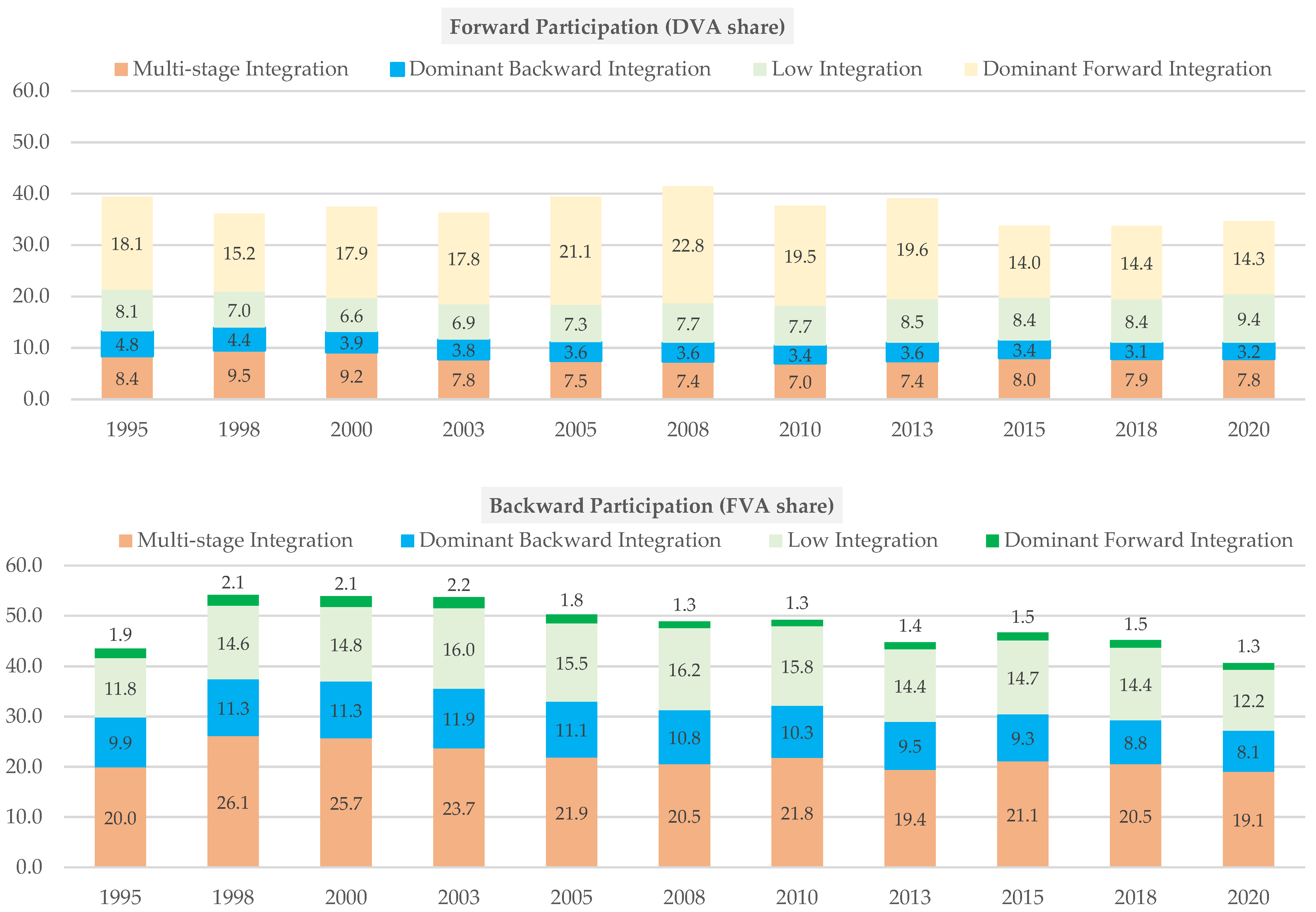
The Mexican economy held a prominent position in the expansion of GVCs over the period 1995–2020 (See Appendix A Table A3 and Table A4). The FVA share increased from 43.5% in 1995 to 53.9% in 2000, declined to 50.3% in 2005, and displayed subsequent fluctuations, reaching a low of 40.7% by 2020. By contrast, the DVA share decreased from 39.4% in 1995 to 37.5% in 2000, recovered to levels close to its initial value in 2005 (39.5%), and fell to 34.6% at the end of the period.
In comparative terms, considering a sample of 76 countries and average values over the period 1995–2020, Mexico registered a higher DVA share than the global average (48.3% versus 44.6%), while its FVA share was 7.2 percentage points below the corresponding world average (See Table 3). Finally, between 2018 and 2020, Mexico experienced a sharper decline than the global average in its FVA share, with a reduction of 4.5 percentage points compared to a global decrease of 1.3 percentage points.
These findings are consistent with Vidal and Pandiella (2024), who demonstrate that Mexico ranks among the OECD countries with the highest levels of backward participation in GVCs. With respect to the evolution of integration, three contrasting phases can be identified over the period 1995–2017: an initial expansion following the entry into force of NAFTA (1995–2001); a deceleration coinciding with China’s growing prominence in the global economy (2001–2008); and a renewed, though uneven, expansion between 2008 and 2017 (Chiquiar & Tobal, 2019). During 2017–2020, Mexico’s level of integration declined more sharply than the global average, reflecting the effects of the first year of the COVID-19 pandemic. Finally, Pérez-Santillán and Arriaga Navarrete (2024) report that Mexico’s relative position within GVCs remained broadly unchanged between 1995 and 2018.
At the sectoral level, observed integration patterns correspond closely to the typology introduced in the methodology section: integration across multiple segments of the value chain, ranging from product design and development to input procurement and final assembly; dominant backward integration; dominant forward integration; and low integration, characterized by backward and forward participation shares persistently below global averages. A salient feature across these categories is the predominance of backward participation throughout the period, except for sectors classified under dominant forward integration (See Figure 1).
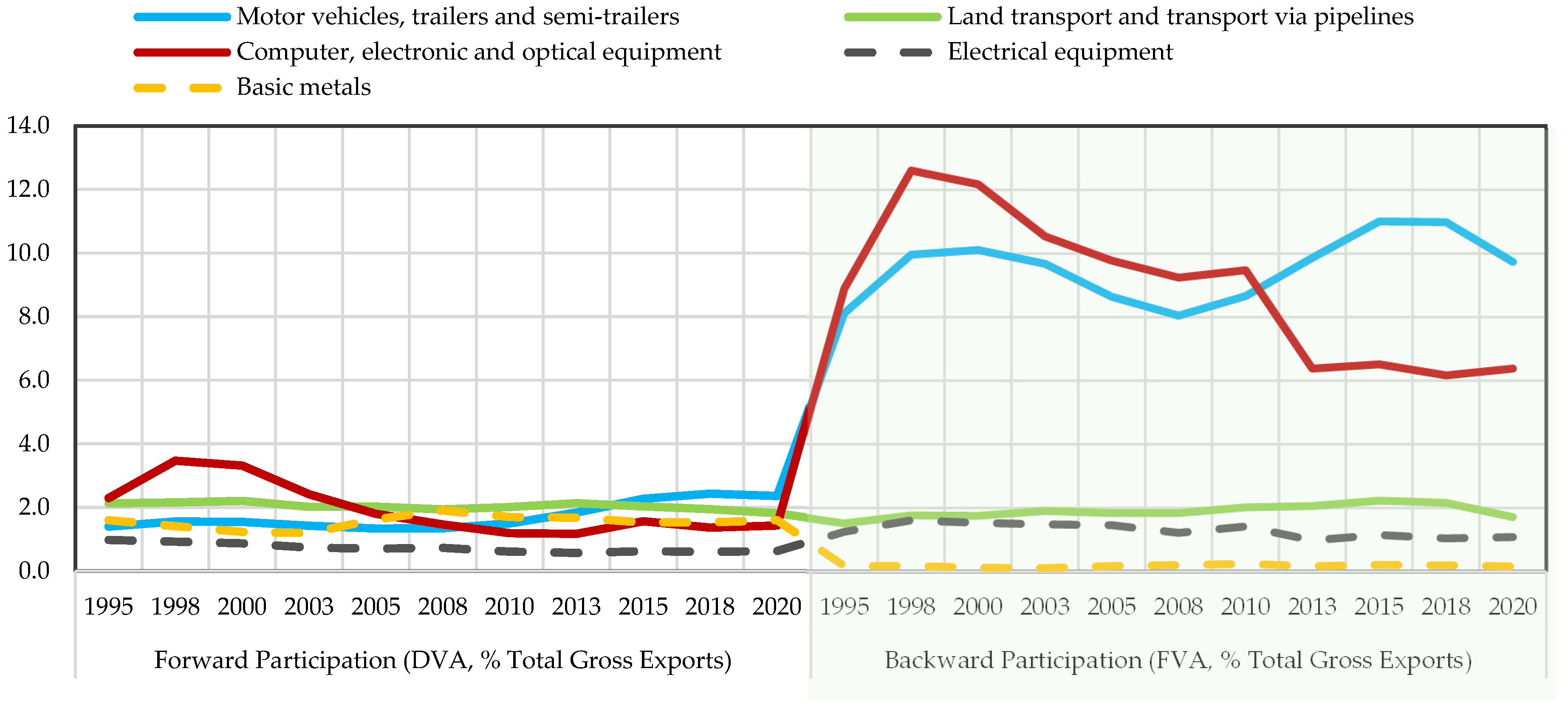
Integration across multiple GVCs segments averaged 8.0% in forward participation and 21.8% in backward participation over the period. This pattern is characteristic of activities such as motor vehicles, trailers, and semi-trailers; electronic, optical, and computer equipment; electrical equipment; basic metals; and land transportation services. These activities exhibit an intensive reliance on imported inputs, parts, and components for the processing and assembly of intermediate and/or final goods; however, they show marked heterogeneity in their backward and forward linkages. At one extreme, the automotive industry records the highest backward linkages, while basic metals manufacturing lies at the opposite end of the spectrum. In terms of forward linkages, land transportation services rank the highest, whereas electrical equipment manufacturing shows the weakest performance.
Within this category, the evolution of integration also diverges across activities. Motor vehicles, trailers, and semi-trailers show greater dynamism over time, whereas electronic, optical, and computer equipment—as well as electrical equipment—experience a relative slowdown in integration (See Figure 2).
These findings underscore the central role of the automotive industry in Mexico’s integration into GVCs, both through auto-parts manufacturing and automobile assembly. What remains uncertain, however, is the extent to which this industry has been able to drive the development of related sectors and to promote the integration of domestic suppliers into these chains (Hernández et al., 2014; Pérez-Santillán & Arriaga Navarrete, 2024). Nevertheless, its importance for domestic production, exports, and formal employment is indisputable (Chiquiar & Tobal, 2019). By contrast, this dynamism stands in sharp contrast to the trajectory of computer, electronic, and optical equipment manufacturing, whose contraction across production stages within GVCs has been associated with a strong dependence on imported inputs from China and other Asian economies (García González & Márquez Mendoza, 2025). Even so, De La Cruz et al. (2013) document increases in the domestic content of Mexico’s exports linked to strengthened backward linkages.
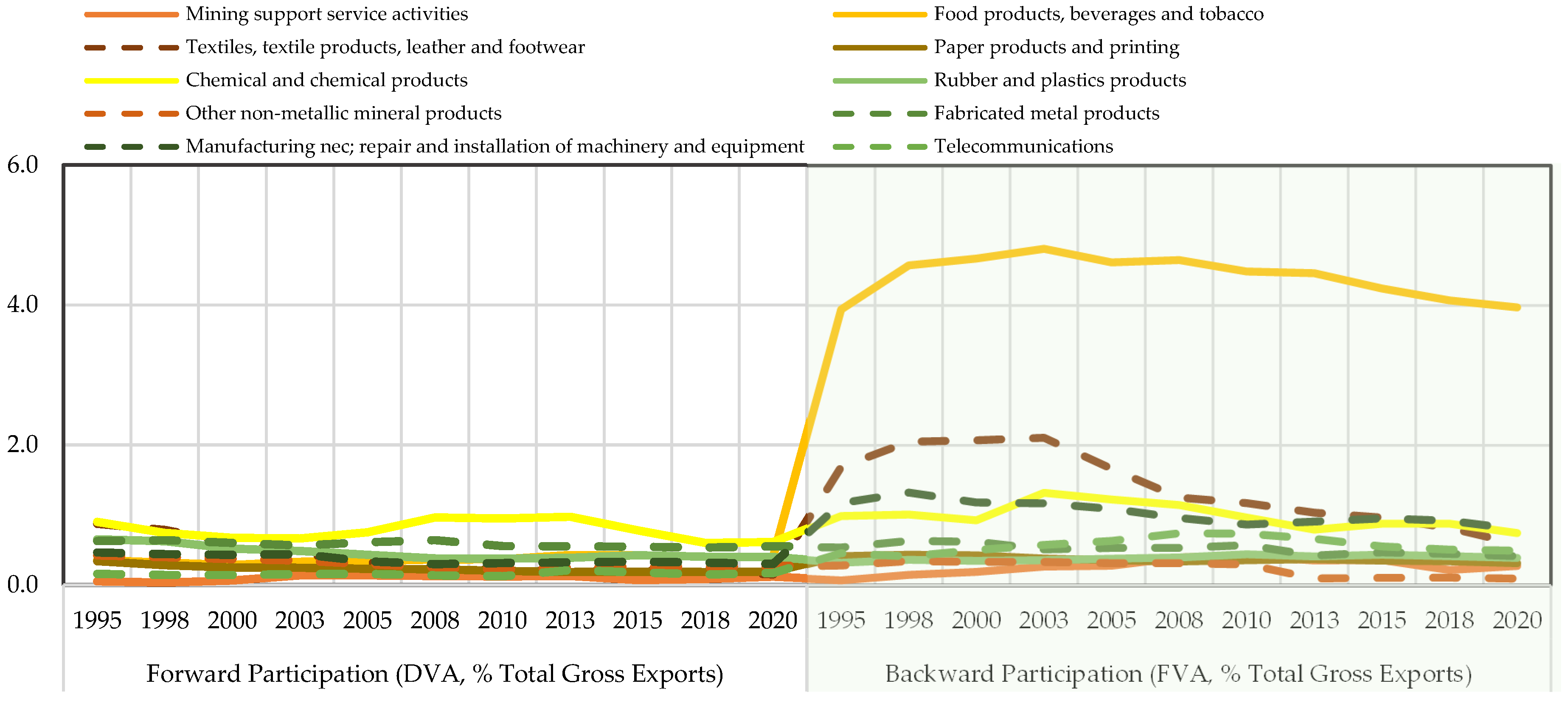
Complementarily, the manufacturing-oriented profile of Mexico’s GVCs integration (Pérez-Santillán & Arriaga Navarrete, 2024) is reflected in average participation rates of 10.2% in FVA and 3.7% in DVA. This group includes industries such as food, beverages, and tobacco; textiles, textile products, leather, and footwear; and chemicals and chemical products, among others. Support services for mining are also classified within this category (See Figure 3). Finally, land transportation and telecommunications exhibit notable dynamism in their integration—across multiple segments and under dominant backward integration, respectively—given their role in providing logistical connectivity and communication services that link geographically dispersed firms. This highlights the importance of physical and digital infrastructure as a key determinant of participation in global markets (Kaplinsky, 2000).
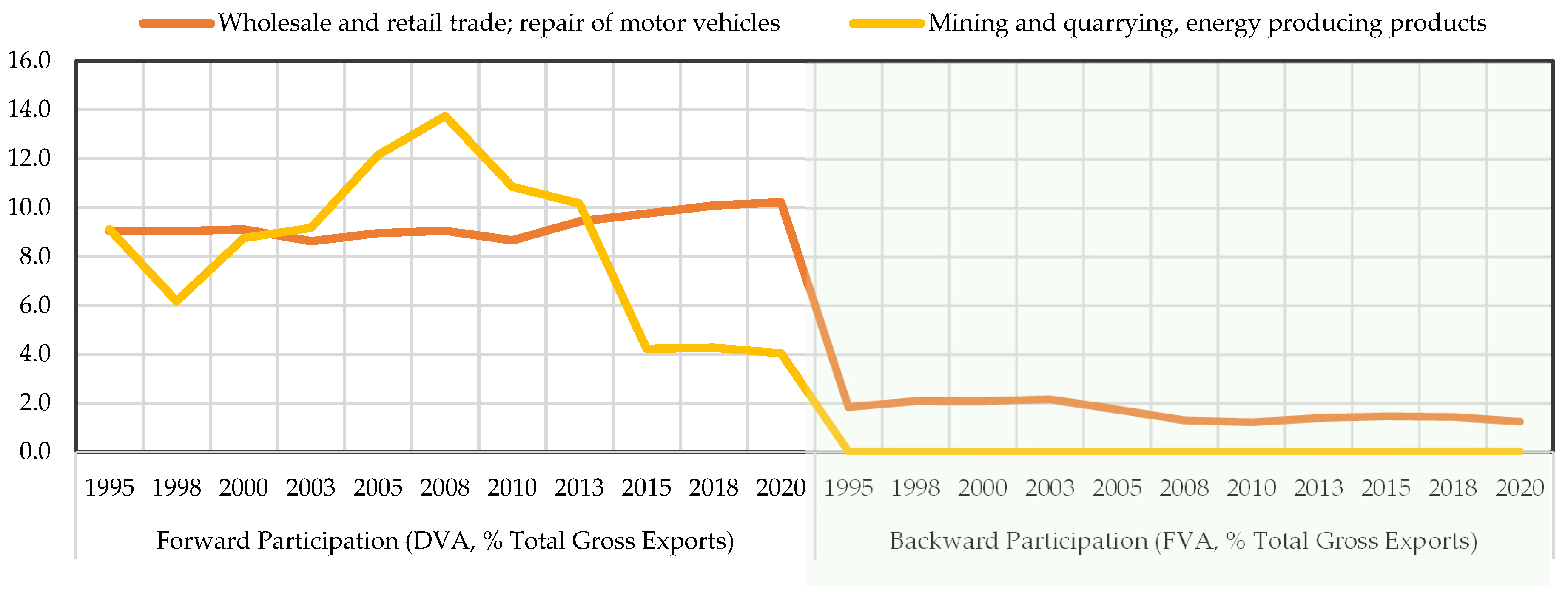
By contrast, dominant forward integration in GVCs characterizes sectors such as mining and quarrying, energy products, and trade, with average participation shares of 17.7% in DVA and 1.7% in FVA, respectively (See Figure 4). Low levels of GVCs integration are observed in other activities, including agriculture, livestock, forestry, and fishing; administrative and support services; and non-energy mining and quarrying, among others. These sectors consistently remain below global averages in both forward and backward participation throughout the period analyzed. Detailed sectoral results for forward and backward participation by integration category are reported in the Appendix A (See Table A5 and Table A6).
To what extent do the degree and type of sectoral integration into GVCs shape sectors’ roles in driving the national production structure over the period 1995–2020? Among sectors exhibiting the highest levels of multi-stage integration, three stand out as key: basic metals; computer, electronic, and optical equipment; and motor vehicles, trailers, and semi-trailers. The first two show high and relatively balanced weighted multipliers—strong backward and forward linkages—indicating both substantial demand for upstream inputs and a significant supply of intermediates to the rest of the economy. Within the same category, motor vehicles, trailers, and semi-trailers maintain persistently high backward linkages and, during the second half of the period, exceed the forward-linkage threshold, suggesting a convergence between backward and forward linkages (See Table 4). Disaggregated results by integration category—by sector, year, and role within the Mexican production structure—are presented in the Appendix A (See Table A7).
Within the dominant backward integration category, multiplier spillover effects are prevalent, particularly in food and beverage processing; textiles, clothing, and footwear; paper and printing; plastics; non-metallic mineral products; and other manufacturing activities not classified elsewhere. Other sectors—such as chemicals and chemical products—appear as key in certain years; however, their forward linkages gradually deteriorate and weaken toward the end of the period. By contrast, within the dominant forward integration category, forward-oriented sectors include mining and quarrying, energy-producing products, and, most notably, wholesale and retail trade. These activities operate as systemic suppliers to the rest of the economy, yet generate relatively limited spillover effects into domestic production linkages.
Sectors classified as having low GVCs integration play heterogeneous roles in stimulating the national economy (See Appendix A Table A7). First, coke and refined petroleum products serve as a key sector due to their cross-cutting role in production, despite relatively limited international integration. Second, machinery and other transport equipment show strategic backward-oriented effects on other sectors. Third, electricity, gas, steam, and air-conditioning supply, together with most private and public services, consolidate their role as drivers of the production structure throughout the period.
Overall, these findings are broadly consistent with Boundi Chraki (2016), underscoring the central role of manufacturing as an economic driver, the limited number of key sectors, and the predominance of non-key sectors—patterns that together indicate constrained productive diversification and persistent structural weaknesses.
Over the period 1995–2020, sectoral roles as drivers of growth exhibit a high degree of stability, with only limited episodes of upgrading or weakening observed in a small number of sectors. Sectors integrated across multiple GVCs segments remain classified as key. By contrast, the chemicals and chemical products sector experiences a reduction in forward linkages toward the end of the period, implying weaker multiplier effects through the supply of intermediates. Driving sectors maintain notable stability—particularly wholesale and retail trade and land transport and pipelines—the latter showing integration across multiple production stages within GVCs. There are also signs of strengthening among knowledge-intensive services (professional, scientific, and technical services; administrative and support services), mainly driven by increases in forward (driving) linkages rather than backward linkages. Meanwhile, non-key sectors remain largely unchanged—such as education, public administration, health, and personal services—consistent with their limited productive articulation with other sectors or their predominantly non-intermediate nature.
Although a small number of sectors cross classification thresholds—most notably Motor vehicles, trailers, and semi-trailers, and to a lesser extent coke and refined petroleum products and non-energy mining—these changes are not generalized across the production structure and do not alter the overall stability of sectoral hierarchies. Accordingly, the evidence supports a pattern of limited and non-systematic transitions rather than an absence of transitions.
In terms of scaling, the most significant case is motor vehicles, trailers, and semi-trailers. Its multiplier spillovers cross the relevant threshold from 2015 onward, positioning the sector as key and suggesting a broader diffusion of demand toward backward-integrated activities, including auto parts, metalworking, technical plastics, and specialized services. The electricity and gas sector also gains momentum from the early 2000s, reflecting its growing enabling role within the production structure. Information technology and other information services nearly reach the spillover threshold toward the end of the period, foreshadowing potential upgrading if local sourcing and linkages with manufacturing deepen. Coke and refined petroleum products temporarily strengthen their driving role during 2008–2013 and subsequently consolidate as key. Non-energy mining follows a similar trajectory, emerging as a driving sector during the 2010s.
Regarding forward linkages, fabricated metal products and paper and printing lose key status as their driving role declines from the early 2000s onward, remaining follower sectors characterized by high dependence on intermediate inputs but lower sales of intermediates to the rest of the economy. Textiles and footwear exhibit a comparable pattern, reinforcing the hypothesis that several traditional manufacturing activities preserved domestic supplier networks without expanding their role as cross-cutting suppliers.
Relating these sectoral changes to the integration categories reveals three distinct patterns. First, manufacturing activities integrated across multiple segments of GVCs—and some sectors classified under dominant backward integration—tend to be identified as key or to generate significant multiplier spillovers. The positioning of motor vehicles, trailers, and semi-trailers as a key sector confirms that, under multi-stage integration, the strengthening of domestic downstream linkages is feasible and can materialize within relatively short time spans. Second, sectors characterized by predominant forward integration sustain long-term driving roles within the production structure, reflecting strong spillovers into domestic intermediate demand but limited spillovers toward local suppliers; in such cases, raising multipliers would require import substitution strategies based on quality upgrading, standardization, and competition in services. Third, persistent functional imbalances in low-integration sectors (e.g., coke and refined petroleum products) coexist with their key role in the national economy, while predominantly backward-integrated sectors have not strengthened their momentum effects, suggesting the presence of downstream bottlenecks associated with limited local intermediate uses, insufficient standards and aggregation, or incomplete industrial clienteles.
In summary, the evidence points to a dual pattern in the Mexican economy. Manufacturing sectors that are strongly integrated across multiple GVCs links—and predominantly backward integrated—also maintain relatively strong productive ties with domestic structures, whereas energy-related activities and productive services contribute to the national economy mainly through systemic impulse linkages. These findings are consistent with Murillo-Villanueva (2020), who reports the coexistence of dual productive structures and the disarticulation of certain GVCs integrated sectors from those oriented toward domestic markets. Finally, instances of upgrading amid weakening integration suggest that sectors’ structural roles have been shaped by their functional insertion into GVCs. In this sense, the slow pace of sectoral change in the Mexican economy is consistent with the functional logic of its integration into GVCs throughout the period under analysis.

4. Conclusions

This study analyzed Mexico’s participation in GVCs based on international trade in value added over the period 1995–2020. A first finding is that multi-stage integration has been particularly relevant, both in terms of its contribution to domestic value added and its dynamism. However, this form of integration has remained highly concentrated in a limited number of sectors throughout the period, revealing one of the main structural constraints of Mexico’s integration into GVCs. A second key finding is that the sectoral dynamics of integration have not translated into a significant process of structural transformation; the dynamic roles of productive sectors within the domestic production structure show only limited variation over time, with few non-generalized cases of upgrading.
The results further suggest that high sectoral concentration and weak production linkages between manufacturing and service activities have constrained the potential for sustained expansion and structural change in the Mexican economy. This configuration has reproduced a dual productive structure: on the one hand, a modern export-oriented sector closely linked to transnational corporations through GVCs; on the other, a large set of activities oriented toward domestic demand with limited articulation to internationally integrated segments. The persistence of this duality during the outward-oriented growth phase largely reflects the disconnect between production segments that supply global markets and those driven by domestic demand.
These structural characteristics help explain both the limited impact of GVC integration on productive diversification and restructuring, and the high vulnerability of the Mexican economy to external shocks, given the weakness of domestic demand as a driver of growth. While these outcomes are shaped by multiple internal factors—including structural heterogeneity, capital scarcity, technological gaps, and uneven firm capabilities—the results highlight the central role played by the disarticulation between GVC-integrated and non-integrated sectors. From a value-added perspective, the analysis reveals circular patterns of external dependence, whereby imported inputs are used for export production and global demand largely determines both import and export volumes. In this sense, Mexico’s slow pace of structural transformation cannot be attributed solely to recurrent external shocks but is consistent with persistent gaps in industrial policy.
From a policy perspective, while the empirical results do not establish causal relationships, they point to differentiated structural patterns that are relevant for the design of industrial policy. In particular, the coexistence of multi-stage integration with relatively strong domestic linkages in a small number of sectors suggests that deeper forms of integration may be compatible with upgrading when backward and forward linkages are simultaneously strengthened. By contrast, sectors characterized by dominant backward integration display a strong dependence on imported intermediates, indicating the presence of downstream bottlenecks that limit the diffusion of GVC-related demand toward domestic suppliers. Finally, sectors with dominant forward integration tend to play a systemic role in the economy, providing inputs to a wide range of activities, yet with relatively limited spillovers toward domestic capability building. Taken together, these patterns highlight the importance of aligning industrial policy with the structural dynamics of GVC participation, ensuring that integration contributes to sustainable and inclusive economic upgrading.
Against this background, the findings are consistent with three broad industrial policy priorities: developing local suppliers through selective import substitution in activities with potential for strengthening domestic linkages; facilitating access to productive financing to support the expansion of domestic firms’ participation in GVCs, particularly in sectors exhibiting multi-stage integration; and investing in industrial, transport, and digital infrastructure to enhance coordination between manufacturing activities and business-intensive services. While integration into GVCs does not, by itself, guarantee sustained growth or structural transformation, the results suggest that targeted industrial policies aimed at reinforcing domestic linkages may enhance the capacity of GVC participation to generate higher domestic value added and reduce exposure to external shocks.
In short, beyond optimistic narratives about Mexico’s insertion into GVCs, the process has largely reflected the profit-maximization logic of multinational corporations, which control chain governance and often overlook the needs of the territories where industries are located. Major global realignments nevertheless open a window to rethink Mexico’s role in GVCs. In this context, the policy priorities discussed above—aimed at strengthening domestic linkages, expanding local supplier capabilities, improving access to productive financing, and investing in industrial and digital infrastructure—are consistent with both the empirical patterns identified in this study and with international experience (Gereffi et al., 2005; OECD, 2013; World Bank, 2020). Together, these measures may enhance the capacity of GVC participation to generate higher domestic value and reduce exposure to external shocks.


Author Contributions

L.R.-B., conceptualization, investigation, formal analysis, methodology, software, writing—review and editing, and validation; M.F.H.-C., investigation, formal analysis, methodology, writing—review and editing, and validation. All authors have read and agreed to the published version of the manuscript.

Funding

This research received no external funding.

Institutional Review Board Statement

Not applicable.

Informed Consent Statement

Not applicable.

Data Availability Statement

The study relies on publicly available OECD Inter-Country Input–Output tables (2023 edition). All data processing routines, sectoral concordances, and codes used to generate the results can be obtained from the authors upon request via email, allowing full replication of the empirical analysis.

Conflicts of Interest

The authors declare no conflicts of interest.

Appendix A

Table A1. Geographical coverage of inter-country input-output tables.
NumberCountriesCodeNumberCountriesCodeNumberCountriesCode
1ArgentinaARG31HungaryHUN61RomaniaROU
2AustraliaAUS32IndonesiaIDN62Russian FederationRUS
3AustriaAUT33IndiaIND63Saudi ArabiaSAU
4BelgiumBEL34IrelandIRL64SenegalSEN
5BangladeshBGD35IcelandISL65SingaporeSGP
6BulgariaBGR36IsraelISR66SlovakiaSVK
7BelarusBLR37ItalyITA67SloveniaSVN
8BrazilBRA38JordanJOR68SwedenSWE
9Brunei DarussalamBRN39JapanJPN69ThailandTHA
10CanadaCAN40KazakhstanKAZ70TunisiaTUN
11SwitzerlandCHE41CambodiaKHM71TürkiyeTUR
12ChileCHL42KoreaKOR72Chinese TaipeiTWN
13China (People’s Republic of)CHN43Lao (People’s Democratic Republic)LAO73UkraineUKR
14Côte d’IvoireCIV44LithuaniaLTU74United StatesUSA
15CameroonCMR45LuxembourgLUX75Viet NamVNM
16ColombiaCOL46LatviaLVA76South AfricaZAF
17Costa RicaCRI47MoroccoMAR77Rest of the WorldROW
18CyprusCYP48MexicoMEX
19CzechiaCZE49MaltaMLT
20GermanyDEU50MyanmarMMR
21DenmarkDNK51MalaysiaMYS
22EgyptEGY52NigeriaNGA
23SpainESP53NetherlandsNLD
24EstoniaEST54NorwayNOR
25FinlandFIN55New ZealandNZL
26FranceFRA56PakistanPAK
27United KingdomGBR57PeruPER
28GreeceGRC58PhilippinesPHL
29Hong Kong, ChinaHKG59PolandPOL
30CroatiaHRV60PortugalPRT
Source: Prepared by the authors based on OECD (2023).
Table A2. Sectoral coverage of inter-country input-output tables.
CodeSectorCodeSector
A01_02Agriculture, hunting, forestryDElectricity, gas, steam and air conditioning supply
A03Fishing and aquacultureEWater supply; sewerage, waste management and remediation activities
B05_06Mining and quarrying, energy producing productsFConstruction
B07_08Mining and quarrying, non-energy producing productsGWholesale and retail trade; repair of motor vehicles
B09Mining support service activitiesH49Land transport and transport via pipelines
C10T12Food products, beverages and tobaccoH50Water transport
C13T15Textiles, textile products, leather and footwearH51Air transport
C16Wood and products of wood and corkH52Warehousing and support activities for transportation
C17_18Paper products and printingH53Postal and courier activities
C19Coke and refined petroleum productsIAccommodation and food service activities
C20Chemical and chemical productsJ58T60Publishing, audiovisual and broadcasting activities
C21Pharmaceuticals, medicinal chemical and botanical productsJ61Telecommunications
C22Rubber and plastics productsJ62_63IT and other information services
C23Other non-metallic mineral productsKFinancial and insurance activities
C24Basic metalsLReal estate activities
C25Fabricated metal productsMProfessional, scientific and technical activities
C26Computer, electronic and optical equipmentNAdministrative and support services
C27Electrical equipmentOPublic administration and defence; compulsory social security
C28Machinery and equipment, necPEducation
C29Motor vehicles, trailers and semi-trailersQHuman health and social work activities
C30Other transport equipmentRArts, entertainment and recreation
C31T33Manufacturing nec; repair and installation of machinery and equipmentSOther service activities
TActivities of households as employers; undifferentiated goods- and services-producing activities of households for own use
Source: Prepared by the authors based on OECD (2023).
Table A3. Forward Participation by Country in Global Value Chains, 1995–2020.
19951998200020032005200820102013201520182020
CYP25.1BGD20.7BGD19.3BGD18.6BGD20.7MLT16.4MLT16.4MLT12.1MLT13.4MLT15.5MLT15.6
KHM25.6HRV24.5HUN24.1KHM23.2MLT22.4BGD19.8BGD19.4BGD17.5BGD16.7BGD17.5LUX17.1
MLT25.8MLT25.7KHM24.6MLT25.2KHM22.4KHM22.2KHM19.8KHM20.9LUX21.2LUX18.6BGD19.9
BGD26.1CYP27.4MLT26.5JOR25.7JOR22.7LUX24.6LUX24.5LUX21.0KHM22.4JOR21.7JOR24.3
TUN26.3TUN27.5HRV26.5HRV27.6LUX25.4JOR25.0JOR25.4JOR25.9JOR24.9KHM24.8KHM25.5
JOR27.0HUN27.7JOR27.5HUN27.8HUN27.5HUN27.1HUN26.7HKG26.9VNM28.5CYP25.4CYP26.9
HRV29.5KHM27.8CYP27.8TUN28.9HRV28.8BGR28.3BLR27.6THA27.9THA28.6HRV27.1VNM27.3
GRC30.2JOR28.3TUN28.2BLR29.8THA30.1BLR28.9VNM27.9IRL28.5HUN28.6VNM27.2SVK28.3
HUN31.1GRC28.8LUX29.1LUX30.5BLR30.7HRV29.0IRL28.6HUN28.9SVK29.0HKG27.3HUN29.7
SGP31.4BLR29.9BLR30.1CYP31.0SGP31.3IRL29.0HRV29.6SVK29.0CYP29.6GRC27.6TUN31.2
THA31.5PHL31.5THA30.2GRC31.3IRL31.4VNM29.0THA29.8CYP29.1IRL29.7SVK28.3IRL31.4
IRL31.9IRL31.9GRC30.2IRL31.3TUN31.9THA30.2SVK30.3HRV29.2HKG29.8THA28.5SGP33.1
SVN32.3THA32.4SGP31.5THA31.7GRC32.0SGP30.6HKG31.5BLR29.8HRV29.8HUN30.2CZE33.4
MYS33.0MYS32.4MAR31.6TUR32.4VNM32.4SVK30.6BGR31.6SGP29.9GRC31.0ISL30.2GRC33.8
PRT33.6LUX32.7IRL32.2MAR33.3BGR32.6HKG31.3SGP31.7VNM30.1CZE32.2BLR30.9MEX34.6
MAR33.9PRT32.8CRI32.4SVK33.7SVN33.0CRI32.1CZE31.7BGR30.7TUN32.3TUN31.2BLR34.9
HKG34.1SVN32.8SVN33.3VNM34.0SVK33.1KOR33.2CYP32.7GRC31.3SGP32.6IRL31.4THA35.0
EST34.2LTU33.6PRT33.8CRI34.1CRI33.2SVN33.7SVN33.4CZE31.3BLR32.7PRT31.6DNK35.1
LTU35.5MAR33.9MYS34.0PRT34.5TUR33.5CZE34.0TWN33.5PRT33.5BGR33.0SGP32.0BGR36.5
TUR35.8EST34.6BGR34.6CHN34.7MAR33.8GRC34.1KOR33.7TUN34.2PRT33.1CZE32.1ISL36.6
ISL36.5SGP35.8ESP35.4SVN34.8CYP34.1TWN34.7GRC33.7ISL34.2ISL33.3BGR32.7PRT37.0
CRI36.5CRI35.8VNM35.6BGR34.8CZE34.3TUR34.7TUN34.5SVN34.3MEX33.8CRI33.7MAR37.8
ITA36.6ESP35.8KOR35.8SGP35.5ISL34.3LTU35.7CRI34.5EST35.2CRI35.6MEX33.8HKG37.8
PHL36.6BGR35.9CHN36.4KOR36.3CHN34.5ITA35.8TUR34.7CRI35.2SVN35.7SVN34.7SVN38.0
KOR36.7MEX36.1TUR36.6ESP36.3PRT35.5ESP36.0PRT35.2KOR35.3DNK35.9MAR34.8HRV38.4
ESP36.9SVK36.5ITA36.8MEX36.3ESP35.6PRT36.2ITA35.7CHN35.7MAR36.0DNK34.9TUR38.4
ISR37.3HKG37.1SVK37.1ISL37.0HKG35.9CYP36.3CHN36.4MAR35.9TUR36.0ESP36.6CRI38.5
SVK37.4KOR37.2PHL37.1NZL37.2MYS36.6CHN36.3LTU36.6TUR36.1ITA36.4TUR36.9CHE38.9
DNK37.6ITA37.2MEX37.5PHL37.3TWN36.9TUN36.4ESP36.7LTU36.2EST37.0ITA37.4PAK39.2
LUX37.9DNK37.3TWN37.5ITA37.6NZL37.1ISR36.9DNK37.3DNK36.2ESP37.3CHE38.0POL39.3
TWN37.9TUR37.6HKG37.5TWN37.7KOR37.4DNK37.5EST37.7ESP36.5CHN38.0POL38.4EST39.7
POL38.0ISL37.7ISL37.5MYS38.0ISR37.5NZL37.5MEX37.7ITA36.9NZL38.2CHN38.6CHN39.8
CHN38.1VNM37.8ISR38.2LTU38.7ITA37.5POL38.1SEN37.8TWN36.9LTU38.3NZL38.8ITA39.9
VNM38.3ISR38.0LTU38.7CZE39.1EST38.5MAR38.2ISR38.0POL38.1KOR39.3BEL39.1BEL40.0
MEX39.4CHN38.0FRA38.9DNK39.2LTU38.6SEN38.4NZL38.4SEN38.2POL39.6FRA39.1ESP40.5
ROU39.5TWN38.8NZL39.2HKG39.4FRA39.2PAK38.6MAR38.4BEL38.9AUT40.1EST39.2AUT40.6
BEL39.8BEL39.3BEL39.2FRA39.4PAK39.2CHE38.6FRA38.4AUT39.1CHE40.1LTU39.2FRA41.3
AUT40.1POL39.3DNK39.2ISR39.5PHL39.4FRA38.6MYS38.4MEX39.1TWN40.1TWN39.2LTU41.5
FRA40.8LAO39.4EST39.5POL40.3MEX39.5BEL38.8POL38.7CHE39.1FRA40.1AUT39.7ROU41.7
CZE41.1CZE39.7UKR40.0PAK40.5DNK39.7MYS39.1CHE39.3FRA39.2DEU40.7PAK39.9NLD41.7
BLR41.4FRA39.8CZE40.5EST41.1LAO39.9ISL39.1AUT39.7IND39.3IND40.8KOR40.3NZL42.3
CHE41.6ROU40.2PAK40.8UKR41.2CHE40.1FIN39.9ISL39.8ISR39.9PAK40.9ROU40.3DEU42.4
LAO41.8NZL40.3AUT41.2CHE41.4AUT40.6EST39.9PAK40.2DEU40.4MYS41.0MYS40.5IND42.4
PAK42.4AUT40.5CHE41.6AUT41.6BEL40.7SWE40.2BEL40.3NZL40.5BEL41.4NLD40.7KOR42.9
UKR42.4CAN41.2POL41.7BEL41.6POL40.8AUT40.7DEU40.6UKR41.3ISR41.5DEU40.9SWE43.6
SWE42.9CHE41.3DEU42.1SWE42.8SWE40.8DEU41.0ROU41.2MYS41.8UKR41.8IND40.9TWN43.8
NZL43.1UKR41.6SWE42.4SEN43.1UKR41.3MEX41.5IND41.4FIN41.9ROU42.1ISR41.8MYS44.0
NLD43.2SWE42.0IND42.7DEU43.2FIN41.9UKR41.6LAO41.5PAK42.2NLD42.5SWE42.3ARG44.1
MMR43.2PAK42.4NLD42.8IND44.1DEU42.4IND42.4UKR42.2ROU42.7SEN43.3PHL42.7FIN44.8
USA43.8DEU43.0CAN42.9ROU44.5ROU44.0ROU42.4FIN42.4ARG42.9LVA43.5UKR43.2ISR45.1
DEU43.8NLD43.8ROU44.6NLD44.8SEN44.1PHL44.4SWE43.2LVA42.9ARG45.0ARG43.3UKR46.1
IND44.5IND44.1FIN45.1FIN44.9IND44.1NLD44.9ARG43.3LAO43.4SWE45.1LVA44.3LVA46.8
CAN44.5USA44.3USA45.2LAO45.8NLD44.2ARG45.3PHL43.7NLD44.0FIN46.1FIN44.8PHL47.2
BGR45.0LVA45.5LAO45.7CAN45.9USA46.8USA45.8NLD44.9SWE44.8PHL46.5SEN44.8MMR47.3
SEN46.0GBR45.6SEN45.9BRA46.9ARG46.9LAO45.9EGY45.7GBR46.4CAN46.8EGY45.1CAN47.4
GBR46.1FIN45.8BRA46.9USA47.1JPN47.5JPN46.4LVA46.5USA47.1GBR47.2MMR45.2ZAF49.0
ARG46.8ARG46.0MMR47.1GBR48.6BRA47.9LVA46.9USA46.7PHL47.2JPN47.5ZAF46.1GBR50.3
JPN47.5SEN46.1GBR48.2JPN49.0LVA48.4GBR48.9JPN47.7JPN47.6USA47.7GBR46.3JPN50.3
FIN47.9MMR46.1ARG48.3ARG49.9GBR48.4BRA50.6GBR47.7BRA50.8MMR47.8JPN46.8SEN51.2
BRA48.9BRA48.0JPN48.9LVA50.1CAN48.4CIV50.8CIV48.8CAN51.0EGY48.5CAN47.3EGY52.3
EGY49.4JPN48.5LVA49.9EGY50.7CIV50.1EGY52.5CAN50.3ZAF53.5LAO48.5USA48.3USA52.3
LVA51.4IDN51.9AUS52.0MMR51.9EGY51.0ZAF53.7BRA52.0EGY53.6BRA49.9BRA52.5BRA54.2
AUS53.2CIV52.2CIV53.7CIV52.0MMR52.8CAN53.9MMR55.8MMR54.6ZAF51.5IDN53.5LAO55.4
CIV53.8AUS53.0EGY54.4AUS52.1AUS56.2MMR55.9ZAF58.0CIV55.2CIV54.7CIV55.3IDN56.1
IDN56.2EGY54.6IDN54.8IDN55.8IDN56.8IDN57.7CMR58.4IDN58.7IDN55.4LAO56.0CIV57.5
CMR59.4NOR56.7COL57.9ZAF57.2ZAF57.1CHL58.5IDN60.2CMR59.4CMR58.2CMR59.5CMR59.4
NOR60.4CHL58.4ZAF59.0COL57.4COL58.9AUS60.3AUS61.6PER62.7AUS60.9COL63.1COL59.7
RUS60.8ZAF58.8CHL60.7CMR60.0CMR59.7PER60.6PER64.4CHL62.8COL62.3PER64.0NOR63.5
ZAF61.0CMR60.5CMR62.4CHL60.4CHL62.9CMR60.6CHL65.6AUS64.0PER62.5AUS64.9CHL68.0
CHL61.2RUS60.6RUS63.2NOR64.4PER65.2COL61.6RUS66.4RUS65.2NOR64.0NOR65.0AUS69.2
PER61.6PER61.0PER63.4RUS64.5RUS67.1RUS66.4COL66.8NOR69.3CHL64.5CHL65.2RUS69.7
COL62.5COL61.9KAZ64.9PER64.6NOR68.6NOR68.8NOR68.1COL70.4RUS65.7RUS69.4PER69.9
KAZ65.1KAZ70.6NOR66.7KAZ66.6KAZ70.1KAZ70.9KAZ71.2KAZ72.3KAZ72.1KAZ70.8KAZ71.8
BRN83.1NGA82.9NGA85.7NGA83.8BRN87.2SAU85.1NGA84.4BRN82.6BRN80.5SAU81.9BRN74.4
NGA83.8SAU84.5SAU87.2SAU86.6NGA87.6NGA85.8BRN87.2NGA85.5SAU83.6BRN83.3NGA83.6
SAU86.3BRN85.8BRN87.5BRN87.7SAU87.9BRN87.2SAU87.5SAU88.3NGA84.6NGA83.5SAU83.6
RoW60.3RoW57.6RoW63.7RoW63.1RoW66.3RoW69.9RoW69.4RoW69.9RoW63.9RoW65.3RoW66.3
Source: Own elaboration.
Table A4. Backward Participation by Country in Global Value Chains, 1995–2020.
19951998200020032005200820102013201520182020
NGA13.8LUX20.8NGA7.8NGA15.4NGA9.7NGA7.5BRN12.0NGA16.2BRN23.2SAU20.7IRL26.6
SAU19.5SAU21.2BRN17.3SAU15.4SAU10.7BRN8.9NGA12.9BRN16.5NGA24.1BRN23.5SAU27.2
LUX21.1NGA21.6RUS17.3BRN15.7BRN10.7SAU13.8SAU18.7SAU18.4TWN28.9NGA26.1SGP28.4
BRN24.2RUS24.5SAU17.4ARG23.1MMR21.8KAZ18.2NOR28.1NOR27.4SGP29.2RUS27.2CHL30.2
BGR26.6BGR29.9NOR22.6RUS23.8RUS21.8NOR22.8CHL28.9CHE31.3RUS29.3IRL27.4BRN30.3
RUS28.1BRN30.4LUX23.0LUX25.2NOR22.1RUS27.8RUS29.3TWN31.9CHE30.8SGP28.2SVN30.4
CMR28.8SGP32.6KAZ28.1NOR25.7KAZ25.0MMR29.8SGP30.2RUS31.9SAU30.9CHE31.1TWN30.6
CHL32.3IDN33.6IDN34.1KAZ28.3SGP27.2SGP31.0LUX30.2CIV32.5IRL31.1SVN31.5AUS32.3
NOR32.6MYS34.1MYS34.8SGP29.6LUX28.9CHE31.8CHE31.4SGP32.7SVN32.2TWN31.8CHE34.0
IRL33.7THA34.4CHE34.9CIV30.4CHL30.6LUX31.9KAZ32.3KAZ33.5LUX32.5NOR31.9LTU34.9
MLT34.9CIV34.7CIV35.5MYS32.1PER32.5MYS32.0CIV32.5SVK33.8CYP32.6CYP33.3BLR35.5
SGP35.6IRL34.9CHL35.8CHE35.0CIV32.9TWN34.2ISL32.9IRL34.3NOR33.1AUS33.6RUS35.9
NLD35.8CMR35.2FIN35.9TWN35.7ARG33.2CIV34.4PER34.1LTU34.4DEU34.3BGR35.2CRI36.1
CIV35.9FIN35.4IRL36.2CHL36.2MYS33.2CHL35.7TWN34.3LUX34.6ISL35.3BLR35.4DEU36.6
CHE36.0SWE35.6SWE36.5FIN36.3TWN34.2AUT35.7MYS35.5SVN34.7CHL35.4AUT35.5PER36.6
FIN36.1MLT36.1DNK36.5IRL36.3CHE34.4DEU36.2AUT36.3BGR35.1AUT35.7CHL35.7ARG36.9
SWE37.2CHE36.1MLT37.3HKG36.5BLR34.7NLD37.0DEU36.3ISL35.2BLR36.0DEU35.7POL37.4
KAZ38.2KAZ36.4NLD37.3DNK36.7DEU35.9SWE37.0IRL36.8CYP36.1SVK36.7PER36.1BGR37.4
DNK38.8KOR36.5SGP37.5DEU36.7HKG36.3ARG37.4SVK36.9DEU36.3SWE36.9CRI37.2CYP37.5
BEL38.8NLD37.0AUT37.5SWE36.7NLD36.5SVK37.9EST37.4BLR36.6LTU38.2LVA38.2AUT37.6
CAN39.7NOR37.1ARG38.3AUT37.4AUT36.7CAN38.2SWE37.9MYS37.2BGR38.2SVK38.3LVA37.6
MYS40.6DEU38.8CAN38.4NLD37.5SWE36.8BLR38.3LTU38.3CHL37.2NLD38.3LTU38.3NLD37.7
DEU40.7BEL39.2NZL38.7MMR37.5BEL37.2PER38.9DNK38.9NLD37.5CIV38.5NLD38.3ZAF38.1
AUT40.7AUT39.3TWN39.0BEL37.7IRL38.0BEL39.1SVN39.0AUT37.7LVA38.5KAZ38.4CZE38.6
NZL40.8CHL39.5BEL39.1IDN37.8EGY38.4HKG39.1NLD39.4SWE37.8EST38.7LUX38.5ISR38.8
ITA40.8NZL39.7HKG39.6EGY38.6SVK38.5IRL41.0ARG40.0LVA39.2CZE38.7EST39.1SWE38.9
ARG41.1TUR40.1CYP39.7MLT39.0CAN39.4SVN41.0LVA40.1PER39.4CRI38.8SWE39.5DNK39.5
POL42.3FRA40.3CMR40.1BLR39.1FIN40.5AUS41.2AUS40.2DNK40.0MYS39.1ISL39.5LUX39.5
ISL42.3DNK40.4ZAF40.5NZL39.2BRA40.9DNK41.6BEL40.2CZE40.1HUN39.8CZE39.8EST40.4
ZAF42.3CAN40.9THA40.7CAN39.9CYP41.2FIN41.9NZL40.5EST40.1AUS40.3POL40.2BEL40.5
TWN42.5ITA40.9DEU41.7SVK40.3DNK41.2EST42.1CYP41.0AUS40.2DNK40.3DNK40.3MEX40.7
SVK42.7ZAF41.1SVK41.9CYP41.6SVN41.3EGY42.2EGY41.1HUN40.3NZL40.7MYS40.5SVK40.7
GBR43.4TWN41.1PHL42.2SVN41.7CZE41.6CZE43.1BGR41.3NZL41.2ISR40.8BEL41.4MYS41.3
MEX43.5JPN41.6CRI42.5FRA42.9CRI43.4ISL43.5HKG41.4BEL41.6BEL41.0HUN41.5ITA41.5
FRA43.8CRI42.3UKR43.0CRI43.0NZL43.5NZL43.6MMR41.5POL41.9POL41.2NZL41.8HUN42.1
JPN44.1CYP42.5AUS43.1THA43.3IDN44.1HUN44.5HUN41.7ESP42.0ESP41.6ESP41.9NGA43.2
AUS44.6AUS43.5BLR43.5ZAF43.4TUN44.4ZAF45.1MLT42.4ROU42.3HKG41.7LAO42.1CIV43.5
IDN44.7HKG43.6JPN43.6PER43.5CMR44.5CMR45.2CZE42.6HKG44.2THA42.2HKG42.2NOR43.9
CRI44.8GBR43.7FRA43.7BRA45.1FRA45.8CHN45.3ZAF43.0CRI44.4PER42.5THA42.8LAO44.8
BLR45.2ISL44.6SVN44.5JPN45.4AUS46.3LTU45.3CRI44.3ISR44.6HRV43.0ISR43.2BRA45.0
EGY45.4SVN45.3GBR44.9GBR45.6EST46.3TUN45.7PHL44.6MEX44.8KOR43.7KHM43.6KHM45.1
TUR45.5BLR45.9EST45.3CMR45.6HUN46.8GBR46.3CAN45.9EGY45.0UKR44.1ROU44.3THA45.2
CYP46.2CHN46.9CZE46.0AUS47.3PHL46.8PHL46.8FIN46.2CAN45.5ROU44.2ITA44.4NZL45.2
SVN46.2HUN47.4ITA47.8PAK47.6GBR46.9IDN47.3GBR46.3CMR45.6ITA44.3CIV45.0GBR45.5
HUN46.6CZE47.4ISR48.9EST47.7ZAF47.2THA48.7IDN46.7PRT47.5PRT45.4KOR45.0ESP45.6
EST47.3EST47.8KOR49.0ISL47.7LTU47.3MEX48.9TUN47.0HRV47.6GBR45.6PRT45.0HKG45.7
CZE47.9ARG48.0TUN49.1PHL48.2POL48.2MLT49.1POL47.3ITA47.8CAN45.9MEX45.2MMR45.9
HKG48.0TUN48.1HUN49.1UKR48.6CHN48.9CYP49.2THA48.1KOR48.4GRC46.5CAN45.2ISL46.4
USA49.4USA49.8VNM50.3HUN48.9THA49.4FRA49.4ISR48.5ARG48.4MEX46.7ZAF45.5KOR46.8
TUN50.5ESP49.9ISL50.5ITA48.9JPN49.5LVA50.4MEX49.2GBR48.6KAZ47.3GBR45.8UKR47.0
THA50.5PAK50.1PER51.1TUN49.0UKR49.6KHM50.7BLR49.5COL48.7LAO47.6EGY45.9CAN47.9
PAK53.5SVK50.6PAK51.2LTU49.2ISR50.0CRI51.7COL49.7KHM48.9CHN47.7HRV46.6IDN49.0
ROU54.2PHL51.6LVA51.4POL49.8VNM50.0POL51.8CHN50.4FIN49.1CMR47.8BRA47.3ROU49.3
ESP54.4LAO51.9BGR52.2CZE49.9MEX50.3BRA52.2ESP50.8PHL49.3PHL48.2GRC47.7CMR49.9
LVA54.9LVA53.0EGY52.4VNM50.7MLT50.9ITA53.1HRV51.2VNM49.8FRA48.2CMR47.8KAZ50.1
PHL55.2ISR53.6COL52.7MAR50.8ITA51.0ISR53.4KOR51.7ZAF50.4KHM48.6ARG48.2VNM50.4
KOR55.4MEX54.1LTU53.3ISR51.1KOR51.6KOR54.3CMR51.8THA50.5FIN49.9FRA49.2FRA50.9
CHN56.1VNM54.4MEX53.9KOR52.2HRV53.1COL54.5FRA52.5FRA51.0USA50.2MLT50.1MAR51.6
UKR57.3POL55.3TUR54.0LAO52.9KHM53.1BGR55.7JPN52.5GRC52.0IDN50.5TUN50.3PRT51.8
BRA58.2MAR55.6HRV54.3CHN52.9LVA54.9MAR56.6KHM52.7TUN52.3MLT51.4UKR50.8FIN51.9
MAR59.7SEN55.7MMR54.4MEX53.7MAR55.5VNM57.0MAR53.7IDN52.4ZAF52.0MMR51.0CHN52.0
SEN59.9UKR56.2CHN54.7TUR54.8COL57.4LAO57.0VNM54.6USA53.8VNM52.5VNM51.1TUN53.6
PER62.0EGY58.4ESP55.4ESP55.2LAO57.4JPN57.7ITA55.1MLT54.0ARG52.6FIN51.3IND54.0
LTU62.9LTU58.9KHM57.0KHM55.5BGR58.1HRV58.7UKR55.6CHN55.6JPN54.5USA51.3HRV54.1
IND63.2COL59.1USA57.5BGR56.5TUR60.4TUR60.8BRA57.3LAO55.8TUN55.2IDN52.1GRC54.1
PRT64.4ROU61.3POL57.5LVA57.1ESP60.8ESP61.1USA58.7UKR55.9MAR55.4MAR52.3USA55.0
LAO65.2HRV61.4LAO58.9HRV57.4ISL62.3UKR63.3ROU58.9MMR58.9BRA55.9JPN53.8MLT55.3
VNM65.3PER61.9MAR59.6PRT60.6GRC63.0ROU64.3LAO60.9MAR59.2EGY56.5CHN55.1JPN55.5
KHM66.9BRA64.4ROU60.2COL61.3BGD63.7PRT66.1GRC61.1BRA61.8MMR56.7TUR55.3PHL57.8
ISR67.2PRT64.8BRA61.8ROU62.8PRT65.5BGD66.8PRT62.6IND63.2IND57.4PHL55.4EGY58.6
COL68.2IND65.9GRC65.4IND63.0IND66.9GRC67.3BGD66.1JPN66.1COL61.1COL57.0TUR59.8
JOR69.3KHM69.3BGD66.9USA64.1PAK67.6USA68.8TUR66.1TUR66.5BGD69.3IND60.0COL67.0
HRV72.0BGD70.3PRT67.4BGD65.6ROU67.7IND71.8JOR68.0BGD67.0TUR69.5BGD76.1BGD75.5
BGD80.1JOR70.5IND67.4JOR71.6USA72.1JOR75.8IND73.2PAK83.5SEN76.5SEN79.5JOR82.8
GRC81.0GRC76.6JOR82.3GRC73.1SEN85.4PAK90.9PAK73.9JOR85.3JOR80.1JOR83.0SEN83.9
MMR109.9MMR92.6SEN85.1SEN88.3JOR92.3SEN99.3SEN86.5SEN85.5PAK84.5PAK115.0PAK102.2
RoW42.9RoW46.8RoW31.6RoW34.8RoW32.3RoW31.7RoW33.5RoW34.2RoW43.7RoW38.8RoW50.8
Source: Own elaboration.
Table A5. Mexico into GVCs: Forward Participation by Sector, 1995–2020. (DVA, % Total Gross Exports).
19951998200020032005200820102013201520182020
Total39.4536.1437.5136.3139.4641.4637.6839.0633.7733.7634.64
Multi-Stage Integration8.389.529.167.787.497.377.007.398.017.877.83
Basic metals1.591.411.231.191.621.911.691.681.521.531.60
Computer, electronic and optical equipment2.293.473.312.411.801.471.191.171.561.361.43
Electrical equipment0.970.920.870.730.700.730.610.570.620.600.62
Motor vehicles, trailers and semi-trailers1.401.561.541.421.341.341.501.842.272.442.36
Land transport and transport via pipelines2.122.162.202.022.031.942.012.132.031.941.82
Dominant Backward Integration4.844.413.933.813.613.613.443.623.403.113.16
Mining support service activities0.050.040.060.140.140.130.120.130.070.080.12
Food products, beverages and tobacco0.350.320.280.330.340.360.370.430.420.400.40
Textiles, textile products, leather and footwear0.870.790.600.450.320.220.220.190.210.190.15
Paper products and printing0.340.280.250.250.230.220.200.180.190.190.19
Chemical and chemical products0.900.740.670.660.750.970.950.970.780.600.61
Rubber and plastics products0.650.630.520.480.430.380.370.390.420.400.40
Other non-metallic mineral products0.420.400.370.350.300.250.220.250.260.250.27
Fabricated metal products0.630.640.600.560.610.640.560.550.540.530.55
Manufacturing; repair and installation 10.460.440.430.440.340.300.310.320.330.320.30
Telecommunications0.160.140.140.150.160.130.120.210.180.150.17
Dominant Forward Integration18.1415.2117.8617.7921.1022.8019.5119.5913.9814.3514.26
Mining and quarrying, energy producing products9.116.178.759.1712.1513.7510.8510.164.224.264.03
Wholesale and retail trade; repair of motor vehicles9.039.039.118.628.959.058.669.439.7610.0910.22
Low Integration8.087.016.566.937.257.687.738.458.398.439.39
Agriculture, hunting, forestry1.511.411.171.201.111.111.081.151.151.141.20
Fishing and aquaculture0.040.040.040.040.030.020.010.020.020.020.02
Mining and quarrying, non-energy producing products0.620.380.300.310.670.801.151.451.361.391.93
Wood and products of wood and cork0.150.140.130.110.100.070.080.080.080.070.07
Coke and refined petroleum products0.340.210.210.150.070.250.210.190.290.270.26
Pharmaceuticals, medicinal chemical and botanical products0.140.140.140.180.110.080.060.050.050.040.04
Machinery and equipment, nec 0.410.390.330.370.460.520.540.570.550.550.51
Other transport equipment0.100.110.110.120.120.120.080.130.190.180.18
Electricity, gas, steam and air conditioning supply0.400.370.340.430.470.540.440.550.570.730.79
Water supply; sewerage, and other activities 20.050.040.040.060.050.040.050.070.070.070.08
Construction0.060.040.040.060.060.050.040.080.070.070.08
Water transport0.090.070.060.050.050.040.030.040.030.030.03
Air transport0.050.070.070.060.070.060.060.030.030.030.03
Warehousing and support activities for transportation0.340.300.300.350.330.270.280.300.300.310.29
Postal and courier activities0.010.010.010.010.010.020.020.020.020.020.03
Accommodation and food service activities0.140.120.130.130.120.080.070.100.100.090.07
Publishing, audiovisual and broadcasting activities0.110.100.090.080.080.060.050.050.050.040.03
IT and other information services0.010.010.010.020.020.020.010.010.010.010.01
Financial and insurance activities0.690.440.460.420.480.620.610.670.720.780.84
Real estate activities0.770.620.530.590.570.580.730.490.480.420.42
Professional, scientific and technical activities0.600.620.680.850.850.840.710.860.810.800.86
Administrative and support services1.401.321.301.271.361.471.381.521.421.351.58
Public administration and defense 30.020.010.010.010.010.000.000.000.000.000.00
Education0.000.010.010.010.010.010.000.000.000.000.00
Human health and social work activities0.000.000.000.000.000.000.000.000.000.000.00
Arts, entertainment and recreation0.010.010.010.010.010.010.010.010.000.000.00
Other service activities0.060.040.040.040.040.010.010.010.010.010.01
Activities of households as employers; and other 40.000.000.000.000.000.000.000.000.000.000.00
Notes: 1 Manufacturing NEC; repair and installation of machinery and equipment. 2 Water supply; sewerage, waste management and remediation activities. 3 Public administration and defense; compulsory social security. 4 Activities of households as employers; undifferentiated goods- and services-producing activities of households for own use. Source: Own elaboration.
Table A6. Mexico into GVCs: Backward Participation by Sector, 1995–2020. (FVA, % Total Gross Exports).
19951998200020032005200820102013201520182020
Total43.5554.1553.9053.7150.3048.8849.2344.8346.6945.2240.66
Multi-Stage Integration19.9526.1225.6923.7121.8920.5421.8019.4521.1220.5519.07
Basic metals0.170.170.120.110.180.200.240.160.210.190.16
Computer, electronic and optical equipment8.9012.6112.1710.549.779.249.486.386.526.176.38
Electrical equipment1.251.611.531.491.461.211.410.981.151.041.08
Motor vehicles, trailers and semi-trailers8.139.9610.119.678.648.048.669.8711.0110.999.74
Land transport and transport via pipelines1.511.771.751.901.841.842.022.062.232.161.71
Dominant Backward Integration9.9011.3211.3011.8611.1210.7610.359.559.358.758.12
Mining support service activities0.070.150.190.270.280.400.420.360.360.220.28
Food products, beverages and tobacco3.944.574.674.814.624.654.494.464.244.073.97
Textiles, textile products, leather and footwear1.692.052.072.111.671.251.181.040.970.820.59
Paper products and printing0.420.440.430.380.360.340.360.370.350.340.32
Chemical and chemical products0.991.010.931.321.231.150.970.800.880.880.75
Rubber and plastics products0.320.370.350.360.380.400.440.410.440.420.39
Other non-metallic mineral products0.290.350.340.340.320.320.300.100.110.110.10
Fabricated metal products0.540.640.620.510.530.540.570.430.470.450.42
Manufacturing; repair and installation 11.181.331.191.171.100.960.870.910.960.920.80
Telecommunications0.460.420.510.580.640.750.740.670.560.510.50
Dominant Forward Integration1.892.132.122.181.781.331.261.431.501.501.30
Mining and quarrying, energy producing products0.040.020.020.010.020.020.030.020.020.050.03
Wholesale and retail trade; repair of motor vehicles1.852.112.102.171.761.311.241.411.481.451.26
Low Integration11.8014.5814.7915.9615.5216.2515.8214.4114.7314.4212.17
Agriculture, hunting, forestry0.410.530.540.550.530.560.560.600.600.600.58
Fishing and aquaculture0.070.050.050.060.050.050.050.040.060.060.05
Mining and quarrying, non-energy producing products0.030.020.010.000.010.010.010.010.010.010.01
Wood and products of wood and cork0.030.030.030.020.020.020.020.020.020.020.02
Coke and refined petroleum products0.270.250.300.710.791.060.891.070.871.110.78
Pharmaceuticals, medicinal chemical and botanical products0.320.350.320.470.610.700.720.510.650.520.55
Machinery and equipment, nec 1.221.461.211.091.070.911.090.961.121.041.07
Other transport equipment0.350.340.310.240.270.240.230.410.500.470.44
Electricity, gas, steam and air conditioning supply0.150.190.280.410.410.540.470.190.140.160.14
Water supply; sewerage, and other activities 20.040.060.070.080.090.090.100.090.090.080.08
Construction4.145.846.076.145.866.416.114.764.764.353.42
Water transport0.030.020.020.050.060.060.090.030.050.060.06
Air transport0.190.200.230.240.320.320.290.290.410.520.26
Warehousing and support activities for transportation0.100.120.140.160.170.210.230.180.180.180.18
Postal and courier activities0.030.040.040.040.030.020.020.020.030.030.03
Accommodation and food service activities0.700.740.800.810.730.700.620.700.720.680.47
Publishing, audiovisual and broadcasting activities0.170.210.220.250.200.210.220.200.190.180.11
IT and other information services0.030.060.060.050.050.050.050.050.060.060.05
Financial and insurance activities0.750.700.560.690.600.610.630.650.630.700.65
Real estate activities0.550.880.860.900.890.740.610.550.520.470.50
Professional, scientific and technical activities0.110.130.140.160.130.100.100.100.100.090.09
Administrative and support services0.050.070.070.070.070.070.060.060.060.050.04
Public administration and defence 30.620.770.960.970.941.091.201.041.151.221.01
Education0.270.280.280.320.280.280.280.360.350.330.28
Human health and social work activities0.690.730.750.910.860.800.811.151.101.071.10
Arts, entertainment and recreation0.210.210.190.200.170.170.170.150.150.130.06
Other service activities0.270.300.310.360.280.230.210.210.220.210.15
Activities of households as employers; and other 40.000.000.000.000.000.000.000.000.000.000.00
Notes: 1 Manufacturing NEC; repair and installation of machinery and equipment. 2 Water supply; sewerage, waste management and remediation activities. 3 Public administration and defense; compulsory social security. 4 Activities of households as employers; undifferentiated goods- and services-producing activities of households for own use. Source: Own elaboration.
Table A7. Mexico: Role of sectors in productive structure according to integration into GVCs, 1995–2020.
Key Driving Strategic Non-Key
IntegrationSectorWeighted Forward Linkages (FLRr)Weighted Backward Linkages (BLRr)
1995199820002003200520082010201320152018202019951998200020032005200820102013201520182020
Multi-StageBasic metals1.85831.63061.52811.54931.67751.89841.72591.60261.59241.55721.61761.26781.24851.23421.24641.23371.24411.22811.22231.22071.19631.1967
Computer, electronic and optical equipment1.46181.92171.95241.68901.52581.42791.38061.24441.31091.30961.39821.33101.29391.30451.35361.41631.50491.54641.51591.48891.48781.5369
Electrical equipment0.88440.94490.91120.84820.83710.86190.84530.84590.83820.81820.83671.41081.42281.40471.39731.40911.42191.44281.41161.38441.37391.3937
Motor vehicles, trailers and semi-trailers0.96301.03971.08011.03560.96650.94850.98351.07301.10801.20831.17501.44541.41871.41851.40741.41671.43381.42531.41821.41041.38981.3991
Land transport and transport via pipelines1.16371.19461.25381.22481.18851.15861.24411.26761.25291.23001.16770.90650.87730.87500.87900.86090.86780.88040.89170.87940.88280.8635
Dominant Blackward Mining support service activities0.59230.59160.60180.63620.61770.60580.63420.64170.65360.65020.67700.97911.00621.00410.97940.97820.96950.96940.97530.97590.96670.9715
Food products, beverages and tobacco0.84180.80710.78370.81940.81320.81650.86290.84320.87940.86560.91111.13491.12451.11311.08851.08681.09761.09001.08791.08861.08121.0944
Textiles, textile products, leather and footwear1.11801.09781.01910.93390.86620.78600.80420.76260.77540.75520.72441.16661.18951.20211.20511.20371.17761.16651.15311.14311.13131.1405
Paper products and printing1.23671.12481.10511.07641.01660.97240.96710.93510.95850.95160.96821.31081.30851.31521.29621.29711.30331.28381.27921.26821.25541.2572
Chemical and chemical products1.88761.79551.75321.79021.96892.08061.89821.73381.69081.58071.45491.17611.15021.14431.20531.21461.20581.17921.14111.18921.23941.2087
Pharmaceuticals, medicinal chemical and botanical products0.81570.83250.82130.86450.78020.67850.68540.70030.76390.71710.74341.16811.13881.12681.13291.20121.19501.20961.17771.24341.20311.2206
Rubber and plastics products1.01420.98350.94690.90280.86280.81940.82690.82670.84660.83190.83761.26241.24281.26431.27061.27531.28631.27061.26341.23801.23391.2298
Other non-metallic mineral products0.85810.84050.82260.82250.79040.75340.75940.78410.81910.81770.83091.16181.17581.17601.19071.19911.22031.21111.22041.20421.19931.1775
Fabricated metal products1.04161.05211.02190.93310.93720.96090.93500.91780.93050.93000.93741.36001.34181.33971.32371.31381.33271.33511.31511.31411.30131.2976
Manufacturing nec /10.82470.86000.82020.83120.80260.76910.78060.76000.79170.77990.77191.23161.23411.22221.20661.24261.23661.24491.26271.26351.24991.2628
Telecommunications0.76510.73070.74510.79350.79390.77950.80240.80520.80840.78240.81760.90440.86620.89320.88370.86300.84660.84570.87770.89360.91060.9335
Dominant ForwardMining and quarrying, energy producing products2.20602.48702.71382.21182.63892.60242.18502.30691.70421.75921.36700.65390.63570.63280.64360.64600.64440.64510.63530.68890.79230.7855
Wholesale and retail trade; repair of motor vehicles3.38213.50473.57533.45413.49363.48093.48493.63423.81493.89953.92890.73490.74330.73620.73190.70980.69090.69260.68870.69050.68270.6889
LowAgriculture, hunting, forestry1.24401.20771.14281.19181.09371.06031.05670.98941.02651.02851.09480.84780.83820.85970.84990.85500.85670.86360.87080.87410.85380.8603
Fishing and aquaculture0.57640.56880.56720.58020.57220.56630.58790.57330.59760.59950.60960.87220.86240.86270.88460.89420.91610.92100.97890.95240.96960.9384
Mining and quarrying, non-energy producing products1.03170.96480.85720.87550.96721.03311.12421.16731.18991.17351.29080.81110.87520.91050.91500.91160.89700.83280.86820.85280.83050.8093
Wood and products of wood and cork0.76600.76430.75090.72090.70860.68280.72630.71080.73120.71700.73031.10721.09771.10631.09001.08791.10361.10491.10481.09291.08141.0880
Coke and refined petroleum products1.11051.02911.07971.13771.38221.82861.80422.05571.54651.61281.26321.05621.09491.09071.18881.25271.25011.28051.31231.24071.29391.2275
Machinery and equipment, nec 0.74410.73770.70950.72750.73430.75470.77050.77170.77020.77720.80251.24011.25291.25881.21601.22821.24121.23311.21711.23271.21471.2735
Other transport equipment0.73010.67570.67170.67000.67230.66810.67160.70590.74060.75110.77081.37521.34951.28281.21581.22861.23781.25881.28911.26601.27061.2647
Electricity, gas, steam and air conditioning supply0.98280.98031.02591.16571.13451.09531.05901.23681.20401.35831.36510.83190.82290.88990.90080.92980.94560.93031.00670.89870.87260.8354
Water supply; sewerage /20.65080.63060.64130.67260.66490.64280.69040.67190.69960.69780.71960.92680.96850.94370.91790.92270.93160.92390.94460.91880.90620.9101
Construction0.70750.67820.67990.74190.70400.67470.71190.74940.76410.77330.78551.02291.01801.00350.98280.97400.97940.98290.95260.95460.93300.9431
Water transport0.60020.58860.58460.60680.59500.56930.58920.57220.59330.59700.60730.86380.87500.89091.10691.08440.93591.03150.88251.00771.05241.0640
Air transport0.62480.62830.63880.65500.65960.66060.66780.60950.63790.64600.64121.27741.24481.24351.24711.23551.26461.23131.25281.22571.25591.2209
Warehousing and support activities for transportation0.75710.73440.74070.80110.77790.69900.75030.91090.98160.98310.95020.86180.87670.89350.86920.85970.88250.87890.90470.91800.91040.9678
Postal and courier activities0.58800.58270.58140.59340.58900.58740.61160.60780.63240.64000.66160.92460.94690.94480.92560.89410.85930.90630.94070.93380.94860.9054
Accommodation and food service activities0.70780.69360.69780.71490.69400.67240.68770.71740.75870.74950.72940.86580.83520.83510.82480.82260.83570.82930.83500.83330.82370.8450
Publishing, audiovisual and broadcasting activities0.70780.69350.69890.72210.68550.65160.66770.65490.67820.67400.65811.10751.09941.08691.07391.03501.01340.99920.98910.99500.99430.9969
IT and other information services0.57920.57770.58120.59940.59520.59320.61370.58750.60870.61220.62490.89440.97430.98360.98250.96850.97790.97170.99091.00971.00661.0184
Financial and insurance activities0.86900.77120.79740.87220.88231.04251.07471.01841.06141.09661.13690.77270.87370.86030.85180.79540.80700.80770.79220.79670.77530.7872
Real estate activities1.23771.14371.06981.15941.12881.10981.26951.12231.16571.09231.11150.62520.64050.63840.63440.62800.62050.60590.59860.60570.60270.6289
Professional, scientific and technical activities1.20441.25121.32701.55121.51361.48751.45261.32001.38051.32821.37880.86330.83550.81870.78410.76700.74160.74660.74850.75240.75120.7498
Administrative and support services2.13402.18632.23352.26402.18222.10882.07502.11502.12082.06712.27000.75360.75020.74710.73960.72110.70520.68980.69330.69850.70240.7000
Public administration and defence; compulsory social security0.58000.57160.57150.58610.57250.55930.57990.56830.58840.59080.60100.77720.78290.80010.76420.76990.78590.78380.77180.79680.82320.7984
Education0.57950.57260.57240.58890.57590.56500.58510.57090.59140.59360.60340.66110.64620.63970.62370.61650.61350.61380.61540.61890.62420.6246
Human health and social work activities0.58360.57380.57270.58820.57810.56800.58940.57060.59050.59270.60310.87000.86340.85030.83320.84710.83420.82780.85470.85850.85460.8572
Arts, entertainment and recreation0.58250.57600.57570.59220.58110.57620.59560.58610.60750.60790.60990.89300.87600.86300.85090.84780.84720.84170.81620.82810.82130.7951
Other service activities0.63500.61380.61180.62940.61130.58280.60240.58440.60640.60680.61580.74840.74320.75380.75500.73390.72270.71730.71830.73190.73380.7035
Activities of households as employers /30.57030.56430.56320.57540.56610.55910.57960.56670.58670.58900.59920.54270.53730.53460.52950.52100.51480.51930.51290.52080.51530.5282
/1 Manufacturing nec; repair and installation of machinery and equipment. /2 Water supply; sewerage, waste management and remediation activities. /3 Activities of households as employers; undifferentiated goods- and services-producing activities of households for own use. Source: Own elaboration.

References

  1. Baldwin, R., & López-González, J. (2015). Supply-chain trade: A portrait of global patterns and several testable hypotheses. The World Economy, 38(11), 1682–1721. [Google Scholar] [CrossRef]
  2. Birlain-Escalante, M. O., Islas-Samperio, J. M., Vega-Navarro, Á. L., & Morales-Acevedo, A. (2023). Development and upstream integration of the photovoltaic industry value chain in Mexico. Energies, 16, 2072. [Google Scholar] [CrossRef]
  3. Blyde, J. S. (2014). Synchronized factories: Latin America and the Caribbean in the era of global value chains. In Synchronized factories: Latin America and the Caribbean in the era of global value chains (pp. 1–141). Springer. [Google Scholar] [CrossRef]
  4. Boundi Chraki, F. (2016). Análisis input-output de encadenamientos productivos y sectores clave en la economía mexicana. Revista Finanzas y Política Económica, 8(1), 55–81. [Google Scholar] [CrossRef]
  5. Cadestin, C., Gourdon, J., & Kowalski, P. (2016). Participation in global value chains in Latin America: Implications for trade and trade-related policy (OECD Trade Policy Papers, No. 192). OECD Publishing. [Google Scholar] [CrossRef]
  6. Cairó-i-Céspedes, G., & Cortés Torres, I. (2022). Semiperiferia y cadenas de valor globales: El caso del sector agroalimentario mexicano. El Trimestre Económico, 89(355), 795–828. [Google Scholar] [CrossRef]
  7. Calva, J. L. (2019). La economía mexicana en su laberinto neoliberal. El Trimestre Económico, 86(343), 579–622. [Google Scholar] [CrossRef]
  8. Chiquiar, D., & Tobal, M. (2019). Global value chains in Mexico: A historical perspective (Documento de investigación No. 2019-06). Banco de México. Available online: https://www.banxico.org.mx/publicaciones-y-prensa/documentos-de-investigacion-del-banco-de-mexico/%7BC926A6CB-4297-1280-EA41-43C81AEB9DC5%7D.pdf (accessed on 25 March 2025).
  9. Cimoli, M. (Ed.). (2005). Heterogeneidad estructural, asimetrías tecnológicas y crecimiento en América Latina (LC/W.35). Comisión Económica para América Latina y el Caribe (CEPAL). Available online: https://repositorio.cepal.org/server/api/core/bitstreams/1cd8da00-9c35-4c31-a23f-341a19cafa63/content (accessed on 14 May 2025).
  10. Cimoli, M., Pereima, J. B., & Porcile, G. (2019). A technology gap interpretation of growth paths in Asia and Latin America. Research Policy, 48(1), 125–136. [Google Scholar] [CrossRef]
  11. Contreras Montellano, Ó. (2000). Empresas globales, actores locales: Producción flexible y aprendizaje industrial en las maquiladoras. El Colegio de México. [Google Scholar]
  12. De Backer, K., & Miroudot, S. (2014). Mapping global value chains. In R. A. Hernández, J. M. Martínez, & N. Mulder (Eds.), Global value chains and world trade: Prospects and challenges for Latin America [ECLAC Books, No. 127] (pp. 43–78). Economic Commission for Latin America and the Caribbean (ECLAC). [Google Scholar]
  13. De La Cruz, J., Koopman, R. B., Wang, Z., & Wei, S.-J. (2013). Estimating foreign value-added in Mexico’s manufacturing exports. In Y.-W. Cheung, & F. Westermann (Eds.), Global interdependence, decoupling, and recoupling (pp. 169–212). MIT Press. [Google Scholar] [CrossRef][Green Version]
  14. Duarte Pac, R., Sánchez Chóliz, J., Sirera, J., & Cazcarro Castellano, I. (2011). ¿Cuánto hemos cambiado? Cambio estructural y cambio tecnológico en la economía aragonesa. Fundación de Economía Aragonesa WP. [Google Scholar]
  15. Dussel Peters, E. (2018). Cadenas globales de valor: Metodología, contenidos e implicaciones para el caso de la atracción de inversión extranjera directa desde una perspectiva regional. In E. Dussel Peters (Ed.), Cadenas globales de valor: Metodología, teoría y debates (pp. 45–66). Universidad Nacional Autónoma de México. Available online: http://dusselpeters.com/CECHIMEX/CechimexCadenasglobales2018.pdf (accessed on 18 March 2025).
  16. Dussel Peters, E. (2022). The new triangular relationship between the US, China, and Latin America: The case of trade in the autoparts-automobile global value chain (2000–2019). Journal of Current Chinese Affairs, 51(1), 60–82. [Google Scholar] [CrossRef]
  17. Feenstra, R. C. (1998). Integration of trade and disintegration of production in the global economy. Journal of Economic Perspectives, 12(4), 31–50. [Google Scholar] [CrossRef]
  18. Fernández-Stark, K., & Gereffi, G. (2011). Manual desarrollo económico local y cadenas globales de valor. Duke University. Available online: https://www.conectadel.ar/wp-content/uploads/downloads/2013/05/14dic2012dukecggcmanualdelgvcversioncorta-120202184240-phpapp01.pdf (accessed on 12 February 2025).
  19. Fröbel, F., Heinrichs, J., & Kreye, O. (1980). La nueva división internacional del trabajo: Paro estructural en los países industrializados e industrialización de los países en desarrollo (2nd ed.). Siglo XXI Editores. [Google Scholar]
  20. Fuentes Flores, N. A., Gaytán Alfaro, E. D., & Brugués Rodríguez, A. (2023). Cadenas de valor global a nivel bilateral-sectorial entre Texas-México y California-México. Problemas del Desarrollo, 54(214), 101–131. [Google Scholar] [CrossRef]
  21. García González, O. A., & Márquez Mendoza, M. A. (2025). Relocation implications in China and North America: Measuring spillover and feedback effects by potential changes on interregional trade in the electronics industry. Regional Science Policy & Practice, 17(2), 100165. [Google Scholar] [CrossRef]
  22. Garrido, C. (2022). México en la fábrica de América del norte y el nearshoring (LC/MEX/TS.2022/15/-*). Sede Subregional de la CEPAL en México (Estudios e Investigaciones), Naciones Unidas, Comisión Económica para América Latina y el Caribe (CEPAL). [Google Scholar]
  23. Gereffi, G. (2019). Economic upgrading in global value chains. In S. Ponte, G. Gereffi, & G. Raj-Reichert (Eds.), Handbook on global value chains (pp. 240–254). Edward Elgar Publishing. [Google Scholar] [CrossRef]
  24. Gereffi, G., & Fernández-Stark, K. (2011). Global value chain analysis: A primer (1st ed.). Duke University, CGGC. Available online: https://www.globalvaluechains.org/wp-content/uploads/Primer_1stEd_2011.pdf? (accessed on 10 December 2024).
  25. Gereffi, G., John Humphrey, J., & Sturgeon, T. (2005). The governance of global value chains. Review of International Political Economy, 12(1), 78–104. [Google Scholar] [CrossRef]
  26. Giuliani, E., Pietrobelli, C., & Rabellotti, R. (2005). Upgrading in global value chains: Lessons from Latin American clusters. World Development, 33(4), 549–573. [Google Scholar] [CrossRef]
  27. Hernández, R. A., Martínez, J. M., & Mulder, N. (2014). Introduction. In R. A. Hernández, J. M. Martínez, & N. Mulder (Eds.), Global value chains and world trade: Prospects and challenges for Latin America (pp. xiii–xxv). ECLAC Books No. 127, LC/G.2617-P. Economic Commission for Latin America and the Caribbean. Available online: https://hdl.handle.net/11362/37177 (accessed on 9 January 2026).
  28. Johnson, R. C., & Noguera, G. (2012). Accounting for intermediates: Production sharing and trade in value added. Journal of International Economics, 86(2), 224–236. [Google Scholar] [CrossRef]
  29. Kaplinsky, R. (2000). Globalisation and unequalisation: What can be learned from value chain analysis? The Journal of Development Studies, 37(2), 117–146. [Google Scholar] [CrossRef]
  30. Koopman, R., Wang, Z., & Wei, S.-J. (2014). Tracing value-added and double counting. American Economic Review, 104(2), 459–494. [Google Scholar] [CrossRef]
  31. Kowalski, P., Gonzalez, J. L., Ragoussis, A., & Ugarte, C. (2015). Participation of developing countries in global value chains: Implications for Trade and trade-related policies (OECD Trade Policy Papers, No. 179). OECD Publishing. [Google Scholar] [CrossRef]
  32. Leontief, W., & Strout, A. (1963). Multiregional input-output analysis. In T. Barna (Ed.), Structural interdependence and economic development. Palgrave Macmillan. [Google Scholar] [CrossRef]
  33. Lowe, N., & Kenney, M. (1999). Foreign investment and the global geography of production: Why the Mexican consumer electronics industry failed. World Development, 27(8), 1427–1443. [Google Scholar] [CrossRef]
  34. Medina Chamorro, F., & De La Peña Cárdenas, N. (2020). Las cadenas globales de valor de las manufacturas en México (2005–2015). Apuntes del Cenes, 39(69), 13–38. [Google Scholar] [CrossRef]
  35. Miller, R., & Blair, P. (2009). Input-output analysis. Foundations and extensions (2nd ed.). University Press. [Google Scholar]
  36. Moreno, O. V., Blanco Jímenez, M., & Guerra Moya, S. A. (2020). Mexican local suppliers in home appliance value chains. Inquietud Empresarial, 19(1), 49–61. [Google Scholar] [CrossRef]
  37. Moreno Brid, J. C. (2016). Política macro e industrial para un cambio estructural y crecimiento: Gran pendiente de la economía mexicana. Problemas Del Desarrollo. Revista Latinoamericana De Economía, 47(185), 59–80. [Google Scholar] [CrossRef]
  38. Moreno-Brid, J. C., Carpizo, J. E. P., & Bosch, J. R. (2009). Economic development and social policies in Mexico. Economy and Society, 38(1), 154–176. [Google Scholar] [CrossRef]
  39. Moreno-Brid, J. C., Santamaría, J., & Rivas Valdivia, J. C. (2005). Industrialization and economic growth in Mexico after NAFTA: The Road travelled. Development and Change, 36, 1095–1119. [Google Scholar] [CrossRef]
  40. Morett-Sánchez, J. C., & Cosío Ruiz, C. (2023). Loss of food sovereignty: A current facet of underdeveloped countries. Agricultura, Sociedad y Desarrollo, 20(2), 178–205. [Google Scholar] [CrossRef]
  41. Murillo-Villanueva, B. (2020). México: Estructura productiva y penetración de las importaciones intermedias, 2003 y 2013. Revista Finanzas y Política Económica, 12(2), 403–430. [Google Scholar] [CrossRef]
  42. Murillo-Villanueva, B. (2022). Valor agregado y cadenas globales de las exportaciones entre México, Estados Unidos y Canadá. Problemas del Desarrollo. Revista Latinoamericana de Economía, 53(210), 39–63. [Google Scholar] [CrossRef]
  43. Murillo Villanueva, B., Carbajal Suárez, Y., & Almonte, L. D. J. (2022). Valor agregado en las exportaciones manufactureras del TLCAN, 2005, 2010 y 2015: Un análisis por subsector. Análisis Económico, 37(95), 69–88. [Google Scholar] [CrossRef]
  44. Organisation for Economic Co-operation and Development. (2013). Interconnected economies: Benefiting from global value chains. OECD Publishing. [Google Scholar] [CrossRef]
  45. Organisation for Economic Co-operation and Development. (2023). Inter-Country Input-Output (ICIO) tables: 2023 edition (regular) [Database]. Available online: https://www.oecd.org/en/data/datasets/inter-country-input-output-tables.html (accessed on 15 June 2024).
  46. Pacheco-López, P., & Thirlwall, A. P. (2004). Trade liberalisation in Mexico: Rhetoric and reality. BNL Quarterly Review, 57(229), 123–165. Available online: https://rosa.uniroma1.it/rosa04/psl_quarterly_review/article/view/9825/9710 (accessed on 15 June 2024).
  47. Pahl, S., & Timmer, M. P. (2020). Do global value chains enhance economic upgrading? A long view. The Journal of Development Studies, 56(9), 1683–1705. [Google Scholar] [CrossRef]
  48. Pérez Akaki, P., Velázquez-Salazar, M., & Lizama Gaitán, G. S. (2023). Global value chains evolution in Latin America. In P. Pérez Akaki, M. Velázquez-Salazar, & G. S. Lizama Gaitán (Eds.), Global value chains in Latin America: Experiences of transformations (pp. 3–14). Palgrave Macmillan. [Google Scholar] [CrossRef]
  49. Pérez-Santillán, L., & Arriaga Navarrete, R. (2024). Integración productiva y comercial de México en las cadenas globales de valor. El Trimestre Económico, 91(363), 663–703. [Google Scholar] [CrossRef]
  50. Phillips, N. (2016). Labour in global production: Reflections on Coxian insights in a world of global value chains. Globalizations, 13(5), 594–607. [Google Scholar] [CrossRef]
  51. Rasmussen, P. N. (1956). Studies in intersectoral relations. North-Holland Publishing. [Google Scholar]
  52. Rivera-Basques, L. (2022). Upgrading process in global value chains: Evidence from Latin American countries. Technium Social Sciences Journal, 32(1), 359–375. [Google Scholar] [CrossRef]
  53. Rodil-Marzábal, Ó., Gómez Pérez, A. L., & Campos-Romero, H. (2022). The global textile and apparel value chain: From Mexico–US–China linkages to a global approach. Economies, 10(10), 258. [Google Scholar] [CrossRef]
  54. Schteingart, D., Santarcángelo, J., & Porta, F. (2017). Cadenas globales de valor: Transformaciones y posibilidades de desarrollo para la periferia desde mediados de la década de 1990. Apuntes. Revista De Ciencias Sociales, 44(81), 89–130. [Google Scholar] [CrossRef]
  55. Sturgeon, T. J. (2001). How do we define value chains and production networks? IDS Bulletin, 32(3), 9–18. [Google Scholar] [CrossRef]
  56. Timmer, M. P., Los, B., & de Vries, G. J. (2015). Incomes and jobs in global production of manufactures: New measures of competitiveness based on the world input-output database. In S. N. Houseman, & M. Mandel (Eds.), Measuring globalization: Better trade statistics for better policy—Volume 2. Factoryless manufacturing, global supply chains, and trade in intangibles and data (pp. 121–164). W.E. Upjohn Institute for Employment Research. [Google Scholar] [CrossRef][Green Version]
  57. Timmer, M. P., Los, B., Stehrer, R., & de Vries, G. J. (2013). Fragmentation, incomes and jobs: An analysis of European competitiveness. Economic Policy, 28(76), 613–661. [Google Scholar] [CrossRef]
  58. Vidal, E., & Pandiella, A. G. (2024). A review of Mexico’s participation in global value chains (OECD Economics Department Working Papers, No. 1802). OECD Publishing. [Google Scholar] [CrossRef]
  59. Wiedmann, T. (2009). A review of recent multi-region input-output models used for consumption-based emission and resource accounting. Ecological Economics, 69(2), 211–222. [Google Scholar] [CrossRef]
  60. Wiedmann, T., Wilting, H. C., Lenzen, M., Lutter, S., & Palm, V. (2011). Quo Vadis MRIO? Methodological, data and institutional requirements for multi-region input-output analysis. Ecological Economics, 70(11), 1937–1945. [Google Scholar] [CrossRef]
  61. Williamson, J. (2008). A short history of the Washington consensus’. In N. Serra, & J. E. Stiglitz (Eds.), The Washington consensus reconsidered: Towards a new global governance. Initiative for Policy Dialogue. [Google Scholar] [CrossRef]
  62. World Bank. (2020). World development report 2020: Trading for development in the age of global value chains. World Bank. [Google Scholar] [CrossRef]
  63. Zaclicever, D. (2017). Trade integration and production sharing. A characterization of Latin American and Caribbean countries’ participation in regional and global value chains (ECLAC-International Trade, 137, 84). Available online: https://repositorio.cepal.org/bitstream/handle/11362/43192/1/S1701271_en.pdf (accessed on 2 May 2025).
Figure 1. Mexico: Dynamics of forward and backward participation in GVCs, by category (1995–2020). Notes: (1) Multi-stage Integration: Basic metals; computer, electronic, and optical equipment; electrical equipment; motor vehicles, trailers, and semi-trailers; and land transport and transport via pipelines. (2) Dominant Backward Integration: Mining support service activities; food products, beverages and tobacco; textiles, textile products, leather and footwear; paper products and printing; chemical and chemical products; pharmaceuticals, medicinal chemical and botanical product; rubber and plastics products; other non-metallic mineral products; fabricated metal products; manufacturing; repair and installation; and telecommunications. (3) Dominant Forward Integration: Mining and quarrying, energy producing products; and wholesale and retail trade; repair of motor vehicles. (4) Low Integration: Agriculture, hunting, forestry; fishing and aquaculture; mining and quarrying, non-energy producing products; wood and products of wood and cork; coke and refined petroleum products; machinery and equipment-not elsewhere classified-repair and installation of machinery and equipment; other transport equipment; electricity, gas, steam and air conditioning supply; water supply; sewerage; waste management and remediation activities; construction; and other services. wood and products of wood and cork; coke and refined petroleum products; machinery and equipment-not elsewhere classified-repair and installation of machinery and equipment; other transport equipment; electricity, gas, steam and air conditioning supply; water supply; sewerage, and waste management and remediation activities; construction; water transport; air transport; and other services (See Appendix A Table A2). Source: Own elaboration.
Economies 14 00030 g001
Figure 2. Sectoral Trends: Multi-Stage Integration in the GVCs, 1995–2020. Source: Own elaboration.
Economies 14 00030 g002
Figure 3. Sectoral Trends: Dominant Backward Integration in GVCs, 1995–2020. Source: Own elaboration.
Economies 14 00030 g003
Figure 4. Sectoral Trends: Dominant Forward Integration in GVCs, 1995–2020.
Economies 14 00030 g004
Table 1. Mexico’s Integration into GVCs: Sectoral Classification.
D V A r   S h a r e     D V A W Share D V A r   S h a r e   <   D V A W
Share
F V A r   S h a r e     F V A W   S h a r e Multi-stageDominant backward
F V A r   S h a r e   < F V A W   S h a r e Dominant forwardLow
Source: Own elaboration.
Table 2. Mexico: Sector Classification Based on Weighted Forward and Backward Linkages.
F L R i     1 F L R i   <   1
B L R j 1 KeyDriver
B L R j < 1 StrategicNon-key
Source: Own elaboration.
Table 3. Mexico’s Position in Global Value Chains, 1995–2020.
WorldMexico
DVA (FVA)
Participation
Change (%)DVA
Participation
Change (%)FVA
Participation
Change (%)
199544.0--39.4--43.5--
199843.2−0.636.1−2.954.17.5
200044.41.437.51.953.9−0.2
200344.70.236.3−1.153.7−0.1
200545.10.539.54.250.3−3.2
200845.40.241.51.748.9−1.0
201045.3−0.237.7−4.749.20.4
201345.30.039.11.244.8−3.1
201544.0−1.533.8−7.046.72.0
201844.10.133.8−0.045.2−1.1
202045.41.434.61.340.7−5.2
Average44.60.237.2−0.548.3−0.4
Notes: (1) Domestic Value Added (DVA) refers to the portion of value added generated domestically and embodied in a country’s gross exports, expressed as a percentage of the total value added embodied in exports. (2) Foreign Value Added (FVA) refers to the portion of value added generated abroad and embodied in a country’s gross exports. Source: Own elaboration.
Table 4. Mexico: Sectoral Classification According to its Role in the Productive Structure.
Driving SectorKey Sector
Electrical equipmentBasic metals
Food products, beverages and tobaccoComputer, electronic and optical equipment
Pharmaceuticals, medicinal chemical and botanical productsMotor vehicles, trailers and semi-trailers 1
Other non-metallic mineral productsChemical and chemical products
Manufacturing; repair and installation of machinery and equipmentCoke and refined petroleum products
Wood and products of wood and cork
Machinery and equipment, nec
Other transport equipment
Air transport
Paper products and printing 2
Textiles, textile products, leather and footwear 2
Fabricated metal products 2
Rubber and plastics products 2
Water transport
Publishing, audiovisual and broadcasting activities 2
IT and other information services
Non-Key SectorStrategic Sector
ConstructionLand transport and transport via pipelines
Mining support service activities *Mining and quarrying, energy producing products
TelecommunicationsWholesale and retail trade; repair of motor vehicles
Fishing and aquacultureReal estate activities
Water supply; sewerage, waste management and remediation activitiesProfessional, scientific and technical activities
Warehousing and support activities for transportationAdministrative and support services
Postal and courier activitiesAgriculture, hunting, forestry
Accommodation and food service activitiesElectricity, gas, steam and air conditioning supply
Public administration and defence; compulsory social securityMining and quarrying, non-energy producing products 1
EducationFinancial and insurance activities 1
Human health and social work activities
Arts, entertainment and recreation
Other service activities
Activities of households as employers *
Note: * Activities of households as employers; undifferentiated goods- and services-producing activities of households for own use. 1 Sectors that began to play a more dynamic role in the economy. 2 Sectors that recorded a weakening in their role in the economy. Source: Own elaboration.
Disclaimer/Publisher’s Note: The statements, opinions and data contained in all publications are solely those of the individual author(s) and contributor(s) and not of MDPI and/or the editor(s). MDPI and/or the editor(s) disclaim responsibility for any injury to people or property resulting from any ideas, methods, instructions or products referred to in the content.