1. Introduction
Mexico’s integration into Global Value Chains (GVCs) has been widely examined in relation to its implications for long-term economic development. Early assessments assumed that a manufacturing-export-led growth model would promote modernization, stimulate technological innovation, and ultimately support convergence with developed economies (
Moreno-Brid et al., 2005;
Moreno Brid, 2016;
Murillo Villanueva et al., 2022). From this perspective, participation in the international fragmentation of production was expected to facilitate integration into GVCs and to foster the expansion of internationally competitive sectors. However, a substantial body of literature has emphasized that the developmental outcomes of such integration depend critically on countries’ functional positions within value chains and on chain-governance arrangements, which shape the scope for domestic value-added generation and structural transformation (
Kaplinsky, 2000;
Gereffi, 2019;
Schteingart et al., 2017).
Since 1986, integration into GVCs has been actively promoted by national governments and supported by international organizations such as the Organisation for Economic Co-operation and Development (OECD), the Economic Commission for Latin America and the Caribbean (ECLAC), and the World Bank. This strategy was grounded in the exploitation of comparative and competitive advantages—particularly Mexico’s geographic location, natural resource endowments, and manufacturing-oriented labor force—and aimed to consolidate an export-led, labor-intensive industrial structure (
Contreras Montellano, 2000;
Moreno-Brid et al., 2005,
2009;
Cadestin et al., 2016;
Garrido, 2022). To support this transition, a set of orthodox reforms—including trade and financial liberalization, exchange-rate liberalization, deregulation, and privatization—was implemented to accelerate the shift from state-led industrialization toward growth driven by global demand for manufactured goods (
Pacheco-López & Thirlwall, 2004;
Williamson, 2008;
Calva, 2019).
Mexico’s integration into GVCs accelerated after the entry into force of the North American Free Trade Agreement (NAFTA), consolidating the country’s position as a strategic node within “Factory North America” in a context of increasing competition from manufacturing platforms in Asia and Europe (
Baldwin & López-González, 2015). During the 1990s and 2000s, a growing body of empirical work documented the dynamism of this integration process, particularly within manufacturing activities (
Blyde, 2014;
De Backer & Miroudot, 2014;
Cadestin et al., 2016). Several studies highlight the role of technology-intensive manufacturing segments associated with relatively higher value added, drawing parallels with the experiences of Brazil and Costa Rica (
Blyde, 2014;
Rivera-Basques, 2022;
Pérez Akaki et al., 2023). Nevertheless, Mexico’s trajectory differs from that of most Latin American economies, where GVC participation has tended to remain concentrated in primary, extractive, or low-processing activities, reflecting distinct patterns of specialization and functional integration (
Cadestin et al., 2016;
Zaclicever, 2017).
By the late 2000s, Mexico’s integration into GVCs began to exhibit signs of relative weakening, reflecting both the rise of competing manufacturing hubs—particularly China and South Korea—and the cumulative effects of major external shocks, including the 2008 global financial crisis, subsequent U.S.–China trade tensions, and, more recently, the COVID-19 pandemic (
Chiquiar & Tobal, 2019;
Murillo-Villanueva, 2022;
Dussel Peters, 2022;
Pérez-Santillán & Arriaga Navarrete, 2024). The Mexican experience thus reveals a pattern of GVC participation marked by strong sectoral concentration in processing and assembly activities with limited domestic value-added content, alongside a high dependence on imported intermediate inputs. This configuration has been reinforced by the expansion of U.S.-owned firms, positioning Mexico within manufacturing segments oriented toward the assembly of higher-value final goods, albeit within production stages that remain functionally constrained and weakly articulated with the domestic productive structure.
From a value-added perspective, Mexico’s participation in GVCs has involved persistently high levels of foreign value added and comparatively lower domestic value added, reflecting structural constraints in the domestic generation and supply of intermediate inputs to third markets (
Chiquiar & Tobal, 2019). These features underscore the limited effectiveness of industrial policy in fostering technological capabilities and deeper domestic production linkages (
Dussel Peters, 2018). More broadly, four decades after the onset of liberalization, outcomes in terms of economic growth, domestic value-added generation, and progress toward structural transformation have fallen short of the optimistic expectations that prevailed in the early 2000s (
Cadestin et al., 2016;
Dussel Peters, 2018;
Garrido, 2022;
Vidal & Pandiella, 2024). GVC participation has not translated into higher growth rates than those observed during the period of state-led industrialization (
Calva, 2019). Overall, the evidence suggests that GVC integration, in the absence of active industrial policy, does not guarantee convergence or a reduction in productive heterogeneity; rather, it may reproduce specialization patterns marked by technological dependence, exposure to external shocks, and limited scaling capacity.
Against this backdrop, this paper examines Mexico’s sectoral integration into GVCs and its relationship with changes in sectors’ roles as drivers of the production structure over the period 1995–2020. The central hypothesis is that, despite deepening integration into GVCs, Mexico’s productive structure has exhibited a high degree of persistence, with limited and non-generalized transitions in sectors’ dynamic roles, reflecting structural constraints in domestic value-added generation and production linkages.
This paper makes three specific contributions to the literature on GVCs and structural change. First, from a methodological perspective, it integrates trade-in-value-added indicators derived from a MRIO framework with a Rasmussen-type classification of sectoral forward and backward linkages. While existing studies typically analyze GVC participation or production linkages in isolation, this paper combines both dimensions within a unified analytical framework, enabling an explicit assessment of whether changes in GVC participation patterns are associated with shifts in sectors’ roles within the domestic production structure.
Second, the paper contributes analytically by moving beyond the measurement of GVC participation intensity to examine the structural implications and quality of integration. Specifically, it evaluates whether sectoral trajectories of forward, backward, or multi-stage integration are linked to upward transitions in sectoral dynamism—such as shifts toward key or driver positions—or whether integration tends to reproduce existing productive hierarchies. In doing so, the study directly engages with the debate on whether GVC participation fosters structural transformation or instead reinforces enclave-type integration patterns.
Third, the paper provides new long-run empirical evidence for Mexico over the period 1995–2020, encompassing the consolidation of NAFTA, the rise of China as a global manufacturing hub, the 2008 global financial crisis, and the initial impact of the COVID-19 shock. By systematically tracking sectoral integration patterns and dynamic roles over this extended horizon, the analysis documents a high degree of structural persistence alongside a small number of notable but non-generalized cases of upgrading, most prominently in the automotive sector.
Accordingly, the main research question guiding the empirical analysis is as follows: To what extent are the intensity and evolution of Mexico’s sectoral integration into GVCs associated with changes in the dynamic hierarchy of sectors within the national production structure over the period 1995–2020?
Methodologically, the analysis proceeds in three steps. First, it examines the intensity and evolution of sectoral GVC integration, distinguishing four integration patterns: multi-stage integration, dominant backward integration, dominant forward integration, and low integration. Second, it establishes the hierarchy of sectoral dynamism using weighted forward and backward linkages and identifies changes in sectoral roles over time. Finally, it assesses whether observed integration trajectories are systematically associated with transitions in sectors’ positions as drivers of the production structure.
The remainder of the paper is organized as follows:
Section 2 reviews the relevant literature and presents the MRIO framework and the indicators used to characterize sectoral participation in GVCs and dynamic production linkages.
Section 3 reports and discusses the empirical results, focusing on aggregate trends, sectoral patterns of GVC integration, and the relationship between integration trajectories and changes in sectors’ roles within the Mexican production structure over the period 1995–2020.
Section 4 summarizes the main findings, discusses the limitations of the analysis, and outlines the main implications for industrial policy.
3. Results and Discussion
The Mexican economy held a prominent position in the expansion of GVCs over the period 1995–2020 (See
Appendix A Table A3 and
Table A4). The FVA share increased from 43.5% in 1995 to 53.9% in 2000, declined to 50.3% in 2005, and displayed subsequent fluctuations, reaching a low of 40.7% by 2020. By contrast, the DVA share decreased from 39.4% in 1995 to 37.5% in 2000, recovered to levels close to its initial value in 2005 (39.5%), and fell to 34.6% at the end of the period.
In comparative terms, considering a sample of 76 countries and average values over the period 1995–2020, Mexico registered a higher DVA share than the global average (48.3% versus 44.6%), while its FVA share was 7.2 percentage points below the corresponding world average (See
Table 3). Finally, between 2018 and 2020, Mexico experienced a sharper decline than the global average in its FVA share, with a reduction of 4.5 percentage points compared to a global decrease of 1.3 percentage points.
These findings are consistent with
Vidal and Pandiella (
2024), who demonstrate that Mexico ranks among the OECD countries with the highest levels of backward participation in GVCs. With respect to the evolution of integration, three contrasting phases can be identified over the period 1995–2017: an initial expansion following the entry into force of NAFTA (1995–2001); a deceleration coinciding with China’s growing prominence in the global economy (2001–2008); and a renewed, though uneven, expansion between 2008 and 2017 (
Chiquiar & Tobal, 2019). During 2017–2020, Mexico’s level of integration declined more sharply than the global average, reflecting the effects of the first year of the COVID-19 pandemic. Finally,
Pérez-Santillán and Arriaga Navarrete (
2024) report that Mexico’s relative position within GVCs remained broadly unchanged between 1995 and 2018.
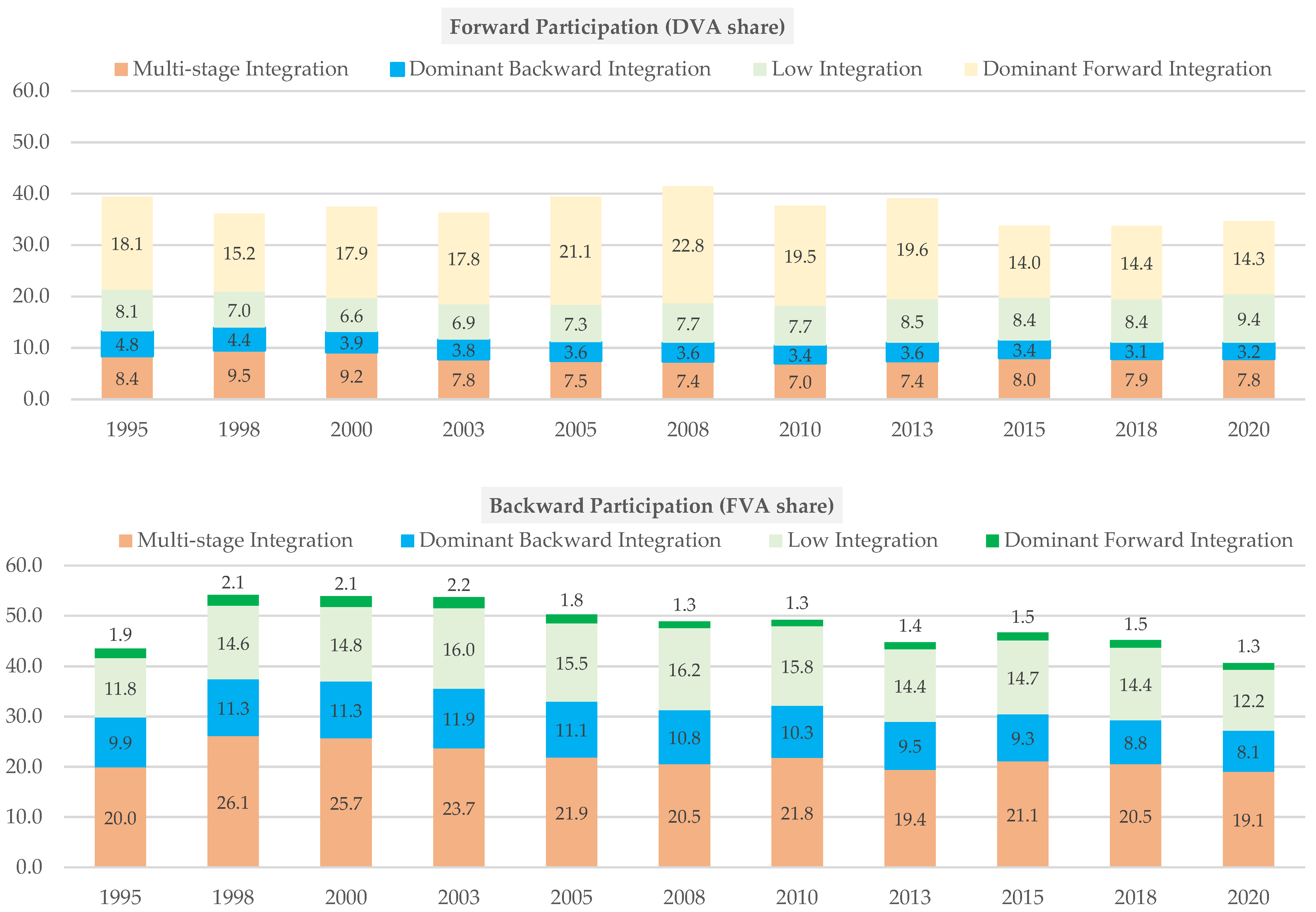
At the sectoral level, observed integration patterns correspond closely to the typology introduced in the methodology section: integration across multiple segments of the value chain, ranging from product design and development to input procurement and final assembly; dominant backward integration; dominant forward integration; and low integration, characterized by backward and forward participation shares persistently below global averages. A salient feature across these categories is the predominance of backward participation throughout the period, except for sectors classified under dominant forward integration (See
Figure 1).
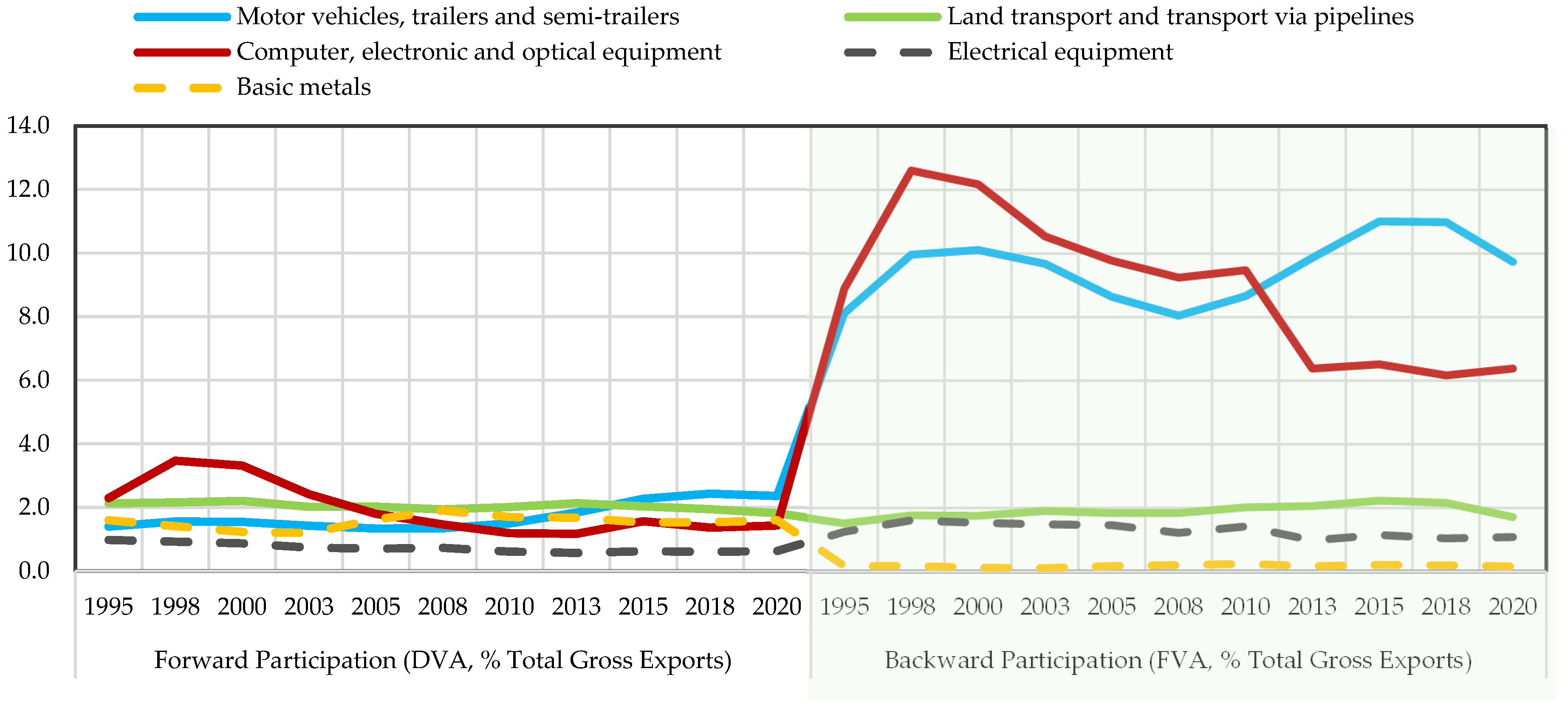
Integration across multiple GVCs segments averaged 8.0% in forward participation and 21.8% in backward participation over the period. This pattern is characteristic of activities such as motor vehicles, trailers, and semi-trailers; electronic, optical, and computer equipment; electrical equipment; basic metals; and land transportation services. These activities exhibit an intensive reliance on imported inputs, parts, and components for the processing and assembly of intermediate and/or final goods; however, they show marked heterogeneity in their backward and forward linkages. At one extreme, the automotive industry records the highest backward linkages, while basic metals manufacturing lies at the opposite end of the spectrum. In terms of forward linkages, land transportation services rank the highest, whereas electrical equipment manufacturing shows the weakest performance.
Within this category, the evolution of integration also diverges across activities. Motor vehicles, trailers, and semi-trailers show greater dynamism over time, whereas electronic, optical, and computer equipment—as well as electrical equipment—experience a relative slowdown in integration (See
Figure 2).
These findings underscore the central role of the automotive industry in Mexico’s integration into GVCs, both through auto-parts manufacturing and automobile assembly. What remains uncertain, however, is the extent to which this industry has been able to drive the development of related sectors and to promote the integration of domestic suppliers into these chains (
Hernández et al., 2014;
Pérez-Santillán & Arriaga Navarrete, 2024). Nevertheless, its importance for domestic production, exports, and formal employment is indisputable (
Chiquiar & Tobal, 2019). By contrast, this dynamism stands in sharp contrast to the trajectory of computer, electronic, and optical equipment manufacturing, whose contraction across production stages within GVCs has been associated with a strong dependence on imported inputs from China and other Asian economies (
García González & Márquez Mendoza, 2025). Even so,
De La Cruz et al. (
2013) document increases in the domestic content of Mexico’s exports linked to strengthened backward linkages.
Complementarily, the manufacturing-oriented profile of Mexico’s GVCs integration (
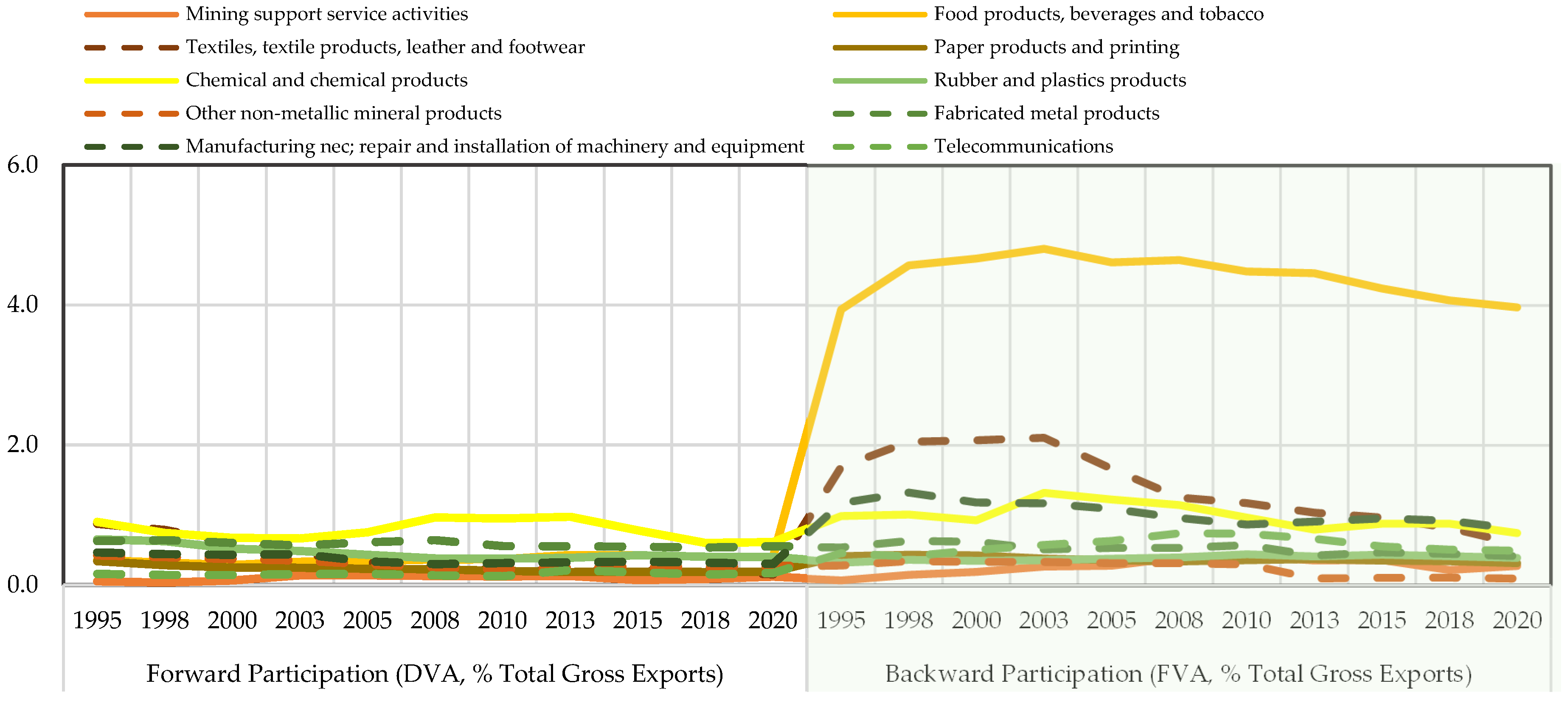
Pérez-Santillán & Arriaga Navarrete, 2024) is reflected in average participation rates of 10.2% in FVA and 3.7% in DVA. This group includes industries such as food, beverages, and tobacco; textiles, textile products, leather, and footwear; and chemicals and chemical products, among others. Support services for mining are also classified within this category (See
Figure 3). Finally, land transportation and telecommunications exhibit notable dynamism in their integration—across multiple segments and under dominant backward integration, respectively—given their role in providing logistical connectivity and communication services that link geographically dispersed firms. This highlights the importance of physical and digital infrastructure as a key determinant of participation in global markets (
Kaplinsky, 2000).
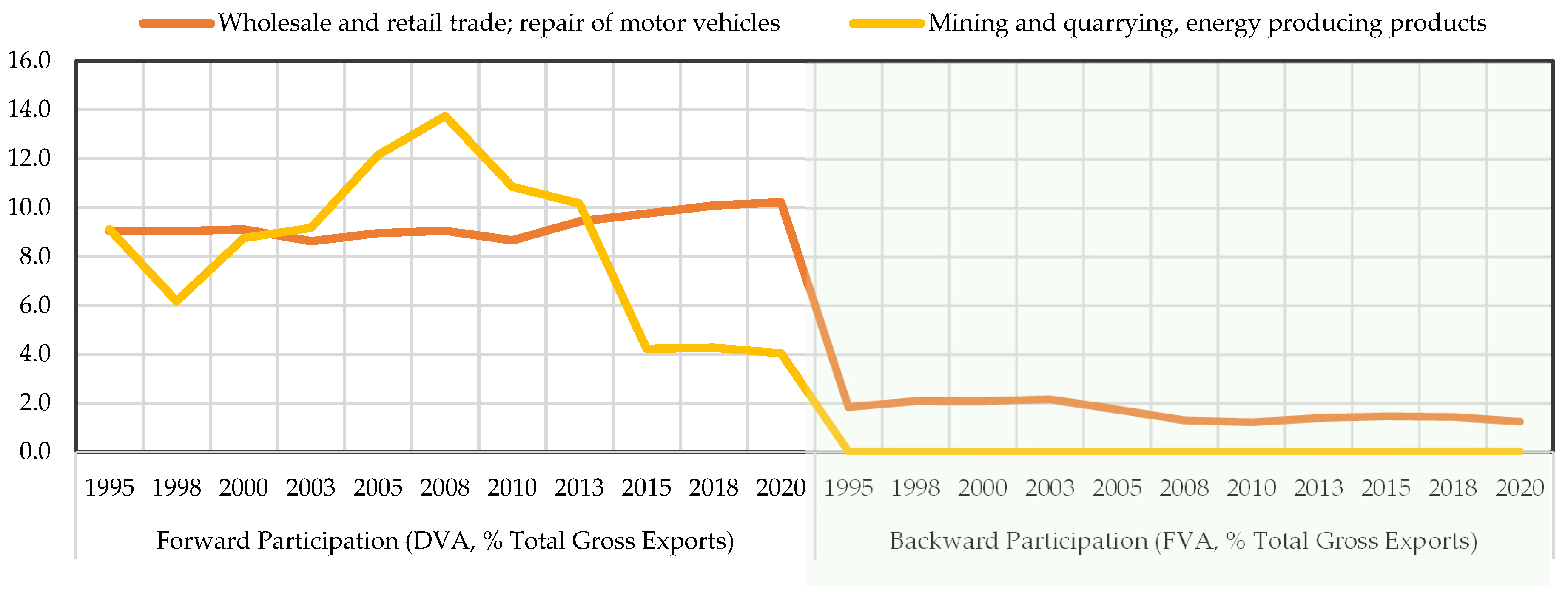
By contrast, dominant forward integration in GVCs characterizes sectors such as mining and quarrying, energy products, and trade, with average participation shares of 17.7% in DVA and 1.7% in FVA, respectively (See
Figure 4). Low levels of GVCs integration are observed in other activities, including agriculture, livestock, forestry, and fishing; administrative and support services; and non-energy mining and quarrying, among others. These sectors consistently remain below global averages in both forward and backward participation throughout the period analyzed. Detailed sectoral results for forward and backward participation by integration category are reported in the
Appendix A (See
Table A5 and
Table A6).
To what extent do the degree and type of sectoral integration into GVCs shape sectors’ roles in driving the national production structure over the period 1995–2020? Among sectors exhibiting the highest levels of multi-stage integration, three stand out as key: basic metals; computer, electronic, and optical equipment; and motor vehicles, trailers, and semi-trailers. The first two show high and relatively balanced weighted multipliers—strong backward and forward linkages—indicating both substantial demand for upstream inputs and a significant supply of intermediates to the rest of the economy. Within the same category, motor vehicles, trailers, and semi-trailers maintain persistently high backward linkages and, during the second half of the period, exceed the forward-linkage threshold, suggesting a convergence between backward and forward linkages (See
Table 4). Disaggregated results by integration category—by sector, year, and role within the Mexican production structure—are presented in the
Appendix A (See
Table A7).
Within the dominant backward integration category, multiplier spillover effects are prevalent, particularly in food and beverage processing; textiles, clothing, and footwear; paper and printing; plastics; non-metallic mineral products; and other manufacturing activities not classified elsewhere. Other sectors—such as chemicals and chemical products—appear as key in certain years; however, their forward linkages gradually deteriorate and weaken toward the end of the period. By contrast, within the dominant forward integration category, forward-oriented sectors include mining and quarrying, energy-producing products, and, most notably, wholesale and retail trade. These activities operate as systemic suppliers to the rest of the economy, yet generate relatively limited spillover effects into domestic production linkages.
Sectors classified as having low GVCs integration play heterogeneous roles in stimulating the national economy (See
Appendix A Table A7). First, coke and refined petroleum products serve as a key sector due to their cross-cutting role in production, despite relatively limited international integration. Second, machinery and other transport equipment show strategic backward-oriented effects on other sectors. Third, electricity, gas, steam, and air-conditioning supply, together with most private and public services, consolidate their role as drivers of the production structure throughout the period.
Overall, these findings are broadly consistent with
Boundi Chraki (
2016), underscoring the central role of manufacturing as an economic driver, the limited number of key sectors, and the predominance of non-key sectors—patterns that together indicate constrained productive diversification and persistent structural weaknesses.
Over the period 1995–2020, sectoral roles as drivers of growth exhibit a high degree of stability, with only limited episodes of upgrading or weakening observed in a small number of sectors. Sectors integrated across multiple GVCs segments remain classified as key. By contrast, the chemicals and chemical products sector experiences a reduction in forward linkages toward the end of the period, implying weaker multiplier effects through the supply of intermediates. Driving sectors maintain notable stability—particularly wholesale and retail trade and land transport and pipelines—the latter showing integration across multiple production stages within GVCs. There are also signs of strengthening among knowledge-intensive services (professional, scientific, and technical services; administrative and support services), mainly driven by increases in forward (driving) linkages rather than backward linkages. Meanwhile, non-key sectors remain largely unchanged—such as education, public administration, health, and personal services—consistent with their limited productive articulation with other sectors or their predominantly non-intermediate nature.
Although a small number of sectors cross classification thresholds—most notably Motor vehicles, trailers, and semi-trailers, and to a lesser extent coke and refined petroleum products and non-energy mining—these changes are not generalized across the production structure and do not alter the overall stability of sectoral hierarchies. Accordingly, the evidence supports a pattern of limited and non-systematic transitions rather than an absence of transitions.
In terms of scaling, the most significant case is motor vehicles, trailers, and semi-trailers. Its multiplier spillovers cross the relevant threshold from 2015 onward, positioning the sector as key and suggesting a broader diffusion of demand toward backward-integrated activities, including auto parts, metalworking, technical plastics, and specialized services. The electricity and gas sector also gains momentum from the early 2000s, reflecting its growing enabling role within the production structure. Information technology and other information services nearly reach the spillover threshold toward the end of the period, foreshadowing potential upgrading if local sourcing and linkages with manufacturing deepen. Coke and refined petroleum products temporarily strengthen their driving role during 2008–2013 and subsequently consolidate as key. Non-energy mining follows a similar trajectory, emerging as a driving sector during the 2010s.
Regarding forward linkages, fabricated metal products and paper and printing lose key status as their driving role declines from the early 2000s onward, remaining follower sectors characterized by high dependence on intermediate inputs but lower sales of intermediates to the rest of the economy. Textiles and footwear exhibit a comparable pattern, reinforcing the hypothesis that several traditional manufacturing activities preserved domestic supplier networks without expanding their role as cross-cutting suppliers.
Relating these sectoral changes to the integration categories reveals three distinct patterns. First, manufacturing activities integrated across multiple segments of GVCs—and some sectors classified under dominant backward integration—tend to be identified as key or to generate significant multiplier spillovers. The positioning of motor vehicles, trailers, and semi-trailers as a key sector confirms that, under multi-stage integration, the strengthening of domestic downstream linkages is feasible and can materialize within relatively short time spans. Second, sectors characterized by predominant forward integration sustain long-term driving roles within the production structure, reflecting strong spillovers into domestic intermediate demand but limited spillovers toward local suppliers; in such cases, raising multipliers would require import substitution strategies based on quality upgrading, standardization, and competition in services. Third, persistent functional imbalances in low-integration sectors (e.g., coke and refined petroleum products) coexist with their key role in the national economy, while predominantly backward-integrated sectors have not strengthened their momentum effects, suggesting the presence of downstream bottlenecks associated with limited local intermediate uses, insufficient standards and aggregation, or incomplete industrial clienteles.
In summary, the evidence points to a dual pattern in the Mexican economy. Manufacturing sectors that are strongly integrated across multiple GVCs links—and predominantly backward integrated—also maintain relatively strong productive ties with domestic structures, whereas energy-related activities and productive services contribute to the national economy mainly through systemic impulse linkages. These findings are consistent with
Murillo-Villanueva (
2020), who reports the coexistence of dual productive structures and the disarticulation of certain GVCs integrated sectors from those oriented toward domestic markets. Finally, instances of upgrading amid weakening integration suggest that sectors’ structural roles have been shaped by their functional insertion into GVCs. In this sense, the slow pace of sectoral change in the Mexican economy is consistent with the functional logic of its integration into GVCs throughout the period under analysis.
4. Conclusions
This study analyzed Mexico’s participation in GVCs based on international trade in value added over the period 1995–2020. A first finding is that multi-stage integration has been particularly relevant, both in terms of its contribution to domestic value added and its dynamism. However, this form of integration has remained highly concentrated in a limited number of sectors throughout the period, revealing one of the main structural constraints of Mexico’s integration into GVCs. A second key finding is that the sectoral dynamics of integration have not translated into a significant process of structural transformation; the dynamic roles of productive sectors within the domestic production structure show only limited variation over time, with few non-generalized cases of upgrading.
The results further suggest that high sectoral concentration and weak production linkages between manufacturing and service activities have constrained the potential for sustained expansion and structural change in the Mexican economy. This configuration has reproduced a dual productive structure: on the one hand, a modern export-oriented sector closely linked to transnational corporations through GVCs; on the other, a large set of activities oriented toward domestic demand with limited articulation to internationally integrated segments. The persistence of this duality during the outward-oriented growth phase largely reflects the disconnect between production segments that supply global markets and those driven by domestic demand.
These structural characteristics help explain both the limited impact of GVC integration on productive diversification and restructuring, and the high vulnerability of the Mexican economy to external shocks, given the weakness of domestic demand as a driver of growth. While these outcomes are shaped by multiple internal factors—including structural heterogeneity, capital scarcity, technological gaps, and uneven firm capabilities—the results highlight the central role played by the disarticulation between GVC-integrated and non-integrated sectors. From a value-added perspective, the analysis reveals circular patterns of external dependence, whereby imported inputs are used for export production and global demand largely determines both import and export volumes. In this sense, Mexico’s slow pace of structural transformation cannot be attributed solely to recurrent external shocks but is consistent with persistent gaps in industrial policy.
From a policy perspective, while the empirical results do not establish causal relationships, they point to differentiated structural patterns that are relevant for the design of industrial policy. In particular, the coexistence of multi-stage integration with relatively strong domestic linkages in a small number of sectors suggests that deeper forms of integration may be compatible with upgrading when backward and forward linkages are simultaneously strengthened. By contrast, sectors characterized by dominant backward integration display a strong dependence on imported intermediates, indicating the presence of downstream bottlenecks that limit the diffusion of GVC-related demand toward domestic suppliers. Finally, sectors with dominant forward integration tend to play a systemic role in the economy, providing inputs to a wide range of activities, yet with relatively limited spillovers toward domestic capability building. Taken together, these patterns highlight the importance of aligning industrial policy with the structural dynamics of GVC participation, ensuring that integration contributes to sustainable and inclusive economic upgrading.
Against this background, the findings are consistent with three broad industrial policy priorities: developing local suppliers through selective import substitution in activities with potential for strengthening domestic linkages; facilitating access to productive financing to support the expansion of domestic firms’ participation in GVCs, particularly in sectors exhibiting multi-stage integration; and investing in industrial, transport, and digital infrastructure to enhance coordination between manufacturing activities and business-intensive services. While integration into GVCs does not, by itself, guarantee sustained growth or structural transformation, the results suggest that targeted industrial policies aimed at reinforcing domestic linkages may enhance the capacity of GVC participation to generate higher domestic value added and reduce exposure to external shocks.
In short, beyond optimistic narratives about Mexico’s insertion into GVCs, the process has largely reflected the profit-maximization logic of multinational corporations, which control chain governance and often overlook the needs of the territories where industries are located. Major global realignments nevertheless open a window to rethink Mexico’s role in GVCs. In this context, the policy priorities discussed above—aimed at strengthening domestic linkages, expanding local supplier capabilities, improving access to productive financing, and investing in industrial and digital infrastructure—are consistent with both the empirical patterns identified in this study and with international experience (
Gereffi et al., 2005;
OECD, 2013;
World Bank, 2020). Together, these measures may enhance the capacity of GVC participation to generate higher domestic value and reduce exposure to external shocks.