



Investigating the Inflation–Output Nexus for the Euro Area: Old Questions and New Results

Abstract
1. Introduction
2. Literature Review
3. Methodology
4. Data and Empirical Results
5. Conclusions
Author Contributions
Funding
Informed Consent Statement
Data Availability Statement
Conflicts of Interest
| 1 | It is fair to say that part of the debate centres on the “optimal level of inflation”. We refrain from any attempt to summarise this debate in this paper. |
| 2 | It is worth mentioning already at this stage that a number of studies have attempted to investigate the same question by focusing on the welfare costs of inflation. For a recent study see, for instance, Andrade et al. (2019). See also ECB (2021) for a comprehensive summary of the considerations underlying the last ECB’s monetary policy strategy review. |
References
- Able, Stephen Lee. 1980. Inflation Uncertainty, Investment Spending, and Fiscal Policy. Economic Review 65: 3–13. [Google Scholar]
- Akerlof, George Arthur, William Thomas Dickens, George Lawrence Perry, Robert James Gordon, and Nicholas Gregory Mankiw. 1996. The Macroeconomics of Low Inflation. In Brookings Papers on Economic Activity. Baltimore: The Johns Hopkins University Press, vol. 1, pp. 1–76. [Google Scholar]
- Akerlof, George Arthur, William Thomas Dickens, George Lawrence Perry, Truman Fassett Bewley, and Alan Stuart Blinder. 2000. Near-Rational Wage and Price Setting and the Long-Run Phillips Curve. In Brookings Papers on Economic Activity. Baltimore: The Johns Hopkins University Press, vol. 2000, pp. 1–60. [Google Scholar]
- Akgül, Isil, and Selin Özdemir. 2012. Inflation Threshold and the Effects on Economic Growth. İktisat İşletme ve Finans Dergisi 27: 85–106. [Google Scholar]
- Andrade, Phillipe, Jordí Gali, Hervé Le Bihan, and Julien Matheron. 2019. The Optimal Inflation Target and the Natural Rate of Interest. In Brookings Papers on Economic Activity. Baltimore: The Johns Hopkins University Press, pp. 173–255. [Google Scholar]
- Aydin, Celil, and Fatma Gundogdu Odabasioglu. 2017. Financial Development and Economic Growth: The Case of Turkey and Romania. International Journal of Academic Research in Business and Social Sciences 7: 23–38. [Google Scholar] [CrossRef] [PubMed]
- Baghli, Mustapha, Christophe Cahn, and Henri Fraisse. 2006. Is the Inflation-Output Nexus Asymmetric in the Euro Area? Economics Letters 94: 1–6. [Google Scholar] [CrossRef]
- Bai, Jushan, and Pierre Perron. 1998. Estimating and Testing Linear Models with Multiple Structural Changes. Econometrica 66: 47–78. [Google Scholar] [CrossRef]
- Bai, Jushan, and Pierre Perron. 2003. Computation and Analysis of Multiple Structural Change Models. Journal of Applied Econometrics 18: 1–22. [Google Scholar] [CrossRef]
- Ball, Laurence. 2014. The Case for a Long-Run Inflation Target of Four Percent. IMF Working Paper, WP/14/92. Washington, DC: International Monetary Fund. [Google Scholar]
- Blanchard, Olivier Jean, Giovanni Dell Ariccia, and Paolo Mauro. 2010. Rethinking Macroeconomic Policy. Revista de Economia Institucional 12: 61–82. [Google Scholar]
- Brand, Claus, Hans-Eggert Reimers, and Franz Seitz. 2003. Forecasting Real GDP: What Role for Narrow Money? ECB Working Paper, No. 254. Frankfurt am Main: European Central Bank. [Google Scholar]
- Christopoulos, Demetres, Peter McAdam, and Elias Tzavalis. 2019. Exploring Okun’s Law Asymmetry: An Endogenous Threshold LSTR Approach. ECB Working Paper, No. 2345. Frankfurt am Main: European Central Bank. [Google Scholar]
- Dholakia, Ravindra Harshadrai. 2020. A Theory of Growth and Threshold Inflation with Estimates. Journal of Quantitative Economics 18: 471–93. [Google Scholar] [CrossRef]
- Dholakia, Ravindra Harshadrai, Jai Chander, Ipsita Pratap, and Bhanu Padhi. 2021. Threshold Level of Inflation—Concept and Measurement. Study No. 45. Reserve Bank of India. Mumbai: Department Economic and Policy. [Google Scholar]
- Ekinci, Ramazan, Osman Tüzün, and Fatih Ceylan. 2020. The Relationship Between Inflation and Economic Growth: Experiences of some Inflation Targeting Countries. Financial Studies 24: 6–20. [Google Scholar]
- European Central Bank. 1998. Introductory Statement. October 13. Available online: http//www.ecb.int (accessed on 6 October 2023).
- European Central Bank. 2003. The ECB’s Monetary Policy Strategy. May 8. Available online: http//www.ecb.int (accessed on 6 October 2023).
- European Central Bank. 2021. The ECB’s Price Stability Framework: Past Experience and Current and Future Challenges. Workstream on the Price Stability Objective, ECB Occasional Paper, No. 269. September. Frankfurt am Main: European Central Bank. [Google Scholar]
- Fischer, Stanley. 1991. Growth, Macroeconomics, and Development. NBER Working Paper, No. 3702. Cambridge, MA: NBER. [Google Scholar]
- Fischer, Stanley. 1993. The Role of Macroeconomic Factors in Growth. NBER Working Paper, No. 4565. Cambridge, MA: NBER. [Google Scholar]
- Friedman, Milton. 1977. Nobel Lecture: Inflation and Unemployment. Journal of Political Economy 85: 451–72. [Google Scholar] [CrossRef]
- Gerdesmeier, Dieter, Andreja Lenarcic, and Barbara Roffia. 2012. An Alternative Method for Identifying Booms and Busts in the Euro Area Housing Market. ECB Working Paper, No. 1493. Frankfurt am Main: European Central Bank. [Google Scholar]
- Granger, Clive William John. 2001. Overview of Nonlinear Macroeconometric Empirical Models. In Macroeconomic Dynamics. Cambridge: Cambridge University Press, vol. 5, pp. 466–81. [Google Scholar]
- Granger, Clive William John, and Timo Teräsvirta. 1993. Modelling Nonlinear Economic Relationships. Oxford: Oxford University Press. [Google Scholar]
- Hansen, Bruce. 1992. Testing for Parameter Instability in Linear Models. Journal of Policy Modeling 14: 517–33. [Google Scholar] [CrossRef]
- Hansen, Bruce. 2000. Sample Splitting and Threshold Estimation. Econometrica 68: 575–604. [Google Scholar] [CrossRef]
- Hasanov, Fakhri. 2011. Relationship Between Inflation and Economic Growth in Azerbaijani Economy: Is There Any Threshold Effect? Asian Journal of Business and Management Sciences 1: 1–11. [Google Scholar]
- Haslag, Joseph H. 1995. Inflation and Intermediation in a Model with Endogenous Growth. Working Paper, No. 9502. Dallas: Federal Reserve Bank of Dallas. [Google Scholar]
- Haslag, Joseph H. 1997. Output, Growth, Welfare, and Inflation: A Survey. Dallas: Economic Review of the Federal Reserve Bank of Dallas, pp. 11–21. [Google Scholar]
- Hubrich, Kirstin, and Timo Teräsvirta. 2013. Thresholds and Smooth Transitions in Vector Autoregressive Models. Advances in Econometrics. Bingley: Emerald Group Publishing Limited, vol. 32, pp. 273–326. [Google Scholar]
- Kelikume, Ikechukwu. 2018. An Estimation of Inflation Threshold for Africa. International Journal of Management, Economics and Social Sciences (IJMESS) 7: 283–300. [Google Scholar] [CrossRef]
- Khan, Mohsin S., and Abdelhak S. Senhadji. 2001. Threshold Effects in the Relationship between Inflation and Growth. IMF Staff Papers 48: 1–21. [Google Scholar] [CrossRef]
- Kremer, Stephanie, Alexander Bick, and Dieter Nautz. 2013. Inflation and Growth: New Evidence from a Dynamic Panel Threshold Analysis. Empirical Economics 44: 861–78. [Google Scholar] [CrossRef]
- Li, Bo-wen, Yun-qui Zhang, and Nian-shen Tang. 2020. Robust Variable Selection and Estimation in Threshold Regression Model. Acta Mathematicae Applicatae Sinica (English Series) 36: 332–46. [Google Scholar] [CrossRef]
- Luetkepohl, Helmut, and Aleksei Netsunajev. 2017. Structural Vector Autoregressions with Smooth Transition in Variances. Journal of Economic Dynamics & Control 84: 43–57. [Google Scholar]
- Luukkonen, Ritva, Pentti Saikkonen, and Timo Teräsvirta. 1988. Testing Linearity against Smooth Transition Autoregressive Models. In Biometrika. Oxford: Oxford University Press, vol. 75, pp. 491–99. [Google Scholar]
- Mubarik, Yasir Ali. 2005. Inflation and Growth: An Estimate of the Threshold Level of Inflation in Pakistan. SBP-Research Bulletin 1: 35–44. [Google Scholar]
- Mundell, Robert. 1963. Inflation and Real Interest. Journal of Political Economy 71: 280–83. [Google Scholar] [CrossRef]
- Munir, Quaiser, Kasim Mansur, and Fumitaka Furuoka. 2009. Inflation and Economic Growth in Malaysia: A Threshold Regression Approach. ASEAN Economic Bulletin 26: 180–93. [Google Scholar] [CrossRef]
- Nasir, Iqbal, and Nawaz Saima. 2010. Investment, Inflation and Economic Growth Nexus. The Pakistan Development Review 48: 863–74. [Google Scholar]
- Nepal Rastra Bank. 2017. Optimal Inflation Rate for Nepal. NRB Working Paper, No. 39. Kathmandu: Nepal Rastra Bank. [Google Scholar]
- Nickel, Christiane, Elena Bobeica, Gerrit Koester, Eliza Lis, and Mario Porqueddu. 2019. Understanding Low Wage Growth in the Euro Area and European Countries. Occasional Paper, No. 232. Frankfurt am Main: European Central Bank. [Google Scholar]
- Omay, Tolga, and Elif Oeznur Kan. 2010. Re-Examining the Threshold Effects in the Inflation Growth Nexus with Cross-Sectionally Dependent Non-Linear Panel: Evidence from Six Industrialized Economies. EconModel 27: 996–1005. [Google Scholar]
- Passamani, Giuliana, Alessandro Sordone, and Roberto Tamborini. 2022. Inflation Puzzles, the Phillips Curve and Output Expectations: New Perspectives from the Euro Zone. Empirica 49: 123–53. [Google Scholar] [CrossRef]
- Reichold, Karsten, Martin Wagner, Milan Damjanovic, and Marija Drenkovska. 2022. Sources and Channels of Nonlinearities and Instabilities of the Phillips Curve: Results for the Euro Area and its Member States. IHS Working Paper, No. 40. Wien: IHS. [Google Scholar]
- Sarel, Michael. 1996. Nonlinear Effects of Inflation on Economic Growth. IMF Staff Papers 3: 199–215. [Google Scholar] [CrossRef]
- Sims, Christopher Albert. 1980. Macroeconomics and Reality. Econometrica 48: 1–48. [Google Scholar] [CrossRef]
- Stockman, Alan C. 1981. Anticipated inflation and the Capital Stock in a Cash-in-Advance Economy. Journal of Monetary Economics 8: 387–93. [Google Scholar] [CrossRef]
- Teräsvirta, Timo. 1994a. Specification, Estimation and Evaluation of Smooth Transition Autoregressive Models. Journal of American Statistical Association 89: 208–18. [Google Scholar]
- Teräsvirta, Timo. 1994b. Testing Linearity and Modelling Nonlinear Time Series. Kybernetika 30: 319–33. [Google Scholar]
- Thanh, Su Dinh. 2015. Threshold Effects of Inflation on Growth in the ASEAN-5 Countries: A Panel Smooth Transition Regression Approach. Journal of Economics, Finance and Administrative Science 20: 41–48. [Google Scholar] [CrossRef]
- Tobin, James. 1965. Money and Economic Growth. Econometrica 33: 671–84. [Google Scholar] [CrossRef]
- Tobin, James. 1972. Inflation and Unemployment. American Economic Review 62: 1–18. [Google Scholar]
- Tsionas, Efthymios G., and Dimitris K. Christopoulos. 2003. Maastricht Convergence and Real Convergence: European Evidence from Threshold and Smooth Transition Regression Models. Journal of Policy Modeling 25: 43–52. [Google Scholar] [CrossRef]
- Tung, Le Thanh, and Pham Tien Thanh. 2015. Threshold in the Relationship between Inflation and Economic Growth: Empirical Evidence in Vietnam. Asian Social Science 11: 105–12. [Google Scholar] [CrossRef]
- van Dijk, Dick, Timo Teräsvirta, and Philip Hans Franses. 2002. Smooth Transition Autoregressive Models—A Survey of Recent Developments. Econometric Reviews 21: 1–47. [Google Scholar] [CrossRef]
- Vinayagathasan, Thanabalasingam. 2013. Inflation and Economic Growth: A Dynamic Panel Threshold Analysis for Asian Economies. Journal of Asian Economics 26: 31–41. [Google Scholar] [CrossRef]
- Wang, Rudan, Bruce Morley, and Michalis P. Stamatogiannis. 2019. Forecasting the Exchange Rate using Nonlinear Taylor Rule Based Models. International Journal of Forecasting 35: 429–42. [Google Scholar] [CrossRef]
- Zeileis, Achim, Christian Kleiber, Walter Kraemer, and Kurt Hornik. 2003. Testing and Dating of Structural Changes in Practice. Computational Statistics & Data Analysis 44: 109–23. [Google Scholar]

| Authors | Period | Sample | Threshold Value |
|---|---|---|---|
| Sarel (1996) | 1970–1990 | 90 countries | 8% |
| Khan and Senhadji (2001) | 1960–1998 | 140 countries | 3% developed countries, 12% developing countries, 9% all countries |
| Mubarik (2005) | 1973–2000 | Pakistan | 9% |
| Munir et al. (2009) | 1970–2005 | Malaysia | 3.89% |
| Hasanov (2011) | 2001–2009 | Azerbaijan | 13% |
| Akgül and Özdemir (2012) | 2003.01–2009.12 | Turkey | 1.26% |
| Kremer et al. (2013) | 1950–2004 | 124 countries | 2.53% for industrialized countries, 17.23% for non-industrialized countries |
| Omay and Kan (2010) | 1972–2005 | 6 developed countries | 2.52% |
| Nasir and Saima (2010) | 1961–2008 | Pakistan | Two thresholds (6% and 11%) |
| Vinayagathasan (2013) | 1980–2009 | 32 Asian countries | 5.43% |
| Tung and Thanh (2015) | 1986–2013 | Vietnam | 7% |
| Thanh (2015) | 1980–2011 | Vietnam, Indonesia, Malaysia, Philippines, Thailand | 7.84% |
| Aydin and Odabasioglu (2017) | 1992–2013 | Azerbaijan, Kyrgyzstan, Kazakhstan, Uzbekistan, Turkmenistan | 7.97% |
| Nepal Rastra Bank (2017) | 1978–2016 | Nepal | 6.25–6.40% depending on the estimation method |
| Dholakia et al. (2021) | 1995–2018 | 58 countries | 11% for the full sample, 4.1% for advanced economies, 24.8% for emerging economies |
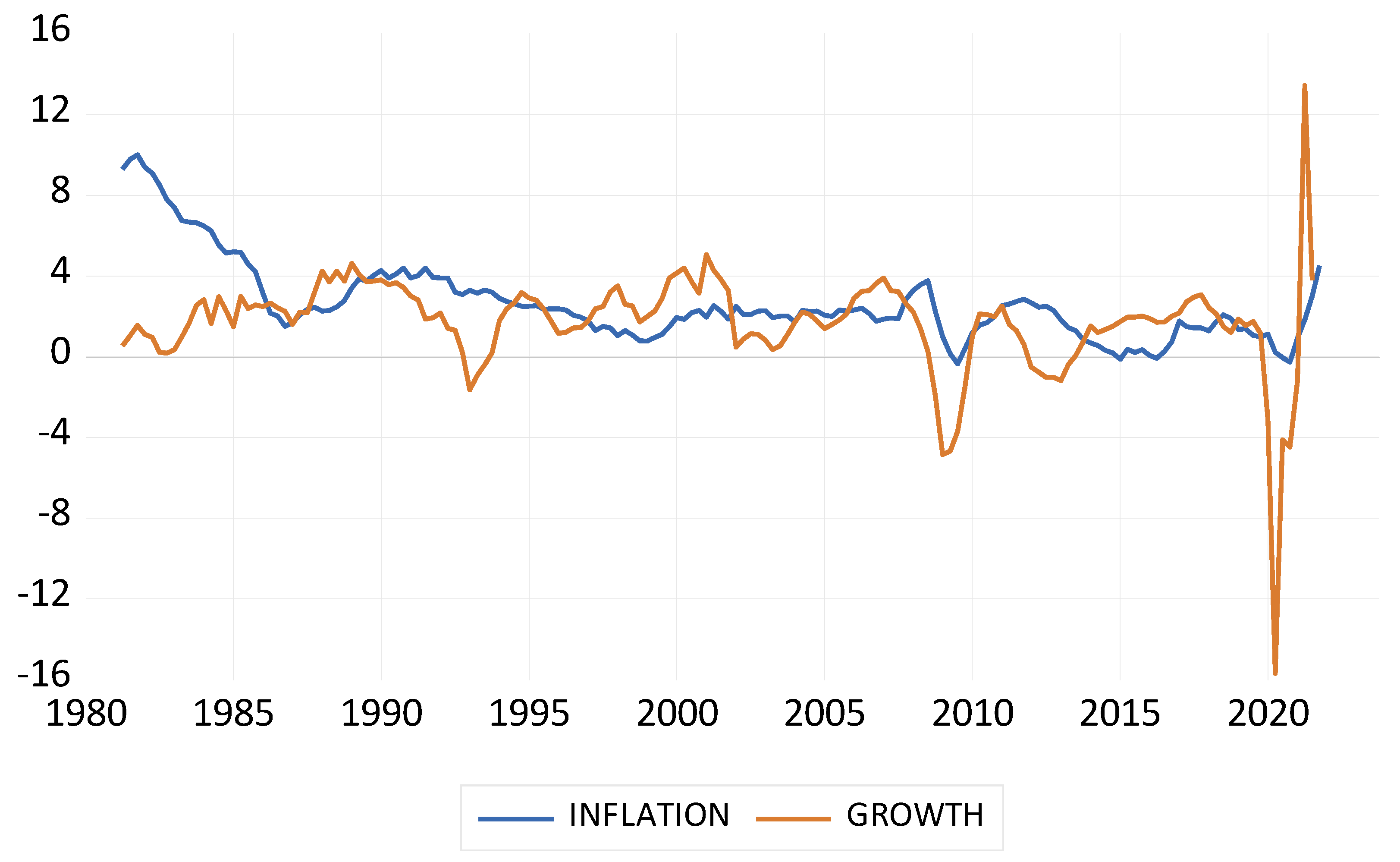
| Variable | Inflation | Real GDP Growth |
|---|---|---|
| Mean | 2.74 | 1.74 |
| Median | 2.25 | 1.96 |
| Maximum | 10.00 | 13.44 |
| Minimum | −0.37 | −15.71 |
| Std. Dev. | 2.16 | 2.42 |
| Skewness | 1.57 | −2.08 |
| Kurtosis | 5.40 | 21.30 |
| α | β | δ | γi | Threshold | Wald-Test | |
|---|---|---|---|---|---|---|
| Equation (11) | ||||||
| Regime 1 | −1.47 (0.01) | 2.62 (0.00) | (-) | (-) | ||
| Regime 2 | 2.18 (0.00) | −0.04 (0.67) | (-) | (-) | 1.91 | 33.8 (0.00) |
| Equation (12) | ||||||
| Regime 1 | −1.49 (0.01) | 2.44 (0.00) | −0.10 (0.08) | (-) | ||
| Regime 2 | 0.83 (0.31) | 0.38 (0.16) | −0.01 (0.87) | (-) | 1.99 | 2.93 (0.09) |
| Equation (13) | ||||||
| Regime 1 | 1.49 (0.09) | 0.09 (0.94) | 0.08 (0.00) | |||
| Regime 2 | 2.30 (0.00) | −0.10 (0.22) | 0.02 (0.01) | 1.03 | 3.39 (0.07) | |
| Equation (14) | ||||||
| Regime 1 | −4.26 (0.00) | 2.42 (0.00) | 0.45 (0.00) | |||
| Regime 2 | 0.21 (0.55) | 0.23 (0.08) | 0.29 (0.00) | 1.91 | 8.25 (0.00) | |
| Equation (15) | ||||||
| Regime 1 | −3.33 (0.00) | 1.85 (0.03) | 1.78 (0.00) | |||
| Regime 2 | 2.70 (0.00) | −0.12 (0.22) | −0.16 (0.35) | 1.27 | 0.80 (0.37) |
| Equation | F-Statistic | LR-Ratio |
|---|---|---|
| (11) | 12.94 (0.00) | 24.61 (0.00) |
| (12) | 4.85 (0.01) | 9.73 (0.01) |
| (13) | 0.19 (0.82) | 0.40 (0.82) |
| (14) | 9.73 (0.00) | 18.93 (0.00) |
| (15) | 28.07 (0.00) | 49.69 (0.00) |
| (a) | |||||
|---|---|---|---|---|---|
| Equation | (11) | (12) | (13) | (14) | (15) |
| Linear part | Coefficient | Coefficient | Coefficient | Coefficient | Coefficient |
| α | −0.81 (0.16) | −3.77 (0.00) | −0.66 (0.19) | −3.19 (0.00) | −1.21 (0.04) |
| β | 0.31 (0.02) | 2.44 (0.00) | 0.27 (0.02) | 0.65 (0.00) | 0.36 (0.00) |
| Non-linear part | Coefficient | Coefficient | Coefficient | Coefficient | Coefficient |
| α | 4.87 (0.00) | 5.65 (0.00) | 4.82 (0.00) | 4.57 (0.00) | 4.76 (0.00) |
| β | −0.47 (0.07) | −2.25 (0.00) | −0.65 (0.01) | −0.43 (0.21) | −0.46 (0.06) |
| Non-threshold | Coefficient | Coefficient | Coefficient | Coefficient | Coefficient |
| δ | −0.01 (0.98) | ||||
| γ1 | (-) | (-) | 0.03 (0.00) | ||
| γ2 | 0.33 (0.00) | ||||
| γ3 | 0.28 (0.08) | ||||
| Slope | 0.93 (0.04) | 1.08 (0.87) | 2.17 (0.03) | 1.37 (0.06) | 1.75 (0.05) |
| Threshold | 2.00 (0.00) | 1.20 (0.00) | 1.86 (0.00) | 1.94 (0.00) | 1.99 (0.00) |
| (b) | |||||
| Linear part | Coefficient | Coefficient | Coefficient | Coefficient | Coefficient |
| α | −0.81 (0.16) | (n.a.) | −0.61 (0.22) | −3.13 (0.00) | −1.17 (0.05) |
| β | 0.31 (0.02) | (n.a.) | 0.26 (0.02) | 0.64 (0.00) | 0.36 (0.00) |
| Non-linear part | Coefficient | Coefficient | Coefficient | Coefficient | Coefficient |
| α | 4.87 (0.00) | (n.a.) | 4.70 (0.00) | 4.45 (0.00) | 4.79 (0.00) |
| β | −0.47 (0.07) | (n.a.) | −0.63 (0.00) | −0.41 (0.21) | −0.47 (0.06) |
| Non-threshold | Coefficient | Coefficient | Coefficient | Coefficient | Coefficient |
| δ | |||||
| γ1 | (-) | (n.a.) | 0.03 (0.00) | ||
| γ2 | 0.33 (0.00) | ||||
| γ3 | 0.28 (0.08) | ||||
| Slope | 0.93 (0.04) | (n.a.) | 1.38 (0.02) | 0.86 (0.04) | 1.02 (0.03) |
| Threshold | 2.01 (0.00) | (n.a.) | 1.87 (0.00) | 1.95 (0.00) | 2.04 (0.00) |
Disclaimer/Publisher’s Note: The statements, opinions and data contained in all publications are solely those of the individual author(s) and contributor(s) and not of MDPI and/or the editor(s). MDPI and/or the editor(s) disclaim responsibility for any injury to people or property resulting from any ideas, methods, instructions or products referred to in the content. |
© 2023 by the authors. Licensee MDPI, Basel, Switzerland. This article is an open access article distributed under the terms and conditions of the Creative Commons Attribution (CC BY) license (https://creativecommons.org/licenses/by/4.0/).
Share and Cite
Reimers, H.-E.; Gerdesmeier, D.; Roffia, B. Investigating the Inflation–Output Nexus for the Euro Area: Old Questions and New Results. Economies 2023, 11, 265. https://doi.org/10.3390/economies11110265
Reimers H-E, Gerdesmeier D, Roffia B. Investigating the Inflation–Output Nexus for the Euro Area: Old Questions and New Results. Economies. 2023; 11(11):265. https://doi.org/10.3390/economies11110265
Chicago/Turabian StyleReimers, Hans-Eggert, Dieter Gerdesmeier, and Barbara Roffia. 2023. "Investigating the Inflation–Output Nexus for the Euro Area: Old Questions and New Results" Economies 11, no. 11: 265. https://doi.org/10.3390/economies11110265
APA StyleReimers, H.-E., Gerdesmeier, D., & Roffia, B. (2023). Investigating the Inflation–Output Nexus for the Euro Area: Old Questions and New Results. Economies, 11(11), 265. https://doi.org/10.3390/economies11110265

