1. Introduction
The deployment and evolution of next-generation wireless networks (BSG/6G) critically hinge on high-precision sensing and exploitation of the radio environment. Radio maps—representations that characterize the spatio-temporal—spectral distribution of the power spectral density (PSD)—provide indispensable environmental awareness for network planning, dynamic spectrum access, resource allocation, and unmanned aerial vehicle (UAV) path planning [
1,
2]. Reconstructing high-resolution radio maps that faithfully capture the intricate three-dimensional (3D) characteristics of real-world scenes, however, remains a formidable challenge when only sparse sensor measurements are available.
Model-driven approaches conventionally operate on 2-D planes or invoke strongly simplified 3D terrain abstractions, e.g., assuming a uniform path-loss exponent. These methods rely heavily on empirical propagation models such as the log-distance path-loss model [
3]. Their principal limitation is the inability to account for the heterogeneous geometric and material attributes of fine-grained 3D terrain. For instance, signal attenuation through foliage differs fundamentally from that through reinforced-concrete structures; yet traditional models subsume such distinctions into coarse parameters, yielding marked accuracy degradation in topographically complex urban or mountainous regions [
4].
Conversely, recent data-driven paradigms leverage machine learning techniques (e.g., CNNs [
5], GANs [
6]) to learn propagation characteristics directly from data, circumventing explicit modeling. Their efficacy, however, is tightly coupled with the quantity and quality of training data. Models trained in one geographic domain exhibit limited generalizability when deployed in regions with markedly different terrain features, thereby constraining practical applicability. Moreover, the data volume required to span high-fidelity 3D scenes—whether via simulation or in situ acquisition—becomes prohibitive, rendering both training and inference computationally infeasible under real-time constraints.
To transcend these bottlenecks, we posit that high-precision 3D scene models are essential. Recent advances in oblique photogrammetry enable the automated generation of centimeter-resolution 3D meshes that accurately capture architectural facades, windows, and tree canopies [
7]. Integrating such detailed 3D data into radio-map reconstruction promises a qualitative leap in fidelity. Yet the sheer granularity of these meshes induces exponential data growth, rendering conventional physics-based simulations (e.g., ray tracing) computationally prohibitive and incompatible with rapid reconstruction.
Addressing this tension, we propose HiFiRadio, a hybrid model- and data-driven radio-map reconstruction framework tailored to high-fidelity 3D scenes. Rather than sacrificing fidelity for tractability, HiFiRadio attacks the computational bottleneck through intelligent data organization and management. Specifically, the framework introduces a spatial data-indexing structure (R-tree) to efficiently store, query, and manipulate massive oblique-photogrammetry meshes. Fine-grained semantic segmentation further differentiates objects—e.g., penetrable vegetation versus impenetrable buildings—enabling physics-aware propagation modeling while achieving orders-of-magnitude acceleration.
Our principal contributions are as follows:
HiFiRadio framework: We present a radio-map reconstruction architecture that synergistically integrates classical propagation models with high-performance 3D spatial indexing. By exploiting the precision gains of detailed terrain data while leveraging spatial indexing for rapid query and computation, the framework achieves extremely high efficiency.
Fine-Grained Semantic 3D Indexing: We devise an R-tree-based indexing scheme for 3D meshes augmented with per-object semantic labels. This segmentation distinguishes between penetrable (vegetation) and impenetrable (buildings) entities, supplying the propagation engine with physically grounded priors.
Semantic-Aware Radio-Map Computation: Guided by the semantic index, the framework dynamically assigns path-loss models to individual segments of the propagation path. Vegetation attenuation models are invoked for foliage, whereas rigorous wall-penetration loss models are applied for building materials, yielding markedly more accurate aggregate path-loss estimates.
Comprehensive Experimental Validation: Using ray-tracing simulations grounded in real-world 3D environments, we benchmark HiFiRadio against leading model- and data-driven baselines, demonstrating superior performance. Furthermore, in situ RF measurements collected at the corresponding physical sites corroborate the framework’s operational reliability and efficacy.
3. Methodology
In complex 3D urban environments, intricate topographic and morphologic features exert a decisive influence on radio-wave propagation. Empirical models that parameterize these terrain characteristics inevitably yield coarse approximations and are therefore inadequate for high-precision electromagnetic situation assessment. By leveraging oblique photogrammetry-based 3D modeling, we treat the acquired city-scale geometry not merely as a visualization backdrop, but as a primary input to the construction of the electromagnetic spectrum map.
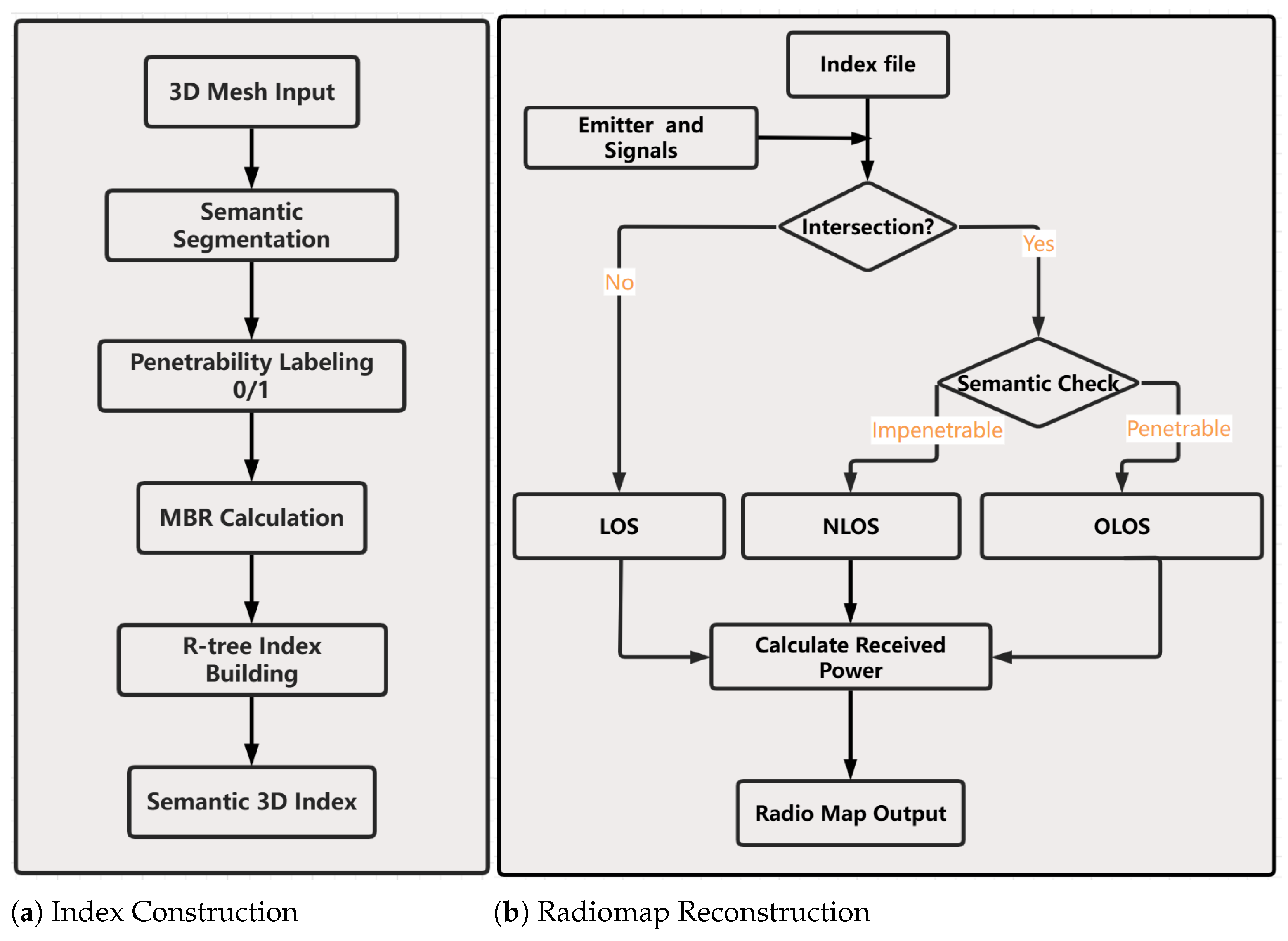
Within this framework in
Figure 1, the high-fidelity 3D mesh is first processed through semantic segmentation to classify each triangular face into categories (e.g., ’building’, ’vegetation’). These labels are then binarized into a penetrability attribute (impenetrable vs. penetrable), thereby enriching the raw geometry with electromagnetic semantics. This semantically enriched mesh is subsequently organized into a specialized 3D R-tree index, which efficiently manages the massive dataset and enables real-time spatial queries coupled with physical properties.
This semantic-enhanced index serves as the computational backbone for our rapid path-category classification algorithm. For any signal trajectory between a transmitter and a receiver, the framework queries the index to identify all intersecting obstacles and analyzes their penetrability attributes. Based on this, it decomposes the path into one of three mutually exclusive classes: line-of-sight (LOS), non-line-of-sight (NLOS), and obstructed line-of-sight (OLOS). Each identified propagation class is subsequently associated with a dedicated, physics-grounded channel model for path-loss prediction, thereby enabling the accurate and efficient generation of electromagnetic spectrum maps in realistic 3D urban settings.
3.1. Semantic-Enhanced 3D R-Tree Indexing
The foundation of our framework is a high-fidelity 3D mesh model of the environment, typically obtained through oblique photogrammetry. These models, often stored in formats like OBJ or PLY, offer centimeter-level geometric detail, accurately capturing features such as building facades, windows, and vegetation canopies, which are crucial for precise propagation modeling. However, the raw geometric detail alone is insufficient, as different materials exhibit vastly different electromagnetic properties. For instance, the penetration loss through vegetation, while non-negligible, is typically significantly lower (e.g., 10 dB) than through reinforced concrete structures (e.g., 20 dB). Ignoring this distinction leads to substantial errors in path-loss estimation.
To incorporate this physical prior, we first perform semantic segmentation on the input 3D mesh. We employ the MeshCNN [
21] model, which is pre-trained on the ShapeNet dataset and fine-tuned on a custom dataset of urban oblique photogrammetry meshes labeled with ‘building’, ‘vegetation’, ‘ground’, and ‘other’ categories. The training set comprises 50 urban scenes with over 10 million labeled triangles. The model achieves an overall segmentation accuracy of 92.3% and per-class IoU of 89.1% for ‘building’ and 85.7% for ‘vegetation’ on our validation set. Although misclassification (e.g., labeling a glass facade as vegetation) could affect path loss estimation, our experiments in
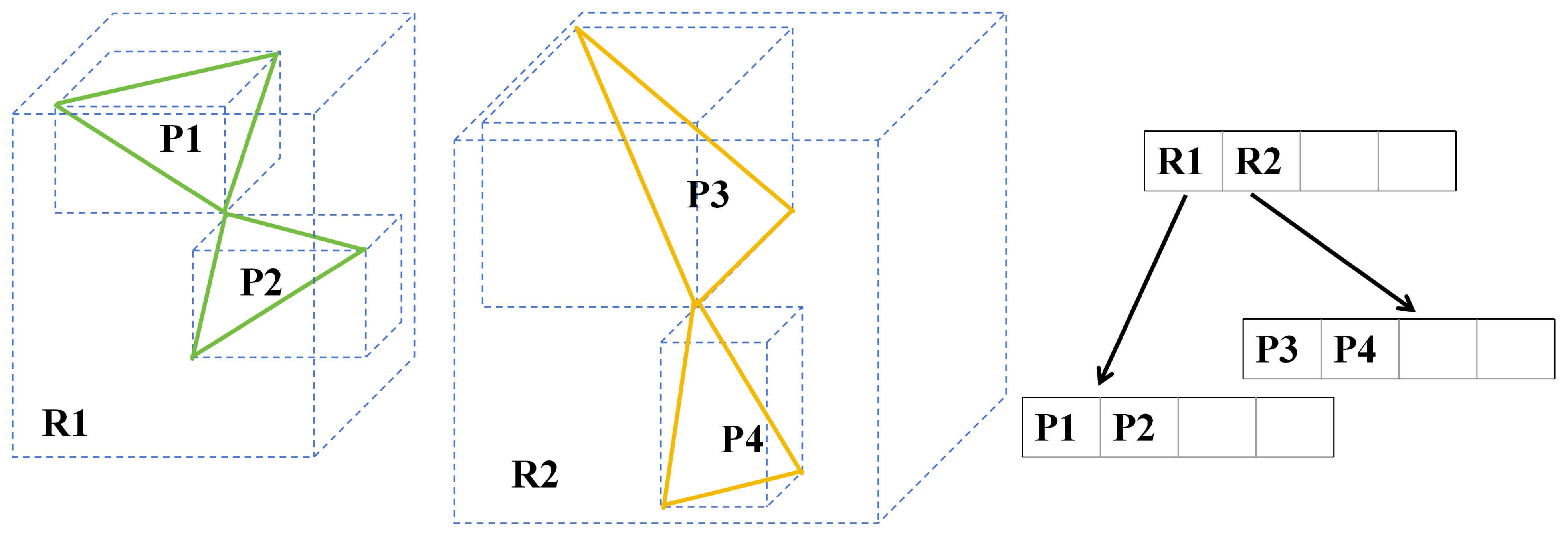
Section 4.5 demonstrate that the framework covers robust-to-moderate segmentation errors, with an average RMSE increase of less than 1.2 dB under simulated label noise of 10%. This preprocessing step classifies each triangular face in the mesh into categories such as ‘building’, ‘vegetation’, ‘ground’, etc. For the core purpose of propagation path classification and loss calculation, these labels are subsequently binarized into a penetrability attribute: impenetrable (e.g., buildings, terrain, encoded as ‘0’) and penetrable (e.g., foliage, encoded as ‘1’). As shown in
Figure 2, the green triangles are assigned an attribute of 1 (representing vegetation), while the yellow triangles are assigned an attribute of 0 (representing buildings). This binary classification provides a critical physically grounded prior for the propagation engine.
Managing and performing efficient spatial queries on the resulting massive, semantically enriched mesh (containing often hundreds of millions of triangles) is computationally challenging. To overcome this, we design a semantic-enhanced 3D R-tree spatial index. The core idea is to hierarchically organize the numerous triangular faces using their Minimum Bounding Rectangles (MBRs), enabling efficient range queries and nearest-neighbor searches necessary for ray-path analysis.
The construction algorithm for our Semantic R-Tree is as follows:
Input Preparation: For each triangular face i in the semantically segmented mesh, we form a data entry . Here, is the 3D axis-aligned bounding box enclosing the triangle, computed from the minimum and maximum x, y, and z coordinates of its three vertices. is a compact data structure storing the triangle’s vertex coordinates and its binary penetrability attribute.
Leaf Node Formation: The algorithm starts by grouping a predefined number M (e.g., ) of these data entries into leaf nodes. The MBR of a leaf node is the tightest bounding box that contains the MBRs of all its constituent data entries.
Hierarchical Clustering: These leaf nodes are then treated as objects themselves, grouped into higher-level nodes based on the proximity and overlap of their MBRs. This process continues recursively until all entries are contained under a single root node. The grouping at each level aims to minimize the overlap and area of the resulting node MBRs, following the typical R*-tree insertion strategy which employs a combination of least area enlargement and least overlap enlargement criteria for choosing subtrees during insertion.
Node Structure: Each node (both internal and leaf) in the tree contains: (a) a list of its child nodes (for internal nodes) or data entries (for leaf nodes); (b) the MBR that covers all objects in its subtree; and (c) for leaf nodes, pointers to the actual geometric and semantic data of the triangles (stored externally for efficiency, with the in the leaf entry serving as a key or storing minimal essential data).
The construction algorithm for our Semantic R-Tree is detailed in Algorithm 1.
Complexity Analysis: The construction of the R-tree index has a time complexity of
, where
n is the number of triangles. Each ray query exhibits an average time complexity of
, where
k is the number of actually intersected triangles—which is significantly lower than the
required for brute-force traversal. Parameter Selection: The leaf node capacity
was chosen empirically to balance tree depth and query performance. The R*-tree insertion strategy is adopted to minimize bounding box overlap and area, thereby optimizing query efficiency.
| Algorithm 1 Constructing the semantic-enhanced 3D R-tree index. |
 |
Given the real-world characteristics of oblique photogrammetry data—where triangles are not uniformly distributed but cluster densely on building surfaces and vegetation—the R-tree effectively groups geographically proximate and semantically similar objects (due to the spatial coherence of semantic labels). This structure allows the propagation engine to rapidly retrieve all potential obstacles (triangles) intersecting a given radio propagation path (e.g., a ray between transmitter and receiver) by traversing the tree from the root, pruning entire branches whose MBR does not intersect the query volume. The concomitant retrieval of the penetrability attribute for each intersecting triangle enables immediate, physics-aware decision-making during path loss calculation.
3.2. Signal Occlusion Detection Algorithm Based on Index
Upon establishing the semantic 3D R-tree index, the next critical step is to accurately and efficiently determine the signal occlusion between a propagation path and the detailed 3D terrain. This occlusion detection is fundamental for classifying propagation paths and calculating aggregate path loss. To address this, we designed a two-stage occlusion detection algorithm that leverages the index structure for rapid culling of non-occluding geometry, followed by precise occlusion validation.
The algorithm operates as follows: For a given signal path—a ray from a Transmitter (Tx) to a Receiver (Rx)—the R-tree index is first traversed to retrieve all leaf nodes (and their contained triangular terrain facets) whose MBRs are intersected by the ray. This broad-phase occlusion culling efficiently eliminates large portions of the scene that do not occlude the signal. For each terrain facet within these candidate MBRs, a second, precise narrow-phase occlusion validation is performed to verify if the signal path is actually occluded (blocked) by the facet itself. A confirmed occlusion indicates that the signal path is obstructed by the terrain at that specific location. The two-stage process is detailed below.
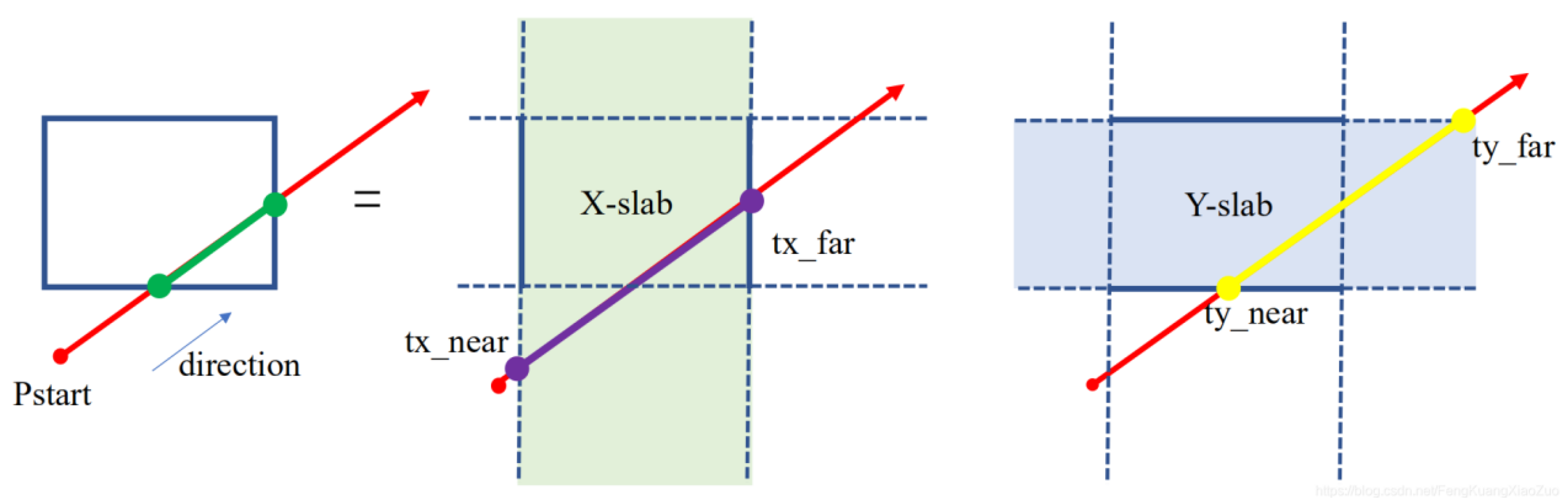
The first part of the algorithm performs a rapid screening to determine whether a signal path warrants further detailed occlusion checking with the terrain facets inside an MBR. We employ the efficient Slab [
22] Method for this purpose. The core idea is to treat the AABB as the intersection of three pairs of parallel planes (slabs). The signal path’s intersection intervals with each pair of slabs are computed independently, and the path is a candidate for occlusion if the overlap of these intervals is non-empty.
As shown in
Figure 3, given a signal path defined by its origin point
O (the transmitter) and a normalized direction vector
D (towards the receiver), and an AABB defined by its minimum and maximum extents
and
:
For each axis :
Calculate the distances to the two slabs along axis
i:
To ensure numerical stability and handle rays pointing in the negative direction, the near and far intersection parameters for each axis are defined as follows:
Find the overall entry and exit points of the signal path with the union of the slabs:
Occlusion Culling Condition: The signal path is a candidate for occlusion by the contents of the AABB if and only if
The first condition ensures the intervals overlap, meaning the signal path enters the box before it exits. The second condition ensures the potential occlusion occurs in the positive direction of the path (i.e., not behind the transmitter).
This method is computationally inexpensive, requiring only comparisons and divisions, making it ideal for quickly culling non-occluding nodes during the R-tree traversal.
If a signal path is identified as a candidate for occlusion by an MBR (broad-phase), a precise check is required for each terrain facet within that MBR to validate the occlusion. For this narrow-phase test, we utilize the fast and widely adopted Moller–Trumbore [
23] algorithm.
Given a signal path defined by origin O (transmitter) and direction D, and a terrain facet defined by its three vertices :
Find two edge vectors of the triangle:
Compute the determinant which determines whether the signal path is parallel to the facet:
Calculate the vector from the facet vertex
to the transmitter
O:
Compute the first barycentric coordinate
u:
If or , the point of occlusion lies outside the facet.
Compute the second barycentric coordinate
v:
If or , the point of occlusion lies outside the facet.
Occlusion Condition: The signal path is occluded by the terrain facet if and only if all the following conditions are met:
The distance
t from the transmitter to the occlusion point is given by
This distance t must also be positive for a valid occlusion ahead of the transmitter.
Input: A signal path (defined by origin O and direction D) and a bounding volume (AABB for Part I, a terrain facet for Part II).
Output: A Boolean result indicating whether occlusion is detected (True/False). For Part II, the barycentric coordinates and occlusion distance t are also valuable outputs for subsequent path loss calculations (e.g., penetration depth).
By combining the efficient occlusion culling of the Slab Method with the precise occlusion validation of the Moller–Trumbore algorithm, our framework achieves high-performance signal occlusion detection, which is paramount for real-time radio map reconstruction in high-fidelity 3D scenes.
3.3. Radio Map Construction Based on Multi-Path Classification
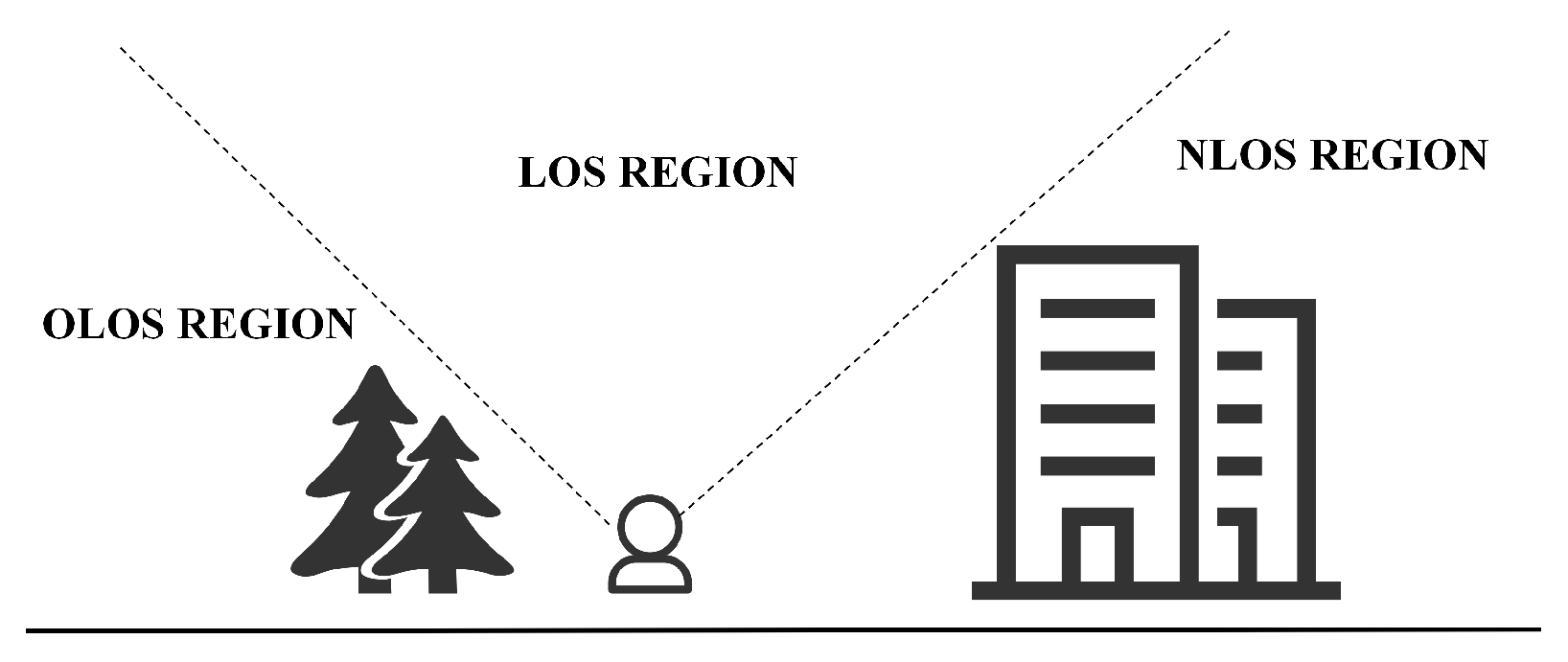
Leveraging the semantic 3D terrain index and the efficient signal occlusion detection method, we can accurately classify the propagation path of a signal in complex terrain into three distinct categories: Line-of-Sight (LOS), Non-Line-of-Sight (NLOS), and Obstructed-Line-of-Sight (OLOS). As shown in
Figure 4. This classification is the cornerstone for applying appropriate and physically grounded path loss models. The core classification logic is formalized in Algorithm 2.
Based on the classification result from Algorithm 2, a dedicated path loss model is applied for each category to calculate the total loss
(in dB) for the link.
| Algorithm 2 Path category classification |
 |
- 1.
Line-of-Sight (LOS) Path Loss
For unobstructed paths, the signal attenuation is modeled by the Free-Space Path Loss (FSPL) model, which predicts the loss incurred by the spreading of the wavefront in free space. The formula is given by
where
d is the distance between the transmitter and receiver in meters, and
f is the frequency in Hz. This model serves as the fundamental baseline for signal attenuation.
- 2.
Non-Line-of-Sight (NLOS) Path Loss
When the path is blocked by impenetrable obstacles like buildings, we adopt the empirically derived 3GPP Urban Macro (UMa) NLOS path loss model from TR 38.901 [
10]. This model accounts for additional losses due to diffraction and reflection over rooftops and around structures.
where
d is the 3D distance (in meters),
f is the carrier frequency in GHz, and
is the user terminal height in meters. The max operation ensures the NLOS loss is never less than the free-space loss.
- 3.
Obstructed Line-of-Sight (OLOS) Path Loss
OLOS paths are obstructed solely by penetrable vegetation. We model the total path loss as the sum of the free-space loss and an additional vegetation attenuation loss (
) based on the ITU-R P.833 [
24] recommendation. The vegetation loss is a function of the carrier frequency
f and the total depth
(in meters) that the signal travels through the foliage.
where
f is the frequency in MHz.
The key to calculating
is accurately determining the total vegetation penetration depth
. We designed Algorithm 3 for this purpose, leveraging the semantic index to identify and sum the penetration segments.
| Algorithm 3 calculateVegetationDepth: Computation of Total Vegetation Penetration Depth |
 |
Finally, the received power
(dBm) at any receiver location is computed as follows:
where
is the transmitted power (dBm). By executing this process for a dense grid of receiver locations, a high-fidelity, physics-aware radio map of the entire area is reconstructed.
4. Experimental Validation
4.1. Accuracy Comparison of Different Methods
To quantitatively evaluate the performance of the proposed HiFiRadio framework, we conducted a comparative experiment against leading model-driven and data-driven baselines using a realistic urban environment.
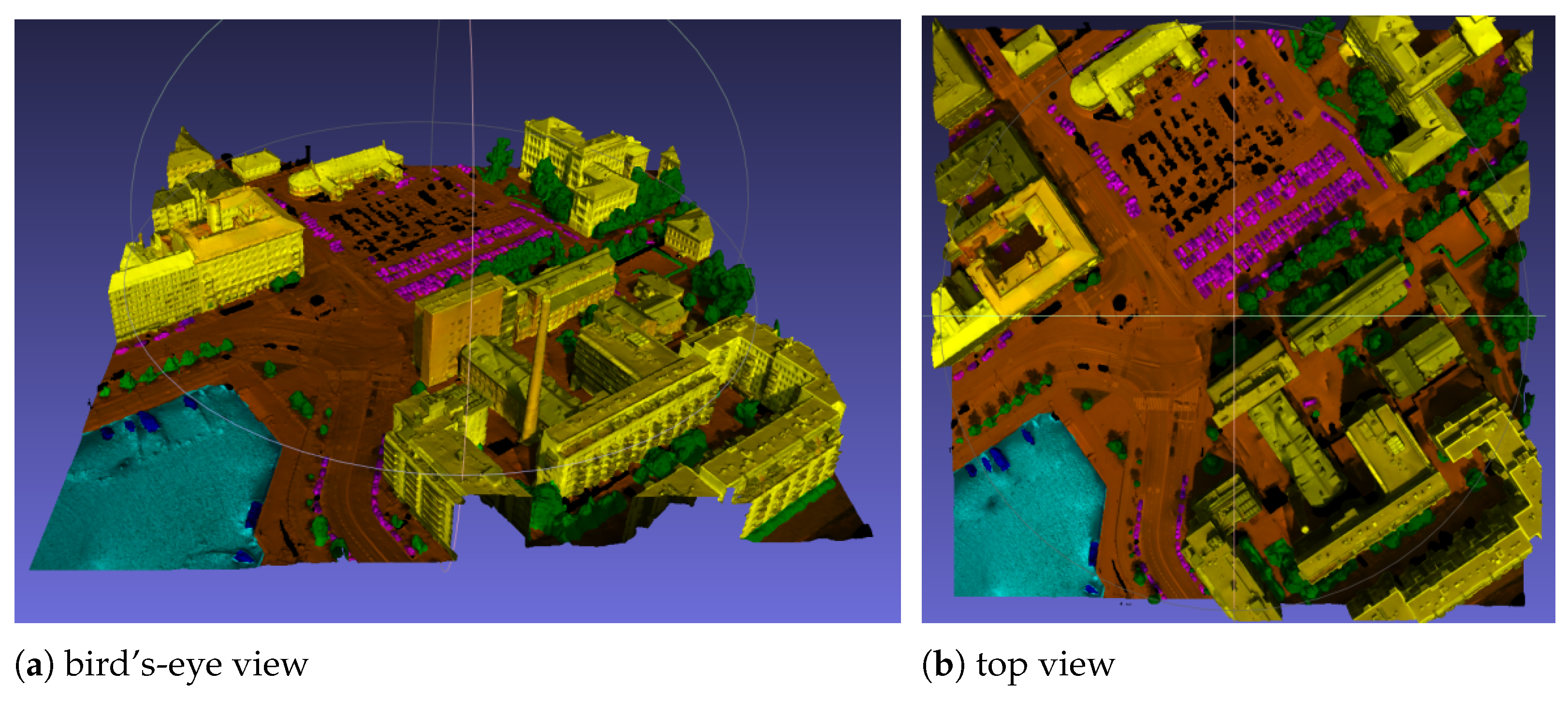
The experiment was conducted on a 250 m × 250 m area extracted from the open-source SUM_Helsinki dataset, as illustrated in
Figure 5. This dataset provides a centimeter-resolution 3D mesh with precise pre-computed semantic segmentation labels (e.g., building, vegetation, ground), making it ideally suited for our method. A transmitter (Tx) was placed at coordinates (100, 100, 80) m with a transmission power of 40 dBm and a frequency of 3 GHz. The objective was to reconstruct the received signal power across a 200 m × 200 m area centered on the Tx, specifically at a receiver height of 1.5 m, simulating a typical handheld device level. The ground truth was generated by importing the detailed 3D mesh and its semantics into the commercial ray-tracing simulator Wireless Insite, with identical Tx parameters, and exporting the simulation result at 1.5 m height.
RadioGAT: A state-of-the-art data-driven method using Graph Attention Networks.
RadioUNet: A prominent deep learning approach based on U-Net for radio map estimation.
COST-231 Hata Model: A widely used empirical model-driven method for urban areas.
HiFiRadio (Ours): The proposed hybrid framework.
We employed two metrics for a comprehensive evaluation:
Root Mean Square Error (RMSE): Measures the average magnitude of the power estimation error in dB.
Correct Detection Zone Ratio (CDZR)/False Alarm Zone Ratio (FAZR): A threshold-based metric. A prediction is considered correct if its absolute error is within 7 dB. CDZR is the ratio of the number of correctly predicted pixels to the total number of pixels. FAZR is the ratio of the number of incorrectly predicted pixels to the total number of pixels. A higher CDZR and a lower FAZR indicate better performance.
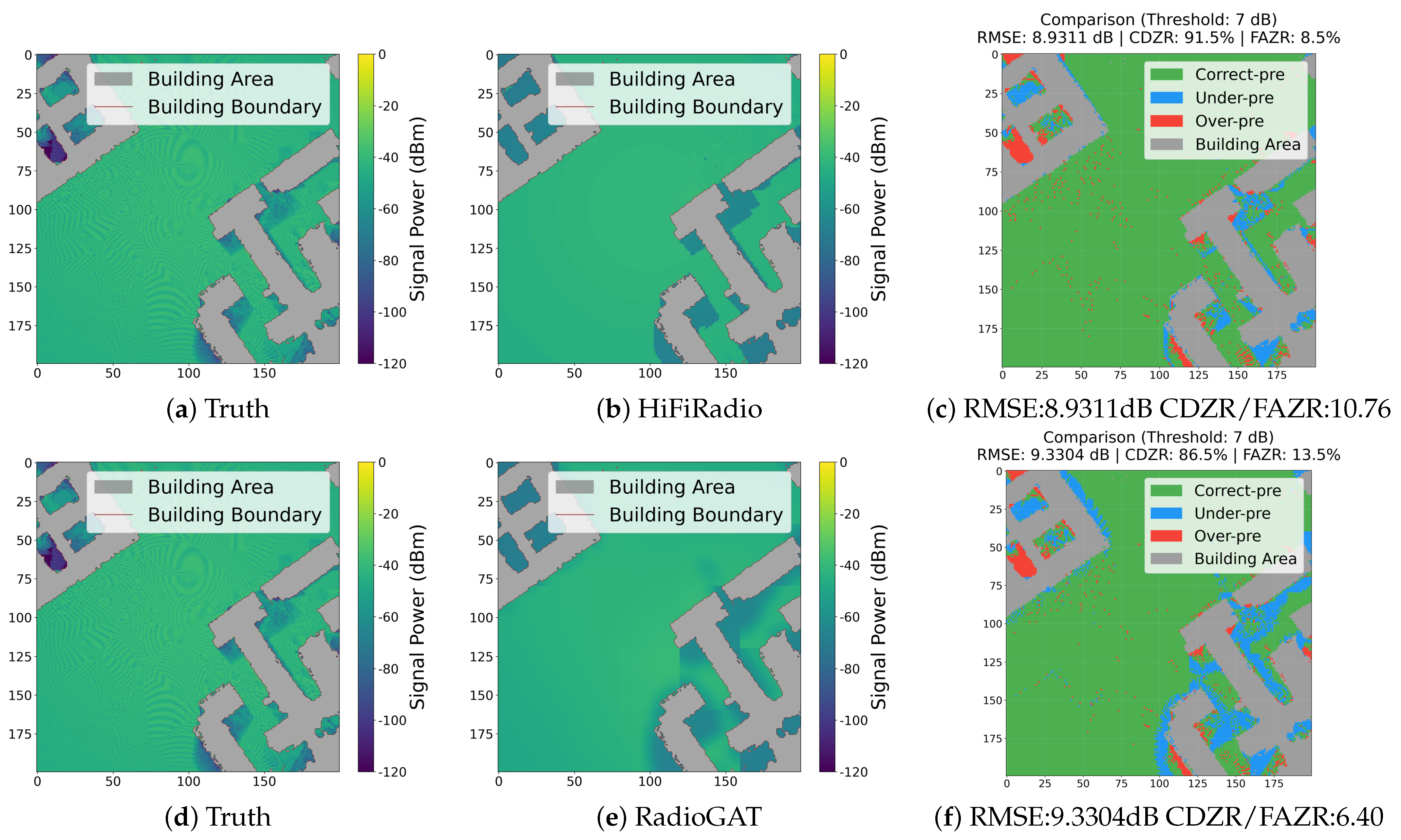
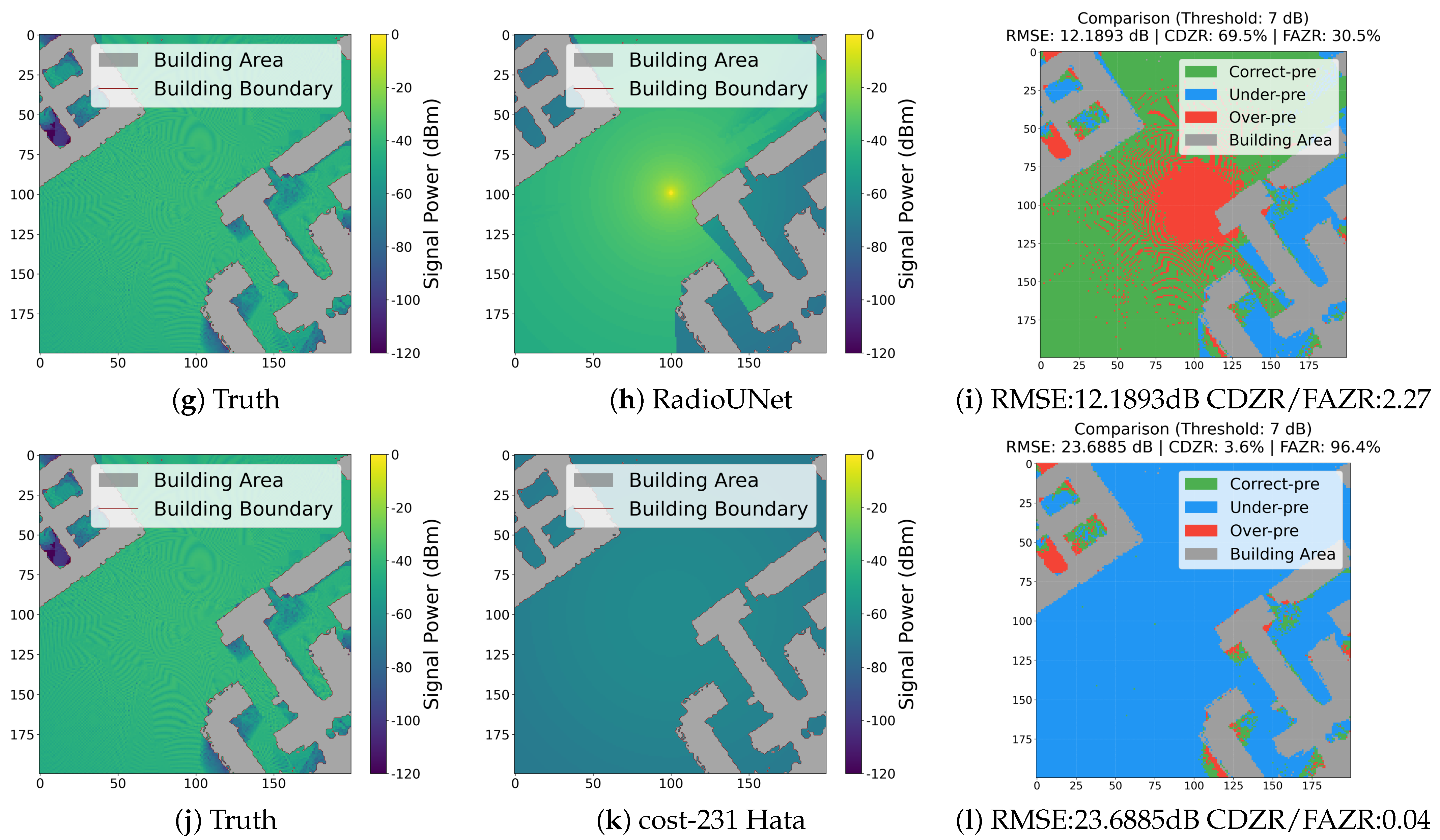
The reconstructed radio maps and the ground truth are visually presented in
Figure 6. Qualitatively, our method most closely resembles the ground truth, accurately capturing the complex shadowing effects caused by buildings and the subtle attenuation through vegetation canopies.
The COST-231 Hata model produces a smooth, radially symmetric pattern that completely fails to capture the intricate interactions with the 3D geometry. It is unable to model NLOS conditions behind buildings or OLOS conditions within parks, leading to massive errors, as confirmed by its high RMSE and poor CDZR/FAZR.
The RadioUNet model, trained primarily on building footprints and lacking explicit 3D awareness, struggles with the height disparity between the Tx (80 m) and the receiver plane (1.5 m). It fails to accurately reconstruct the deep shadows cast by tall buildings, resulting in significant underestimation of path loss in those areas.
The RadioGAT model, which processes the scene in partitioned blocks, exhibits visible artifacts and power discontinuities at the boundaries between these blocks. This tiling effect is a direct result of its limited receptive field and leads to unrealistic predictions, which is reflected in its suboptimal metrics.
In contrast, HiFiRadio explicitly models the 3D propagation paths by leveraging the detailed geometry and semantics for precise signal occlusion detection. It correctly identifies LOS, NLOS (behind buildings), and OLOS (through vegetation) conditions, applying physically grounded models for each. This results in a highly accurate and spatially consistent reconstruction.
The quantitative results, summarized in
Figure 6, strongly support the visual observations. Our method achieves the lowest RMSE and the highest CDZR, significantly outperforming all other baselines. This demonstrates the critical importance of incorporating fine-grained 3D semantic geometry into the radio map reconstruction process for achieving high fidelity.
4.2. Efficiency Comparison of Different Methods
While accuracy is paramount, computational efficiency is equally critical for the practical deployment of radio map reconstruction systems, especially in large-scale scenarios. This subsection evaluates the time efficiency of the proposed HiFiRadio framework against other methods across varying reconstruction scales.
To assess scalability, we selected a larger 500 m × 500 m area from the SUM_Helsinki dataset. A transmitter was placed at the center (250, 250, 80) m with the same parameters as those listed in
Section 4.1 (3 GHz, 40 dBm). We measured the total computation time required by each method to reconstruct the received signal power map at 1.5m height for five increasingly large areas centered on the
: 50 m × 50 m, 100 m × 100 m, 150 m × 150 m, 200 m × 200 m, and 250 m × 250 m.
Wireless Insite (Ray Tracing): This high-fidelity commercial simulator is used as the accuracy benchmark in
Section 4.1. It represents the upper bound of accuracy but also of computational cost.
RadioUNet (NET) & RadioGAT (GAT): Representative data-driven deep learning methods.
HiFiRadio (Ours): The proposed framework.
The COST-231 Hata model was excluded from this comparison due to its negligible computational cost and significantly inferior accuracy, which does not constitute a meaningful baseline for efficiency in this context.
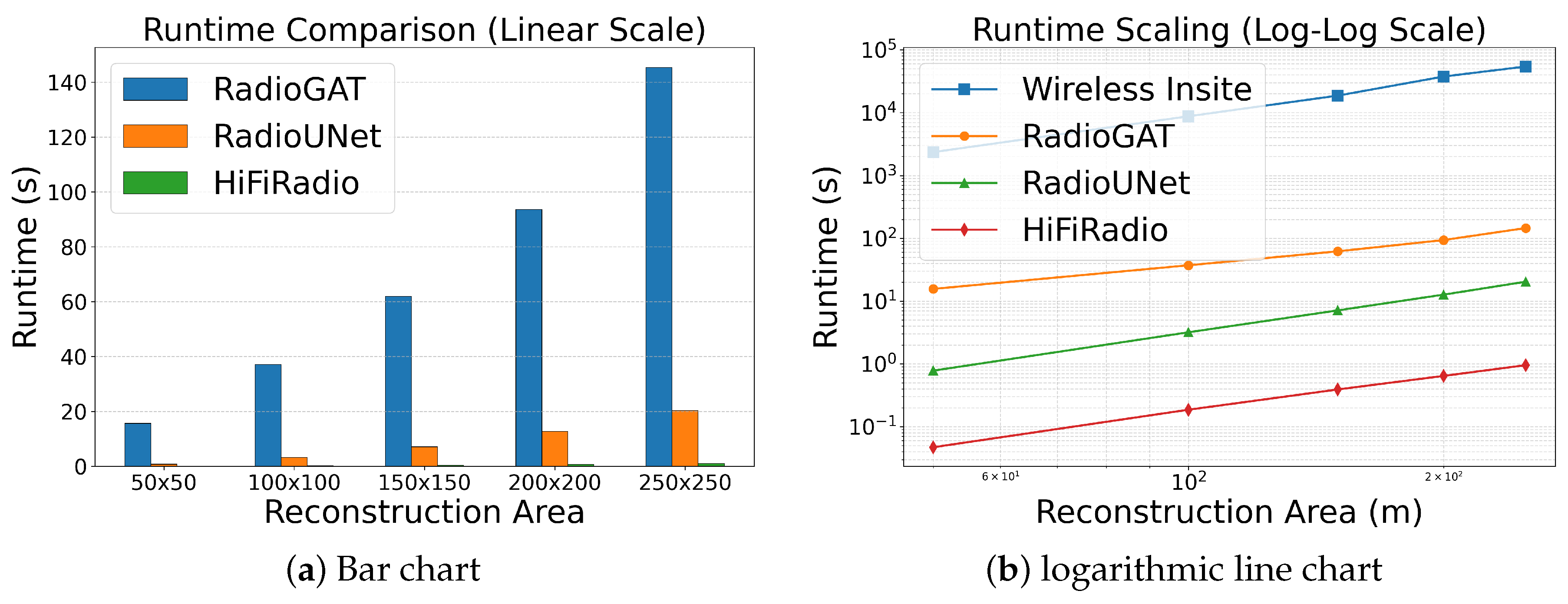
The detailed runtime results for all methods are presented in
Table 2. The data is also visualized in
Figure 7 to illustrate the scaling trends more intuitively.
The results lead to several key conclusions:
Prohibitive Cost of Ray Tracing: As expected, the precision of Wireless Insite comes at an enormous computational expense. Its runtime grows rapidly with the area size, taking over 15 h to simulate the 250 m × 250 m area. This renders it utterly impractical for real-time applications, despite its high accuracy.
Superior Efficiency of HiFiRadio: Our proposed HiFiRadio framework demonstrates exceptional computational efficiency. It is over 16 times faster than RadioUNet and over 150 times faster than RadioGAT at the 250 m × 250 m scale. Most notably, it is nearly 60,000 times faster than the ray-tracing benchmark for the same area. This immense speedup is a direct result of our hybrid approach, which replaces millions of computationally intensive physics-based ray-triangle intersection calculations (in pure ray tracing) with an intelligent combination of rapid spatial indexing and simplified—yet physics-aware—propagation models.
Favorable Scaling: The runtime of HiFiRadio scales approximately linearly with the number of receiver points (i.e., the area), as evidenced by the data. This predictable and favorable scaling behavior is crucial for applications requiring the reconstruction of city-scale radio maps.
Accuracy–Efficiency Trade-off: Crucially, this dramatic efficiency gain, as shown in
Table 1 and
Figure 7, is achieved without sacrificing accuracy. As demonstrated in
Section 4.1, HiFiRadio significantly outperforms the data-driven methods (GAT, NET) in reconstruction fidelity and approaches the accuracy of ray tracing. Therefore, our framework successfully breaks the long-standing trade-off between accuracy and efficiency in radio map reconstruction.
In summary, the HiFiRadio framework establishes a new state of the art by achieving high-fidelity reconstruction that is orders of magnitude faster than both precise physical simulations and contemporary data-driven deep learning models, making it viable for large-scale, practical deployment.
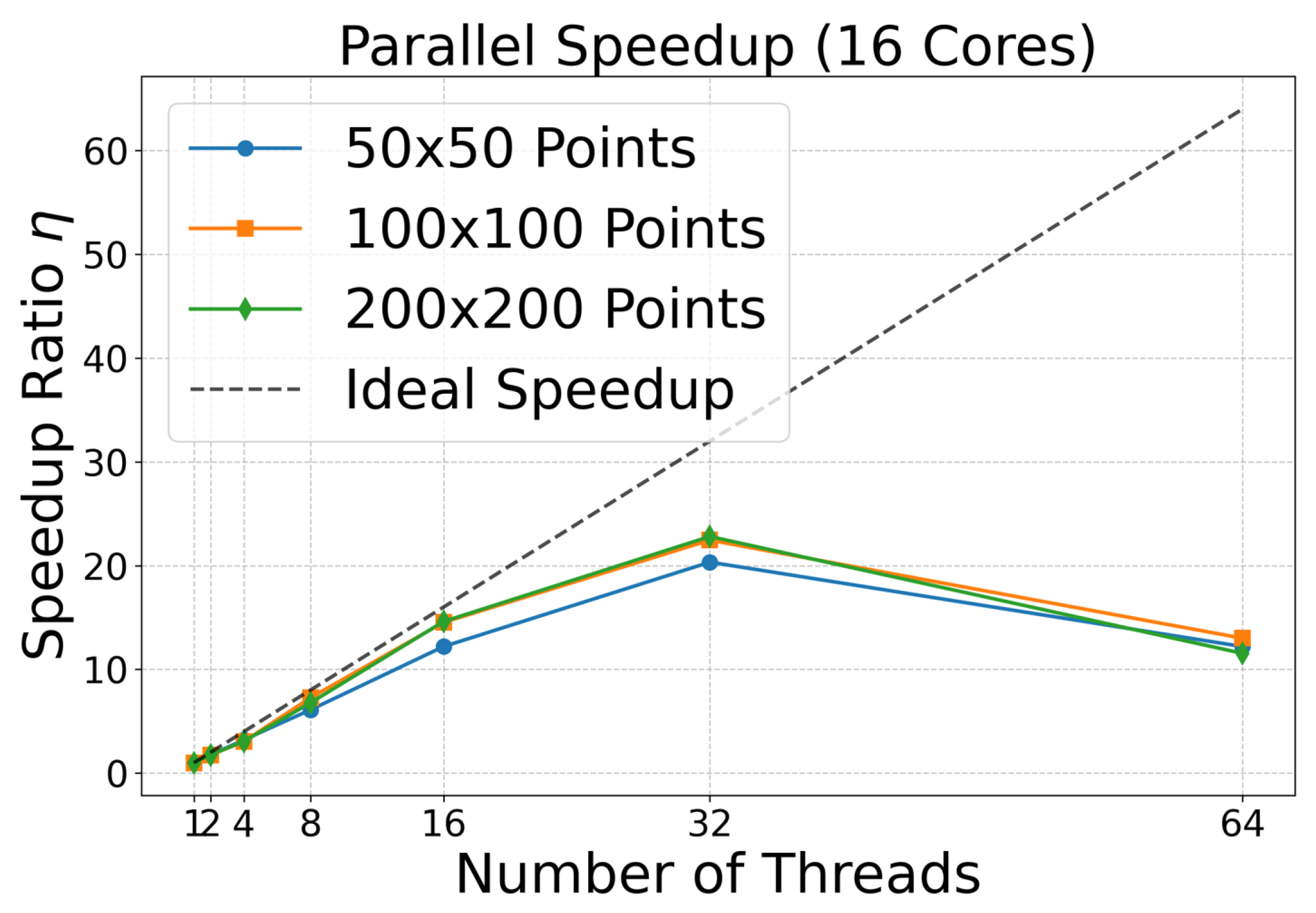
4.3. Parallel Performance
To further demonstrate the practicality and scalability of the HiFiRadio framework for large-scale scenarios, we evaluated its parallel computing performance. The core computation in our method—performing ray queries against the indexed 3D mesh for a large number of receiver points—is highly parallelizable, as each point can be processed independently.
This experiment was conducted on Dataset-1 (the 250 m × 250 m area from SUM_Helsinki, comprising approximately 340,000 triangular faces, introduced in
Section 4.1). We implemented a parallel version of the HiFiRadio reconstruction pipeline using OpenMP, focusing on the embarrassingly parallel task of computing received power for each point on a grid.
We varied two key parameters:
Number of Threads: 1, 2, 4, 8, 16, 32, 64.
Reconstruction Scale (Number of Receiver Points): 50 × 50 (2500 points), 100 × 100 (10,000 points), and 200 × 200 (40,000 points).
The transmitter location and parameters remained consistent with previous experiments. For each configuration, we recorded the total runtime. The Speedup Ratio(), defined as , where is the runtime with 1 thread and is the runtime with N threads, was calculated to quantify parallel efficiency.
Results and Analysis:
The runtime and calculated speedup for all configurations are presented in
Table 3. The scaling behavior is further visualized in
Figure 8.
The results lead to the following conclusions:
Near-Linear Scaling for Moderate Thread Counts: For up to 32 threads, the HiFiRadio framework demonstrates excellent parallel scalability. The speedup ratio increases almost linearly with the number of threads across all problem sizes. This is because the computational workload for each receiver point is significant enough to outweigh the overhead of parallel task scheduling, making efficient use of the available cores.
Performance Degradation Beyond Hardware Support: When the thread count (64) exceeds the number of available physical hardware threads (32 threads on our 16-core/ 32-thread test system), performance deteriorates. The runtime increases and the speedup ratio drops significantly (e.g., from 22.8× to 11.5× for the 200 × 200 case). This is due to the increased overhead of context switching and contention for shared resources among an excessive number of logical threads, confirming that optimal performance is achieved when the thread count aligns with the hardware’s parallel capabilities.
Efficiency for Large-Scale Computation: The parallel efficiency is more pronounced for larger receiver grids (e.g., 200 × 200). The absolute time reduction is greatest for these cases, and the speedup remains stable until the hardware limit is hit. This underscores the framework’s particular suitability for accelerating the reconstruction of large-scale, high-resolution radio maps, reducing the computation time from nearly 10 s serially to under half a second in parallel—a critical improvement for near-real-time applications.
In conclusion, the HiFiRadio framework is not only accurate and efficient but also effectively leverages modern multi-core architectures through parallelization. This design choice future-proofs the method, ensuring it can capitalize on the increasing core counts of future processors to tackle even larger scenes, such as Dataset-2 (the 500 m × 500 m area with ∼1.45 million faces from
Section 4.2), with continued high performance.
4.4. Computational Performance on Large-Scale Datasets
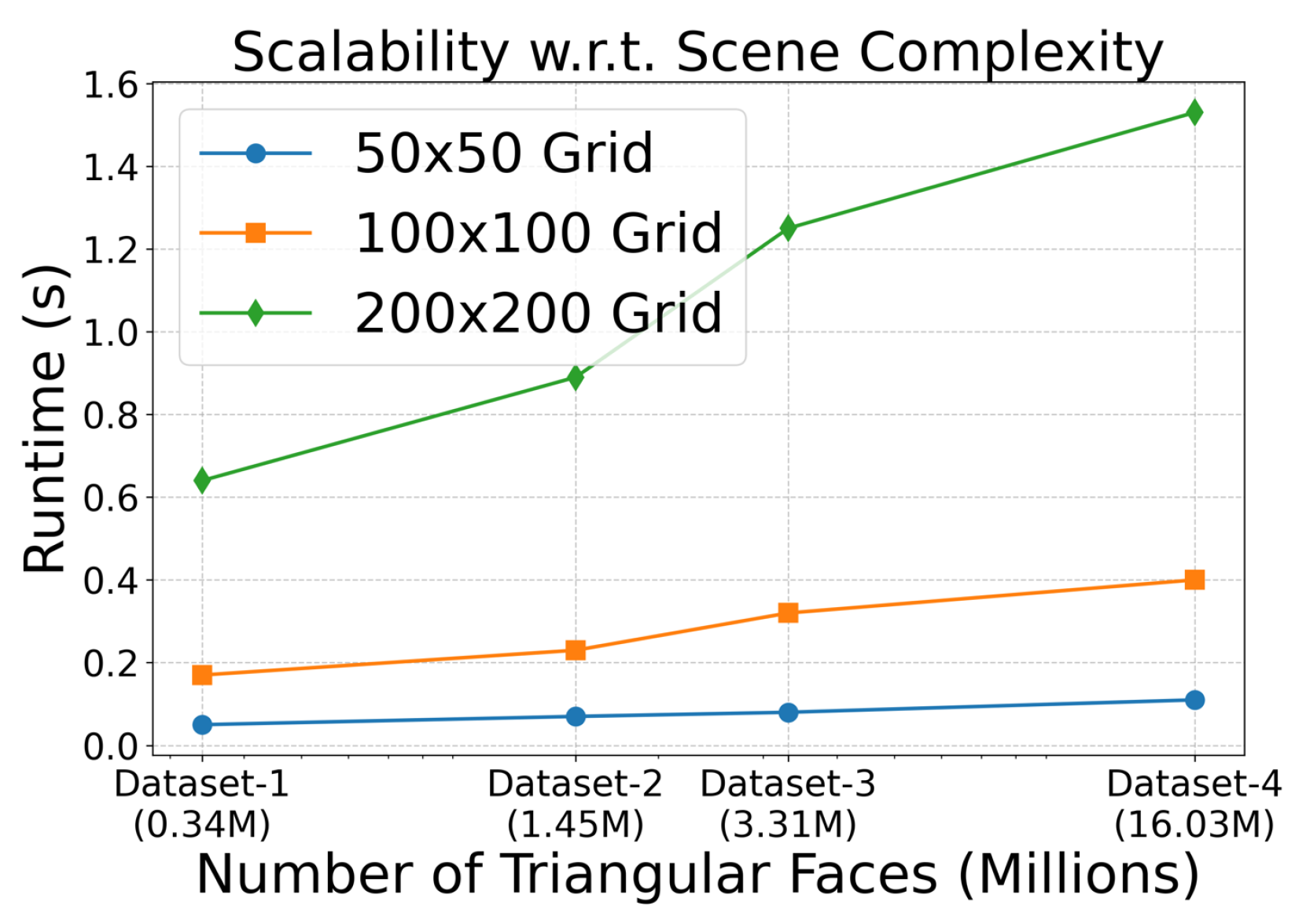
A critical requirement for a practical radio map reconstruction framework is its ability to handle increasingly large and detailed 3D environmental models without a catastrophic increase in computational cost. This subsection evaluates the scalability of the HiFiRadio framework with respect to the size and complexity of the input 3D mesh.
We employed four datasets of vastly different scales to stress-test the framework:
Dataset-1: The 250 m × 250 m area from SUM_Helsinki, comprising ∼0.34 million triangular faces.
Dataset-2: The 500 m × 500 m area from SUM_Helsinki, comprising ∼1.45 million triangular faces (introduced in
Section 4.2).
Dataset-3: A large urban area comprising ∼3.14 million triangular faces.
Dataset-4: An extensive city-scale area comprising ∼16.03 million triangular faces.
For all experiments, the parallel thread count was fixed to 16 to leverage the performance gains established in
Section 4.3. We measured the runtime required to reconstruct received power maps of three different resolutions (50 × 50, 100 × 100, and 200 × 200 receiver points) on each dataset. The transmitter was placed at a central location within each scene.
The runtime results are summarized in
Table 4. The data clearly demonstrates the framework’s robustness against scene complexity.
The key observation from
Table 3 and
Figure 9 is the sub-linear growth of runtime as the number of triangular faces in the mesh increases by nearly 50 times (from 0.34 M to 16.03 M). For instance, when reconstructing a 200 × 200 map,
The mesh size increases by a factor of ∼47.
The runtime only increases by a factor of ∼2.4 (from 0.64 s to 1.53 s).
This highly favorable scaling is a direct consequence of the spatial indexing structure (R-tree) at the core of our framework. The R-tree organizes the massive mesh data in a hierarchical manner. During a ray query, the algorithm does not need to check every single triangle in the scene. Instead, it efficiently traverses the tree, quickly pruning away large branches of the hierarchy whose bounding volumes do not intersect the ray. This reduces the average time complexity of a single ray query from (checking all n triangles) to approximately .
Therefore, the total computational cost for reconstructing a radio map with k receiver points scales roughly as , rather than . This logarithmic scaling with respect to scene complexity (n) is the reason why the runtime increase is minimal even when moving from a medium-sized urban model (Dataset-1) to a massive city-scale model (Dataset-4).
The experimental results confirm that the HiFiRadio framework is not only efficient but also highly scalable. Its performance degrades gracefully with increasing input size, thanks to the intelligent data organization provided by the semantic 3D R-tree index. This property is indispensable for practical applications, as it ensures that the framework can be deployed for city-scale planning and optimization using the highly detailed 3D models that are becoming increasingly available.
4.5. Validation with Field Measurements
To further validate the accuracy of our proposed HiFiRadio framework in a real-world scenario, we conducted a field measurement campaign. Simulation-based validation, while valuable, can be influenced by model imperfections. In situ measurements provide the most credible ground truth for evaluating radio map reconstruction performance.
The experiment was conducted near the Hunan Aerospace Hospital in Changsha, China. We first captured the 3D geometry of a 200 m × 200 m area using an unmanned aerial vehicle (UAV) equipped with an oblique photogrammetry camera. The resulting 3D mesh was semantically segmented using the MeshCNN model to classify objects (e.g., buildings, vegetation) and subsequently used to build the semantic 3D R-tree index, as described in
Section 3.1.
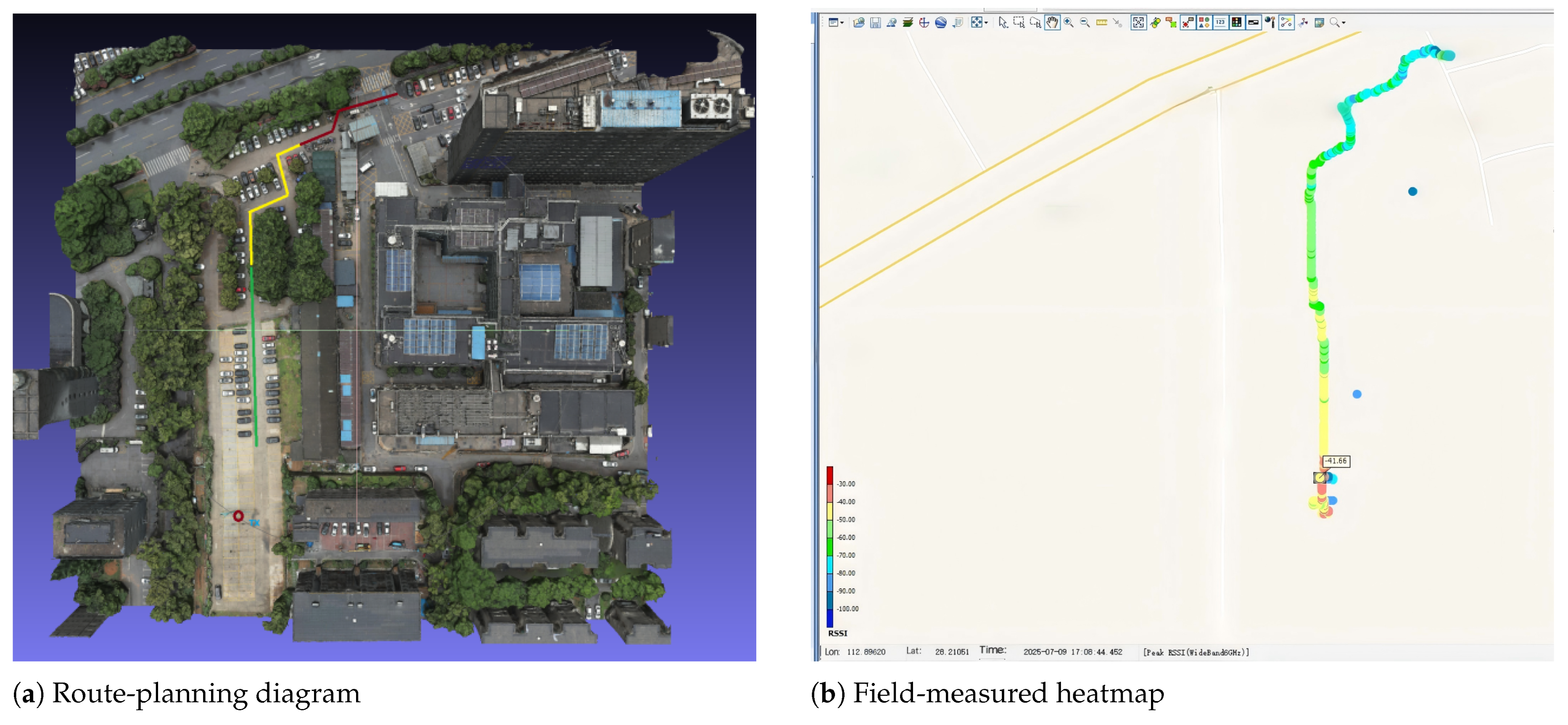
A signal transmitter was placed at coordinates (40, 40, 8) m within this area, operating at 3 GHz with a transmission power of 40 dBm. A handheld spectrum analyzer was used as a mobile receiver to measure the received signal power (RSS) along a pre-defined path, as shown in
Figure 10. A total of 4000 measurement points, along with their precise coordinates, were collected.
The measurement path and the corresponding recorded RSS values are visualized in
Figure 10, respectively. The RSS distribution along the path can be clearly divided into three distinct intervals, which correspond remarkably well to the three propagation categories defined by our framework:
Region A (green): Corresponds to a Line-of-Sight (LOS) area with minimal obstruction.
Region B (red): Corresponds to a Non-Line-of-Sight (NLOS) area blocked by large buildings.
Region C (yellow): Corresponds to an Obstructed-Line-of-Sight (OLOS) area where the signal penetrates through vegetation, experiencing attenuated but not completely blocked propagation.
This strong qualitative agreement between the physical environment, the measured signal strength, and our path categorization logic provides compelling evidence for the soundness of our methodological foundation.
To quantitatively assess the accuracy, we generated the predicted radio maps for the entire area using both our HiFiRadio framework and the ray-tracing software Wireless Insite (version 3.3.2), using the same transmitter parameters and a receiver height of 1.5 m. We then compared the predictions against the field measurements. For a balanced evaluation, we randomly selected 500 sample points from each of the three propagation regions (LOS, NLOS, OLOS) identified in
Figure 10) and calculated the root mean square error (RMSE). The results are summarized in
Table 5.
The results in
Table 5 lead to two key insights:
Inherent Limitations of Modeling: Even the computationally intensive ray-tracing method (Wireless Insite) exhibits non-negligible errors when compared to real-world measurements. This highlights the inherent challenge of perfectly modeling complex electromagnetic propagation phenomena, which are influenced by countless factors in the real environment that are difficult to fully capture (e.g., exact material properties, surface roughness, small-scale scatterers).
Favorable Accuracy–Efficiency Trade-off: Although HiFiRadio’s accuracy, particularly in complex NLOS and OLOS conditions, is lower than that of the dedicated ray-tracing simulator, the margin is acceptable. Crucially, this minor compromise in accuracy is made in exchange for a computational speedup of four to five orders of magnitude (as demonstrated in
Section 4.2. Our method achieves RMSE values within the same order of magnitude as the high-fidelity benchmark.
This experiment confirms that the HiFiRadio framework successfully strikes an effective balance between efficiency and accuracy. It provides predictions that are sufficiently reliable for numerous practical applications (e.g., network planning, UAV pathing) while being computationally feasible for real-time operation—a feat that pure ray-tracing methods cannot accomplish.
5. Limitations and Future Work
Despite its promising performance, HiFiRadio has several limitations that point to fruitful directions for future research.
1. Dependency on Semantic Segmentation: The accuracy of HiFiRadio relies on the quality of semantic segmentation. Misclassification (e.g., glass facades labeled as vegetation) could lead to incorrect path categorization. Future work could explore more robust segmentation networks or multi-sensor fusion (e.g., LiDAR + RGB) to improve label accuracy.
2. Simplified Physical Modeling: For NLOS paths, HiFiRadio currently employs the empirical 3GPP model without explicitly modeling multipath reflections or diffraction. While this ensures real-time performance, it may underestimate received power in dense urban canyons. Incorporating simplified ray tracing (e.g., first-order reflections) could enhance NLOS modeling fidelity.
3. Binary Material Representation: Materials are currently classified as either penetrable or impenetrable, ignoring frequency-dependent permittivity and conductivity. Future versions could integrate a material library with electromagnetic properties for different surface types.
4. Dynamic Environment Modeling: The current framework assumes a static environment. Extending HiFiRadio to handle dynamic objects (e.g., moving vehicles, seasonal foliage changes) would enable time-varying radio map reconstruction.
5. Multi-frequency and Multi-antenna Support: Experiments were conducted for a single frequency and omnidirectional antenna. Future work will extend HiFiRadio to multi-band and MIMO systems for 5G/6G network planning.
6. GPU Acceleration Comparison: The current parallel implementation uses CPU-based OpenMP. While significant speedup is demonstrated, a comparison with GPU-accelerated ray tracing would provide a more balanced evaluation. A GPU version of HiFiRadio is planned for future work.
6. Conclusions
In this paper, we have presented HiFiRadio, a hybrid model- and data-driven framework for high-fidelity radio-map reconstruction in 3D scenes. By synergistically integrating detailed oblique-photogrammetry-derived 3D meshes with a semantic-aware spatial indexing structure for efficient signal occlusion detection, HiFiRadio effectively bridges the gap between physical accuracy and computational tractability, achieving extremely high efficiency.
Extensive experimental validation demonstrates that HiFiRadio significantly outperforms both classical model-driven methods and contemporary data-driven approaches in terms of reconstruction accuracy, while achieving a computational speedup of several orders of magnitude compared to high-fidelity ray-tracing simulations. Field measurements further corroborate the practical viability of HiFiRadio, showing close alignment between predicted and actual signal propagation patterns across diverse terrain types.
Balanced Perspective on Performance: Although HiFiRadio demonstrates a favorable trade-off between accuracy and efficiency, it is important to acknowledge its current simplifying assumptions. The framework’s accuracy is contingent upon the quality of semantic segmentation, and its physical modeling for NLOS conditions relies on empirical rather than deterministic propagation models. Furthermore, the binary classification of materials overlooks nuanced electromagnetic properties. Despite these limitations, HiFiRadio achieves a level of accuracy sufficient for many practical applications—such as network planning, dynamic spectrum access, and UAV path optimization—while operating at speeds that enable near-real-time, city-scale reconstruction, a capability that pure ray-tracing methods cannot provide.
Looking forward, we envision several promising directions for future work, including the integration of dynamic environmental factors (e.g., moving vehicles, seasonal foliage changes), support for multi-frequency and multi-antenna systems, and the extension to time-varying radio maps. Once its current limitations are addressed, particularly through enhanced physical modeling and more robust semantic understanding, the HiFiRadio framework can evolve into an even more powerful tool. It establishes a solid foundation for next-generation radio-environment sensing and exploitation, paving the way toward more intelligent and adaptive wireless networks.