
A Bibliometric Analysis of Digital Financial Literacy and Its Role in Reducing Online Financial Fraud in the European Union



Abstract
1. Introduction
- (1)
- trace the history and the modern state of research in this field;
- (2)
- find the individuals, organizations, and partnerships;
- (3)
- conceptualize the research structure and primary research themes; and
- (4)
- summarize the results on the effectiveness of DFL interventions and define essential research gaps.
2. Literature Review
2.1. The Context: Digitalization, Literacy, and Fraud
2.2. Digital Financial Literacy in the European Union
2.3. Statistics and Trends of Online Financial Fraud in the European Union
2.4. Digital Financial Literacy as a Mitigator of Online Financial Fraud
2.4.1. Vulnerability of Specific Demographics
2.4.2. DFL as a Multi-Pronged Defense Mechanism
2.4.3. Synergy Between Fintech and DFL
3. Methodology
3.1. Eligibility Criteria for Study Inclusion
3.2. Information Sources and Search Strategy
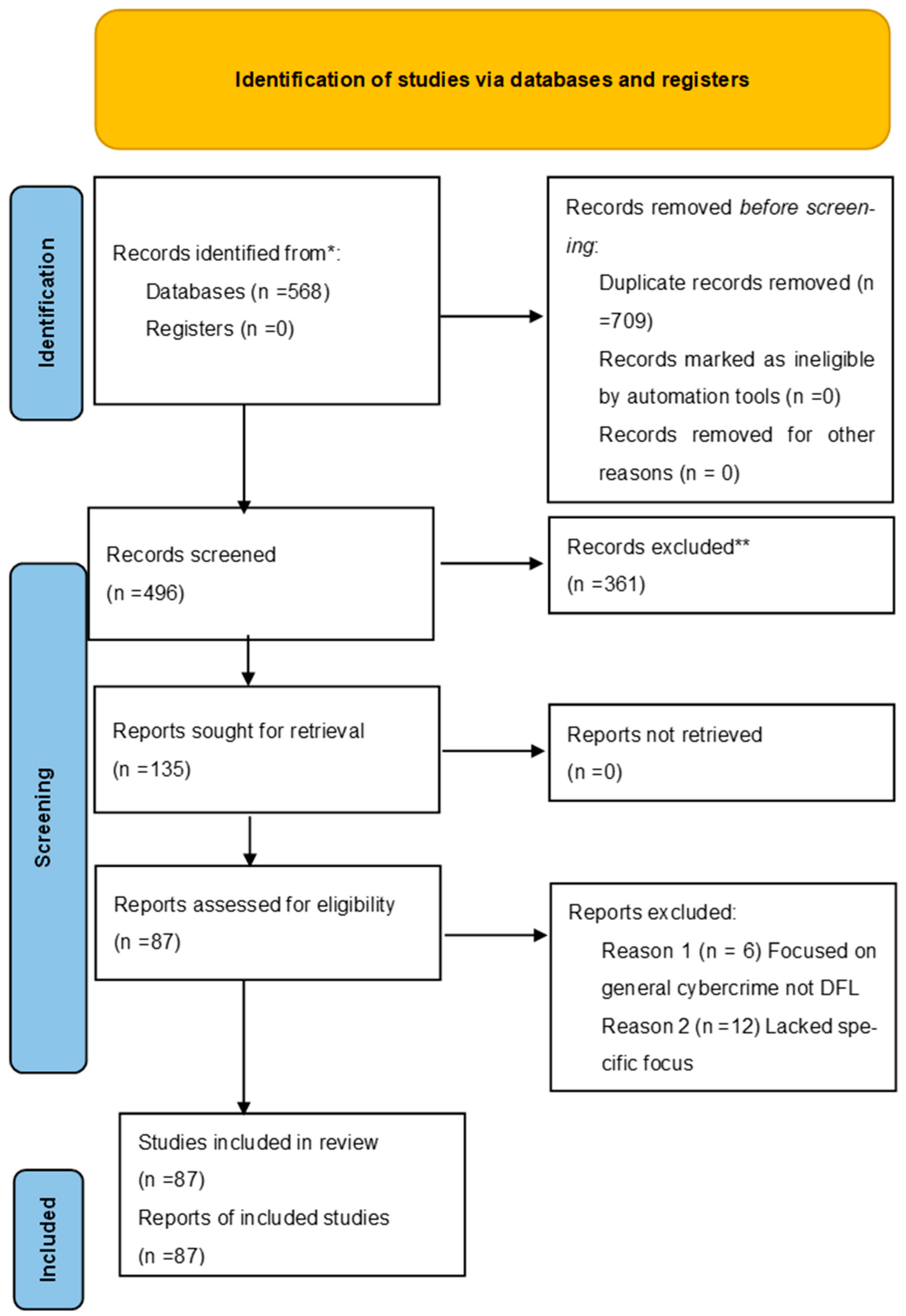
3.3. Study Selection and Screening Process
3.4. Data Extraction and Synthesis
3.5. Bibliometric Analysis and Science Mapping
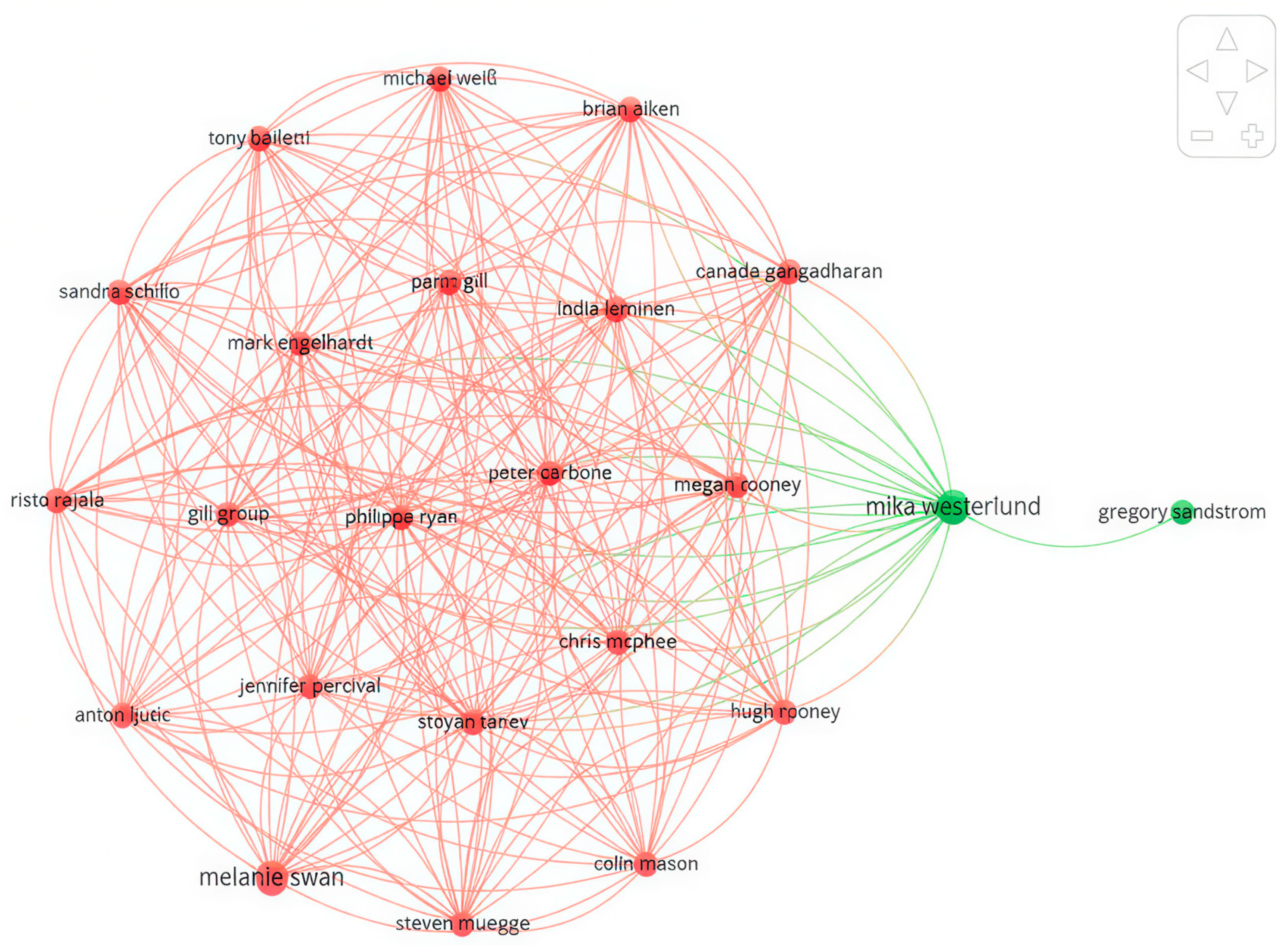
- Coauthorship analysis: coauthorship was used to identify collaborative relationships between authors, institutions, and countries to map scholarly networks.
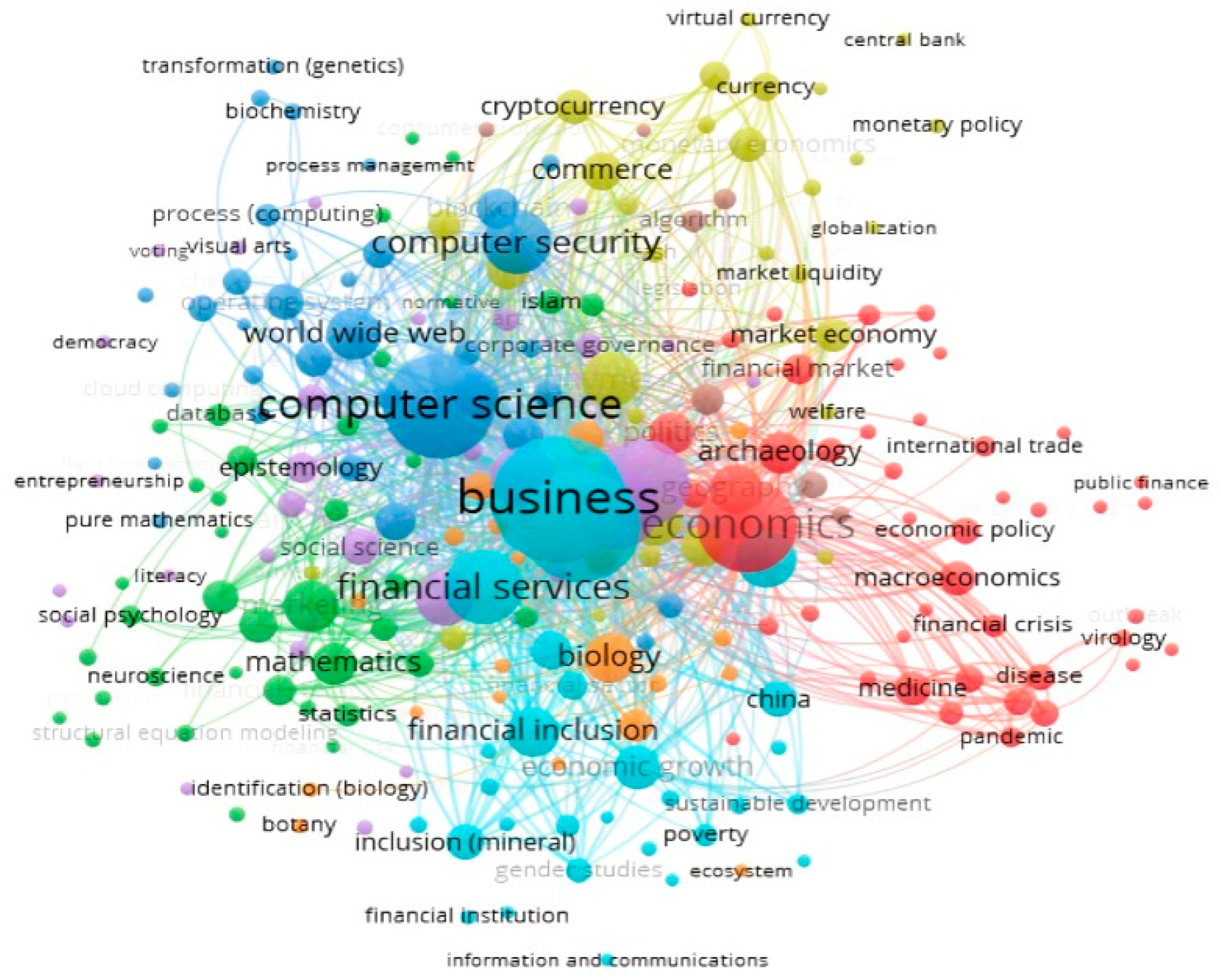
- Keyword co-occurrence analysis—explores the usage of key words and their association, showing prevalent themes and concept groups.
- Citation analysis—calculated citation frequency to determine the most effective studies and authors in the area.
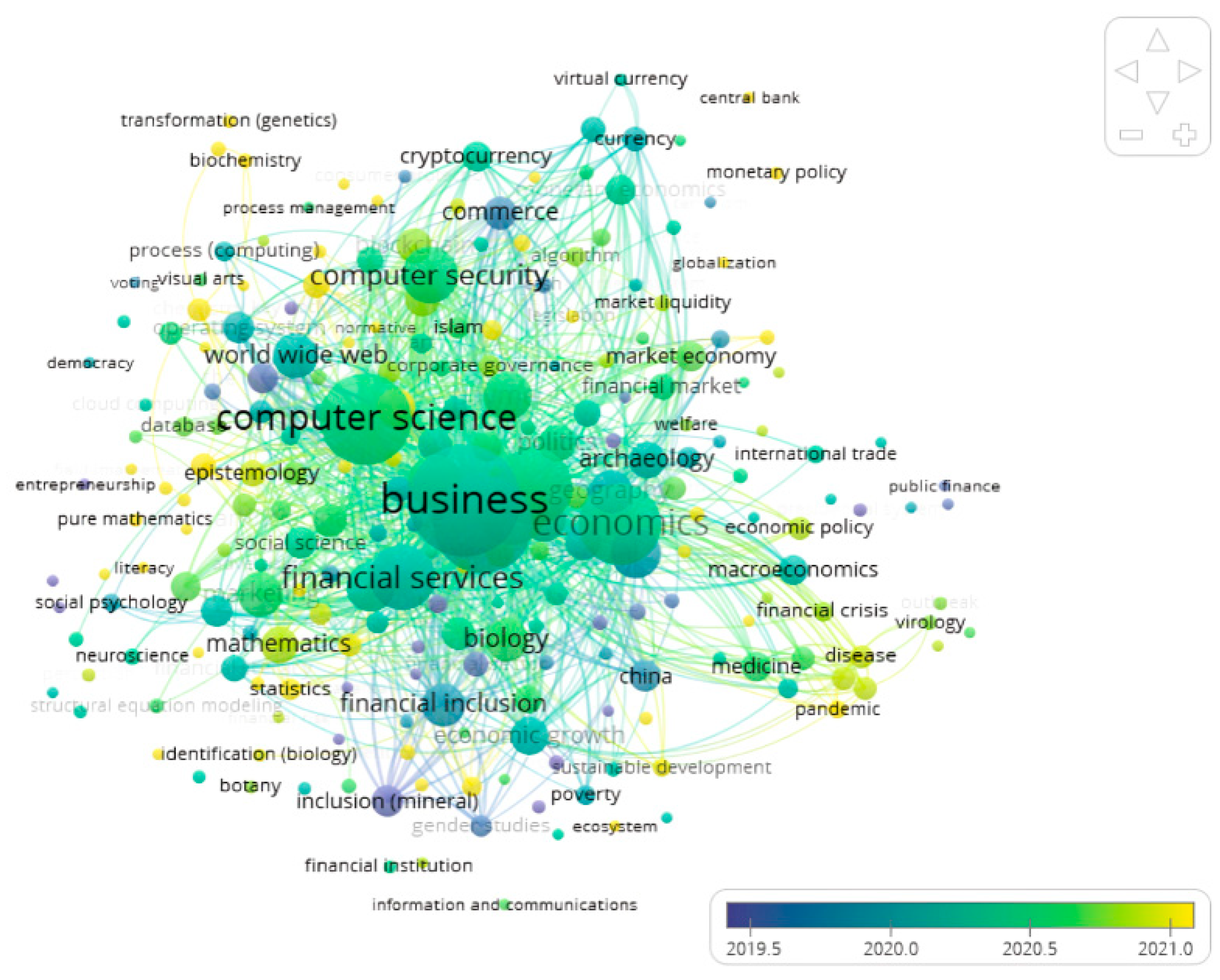
- Temporal overlay visualization followed the chronological progression of research topics to determine emergent and decaying interests.
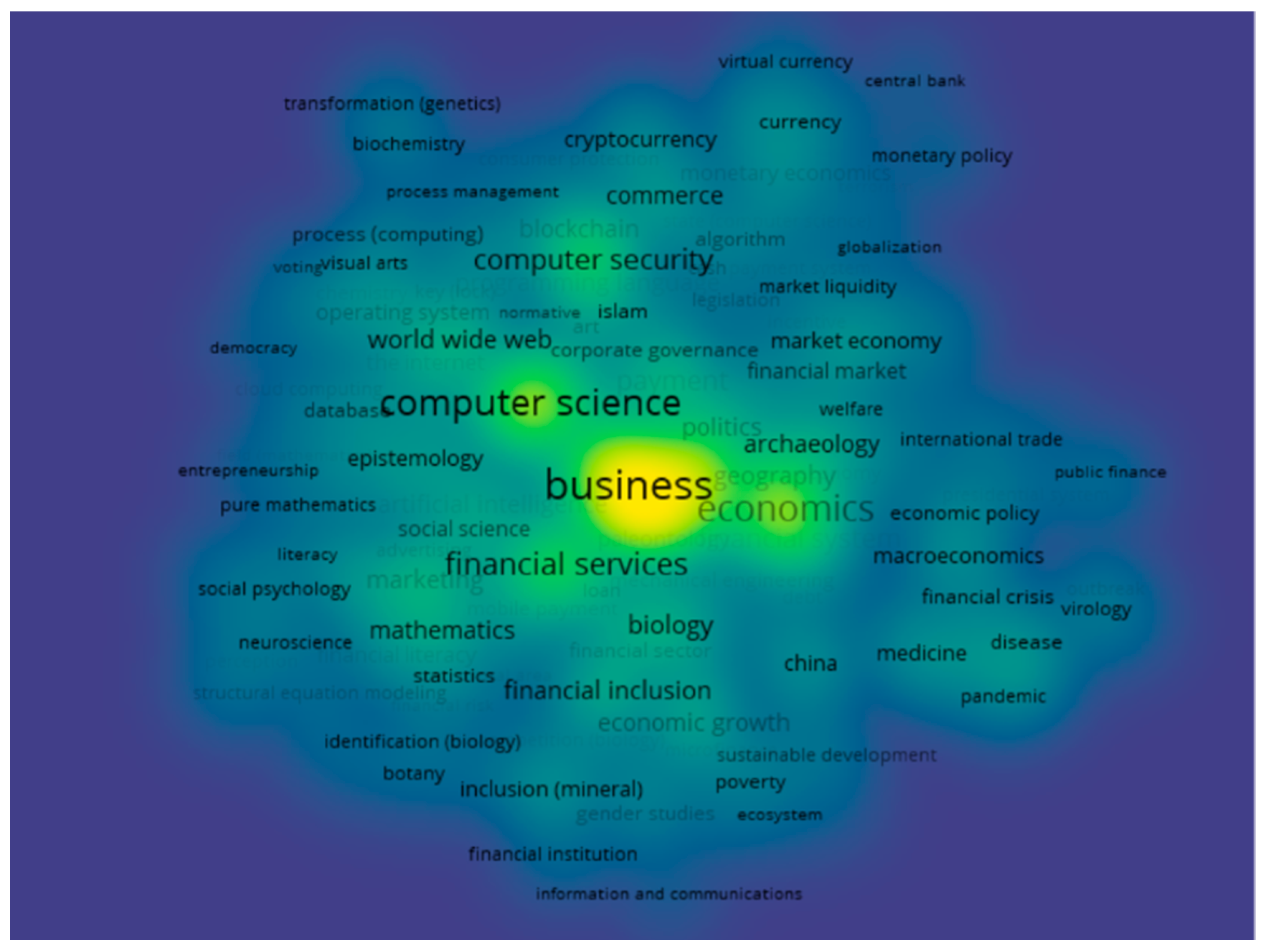
- Density visualization—used to identify areas of high research activity, indicating core and peripheral issues in the field.
3.6. Marginal Contribution of the Selected Studies
4. Results
4.1. Coauthorship Analysis
4.2. Keyword Co-Occurrence Analysis
- 6.
- Macroeconomic and Policy Cluster (Red): captures economic and institutional aspects, including fiscal crisis, monetary policy, globalization, and central banking.
- 7.
- Business and Technological Cluster (Green): links to business, commerce, and process management with cybersecurity, databases, and cryptocurrency.
- 8.
- Social and Psychological Cluster (Blue): highlights social development, financial inclusion, education, and gender dynamics in DFL.
- 9.
- Foundational Cross-Disciplinary Cluster (Yellow): represents core analytical and conceptual constructs such as mathematics, identification, and ecosystems.
4.3. Overlay Visualization
4.4. Density Visualization
4.5. Citation Analysis
5. Discussion
6. Conclusions
Author Contributions
Funding
Institutional Review Board Statement
Informed Consent Statement
Data Availability Statement
Conflicts of Interest
Abbreviations
| Acronym | Meaning |
| DFL | Digital Financial Literacy |
| EU | European Union |
| APP Fraud | Authorized Push Payment Fraud |
| RegTech | Regulatory Technology |
| PSD2 | Payment Services Directive 2 |
| GDPR | General Data Protection Regulation |
| PRISMA | Preferred Reporting Items for Systematic Reviews and Meta-Analyses |
Appendix A. List of 87 Publications Included in the Bibliometric Analysis
| No. | Author(s) | Year | Title | Source (Journal) |
| Lusardi, A., & Mitchell, O.S. | 2011 | Financial Literacy and Planning: Implications for Retirement Well-being | In Financial Literacy: Implications for Retirement Security and the Financial Marketplace | |
| 2 | van Rooij, M., Lusardi, A., & Alessie, R. | 2011 | Financial Literacy and Stock Market Participation | Journal of Financial Economics |
| 3 | Klapper, L., Lusardi, A., & Panos, G.A. | 2012 | Financial Literacy and the Financial Crisis | NBER Working Paper Series |
| 4 | Williams, E., & Beardmore, A. | 2017 | Individual Differences in Susceptibility to Online Influence: A Theoretical Review | Computers in Human Behavior |
| 5 | Williams, E., et al. | 2019 | Applying Behavioral Insights to Improve Fraud Resilience | Journal of Economic Psychology |
| 6 | European Commission | 2020 | Digital Finance Strategy for the EU | European Commission Policy Document |
| 7 | Goyal, K., & Kumar, S. | 2021 | Financial Literacy: A Systematic Review and Bibliometric Analysis | International Journal of Consumer Studies |
| 8 | European Banking Authority (EBA) | 2022 | Report on Financial Education and Digitalization | EBA Policy Report |
| 9 | Organisation for Economic Co-operation and Development (OECD) | 2022 | OECD/INFE 2022 International Survey of Adult Financial Literacy | OECD Publishing |
| 10 | Europol | 2023 | European Union Serious and Organized Crime Threat Assessment (SOCTA) | Europol Report |
| 11 | Yadav, M., & Banerji, P. | 2023 | A Bibliometric Analysis of Digital Financial Literacy | American Journal of Business |
| 12 | Zaimovic, A., et al. | 2023 | Mapping Financial Literacy: A Systematic Literature Review of Determinants and Recent Trends | Sustainability |
| 13 | European Banking Authority and European Central Bank | 2024 | 2024 Report on Payment Fraud | Joint ECB/EBA Publication |
| 14 | Ferilli, G.B., et al. | 2024 | The Impact of FinTech Innovation on Digital Financial Literacy in Europe: Insights from the Banking Industry | Research in International Business and Finance |
| 15 | Kovács, L., & Terták, E. | 2024 | Thematic Review of Financial Education and Financial Literacy in the Digital Age | Acta Oeconomica |
| 16 | Mohd Zukry, M.A.A., et al. | 2024 | Strategies for Protecting Senior Citizens Against Online Banking Fraud and Scams: A Systematic Literature Review | Journal of Theoretical and Applied Information Technology |
| 17 | Andersen, S., & Nielsen, K.M. | 2020 | Financial Literacy and Digital Payment Adoption: Evidence from Denmark | Journal of Banking and Finance |
| 18 | Bauer, J., & Grotlüschen, A. | 2021 | Measuring Digital Financial Literacy: A European Scale Development | International Journal of Educational Research |
| 19 | Carfora, A., et al. | 2022 | Cybersecurity Awareness and Fraud Prevention: The Role of Digital Literacy in Italy | Computers and Security |
| 20 | Davies, P., & Lea, S.E.G. | 2019 | Financial Literacy and Online Scam Susceptibility: A UK Study | Journal of Consumer Affairs |
| 21 | Durovic, M., & Mickovic, S. | 2023 | The GDPR and Consumer Trust in Digital Finance: A Behavioral Analysis | European Journal of Law and Economics |
| 22 | Ekman, P., & Lundqvist, P. | 2024 | Real-Time Payment Fraud in the EU: Challenges for Literacy and Regulation | Journal of Financial Crime |
| 23 | Fabris, N., & Luburić, R. | 2022 | Financial Education in Digital Times: A Comparative Study of Western Balkans and EU | Economic Annals |
| 24 | Fischer, T., & Rau, H.A. | 2021 | Nudging for Safety: Behavioral Interventions Against Phishing | Journal of Behavioral and Experimental Finance |
| 25 | García, J.M., & Fernández, I. | 2023 | The Digital Divide in Financial Services: A Case Study of Rural Spain | Technology in Society |
| 26 | Georgiou, M.N. | 2020 | Fintech, Financial Literacy, and Financial Inclusion in Southern Europe | South European Society and Politics |
| 27 | Gruber, M., & Klemens, J. | 2022 | Artificial Intelligence in Fraud Detection: User Literacy and Acceptance in Germany | Journal of Business Research |
| 28 | Hakkarainen, A., & Ilomäki, S. | 2021 | Senior Citizens and Digital Banking Fraud in Finland: A Qualitative Inquiry | Journal of Aging Studies |
| 29 | Hangel, N., & Schmidt-Petri, C. | 2023 | The Role of Financial Influencers (“Finfluencers”) on Digital Literacy | New Media and Society |
| 30 | Huston, S.J. | 2022 | Assessing the Components of Digital Financial Literacy | Journal of Financial Counseling and Planning |
| 31 | Irimia-Diéguez, A., et al. | 2024 | Consumer Vulnerability in Cryptocurrency Markets: An EU Regulatory Perspective | Financial Innovation |
| 32 | Jansen, L., & van der Schors, A. | 2020 | Payment Account Directive (PAD) and Consumer Empowerment | Journal of Financial Regulation and Compliance |
| 33 | Jentzsch, N. | 2015 | Financial Privacy and Digital Literacy: An Exploratory Study | International Journal of Bank Marketing |
| 34 | Joo, S.H., & Lee, J.Y. | 2022 | Cross-Cultural Comparison of Digital Financial Literacy: South Korea and France | Cross Cultural & Strategic Management |
| 35 | Kalmi, P., & Ruuskanen, O.P. | 2021 | Financial Literacy and Choice of Digital Financial Services | Journal of Financial Services Marketing |
| 36 | Karlsson, N., et al. | 2023 | The Psychology of Authorized Push Payment (APP) Fraud | Journal of Cybersecurity |
| 37 | Ke, D., & Urquhart, A. | 2024 | Disentangling Digital Literacy from General Financial Literacy: A Construct Validation | Finance Research Letters |
| 38 | Klapper, L., & Singer, D. | 2023 | The Global Findex Database 2021: Digital Payments and Financial Resilience | World Bank Policy Research Working Paper |
| 39 | Klement, C., & Schwizer, P. | 2022 | Financial Education in Schools: Evaluating Digital Literacy Programs | Journal of Economic Education |
| 40 | Köhler, T., & Metzger, A. | 2020 | Open Banking and Consumer Data Literacy: The PSD2 Challenge | Business and Information Systems Engineering |
| 41 | Lagna, A. | 2022 | Fintech and the Governmentality of Digital Finance | Environment and Planning A: Economy and Space |
| 42 | Letkiewicz, J.C., et al. | 2021 | Financial Knowledge, Confidence, and Behavior: A Study of Young Adults | Emerging Adulthood |
| 43 | Lourenço, C.J.S. | 2023 | Behavioral Biases in Digital Investment Fraud: The Case of Portugal | Portuguese Economic Journal |
| 44 | Lusardi, A., & Messy, F.A. | 2023 | The Importance of Financial Literacy in the Digital Age | OECD Working Papers on Finance, Insurance and Private Pensions |
| 45 | Marchetti, A., & Pico, R. | 2022 | Digital Identity Theft and Financial Literacy: An Italian Survey | European Journal of Criminology |
| 46 | Migliorelli, M. | 2021 | The Rise of Social Engineering Fraud in the EU Post-PSD2 | Journal of Financial Stability |
| 47 | Merton, Z., & Nowak, A. | 2020 | Gamification of Digital Financial Literacy Education | Computers and Education |
| 48 | Nienaber, A.G., et al. | 2024 | The Dunning-Kruger Effect in Self-Assessed Digital Financial Literacy | Journal of Behavioral Decision-Making |
| 49 | Oehler, A., et al. | 2022 | Crowdfunding and Digital Literacy: Risks and Opportunities for Retail Investors | Venture Capital |
| 50 | Panos, G.A., & Wilson, J.O.S. | 2020 | Financial Literacy and Responsible FinTech Innovation: A Regulatory View | British Accounting Review |
| 51 | Potocki, T., & Czarnecka, M. | 2023 | Digital Financial Exclusion in Central and Eastern Europe: Trends and Determinants | East European Economics |
| 52 | Rantala, V., & Vanhala, M. | 2021 | The Effectiveness of Anti-Phishing Training in the Workplace | Journal of Computer Information Systems |
| 53 | Riitsalu, L., & Põldma, A. | 2022 | Subjective vs. Objective Measures of Digital Financial Literacy in Estonia | Baltic Journal of Economics |
| 54 | Rinaldi, L. | 2020 | Financial Education and Digital Skills: A Synergy for Consumer Protection | European Journal of Law Reform |
| 55 | Robla, J.I., & Pérez, A. | 2023 | AI-Powered Chatbots for Financial Literacy: A Field Experiment | Electronic Commerce Research and Applications |
| 56 | Röder, F., & Walter, A. | 2024 | The Cost of Financial Illiteracy in the Digital Single Market | Journal of Common Market Studies |
| 57 | Rotondi, V., et al. | 2021 | Social Media, Financial Advice, and Fraud Risk | PLOS ONE |
| 58 | Sabbagh, C. | 2022 | A Capabilities Approach to Digital Financial Inclusion | Journal of Human Development and Capabilities |
| 59 | Santini, F.D.O., et al. | 2023 | Digital Influencers and Financial Decision-Making Among Young Consumers | Young Consumers |
| 60 | Sarigül, S.S. | 2020 | A Review of Financial Literacy Research in the Era of Digitalization | Borsa Istanbul Review |
| 61 | Schich, S., & Aydin, Y. | 2022 | Cyber Insurance and Financial Literacy: Market Development in the EU | The Geneva Papers on Risk and Insurance—Issues and Practice |
| 62 | Shim, S., et al. | 2023 | A Pathway Model of Antecedents to Online Fraud Victimization | Journal of Financial Services Marketing |
| 63 | Sivaram, A., et al. | 2024 | Machine Learning for Fraud Detection: User Literacy as a Key Adoption Factor | Decision Support Systems |
| 64 | Stolper, O.A., & Walter, A. | 2019 | Financial Literacy and Investment Scams: How Knowledge Protects | Journal of Empirical Legal Studies |
| 65 | Strömbäck, C., et al. | 2020 | Does Financial Literacy Reduce Fear of Digital Payment Fraud? | Journal of Risk and Financial Management |
| 66 | Sundaram, R.M., et al. | 2022 | Digital Wallets, Financial Literacy, and Security Perceptions | International Journal of Bank Marketing |
| 67 | Tanda, A., & Schena, C.M. | 2019 | FinTech and the Future of Retail Banking: Risks and Literacy Requirements | In The Palgrave Handbook of FinTech and Blockchain |
| 68 | Tharp, D.T., et al. | 2021 | Measuring Vulnerability to Financial Fraud: A New Scale Development | Journal of Consumer Policy |
| 69 | Tobin, R., & Haffner, M. | 2023 | Smart Contracts and Financial Literacy: A Barrier to Decentralized Finance (DeFi) Adoption? | Blockchain: Research and Applications |
| 70 | Torstensson, B.M. | 2022 | Gender Gaps in Digital Financial Literacy: Evidence from the Nordic Region | Women’s Studies International Forum |
| 71 | Triantafillidou, E., & Georgiou, D. | 2024 | Public Awareness Campaigns on Digital Fraud: Evaluating EU Initiatives | Public Relations Review |
| 72 | Utz, M., & Johanning, S. | 2020 | From Financial Literacy to Digital Financial Capability: A Conceptual Framework | Schmalenbach Business Review |
| 73 | Van Campenhout, G. | 2022 | The Role of Visual Design in Digital Financial Interfaces for Low-Literacy Users | Journal of Usability Studies |
| 74 | Van der Cruijsen, C., & Van der Horst, F. | 2023 | Cashlessness and Digital Fraud Anxiety | Journal of Money, Credit and Banking |
| 75 | Van der Heijden, H., & Brinkhuis, M. | 2021 | Social Engineering Attacks in Digital Banking: A Taxonomy | Computers and Security |
| 76 | Van Rijn, J., et al. | 2022 | Financial Literacy and Retirement Planning in the Digital Era: A Meta-Analysis | Journal of Pension Economics and Finance |
| 77 | Varga, D. | 2024 | The Intersection of Data Protection Literacy (GDPR) and Financial Literacy | International Data Privacy Law |
| 78 | Vitt, L.A. | 2019 | Families and Digital Finance: Literacy Transmission Across Generations | Journal of Family and Economic Issues |
| 79 | Von Solms, J., & Kortjan, O. | 2020 | A Framework for Cybersecurity Education within Financial Literacy Programs | Information and Computer Security |
| 80 | Walczak, D., & Pieńkowska-Kamieniecka, S. | 2023 | Digital Financial Literacy and Over-Indebtedness in the Polish Consumer Market | Empirical Economics |
| 81 | Węziak-Białowolska, D., et al. | 2022 | Financial Well-Being and Digital Skills: A Longitudinal Assessment | Social Indicators Research |
| 82 | Widdows, K., & Marriott, P. | 2021 | The Role of Libraries in Enhancing Digital Financial Literacy | Library and Information Science Research |
| 83 | Wójcik, D., & Knight, E. | 2023 | The Geographies of FinTech and Financial Literacy: A Global Urban Network Analysis | Economic Geography |
| 84 | Xiao, J.J., & Porto, N. | 2022 | Financial Education in the Digital World: New Tools and New Challenges | Journal of Financial Transformation |
| 85 | Yakoboski, P.J., et al. | 2021 | The 2021 TIAA Institute-GFLEC Personal Finance Index: A Focus on Digital Finance | TIAA Institute Research Report |
| 86 | Zattoni, A., & van Ees, H. | 2020 | Corporate Governance in FinTech Firms and Implications for Investor Literacy | Corporate Governance: An International Review |
| 87 | Ziegler, T., et al. | 2023 | The Global Alternative Finance Market Benchmarking Report | Cambr |
References
- Alperin, J. P., Portenoy, J., Demes, K., Larivière, V., & Haustein, S. (2024). An analysis of the suitability of OpenAlex for bibliometric analyses (Preprint). arXiv, arXiv:2404.17663. [Google Scholar] [CrossRef]
- Donthu, N., Kumar, S., Mukherjee, D., Pandey, N., & Lim, W. M. (2021). How to conduct a bibliometric analysis: An overview and guidelines. Journal of Business Research, 133, 285–296. [Google Scholar] [CrossRef]
- European Banking Authority. (2022). EBA report on the application of strong customer authentication and common and secure communication under PSD2. Available online: https://www.eba.europa.eu/legacy/regulation-and-policy/regulatory-activities/payment-services-and-electronic-money-0 (accessed on 5 April 2022).
- European Banking Authority & European Central Bank. (2024). 2024 report on payment fraud. Available online: https://www.ecb.europa.eu/press/pr/date/2024/html/ecb.pr240801~f21cc4a009.en.html (accessed on 1 August 2024).
- European Commission. (2020). Digital finance strategy for the EU. Available online: https://finance.ec.europa.eu/publications/digital-finance-package_en (accessed on 24 September 2020).
- Europol. (2023). European Union serious and organised crime threat assessment (SOCTA). Available online: https://www.europol.europa.eu/publications-events/main-reports/socta-report (accessed on 12 April 2023).
- Ferilli, G. B., Palmieri, E., Miani, S., & Stefanelli, V. (2024). The impact of FinTech innovation on digital financial literacy in Europe: Insights from the banking industry. Research in International Business and Finance, 69, 102218. [Google Scholar] [CrossRef]
- Goyal, K., & Kumar, S. (2021). Financial literacy: A systematic review and bibliometric analysis. International Journal of Consumer Studies, 45(1), 80–105. [Google Scholar] [CrossRef]
- Klapper, L., Lusardi, A., & Panos, G. A. (2012). Financial literacy and the financial crisis (NBER Working Paper No. 17930). National Bureau of Economic Research. [CrossRef]
- Kovács, L., & Terták, E. (2024). Thematic review of financial education and financial literacy in the digital age. Acta Oeconomica, 74(4), 483–506. [Google Scholar] [CrossRef]
- Lusardi, A., & Mitchell, O. S. (2011). Financial literacy and planning: Implications for retirement well-being. In O. S. Mitchell, & A. Lusardi (Eds.), Financial literacy: Implications for retirement security and the financial marketplace (pp. 17–39). Oxford University Press. [Google Scholar] [CrossRef]
- Mohd Zukry, M. A. A., Khatiman, M. N. A., & Abdullah, R. B. (2024). Strategies for protecting senior citizens against online banking fraud and scams: A systematic literature review. Journal of Theoretical and Applied Information Technology, 102(14), 5545–5555. [Google Scholar]
- Organisation for Economic Co-operation and Development. (2022). OECD/INFE 2022 international survey of adult financial literacy. OECD Publishing. Available online: https://www.oecd.org/en/publications/oecd-infe-2023-international-survey-of-adult-financial-literacy_56003a32-en.html (accessed on 12 April 2023).
- Page, M. J., McKenzie, J. E., Bossuyt, P. M., Boutron, I., Hoffmann, T. C., Mulrow, C. D., Shamseer, L., Tetzlaff, J. M., Akl, E. A., Brennan, S. E., Chou, R., Glanville, J., Grimshaw, J. M., Hróbjartsson, A., Lalu, M. M., Li, T., Loder, E. W., Mayo-Wilson, E., McDonald, S., & Moher, D. (2021). The PRISMA 2020 statement: An updated guideline for reporting systematic reviews. BMJ, 372, n71. [Google Scholar] [CrossRef] [PubMed]
- van Rooij, M., Lusardi, A., & Alessie, R. (2011). Financial literacy and stock market participation. Journal of Financial Economics, 101(2), 449–472. [Google Scholar] [CrossRef]
- Williams, E. J., Beardmore, A., & Joinson, A. N. (2017). Individual differences in susceptibility to online influence: A theoretical review. Computers in Human Behavior, 72, 412–421. [Google Scholar] [CrossRef]
- Zaimovic, A., Torlakovic, A., Arnaut-Berilo, A., Zaimovic, T., Dedovic, L., & Meskovic, M. N. (2023). Mapping financial literacy: A systematic literature review of determinants and recent trends. Sustainability, 15(12), 9358. [Google Scholar] [CrossRef]
- Zupic, I., & Čater, T. (2015). Bibliometric methods in management and organization. Organizational Research Methods, 18(3), 429–472. [Google Scholar] [CrossRef]



| DFL Dimension | Description | Relevance to Fraud Reduction | Source |
|---|---|---|---|
| Financial Knowledge | Understanding fundamental financial concepts such as risk, saving, and investment. | Enables critical assessment of fraudulent investment and prize schemes, enhancing skepticism toward suspicious offers. | European Commission (2020) |
| Digital/Operational Proficiency | Ability to use digital devices, platforms, and online interfaces safely and efficiently. | Facilitates secure use of online banking systems and minimizes accidental exposure to fraudulent websites or links. | Mohd Zukry et al. (2024) |
| Cybersecurity Knowledge | Awareness of online privacy settings, secure browsing, password protection, and multi-factor authentication. | Reduces risks of identity theft, malware infection, and phishing attacks by reinforcing safe online behavior. | Mohd Zukry et al. (2024) |
| Threat Identification and Response | Cognitive and behavioral ability to recognize and respond to suspicious digital interactions. | Enhance self-protection against social engineering and impersonation of fraud through critical awareness. | Mohd Zukry et al. (2024) |
| Metric | H1 2023 Value/Volume | Insight | Source |
|---|---|---|---|
| Total Fraud Value (2022) | €4.3 billion | Represents the overall cost of fraudulent transactions to the financial system. | European Banking Authority and European Central Bank (2024). |
| Total Fraud Value (H1 2023) | €2.0 billion | Indicates ongoing and significant economic losses despite regulatory efforts. | European Banking Authority and European Central Bank (2024). |
| Most Fraudulent Instruments (by Value) | Credit Transfers and Card Payments | These account for most fraud-related losses. | European Banking Authority and European Central Bank (2024). |
| Card Fraud Rate (EU/EEA Transactions, by Value) | 0.031% | For every €100 transacted, 3.1 cents were fraudulent. | European Banking Authority and European Central Bank (2024). |
| Card Fraud Rate (Non-EEA Counterpart) | Approx. 10× higher than EEA transactions | Reflects the success of strong customer authentication (SCA) requirements under PSD2. | European Banking Authority and European Central Bank (2024). |
| Adults Who Experienced Fraud/Scam | 56% (within two years, pre-2020 data) | Demonstrates the widespread nature of exposure to fraud among EU citizens. | European Commission (2020). |
| Most Common Scams (by Volume) | Lottery/Prize Scams (28%), Impersonation Fraud (22%), Computer Problem Fraud (21%) | Highlights fraudsters’ reliance on social engineering rather than technical system breaches. | European Commission (2020). |
| Component | Key Mechanisms | Expected Outcomes |
|---|---|---|
| Digital Financial Literacy (DFL) | Knowledge, digital proficiency, cybersecurity awareness, and fraud response skills. | Increases user vigilance and resilience against social engineering and fraud. |
| Technological Safeguards | Implementation of strong customer authentication (SCA), AI fraud detection, and secure payment systems. | Reduces unauthorized transactions and enhances systemic trust. |
| Regulatory Framework | Enforcement of PSD2, GDPR, and EU cybersecurity directives. | Establishes legal and procedural protection for consumers. |
| Behavioral and Educational Interventions | Targeted DFL training, awareness campaigns, and inclusion programs. | Strengthens consumer confidence and reduces susceptibility among vulnerable groups. |
| Outcome: Reduced Fraud Vulnerability | Integration of literacy, technology, and regulation. | Sustainable fraud reduction and a more resilient digital financial ecosystem. |
| Category | Criteria Type | Description | Rationale |
|---|---|---|---|
| Population/Context | Inclusion | Studies focusing on populations, cases, or datasets originating from the European Union (EU) or any of its member states. | Ensures findings reflect the EU’s socio-economic, digital, and regulatory environment. |
| Exclusion | Studies conducted outside the EU or that do not specify an EU context (e.g., global studies without EU data). | Maintains regional focus and relevance of results. | |
| Concept (Thematic Focus) | Inclusion | Studies addressing digital financial literacy (DFL) and its subcomponents, including online risk awareness, digital competence, fraud prevention, and responsible financial behavior. | Focuses on DFL as an integrated construct linking financial literacy with digital security and decision-making. |
| Inclusion | Studies analyzing or discussing online financial fraud types such as phishing, impersonation, APP fraud, or investment frauds. | Ensures inclusion of the human and behavioral dimensions of digital fraud. | |
| Exclusion | Studies focus solely on cybersecurity, blockchain, or IT systems without a behavioral or literacy component. | Avoids technical bias and centers on human capability and knowledge. | |
| Publication Type and Quality | Inclusion | Peer-reviewed journal articles indexed in recognized databases (Web of Science, Elsevier, SpringerLink) published between 2010 and 2025. | Ensure academic credibility, reliability, and peer validation. |
| Exclusion | Non-peer-reviewed materials such as conference papers, dissertations, book chapters, editorials, and preprints. | Eliminates non-academic or opinion-based materials lacking methodological rigor. | |
| Language | Inclusion | Studies published in English. | Enhances accessibility and facilitates comparative synthesis across studies. |
| Exclusion | Publications in other languages (e.g., French, German, Spanish) without English translation. | Minimizes translation bias and ensures interpretability. | |
| Methodological Rigor | Inclusion | Empirical, conceptual, or bibliometric studies using clear methodologies (quantitative, qualitative, or mixed methods). | Guarantees that included studies contribute to credible, replicable findings. |
| Exclusion | Opinion papers or commentaries lacking methodological detail or analytical depth. | Maintains consistency in analytical robustness. |
| Stage | Action | Number of Records | Details/Reason for Exclusion |
|---|---|---|---|
| Identification | Records identified through OpenAlex search | 568 | Comprehensive database search results |
| Duplicates removed | 72 | Duplicate entries across datasets | |
| Screening | Records screened by title and abstract | 496 | 361 excluded for lack of relevance or non-EU focus |
| Eligibility | Full-text articles assessed for eligibility | 135 | 36 excluded (18—cybersecurity only, 12—non-EU, 6—non-peer reviewed) |
| Inclusion | Studies included in the final review and bibliometric analysis | 87 | Final set of peer-reviewed studies meeting all inclusion criteria |
| Author(s) | Year | Title | Key Contribution |
|---|---|---|---|
| Lusardi & Mitchell | 2011 | Financial Literacy and Planning: Implications for Retirement Well-being | Seminal work establishes the importance of financial literacy. |
| van Rooij, Lusardi & Alessie | 2011 | Financial Literacy and Stock Market Participation | Linked literacy to financial behavior. |
| OECD | 2022 | International Survey of Adult Financial Literacy | Provided cross-country DFL metrics. |
| European Banking Authority | 2022 | Report on Financial Education and Digitalization | Guided EU-specific digital literacy policy. |
| Williams et al. | 2019 | Applying Behavioral Insights to Improve Fraud Resilience | Integrated behavioral economics into fraud prevention. |
Disclaimer/Publisher’s Note: The statements, opinions and data contained in all publications are solely those of the individual author(s) and contributor(s) and not of MDPI and/or the editor(s). MDPI and/or the editor(s) disclaim responsibility for any injury to people or property resulting from any ideas, methods, instructions or products referred to in the content. |
© 2026 by the authors. Licensee MDPI, Basel, Switzerland. This article is an open access article distributed under the terms and conditions of the Creative Commons Attribution (CC BY) license.
Share and Cite
Maina, C.W.; Bashokoh, M.I.; Koponicsné Györke, D. A Bibliometric Analysis of Digital Financial Literacy and Its Role in Reducing Online Financial Fraud in the European Union. Int. J. Financial Stud. 2026, 14, 18. https://doi.org/10.3390/ijfs14010018
Maina CW, Bashokoh MI, Koponicsné Györke D. A Bibliometric Analysis of Digital Financial Literacy and Its Role in Reducing Online Financial Fraud in the European Union. International Journal of Financial Studies. 2026; 14(1):18. https://doi.org/10.3390/ijfs14010018
Chicago/Turabian StyleMaina, Carol Wangari, Mahdi Imani Bashokoh, and Diána Koponicsné Györke. 2026. "A Bibliometric Analysis of Digital Financial Literacy and Its Role in Reducing Online Financial Fraud in the European Union" International Journal of Financial Studies 14, no. 1: 18. https://doi.org/10.3390/ijfs14010018
APA StyleMaina, C. W., Bashokoh, M. I., & Koponicsné Györke, D. (2026). A Bibliometric Analysis of Digital Financial Literacy and Its Role in Reducing Online Financial Fraud in the European Union. International Journal of Financial Studies, 14(1), 18. https://doi.org/10.3390/ijfs14010018