Review

Sustainable Finance, Green Bonds and Financial Performance—A Literature Review

by
Roberto Rodrigues Loiola
1,*,
Herbert Kimura
1 and
Ludmila de Melo Souza
2
1
Department of Business Management, Faculty of Economics, Business Management, Accounting and Public Policy Management (FACE), University of Brasília, Brasília 70910-900, DF, Brazil
2
Department of Accounting and Actuarial Sciences, Faculty of Economics, Business Management, Accounting and Public Policy Management (FACE), University of Brasília, Brasília 70910-900, DF, Brazil
*
Author to whom correspondence should be addressed.
Int. J. Financial Stud. 2025, 13(4), 233; https://doi.org/10.3390/ijfs13040233
Submission received: 17 October 2025 / Revised: 6 November 2025 / Accepted: 21 November 2025 / Published: 4 December 2025

Abstract

The growing relevance of sustainable finance has positioned green bonds as central instruments in debates on how capital markets can contribute to climate transition while creating value for firms. This article conducts a literature review to examine the relationship between green bond issuance, corporate financial performance, and the cost of debt. Using the PRISMA 2020 protocol, 59 articles published between 2019 and 2025 were identified and classified according to study type, methodological approach, analytical technique, sectoral and geographic focus, and performance indicators. A bibliometric analysis was also performed to map publication trends, research clusters, and thematic evolution. The results indicate a fragmented but expanding field, with most studies concentrated in developed markets, especially Europe, the United States, and China, and limited evidence from emerging economies. Empirical findings converge on modest but heterogeneous financial benefits, frequently reflected in the so-called “Greenium,” typically ranging between 1 and 63 basis points. Accounting-based effects on profitability (ROA, ROE) remain mixed, while econometric/regression, panel analysis and event studies dominate the empirical landscape. The paper’s incremental contribution lies in consolidating these quantitative insights into a reproducible classification framework that enables systematic comparison between developed and emerging markets, supporting future research on long-term financial and sustainability outcomes.

1. Introduction

The transition to a low-carbon economy has accelerated global interest in sustainable finance instruments, particularly green bonds. These instruments have emerged as a key mechanism for channeling capital into environmentally beneficial projects, offering a market-based response to climate change and sustainable development goals. Over the past decade, the green bond market has expanded rapidly in volume, issuer diversity, and geographic coverage. However, despite the growing popularity of green bonds, there is still considerable uncertainty regarding their actual financial impact on issuing firms (X. Zhou & Cui, 2019).
Beyond their environmental appeal, green bonds raise important financial questions. Green bonds are based on sustainable finance principles, which translates the consideration of environmental, social, and governance into areas of investments (Hussain et al., 2025). Do they affect a firm’s profitability, market valuation, or cost of capital? Can green bonds attract a different investor base or offer more favorable financing conditions? These questions are at the heart of a growing body of empirical research, which seeks to understand whether sustainable finance also brings financial benefits for issuers.
One key issue within this debate is the so-called “Greenium”, a pricing effect that implies green bonds may be issued at a lower yield than comparable conventional bonds. Theoretically, this discount could arise from high investor demand, perceived reputational value, or reduced risk premiums associated with green investments. Nevertheless, empirical results are mixed, with some studies confirming the existence of a Greenium and others finding little to no difference in yields between green and vanilla bonds. Furthermore, any observed Greenium may not be evenly distributed, tending to favor large, investment-grade issuers, particularly in the banking sector and developed economies (Caramichael & Rapp, 2022).
Much of the existing literature has focused on developed markets, where green bond regulation, market liquidity, and investor demand are relatively advanced. Studies have examined firms in the EU, the United States, and China, often analyzing short-term stock market reactions or immediate yield differences. Our research indicates that approximately 70% of the reviewed studies focus on these developed contexts, where the financial and banking sectors dominate and the Greenium is consistently reported—typically ranging from 1 to 63 basis points. In contrast, only about 30% of the studies examine emerging markets, where results are far more heterogeneous: most report no statistically significant yield differential and find mixed or non-significant effects on accounting indicators such as ROA, ROE, and EBITDA. These contrasts suggest that higher disclosure quality, market depth, and regulatory enforcement in developed economies facilitate the pricing advantages observed in green bonds, while informational asymmetries and limited liquidity weaken such effects in emerging contexts. This geographic imbalance limits our understanding of how green bonds function in less mature or less transparent financial environments.
Furthermore, although studies have investigated the financial effects of green bonds, there is a lack of systematic evidence on their long-term performance implications and cost of debt dynamics in emerging markets. To address this, our review applies a coding system that captures each study’s region (developed, emerging, or global), sector, issuer type, methodological design, outcome dimension (financial performance or cost of debt), and time horizon. This structure enables direct comparison across economic contexts. It reveals, for example, that event-study and panel-regression approaches with bias-control methods (e.g., PSM or DID) account for nearly 70% of the analyses in developed markets but less than one-quarter in emerging markets, where descriptive or short-horizon studies predominate. These methodological differences partly explain the divergent results between markets and justify our approach to integrating and contrasting these findings. Furthermore, little is known about how firm-specific factors such as size, sector, and governance quality influence these effects. Inconsistencies in ESG disclosure practices and the absence of globally harmonized green bond standards further complicate the analysis. These gaps call for a structured review of the current state of research.
We observed that, beyond the cross-market, the literature still offers limited informations into how firm-specific factors—such as size, sector, or governance quality—mediate the relationship between green bond issuance and financial outcomes. Heterogeneity in ESG disclosure practices and the absence of harmonized global standards further complicate comparisons across studies and markets. These limitations reinforce the need for a structured and transparent synthesis of the current state of research.
To address these gaps, this study conducts a literature review on the financial implications of green bond issuance. Specifically, we seek to answer the following research questions:
  • Q1: What research methods and analytical approaches have been used to investigate the relationship between green bond issuance, corporate financial performance, and cost of debt?
  • Q2: What are the main findings, dominant trends, and gaps in the literature on the financial implications of green bonds?
  • Q3: To what extent do existing studies reveal geographical or temporal differences in these outcomes, particularly between developed and emerging markets?
  • Q4: What contextual factors—such as certification, disclosure quality, sector, or issuer type—have been identified as moderators influencing the relationship between green bond issuance and financial outcomes?
By structuring these questions around the coding dimensions of region, sector, and methodological approach, the study ensures coherence between the stated objectives and the analytical design adopted in the subsequent sections.
Therefore, the manuscript is structured as follows. Theoretical framework (Section 2) develops and presenting the concepts, evolution of green bonds, their motivations, market dynamics, and firm-level implications, including financial performance and the cost of debt (Greenium effect). Materials & Methods (Section 3) describes the methodology adopted to conduct the literature review, including classification and coding procedures. Results (Section 4) presents the bibliometric and review results, while the Discussion section (Section 5) presents and analyses the findings in light of the existing literature. Conclusions and research gaps (Section 6) concludes the study by summarizing the main contributions and outlining research gaps and future avenues.

2. Theoretical Framework

2.1. Bonds and Capital Markets

Bonds represent a fundamental source of long-term financing for firms and governments, providing a mechanism to raise capital for diverse projects and initiatives (Pires & Cantarinha, 2024). These debt instruments enable issuers to access substantial funds from a wide range of investors, who in turn receive fixed or variable interest payments over a predetermined period, with the principal repaid at maturity. Bonds play a crucial role in capital markets, facilitating the efficient allocation of capital and supporting economic growth by channeling savings into productive investments (Taghizadeh-Hesary et al., 2021).
Unlike equity instruments, bonds establish a debt relationship in which the issuer is obligated to repay the principal along with interest, irrespective of the firm’s profitability. The risk-return profile of bonds is generally considered less volatile than that of equities, making them attractive to investors seeking stability and predictable income streams.
In corporate finance, traditional or “vanilla” bonds are commonly used due to their predictable cash flows, standardized structure, and widespread acceptance among investors seeking stable, fixed-income returns. The market for conventional bonds is highly liquid and offers various maturities, credit ratings, and coupon rates to match the specific needs of issuers and preferences of investors.
These instruments typically include a fixed interest rate, known as a coupon, and a maturity date that is determined at issuance, allowing companies to plan their financial obligations accordingly (Hu et al., 2022). Bond valuation is a critical aspect of fixed-income analysis, involving the discounting of future cash flows to determine the present value of the bond (Agliardi & Agliardi, 2019).
The issuance of corporate bonds is influenced by factors such as interest rate levels, credit rating, and investor sentiment. During periods of low interest rates, corporations may find it more attractive to issue bonds, as the cost of borrowing is reduced, which incentivizes them to fund expansions and refinance existing debts.
Investors often value bonds based on their yield-to-maturity, which reflects the total return anticipated if the bond is held until it matures, taking into account the coupon payments, face value, and purchase price (Subramani, 2012).
Corporate bonds have become an increasingly important source of financing for non-financial companies worldwide, as an alternative to traditional bank lending (Celik et al., 2015). In India, the corporate debt segment is still emerging compared to government bonds, which make up a large portion of the total debt market volume (Mukherjee, 2012). The market’s evolution is closely tied to broader trends in corporate finance and capital market development (Yang, 2021).
In capital markets, bonds play a crucial role in facilitating capital allocation by providing a mechanism through which savings are directed towards productive investments, and also supporting the growth of businesses across different stages (Damodaran, 2011).
The secondary market for bonds provides liquidity and price discovery, allowing investors to trade bonds before their maturity date. Bond markets exhibit variations in liquidity, depth, and regulatory frameworks across different regions.
Regulatory frameworks, such as those established by the SEC or ESMA, affect bond issuance practices by ensuring transparency, protecting investors, and preventing market manipulation. These regulatory measures are designed to ensure transparency, protect investors, and maintain market integrity, thereby fostering confidence and stability in the bond market (Polić et al., 2015).
As a baseline, traditional bonds serve as a useful benchmark for evaluating the financial characteristics of innovative instruments like green bonds, particularly in terms of pricing, investor base, and impact on the issuer’s financial performance and sustainability profile.

2.2. Green Bonds: Concepts and Evolution

2.2.1. Definition and Taxonomies

Green bonds are fixed-income instruments specifically earmarked to finance or refinance projects with positive environmental outcomes, such as renewable energy, energy efficiency, pollution prevention, and sustainable water management (Gianfrate & Peri, 2019). The first green bond was issued in 2007 by the European Investment Bank, initiating a market that has since expanded rapidly, reflecting increased awareness of climate change and a rising demand for sustainable investment options (Flammer, 2020; Verma & Agarwal, 2020).
Although the precise definition of green bonds may vary among institutions, most frameworks converge on key principles: transparency, clear use-of-proceeds, and measurable environmental benefits. The Green Bond Principles (GBP), established by the International Capital Markets Association (ICMA), are among the most widely adopted voluntary guidelines and include four core components: use of proceeds, project evaluation and selection, management of proceeds, and reporting (Reboredo & Ugolini, 2019). These guidelines aim to enhance the credibility of green bonds and reduce concerns over opportunistic labeling.
Several taxonomies have been developed to strengthen market integrity. The ICMA GBP and the EU Green Bond Standard (EU GBS) provide criteria to ensure alignment with environmental objectives, while the Climate Bonds Initiative offers certification based on rigorous scientific thresholds (Indriastuty & Widiantoro, 2020). According to ICMA, eligible green projects span categories such as renewable energy, sustainable transport, climate adaptation, and biodiversity conservation. The EU GBS further aligns green bonds with the EU Taxonomy Regulation, establishing a more prescriptive framework for environmentally sustainable activities (Lebelle et al., 2020).
Despite the progress in harmonizing standards, the absence of a globally unified taxonomy still leads to discrepancies in project eligibility and impact reporting across jurisdictions, raising challenges for cross-border comparability and investor confidence.

2.2.2. Motivations for Issuing Green Bonds

Issuing green bonds serves multiple strategic objectives for firms. First, they function as a signaling mechanism, allowing issuers to communicate environmental commitment and align with stakeholder expectations. This reputational benefit may enhance a firm’s image, foster investor loyalty, and improve long-term legitimacy in the eyes of regulators, consumers, and civil society (H. Wang, 2023; Yu et al., 2024).
Also, green bonds enable firms to diversify their investor base. By tapping into the growing pool of ESG-focused funds and sustainability mandates, companies can access new capital sources, potentially on more favorable terms. This expansion of funding options is particularly attractive for firms seeking to finance long-duration or capital-intensive green projects (Khurram et al., 2023; Zheng et al., 2023).
Another point is that regulatory developments and disclosure frameworks increasingly nudge companies toward adopting sustainable finance instruments. In many jurisdictions, evolving ESG reporting requirements, investor pressure, and national climate goals create incentives for firms to integrate green bonds into their financial strategies (Aswani & Rajgopal, 2022; Lansink & Kapelko, 2025).
Finally, green bonds contribute to strengthening a company’s ESG performance and internal sustainability governance. The obligation to report on the use of proceeds and environmental impacts promotes greater transparency and accountability. In this sense, issuing green bonds becomes both a financing mechanism and a tool for advancing broader corporate sustainability agendas (Su et al., 2023).
Overall, the decision to issue green bonds is shaped by a combination of financial, reputational, regulatory, and strategic factors, reflecting a growing convergence between sustainability and corporate finance.

2.2.3. Growth of the Green Bond Market and Key Issuers

Since the issuance of the first green bonds by multilateral development banks in the late 2000s, the market has expanded significantly in volume, issuer diversity, and instrument complexity (Bracking et al., 2023; Huynh et al., 2022). Initially dominated by supranational institutions such as the World Bank and the European Investment Bank, the green bond space now includes sovereign issuers, municipalities, financial institutions, and non-financial corporations (Cheong & Choi, 2020).
This expansion reflects not only rising investor demand for sustainable assets, but also issuers’ strategic adaptation to climate-related risks and regulatory shifts. The mid-2010s marked a turning point, with green bond issuance spreading across geographies and sectors, and the establishment of voluntary standards (e.g., ICMA GBP) improving transparency and market discipline (Lebelle et al., 2020).
Today, non-financial corporations account for approximately 40% of total issuance, signaling the mainstreaming of green bonds beyond the public sector (Kant, 2021). European entities continue to lead the market, especially in allocating proceeds to energy, transport, and construction-related green projects (Cioli et al., 2021). At the same time, countries such as the United States, China, Germany, and France rank among the largest issuers globally (Ballester et al., 2024).
The evolution of the green bond market also includes the emergence of transition finance and sustainability-linked instruments, which broaden the scope of sustainable finance to include firms in carbon-intensive sectors. These developments highlight the increasing alignment between environmental considerations and capital markets (Bremus et al., 2021; Smirnov, 2022).

2.2.4. Market Perceptions and ESG Integration

Market participants widely view green bonds as part of a broader shift toward sustainable finance, influencing not only capital allocation but also corporate disclosure, pricing behavior, and investor engagement. By channeling funds toward projects with measurable environmental benefits, green bonds contribute to addressing systemic challenges such as climate change and resource scarcity (Nair et al., 2022).
For many investors, ESG integration in fixed-income strategies has become standard practice. Green bonds serve as a preferred vehicle for aligning financial returns with environmental impact goals, supported by ESG ratings and third-party verifications (Kapraun et al., 2019). Some empirical studies have identified the presence of a “Greenium”—a yield discount that investors are willing to accept in exchange for environmental impact.
However, concerns remain regarding greenwashing, inconsistent reporting standards, and limited transparency in some issuances. These challenges have prompted calls for enhanced third-party certification, better impact metrics, and convergence of reporting frameworks to ensure credibility and comparability (Hussain et al., 2025).
As market confidence grows, there is increasing interest in linking green bonds to verifiable environmental performance indicators, such as carbon emission reductions or biodiversity metrics. This evolution reflects a deeper integration of ESG principles into capital markets and strengthens the role of green bonds as instruments of both finance and accountability.

2.3. Green Bond Issuance and Firm-Level Impacts

The decision to issue green bonds is often aligned with a firm’s broader sustainability strategy, serving not only as a financial instrument but also as a signal of environmental commitment (Lansink & Kapelko, 2025).
By entering the green bond market, firms aim to position themselves as leaders in environmental responsibility, which can enhance their reputation among investors, customers, and regulators (H. Ge, 2025). The proceeds from green bonds are typically earmarked for specific environmentally beneficial projects, ensuring transparency and accountability in their use (Cioli et al., 2021).
This strategic positioning may offer reputational advantages, including greater visibility, improved stakeholder relations, and alignment with evolving environmental standards (Deschryver & de Mariz, 2020). Green bond issuance also signals long-term commitment to sustainability, particularly when combined with internal ESG policies and climate risk management strategies.
To strengthen credibility, many issuers seek independent, third-party certification—such as that provided by the Climate Bonds Initiative—to validate the environmental integrity of their bonds and reinforce investor confidence (Queen, 2016). These certification frameworks require issuers to define the use of proceeds, linking them to projects such as renewable energy, energy efficiency, or sustainable transportation. They also promote adherence to established green finance benchmarks and demand periodic reporting on environmental outcomes.
The use-of-proceeds requirement improves transparency, enabling investors to track the allocation of funds and assess their environmental impact. Some studies suggest that green bond issuance may improve firms’ access to capital, especially from institutional investors with specific ESG mandates (Hussain et al., 2025). Regular reporting further contributes to market trust and encourages issuers to establish internal systems for monitoring and disclosing results (Petreski et al., 2025).
Firms that issue green bonds are frequently associated with more mature ESG governance practices, including board-level oversight of environmental risks and sustainability strategies (Yu et al., 2024). These organizations are more likely to engage in voluntary disclosures, publish sustainability and impact reports, and integrate environmental metrics into investor communications. The issuance process itself often acts as a catalyst for internal alignment across finance, sustainability, and compliance teams. Issuers, particularly those in environmentally sensitive sectors, are increasingly expected to demonstrate robust environmental credentials, which may involve significant costs for certification and impact verification (Yu et al., 2024).
Nevertheless, green bonds face growing scrutiny over issues such as greenwashing, where the actual environmental impact of financed projects may be overstated or unclear. The lack of uniform global standards creates uncertainty about what qualifies as “green” and limits comparability across issuers and jurisdictions (Lansink & Kapelko, 2025). The principle of additionality, whether green bonds fund genuinely new projects or simply relabel existing initiatives, remains particularly contentious. In cases where proceeds are allocated to already-planned investments, the added environmental value becomes questionable, weakening the legitimacy of the instrument.
Furthermore, the costs associated with external reviews, impact assessments, and compliance can be substantial, especially for smaller firms or issuers in developing markets. These barriers may limit broader adoption and raise questions about the scalability of green bond frameworks without regulatory or institutional support.
Despite these concerns, green bonds continue to evolve as instruments that influence not only financing structures but also corporate behavior, internal governance, and environmental accountability. Their growing role in aligning financial practices with long-term sustainability goals highlights their potential to drive meaningful change in the way firms access capital and manage their environmental responsibilities (Monk & Perkins, 2020).

2.4. Financial Performance: Concepts and Measurement

Financial performance is a critical dimension in corporate analysis and is typically assessed using indicators such as Return on Assets (ROA), Return on Equity (ROE), Earnings Before Interest, Taxes, Depreciation, and Amortization (EBITDA), Tobin’s Q, and stock return (Dong et al., 2024). Return on Assets (ROA) measures how efficiently a company uses its assets to generate profits, while ROE indicates the profitability from the perspective of equity holders (Flammer, 2020). EBITDA offers insight into a firm’s operating performance before capital structure and tax considerations, making it especially relevant in capital-intensive industries.
Tobin’s Q provides a market-based perspective by comparing the market value of a firm to the replacement cost of its assets. Stock return, which reflects total shareholder gains, is influenced by both firm fundamentals and broader investor sentiment regarding future earnings and growth (Tan et al., 2022).
These metrics offer complementary views of financial performance, encompassing operational efficiency, valuation, and market expectations. The choice of metric often depends on the analytical objective and data availability.
In recent years, scholars have explored the relationship between ESG practices and corporate financial performance with growing interest. Theoretically, ESG initiatives may enhance firm value by improving resource efficiency, reducing risk exposure, and strengthening stakeholder trust. ESG-aligned firms may also benefit from improved access to capital, stronger employee engagement, and enhanced brand reputation. However, implementing ESG strategies can involve short-term costs and organizational restructuring, which may temporarily impact profitability.
Empirical findings remain mixed. Some studies report a positive correlation between ESG performance and metrics such as ROE and Tobin’s Q, suggesting that companies with stronger ESG practices tend to be more profitable and better valued by the market (Wicaksono, 2023). Others find no significant relationship or even negative short-term effects, particularly in firms undergoing major ESG transitions (Loew et al., 2024; Shaikh, 2022). The inconsistency in findings may stem from differences in ESG measurement, industry context, and challenges in isolating causal effects.
Green bond issuance, as a concrete ESG commitment, may affect financial performance through multiple channels. It can enhance a firm’s reputation and attract environmentally conscious investors, potentially leading to stock price appreciation and higher valuation multiples (Su et al., 2023). By broadening the investor base, particularly toward institutions with ESG mandates, green bonds may reduce capital constraints and allow more favorable financing terms.
Companies with strong ESG performance often experience superior value creation, as markets reward credible sustainability actions (Aydoğmuş et al., 2022). Moreover, enhanced transparency and reporting requirements reduce information asymmetry and perceived risk, contributing to greater investor confidence. The reputational benefits of green bonds may also improve customer loyalty, talent retention, and stakeholder goodwill.
Firms may also attract long-term investors who prioritize sustainability and are less sensitive to short-term market volatility. Some studies suggest that stock prices react positively to green bond announcements, particularly when they are accompanied by credible reporting and certification (Cioli et al., 2021).
Ultimately, the financial impact of green bond issuance depends on firm-specific characteristics, market context, and the perceived authenticity of the issuer’s environmental commitment.

2.5. Cost of Debt and the Greenium Effect

The cost of debt represents the effective interest rate that firms pay when issuing bonds or securing loans in the market (Ballester et al., 2024). It reflects the risk premium demanded by investors, incorporating factors such as credit quality, market liquidity, macroeconomic conditions, maturity structure, and firm-specific financial health (R. Zhang et al., 2021). Investors assess these elements to determine the required yield, directly influencing how much firms pay to access capital.
Within this context, a key question is whether green bonds offer a financing advantage over conventional bonds. The term Greenium, a blend of “green” and “premium”, refers to a yield discount observed in green bonds, where investors are willing to accept lower returns in exchange for positive environmental impact (Dorfleitner et al., 2022). Early anecdotal evidence suggested that green bonds were often oversubscribed, potentially creating pricing advantages over comparable vanilla bonds (Harrison et al., 2020).
If present, the Greenium implies that firms can issue green bonds at lower yields, thereby reducing their effective cost of debt (R. Zhang et al., 2021).One study found that green bonds were priced approximately 24.9 basis points below non-green counterparts, likely driven by strong demand from ESG-focused investors (R. Zhang et al., 2021). These investors, often constrained by sustainability mandates, may prioritize environmental alignment over maximum return.
Theoretically, several mechanisms help explain the Greenium. Signaling theory suggests that green bond issuance conveys a firm’s long-term environmental commitment and risk-awareness to the market (Hoang et al., 2022). Third-party certification and detailed environmental disclosures further reduce information asymmetry, reinforcing investor confidence (Kapraun et al., 2019). In this sense, green bonds serve as both financial and reputational instruments.
Liquidity may also play a role—green bonds from credible issuers, such as sovereigns and supranational entities, tend to trade more frequently and exhibit tighter spreads. Investors may also employ top-down strategies that favor issuers with strong ESG scores, further boosting demand and compressing yields.
Empirical findings on the Greenium effect, however, remain inconclusive. While several studies identify statistically significant yield differentials, particularly in developed markets and among investment-grade issuers (Löffler et al., 2021), others find negligible or no difference.
In emerging markets or among smaller issuers, the Greenium tends to be weaker or absent, possibly due to higher investor skepticism or concerns over greenwashing. Bonds from polluting sectors may even be penalized with higher yields, reflecting elevated perceived risk (Aswani & Rajgopal, 2022). Estimates of the Greenium vary widely, from 1 to 69 basis points, depending on issuer credibility, sector, tenor, and certification status (Löffler et al., 2021).
Some scholars argue that the Greenium reflects temporary supply-demand imbalances and may diminish as the market matures and issuance becomes more widespread. Others question whether the pricing advantage is sufficient to offset the added costs of certification, reporting, and compliance.
Ultimately, while the Greenium represents a potential financial benefit for green bond issuers, it is neither universal nor guaranteed. Its magnitude and persistence depend on multiple contextual factors and should be interpreted with caution. Ongoing academic debate continues to refine the methodologies used to detect the Greenium and to assess its implications for corporate financing strategies (Harrison et al., 2020).

3. Materials & Methods

To conduct this research, we adopted an approach that combines a literature review with bibliometric analyses, enabling a quantitative assessment of the selected set of articles (Rojon et al., 2021). In this way, we aim to develop a broader and scientifically grounded understanding of the field of study in question. We conducted this literature review following the PRISMA 2020 method (Preferred Reporting Items for Systematic Reviews and Meta-Analyses). This method structures the process into three main stages: identification, screening, and inclusion (Page et al., 2021).
The searches were conducted in the Scopus database as the exclusive source for three methodological reasons relevant to finance/ESG reviews. First, coverage: Scopus indexes a broader set of business, management, and sustainability outlets than Web of Science (WoS), which historically emphasizes natural sciences and engineering, thereby improving recall for corporate-finance topics and ESG disclosures (Chadegani et al., 2013). Second, metadata richness and harmonization: Scopus provides consistent DOIs, author–affiliation–country/region fields, and subject categories, which are essential for our geographical and sectoral coding and reduce missingness in firm/issuer tagging. Third, internal validity of the screening pipeline: using a single database avoids cross-database format heterogeneity and duplicate inflation, which are known to complicate PRISMA 2020 flows and bias rate estimates in small/medium corpora. To preempt selection-bias concerns, we crafted field-level queries targeting titles, abstracts, and keywords (Appendix A) and imposed uniform inclusion criteria on document type, language, and time window.
In that regard, the initial identification stage involved applying the following filters: language (English) and document type (“article” and “review”). The search was conducted in September 2025, using descriptors applied to the fields of titles, abstracts, and keywords, covering the period from 2019 to 2025.
To ensure the collection of relevant articles on the investigated topics, we defined three intermediate search strategies after preliminary consultations in the Scopus database: (a) green bonds and performance finance; (b) green bonds and cost of debt. The final descriptors used in these strategies are presented in Table 1.
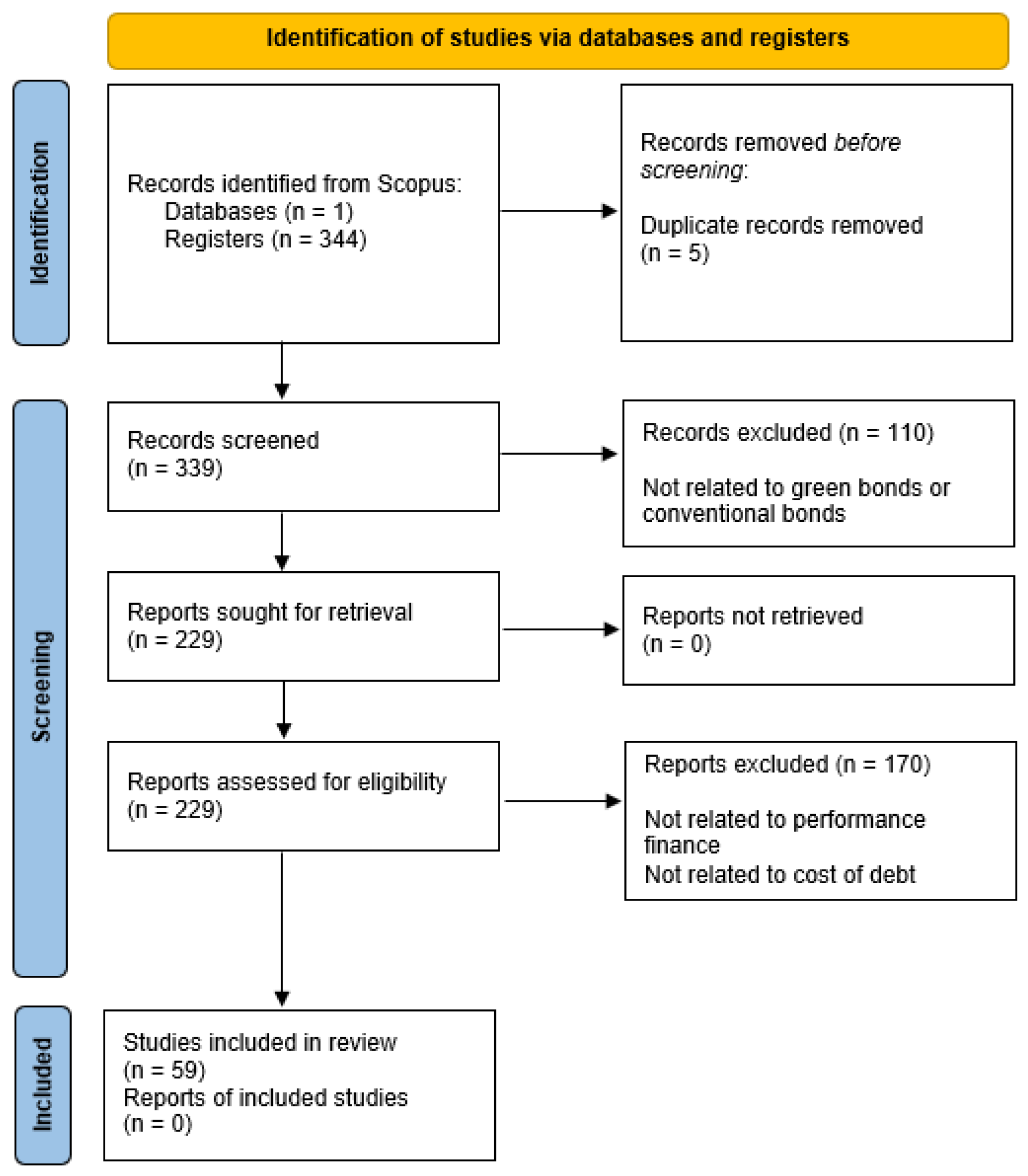
The initial search in the Scopus database identified 344 articles and literature reviews related to the topic of interest (Figure 1). The selection of articles occurred in two stages: the first, called the initial screening, involved reading and evaluating the titles, abstracts, and keywords of the articles, resulting in the exclusion of 5 duplicate articles and another 312 that did not specifically address the green bonds, conventional bonds, performance finance or cost of debt.
In the second stage, called detailed screening, we performed a full-text review of the remaining 229 articles. At this stage, predefined screening criteria were applied to ensure that only studies meeting the scope of the review were included. The criteria varied according to the specific research stream:
  • Green bonds and financial performance: studies were included if they examined corporate issuers of green, sustainable, climate, or environmental bonds; measured financial performance outcomes such as return on assets (ROA), return on equity (ROE), EBITDA, profitability ratios, stock returns, or market valuation; included a comparison group of conventional bond issuers or non-issuers; employed empirical quantitative methods (experimental, quasi-experimental, or observational designs); relied on financial data from publicly traded companies or firms with accessible information; maintained a corporate-level focus rather than sovereign or municipal issuers; emphasized financial outcomes rather than exclusively environmental or social dimensions; and conducted firm-level analyses of financial performance rather than focusing solely on bond pricing or market-level indicators. Purely theoretical papers, descriptive reports, or opinion pieces were excluded.
  • Green bonds and cost of debt (Greenium): studies were included if they examined corporate green bond issuers; incorporated a comparison group of non-issuers or conventional bond issuers; measured cost of debt outcomes such as bond pricing, yield spreads, Greenium, or green premium; employed empirical quantitative analysis; originated from peer-reviewed journals or reports from established financial organizations; explicitly measured financial metrics rather than exclusively environmental or social outcomes; provided firm-level analyses of financial impacts rather than market development or policy-level perspectives; and offered comparative analysis beyond single-firm or single-issuance case studies.
In both research streams, all criteria were considered jointly, and inclusion decisions were based on a holistic judgment about the study’s relevance and methodological rigor. A summary of the screening checklist, calibration procedure, and inter-rater protocol is provided in Appendix C, enhancing transparency and reproducibility in accordance with PRISMA 2020 and ensuring traceability of the inclusion process. After this stage, 59 articles were confirmed as suitable and constituted the final corpus of the bibliometric and review analyses.
Finally, for the structured analyses, the open-source software RStudio was used, employing the bibliometrix package (Aria & Cuccurullo, 2017). Details on the software environment, data exports, and versioning of R packages used in this study are provided in Appendix B to ensure reproducibility of the bibliometric and coding procedures. Figure 2 summarizes the steps taken in constructing this review.

Classification and Coding

We developed a standardized methodology for the classification and coding of articles, drawing on the frameworks proposed by Jabbour (2013); Junior and Godinho Filho (2010); Seuring (2013). This approach led to the construction of a detailed classification table designed to systematically capture the main characteristics of each study. The classification scheme includes 10 categories, numbered from 1 to 10. We also code each classification with letters (A, B, C, etc.). Thus, this classification system involves an aggregation of numbers and letters. We should note that an article may be associated with multiple codes for a given item.
Table 2 presents the classification structure and the codes used, while Table 3 provides the complete list of articles that compose the sample and their classification across the various listed items.
The classification scheme covers ten dimensions. Type of Study distinguishes empirical, theoretical, systematic reviews, and case studies, while Type of Approach separates quantitative, qualitative, and mixed methods. Main Research Topic identifies the focus, including green bonds, conventional bonds, financial performance, cost of debt, or comparative analyses. Analytical Method captures the techniques employed, such as regression models, Propensity Score Matching (PSM), Difference-in-Differences (DID), panel analysis, or event studies. Data Source specifies information origins, ranging from financial statements and annual reports to databases such as S&P Capital IQ, Refinitiv LSEG, or Bloomberg. Industry/Sector indicates whether the study spans all sectors or emphasizes specific domains such as energy, high-emission industries, financial services, or infrastructure.
Country/Region records the geographical scope, distinguishing global, developed, and emerging markets, or specific regions such as Europe, Latin America, and Asia. Performance Indicators include financial outcomes such as ROE, ROA, EBITDA, stock price, cost of debt, credit or ESG ratings, and valuation multiples. Comparison Scheme identifies the reference group, contrasting issuers with non-issuers, green with conventional bonds, or pre- and post-issuance periods. Finally, Bias Control/Robustness Techniques capture methods used to ensure validity, including Propensity Score Matching, Difference-in-Differences, generalized matching, instrumental variables, or placebo tests. Together, these dimensions provide a structured basis for systematic synthesis and cross-study comparison.
To ensure internal consistency during the coding phase, multi-market studies—those including both developed and emerging economies—were classified as “global” when their empirical design did not allow disaggregated attribution of results by region. When separate regional subsamples or comparative analyses were provided, the observations were coded individually according to the market category (developed or emerging) reported in the study. This procedure preserved comparability while avoiding double counting.
Regarding methodological design, event-study-only articles that exclusively examined short-term stock market reactions to green bond announcements were coded under the “market reaction” dimension within the financial performance stream. Only studies that also included firm-level accounting outcomes (e.g., ROA, ROE, EBITDA) were jointly classified under “financial performance.” This differentiation allows the synthesis to separate valuation effects captured by abnormal returns from accounting-based measures of performance, thereby improving construct validity.
To assess the reliability of the ten-dimensional coding framework, we conducted an inter-coder agreement check on a random 20% subsample of the corpus (12 articles). The results indicated substantial concordance across dimensions, with Cohen’s κ = 0.78 , consistent with the “substantial agreement” range (0.61–0.80) according to Landis and Koch (1977). Minor disagreements, mostly related to sectoral and regional tags, were resolved through discussion.
To enhance the replicability of the taxonomy, an additional Appendix D provides concise definitions for potentially overlapping categories, clarifying how specific sectors and regional groups were coded. For example, the “infrastructure” category encompasses transportation-related assets such as highways, railways, ports, and airports, while “energy” captures generation, distribution, and renewables—separated due to their prominence in green bond financing. Similarly, studies covering both developed and emerging markets without disaggregated results were coded as “global.” These clarifications reinforce transparency and facilitate reuse of the framework by other researchers.

4. Results

4.1. General Characteristics of the Studies

The bibliometric analysis identified 59 documents published between 2019 and 2025, distributed across 44 journals and produced by 175 authors. The field exhibits an average annual growth rate of 46.78%, indicating rapid expansion and consolidation of the topic in the literature. International collaboration accounts for 30.5% of the total, reflecting a research network of transnational scope. The average number of co-authors per article is 3.08, highlighting the predominance of collaborative works, while only one study was conducted individually. The articles have an average age of 1.9 years and accumulate an average of 22.7 citations, suggesting relevant scientific impact in a relatively short period of time (Table 4).
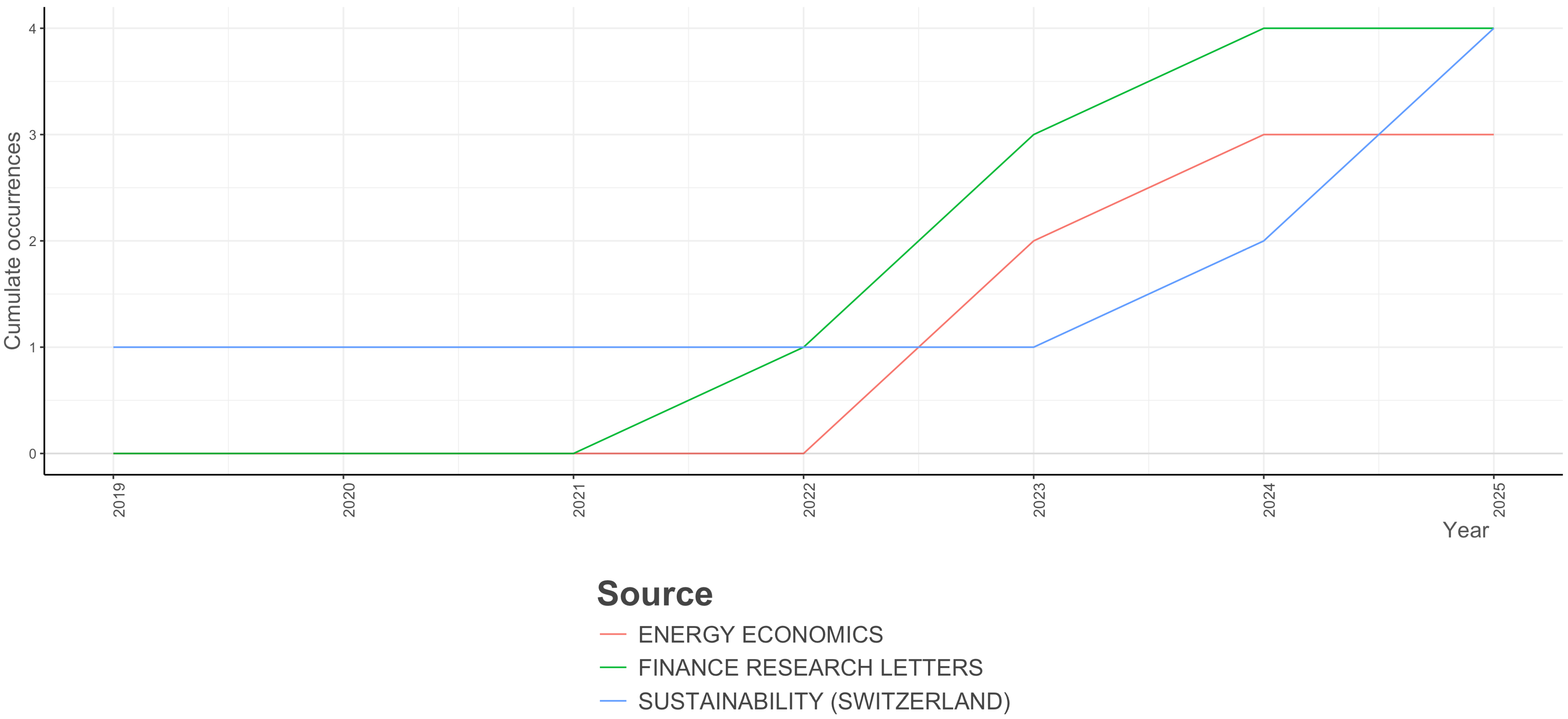
The dynamics of sources’ production over time (Figure 3) reveal that the literature on green bonds and financial performance has gained visibility only in recent years, with most outlets beginning to accumulate publications from 2022 onwards. The leading journals are Finance Research Letters and Sustainability (Switzerland), followed by Energy Economics. This pattern indicates both the interdisciplinary character of the field—spanning finance, applied economics, and environmental studies—and the still fragmented nature of the literature, as no single outlet concentrates a dominant share of publications.
At the geographical level, the distribution by the country/region of the first author’s affiliation (Table 5) shows the prominent leadership of China, followed by France and India, along with consistent contributions from the United States, Spain, the United Kingdom, Canada, and South Korea. The remaining countries, grouped under the category “Others,” account for 18 articles, reflecting both the concentration of production in a few central hubs and the increasing regional diversification of research.
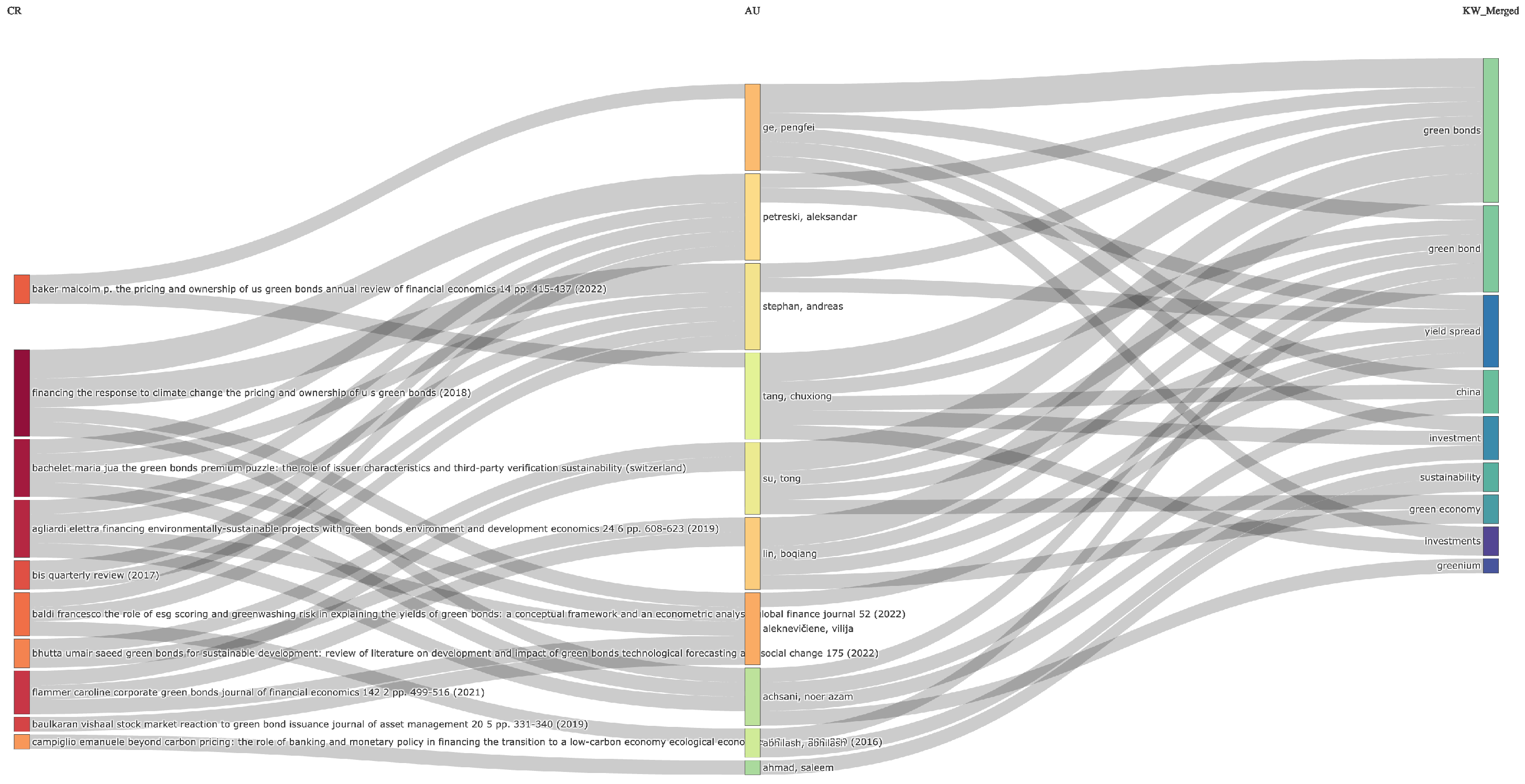
The three-field plot (Figure 4) highlights the connection between key references, authors, and keywords. The main foundational studies include Baker et al. (2022); Flammer (2020) which are strongly linked to authors such as Tan et al. (2022) and Su et al. (2023). On the thematic side, prominent terms include green bonds, Greenium, yield spread, and event study, which are organized into three axes: (i) the impact of green bonds on firms’ financial performance; (ii) the cost of debt and differentiated pricing (Greenium and yield spread); and (iii) institutional and governance factors, such as public policies and disclosure. These clusters indicate that the literature has evolved from direct impact analyses toward approaches that incorporate regulatory and sectoral variables.
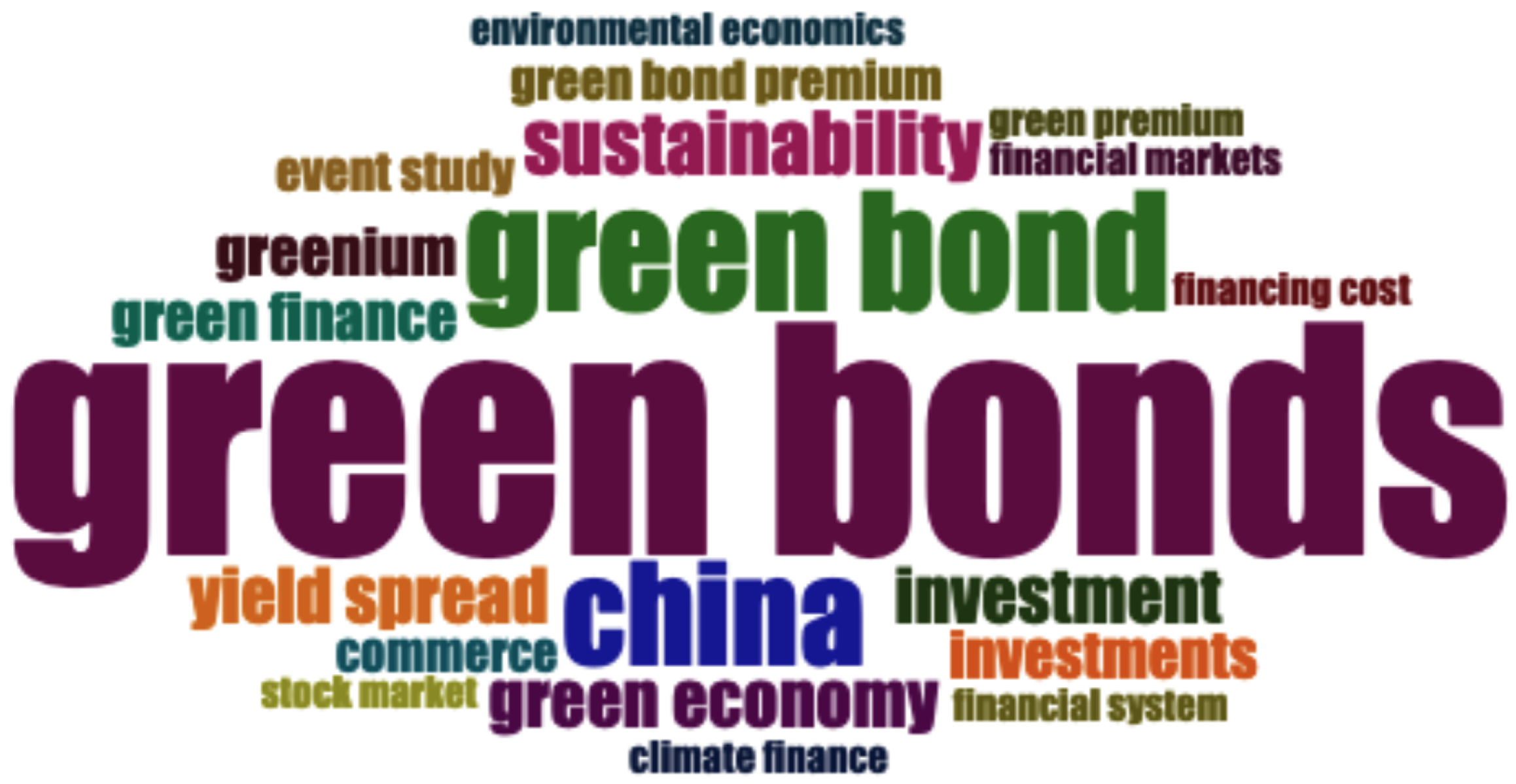
The keyword analysis confirms the centrality of terms such as green bond, investment, green economy, and financial markets, along with the recurrence of “China” as a major research hub (Figure 5).
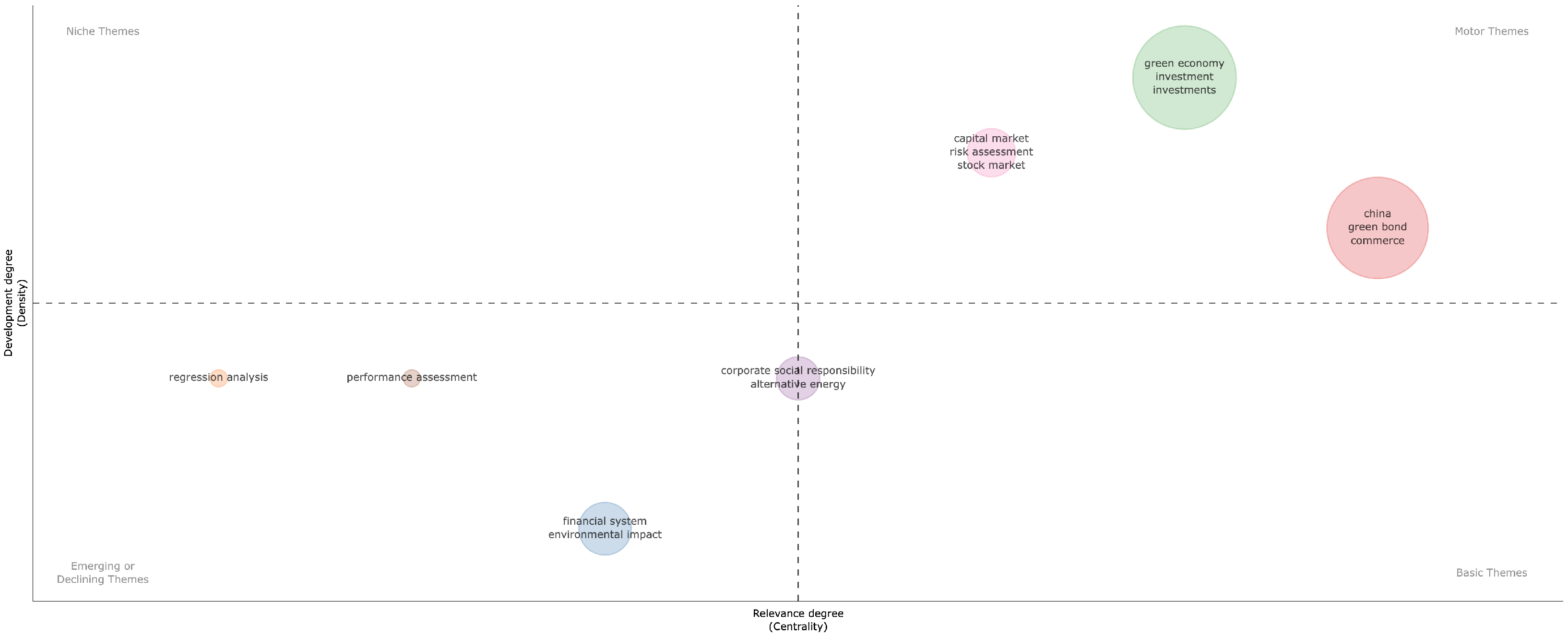
The thematic map (Figure 6) reinforces this pattern, highlighting two groups of driving themes: on one side, green economy, investment, and investments, associated with the expansion of the literature on performance and sustainability; on the other, green bond and commerce, which structure the core of debates on pricing and diffusion of these instruments. In contrast, topics such as financial system and environmental impact appear as basic themes, supporting the agenda without high developmental density, while regression analysis and performance assessment emerge as developing topics, still in consolidation. Taken together, these results indicate that research on green bonds and financial performance has advanced rapidly but still presents opportunities for methodological maturation and integration with institutional and environmental dimensions.
To complement these results, the corpus analyzed comprises 59 peer-reviewed articles published between 2019 and 2025, with a median publication year of 2023 and an interquartile range (IQR) of 2022–2024, confirming the recent and rapidly expanding nature of this research field. Geographically, production is highly concentrated: China accounts for approximately 35% of total publications, followed by the United Kingdom (4%) and India (3%), while the United States (3%) and France (2.5%) complete the top five contributors. Together, these countries represent about 60% of the entire corpus, reflecting their central role in advancing the topic. In terms of dissemination outlets, Finance Research Letters and Sustainability (Switzerland) are the most prolific journals (four articles each), followed by Energy Economics (three) and both Applied Economics Letters and Business Strategy and the Environment (two each). Collectively, these five journals account for roughly one-quarter of all publications.
When results are aggregated by continent, a clearer regional pattern emerges: Asia (dominated by China and India) accounts for nearly 45% of all publications, Europe (including the United Kingdom and France) represents about 30%, and the Americas (mainly the United States and Canada) contribute approximately 15%. The remaining 10% of studies originate from other regions, notably Africa and Oceania. This continental framing provides a more balanced interpretation of research activity and mitigates the risk of overinterpreting country/region-level differences within a relatively small corpus. These regional aggregates also reinforce the concentration of scholarly output in Asia and Europe, which together account for roughly three-quarters of all green bond research to date. Such consolidation offers a reliable descriptive basis for the classification and coding analyses presented in the next section.

4.2. Classification of Articles

The analysis of the 59 articles through the classification table (Table 3) shows that the literature on green bonds related to financial performance and Greenium is predominantly empirical and quantitative. In terms of focus, two major blocks stand out: around 55% of the studies investigate cost of debt/Greenium, 35% financial performance, and the remainder address disclosure, ESG, and innovation. For this purpose, the techniques most frequently employed include econometric regressions, panel analysis, Propensity Score Matching (PSM), Difference-in-Differences (DID), and event studies. The main data sources are Bloomberg/Refinitiv/S&P Capital IQ and corporate reports when referring to studies focused on developed markets, Europe, and Latin America. In Asia (mainly China and Korea), local financial databases such as CSMAR/Wind are used.
Sector-wise, most studies are multi-sectoral (45%), with specific emphasis on energy (20%), infrastructure (15%), and financial services (10%). Geographically, China/emerging Asia accounts for 45% of the studies, Europe 30%, the United States 15%, and only 10% are global studies, with a marked absence of research on Latin America and Africa. The most widely used indicators are cost of debt/yield spread (40%), ROA/ROE/Tobin’s Q (30%), and stock prices (20%). Comparison schemes are concentrated in green vs. conventional bonds (50%), issuers vs. non-issuers (30%), and pre- vs. post-issuance (20%). Finally, the most common bias control techniques are PSM (40%), DID (30%), placebo tests (20%), and instrumental variables (10%).
From this panorama, it is possible to detail important patterns. In studies on financial performance, the dominant methods are panel econometrics and DID, almost always combined with PSM to control for selection bias. Event studies stand out in works that measure market reactions (stock prices), using abnormal return metrics (AR, CAR, CAAR). In studies on cost of debt/Greenium, cross-section regressions, panel analyses, and comparisons of green vs. conventional bonds prevail, with frequent use of robustness tests (to address endogeneity in spreads), placebos, and alternative specifications. Other themes (ESG, disclosure, shade of green, and innovation) exhibit greater methodological diversity, ranging from GMM models to descriptive analyses. These articles generally deal with qualitative variables such as reputation, environmental ratings, or external certification, incorporated into traditional regressions.
The data sources follows this segmentation. Research on bond pricing relies almost exclusively on Bloomberg, Refinitiv, and S&P Capital IQ, while corporate performance studies draw on CSMAR, Wind, and accounting databases such as Worldscope/Compustat. Annual and sustainability reports are used mainly in analyses of disclosure and greenwashing. In sectoral terms, “all sectors” samples dominate, but in emerging markets there is a clear concentration in energy and infrastructure, which are central to the energy transition. In developed markets, the financial sector gains prominence, either through the direct issuance of green bonds by banks or through studies analyzing their pricing role.
Performance indicators confirm this duality. For corporate performance, the most common are ROA, ROE, EBITDA, and Tobin’s Q, in addition to stock prices in event studies. For Greenium/cost of debt, the predominant measures are yield spread, z-spread, and credit ratings, often accompanied by liquidity proxies. Comparison schemes also reflect this division: green bonds vs. conventional bonds is the most recurrent strategy to identify Greenium; issuer vs. non-issuer is typical in corporate performance studies; and pre- vs. post-issuance is applied in regulatory or policy shock settings (panels with DID). In bias control, PSM is widely applied in corporate performance studies to balance groups (issuers and non-issuers), while DID becomes central in contexts with temporal or regulatory shocks. In pricing, authors prioritize placebos and alternative specifications.
Bias control is essential for the robustness and validity of the studies. PSM is mainly applied in corporate performance research, allowing the creation of comparable groups between issuers and non-issuers. DID is frequent in studies analyzing regulatory shocks, policy changes, or the temporal effects of issuance. Placebo and falsification tests are mostly used in pricing studies to verify the consistency of event windows or alternative specifications. Finally, instrumental variables appear on a smaller scale but are relevant in works dealing with severe endogeneity in issuance spreads.
The combination of the classification findings allows the identification of structural patterns. Studies on financial performance in emerging countries, especially in energy and infrastructure sectors, tend to employ DID combined with PSM, using ROA, ROE, and Tobin’s Q as indicators and relying on CSMAR and Wind as data sources. In developed countries, performance analysis is less frequent, but when present, it relies on Worldscope/Compustat, focusing on financial or multi-sectoral samples, with indicators such as EBITDA and stock prices. Research on cost of debt in developed markets, mainly in Europe and the U.S., prefers analyses of pairs of green vs. conventional bonds, estimated through regressions and placebo tests as the main robustness instruments, using Bloomberg and Refinitiv data. In contrast, in emerging markets, especially in China, cost of debt studies draw on CSMAR/Wind, applied to energy and infrastructure sectors, and adopt similar regression and panel methodologies. When the topic is the stock market in emerging economies, event studies predominate, centered on abnormal returns around issuance announcements. Finally, studies on credibility, disclosure, and shades of green are concentrated in Europe, using yield spread, ESG ratings, and external certifications as metrics.
Stock market studies predominantly use event studies, focusing on abnormal returns (AR, CAR, CAAR) around issuance announcements. These works are concentrated in emerging markets, particularly in China, use CSMAR/Wind data, and adopt stock prices as the main performance indicator. The results suggest that stock markets respond differently to green bond issuance, being more sensitive in non-financial sectors and in the context of environmental policies. In parallel, there is a smaller but relevant group of studies exploring ESG performance (ESG ratings) in relation to cost of debt and the credibility of issuances. These works are concentrated in developed markets, especially in Europe and Nordic countries, where external certification and the shade of green are more thoroughly examined. The most frequently used performance indicator in this case is the yield spread, often accompanied by ESG rating as an explanatory variable. Although less numerous, these studies reinforce that the credibility of the green label directly influences bond pricing.
Finally, the classification and coding table highlights clear research gaps: (i) the absence of robust studies on Latin America; (ii) the under-exploration of infrastructure sectors outside energy; (iii) limited investigation into the impact of green bonds on long-term metrics such as market value; and (iv) the need for analyses combining financial metrics with ESG indicators across different institutional contexts.

5. Discussion

The rapid growth of the green bond market has prompted significant research into whether issuing green (sustainable, climate, or environmental) bonds confers financial advantages to firms compared to issuing conventional bonds or not issuing bonds at all. Studies consistently report that green bond issuance can lead to positive short-term stock market reactions and improvements in certain financial metrics such as profitability, operational performance, and innovation capacity, particularly in emerging markets like China (Y. Li et al., 2023; Yeow & Ng, 2021; X. Zhou & Cui, 2019).
However, the evidence for long-term financial outperformance is mixed, with some studies finding that the positive effects weaken over time or are not statistically significant in developed markets (Flammer, 2020; Khurram et al., 2023; Lebelle et al., 2020). The impact also appears to be influenced by firm characteristics (e.g., size, ownership, ESG performance) and market context (developed vs. emerging markets) (Sisodia et al., 2022). While green bonds can improve ESG scores and attract institutional investors, concerns about greenwashing and the need for third-party certification remain (Flammer, 2020).
Considering a lower cost of debt, often referred to as the “Greenium” or “Green premium”, a substantial body of research finds that green bond issuance is typically associated with lower yield spreads and reduced financing costs compared to conventional bonds, especially when green certification and high-quality environmental disclosure are present (Agliardi & Agliardi, 2019; Dorfleitner et al., 2022). The size of this cost advantage varies across markets and sectors, with some studies reporting a more pronounced Greenium in emerging markets and for corporates with strong ESG credentials (Ballester et al., 2024; Grishunin et al., 2023).
However, not all research finds a significant or persistent Greenium, and some studies highlight that the effect may diminish over time or be absent for certain issuers, such as financial institutions (Tang et al., 2023). Additionally, green bond issuance is linked to broader positive outcomes, including improved ESG performance, innovation, and credit quality, though the evidence on long-term financial performance is mixed and context-dependent (Hu et al., 2022).

5.1. Green Bonds and Finance Performance

Empirical evidence suggests that stock prices often react positively to green bond announcements, indicating perceived value creation for shareholders (Cioli et al., 2021; Flammer, 2020; Makpotche et al., 2024; Sisodia et al., 2022; Su et al., 2023; Xi & Jing, 2022; Y. Zhang et al., 2024; X. Zhou & Cui, 2019). However, some international studies find negative or neutral short-term abnormal returns, particularly for first-time issuers or in developed markets, possibly reflecting investor uncertainty or concerns about overinvestment (Lebelle et al., 2020). The positive effects are more pronounced for certified bonds and in emerging markets (Ahmad & Mokhchy, 2023; Khurram et al., 2023; Kodiyatt et al., 2024; Y. Zhang et al., 2024; X. Zhou & Cui, 2019).
The impact of green bond issuance on core profitability metrics (ROA, ROE, EBITDA) is mixed (Aleknevičiene & Vilutytė, 2024; Jiang et al., 2022; Y. Li et al., 2023; Muhammad et al., 2025; Petreski et al., 2025; Sheng & Montgomery, 2025; Xi & Jing, 2022). Some studies find modest improvements in profitability and operational performance, especially in the short term or when green bonds are certified (Yeow & Ng, 2021; X. Zhou & Cui, 2019). Others report no significant effect, or that any positive impact is unsustained and may be offset by the costs of green investments (Lichtenberger et al., 2022). The effect is often stronger for non-state-owned, smaller, or innovative firms.
Certification by third parties and strong ESG performance amplify the positive financial effects of green bond issuance (Fan et al., 2023; Jiang et al., 2022; Lichtenberger et al., 2022; Yeow & Ng, 2021). Green bonds also tend to improve ESG scores, innovation, and access to capital, which can indirectly benefit financial performance (Yeow & Ng, 2021). However, concerns about greenwashing and market immaturity can limit these benefits, and in some cases, green bond issuance is used more for reputational or regulatory reasons than for direct financial gain (Lichtenberger et al., 2022; Taghizadeh-Hesary et al., 2021).

5.2. Green Bonds and Cost of Debt “Greenium”

Multiple studies using regression analysis (most common), Propensity Score Matching, Difference-in-Differences and panel analysis, consistently find that green bonds are issued at lower yields than comparable conventional bonds, resulting in a Greenium typically ranging from 1 to 63 basis points (Baker et al., 2022; Baldi & Pandimiglio, 2022; Grishunin et al., 2023; Hu et al., 2022; Lian & Hou, 2024; Lichtenberger et al., 2022; Löffler et al., 2021). This effect is robust across primary and secondary markets, with some studies noting a larger Greenium at issuance that may narrow in secondary trading (Lichtenberger et al., 2022). The Greenium is generally more pronounced for corporate and supranational issuers than for financial institutions (Chan & Liao, 2025; Kim & Ahn, 2022).
Third-party certification, high-quality environmental disclosure, and frequent issuance are associated with larger Greenium effects, as these factors reduce information asymmetry and greenwashing concerns (Baldi & Pandimiglio, 2022; Dorfleitner et al., 2022; Hu et al., 2022; Q. Li et al., 2022; Nanayakkara & Colombage, 2021; Xu et al., 2023). Infrequent issuers and those lacking certification tend to pay higher yields (Chan & Liao, 2025; Petreski et al., 2025).
Not all studies find a significant Greenium. Some report negligible or even negative effects, particularly for financial institutions or in certain markets (Devine & McCollum, 2022; Sheng & Montgomery, 2025). Survey evidence suggests that while many issuers experience lower funding costs, a substantial minority report no difference or even higher costs due to additional reporting and certification requirements (Aleknevičiene et al., 2025; Cao et al., 2021; Dutordoir et al., 2024; Muhammad et al., 2025; Su et al., 2023; Tang et al., 2023). Market context, sample selection, and methodology contribute to these mixed findings.
Green bond issuance is also linked to improved ESG performance, reduced credit risk (especially in environmentally exposed sectors), and enhanced firm reputation (Grishunin et al., 2023). However, the direct impact on cost of debt remains the primary channel of financial benefit, with secondary effects on stock returns and institutional ownership (Devine & McCollum, 2022; Q. Li et al., 2022).
Supportive policy interventions (such as People’s Bank of China collateral eligibility, government declarations) and macroeconomic factors (oil prices, interest rates) were reported to amplify the Greenium (Hyun et al., 2023; Kim & Ahn, 2022; Lian & Hou, 2024; Macaire & Naef, 2023; D. Zhou & Kythreotis, 2024).
The Greenium was reported to fluctuate over time, disappearing during periods of market stress (such as COVID-19) and reappearing post-policy interventions (Hyun et al., 2023; Kim & Ahn, 2022; D. Zhou & Kythreotis, 2024).

5.3. Green Bonds and Short and Long-Term Financial Outcomes

Short-term financial outcomes, particularly around the announcement of green bond issuance, are mixed. Several event studies find that stock markets may react negatively or neutrally to green bond announcements, with cumulative abnormal returns ranging from −0.5% to −0.2% in the days surrounding the announcement (Lebelle et al., 2020). This effect is more pronounced for first-time issuers and in developed markets, suggesting that investors may initially perceive green bond issuance as a signal of increased risk or dilution (Lebelle et al., 2020). However, other studies find positive or neutral short-term stock price reactions, especially in markets with strong environmental regulation or high investor demand for sustainable finance (Taghizadeh-Hesary et al., 2021; X. Zhou & Cui, 2019).
In the long term, green bond issuance is associated with improved firm value, profitability, and operational performance, particularly when funds are allocated to genuine green projects and when bonds are externally certified (Badía et al., 2024; Jiang et al., 2022; Makpotche et al., 2024; Petreski et al., 2025; Sheng & Montgomery, 2025; X. Zhou & Cui, 2019). Studies using Difference-in-Differences and Propensity Score Matching approaches show that green bond issuers experience higher internal rates of return, better debt service coverage, and enhanced innovation capacity compared to conventional bond issuers and non-issuers (Y. Li et al., 2023; Muhammad et al., 2025; H. Wang et al., 2023). These benefits are more pronounced in regions with strong environmental regulation and for firms with high ESG ratings (Baldi & Pandimiglio, 2022; H. Ge, 2025; Nair et al., 2022).
Green bonds tend to offer lower volatility and superior risk-adjusted returns (e.g., Sharpe ratios) compared to conventional bonds, making them attractive for portfolio diversification, especially during periods of market uncertainty or crisis (Agliardi & Agliardi, 2019; Lichtenberger et al., 2022; Yeow & Ng, 2021). However, the efficiency and volatility persistence of green bond markets can vary, with some studies noting higher inefficiency or volatility during crises such as COVID-19 620. Green bonds also serve as effective hedges and safe havens in portfolios, particularly for assets with high carbon footprints (Agliardi & Agliardi, 2019).

5.4. Green Bonds and Developed and Emerging Markets Effects

The positive performance financial effects of green bond issuance are generally more pronounced in emerging markets, such as China, where green bonds can improve firm value, innovation, and ESG performance (Sisodia et al., 2022; Yeow & Ng, 2021; X. Zhou & Cui, 2019).
In developed markets, the effects are less consistent, with some studies reporting negative or insignificant stock market reactions and increased credit risk for certain sectors (Glavas, 2023; Lebelle et al., 2020). Factors such as firm leverage, growth opportunities, and ESG scores can moderate these effects.
The Greenium effect and financial outcomes of green bond issuance differ between developed and emerging markets. Emerging markets often exhibit a larger Greenium, possibly due to higher information asymmetry and greater investor demand for credible green projects (Abhilash et al., 2024; Ballester et al., 2024; Fang et al., 2023; Grishunin et al., 2023; Hu et al., 2024; Kim & Ahn, 2022; Q. Li et al., 2022; Lian & Hou, 2024; Nurvita et al., 2024; P. Wang & Lu, 2024; Xu et al., 2023).
Developed markets, while still showing a Greenium, may experience a smaller or less persistent effect, and the market reaction to green bond announcements can be negative or neutral, especially for repeat issuers (Aleknevičiene et al., 2025; Baker et al., 2022; Devine & McCollum, 2022; Fandella & Cociancich, 2024; Grishunin et al., 2023; Löffler et al., 2021; Petreski et al., 2025).
Overall, these mixed and context-dependent findings illustrate the complexity of the financial mechanisms surrounding green bond issuance. To consolidate these insights and align them with the objectives of this review, the following synthesis organizes the evidence in light of the four research questions (Q1–Q4).
Regarding Q1, the field is methodologically convergent, relying predominantly on econometric analyses—especially panel regressions, event studies, and quasi-experimental designs such as PSM and DID—although replication across markets remains limited. For Q2, the literature displays partial consensus: most studies report positive short-term market reactions and modest but significant yield advantages (Greenium) for certified or transparent issuers, yet evidence on accounting-based indicators (ROA, ROE, EBITDA) remains mixed and context-dependent.
Addressing Q3, geographical heterogeneity is pronounced: developed markets, notably Europe and the United States, exhibit smaller or short-lived financial effects, whereas emerging markets, particularly China and India, tend to show stronger improvements in valuation and debt costs.
Finally, in response to Q4, certification, disclosure quality, sectoral focus, and issuer type consistently appear as moderating mechanisms. Certified bonds and those issued by firms in energy and infrastructure sectors with high ESG transparency display larger and more persistent benefits, while financial institutions and non-certified issuers often exhibit null or inconsistent effects. This synthesis clarifies where the literature converges, where uncertainty persists, and how contextual factors condition outcomes—offering a basis for future hypothesis testing and comparative empirical designs.

6. Conclusions

The literature consistently shows that green bond issuance can generate financial advantages for firms, though these benefits are modest and highly context-dependent. Evidence points to improvements in stock market performance, reductions in the cost of debt, and in some cases, enhanced risk-adjusted returns. However, impacts on traditional profitability measures such as ROA or ROE remain mixed, highlighting that the value of green bonds is not uniformly reflected across all financial indicators.
A recurring finding across studies is the presence of a “Greenium,” or lower yields on green bonds compared to conventional bonds. This effect, however, is heterogeneous. It tends to be more pronounced among corporates and supranationals, particularly when bonds are supported by third-party certification and transparent disclosure. These conditions strengthen investor confidence and contribute to more consistent pricing advantages.
Short- and long-term outcomes also diverge. While immediate market reactions can be neutral or even negative, longer horizons often reveal modest but meaningful financial gains for issuers. These include improved valuation, reputational benefits, and lower financing costs, provided that the issuance is credible and aligned with sustainability goals. The durability of these advantages depends heavily on market structure, investor expectations, and the robustness of the firm’s sustainability practices.
Finally, geographic context plays a critical role. In emerging markets, certified green bonds appear particularly effective in lowering the cost of debt and attracting investors, while in developed markets, the effects are more variable and sometimes limited. Evidence also suggests that repeated issuances tend to amplify financial benefits, that sectoral differences matter—especially for state-owned enterprises, banks, and highly polluting industries—and that supportive policy and regulatory frameworks can strengthen the presence of the Greenium. Across all contexts, however, risks of greenwashing and inconsistent disclosure remain central concerns. The literature therefore underscores the importance of credible certification, transparent communication, and strong governance as prerequisites for realizing the financial and sustainability potential of green bonds.

Research Gaps and Future Directions

Although the literature on green bonds has expanded considerably in recent years, important gaps remain regarding their long-term financial implications. While short-term effects have been relatively well documented, evidence on whether the issuance of green bonds translates into sustained improvements in firm performance, value creation, or risk-adjusted returns over time is still limited. This lack of clarity raises questions about the durability and consistency of the financial benefits often attributed to green financing.
Another area requiring further investigation is the persistence and heterogeneity of the Greenium across markets, issuers, and bond types. While several studies identify lower yields for green bonds compared to conventional instruments, the stability of this effect remains uncertain. In particular, more research is needed to examine how certification standards, disclosure quality, and evolving investor preferences influence the magnitude and persistence of the Greenium.
The role of certification and disclosure also represents a significant research gap. Although third-party verification and high-quality reporting are frequently associated with stronger financial outcomes, the mechanisms through which these practices enhance credibility and reduce information asymmetry remain underexplored. Moreover, the evolution of certification standards and their differential impacts across sectors and issuer types deserve greater scholarly attention.
Also, geographic and institutional diversity in the literature is still limited. Existing studies focus heavily on Europe and China, while emerging markets and less-studied regions receive comparatively little attention. Similarly, the evidence for non-corporate issuers—such as municipalities, sovereigns, and supranationals—remains fragmented. Future research could also benefit from examining the comparative effects for non-issuers, as well as the influence of varying regulatory and institutional environments on the financial and sustainability outcomes of green bond issuance.
Building on these gaps, future research should prioritize a deeper investigation of green bond issuance in emerging markets beyond China, particularly in Latin America and Brazil, where institutional dynamics, investor bases, and regulatory frameworks may yield distinct outcomes. Such analysis should also consider sectoral heterogeneity, comparing the experiences of banks, highly polluting firms, and companies in the process of energy transition that increasingly incorporate clean energy into their operations.
Greater attention should be devoted to long-term effects, as most existing studies remain focused on short-term or event-driven analyses, leaving the durability of financial benefits largely unexplored. Furthermore, expanding the range of financial performance indicators under consideration—moving beyond traditional measures such as ROA and ROE to include stock price dynamics, market valuation, EBITDA margin, operating margin, net profit margin, cash flow from operations, cost of debt, and other risk-adjusted metrics—could provide a more comprehensive understanding of the financial implications of green bond issuance.
Another important point, special emphasis should be placed on the role of third-party certification, as credible verification and disclosure practices are critical to reducing information asymmetry, mitigating the risk of greenwashing, and ensuring that observed financial outcomes are truly linked to sustainable finance commitments. Addressing these dimensions would not only advance the academic debate but also contribute to a more nuanced evaluation of how sustainable finance instruments shape firm performance, market development, and investor behavior.
Beyond identifying conceptual gaps, future research should also advance methodologically. Multi-market matched panel designs that combine bond pricing data from Refinitiv or Bloomberg with firm-level fundamentals from Compustat or Worldscope could help assess the persistence of Greenium and profitability effects across institutional contexts. Pre-registered event studies with standardized announcement windows would improve comparability of short-term reactions, while Difference-in-Differences (DID) frameworks centered on regulatory or disclosure shocks—such as the EU Taxonomy, Climate Bond Initiative certifications, or new ESG reporting mandates—could isolate causal mechanisms. Applying Propensity Score Matching (PSM) alongside DID would further mitigate selection bias in issuer samples.
Finally, longitudinal research should explore how evolving disclosure frameworks and certification standards affect the trajectory of financial and ESG outcomes over time. Integrating firm-level ESG ratings, environmental risk exposures, and financial indicators into unified datasets would enable more sophisticated analyses of transmission channels between sustainable finance and corporate value. By specifying these feasible and data-driven research designs, future work can transform the current descriptive evidence base into a cumulative and testable body of knowledge on the financial dynamics of green bonds.

Author Contributions

Conceptualization, R.R.L.; methodology, R.R.L.; software, R.R.L.; validation, H.K. and L.d.M.S.; formal analysis, R.R.L.; investigation, R.R.L.; resources, R.R.L.; data curation, R.R.L.; writing—original draft preparation, R.R.L.; writing—review and editing, H.K. and L.d.M.S.; visualization, R.R.L.; supervision, H.K. and L.d.M.S.; project administration, R.R.L. All authors have read and agreed to the published version of the manuscript.

Funding

This research received no external funding.

Institutional Review Board Statement

Not applicable.

Informed Consent Statement

Not applicable.

Data Availability Statement

No new data were created or analyzed in this study. Data sharing is not applicable to this article.

Acknowledgments

During the preparation of this manuscript, the authors used DeepL Translator (version current as of 2025) to translate the text from Portuguese to English, and OpenAI ChatGPT (GPT-5) to refine the fluency and linguistic clarity of author-written sentences during the translation and text editing process (grammar, structure, spelling and punctuation). These uses are not covered by the MDPI policy and do not require formal declaration; however, they are disclosed here for transparency, in accordance with MDPI’s guidelines on the ethical use of AI tools. The authors have reviewed and edited all content and take full responsibility for the final version of the manuscript.

Conflicts of Interest

The authors declare no conflicts of interest.

Abbreviations

The following abbreviations are used in this manuscript:
ARAbnormal Return
CAARCumulative Average Abnormal Return
CARCumulative Abnormal Return
CSMARChina Stock Market & Accounting Research (database)
DIDDifference-in-Differences
EBITDAEarnings Before Interest, Taxes, Depreciation, and Amortization
ESGEnvironmental, Social, and Governance
EUEuropean Union
EU GBSEU Green Bond Standard
GBPGreen Bond Principles
GMMGeneralized Method of Moments
ICMAInternational Capital Markets Association
LSEGLondon Stock Exchange Group
MDPIMultidisciplinary Digital Publishing Institute
PRISMAPreferred Reporting Items for Systematic Reviews and Meta-Analyses
PSMPropensity Score Matching
ROAReturn on Assets
ROEReturn on Equity
S&PStandard & Poor’s (e.g., S&P Capital IQ)
SECU.S. Securities and Exchange Commission
WindWind Financial Database (China)
Z-SPREADZero-volatility spread

Appendix A. Search Queries (Verbatim)

All searches were executed in Scopus in September 2025; fields limited to Title–Abstract–Keywords; language: English; document type: Article or Review; years: 2019–2025.
Query A—Performance finance and Green bonds
TITLE-ABS-KEY((“green bond*” OR “greenbond*” OR “conventional bond*”
OR “vanilla bond*”) AND
(“performance finance” OR “performance” OR “profitability”
OR “ROA” OR “ROE” OR “EBITDA” OR “Tobin’s q”
OR “valuation” OR “stock return*”))
AND PUBYEAR > 2018 AND PUBYEAR < 2026
AND (LIMIT-TO(DOCTYPE,“ar”) OR LIMIT-TO(DOCTYPE,“re”))
AND (LIMIT-TO(LANGUAGE,“English”))
Query B—Cost of debt and Green bonds
TITLE-ABS-KEY((“green bond*” OR “greenbond*” OR “conventional bond*”
OR “vanilla bond*”) AND
(“cost of debt” OR “yield spread*” OR “Greenium” OR
“green premium” OR “pricing”))
AND PUBYEAR > 2018 AND PUBYEAR < 2026
AND (LIMIT-TO(DOCTYPE,“ar”) OR LIMIT-TO(DOCTYPE,“re”))
AND (LIMIT-TO(LANGUAGE,“English”))
Combined (as used for the consolidated PRISMA count)
(Query A) AND (Query B)

Appendix B. Data and Software Environment

Search execution month: September 2025. Export formats: BibTeX (.bib) and CSV (.csv).
R version: 4.x; RStudio: 202x.x; Key packages: bibliometrix (v 4.3), tidyverse (v 2.x), stringdist (v 0.x).
Pipeline overview: record normalization → conversion (convert2df) → duplicate removal (DOI; fuzzy title+author+year) → screening logs → coding matrix (region, sector, issuer type, outcomes, horizon, method, bias-control).
Derived artifacts: PRISMA flow data, screening checklist, and coding dictionary (see Appendix C).

Appendix C. Screening Checklist and Inter-Rater Protocol

Eligibility checklist (title/abstract): (1) corporate issuers of green, sustainable, climate, or environmental bonds; (2) outcomes in financial performance or cost of debt; (3) presence of a comparison group (conventional issuers, non-issuers, or pre–post); (4) empirical quantitative design (experimental, quasi-experimental, or observational); (5) firm-level focus (excluding purely sovereign or municipal studies unless corporate subsamples are analyzed).
Full-text inclusion: confirm measurement of specified outcomes; adequate sample and method; data transparency sufficient for classification.
Calibration: initial training on 30 records; decision rules documented.
Inter-rater agreement: assessed on a random 20% subsample; agreement rate and Cohen’s κ indicated substantial concordance; disagreements resolved by discussion or third-reviewer adjudication.
De-duplication detail: pass 1 (DOI exact); pass 2 (fuzzy title+first_author+year at 0.95); manual verification of borderline pairs.

Appendix D. Coding Notes (Compact Data Dictionary)

Sectoral delineation: “Infrastructure” refers to transportation and logistics assets (highways, railways, ports, airports). “Energy” captures generation, transmission, and renewable energy projects, treated separately because of their specific relevance in green bond financing.
Geographical classification: “Developed” includes OECD and EU economies, the United States, and high-income Asia-Pacific countries; “Emerging” includes BRICS and middle-income economies. Multi-region or cross-country/region studies without separable results were classified as “Global.”
Issuer type: “Corporate” encompasses private and state-owned firms; “Sovereign” and “Municipal” apply to government-level issuers.
Outcome dimensions: “Financial performance” includes accounting-based indicators; “Market reaction” refers to event-study abnormal returns; “Cost of debt” captures yield spreads or Greenium effects.

References

  1. Abhilash, A., Shenoy, S., & Shetty, D. (2024). Factors influencing green bond yield: Evidence from Asia and Latin American countries. Environmental Economics, 15(1), 108–117. [Google Scholar] [CrossRef]
  2. Agliardi, E., & Agliardi, R. (2019). Financing environmentally-sustainable projects with green bonds. Environment and Development Economics, 24, 608–623. [Google Scholar] [CrossRef]
  3. Ahmad, S., & Mokhchy, J. (2023). Corporate social responsibilities, sustainable investment, and the future of green bond market: Evidence from renewable energy projects in Morocco. Environmental Science and Pollution Research, 30(6), 15186–15197. [Google Scholar] [CrossRef]
  4. Aleknevičiene, V., Kazilionienė, A., & Bendoraitytė, A. (2025). Does the green bond premium exist in the secondary market? Evidence from Nordic countries. Equilibrium. Quarterly Journal of Economics and Economic Policy, 20(1), 327–355. [Google Scholar] [CrossRef]
  5. Aleknevičiene, V., & Vilutytė, R. (2024). Short-term stock market reaction to the announcement of green bond issue: Evidence from Nordic countries. Green Finance, 6(4), 728–744. [Google Scholar] [CrossRef]
  6. Arhinful, R., Obeng, H., Mensah, L., & Mensah, C. (2025). Signaling sustainability: The impact of sustainable finance on dividend policy among firms listed on the London stock exchange. Business Strategy and the Environment, 34, 8001–8019. [Google Scholar] [CrossRef]
  7. Aria, M., & Cuccurullo, C. (2017). bibliometrix: An R-tool for comprehensive science mapping analysis. Journal of Informetrics, 11(4), 959–975. [Google Scholar] [CrossRef]
  8. Aswani, J., & Rajgopal, S. (2022). Rethinking the value and emission implications of green bonds. SSRN Working Paper. [Google Scholar] [CrossRef]
  9. Aydoğmuş, M., Gülay, G., & Ergun, K. (2022). Impact of ESG performance on firm value and profitability. Borsa Istanbul Review, 22, S119–S127. [Google Scholar] [CrossRef]
  10. Badía, G., Cortez, M., & Silva, F. (2024). Do investors benefit from investing in stocks of green bond issuers? Economics Letters, 242, 111859. [Google Scholar] [CrossRef]
  11. Baker, M., Bergstresser, D., Serafeim, G., & Wurgler, J. (2022). The pricing and ownership of US green bonds. Annual Review of Financial Economics, 14, 415–437. [Google Scholar] [CrossRef]
  12. Baldi, F., & Pandimiglio, A. (2022). The role of ESG scoring and greenwashing risk in explaining the yields of green bonds: A conceptual framework and an econometric analysis. Global Finance Journal, 52, 100711. [Google Scholar] [CrossRef]
  13. Ballester, L., González-Urteaga, A., & Shen, L. (2024). Green bond issuance and credit Risk: International evidence. Journal of International Financial Markets Institutions and Money, 94, 102013. [Google Scholar] [CrossRef]
  14. Bracking, S., Borie, M., Sim, G. J., & Temple, T. (2023). Turning investments green in bond markets: Qualification, devices and morality. Economy and Society, 52, 626–649. [Google Scholar] [CrossRef]
  15. Bremus, F., Schuetze, F., & Zaklan, A. (2021). The impact of ECB corporate sector purchases on European green bonds. SSRN Working Paper. [Google Scholar] [CrossRef]
  16. Cao, X., Jin, C., & Ma, W. (2021). Motivation of Chinese commercial banks to issue green bonds: Financing costs or regulatory arbitrage? China Economic Review, 66, 101582. [Google Scholar] [CrossRef]
  17. Caramichael, J., & Rapp, A. C. (2022). The green corporate bond issuance premium. SSRN Working Paper. [Google Scholar] [CrossRef]
  18. Celik, S., Demirtas, G., & Isaksson, M. (2015). Corporate bonds, bondholders and corporate governance. (OECD Corporate Governance Working Papers 16). OECD Publishing. [Google Scholar] [CrossRef]
  19. Chadegani, A., Salehi, H., Yunus, M., Farhadi, H., Fooladi, M., Farhadi, M., & Ale Ebrahim, N. (2013). A comparison between two main academic literature collections: Web of science and scopus databases. Asian Social Science, 9(5), 18–26. [Google Scholar] [CrossRef]
  20. Chan, K., & Liao, V. (2025). Sustainability commitment, environmental achievement, and green bond premium. Journal of Environmental Management, 392, 126875. [Google Scholar] [CrossRef]
  21. Chang, K., Feng, Y., Liu, W., Lu, N., & Li, S. (2021). The impacts of liquidity measures and credit rating on corporate bond yield spreads: Evidence from China’s green bond market. Applied Economics Letters, 28(17), 1824062. [Google Scholar] [CrossRef]
  22. Cheong, C., & Choi, J. (2020). Green bonds: A survey. Journal of Derivatives and Quantitative Studies, 28, 175–189. [Google Scholar] [CrossRef]
  23. Cioli, V., Colonna, L. A., Giannozzi, A., & Roggi, O. (2021). Corporate green bond and stock price reaction. International Journal of Business and Management, 16, 75. [Google Scholar] [CrossRef]
  24. Damodaran, A. (2011). Applied corporate finance. Wiley. [Google Scholar]
  25. Deschryver, P., & de Mariz, F. (2020). What future for the green bond market? How can policymakers, companies, and investors unlock the potential of the green bond market? Journal of Risk and Financial Management, 13, 61. [Google Scholar] [CrossRef]
  26. Devine, A., & McCollum, M. (2022). Advancing energy efficiency through green bond policy: Multifamily green mortgage backed securities issuance. Journal of Cleaner Production, 345, 131019. [Google Scholar] [CrossRef]
  27. Dong, H., Zhang, L., & Zheng, H. (2024). Green bonds: Fueling green innovation or just a fad? Energy Economics, 135, 107660. [Google Scholar] [CrossRef]
  28. Dorfleitner, G., Utz, S., & Zhang, R. (2022). The pricing of green bonds: External reviews and the shades of green. Review of Managerial Science, 16(3), 797–834. [Google Scholar] [CrossRef]
  29. Dutordoir, M., Li, S., & Quariguasi Frota Neto, J. (2024). Issuer motivations for corporate green bond offerings. British Journal of Management, 35(2), 952–973. [Google Scholar] [CrossRef]
  30. Fan, R., Xiong, X., Li, Y., & Gao, Y. (2023). Do green bonds affect stock returns and corporate environmental performance? Evidence from China. Economics Letters, 232, 111322. [Google Scholar] [CrossRef]
  31. Fandella, P., & Cociancich, V. (2024). Uncovering the greenium: Investigating the yield spread between green and conventional bonds. Investment Management and Financial Innovations, 21(2), 56–69. [Google Scholar] [CrossRef]
  32. Fang, F., Si, D., & Hu, D. (2023). Green bond spread effect of unconventional monetary policy: Evidence from China. Economic Analysis and Policy, 80, 398–413. [Google Scholar] [CrossRef]
  33. Flammer, C. (2020). Green bonds: Effectiveness and implications for public policy. The University of Chicago Press Journal, 1, 95–128. [Google Scholar] [CrossRef]
  34. Ge, H. (2025). Green bond policy and corporate ESG performance. Advances in Economics, Management and Political Sciences, 156, 40–52. [Google Scholar] [CrossRef]
  35. Ge, P., Yue, W., Tang, C., & Zhu, R. (2024). How does the issuance of green bonds impact stock price crash risk: An analysis utilizing the NCSKEW and DUVOL. Journal of Environmental Management, 367, 121999. [Google Scholar] [CrossRef]
  36. Gianfrate, G., & Peri, M. (2019). The green advantage: Exploring the convenience of issuing green bonds. Journal of Cleaner Production, 219, 127–135. [Google Scholar] [CrossRef]
  37. Glavas, D. (2023). Do green bond issuers suffer from financial constraints? Applied Economics Letters, 30(14), 2083559. [Google Scholar] [CrossRef]
  38. Grishunin, S., Bukreeva, A., Suloeva, S., & Burova, E. (2023). Analysis of yields and their determinants in the european corporate green bond market. Risks, 11(1), 14. [Google Scholar] [CrossRef]
  39. Harrison, C., Partridge, C., & Tripathy, A. (2020). What’s in a greenium: An analysis of pricing methodologies and discourse in the green bond market. SSRN Working Paper. Available online: https://papers.ssrn.com/sol3/papers.cfm?abstract_id=3684927 (accessed on 10 October 2025).
  40. Hoang, T.-H.-V., Berrou, R., & Pham, L. (2022). The impact of green bond issuance on firms’ financial and ESG performance: Does the proportion of green bonds matter? SSRN Working Paper. [Google Scholar] [CrossRef]
  41. Hong, N., Nguyen, V., Hong, Q., Duc, M., Hien, H., Yen, N., & Mai, V. (2025). Impact of COP26 and COP27 events on investor attention and investor yield to green bonds. Sustainability, 17(4), 1574. [Google Scholar] [CrossRef]
  42. Hu, X., Zhong, A., & Cao, Y. (2022). Greenium in the Chinese corporate bond market. Emerging Markets Review, 53, 100946. [Google Scholar] [CrossRef]
  43. Hu, X., Zhu, B., Lin, R., Li, X., Zeng, L., & Zhou, S. (2024). How does greenness translate into greenium? Evidence from China’s green bonds. Energy Economics, 133, 107511. [Google Scholar] [CrossRef]
  44. Huang, C., Dekker, D., & Christopoulos, D. (2023). Rethinking greenium: A quadratic function of yield spread. Finance Research Letters, 54, 103710. [Google Scholar] [CrossRef]
  45. Huang, X., Tang, C., Liu, Y., & Ge, P. (2025). Greening or greenwashing? Corporate green bonds and stock pricing efficiency in China. Sustainability Accounting, Management and Policy Journal, 16(3), 874–913. [Google Scholar] [CrossRef]
  46. Hussain, M., Jaweed, M., Murtaza, M., & Ali, M. (2025). Green bonds and sustainable investment strategies: Evaluating risk-return profiles, market growth, and the role of climate-conscious portfolios in sustainable finance. Advance Journal of Econometrics and Finance, 3, 39–53. [Google Scholar] [CrossRef]
  47. Huynh, T. L. D., Ridder, N., & Wang, M. (2022). Beyond the shades: The impact of credit rating and greenness on the green bond premium. SSRN Working Paper. [Google Scholar] [CrossRef]
  48. Hyun, S., Park, D., & Tian, S. (2023). The price of frequent issuance: The value of information in the green bond market. Economic Change and Restructuring, 56(5), 3041–3063. [Google Scholar] [CrossRef]
  49. Indriastuty, D. E., Pujianto, & Widiantoro, A. (2020). Policy direction and regulation of green bonds in Indonesia. Journal of Law, Policy and Globalization, 101, 20–24. [Google Scholar] [CrossRef]
  50. Jabbour, C. J. C. (2013). Environmental training in organisations: From a literature review to a framework for future research. Resources, Conservation and Recycling, 74, 144–155. [Google Scholar] [CrossRef]
  51. Jiang, K., Chen, Z., & Chen, F. (2022). Green creates value: Evidence from China. Journal of Asian Economics, 78, 101425. [Google Scholar] [CrossRef]
  52. Jin, J., & Zhang, J. (2023). The stock performance of green bond issuers during COVID-19 pandemic: The case of China. Asia-Pacific Financial Markets, 30(1), 211–230. [Google Scholar] [CrossRef]
  53. Junior, M. L., & Godinho Filho, M. (2010). Variations of the kanban system: Literature review and classification. International Journal of Production Economics, 125(1), 13–21. [Google Scholar] [CrossRef]
  54. Kant, A. (2021). Practical vitality of green bonds and economic benefits. Review of Business and Economics Studies, 9, 62–83. [Google Scholar] [CrossRef]
  55. Kapraun, J., Latino, C., Scheins, C., & Schlag, C. (2019). (In)-credibly green: Which bonds trade at a green bond premium? SSRN Electronic Journal. [Google Scholar] [CrossRef]
  56. Khurram, M., Xie, W., Mirza, S., & Tong, H. (2023). Green bonds issuance, innovation performance, and corporate value: Empirical evidence from China. Heliyon, 9(4), e14895. [Google Scholar] [CrossRef]
  57. Kim, H., & Ahn, H. (2022). Is there a greenium in Korean bond markets?: An empirical analysis of bond secondary-market trading data*. Korean Journal of Financial Studies, 51(4), 383–416. [Google Scholar] [CrossRef]
  58. Kodiyatt, S., Biju, A., Jacob, M., & Reddy, K. (2024). Does green bond issuance enhance market return of equity shares in the Indian stock market?*. Asia-Pacific Journal of Financial Studies, 53(3), 390–409. [Google Scholar] [CrossRef]
  59. Landis, J. R., & Koch, G. G. (1977). The measurement of observer agreement for categorical data. Biometrics, 33(1), 159–174. [Google Scholar] [CrossRef]
  60. Lansink, A. O., & Kapelko, M. (2025). Do sustainability-linked bonds pay lower interest rates? Corporate Social Responsibility and Environmental Management, 32, 5337–5347. [Google Scholar] [CrossRef]
  61. Lebelle, M., Lajili-Jarjir, S., & Sassi, S. (2020). Corporate green bond issuances: An international evidence. Journal of Risk and Financial Management, 13(2), 25. [Google Scholar] [CrossRef]
  62. Li, Q., Zhang, K., & Wang, L. (2022). Where’s the green bond premium? Evidence from China. Finance Research Letters, 48, 102950. [Google Scholar] [CrossRef]
  63. Li, Y., Yu, C., Shi, J., & Liu, Y. (2023). How does green bond issuance affect total factor productivity? Evidence from Chinese listed enterprises. Energy Economics, 123, 106755. [Google Scholar] [CrossRef]
  64. Lian, J., & Hou, X. (2024). Navigating geopolitical risks: Deciphering the greenium and market dynamics of green bonds in China. Sustainability, 16(15), 6354. [Google Scholar] [CrossRef]
  65. Lichtenberger, A., Braga, J., & Semmler, W. (2022). Green bonds for the transition to a low-carbon economy. Econometrics, 10(1), 11. [Google Scholar] [CrossRef]
  66. Loew, E., Endres, L., & Xu, Y. (2024, January 19). How ESG performance impacts a company’s profitability and financial performance (European Banking Institute Working Paper Series, No. 162). Available online: https://papers.ssrn.com/sol3/papers.cfm?abstract_id=4700173 (accessed on 10 October 2025). [CrossRef]
  67. Löffler, K., Petreski, A., & Stephan, A. (2021). Drivers of green bond issuance and new evidence on the “greenium”. Eurasian Economic Review, 11(1), 1–24. [Google Scholar] [CrossRef]
  68. Macaire, C., & Naef, A. (2023). Greening monetary policy: Evidence from the People’s Bank of China. Climate Policy, 23(1), 2013153. [Google Scholar] [CrossRef]
  69. Makpotche, M., Bouslah, K., & M’Zali, B. (2024). Long-run performance following corporate green bond issuance. Managerial Finance, 50(1), 140–178. [Google Scholar] [CrossRef]
  70. Monk, A., & Perkins, R. (2020). What explains the emergence and diffusion of green bonds? Energy Policy, 145, 111641. [Google Scholar] [CrossRef]
  71. Muhammad, A., Cheng, M., Bangash, R., & Osinska, M. (2025). The impact of green bonds on firm cost of capital, and market stability: A global analysis. Studies in Economics and Finance. ahead-of-print. [Google Scholar] [CrossRef]
  72. Mukherjee, K. N. (2012). Corporate bond market in India: Current scope and future challenges. SSRN Electronic Journal. ahead-of-print. [Google Scholar] [CrossRef][Green Version]
  73. Nair, B. A. V., Reddy, K., Tan, Y., & Wallace, D. (2022). The effect of green bond issuance and ESG ratings on energy companies’ returns in China and Japan. SSRN Electronic Journal. ahead-of-print. [Google Scholar] [CrossRef]
  74. Nanayakkara, M., & Colombage, S. (2021). Does compliance with green bond principles bring any benefit to make G20’s ‘green economy plan’ a reality? Accounting and Finance, 61(3), 4257–4285. [Google Scholar] [CrossRef]
  75. Nurvita, T., Achsani, N., Anggraeni, L., Malahayati, M., & Novianti, T. (2024). Exploring greenium and the determinants of green bond performance in Asia. Journal of Environmental Assessment Policy and Management, 26(4), 2450015. [Google Scholar] [CrossRef]
  76. Page, M. J., McKenzie, J. E., Bossuyt, P. M., Boutron, I., Hoffmann, T. C., Mulrow, C. D., Shamseer, L., Tetzlaff, J. M., Akl, E. A., Brennan, S. E., Chou, R., Glanville, J., Grimshaw, J. M., Hróbjartsson, A., Lalu, M. M., Li, T., Loder, E. W., Mayo-Wilson, E., McDonald, S., … Moher, D. (2021). The PRISMA 2020 statement: An updated guideline for reporting systematic reviews. BMJ, 372, n71. [Google Scholar] [CrossRef]
  77. Petreski, A., Schäfer, D., & Stephan, A. (2025). The reputation effect of repeated green-bond issuance and its impact on the cost of capital. Business Strategy and the Environment, 34(2), 2436–2448. [Google Scholar] [CrossRef]
  78. Pires, M. C. P., & Cantarinha, A. I. G. (2024). Do green bonds issue statistically significant effect on the indebtedness’ European companies’ performance? Revista de Gestão Social e Ambiental, 18(10), e09499. [Google Scholar] [CrossRef]
  79. Polić, N., Kozarević, E., & Džafić, J. (2015). Development of corporate bond markets in emerging market countries: Empirical evidence from Bosnia and Herzegovina. International Business Research, 8(4), 180–193. [Google Scholar] [CrossRef]
  80. Queen, I. (2016). Green bonds and climate change: State of the art or artful dodge? [Master’s thesis, Miami University]. Available online: https://ui.adsabs.harvard.edu/abs/2016MsT..........3Q (accessed on 10 October 2025).
  81. Reboredo, J. C., & Ugolini, A. (2019). Price connectedness between green bond and financial markets. Economic Modelling, 88, 25–38. [Google Scholar] [CrossRef]
  82. Rojon, C., Okupe, A., & McDowall, A. (2021). Utilization and development of systematic reviews in management research. International Journal of Management Reviews, 23(2), 191–223. [Google Scholar] [CrossRef]
  83. Seuring, S. (2013). A review of modeling approaches for sustainable supply chain management. Decision Support Systems, 54(4), 1513–1520. [Google Scholar] [CrossRef]
  84. Shaikh, I. (2022). Environmental, social, and governance (esg) practice and firm performance: An international evidence. Journal of Business Economics and Management, 23, 218–237. [Google Scholar] [CrossRef]
  85. Sheng, D., & Montgomery, H. (2025). The financial benefits of going green: An analysis of bank performance and policy impact in China. Studies in Economics and Finance, 42(3), 553–571. [Google Scholar] [CrossRef]
  86. Sisodia, G., Joseph, A., & Dominic, J. (2022). Whether corporate green bonds act as armour during crises? Evidence from a natural experiment. International Journal of Managerial Finance, 18(4), 701–724. [Google Scholar] [CrossRef]
  87. Smirnov, S. D. (2022). The efficiency of environmental project financing with green bonds in the energy sector: Evidence from EU countries. Journal of Corporate Finance Research, 16, 63–70. [Google Scholar] [CrossRef]
  88. Su, T., & Lin, B. (2025). Modeling investor responses to green bond issuance: Multidimensional perspectives and evidence from China. IEEE Transactions on Engineering Management, 72, 651–663. [Google Scholar] [CrossRef]
  89. Su, T., Shi, Y., & Lin, B. (2023). Label or lever? The role of reputable underwriters in Chinese green bond financing. Finance Research Letters, 53, 103612. [Google Scholar] [CrossRef]
  90. Subramani, R. V. (2012). Fixed income securities—theory. In R. V. Subramani (Ed.), Accounting for investments: Fixed income securities and interest rate derivatives—A practitioner’s guide, Volume 2. Wiley. [Google Scholar] [CrossRef]
  91. Taghizadeh-Hesary, F., Yoshino, N., & Phoumin, H. (2021). Analyzing the characteristics of green bond markets to facilitate green finance in the Post-COVID-19 world. Sustainability, 13, 5719. [Google Scholar] [CrossRef]
  92. Tan, X., Dong, H., Liu, Y., Su, X., & Li, Z. (2022). Green bonds and corporate performance: A potential way to achieve green recovery. Renewable Energy, 200, 59–68. [Google Scholar] [CrossRef]
  93. Tang, Y., Wang, B., Pan, N., & Li, Z. (2023). The impact of environmental information disclosure on the cost of green bond: Evidence from China. Energy Economics, 126, 107008. [Google Scholar] [CrossRef]
  94. Verma, A., & Agarwal, R. (2020). A study of green bond market in india: A critical review (Vol. 804). IOP Publishing. [Google Scholar] [CrossRef]
  95. Wang, H. (2023). An empirical study on the stock market reaction to corporate green bond issuance in China. Highlights in Business Economics and Management, 10, 417–424. [Google Scholar] [CrossRef]
  96. Wang, H., Duan, L., & Zeng, H. (2023). Green bond financing, environmental regulation, and long-term value orientation: Evidence from Chinese-listed companies. Environmental Science and Pollution Research, 30(59), 123335–123350. [Google Scholar] [CrossRef]
  97. Wang, P., & Lu, Z. (2024). The effect of collateral-based monetary policy on green finance: Evidence from China. Oeconomia Copernicana, 15(4), 1223–1262. [Google Scholar] [CrossRef]
  98. Wicaksono, K. A. (2024). The impact of green bond issuance and ESG performance on firm profitability: Evidence from listed companies in China, South Korea and Thailand. Cakrawala Repositori IMWI, 6(6), 2604–2628. [Google Scholar] [CrossRef]
  99. Xi, B., & Jing, H. (2022). Research on the impact of green bond issuance on the stock price of listed companies. Kybernetes, 51(4), 1478–1497. [Google Scholar] [CrossRef]
  100. Xu, X., Li, J., & Yin, D. (2023). How and why does green bond have lower issuance interest rate? Evidence from China. Emerging Markets Finance and Trade, 60(1), 2207702. [Google Scholar] [CrossRef]
  101. Yang, H. (2021). Capital supply and financial risk of enterprises. In Proceedings of the 2021 6th international conference on social sciences and economic development (ICSSED 2021) (pp. 850–854). Advances in Social Science, Education and Humanities Research. Atlantis Press. [Google Scholar] [CrossRef]
  102. Yeow, K., & Ng, S. (2021). The impact of green bonds on corporate environmental and financial performance. Managerial Finance, 47(10), 1486–1510. [Google Scholar] [CrossRef]
  103. Yu, H., Burlacu, R., & Enjolras, G. (2024). Green bond issuances: A promising signal or a deceptive opportunity? Business & Society, 64(2), 218–255. [Google Scholar] [CrossRef]
  104. Zhang, R., Li, Y., & Liu, Y. (2021). Green bond issuances and corporate cost of capital. SSRN Working Paper. [Google Scholar] [CrossRef]
  105. Zhang, Y., Li, Y., & Chen, X. (2024). Does green bond issuance affect stock price crash risk? Evidence from China. Finance Research Letters, 60, 104908. [Google Scholar] [CrossRef]
  106. Zheng, J., Jiang, Y., Cui, Y., & Shen, Y. (2023). Green bond issuance and corporate ESG performance: Steps toward green and low-carbon development. Research in International Business and Finance, 66, 102007. [Google Scholar] [CrossRef]
  107. Zhou, D., & Kythreotis, A. (2024). Why issue green bonds? Examining their dual impact on environmental protection and economic benefits. Humanities and Social Sciences Communications, 11(1), 1761. [Google Scholar] [CrossRef]
  108. Zhou, X., & Cui, Y. (2019). Green bonds, corporate performance, and corporate social responsibility. Sustainability, 11, 6881. [Google Scholar] [CrossRef]
  109. Zhu, Z., Tian, Y., Zhao, X., & Huang, H. (2025). Green washing, green bond issuance, and the pricing of carbon risk: Evidence from a-share listed companies. Sustainability, 17(11), 4788. [Google Scholar] [CrossRef]
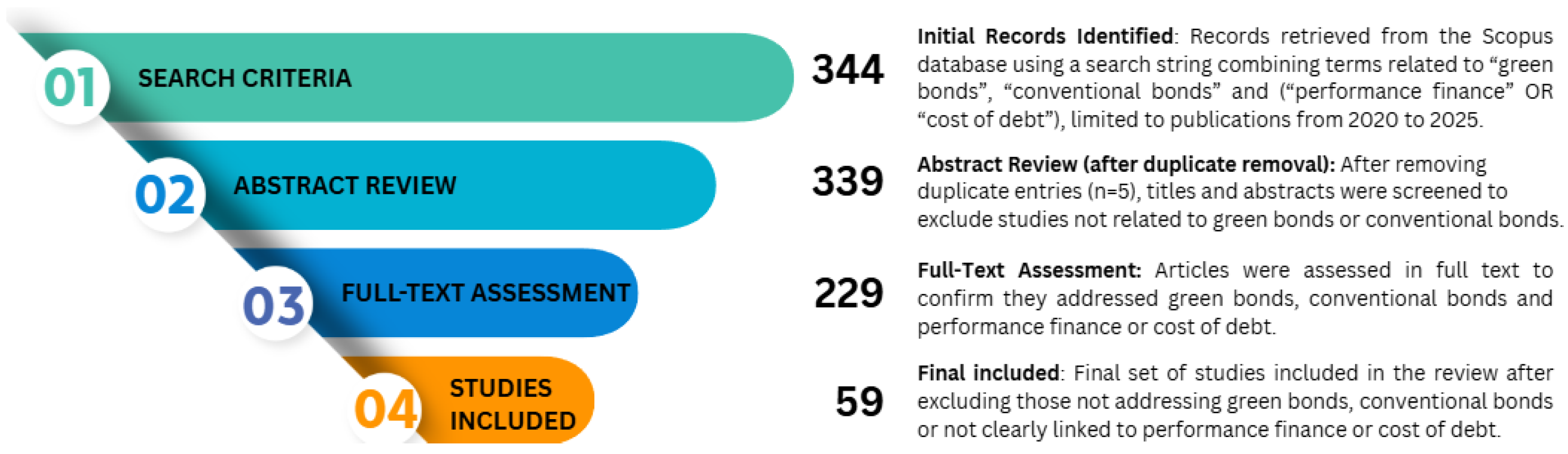
Figure 1. Inclusion Flowchart.
Ijfs 13 00233 g001
Figure 2. PRISMA 2020.
Ijfs 13 00233 g002
Figure 3. Source’s production over time.
Ijfs 13 00233 g003
Figure 4. Three-field plot illustrating the connections between cited references (left), authors (middle), and merged keywords (right). The plot displays the 10 most influential items in each field to enhance readability, following the recommendations of Aria and Cuccurullo (2017). Key referenced works appearing in the figure include Agliardi and Agliardi (2019); Baker et al. (2022); Baldi and Pandimiglio (2022); Flammer (2020). Merged keywords such as “green bonds”, “yield spread”, “greenium”, “sustainability”, and “investment” represent the dominant thematic clusters in the literature.
Ijfs 13 00233 g004
Figure 5. Wordcloud.
Ijfs 13 00233 g005
Figure 6. Thematic Map.
Ijfs 13 00233 g006
Table 1. Search Criteria.
DatabaseScopus
Period2019–2025
Document typeArticle; Review
LanguageEnglish
FieldsTitles, abstracts and keywords
Descriptors(TITLE-ABS-KEY((“green bond*” OR “greenbond*” OR “conventional bond*” OR “vanilla bond*”) AND (“performance finance” OR “performance”)) OR TITLE-ABS-KEY((“green bond*” OR “greenbond*” OR “conventional bond*” OR “vanilla bond*”) AND (“cost of debt” OR “Greenium” OR “green premium”))) AND PUBYEAR > 2018 AND PUBYEAR < 2026 AND (LIMIT-TO(DOCTYPE, “ar”) OR LIMIT-TO(DOCTYPE, “re”))
Table 2. Classification and coding used for data analysis.
RatingMeaningEncryption
1Type of StudyA—Empirical; B—Theoretical; C—Systematic Review; D—Case Study
2Type of ApproachA—Quantitative; B—Qualitative; C—Mixed
3Main Research TopicA—Green Bonds; B—Conventional Bonds; C—Financial Performance; D—Cost of Debt; E—Comparison with Conventional Bonds; F—Other
4Analytical Method/TechniqueA—Econometric/Regression; B—Propensity Score Matching; C—Difference-in-Differences; D—Panel Analysis; E—Event Study; F—Other
5Data SourceA—Financial Statements; B—Annual Reports/reference forms; C—S&P Capital IQ/Refinitiv LSEG/Bloomberg; D—Other
6Industry/SectorA—All; B—Energy; C—High-Emission Industries (e.g., heavy industry); D—Financial Services; E—Infrastructure; F—Other
7Country/RegionA—Global; B—Developed Markets; C—Emerging Markets; D—Europe; E—Latin America; F—Asia; G—Other
8Performance Indicator/Key VariableA—ROE; B—ROA; C—EBITDA; D—Stock Price; E—Cost of Debt; F—Credit Rating; G—ESG Rating; H—Multiples (e.g., A/B, C/E); I—Other
9Comparison SchemeA—Green Bond Issuers vs. Non-Issuers; B—Green Bonds vs. Conventional Bonds; C—Pre vs. Post-Issuance; D—Other
10Bias Control/Robustness TechniqueA—PSM; B—DID; C—Generalized Matching; D—Instrumental Variables; E—Placebo Tests; F—Other
Table 3. Classification of Articles Using the Proposed Coding.
AuthorStudyTypeResearch TopicTechniqueData SourceSectorCountry/RegionPerformance IndicatorComparision SchemeBias Control
Devine and McCollum (2022)1A2A3A,C,D4A5D6E7B8E,G9A10E,F
Grishunin et al. (2023)1A2A3A,D,E4A,D5C6C,D,F7D8E,F,G9B10F
Ahmad and Mokhchy (2023)1A2A3A,C4A5A,B,D6B,C7C8B,F,G9D10D,F
Lebelle et al. (2020)1A2A3A,C,E4A,E5C6A7A,B,C8B,D,F9C,D10F
Glavas (2023)1A2A3A,C4A,B5C6A7A8A,B,F,G9A,C10A,F
Fan et al. (2023)1A2A3A,C,F4A,E5D6A7C,F8D,G9B,D10F
Badía et al. (2024)1A2A3A,C,F4A,B5C6A7A8D,G9A,D10A,F
Nanayakkara and Colombage (2021)1A2A3A,D,F4A5C,D6A7B,C8E,G9D10F
Y. Zhang et al. (2024)1A2A3A,C,D,F4A,C5D6A,C7C,F8D,F,G9A,D10A,B,E,F
Kodiyatt et al. (2024)1A2A3A,C4A,E5C,D6B,D,E7C,F8D9C,D10F
Aleknevičiene et al. (2025)1A2A3A,D,E4A,B,F5C,D6A,D,F7D8E,F9B,D10F
Löffler et al. (2021)1A2A3A,D,E4A,B,F5C6C,D,E,F7A8E,F,G9B,C,D10A,F
Nurvita et al. (2024)1A2A3A,D,E4A,F5C,D6B,C,D,E,F7C,F8E,F,G9B,D10C,F
Abhilash et al. (2024)1A2A3A,D,F4A,F5C,D6B,C,D,E,F7C,E,F8E,F,G9D10F
H. Wang et al. (2023)1A2A3A,C,F4A,C,F5C,D6C,F7C,F8B,F,G9A,D10A,B,C,D,E,F
Flammer (2020)1A2A3A,C,D4A,E5C,D6A7A,B,C8D,E,F,G9B,C10A,E,F
Fang et al. (2023)1A2A3A,D,F4A,C,F5D6A,D,F7C,F8E,F,G9A,C,D10B,E,F
Tan et al. (2022)1A2A3A,C,F4A,C,F5C,D6C,F7C,F8A,B,F,G9A,D10B,E,F
Khurram et al. (2023)1A2A3A,C,F4A,C,F5D6B,C,F7C,F8A,B,F,G9A,C10B,E,F
X. Zhou and Cui (2019)1A2A3A,C,F4A,E,F5D6A,D,F7C,F8A,B,D,F,G9A,C,D10A,B,E,F
Jiang et al. (2022)1A2A3A,C,D,F4A,B,C,D,F5D6A7C,F8A,E,F,G9A,C10A,B,D,E,F
Lichtenberger et al. (2022)1A2A3A,C,D,E,F4A,F5C,D6B,D,F7B,D8E,G9B,D10F
Macaire and Naef (2023)1A2A3A,D,F4A,C,F5C6D7C,F8E,F,G9A,C10B,E,F
X. Huang et al. (2025)1A2A3A,C,F4A,C,E,F5D6A,C7C,F8B,D,F,G9A,C,D10A,B,E,F
Hu et al. (2022)1A2A3A,D,F4A,B,F5D6A,C,F7C,F8B,F9A,D10A,E,F
Zhu et al. (2025)1A2A3A,B,D,F4A,B,C,D,F5D6A,B7C,F8A,D,E,F,G9A,B,C,D10A,E,F
Xu et al. (2023)1A2A3A,D,E4A,B,F5D6A,C,E7C,F8E,F,G9B,D10A,F
Y. Li et al. (2023)1A2A3A,C,F4A,B,C,F5D6F7C,F8B,F,G9A,C,D10A,B,E,F
Hu et al. (2024)1A2A3A,D,F4A,D,F5D6A,B,C,E,F7C,F8E,F,G9D10D,F
P. Ge et al. (2024)1A2A3A,C,D,F4A,B,C,F5C,D6A,C7C,F8I9A,C,D10A,B,E,F
Hong et al. (2025)1A2A3A,C,D,E4A,E5C,D6A7A8D,E,G9B,C10F
Dutordoir et al. (2024)1A2A3A,C,F4A,E5C,D6A7A,B,C8A,B,D,F,G9A,C,D10A,E,F
Kim and Ahn (2022)1A2A3A,D,E4A,B5D6D,F7C,F8E,F,I9B,D10A,E,F
Su et al. (2023)1A2A3A,D,F4A,B,D,F5D6A,C,F7C,F8F,I9D10A,D,F
Makpotche et al. (2024)1A2A3A,C,E4A,E5C,D6A7A,B,C8A,B,G9A,C,D10A,E,F
Su and Lin (2025)1A2A3A,C,F4A,D,E5D6A7C,F8D,I9C,D10F
Cao et al. (2021)1A2A3A,D,F4A,D,F5D6D7C,F8E,F,I9B,D10B,D,F
Lian and Hou (2024)1A2A3A,D,F4A,B,D5D6A,D7C,F8E,I9B,D10A,F
Xi and Jing (2022)1A2A3A,C,F4A,D,E5D6A,C,D7C,F8D,E,F,I9A,B,C,D10E,F
C. Huang et al. (2023)1A2A3A,D,F4A,B,F5C,D6A,D,F7A8E,F,G9B10A,F
Aleknevičiene and Vilutytė (2024)1A2A3A,C,F4A,E,F5C6A,C,D7B,D8A,D,F,G9C,D10F
Arhinful et al. (2025)1A2A3A,E,F4A,D5C6A7A,E8A,E,F,H9B,D10C,E,F
Chan and Liao (2025)1A2C3A,D,E,F4A,F5C,D6A7A8E,I9B10F
P. Wang and Lu (2024)1A2A3A,D,E,F4A,B,C,D,E,F5D6A7C,F8E,G9A,B,C10A,B,E,F
Sheng and Montgomery (2025)1A2A3A,C,D,E,F4A,B,C,D5D6D7C,F8A,B,E,I9A,B,C10A,B,F
Tang et al. (2023)1A2A3A,D,F4A,F5D6A,D7C,F8E,G9B,C,D10A,D,F
Yeow and Ng (2021)1A2A3A,C,E,F4A,B,C5B,D6A7A8B,I9A,C10A,B,F
Muhammad et al. (2025)1A2A3A,C,D,F4A,B,C,D5C6A7A8E,I9A,C10A,B,E,F
Chang et al. (2021)1A2A3A,D,E,F4A,D,F5D6A7C,F8E,G9B,D10F
Hyun et al. (2023)1A2A3A,D,F4A,F5C6A7A8E,I9D10F
Baker et al. (2022)1C2B3A,D,E,F4F5C,D6A,F7B8E,G9B,D10F
Petreski et al. (2025)1A2A3A,C,D,E,F4A,C,D,F5C6F7B,D8E,G9B,C,D10B,D,F
Baldi and Pandimiglio (2022)1A2A3A,D,E,F4A,F5C,D6A7A8E,G9B,D10F
Jin and Zhang (2023)1A2A3A,C,F4A,E5D6A,D7C,F8D9C,D10F
Dorfleitner et al. (2022)1A2A3A,D,E,F4A,D5C,D6A7A8E,I9B,D10F
Fandella and Cociancich (2024)1A2A3A,D,E,F4A,D,F5C6A,D7B,D8E,I9B10F
Q. Li et al. (2022)1A2A3A,D,E,F4A,B,F5D6A7C,F8E,I9B,D10A,F
Sisodia et al. (2022)1A2A3A,C,F4A,B,F5C,D6A7A8D,I9A,D10A,F
D. Zhou and Kythreotis (2024)1A2A3A,C,D,E,F4A,C,F5C6A7A8E,I9B,D10B,F
Table 4. Scientific production over time—Green bonds and performance finance (2019–2025).
YearNumber of Articles
20191
20201
20215
202212
202315
202415
202510
Table 5. Distribution of the 59 articles by the country/region of the first author’s affiliation.
Country/RegionNumber of Articles
China25
France3
India3
United States2
Spain2
United Kingdom2
Canada2
South Korea2
Others18
Disclaimer/Publisher’s Note: The statements, opinions and data contained in all publications are solely those of the individual author(s) and contributor(s) and not of MDPI and/or the editor(s). MDPI and/or the editor(s) disclaim responsibility for any injury to people or property resulting from any ideas, methods, instructions or products referred to in the content.