Next Article in Journal
Mechanistic Studies on the Surface Reactions of Aluminum–Lithium Alloy Oxides
Previous Article in Journal
Development of RP-3 Surrogate Fuels via Multi-Objective Genetic Algorithm for Regenerative Cooling CFD with Supercritical Property Fidelity
 
 
Due to scheduled maintenance work on our servers, there may be short service disruptions on this website between 11:00 and 12:00 CEST on March 28th.
Article

Adaptive Event-Triggered-Based Consensus Control for QUAV Formation System with External Disturbances and State Constraints


1
Department of Mathematics and Artificial Intelligence, Lyuliang University, Lvliang 033001, China
2
Hubei Key Laboratory of Intelligent Robot, Wuhan Institute of Technology, Wuhan 430205, China
3
College of Electronic Information Engineering, Xi’an Technological University, Xi’an 710021, China
*
Author to whom correspondence should be addressed.
Aerospace 2026, 13(4), 308; https://doi.org/10.3390/aerospace13040308
Submission received: 10 February 2026 / Revised: 11 March 2026 / Accepted: 23 March 2026 / Published: 25 March 2026
(This article belongs to the Section Aeronautics)

Abstract

In this work, an adaptive event-triggered-based consensus control strategy is proposed for the quadrotor unmanned aerial vehicle (QUAV) formation system in the presence of external disturbances and state constraints. Firstly, the disturbed QUAV formation system dynamic model is established. Then, to address the initial peaking explosion problem in the traditional active disturbance rejection control method, a time-varying gain extended state observer (TGESO) is designed to suppress external disturbances. Meanwhile, a novel barrier Lyapunov function (BLF) is constructed to cope with the adverse effects caused by state constraints. Furthermore, aiming to alleviate network congestion and reduce communication burden, the adaptive event-triggered mechanism (AETM) is adopted to design the formation flight controller. Finally, the stability of the developed consensus controller and the boundedness of all error signals are proved via Lyapunov theory. Comparative simulation results demonstrate the practicality of the presented control algorithm.

1. Introduction

Along with the rapid advancement of automatic control and artificial intelligence technologies [1], quadrotor unmanned aerial vehicle (QUAV) has been widely applied in numerous scenarios, including agricultural production [2], environmental protection [3], and disaster monitoring [4]. However, single QUAV exhibits significant limitations when handling complex tasks. Consequently, research on QUAV formation cooperative control has garnered extensive attention from researchers and scholars. In particular, substantial research outcomes have emerged from control methods based on consensus theory. In [5], a distributed adaptive formation control scheme based on consensus theory was proposed for QUAV formation in the face of uncertainties and unknown external disturbances. In [6], a consensus formation control method with prescribed performance constraints was developed for quadrotor UAVs formation to address trajectory tracking and internal collision avoidance problems. Despite the promising application prospects of the QUAV formation system, the problem of safe cooperative control remains a critical challenge to be addressed.
During practical flight operations, external disturbances seriously affect the flight performance of the QUAV formation system. To deal with this problem, a variety of anti-disturbance control approaches have been proposed, such as the disturbance observer method [7], sliding mode control [8], and active disturbance rejection control (ADRC) [9,10,11]. Among these methods, the ADRC technique, whose core is an extended state observer (ESO), has found extensive application in recent years. In [9], an ESO-based finite-time fault-tolerant formation control method was proposed for the QUAV formation system in the presence of actuator faults and unmeasurable states. In [10], a distributed cooperative control algorithm based on a finite-time ESO was designed for the disturbed multi-agent system to solve the output consensus problem. In [11], an ESO-based distributed double-loop sliding mode controller design method was proposed for a multi-UAV swarm in the presence of unit failure or loss. However, to enhance anti-disturbance capability, the ESO typically requires a relatively large gain to achieve rapid convergence of the observation error, which also gives rise to the so-called initial peaking phenomenon. To address this issue, several time-varying gain ESO (TGESO) methods have attracted increasing attention. In [12], an adaptive ESO was proposed for a class of nonlinear disturbed systems. In [13], a TGESO-based finite-time fault-tolerant control strategy was proposed for QUAV. In [14], a robust control scheme based on the TGESO and adaptive dynamic programming was developed for the disturbed unmanned helicopter to achieve optimal tracking control. On account of the special rotor structure, the state constraint problem is another factor that severely affects the flight safety of the system besides disturbances, which merits in-depth research.
As a typical rotorcraft, the special mechanical structure of the QUAV determines that its flight state must be strictly constrained within a reasonable range. In particular, if the roll and pitch angles exceed their predefined limits, the QUAV can easily become unstable. To deal with the problem of state constraints, numerous effective approaches have been proposed, such as model predictive control [15], sliding mode control [16], and the barrier Lyapunov function (BLF) methods [17,18,19,20,21,22,23,24]. Among these, the BLF method has been widely adopted to handle issues related to constrained QUAV. In [17,18], the adaptive controllers were designed for nonlinear systems with full-state constraints by applying the integral BLF. In [19], by utilizing BLF, a robust adaptive fault-tolerant flight controller was designed for the unmanned autonomous helicopter with full-state constraints and actuator faults. In [20,21], the BLF-based formation control issues were investigated for multi-QUAVs under the state constraints. However, the aforementioned BLF-based methods face a potential singularity problem, and thus their improvement has become a prominent new challenge in relevant research. In [22,23], a novel controller design method based on the time-varying barrier Lyapunov function (TBLF) was proposed to address the singularity problem. In [24], a robust anti-saturation fault-tolerant control scheme was presented for an unmanned autonomous helicopter with multi-constrained conditions. However, most of the aforementioned studies adopt time-driven control strategy while neglecting the problem of limited communication resources, which is a crucial constraint for the cooperative flight of the QUAV formation system.
It should be pointed out that most research findings on the QUAV formation system fail to consider the limitation of network resources. Prolonged repetitive and ineffective network transmission will give rise to resource waste and network congestion. In contrast to time-triggered mechanism-based methods, the event-triggered mechanism-based strategies [25] can effectively alleviate this problem. In [26], an event-triggered control strategy was proposed for the fixed-time consensus tracking control problem of a multi-agent system. In [27], a robust control scheme based on an adaptive event-triggered mechanism (AETM) was developed for a saturated nonlinear system with state constraints. In [28], an event-triggered-based supertwisting algorithm was proposed to achieve the attitude control of UAVs. In [29], a distributed adaptive event-triggered neural network control strategy was proposed for the six-rotor UAVs’ cooperative control problem. In [30], a cooperative event-triggered filtering algorithm was proposed for the multi-agent systems consensus control problem. However, when state constraints, external disturbances and event-triggered mechanisms are considered simultaneously, the problem of safe control for the QUAV formation system remains to be further investigated in depth.
Based on the preceding analysis, an adaptive event-triggered anti-disturbance control strategy is presented for the QUAV formation system based on the TBLF and consensus theory. The main contributions are summarized as follows:
(1)
The proposed TGESO can overcome the initial peaking explosion problem existing in the traditional fixed-gain ESO approach, thus improving the transient performance of the QUAV formation system.
(2)
Compared with the traditional BLF-based method when dealing with state constraints, the developed TBLF technique can overcome the singularity problem that the denominator of the controller may be zero under certain circumstances.
(3)
Compared with the traditional time-triggered control strategy, the designed AETM can conserve network resources and reduce the computational burden.
This article is structured as follows. Section 2 introduces the problems to be solved. Section 3 describes the proposed adaptive event-triggered consensus control strategy in detail. Section 4 conducts simulation experiments. Finally, Section 5 concludes the paper.
Notations: In this article, X R n × m is the n × m dimension of a matrix X , I n × n is the unit matrix of R n × n , · is the Euclidean norm of a matrix, λ max ( · ) is the maximum eigenvalue of the a matrix, and λ min ( · ) is the minimum eigenvalue of a matrix.

2. Problem Formulation and Preparation

2.1. Graph Theory

Define an undirected graph Λ = ( V , E , A ) to establish the information interaction between virtual leader and i-th QUAV, where V = 1 , , N denotes the set of the nodes, E V × V Λ represents the set of edges, and ( i , j ) E indicates that i-th QUAVs and j-th QUAV can exchange information. The neighborhood set of the i-th QUAV is denoted as N j = { j V | ( i , j ) E } . The matrix A = [ a i j ] R N × N is the adjacency matrix, where a i j > 0 if the i-th QUAV can obtain information from the j-th QUAV. Δ = d i a g Δ 1 , Δ N as the diagonal matrix, Laplacian matrix is L = Δ A .
When a virtual leader exists in the undirected graph, an incidence matrix exists B = d i a g b 1 , , b N , and b i > 0 indicates that the i-th QUAV can interact with the leader for information exchange, otherwise b i = 0 .

2.2. The Model of QUAV

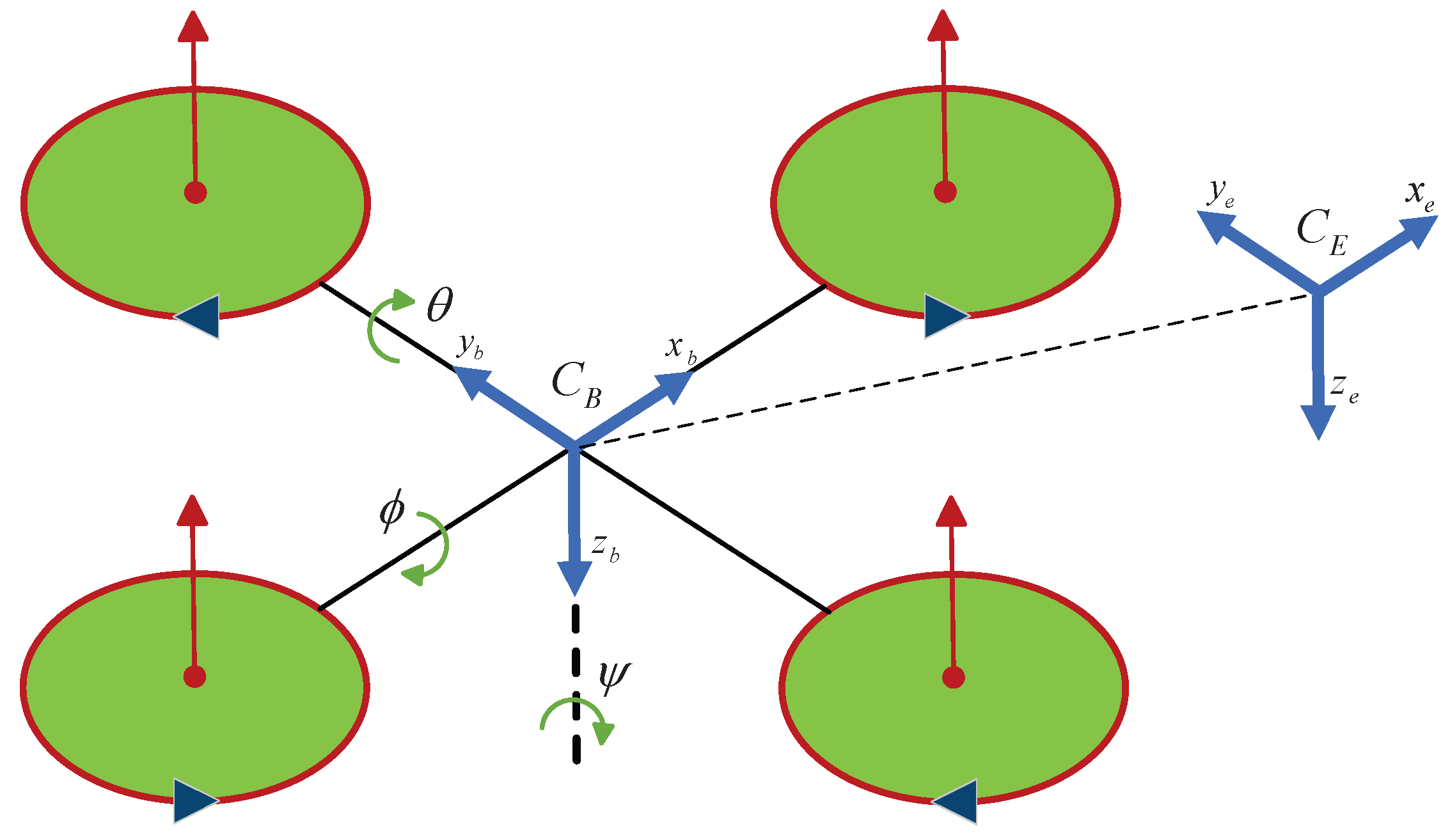
The structure of the QUAV is shown in Figure 1, where C E = { x E , y E , z E } and C B = { x B , y B , z B } represent the inertial frame and the body frame, respectively. On the basis of the Newton–Euler theorem, the nonlinear model of the i-th QUAV can be formulated as follows [31]:
P ˙ i = V i V ˙ i = R i U i + G i + D i , 1 Σ ˙ i = H i Ω i Ω ˙ i = J i 1 Ω i × J i Ω i + J i 1 M i + D i , 2
where i = 1 , , N represents the i-th QUAV, P i = x i , y i , z i T is the position vector of the i-th QUAV in the inertial frame C E , V i = u i , v i , w i T is velocity vector, Σ i = [ ϕ i , θ i , ψ i ] T stands for the three Euler angles in the body frame C B , Ω i = [ p i , q i , r i ] T is the angular velocity, R i = R B E / m , m is the mass of the QUAV, G i = [ 0 , 0 , g ] T , g denotes the gravitational acceleration, U i = [ 0 , 0 , F i ] T , F i denotes the total lift, H i stands for the attitude kinematics matrix, J i = d i a g J i , x x , J i , y y , J i , z z represents the moment of inertia matrix, M i = [ M i x , M i y , M i z ] T denotes the three-dimensional torque, D i , 1 = D i x , D i y , D i z T and D i , 2 = D i ϕ , D i θ , D i ψ T indicate the external disturbances acting on the QUAV.

2.3. State Constraint-Related Descriptions

The full-state constraint of the i-th QUAV is described as
π ̲ i m n < π i m n < π ¯ i m n
where m = p , Θ and n = 1 , 2 .
To tackle the potential singularity issue, k d i , m n and k c i , m n are constructed such that [24]
k d i , m n < k b i , m n < e i , m n < k a i , m n < k c i , m n
where k c i , m n = δ 1 k a i , m n , k d i , m n = δ 2 k b i , m n , and δ 1 1 , 2 , δ 2 1 , 2 are the positive constants.
Select the following TBLF
V i m n = H i m n 2 ln k a i , m n 2 k a i , m n 2 e i , m n 2 + 1 H i m n 2 ln k b i , m n 2 k b i , m n 2 e i , m n 2
The specific definition is
k b i , m n ( t ) = y i , m d π ̲ i m n k a i , m n ( t ) = π ¯ i m n y i , m d , H i m n e = 1 , e > 0 0 , e 0
where e is shorthand for e i , m n .
Differentiating V i m n yields
V ˙ i m n = ζ i , m n e i , m n e ˙ i , m n 1 H i m n k ˙ b i , m n k b i , m n e i , m n H i m n k ˙ a i , m n k a i , m n e i , m n
where ζ i , m n = 1 H i m n k b i , m n 2 e i , m n 2 + H i m n k a i , m n 2 e i , m n 2 .
The control objective is to design an event-triggered anti-disturbance controller for the QUAV formation system with full-state constraints and external disturbances, ensuring that each QUAV can track the virtual leader and maintain a certain tracking distance. χ i , p d = x i d , y i d , z i d T and [ ϕ d , θ d , ψ d ] T = [ 0 , 0 , 0 ] T are the desired positioning offsets of the i-th QUAV. The target trajectory of each QUAV is dynamically adjusted based on the information of its neighboring QUAV. Moreover, ensure that the formation tracking signal y i , m d = y 0 , p + χ i , m d tracks the virtual leader’s trajectory y 0 , p , and further ensure that the i-th QUAV tracks its desired roll angle ϕ i d and desired pitch angle θ i d .
In order to fulfill the control objective, it is essential to introduce the assumptions and lemmas below.
Assumption 1
([13]). Suppose that the disturbances d i , p t and d i , Θ t are bounded, and there exist constants α 1 , α 2 , α ¯ 1 , α ¯ 2 > 0 such that
d i , p t α 1 , d i , Θ t α 2 d ˙ i , p t α ¯ 1 , d ˙ i , Θ t α ¯ 2
Assumption 2
([22,24]). The time-varying constraints π ̲ i m n and π ¯ i m n and their first-order derivatives are smooth and bounded.
Assumption 3
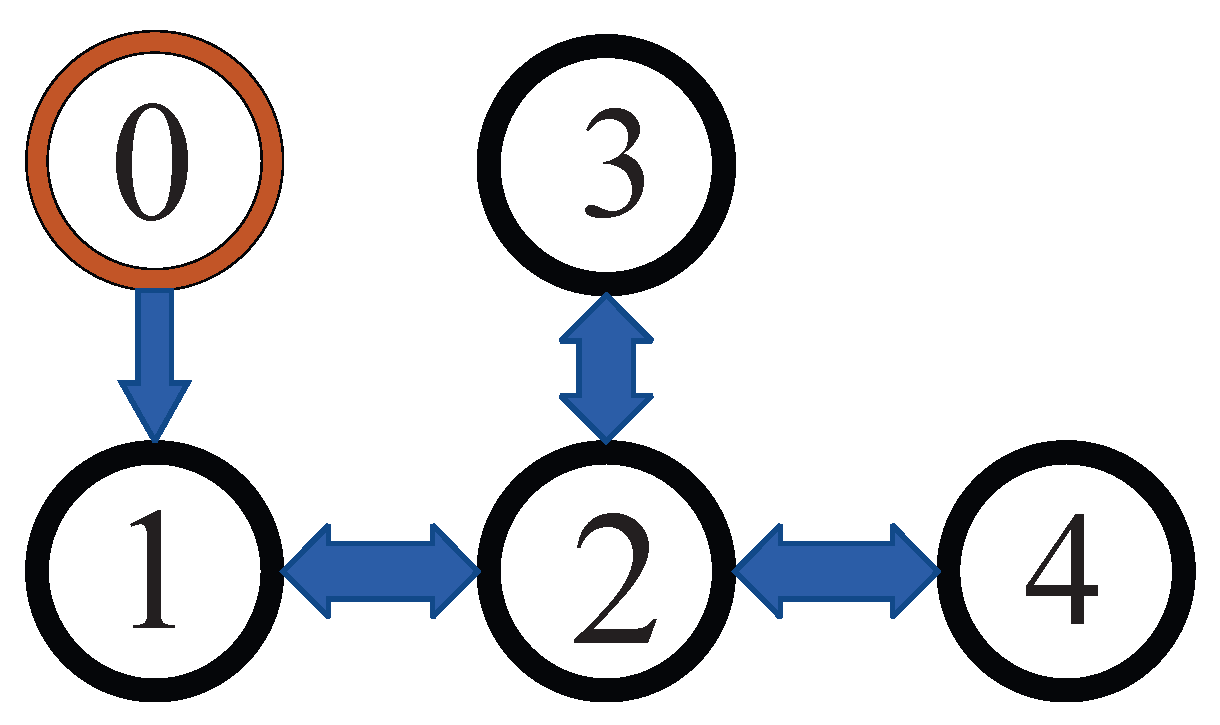
([29,32]). The directed graph contains a spanning tree with the root node leader.
Lemma 1
([29,33]). For any positive constant ξ p > 0 and variable s R , the following inequality holds
0 s s tanh s ξ p ξ p ϖ p
where ϖ p = 0.2785 .
Lemma 2
([22,24]). For any constant k 1 > b 1 , the following inequality holds
b 1 2 k 1 2 b 1 2 ln k 1 2 k 1 2 b 1 2
Lemma 3
([22,24]). For variable c 1 , k 2 and k 3 such that k 2 > k 3 > c 1 and k 3 2 k 3 2 tanh k 3 2 tanh k 3 2 k 2 2 , the following inequality holds
c 1 2 k 3 2 c 1 2 c 1 2 k 2 2 c 1 2 ln k 1 2 k 2 2 c 1 2
Lemma 4
([19]). For the bounded initial conditions, and a positive definite function A ( x ) satisfying 1 x A ( x ) 2 x , if A ˙ x α A x + β holds, where α > 0 , β > 0 , 1 and 2 : R n R are class K functions, then the solution x t is uniformly bounded.

3. Main Results

In this section, the design of the adaptive event-triggered consensus controller is detailed. To clarify the controller design process, the model of the i-th QUAV is rewritten as:
π ˙ i , p 1 = π i , p 2 π ˙ i , p 2 = l i , p u i , p + G i + D i , p π ˙ i , Θ 1 = H i π i , Θ 2 π ˙ i , Θ 2 = l i , Θ 1 τ i + f i , Θ + D i , Θ
where π i , p 1 = P i , π i , Θ 1 = Σ i , π i , Θ 2 = Ω i , u i , p denotes the control input of the position subsystem, D i , p = D i , 1 , u i , p = [ F i , F i , F i ] T , l i , p = d i a g Λ 1 , Λ 2 , Λ 3 , Λ 1 = cos ϕ i sin θ i cos ψ i + sin ϕ i sin ψ i m , Λ 2 = cos ϕ i sin θ i sin ψ i sin ϕ i cos ψ i m , Λ 3 = cos ϕ i cos θ i m , l i , Θ = J i , f i , Θ = J i 1 Ω i × J i Ω i , τ i = M i , D i , Θ = D i , 2 .

3.1. Design of TGESO for Position Loop

By regarding d i , p as a new state π i , p 3 , the nonlinear dynamics of i-th QUAV can be further described as:
π ˙ i , p 1 = π i , p 2 π ˙ i , p 2 = l i , p u i , p + G i , p + π i , p 3 π ˙ i , p 3 = η 1
where d i , p = π i , p 3 . According to Assumption 1, it can be obtained η 1 is bounded with η 1 α 1 .
Based on (12), the TGESO is constructed as follows:
π ˜ i , p 1 = π i , p 1 π ^ i , p 1 π ^ ˙ i , p 1 = π ^ i , p 2 + γ i , p 1 ε ( t ) π ˜ i , p 1 π ^ ˙ i , p 2 = l i , p u i , p + G i , p + π ^ i , p 3 + γ i , p 2 ε 2 ( t ) π ˜ i , p π ^ ˙ i , p 3 = γ i , p 3 ε 3 ( t ) π ˜ i , p 1
where π ^ i , p j j = 1 , 2 , 3 are the estimations of π i , p j j = 1 , 2 , 3 , γ i , p 1 = d i a g γ 11 , γ 12 , γ 13 , γ i , p 2 = d i a g γ 21 , γ 22 , γ 23 , and γ i , p 3 = d i a g γ 31 , γ 32 , γ 33 are the designed positive constants. ε t is a time-varying function, which is given by:
ε t = ε 0 , t ln ε 0 κ ln 1 + κ 1 + κ κ t , 0 t < ln ε 0 κ ln 1 + κ
where ε 0 and κ are the positive constants.
By defining the observation error of the TGESO is π ˜ i , p j = π i , p j π ^ i , p j j = 1 , 2 , 3 , according to (12) and (13), we have
π ˜ ˙ i , p 1 = π ˙ i , p 1 π ^ ˙ i , p 1 = π ˜ i , p 2 γ i , p 1 ε ( t ) π ˜ i , p 1 π ˜ ˙ i , p 2 = π ˙ i , p 2 π ^ ˙ i , p 2 = π ˜ i , p 3 γ i , p 2 ε 2 ( t ) π ˜ i , p 1 π ˜ ˙ i , p 3 = η 1 γ i , p 3 ε 3 ( t ) π ˜ i , p 1
By defining the new auxiliary variable ϑ i i = 1 , 2 , 3 as follows:
ϑ 1 = ε 2 t π ˜ i , p 1 ϑ 2 = ε t π ˜ i , p 2 ϑ 3 = π ˜ i , p 3
Since ε t is a piecewise function, the analysis is split into two cases.
Case 1: when t ln ε 0 κ ln 1 + κ , it is recognized that ε t = ε 0 , we have
ϑ 1 = ε 0 2 π ˜ i , p 1 ϑ 2 = ε 0 π ˜ i , p 2 ϑ 3 = π ˜ i , p 3
Based on (15)–(17) and taking the time derivative of ϑ i i = 1 , 2 , 3 , we can obtain
ϑ ˙ 1 = γ i , p 1 ε 0 ϑ 1 + ε 0 ϑ 2 = ε 0 2 π ˜ ˙ i , p 1 ϑ ˙ 2 = γ i , p 2 ε 0 ϑ 1 + ε 0 ϑ 3 = ε 0 π ˜ ˙ i , p 2 ϑ ˙ 3 = γ i , p 3 ε 0 ϑ 1 + η 1 = π ˜ ˙ i , p 3
By defining ϑ p = ϑ 1 T , ϑ 2 T , ϑ 3 T T , it gives
ϑ ˙ = ε 0 γ i , p 1 I 3 × 3 0 3 × 3 γ i , p 2 0 3 × 3 I 3 × 3 γ i , p 3 0 3 × 3 0 3 × 3 ϑ p + 0 3 × 1 0 3 × 1 η 1 = ε 0 A p ϑ p + B p
where 0 and I represent the zero matrix and the identity matrix, respectively. 3 × 3 and 3 × 1 specify the dimensional information of matrix, respectively.
Here, by selecting parameters properly A p can be guaranteed to be a Hurwitz matrix. This indicates the existence of a positive definite matrix M p verifying
A p T M p + M p A p = Q p
where Q p is the positive definite matrix.
The Lyapunov candidate function is chosen as:
V i , 1 = ϑ p T M p ϑ p
Invoking (19) and differentiating (21), we can deduce
V ˙ i , 1 = ϑ p T M p ϑ ˙ p + ϑ ˙ p T M p ϑ p = ε 0 ϑ p T Q p ϑ p + 2 ϑ p T M p B p ε 0 ϑ p T Q p ϑ p + ϑ p 2 + ν 2 2 ϑ p T ε 0 Q p I 3 × 3 ϑ p + ν 2 2 o 1 ϑ p T ϑ p + ν 2 2
where M p B p ν 2 , ν 2 is the positive constants, o 1 = λ min ε 0 Q p I 3 × 3 .
Case 2: when 0 t ln ε 0 κ ln 1 + κ , we have ε ( t ) = ( 1 + κ ) κ t , based on (15) and (16)
ϑ ˙ 1 = 2 ε ( t ) ε ˙ ( t ) π ˜ i , p 1 + ε 2 ( t ) π ˜ i , p 2 γ i , p 1 ε ( t ) π ˜ i , p 1 = 2 κ ε 2 ( t ) π ˜ i , p 1 + ε 2 ( t ) π ˜ i , p 2 γ i , p 1 ε ( t ) π ˜ i , p 1 = γ i , p 1 ε ( t ) ϑ 1 + 2 κ ϑ 1 + ε ( t ) ϑ 2 , ϑ ˙ 2 = ε ˙ ( t ) π ˜ i , p 2 + ε ( t ) π ˜ i , p 3 γ i , p 2 ε 2 ( t ) π ˜ i , p 1 = κ ε ( t ) π ˜ i , p 2 + ε ( t ) π ˜ i , p 3 γ i , p 2 ε 2 ( t ) π ˜ i , p 1 = γ i , p 2 ε ( t ) ϑ 1 + κ ϑ 2 + ε ( t ) ϑ 3 , ϑ ˙ 3 = γ i , p 3 ε ( t ) ϑ 1 + η 1 .
Similar to case 1, it can be concluded that
ϑ ˙ = ε ( t ) γ i , p 1 I 3 × 3 0 3 × 3 γ i , p 2 0 3 × 3 I 3 × 3 γ i , p 3 0 3 × 3 0 3 × 3 ϑ + 2 κ I 3 × 3 ε ( t ) 0 3 × 3 0 3 × 3 κ I 3 × 3 0 3 × 3 0 3 × 3 0 3 × 3 0 3 × 3 ϑ + 0 3 × 1 0 3 × 1 η 1 = ε ( t ) A p ϑ + B p 1 ϑ + B p 2
Now, the same Lyapunov function (21) is adopted, and its time derivative becomes
V ˙ i , 1 = ϑ p T M p ϑ ˙ p + ϑ ˙ p T M p ϑ p = ε ( t ) ϑ p T Q p ϑ p + 2 ϑ p T M p B p 1 ϑ p + 2 ϑ p T M p B p ε ( t ) ϑ p T Q p ϑ p + 2 ν 1 ϑ p 2 + ϑ p 2 + ν 2 2
where M p B p 1 ν 1 , and ν 1 is the positive constant.
By analyzing the properties of the function ε t = 1 + κ κ t , the variation range of ε t 1 , ε m , where ε m = 1 + κ ln ε 0 ln 1 + κ . Thus, it is determined that
ε t ϑ p T Q p ϑ p ϑ p T Q p ϑ p
Substituting (25) into (26), we can obtain
V ˙ i , 1 ϑ p T Q p 2 ν 1 I 3 × 3 I 3 × 3 ϑ p + ν 2 2 o 2 ϑ p T ϑ p + ν 2 2
where o 2 = λ min Q p 2 ν 1 I 3 × 3 I 3 × 3 .
By combining the conclusions from (22) and (27), we obtain
V ˙ i , 1 o M 1 ϑ p T ϑ p + ν 2 2
where o M 1 = max o 1 , o 2 .

3.2. Design of TGESO for Attitude Loop

By regarding d i , Θ as a new state π i , Θ 3 , the nonlinear model of i-th QUAV can be further described as:
π ˙ i , Θ 1 = H i π i , Θ 2 π ˙ i , Θ 2 = l i , Θ 1 τ i + f i , Θ + π i , Θ 3 π ˙ i , Θ 3 = η 2
where d i , Θ = π i , Θ 3 . According to Assumption 2, we arrive at η 2 is bounded with η 2 α 2 .
Based on (29), the TGESO is constructed as follows:
π ˜ i , Θ 1 = π i , Θ 1 π ^ i , Θ 1 π ^ ˙ i , Θ 1 = H i π ^ i , Θ 2 + γ i , Θ 1 ε ( t ) π ˜ i , Θ 1 π ^ ˙ i , Θ 2 = l i , Θ 1 τ i + f i , Θ + π i , Θ 3 + γ i , Θ 2 ε 2 ( t ) π ˜ i , Θ 1 π ^ ˙ i , Θ 3 = γ i , Θ 3 ε 3 ( t ) π ˜ i , Θ 1
where π ^ i , Θ j j = 1 , 2 , 3 are the estimations of π i , Θ j j = 1 , 2 , 3 , γ i , Θ 1 = d i a g γ 41 , γ 42 , γ 43 , γ i , Θ 2 = d i a g γ 51 , γ 52 , γ 53 , and γ i , Θ 3 = d i a g γ 61 , γ 62 , γ 63 are the designed positive constants. The time-varying function ε t is consistent with that of the position loop.
By defining the observation error of the TGESO is π ˜ i , Θ j = π i , Θ j π ^ i , Θ j j = 1 , 2 , 3 , according to (29) and (30), we have
π ˜ ˙ i , Θ 1 = π ˙ i , Θ 1 π ^ ˙ i , Θ 1 = π ˜ i , Θ 2 γ i , Θ 1 ε ( t ) π ˜ i , Θ 1 π ˜ ˙ i , Θ 2 = π ˙ i , Θ 2 π ^ ˙ i , Θ 2 = π ˜ i , Θ 3 γ i , Θ 2 ε 2 ( t ) π ˜ i , Θ 1 π ˜ ˙ i , Θ 3 = η 2 γ i , Θ 3 ε 3 ( t ) π ˜ i , Θ 1
The proof process of the observer in the attitude loop is analogous to that in the position loop, and is abbreviated herein due to space constraints.
The Lyapunov function candidate is selected by:
V i , 2 = ϑ Θ T M Θ ϑ Θ
Then, we can obtain
V ˙ i , 2 o M 2 ϑ Θ T ϑ Θ + ν 4 2
where o M 2 = max o 3 , o 4 .

3.3. Design of Controller for Position Loop

The consensus error is defined as:
e i , p 1 = j = 1 N a i , j π i , p 1 χ i , p d π j , p 1 χ j , p d + b i π i , p 1 y 0 , p χ i , p d
where χ i , p d denotes the desired position offset.
Taking (34) the time derivative gives
e ˙ i , p 1 = j = 1 N a i , j π ˙ i , p 1 π ˙ j , p 1 + b i π ˙ i , p 1 π ˙ i , p 1 d = Γ i π i , p 2 j = 1 N a i , j π ˙ j , p 1 b i π ˙ i , p 1 d = Γ i e i , p 2 + α i , p 1 j = 1 N a i , j π ˙ j , p 1 b i π ˙ i , p 1 d
where Γ i = υ i + b i , υ i = j = 1 N a i , j , and e i , p 2 = π i , p 2 α i , p 1 .
Then, the virtual control law is designed as:
α i , p 1 = 1 Γ i k i , 1 * e i , p 1 + j = 1 N a i , j π ˙ j , p 1 + b i π ˙ i , p 1 d μ i , 1
where k i , 1 * = k i , 1 + k ¯ i , 1 , k i , 1 = d i a g k i , 11 , k i , 12 , k i , 13 is a designed positive matrix, k ¯ i , 1 = d i a g k ¯ i , 11 , k ¯ i , 12 , k ¯ i , 13 , k ¯ i , 1 n = 1 H i p 1 k ˙ b i , p 1 k b i , p 1 2 + H i p 1 k ˙ a i , p 1 k a i , p 1 2 + δ i , 1 n , δ i , 1 n is the designed positive constant, μ i , 1 = μ i , 11 , μ i , 12 , μ i , 13 T , μ i , 1 n = 1 2 β 1 e i , p 1 n χ i , p 1 n tanh 1 2 β 1 e i , p 1 n 2 χ i , p 1 n 2 , χ i , p 1 n = H i p 1 e i , p 1 n k c i , p n 2 e i , p 1 n 2 + 1 H i p 1 e i , p 1 n k d i , p n 2 e i , p 1 n 2 , and β 1 is the designed positive constant.
Substituting (36) into (35) produces
e ˙ i , p 1 = k i , 1 * e i , p 1 + Γ i e i , p 2 μ i , 1
Select the following TBLF:
V i p 1 = H i p 1 e i , p 1 2 ln k b i , p 1 2 k b i , p 1 2 e i , p 1 2 + 1 H i p 1 e i , p 1 2 ln k a i , p 1 2 k a i , p 1 2 e i , p 1 2
Differentiating (38) yields
V ˙ i p 1 = n = 1 3 ζ i , 1 n e i , p 1 e ˙ i , p 1 ( 1 H i p 1 ) k ˙ b i , p 1 k b i , p 1 e i , p 1 H i p 1 k ˙ a i , p 1 k a i , p 1 e i , p 1
Substituting (37) into (39), we can acquire
V ˙ i p 1 = n = 1 3 ζ i , 1 n e i , p 1 k i , 1 * e i , p 1 + Γ i e i , p 2 μ i , 1 ( 1 H i p 1 ) k ˙ b i , p 1 k b i , p 1 e i , p 1 H i p 1 k ˙ a i , p 1 k a i , p 1 e i , p 1 n = 1 3 ζ i , p n e i , p 1 Γ i e i , p 2 1 2 β 1 ζ i , p n e i , p 1 2 χ i , p 1 tanh 1 2 β 1 e i , p 1 2 χ i , p 1 2 N i , 1 k i , 1 e i , p 1 2
where N i , 1 = d i a g ζ i , 11 , ζ i , 12 , ζ i , 13 .
Passing α i , p 1 through first-order filter yields
η i , p ς ˙ i , p 2 + ς i , p 2 = α i , p 1 ς i , p 2 0 = α i , p 1 0
where η i , p = d i a g η i , p 1 , η i , p 2 , η i , p 3 .
Defining the filtering error as κ i , p = ς i , p 2 α i , p 1 , and we have
κ ˙ i , p = η i , p 1 κ i , p + Q i , 1
where Q i , 1 is a bounded smooth function, and Q i , 1 Q ¯ i , 1 .
Taking the derivative of e i , p 2 yields
e ˙ i , p 2 = π ˙ i , p 2 α ˙ i , p 1 = l i , p u i , p + G i , p + D i , p α ˙ i , p 1
Defining α i , p 2 = l i , p u i , p , we propose the position loop control signal α i , p 2 as follows:
α i , p 2 = k i , 2 * e i , p 2 + ς ˙ i , p 2 G i , p D ^ i , p + 3 μ i , 2 + β 1 2 N i , 2 1 e i , p 2 Γ i e i , p 1
where k i , 2 * = k i , 2 + k ¯ i , 2 , k i , 2 = d i a g k i , 21 , k i , 22 , k i , 23 is a designed positive matrix, k ¯ i , 2 = d i a g k ¯ i , 21 , k ¯ i , 22 , k ¯ i , 23 , k ¯ i , 2 n = 1 H i p 2 k ˙ b i , p 2 k b i , p 2 2 + H i p 2 k ˙ a i , p 2 k a i , p 2 2 + δ i , 2 n , δ i , 2 n is the designed positive constant. μ i , 1 = μ i , 21 , μ i , 22 , μ i , 23 T , μ i , 2 n = 1 2 β 2 e i , p 2 n χ i , p 2 n tanh 1 2 β 2 e i , p 2 n 2 χ i , p 2 n 2 , χ i , p 2 n = H i p 2 e i , p 2 n k c i , p 2 n 2 e i , p 2 n 2 + 1 H i p 2 e i , p 2 n k d i , p 2 n 2 e i , p 2 n 2 , and β 2 is the designed positive constant.
To conserve the system’s limited network resources, the AETM is designed at t i t i k , t i k + 1 as [34,35]:
ω i , p ( t ) = α i , p 2 χ ¯ i , p tanh χ ¯ i , p e i , p 2 ρ i , p u i , p ( t ) = ω i , p t i k , k Z + , t t i k , t i k + 1 t i k + 1 = inf t > t i k | e ˜ i , p u ( t ) χ i , p * , t i 1 = 0
where ω i , p t is the auxiliary control input signal, u i , p t is the actual control input signal. triggering error e ˜ i , p u t = ω i , p t u i , p t , triggering threshold χ i , p * = χ i , p + σ i , p 1 α i , p e i , p 1 + σ i , p 2 , α i , p , σ i , p 1 , σ i , p 2 , χ ¯ i , p , χ i , p , ρ i , p are positive parameters to be designed. ω i , p t = u i , p t + o i , p t χ i , p , o i , p t is a continuous time-varying parameter, o i , p t < 1 .
Substituting (44) into (43), we can deduce
e ˙ i , p 2 = k i , 2 e i , p 2 + 3 μ i , 2 + β 1 2 N i , 1 1 e i , p 2 + π ˜ i , p 3 η i , p 1 κ i , p + Q i , 1
The Lyapunov candidate function is chosen as:
V i , p = V i p 1 + V i p 2 + V i , 1 + 1 2 κ i , p T κ i , p
Taking the time derivative of (47), we have
V ˙ i , p n = 1 3 ζ i , 1 n e i , p 1 Γ i e i , p 2 1 2 β 1 ζ i , 1 n e i , p 1 2 χ i , p 1 tanh 1 2 β 1 e i , p 1 2 χ i , p 1 2 + n = 1 3 ζ i , 2 n e i , p 2 κ i , p η i , 1 + Q i , 1 3 2 β 2 ζ i , 2 n e i , p 2 2 χ i , p 1 tanh 1 2 β 2 e i , p 2 2 χ i , p 1 2 N i , 1 k i , 1 e i , p 1 2 N i , 2 k i , 2 e i , p 2 2 o M 1 ϑ p T ϑ p + e i , p 2 T N i , 2 π ˜ i , p 3 β 1 2 e i , p 2 T e i , p 2 + ν 2 2 + κ i , p T η i , p 1 κ i , p + Q i , 1
where N i , 2 = d i a g ζ i , 21 , ζ i , 22 , ζ i , 23 .
Let
Ξ 1 = ζ i , 1 n e i , p 1 Γ i e i , p 2 1 2 β 1 ζ i , 1 n e i , p 1 2 χ i , p 1 tanh 1 2 β 1 e i , p 1 2 χ i , p 1 2 Ξ 2 = ζ i , 2 n e i , p 2 κ i , p η i , 1 + Q i , 1 3 2 β 2 ζ i , 2 n e i , p 2 2 χ i , p 1 tanh 1 2 β 2 e i , p 2 2 χ i , p 1 2
Then, by using the Lemma 1 and Young’s inequality, we can obtain
Ξ 1 β 1 2 e i , p 2 2 + 2 ϖ p Ξ 2 β 2 2 κ i , p 2 η i , p + Q i , 1 2 + 4 ϖ p κ i , p T Q i , 1 1 2 κ i , p T κ i , p + 1 2 Q ¯ i , 1 2 e i , p 2 T N i , 2 π ˜ i , p 3 1 2 e i , p 2 T N i , 2 e i , p 2 + 1 2 π ˜ i , p 3 T N i , 2 π ˜ i , p 3
Invoking (50) into (48), we can compute
V ˙ i , p e i , p 1 T N i , 1 k i , 1 e i , p 1 e i , p 2 T N i , 2 k i , 2 e i , p 1 + 1 2 e i , p 2 T N i , 2 e i , p 2 + 1 + β 2 2 Q ¯ i , 1 2 + κ i , p T η i , p 1 + β 2 2 η i , p + 1 2 κ i , p o M 1 ϑ p T ϑ p + 1 2 π ˜ i , p 3 T N i , 2 π ˜ i , p 3 + 18 ϖ p + ν 2 2 e i , p 1 T N i , 1 k i , 1 e i , p 1 e i , p 2 T N i , 2 k i , 2 1 e i , p 1 κ i , p T I β 2 η i , p 1 + 2 η i , p 1 2 κ i , p ϑ p T o M 1 N i , 2 2 ϑ p + 1 + β 2 2 Q ¯ i , 1 2 + 18 ϖ p + ν 2 2
Defining u i , p = u i , 1 , u i , 2 , u i , 3 T and giving the reference attitude angle ψ i , d , the i-th QUAV total lift F i and the reference attitude angles θ i , d and ϕ i , d can be given by the following equations: [13,31]
ϕ i , d = arctan ( u i , 1 sin ψ i , d u i , 2 cos ψ i , d ) cos θ i , d u i , 3 θ i , d = arctan u i , 1 cos ψ i , d + u i , 2 sin ψ i , d u i , 3 F i = m u i , 3 cos ϕ i , d cos θ i , d

3.4. Design of Controller for Attitude Loop

Define the i-th QUAV tracking errors as:
e i , Θ 1 = π i , Θ 1 π i , Θ 1 d e i , Θ 2 = π i , Θ 2 α i , Θ 1
where π i , Θ 1 d denote the desired attitude angle, and α i , Θ 1 represent the designed virtual control law.
Differentiating e i , Θ 1 yields
e ˙ i , Θ 1 = π ˙ i , Θ 1 π i , Θ 1 d = H i e i , Θ 2 + α i , Θ 1 π ˙ i , Θ 1 d
Passing π i , Θ 1 d through first-order filter yields
η i , 21 ς ˙ i , Θ 1 + ς i , Θ 1 = π i , Θ 1 d ς i , Θ 1 0 = π i , Θ 1 d 0
where η i , 21 = d i a g η i , Θ 1 , η i , Θ 2 , η i , Θ 3 .
Define the filter error as κ i , Θ 1 = ς i , Θ 1 π i , Θ 1 d , and we have
κ ˙ i , Θ 1 = η i , 21 1 κ i , Θ 1 + Q i , 2
where Q i , 2 is a bounded smooth function, and Q i , 2 Q ¯ i , 2 .
Then, we design the virtual control law as:
α i , Θ 1 = H 1 k i , 3 * e i , Θ 1 + ς ˙ i , Θ 1 3 μ i , 3
where k i , 3 * = k i , 3 + k ¯ i , 3 , k i , 3 = d i a g k i , 31 , k i , 32 , k i , 33 is a designed positive matrix, k ¯ i , 3 = d i a g k ¯ i , 31 , k ¯ i , 32 , k ¯ i , 33 , k ¯ i , 3 m = 1 H i Θ 1 k ˙ b i , Θ 1 k b i , Θ 1 2 + H i Θ 1 k ˙ a i , Θ 1 k a i , Θ 1 2 + δ i , 3 n , δ i , 3 n is the designed positive constant. μ i , 3 = 1 2 β 3 e i , Θ 1 n χ i , Θ 1 n tanh 1 2 β 3 e i , Θ 1 n 2 χ i , Θ 1 n 2 , χ i , Θ 1 n = H i Θ 1 e i , Θ 1 n k c i , Θ 1 n 2 e i , Θ 1 n 2 + 1 H i Θ 1 e i , Θ 1 n k d i , Θ 1 n 2 e i , Θ 1 n 2 , and β 3 is the designed positive constant.
Substituting (57) into (54), we can compute
e ˙ i , Θ 1 = k i , 3 * e i , Θ 1 + H e i , Θ 2 3 μ i , 3 η i , 21 1 κ i , Θ 1 + Q i , 2
Select the following TBLF:
V i Θ 1 = H i Θ 1 e i , Θ 1 2 ln k b i , Θ 1 2 k b i , Θ 1 2 e i , Θ 1 2 + 1 H i Θ 1 e i , Θ 1 2 ln k a i , Θ 1 2 k a i , Θ 1 2 e i , Θ 1 2
Taking (59) the time derivative gives
V ˙ i Θ 1 = n = 1 3 ζ i , 3 n e i , Θ 1 e ˙ i , Θ 1 H i Θ 1 k ˙ a i , Θ 1 k a i , Θ 1 e i , Θ 1 1 H i Θ 1 k ˙ b i , Θ 1 k b i , Θ 1 e i , Θ 1
Substituting (58) into (60), we can calculate
V ˙ i Θ 1 = n = 1 3 ζ i , 3 n e i , Θ 1 k i , 3 e i , Θ 1 H i Θ 1 k ˙ a i , Θ 1 k a i , Θ 1 e i , Θ 1 ( 1 H i Θ 1 ) k ˙ b i , Θ 1 k b i , Θ 1 e i , Θ 1 + e i , Θ 2 μ i , 3 n = 1 3 ζ i , 3 n e i , Θ 1 η i , 21 1 κ i , Θ 1 + Q i , 2 3 2 β 3 ζ i , 3 n e i , Θ 1 2 χ i , Θ 1 tanh 1 2 β 3 e i , Θ 1 2 χ i , Θ 1 2 e i , Θ 1 T N i , 3 k i , 3 e i , Θ 1 + e i , Θ 1 T N i , 3 H e i , Θ 2
where N i , 3 = d i a g ζ i , 31 , ζ i , 32 , ζ i , 33 .
Passing α i , Θ 1 through first-order filter yields
η i , 31 ς ˙ i , Θ 2 + ς i , Θ 2 = α i , Θ 1 ς i , Θ 2 0 = π i , Θ 2 d 0
where η i , 31 = d i a g η i , Θ 4 , η i , Θ 5 , η i , Θ 6 .
Define the filter error as κ i , Θ 2 = ς i , Θ 2 α i , Θ 1 , and we have
κ ˙ i , Θ 2 = η i , 31 1 κ i , Θ 2 + Q i , 3
where Q i , 3 is a bounded smooth function, and Q i , 3 Q ¯ i , 3 .
Differentiating e i , Θ 2 yields
e ˙ i , Θ 2 = π ˙ i , Θ 2 α ˙ i , Θ 1 = f i , Θ + l i , Θ 1 τ i + D i , Θ α ˙ i , Θ 1
Defining l i , Θ 1 τ i = α i , Θ 2 , we propose the attitude loop control signal α i , Θ 2 as follows:
α i , Θ 2 = k i , 4 * e i , Θ 2 + ς ˙ i , Θ 2 f i , Θ D ^ i , Θ + 3 μ i , 4 + β 3 2 N i , 4 1 H T H e i , p 2
where k i , 4 * = k i , 4 + k ¯ i , 4 , k i , 4 = d i a g k i , 41 , k i , 42 , k i , 43 is a designed positive matrix, k ¯ i , 4 = d i a g k ¯ i , 41 , k ¯ i , 42 , k ¯ i , 43 , k ¯ i , 4 n = 1 H i Θ 2 k ˙ b i , Θ 2 k b i , Θ 2 2 + H i Θ 2 k ˙ a i , Θ 2 k a i , Θ 2 2 + δ i , 4 n , δ i , 4 n is the designed positive constant. μ i , 4 = 1 2 β 4 e i , Θ 2 n χ i , Θ 2 n tanh 1 2 β 4 e i , Θ 2 n 2 χ i , Θ 2 n 2 , χ i , Θ 2 n = H i Θ 2 e i , Θ 2 n k c i , Θ 2 n 2 e i , Θ 2 n 2 + 1 H i Θ 2 e i , Θ 2 n k d i , Θ 2 n 2 e i , Θ 2 n 2 , and β 4 is the designed positive constant.
Similarly to the position system, the attitude system AETM is designed as:
ω i , Θ ( t ) = α i , Θ 2 χ ¯ i , Θ tanh χ ¯ i , Θ e i , p 2 ρ i , Θ u i , Θ ( t ) = ω i , Θ ( t i k ) , k Z + t i k + 1 = inf t > t i k e ˜ i , Θ u ( t ) χ i , Θ * , t i 1 = 0
where ω i , Θ t is the auxiliary control input signal, u i , Θ t is the actual control input signal. e ˜ i , Θ u t = ω i , Θ t u i , Θ t is triggering error, triggering threshold χ i , Θ * = χ i , Θ + σ i , Θ 1 e i , Θ 1 + σ i , Θ 2 , α i , Θ , σ i , Θ 1 , σ i , Θ 2 , χ ¯ i , Θ , ρ i , Θ are positive parameters to be designed. ω i , Θ t = u i , Θ t + o i , Θ t χ i , Θ is a continuous time-varying parameter, o i , Θ t < 1 .
Substituting (65) into (64), we can deduce
e ˙ i , Θ 2 = k i , 4 * e i , Θ 2 + 3 μ i , 4 + π ˜ i , Θ 3 + Q i , 3 + β 3 2 N i , 4 1 H T H e i , p 2 η i , 31 1 κ i , Θ 2
The Lyapunov candidate function is chosen as:
V i , Θ = V i Θ 1 + V i Θ 2 + V i , 2 + 1 2 κ i , Θ 1 T κ i , Θ 1 + 1 2 κ i , Θ 2 T κ i , Θ 2
Differentiating V i , Θ yields
V ˙ i , Θ n = 1 3 ζ i , 3 n e i , Θ 1 K i , Θ 1 η i , 21 + Q i , 2 3 2 β 3 ζ i , 3 n e i , Θ 1 2 χ i , Θ 1 tanh 1 2 β 3 e i , Θ 1 2 χ i , Θ 1 2 + n = 1 3 ζ i , 4 n e i , Θ 2 K i , Θ 2 η i , 31 + Q i , 3 3 2 β 4 ζ i , 4 n e i , Θ 2 2 χ i , Θ 2 tanh 1 2 β 4 e i , Θ 2 2 χ i , Θ 2 2 e i , Θ 1 T N i , 3 κ i , 3 e i , Θ 1 + e i , Θ 1 T N i , 3 H e i , Θ 2 β 3 2 e i , Θ 2 T H T H e i , Θ 2 e i , Θ 2 T N i , 4 κ i , 4 e i , Θ 2 + e i , Θ 2 T N i , 4 π ˜ i , Θ 3 + K i , Θ 1 T η i , 2 1 K i , Θ 1 + Q i , 2 + K i , Θ 2 T η i , 3 1 K i , Θ 2 + Q i , 3 o M 2 ϑ Θ T ϑ Θ + ν 4 2
where N i , 4 = diag ζ i , 41 , ζ i , 42 , ζ i , 43 .
Then, by using Young’s inequality and Lemmas 1–2, it yields
e i , Θ 1 T N i , 3 H i e i , Θ 2 1 2 β 3 e i , Θ 1 T N i , 3 T N i , 3 e i , Θ 1 + β 3 2 e i , Θ 2 T H T H e i , Θ 2 e i , Θ 2 T N i , 4 π ˜ i , Θ 3 1 2 e i , Θ 2 T N i , 4 e i , Θ 2 + 1 2 π ˜ i , Θ 3 T N i , 4 π ˜ i , Θ 3 K i , Θ 1 T Q i , 2 1 2 K i , Θ 1 T K i , Θ 1 + 1 2 Q ¯ i , 2 2 K i , Θ 2 T Q i , 3 1 2 K i , Θ 2 T K i , Θ 2 + 1 2 Q ¯ i , 3 2
Substituting (70) into (69), we can derive
V ˙ i , Θ n = 1 3 ζ i , 3 n e i , Θ 1 K i , Θ 1 η i , 21 + Q i , 2 3 2 β 3 ζ i , 3 n e i , Θ 1 2 χ i , Θ 1 tanh 1 2 β 3 e i , Θ 1 2 χ i , Θ 1 2 + n = 1 3 ζ i , 4 n e i , Θ 2 K i , Θ 2 η i , 31 + Q i , 3 3 2 β 4 ζ i , 4 n e i , Θ 2 2 χ i , Θ 2 tanh 1 2 β 4 e i , Θ 2 2 χ i , Θ 2 2 + n = 1 3 1 2 β 4 γ i , 3 n 2 e i , Θ 2 2 1 2 β 4 γ i , p m e i , Θ 2 2 χ i , p 1 tanh 1 2 β 4 e i , p 1 2 χ i , p 1 2 + ν 4 2 + e i , Θ 1 T N i , 3 k i , 3 e i , Θ 1 e i , Θ 2 T N i , 4 k i , 4 e i , Θ 2 + 1 2 e i , Θ 2 T N i , 4 e i , Θ 2 + 1 2 Q ¯ i , 2 2 + 1 2 Q ¯ i , 3 2 κ i , Θ 1 T η i , 2 1 κ i , Θ 1 κ i , Θ 2 T η i , 3 1 κ i , Θ 2 + 1 2 κ i , Θ 1 T κ i , Θ 1 + 1 2 κ i , Θ 2 T κ i , Θ 2 + 1 2 π ˜ i , Θ 3 T N i , 4 π ˜ i , Θ 3 o M 2 ϑ Θ T ϑ Θ
Let
Ξ 3 = ζ i , 3 n e i , Θ 1 K i , Θ 1 η i , 2 n + Q i , 2 1 β 3 ζ i , 3 n e i , Θ 1 2 χ i , Θ 1 tanh 1 2 β 3 e i , Θ 1 2 χ i , Θ 1 2 Ξ 4 = ζ i , 4 n e i , Θ 2 K i , Θ 2 η i , 3 n + Q i , 3 3 2 β 4 ζ i , 4 n e i , Θ 2 2 χ i , Θ 2 tanh 1 2 β 4 e i , Θ 2 2 χ i , Θ 2 2 Ξ 5 = 1 2 β 3 ζ i , 3 n 2 e i , Θ 2 2 1 2 β 3 ζ i , p m e i , Θ 2 2 χ i , p 1 tanh 1 2 β 3 e i , p 1 2 χ i , p 1 2
Applying Young’s inequality, we can derive
Ξ 3 + Ξ 5 β 3 2 e i , Θ 2 2 + κ i , Θ 1 2 η i , 2 n + Q i , 2 2 + 6 ϖ p Ξ 4 β 4 2 κ i , Θ 2 2 η i , 3 n + Q i , 3 2 + 4 ϖ p
Substituting (73) into (71), we can compute
V ˙ i , Θ e i , Θ 1 T N i , 3 k i , 3 e i , Θ 1 e i , Θ 2 T N i , 4 k i , 4 1 + β 3 2 e i , Θ 2 κ i , Θ 1 T η i , 2 1 β 3 η i , 2 1 I 2 κ i , Θ 1 + ν 4 2 + 1 + β 3 2 Q ¯ i , 2 2 κ i , Θ 2 T η i , 3 1 β 4 η i , 3 1 I 2 κ i , Θ 2 + 30 ϖ p ϑ Θ T o M 2 N i , 4 2 ϑ Θ + 1 + β 4 2 Q ¯ i , 3 2

3.5. Stability Analysis

To sum up, the main contributions of the above study can be summarized as the following theorem.
Theorem 1.
For the i-th QUAV model (1), the TGESO are constructed as (13) and (30). By applying the proposed event-triggered consensus formation controllers (44) and (65) together with the AETM (45) and (66), all state variables of the QUAV formation system satisfy the state constraints, all tracking error signals are uniformly bounded, and the Zeno behavior is avoided.
Proof of Theorem 1.
Consider the Lyapunov function candidate as: □
V H i = V i , p + V i , Θ
Differentiating V H i , we can deduce
V ˙ H i e i , p 1 T N i , 1 k i , 1 e i , p 1 e i , p 2 T N i , 2 k i , 2 I e i , p 1 κ i , p T I β 2 η i , p 1 + 2 η i , p 1 2 κ i , p ϑ p T o M 1 N i , 2 2 ϑ p e i , Θ 1 T N i , 3 k i , 3 e i , Θ 1 e i , Θ 2 T N i , 4 k i , 4 1 + β 3 2 I e i , Θ 2 κ i , Θ 1 T η i , 2 1 β 3 η i , 2 1 I 2 κ i , Θ 1 + 48 ϖ p κ i , Θ 2 T η i , 3 1 β 4 η i , 3 1 I 2 κ i , Θ 2 ϑ Θ T o M 2 N i , 4 2 ϑ Θ + v 2 2 + v 4 2 + 1 + β 2 2 Q ¯ i , 1 2 + 1 + β 3 2 Q ¯ i , 2 2 + 1 + β 4 2 Q ¯ i , 3 2
Furthermore, we can obtain
V ˙ H i j = 1 3 k i , 1 j V i , 1 j p j = 1 3 k i , 2 1 γ i , 2 j V i , 2 j p j = 1 3 k i , 3 V i , 2 j Θ j = 1 3 k i , 4 1 + β 3 2 γ i , 4 j V i , 2 j Θ κ i , p T I β 2 η i , p 1 + 2 η i , p 1 2 κ i , p κ i , Θ 1 T η i , 2 1 β 3 η i , 2 1 I 2 κ i , Θ 1 κ i , Θ 2 T η i , 3 1 β 4 η i , 3 1 I 2 κ i , Θ 2 ϑ p T o M 1 N i , 2 2 ϑ p + 48 ϖ p ϑ Θ T o M 2 N i , 4 2 ϑ Θ + v 2 2 + v 4 2 + 1 + β 2 2 Q ¯ i , 1 2 + 1 + β 3 2 Q ¯ i , 2 2 + 1 + β 4 2 Q ¯ i , 3 2 Ψ i 1 V H i + Ψ i 2
where
Ψ i 1 = min λ min 2 k i , 1 , λ min 2 k i , 2 2 γ i , 2 j I , λ min 2 k i , 3 , λ min 2 k i , 4 1 + β 3 γ i , 4 j I , λ min 2 o M 1 N i , 2 , λ min 2 o M 2 N i , 4 , λ min I β 2 η i , p 1 + 2 η i , p 1 , λ min η i , 2 1 β 3 η i , 2 1 I , λ min η i , 3 1 β 4 η i , 3 1 I > 0 , Ψ i 2 = ν 2 2 + ν 4 2 + 1 + β 2 2 Q ¯ i , 1 2 + 1 + β 3 2 Q ¯ i , 2 2 + 1 + β 4 2 Q ¯ i , 3 2 + 48 ϖ p
Furthermore, it can be obtained that lim t V H i t Ψ i 2 Ψ i 1 . Taking the definition of V H i into account, when H i m n = 1 , we have
ln k a i , m , n 2 t k a i , m , n 2 t e i , m n 2 2 2 Ψ i 2 Ψ i 1 1 = Π i
In addition, according to Σ i = e i , Θ 1 = π i , Θ 1 π i , Θ 1 d and π i , Θ 1 d ι 1 , we can obtain Σ i π i , Θ 1 d + e i , Θ 1 h i , Θ 1 + ι 1 1 . Therefore, the system state Σ i satisfy the requirement. And α i , Θ 1 is a function of e i , Θ 1 and π ˙ i , Θ 1 d . Since e i , Θ 1 and π ˙ i , Θ 1 d are all bounded, the boundary of Σ i exists. Considering e i , Θ 2 = π i , Θ 2 α i , Θ 1 , it can be proved that system state Ω i also satisfy the requirement in the same way. Ultimately, all states of the QUAV formation system are in the required compact set. We obtain the following inequality:
π ̲ i m n < π i m n < π ¯ i m n
Moreover, for the AETM, we have [36]
d d t e ˜ i , p u ( t ) = d d t ω i , p ( t ) u i , p ( t ) ω ˙ i , p ( t )
According to (45), ω ˙ i , p t is continuous and bounded, we have ω ˙ i , p p , with p > 0 . Then, due to e ˜ i , p u t i k = 0 and lim t t i k e ˜ i , p u t = χ i , p * , we have t α χ i , p * χ i , p * p p . Therefore, Zeno behavior is proven to be excluded. This concludes the proof.

4. Simulation Results

To demonstrate the performance of the proposed adaptive event-triggered consensus control strategy, we carry out simulations with one virtual leader and four followers. The corresponding communication topology is shown in Figure 2. The initial states of the four followers are given as follows: P 10 = 1 , 1 , 0 T , P 20 = 1 , 1 , 0 T , P 30 = 2 , 2 , 0 T , P 40 = 2 , 2 , 0 T , Σ 10 = Σ 20 = Σ 30 = Σ 40 = 0 , 0 , 0 T . The position offsets in the formation are selected as: χ 1 , p d = 1 , 1 , 0 T , χ 2 , p d = 1 , 1 , 0 T , χ 3 , p d = 2 , 2 , 0 T , χ 4 , p d = 2 , 2 , 0 T . The virtual leader is specified the following desired trajectory: y 0 , p = 0.5 sin π t π t 8 8 , 0.5 cos π t π t 8 8 , 0.1 t , 0.5 r a d T .
The mass of each QUAV is m = 1.4 kg , the gravitational acceleration is g = 9.8 m / s 2 , the inertia matrix is J = diag { 0.0211 , 0.0219 , 0.0366 } kg · m 2 . The selected controller parameters are given as: k i , 1 = d i a g 2 , 2 , 2 , k i , 2 = d i a g 5 , 5 , 5 , k i , 3 = d i a g 10 , 10 , 10 , k i , 4 = d i a g 15 , 15 , 15 , δ i , 1 n = δ i , 2 n = δ i , 3 n = δ i , 4 n = 0.01 , β 1 = β 2 = β 3 = β 4 = 0.5 . The parameters of the AETM are given as: χ ¯ i , p = 0.01 , χ ¯ i , Θ = 0.5 , χ i , p = χ i , Θ = 0.03 , σ i , p 1 = σ i , Θ 1 = 0.001 , σ i , p 2 = σ i , Θ 2 = 0.1 , α i , p = 1 . The parameters of the TGESO are given as: κ = 2 , ε 0 = 80 , γ i , p 1 = d i a g 1 , 1 , 1 , γ i , p 2 = d i a g 1 , 1 , 1 , γ i , p 3 = d i a g 1.5 , 1.5 , 1.5 , γ i , Θ 1 = d i a g 1 , 1 , 1 , γ i , Θ 2 = d i a g 3 , 3 , 3 , γ i , Θ 3 = d i a g 1.5 , 1.5 , 1.5 . The external disturbances applied to the four followers are as follows:
D 1 , 1 = 0.3 sin ( 0.4 t ) 1.2 sin ( 0.3 t ) 1.3 sin ( 0.5 t ) , D 1 , 2 = 1.1 cos ( 0.5 t ) 1.2 cos ( 0.1 t ) 1.2 cos ( 0.4 t ) D 2 , 1 = 1.2 sin ( 0.1 t ) 1.3 sin ( 0.2 t ) 1.1 sin ( 0.4 t ) , D 2 , 2 = 1.1 cos ( 0.2 t ) 1.1 cos ( 0.3 t ) 1.1 cos ( 0.1 t ) D 3 , 1 = 1.2 sin ( 0.3 t ) 1.1 sin ( 0.3 t ) 1.2 sin ( 0.3 t ) , D 3 , 2 = 1.3 cos ( 0.3 t ) 1.1 cos ( 0.1 t ) 1.2 cos ( 0.4 t ) D 4 , 1 = 1.1 sin ( 0.4 t ) 1.3 sin ( 0.3 t ) 1.2 sin ( 0.5 t ) , D 4 , 2 = 1.4 cos ( 0.5 t ) 1.2 cos ( 0.2 t ) 1.3 cos ( 0.1 t )
Meanwhile, the following state constraints are considered i = 1 , 2 , 3 , 4 :
π ¯ 1 p 1 = 0.5 sin ( π t / 8 ) + 5 , 0.5 cos ( π t / 8 ) + 3 , 0.1 t + 2 T π ̲ 1 p 1 = 0.5 sin ( π t / 8 ) 3 , 0.5 cos ( π t / 8 ) 5 , 0.1 t 2 T π ¯ 2 p 1 = 0.5 sin ( π t / 8 ) + 3 , 0.5 cos ( π t / 8 ) + 5 , 0.1 t + 2 T π ̲ 2 p 1 = 0.5 sin ( π t / 8 ) 5 , 0.5 cos ( π t / 8 ) 3 , 0.1 t 2 T π ¯ 3 p 1 = 0.5 sin ( π t / 8 ) + 6 , 0.5 cos ( π t / 8 ) + 2 , 0.1 t + 2 T π ̲ 3 p 1 = 0.5 sin ( π t / 8 ) 2 , 0.5 cos ( π t / 8 ) 6 , 0.1 t 2 T π ¯ 4 p 1 = 0.5 sin ( π t / 8 ) + 2 , 0.5 cos ( π t / 8 ) + 6 , 0.1 t + 2 T π ̲ 4 p 1 = 0.5 sin ( π t / 8 ) 6 , 0.5 cos ( π t / 8 ) 2 , 0.1 t 2 T
π ¯ i p 2 = sin ( 0.4 t ) + 4 , sin ( 0.4 t ) + 4 , sin ( 0.4 t ) + 4 T π ̲ i p 2 = sin ( 0.4 t ) 4 , sin ( 0.4 t ) 4 , sin ( 0.4 t ) 4 T π ¯ i Θ 1 = π 6 , π 6 , π T π ̲ i Θ 1 = π 6 , π 6 , π T π ¯ i Θ 2 = 10 e t + 4 , 10 e t + 4 , 10 e t + 4 T π ̲ i Θ 2 = 10 e t 4 , 10 e t 4 , 10 e t 4 T
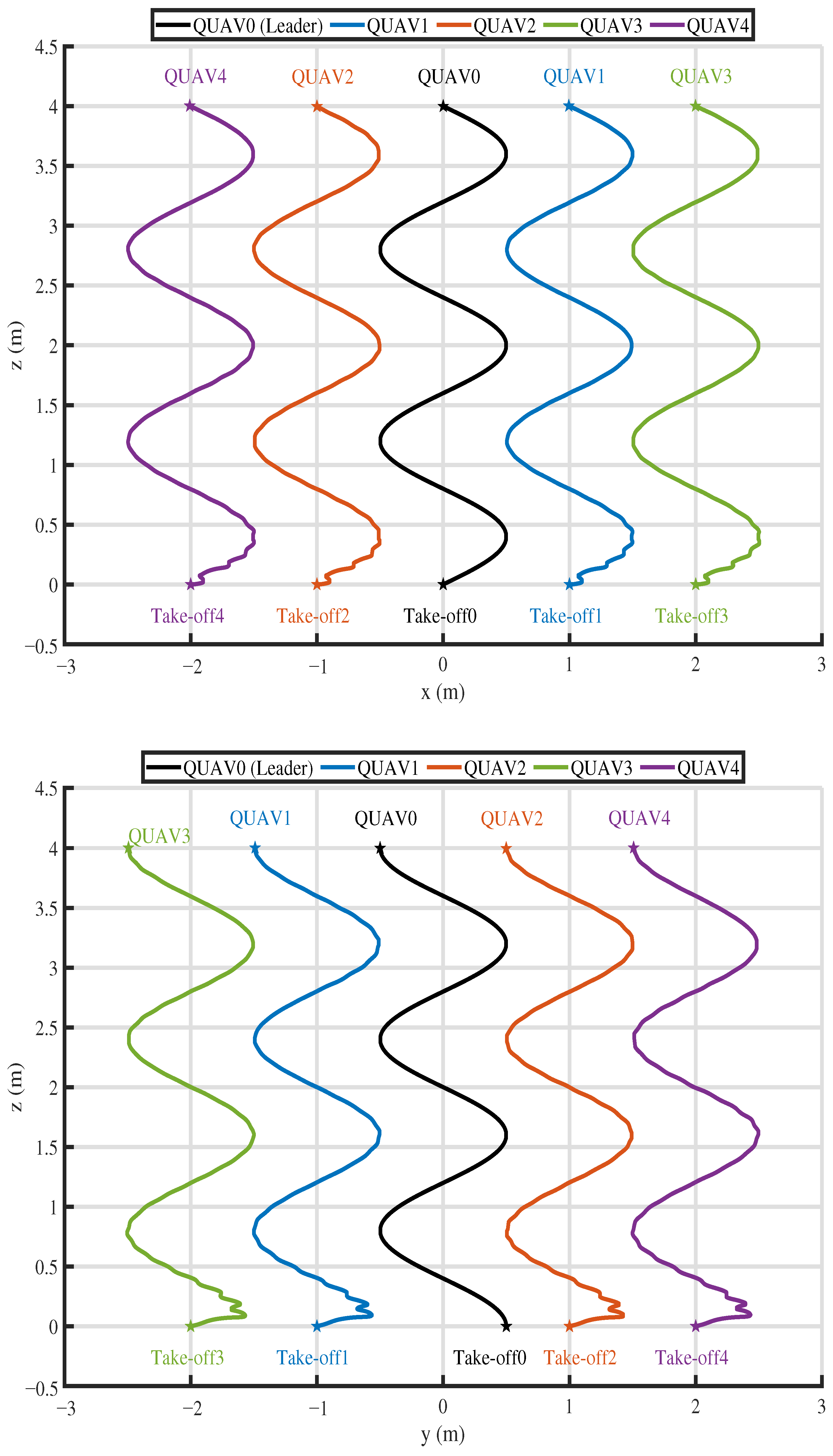
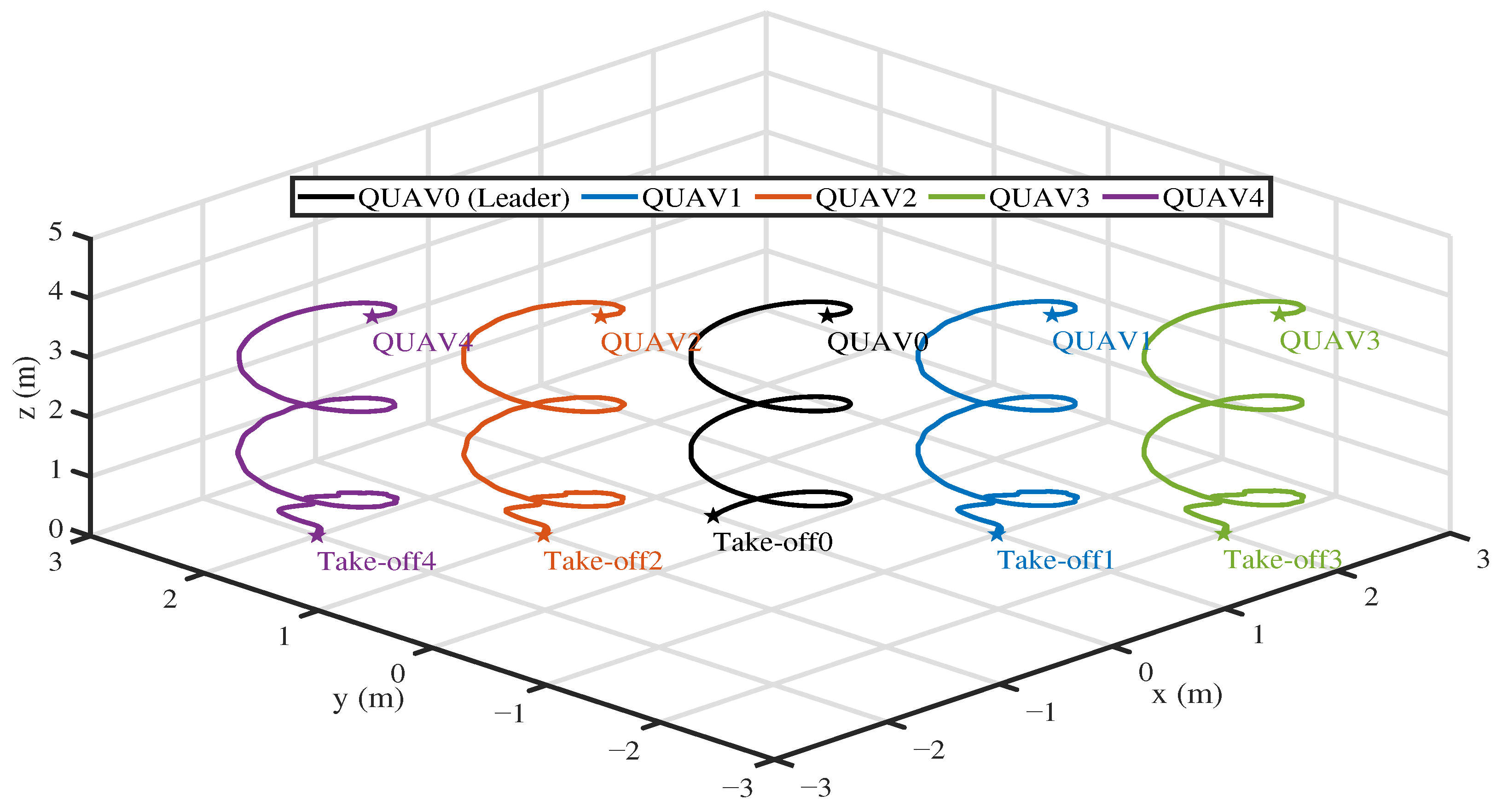
Figure 3 illustrates the 3D trajectory tracking of the formation composed of four QUAVs. The black solid line represents the trajectory of the virtual leader, while the orange-red, light-blue, purple, and green curves correspond to the flight trajectories of the four QUAVs, respectively. Moreover, Figure 4 presents the 2D side view the flight trajectories of all QUAVs. In summary, the four QUAVs achieve tracking of the virtual leader trajectory and maintenance of a prescribed formation.
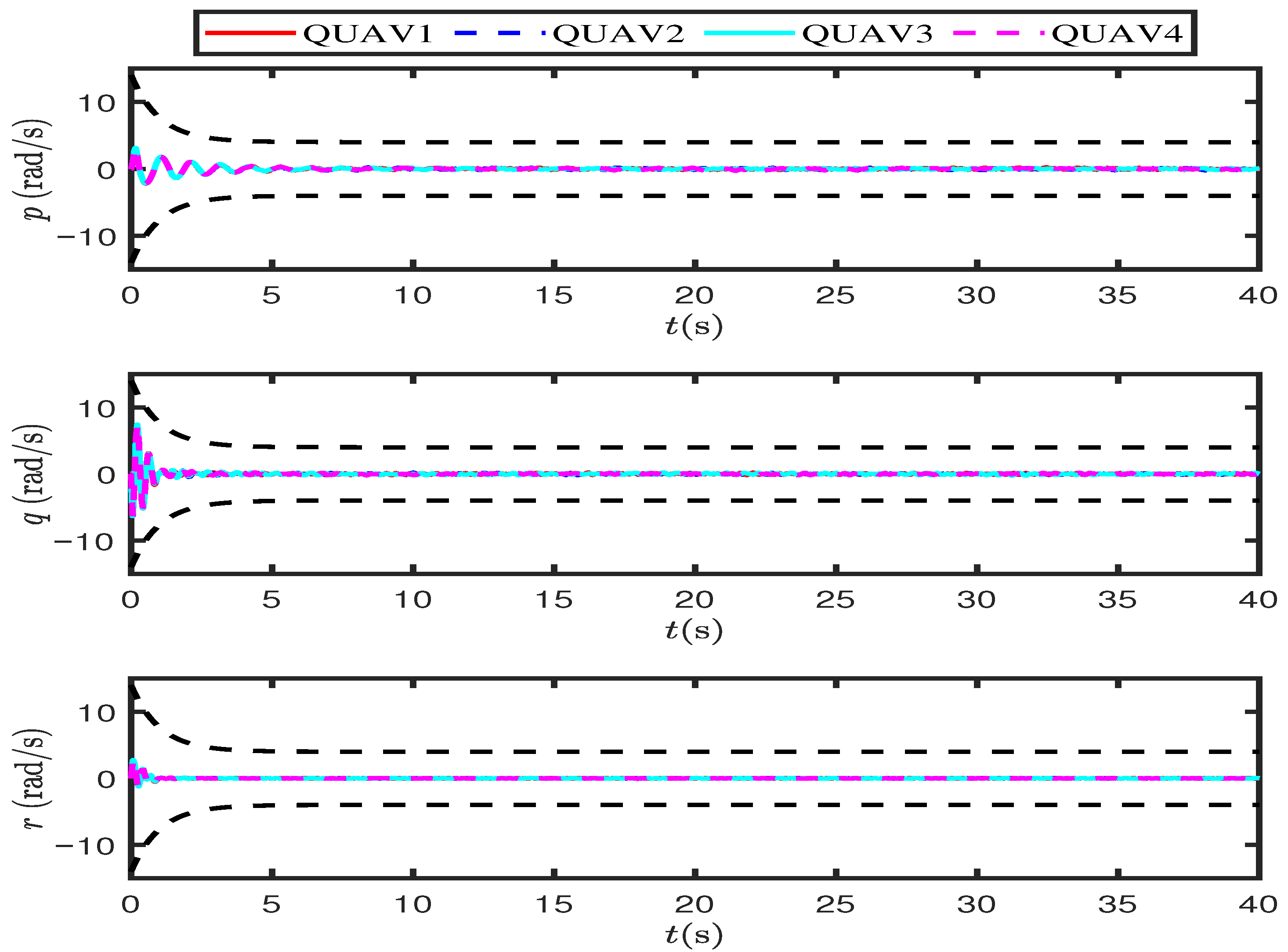
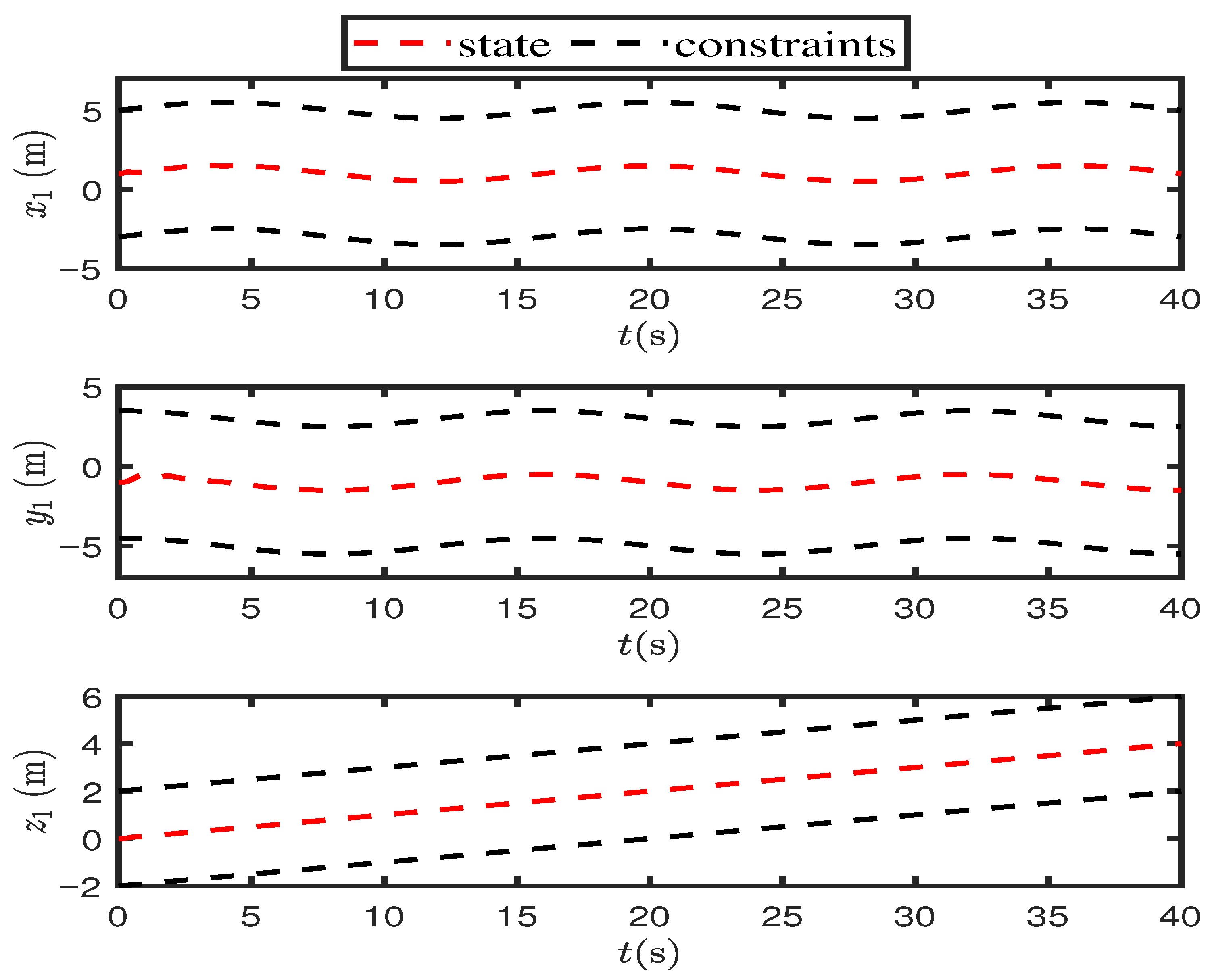
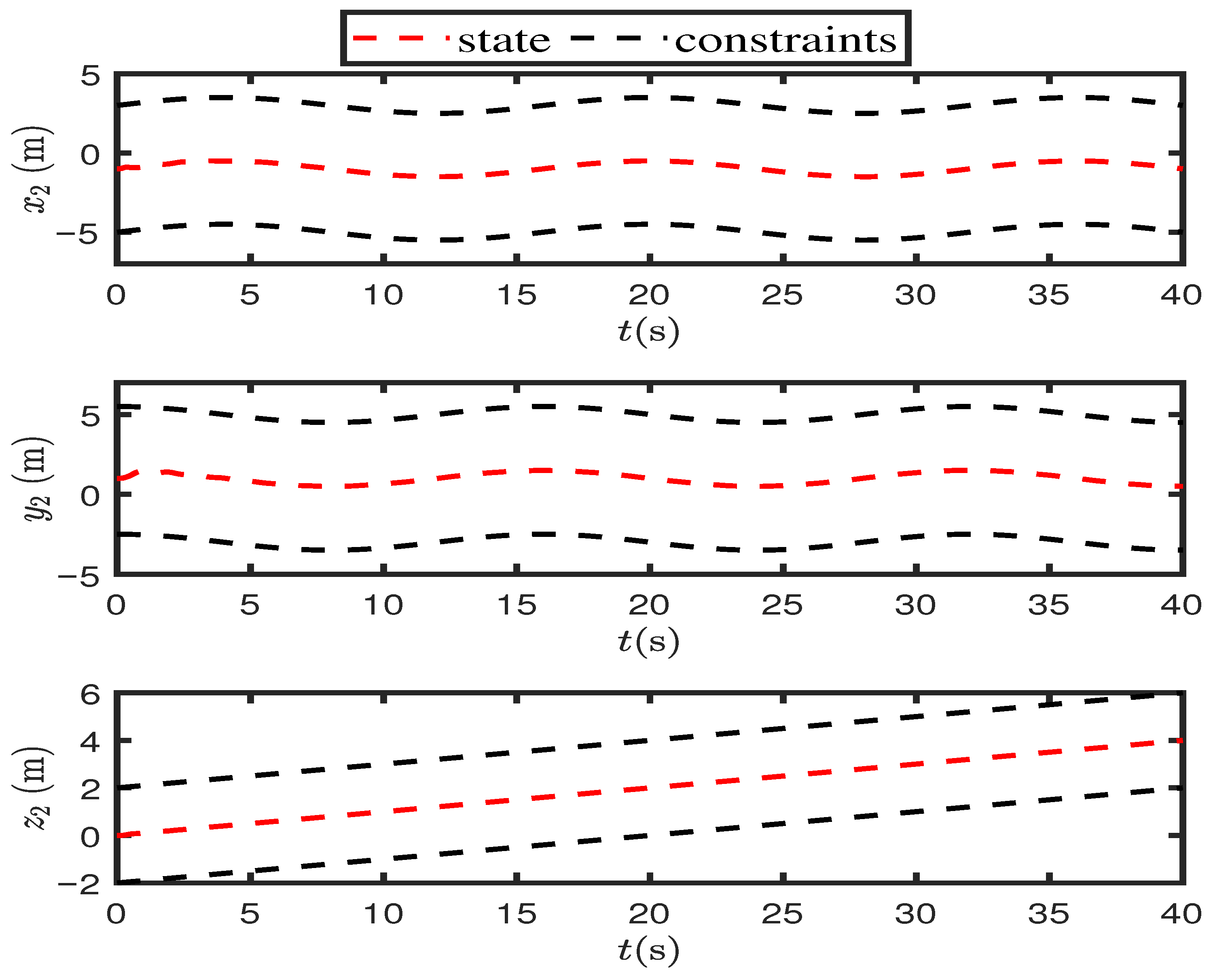
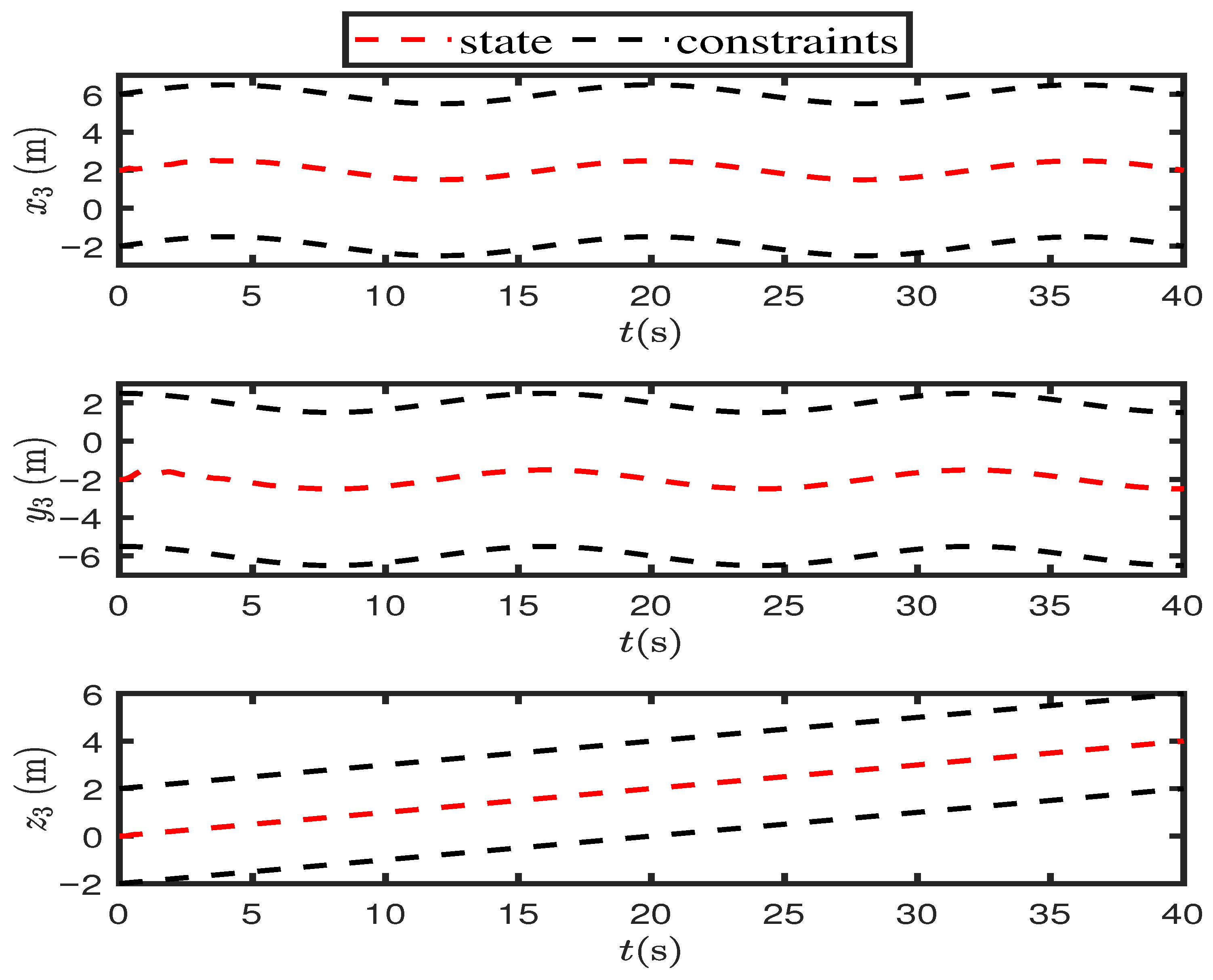
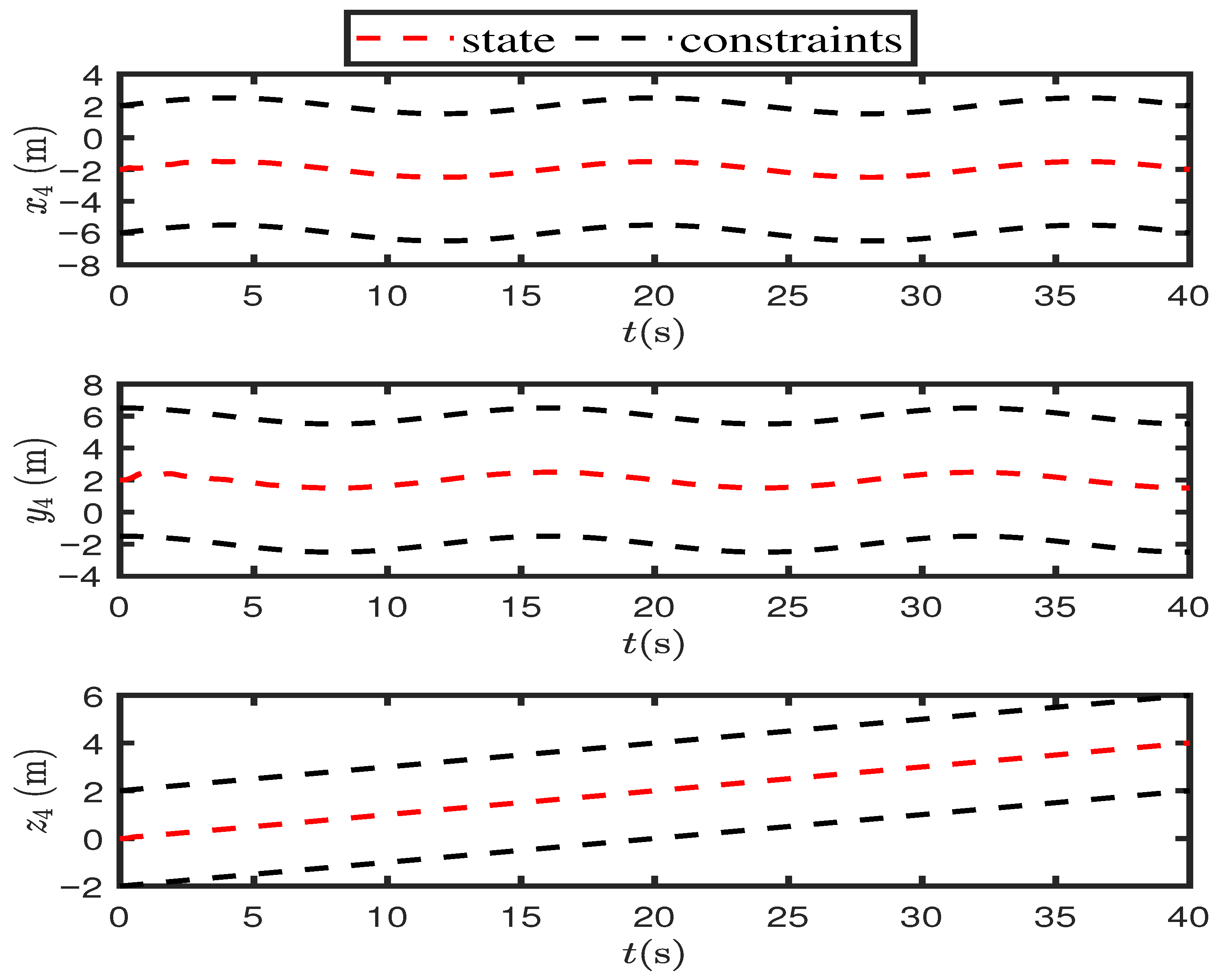
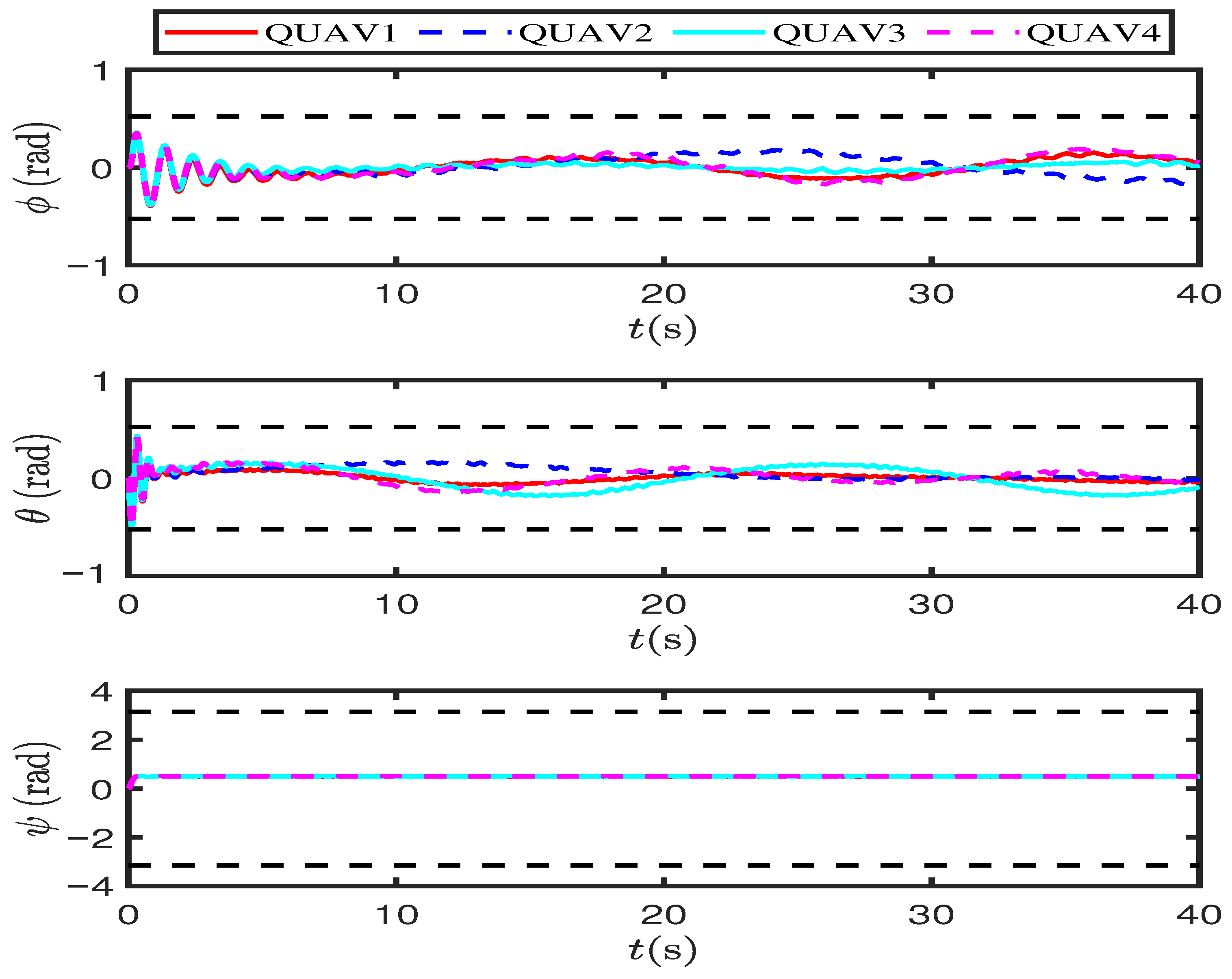
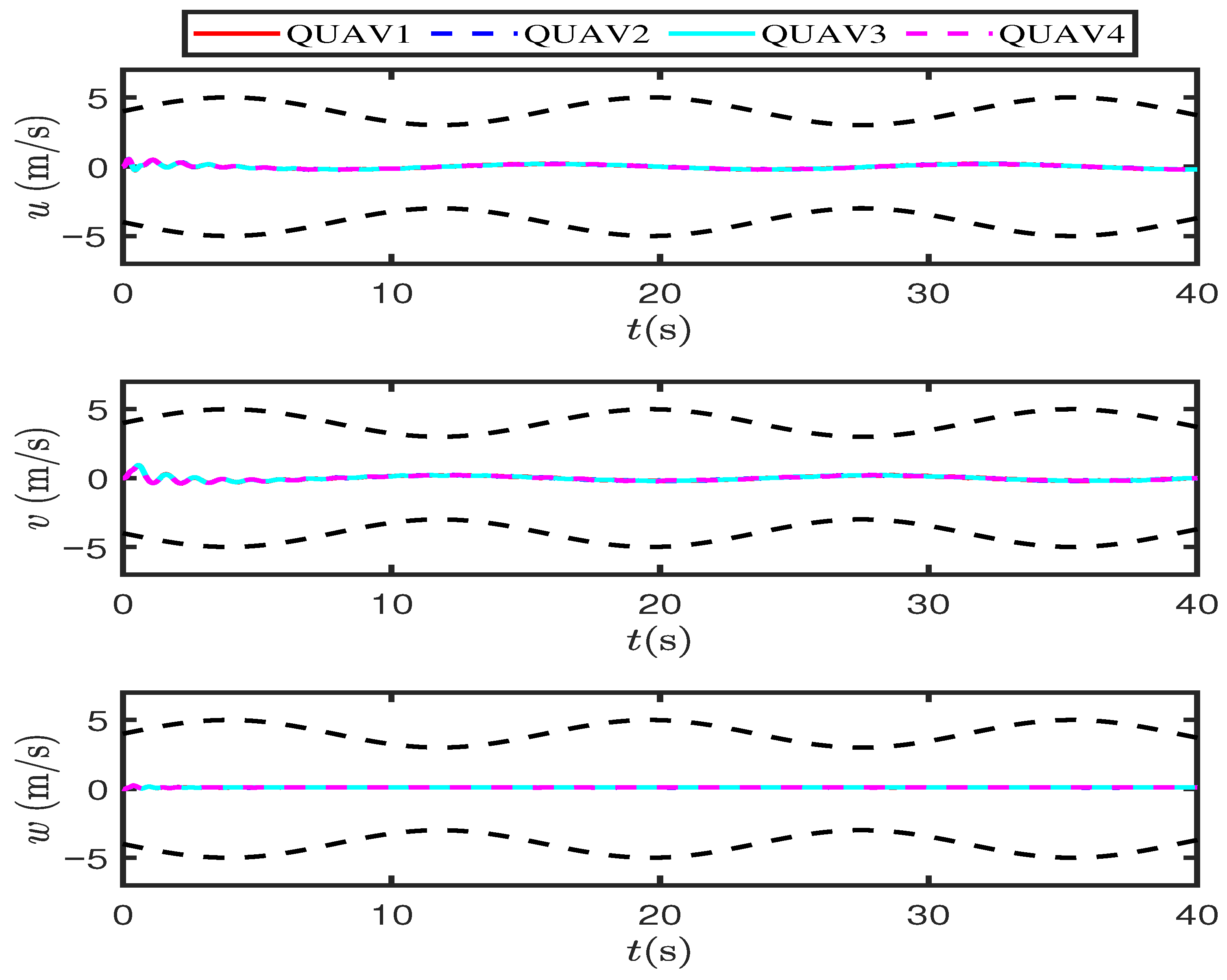
Specifically, Figure 5, Figure 6, Figure 7 and Figure 8 show the tracking results of each QUAV under position constraints, respectively. Figure 9 shows the attitude angle constraint curves of the four QUAVs, where the black dashed lines represent the constraint boundaries of the attitude angles. It can be observed that the four QUAVs under external disturbances can still quickly track the trajectory of the virtual leader in terms of position and attitude outputs while maintaining a fixed offset, thereby preserving the predefined formation. Figure 10 shows the velocity constraint curves of the four QUAVs, where the black dashed lines represent the constraint boundaries of the velocity. Figure 11 shows the angular rate constraint curves of the four QUAVs, where the black dashed lines represent the constraint boundaries of the angular rate. From Figure 10 and Figure 11, it can be observed that the angular rate and velocity are able to track the derivatives of the virtual leader trajectory. The four QUAVs exhibit fast trajectory tracking responses, and all state variables satisfy the full-state constraints.
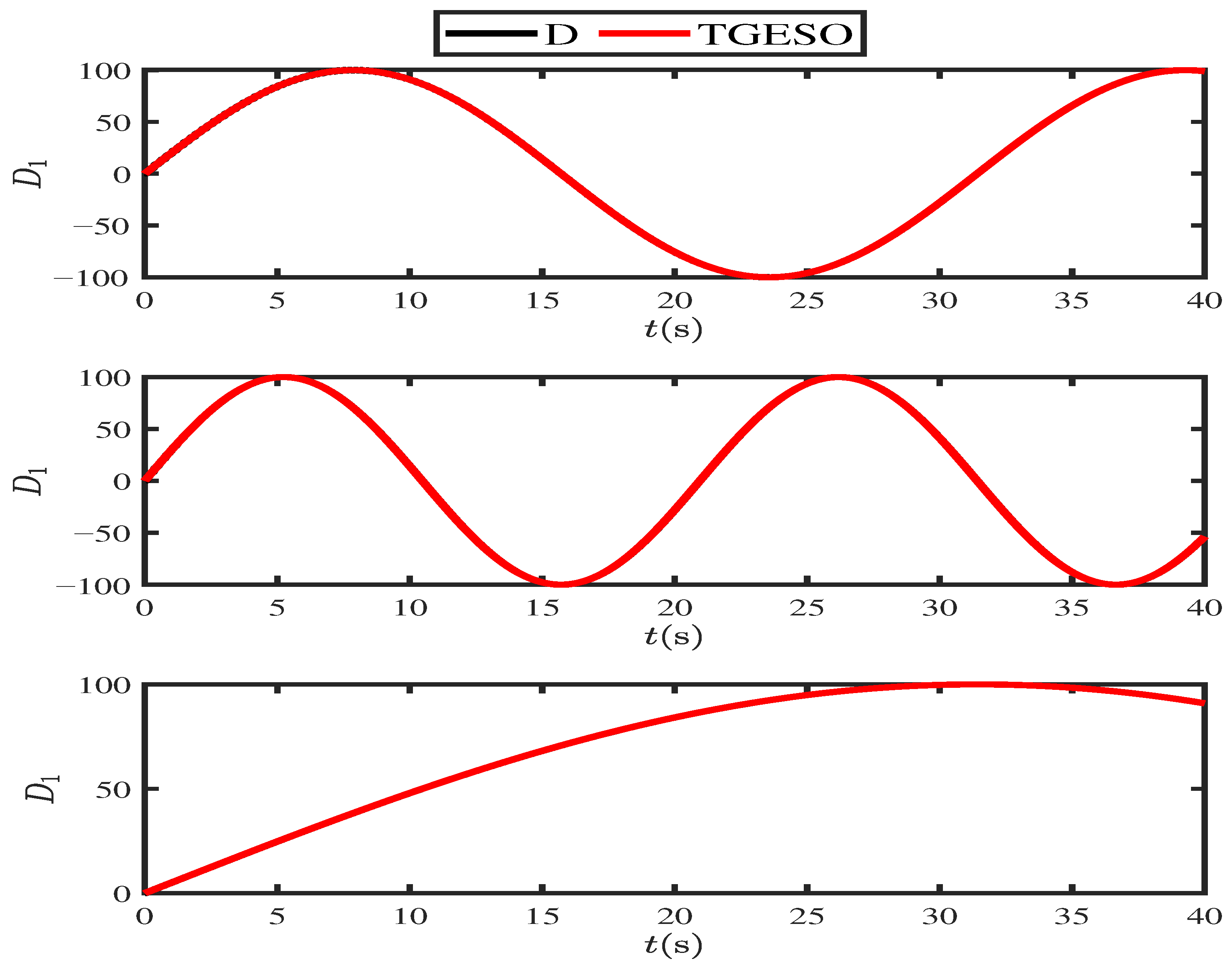
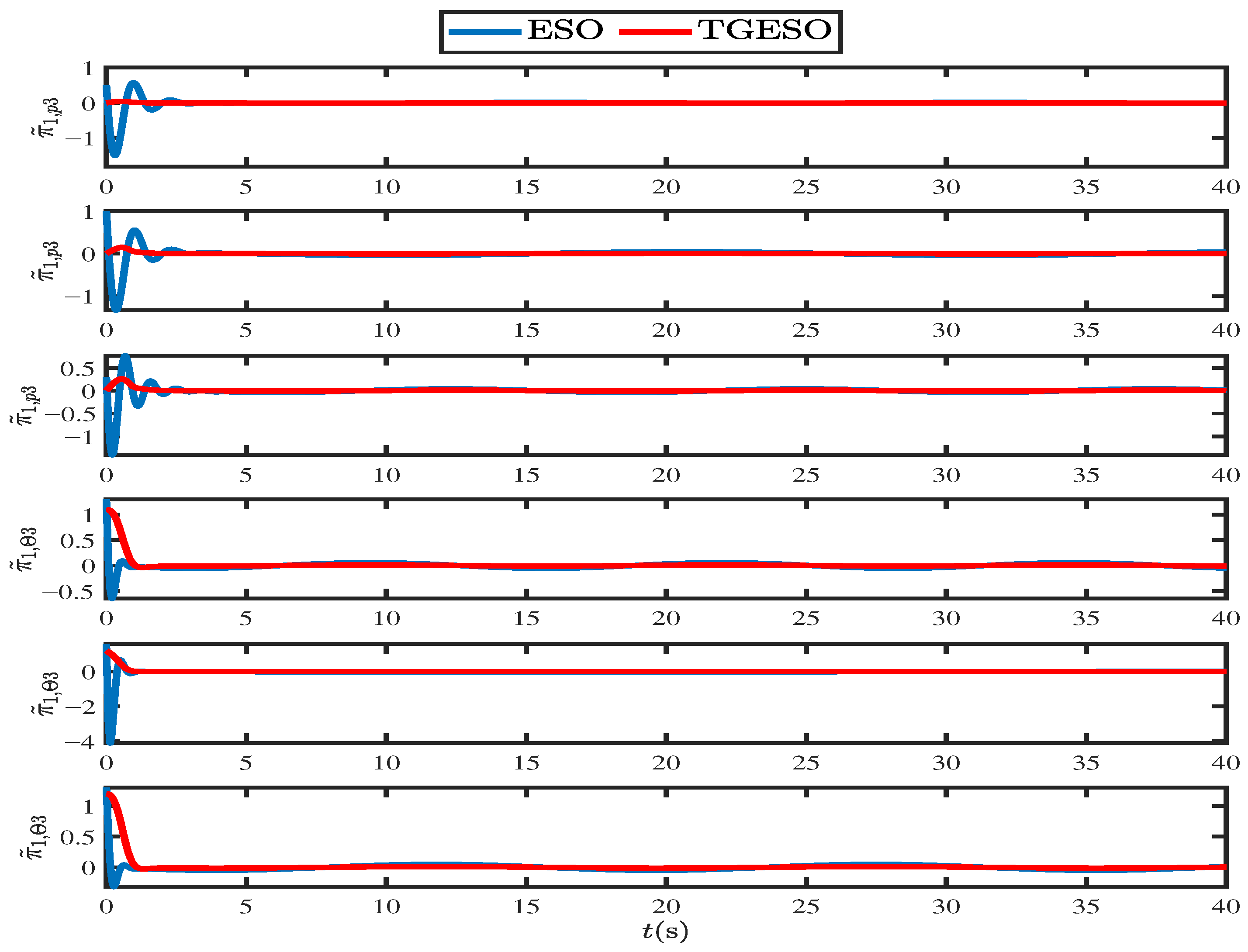
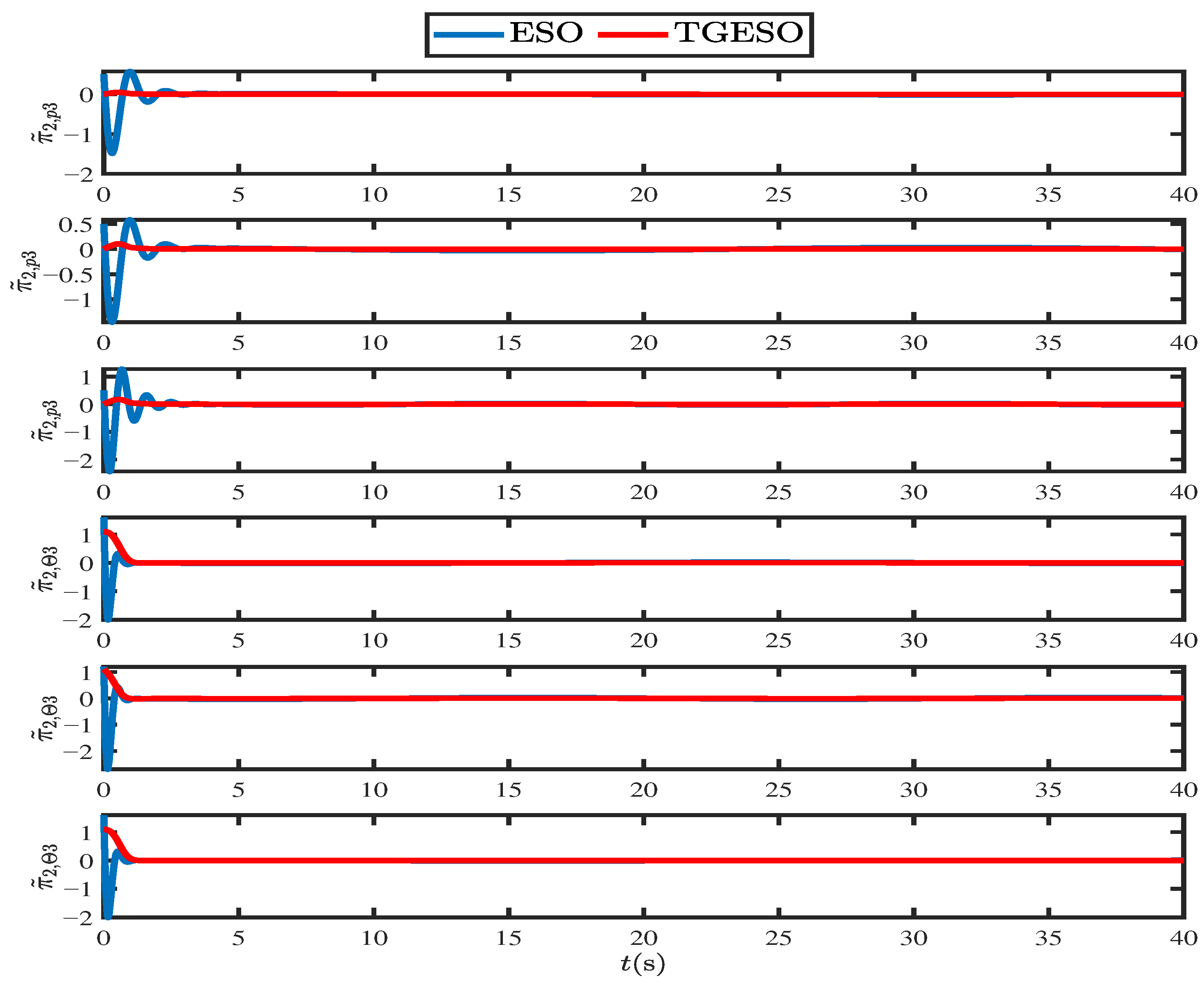
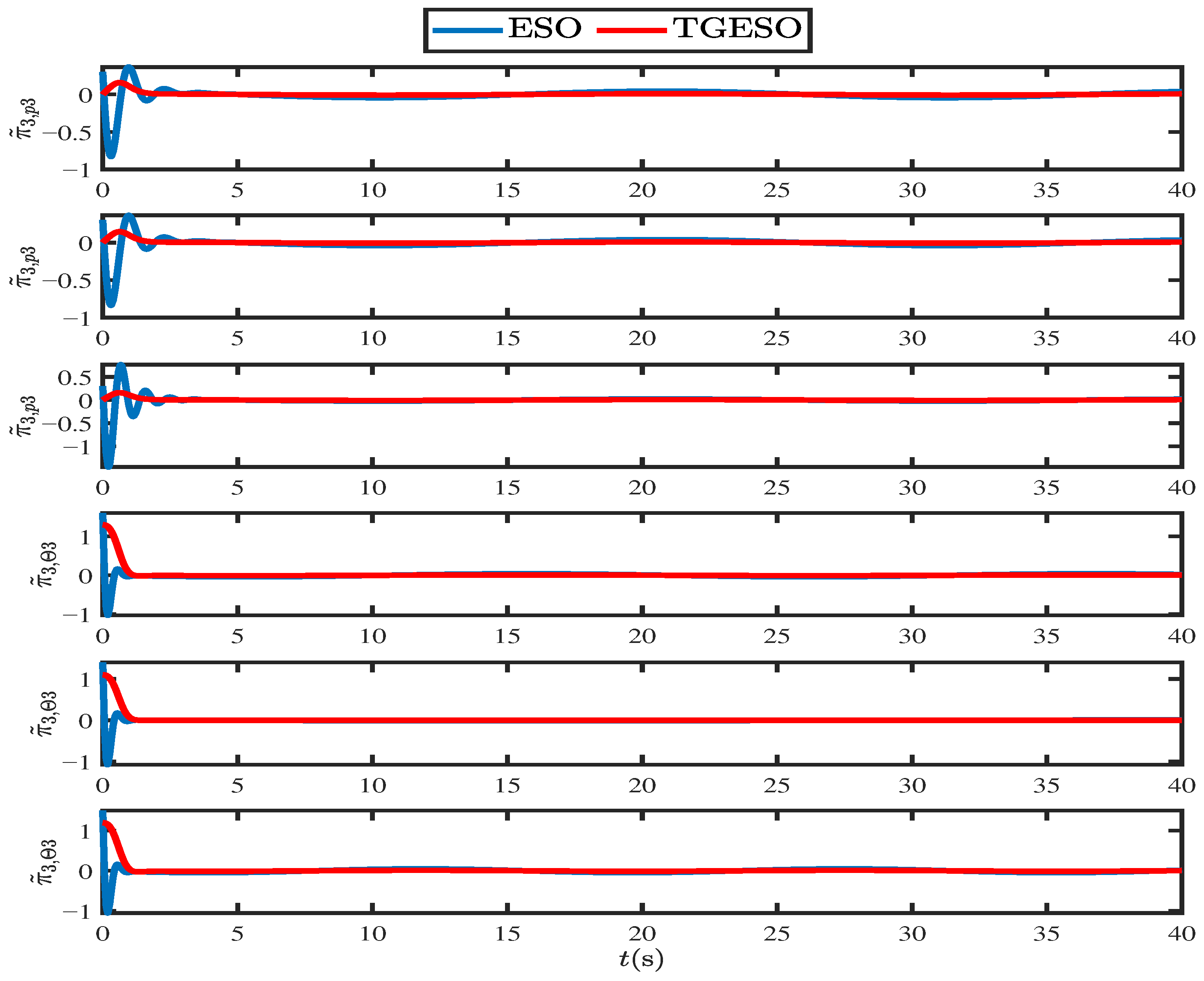
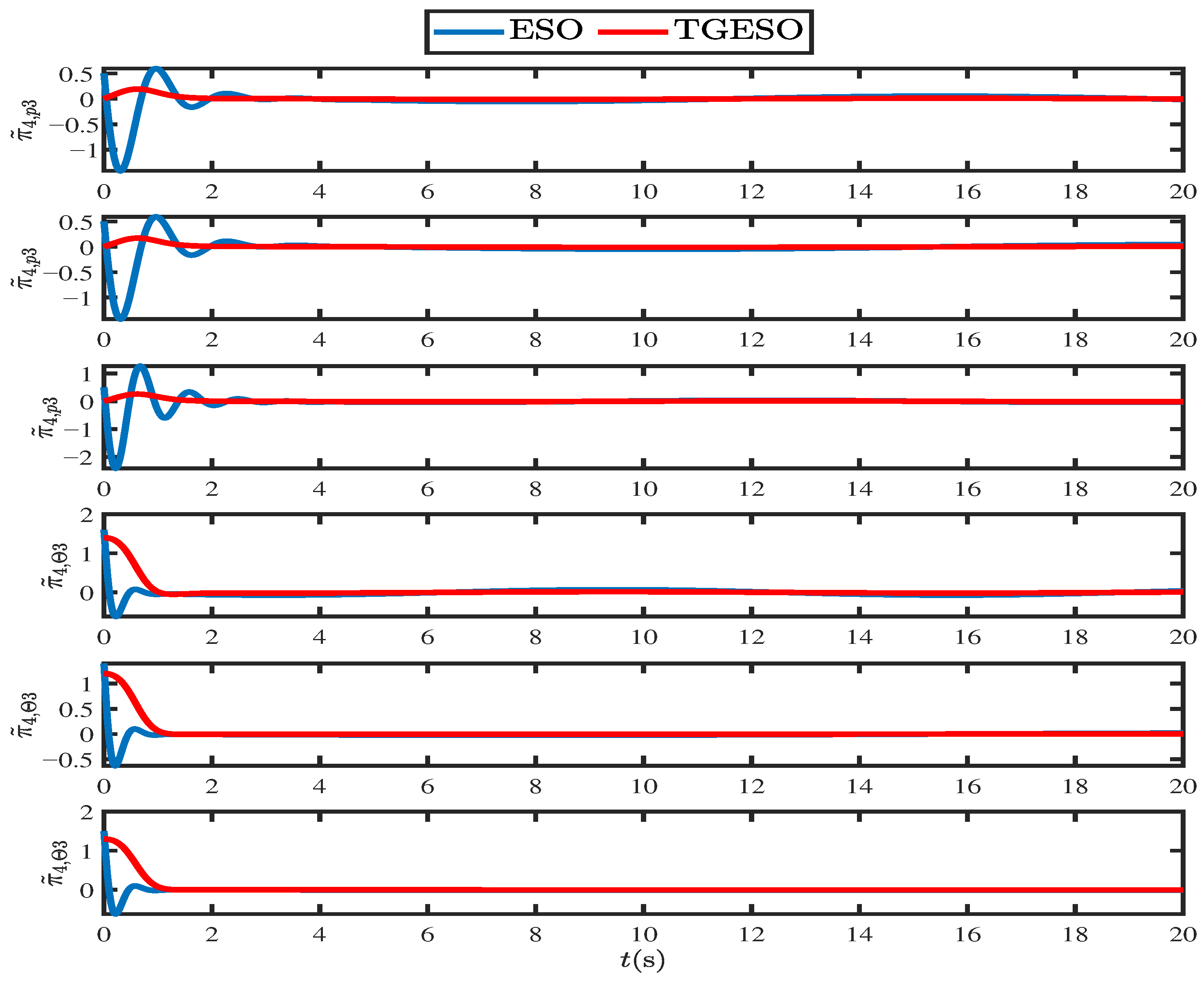
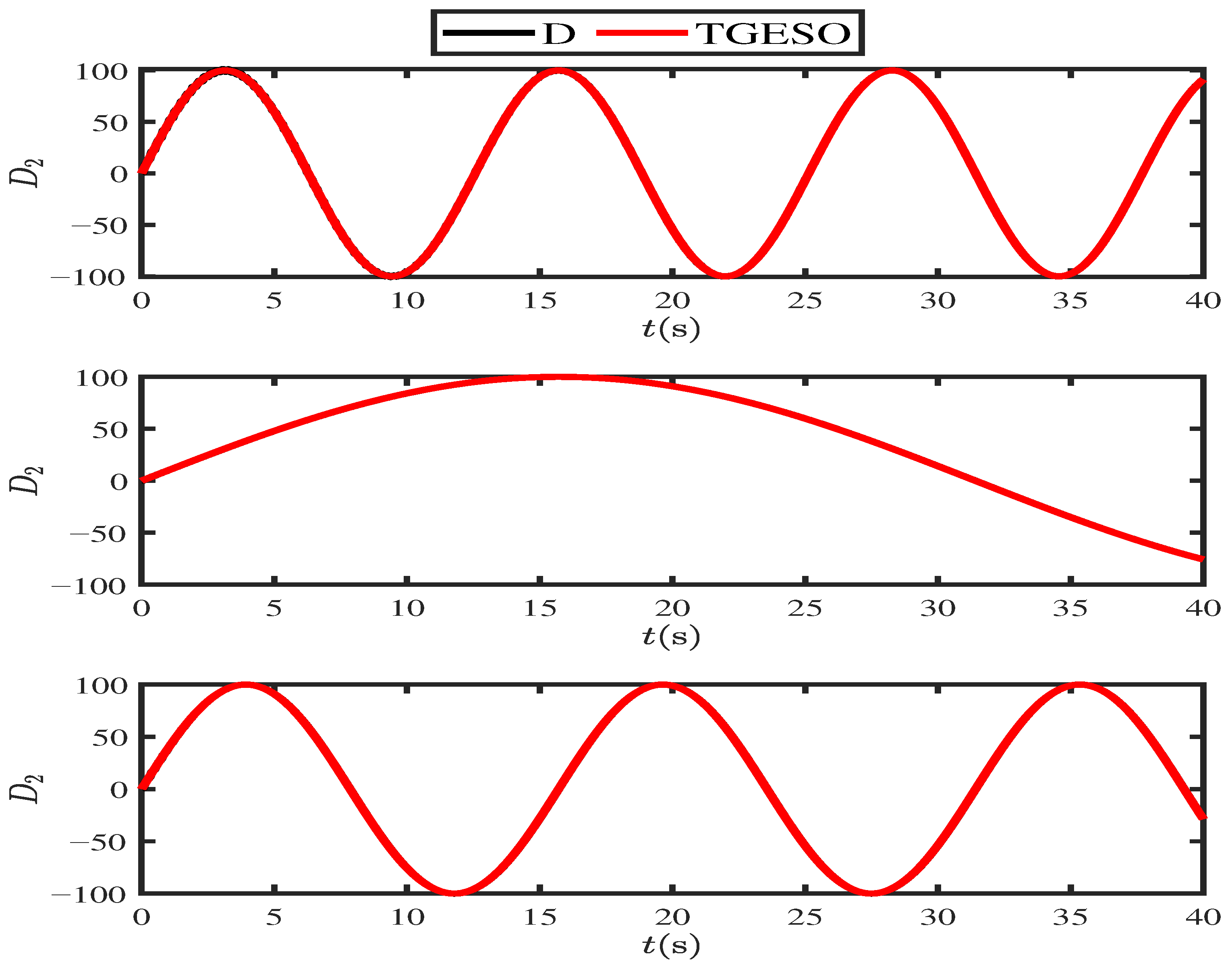
Figure 12, Figure 13, Figure 14 and Figure 15 show the estimation errors between the actual disturbance values and the estimated disturbance values of the four QUAVs. For the sake of clarity, the blue solid line denotes the estimation results of the ESO, and the red solid line denotes the estimation results of the TGESO. The parameters of the conventional ESO are given as: γ i , p 1 = d i a g 1 , 1 , 1 , γ i , p 2 = d i a g 3 , 3 , 3 , γ i , p 3 = d i a g 25 , 25 , 25 , γ i , Θ 1 = d i a g 1 , 1 , 1 , γ i , Θ 2 = d i a g 10 , 10 , 10 , γ i , Θ 3 = d i a g 100 , 100 , 100 . From the figures, it is evident that the conventional ESO can achieve basic disturbance estimation, but there is an obvious peaking phenomenon in the initial stage. In contrast, the TGESO adopts a smaller gain in the initial stage, thus avoiding the obvious initial peaking phenomenon in disturbance estimation. The simulation results indicate that the TGESO not only effectively suppresses the initial estimation overshoot but also improves the accuracy of disturbance estimation. Figure 16 and Figure 17 present the observer estimation performance test under strong disturbances. The given strong disturbance is set as: D 1 = 100 sin ( 0.2 t ) ; 100 sin ( 0.3 t ) ; 100 sin ( 0.05 t ) , D 2 = 100 sin ( 0.5 t ) ; 100 sin ( 0.1 t ) ; 100 sin ( 0.4 t ) . It can be seen that the disturbance estimates still maintain good tracking performance under stronger disturbances.
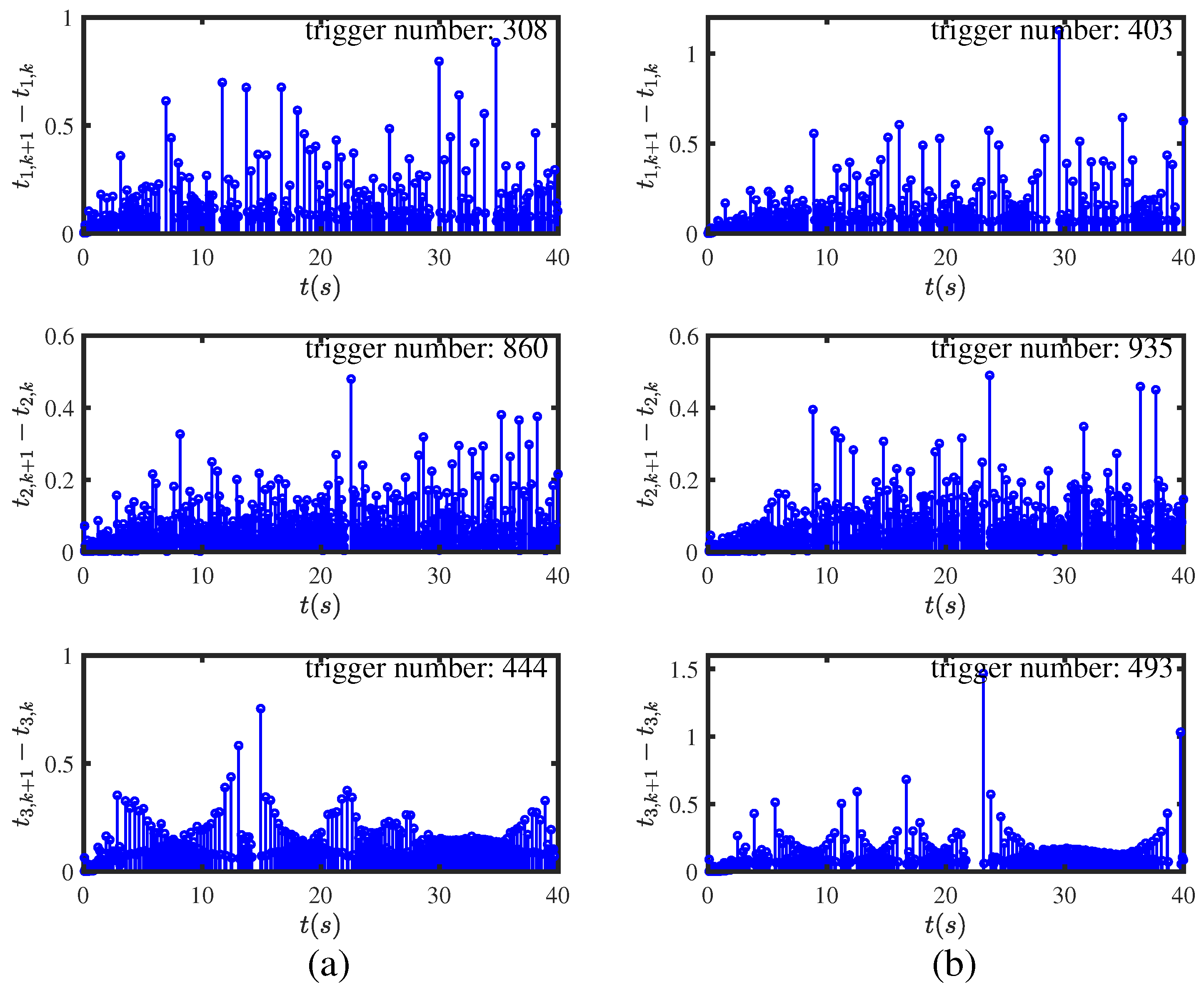
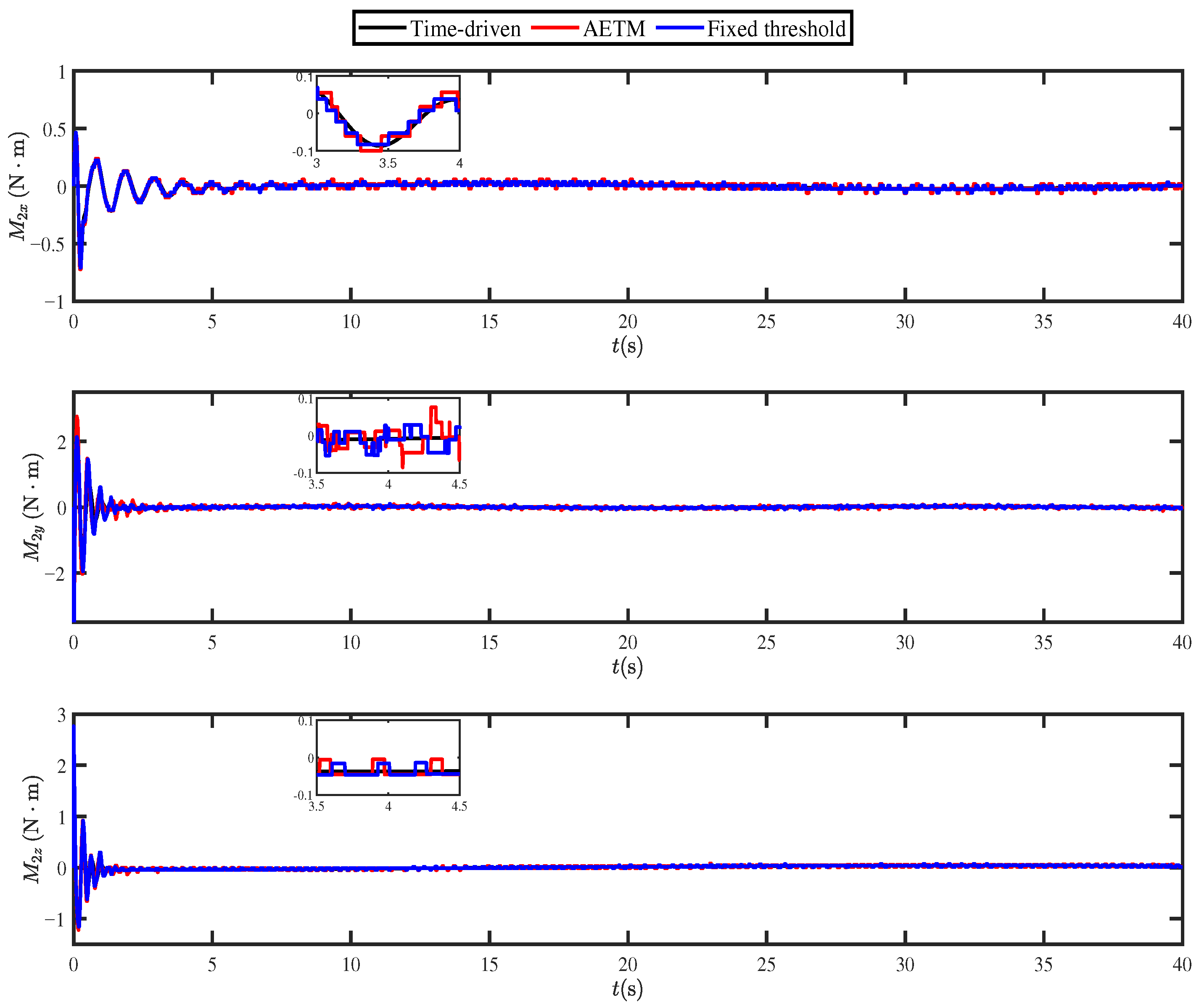
Figure 18 and Figure 19 take the three-dimensional torque of QUAV 2 as the illustration object and conduct a comparative analysis of the event-triggered mechanism with the adaptive threshold proposed in this paper and one with a fixed threshold. Specifically, in Figure 18, the black solid line, red solid line, and blue solid line correspond to the control input signals under time-driven, AETM, and fixed threshold, respectively. Figure 19a shows the number of trigger under the AETM, and Figure 19b shows the number of triggers under the fixed threshold. Figure 19 illustrates that, with basic tracking performance guaranteed, the event-triggered strategy with adaptive threshold has fewer trigger counts and positive sampling intervals, which avoids Zeno behavior and eases the system communication burden.
To more clearly observe the influence of different triggering mechanisms on system performance, a simulation period of 40 s is used. The system’s transmission cycle h, actual transmitted data volume n, and data transmission rate r are shown in Table 1.
Table 1 shows that the QUAV formation system under the proposed AETM requires fewer actual data transmissions than the fixed-threshold scheme. This demonstrates that the developed AETM can further reduce the communication burden while preserving satisfactory tracking performance, thereby improving network resource utilization.

5. Conclusions

This paper studies the adaptive event-triggered formation tracking control problem for the QUAV formation system in the presence of full-state constraints and unknown external disturbances. Firstly, the TGESO designed specifically for external disturbances not only overcome the initial peaking explosion problem of the traditional ESO, but also exhibits superior estimation accuracy and fast response performance. Moreover, based on the backstepping method, a formation tracking scheme is developed, enabling all state variables of each QUAV to track the corresponding trajectory signals of the virtual leader without violating the prescribed state constraints. Then, the AETM is adopted in the QUAV formation system, which reduces unnecessary transmission of network resources. Finally, the efficacy of the proposed adaptive event-triggered consensus control algorithm is validated by means of numerical simulations. In the future, the parameter tuning method and the issues involved in real-flight experiments will be further investigated.

Author Contributions

Conceptualization, K.Y.; methodology, K.Y. and G.H.; investigation, L.L. and G.H.; writing—original draft preparation, L.L. and G.H.; writing—review and editing, T.L. and K.Y.; supervision, K.Y.; project administration, L.L. and C.C.; funding acquisition, T.L. and C.C. All authors have read and agreed to the published version of the manuscript.

Funding

This work was supported in part by the National Natural Science Foundation of China under Grants 52572455 and 52572487, the Shanxi Province Higher Education Institutions Science and Technology Innovation Program Project under Grant 2024L374, the Lvliang City Introducing High-level Scientific and Technological Talents Key Research and Development Project under Grant 2024RC28, the Shaanxi Provincial Education Department Service Local Special Plan Project under Grant 24JC038, the Hubei Key Laboratory of Intelligent Robot under Grant HBIR202403, and the 2023 Youth Innovation Team of Shaanxi Universities.

Data Availability Statement

All data generated or analyzed are included in this study.

Acknowledgments

The authors thank the colleagues for their constructive suggestions and research assistance throughout this study.

Conflicts of Interest

The authors declare no conflict of interest.

References

  1. Adil, M.; Jan, M.; Liu, Y.; Abulkasim, H. A systematic survey: Security threats to UAV-aided IoT applications, taxonomy, current challenges and requirements with future research directions. IEEE Trans. Intell. Transp. Syst. 2022, 24, 1437–1455. [Google Scholar]
  2. Duan, B.; Fang, S.; Gong, Y.; Peng, Y.; Wu, X.; Zhu, R. Remote estimation of grain yield based on UAV data in different rice cultivars under contrasting climatic zone. Field Crops Res. 2021, 267, 108148. [Google Scholar]
  3. Li, C.; Liu, M.; Hu, Y.; Wang, H.; Xiong, Z.; Wu, W.; Liu, C.; Zhang, C.; Du, Y. Investigating the vertical distribution patterns of urban air pollution based on unmanned aerial vehicle gradient monitoring. Sustain. Cities Soc. 2022, 86, 104144. [Google Scholar] [CrossRef]
  4. Zhang, Q.; Bai, Z.; Huang, G.; Kong, J.; Du, Y.; Wang, D.; Jing, C.; Xie, W. Innovative landslide disaster monitoring: Unmanned aerial vehicle-deployed GNSS technology. Geomat. Nat. Hazards Risk 2024, 15, 2366374. [Google Scholar] [CrossRef]
  5. Guo, H.; Chen, M.; Jiang, Y.; Lungu, M. Distributed adaptive human-in-the-loop event-triggered formation control for QUAVs with quantized communication. IEEE Trans. Ind. Inform. 2022, 19, 7572–7582. [Google Scholar] [CrossRef]
  6. Yang, K.; Dong, W.; Tong, Y.; He, L. Leader-follower formation consensus of quadrotor UAVs based on prescribed performance adaptive constrained backstepping control. Int. J. Control Autom. Syst. 2022, 20, 3138–3154. [Google Scholar] [CrossRef]
  7. Shao, S.; Chen, M.; Hou, J.; Zhao, Q. Event-triggered-based discrete-time neural control for a quadrotor UAV using disturbance observer. IEEE/ASME Trans. Mechatron. 2021, 26, 689–699. [Google Scholar] [CrossRef]
  8. Gao, Y.; Wang, W.; Yang, C.; Zhang, Y.; Qie, T. A new reaching law for anti-disturbance sliding mode control of steer-by-wire system. IEEE Trans. Veh. Technol. 2025, 74, 4064–4075. [Google Scholar]
  9. Wu, Y.; Liang, H.; Xuan, S.; Zhang, X. Extended state observer based finite-time fault-tolerant formation control for multi-UAVs. J. Frankl. Inst. 2024, 361, 107158. [Google Scholar] [CrossRef]
  10. Wang, Y.; Yuan, Y.; Liu, J. Finite-time leader-following output consensus for multi-agent systems via extended state observer. Automatica 2021, 124, 109133. [Google Scholar] [CrossRef]
  11. Xiao, H.; Yang, Y.; Yu, D.; Chen, C. 3D Self-triggered-organized communication topology based UAV swarm consensus system with distributed extended state observer. IEEE Trans. Netw. Sci. Eng. 2025, 12, 3985–4000. [Google Scholar] [CrossRef]
  12. Pu, Z.; Yuan, R.; Yi, J.; Tan, X. A class of adaptive extended state observers for nonlinear disturbed systems. IEEE Trans. Ind. Electron. 2015, 62, 5858–5869. [Google Scholar] [CrossRef]
  13. Shen, H.; Du, J.; Yan, K.; Liu, Y.; Chen, J. VGESO-based finite-time fault-tolerant tracking control for quadrotor unmanned aerial vehicle. Int. J. Aerosp. Eng. 2024, 2024, 2541698. [Google Scholar] [CrossRef]
  14. Yan, K.; Chen, H.; Chen, C.; Gao, S.; Sun, J. Time-varying gain extended state observer-based adaptive optimal control for disturbed unmanned helicopter. ISA Trans. 2024, 148, 1–11. [Google Scholar] [CrossRef] [PubMed]
  15. Ye, H.; Chen, M.; Wu, Q. Flight envelope protection control based on reference governor method in high angle of attack maneuver. Math. Probl. Eng. 2015, 2015, 254975. [Google Scholar] [CrossRef]
  16. Cruz-Ortiz, D.; Chairez, I.; Poznyak, A. Sliding-mode control of full-state constraint nonlinear systems: A barrier Lyapunov function approach. IEEE Trans. Syst. Man Cybern. Syst. 2022, 52, 6593–6606. [Google Scholar] [CrossRef]
  17. Zhao, W.; Liu, Y.; Liu, L. Observer-based adaptive fuzzy tracking control using integral barrier Lyapunov functionals for a nonlinear system with full state constraints. IEEE/CAA J. Autom. Sin. 2021, 8, 617–627. [Google Scholar] [CrossRef]
  18. Tian, D.; Song, X. Addressing complex state constraints in the integral barrier Lyapunov function-based adaptive tracking control. Int. J. Control 2023, 96, 1202–1209. [Google Scholar] [CrossRef]
  19. Yan, K.; Wu, Q. Adaptive tracking flight control for unmanned autonomous helicopter with full state constraints and actuator faults. ISA Trans. 2022, 128, 32–46. [Google Scholar] [CrossRef]
  20. Cui, G.; Xu, H.; Chen, X.; Yu, J. Fixed-time distributed adaptive formation control for multiple QUAVs with full-state constraints. IEEE Trans. Aerosp. Electron. Syst. 2023, 59, 4192–4206. [Google Scholar] [CrossRef]
  21. Chen, J.; Hua, C.; Wang, F.; Guan, X. Distributed adaptive containment control of uncertain QUAV multiagents with time-varying payloads and multiple variable constraints. ISA Trans. 2019, 90, 107–115. [Google Scholar] [CrossRef]
  22. Lu, S.; Chen, M.; Liu, Y.; Shao, S. SDO-based command filtered adaptive neural tracking control for MIMO nonlinear systems with time-varying constraints. IEEE Trans. Cybern. 2023, 54, 5054–5067. [Google Scholar] [CrossRef] [PubMed]
  23. Lu, S.; Chen, M.; Liu, Y.; Shao, S. Adaptive NN tracking control for uncertain MIMO nonlinear system with time-varying state constraints and disturbances. IEEE Trans. Neural Netw. Learn. Syst. 2022, 34, 7309–7323. [Google Scholar] [CrossRef] [PubMed]
  24. Yan, K.; Zhao, J.; Fang, J.; Zhang, P.; Cheng, B.; Yu, X. Adaptive fault tolerant compensation control for unmanned autonomous helicopter with multi-constrained conditions. ISA Trans. 2025, 167, 1339–1350. [Google Scholar] [CrossRef] [PubMed]
  25. Xing, L.; Wen, C.; Liu, Z.; Su, H.; Cai, J. Event-triggered adaptive control for a class of uncertain nonlinear systems. IEEE Trans. Autom. Control 2016, 62, 2071–2076. [Google Scholar] [CrossRef]
  26. Liu, J.; Zhang, Y.; Yu, Y.; Sun, C. Fixed-time leader-follower consensus of networked nonlinear systems via event/self-triggered control. IEEE Trans. Neural Netw. Learn. Syst. 2020, 31, 5029–5037. [Google Scholar]
  27. Wang, L.; Chen, C.; Li, H. Event-triggered adaptive control of saturated nonlinear systems with time-varying partial state constraints. IEEE Trans. Cybern. 2018, 50, 1485–1497. [Google Scholar] [CrossRef]
  28. Tian, B.; Cui, J.; Lu, H.; Liu, L.; Zong, Q. Attitude control of UAVs based on event-triggered supertwisting algorithm. IEEE Trans. Ind. Inform. 2020, 17, 1029–1038. [Google Scholar]
  29. Wu, Y.; Chen, M.; Li, H.; Chadli, M. Event-triggered-based adaptive NN cooperative control of six-rotor UAVs with finite-time prescribed performance. IEEE Trans. Autom. Sci. Eng. 2023, 21, 1867–1877. [Google Scholar] [CrossRef]
  30. Song, W.; Wang, J.; Zhao, S.; Shan, J. Event-triggered cooperative unscented kalman filtering and its application in multi-UAV systems. Automatica 2019, 105, 264–273. [Google Scholar] [CrossRef]
  31. Yan, K.; Fan, J.; Tang, J.; He, C. Fault detection and distributed consensus fault-tolerant control for multiple quadrotor UAVs based on nussbaum-type function. Aerospace 2025, 12, 734. [Google Scholar]
  32. Liu, S.; Jiang, B.; Mao, Z.; Zhang, Y. Decentralized adaptive event-triggered fault-tolerant synchronization tracking control of multiple UAVs and UGVs with prescribed performance. IEEE Trans. Veh. Technol. 2024, 73, 9656–9665. [Google Scholar] [CrossRef]
  33. Zhang, B.; Sun, X.; Liu, S.; Lv, M.; Deng, X. Event-triggered adaptive fault-tolerant synchronization tracking control for multiple 6-DOF fixed-wing UAVs. IEEE Trans. Veh. Technol. 2021, 71, 148–161. [Google Scholar] [CrossRef]
  34. Zhu, C.; Chen, J.; Iwasaki, M.; Zhang, H. Event-triggered deep learning control of quadrotors for trajectory tracking. IEEE Trans. Ind. Electron. 2023, 71, 2726–2736. [Google Scholar] [CrossRef]
  35. Lin, G.; Li, H.; Ahn, C.; Yao, D. Event-based finite-time neural control for human-in-the-loop UAV attitude systems. IEEE Trans. Neural Netw. Learn. Syst. 2022, 34, 10387–10397. [Google Scholar]
  36. Guo, Y.; Tian, Y.; Ji, Y.; Ge, Z. Fixed-time consensus of nonlinear multi-agent system with uncertain disturbances based on event-triggered strategy. ISA Trans. 2022, 126, 629–637. [Google Scholar]
Figure 1. The QUAV structure diagram.
Aerospace 13 00308 g001
Figure 2. The communication topolopy of the QUAV formation system.
Aerospace 13 00308 g002
Figure 3. The 3D trajectories of the QUAV formation system.
Aerospace 13 00308 g003
Figure 4. The 2D trajectories of the QUAV formation system.
Aerospace 13 00308 g004
Figure 5. Position of QUAV 1 under state constraints.
Aerospace 13 00308 g005
Figure 6. Position of QUAV 2 under state constraints.
Aerospace 13 00308 g006
Figure 7. Position of QUAV 3 under state constraints.
Aerospace 13 00308 g007
Figure 8. Position of QUAV 4 under state constraints.
Aerospace 13 00308 g008
Figure 9. Attitude angle of each QUAV under state constraints.
Aerospace 13 00308 g009
Figure 10. Velocity of each QUAV under state constraints.
Aerospace 13 00308 g010
Figure 11. Angular rate of each QUAV under state constraints.
Aerospace 13 00308 g011
Figure 12. Comparative estimation errors under the TGESO and ESO.
Aerospace 13 00308 g012
Figure 13. Comparative estimation errors under the TGESO and ESO.
Aerospace 13 00308 g013
Figure 14. Comparative estimation errors under the TGESO and ESO.
Aerospace 13 00308 g014
Figure 15. Comparative estimation errors under the TGESO and ESO.
Aerospace 13 00308 g015
Figure 16. Estimation results of the TGESO under strong disturbances.
Aerospace 13 00308 g016
Figure 17. Estimation results of the TGESO under strong disturbances.
Aerospace 13 00308 g017
Figure 18. Comparison of control input signal under adaptive and fixed thresholds.
Aerospace 13 00308 g018
Figure 19. The trigger numbers for adaptive (a) and fixed (b) thresholds.
Aerospace 13 00308 g019
Table 1. Comparison of system performance under different trigger mechanisms.
Methodnhr
Time-driven40,0000.001100%
Fixed threshold14,5950.00136%
AETM13,4190.00133%
Disclaimer/Publisher’s Note: The statements, opinions and data contained in all publications are solely those of the individual author(s) and contributor(s) and not of MDPI and/or the editor(s). MDPI and/or the editor(s) disclaim responsibility for any injury to people or property resulting from any ideas, methods, instructions or products referred to in the content.