In total, 48 specimens of 18 taxa were studied. Taxonomically, the studied specimens belong to the following genera: Arachniopsis Spruce (1 species), Bazzania (11 species and 1 subspecies), Lepidozia (2 species), Neolepidozia (2 species), and Tricholepidozia (1 species).
Taxonomic Treatment
Arachniopsis major Herzog, Trans. Brit. Bryol. Soc. 1 (4): 294, 1950
Telaranea major (Herzog) J.J.Engel et G.L.Merr., Fieldiana, Bot. (n.ser.) 44: 165, 2004
Illustrations: [
37] (Figures 12 and 13), [
36,
38] (Figure la,b).
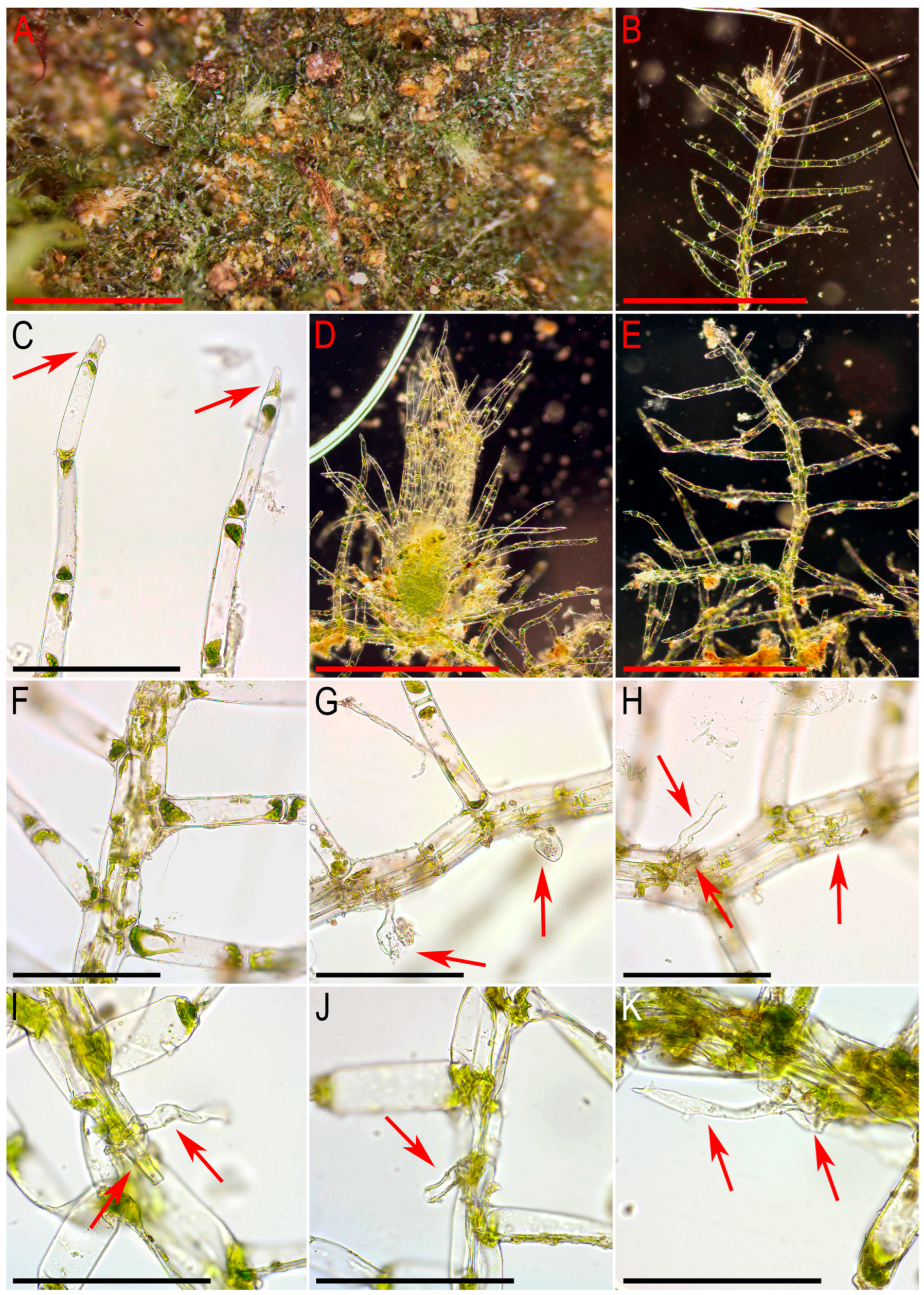
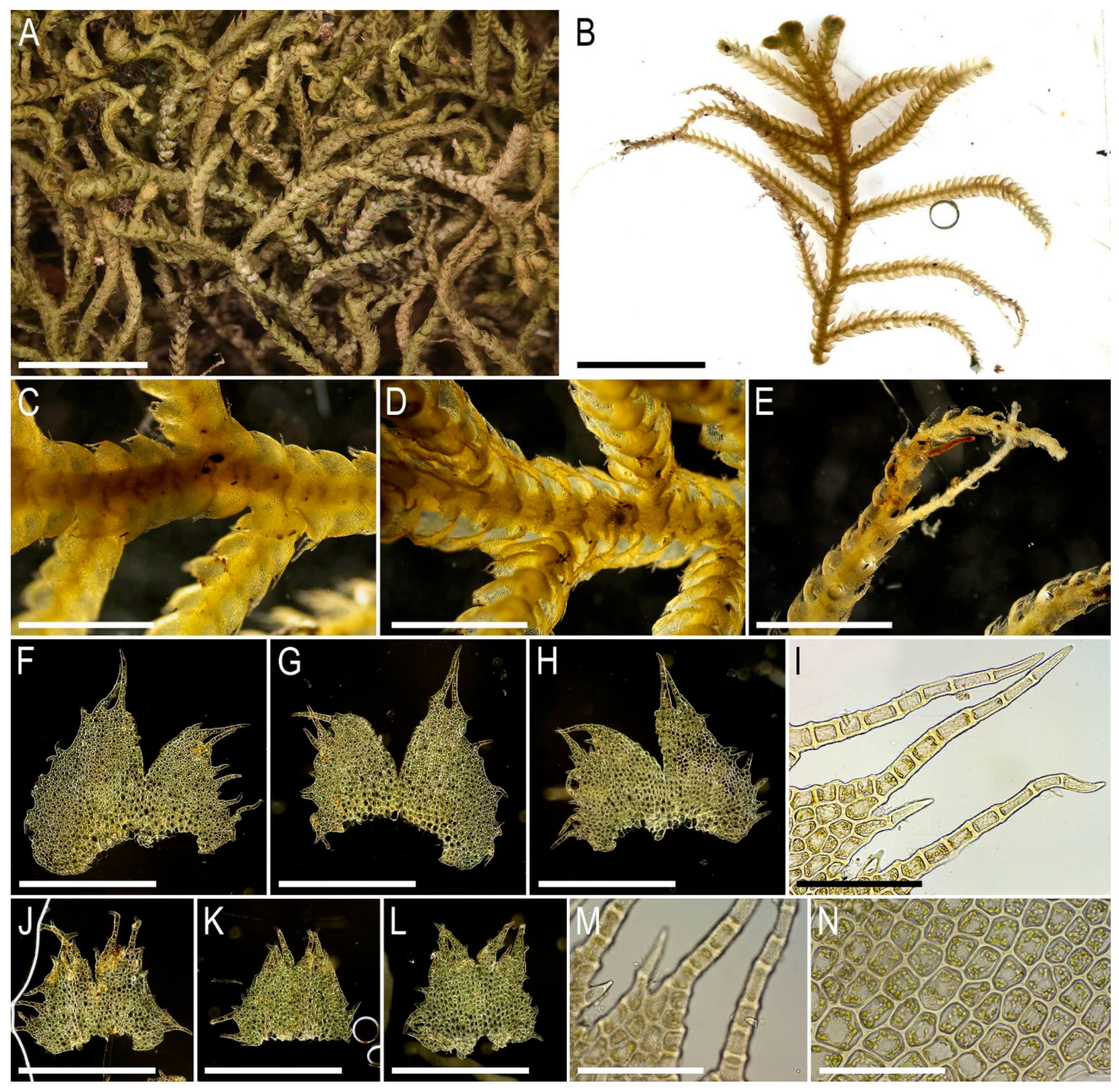
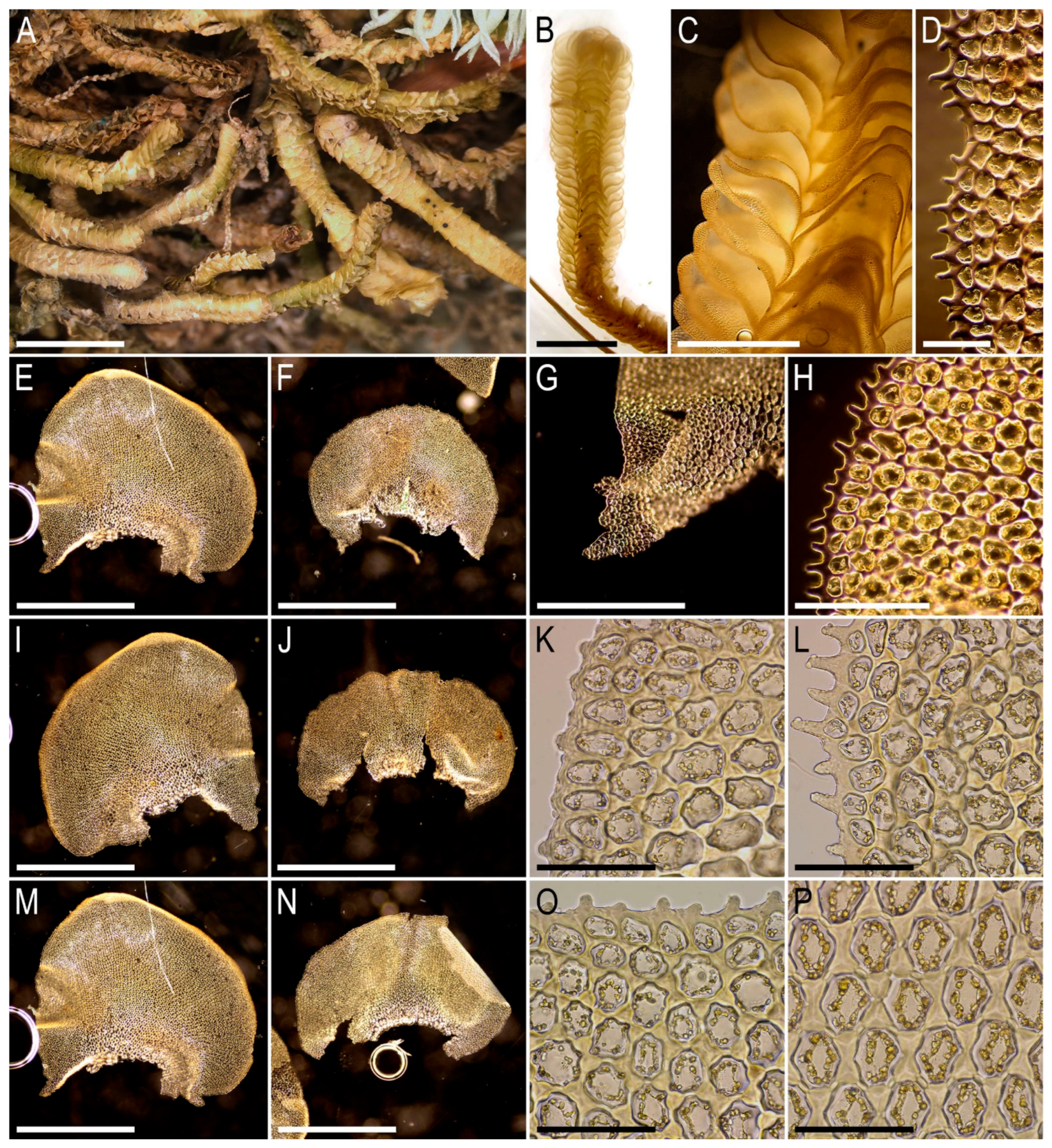
Description. Plants very delicate, closely attached to the substrate, easily fragmenting when detaching from the substrate, pale greenish, 3–5 mm long and 0.5–0.9 mm wide sparsely branched (branches
Frullania-type, instead complete the leaf,
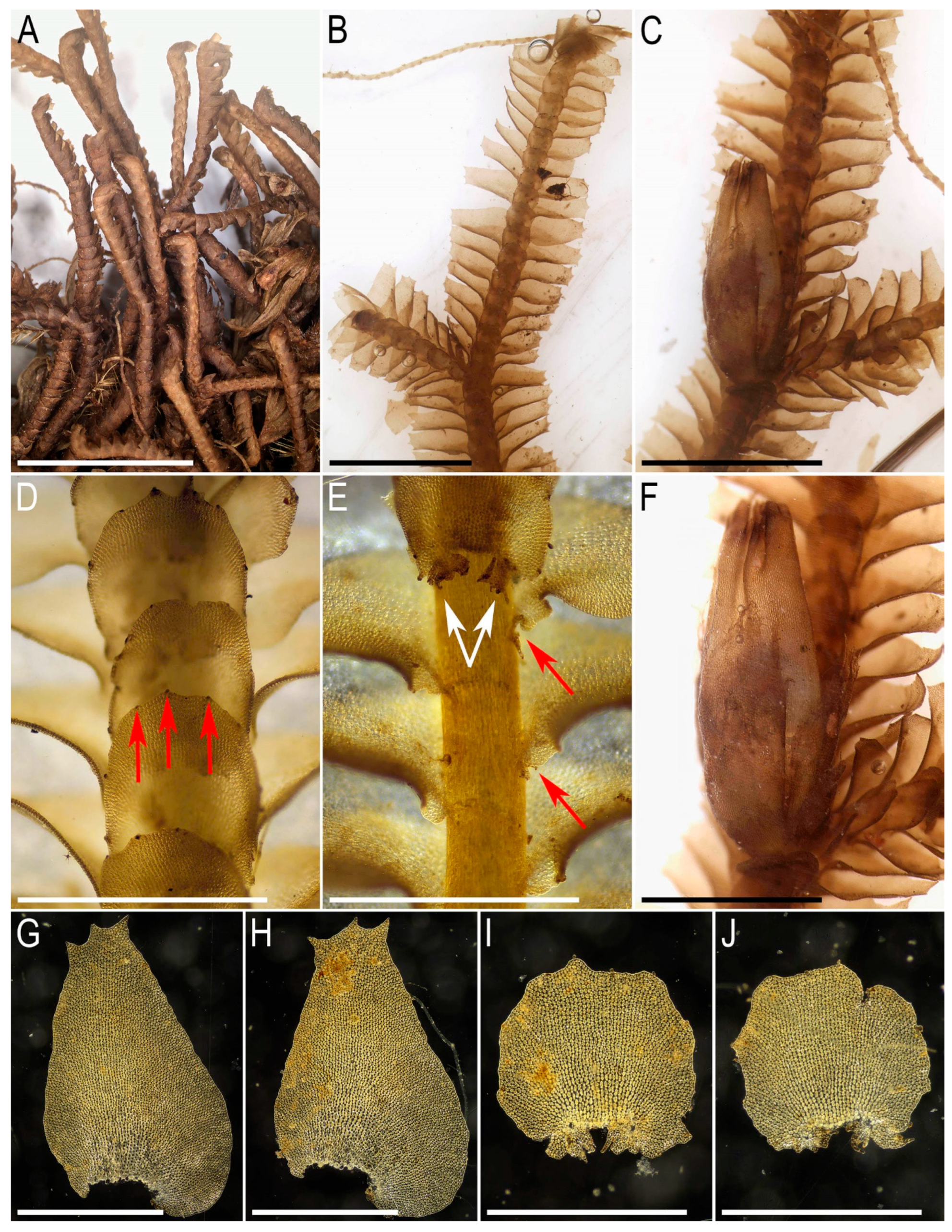
Figure 1E), also merely commonly ventrally branched, with ventral branches soon becoming ‘normal’ in size. Stem cross section of 4 cells only: dorsal cells in two rows, 45–75 × (17–)20–25 µm, thin-walled, its vestigial trigones, cuticle smooth; ventral segments with two rows of cells, 30–100 × 10–15 µm, thin-walled, with vestigial trigones, cuticle smooth. Rhizoids as the underleaf continuation. Leaves reduced to one uniseriate cilia 4–5 cells long, with cells ca. 80–120 µm long and (20–)25–27(–30) µm wide, rectangular, somewhat narrower to the apex where only (12–)15–17 µm wide, except of the terminal cell that is always triangular, 12–15 × 7–10 µm; cells thin-walled throughout, trigones vestigial to very small, concave, cuticle virtually smooth, leaves situated between every second cell of the dorsal stem segment. Underleaves were not observed, where they should be we found only single (may be the second was simply broken there) or paired rhizoids instead, underleaves if they were present seem easily deciduous. Perianth on short ventral branch, suddenly turned vertically, with two rings of bracts and bracteoles; the outer ring has bracts with paired segments without distinct discus and with reduced bracteoles, but densely rhizogenous in that place; the inner ring has bracts with four lobes, each lobe two cells wide in the base, leaf lobes adjacent each to another, but discus is unclear. Perianth tubular, with undivided part 300–400 µm long and ca. 250 µm wide, continuing above as not branched cilia 250–350 µm long, cilia in perianth mouth similar to leaf segments or slightly narrower; only one archegonium per perianth was seen (the only one mature perianth was studied and the data may not be reliable).
Illustrations in the present paper:
Figure 1.
Comment. This is the only species of
Arachniopsis occurring in the nearest locations to the Indochina Peninsula (although over 1500 km away), while other similar taxa such as
Arachniopsis diacantha (Mont.) M. Howe and
Arachniopsis coactilis Spruce occur in tropical America and southern Africa, respectively [
39]. Among the regional representatives of
Lepidoziaceae, the species is easily distinguished by its leaves, reduced to single-row cilia, and a stem consisting of only four cells in cross-section. The plants reach 0.9 mm in width, thus exceeding most representatives of
Kurzia and
Tricholepidozia from
Lepidoziaceae, as well as from other families with linearly lobed leaves, such as
Blepharostoma (L.) Dumort. According to available data, this is the first known occurrence of this species in Indochina and in the Asian mainland. However, given the general patterns of distribution of the species, this discovery should be expected.
Our treatment of
Arachniopsis as a genus separate from
Telaranea Spruce ex Schiffn. contradicts both Engel and Merrill [
39] and the subsequent world liverwort checklist by Söderström et al. [
1]. However, as pointed out by Cooper et al. [
20], the nomenclatural type of
Archniopsis has not been sequenced, as with the nomenclatural type of
Telaranea, whereas the latter genus shows clear paraphyly, contradicting the treatment by Engel and Merrill [
39] based entirely on morphology. The species similar to the nomenclatural type of
Telaranea,
T. herzogii (E.A. Hodgs.) E.A. Hodgs., was placed in the clade
Zoopsis III, while
Telaranea major (=
Arachniopsis major) is placed either in the clade ‘
Zoopsis I’ or in the clade ‘
Zoopsis II’. Moreover, the phylogenetic relationship of
Arachniopsis major to
Telaranea coactilis (Spruce) J.J. Engel et G.L. Merr. (
Arachniopsis type species) is unknown. In addition,
Arachniopsis major was actually found to be paraphyletic [
20]. As Cooper et al. [
20] (p. 500) note, “Nevertheless, it is clear from the current phylogeny that
Telaranea species with reduced stem and leaf anatomy exhibit a convergent morphology, and more complete taxonomic sampling will be necessary before taxonomic changes are made.” A year later, Cooper et al. [
21] confirmed the previous results, which placed ‘
Telaranea major’ in the clade ‘
Zoopsis I’. Thus, there is no certainty as to which genus
Arachniopsis major actually belongs (
Telaranea s.str.,
Zoopsis Hook.f. ex Gottsche derivative,
Arachniopsis s. str., or its own genus not described yet). In light of these data, we continue to maintain the generic status of
Arachniopsis.
Distribution. The distribution of the species stretches from South Asia (Sri Lanka), East Indochina (new report), through Malesia and Melanesia to Oceania (eastward to Vanuatu) [
39,
40].
Ecology. We were not able to find data on habitat in the available sources. Our specimen was collected from a small stone in an evergreen tropical mountain forest with Fokienia hodginsii (Dunn) A. Henry et H.H. Thomas and Pinus krempfii Lecomte slightly above 1500 m a.s.l.
Specimen examined: VIETNAM. Central Highlands, Lâm Đồng Province, Lạc Dương District (12.181147° N 108.689575° E), 1532 m a.s.l., evergreen tropical mountain forest with Fokienia hodginsii (Dunn) A.Henry et H.H.Thomas and Pinus krempfii Lecomte, on small stone, may be sandstone or siltstone, 28 October 2023, E.V. Kushnevskaya, Fok23#8 kamen kushn8 (VBGI).
Bazzania adnexa (Lehm. et Lindenb.) Trevis., Mem. Reale Ist. Lombardo Sci. (Ser. 3), C. Sci. Mat. 4 (13): 414, 1877
Illustrations: [
26] (Figure 4), [
27] (Figure 2), [
41,
42] (Figure 4).
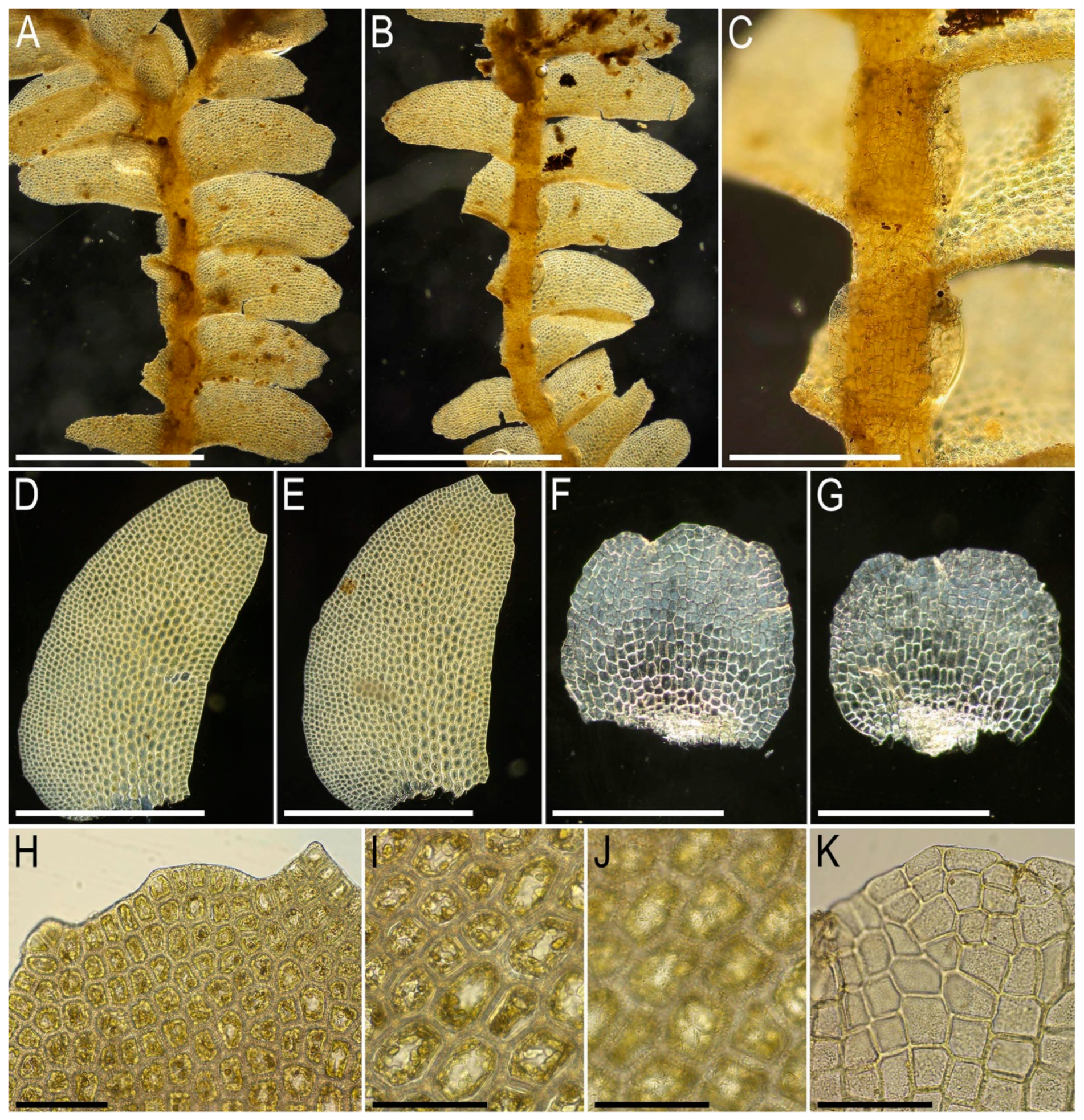
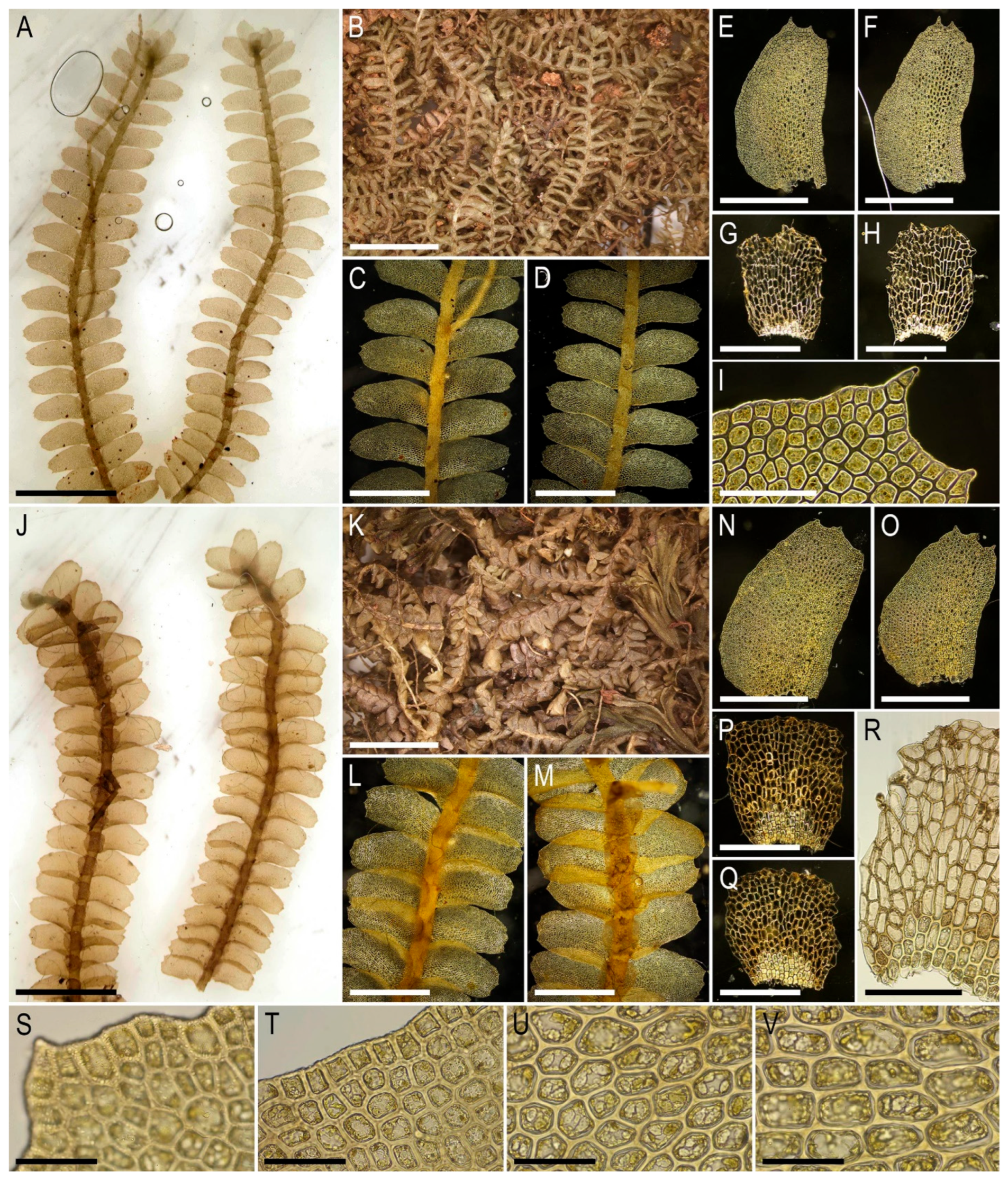
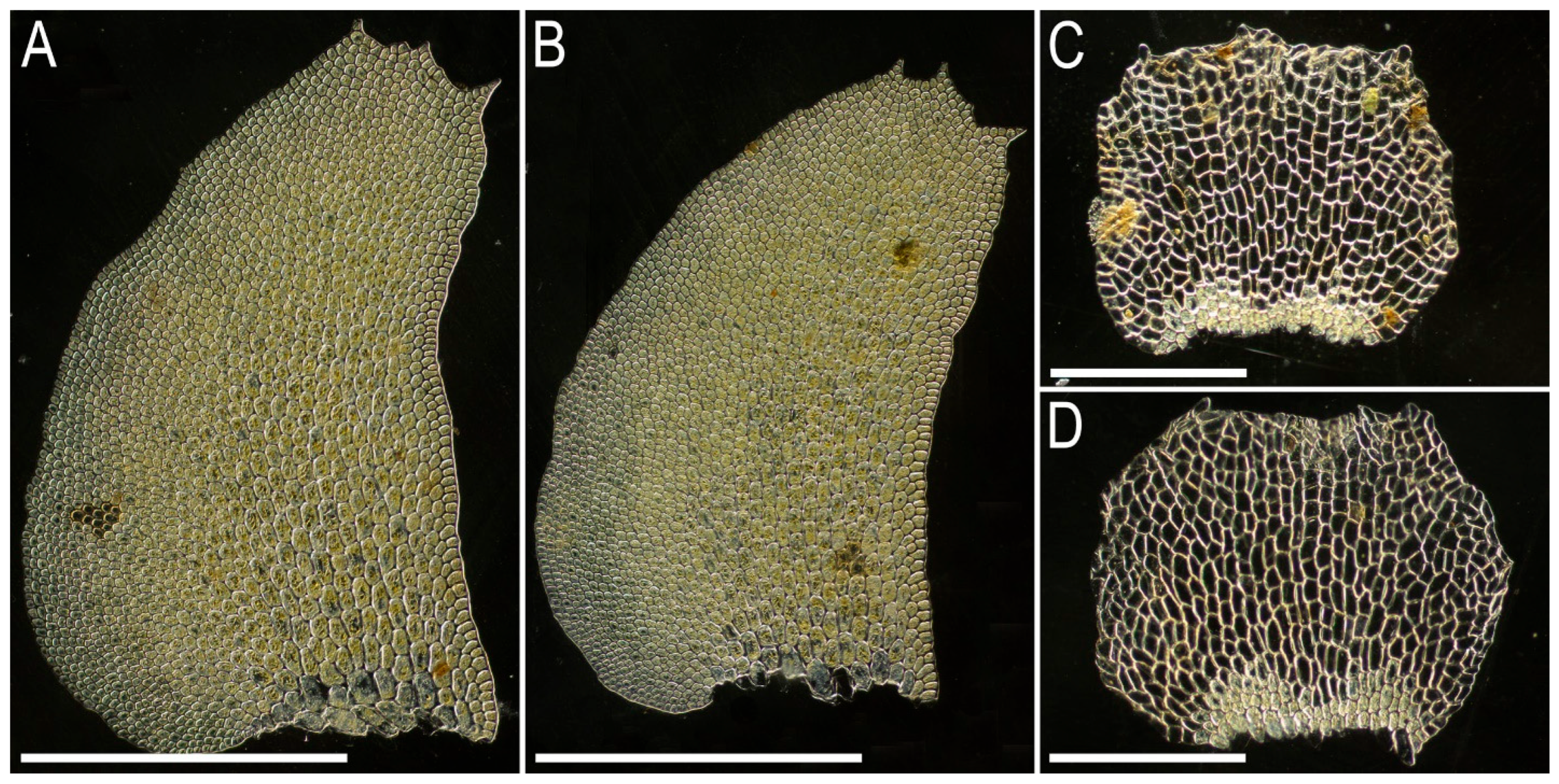
Description. Plants pale greenish to yellowish greenish, merely soft, in loose patches, sparsely branched, ventral scale-like leaved ‘flagella’ common, 6–20 mm long and 1.1–2.0 mm wide. Rhizoids not seen in normally leaved shoots, relatively abundant in terminal parts of ventral scale-like leaved ‘flagella’, where from the stem in the areas adjacent just below to the modified leaves and underleaves, colorless to brownish, mostly united into loose, obliquely spreading fascicles. Leaves obliquely inserted, dorsally insertion line arcuate, in moist conditions obliquely oriented and suberect spreading, without the teeth on the both ventral and dorsal bases, imbricate, covering to ½ of above situated leaf, obliquely ovate, sharply 3–lobed with several or solitary accessory teeth those are most evident in the lobed zone, when flattened in the slide 700–1100 × 500–600 µm. Midleaf cells considerably larger than at the margins, but not forming ‘vitta-like’ zone, 25–45 × 20–30 µm, thin-walled, trigones mostly moderate in size, concave to slightly convex, cuticle smooth; dorsal margin cells 7–13 µm, thick-walled, with small concave trigones, cuticle smooth to indistinctly punctate. Underleaves distant, plane to loosely concave, obliquely spreading, connate with the leaves in the both sides, when flattened in the slide transversely ellipsoidal, 200–300 × 350–500 µm, with margin composed by hyaline thin-walled and trigone-less cells, while from the middle part and below cells are chlorophyllose, more stout and bearing trigones, cuticle verrucose in hyaline part and virtually smooth below.
Comment. Zhou et al. [
26] compare
Bazzania adnexa with
B. japonica (Sande Lac.) Lindb. These two species are indeed quite similar in the underleaf and leaf connation, but may be easily differentiated by the following traits: (1) presence of hyaline underleaf margin (versus its complete absence in
B. japonica); (2) leaves are wider and only obliquely ovate in
B. adnexa, compared with the oblong leaf shape with subparallel sides in its upper part in
B. japonica and evident from the type-derived photographs and figures published in [
2].
The species is somewhat morphologically similar to B. intermedia, from which it differs in terms of the smaller size of the plants and the underleaves being wider than they are long (versus longer than wide in B. intermedia). One more morphologically related taxon is B. fleischeri (discussed below) which differs from B. adnexa in its larger plants with distinctly developed darker (brownish) colored zone along the leaf margin composed by small cells with thick walls. Moreover, B. fleischeri has underleaves with the chlorophyllose zone persistent only very near the base, compared with B. adnexa where the chlorophyllose zone extends at least to the underleaf middle.
Pócs [
29] reported this species for Vietnam, as presented in his Figure 1A,B. These figures provide photographs of one underleaf and the upper part of one leaf. Both do not correspond well with the description and illustration published before in [
27,
41,
42]. The picture of the underleaf in [
29] seems longer than it is wide and the leaf looks as if it’s going from the wide base, which is at least different from the plants we see in the literature and our collections. Therefore, we cannot regard the report as undoubtedly true regarding
B. adnexa.
Bazzania adnexa is a mostly Australasian species and the identity of Chinese and Indochinese plants with Australasian providence was never tested, remaining a large field for speculations including: (1) whether the Indochinese and Australian plants are genetically identical, (2) whether
B. adnexa-named plants collected in Indochina and China are genetically different from
B. intermedia or simply the ecological deviation of the latter. It is worth mentioning that the Vietnamese location is situated at approximately the same latitude as the Chinese one (Hainan, cf. Zhou et al. [
26,
27]), and the plants from these two sites are most likely conspecific.
Distribution. East Asia (China: Hainan), Indochina (Vietnam), Melanesia (New Caledonia) Australasia (Australia, New Zealand) [
26,
27,
41,
42].
Ecology. In China, the species is known from decaying wood, trunks and branches in evergreen forests near 1100 m alt. (Hainan) [
26]. Far away, ca. 8000 km to the southeast in New Caledonia, the species is occurring on decaying wood and rocks at elevations ca. 400–1000 m a.s.l. [
42] thus in essentially the same habitat. The habitats in Vietnam cover decaying wood, tree trunk bases and small stones in tropical evergreen forests slightly above 1000 m a.s.l.
Specimen examined: VIETNAM. Central Highlands, Gia Lai Province, Kbang District (14.490503° N 108.56661° E), 1030 m a.s.l., evergreen tropical forest with substantial share Dacrydium elatum (Roxb.) Wall. ex Hook, on wood of fallen suspending trunk, 12 March 2022, E.V. Kushnevskaya, DAK6 Valezh1 kushn1 (VBGI).
The species is quite polymorphous especially in the leaf apical part accessory tooth density and hyaline zone of underleaf size. The following deviations may be recognized:
Specimen DAK6 kamen3 kushn2—leaves almost edentate, while underleaves are characteristic.
Specimen examined for deviations: VIETNAM. Central Highlands, Gia Lai Province, Kbang District (14.490503° N 108.56661° E), 1030 m a.s.l., evergreen tropical forest with substantial share Dacrydium elatum, on small stone, may be sandstone or siltstone, 12 March 2022, E.V. Kushnevskaya, DAK6 kamen3 kushn2 (VBGI).
Bazzania albifolia Horik., J. Sci. Hiroshima Univ., Ser. B, Div. 2, Bot. 2: 195, 1934
= Bazzania semiopaca N. Kitag. J. Hattori Bot. Lab. 30: 261. f. 5 1967
Descriptions: [
27,
43], ref. [
16] (under
B. semiopaca N. Kitag.).
Illustrations: [
43] (Plate 16, Figures 22–30), [
16,
27] (Figure 5).
Comment. The species was comprehensively described in the sources cited above. As it was circumscribed by Kitagawa [
16] under the name
B. semiopaca, and is morphologically most similar to the species
B. asperrima Steph. The former is, however, different in its smaller size and only shortly divided leaves. The vast majority of our studied materials correspond very well to the original descriptions of
B. albifolia and
B. semiopaca, as well as the type of the latter (isotype in NICH-279771!). The basic features of
B. albifolia are the hyaline underleaves, densely verruculose leaf cuticle and only shortly lobed leaves. There are, however, some deviations. One of them is provided by Cam-81–33–11, whose plants are characterized by more sharply lobed leaves, although the leaf ‘lobation’ is in any case much shorter than it should be in the ‘true’
B. asperrima. Whether the sympatric distribution of these two taxa occurs remains unclear.
Distribution. East Asia (East and South China, including Taiwan), Indochina (Thailand, Cambodia, Vietnam), Malesia (Malaysia) [
16,
23,
27,
32,
40,
43]. The species is hitherto newly reported for Vietnam.
Ecology. Horikawa [
43] (p. 196) briefly described the habitat as “on humus”, while Kitagawa [
16] (p. 262) indicates “tree trunk in moist evergreen forest”. Our specimens are quite corresponding to the both above and were collected from humus, decaying wood and small wood debris in evergreen tropical forest with substantial participation of
Dacrydium elatum at the elevation 700–1030 m a.s.l.
Specimens examined: THAILAND. Loey, Mt. Phu Luang, ca. 1500 m a.s.l., on tree trunk in moist evergreen forest, 12 March 2022, M. Tagawa & N. Kitagawa, T1679, isotype of Bazzania semiopaca. N. Kitag., NICH-279771 (NICH!); VIETNAM. Central Highlands, Gia Lai Province, Kbang District (14.49050300° N 108.56661000° E), 1030 m a.s.l., evergreen tropical forest with substantial share Dacrydium elatum, on small wood debris, on fragments of wood and bark, 12 March 2022, E.V. Kushnevskaya, DAK6 Melky debris kushn4 (VBGI); CAMBODIA. Koh Kong Province, Phumi Chréav (11.80528° N 103.51083° E), 700 m a.s.l., broadleaved evergreen forest on slope, decaying wood, 22 December 2011, V.A. Bakalin, Cam-81–33–11 (VBGI).
Bazzania appendiculata (Mitt.) S.Hatt., Fl. E. Himalaya: 505, 1966 ssp. appendiculata
Illustrations: [
27] (Figure 6); [
31] (Figures 1L–R and 4).
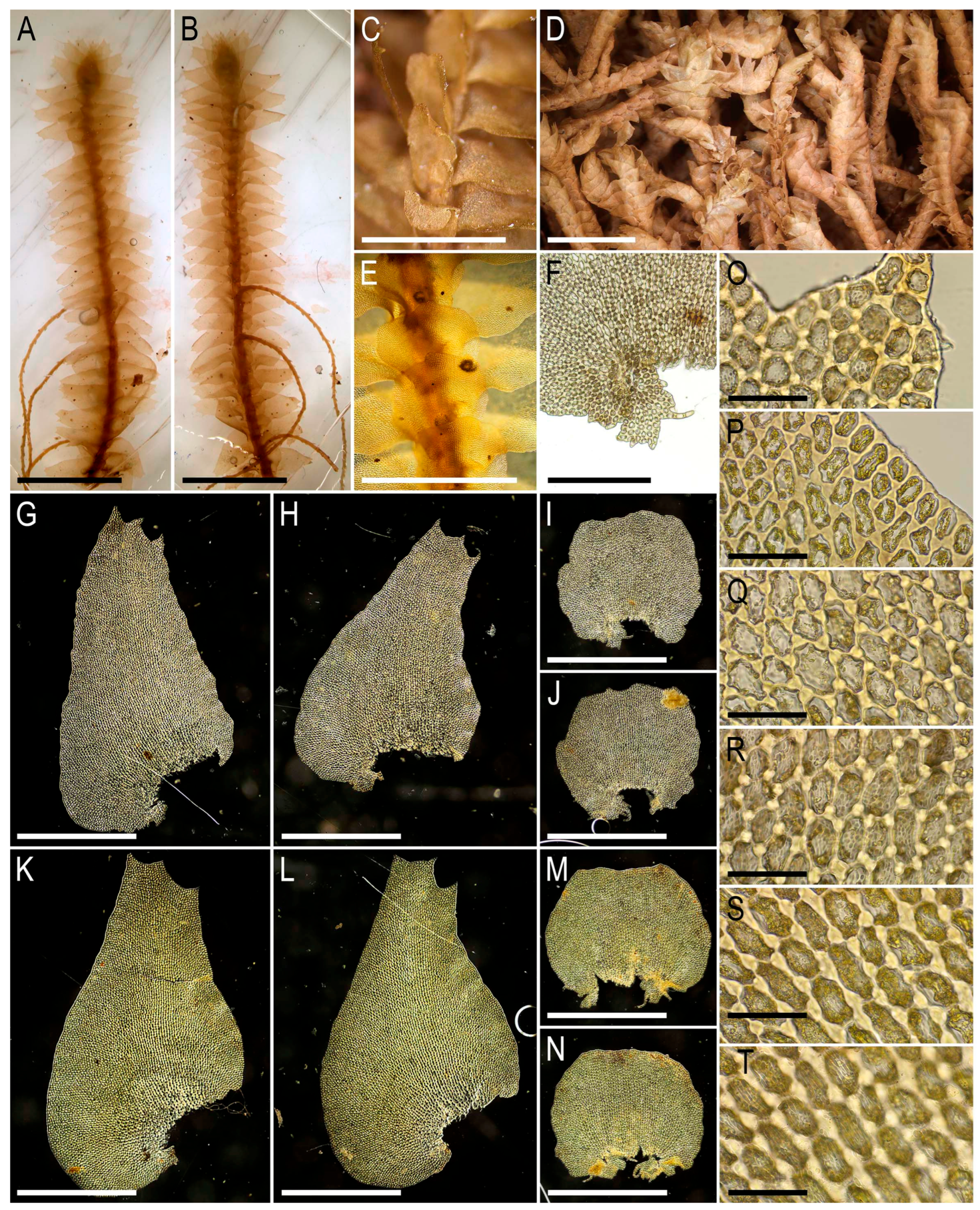
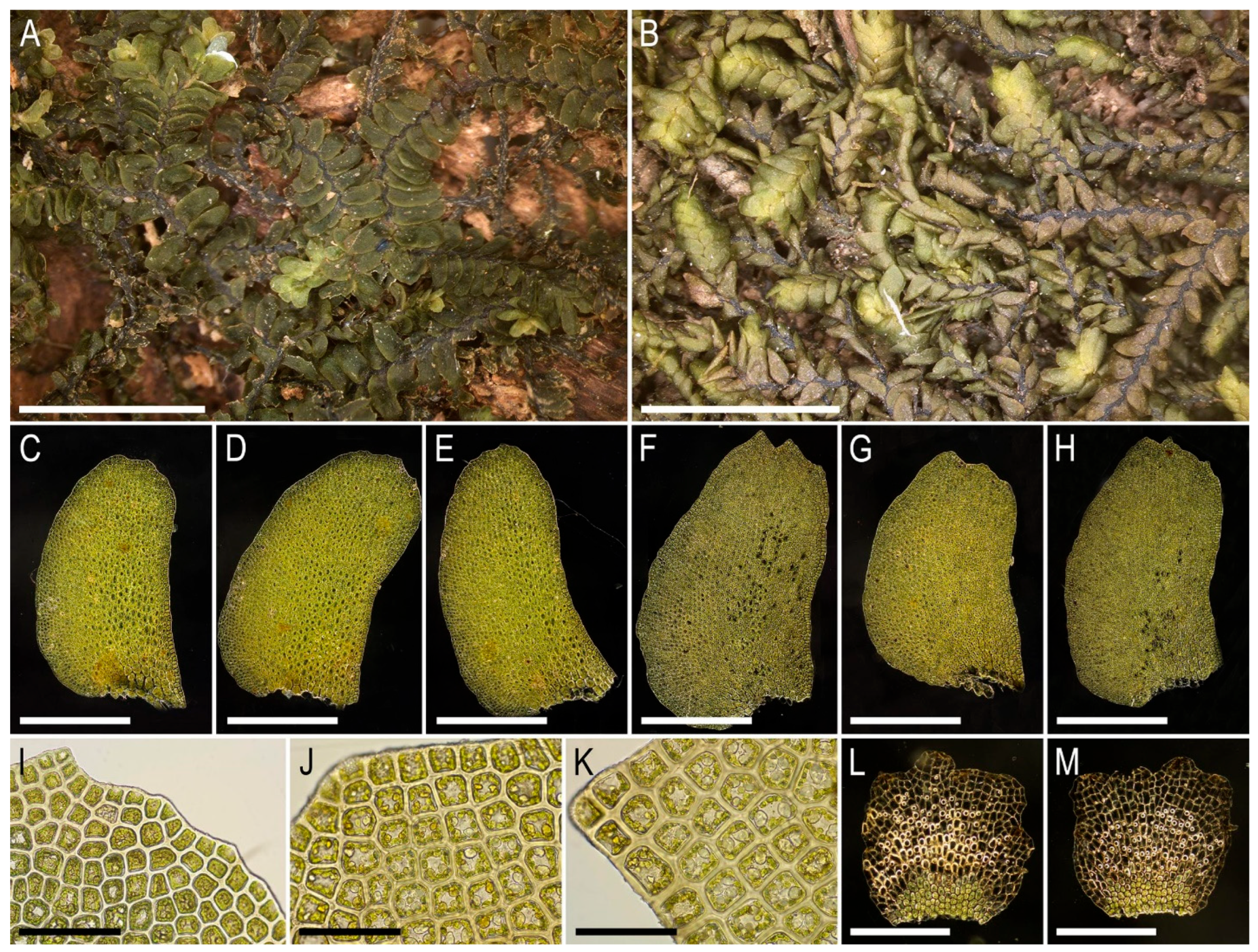
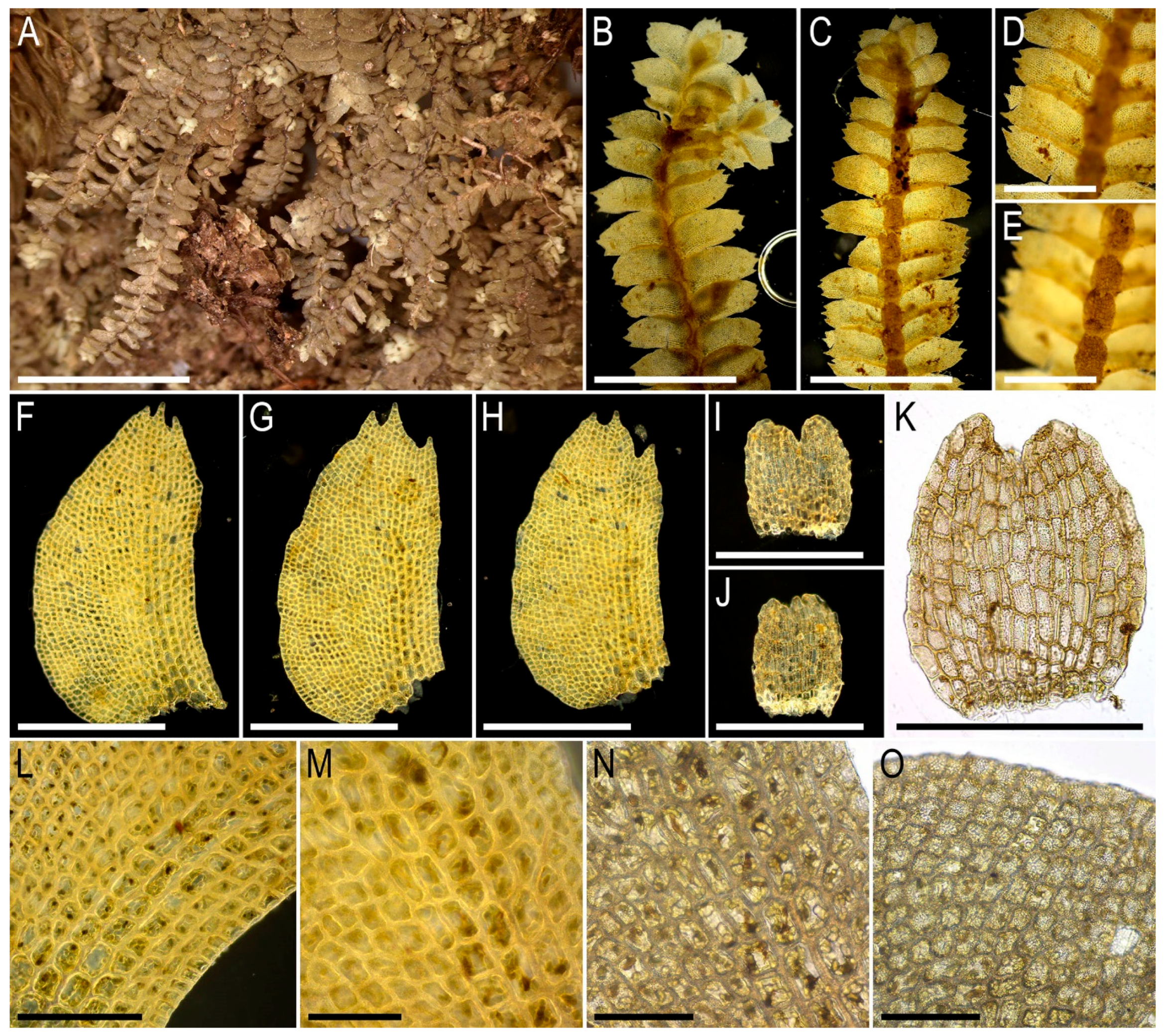
Illustrations in the present paper:
Figure 6.
Comment. The species was well described in the sources cited above, including original description. It possesses the following characteristic features:
Strongly pachydemous leaf and underleaf cells;
Papillose cuticle of leaves and underleaves;
Obliquely ovate to ovate-triangular leaves that are distinctly three-lobed with slightly diverging lobes;
Subquadrate–suborbicular underleaves with margin entire to crispate;
Well-developed and distinctly toothed underleaf appendages.
The most morphologically similar taxon is
Bazzania asymmetrica (Steph.) N. Kitag., whose distribution stretches from China to Malesia and then Melanesia [
23], where
B. appendiculata is generally broadly Sino-Himalayan although readily spreading eastward. Therefore, the occurrence of
Bazzania asymmetrica is not impossible in Indochina.
Bazzania appendiculata is, however, distinct from the latter due to its distinctly verrucose–papillose leaf cuticle (versus cuticle smooth) and underleaves entire to crispate along the margin (versus crispate to lobed and sometimes sparsely dentate underleaf margin in
B. asymmetrica). In addition, although the leaf cell trigones are large in both taxa, the size of them in
B. asymmetrica is nevertheless much larger and causes a somewhat vermicular appearance of the midleaf cells, which are additionally elongated more prominently than in
B. appendiculata.
Distribution. South Asia (Bangladesh, India), East Asia (South and West China, Nepal, Bhutan), Indochina (Thailand, Myanmar, Cambodia—new record, Vietnam—new record), Malaysia [
23,
27].
Ecology. Cheah et al. [
23] identify the habitat as tree trunks and ground at an elevation around 1500 m. The occurrences in Cambodia and Vietnam are essentially the same. The species is growing as an epiphyte or occurs in epilithic habitats in tropical or mountain subtropical (North Vietnam) evergreen forests at elevations of 1000–1500 m a.s.l.
Specimens examined: VIETNAM. Northwest Vietnam, Điện Biên Province, Mường Nhé District, Sín Thầu Commune, Mường Nhé Nature Reserve, Pờ Nhù Khò Mt. (22.37348° N 102.19241° E), 1501 m a.s.l., subapical part of unnamed mountain covered with evergreen tropical forest on NW-facing slope, open mesic cliff, 7 April 2022, V.A. Bakalin & M.H. Nguyễn, V-2-6-22 (VBGI, HN); CAMBODIA. Kampot Province, Preah Monivong (Phnom Bokor) Natonal Park (10.635775° N 104.006254° E), 1040 m a.s.l., mossy forest near the cliffs of the plateau near Bokor Mt., epiphyte, 24 June 2022, A.K. Eskov & N.G. Prilepsky, eskov5, eskov10 (VBGI); ibid. mossy forest, epiphyte 27 June 2022, A.K. Eskov & N.G. Prilepsky, eskov66 (VBGI).
Bazzania appendiculata subsp. cambodiana Bakalin, S.S. Choi, Klimova subsp. nov.
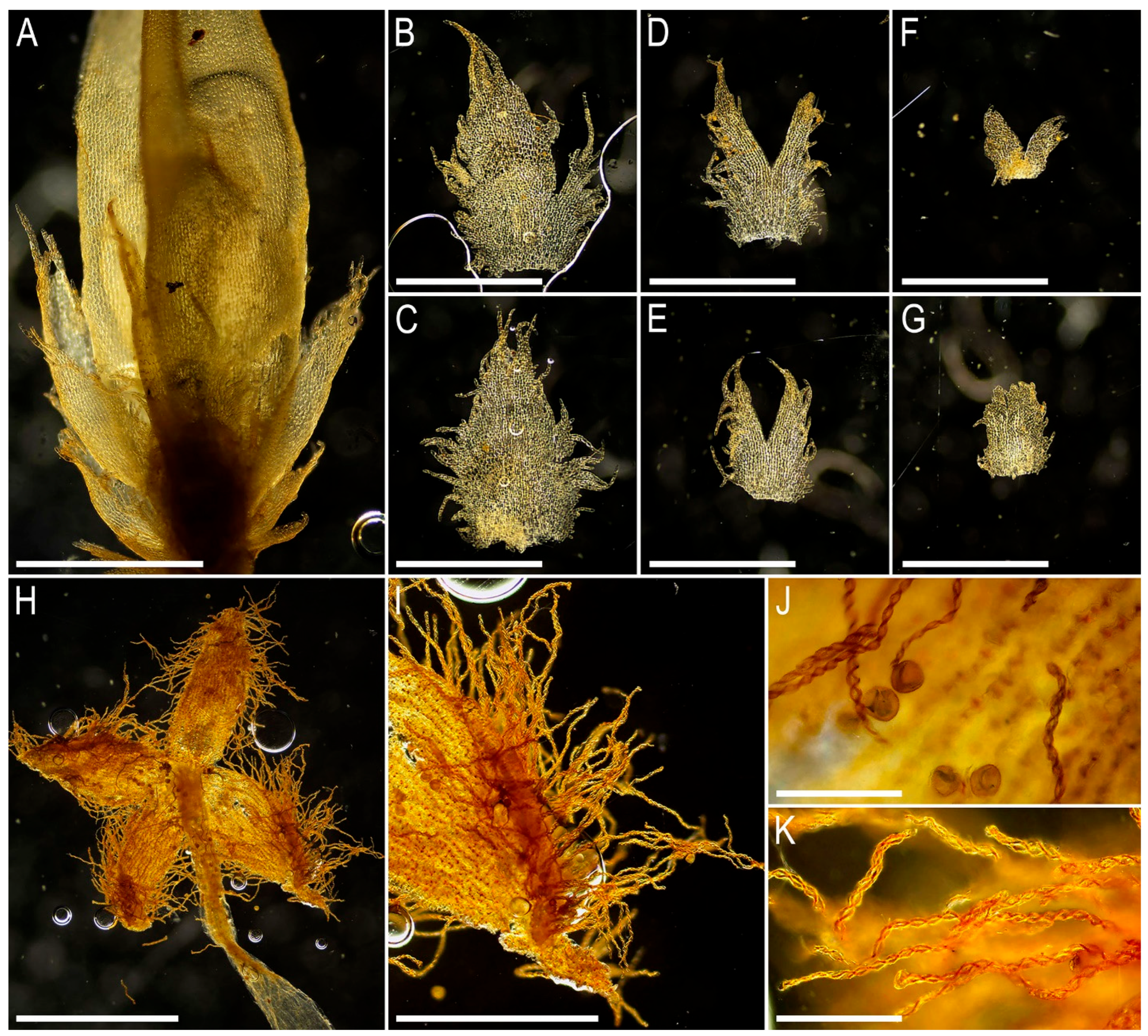
Description. Plants brown to yellowish brown, with leaves strongly turned ventrally when dry and sometimes clasped in ventral side, robust, 30–40 mm long and 3–4 mm wide. Stem 300–400 µm wide, sparsely branched by Frullania-type branching, with more or less common ventral scale-like leaved ‘flagella’. Rhizoids seen only in distal part of ventral flagella, colorless to light brownish, originating from stem in the areas adjacent to modified leaves and underleaves, obliquely spreading. Leaves imbricate, convex to ridged (thus concave-canaliculate if to view from the ventral side), covering 1/3–1/2 of the above situated leaf, obliquely oriented, laterally suberect spreading, in ventral side with obscure appendages with teeth or without them, in dorsal side arcuately inserted, with small appendage, with teeth or without them, when flattened in the slide obliquely ovate, 1500–1800 × 1200–1400 µm, distinctly 3–lobed, with diverging lobes, not vittate. Midleaf cells oblong, (20–)25–35(–40) × 15–20 µm, thin-walled, with large, bulging trigones, cuticle papillose; cells along margin 15–20 µm, thin- to thick-walled, external wall mostly thickened, trigones large, sometimes confluent, triangle to concave when adjacent to external wall and nodulose inward, cuticle papillose-verrucose. Underleaves overlapping 1/3 of the above situated underleaf, obliquely spreading, concave-canaliculate, when flattened in the slide suborbicular, with large toothed appendage near bases, 700–900 × 900–1000 mm, connate with the leaf in one side, with long persistent, brown colored slime papillae along underleaf margin. Perianth on reduced ventral branch appearing in underleaf sinus, ovate-fusiform, 4300 × 2000 µm [mouth broken and its features are not seen], with 3 pairs of bracts, bracts irregularly lobed and dentate-ciliate, innermost 2700 µm long, middle—1700 µm long, outermost—600 µm long, imbricate.
Holotype: CAMBODIA. Kampot Province, Bokor National Park, below the Popokvil waterfall (10.66236° N 104.04844° E), 872 m a.s.l., near waterfall, 12 January 2012, S.S. Choi, C2317 (JNU, dupl. in VBGI).
Comment. The subspecies is characterized by the same basic features as listed above for ssp. appendiculata. However, ssp. cambodiana is strikingly different from the type of subspecies (ssp. appendiculata) due to its brown color (versus yellowish brownish in ssp. appendiculata), as well as its long persistent deeper-colored slime papillae in underleaf apex (as commonly observed in otherwise different B. himalayana (Mitt.) Schiffn.); wider (=more shortly ovate) leaves—although this feature is very variable in ssp. appendiculata; shorter (tending to be round) papillae in midleaf cell surface. Two subspecies may be sympatrically distributed. At least the true ssp. appendiculata also occurs in Cambodia (see above). The taxon status needs verification.
The issue of the perimeters of morphological variability of the
Lepidoziaceae taxa, and
Bazzania in particular, is still far from being correctly understood. The known sequences of various loci for most species are based on one or two original specimens, often collected far from the type localities [
4]. Therefore, the interpretation of the available data can hardly extend much beyond a discussion of the genetic differences in the particular specimens and move on to the level of distinguishing species, since there is no general criteria. The
Bazzania revision for New Caledonia [
42] provides illustrations of
B. tridens (p. 149), which differs strikingly from the type material of the species [
31] in the nature of the leaf margin—coarsely serrulate, as opposed to completely entire or nearly so. Nevertheless, it is hardly possible to immediately reject the correctness of the species identification in New Caledonia without conducting an integrative comparison. However, if such morphological variability is genetically confirmed for
B. tridens, it will force a revision of the morphological concepts of other species. Returning to the
B. appendiculata ssp.
cambodiana described here, it can be said that the nature of its morphological differences, apart from the ecology, likely corresponds to the rank of species. However, the lack of clear data on the correlation of genetic structure with morphological variability precludes a definitive answer to this question. Whether the cited morphological differences are environmentally induced can also be determined through molecular genetic studies. Unfortunately,
Bazzania are difficult to study molecularly (in particular, the amplification of the most popular loci), and further targeted research, including the search for new molecular analysis methods, is necessary to resolve this issue.
Ecology. The subspecies is found on the open presumable mesic cliffs surrounded by dense tropical evergreen rather secondary forest at the elevation 872 m a.s.l.
Bazzania callida (Sande Lac. ex Steph.) Abeyw., Ceylon J. Sci., Biol. Sci. 2 (1): 45, 1959
Illustrations: [
44] (Plate 1, Figure 2).
Description. Plants prostrate, brownish yellowish to brownish when dry, somewhat glistening, in loose patches, 10–30(–60) mm long and 1.8–2.3 mm wide, sparsely branched (Frullania-type). Rhizoids virtually absent in normally leaved shoots, but sparsely present in distal parts of the rater abundant ventral scale-like leaved ‘flagella’, where originating from the stem in the areas just below the modified leaves and underleaves. Leaves contiguous to shortly imbricate (overlapping to 1/5 of the above situated leaf in the base), obliquely inserted, slightly convex-ridged, subhorizontally oriented, suberect spreading (both in dry and wet conditions), when flattened in the slide obliquely ovate, 800–1000 × 500–700 µm in the middle of the lower half of the leaf with the large-celled zone, very shortly, distinctly to unclearly 3–lobed. Cells in the midleaf oblong, in pseudovittate area 30–42 × 17–20(–25) µm, thin-walled to walls slightly thickened, trigones moderate to large in size, concave to slightly convex, cuticle smooth; cells aside pseudovittate area nearly subisodiametric to shortly oblong, 15–22(–25) µm in diameter to 20–23 × 15–20 µm, with thin to somewhat thickened walls, trigones moderate to large in size, concave, somewhat confluent, cuticle smooth; cells along margin in leaf dorsal side, (10–)12(–15) µm, subquadrate, with thick walls and small trigones, cuticle verrucose; near leaf apex margin cells 14–17 × 12–15 µm, with walls thick, trigones small, concave, cuticle verrucose (verrucae 1.5–2.0 µm in diameter). Underleaves tightly appressed to the stem, hyaline except area very near the base or chlorophyllose up to 1/4 of the underleaf length, subquadrate to obtrapezoidal, shortly dentate along margin, 300–500 × 300–450 µm, underleaf cuticle smooth.
Distribution. South Asia (0Sri Lanka), Indochina (Thailand, Cambodia, Laos—new report, Vietnam—new report).
Ecology. Kitagawa [
16] (p. 262) describes habitat in Thailand as “350–600 m, on soil in dry deciduous forest”. In Vietnam, the predominant habitats are tree trunk bases, and sometimes decaying wood in evergreen forests at 1000 m a.s.l. In Cambodia the species occurs on stone sides in dry evergreen forests at elevations 360–700 m a.s.l. The ecology in Laos is similar to above, where it occurs on open dry cliffs near stream at the elevation 354 m a.s.l. The species is probably the most xerophytic and the taxon occurring in the lowest elevation in the genus occurring in Indochina.
Specimen examined: CAMBODIA. Koh Kong Province, Phumi Chréav (11.81556° N 103.47611° E), 700 m a.s.l., broadleaved evergreen forest on slope, stone side, 25 December 2011, V.A. Bakalin, Cam-88–27–11 (VBGI); VIETNAM. North Central Coast, Quang Tri Province, Bố Trạch District, Phú Định Commune, northern part of Annamite Range (Trường Sơn Range), Phong Nha–Kẻ Bàng National Park, surroundings of U Bò Mountain Ranger Station (17.46842° N 106.37622° E), 896 m a.s.l., saddle on a ridge covered by low tropical montane evergreen forest with major broadleaf species and palms (Livistona, Lanonia, etc.), Pandanus and dwarf tree fern in understory, partly shaded moist stone, 26 April 2025, V.A. Bakalin, K.G. Klimova & M.H. Nguyễn, V-22-13-25 (VBGI, HN); ibid. the border of buffer zone of Phong Nha–Kẻ Bàng National Park, Hồ Chí Minh Trail (17.40308° N 106.47794° E), 69 m a.s.l., secondary tropical evergreen forest along the mountain road, open mesic cliff on the road cut, 25 April 2025, V.A. Bakalin, K.G. Klimova & M.H. Nguyễn, V-17-5-25 (VBGI, HN).
Comment. The species experience some morphological variation; the following deviations were observed:
Specimen Cam-83–51–11 differs from above in distant to contiguous leaves and rather oblong underleaves (0.45 × 0.3 mm).
Specimen KON1 Derevo1komel kushn5 characterized by bright green coloration (probably due to shady conditions and more fresh material) and only unclearly lobed leaves—in that feature, the plants are even more similar to the type than in the description above.
Specimen L-6–11–24 characterized by bright green coloration and plants size larger, reaching 2.1–2.8 mm wide. Correspondingly, leaves are larger, up to 1.4 × 0.8 mm, larger leaves are more clearly lobed, although the great variation observed in this feature within the mat; underleaves somewhat lobed, subquadrate to 0.5 × 0.5 mm. Moreover, it seems all the specimens from Laos are more brightly colored and larger, and leaves are more clearly trilobed. The status of those plants may require verification.
Specimens examined for deviations: VIETNAM. Central Highlands, Gia Lai Province, Kbang District (14.50000100° N 108.54515600° E), 1049 m a.s.l., evergreen tropical forest, on bark at base alive tree trunk, 7 March 2022, E.V. Kushnevskaya, KON1 Derevo1komel kushn5 (VBGI); CAMBODIA. Koh Kong Province, Thma Bang Village area (11.66194° N 103.39861° E), 360 m a.s.l., broadleaved evergreen forest on slope to waterfall, more or less dry cliff near waterfall (sometimes sprayed area), 23 December 2011, V.A. Bakalin, Cam-83–51–11 (VBGI); LAOS. Bolikhamsai Province, Thaphabath Commune (18.43588° N 102.95078° E), 354 m a.s.l., evergreen secondary tropical forest along sluggishly flowing stream in wide valley, open dry cliff near the stream, 8 May 2024, V.A. Bakalin, L-6–11–24 (VBGI).
Bazzania commutata (Lindenb. et Gottsche) Schiffn., Consp. Hepat. Arch. Ind.: 149, 1898
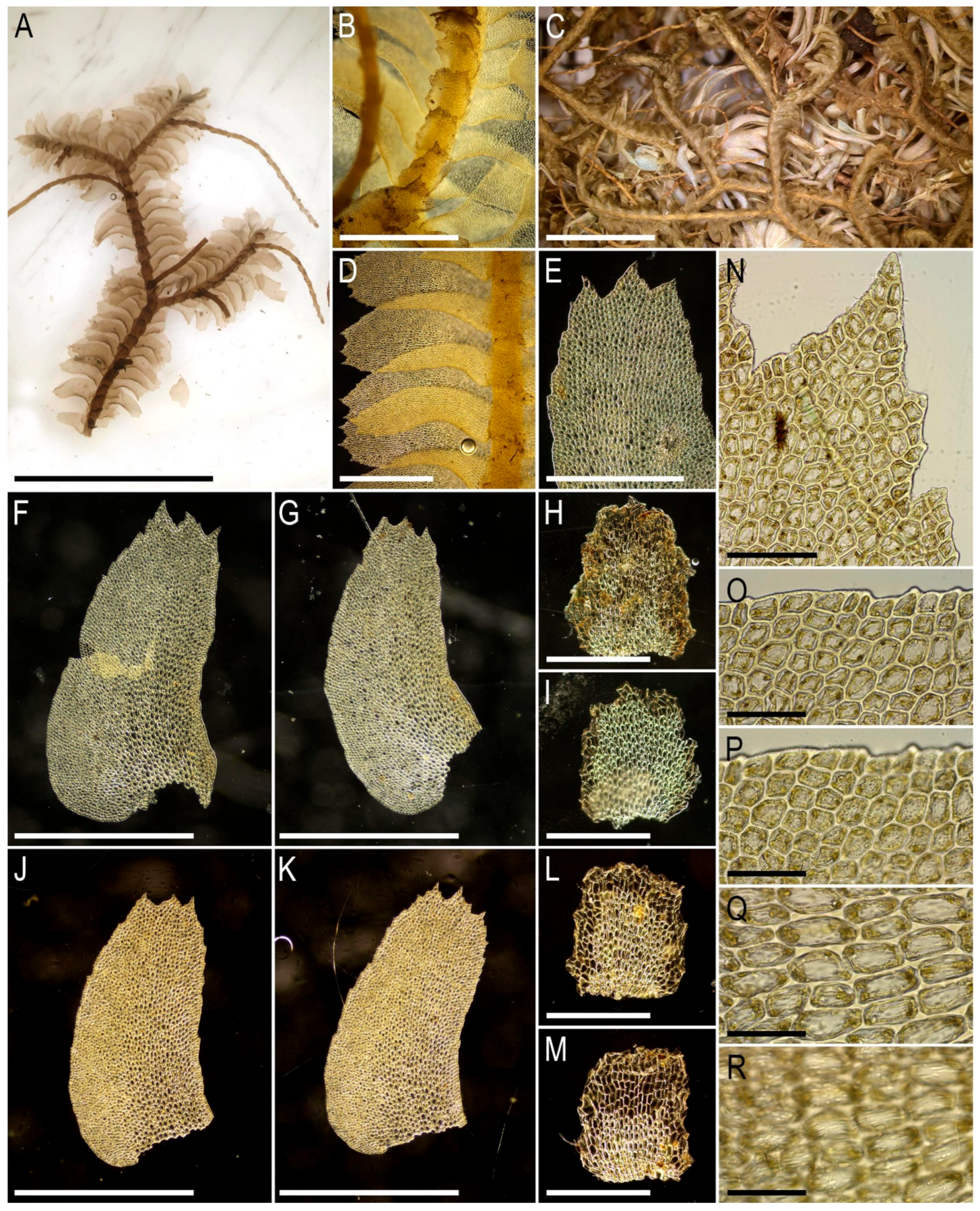
Description. Plants large, robust, creeping to loosely ascending, yellowish with brownish tint in lower part, freely branched (branching Frullania-type), ventral ‘flagella’ with scale-like leaves abundant, 30–50 mm long and 3–4 mm wide. Rhizoids absent in leaves shoots, very sparse in terminal portions of ventral ‘flagella’, where, although, in the vast majority of cases totally absent. Leaves obliquely inserted and oriented suberect spreading, dorsally insertion line arcuate, ridged, imbricate, covering 2/3–3/4 of the above situated leaf, when flattened in the slide obliquely ovate-falcate, from very wide base to the narrow, distinctly trilobed apex, antical side strongly arcuate, postical—almost straight to slightly arcuate, 1500–1900 × 1200–1400 µm, crenulate-denticulate in lower part of the leaf, and denticulate to dentate in upper 1/3, therefore lobes with numerous accessory teeth. Midleaf cells although longer than in the margin, but never form pseudo-vitta area, oblong, 40–50(–75) × 25–30(–35) µm, thin-walled, with large, nodulose trigones with visible middle lamina, cuticle virtually smooth. Cells along margin in antical side (20–)25–30 µm, thin-walled, with strongly thickened external wall, where many cell walls continue thickenings to form short denticulation, cuticle verrucose just along the margin. Cells in apical part of the leaf 25–45 × 25–35 µm, thin-walled, with nodulose trigones, with visible middle lamina, cuticle distinctly papillose-verrucose along margin, inward soon become nearly smooth. Underleaves concave, connate with leaves in one or both sides, with recurved apex, obliquely to suberect spreading, contiguous, when flattened in the side transversely ellipsoidal to subquadrate, with small auricles near the base, apex shortly to indistinctly 3–4–lobed, with rounded lobes, 600–900 × 1000–1200 µm, in apical part densely denticulate, in lateral sides only crenulate.
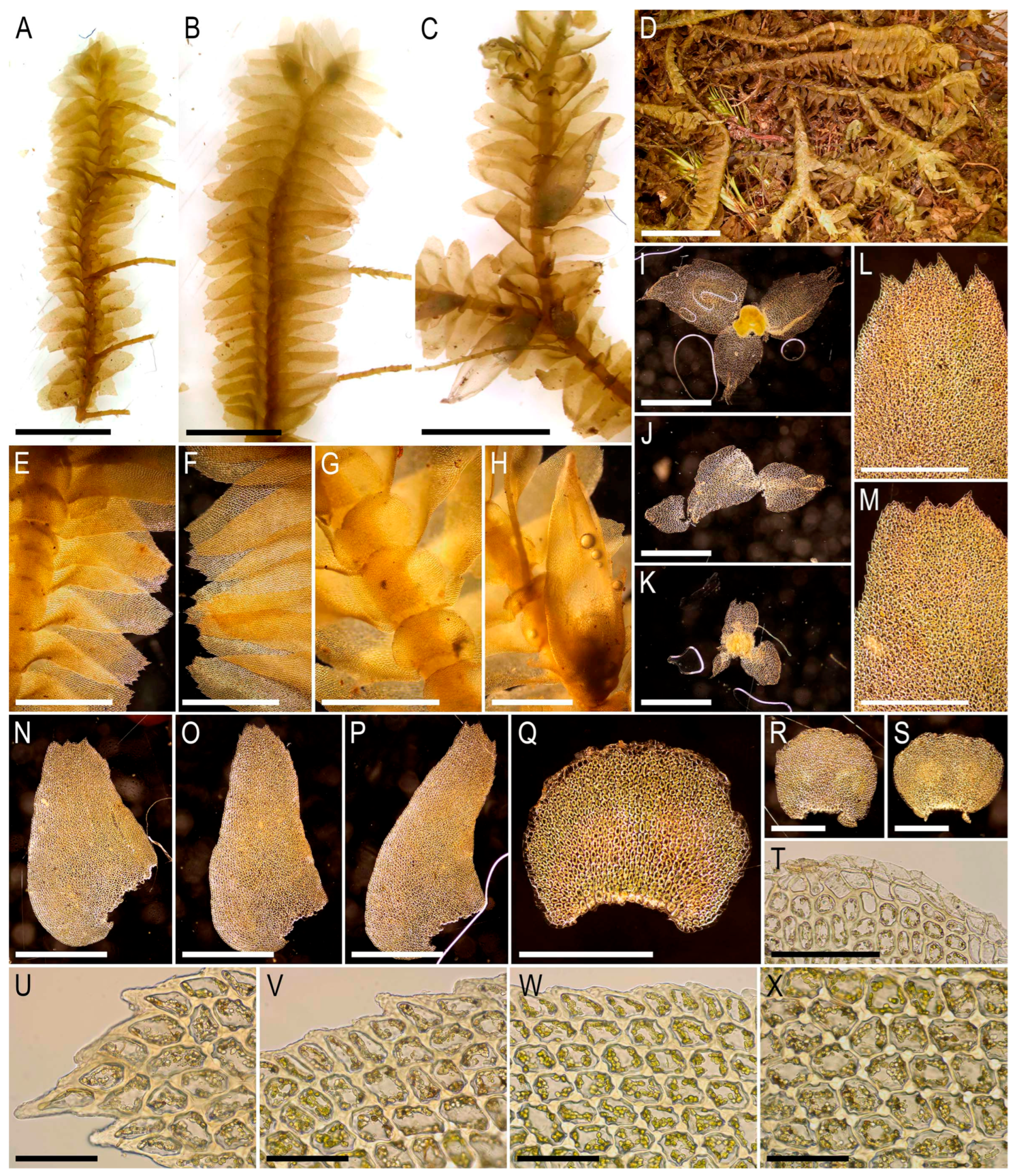
Illustrations in the present paper can be found in
Figure 11.
Comment. Bazzania commutata is well characterized by the following features:
Three–four-lobed leaves with numerous teeth and denticulations descending from the leaf apex in both lateral sides of the leaf;
Recurved subquadrate to transversely ellipsoidal underleaves, indistinctly lobed and denticulate throughout;
Leaf with wide base and strongly narrowing to the apex;
Prominently nodulose trigones in leaf cells with visible middle lamina.
Kitagawa [
19] mentions the similarity of the species and
Bazzania confertifolia (Steph.) Herzog, from which
B. commutata differs in leaf lobation (leaves short but rather distinctly lobed versus unlobed in
B. confertifolia), and subquadrate underleaves (versus reniform). Also the leaf apex seems to be more wide in
B. commutata than in
B. confertifolia. Kitagawa [
19] (p. 80) wrote that “intermediate forms” were observed between two species. Therefore, further study is required to resolve this issue.
Among the regional representatives of the genus, the species also resembles: (1)
Bazzania erosa, from which is distinguished by the absence of a hyaline border along the underleaf margin; (2)
Bazzania indica (Gottsche et Lindenb.) Trevis. (the name may be misleading, actually the species was described from Singapore), from which
B. commutata differs in dentate-denticulate leaf margin with lobes bearing numerous accessory teeth and densely dentate-denticulate underleaf margin. Illustrations of
B. indica are published by Bakalin, Maltseva [
31] and Pócs et al. [
29].
Distribution. Indochina (Vietnam—new report); Malesia (Malaysia, Indonesia: Java Island, Moluccas) [
23,
40,
45,
46]. Furthermore, Stephani [
45] points out that very similar plants were observed in the Duthie collection from the Himalayas, but the material there is very scant, precluding further estimations.
Ecology. The species occurs in Vietnam at an elevation above 1800 m a.s.l. in evergreen forests, as epiphytes in the complex moss mat over tree trunks. We could not find any other data on the species ecology in the available literature.
Specimens examined: VIETNAM. Central Highlands, Lâm Đồng Province, Lạc Dương District, southern part of Annamite Range (Trường Sơn Range), Lâm Viên Plateau, Bidoup Núi Bà National Park, Hòn Giao Mt. (12.19° N 108.710556° E), 1861 m a.s.l., mossy mats over tree trunks, 23 November 2018, A.K. Eskov & N.G. Prilepsky, Eskov Pn-9 (VBGI).
Bazzania erosa (Reinw., Blume et Nees) Trevis., Mem. Reale Ist. Lombardo Sci. (Ser. 3), C. Sci. Mat. 4 (13): 415, 1877.
Descriptions: [
18,
41]. Note, the description in [
47] corresponds to
Bazzania longicaulis (cf. [
18]).
Illustrations: [
41] (Figure 11); [
9] (Plate 16, Figures 1–10), [
18] (Figures 1–13). Note, the description in [
47] (Plate XVI) corresponds to
Bazzania longicaulis (cf. [
18]).
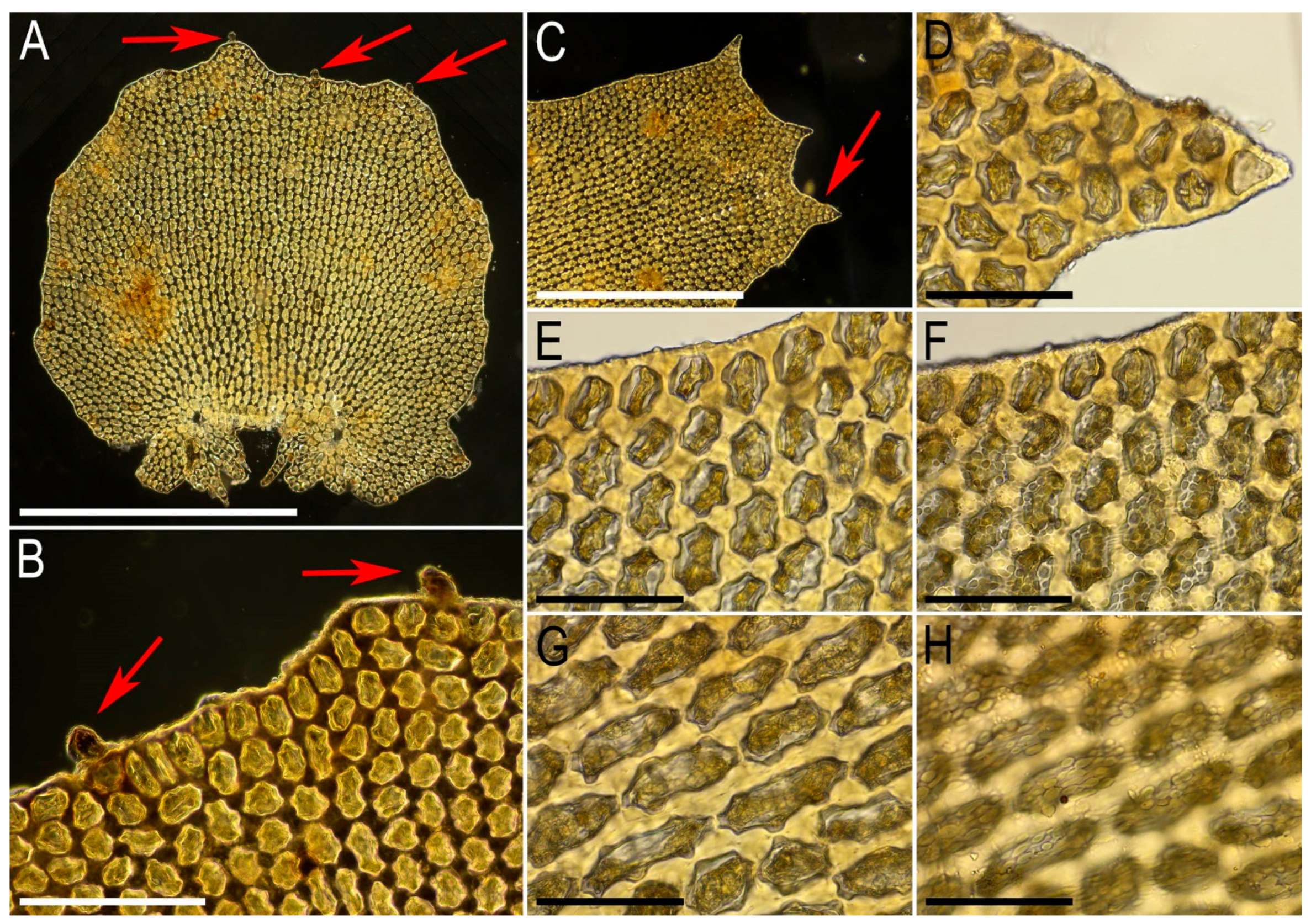
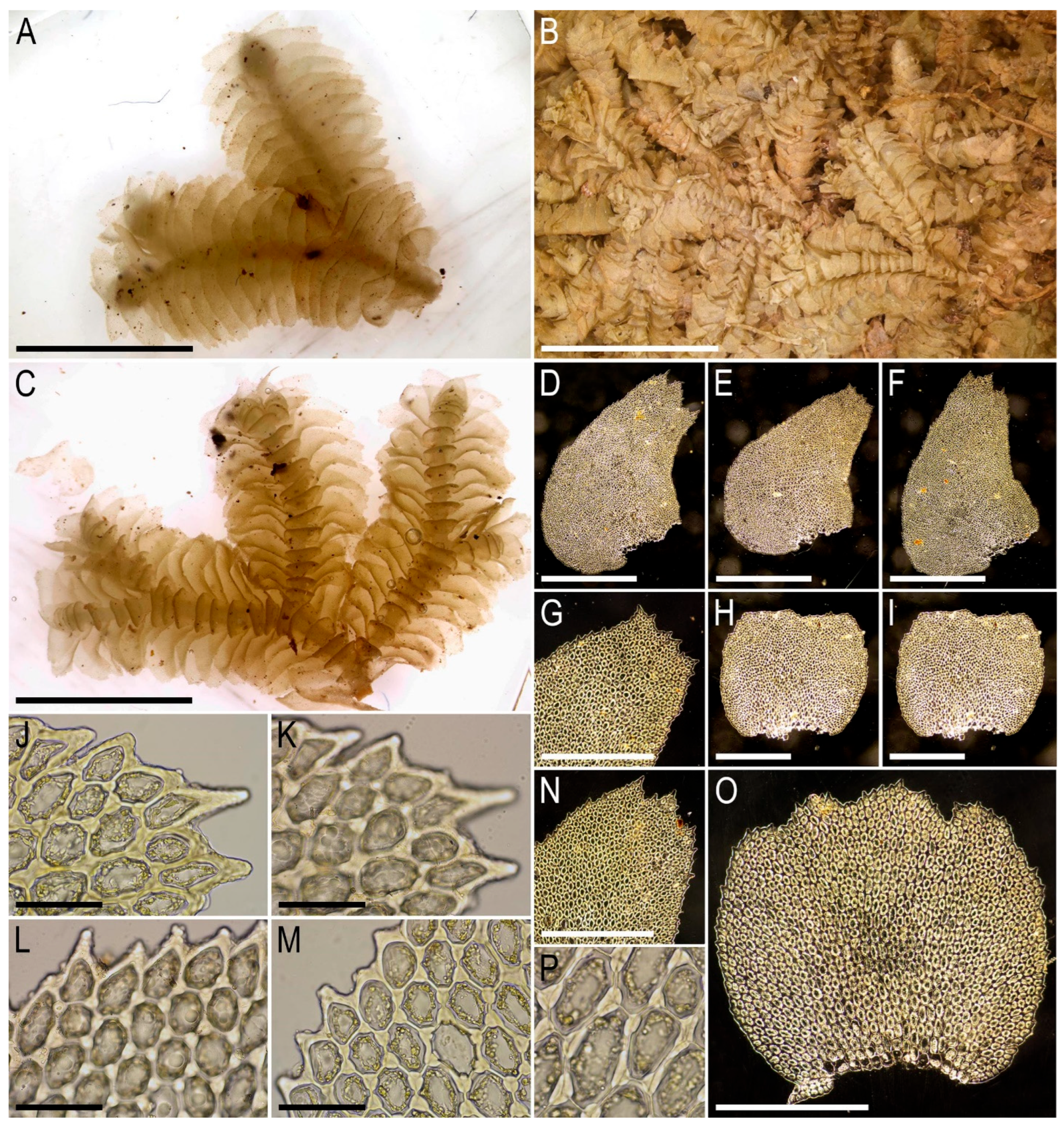
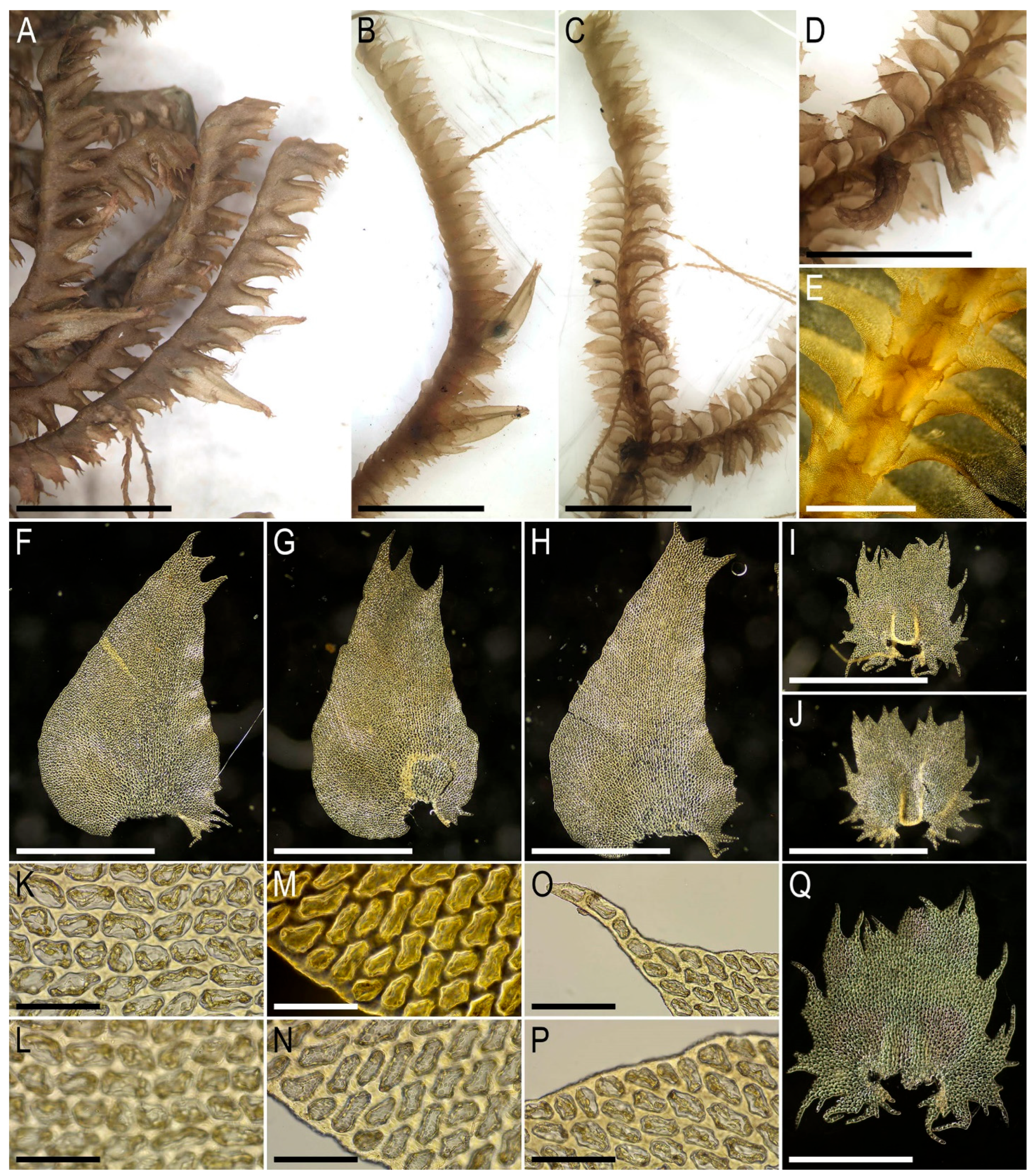
Description. Plants rigid, robust, in loose patches, brownish green to yellowish brownish in the herbarium, sparsely branched (branching Frullania-type) and with common to numerous ventral ‘flagella’ with scale-like leaves, 30–70 mm long and 3.2–5.0 mm wide. Rhizoids absent in normally leaves shoots, but present in the terminal portions of ventral ‘flagella’ where from the stem in the areas adjacent both to the bases of the modified leaves and underleaves, obliquely to erect spreading, colorless, shorter 1 mm in length. Leaves obliquely inserted and oriented, suberect spreading, slightly ridged, dorsally insertion line arcuate, imbricate, covering 1/2–2/3 of the above situated leaf in its base (apical part is not overlapped or only slightly so), when flattened in the slide obliquely ovate to narrowly obliquely ovate and rarely somewhat falcate, shortly, but in the vast majority of the cases, distinctly 3-lobed with numerous accessory teeth and also dentate along leaf margin in apical 1/3–1/4 of the leaf, below commonly denticulate, on general outline 1800–2200 × 1200–1400 µm. Midleaf cells oblong, 30–45(–50) × (18–)20–25 µm, thin-walled, trigones large, nodulose, with visible middle lamina, cuticle more or less smooth. Cells along margin 20–25(–30) µm, external wall variously thickened and producing denticulations, radial walls unequally thickened, tangential (innermost to the midleaf) thin, trigones large, nodulose to concave, sometimes confluent, cuticle verrucose. Cells in the apical part of the leaf 25–35 × 15–25(–30) µm, oblong to subisodiametric, thin-walled, trigones large to moderate in size, nodulose, cuticle distinctly papillose. Underleaves concave (if to look from ventral side), obliquely to narrowly so spreading, with apical part sometimes erect spreading, never reflexed or recurved, connate in the both sides with the leaves (rarely in one side only), shortly auriculate near the base, when flattened in the slide more or less reniform to transversely ellipsoidal, 500–700 × 700–1000 µm, along margin with 1–3 rows of cells discolored (not chlorophyllose) and thin-walled. Mature perianth fusiform, 3500–4000 × 1200 µm, basically 3–plicate in upper half, sometimes with additional folds, with three pairs of bracts. Outer bracts ovate, 400–500 µm long, bracteole narrowly ovate, with acuminate apex; middle bracts ovate, 1000–1200 µm long, with apex laciniate, bracteole ovate ca. 600 µm long; inner bracts ovate, 1700–1800 µm long, with laciniate apex, bracteole 1200 µm long, with laciniate apex.
Illustrations in the present paper can be found in
Figure 12.
Comment. Cheah et al. [
23] propose synonymy of the
B. erosa and
B. serrulatoides Horik., which is difficult to disagree with. However, the description and drawings by Horikawa [
43] suggest crispate underleaf margin (Figure 33 in l.c.). Therefore, this issue requires further study. The data on the occurrence of
B. serrulatoides in Indonesia, Thailand and China [
27] may be based on
B. erosa. Differences from the morphologically most similar species are given in detail by Cheah et al. [
23] as well as Kitagawa [
18]. In addition, both studies point out the significant variability of this widespread species in Southeast Asia. Some problems may arise in distinguishing
B. erosa from
B. spiralis (Reinw., Blume et Nees) Meijer. The last of the differences cited by Kitagawa [
19] (p. 75) is the distanced underleaves, which are “strongly deflexed at the apex” in
B. spiralis. However, in our
B. erosa plants, the underleaves may not overlap but rather be contiguous; however, they are never strongly deflexed and crispate. Pócs et al. [
30] has reported
B. serrulatoides from Vietnam (Bidoup-Núi Bà National Park). We were not able to understand whether they maintained the differences between
B. serrulatoides and
B. erosa at the species level, because the authors did not mention the latter in the discussion.
Distribution. Stretching area from South Asia (Sri Lanka), East Asia (China), Indochina (Thailand, Cambodia, Vietnam), Malesia (Philippines, Malaysia, Indonesia) to Melanesia, Australasia and Oceania [
18,
23,
27,
30,
40,
41], in [
27,
30] described under
B. serrulatoides.
Ecology. Across its large area the species shows uniform ecology growing on tree trunks, decaying wood and ground in humid evergreen montane forests at elevation above 1400 m [
23,
25]. The ecology in Cambodia is similar, the species was found as epiphyte over tree trunk near the ridge slightly above 1000 m a.s.l.
Specimens examined: CAMBODIA. Kampot Province, Preah Monivong (Phnom Bokor) Natonal Park (10.635775° N, 104.006254° E), 1050 m a.s.l., mossy forest on the cliff, epiphyte, 27 June 2022, A.K. Eskov & N.G. Prilepsky, Eskov71, eskov57, eskov60 (VBGI); ibid. (10.638712° N 104.004770° E), 1050 m a.s.l., mossy forest near the cliff of the plateau, epiphyte, 26 June 2022, A.K. Eskov & N.G. Prilepsky, eskov20 (VBGI).
Bazzania fleischeri (Steph.) Abeyw., Ceylon J. Sci., Biol. Sci. 2 (1): 45, 1959
Illustrations: [
26] (Figure 7); [
27] (Figure 14); [
13] (Figures VI: 10–17).
Bazzania fleischeri—is a puzzling species for us. We never see the ‘typical’ variant that could be immediately and undoubtedly referred to this taxon. However, we observed some variations which we cannot refer nor to ‘true’ B. fleischeri neither to another species and describe the morphology of the plants here under B. cf. fleischeri. Two main modifications (the actual status needs clarification) may be recognized.
Bazzania cf. fleischeri 1 (Specimen Cam-89–10–11)
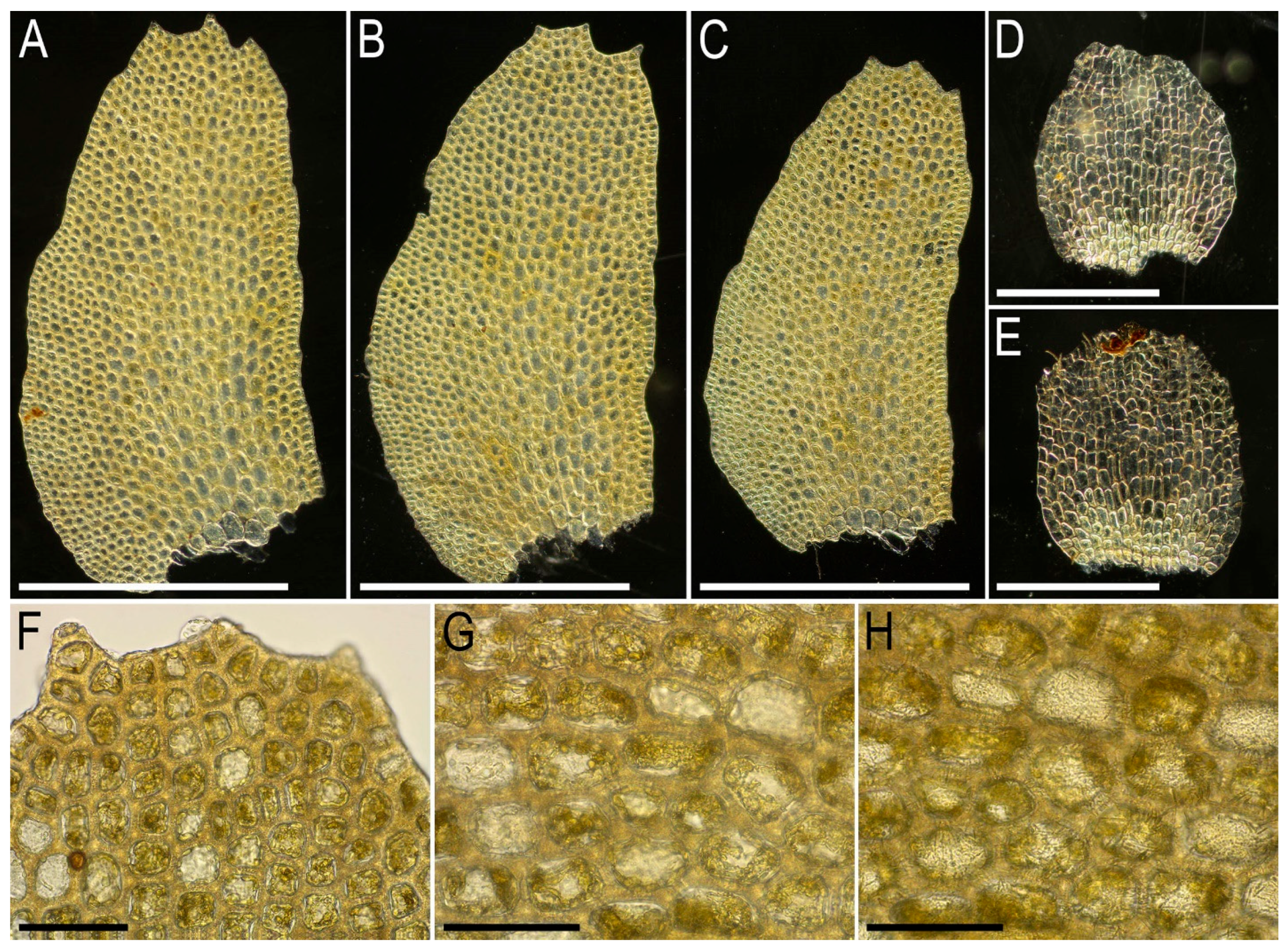
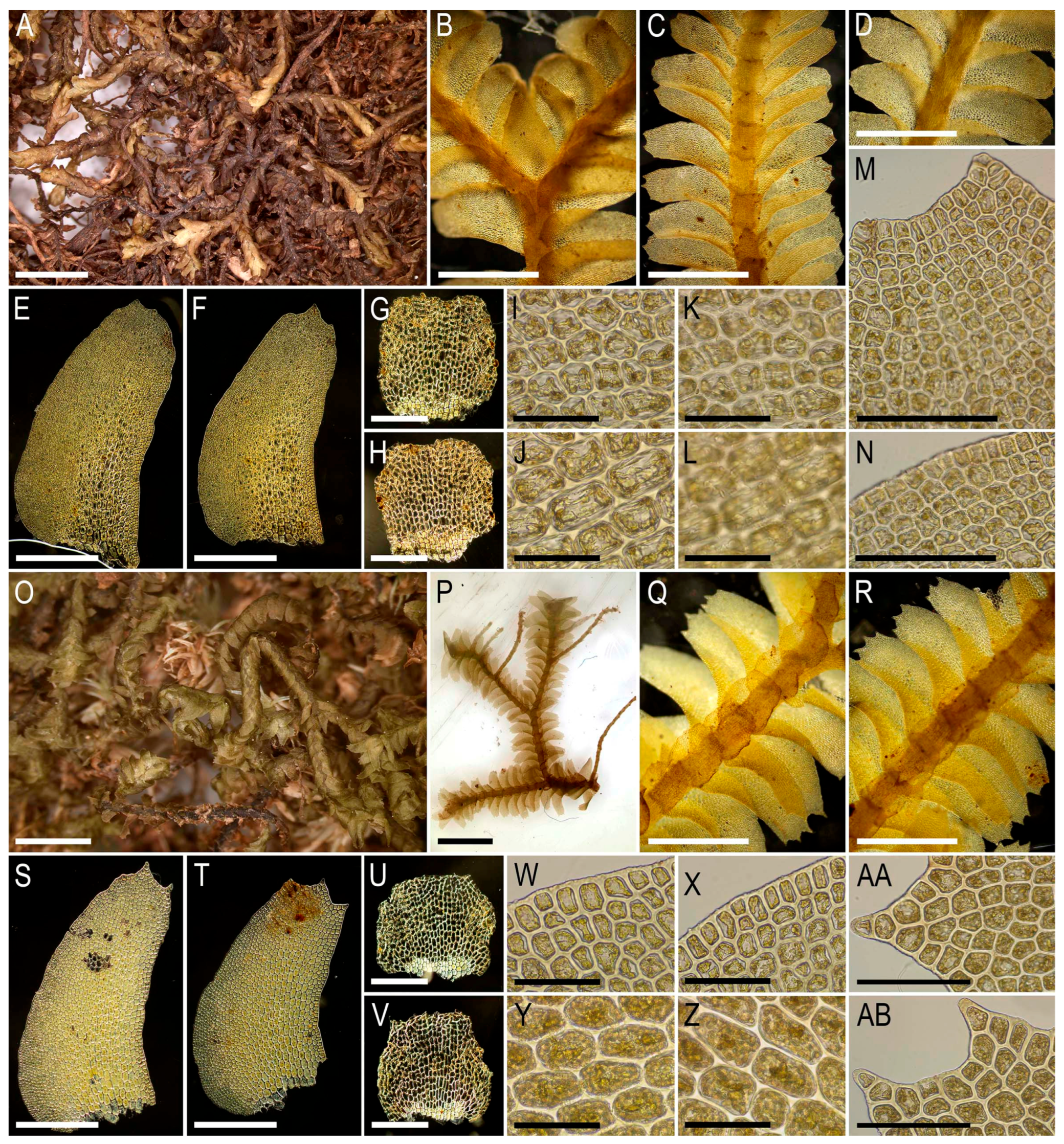
Description. Plants brownish to yellowish brown, merely rigid, in loose patches, 20–30 mm long and 1.8–2.5 mm wide, freely branched (Frullania-type), ventral scale-like leaved ‘flagella’ common, commonly branched again. Rhizoids absent in normally leaved shoots, but present in terminal parts of the ventral ‘flagella’ wherefrom the stem in the areas just below of modified leaves and underleaves, pale brownish, obliquely spreading. Leaves obliquely inserted, slightly convex-ridged, subhorizontally oriented, suberect spreading, contiguous to subimbricate, overlapping 1/5–1/3 of the above situated leaf, when flattened in the slide obliquely ovate, somewhat falcate, 1100–1300 × 500–600 µm, only shortly trilobed or unclearly so. Leaves somewhat pseudovittate, pseudovitta cells in the midleaf 25–50 × 20–25 µm, thin-walled, with moderate in size, mostly concave trigones, cuticle papillose (but not verruculose); cells in the midleaf aside of pseudovitta subisodiametric, 12–15(–17) µm, thin-walled with small to rarely moderate in size trigones, cuticle unclearly papillose; cells along dorsal leaf margin 10–12 µm, walls somewhat thickened, trigones small, concave; cells in apical part of leaf along margin 12–15 µm, with walls unequally thickened, trigones small, concave. Underleaves subquadrate, hyaline except area very near the base, 400–500 × 400–500 µm, unclearly crispate along margin, tightly appressed to the stem.
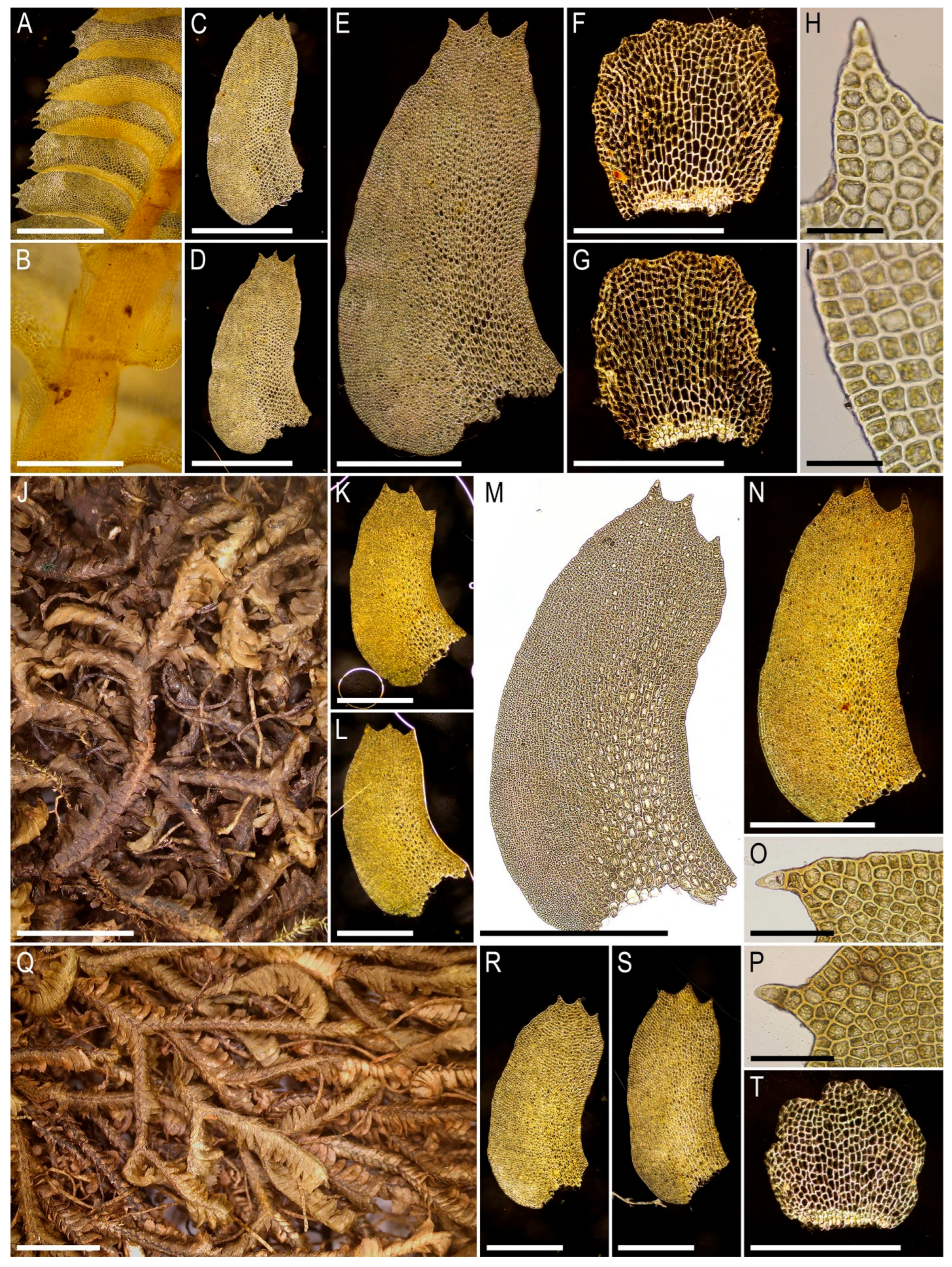
Illustrations in the present paper can be found in
Figure 13.
Comment. The plants in the specimen are similar to B. fleischeri in their dark coloration with leaves characterized by thick-walled and small cells along the leaf margins and a ‘pseudovittate’ cell organization in the leaf midline. However, the plants in the specimen differ from typical B. fleischeri in (1) having very shortly trilobed leaves and (2) having underleaves that are quite narrow but not wider than they are long. In any case, we have not yet been able to find a better name for the plant in the specimen. The plants in the specimen are somewhat similar to B. tridens, from which they differs in (1) having very shortly trilobed leaves and (2) having a border of small thick-walled cells along the leaf margin.
Bazzania cf. fleischeri 2 (Specimens DAK1 valezh1 kushn6, DAK9 valezh2 kushn3)
Description. Plants deep brown green, relatively rigid, 20–40 mm long and 1.8–2.5 mm wide, in loose patches, freely branched (Frullania-type). Rhizoids in terminal parts of ventral scale-like leaved ‘flagella’, from the stem, in the areas adjacent to the bases of modified leaves and underleaves. Leaves obliquely inserted, subhorizontally oriented, suberect spreading, slightly ridged, overlapping 1/3–1/2 of above situated leaf near its base, when flattened in the slide obliquely ovate and somewhat falcate, shortly but distinctly (2–)3–lobed, sometimes with fourth lobe or with small solitary accessory teeth, 1000–1300 × 600–800 µm. Large-celled zone in the leaf axis area large and distinct, composed by cells 30–50 × 25–35 µm, walls thin, trigones moderate slightly concave to slightly convex, cuticle smooth. Cells along dorsal margin 7–12 µm, think-walled, external wall thickened, cuticle verrucose very near to the margin, trigones small to moderate in size, concave. Cells in apical area 20–25(30) µm in diameter, very thick-walled, trigones small to moderate in size, concave. Underleaves tightly appressed to the stem, hyaline except area near the base, subquadrate, transversely rectangular and even trapezoidal, 400–500 × 450–600 µm, margin weakly irregularly dentate or loosely crispate.
Comment 2. Another morphotype similar to Bazzania fleischeri is the morphological grading of both B. albifolia and B. tridens. It differs from typical B. fleischeri in that the border is expressed only along the dorsal leaf margin, not the ventral one; the underleaves are nearly as wide as they are long. The leaf apices are generally similar in their thick-walled marginal cells to B. callida; however, the cuticle is virtually smooth, being only slightly verrucose at the leaf apex. The distinct small-celled zone in the dorsal side of the leaf and distinct leaf lobation and deeper pigmentation are characteristic for the plants in the specimen. Overall, the plants in the specimen exhibit a combination of (1) thickened walls and somewhat large cells at the leaf apex; (2) a small-celled border along the dorsal leaf margin only; (3) the presence of accessory leaf lobe or few accessory teeth. These characteristics place the plants in an intermediate position between a number of species, including B. fleischeri, B. callida, B. tridens, and B. intermedia. Moreover, the mat in the specimen is a mixture of B. cf. fleischeri and B. albifolia, but both species are easily differentiated even under a dissecting microscope.
Other observed morphotypes tentatively referred to as B. cf. fleischeri are briefly discussed below.
Specimen Cam-81–11–11.
Comment 3. Quite similar to Cam-89–10–11, but peculiar by more deeply (more distinctly) lobed leaves. In the latter respect seems to be morphologically similar to DAK1 valezh1 kushn6, but small-celled rim is prominent in all the parts of leaf margin. The plants in the specimen besides are characterized by larger leaves those are more or less distinctly falcate.
Specimen Cam-83–16–11.
Comment 4. Brownish to brown colored plants highly similar to plants in Cam-89–10–11, except of distinctly lobed leaves (versus only very shortly lobed) in the present specimen.
Specimen Cam-81–1–11.
Comment 5. Plants rigid, brown to yellowish brown, with small cells present in antical leaf margin, but not so in the postical margin. Cuticle in the apical part of the leaf finely verrucose to papillose, leaves distinctly trilobed.
Specimen Cam-84–7–11.
Comment 6. Plants brownish to brown. Small-celled zone present only along antical margin, not in the postical. Leaves distinctly trilobed.
Although we did not see the plants we could send to the ‘true’ B. fleischeri, below we provide the general distribution data of the taxon with some reservation for the unclear taxonomic position of our specimens.
Illustrations in the present paper:
Figure 15.
Distribution. South Asia (Sri Lanka), East Asia (China: Hainan) [
26]. Stephani [
45] has reported it for Sino-Himalaya (Assam), but due to Mizutani [
13] the latter report is uncertain. Due to the present observation, the species is newly reported from Indochina (Vietnam and Cambodia).
Ecology. In China the species is reported from decaying wood in evergreen forests below 1000 m alt. [
26]. The ecology in Cambodia is slightly different: the species is occurring in lower elevations (below 700 m a.s.l.) on tree trunks and once also collected on the stone in dry (wetted in the flood period) riverbed. However, the occurrence in Vietnam is from decaying wood at the elevation slightly above 1000 m a.s.l. All the observed occurrences are from semidry evergreen forest.
Specimens examined: CAMBODIA. Koh Kong Province, Tatai Waterfall (11.58639° N 103.09639° E), 400 m a.s.l., area near the waterfall in evergreen forest, stone near the riverbed, 26 December 2011, V.A. Bakalin, Cam-89–10–11 (VBGI); VIETNAM. Central Highlands, Gia Lai Province, Kbang District (14.48959800° N 108.56691800° E), 1015 m a.s.l., evergreen tropical forest with substantial share Dacrydium elatum, large dead trunk, not Dacrydium elatum (wood was examined), 7 March 2022, E.V. Kushnevskaya, DAK1 valezh1 kushn6 (VBGI); ibid. (14.48968400° N 108.56652400° E), 1015 m a.s.l., evergreen tropical forest with substantial share Dacrydium elatum, on dead wood of middle stages of decomposition, mixed with Bazzania tridens (Reinw., Blume et Nees) Trevis., Bazzania albifolia, 14 March 2022, E.V. Kushnevskaya, DAK9 valezh2 kushn3 (VBGI).
Specimens examined for deviations: CAMBODIA. Koh Kong Province, Phumi Chréav (11.80528° N 103.51083° E), 700 m a.s.l., broadleaved evergreen forest on slope, tree trunk, 22 December 2011, V.A. Bakalin, Cam-81–1–11, Cam-81–11–11 (VBGI); ibid. Thma Bang Village area (11.66194° N 103.39861° E), 360 m a.s.l., broadleaved evergreen forest on slope to waterfall, tree trunk, 23 December 2011, V.A. Bakalin, Cam-83–16–11 (VBGI); ibid. (11.68750° N 103.42722° E), 400 m a.s.l., broadleaved evergreen forest on slope to waterfall, bark of tree; 23 December 2011, V.A. Bakalin, Cam-84–7–11 (VBGI).
Bazzania intermedia (Gottsche et Lindenb.) Trevis., Mem. Reale Ist. Lombardo Sci. (Ser. 3), C. Sci. Mat. 4 (13): 415, 1877
Illustrations: [
41] (Figure 20), [
47] (Plate XV, Figures 16–25), [
13] (Figure VIII).
Description. Plants yellowish brownish, freely branched (Frullania-type), ventral scale-like leaved flagella abundant, 15–30 mm long and 2.2–2.8 mm wide. Rhizoids virtually absent even at the distal parts of flagella. Leaves obliquely inserted, slightly overlapping (covering up to 1/3 in the leaf base of the next situated leaf), slightly ridged to plane in upper halves, somewhat falcate, when flattened in the slide 1400–1800 × 600–900 µm, distinctly 3–lobed, in upper half of the leaf with solitary to numerous accessory teeth, cells in the middle of the lower half of the leaf are longer, but leaves are not vittate. Midleaf cells distinctly longer than along the margin, (20–)25–45 × 13–20 µm, thin-walled, with moderate to large in size, slightly concave to convex trigones, cuticle papillose; in dorsal leaf margin 8–18 µm, with unclearly thickened walls and small to moderate in size, concave trigones, cuticle papillose-verrucose, mostly unclearly so. Underleaves 1.5 wider than the stem, appressed in lower parts (where chlorophyllose) and obliquely spreading to loosely recurved above, longer than wide, when flattened in the slide 500–600 × 400–500 µm, marginal rows of discolored cells are with thin walls, middle part (actually the chlorophyllose zone is very variable in the size and shape) with thick cell walls and distinct trigones, loosely connate or adjacent to the lateral leaves in the both sides.
Illustrations in the present paper can be found in
Figure 16.
Comment. In many aspects, the species somewhat resembles
B. tridens, but is easily recognizable due to its only partly hyaline underleaves (lower half chlorophyllose) and commonly numerous accessory teeth in the apical parts. The species is somewhat similar to
B. adnexa, which, however, differs in its distinctly wider than long underleaves. Some deviations were observed in some plants in our specimens: (1) underleaves may be almost completely hyaline, thus approaching
B. tridens, although the leaves have numerous accessory teeth; (2) the underleaves are partly hyaline (thus, as it ‘should be’), but leaves have solitary to nearly absent accessory teeth, thus approaching
B. tridens in this feature; (3) the leaf cuticle varies from papillose to virtually smooth, as observed in
B. tridens. Furthermore, we now follow Mizutani [
13] (p. 88) regarding
Bazzania wallichiana, which “seems to be closely related to, and may be merely a form of
B. intermedia”.
Distribution. From South Asia (India: Tamil Nadu State), Southeast Asia (Southern Japan (Ryukyu, Bonin)) through Indochina (Vietnam, Cambodia—new report), Malesia, Melanesia and to Oceania and Australasia [
40,
41,
43,
48,
49].
Ecology. In the southern Japan Horikawa [
43] (p. 196) the species occurs “on the banks, barks and decayed woods”. The ecology of the species in Cambodia partly coincides with the latter. The species occurs in evergreen dense forests on slopes to watercourses, where it grows on the bark of trees and on more or less dry cliffs at lower elevations varying from 360 to 400 m a.s.l.; this is one of the lowest occurrences of the genus in Indochina.
Specimens examined: CAMBODIA. Koh Kong Province, Thma Bang Village area (11.68750° N 103.42722° E), 400 m a.s.l., broadleaved evergreen forest on slope to waterfall, bark of tree; 23 December 2011, V.A. Bakalin, Cam-84–8–11, Cam-84–18–11 (VBGI).
Bazzania paradoxa (Sande Lac.) Steph., Bot. Jahrb. Syst. 23 (1/2, 3): 307, 1896
Illustrations: [
11] (Table IX), [
47] (Plate XVIII, Figures 1–11).
Description. Plants merely rigid, yellowish brownish in the herbarium, regularly branched, ventral scale-like leaved ‘flagella’ numerous, 30–50 mm long and 3–4 mm wide. Leaves obliquely inserted, laterally suberect spreading, slightly convex-ridged, in ventral side with toothed appendage, obliquely ovate, 1800–2200 × 1100–1300 µm. Midleaf cells thin-walled, with large, rarely confluent, nodulose trigones, mostly oblong to shortly so, 25–40 × 15–22 µm, cuticle smooth to indistinctly papillose; cells along dorsal margin 12–25 µm, thin-walled, external wall thickened, trigones large, nodulose, to slightly convex or concave, when adjacent to the external wall, cuticle papillose. Underleaves concave-canaliculate, loosely appressed to narrowly spreading, not or indistinctly connate with leaves in one side, subquadrate, 700–1000 × 700–1000 µm, densely toothed-laciniate, with large and densely toothed basal appendages in the both sides, overlapping 1/3–1/2 of above situated underleaf. Dioicous. Androecia ventral, with 10 and more pairs of bracts, becoming depauperate and appears to be dying at the tips, subisophyllous, but male bracteoles without antheridia. Perianth on abbreviated ventral branch, 3–plicate, ovate-fusiform, 3.8–4.0 mm long and 1.0–1.2 mm wide, mouth laciniate-ciliate, with uniseriate cilia 3–4 cells long; with 3 pairs of bracts, bracts and bracteoles indistinguishable, innermost narrowly ovate, dentate-ciliate-laciniate through the margin, shortly bilobed in the apex, 1.7–2.0 × 1.0–1.2 mm, middle pair of bracts deeply bilobed, ciliate-laciniate through the margin, 1.0–0.7–0.9 mm, outer bracts shortly to deeply bilobed, more or less ovate, 0.5–0.7 × 0.4–0.6 mm. Capsule short emerged from the perianth, with 4 valves, valve length ca. 1 mm. Seta 4 mm long. Elaters mostly sessile on the apical and lateral parts of the inner side of capsule, bispiral, without homogenous ends, 300–500 µm long and (6–)8–10 µm wide. Spores spherical, brown, finely papillose, 23–26 µm in diameter, outer ells of the capsule ca. 23–25 µm wide, the length is difficult to measure since the cells are mostly collapsed with transverse walls difficult to find.
Comment. The taxon may be mistaken with B. calcarata (Sande Lac.) Schiffn., from which it is differing in several features:
The underleaves overlap the next nearest underleaf for 1/3–1/2 of their lengths, whereas they are distanced in
B. calcarata (as discussed by Kitagawa [
19]);
The plant size is 3.0–4.0 mm wide, versus 2.4–3.0 mm;
The leaf cell trigones abruptly end in
B. calcarata (as may be evidenced from Kitagawa’s [
19] pictures), but have a more or less smooth gradient to the cell wall in
B. paradoxa;
The appendages are present in the underleaf bases, versus absent or poorly developed in
B. calcarata, although Kitagawa [
19] indicates the presence of appendages;
The leaves 1.5 as long as wide, versus ca 2.0 as long as wide in B. calcarata;
The leaf ventral base has commonly toothed auricles, versus leaf ventral base having a tooth, but not auricles (although Kitagawa [
19] highlights small auricles);
No teeth in dorsal leaf base, versus dorsal leaf base sometimes with teeth in B. calcarata;
The leaf cuticle is papillose, sometimes unclearly so, versus smooth in B. calcarata.
The name ‘
calcarata’ seems to mean the occurrence on calcium-rich substrates, while
B. paradoxa seems to occur on trees. However,
B. calcarata also occurs on rocky substrates. Tixier [
50] (p. 342) provided occurrence as “on rotten wood in evergreen forest” in Pahang, Malaysia.
Despite the numerous listed features, intermediate, hardly distinguishable modifications may occur. For instance, Cam-87–39–11 is characterized by narrower leaves, and more abruptly ended trigones, but possesses a prominently papillose leaf cuticle. The plants in our specimens and the illustrations in the above cited sources are similar to those photographed and published in Khotimperwati et al. (2018) [
51] under
B. calcarata, leading us to suspect that the report in the latter source is misidentification-based.
Distribution. Indochina (Thailand, Cambodia—new report here), Malesia (Malaysia, Indonesia) Melanesia (Fiji), Polynesia (Samoa) [
16,
23,
25,
40,
50].
Ecology. Siregar et al. [
25] provide data on the collection, including climatic measurements at that time. The species occurs in epiphytic habitats at an elevation of 1421 m a.s.l. with humidity near 72% and temperature near 24 °C. Data on ecology in Thailand are more scarce and,, following Kitagawa [
16] (p. 265), these are “tree trunk and rock in rain forest”. The species was collected in Cambodia at one site in a wet evergreen forest at the edge of grassland on the bark of tree at an elevation of 380 m a.s.l.
Specimens examined: CAMBODIA. Koh Kong Province, National Mega Forested Area (11.59694° N 103.22556° E), 380 m a.s.l., wet broadleaved evergreen forest at the edge of grassland, bark of tree, 24 December 2011, V.A. Bakalin, Cam-87–38–11, Cam-87–39–11 (VBGI).
Bazzania recurva (Mont.) Trevis., Mem. Reale Ist. Lombardo Sci. (Ser. 3), C. Sci. Mat. 4 (13): 414, 1877
Illustrations: [
29] (Figures 4A,B and 6C,D); [
53] (Figure 4).
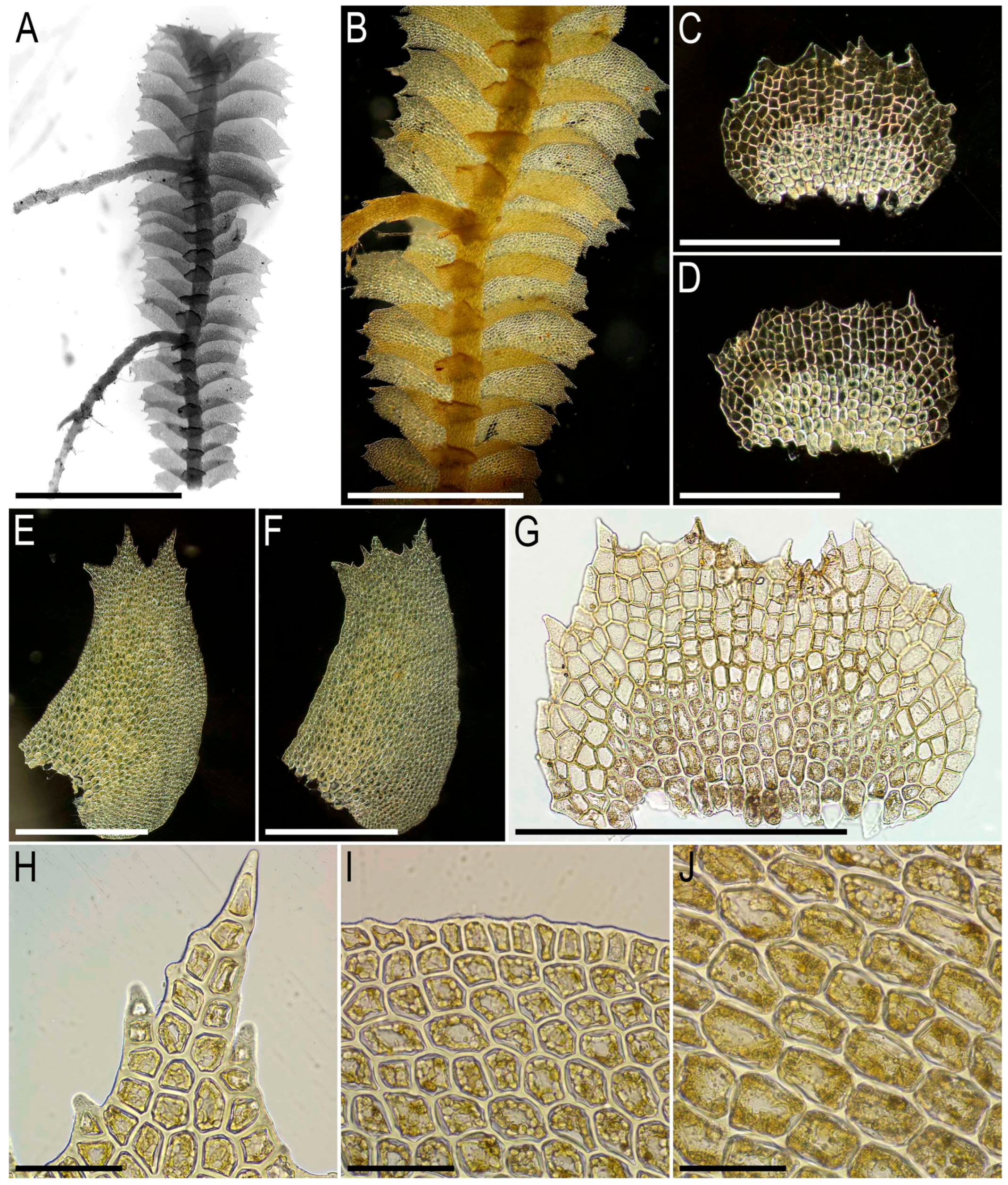
Description. Plants yellowish brownish when dry, in dry condition strongly turned ventrally, but with leaves not clasping, due to this, plants in dry conditions much narrower than in wet conditions and only 1.0–1.3 mm wide, due to imbricate and turned ventrally leaves plants resembling in dry conditions Acrolejeunea infuscata (Mitt.) Jian Wang bis & Gradst., but immediately different in numerous ventral ‘flagella’; in moist conditions 40–70 mm long and 3.0–3.5 mm wide, sparsely terminally branched (branching of Frullania-type) and with numerous ventral ‘flagella’ with reduced leaved, although some ‘flagella’ has subimbricate and not so reduced leaves. Rhizoids brownish, very sparse, present in terminal parts of ‘flagella’. Leaves obliquely to subtransversely inserted and oriented, suberect spreading, imbricate, convex-ridged, somewhat turned ventrally, in apical part somewhat involute, when flattened in the slide commonly becoming lacerate or plicate, both in ventral and dorsal bases sometimes bear sharply to obtusely dentate appendages, in general outline widely obliquely ovate, unlobed, 1200–1600 × 1700–2000 µm, with prominently denticulate margin with becoming longer protruding to the apex, apex also rarely very shortly emarginate. Midleaf cells subisodiametric, 25–30 × 25–27 µm, thin-walled, with large nearly triangular trigones with visible middle lamina, trigones sometimes confluent in shorter wall, cuticle smooth. Cells along margin 12–20(–25) µm, external wall very thick, tooth situated above middle of the cell lumen, other walls thin to thickened due to trigones confluence, trigones large, concave to convex, sometimes confluent in radial wall, commonly with visible middle lamina, cuticle verrucose. Underleaves canaliculate-concave (if to view from ventral side), imbricate with apical part and sides loosely recurved, although situated very closely to the ventral base of the leaves seems never connate with them, when flattened in the slide commonly becoming lacerate or plicate, virtually without appendages or with very unclear ones, in general outline transversely ellipsoidal, 800–1000 × 1500–1900 µm, prominently denticulate through the margin (more prominently than the leaf sides).
Illustrations in the present paper:
Figure 19.
Comment.
Bazzania recurva possesses a peculiar type of denticulation formed entirely by wall thickenings those are not accompanied by cell lumen protrusions. Illustrations of the species are provided by Pócs [
29] for Vietnam and Piippo et al. [
53] for Singapore. The same authors and Kitagawa [
19] mention only selected characteristics of the species; apparently, the species was only described in the original description, so we provide its full description here. Kitagawa [
19] (pp. 80–81) noted the close resemblance of
B. recurva with
B. confertifolia (Steph.) Herzog (a Malesian-Melanesian species), but the former “the leaves serrulate rather regularly and the underleaves bear no basal auricles”, versus denticulations are scattered and basal auricles well-developed in
B. confertifolia.
Distribution. Probably widely distributed in SE Asia including Indochina (Vietnam, Thailand) and Malesia (Malaysia) [
19,
23,
29,
40,
54,
55,
56].
Ecology. Pócs, 2023 [
29], describes the habitat as “sur bois au sol en forêt, 900 m” [on wood on the ground in the forest] (Vietnam, Lâm Đồng, Bao Loc). On the contrary, our specimen is from the fallen branch of
Fokienia hodginsii, originally situated in a tree crown.
Specimens examined: VIETNAM. Central Highlands, Lâm Đồng Province, Lạc Dương District (12.18141667° N 108.69028333° E), 1550 m a.s.l., evergreen tropical mountain forest with Fokienia hodginsii and Pinus krempfii, on fresh broken branch of old large Fokienia hodginsii, 28 October 2023, E.V. Kushnevskaya, kushn7-epiphytes (VBGI).
Bazzania vittata (Gottsche) Trevis., Mem. Reale Ist. Lombardo Sci. (Ser. 3), C. Sci. Mat. 4 (13): 414, 1877
Illustrations: [
27] (Figure 37), [
41] (Figure 33), [
42] (Figure 13L–P).
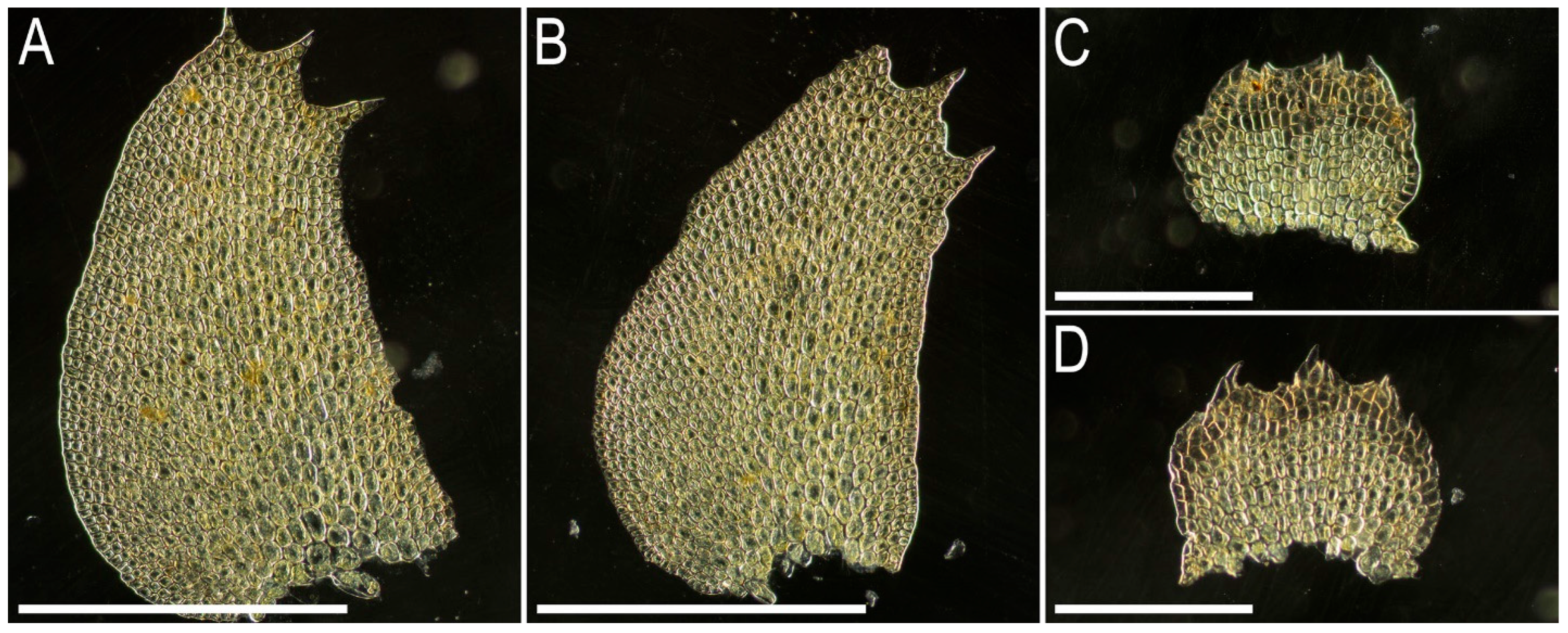
Description. Plants brownish-whitish when dry, very fragile, closely adjacent to the substrate, in loose patches, with tiny admixture of B. intermedia, 7–15 mm long and 1.0–1.2 mm wide, sparsely branched (Frullania-type), ventral scale-like leaved ‘flagella’ sparse. Rhizoids absent in normally leaved shoots but present distal areas of ‘flagella’, where brownish, obliquely to erect spreading originating from the stem just below modified leaves and underleaves. Leaves obliquely inserted and oriented, suberect spreading, slightly convex-ridged (both in dry and wet conditions), imbricate, overlapping ca. 1/5–1/4 of the next leaf in the base, when flattened in the slide obliquely ovate to very slightly falcate, 500–600 × 250–350 µm, with apex shortly, but distinctly trilobed, lobes acute, with vitta formed by 3–4 rows of cells reaching 2/3 of leaf length and sometimes even entering to the upper third of the leaf, without accessory teeth along leaf margin (except of rare aberrations). Cuticle densely verruculose through the leaves and underleaves; vitta cells rectangular, 15–25 × 15–20 µm, with walls slightly thickened, trigones moderate in size, concave; in the midleaf aside vitta cells subisodiametric, 10–13 × 10–13 µm, with thin to somewhat thickened walls, trigones mostly small to moderate in size, concave; cells along margin 10–14 µm, mostly thin-walled, external wall may be slightly thickened, trigones small to moderate, concave. Underleaves tightly appressed to the stem to narrowly spreading in apical third of the underleaf, contiguous to somewhat distant, subquadrate to rectangular, 200–250 × 150–200 µm, hyaline except 1–several rows of cells very near the base, shortly emarginated to bilobed for 1/5 of underleaf length, with rounded lobe apices or shortly and unclearly 3(–4)-lobed, with rounded lobes.
Illustrations in the present paper can be found in
Figure 20.
Comment. Among the regional species,
B. vittata is characterized by its (1) densely verruculose cuticle through the leaf and underleaf surfaces, (2) almost completely hyaline underleaves, and (3) distinctly vittate leaves. The lobation of the leaves is the subject of great variation. While modifications with only short to almost unlobed leaves are common, our plants display modification with more distinct than commonly trilobed leaves. Some resemblance may be seen with other small-sized species in the flora—
Bazzania mayebarae S. Hatt. (to which
B. debilis N. Kitag. may be identical).
Bazzania mayebarae is, however, different from
B. vittata in that the (1) plants are not so densely adjacent to the substrate, (2) have bilobed leaves, (3) an absence of vitta, and (4) a verrucose to papillose, but not verruculose, leaf cuticle. Zhou et al. [
27] also stressed some difficulties in differentiating
B. vittata from
B. tridens due to the occasional presence of a vitta-like cell group in the central part of the leaves in the latter. However,
B. vittata is much smaller, has a whitish color and possesses a pronouncedly verruculose leaf cuticle.
Distribution. East Asia (China: Hainan), Indochina (Thailand, Cambodia—the present report), Malesia (Indonesia, Malaysia) to Melanesia (New Guinea), Oceania (Tahiti, New Caledonia) and Australasia [
7,
27,
40,
41,
42]. The species is hitherto new to Cambodia.
Ecology. Mejer [
57] (p. 372) describes the occurrence in Java Island as “in primary forests, … 1200–2700 m”. The bark of trees, fern trees, and rotten wood in 700–2000 m a.s.l. are known as the habitat in the Philippines [
7]. Essentially the same as above is the habitat in New Caledonia, where the species occurs on decaying wood, tree fern stripes, and the bark of trees at ca. 500–1400 m a.s.l. [
42]. In East Indochina, this seems to be quite a rare species, collected just once on a tree base in an evergreen tropical forest on a slope at an elevation of ca. 900 m a.s.l.
Specimens examined: CAMBODIA. Mondulkiri Province, Phnom Nam Lyr Wildlife Sanctuary (12.54444° N 107.50861° E), 900 m a.s.l., broadleaved evergreen forest on slope, tree base, 19 December 2011, V.A. Bakalin, Cam-79–32–11 (VBGI).
Lepidozia holorhiza (Reinw., Blume et Nees) Nees, Syn. Hepat. 2: 210, 1845
Illustrations: [
14] (Figure V1–10).
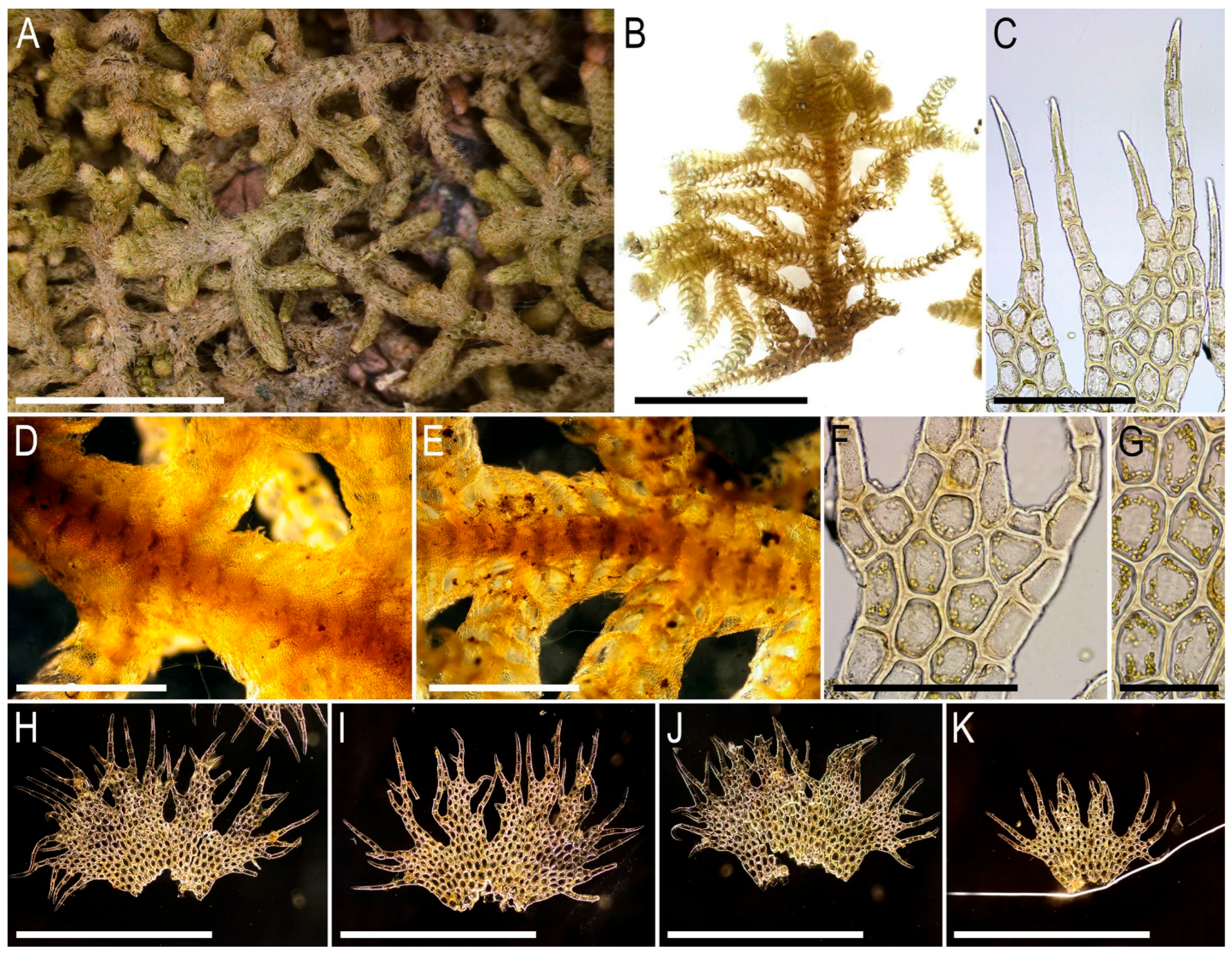
Description. Plants in loose patches, yellowish greenish in the herbarium, pale green when fresh, freely pinnately branched (branching Frullania-type), ca. 70–80% of branches becoming at the ends into flagelliform shoots with reduced leaves and in that area branching again (but branches there is only ventral), ventral ‘flagella’ with reduced leaves sparse, but occurs regularly, normally leaved shoots 20–40(–50) mm long and 0.7–0.8(–0.9) mm wide. Leaves imbricate or nearly so, subtransversely inserted and oriented, slightly convex, densely ciliate-laciniate along margin, lacinae become longer to the apex, near apex with 2–3 prominent large lacinae (=lobes), when flattened in the slide always lacerate with dorsal part distinctly larger than ventral part, 500–600 × 600–800 µm. Midleaf cells rectangular, 15–20 × 10–15 µm, walls thin to somewhat thickened, trigones small to moderate in size, concave, cuticle smooth. Uniseriate ends of large lacinae with cells becoming longer to the lacinae apex, 5–7 cells long, the basal cells of uniseriate end start from 20 µm then reaching 50 µm to the apex, external wall thickened, the transverse walls projecting as commonly occurs on Blepharostoma neglectum Vilnet & Bakalin, cuticle distinctly papillose in lacinae and cilia. Underleaves erect to suberect spreading, convex to somewhat folded, merely similar to leaves also with 2 prominent lacinae near the apex, but with the sides merely equal in size, always lacerate when flattened in the slides, 450–500 × 500–600 µm.
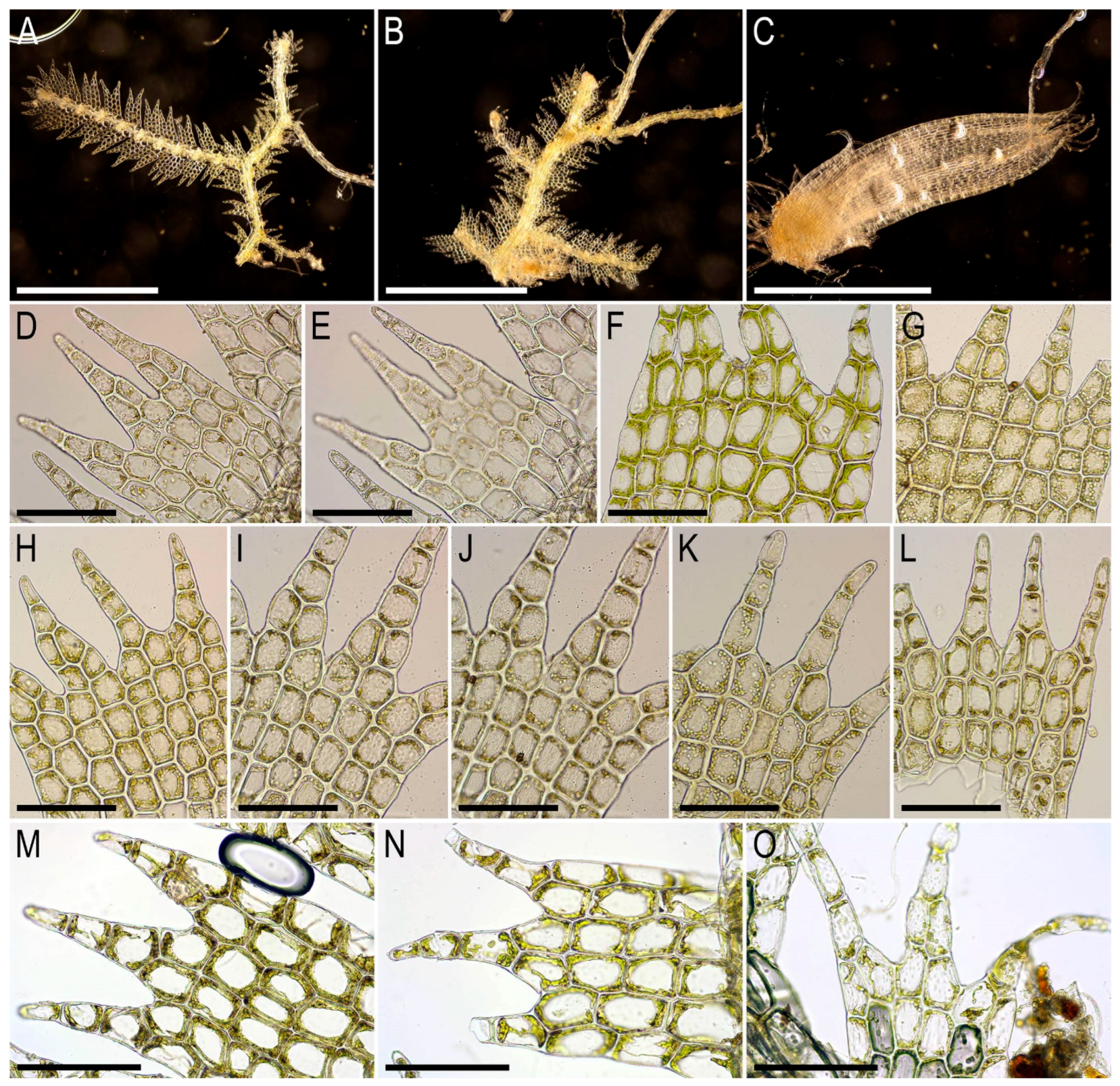
Illustrations in the present paper can be found in
Figure 21.
Comment. Lepidozia holorhiza is morphologically similar to L. cladorhiza (Reinw., Blume et Nees) Nees and may be distinguished by the following: (1) leaves that are obliquely trapezoidal, distinctly and long ciliate–laciniate in L. holorhiza, versus leaves that are ovate with a rather narrowed apex, without distinct lobation in L. cladorhiza and (2) plants narrower than 0.9 mm wide in L. holorhiza versus plants wider than 1.0 mm in L. cladorhiza.
There are some discrepancies with Mizutani [
14]’s description in terms of the length of cilia cells. Following the latter author,
L. holorhiza cilia cells reach 30 µm long, whereas they reach 90 µm in
L. cladorhiza. The cilia cells reach 50 µm long in our specimen plants. Another morphologically similar species,
Lepidozia borneensis Steph. (morphological description and illustrations provided by Mizutani [
14], and micrographs by Pócs et al. [
30]), differs from
L. holorhiza in having larger plants (wider than 1.1 mm, versus less than 0.9 mm in
L. holorhiza) and the presence of short lateral teeth at the base of the underleaf lobes (versus absent in
L. borneensis).
Distribution. Indochina (Vietnam—the present report), Malesia (Malaysia, Indonesia) [
40,
58]. The species was reported by Miller et al. [
59] for Hawaii in Polynesia, without exact location, and listed in Staples and Imada [
60] as dubious records.
Ecology. We did not find data on the ecology of the species in any localities across the species area. The habitat in Vietnam is a mountainous, evergreen Rhododendron-tree-dominated forest, at an elevation of 1613 m a.s.l., where the specimen was collected on moist humus on slope in part shade.
Specimens examined: VIETNAM. North Central Coast, Nghệ An Province, Tương Dương District, Pù Mát National Park (19.02464° N 104.58004° E), 1613 m a.s.l., area near the peak of Pù Mát Mt. covered by dense Rhododendron forest, moist humus on slope in part shade, 25 May 2022, V.A. Bakalin & M.H. Nguyễn, V-37–46–22 (VBGI, HN).
Lepidozia miqueliana Sande Lac., Ann. Mus. Bot. Lugduno-Batavi 1: 301, 1864
Illustrations: [
14] (p. Figure VII1–8); [
12] (Plate VII: 1–4).
Description. Plants in loose patches, pure or intermixed with Bazzania tridens, B. vietnamica Pócs, due to numerous cilia looking at the first glance in the field as Trichocolea Dumort. or Neotrichocolea S. Hatt. by naked eye, pale green to yellowish greenish when fresh, yellowish-brownish in the herbarium, freely bipinnately branched, 30–50% of the branches of the second order become depauperate with reduced leaves (like flagella) and then dyeing, ventral flagella not seen; main stem with leaves 20–30(–50) mm long and 0.8–1.0 mm wide. Very sparse rhizoid production seen only at the terminal parts of the ‘flagelliform’ branches, where separate, obliquely to erect spreading, nearly brownish to colorless. Leaves subtransversely inserted and oriented, suberect spreading (in the lower half of leaves), strongly convex, covering about 1//3–2/3 of the above situated leaf, when flattened in the slide nearly transversely ellipsoidal in outline, 600–700 × 700–1200 µm, basically unequally 4–lobed (dorsal slightly larger), each lobe commonly subdivided into two sublobes, leaf margin densely ciliate, undivided part (discus) ca. 1/4 of leaf length. Cells I the middle of the discus 25–53 × 25–35 µm, with thin to somewhat thickened walls, trigones small to moderate in size, concave, cuticle smooth. Cells in the ‘sublobes’ 25–30(–40) × 20–25 µm, with thickened walls and moderate to large in size slightly concave to convex trigones with visible middle lamina, cuticle smooth to scarcely verruculose. Cilia 3–5 cells long, with distinctly protruding transverse walls, from 25 µm long in the basal cells to 70 µm long in terminal cells, walls thickened throughout, cuticle smooth. Underleaves suberect spreading (if to look from ventral side), contiguous, although with ciliate apical part covering lower half of the above situated underleaf, 400–500 × 600–750 µm, similar to leaves, but with nearly equal lobes in size, undivided part (discus) ca. 1/3 of the underleaf length.
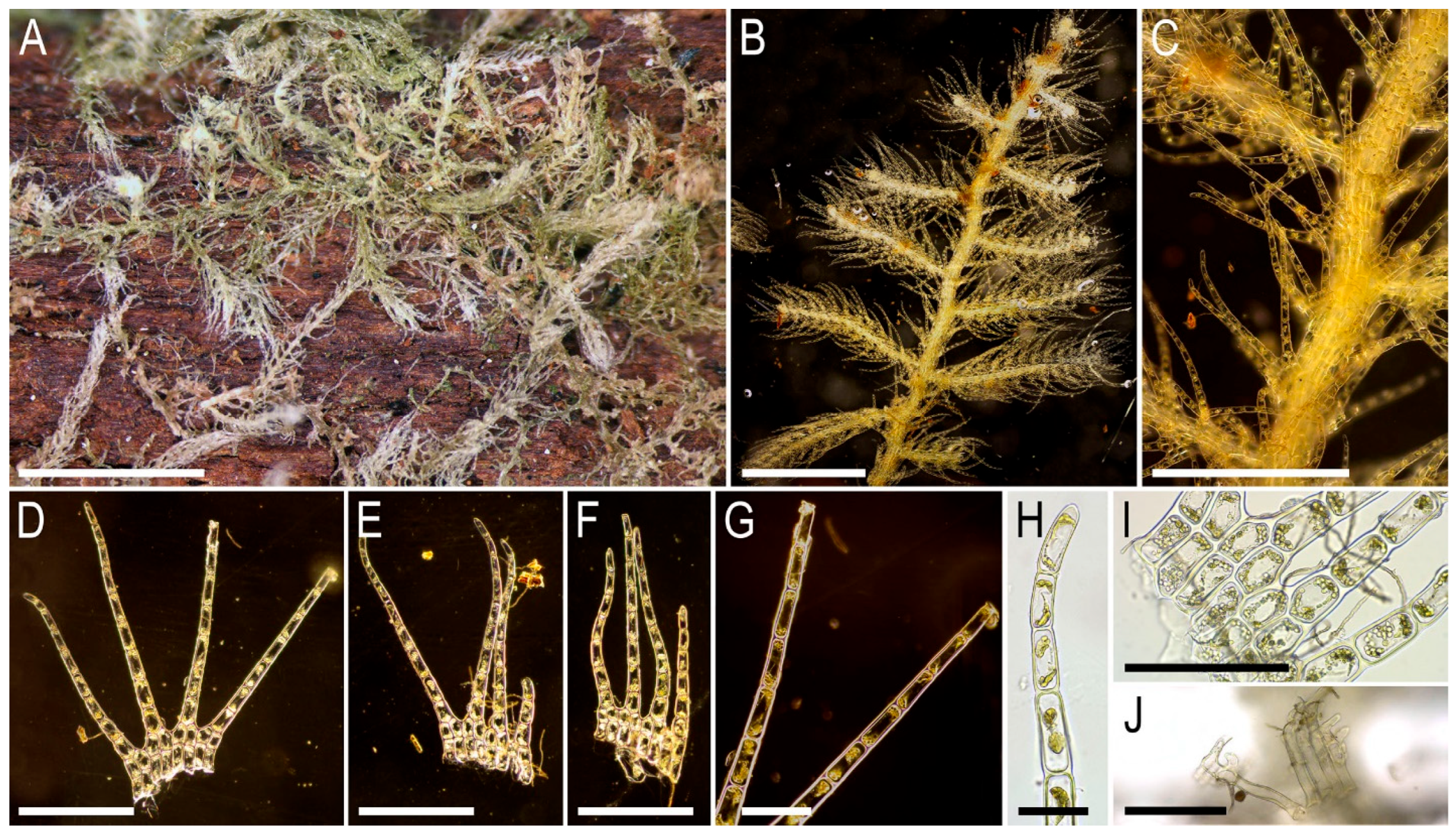
Illustrations in the present paper can be found in
Figure 22.
Comment. This is a fairly easily recognizable species, resembling
Trichocolea in the field, either without a magnifying glass or with a weak magnifying glass, due to the large number of cilia along the leaf margin. Mizutani [
14] describes and illustrates
Lepidozia lacerifolia Steph. and points out its close morphological similarity to
L. miqueliana. However, the latter is characterized by shorter cilia, only 3–5 cells long, and shorter leaf disk cells (22–35 in [
14] but 25–53 µm in our specimen). In contrast,
L. lacerifolia has cilia 5–8 cells long, and the length of leaf disk cells is 50–90 µm.
Distribution. Indochina (Vietnam—the present study); Malesia (Malaysia, Indonesia) [
14,
40,
58].
Ecology. We did not find data on the ecology of the species in any localities of the species area. The habitat in Vietnam is a mountainous, evergreen tropical forest, at an elevation of 1552 m a.s.l., where the specimen was collected on moist humus on slope in part shade. The collection was made a short distance from the collection of another rare taxon treated above (Lepidozia holorhiza).
Specimens examined: VIETNAM. North Central Coast, Nghệ An Province, Tương Dương District, Pù Mát National Park (19.02312° N 104.57874° E), 1552 m a.s.l., N-facing slope of Pù Mát Mt. covered by dense tropical forest, moist humus in part shade, 25 May 2022, V.A. Bakalin & M.H. Nguyễn, V-36–36–22 (VBGI, HN).
Neolepidozia papulosa (Steph.) Fulford et J. Taylor and Neolepidozia wallichiana (Gottsche) Fulford et J. Taylor in East Indochina.
Illustrations in the present paper can be found in
Figure 23.
Comment. Kitagawa [
17] first drew attention to
Neopepidozia papulosa (
Lepidozia papulosa Steph. in [
17]), noting that the frequency of this species is greatly underestimated due to its frequent misidentification as
N. wallichiana. Describing the distinguishing features, Kitagawa [
17] (p. 267) noted the following: “
L. papulosa and
L. wallichiana are immediately distinguished from each other in the characteristics of the leaf cells; in
L. papulosa they are isodiametric or slightly elongated, small (30–40 × 25–30 µm in the middle of discs) and relatively thick-walled, while in
L. wallichiana they are strongly elongated, much larger (40–60 × 25–35 µm) and thin-walled”. However, even in his description of the delimiting characters, the lower limit of cell length for
Neolepidozia papulosa (30 µm) is equal to the upper limit of width; that is, the cells cannot be purely isodiametric, at least in most of the material. The second thing that attracts attention is the wide overlap of leaf cell width ranges: 25–30 µm in
N. papulosa versus 25–35 µm in
N. wallichiana. Thus, the remaining characteristics are relative cell length (in Kitagawa’s description, the ranges do not overlap) and cell wall thickness (thick versus thin). Observing specimens from central Vietnam, we noted some significant variations in cell size and wall thickness. A description of these variants is provided below and also shown in
Figure 23. Thus, the distinction between the two species does not appear as simple as might follow from interpretations of Kitagawa’s [
17] explanations. When deciding on species assignment, we essentially had to rely on the cell length-to-width ratio, but even there, significant overlap in variation ranges was noted. The question of the two species’ distinctness can be resolved through molecular genetic analysis of a significant amount of material from various localities of both species, which was not undertaken in this study.
N. papulosa (Specimen DAK1 Valezh1 kushn9)
Characterized by midleaf cells 35–45 × 25–35 µm, with somewhat thickened walls, cuticle papillose.
N. wallichiana (Specimen DAK1 Valezh2 kushn10)
Midleaf cells 37–50 × 15–35 µm, thin-walled, cuticle smooth.
N wallichiana (Specimen DAK1 Derevo1komel kushn12)
Midleaf cells 48–50 × 30–35 µm, thin-walled, cuticle smooth.
N. wallichiana (Specimen DAK1 melky debris kushn13)
Midleaf cells 38–45 × 20–28 µm, thin-walled, cuticle papillose
N. papulosa (Specimen Cam-81–111–11)
Midleaf cells 30–35 × 30–32 µm, walls slightly thickened, cuticle smooth.
N. papulosa (Specimen Cam-88–9–11)
Midleaf cells 40–46 × 20–25 µm, thin-walled, cuticle smooth.
N. papulosa (Specimen Cam-88–8–11)
Midleaf cells 40–50 × 25–40 µm, walls thin to thickened, cuticle smooth.
N. papulosa (Specimen Cam-85–18–11)
Midleaf cells 25–40 × 25–35 µm, thin-walled, cuticle smooth.
N. papulosa (Specimen Cam-81–109–11)
Midleaf cells 25–40 × 25–35 µm, walls thickened, cuticle smooth.
N. papulosa (Specimen Cam-87–17–11)
Midleaf cells 35–45 × 30–40 µm, walls thin to thickened, trigones somewhat large, cuticle papillose.
N. papulosa (mod. leptoderma?) (Specimen Cam-81–110–11)
Midleaf cells 40–60 × 30–45 µm, thin-walled, cuticle smooth.
The ecology of both taxa seems to be very similar when this species is really abundant in the forest community; it may grow on many substrates including soil, woody litter, the bark of the base of trees and fallen logs. On decaying logs, it may be the dominant species. In such cases, the variability of the features increases. Every place both taxa were collected in tropical evergreen forests at the elevations stretched from 200 to slightly above 1000 m a.s.l.
Specimens examined for Neolepidozia papulosa: VIETNAM. Central Highlands, Gia Lai Province, Kbang District (14.48938500° N 108.56658100° E), 1026 m a.s.l., evergreen tropical forest with substantial share Dacrydium elatum, on large dead fallen trunk, not Dacrydium elatum (wood was examined), 7 March 2022, E.V. Kushnevskaya, DAK1 Valezh1 kushn9 (VBGI); North Central Coast, Hà Tĩnh Province, Vũ Quang District, Hương Quang Commune, northern part of Annamite Range (Trường Sơn Range), Vũ Quang National Park (18.24689° N 105.34067° E), 1204 m a.s.l., medium montane evergreen forest on NE-facing gentle slope, rotten part of decaying wood, moist, in part shade, 21 April 2025, K.G. Klimova, V.A. Bakalin and M.H. Nguyễn, Viet-19-8-25 (VBGI, NH); CAMBODIA. Koh Kong Province, Phumi Chréav (11.80528° N 103.51083° E), 700 m a.s.l., broadleaved evergreen forest on slope, fine soil on slope, 22 December 2011, V.A. Bakalin, Cam-81–109–11, Cam-81–110–11, Cam-81–111–11 (VBGI); ibid. (11.81556° N 103.47611° E), 700 m a.s.l., broadleaved evergreen forest on slope, fern tree trunk, 25 December 2011, V.A. Bakalin, Cam-88–8–11, Cam-88–9–11 (VBGI); ibid. National Mega Forest Area (11.62583° N 103.26861° E), 200 m a.s.l., broadleaved evergreen forest on slope, decaying wood, 24 December 2011, V.A. Bakalin, Cam-85–18–11 (VBGI); ibid. (11.59694° N 103.22556° E), 380 m a.s.l., wet broadleaved evergreen forest at the edge of grassland, forest floor, 24 December 2011, V.A. Bakalin, Cam-87–17–11 (VBGI).
Specimens examined for Neolepidozia wallichiana: VIETNAM. Central Highlands, Gia Lai Province, Kbang District (14.48938500° N 108.56658100° E), 1026 m a.s.l., evergreen tropical forest with substantial share Dacrydium elatum, on deadwood late stages of decomposition, 7 March 2022, E.V. Kushnevskaya, DAK1 Valezh2 kushn10 (VBGI); ibid. on bark in the base of large alive tree, 7 March 2022, E.V. Kushnevskaya, DAK1 Derevo1komel kushn12 (VBGI); ibid. on small wood debris, on fragments of wood and bark, 7 March 2022, E.V. Kushnevskaya, DAK1 melky debris kushn13 (VBGI); Central Highlands, Lâm Đồng Province, Lạc Dương District (12.18226000° N 108.68964600° E), 1520 m a.s.l., evergreen tropical mountain forest with Fokienia hodginsii and Pinus krempfii, on open soil, 28 October 2023, E.V. Kushnevskaya, Fok23#2soil kushn14 (VBGI).
Tricholepidozia semperiana (Steph.) E.D.Cooper, Phytotaxa 97 (2): 60, 2013
≡ Telaranea semperiana (Steph.) Del Ros., Philipp. J. Sci. 100: 238. 1973 (1971).
≡ Lepidozia semperiana Steph., Spec. Hep. 3: 612. 1909.
Illustrations: [
61] (Figures 39–42); [
24] (Figures 11–16 and 22–25).
Illustrations in the present paper can be found in
Figure 24.
Comment. A description and detailed illustrations were provided by Shi and Zhu [
24], who also described the general distribution of the species (p. 131 in l.c.) and provided a key to the species in Southeast Asia.
Tricholepidozia semperiana differs from another representative of the genus known in Vietnam (
T. neesii (Lindenb.) E.D. Cooper) in 4-lobed leaves (versus 6-lobed). The species was collected from several localities on decaying wood, a habitat very characteristic of the taxon.
Distribution. South Asia (Sri Lanka), East Asia (Hainan), Southeast Asia (Vietnam—the present study), Malesia (Philippines, Malaysia) [
24,
39,
40].
Ecology. The species was reported in Hainan, where it was found on a rotten log at an elevation of 950 m a.s.l. [
24]. Our specimen was collected in a similar habitat (decaying wood) in an evergreen tropical forest with a substantial share of
Dacrydium elatum.
Specimens examined: VIETNAM. Central Highlands, Gia Lai Province, Kbang District (14.48968400° N 108.56652400° E), 1015 m a.s.l., evergreen tropical forest with substantial share Dacrydium elatum, on dead wood, middle stages of decomposition, 14 March 2022, E.V. Kushnevskaya, DAK9 valezh2 kushn15 (VBGI); North Central Coast, Quang Tri Province, Bố Trạch District, Tân Trạch Commune, northern part of Annamite Range (Trường Sơn Range), buffer zone of Phong Nha–Kẻ Bàng National Park, surroundings of Ba Reng Mt. (17.48958° N 106.37836° E), 818 m a.s.l., small stream with sluggishly flowing water in shady narrow valley surrounded by low tropical montane evergreen forest with major broadleaf species and tree ferns and giant ferns in understory, partly shaded moist fallen decaying decorticated tree trunk, 27 April 2025, V.A. Bakalin, K.G. Klimova & M.H. Nguyễn, V-26-3-25 (VBGI, NH); ibid. Hà Tĩnh Province, Vũ Quang District, Hương Quang Commune, northern part of Annamite Range (Trường Sơn Range), Vũ Quang National Park (18.24845° N 105.34189° E), 1117 m a.s.l., medium montane evergreen forest on a small hill, partly shaded mesic fallen decaying decorticated tree trunk, 21 April 2025, V.A. Bakalin, K.G. Klimova & M.H. Nguyễn, V-9-7-25 (VBGI, NH).




 ,
,