


Abstract
Soybean, Glycine max (L.) Merrill, is usually grown on a large scale, with pest control based on chemical insecticides. However, the overuse of chemicals has led to several adverse effects requiring more sustainable approaches to pest control. Results from Integrated Pest Management (IPM) employed on Brazilian soybean farms indicate that adopters of the technology have reduced insecticide use by approximately 50% relative to non-adopters, with yields comparable to or slightly higher than those of non-adopters. This reduction can be explained not only by the widespread use of Bt soybean cultivars across the country but also by the adoption of economic thresholds (ETs) in a whole Soybean-IPM package, which has reduced insecticide use. However, low refuge compliance has led to the first cases of pest resistance to Cry1Ac, thereby leading to the return of overreliance on chemical control and posing additional challenges for IPM practitioners. The recent global agenda for decarbonized agriculture might help to support the adoption of IPM since less chemical insecticides sprayed over the crops reduces CO2-equivalent emissions from its application. In addition, consumers’ demand for less pesticide use in food production has favored the increased use of bio-inputs in agriculture, helping mitigate overdependence of agriculture on chemical inputs to preserve yields. Despite the challenges of adopting IPM discussed in this review, the best way to protect soybean yield and preserve the environment remains as IPM, integrating plant resistance (including Bt cultivars), ETs, scouting procedures, selective insecticides, biological control, and other sustainable tools, which help sustain environmental quality in an ecological and economical manner. Soon, those tools will include RNAi, CRISPR-based control strategies, among other sustainable alternatives intensively researched around the world.
1. Introduction
Soybean, Glycine max (L.) Merrill, is one of the most important crops around the world [1]. It supplies 60% of vegetable protein and roughly 30% of the world’s edible oil [2]. Production reached 396 million metric tons in the 2023/2024 season [3] and will continue to grow because of the increasing global demand for food and biodiesel [4]. However, soybean yields can be severely impacted by outbreaks of a variety of pest species, especially from caterpillars (Lepidoptera) and hemipterans [5]. These pests cause global losses of at least 29% when not properly managed [6,7]. In Brazil, the world leader in soy production, soybean losses from pests have reached 4.31 million tons each year [8].
Although chemical insecticides remain effective against pests [9] and play an important role in managing soybean pests [3,10], the overdependency on them raises concerns about their lasting impact on the environment and human health [11,12]. The overuse of chemicals can trigger adverse side effects, including outbreaks of secondary pests [13], selection of resistant pests [14], and detrimentally impact pollinators [15] and biocontrol agents [16], in addition to other negative impacts [17]. Consequently, reducing the use of chemical insecticides in agriculture is increasingly demanded [18] and an important goal of public policies around the world [19].
Integrated Pest Management (IPM) is an efficient strategy to control pests in agriculture [20]. IPM improves safety to non-target organisms [21] and final consumers [22], while also increasing farmers’ profits [10]. As a science-based pest management approach, Soybean-IPM aims to use a combination of strategies, including the planting of resistance cultivars (including Bt soybean), cultivation measures, pest identification and scouting, adoption of biological control, and use of less harmful chemicals only when necessary (based on established ETs), to manage pests while minimizing risks to people, non-target organisms, property, and the environment [23].
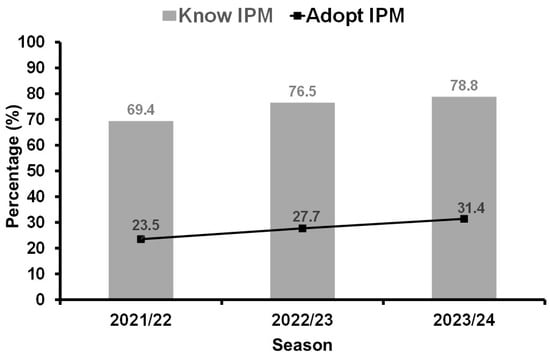
Despite the known benefits provided by its adoption, IPM has not been implemented with the necessary intensity by many growers [13]. Despite the increasing knowledge and adoption of Soybean-IPM, there are still a large number of farmers who do not know about IPM (21.2%, 2023/24) and even a greater number of farmers who, despite knowing the strategies, do not practice Soybean-IPM (68.6%, 2023/24) (Figure 1). For instance, in the state of Paraná, Brazil, while 78.8% of the soybean farmers declare knowing how to practice Soybean-IPM, only 31.4% of them have adopted the strategy. Nevertheless, Soybean-IPM is considered the most successful IPM program developed in Brazil, reducing the amount of insecticide used to control insect pests by about 50% [10].
Figure 1.
Percentage of soybean farmers in the state of Paraná, Brazil, who know the IPM principles (gray bars) and the percentage who have adopted IPM (black line) in their fields. Adapted from [24,25,26].
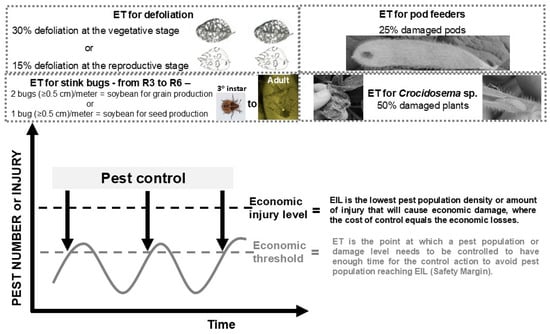
Since the 2013/14 growing season, the Soybean-IPM program in Paraná has been reinforced by cooperation between federal (represented by the research institution, Embrapa Soja) and state (represented by the extension service and research institution, Paraná Rural Development Institute—IDR) governments. Furthermore, several farmers allowed their soybean fields to be used to demonstrate the benefits of adopting sustainable Soybean-IPM. Those soybean fields have been called Unit of Technological Reference, which have been monitored by the IDR-Paraná extension program throughout the whole soybean growing season. An extensionist was responsible for one or more weekly pest samplings (scouting) in the field and for quantifying pests per meter and defoliation. Insecticides were applied only when economic thresholds (ETs) (Figure 2) were reached or surpassed [10]. Simultaneously, a survey was carried out, with the aid of a questionnaire, with farmers not assisted by the Soybean-IPM program, to quantify the number and time of chemical applications. This data was used to compare non-assisted and assisted farmers and evaluate the results and challenges of adopting Soybean-IPM in the state, as further discussed in the following sections.
Figure 2.
Economic injury levels (EILs) in relation to the most important economic thresholds (ETs) for soybean pests recommended in Brazil. Adapted from [27,28,29,30].
2. Soybean-IPM: A Successful Case Study from the State of Paraná, Brazil
Comparing the results from farms that adopted Soybean-IPM with those that did not, across eleven soybean seasons, adopters reduced the average number of insecticide applications by 52.8% (varying from 43.3% in 2019/20 to 69.2% in 2021/22 seasons) compared with farmers who did not adopt IPM. This reduction lowered pest control costs by 51.6%, which is equivalent to 117 kg of soybean per hectare (ha). IPM not only reduced pest control costs but also slightly increased average yield by 93.8 kg/ha (2.8%), resulting in an average profit increase of 210.7 kg/ha (Table 1). Thus, the adoption of Soybean-IPM increased farmers’ profit in addition to being a more sustainable and efficient pest management [10,31,32,33,34,35]. These results are not surprising as the profitability of IPM adoption has been consistently reported in the scientific literature [36]. A reported economic return from employing IPM in soybean ranged from USD 0.6 to USD 2.6 billion in 2005 for USA farmers [37]. Similar positive economic results have also been reported for Soybean-IPM adopters in Brazil [38], Argentina [5], India [39], and Indonesia [40].
Not only is Soybean-IPM more profitable to farmers, but it is also safer for the environment, preserving biological control agents and pollinators. The number of days from sowing to the first insecticide application increased approximately 37% from 46.9 days (non-adopters) to 73.4 days for the Soybean-IPM adopters (Table 1). Delaying insecticide application by 26.5 days is an important strategy to conserve predators, parasitoids, pollinators, and other beneficials, which provide critical ecosystem services [10].
Despite not being universally adopted (Figure 1), Soybean-IPM definitely shows success in Brazil [41], leading to a significant reduction in insecticide sprays compared with non-adopters of the technology [10]. The reduction in traditional chemical insecticides used in soybean has been a result not only of using ETs as a basis for IPM decisions [42], but also as a consequence of the increasing use of biological control agents and adoption of Bt soybean cultivars in Brazil. These are further discussed in the following sections of this review.
Table 1.
Results from 11 years of adoption of Soybean-IPM 1 in the state of Paraná, Brazil, compared with farmers who did not adopt IPM. Adapted from [24,31,32,33,34,35,43,44,45].
3. Use of Economic Thresholds (ETs) in Soybean-IPM
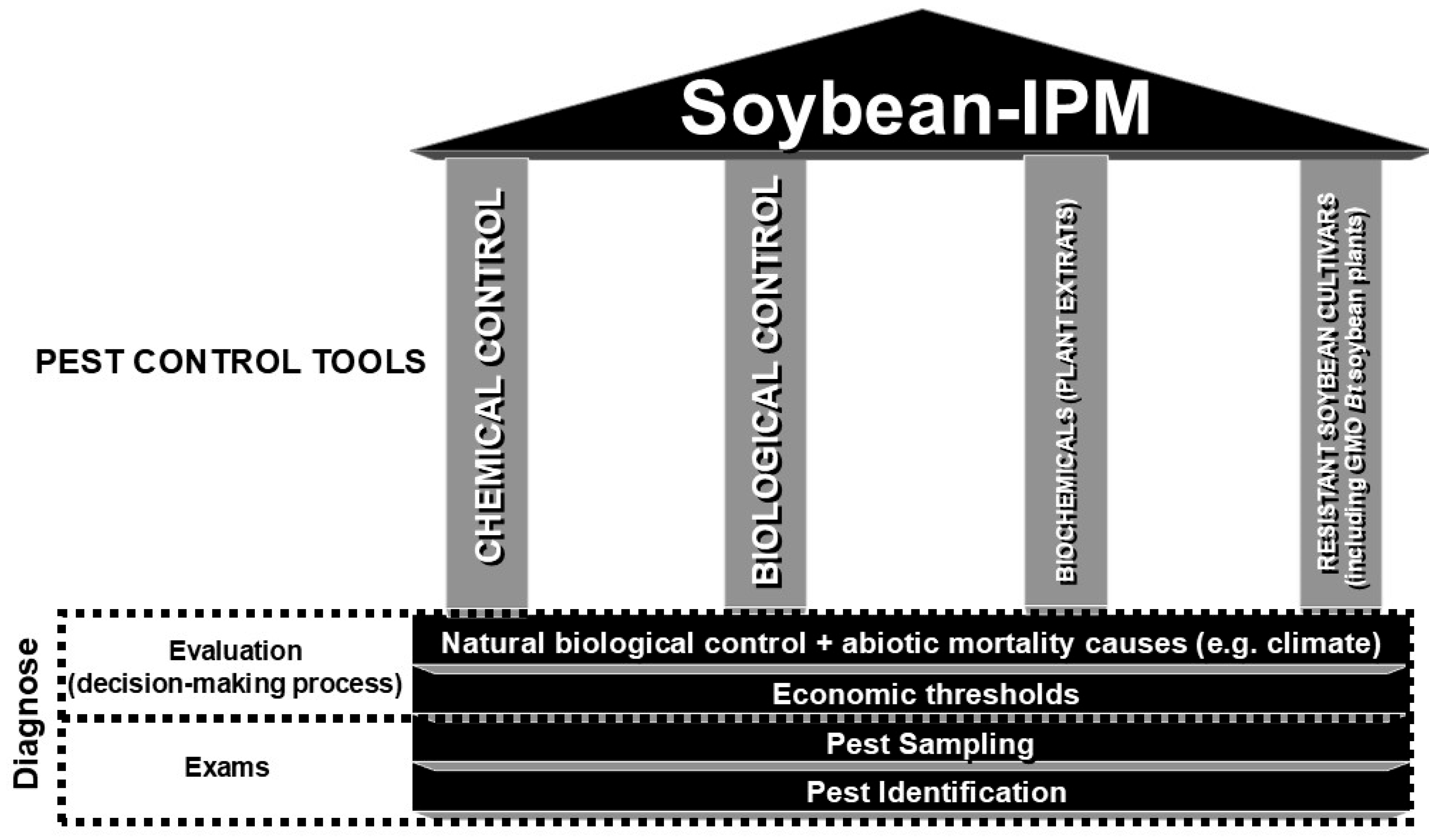
Pest monitoring (insect sampling and identification) and decision-making, comparing pest populations with ETs, are the basis of Soybean-IPM (Figure 3) and crucial to its success [46]. ETs are based on the premise that cultivated plants can tolerate certain levels of injury without economically significant yield reductions [47]; therefore, not all herbivorous insects will become pests and/or require control (Figure 2) [48,49]. In this context, a decision to control any pest species in soybean should only be made when the pest population is equal to or greater than previously established ETs (Figure 2, Table 2) or is expected to surpass those levels within hours or a few days [42].
Figure 3.
Soybean-IPM structure, sustained by the association of different pest management tools and based on diagnosis.
Table 2.
Economic thresholds (ETs) recommended for soybean pests.
Around the world, the established ETs for soybean pests slightly differ because of variations in crop value; different adopted cultivars, pest control costs, pest species occurring, and local environmental conditions; and the availability and effectiveness of control technologies [57]. For instance, different ETs for defoliators (Lepidoptera) and stink bugs (Hemiptera: Pentatomidae) have been reported between Brazil and the USA, which are the first and second global soybean producers, respectively. In Brazil, the ET for defoliators is 30% defoliation (in the vegetative stage) or 15% defoliation (in the reproductive stage) [42]; however, in the USA, this ET is 35% defoliation at the vegetative stage and 20% at the reproductive stage [53]. ETs can also vary between regions in the same country [53]. In the USA, the ET for defoliation ranges from 40% to 30% defoliation during vegetative stages and from 25% to 15% defoliation during reproductive stages in different growing areas of the country (Table 2).
ETs for stink bugs vary less than for defoliators. The recommended ET for stink bugs in soybean is two insects larger than 0.5 cm (including nymphs from third instar to adults) per row meter if the fields are intended for grain production or only one bug if the field is used for seed production in Brazil [42]. In the USA, the ET is three bugs larger than 0.6 cm per row meter if a beat cloth is used as the sampling method or ten bugs per 25 sweeps [53] (Table 2).
Despite the remaining challenges, ETs are generally well established for the most important pests of soybean (Table 2). Some occasional or sporadic soybean pests, such as mites, thrips, and whiteflies, require more research to precisely establish ETs [42]. For instance [58], a study of different ETs for whitefly control in soybean recorded that yield was only reduced when whitefly outbreaks were extensive enough to trigger the growth of sooty mold, Capnodium, on the leaves. However, the growth of sooty mold on whitefly-infested soybean differs depending not only on pest infestation but also on soybean cultivars [54], making it difficult to establish a number of insects per foliar area as an ET.
Despite these challenges, ref. [52] proposed an ET for whitefly on soybean of 1.5 insects per leaflet. This very conservative ET is seven times lower than the ET of whitefly on cotton [59]. However, the yield results by [52] of 18.73 g plant−1, from treatment receiving seven insecticide sprays and resulting in 0.35 whiteflies per trifoliate (0.1 whitefly per leaflet), were statistically equal to results from the control (without any insecticide spray), with 27.35 whiteflies per trifoliate (9.1 whitefly per leaflet). These results contradict realistic ET and principles of IPM [47,60]. Moreover, the size of a soybean leaflet can vary considerably depending on the plant’s developmental stages, cultivar, and environmental conditions [61], reinforcing the need for further studies with whiteflies to determine ET.
Similarly, ETs for mites also remain understudied [13]. An ET of approximately 21 individuals per soybean leaflet of Tetranychus cucurbitacearum (Sayed) was proposed by [56]. However, as previously noted, the size of a soybean leaflet varies [61]. Later, an economic injury level (EIL) for Tetranychus urticae in soybean based on population density was determined as one T. urticae per cm2 of leaf area, considering the control cost of USD 20.00 ha−1 and the soybean crop value of USD 350.00 Mg−1 [62]. Nevertheless, the ET, which is the direct tool used by farmers to make decisions, is still unclear.
Thrips are common in soybean despite rarely causing direct economic damage, although dry and hot weather can lead to high populations. The EIL for thrips in soybean was estimated to be between 4.53 and 3.43 thrips per plastic beating tray (40 × 25 × 3 cm) placed beneath the plant’s apex while the branch bearing the apical foliage is struck sharply [63]; however, no ET has been proposed.
Despite the differences in recommendations and the remaining challenges posed by more sporadically occurring pest species, the principle behind ETs is to avoid preventive insecticide applications [10]. Globally, threshold-based programs reduced overall insecticide applications by 44% and associated costs by 40%, without compromising pest control or yield compared with calendar-based programs [64], making them economically advantageous for farmers and ecologically beneficial to the environment. Nevertheless, farmers and pest managers often question these thresholds and apply insecticides when pest densities are well below recommended ETs [13,53].
Among the range of reasons for such low adoption of ETs, two crucial challenges are that (1) farmers usually fear facing significant yield loss without spraying insecticides, consequently resulting in the refusal to fully adopt ETs and, especially, (2) the amount of work required for pest monitoring [13]. Assessing soybean pest numbers or their injuries is required for ET use but is frequently perceived as too time-consuming [13,50]. The shortage of farm labor is a reality for soybean farmers due to urbanization and the migration of people from rural to urban centers [65]. Furthermore, the lack of workers, inadequate training and capacity-building for IPM practitioners, and insufficient attention to IPM adoption are challenges for ET adoption [66]. After training, soybean farmers increase their adoption of ET, consequently decreasing pesticide use [67].
4. Use of Bt Cultivars in Soybean-IPM
In Brazil, the Soybean-IPM heavily utilizes prevention strategies [9]. Before sowing the soybean field, choosing resistant cultivars plays an important role in the success of IPM [68] as an economically, ecologically, and environmentally safe decision [69]. Resistant plants suffer less damage from pests than susceptible counterparts, consequently eliminating or reducing the need for insecticides to keep pest populations below economic thresholds [70]. Genetically modified (GM) plants, resistant to insects, represent a more recent insect pest control method for IPM programs in various agroecosystems [71].
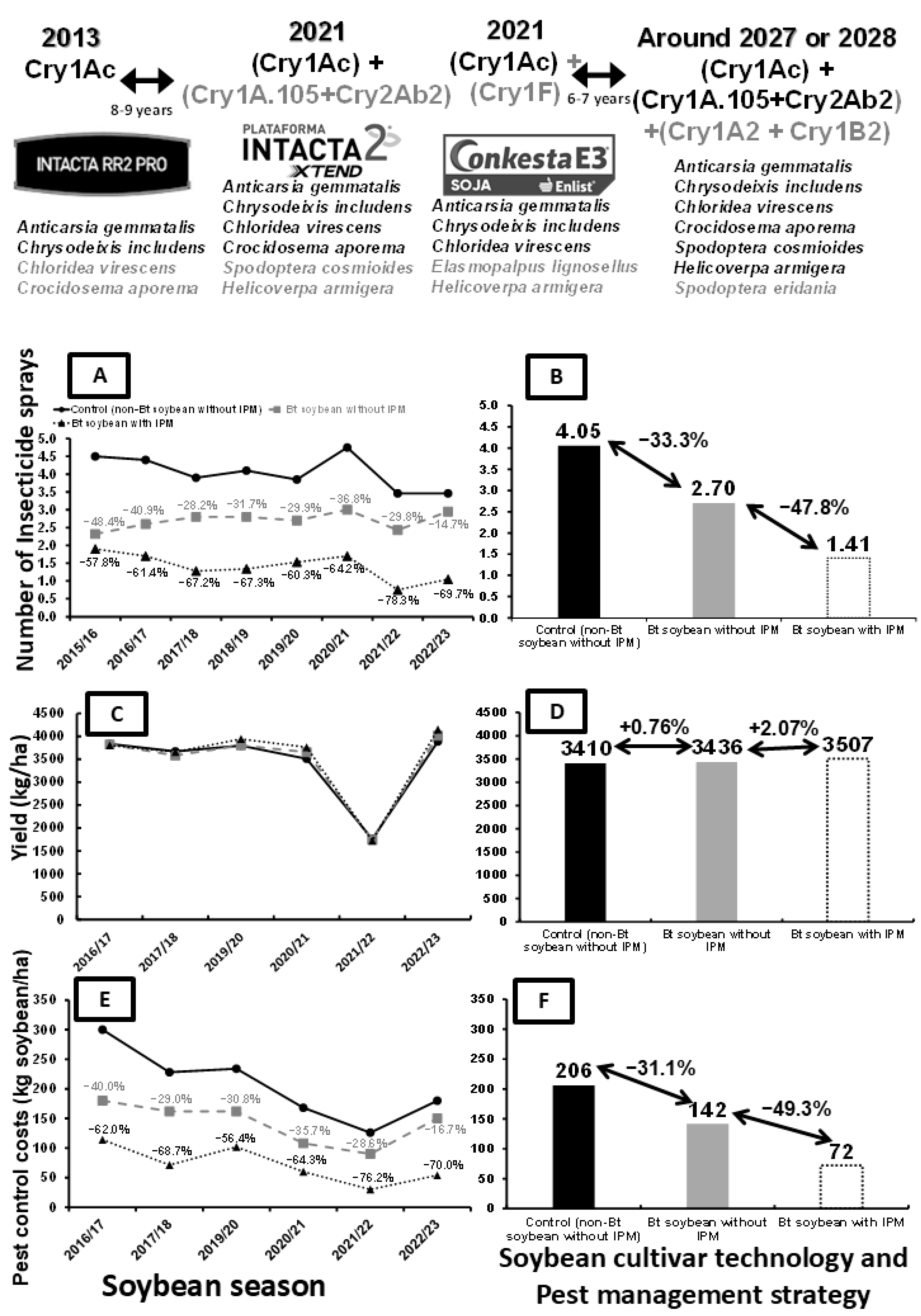
Since its first commercial release in 1995, crops genetically transformed with the addition of Cry proteins from Bacillus thuringiensis (Bt) have increasingly been part of the agricultural landscape and an important tool in IPM. GM plants have been widely adopted by at least 26 different countries spread worldwide [72]. As in other crops, Soybean-IPM has been transformed by the introduction of the Bt soybean technology expressing Cry1Ac (event MON 87701) protein (Bt) at high levels due to its high efficacy and simplicity of adoption [73]. Initially (2013), growers adopted the first generation of this technology (expressing only Cry1Ac) and later (2021) enjoyed the addition of the second generation (expressing Cry1Ac + Cry1A.105 + Cry2Ab2 for Intacta 2 Xtend and Cry1Ac + Cry1F for Conkesta) (Figure 4). The use of Bt soybean has been especially high in South America, particularly in Brazil and Argentina, the first- and third-largest world soybean producers, respectively (Table 3). By the fifth year of Bt soybean adoption in South America, Bt soybean was cultivated over an area of 73.6 million hectares, generating an increased income of USD 7.64 billion for farmers [74] and reducing pesticide use by approximately 10.44 million kg. This reduction in pesticide use and field operations contributed indirectly to lower greenhouse gas (GHG) emissions, primarily by decreasing energy demand associated with pesticide manufacturing, transport, and application. Estimates indicate that this mitigation effect is equivalent to removing approximately 3.3 million cars from the roads in terms of CO2-equivalent emissions [74,75].
Figure 4.
Results from the adoption of Bt soybean with and without the adoption of IPM in the State of Paraná, Brazil, during eight crop seasons from 2016/17 to 2022/23. (A) Insecticide spray per season and (B) mean spray of insecticides of different pest management technologies. (C) Yield over the seasons and (D) mean yield according to the adopted pest management technology. (E) Pest control costs over the seasons and (F) mean pest control cost according to the adopted pest management technology. Adapted from [73].
Table 3.
Adoption of Bt soybean cultivars in South American countries.
The reduction in insecticide applications in soybean fields has occurred both with and without the adoption of IPM when adopting Bt cultivars (Figure 4A). The adoption of just Bt soybean (at farms not adopting IPM) reduced insecticide applications from 48.4% (2015/16 crop season) to 14.7% (2022/23 crop season). When Bt soybean was adopted as a pest management strategy within the IPM framework, especially associated with pest sampling and insecticide application only when the pest population reaches or surpasses ET, insecticide use was reduced even further. Reductions from 57.8% (2015/16 crop season) to 78.3% (2021/22 crop season) were recorded (Figure 4A). On average of all seasons (Figure 4B), an insecticide reduction of 33.3% with adoption of Bt cultivars without IPM is noted compared with the control, with this reduction increasing to 65.2% with the adoption of Bt cultivars with IPM compared with the control. These results reinforce the importance of the adoption of Bt cultivars and IPM to further reduce the use of insecticides, highlighting the additive effect of Bt technology combined with pest monitoring and economic threshold-based decision-making adoption.
The reduction in insecticides associated with Bt crops has been reported in the literature in other crop systems. In the USA, insecticide applied in maize, Zea mays, fields decreased 75% with the adoption of Bt varieties, falling from 0.2 kg/ha in 1998 to about 0.05 kg/ha in 2011, when the adoption of Bt varieties exceeded 80% of the maize cultivated in the country [77]. This lower use of insecticide has benefited the conservation of natural biological control agents in different agroecosystems [72], including cotton, corn, potato, rice, and eggplant [78], as well as soybean [73]. Because Bt has negligible effects on non-target organisms [79], it is regarded as a safer choice than chemical insecticides [80] to manage target pests.
Despite the recorded benefits of Bt soybean over insecticides, some negative effects have been recorded due to the over adoption of the technology (higher than the 80% limit), lacking compliance for refuges (adoption of at least 20% the field with non-Bt cultivars) as Insect Resistance Management (IRM) [73]. Refuge areas (non-Bt cultivars) managed with IPM are essential to produce insects susceptible to Bt, preserving the efficacy of Bt cultivars. Consequently, the resurgence of target pests associated with the populations resistant to the Bt toxins has been reported [81,82], including for Rachiplusia nu [83] and Crocidosema sp. [84] in Brazilian soybean fields.
Outbreaks of secondary pests in soybean have also been associated with the adoption of Bt cultivars [85,86]. With the reduction in the insecticide load in the crop, Spodoptera spp., which have been known for tolerance to commercial Bt cultivars and were previously controlled by insecticides applied for other lepidopterans, have survived and been reported as attacking soybean leaves and plant reproductive structures, potentially reducing yield [85]. Despite these negative effects, which are also similarly reported for conventional insecticides [13], the potential conservation of the biocontrol diversity in the Bt soybean agroecosystem are valuable. Reductions in insecticide use due to the adoption of Bt cultivars have been reported in soybean, not only in Brazil [73] but also in Argentina [87] and Uruguay [88], which is certainly helpful to conserve natural biological control and, therefore, mitigate pest outbreaks in the fields [10].
Importantly, the reduction in conventional insecticide use due to the adoption of Bt soybean does not cause measurable yield reduction (Figure 4C). In fact, Bt soybean fields had a higher yield on average than non-Bt fields (Figure 4D), likely as a result of better lepidopteran control. In addition, fields planted with Bt cultivars had lower pest control costs (Figure 4E,F). Pest control costs (transformed to their equivalent in value of kg soybean/ha in each crop season) were between 16.7% (2022/23 crop season) and 40.0% (2015/16 crop season) lower for Bt fields without IPM than non-Bt fields without IPM. The adoption of Bt soybean in the IPM framework reduced pest control costs even more, from 56.4% (2019/20 crop season) to 76.2% (2021/22 crop season), compared with control fields (non-Bt without IPM) (Figure 4E). This is an average reduction in costs equal to 64 kg/ha (31.1%) (Bt soybean with IPM adoption) compared with the control (non-Bt without IPM fields) (Figure 4F). The combined impacts of the adoption of Bt cultivars on reducing production costs associated with higher yields (consequences of better pest control) are clearly resulting in significant increases in profits. A national survey carried out from 1998 to 2017 in Brazil, including both soybean Bt and herbicide resistance traits, found that farmers planting GM soybean had 26% higher profits than those using conventional cultivars [89].
5. Role of Biological Control in Soybean-IPM
The intensification of agriculture has been required to ensure food security for an increasing global population [90]. However, this intensification also provides more food to pests, favoring their outbreaks [91]. This sequence of events demands more and new crop protection options because the pressure to decrease insecticides has also increased [18]. These apparently conflicting demands (intensification of food production versus reduction in insecticide use) increase the importance of safer alternatives such as biological control [92,93,94]. Consequently, the augmentative biological control market has been growing globally, and it is expected to surpass USD 10 billion in 2027 [95].
Biopesticides are increasingly recognized for their effectiveness in controlling pests [96,97]. These biocontrol agents play an essential role in IPM [10] and can be applied either alone or in combination with synthetic selective pesticides [98]. This approach enhances control efficacy, reduces environmental risks, and the exposure of farmers and consumers to synthetic pesticides [95]. Moreover, biopesticides help manage not only pest populations but also their resistance, as biopesticides allow the rotation and diversification of control tactics with distinct modes of action, reducing selection pressure associated with repeated use of the same chemical groups [99], which is a major problem for soybean production [14,100].
In addition to augmentative biological control, conservation biological control is important for the success of Soybean-IPM, despite the potential of natural biological control to help maintain soybean pests below ETs being frequently underestimated [98]. For instance, common hemipteran predators found in soybean, such as those from the genus Geocoris and Nabis, have predation capacities of consuming 9 and 21 Lepidoptera eggs per day, respectively [101]. The soybean agroecosystem is rich not only in hemipteran predators but also in coleopterans [102] and a great number of other biocontrol agents, including parasitoids [103] and entomopathogens [104].
Larvae of Callida spp. consume around 65.6 velvetbean caterpillars, Anticarsia gemmatalis (Hübner) [105], while the egg parasitoid Telenomus podisi can parasitize about 100 eggs of the stink bugs Euschistus heros (Fabricius) [106] and Diceraeus melacanthus Dallas (Hemiptera: Pentatomidae) [107] during its lifespan. A recent study from China demonstrated that Trichogramma leucaniae reared on eggs of the Eri silkworm Samia ricini Willian Jones can parasitize, in a 24 h period, 27–48 eggs of the soybean pod borer Leguminivora glycinivorella (Matsumura), which is a critical pest for soybean farmers in the county [108].
The potential of conserving those biocontrol agents in the soybean agroecosystem was illustrated by [109], who recorded the mortality of Helicoverpa armigera (Hübner) (Lepidoptera: Noctuidae). When the pest was first reported in Brazil in the 2013/14 crop season, they suffered 70.2% of natural mortality [10]. In modern agriculture, biological control is crucial to the success of IPM, and IPM is essential for providing a more stable and favorable environment that enables biocontrol agents to express their full potential in pest control and succeed [110].
6. Opportunities for Increasing the Adoption of Soybean-IPM
As previously discussed in this review, despite successful examples of Soybean-IPM in major world producers and numerous benefits from its adoption, barriers remain in increasing its acceptance and further adoption. Key barriers include inadequate training and a lack of technical support for farmers; shortages of IPM specialists and extension agents; and a lack of simultaneously managing recommendations for multiple pest species, the most common situation faced by soybean farmers [13]. To increase Soybean-IPM adoption, strategies must address the whole soybean pest complex occurring in each region, and ideally offer simple, effective solutions that are common with insecticide sprays [111].
While earlier IPM models were restricted to ecological and economic aspects based on chemical control, newer IPM models include management, business, and sustainability, emphasizing the importance of research and outreach as well as various social factors that influence the market of IPM products [20]. Moreover, governmental banning of several harmful chemical insecticides and the advent of more selective options further increase the potential for integrating chemical and biological control [112]. Finally, the more recent agenda focused on reducing carbon emissions from agriculture has been intensified [113]. The significant greenhouse gas (GHG) emissions from agriculture, including non-carbon gases, require immediate action to meet emission reduction goals and address global climate change [114]. Federal actions, along with broader societal efforts, focus on mitigating non-CO2 emissions like methane and scaling up CO2 removal initiatives [115,116]. This new global arena has encouraged the adoption and renewed interest in Soybean-IPM principles, giving the technology its momentum.
Reduction in insecticide use due to Soybean-IPM adoption is directly linked with a proportional decrease in the diesel used to apply such chemicals, as well as a reduction in CO2 emissions related to the mitigation of this operation for pest control in the field. For instance, Soybean-IPM adoption in Brazil in the 2021/22 crop season reduced emissions by 6,025.82 kg CO2 equation for every 100 hectares of soybean [10]. Similar benefits have been reported for the overall adoption of GM soybean in Brazil, saving 79.2 million liters of diesel from 1998 to 2017. This amount of fuel is enough to power around 53,000 cars for one year [108].
Certification protocols of the Low Carbon Soybean Program (LCSP) initiative, led by EMBRAPA SOJA in Brazil, can also work as incentives to soybean farmers without depending on the federal government. This program aims to add value to soybean by certifying its sustainability, with the LCSP anticipating a reduction of approximately 30% in emissions per ton of soybean through methods like no-till farming and inoculants to reduce nitrogen fertilizer use [117,118]. Thus, Soybean-IPM certainly fits into the scope of this initiative.
Increased federal actions that favor the adoption of Soybean-IPM could include financial incentives to practitioners of the technology. For instance, in Brazil, federal government programs offer credit lines with subsidized interest rates and special conditions for other sustainable practices in agriculture, including the use of technologies that promote nutrient efficiency, such as the inoculation of soybean seeds with Bradyrhizobium and Azospirillum. These subsidized credit lines have made inoculation practices more financially attractive, increasing adoption to 85% of the soybean cultivated area in the 2022/2023 season, using around 8.4 billion liters or kilograms of inoculants [118]. Similar support for Soybean-IPM would certainly increase its adoption.
7. Final Considerations and Future Perspectives of Soybean-IPM
There is increased interest in cultivating soybeans in a productive and ecologically sound manner that yields healthy food while protecting environmental integrity for future generations. Not all technologies that increase productivity are free of negative impacts on long-term sustainability. For these reasons, there is a need to develop approaches that are stable, resilient, and sustainable as well as productive and profitable for farmers. Resistance to insecticides, herbicides, and other pesticides has led to higher application rates of chemical insecticides, greater crop losses, and increased production costs for soybean farmers. In addition, the increasing use of pesticides is closely linked to elevated health risks for farmers, farm workers, rural populations, and final consumers. Overusing pesticides brings negative effects on soil health, water quality, and wildlife habitats. The non-market costs of insecticide negative impacts are only estimable globally and impose a significant burden.
Various pest control strategies, such as biotechnology, biological control, and insecticides, have been recognized as important breakthroughs in food production. Nevertheless, they must be used within IPM to achieve long-term efficacy. In this context, biological control, the rational use of more selective insecticides, the adoption of ETs for control decisions, and the cultivation of Bt soybean have been key elements of the success of Soybean-IPM. The IPM concept integrates a wide array of alternative approaches, including biopesticides (macro- and microorganisms), botanical pesticides (essential oils, plant extracts), and genetic pest management methods, such as the sterile insect technique, genome-editing tools (e.g., CRISPR-Cas9, RNAi), and marker-assisted selection) as well as any other sustainable alternative focused on the multiple pest species scenario usually faced by farmers. Proposing a simple, efficient, straightforward combination of solutions will make this technology more acceptable to farmers.
Future trends of Soybean-IPM include (1) maximizing the efficacy of biocontrol agents; (2) the development and use of genetic tools, such as DNA and CRISPR-Cas9 technologies; (3) improvement in plant resistance, including the development of newer GMs and genetically edited cultivars; (4) nanoformulations and encapsulations for microbiological and botanical insecticides, including water–oil emulsion encapsulation for Bacillus thuringiensis to improve its stability, nanoformulations of Bacillus lipopeptides (Lps), and CRISPR-based technologies for managing pests. Mobile applications have become vital to the dissemination of IPM. Apps that use artificial intelligence to identify pest problems and recommend suitable interventions will help increase IPM efficacy and the adoption of Soybean-IPM.
8. Conclusions
Pests should not be exterminated; instead, they should be kept below EILs. In a more balanced agricultural system, no pest control method should achieve 100% pest mortality, as many farmers strive for. On the contrary, 100% control of a given pest is undesirable as it can lead to a decline in the natural biological control species due to the unavailability of prey or host to sustain their population, making the crop more susceptible to a reemergence of the pests and outbreaks of secondary pests. Thus, a critical and broader shift in farmers’ behavior is underway, and the most significant challenge is to achieve greater adoption of Soybean-IPM. GM soybean, such as Bt cultivars, has been an essential technology for the success of Soybean-IPM, combining better conservation of natural biological control with increased profits for farmers. Nevertheless, resistance must be managed effectively to avoid issues that could permanently impair the lifespan of Bt technology. In addition to biological control, Soybean-IPM is currently experiencing a positive phase. Nevertheless, greater efforts should be directed towards outreach, practitioner incentives, and technology research to avoid losing the favorable momentum for IPM implementation and success.
Author Contributions
Conceptualization, writing—original draft preparation and final review and editing A.d.F.B.; writing—review and editing, W.W.H., Y.C.C., I.V., W.P.S., L.-S.Z., and R.J.H. All authors have read and agreed to the published version of the manuscript.
Funding
The authors thank the National Council for Scientific and Technological Development (CNPq) (project number 304052/2021-3) for scholarships provided to the first author. No additional funding was used in this work.
Data Availability Statement
No new data was created in this review.
Conflicts of Interest
Author Renato J. Horikoshi is employed by the company Bayer Crop Science. The remaining authors declare that the research was conducted in the absence of any commercial or financial relationships that could be construed as a potential conflict of interest.
References
- Hamza, M.; Basit, A.W.; Shehzadi, I.; Tufail, U.; Hassan, A.; Hussain, T.; Siddique, M.U.; Hayat, H.M. Global impact of soybean production: A review. Asian J. Biochem. Genet. Mol. Biol. 2024, 16, 12–20. [Google Scholar] [CrossRef] [Scilit]
- Mondal, S.; Anokhe, A.; Duraimurugan, P. A brief overview of pest complex in soybean [Glycine max (L.) Merill] and their management. J. Oilseeds Res. 2023, 40, 105–116. [Google Scholar] [CrossRef] [Scilit]
- SoyStats. A Reference Guide to Important Soybean Facts & Figures. The American Soybean Association, 2025. Available online: https://soystats.com/2024-soystats/ (accessed on 1 November 2025).
- Jiang, Y.; Zhong, S.; Li, Q. The research progress and frontier studies on soybean production technology: Genetic breeding, pest and disease control, and precision agriculture applications. Adv. Resour. Res. 2025, 5, 1065–1082. [Google Scholar] [CrossRef]
- Gaur, N.; Mogalapu, S. Pests of Soybean. In Pests and Their Management; Omkar, Ed.; Springer: Singapore, 2018. [Google Scholar] [CrossRef] [Scilit]
- Abudulai, M.; Salifu, A.B.; Opare-Atakora, D.; Haruna, M.; Denwar, N.N.; Baba, I.I.Y. Yield loss at the different growth stages in soybean due to insect pests in Ghana. Arch. Phytopathol. Plant Prot. 2012, 45, 1796–1809. [Google Scholar] [CrossRef] [Scilit]
- Musser, F.R.; Bick, E.; Brown, S.A.; Crow, W.D.; Davis, J.A.; DiFonzo, C.; Floyd, C.; Graham, S.H.; Greene, J.K.; Hamby, K.A.; et al. 2023 Soybean Insect Losses in the United States. Midsouth Entomol. 2023, 17, 6–30. Available online: https://www.midsouthentomologist.org.msstate.edu/ (accessed on 1 November 2025).
- Saldanha, A.V.; Horikoshi, R.; Dourado, P.; Lopez-Ovejero, R.F.; Berger, G.U.; Martinelli, S.; Head, G.P.; Moraes, T.; Corrêa, A.S.; Schwertner, C.F. The first extensive analysis of species composition and abundance of stink bugs (Hemiptera: Pentatomidae) on soybean crops in Brazil. Pest Manag. Sci. 2024, 80, 3945–3956. [Google Scholar] [CrossRef] [Scilit]
- Ullah, F.; Guru-Pirasanna-Pandi, G.; Murtaza, G.; Sarangi, S.; Gul, H.; Li, X.; Chavarín-Gómez, L.E.; Ramírez-Romero, R.; Guedes, R.N.C.; Desneux, N.; et al. Evolving strategies in agroecosystem pest control: Transitioning from chemical to green management. J. Pest Sci. 2025, 98, 2307–2324. [Google Scholar] [CrossRef] [Scilit]
- Bueno, A.F.; Colmenarez, Y.C.; Carnevalli, R.A.; Sutil, W.P. Benefits and perspectives of adopting soybean-IPM: The success of a Brazilian programme. Plant Health Cases 2023, 1–16. [Google Scholar] [CrossRef] [Scilit]
- Zhou, W.; Li, M.; Achal, V. A comprehensive review on environmental and human health impacts of chemical pesticide usage. Emerg. Contam. 2025, 11, 100410. [Google Scholar] [CrossRef] [Scilit]
- Mali, H.; Shah, C.; Raghunandan, B.; Prajapati, A.S.; Patel, D.H.; Trivedi, U.; Subramanian, R. Organophosphate pesticides: An emerging environmental contaminant: Pollution, toxicity, bioremediation progress, and remaining challenges. J. Environ. Sci. 2023, 127, 234–250. [Google Scholar] [CrossRef] [Scilit]
- Bueno, A.F.; Panizzi, A.R.; Hunt, T.E.; Dourado, P.M.; Pitta, R.M.; Gonçalves, J. Challenges for adoption of integrated pest management (IPM): The soybean example. Neotrop. Entomol. 2021, 50, 5–20. [Google Scholar] [CrossRef] [Scilit]
- Sosa-Gómez, D.R.; Corrêa-Ferreira, B.S.; Kraemer, B.; Pasini, A.; Husch, P.E.; Vieira, C.E.D.; Martinez, C.B.R.; Lopes, I.O.N. Prevalence, damage, management and insecticide resistance of stink bug populations (Hemiptera: Pentatomidae) in commodity crops. Agric. For. Entomol. 2020, 22, 99–118. [Google Scholar] [CrossRef] [Scilit]
- Santos, C.F.; Otesbelgue, A.; Blochtein, B. The dilemma of agricultural pollination in Brazil: Beekeeping growth and insecticide use. PLoS ONE 2018, 13, e0200286. [Google Scholar] [CrossRef] [Scilit]
- Lisi, F.; Siscaro, G.; Biondi, A.; Zappalà, L.; Ricupero, M. Non-target effects of bioinsecticides on natural enemies of arthropod pests. Curr. Opin. Environ. Sci. Health 2025, 45, 100624. [Google Scholar] [CrossRef] [Scilit]
- Gong, Y.; Li, T.; Hussain, A.; Xia, X.; Shang, Q.; Ali, A. The side effects of insecticides on insects and the adaptation mechanisms of insects to insecticides. Front. Physiol. 2023, 14, 1287219. [Google Scholar] [CrossRef] [Scilit]
- Jacquet, F.; Jeuffroy, M.-H.; Jouan, J.; Le Cadre, E.; Litrico, I.; Malausa, T.; Reboud, X.; Huyghe, C. Pesticide-free agriculture as a new paradigm for research. Agron. Sustain. Dev. 2022, 42, 8. [Google Scholar] [CrossRef] [Scilit]
- Lee, R.; den Uyl, R.; Runhaar, H. Assessment of policy instruments for pesticide use reduction in Europe: Learning from a systematic literature review. Crop Prot. 2019, 126, 104929. [Google Scholar] [CrossRef] [Scilit]
- Dara, S.K.; Rodriguez-Saona, C.; Morrison III, W.R. Editorial: Integrated pest management strategies for sustainable food production. Front. Sustain. Food Syst. 2023, 7, 1224604. [Google Scholar] [CrossRef] [Scilit]
- Dara, S.K. The new integrated pest management paradigm for the modern age. J. Integr. Pest Manag. 2019, 10, 12. [Google Scholar] [CrossRef] [Scilit]
- Damalas, C.A. Safe food production with minimum and judicious use of pesticides. In Food Safety; Selamat, J., Iqbal, S., Eds.; Springer: Berlin/Heidelberg, Germany, 2016; pp. 43–55. [Google Scholar] [CrossRef] [Scilit]
- Santos, J.L.; Peluzio, J.M.; Picanço, M.C.; Sarmento, R.A. Integrated pest management of soybean emerging pests in Brazil and United States: A review. Concilium 2024, 24, 0010–5236. [Google Scholar] [CrossRef] [Scilit]
- Carnevalli, R.A.; Oliveira, A.B.; Gomes, E.C.; Possamai, E.J.; Silva, G.C.; Reis, E.A.; Roggia, S.; Prando, A.M.; Lima, D. Resultados Do Manejo Integrado de Pragas Da Soja NA Safra 2021/2022 No Paraná; Documentos 448; Embrapa Soja: Londrina, Brazil, 2022; pp. 1–43. [Google Scholar]
- Carnevalli, R.A.; Prando, A.M.; Lima, D.; Borges, R.S.; Possamai, E.J.; Silva, G.C.; Reis, E.A.; Gomes, E.C.; Silva, G.C.; Roggia, S. Resultados Do Manejo Integrado de Pragas Da Soja NA Safra 2022/2023 No Paraná; Documentos 455; Embrapa Soja: Londrina, Brazil, 2023; pp. 1–44. [Google Scholar]
- Carnevalli, R.A.; Prando, A.M.; Lima, D.; Borges, R.S.; Possamai, E.J.; Reis, E.A.; Gomes, E.C.; Roggia, S. Resultados Do Manejo Integrado de Pragas Da Soja NA Safra 2023/2024 No Paraná; Documentos 467; Embrapa Soja: Londrina, Brazil, 2024; pp. 1–51. [Google Scholar]
- Batistela, M.J.; Bueno, A.F.; Nishikawa, M.A.N.; Bueno, R.C.O.F.; Hidalgo, G.; Silva, L.; Corbo, E.; Silva, R.B. Re-evaluation of leaf-lamina consumer thresholds for IPM decision in short-season soybeans using artificial defoliation. Crop Prot. 2012, 32, 7–11. [Google Scholar] [CrossRef] [Scilit]
- Bueno, A.F.; Bortolotto, O.C.; Pomari-Fernandes, A.; França-Neto, J.B. Assessment of a more conservative stink bug economic threshold for managing stink bugs in Brazilian soybean production. Crop Prot. 2015, 71, 132–137. [Google Scholar] [CrossRef] [Scilit]
- Justus, C.M.; Paula-Moraes, S.V.; Pasini, A.; Hoback, W.W.; Hayashida, R.; Bueno, A.F. Simulated soybean pod and flower injuries and economic thresholds for Spodoptera eridania (Lepidoptera: Noctuidae) management decisions. Crop Prot. 2022, 155, 105936. [Google Scholar] [CrossRef] [Scilit]
- Hayashida, R.; Hoback, W.W.; Dourado, P.M.; Bueno, A.F. Re-evaluation of the economic threshold for Crocidosema aporema injury to indeterminate Bt soybean cultivars. Agron. J. 2023, 115, 1972–1980. [Google Scholar] [CrossRef] [Scilit]
- Conte, O.; Oliveira, F.T.; Harger, N.; Corrêa-Ferreira, B.S. Resultados Do Manejo Integrado de Pragas Da Soja NA Safra 2013/14 No Paraná; Documentos 356; EMBRAPA-CNPSo: Londrina, Brazil, 2014; pp. 1–53. [Google Scholar]
- Conte, O.; Oliveira, F.T.; Harger, N.; Corrêa-Ferreira, B.S.; Roggia, S. Resultados Do Manejo Integrado de Pragas Da Soja NA Safra 2014/15 No Paraná; Documentos 361; EMBRAPA-CNPSo: Londrina, Brazil, 2015; pp. 1–60. [Google Scholar]
- Conte, O.; Oliveira, F.T.; Harger, N.; Corrêa-Ferreira, B.S.; Roggia, S.; Prando, A.M.; Seratto, C.D. Resultados Do Manejo Integrado de Pragas Da Soja NA Safra 2015/16 No Paraná; Documentos 375; EMBRAPA-CNPSo: Londrina, Brazil, 2016; pp. 1–59. [Google Scholar]
- Conte, O.; Oliveira, F.T.; Harger, N.; Corrêa-Ferreira, B.S.; Roggia, S.; Prando, A.M.; Seratto, C.D. Resultados Do Manejo Integrado de Pragas Da Soja NA Safra 2016/17 No Paraná; Documentos 394; EMBRAPA-CNPSo: Londrina, Brazil, 2017; pp. 1–70. [Google Scholar]
- Oliveira, A.B.; Gomes, E.C.; Possamai, E.J.; Silva, G.C.; Reis, E.A.; Roggia, S.; Prando, A.M.; Conte, O. Resultados Do Manejo Integrado de Pragas Da Soja NA Safra 2020/2021 No Paraná; Documentos 443; Embrapa Soja: Londrina, Brazil, 2022; pp. 1–68. [Google Scholar]
- Norton, G.W.; Moore, K.; Quishpe, D.; Barrera, V.; Debass, T.; Moyo, S.; Taylor, D.B. Evaluating Socio-Economic Impacts of IPM. In Globalizing Integrated Pest Management: A Participatory Research Process; Norton, G.W., Heinrichs, E.A., Luther, G.C., Irwin, M.E., Eds.; John Wiley & Sons: Hoboken, NJ, USA, 2005; pp. 223–244. [Google Scholar] [CrossRef] [Scilit]
- Song, F.; Swinton, S.M. Returns to Integrated Pest Management Research and Outreach for Soybean Aphid. J. Econ. Entomol. 2009, 102, 2116–2125. [Google Scholar] [CrossRef] [Scilit]
- Ávila, C.J.; Vessoni, I.C.; Silva, I.F.; Vieira, E.C.S.; Mariani, A.; Moreira, S.C.S. IPM in soybeans: How to reduce crop damage and increase profit for the farmer. Ver. Agric. Neotrop. 2024, 11, e8214. [Google Scholar] [CrossRef] [Scilit]
- Vinayagam, S.S.; Dupare, B.U. Monetary benefits of integrated pest management in soybean [Glycine max (L.) Merrill] cultivation. Soybean Res. 2019, 17, 89–94. [Google Scholar]
- Mariyono, J. The impact of integrated pest management technology on insecticide use in soybean farming in Java, Indonesia: Two models of demand for insecticides. Asian J. Agric. Dev. 2008, 5, 43–55. [Google Scholar] [CrossRef] [Scilit]
- Panizzi, A.R. History and contemporary perspectives of the integrated pest management of soybean in Brazil. Neotrop. Entomol. 2013, 42, 119–127. [Google Scholar] [CrossRef] [Scilit]
- Bueno, A.F.; Paula-Moraes, S.V.; Gazzoni, D.L.; Pomari, A.F. Economic thresholds in soybean integrated pest management: Old concepts, current adoption, and adequacy. Neotrop. Entomol. 2013, 42, 439–447. [Google Scholar] [CrossRef] [Scilit]
- Conte, O.; Oliveira, F.T.; Harger, N.; Corrêa-Ferreira, B.S.; Roggia, S.; Prando, A.M.; Seratto, C.D. Resultados do Manejo Integrado de Pragas da Soja na safra 2017/18 no Paraná; Documentos 402; EMBRAPA-CNPSo: Londrina, Brazil, 2018; pp. 1–66. [Google Scholar]
- Conte, O.; Oliveira, F.T.; Harger, N.; Corrêa-Ferreira, B.S.; Roggia, S.; Prando, A.M.; Possmai, E.J.; Reis, E.A.; Marx, E.F. Resultados do Manejo Integrado de Pragas da Soja na safra 2018/19 no Paraná; Documentos 416; EMBRAPA-CNPSo: Londrina, Brazil, 2019; pp. 1–63. [Google Scholar]
- Conte, O.; Possamai, E.J.; Silva, G.C.; Reis, E.A.; Gomes, E.C.; Corrêa-Ferreira, B.S.; Roggia, S.; Prando, A.M. Resultados do Manejo Integrado de Pragas da Soja na safra 2019/20 no Paraná; Documentos 431; EMBRAPA-CNPSo: Londrina, Brazil, 2020; pp. 1–66. [Google Scholar]
- Rossi, V.; Sperandio, G.; Caffi, T.; Simonetto, A.; Gilioli, G. Critical success factors for the adoption of decision tools in IPM. Agronomy 2019, 9, 710. [Google Scholar] [CrossRef] [Scilit]
- Higley, L.G.; Peterson, R.K.D. The biological basis of the EIL. In Economic Threshold for Integrated Pest Management; Higley, L.G., Pedigo, L.P., Eds.; University of Nebraska Press: Lincoln and London, UK, 1996; 327p. [Google Scholar]
- Pedigo, L.P.; Rice, M.E. Entomology and Pest Management, 6th ed.; Prentice Hall: Upper Saddle River, NJ, USA, 2009; xxvii + 749p. [Google Scholar]
- Pedigo, L.P.; Rice, M.E.; Krell, R.K. Entomology and Pest Management; Waveland Press: Long Grove, IL, USA, 2021. [Google Scholar]
- Ragsdale, D.W.; Mccornack, B.P.; Venette, R.C.; Potter, B.D.; MacRae, I.V.; Hodgson, E.W.; O’neal, M.E.; Johnson, K.D.; O’neil, R.J.; Difonzo, C.D.; et al. Economic threshold for soybean aphid (Hemiptera: Aphididae). J. Econ. Entomol. 2007, 100, 1258–1267. [Google Scholar] [CrossRef]
- Vieira, S.S.; Lourenção, A.L.; da Graça, J.P.; Janegitz, T.; Salvador, M.C.; Oliveira, M.C.N.; Hoffmann-Campo, C.B. Biological aspects of Bemisia tabaci biotype B and the chemical causes of resistance in soybean genotypes. Arthropod-Plant Interac. 2016, 10, 525–534. [Google Scholar] [CrossRef] [Scilit]
- Padilha, G.; Pozebon, H.; Patias, L.S.; Ferreira, D.R.; Castilhos, L.B.; Forgiarini, S.E.; Donatti, A.; Bevilaqua, J.G.; Marques, R.P.; Moro, D.; et al. Damage assessment of Bemisia tabaci and economic injury level on soybean. Crop Prot. 2021, 143, 105542. [Google Scholar] [CrossRef] [Scilit]
- Andrews, G.; Daves, C.; Koger, T.; Reed, J.; Burdine, B.; Dodds, D.; Larson, E.; Robbins, J.; Catchot, A.; Gore, J.; et al. Insect Control Guides for Cotton, Soybeans, Corn, Grain Sorghum, Wheat, Sweet Potatoes & Pastures; Mississippi State University Extension Service: Starkville, MS, USA, 2009; 64p. [Google Scholar]
- Seiter, N.J.; Decker, A.L.; Kelley, J.; Tilmon, K.J.; McCornack, B.; Krupke, C.; DiFonzo, C.; Knodel, J. Soybean defoliation estimation methods and thresholds in the North Central United States. J. Econ. Entomol. 2025, toaf288. [Google Scholar] [CrossRef] [Scilit]
- Adams, B.P.; Cook, D.R.; Catchot, A.L.; Gore, J.; Musser, F.; Stewart, S.D.; Kerns, D.L.; Lorenz, G.M.; Irby, J.T.; Golden, B. Evaluation of corn earworm, Helicoverpa zea (Lepidoptera: Noctuidae), economic injury levels in Mid-South reproductive stage soybean. J. Econ. Entomol. 2016, 109, 1161–1166. [Google Scholar] [CrossRef] [Scilit]
- Bueno, R.C.O.F.; Bueno, A.F.; Moscardi, F.; Parra, J.R.P.; Hoffmann-Campo, C.B. Lepidopteran larvae consumption of soybean foliage: Basis for developing multiple-species economic thresholds for pest management decisions. Pest Manag. Sci. 2011, 67, 170–174. [Google Scholar] [CrossRef] [Scilit]
- Kalmosh, F.S. Economic threshold and economic injury levels for the two spotted spider mite Tetranychus cucurbitacearum (Sayed) on soybean. Ann. Agric. Sci. Moshtohor 2016, 54, 961–968. [Google Scholar] [CrossRef] [Scilit]
- Hall, D.C. The regional economic threshold for integrated pest management. Nat. Resour. Model. 1988, 2, 631–652. [Google Scholar] [CrossRef] [Scilit]
- Vieira, S.S.; Bueno, R.C.O.F.; Bueno, A.F.; Boff, M.I.C.; Gobbi, A.L. Different timing of whitefly control and soybean yield. Ciência Rural. 2013, 43, 247–253. [Google Scholar] [CrossRef] [Scilit]
- Naranjo, S.E.; Ellsworth, P.C.; Chu, C.C.; Henneberry, T.J.; Riley, D.G.; Watson, T.F.; Nichols, R.L. Action Thresholds for the Management of Bemisia tabaci (Homoptera: Aleyrodidae) in Cotton. J. Econo. Entomol. 1998, 91, 1415–1426. [Google Scholar] [CrossRef] [Scilit]
- Onstad, D.W.; Bueno, A.F.; Favetti, B.M. Economic Thresholds and sampling in Integrated Pest Management. In The Economics of Integrated Pest Management of Insects, 1st ed.; CABI: Wallingford, Oxfordshire, UK, 2019; Volume 1, pp. 122–139. [Google Scholar] [CrossRef] [Scilit]
- Krisnawati, A.; Adie, M.M. The leaflet shape variation from several soybean genotypes in Indonesia. Biodiversitas 2017, 18, 359–364. [Google Scholar] [CrossRef] [Scilit]
- Padilha, G.; Fiorin, R.A.; Filho, A.C.; Pozebon, H.; Rogers, J.; Marques, R.P.; Castilhos, L.B.; Donatti, A.; Stefanelo, L.; Burtet, L.M.; et al. Damage assessment and economic injury level of the two-spotted spider mite Tetranychus urticae in soybean. Pesqui. Agropecu. 2020, 55, e01836. [Google Scholar] [CrossRef] [Scilit]
- Neves, D.V.C.; Lopes, M.C.; Sarmento, R.A.; Pereira, P.S.; Pires, W.S.; Peluzio, J.M.; Picanço, M.C. Economic injury levels for control decision-making of thrips in soybean crops (Glycine max (L.) Merrill). Res. Soc. Dev. 2022, 11, e52411932114. [Google Scholar] [CrossRef] [Scilit]
- Leach, A.; Gomez, A.A.; Kaplan, I. Threshold-based management reduces insecticide use by 44% without compromising pest control or crop yield. Commun. Earth Environ. 2025, 6, 710. [Google Scholar] [CrossRef] [Scilit]
- Duncan, H.; Popp, I. Migrants and Cities: Stepping Beyond World Migration Report 2015. In World Migration Report 2018; IOM: Geneva, Switzerland, 2018; Available online: https://publications.iom.int/system/files/pdf/wmr_2018_en_chapter10.pdf (accessed on 11 November 2025).
- Hoidal, N.; Koch, R.L. Perception and use of Economic Thresholds among farmers and agricultural professionals: A case study on soybean aphid in Minnesota. J. Integr. Pest Manag. 2021, 12, 9. [Google Scholar] [CrossRef] [Scilit]
- Mariyono, J. The impact of IPM training on farmers’ subjective estimates of economic thresholds for soybean pests in central Java, Indonesia. Int. J. Pest Manag. 2007, 53, 83–87. [Google Scholar] [CrossRef] [Scilit]
- Kumari, P.; Jasrotia, P.; Kumar, D.; Kashyap, P.L.; Kumar, S.; Mishra, C.N.; Kumar, S.; Singh, G.P. Biotechnological approaches for host plant resistance to insect pests. Front. Genet. 2022, 13, 914029. [Google Scholar] [CrossRef] [Scilit]
- Warghat, A.N.; Kumar, A.; Raghuvanshi, H.R.; Aman, A.S.; Kumar, A. Recent advancements in plant protection. In Recent Advances in Plant Protection; Kumar, N., Purushotham, P., Kumar, A., Sahu, A., Nandeesha, S.V., Eds.; Golden Leaf Publishers: Lucknow, Uttar Pradesh, India, 2023; pp. 1–25. [Google Scholar]
- Baldin, E.L.L.; Vendramim, J.D.; Lourenção, A.L. Introdução a resistência de plantas a insetos: Fundamentos e aplicações. In Resistência de Plantas a Insetos: Fundamentos e Aplicações; FEALQ: Piracicaba, Brazil, 2019; pp. 1–493. [Google Scholar]
- Martins-Salles, S.; Machado, V.; Massochin-Pinto, L.; Fiuza, L.M. Genetically modified soybean expressing insecticidal protein (Cry1Ac): Management risk and perspectives. Facets 2017, 2, 496–512. [Google Scholar] [CrossRef] [Scilit]
- Naranjo, S.E. Effects of GE Crops on Non-target Organisms. In Plant Biotechnology; Ricroch, A., Chopra, S., Kuntz, M., Eds.; Springer: Berlin/Heidelberg, Germany, 2021; pp. 127–144. [Google Scholar] [CrossRef] [Scilit]
- Bueno, A.F.; Braz-Zini, E.C.; Horikoshi, R.J.; Bernardi, O.; Andrade, G.; Sutil, W.P. Over 10 years of Bt soybean in Brazil: Lessons, benefits, and challenges for its use in Integrated Pest Management (IPM). Neotrop. Entomol. 2025, 54, 1–12. [Google Scholar] [CrossRef] [Scilit] [PubMed]
- Brookes, G.; Barfoot, P. Environmental impacts of genetically modified (GM) crop use 1996–2016: Impacts on pesticide use and carbon emissions. GM Crops Food 2018, 9, 109–139. [Google Scholar] [CrossRef] [Scilit]
- Alves, L.R.A.; Filho, J.B.D.S.F.; da Silveira, J.M.F.J.; da Costa, M.S.; Osaki, M.; de Lima, F.F.; Ribeiro, R.G. Genetically modified corn adoption in Brazil, costs and production strategy: Results from a four-year field survey. Rev. De Econ. E Agronegócio 2020, 18, 1–23. [Google Scholar] [CrossRef] [Scilit]
- ISAAA (International Service for the Acquisition of Agri-biotech Applications) (2018) Global Status of Commercialized Biotech/GM Crops: 2018. ISAAA Brief 54. Available online: https://www.isaaa.org/resources/publications/briefs/54/ (accessed on 24 October 2024).
- Perry, E.D.; Ciliberto, F.; Hennessy, D.A.; Moschini, G. Genetically engineered crops and pesticide use in U.S. Maize soybeans. Sci. Adv. 2016, 2, e1600850. [Google Scholar] [CrossRef] [Scilit]
- Romeis, J.; Naranjo, S.E.; Meissle, M.; Shelton, A.M. Genetically engineered crops help support conservation biological control. Biol. Control. 2019, 130, 136–154. [Google Scholar] [CrossRef] [Scilit]
- Marques, L.H.; Santos, A.C.; A Castro, B.; Storer, N.P.; Babcock, J.M.; Lepping, M.D.; Sa, V.; Moscardini, V.F.; Rule, D.M.; A Fernandes, O. Impact of transgenic soybean expressing Cry1Ac and Cry1F proteins on the non-target arthropod community associated with soybean in Brazil. PLoS ONE 2018, 13, e0191567. [Google Scholar] [CrossRef] [Scilit] [PubMed]
- Rousset, R.; Gallet, A. Unintended effects of Bacillus thuringiensis spores and Cry toxins used as microbial insecticides on non-target organisms. Curr. Opin. Environ. Sci. Health 2025, 43, 100598. [Google Scholar] [CrossRef] [Scilit]
- Reisig, D.D.; Huseth, A.S.; Bacheler, J.S.; Aghaee, M.-A.; Braswell, L.; Burrack, H.J.; Flanders, K.; Greene, J.K.; Herbert, D.A.; Jacobson, A.; et al. Long-term empirical and observational evidence of practical Helicoverpa zea resistance to cotton with pyramided Bt toxins. J. Econ. Entomol. 2018, 111, 1824–1833. [Google Scholar] [CrossRef] [Scilit]
- Tabashnik, B.E.; Carrière, Y. Global patterns of resistance to Bt crops highlighting pink bollworm in the United States, China, and India. J. Econ. Entomol. 2019, 112, 2513–2523. [Google Scholar] [CrossRef] [Scilit]
- Horikoshi, R.J.; Bernardi, O.; Godoy, D.N.; Semeão, A.A.; Willse, A.; Corazza, G.O.; Ruthes, E.; Fernandes, D.d.S.; Sosa-Gómez, D.R.; Bueno, A.d.F.; et al. Resistance status of lepidopteran soybean pests following large-scale use of MON 87701 × MON 89788 soybean in Brazil. Sci. Rep. 2021, 11, 21323. [Google Scholar] [CrossRef] [Scilit]
- Steinhaus, E.A.; Reis, A.C.; Palharini, R.B.; Godoy, D.N.; Dallanora, A.; Diniz, L.H.M.; Warpechowski, L.F.; Horikoshi, R.J.; Ovejero, R.F.L.; Berger, G.U.; et al. Characterization of resistance to Bacillus thuringiensis toxin Cry1Ac in Crocidosema sp. (Lepidoptera: Tortricidae) from Brazil. Pest Manag. Sci. 2025, 81, 3066–3073. [Google Scholar] [CrossRef] [Scilit]
- Jerez, P.G.P.; Hill, J.G.; Pereira, E.J.; Alzogaray, R.A.; Vera, M.T. Ten years of Cry1Ac Bt soybean use in Argentina: Historical shifts in the community of target and non-target pest insects. Crop Prot. 2023, 170, 106265. [Google Scholar] [CrossRef] [Scilit]
- Murúa, M.G.; Vera, M.A.; Herrero, M.I.; Fogliata, S.V.; Michel, A. Defoliation of soybean expressing Cry1Ac by lepidopteran pests. Insects 2018, 9, 93. [Google Scholar] [CrossRef] [Scilit] [PubMed]
- Giraudo, W.G.; Figueruelo, A.M.; Trumper, E.V. Effects of Bt soybean on biodiversity are limited to target species and host-specific parasitoids in La Pampa province, Argentina. Rev. Investig. Agropec. 2024, 50, 112–129. [Google Scholar]
- Lorente, J.; Vassallo, M.; García Suárez, F. Economic and environmental impacts of stacked transgenic events on soybean and corn. Agrociencia Urug. 2025, 29, e1323. [Google Scholar] [CrossRef] [Scilit]
- CIB (Conselho de Informações Sobre Biotecnologia). 20 Anos de Transgênicos: Impactos Ambientais, Econômicos e Sociais No Brasil; CIB (Conselho de Informações Sobre Biotecnologia): São Paulo, Brazil, 2018; 20p, Available online: https://agroavances.com/img/publicacion_documentos/153575459920-anos-de-transgenicos-no-brasil.pdf (accessed on 15 November 2025).
- Bernal, J.S.; Medina, R.F. Agriculture sows pests: How crop domestication, host shifts, and agricultural intensification can create insect pests from herbivores. Curr. Opin. Insect Sci. 2018, 26, 76–81. [Google Scholar] [CrossRef] [Scilit]
- Denning, G. Sustainable intensification of agriculture: The foundation for universal food security. npj Sustain. Agric. 2025, 3, 7. [Google Scholar] [CrossRef] [Scilit]
- Pretty, J. Intensification for redesigned and sustainable agricultural systems. Science 2018, 362, eaav0294. [Google Scholar] [CrossRef] [Scilit] [PubMed]
- Guo, B.; Sun, L.; Jiang, S.; Ren, H.; Sun, R.; Wei, Z.; Hong, H.; Luan, X.; Wang, J.; Wang, X.; et al. Soybean genetic resources contributing to sustainable protein production. Theor. Appl. Genet. 2022, 135, 4095–4121. [Google Scholar] [CrossRef] [Scilit]
- Dukariya, G.; Shah, S.; Singh, G.; Kumar, A. Soybean and Its Products: Nutritional and Health Benefits. J. Nut. Sci. Heal. Diet. 2020, 1, 22–29. Available online: https://journalofnutrition.org (accessed on 15 November 2025).
- Andreata, M.F.d.L.; Mian, S.; Andrade, G.; Bueno, A.d.F.; Ventura, M.U.; de Almeida, J.E.M.; Ivan, E.A.F.; Mosela, M.; Simionato, A.S.; Robaina, R.R.; et al. The current increase and future perspectives of the microbial pesticides market in agriculture: The Brazilian example. Front. Microbiol. 2025, 16, 1574269. [Google Scholar] [CrossRef] [Scilit]
- Fenibo, E.O.; Ijoma, G.N.; Matambo, T. Biopesticides in Sustainable Agriculture: A Critical Sustainable Development Driver Governed by Green Chemistry Principles. Front. Sustain. Food Syst. 2021, 5, 619058. [Google Scholar] [CrossRef] [Scilit]
- Marrone, P.G. Status of the biopesticide market and prospects for new bioherbicides. Pest Manag. Sci. 2024, 80, 81–86. [Google Scholar] [CrossRef] [Scilit]
- Bueno, A.d.F.; Sutil, W.P.; Jahnke, S.M.; Carvalho, G.A.; Cingolani, M.F.; Colmenarez, Y.C.; Corniani, N. Biological control as part of the soybean integrated pest management (IPM): Potential and challenges. Agronomy 2023, 13, 2532. [Google Scholar] [CrossRef] [Scilit]
- Sarangi, S.; Bhavana, P.; Padhan, E.K. Insecticide resistance and management strategies. In Advances in Applied Entomology; Dash, S.S., Pradhan, P.P., Sahoo, S., Nag, Y.K., Sorahia, D., Eds.; Golden Leaf Publishers: Lucknow, Uttar Pradesh, India, 2025; pp. 184–208. [Google Scholar] [CrossRef] [Scilit]
- Perini, C.R.; Tabuloc, C.A.; Chiu, J.C.; Zalom, F.G.; Stacke, R.F.; Bernardi, O.; Nelson, D.R.; Guedes, J.C. Transcriptome analysis of pyrethroid-resistant Chrysodeixis includens (Lepidoptera: Noctuidae) reveals overexpression of metabolic detoxification genes. J. Econ. Entomol. 2021, 114, 274–283. [Google Scholar] [CrossRef] [Scilit] [PubMed]
- Corrêa-Ferreira, B.S.; Moscardi, F. Seasonal occurrence and host spectrum of egg parasitoids associated with soybean stink bugs. Biol. Control 1995, 5, 196–202. [Google Scholar] [CrossRef] [Scilit]
- Prescott, K.K.; Andow, D.A. Lady beetle (Coleoptera: Coccinellidae) communities in soybean and maize. Environ. Entomol. 2016, 45, 74–82. [Google Scholar] [CrossRef] [Scilit] [PubMed]
- Noma, T.; Brewer, M.J. Seasonal abundance of resident parasitoids and predatory flies and corresponding soybean aphid densities, with comments on classical biological control of soybean aphid in the Midwest. J. Econ. Entomol. 2008, 101, 278–287. [Google Scholar] [CrossRef]
- Sosa-Gómez, D.R.; Delpin, K.E.; Moscardi, F.; Farias, J.R. Natural occurrence of the entomopathogenic fungi Metarhizium, Beauveria and Paecilomyces in soybean under till and no-till cultivation systems. Neotrop. Entomol. 2001, 30, 407–410. [Google Scholar] [CrossRef] [Scilit]
- Corrêa-Ferreira, B.S.; Pollato, S.L.B. Biology and consumption of predator Callida sp. (Coleoptera: Carabidae) reared on Anticarsia gemmatalis Hübner, 1818. Pesqui. Agropec. Bras. 1989, 24, 923–927. [Google Scholar] [CrossRef]
- Silva, G.V.; Bueno, A.F.; Neves, P.M.O.J.; Favetti, B.M. Biological characteristics and parasitism capacity of Telenomus podisi (Hymenoptera: Platygastridae) on eggs of Euschistus heros (Hemiptera: Pentatomidae). J. Agricult. Sci. 2018, 10, 210–220. [Google Scholar] [CrossRef] [Scilit]
- Taguti, E.A.; Goncalvez, J.; Bueno, A.F.; Marchioro, S.T. Telenomus podisi parasitism on Dichelops melacanthus and Podisus nigrispinus eggs at different temperatures. Fla. Entomol. 2019, 102, 607–613. [Google Scholar] [CrossRef] [Scilit]
- Xue, J.-Z.; Tariq, T.; Shen, Z.; Zhang, Y.-H.; Tang, L.-D.; Luo, R.-B.; Sun, Y.; Hu, C.-C.; Zang, L.-S. Eri silkworm eggs as a superior factitious host for mass rearing Trichogramma leucaniae, the key natural enemy of soybean pod borer. Biol. Control 2025, 209, 105860. [Google Scholar] [CrossRef] [Scilit]
- Corrêa-Ferreira, B.S.; Hoffmann-Campo, C.B.; Sosa-Gómez, D.R. Inimigos Naturais de Helicoverpa Armigera em Soja; Comunicado Técnico Embrapa Soja 80. Londrina; Embrapa Soja: Londrina, Brazil, 2014; 12p, Available online: https://www.embrapa.br/busca-de-publicacoes/-/publicacao/992733/inimigos-naturais-de-helicoverpa-armigera-em-soja (accessed on 15 November 2025).
- van Lenteren, J.C.; Bolckmans, K.; Köhl, J.; Ravensberg, W.J.; Urbaneja, A. Biological control using invertebrates and microorganisms: Plenty of new opportunities. BioControl 2018, 63, 39–59. [Google Scholar] [CrossRef] [Scilit]
- Horne, P.A.; Page, J.; Nicholson, C. When will integrated pest management strategies be adopted? Example of the development and implementation of integrated pest management strategies in cropping systems in Victoria. Aust. J. Experimen. Agric. 2008, 48, 1601–1607. [Google Scholar] [CrossRef] [Scilit]
- Gontijo, L.M.; Torres, J.B.; Abram, P.K.; Alfaro-Tapia, A.; Arredondo-Bernal, H.C.; Biondi, A.; Cloyd, R.A.; Costamagna, A.C.; Desneux, N.; D’oTtavio, M.; et al. Insect biological control: A global perspective. Entomol. Gen. 2025, 45, 879–904. [Google Scholar] [CrossRef] [Scilit]
- Kuzmanović, D. Sustainable development in agriculture with a focus on decarbonization. West. Balk. J. Agric. Econ. Rural. Dev. 2023, 5, 163–177. [Google Scholar] [CrossRef] [Scilit]
- Khatri Chhetri, A.; Junior, C.; Wollenberg, E. Greenhouse gas mitigation co-benefits across the global agricultural development programs. Glob. Environ. Change 2022, 76, 102586. [Google Scholar] [CrossRef] [Scilit]
- USDE. Industrial Decarbonization Roadmap; Document no. DOE/EE-2635; United States Department of Energy: Washington, DC, USA, 2022. Available online: https://www.energy.gov/sites/default/files/2022-09/Industrial%20Decarbonization%20Roadmap%20Fact%20Sheet (accessed on 15 November 2025).
- EMBRAPA. Brazil Defines Guidelines for Certifying Low-Carbon Soybean. 2024. Available online: https://www.brazilianfarmers.com/news/brazil-defines-guidelines-for-certifying-low-carbon-soybean/ (accessed on 15 November 2025).
- ANPIIBIO (Associação Nacional de Promoção e Inovação da Indústria de Biológicos). Estatística. 2024. Available online: https://anpiibio.org.br/estatisticas/ (accessed on 15 November 2025).

Disclaimer/Publisher’s Note: The statements, opinions and data contained in all publications are solely those of the individual author(s) and contributor(s) and not of MDPI and/or the editor(s). MDPI and/or the editor(s) disclaim responsibility for any injury to people or property resulting from any ideas, methods, instructions or products referred to in the content. |
© 2026 by the authors. Licensee MDPI, Basel, Switzerland. This article is an open access article distributed under the terms and conditions of the Creative Commons Attribution (CC BY) license.