


Abstract
Global climate change has intensified land desertification in the arid and semi-arid regions of northwestern China, highlighting the urgent need to cultivate plant species with ideal architecture and well-developed root systems to combat ecosystem degradation. Amorpha fruticosa is widely used as a windbreak and sand-fixation shrub; however, its rapid growth and high transpiration during the early planting stage often result in excessive water loss, low survival rates, and limited vegetation restoration effectiveness. Plant growth retardants (PGRts) are known to suppress apical dominance and promote branching. In this study, one-year-old A. fruticosa seedlings were treated with different combinations of paclobutrazol (PP333) and uniconazole (S3307) to investigate their effects on plant morphology and biomass allocation; it aims to determine the optimal formula for cultivating shrub structures with excellent windbreak and sand-fixation effects in land desertification areas. The results showed that both PP333 and S3307 significantly inhibited plant height while promoting basal stem diameter, branching, and root development. Among all treatments, the S3307 200 mg·L−1 + PP333 200 mg·L−1 combination (SD3) was the most effective, resulting in the greatest increases in basal diameter, branch number, total root length, and root-to-shoot ratio, while significantly reducing height increment, leaf length and leaf area (p < 0.05). Under the S3307 200 mg·L−1 + PP333 300 mg·L−1 treatment (SD4), leaf width and specific leaf area were reduced by 17.92% and 38.89%, respectively, compared with the control. Correlation analysis revealed significant positive or negative relationships among most growth traits, with leaf length negatively correlated with other morphological indicators. Fresh and dry weights of both aboveground and root tissues were significantly positively correlated with basal diameter (R = 0.38) and branch basal diameter (R = 0.33). Principal component analysis demonstrated that the SD3 treatment achieved the highest comprehensive score (2.91), indicating its superiority in promoting a compact yet robust plant architecture. Overall, the SD3 treatment improved drought resistance and sand-fixation capacity of A. fruticosa by “dwarfing and strengthening plants while optimizing root–shoot allocation.” These findings provide theoretical support for large-scale cultivation and vegetation restoration in arid and semi-arid regions and offer a technical reference for growth regulation and windbreak and sand-fixation capacity in other xerophytic shrub species.
1. Introduction
Land desertification poses one of the most severe global environmental challenges, jeopardizing ecological security and sustainable development [1,2,3]. Under the accelerating trend of global warming, the frequency and intensity of extreme climate events such as droughts, heatwaves, and wildfires have increased, resulting in the rapid expansion and exacerbation of land degradation in arid and semi-arid regions [4,5]. It is estimated that nearly 75% of the Earth’s terrestrial ecosystems are currently experiencing varying levels of degradation, impacting over two billion people and threatening food security, biodiversity, and ecosystem stability at a global scale [6,7]. China is one of the countries most seriously affected by desertification, particularly in its northwestern regions such as the Mu Us Desert, Horqin Sandy Land, and Ulan Buh Desert, where desertified land accounts for approximately 27% of the national territory [8,9]. These regions are characterized by harsh climatic conditions and fragile ecosystems, lending to significant vegetation loss, soil degradation, and declining productivity, which underline the urgent need for effective ecological restoration strategies [9,10,11,12,13].
Among the various measures for desertification control, phytodesertification control occupies an important position due to its unique advantages, yet it also faces practical challenges. Vegetation plays a critical role in combating desertification by reducing wind speed, stabilizing dunes, trapping mobile sand particles, and improving soil conditions [14,15]. The aboveground plant structure (including leaves, branches, stems, and canopy) and the belowground root system jointly determine the effectiveness of windbreak and sand-fixation functions [16,17]. Studies have demonstrated that factors such as vegetation height, coverage, configuration, branch flexibility, and spatial distribution significantly influence wind speed and airflow, thereby affecting the windbreak function of plants [18,19]. Among these, plants with higher branching rates, larger branching angles [20], and dwarf tree [21] exhibit better windbreak and sand-fixation performance. Although vegetation restoration in desertified areas provides significant ecological, economic, and societal benefits, contributing to long-term environmental sustainability [22]. However, the success of such restoration efforts largely hinges on the cultivation and domestication of plant species possessing appropriate structural characteristics and root system morphologies, as environmental conditions such as drought, high temperatures, strong winds, and low soil fertility frequently often limit plant establishment and survival in these regions [9,23]. Therefore, optimizing plant architecture through targeted regulation represents a critical approach to improving the adaptability and ecological performance of vegetation in desertification control programs.
To address the bottlenecks in phytodesertification control, the characteristics and applications of plant growth retardants offer a novel approach for us. Plant growth retardants (PGRts) are a class of plant growth regulators that inhibit endogenous gibberellin biosynthesis, thereby suppressing apical dominance, reducing stem elongation, and promoting lateral branching [24,25]. The application of PGRts has been widely documented in agricultural crops, fruit trees, and ornamental horticulture [25,26,27,28], where they have been shown to reduce plant height, enhance stem diameter, increase chlorophyll content, and improve stress tolerance [29,30,31,32,33]. Among the commonly used growth retardants, paclobutrazol (PP333) primarily inhibits gibberellin synthesis, lending to reduced internode elongation and suppressed shoot growth [34]. In contrast, uniconazole (S3307) inhibits abscisic acid catabolism, enhances photosynthetic capacity, and improves antioxidant activity [35,36,37]. Previous studies have demonstrated that PP333 effectively reduces plant height in rice and pomegranate [25,38], while S3307 promotes root development in wheat and increases stem diameter in japonica rice [39,40]. However, despite these promising effects, the application of these growth retardants in forestry species, particularly in xerophytic shrubs utilized for larges-cale vegetation restoration in arid and semi-arid regions, remains underexplored.
A. fruticosa is a perennial, multi-stemmed shrub of the family Leguminosae that is widely used in northwestern China for windbreak, sand fixation, and ecological restoration [41]. This species is characterized by its extensive lateral root system, strong regenerative capacity, and high adaptability to poor soils, enabling it to effectively reduce wind erosion and stabilize sandy surfaces [42]. However, during the initial establishment stage, A. fruticosa exhibits rapid vegetative growth and high transpiration rates, which can lead to excessive water consumption and reduce survival under arid conditions [43]. These physiological characteristics, combined with severe environmental stressors, frequently result in low establishment rates and hinder its large-scale application in desertification control. As such, regulating the architectural traits of A. fruticosa to improve its root-to-shoot allocation and stress resistance is crucial for improving its ecological effectiveness in arid regions.
In this study, A. fruticosa seedlings were treated with different combinations of paclobutrazol (PP333) and uniconazole (S3307) to evaluate their effects on plant morphology, root development, and biomass allocation. A principal component analysis (PCA) method was employed to assess the comprehensive effects of these treatments. The objectives of this study were to: (i) elucidate the regulatory effects of different PP333 and S3307 formulations on phenotypic traits and biomass allocation in A. fruticosa seedlings; (ii) clarify the correlations among key growth traits through correlation analysis; and (iii) identify the optimal growth retardant combination for achieving dwarfing with enhanced robustness and improved biomass allocation efficiency using principal component analysis. The findings of this study are expected to provide a theoretical basis for the rational application of plant growth retardants in xerophytic shrubs and it provides technical support and theoretical reference for the plant type regulation, largescale cultivation, and vegetation restoration of desert plants represented by A. fruticosa.
2. Results
2.1. Effects of Plant Growth Retardants on Seedling Height and Basal Stem Diameter
It was found through studying the effects of PP333 and S3307 on the growth dynamics of plant height and basal diameter of A. fruticosa seedlings (Table 1) that, when the treatment duration reached 15 days, seedlings exhibited the fastest height increment, yet all treatments significantly reduced height growth relative to CK (p < 0.05). As treatment duration progressed, between-group differences gradually narrowed. By 90 days, SD3 (200 mg·L−1 S3307 + 200 mg·L−1 PP333) produced the lowest height increment (7.40 cm), only 11.35% of CK, indicating a strong dwarfing effect. In contrast, all treatments increased basal diameter (BDH), with the strongest promotion occurring early after application; the effect weakened over time. SD3 yielded the greatest BDH increment (3.45 mm), 4.49-fold that of CK, demonstrating that appropriate PP333–S3307 combinations can suppress excessive height while enhancing stem thickening and architectural stability.
Table 1.
Effects of mixed agents of PP333 and S3307 plant growth retardants on the growth of A. fruticosa seedlings. H: height increment; BDH: basal diameter increment. Different letters in the same column indicate significant differences at the 0.05 level.
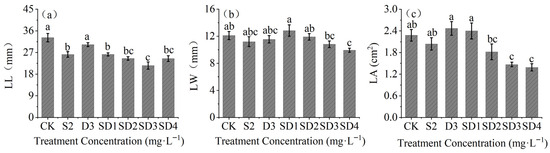
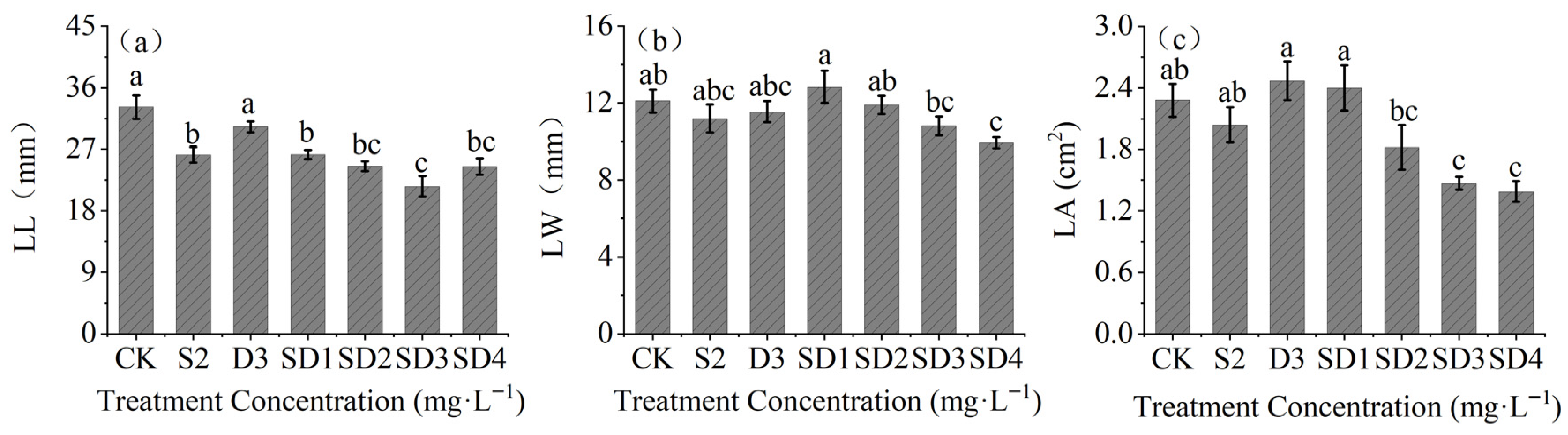
Analysis of leaf traits (Figure 1) revealed that, except for the D3 treatment significantly decreased LL compared with CK (p < 0.05). SD3 produced the smallest LL (21.57 mm), a 26.30% reduction versus CK (p < 0.05). LW reached its minimum under SD4 (9.94 mm), 17.92% lower than CK, whereas other treatments showed no significant LW change. LA was significantly reduced by SD3 and SD4 (p < 0.05), by 35.53% and 38.89% relative to CK, respectively; differences for other treatments were not significant (p > 0.05).
Figure 1.
Effects of mixed agents of PP333 and S3307 on leaf traits of A. fruticosa seedlings. (a) leaf length (LL); (b) leaf width (LW); (c) leaf area (LA). Different lowercase letters indicate significant differences at the 0.05 level.
2.2. Effects of Plant Growth Retardants on Root System Development
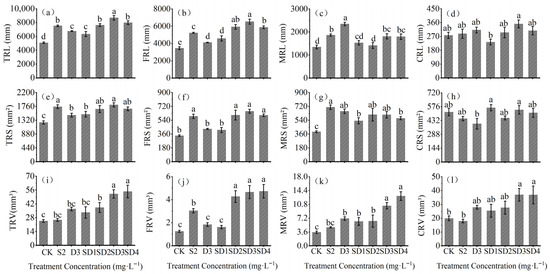
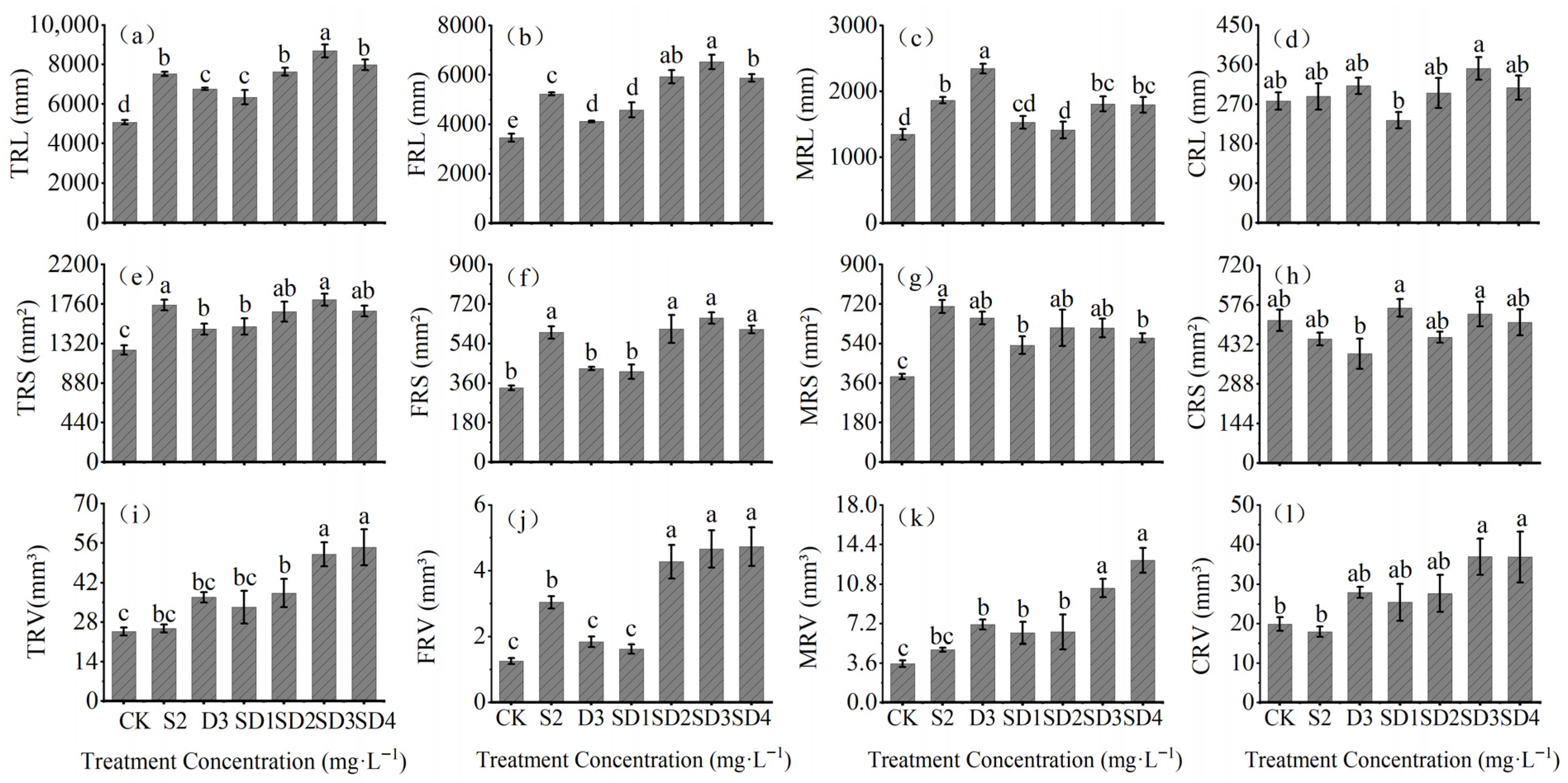
All treatments significantly increased TRL and TRS compared with the control (p < 0.05) (Figure 2a,b). Among them, the SD3 treatment resulted in the greatest enhancement of TRL, reaching 1.71 times that of the CK, while the S2 treatment exhibited the highest TRS, which was 1.60 times that of the CK. Furthermore, the SD3 treatment markedly promoted FRL and FRS, increasing them by 88.89% and 93.86%, respectively, compared with CK (Figure 2c,d).
Figure 2.
Effects of mixed agents of PP333 and S3307 on root growth of A. fruticosa seedlings. (a) Total root length (TRL), (b) Fine root length (FRL), (c) Medium root length (MRL), (d) Coarse root length (CRL), (e) Total root surface area (TRS), (f) Fine root surface area (FRS), (g) Medium root surface area (MRS), (h) Coarse root surface area (CRS), (i) Total root volume (TRV), (j) Fine root volume (FRV), (k) Medium root volume (MRV), and (l) Coarse root volume (CRV). Different lowercase letters indicate significant differences at the 0.05 level.
The MRL and MRS were observed under the D3 and S2 treatments, with values of 233.95 mm and 709.3 mm2, respectively (Figure 2e,f). In contrast, no significant effects on CRL and CRS were detected across treatments (Figure 2g,h). Additionally, as shown in Figure 2i–l, the SD4 treatment most effectively stimulated TRV, FRV, and MRV, which increased to 2.21, 3.75, and 3.66 times those of CK, respectively. CRV also increased significantly under SD3 and SD4 treatments, by 85.95% and 85.50%, respectively (p < 0.05).
According to Table 2, fine roots accounted for the largest proportion of both root fresh weight (RFW) and root dry weight (RDW), exceeding 40%. The proportions of root surface area (RS) among fine, medium, and coarse roots were relatively balanced, ranging from 20% to 40%. In contrast, coarse roots contributed the highest proportion to total root volume (RV), accounting for more than 60%.
Table 2.
The Proportion of each root class in total root system of A. fruticosa under the application of a mixed agent of PP333 and S3307 (%). RFW: root fresh weight, RDW: root dry weight, RS: root surface area, RV: root volume, FR: fine roots, MR: medium roots, CR: coarse roots, same below. Different lowercase letters in the same row indicate significant differences at the 0.05 level.
2.3. Effects of Plant Growth Retardants on Biomass Allocation of Seedlings
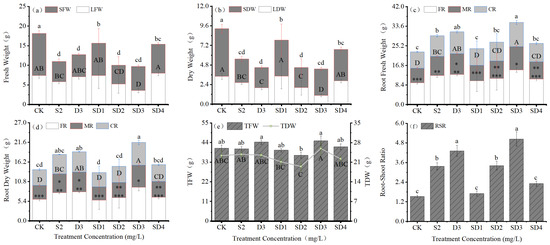
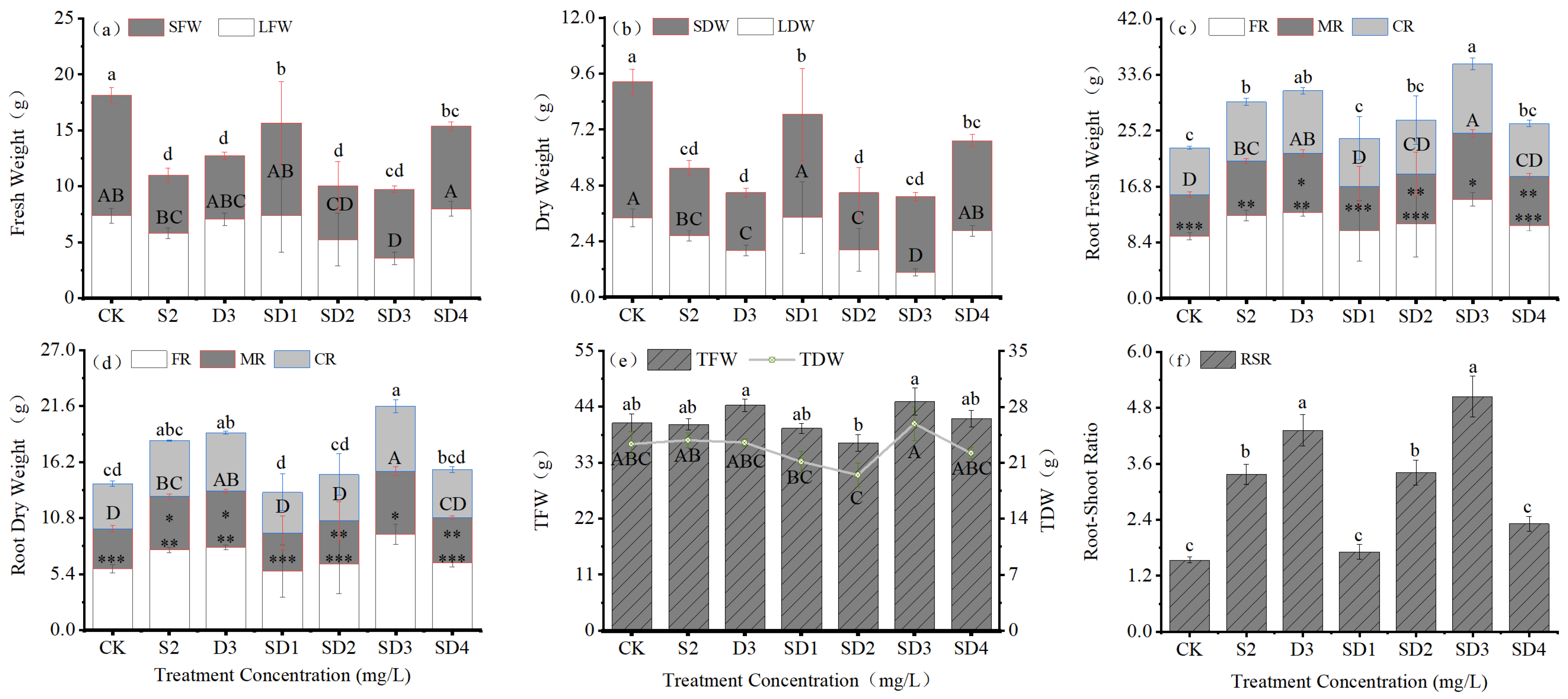
Analysis of plant biomass showed that, the application of growth retardants reduced the leaf fresh weight (LFW), leaf dry weight (LDW), stem fresh weight (SFW), and stem dry weight (SDW) of A. fruticosa seedlings. Under the SD3 treatment, LFW and LDW were the lowest, reaching 0.48 and 0.31 times those of CK, respectively. SFW and SDW were the lowest under SD2, decreasing by 55.29% and 58.26% compared with CK (Figure 3a,b).
Figure 3.
Effects of mixed agents of PP333 and S3307 on biomass allocation in A. fruticosa seedlings. (a) leaf fresh weight (LFW) and stem fresh weight (SFW), (b) leaf dry weight (LDW) and stem dry weight (SDW), (c) root fresh weight, (d) root dry weight (FR: fine roots, MR: medium roots, CR: coarse roots), (e) total fresh weight (TFW) and total dry weight (TDW), (f) root-to-shoot ratio (RSR). Different lowercase and uppercase letters. indicate significant differences at the 0.05 level. The asterisks (*, **, and ***) denote the significance of differences between various treatments for the same trait at the 0.05 level in the figure (i.e., an identical number of asterisks within the same layer signifies no significant difference (p > 0.05), whereas varying numbers of asterisks indicate a statistically significant difference (p < 0.05)).
Figure 3c,d show that root fresh weight and root dry weight of fine, medium, and coarse roots increased in all treatments. The SD3 treatment exhibited the highest values, which were significantly higher than CK (p < 0.05), reaching 1.59-, 1.58-, and 1.49-fold increases in root fresh weight and 1.57-, 1.57-, and 1.45-fold increases in root dry weight for fine, medium, and coarse roots, respectively.
As shown in Figure 3e, there were no significant differences among treatments in total fresh weight (TFW) and total dry weight (TDW). Figure 3f indicates that the root–shoot ratio (RSR) increased significantly in all treatments except SD1 and SD4 (p < 0.05), with the highest value observed under SD3, reaching 5.04, 228.54% higher than CK.
2.4. Effects of Plant Growth Retardants on Branch Growth
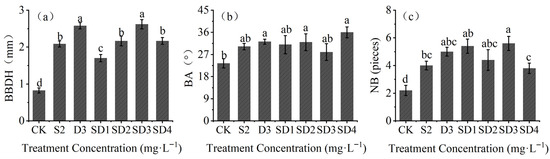
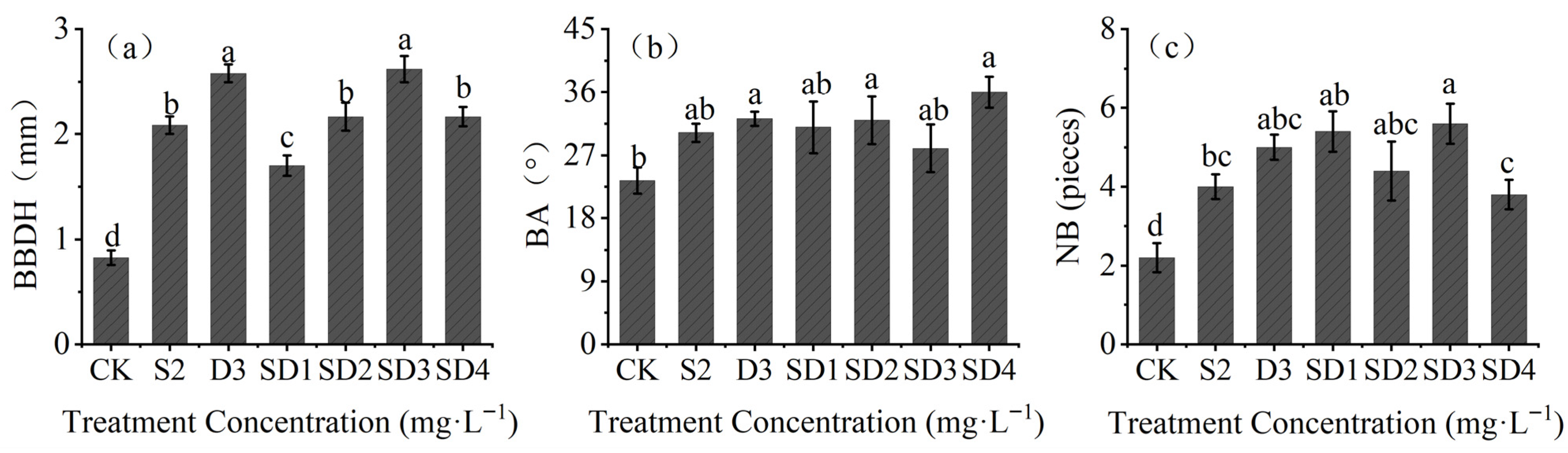
Studies on branching characteristics showed that, the branch basal diameter (BBDH) of seedlings in all treatments was significantly higher than that of CK (p < 0.05). The SD3 treatment showed the highest BBDH, which was 3.16 times that of CK (Figure 4a). Figure 4b indicates that branch angle (BA) under the S2, SD1, and SD3 treatments did not differ significantly from CK, whereas other treatments resulted in significantly larger BA values (p < 0.05). The largest branch angle was observed in the SD4 treatment (36.0°), 53.85% higher than CK. As shown in Figure 4c, all treatments significantly increased branch number (NB) compared with CK, with the SD3 treatment showing the highest NB (5.6), 1.55 times that of CK.
Figure 4.
Effects of mixed agents of PP333 and S3307 on branch basal diameter, branch angle, and number of branches in A. fruticosa seedlings. (a) branch basal diameter (BBDH); (b) branch angle (BA); (c) number of branches (NB). Different lowercase letters indicate significant differences at the 0.05 level.
2.5. Correlation Analysis of Morphological Traits Under Different Treatments
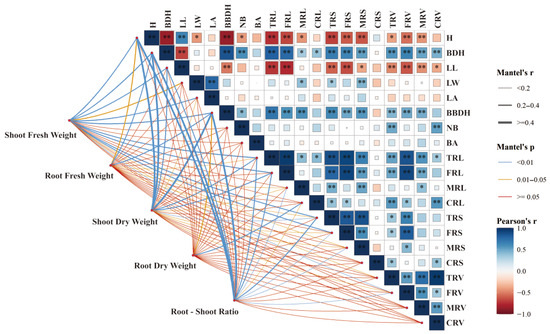
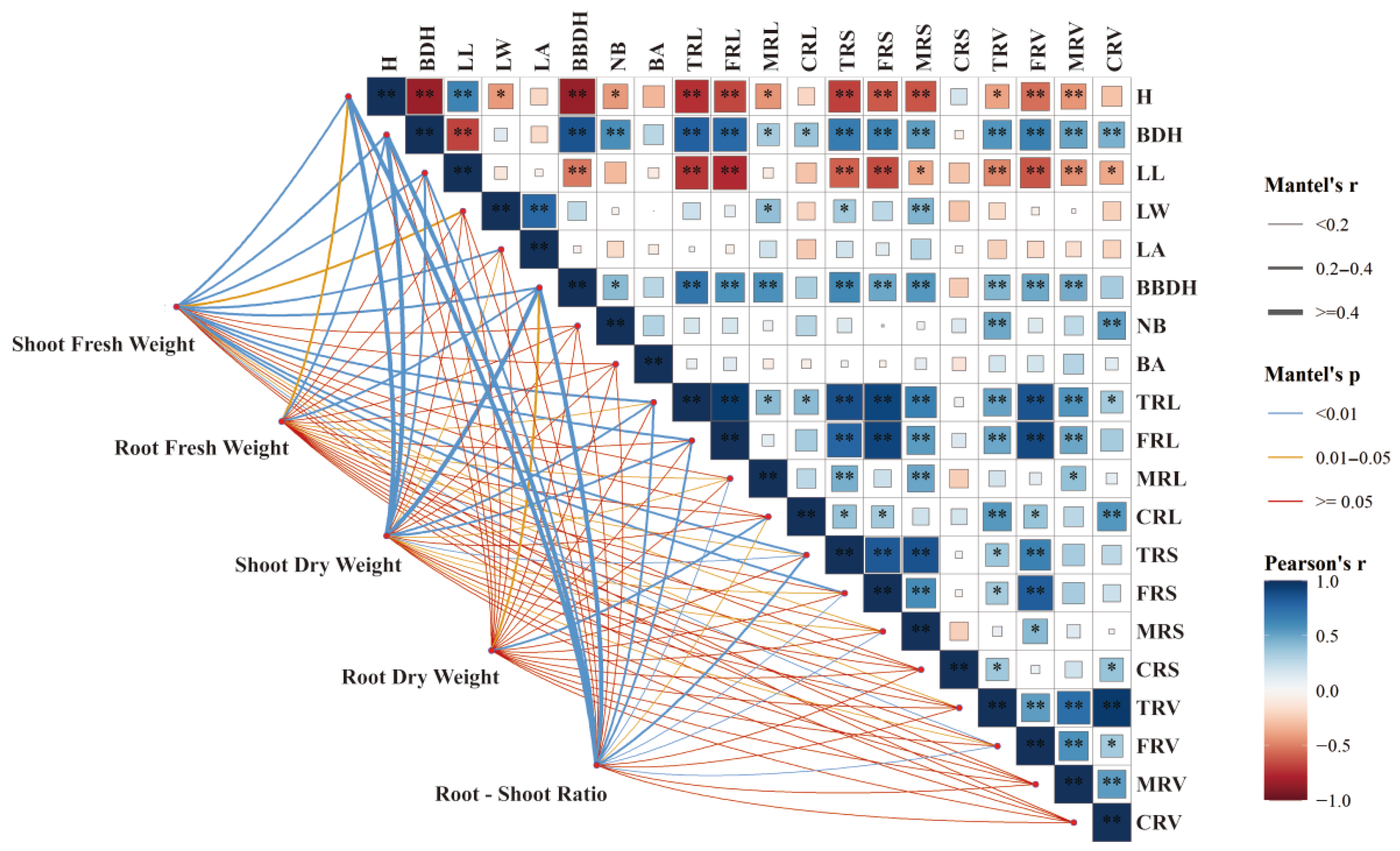
Correlation analysis indicated that (Figure 5), varying degrees of correlation were observed among the growth traits of A. fruticosa seedlings under different combinations of plant growth retardants. Plant H was positively correlated with LL (R = 0.64) and negatively correlated with BBDH (R = −0.85). Basal diameter (BDH) was negatively correlated with LL (R = −0.68) and positively correlated with BBDH (R = 0.85). LL showed a significant negative correlation with FRL (R = −0.76), while LW was strongly positively correlated with LA (R = 0.77).
Figure 5.
Correlation analysis of morphological traits of A. fruticosa seedlings under mixed agents of PP333 and S3307 treatments. * indicates a significant correlation at p < 0.05, ** indicates an extremely significant correlation at p < 0.01.
BBDH was positively correlated with TRL (R = 0.70), and NB exhibited a moderate positive correlation with CRV (R = 0.52). TRL was very strongly correlated with FRL (R = 0.94), and FRL was strongly correlated with FRS (R = 0.91). MRL and MRS were positively correlated (R = 0.50), and CRL was positively correlated with CRV (R = 0.56). TRS was positively correlated with MRS (R = 0.86), and FRS was strongly correlated with FRV (R = 0.82). MRS and FRV showed a moderate positive correlation (R = 0.41), and TRV was very strongly correlated with CRV (R = 0.96). FRV was correlated with MRV (R = 0.58), and MRV was correlated with CRV (R = 0.53).
From a biomass perspective, aboveground fresh weight showed a positive correlation with overall growth traits, particularly with BDH (R = 0.38). Root fresh weight (RFW) exhibited weak positive correlations with H, BDH, and BBDH, with the highest correlation observed with BBDH (R = 0.33). Aboveground dry weight and RSR were positively correlated with H (R = 0.40, 0.41), BDH (R = 0.44, 0.43), and BBDH (R = 0.48, 0.59), respectively. RDW showed weak positive correlations with BBDH (R = 0.23) and CRL (R = 0.29).
2.6. Principal Component Analysis and Comprehensive Evaluation
Based on principal component analysis (PCA) of 33 phenotypic traits of A. fruticosa seedlings (Table 3), seven principal components were extracted, with a cumulative contribution rate of 86.48%. The first principal component (PC1) included FRFW, MRFW, CRFW, FRDW, MRDW, CRDW, TFW, TDW, and RSR, with a contribution rate of 41.01%. The second principal component (PC2) included TRL, FRL, TRS, FRS, MRS, and FRV, with a contribution rate of 15.35%. The third principal component (PC3) included H, BBDH, SFW, LDW, SDW, and RSR, accounting for 10.22% of the total variance. The fourth principal component (PC4) comprised LW and LA, contributing 6.96%. The fifth principal component (PC5) included NB and BA, contributing 6.07%. The sixth principal component (PC6) was composed of TRV, MRV, and CRV, with a contribution rate of 3.83%. The seventh principal component (PC7) included CRS, accounting for 3.04% of the total variance.
Table 3.
Principal component analysis results of phenotypic traits of A. fruticosa seedlings under different treatments.
Comprehensive evaluation based on principal component scores (Table 4) showed that the SD3 treatment had the highest comprehensive score (2.91), ranking first among all treatments. SD4 ranked second, followed by D3 and SD2, while CK had the lowest comprehensive score.
Table 4.
Principal component scores and ranking of comprehensive evaluation for different treatments.
3. Discussion
Vegetation-based sand control has been widely recognized as one of the most effective strategies for mitigating land desertification, particularly in arid and semi-arid regions where wind erosion is severe [44]. Plant architecture is a direct manifestation of plant environmental adaptability and plays a crucial role in determining ecological functions such as wind resistance, soil stabilization, and water conservation [45,46,47]. However, plant morphological traits are dynamic and can be significantly modified by both environmental factors and growth regulatory substances [48]. In this study, all mixed applications of paclobutrazol and uniconazole inhibited plant height and leaf length while promoting basal diameter, branch basal diameter, number of branches, and branch angle in A. fruticosa seedlings. The SD3 treatment demonstrated the most potent inhibitory effect on plant height and the most significant improvements in basal diameter and branch number, indicating that this combination effectively promotes a more compact and structurally stable architecture. The SD4 treatment induced the greatest increase in branch angle, suggesting a favorable modification for enhancing canopy spatial distribution. Both treatments also significantly suppressed leaf growth, likely due to the ability of paclobutrazol and uniconazole to inhibit gibberellin biosynthesis and reduce cell elongation, resulting in morphological dwarfing [34]. Moreover, these growth retardants promote cell division and increase the number of cell layers, thereby enhancing stem thickening and structural robustness [42], consistent with previous findings by Shahzad et al. [49], Lin et al. [50], and Ebmeyer et al. [51].
Roots are essential organs for water and nutrient uptake and play a critical role in plant survival, particularly during the early growth stages in arid environments [52]. Fine roots primarily function in resource absorption, while coarse roots are responsible for transport and mechanical support [53,54]. Root traits differ significantly among vegetation types and strongly influence ecosystem processes such as hydrological regulation, nutrient cycling, and resistance to wind erosion [55,56,57,58]. In this study, all PP333 and S3307 combinations significantly promoted the root development of A. fruticosa. The SD3 treatment resulted in the greatest increases in total root length, fine root length, fine root surface area, and coarse root volume, whereas the SD4 treatment yielded the highest total root volume and volumes of fine, medium, and coarse roots. These results suggest that combined treatments are more effective than single-agent applications, indicating a potential additive or synergistic effect. Fine roots accounted for the largest proportion of root fresh and dry weights across all treatments, indicating that growth retardants primarily enhanced absorptive root development. These responses may be attributed to the inhibitory effects of paclobutrazol and uniconazole on primary root elongation and cell expansion, coupled with their stimulatory role in lateral root proliferation and cell layer formation. Consequently, the increased fine root development likely contributes to enhanced water acquisition and improved tolerance to environmental stress. These findings align with previous studies reporting that plant growth retardants enhance root system architecture [59,60,61,62].
Biomass allocation is a key adaptive strategy by which plants respond to environmental conditions, optimizing growth and resource use efficiency [63,64,65]. In desert ecosystems, plants typically allocate more biomass to belowground organs to enhance water uptake and improve survival under drought and nutrient-poor conditions [66]. Watson et al. [67] reported that root biomass increases when shoot growth is restricted and photosynthetic assimilates are preferentially allocated to belowground tissues. In this study, all retardant treatments decreased leaf and stem fresh and dry weights while significantly increasing root biomass, leading to higher root–shoot ratios, particularly under the SD3 treatment. This indicates that growth retardants facilitated a shift in biomass allocation patterns, favoring root development over shoot growth. Although total biomass showed no significant differences among treatments, the redistribution of biomass towards root tissues suggests an adaptive response that enhances windbreak and sand-fixation capacity in arid environments. These findings are consistent with Sara et al. [68] who reported similar shifts in biomass allocation under growth retardant treatments in xerophytic species.
Comprehensive analysis of plant architecture, root development, and biomass allocation revealed that the mixed application of PP333 and S3307 significantly altered the morphological structure and physiological responses of A. fruticosa seedlings. Although growth retardants reduced plant height, total biomass exhibited an increasing trend under combined treatments, suggesting that the growth-promoting effects of mixed applications outweigh the inhibitory effects observed in single treatments. Morphological modifications such as reduced height and increased basal diameter contribute to a lower center of gravity, thereby decreasing lodging risk and enhancing structural stability. Furthermore, The reduction in plant height, thickening of basal diameter and branch basal diameter, increase in branch number, and enlargement of branch angle of A. fruticosa can not only protect the ground surface but also better intercept wind and sand. The enhanced root system further improves lodging resistance and increases soil water absorption, ultimately contributing to enhanced windbreak and sand-fixation capabilities. Song et al. [43] showed that 300 mg·L−1 paclobutrazol had the best regulatory effect on A. fruticosa seedlings; Zhang et al. [69] reported that among single-agent treatments, 300 mg·L−1 paclobutrazol and 200 mg·L−1 uniconazole exhibited the optimal regulatory effects on A. fruticosa seedlings. These findings are inconsistent with the results of our study, which indicated that the mixed-agent treatment SD3 had a better regulatory effect on A. fruticosa seedlings than the two optimal single-agent concentration treatments. This may be attributed to the different mechanisms of action between paclobutrazol and uniconazole [34,35,36], and their combination produces a certain synergistic effect, which is consistent with the research results of Qian et al. [70]. Our study demonstrated that the regulatory effect of SD3 treatment on A. fruticosa seedlings was the best, superior to that of the mixed agent composed of the two optimal single-agent concentrations. This could be because both paclobutrazol and uniconazole are gibberellin-antagonistic growth inhibitors. Mixing their optimal concentrations may cause phytotoxicity in plants: high concentrations might excessively inhibit gibberellin synthesis in plants, thereby arresting plant growth and inducing phytotoxic traits [25]. However, influenced by plant growth stages and environmental factors, further verification and con-sideration are required regarding the selection of appropriate growth retardants and dos-ages, as well as whether these findings are universally applicable to most plants dependent on arid regions for survival.
4. Materials and Methods
4.1. Plant Materials
In April 2019, current-year cuttings (12 cm in length and 1.50 mm in diameter) with uniform size were collected from six-year-old A. fruticosa mother plants. The cuttings were inserted into seedling pots (21.80 cm in diameter and 21.70 cm in height) in a greenhouse at Inner Mongolia Agricultural University (111.717926° E, 40.810654° N), with one seedling per pot and a total of 140 seedlings. The relative humidity inside the greenhouse ranged from 35% to 70%, with an average temperature of 22 °C. Before watering, the initial total weight of each pot including substrate and container was 6.87 kg. The substrate consisted of field soil and nutrient soil at a volume ratio of 4:1, with a pH of 6.62, a volumetric water content of approximately 45.97%, and a maximum water-holding capacity of 64.27%. During the nursery period, seedlings were irrigated with 700 mL of water every 3 days. The position of each pot was rotated diagonally every 7 days, and weed removal, pest control, and soil loosening were conducted every 10 days to ensure uniform environmental conditions and avoid the effects of light, moisture, temperature, and pest damage on seedling growth.
4.2. Experimental Design
At the end of April 2019, when the lower part of the cuttings had reached a semi-lignified stage, 35 pots of A. fruticosa seedlings with similar growth status and vigor were selected to minimize individual variation and ensure the reliability of subsequent experiments. Prior to treatment, plants were watered to full saturation, and after free drainage of excess soil water from the pots, treatments were applied according to the method of Chen [71]. Each seedling was subjected to paclobutrazol (PP333, 15% wettable powder, Sichuan Guoguang Agrochemical Co., Ltd., Chengdu, China) or uniconazole (S3307, 5% wettable powder, Sichuan Guoguang Agrochemical Co., Ltd., Chengdu, China), or their combinations. Treatments were applied via soil drench at 16:00 on a clear afternoon (30 April 2019). Based on previous studies [69], Paclobutrazol (200 mg·L–1, 300 mg·L–1) and Uniconazole (100 mg·L–1, 200 mg·L–1) were selected, along with the concentration that shows the best regulatory effect on A. fruticosa. A total of six retardant treatments (S2, D3, SD1, SD2, SD3, and SD4) and one control (CK) were included. The application concentrations, dosages, and number of replicates are shown in Table 5. To prevent loss of applied solution, mats were placed under each pot, and 700 mL of water was applied every 3 days; leachate was collected and returned to the corresponding pots on a regular basis.
Table 5.
Treatment combinations and application parameters.
4.3. Measurement of Growth Parameters
4.3.1. Plant Height and Basal Diameter
Before treatment (30 April 2019), plant height and basal diameter of each seedling were measured using a steel tape (YM-CL001, Yuma Tools Co., Ltd., Zhengzhou, China) and a vernier caliper (Diangjiang Technology Co., Ltd., Shanghai, China), respectively, as the initial values. After treatment, five seedlings from each treatment were randomly selected every 15 days, and plant height and basal diameter were measured to calculate the increments.
4.3.2. Branch and Leaf Traits
After 90 days of treatment, branch number and branch basal diameter of five seedlings in each treatment were recorded, and the branch angle of the primary branches was measured using a protractor (Starrett, L.S. Starrett Company, Athol, MA, USA). Three fully expanded functional leaves from each seedling were selected (15 functional leaves were measured per treatment), and leaf length, leaf width, and leaf area were measured using a leaf area meter (Yaxin-1242, Beijing Yaxin Liyi Technology Co., Ltd., Beijing, China).
4.3.3. Root Trait Measurement
At the end of the experiment, the soil in each pot was gently washed off with tap water. The root system was separated from the shoot and cleaned to remove any remaining debris. Leaves and stems were separated from the aboveground parts, and roots were classified into fine roots (<1.00 mm), medium roots (1.00–2.00 mm), and coarse roots (>2.00 mm) according to root classification standards. Each root class was placed in a labeled paper envelope, and fresh weight was recorded, five replicates per treatment. The root samples were then scanned using an Epson Expression 10000XL scanner (Epson, Long Beach, CA, USA), and root morphological parameters, including root length, surface area, and volume, were analyzed using WinRhizo software (v.2013e).
4.3.4. Biomass Measurement
Biomass was determined using the oven-drying method. After measuring the fresh weight, the various organs (leaves, stems, and different root classes) were placed in an oven, heated at 105 °C for 0.5 h for enzyme deactivation, and then dried at 75 °C to a constant weight. Dry weights were recorded, and the root-to-shoot ratio (RSR) was calculated.
4.4. Data Processing and Analysis
Data organization and preprocessing were conducted using Excel 2023. Descriptive statistics, one-way analysis of variance (ANOVA), and Duncan’s multiple range test were performed using SPSS software (version 21.0). Growth curve fitting was carried out using Forstat software (version 2.2) [37]. Figures, tables, and correlation analyses were generated using Excel 2023, Origin 2023, and R software (version 3.1.2).
A membership function method was employed to normalize the data, and principal component analysis (PCA) was used to comprehensively evaluate the growth performance of A. fruticosa seedlings under different plant growth retardant treatments. In principal component analysis, the degree of association between an indicator and a principal component is mainly determined by the absolute value of the factor loading. It is generally considered that the closer the absolute value of the factor loading is to 1, the stronger the association between the indicator and that principal component [72,73]. The membership function was calculated using the following formulas [74]:
where is the standardized value of the corresponding index, is the maximum value of that index across all treatments, and is the minimum value. Formula (1) was used for indicators positively correlated with treatment effects, while Formula (2) was applied for negatively correlated indicators.
5. Conclusions
Land desertification is one of the major challenges to global ecosystem stability and human survival. Exploring methods that promote plant growth and structural modification in the region is a critical task for enhancing vegetation for sand fixation and mitigating the pace of desertification. In this study, the perennial shrub A. fruticosa, which is commonly distributed in arid and semi-arid sandy regions, was used to investigate the effects of different combinations of two plant growth retardants, paclobutrazol (PP333) and uniconazole (S3307), on seedling growth characteristics and biomass allocation. The results showed that the mixed application of PP333 and S3307 effectively regulated the growth of A. fruticosa seedlings, enhanced stress resistance, and improved early survival. Among all treatments, the combination of 200 mg·L−1 S3307 + 200 mg·L−1 PP333 exhibited the best improvement in plant architecture, reducing height increment to 11.35% of the control while increasing basal diameter and branch number to 4.49-fold and 1.55-fold of the control, respectively. Leaf length and area were significantly reduced, indicating an adaptive morphological response to the treatment. Correlation analysis further revealed a strong positive relationship between root development and aboveground growth, highlighting the critical role of root systems in overall plant performance. However, the study was limited to one-year-old seedlings, and future research should consider different growth stages and environmental conditions, as well as evaluate the applicability of this retardant combination to other xerophytic shrub species to broaden its use in windbreak and sand-fixation practices.
Author Contributions
Conceptualization, J.Z. and C.L.; methodology, J.Z., N.L. and C.L.; software, J.Z., N.L. and K.W.; validation, K.W., X.Z., C.G. and F.L.; formal analysis, J.Z., N.L., X.Z. and F.L.; investigation, J.Z., X.Z., C.G., F.L. and J.S.; resources, K.W., J.S. and C.L.; data curation, J.Z., N.L., C.G. and C.L.; writing—original draft preparation, J.Z.; writing—review and editing, J.Z., N.L. and C.L.; visualization, J.Z.; supervision, C.L.; project administration, J.Z.; funding acquisition, K.W. and C.L. All authors have read and agreed to the published version of the manuscript.
Funding
This study was supported by the State Forestry and Grassland Administration 948 Project (Grant No. 2015–4–22).
Data Availability Statement
The data presented in this study are available upon request from the corresponding author. The data are not publicly available due to ethical reasons.
Conflicts of Interest
The authors declare no conflicts of interest.
References
- Wang, X.; Ge, Q.; Geng, X.; Wang, Z.; Gao, L.; Bryan, B.A.; Chen, S.; Su, Y.; Cai, D.; Ye, J.; et al. Unintended consequences of combating desertification in China. Nat. Commun. 2023, 14, 1139. [Google Scholar] [CrossRef] [Scilit] [PubMed]
- Maestre, F.T.; Guirado, E.; Armenteras, D.; Beck, H.E.; AlShalan, M.S.; Al-Saud, N.T.; Chami, R.; Fu, B.; Gichenje, H.; Huber-Sannwald, E.; et al. Bending the curve of land degradation to achieve global environmental goals. Nature 2025, 644, 347–355. [Google Scholar] [CrossRef] [Scilit]
- Wang, J.; Wang, Y.; Xu, D. Desertification in northern China from 2000 to 2020: The spatial-temporal processes and driving mechanisms. Eco. Inform. 2024, 82, 102769. [Google Scholar] [CrossRef] [Scilit]
- Li, G.; Yang, B.; Wu, G.; Feng, G.; Ljungqvist, F.C.; Che, T.; Zhang, Y.; Yang, H.; Guan, X.; Huang, C.; et al. Increased desertification exposure in dryland areas. Ecol. Indic. 2025, 179, 114264. [Google Scholar] [CrossRef] [Scilit]
- Song, Z.; Lu, Y.; Yuan, J.; Lu, M.; Qin, Y.; Sun, D.; Ding, Z. Research on desertification monitoring and vegetation refinement extraction methods based on the synergy of multisource remote sensing imagery. IEEE Trans. Geosci. Remote Sens. 2025, 63, 4404819. [Google Scholar] [CrossRef] [Scilit]
- Perović, V.; Kadović, R.; Đurđević, V.; Pavlović, D.; Pavlović, M.; Cakmak, D.; Mitrović, M.; Pavlović, P. Major drivers of land degradation risk in Western Serbia: Current trends and future scenarios. Ecol. Indic. 2021, 123, 107377. [Google Scholar] [CrossRef] [Scilit]
- Elnashar, A.; Zeng, H.; Wu, B.; Gebremicael, T.G.; Marie, K. Assessment of environmentally sensitive areas to desertification in the Blue Nile Basin driven by the MEDALUS-GEE framework. Sci. Total Environ. 2022, 815, 152925. [Google Scholar] [CrossRef] [Scilit]
- Tu, Z.; Li, M.; Sun, T. The status and trend analysis of desertification and sandification. For. Resour. Manag. 2016, 1, 1–5+13. (In Chinese) [Google Scholar]
- Zhang, L.; Jia, X.; Zhao, Y.; Wang, H.; Peng, B.; Zhang, P.; Zhao, M. Spatiotemporal characteristics and driving mechanism of land degradation sensitivity in Northwest China. Sci. Total Environ. 2024, 918, 170403. [Google Scholar] [CrossRef] [Scilit]
- Zhou, Q.; Chen, W.; Wang, H.; Wang, D. Spatiotemporal evolution and driving factors analysis of fractional vegetation coverage in the arid region of northwest China. Sci. Total Environ. 2024, 954, 176271. [Google Scholar] [CrossRef] [Scilit]
- Li, W.; Shen, Y.; Wang, G.; Ma, H.; Yang, Y.; Li, G.; Huo, X.; Liu, Z. Plant species diversity and functional diversity relations in the degradation process of desert steppe in an arid area of northwest China. J. Environ. Manag. 2024, 365, 121534. [Google Scholar] [CrossRef] [Scilit]
- Zhou, W.; Li, C.; Fu, B.; Wang, S.; Ren, Z.; Stringer, L.C. Changes and drivers of vegetation productivity in China’s drylands under climate change. Environ. Res. Lett. 2024, 19, 114001. [Google Scholar] [CrossRef] [Scilit]
- He, Y.; Wang, L.; Niu, Z.; Nath, B. Vegetation recovery and recent degradation in different karst landforms of Southwest China over the past two decades using GEE Satellite archives. Ecol. Inform. 2022, 68, 101555. [Google Scholar] [CrossRef] [Scilit]
- Qi, K.; Zhu, J.; Zheng, X.; Wang, G.G.; Li, M. Impacts of the world’s largest afforestation program (Three-North Afforestation Program) on desertification control in sandy land of China. GISci. Remote Sens. 2023, 60, 2167574. [Google Scholar] [CrossRef] [Scilit]
- Guan, X.; Huang, J. Constructing semi-arid ecological barriers to prevent desertification. Innov. Geosci. 2024, 2, 100067. [Google Scholar] [CrossRef] [Scilit]
- Wolfe, S.A.; Nickling, W.G. The protective role of sparse vegetation in wind erosion. Prog. Phys. Geog. 1993, 17, 50–68. [Google Scholar] [CrossRef] [Scilit]
- Fryrear, D.W.; Bilbro, J.D.; Saleh, A.R.W.E.Q.; Schomberg, H.; Stout, J.E.; Zobeck, T.M. RWEQ: Improved wind erosion technology. J. Soil Water Conserv. 2000, 55, 183–189. [Google Scholar] [CrossRef] [Scilit]
- Sasaki, T.; Koyama, A.; Okuro, T. Coupling structural and functional thresholds for vegetation changes on a Mongolian shrubland. Ecol. Indic. 2018, 93, 1264–1275. [Google Scholar] [CrossRef] [Scilit]
- Foroutan, H.; Young, J.; Napelenok, S.; Ran, L.; Appel, K.W.; Gilliam, R.C.; Pleim, J. Development and evaluation of a physics-based windblown dust emission scheme implemented in the CMAQ modeling system. J. Adv. Model. Earth Syst. 2017, 9, 585–608. [Google Scholar] [CrossRef] [Scilit]
- Liu, H. The Study on Architecture and Wind Break Efficiency of Imitation Sand–Fixed Shrub. Ph.D. Thesis, Gansu Agricultural University, Lanzhou, China, 2012. (In Chinese) [Google Scholar]
- Zhao, H.L.; Cheng, H.; Xie, Q.M.; Hou, H.; Ni, X.L. Evaluation of drought resistance of six shrubs in arid area and selection of identification indexes. J. Northwest For. Univ. 2022, 37, 24–29. (In Chinese) [Google Scholar]
- Wilder, B.T.; Hultine, K.R.; Dorshow, W.B.; Vanderplank, S.E.; López, B.R.; Medel-Narváez, A.; Marvan, M.; Kindl, K.; Musgrave, A.; Macfarlan, S.; et al. Plant responses to anomalous heat and drought events in the Sonoran desert. Glob. Change Biol. 2025, 31, e70217. [Google Scholar] [CrossRef] [Scilit]
- Li, H.; Cui, G.; Li, G.; Lu, H.; Wei, H.; Zhang, H.; Zhang, H. Assessing the efficacy and residual impact of plant growth retardants on crop lodging and overgrowth: A review. Eur. J. Agron. 2024, 159, 127276. [Google Scholar] [CrossRef] [Scilit]
- Tsegaw, T.; Hammes, S.; Robbertse, J. Paclobutrazol induced leaf, stem, and root anatomical modifications in potato. J. Am. Soc. Hortic. Sci. 2005, 40, 1343–1346. [Google Scholar] [CrossRef] [Scilit]
- Liu, W.; Gai, D.; Liang, J.; Cui, J.; Geng, Y.; Zhang, Q.; Guo, L.; Shao, X. Paclobutrazol enhances lodging resistance and yield of direct-seeded rice by optimizing plant type and canopy light transmittance. Field Crop. Res. 2025, 331, 109882. [Google Scholar] [CrossRef] [Scilit]
- Zhang, Y.; Li, Y.; Deng, Y.; Ou, Y.; Ma, D.; Li, D.; Xie, W.; Li, Z. Effects of PBO and PP333 on shoot growth, nutrient accumulation, and fruit quality in Carya Illinoinensis cv. ‘Shaoxing’. Phyton-Int. J. Exp. Bot. 2024, 93, 3293–3312. [Google Scholar]
- Xu, T.; Guo, Y.; Yuan, X.; Chu, Y.; Wang, X.; Han, Y.; Wang, W.; Wang, Y.; Song, R.; Fang, Y.; et al. Effects of exogenous paclobutrazol and sampling time on the efficiency of in vitro embryo rescue in the breeding of new seedless grape varieties. J. Int. Agric. 2022, 21, 1633–1644. [Google Scholar]
- Al-Ajlouni, M.G.; Othman, Y.A.; A’saf, T.S.; Ayad, J.Y. Lilium morphology, physiology, anatomy and postharvest flower quality in response to plant growth regulators. S. Afr. J. Bot. 2023, 156, 43–53. [Google Scholar] [CrossRef] [Scilit]
- Rademacher, W. Growth retardants: Effects on gibberellin biosynthesis and other metabolic pathways. Annu. Rev. Plant Biol. 2000, 51, 501–531. [Google Scholar] [CrossRef] [Scilit]
- Olszewski, N.; Sun, T.; Gubler, F. Gibberellin signaling: Biosynthesis, catabolism and response pathways. Plant Cell. 2002, 14, 61–80. [Google Scholar] [CrossRef] [Scilit]
- Srivastava, L. Plant Growth and Development: Hormones and Environment; Elsevier: Amsterdam, The Netherlands, 2002; Volume 16, pp. 68–74. [Google Scholar]
- Wittwer, S.; Tolbert, N. 2-chloroethyl trimethylammonium chloride and related compounds as plant growth substances. V. Growth, flowering, and fruiting responses as related to those induced by auxin and gibberellin. Plant Physiol. 1960, 35, 871–877. [Google Scholar] [CrossRef] [Scilit]
- Izumi, K.; Kamiya, Y.; Sakurai, A.; Oshio, H.; Takahashi, N. Studies of sites of action of a new plant growth retardant (E)-1-(4-chlorophenyl)-4,4-dimethyl-2-(1, 2, 4-triazol-1-yl)-1-penten-3-ol (S-3307) and comparative effects of its stereoisomers in a cell-free system from Cucurbita maxima. Plant Cell Physiol. 1985, 26, 821–827. [Google Scholar]
- Yuan, X.; Yuan, T. Effect of GA and PP333 on autumn reflowering of two Chinese tree peony (Paeonia × suffruticosa Andrews) cultivars. S. Afr. J. Bot. 2025, 177, 312–319. [Google Scholar] [CrossRef] [Scilit]
- Saito, S.; Okamoto, M.; Shinoda, S.; Kushiro, T.; Koshiba, T.; Kamiya, Y.; Hirai, N.; Todoroki, Y.; Sakata, K.; Nambara, E.; et al. A plant growth retardant, Uniconazole, is a potent inhibitor of ABA catabolism in Arabidopsis. Biosci. Biotech. Bioch. 2006, 70, 1731–1739. [Google Scholar] [CrossRef] [Scilit]
- Liu, C.; Feng, N.; Zheng, D.; Cui, H.; Sun, F.; Gong, X. Uniconazole and diethyl aminoethyl hexanoate increase soybean pod setting and yield by regulating sucrose and starch content. J. Sci. Food Agric. 2019, 99, 748–758. [Google Scholar] [CrossRef] [Scilit] [PubMed]
- Du, X.; Feng, N.; Zheng, D.; Lin, Y.; Zhou, H.; Li, J.; Yang, X.; Huo, J.; Mei, W. Effects of exogenous Uniconazole (S3307) on oxidative damage and carbon metabolism of rice under salt stress. BMC Plant Biol. 2025, 25, 541. [Google Scholar] [CrossRef] [Scilit]
- Qian, J.; Wang, N.; Ren, W.; Zhang, R.; Hong, X.; Chen, L.; Zhang, K.; Shu, Y.; Hu, N.; Yang, Y. Molecular dissection unveiling dwarfing effects of plant growth retardants on pomegranate. Front. Plant Sci. 2022, 13, 866193. [Google Scholar] [CrossRef] [Scilit]
- Yang, H.; Xiao, Y.; Zhang, X.; Huang, X.; Fan, G. Maize straw mulching with uniconazole application increases the tillering capacity and grain yield of dryland winter wheat (Triticum aestivum L.). Field Crop. Res. 2022, 284, 108573. [Google Scholar] [CrossRef] [Scilit]
- Zhu, M.; Lin, C.; Jiang, Z.; Yan, F.; Li, Z.; Tang, X.; Yang, F.; Ding, Y.; Li, W.; Liu, Z.; et al. Uniconazole enhances lodging resistance by increasing structural carbohydrate and sclerenchyma cell wall thickness of japonica rice (Oryza sativa L.) under shading stress. Environ. Exp. Bot. 2023, 206, 105145. [Google Scholar] [CrossRef] [Scilit]
- Yang, H.; Liu, C.; Zhuang, J.; Zhang, S.; Zhang, W.; Mao, G. Effects of different carrier bacterial fertilizers on growth, photosynthetic characteristics and soil nutrients of Amorpha fruticosa. J. Nanjing For. Univ. 2024, 48, 81–89. (In Chinese) [Google Scholar]
- Bi, Y.; Du, X.; Tian, L.; Li, M.; Yin, K. Effects of an arbuscular mycorrhizal fungus on Amorpha fruticosa roots and soil preferential flow in an arid area of opencast coal mine waste. Soil Till. Res. 2025, 245, 106321. [Google Scholar] [CrossRef] [Scilit]
- Song, H.; Li, S.; Sun, H.; Liu, J.; Chen, Y. Effects of soil-applied paclobutrazol on growth and physiological characteristics of Amorpha fruticosa. Plant Physiol. J. 2015, 51, 1495–1501. (In Chinese) [Google Scholar]
- Hou, Q.; Hu, W.; Sun, Y.; Morriën, E.; Yang, Q.; Aqeel, M.; Du, Q.; Xiong, J.; Dong, L.; Yao, S.; et al. Active restoration efforts drive community succession and assembly in a desert during the past 53 years. Ecol. Appl. 2025, 35, e3068. [Google Scholar] [CrossRef] [Scilit] [PubMed]
- Laurans, M.; Munoz, F.; Charles-Dominique, T.; Heuret, P.; Fortunel, C.; Isnard, S.; Sabatier, A.A.; Caraglio, Y.; Violle, C. Why incorporate plant architecture into trait-based ecology? Trends Ecol. Evol. 2024, 39, 524–536. [Google Scholar] [CrossRef] [Scilit]
- Zhang, X.; Fu, B.; Deng, R.; Li, Y.; Li, J.; Jiang, J.; Tang, J. Integrating remote sensing and mechanistic model for spatial evaluation of shelterbelt porosity and windbreak effectiveness in agricultural landscapes. Agric. For. Meteorol. 2025, 374, 110822. [Google Scholar] [CrossRef] [Scilit]
- Ren, J.; Jiang, Y.; Han, W.; Shi, L.; Zhang, Y.; Liu, G.; Cui, Y.; Du, X.; Gao, Z.; Liang, X. Simultaneous enhancement of maize yield and lodging resistance via delaying plant growth retardant application. Field Crop. Res. 2024, 317, 109530. [Google Scholar] [CrossRef] [Scilit]
- Barthélémy, D.; Caraglio, Y. Plant architecture: A dynamic, multilevel and comprehensive approach to plant form, structure and ontogeny. Ann. Bot. 2007, 99, 375–407. [Google Scholar] [CrossRef] [Scilit]
- Shahzad, M.; Akhtar, G.; Shehzad, M.; Ullah, S.; Faried, H.; Razzaq, K.; Nawaz, F.; Rajwana, I.; Amin, M.; Ahsan, M. Paclobutrazol and maleic hydrazide-induced growth inhibition in warm season turfgrasses through structural and physiological differences. Kuwait J. Sci. 2023, 50, 674–680. [Google Scholar] [CrossRef] [Scilit]
- Lin, G.; Li, H.; Yang, Z.; Ruan, Y.; Liu, C. Pod canopy staggered-layer cultivation increases rapeseed (Brassica napus L.) yield by improving population canopy structure and fully utilizing light-energy resources. Eur. J. Agron. 2024, 158, 127229. [Google Scholar] [CrossRef] [Scilit]
- Ebmeyer, H.; Fiedler-Wiechers, K.; Hoffmann, C. Drought tolerance of sugar beet-Evaluation of genotypic differences in yield potential and yield stability under varying environmental conditions. Eur. J. Agron. 2021, 125, 126262. [Google Scholar] [CrossRef] [Scilit]
- Testerink, C.; Lamers, J. How plant roots go with the flow. Nature 2022, 612, 414–415. [Google Scholar] [CrossRef] [Scilit]
- Guo, D.; Xia, M.; Wei, X.; Chang, W.; Liu, Y.; Wang, Z. Anatomical traits associated with absorption and mycorrhizal colonization are linked to root branch order in twenty-three Chinese temperate tree species. New Phytol. 2008, 180, 673–683. [Google Scholar] [CrossRef] [Scilit]
- McCormack, M.; Dickie, I.; Eissenstat, D.; Fahey, T.; Fernandez, C.; Guo, D.; Helmisaari, H.; Hobbie, E.; Iversen, C.; Jackson, R.; et al. Redefining fine roots improves understanding of below-ground contributions to terrestrial biosphere processes. New Phytol. 2015, 207, 505–518. [Google Scholar] [CrossRef] [Scilit]
- Cairns, M.; Brown, S.; Baumgardner, H. Root biomass allocation in the world’s upland forests. Oecologia 1997, 111, 1–11. [Google Scholar] [CrossRef] [Scilit] [PubMed]
- Jobbagy, E.; Jackson, R. The Vertical distribution of soil organic carbon and its relation to climate and vegetation. Ecol. Appl. 2000, 10, 423–436. [Google Scholar] [CrossRef]
- Esteban, G.; Jobbágy, R. The Distribution of Soil Nutrients with Depth: Global Patterns and the Imprint of Plants. Biogeochemistry 2001, 53, 51–77. [Google Scholar] [CrossRef] [Scilit]
- Bormann, B.; Wang, D.; Snyder, M.; Bormann, F.; Benoit, G.; April, R. Raped, plant-induced weathering in an aggrading experimental Ecosystem. Biogeochemistry 1998, 43, 129–155. [Google Scholar] [CrossRef] [Scilit]
- Zhang, H.; Ali, S.; Chen, Y.; Yang, L.; Pang, G.; Assal, M.; Rafi Shaik, M. Irrigation management practices with novel plant growth regulators improve root growth, root lodging resistance and maize productivity under semi-arid regions. Field Crop. Res. 2025, 333, 110097. [Google Scholar] [CrossRef] [Scilit]
- Si, C.; Li, Y.; Liu, H.; Zhang, H.; Meng, Y.; Wang, N.; Shi, C. Impact of paclobutrazol on storage root number and yield of sweet potato (Ipomoea batatas L.). Field Crop. Res. 2023, 300, 109011. [Google Scholar] [CrossRef] [Scilit]
- Muhammad, K.; Su, W.; Irshad, A.; Meng, X.; Cui, W.; Zhang, X.; Mou, S.; Aaqil, K.; Han, Q.; Liu, T. Application of paclobutrazol affect maize grain yield by regulating root morphological and physiological characteristics under a semi-arid region. Sci. Rep. 2018, 8, 4818. [Google Scholar] [CrossRef] [Scilit]
- Pan, R.; Liu, Y.; Buitrago, S.; Jiang, W.; Gao, H.; Han, H.; Wu, C.; Wang, Y.; Zhang, W.; Yang, X. Adventitious root formation is dynamically regulated by various hormones in leaf-vegetable sweet potato cuttings. J. Plant Physiol. 2020, 253, 153267. [Google Scholar] [CrossRef] [Scilit]
- Li, X.; Hu, Y.; Song, Z.; Cong, P.; Cheng, H.; Zheng, X.; Song, W.; Yue, P.; Wang, S.; Zuo, X. Precipitation-induced biomass enhancement and differential allocation in Inner Mongolia’s herbaceous and shrub communities. Sci. Total Environ. 2024, 954, 176483. [Google Scholar] [CrossRef] [Scilit]
- Umaña, M.N.; Cao, M.; Lin, L.; Swenson, N.G.; Zhang, C. Trade-offs in above- and below-ground biomass allocation influencing seedling growth in a tropical forest. J. Ecol. 2021, 109, 1184–1193. [Google Scholar] [CrossRef] [Scilit]
- Liang, P.; Xu, X.; Liao, X.; Liu, J.; Chen, J. Ampelocalamus luodianensis (Poaceae), a plant endemic to karst, adapts to resource heterogeneity in differing microhabitats by adjusting its biomass allocation. Glob. Ecol. Conserv. 2023, 41, e02374. [Google Scholar] [CrossRef] [Scilit]
- Akash, T.; Corina, G.; Jordi, S.; Zeng, F.; Alice, C.H.; Zeeshan, A.; Abd, U.; Sikandar, A.; Gao, Y.; Josep, P. Plant root mechanisms and their effects on carbon and nutrient accumulation in desert ecosystems under changes in land use and climate. New Phytol. 2024, 242, 916–934. [Google Scholar] [CrossRef] [Scilit]
- Watson, G.W. Effect of transplanting and paclobutrazol on root growth of ‘Green Column’ black maple and ‘Summit’ green ash. J. Environ. Hortic. 2004, 22, 209–212. [Google Scholar] [CrossRef] [Scilit]
- Sara, R.; McCullough, D.G.; Bert, M.C. Effects of paclobutrazol and fertilizer on the physiology, growth and biomass allocation of three Fraxinus species. Urban For. Urban Green. 2015, 14, 590–598. [Google Scholar] [CrossRef] [Scilit]
- Zhang, J. Effects of Plant Growth Retardants on the Phenotype Characteristics of Amorpha fruticosa Seedlings. Master’s Thesis, Inner Mongolia Agricultural University, Hohhot, China, 2020. (In Chinese) [Google Scholar]
- Qian, Y.; Yang, L.; Huang, C.; Wang, Z.; Yang, H.; Wu, A. Effects of Combined Administration of Naphthalene Acetic Acid with Paclobutrazol on Growth and Biomass Allocation of Carya illinoensis ‘Pawnee’ Container Seedling. J. Northeast For. Univ. 2023, 51, 64–69. (In Chinese) [Google Scholar]
- Chen, X. The Effects of Plant Retardant on Phenotypic Plasticity of Hedysarum laeve Under Drought and Saline-Alkali Stress. Master’s Thesis, Inner Mongolia Agricultural University, Hohhot, China, 2018. (In Chinese) [Google Scholar]
- Michael, G.; Patrick, J.F.G.; Trevor, H.; Alfonso, I.; Angelos, M.; Elena, T. Principal component analysis. Nat. Rev. Method. Prime. 2022, 2, 100. [Google Scholar]
- Matthew, C. Notes on the use of principal component analysis in agronomic research. Nat. Rev. Methods Primers 2025, 4, 1–6. [Google Scholar] [CrossRef] [Scilit]
- Zou, Z.; Guo, B.; Guo, Y.; Ma, X.; Luo, S.; Feng, L.; Pan, Z.; Deng, L.; Pan, S.; Wei, J.; et al. A comprehensive “quality-quantity-activity” approach based on portable near-infrared spectrometer and membership function analysis to systematically evaluate spice quality: Cinnamomum cassia as an example. Food Chem. 2024, 439, 138142. [Google Scholar] [CrossRef] [Scilit]

Disclaimer/Publisher’s Note: The statements, opinions and data contained in all publications are solely those of the individual author(s) and contributor(s) and not of MDPI and/or the editor(s). MDPI and/or the editor(s) disclaim responsibility for any injury to people or property resulting from any ideas, methods, instructions or products referred to in the content. |
© 2025 by the authors. Licensee MDPI, Basel, Switzerland. This article is an open access article distributed under the terms and conditions of the Creative Commons Attribution (CC BY) license (https://creativecommons.org/licenses/by/4.0/).