Article

Cloning and Functional Verification of Salt Tolerance Gene HbNHX2 in Hordeum brevisubulatum

College of Animal Science and Technology, Northeast Agricultural University, Harbin 150030, China
*
Authors to whom correspondence should be addressed.
These authors contributed equally to this work.
Plants 2025, 14(23), 3658; https://doi.org/10.3390/plants14233658 (registering DOI)
Submission received: 29 October 2025 / Revised: 27 November 2025 / Accepted: 28 November 2025 / Published: 30 November 2025
(This article belongs to the Section Plant Genetics, Genomics and Biotechnology)

Abstract

A high salt environment seriously affects the physiological metabolism and yield of plants. Hordeum brevisubulatum (Trin.) Link has high biomass and important ecological, feeding and economic values, but its growth conditions have serious saline-alkali effects. The NHX gene family plays a vital role in regulating intracellular Na+/K+ balance, pH homeostasis, and vesicle and protein transport in plants. In this study, the HbNHX2 gene was cloned from Hordeum brevisubulatum and functionally characterized through phenotypic, physiological, and molecular analyses in transgenic tobacco. Expression profiling revealed that HbNHX2 was most abundant in spikes and least abundant in root tips, and the expression level was significantly induced under salt stress. Overexpression of HbNHX2 led to decreased malondialdehyde (MDA) and superoxide anion (O2−) levels, while it enhanced the activities of superoxide dismutase (SOD), peroxidase (POD), and catalase (CAT). Additionally, the levels of glutathione (GSH), soluble proteins, proline, and chlorophyll were also increased. Several stress-responsive genes, including CBL1, ERF2, BI-1, Cu/Zn-SOD, Mn-SOD, POD, GR1, KC1, TPK1, TIP, P5CS, BAS1, STN7 and LTP1, were significantly upregulated, while SERK3B was downregulated. These findings suggest that HbNHX2 enhances plant salt tolerance by maintaining osmotic balance, scavenging reactive oxygen species (ROS), and regulating stress-responsive gene expression. This study provides new insights into the molecular mechanism of salt tolerance in Hordeum brevisubulatum and lays a foundation for breeding salt-tolerant forage crops.

1. Introduction

Globally, more than 900 million hectares of land—approximately 7% of the total terrestrial area—are affected by salinity and alkalinity [1]. The Songnen Plain, a major grassland region in Northeast China, represents a typical example of soda saline-alkaline soils [2]. These soils are characterized by high concentrations of alkaline salts such as sodium carbonate (Na2CO3) and sodium bicarbonate (NaHCO3), along with the accumulation of neutral salts, primarily sodium chloride (NaCl). Excessive salt accumulation imposes severe saline-alkali stress, significantly restricting plant growth and development in this region [3,4]. Short-term salt stress causes a rapid decline in plant water content, inhibiting growth and physiological functions [5]. Understanding plant adaptive mechanisms to saline environments is therefore essential for developing sustainable strategies to improve crop productivity.
Among the various salt-responsive pathways, NHX (Na+/H+ exchanger) genes have been widely recognized as key regulators associated with stress adaptation and plant development [6,7]. The NHX gene family is evolutionarily conserved across diverse plant species and exhibits characteristic transmembrane structural domains that determine its functional specificity [8]. NHX antiporters are crucial regulators of cellular osmotic adjustment by maintaining vacuolar turgor pressure, promoting water uptake, stabilizing intracellular pH, and ultimately regulating plant drought and salinity tolerance [9,10,11]. To date, NHX genes have been identified in various plant species, including Arabidopsis thaliana [12], rice [13], maize [14], Brassica napus [15], and wheat [16]. Numerous salt tolerance-related genes, including NHX family members, have also been developed as genetic resources for stress-resilient crop improvement [17].
Functional investigations have demonstrated that NHX overexpression is an effective strategy for enhancing plant stress resistance. For example, transgenic rice overexpressing OsNHX1 exhibited significantly improved salt tolerance [14]. A genome-wide analysis in rice revealed 16 NHX orthologs and confirmed their involvement in drought responses, with OsNHX7 and OsNHX16 showing significantly higher expression in transgenic leaves compared with wild-type plants [18]. Overexpression of NnNHX1 in tobacco also conferred enhanced salt tolerance in a dose-dependent manner [19], and AtNHX1-overexpressing Arabidopsis plants maintained vigorous growth under 200 mmol L−1 NaCl conditions [20]. Additionally, GhNHX1 plays a key role in salt stress response in cotton [21], while IbNHX2 expression is positively associated with drought tolerance in transgenic sweet potato [22]. Collectively, these studies confirm that NHX proteins act as critical determinants of plant resilience to salinity and drought stress. NHX genes are implicated not only in salt resistance but also in broader physiological processes such as cell expansion, vacuolar development, protein trafficking, reproductive growth, and overall biomass accumulation [23,24,25]. Transgenic experiments in multiple species have demonstrated that enhancing NHX gene expression improves plant growth performance and stress adaptability, supporting their strong application potential for crop genetic improvement [26]. Therefore, comprehensive elucidation of NHX molecular characteristics and functions remains a vital objective in stress biology research [27,28,29].
Hordeum brevisubulatum, a perennial grass species in the Poaceae family, is characterized by dense tillering, strong regenerative capacity, high forage yield, and notable tolerance to cold, drought, and salinity [30,31]. Its ecological and economic importance makes it an ideal candidate for molecular studies aimed at improving salt tolerance [32]. However, studies on NHX gene family characteristics and functional verification in Hordeum brevisubulatum remain insufficient, leaving gaps in understanding the molecular basis of its remarkable salt resilience. Although NHX genes are widely cloned and functionally identified in a variety of species, current research mainly focuses on cultivated plants or model species. However, little attention has been given to NHX genes from naturally salt-resilient germplasm, especially Hordeum brevisubulatum, which has evolved unique adaptive mechanisms under long-term saline–alkali environments. Therefore, exploring NHX gene characteristics and functions in Hordeum brevisubulatum may uncover novel allelic variations and distinct regulatory features that are absent in domesticated crops.
In this study, we performed systematic bioinformatics characterization, gene cloning, transgenic expression analysis, and physiological evaluation to investigate the functional role of HbNHX2 in salt stress responses. The results will contribute to understanding NHX-mediated stress adaptation strategies in Hordeum brevisubulatum and provide important genetic resources for the development of salt-tolerant crops and efficient utilization of saline-alkali lands.

2. Results

2.1. Identification of HbNHX Family Members

Using transcriptome data from Hordeum brevisubulatum, a total of 16 NHX family members containing the complete NHX superfamily domain were identified and designated HbNHX01 to HbNHX16 (Figure 1a). Motif analysis showed that there were several highly conserved motifs in all members. In particular, motif-2, 3, 4, 8 showed consistency in all family members, which may be related to protein interaction or DNA binding The logo involved is shown in Figure 1d (Figure 1c,d).
The predicted proteins ranged from 203 to 729 amino acids, with molecular weights of 22.31–78.81 kDa and isoelectric points (pI) ranging from 4.88 to 9.61. Five members were predicted to be unstable, and all were hydrophobic proteins. Subcellular localization analysis predicted that these proteins were mainly localized to the inner membrane (Table S2).
Phylogenetic analysis was conducted by comparing the amino acid sequences of 16 HbNHX proteins with 7 Arabidopsis NHX proteins. The resulting phylogenetic tree (Figure 1b) classified the proteins into four groups. Group I included four Arabidopsis NHXs and seven HbNHX proteins (HbNHX01, 02, 03, 08, 14, 15, and 16); Group II contained one Arabidopsis NHX; Group III included seven HbNHX proteins (HbNHX05-HbNHX12); and Group IV consisted of two Arabidopsis and two HbNHX proteins (HbNHX04, 13).

2.2. Cloning and Characteristics of HbNHX2

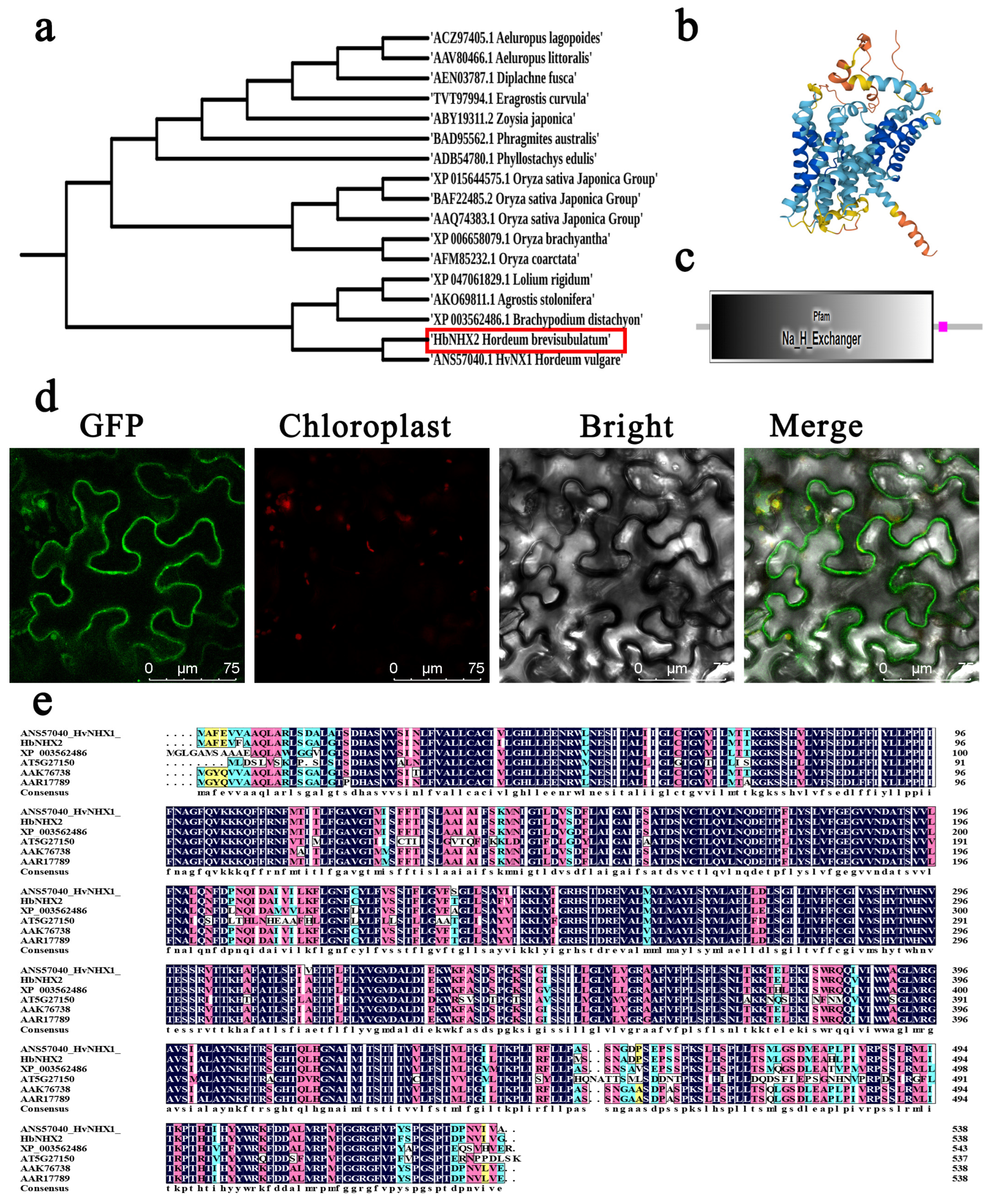
The full-length coding sequence (CDS) of HbNHX2 was 1617 bp, encoding a 538-amino acid protein (GenBank accession: OQ596533). The predicted molecular weight was 59.28 kDa with a theoretical pI of 8.14. The average hydrophilicity index was 0.608, and the protein was classified as stable and hydrophobic. According to the phylogenetic tree, HbNHX2 is in the same branch as HvNHX1 in barley, indicating that these genes have the greatest similarity (Figure 2a). The predicted 3D structure from SWISS-MODEL was consistent with its secondary structure (Figure 2b). Multiple sequence alignment showed 96.67% identity between HbNHX2 and HvNHX1 from barley (Figure 2e). Secondary structure prediction revealed that HbNHX2 contained approximately 45% α-helices, 5% β-turns, and 30% random coils. Subcellular localization prediction indicated that HbNHX2 was most likely localized to the plasma membrane. Transient expression of HbNHX2-GFP in tobacco leaf epidermal cells confirmed its localization in both the plasma membrane and chloroplasts (Figure 2d).

2.3. Expression Pattern Analysis of HbNHX2

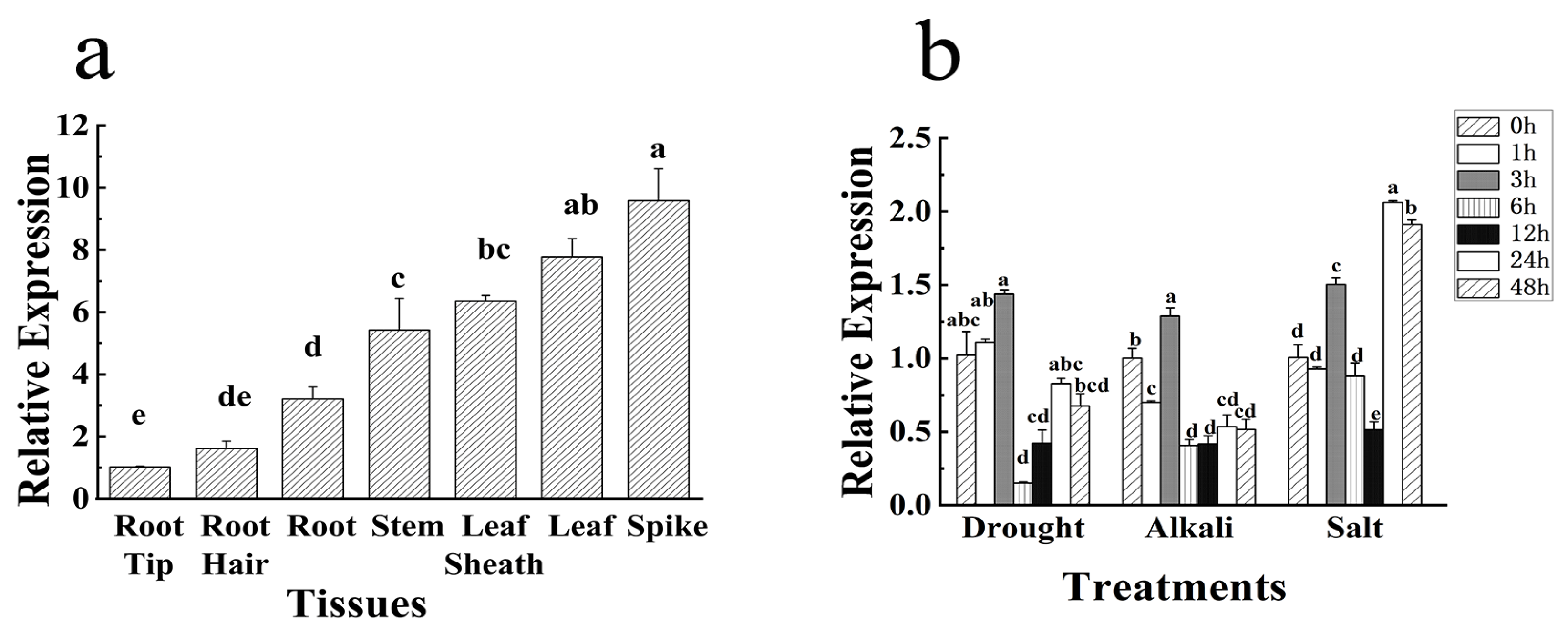
Quantitative expression analysis revealed that HbNHX2 was highly expressed in the spike and least expressed in the root tip. Expression in the spike and stem was 9.39 times and 5.31 times higher than in the root hair, respectively (Figure 3a). In the leaves of Hordeum brevisubulatum, under drought stress, the expression of HbNHX2 gene showed a trend of increasing first, then decreasing and then fluctuating, which was significantly up-regulated at 3 h of stress, reaching a peak (1.41 times). At 6 h, it began to decrease to the lowest level. At 48 h, HbNHX2 gene was significantly up-regulated compared with that at 6 h, but it was still lower than that at 0 h. Under alkali stress, the expression level of HbNHX2 gene showed a trend of first increasing, decreasing, then increasing, then decreasing and then stabilizing. The expression level of HbNHX2 gene was the highest at 3 h, which was 1.28 times of that at 0 h, and reached the lowest level at 6 h (0.40 times). Under NaCl treatment, HbNHX2 expression level in leaves showed a dynamic response. It initially increased at 3 h (1.49 times), decreased at 6 h, reached its lowest level at 12 h (0.51 times), and peaked at 24 h (2.05 times) (Figure 3b).

2.4. Genetic Transformation, Expression, and Phenotypic Analysis of Transgenic Tobacco

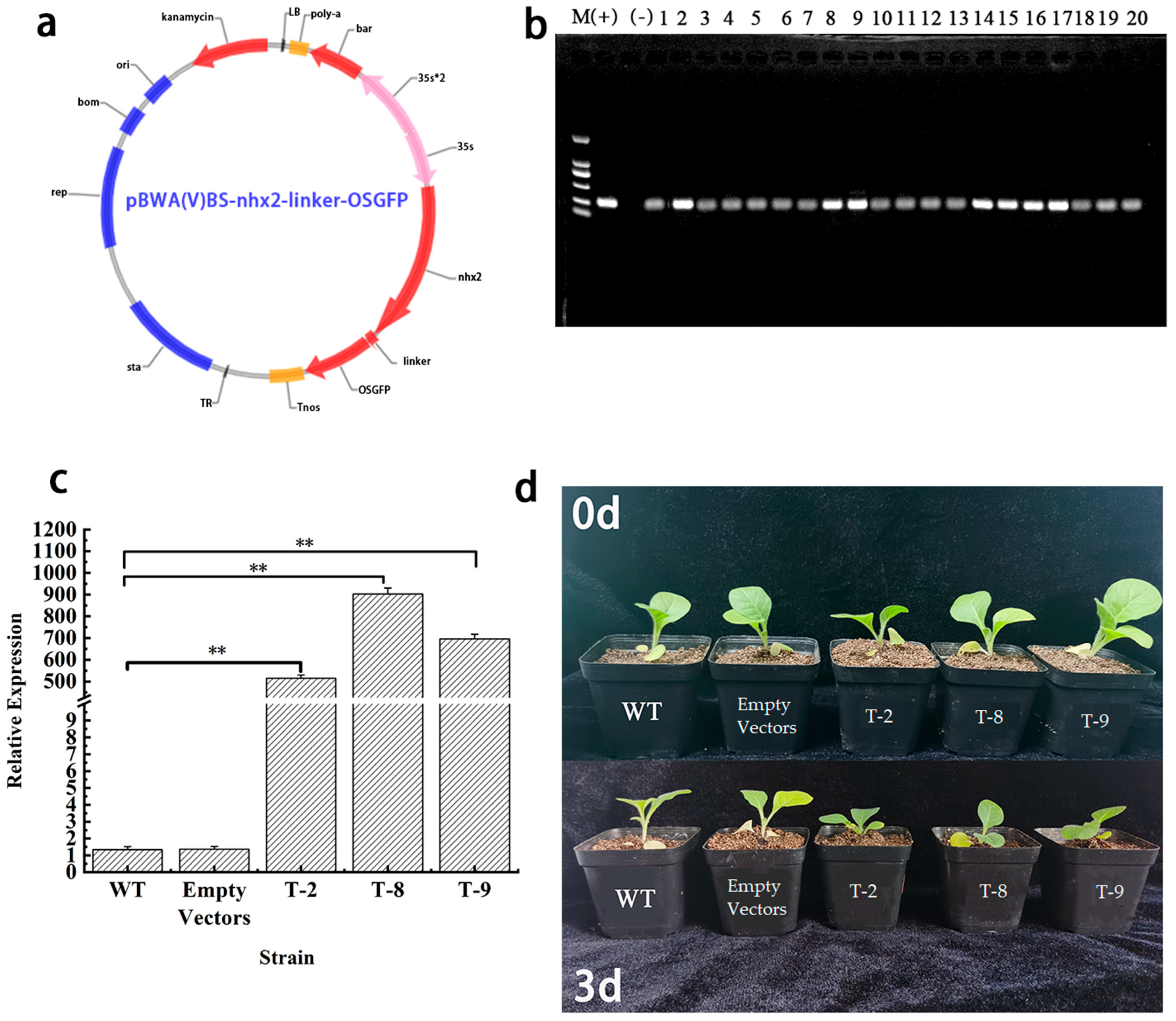
To investigate the role of HbNHX2 in salt tolerance, an overexpression vector (pBWA(V)BS-nhx2-linker-OSGFP) was constructed and transformed into tobacco (Nicotiana tabacum L. cv. K326) Among the transformed lines, T-2, T-8 and T-9 were selected based on PCR and qRT-PCR validation. These lines showed significantly higher HbNHX2 expression compared to WT plants (p < 0.01). Under 200 mM NaCl treatment, the non-transgenic tobacco lines showed an obvious yellowing phenomenon, indicating that the transgenic tobacco had resistance to salt stress (Figure 4). The empty-vector line showed no significant differences from WT under either or salt treatment conditions, confirming that the phenotypic changes observed in the overexpression lines were specifically due to HbNHX2 expression.

2.5. Physiological Response of Transgenic Tobacco Under Salt Stress

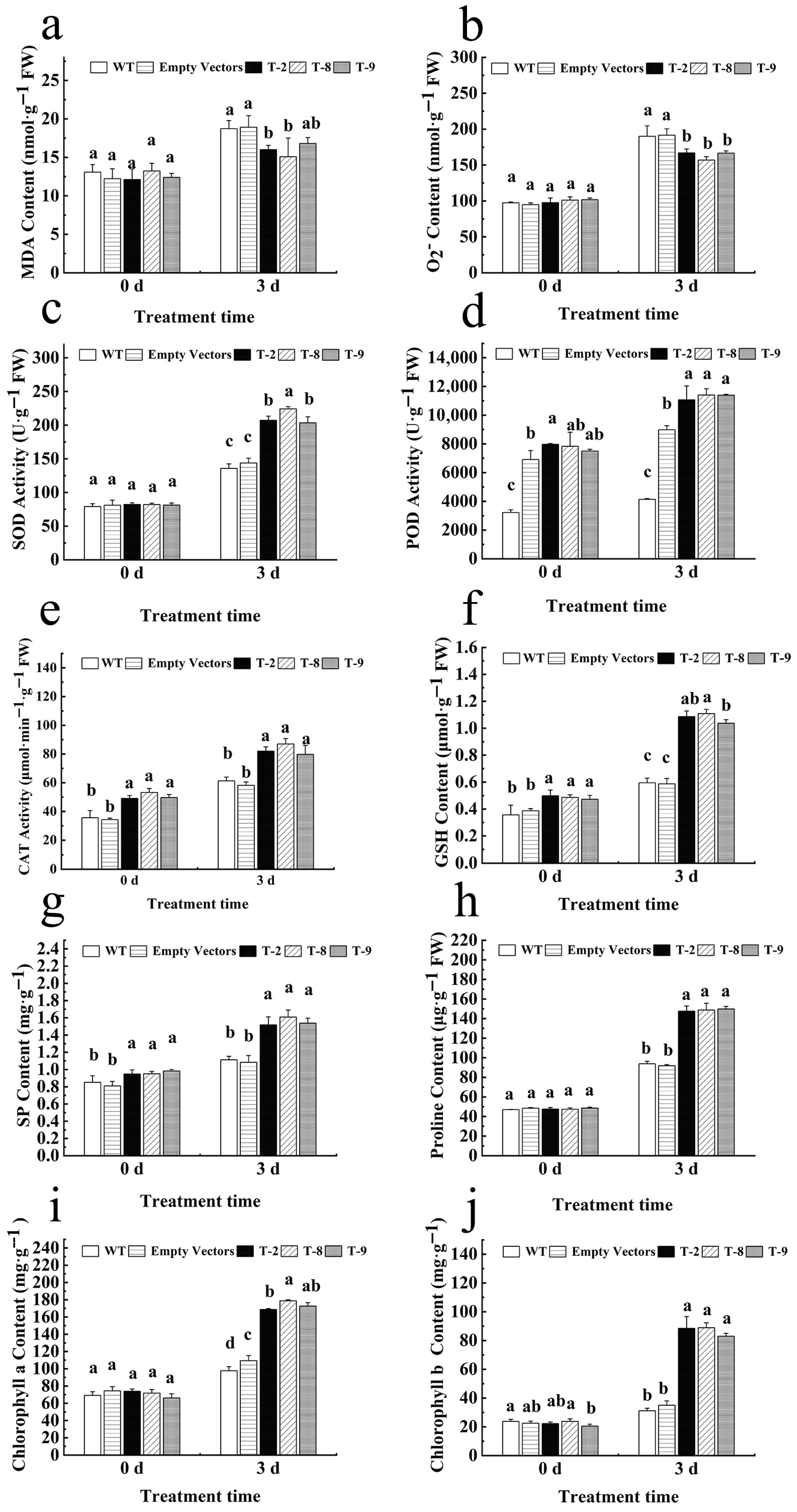
Physiological assays revealed that under 200 mM NaCl stress, transgenic lines overexpressing HbNHX2 showed significantly lower levels of MDA and O2, and higher level of SOD compared to WT and empty vector controls. Activities of antioxidant enzymes (POD, CAT) were significantly enhanced, although POD was significantly higher in the empty strain than in WT, POD activity in the OE strain was significantly higher than that in the empty strain. The overexpression lines also displayed increased levels of GSH, soluble protein, proline, and chlorophyll a and b, both under salt-stress conditions (Figure 5), These results suggest the overexpression of HbNHX2 increased the plant level of improved antioxidant capacity, osmotic adjustment, and photosynthetic efficiency under salt stress conditions.

2.6. Expression of Stress-Responsive Genes in Transgenic Tobacco

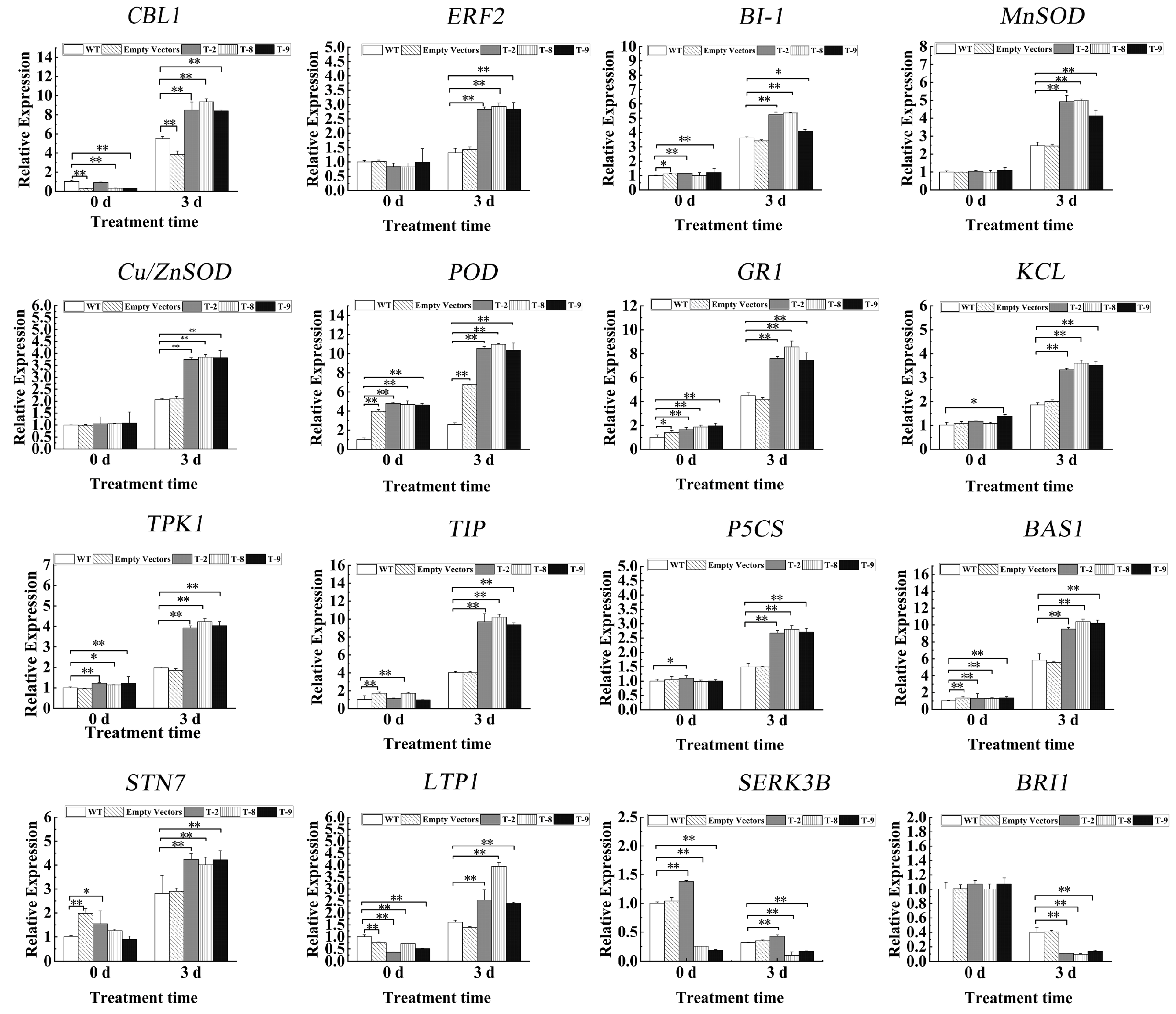
To further explore the molecular mechanisms of HbNHX2-mediated salt tolerance, the expression of 16 stress-related genes was evaluated in transgenic and WT plants under 200 mM NaCl treatment (Figure 6). Under normal conditions, there was no significant difference in the expression levels of ERF2, MnSOD, Cu/Zn-SOD and BRI1 in each strain. After stress treatment, the expression levels in OE strains were significantly different from those in WT and empty strains. ERF2, MnSOD, and Cu/Zn-SOD were significantly up-regulated, and BRI1 was significantly down-regulated. The expression levels of KC1, CBL1, and P5CS were inconsistent in each line under normal conditions, but they were significantly up-regulated in OE lines after stress. Although the expression levels of BI-1, POD, GR1, TIP, BAS1, STN7 and LTP1 in the empty lines were significantly different from those in WT under normal conditions, their expression levels in OE lines were significantly higher than those in WT and empty lines after stress treatment. These results indicate that overexpression of HbNHX2 can regulate stress-related genes to respond to salt stress without being affected by the vector.

3. Discussion

3.1. HbNHX2 and the NHX Gene Family in Plant Salt Tolerance

Na+/H+ antiporters (NHXs) are key membrane-bound transporters widely distributed in eukaryotes that maintain ion and pH homeostasis, thereby enabling plants to cope with diverse abiotic stresses [33]. They exchange cytosolic Na+ for H+ across cellular membranes and participate in multiple biological processes, including vacuolar ion compartmentalization, vesicle trafficking, cell expansion, and osmotic regulation [34]. In this study, HbNHX2 was cloned from Hordeum brevisubulatum, a halophytic species known for its remarkable salt tolerance. The protein shared high sequence similarity with HvNHX2 from barley, suggesting evolutionary conservation and functional relevance.
Expression profiling showed that HbNHX2 was highly expressed in stems and roots and was significantly induced under both salt and low-temperature stresses, implying a role in stress perception and ion homeostasis regulation, These results are consistent with previous reports on AtNHX1 in Arabidopsis and OsNHX1 in rice, both of which are strongly upregulated under salinity and contribute to enhanced Na+ sequestration and K+ retention [33,35,36]. Therefore, HbNHX2 may function as an important vacuolar or endosomal Na+/H+ antiporter in the halophytic adaptation of Hordeum brevisubulatum.

3.2. Functional and Physiological Characterization of HbNHX2 Was Studied Using Genetic Transformation

Subcellular localization analysis demonstrated that HbNHX2 was mainly distributed on the plasma membrane and chloroplast envelope, which is consistent with class II NHX-type proteins localized to endomembrane systems [37]. Dual localization of HbNHX2 to both the plasma membrane and chloroplast is particularly intriguing and may imply its multifaceted function in ion homeostasis under salt stress. NHX family members localized on the plasma membrane have been reported to participate in Na+ extrusion and K+ uptake to maintain cytosolic ion balance [23]. In contrast, chloroplast-associated NHX proteins are known to regulate stromal K+ retention, thylakoid lumen pH, and photosynthetic efficiency [38,39]. The dual localization of HbNHX2 therefore suggests that it may coordinate ion distribution across multiple cellular compartments. Under salt stress, a plasma membrane-localized pool of HbNHX2 could prevent cytosolic Na+ toxicity by excluding excess Na+, while the chloroplast-localized fraction might help sustain adequate K+ levels for optimal enzyme activity and photochemical stability, thereby mitigating chloroplast dysfunction and leaf chlorosis. These functions align well with the enhanced growth performance and alleviated photosynthetic inhibition observed in the transgenic plants. Future work combining ion-specific probes or subcellular fractionation will help clarify whether HbNHX2 modulates Na+ and K+ partitioning between the cytosol and chloroplast to confer salt tolerance more precisely. To further elucidate its function, HbNHX2 was overexpressed in K326. The transgenic plants displayed significantly enhanced salt tolerance compared with wild-type and empty-vector controls (Figure 4d).
Under NaCl stress, HbNHX2-overexpressing lines maintained significantly lower malondialdehyde (MDA) and superoxide (O2) levels, indicating reduced lipid peroxidation and oxidative membrane damage [40].This protection was associated with elevated activities of major antioxidant enzymes, including superoxide dismutase (SOD), peroxidase (POD), and catalase (CAT), and increased glutathione (GSH) content. Such enhancement of the antioxidant system suggests that HbNHX2 indirectly contributes to ROS detoxification, reducing oxidative stress in plant cells [41]. The empty-vector lines behaved similarly to WT in growth and physiological responses, indicating that the phenotype enhancement resulted from HbNHX2 expression rather than vector effects, consistent with previous reports on NHX overexpression.
Moreover, transgenic plants accumulated higher levels of soluble protein and proline, which serve as osmoprotectants and help maintain osmotic potential under salt stress [42], Elevated chlorophyll a and b contents further indicated that photosynthetic efficiency and pigment stability were better maintained in transgenic lines than in controls. Together, these findings demonstrate that HbNHX2 not only contributes to ion and osmotic balance but also enhances redox homeostasis and photosynthetic stability, resulting in improved physiological resilience under salinity.
NHX-type Na+/H+ antiporters primarily contribute to ion homeostasis by reducing cytosolic Na+ and maintaining cellular K+ levels under salt stress, which are essential for ROS detoxification and enzyme stability [43]. Improved ion balance can indirectly attenuate ROS generation in chloroplasts and mitochondria, thereby reducing oxidative damage. Meanwhile, increasing evidence suggests that NHX activity may also modulate ROS signaling pathways, influencing the transcription of antioxidant-related genes through Ca2+ or MAPK signaling crosstalk [39,41]. Thus, the enhanced antioxidant capacity observed in HbNHX2 plants is likely the result of coordinated effects of improved ion homeostasis and stress-responsive ROS signaling. To further strengthen this mechanistic model, future work could investigate the expression of ROS-related regulatory genes and quantify ROS levels together with ion contents (e.g., Na+/K+ ratios) to establish correlations among ion transport, ROS homeostasis, and transcriptional responses [44]. Such evidence would help clarify whether HbNHX2 confers salt tolerance primarily via direct ROS signaling modulation, indirect ionic regulation, or both.
In various plants, the compartmentalization of Na+ and the maintenance of K+ homeostasis are crucial for salt stress tolerance. For instance, overexpression of the McNHX1 gene in tobacco significantly enhances vacuolar Na+ compartmentalization, thereby improving salt tolerance in sensitive plants [45]. Similarly, overexpression of OsNHX1 in Oryza sativa L. strengthens Na+ compartmentalization in the roots, reducing Na+ transport to the shoot while maintaining K+ levels in the leaves [13]. In tobacco, overexpression of TaNHX3 in Triticum aestivum L. is not only promoted Na efflux but also helps retain K induced, contributing to ion homeostasis [46]. In Ricinus communis L., compared with the control group, the plants overexpressing SbNHX1 showed lower Na+ content and higher K+ ion accumulation, and generally showed higher K+/Na+ [47] (Table S3).
Comparative analysis suggests that HbNHX2 functions similarly to NHX genes from halophytes and salt-tolerant algae, mainly by maintaining Na+/K+ homeostasis and mitigating oxidative stress under salinity [48]. This indicates a conserved protective mechanism across salt-adapted species. Meanwhile, the observed effects on antioxidant regulation and signaling dynamics may reflect species-specific optimization for the extreme saline environment of Hordeum brevisubulatum.
Potential trade-offs should also be considered. Constitutive NHX activation may affect cellular pH gradients, energy cost, or hormone balance, potentially limiting growth when stress is absent [33]. Therefore, conditional expression strategies or long-term performance evaluation would be valuable for future applications.

3.3. Transcriptional Regulation of Stress-Responsive Genes in HbNHX2-Overexpressing Plants

Quantitative RT-PCR analysis revealed that HbNHX2 overexpression triggered broad transcriptional reprogramming in tobacco, affecting multiple stress-responsive pathways. Upregulation of CBL1, a calcium sensor involved in abiotic stress signaling, indicates that HbNHX2 may interact with calcium-dependent signaling cascades to facilitate salt tolerance [49,50,51,52]. Similarly, ERF2, an ethylene-responsive transcription factor, and BI-1, an anti-apoptotic gene suppressing ROS-induced cell death, were significantly upregulated, enhancing cellular adaptation to oxidative and ionic stresses [53]. Genes related to ion transport (KC1, TPK1) and osmotic regulation (TIP, P5CS) were also strongly induced. These genes are essential for maintaining K+ absorption, vacuolar ion storage, and proline biosynthesis, collectively supporting osmotic adjustment and ion balance [54,55,56]. The enhanced expression of Cu/Zn-SOD, MnSOD, and NtPOD was consistent with higher enzyme activities observed physiologically, reflecting stronger ROS-scavenging capacity. In addition, the upregulation of BAS1 and STN7 suggests that HbNHX2 may stabilize chlorophyll content and maintain photosynthetic electron transport under salinity [57,58,59,60,61].
Conversely, SERK3B and BRI1, both known to negatively regulate stress resistance, were significantly downregulated in HbNHX2-overexpressing plants. The downregulation of SERK3B and BRI1 in the transgenic lines is intriguing and may indicate an adaptive adjustment of brassinosteroid (BR) signaling under salt stress. BRI1 and its co-receptor SERK3/BAK1 are essential for BR perception and growth promotion, but several studies have shown that partial suppression of BR signaling can enhance abiotic stress tolerance by redirecting resources from cell expansion toward defense and stress protection. Reduced BR signaling may also enhance ABA sensitivity, regulate the expression of ion transporters, and modulate ROS-scavenging enzymes. Under saline conditions, lower BRI1–SERK3B activity could help maintain ion and osmotic homeostasis by reducing Na+ influx through decreased transpiration, while promoting protective pathways that stabilize membranes and chloroplast function. Thus, the observed downregulation of these genes may reflect a strategic reprogramming that balances growth inhibition with improved stress resilience. Further experiments, such as exogenous BR application or BR-responsive gene analysis, would clarify whether suppression of BR signaling directly contributes to the enhanced salt tolerance observed here [62,63].
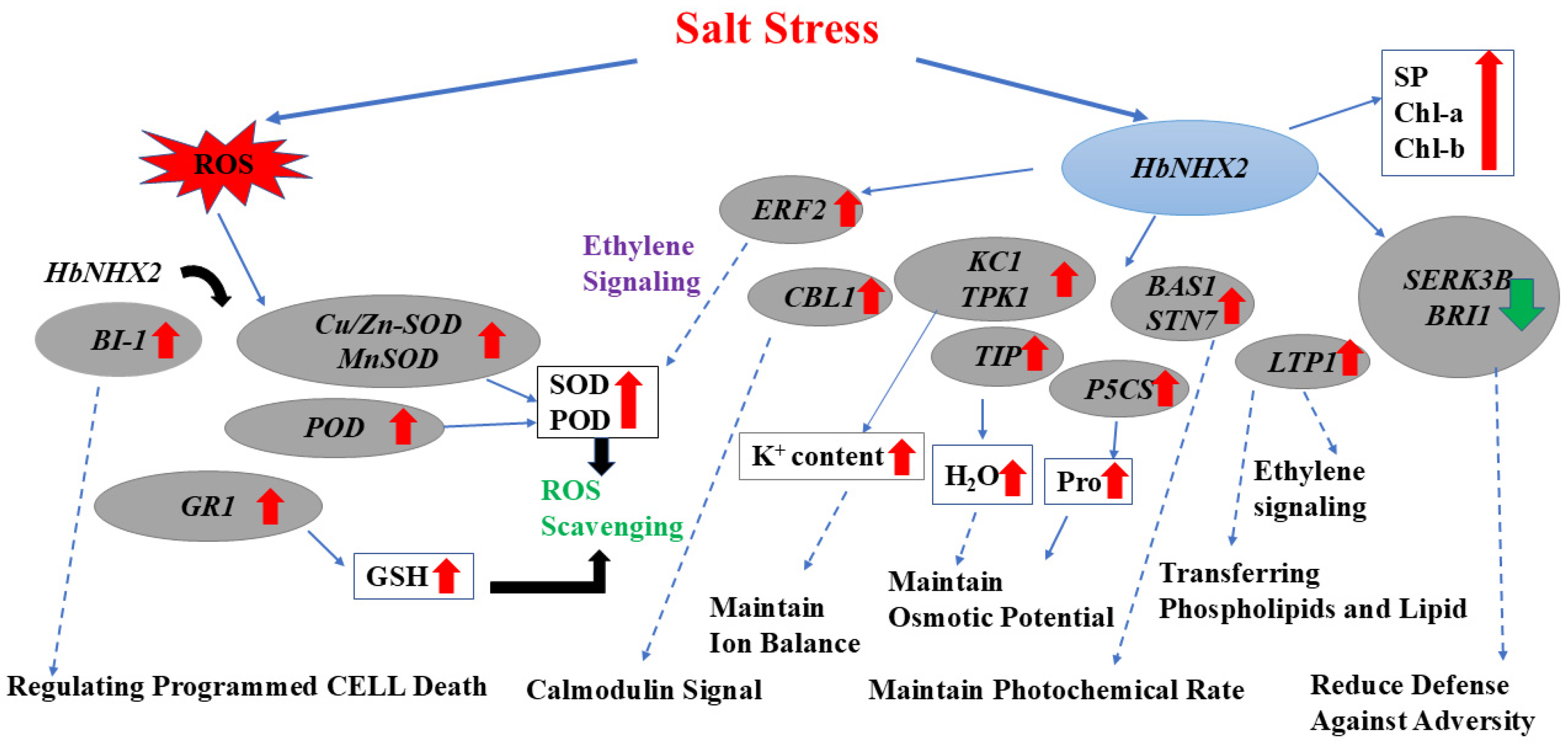
These integrated physiological and molecular responses collectively form the basis of a proposed model for HbNHX2-mediated salt tolerance (Figure 7). It activates osmotic adjustment through increased accumulation of soluble proteins and proline. Enhanced antioxidant enzyme activities (SOD, POD, CAT) and elevated GSH levels contribute to effective ROS detoxification, reducing oxidative membrane damage. At the molecular level, HbNHX2 overexpression induces transcription of CBL1, ERF2, BI-1, NtKC1, NtTPK1, TIP, P5CS, and antioxidant-related genes, while repressing SERK3B and BRI1. This coordinated regulation enhances Ca2+ signaling, ethylene response, osmotic regulation, and redox balance, forming a multilayered defense network. The synergistic regulation of these pathways enables plants to maintain physiological and metabolic stability in high-salinity environments.
In conclusion, HbNHX2 confers salt tolerance by integrating ionic, osmotic, and oxidative stress responses at both physiological and transcriptional levels. These findings expand our understanding of NHX-mediated stress adaptation and provide a valuable genetic resource for improving crop resilience through molecular breeding and transgenic approaches.

4. Materials and Methods

4.1. Plant Growth and Treatment

In this study, Hordeum brevisubulatum (Trin.) Link cv. Saertu was used as the plant material. Mature and uniform seeds of Hordeum brevisubulatum were surface-sterilized through immersion in 10% NaClO for 1 min, followed by three rinses with distilled water, treatment with 70% ethanol for 2 min, and finally washed 4–5 times with sterile water. The sterilized seeds were cultured on germination medium in an incubator. After 10 days, seedlings were transplanted to plastic pots filled with vermiculite and maintained in a growth chamber at 25 ± 2 °C and 65% ± 2% relative humidity, under a 16 h light/8 h dark photoperiod. Plants were irrigated with 1/10 Hoagland nutrient solution. Most of the 30-day-old Hordeum brevisubulatum seedlings were subjected to 15% PEG-6000, 150 mM NaCl, and 150 mM NaHCO3 for 0 (control), 3, 6, 12, 24, and 48 h. Leaf samples were frozen in liquid nitrogen and stored at −80 °C for subsequent analysis. Each treatment included three biological replicates. The remaining plants were further cultivated until they began to spike. The spikes, leaves, leaf sheaths, stems, roots, root hairs, and root tips of Hordeum brevisubulatum were collected and frozen in liquid nitrogen for storage at −80 °C for tissue-specific expression analysis.

4.2. Identification of HbNHX Gene Family Members

NHX amino acid sequences of Arabidopsis thaliana were retrieved from the TAIR database (http://arabidopsis.org/) (accessed on 1 October 2025). Using the transcriptome data of Hordeum brevisubulatum from previous studies, a local BLAST database (ncbi-blast-2.17.0 was constructed to identify homologs according to Arabidopsis NHX sequences. Candidate NHX proteins were verified using Batch-CDD (https://www.ncbi.nlm.nih.gov/cdd) (accessed on 1 October 2025). A total of 16 putative HbNHX genes were identified, after excluding sequences lacking the NHX domain.
Physicochemical properties and subcellular localization of HbNHX family members were predicted using ExPASy (https://web.expasy.org/protparam/) (accessed on 1 October 2025) and CELLO (http://cello.life.nctu.edu.tw/) (accessed on 1 October 2025), respectively. Conserved motifs were analyzed using MEME Suite (http://meme-suite.org/) (accessed on 1 October 2025) and visualized with TBtools v2.096. Homology analysis was conducted via blast using the NCBI database, and a phylogenetic tree was constructed using MEGA11.0 software with the neighbor-joining method.

4.3. Isolation and Cloning of HbNHX2

Total RNA was extracted from healthy Hordeum brevisubulatum seedlings using an Ultrapure RNA Kit (CWBIO, Beijing, China), and RNA integrity and concentration were assessed with a NanoPhotometer (Implen, Munich, Germany). First-strand cDNA synthesis was performed using the HiScript II Q Select RT SuperMix for qPCR (+gDNA wiper) (Vazyme, Nanjing, China). The CDS of HbNHX2 was amplified using primers (Table S1) designed with Primer Express 5.0 based on the Hordeum vulgare HvNHX1 gene sequence (ANS57040.1). The PCR products of HbNHX2 were was inserted into the pCE2 TA/Blunt-Zero vector (Vazyme, Nanjing, China) using the ClonExpress R II One Step Cloning Kit (Vazyme, Nanjing, China) and sequenced by RuiBiotech Co. (Harbin, China). The conserved domain and protein structure of HbNHX2 were predicted using NCBI-CDD, SOPMA (http://pbil.ibcp.fr) (accessed on 1 October 2025), and SWISS-MODEL (https://swissmodel.expasy.org/) (accessed on 1 October 2025) [64,65,66].

4.4. Expression Pattern Analysis of Tissue Specificity and Stress Response of HbNHX2 Gene

Real-time quantitative PCR (qRT-PCR) was used to analyze tissue-specific and stress-responsive expression patterns of HbNHX2. Total RNA from each sample was reverse-transcribed using the HiScript II Q Select RT SuperMix for qPCR (+gDNA wiper); (Vazyme, Nanjing, China). qRT-PCR was performed using ChamQ Universal SYBR qPCR Master Mix (Vazyme, Nanjing, China) on a Quantagene q225 Real-Time PCR system (Novogene, Nanjing, China). Primer sequences are listed in Table S1. The HvActin was used as the internal reference gene, and relative expression levels were calculated using the comparative cycle threshold (Ct) method (2−ΔΔCt) [67].

4.5. Plant Transformation and Generation of Transgenic Tobacco

The coding sequence of HbNHX2 was cloned into the pBWA(V)BS-ccdB-OSGFP vector using BsaI/Eco31I restriction enzymes, generating the pBWA(V)BS-HbNHX2-linker-OSGFP overexpression vector. The recombinant plasmid was introduced into Agrobacterium tumefaciens strain EHA105 to perform genetic transformation for wild-type (WT) of tobacco. Transgenic tobacco was selected on glyphosate-containing medium (15 mg/L), and positive transformants were identified using PCR with Bar gene specific primers (Table S1). Homozygous lines were confirmed with qRT-PCR using qPCR-HbNHX2 primers, with NtActin as the reference gene (Table S1). The homozygous linesT-2, T-8, and T-9 were selected for subsequent experiments.

4.6. Subcellular Localization of HbNHX2 Protein

Tobacco (Nicotiana benthamiana) seeds were germinated in vermiculite and irrigated with 1/10 Hoagland solution. Plants at the 4–5 true leaf stage were used for transient expression experiments.
The coding sequence of HbNHX2 without a termination codon was cloned into the pBWA(V)BS-ccdB-OSGFP vector using BsaI/Eco31I restriction enzymes to generate the pBWA(V)BS-HbNHX2-linker-OSGFP fusion construct under the control of the 35S promoter. The recombinant plasmid and the control vector (35S::OSGFP) were transformed into Agrobacterium tumefaciens strain GV3101 and transiently expressed in tobacco leaves through agroinfiltration. After incubation for 48–72 h, GFP fluorescence was observed using a confocal laser scanning microscope (Leica TCS SP2 AOBS, Shanghai, China). The localization of the HbNHX2-GFP fusion protein was analyzed by comparing the GFP signal.

4.7. Physiological Index of Homozygous Lines Subjected to Salt Stress

A total of 400 seeds from transgenic and WT tobacco lines were germinated on 1/2 MS medium after vernalization at 4 °C for 2 days. After germination, seedlings were transplanted into vermiculite-filled pots and grown under controlled conditions (25 °C). After 15 days, uniform and healthy seedlings were subjected to 200 mM NaCl stress for 3 days. Leaf samples before and after treatment were harvested, frozen in liquid nitrogen, and stored at −80 °C for further physiological and molecular analyses. Each treatment included three biological replicates, with each replicate containing three plants.
The contents of malondialdehyde (MDA) were determined using the thiobarbituric acid (TBA) method, and the generation rate of superoxide anion (O2) was measured using the hydroxylamine method. Superoxide dismutase (SOD) activity was assayed using the nitroblue tetrazolium (NBT) photoreduction inhibition method, peroxidase (POD) activity with the guaiacol method, and catalase (CAT) activity by monitoring the decrease in absorbance at 240 nm (A240 method). Reduced glutathione (GSH) content was determined using the 5,5′-dithiobis-(2-nitrobenzoic acid) (DTNB) method, soluble protein content was measured with the Bradford assay, and proline content was determined using the acidic ninhydrin method [68,69,70,71]. Chlorophyll a, b, and total chlorophyll contents were quantified using the acetone extraction method. were measured using commercial assay kits (Suzhou Keming Biotechnology Co., Ltd., Suzhou, China) following the manufacturer’s instructions. Absorbance values were determined using a k6600-a (Beijing Kaiao Technology Development Co., Ltd., Beijing, China) tmna microplate reader. All physiological measurements were based on at least three independent biological replicates (each replicate containing five plants per line).

4.8. Expression Analysis of Stress-Responsive Gene Subjected to Salt Stress

To further elucidate the molecular mechanisms underlying HbNHX2-mediated salt tolerance, we selected a set of marker genes representing major stress-responsive pathways. These included genes involved in ion homeostasis and signal transduction (CBL1, KC1, PK1, SERK3B, BRI1, BAS1), cell death and stress protection (BI-1), ROS scavenging (MnSOD, Cu/Zn-SOD, POD, GR1), osmotic regulation (P5CS), membrane water transport (TIP), lipid transfer and membrane stability (LTP1), photosynthetic protection (STN7), and ethylene-dependent stress signaling (ERF2). These genes have been widely reported to participate in salt response networks in plants. Their expression patterns were therefore used to evaluate whether HbNHX2 overexpression enhances salt tolerance through coordinated regulation of ion homeostasis, ROS balance, and stress signaling cascades.
Seventeen stress-related genes were analyzed in WT and transgenic tobacco under salt stress. qRT-PCR was performed using NtActin as an internal reference. Primer sequences are listed in Table S1.

4.9. Data Analysis

The experiments were replicated three times using the same methodology and all the data are expressed as the means ± standard deviation. Gene expression and physiological data were statistically analyzed using Excel 2019 and SPSS 22.0. Graphs were generated and visualized using Origin 2018, TBtools v2.096 and PowerPoint 2019. Significant differences between treatments were determined using one-way ANOVA and independent-samples t-tests (α = 0.05 or 0.01, as indicated).

5. Conclusions

In this study, the 16 members of the HbNHX family in Hordeum brevisubulatum were identified, and the HbNHX2 gene was cloned and functionally characterized. The gene encodes a stable and hydrophobic protein localized to the plasma membrane and chloroplast. Its expression is highest in spikes and is induced to salt and low-temperature stress. Transgenic tobacco plants overexpressing HbNHX2 showed enhanced salt tolerance reflected by the improved antioxidant capacity and osmotic regulation. Moreover, HbNHX2 influenced the expression of stress-related genes involved in ion transport, osmotic adjustment, and oxidative defense. Overall, HbNHX2 plays a key role in plant salt stress adaptation and represents a promising candidate for improving salt tolerance in forage and crop species.

Supplementary Materials

The following supporting information can be downloaded at: https://www.mdpi.com/article/10.3390/plants14233658/s1, Table S1. List of primers in this study. Table S2. Physicochemical properties and subcellular localization of HbNHXs family protein. Table S3. The function of NHX gene in different plants and its effect on Na+ and K+ homeostasis under salt stress.

Author Contributions

Conceptualization, H.Y., B.L. and G.C.; Methodology, H.Y., B.L., M.T., S.Z. and G.C.; Software, H.Y., B.L. and G.C.; Validation, M.Z., H.Y., B.L. and G.C.; Formal analysis, M.Z., M.Y., W.Z., M.T. and G.C.; Investigation, M.Z., M.Y., W.Z., X.Z., B.W. and S.Z.; Resources, M.Z., M.Y., X.Z. and B.W.; Data curation, M.Z. and M.Y.; Writing—original draft, M.Z. and W.Z.; Writing—review and editing, M.Y.; Visualization, M.Z., M.Y., W.Z., X.Z., B.W. and S.Z.; Supervision, H.Y., B.L. and G.C.; Project administration, H.Y., B.L. and G.C.; Funding acquisition, G.C. All authors have read and agreed to the published version of the manuscript.

Funding

This research was funded by Creation and Utilization of New Saline-Alkali Tolerant Germplasm, grant number [2023YFD120030403], and The National Key Research and Development Program of China [2023YFD1200300].

Data Availability Statement

The original contributions presented in this study are included in the article/Supplementary Material. Further inquiries can be directed to the corresponding authors.

Acknowledgments

We thank the individuals who provided linguistic assistance.

Conflicts of Interest

The authors declare that there are no conflicts of interest.

Abbreviations

The following abbreviations are used in this manuscript:
MDAMalondialdehyde
O2Superoxide anion
SODSuperoxide dismutase
PODPeroxidase
CATCatalase
ROSReactive oxygen species
GSHGlutathione
K326Nicotiana tabacum L. cv. K326
CBL1Calcineurin B-like 1
ERF2Ethylene-Responsive Factor
BI-1Bax inhibitor-1
MnSODSuperoxide dismutase [Mn]
Cu/Zn-SODSuperoxide dismutase [41Cu-Zn]
PODNicotiana tabacum Peroxidase
GR1Protein gamma response 1.
KC1Potassium channel KAT3-like 1.
TPK1:Two-pore potassium channel 1-like 1
TIPAquaporin TIP-type
P5CSDelta-1-pyrroline-5-carboxylate synthase
BAS12-Cys peroxiredoxin
STN7Serine/Threonine kinase domain protein
LTP1Lipid-transfer protein 1.
SERK3BSomatic Embryogenesis Receptor-like Kinase 3B
BRI1Brassinosteroid LRR receptor kinase

References

  1. Li, J.; Pu, L.; Han, M.; Zhu, M.; Zhang, R.; Xiang, Y. Soil salinization research in China: Advances and prospects. J. Geogr. Sci. 2014, 24, 943–960. [Google Scholar] [CrossRef]
  2. Lin, J.; Wang, J.; Li, X.; Zhang, Y.; Xu, Q.; Mu, C. Effects of saline and alkaline stresses in varying temperature regimes on seed germination of Leymus chinensis from the Songnen Grassland of China. Grass Forage Sci. 2011, 66, 578–584. [Google Scholar] [CrossRef]
  3. Zhang, Z.; He, K.; Zhang, T.; Tang, D.; Li, R.; Jia, S. Physiological responses of Goji berry (Lycium barbarum L.) to saline-alkaline soil from Qinghai region, China. Sci. Rep. 2019, 9, 12057. [Google Scholar] [CrossRef] [PubMed]
  4. Shi, D.; Wang, D. Effects of various salt-alkaline mixed stresses on Aneurolepidium chinense (Trin.) Kitag. Plant Soil 2005, 271, 15–26. [Google Scholar] [CrossRef]
  5. Van Zelm, E.; Zhang, Y.; Testerink, C. Salt tolerance mechanisms of plants. Annu. Rev. Plant Biol. 2020, 71, 403–433. [Google Scholar] [CrossRef] [PubMed]
  6. Ahanger, M.A.; Agarwal, R. Salinity stress induced alterations in antioxidant metabolism and nitrogen assimilation in wheat (Triticum aestivum L.) as influenced by potassium supplementation. Plant Physiol. Biochem. 2017, 115, 449–460. [Google Scholar] [CrossRef]
  7. Elkelish, A.A.; Soliman, M.H.; Alhaithloul, H.A.; El-Esawi, M.A. Selenium protects wheat seedlings against salt stress-mediated oxidative damage by up-regulating antioxidants and osmolytes metabolism. Plant Physiol. Biochem. 2019, 137, 144–153. [Google Scholar] [CrossRef]
  8. Ahanger, M.A.; Qin, C.; Maodong, Q.; Dong, X.X.; Ahmad, P.; Abd_Allah, E.F.; Zhang, L. Spermine application alleviates salinity induced growth and photosynthetic inhibition in Solanum lycopersicum by modulating osmolyte and secondary metabolite accumulation and differentially regulating antioxidant metabolism. Plant Physiol. Biochem. 2019, 144, 1–13. [Google Scholar] [CrossRef]
  9. Finn, R.D.; Clements, J.; Eddy, S.R. HMMER web server: Interactive sequence similarity searching. Nucleic Acids Res. 2011, 39, W29–W37. [Google Scholar] [CrossRef]
  10. Wang, L.; Wu, X.; Liu, Y.; Qiu, Q.-S. AtNHX5 and AtNHX6 control cellular K+ and pH homeostasis in Arabidopsis: Three conserved acidic residues are essential for K+ transport. PLoS ONE 2015, 10, e0144716. [Google Scholar] [CrossRef]
  11. Yamaguchi, T.; Fukada-Tanaka, S.; Inagaki, Y.; Saito, N.; Yonekura-Sakakibara, K.; Tanaka, Y.; Kusumi, T.; Iida, S. Genes encoding the vacuolar Na+/H+ exchanger and flower coloration. Plant Cell Physiol. 2001, 42, 451–461. [Google Scholar] [CrossRef]
  12. Gaxiola, R.A.; Rao, R.; Sherman, A.; Grisafi, P.; Alper, S.L.; Fink, G.R. The Arabidopsis thaliana proton transporters, AtNhx1 and Avp1, can function in cation detoxification in yeast. Proc. Natl. Acad. Sci. USA 1999, 96, 1480–1485. [Google Scholar] [CrossRef]
  13. Fukuda, A.; Nakamura, A.; Tagiri, A.; Tanaka, H.; Miyao, A.; Hirochika, H.; Tanaka, Y. Function, intracellular localization and the importance in salt tolerance of a vacuolar Na+/H+ antiporter from rice. Plant Cell Physiol. 2004, 45, 146–159. [Google Scholar] [CrossRef] [PubMed]
  14. Zorb, C.; Noll, A.; Karl, S.; Leib, K.; Yan, F.; Schubert, S. Molecular characterization of Na+/H+ antiporters (ZmNHX) of maize (Zea mays L.) and their expression under salt stress. J. Plant Physiol. 2020, 162, 55–66. [Google Scholar] [CrossRef]
  15. Wang, J.; Zuo, K.; Wu, W.; Song, J.; Sun, X.; Lin, J.; Li, X.; Tang, K. Molecular cloning and characterization of a new Na+/H+ antiporter gene from Brassica napus. DNA Seq. 2003, 14, 351–358. [Google Scholar] [CrossRef]
  16. Sharma, P.; Mishra, S.; Pandey, B.; Singh, G. Genome-wide identification and expression analysis of the NHX gene family under salt stress in wheat (Triticum aestivum L.). Front. Plant Sci. 2023, 14, 17. [Google Scholar] [CrossRef]
  17. Cavusoglu, E.; Sari, U.; Tiryaki, I. Genome-wide identification and expression analysis of Na+/H+ antiporter (NHX) genes in tomato under salt stress. Plant Direct 2023, 7, 17. [Google Scholar] [CrossRef] [PubMed]
  18. Khare, T.; Joshi, S.; Kaur, K.; Srivastav, A.; Kumar, V. Genome-wide in silico identification and characterization of sodium-proton (Na+/H+) antiporters in Indica rice. Plant Gene 2021, 26, 100280. [Google Scholar] [CrossRef]
  19. Guo, H.-M.; Gu, C.-S.; Chen, F.-D.; Xu, Y.-C.; Liu, Z.-L. Salt Tolerance Verification of Lotus NnNHX1 in Transformed Tobacco. Acta Hortic. Sin. 2012, 39, 323. [Google Scholar]
  20. Apse, M.P.; Aharon, G.S.; Snedden, W.A.; Blumwald, E. Salt Tolerance Conferred by Overexpression of a Vacuolar Na+/H+ Antiport in Arabidopsis. Science 1999, 285, 1256–1258. [Google Scholar] [CrossRef]
  21. Wu, C.A.; Yang, G.D.; Meng, Q.W.; Zheng, C.C. The Cotton GhNHX1 Gene Encoding a Novel Putative Tonoplast Na+/H+ Antiporter Plays an Important Role in Salt Stress. Plant Cell Physiol. 2004, 45, 600–607. [Google Scholar] [CrossRef]
  22. Wang, B.; Zhai, H.; He, S.; Zhang, H.; Ren, Z.; Zhang, D.; Liu, Q. A vacuolar Na+/H+ antiporter gene, IbNHX2, enhances salt and drought tolerance in transgenic sweetpotato. Sci. Hortic. 2016, 201, 153–166. [Google Scholar] [CrossRef]
  23. Apse, M.P.; Blumwald, E. Na+ transport in plants. FEBS Lett. 2007, 581, 2247–2254. [Google Scholar] [CrossRef]
  24. Blumwald, E. Sodium transport and salt tolerance in plants. Curr. Opin. Cell Biol. 2000, 12, 431–434. [Google Scholar] [CrossRef]
  25. Jegadeeson, V.; Kumari, K.; Pulipati, S.; Parida, A.; Venkataraman, G. Expression of wild rice Porteresia coarctata PcNHX1 antiporter gene (PcNHX1) in tobacco controlled by PcNHX1 promoter (PcNHX1p) confers Na+-specific hypocotyl elongation and stem-specific Na+ accumulation in transgenic tobacco. Plant Physiol. Biochem. 2019, 139, 161–170. [Google Scholar] [CrossRef]
  26. Solis, C.A.; Yong, M.-T.; Zhou, M.; Venkataraman, G.; Shabala, L.; Holford, P.; Shabala, S.; Chen, Z.-H. Evolutionary significance of NHX family and NHX1 in salinity stress adaptation in the genus oryza. Int. J. Mol. Sci. 2022, 23, 2092. [Google Scholar] [CrossRef]
  27. Chanroj, S.; Wang, G.; Venema, K.; Zhang, M.W.; Delwiche, C.F.; Sze, H. Conserved and diversified gene families of monovalent cation/H+ antiporters from algae to flowering plants. Front. Plant Sci. 2012, 3, 25. [Google Scholar] [CrossRef] [PubMed]
  28. Bassil, E.; Coku, A.; Blumwald, E. Cellular ion homeostasis: Emerging roles of intracellular NHX Na+/H+ antiporters in plant growth and development. J. Exp. Bot. 2012, 63, 5727–5740. [Google Scholar] [CrossRef] [PubMed]
  29. Tsujii, M.; Tanudjaja, E.; Uozumi, N. Diverse physiological functions of cation proton antiporters across bacteria and plant cells. Int. J. Mol. Sci. 2020, 21, 4566. [Google Scholar] [CrossRef] [PubMed]
  30. Linde-Laursen, I.; von Bothmer, R. Giemsa C-banded karyotypes of two subspecies of Hordeum brevisubulatum from China. Plant Syst. Evol. 1984, 145, 259–267. [Google Scholar] [CrossRef]
  31. Clement, S.; Lester, D. Screening wild Hordeum species for resistance to Russian wheat aphid. Cereal Res. Commun. 1990, 18, 173–177. [Google Scholar]
  32. Zhang, H.; Tian, X.; Yu, W.; Wang, Y.; Du, Q.; Li, R. The specific HbHAK2 promoter from halophytic Hordeum brevisubulatum regulates root development under salt stress. Agric. Commun. 2024, 2, 100050. [Google Scholar] [CrossRef]
  33. Bassil, E.; Tajima, H.; Liang, Y.C.; Ohto, M.A.; Ushijima, K.; Nakano, R.; Esumi, T.; Coku, A.; Belmonte, M.; Blumwald, E. The Arabidopsis Na+/H+ antiporters NHX1 and NHX2 control vacuolar pH and K+ homeostasis to regulate growth, flower development, and reproduction. Plant Cell 2011, 23, 3482–3497. [Google Scholar] [CrossRef]
  34. Pardo, J.M.; Cubero, B.; Quintero, L.F.J. Alkali cation exchangers: Roles in cellular homeostasis and stress tolerance. J. Exp. Bot. 2006, 57, 1181–1199. [Google Scholar] [CrossRef]
  35. Fukuda, A.; Nakamura, A.; Hara, N.; Toki, S.; Tanaka, Y. Molecular and functional analyses of rice NHX-type Na+/H+ antiporter genes. Planta 2011, 233, 175–188. [Google Scholar] [CrossRef]
  36. Liu, M.; Song, X.; Jiang, Y. Growth, ionic response, and gene expression of shoots and roots of perennial ryegrass under salinity stress. Acta Physiol. Plant. 2018, 40, 112. [Google Scholar] [CrossRef]
  37. Leidi, E.O.; Barragán, V.; Rubio, L.; El-Hamdaoui, A.; Pardo, J.M. The AtNHX1 exchanger mediates potassium compartmentation in vacuoles of transgenic tomato. Plant J. 2010, 61, 495–506. [Google Scholar] [CrossRef]
  38. Müller, M.; Kunz, H.H.; Schroeder, J.I.; Kemp, G.; Young, H.S.; Neuhaus, H.E. Decreased capacity for sodium export out of Arabidopsis chloroplasts impairs salt tolerance, photosynthesis and plant performance. Plant J. 2014, 78, 646–658. [Google Scholar] [CrossRef]
  39. Trinh, M.D.L.; Masuda, S. Chloroplast pH homeostasis for the regulation of photosynthesis. Front. Plant Sci. 2022, 13, 919896. [Google Scholar] [CrossRef]
  40. Chen, K.; Guo, Y.; Song, M.; Liu, L.; Xue, H.; Dai, H.; Zhang, Z. Dual role of MdSND1 in the biosynthesis of lignin and in signal transduction in response to salt and osmotic stress in apple. Hortic. Res. 2020, 7, 204. [Google Scholar] [CrossRef] [PubMed]
  41. Zhu, J.K. Abiotic Stress Signaling and Responses in Plants. Cell 2016, 167, 313–324. [Google Scholar] [CrossRef]
  42. Szabados, L.; Savouré, A. Proline: A multifunctional amino acid. Trends Plant Sci. 2010, 15, 89–97. [Google Scholar] [CrossRef]
  43. Khan, I.U.; Ali, A.; Yun, D.-J. Arabidopsis NHX transporters: Sodium and potassium antiport mythology and sequestration during ionic stress. J. Plant Biol. 2018, 61, 292–300. [Google Scholar] [CrossRef]
  44. Hauser, F.; Horie, T. A conserved primary salt tolerance mechanism mediated by HKT transporters: A mechanism for sodium exclusion and maintenance of high K+/Na+ ratio in leaves during salinity stress. Plant Cell Environ. 2010, 33, 552–565. [Google Scholar] [CrossRef] [PubMed]
  45. Zhang, H.-X.; Blumwald, E. Transgenic salt-tolerant tomato plants accumulate salt in foliage but not in fruit. Nat. Biotechnol. 2001, 19, 765–768. [Google Scholar] [CrossRef] [PubMed]
  46. Lu, W.; Guo, C.; Li, X.; Duan, W.; Ma, C.; Zhao, M.; Gu, J.; Du, X.; Liu, Z.; Xiao, K. Overexpression of TaNHX3, a vacuolar Na+/H+ antiporter gene in wheat, enhances salt stress tolerance in tobacco by improving related physiological processes. Plant Physiol. Biochem. 2014, 76, 17–28. [Google Scholar] [CrossRef] [PubMed]
  47. Patel, M.K.; Joshi, M.; Mishra, A.; Jha, B. Ectopic expression of SbNHX1 gene in transgenic castor (Ricinus communis L.) enhances salt stress by modulating physiological process. Plant Cell Tissue Organ Cult. (PCTOC) 2015, 122, 477–490. [Google Scholar] [CrossRef]
  48. Almeida, D.M.; Oliveira, M.M.; Saibo, N.J. Regulation of Na+ and K+ homeostasis in plants: Towards improved salt stress tolerance in crop plants. Genet. Mol. Biol. 2017, 40, 326–345. [Google Scholar] [CrossRef]
  49. Luan, S. The CBL-CIPK network in plant calcium signaling. Trends Plant Sci 2009, 14, 37–42. [Google Scholar] [CrossRef]
  50. Cheong, Y.H.; Kim, K.-N.; Pandey, G.K.; Gupta, R.; Grant, J.J.; Luan, S. CBL1, a calcium sensor that differentially regulates salt, drought, and cold responses in Arabidopsis. Plant Cell 2003, 15, 1833–1845. [Google Scholar] [CrossRef]
  51. Mao, J.; Mo, Z.; Yuan, G.; Xiang, H.; Visser, R.G.; Bai, Y.; Liu, H.; Wang, Q.; van der Linden, C.G. The CBL-CIPK network is involved in the physiological crosstalk between plant growth and stress adaptation. Plant Cell Environ. 2023, 46, 3012–3022. [Google Scholar] [CrossRef]
  52. You, Z.; Guo, S.; Li, Q.; Fang, Y.; Huang, P.; Ju, C.; Wang, C. The CBL1/9-CIPK1 calcium sensor negatively regulates drought stress by phosphorylating the PYLs ABA receptor. Nat. Commun. 2023, 14, 5886. [Google Scholar] [CrossRef] [PubMed]
  53. Kobylińska, A.; Posmyk, M.M. Melatonin restricts Pb-induced PCD by enhancing BI-1 expression in tobacco suspension cells. Biometals 2016, 29, 1059–1074. [Google Scholar] [CrossRef] [PubMed]
  54. Hamamoto, S.; Yabe, I.; Uozumi, N. Electrophysiological properties of NtTPK1 expressed in yeast tonoplast. Biosci. Biotechnol. Biochem. 2008, 72, 2785–2787. [Google Scholar] [CrossRef]
  55. Yang, D.; Ni, R.; Yang, S.; Pu, Y.; Qian, M.; Yang, Y.; Yang, Y. Functional characterization of the Stipa purpurea P5CS gene under drought stress conditions. Int. J. Mol. Sci. 2021, 22, 9599. [Google Scholar] [CrossRef]
  56. Soostani, S.B.; Ranjbar, M.; Memarian, A.; Mohammadi, M.; Yaghini, Z. Investigating the effect of chitosan on the expression of P5CS, PIP, and PAL genes in rapeseed (Brassica napus L.) under salt stress. BMC Plant Biol. 2025, 25, 215. [Google Scholar] [CrossRef] [PubMed]
  57. Marques, A.T.; Santos, S.P.; Rosa, M.G.; Rodrigues, M.A.; Abreu, I.A.; Frazao, C.; Romão, C.V. Expression, purification and crystallization of MnSOD from Arabidopsis thaliana. Struct. Biol. Cryst. Commun. 2014, 70, 669–672. [Google Scholar] [CrossRef]
  58. Zheng, Z.; Yang, J.; Wang, X.; Zhang, N.; Si, H. Potato Stu-miR398b-3p negatively regulates Cu/Zn-SOD response to drought tolerance. Int. J. Mol. Sci. 2023, 24, 2525. [Google Scholar] [CrossRef]
  59. Tayengwa, R.; Westenskow, S.R.; Peng, H.; Hulbert, A.K.; Neff, M.M. Genetic Interactions Between BEN1-and Cytochrome P450-Mediated Brassinosteroid Inactivation. Physiol. Plant. 2024, 176, e14141. [Google Scholar] [CrossRef]
  60. Ancín, M.; Fernández-San Millán, A.; Larraya, L.; Morales, F.; Veramendi, J.; Aranjuelo, I.; Farran, I. Overexpression of thioredoxin m in tobacco chloroplasts inhibits the protein kinase STN7 and alters photosynthetic performance. J. Exp. Bot. 2019, 70, 1005–1016. [Google Scholar] [CrossRef]
  61. Buhot, N.; Gomes, E.; Milat, M.-L.; Ponchet, M.; Marion, D.; Lequeu, J.; Delrot, S.; Coutos-Thévenot, P.; Blein, J.-P. Modulation of the biological activity of a tobacco LTP1 by lipid complexation. Mol. Biol. Cell 2004, 15, 5047–5052. [Google Scholar] [CrossRef] [PubMed]
  62. Nietzschmann, L.; Gorzolka, K.; Smolka, U.; Matern, A.; Eschen-Lippold, L.; Scheel, D.; Rosahl, S. Early Pep-13-induced immune responses are SERK3A/B-dependent in potato. Sci. Rep. 2019, 9, 18380. [Google Scholar] [CrossRef]
  63. Choi, J.-H.; Oh, E.-S.; Min, H.; Chae, W.B.; Mandadi, K.K.; Oh, M.-H. Role of tyrosine autophosphorylation and methionine residues in BRI1 function in Arabidopsis thaliana. Genes Genom. 2022, 44, 833–841. [Google Scholar] [CrossRef]
  64. Yu, C.S.; Chen, Y.C.; Lu, C.H.; Hwang, J.K. Prediction of protein subcellular localization. Proteins Struct. Funct. Bioinform. 2006, 64, 643–651. [Google Scholar] [CrossRef]
  65. Bailey, T.L.; Boden, M.; Buske, F.A.; Frith, M.; Grant, C.E.; Clementi, L.; Ren, J.; Li, W.W.; Noble, W.S. MEME SUITE: Tools for motif discovery and searching. Nucleic Acids Res. 2009, 37, W202–W208. [Google Scholar] [CrossRef]
  66. Gasteiger, E.; Gattiker, A.; Hoogland, C.; Ivanyi, I.; Appel, R.D.; Bairoch, A. ExPASy: The proteomics server for in-depth protein knowledge and analysis. Nucleic Acids Res. 2003, 31, 3784–3788. [Google Scholar] [CrossRef]
  67. You, J.; Zong, W.; Li, X.; Ning, J.; Hu, H.; Li, X.; Xiao, J.; Xiong, L. The SNAC1-targeted gene OsSRO1c modulates stomatal closure and oxidative stress tolerance by regulating hydrogen peroxide in rice. J. Exp. Bot. 2013, 64, 569–583. [Google Scholar] [CrossRef] [PubMed]
  68. De Leon, J.A.D.; Borges, C.R. Evaluation of Oxidative Stress in Biological Samples Using the Thiobarbituric Acid Reactive Substances Assay. J. Vis. Exp. 2020, 10.3791/61122. [Google Scholar] [CrossRef]
  69. Kono, Y. Reprint of: Generation of superoxide radical during autoxidation of hydroxylamine and an assay for superoxide dismutase. Arch. Biochem. Biophys. 2022, 726, 109247. [Google Scholar] [CrossRef]
  70. Lozovskaya, E.; Vartanyan, L. Superoxide dismutase: Determination of activity by inhibition of photosensitized chemiluminescence of glycyltryptophan. Biochem. Biokhimiia 2000, 65, 599–603. [Google Scholar]
  71. Sailaja, K.; Shivaranjani, V.L.; Poornima, H.; Rahamathulla, S.; Devi, K.L. Protective effect of Tribulus terrestris L. fruit aqueous extracton lipid profile and oxidative stress in isoproterenol induced myocardial necrosis in male albino Wistar rats. EXCLI J. 2013, 12, 373. [Google Scholar] [PubMed]
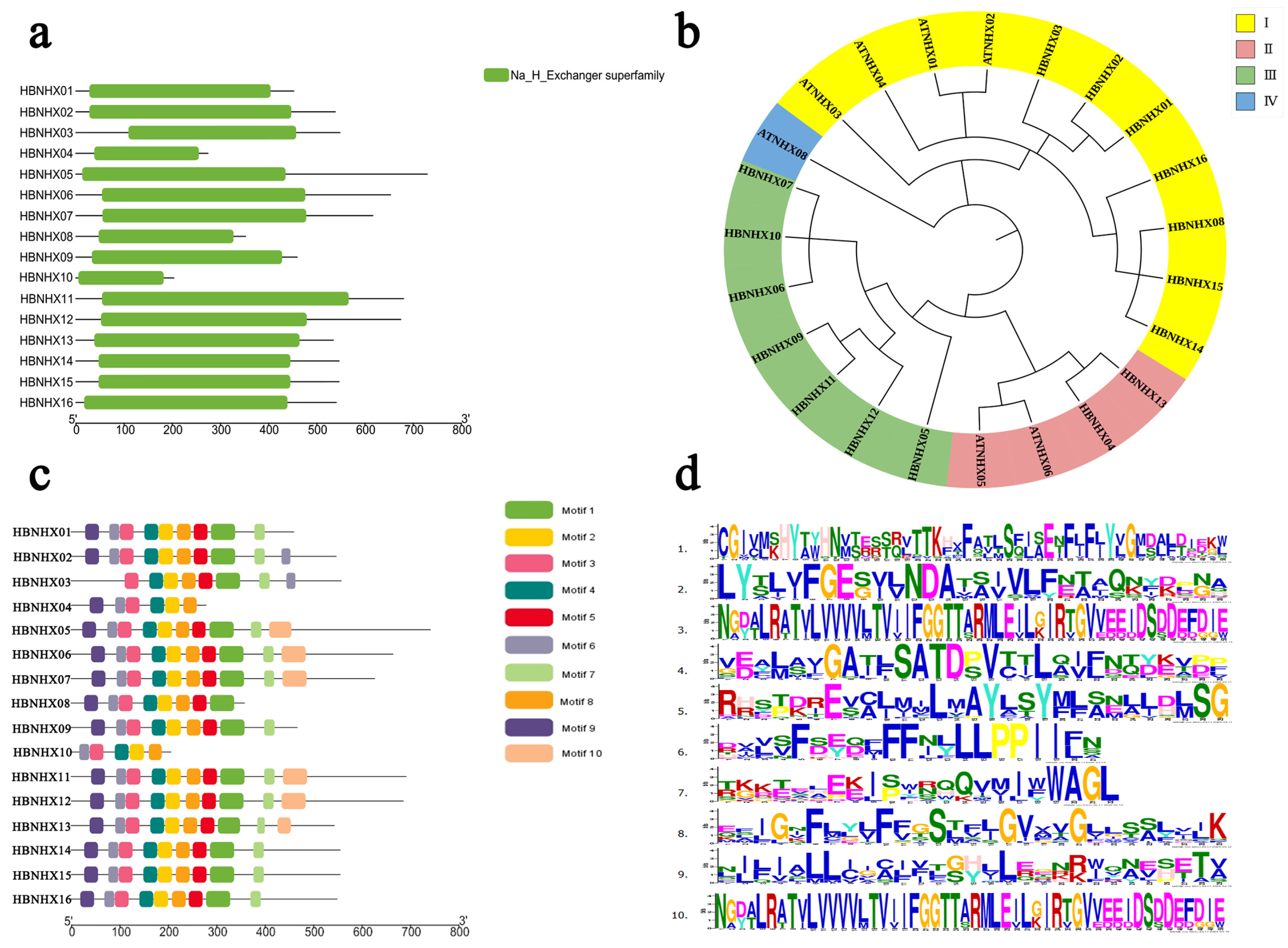
Figure 1. (a) Conserved domains of HbNHX family proteins; (b) phylogenetic tree of HbNHX gene family; (c) Conservative motif analysis of HbNHX family members; (d) logos of 10 motifs in HbNHX proteins.
Plants 14 03658 g001
Figure 2. Amino acid sequence analysis and Subcellular localization of HbNHX2. (a) Phylogenetic tree of HbNHX2. (b) 3D protein model of HbNHX2. (c) Domains of HbNHX2 protein. (d) Subcellular localization of HbNHX2. (e) Amino acid sequence alignment.
Plants 14 03658 g002
Figure 3. Expression pattern of HbNHX2. (a) The relative expression of HbNHX2 gene in different tissues of Hordeum brevisubulatum. (b) The expression level of HbNHX2 gene in leaf of Hordeum brevisubulatum under different stresses. The error bars represent the means ± student error values, and the different small letters on the error bars indicate significant differences among treatments at p < 0.05; the same applies below.
Plants 14 03658 g003
Figure 4. (a) pBWA(V) BS-HbNHX2-linker-OSGFP recombinant vector diagram. (b) Screening of HbNHX2 gene gel map. (c) Expression level of HbNHX2 in transgenic tobacco lines. (d) Phenotypic changes of 0 d and 3 d under 200 mM NaCl treatment. WT: wild type. T-2, T-8, and T-9: transgenic tobacco lines 2, 8, and 9, respectively. The same applies below. **: p < 0.01.
Plants 14 03658 g004
Figure 5. The changes inphysiological indexes in transgenic tobacco under salt stress. (a) MDA content; (b) O2 content; (c) SOD activity; (d) POD activity; (e) CAT activity; (f) GSH content; (g) soluble protein content; (h) proline content; (i) chlorophyll a content; (j) chlorophyll b content. Data are presented as mean ± SD (n = 3 biological replicates). Different letters indicate significant differences among WT, EV, and OE lines (p < 0.01, one-way ANOVA followed by Tukey’s test).
Plants 14 03658 g005
Figure 6. Expression patterns of stress-responsive genes in tobacco overexpressing HbNHX2 under salt stress. CBL1: Calcineurin B-like 1. ERF2: Ethylene-Responsive Factor. BI-1: Bax inhibitor-1. MnSOD: superoxide dismutase [Mn]. Cu/Zn-SOD: superoxide dismutase [Cu-Zn] POD: peroxidase. GR1: protein gamma response 1. KC1: potassium channel KAT3-like 1. TPK1: Two-pore potassium channel 1-like 1. TIP: aquaporin TIP-type. P5CS: delta-1-pyrroline-5-carboxylate synthase. BAS1: 2-Cys peroxiredoxin. STN7: Serine/Threonine kinase domain protein. LTP1: lipid-transfer protein 1. SERK3B: Somatic Embryogenesis Receptor-like Kinase 3B. BRI1: brassinosteroid LRR receptor kinase. * indicates that the p value is less than 0.05, and ** indicates that the p value is less than 0.01.
Plants 14 03658 g006
Figure 7. Molecular mechanism of HbNHX2 in response to salt stress. The red arrow indicates the up-regulation of genes or the increase in physiological indicators, and the green arrow indicates the down-regulation of genes. Possible regulatory mechanisms are represented by dotted lines.
Plants 14 03658 g007
Disclaimer/Publisher’s Note: The statements, opinions and data contained in all publications are solely those of the individual author(s) and contributor(s) and not of MDPI and/or the editor(s). MDPI and/or the editor(s) disclaim responsibility for any injury to people or property resulting from any ideas, methods, instructions or products referred to in the content.