
Design an Adaptive PID Control Based on RLS with a Variable Forgetting Factor for a Reconfigurable Cable-Driven Parallel Mechanism



Abstract
1. Introduction
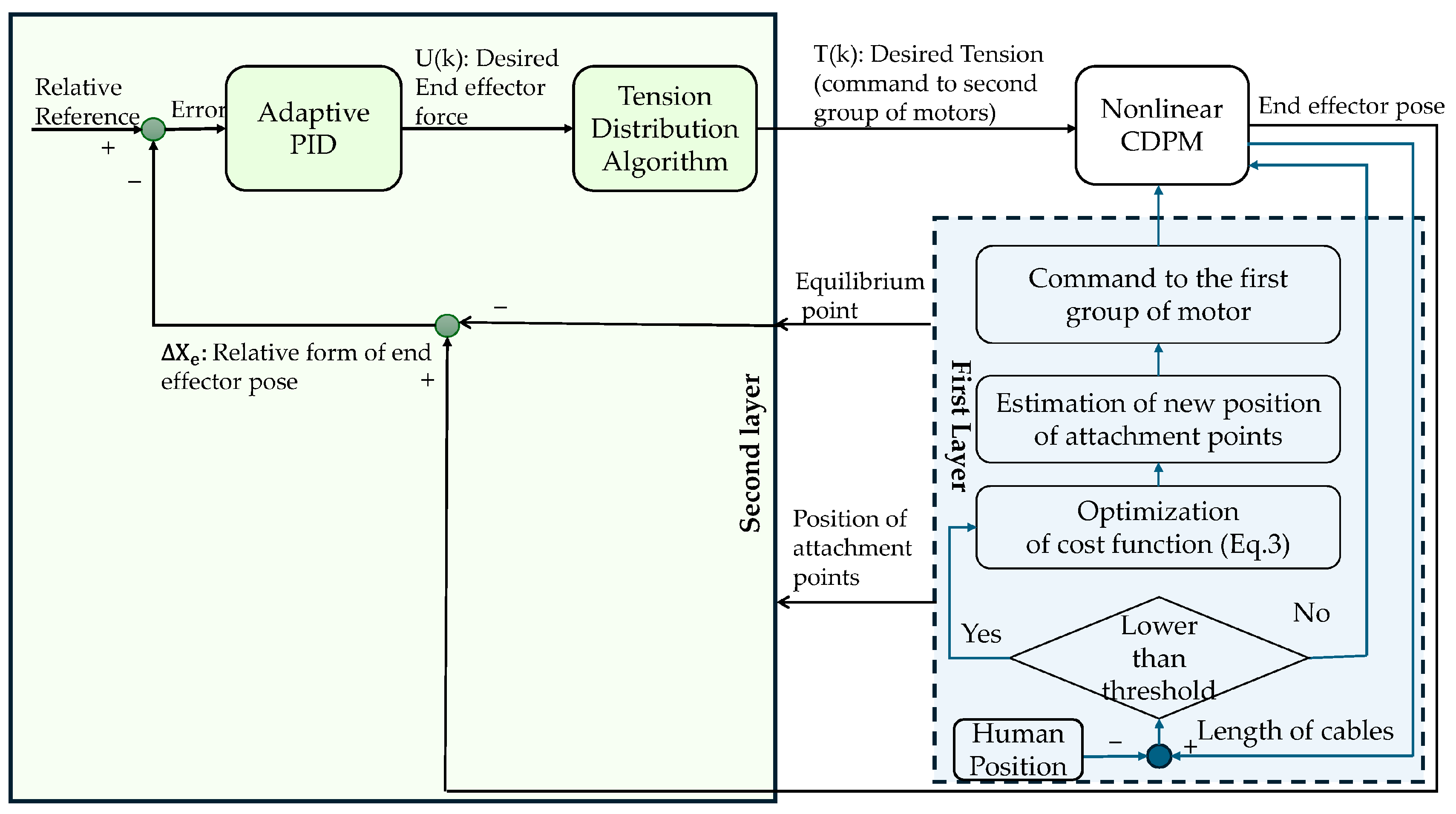
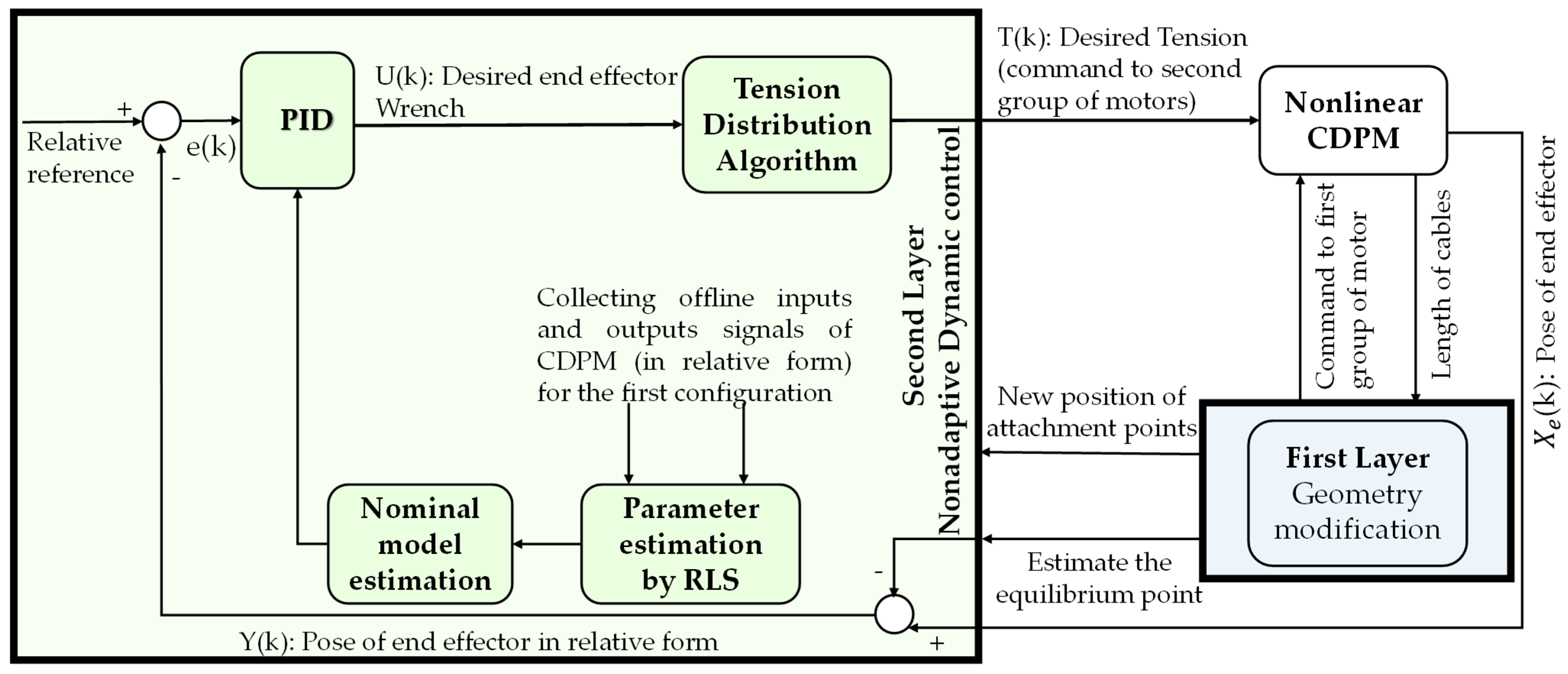
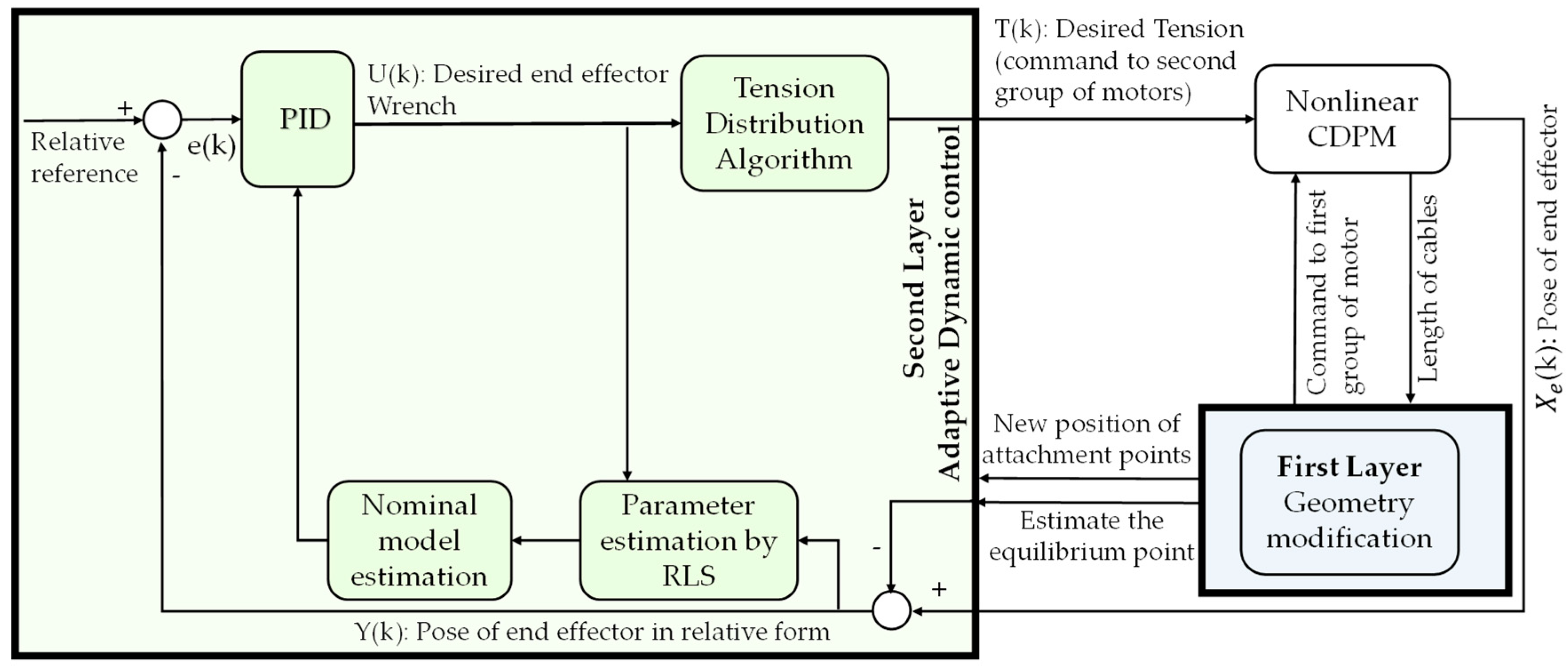
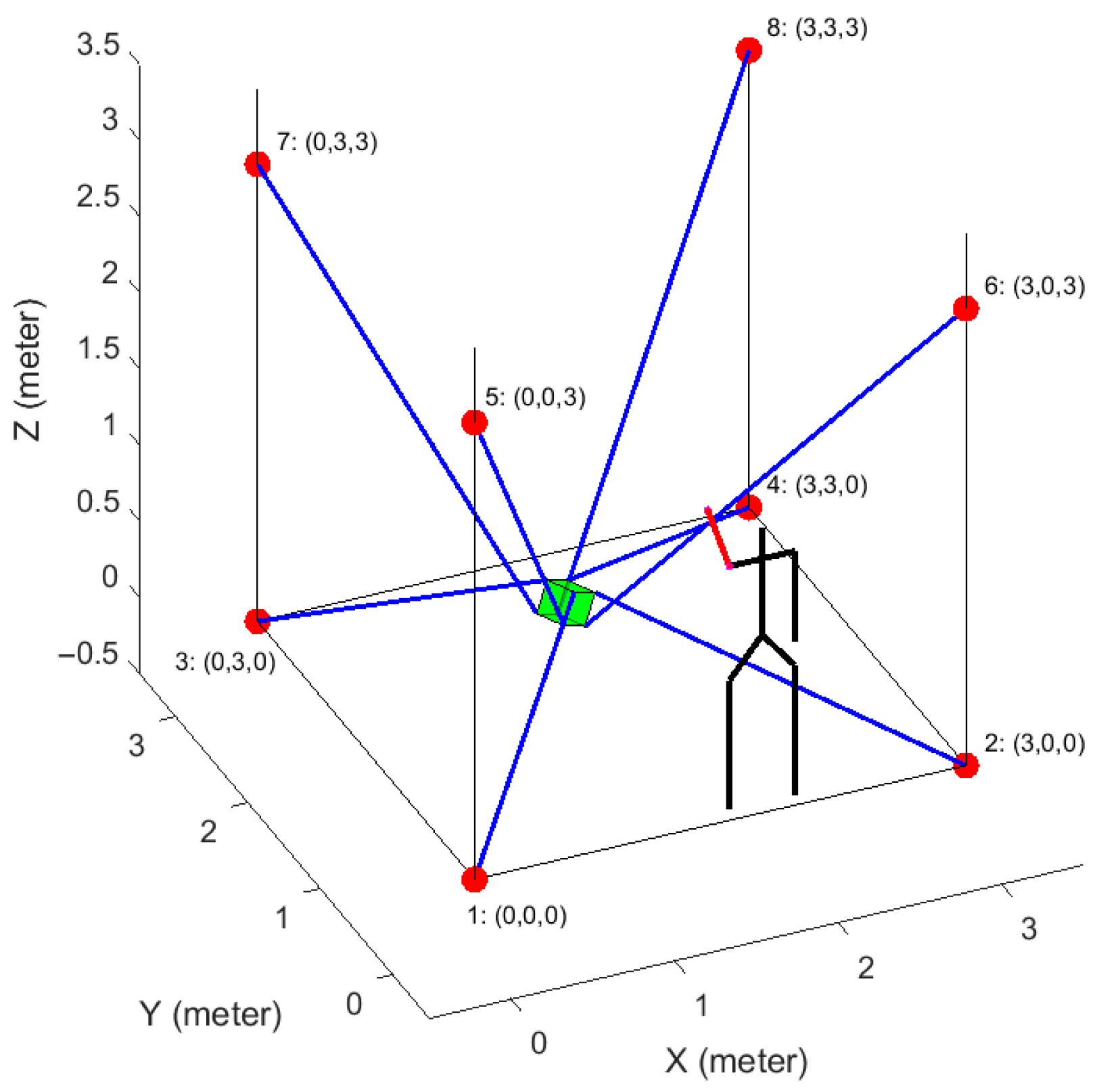
2. The Schematic of the Proposed Control Architecture with Adaptive PID
| Algorithm 1: First Layer: Attachment Point Position Adjustment | |
| Function Main Kinematic Control Loop (N,A0,Xe0,system_config) Inputs: | |
| |
| Outputs: | |
| |
| Initialize: Set k ← 1 Initialize Attachment Points A ← For k = 1 to N do: Compute Shortest Distance () ← KKTsolver(, ) If < then Collision Risk ← True Else Collision Risk ← False End If //Check if end effector and cables are within workspace limits Compute tensions T ← TensionSolver(A,) If any(T <) OR any(T >) WorkspaceValid ← False L ← CableLengths(A,) If any(L < ) OR any(L > ): WorkspaceValid ← False # Singularities/poor conditioning J ← Jacobian(A, ) Else If det(J*J′) < epsilon WorkspaceValid ← False # Equilibrium proximity constraint If norm(, 2) > 0.5: return False If (Collision Risk = True) OR (Workspace Valid = False) Then //Adjustment Needed Solving function z_new ← Solve Optimization(Objective Function, Constraints) where Constraints include | |
| |
| A[:,:,k] ← Update Attachment Points (z_new) Else //No Adjustment A[:,:,k] ← A[:,:,k−1] End If Transmit attachment points position to first group of motors in first layer (A[:,:,k]) End For Return (A, ) | |
| Algorithm 2: Second layer: RCDPM adaptive PID loop |
| Inputs: : Total number of time steps (time horizon) : Initial position and rotation of end effector where : Initial_model_params (e.g., ARX model coefficients) where is the number of parameters for each output. system_config: System configuration (e.g., input/output dimensions, sampling time dt) pid_tuning_params: Parameters for PID tuning rls_params: Parameters for RLS (e.g., forgetting factor, initial covariance) : equilibrium point from first layer Outputs: : optimal control inputs applied over time : matrix of measured system outputs over time : updated model parameters over time Begin: Initialize: Set k ← 1 Initialize the covariance matrix ← Initialize forgetting factor ← Initialize input ← zeros Initialize end effector pose X ←zeros Initialize model parameters ←zeros Set dt//Time step Defined the desired trajectory For k = 1 to N do: //Update the dynamic model of CDPM (Appendix A to simulate nonlinear dynamics) ← Input from previous step [1:6,k]← (Measured current outputs by sensors (e.g., pose) //Defined ARX model (Equation (A15), Appendix B) in relative form − //Update Model Parameters Defined ←ConstructRegressor(xm,uprevious,gravity,system_configuration) Estimated parameters of ARX ← UpdateRLS(, , X, P, ) If UpdateRLS failed = true” Then Log “RLS update failed at time step k = “, k ← Reset to initial params End If //Compute Optimal Control Input Tracking Error(k) ← [k] − Pid_gains ←//Compute , , for MIMO ΔF(k) ← PID_task(e(k), e_dot, e_int) F(k) ← (k) + ΔF(k) //Add equilibrium feedforward (optional but recommended) U(k) ← F(k) //Input of system in task space //Tension distribution with constraints J ← Jacobian(A, (k)) (T(:,k), status) ← DistributeTension(J, F(k), , Limits) //transmit tension to the second group of motors End For Return , , End |
2.1. Dynamic and Kinematic Model of 6 DOF CDPM with 8 Cables
2.2. First Layer: Estimation of the Position of Attachment Points on the Base
2.3. Second Layer: Pose Control of RCDPM
2.3.1. System Identification
2.3.2. Non-Adaptive PID Controller
| Control Loop 1: Non-adaptive relative dynamic control with offline RLS-based parameter estimation | |
| Choosing a safe distance by an expert Choosing a desired trajectory First layer: The main control loop steps of the first layer loop K1 ≤ 1 //Step time index Initializing for each step index K1 (K1 = 1 to N1) do: Step 1.1: Find the shortest distance between humans and cables by the KKT method presented in [13]. Step 1.2: Comparison between the safe distance and the calculated distance If the distance is higher than the safe distance, go to step 1.3. else if the distance is lower than the safe distance, go to the end for. Step 1.3: Estimate optimized attachment point positions to a safe position by solving the cost function. Step 1.4: Estimate the equilibrium point based on estimated new attachment points. Step 1.5: Transmit the optimized positions to the first group of servomotors for relocation. Step 1.6: Send the equilibrium point and new attachment points to the second layer. end for Second layer: The main non-adaptive control of the second layer loop (offline RLS + fixed parameters PID controller) Step 2.1 Gather outputs x(i,k) and inputs u(j,k) from the nonlinear or physical model with the initial position of attachment points (In the absence of real data, the data obtained from the nonlinear model in Equation (1) is used). Step 2.2: Receive equilibrium points from first layer (step 1.6). Step 2.3: Estimate end effector pose and input in relative form . Step 2.4: Estimate parameters of the nominal linear model from gathered u and x via offline RLS. The second layer uses offline RLS to estimate the unknown parameters of the nominal linearized model () at each time step. These parameters do not directly represent the coefficients M0, C0, K0, but rather include the parameters of ARX presented in the form of Equation (4). for each step index K2, (K2 = 1 to N2) perform the following: Step 2.5: Define the desired trajectory for the end effector at the step time K2. Step 2.6: Design PID for the nominal model based on offline RLS. Step 2.7: Estimate the optimal control force on the end effector. Step 2.8: Using the tension distribution algorithm to generate tension on the cables. Step 2.9: Transmit the tension to the second group of servomotors for tracking trajectory. end for | |
2.3.3. Adaptive PID Controller
- Adaptive Modeling: An RLS-based algorithm updates the nominal linear model in real time, adapting to attachment point changes and noise.
- Error Compensation: A compensator adjusts the cable tension to minimize pose errors and ensure accurate trajectory tracking.
| Control Loop 2: Main adaptive PID control loop based on RLS algorithm with forgetting factor Choosing a safe distance by an expert Choosing a desired trajectory First layer: The main control loop steps of the first layer loop are the same as the first layer in Control Loop 1. Second layer: The main adaptive control of the second layer loop (online RLS + updated parameters PID controller) |
| for each step index K2(K2= 1 to N2), perform the following: for i = 1:6 (number of output) Step 1: Collect data of inputs u(i,k) and outputs y(j,k) from the nonlinear or physical model. Step 2: Computation of regression vector: Step 3: Computation of the RLS gain matrix: |
| Step 4: Computation of estimated output: |
| Step 5: Error computation (error between estimated output matrix and measurement output matrix): |
| Step 6: Unknown parameters estimation: |
| Step 7: Updating of the covariance matrix: |
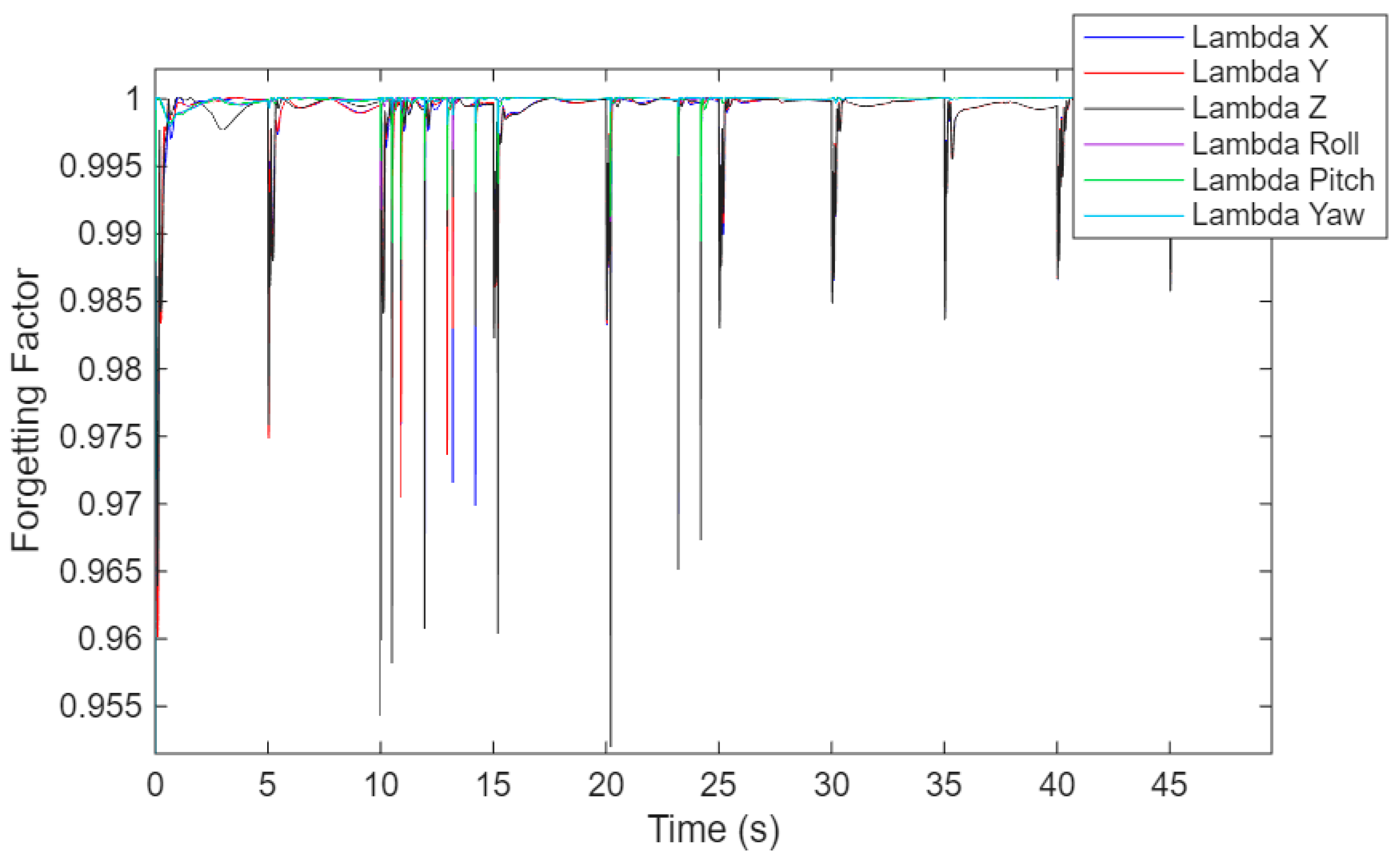
| Step 8: Updating the forgetting factor: |
| are the fixed parameters |
| end for. |
3. Results
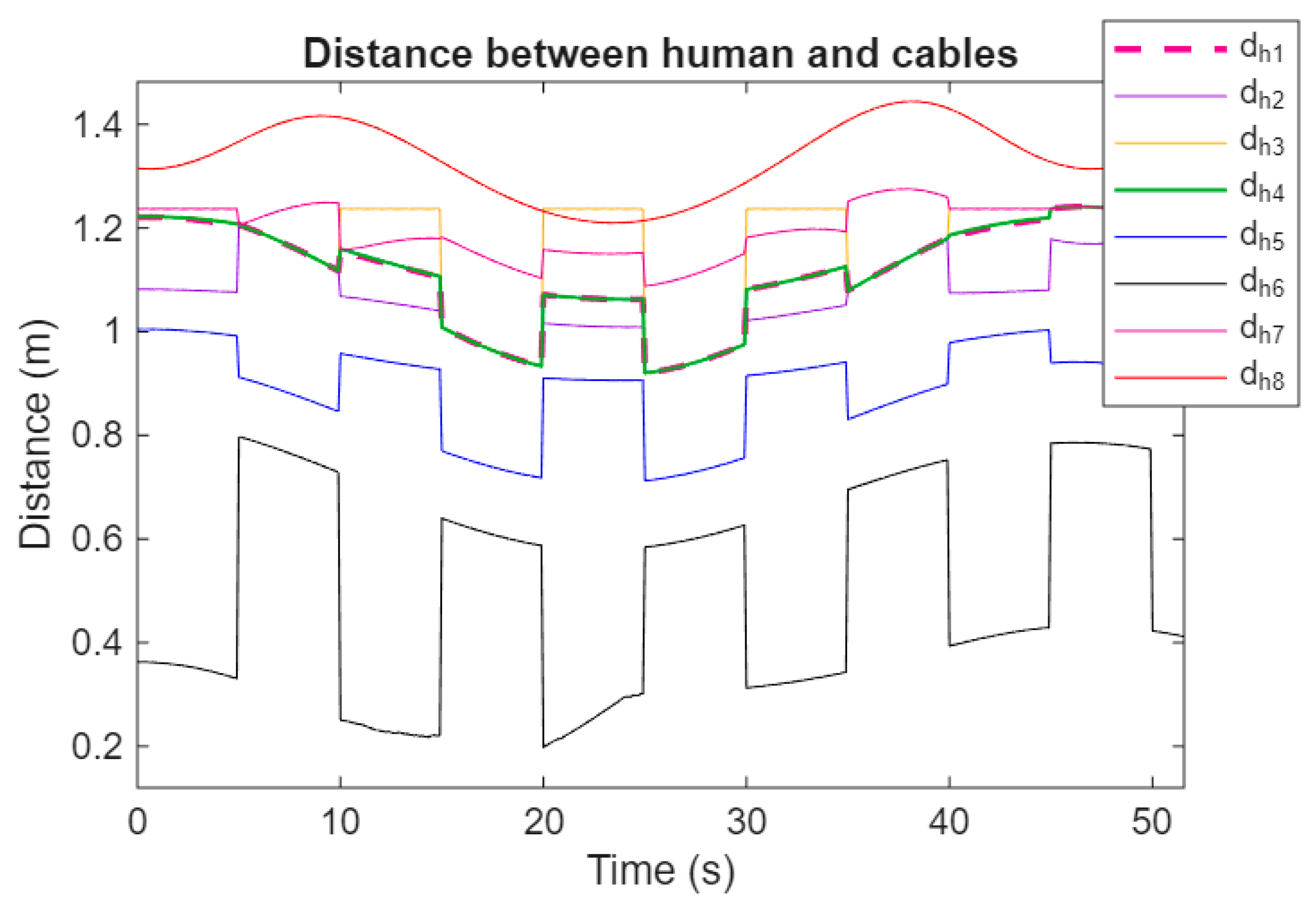
3.1. Collision Avoidance (First Layer)
3.2. Tracking Trajectory (Second Layer)
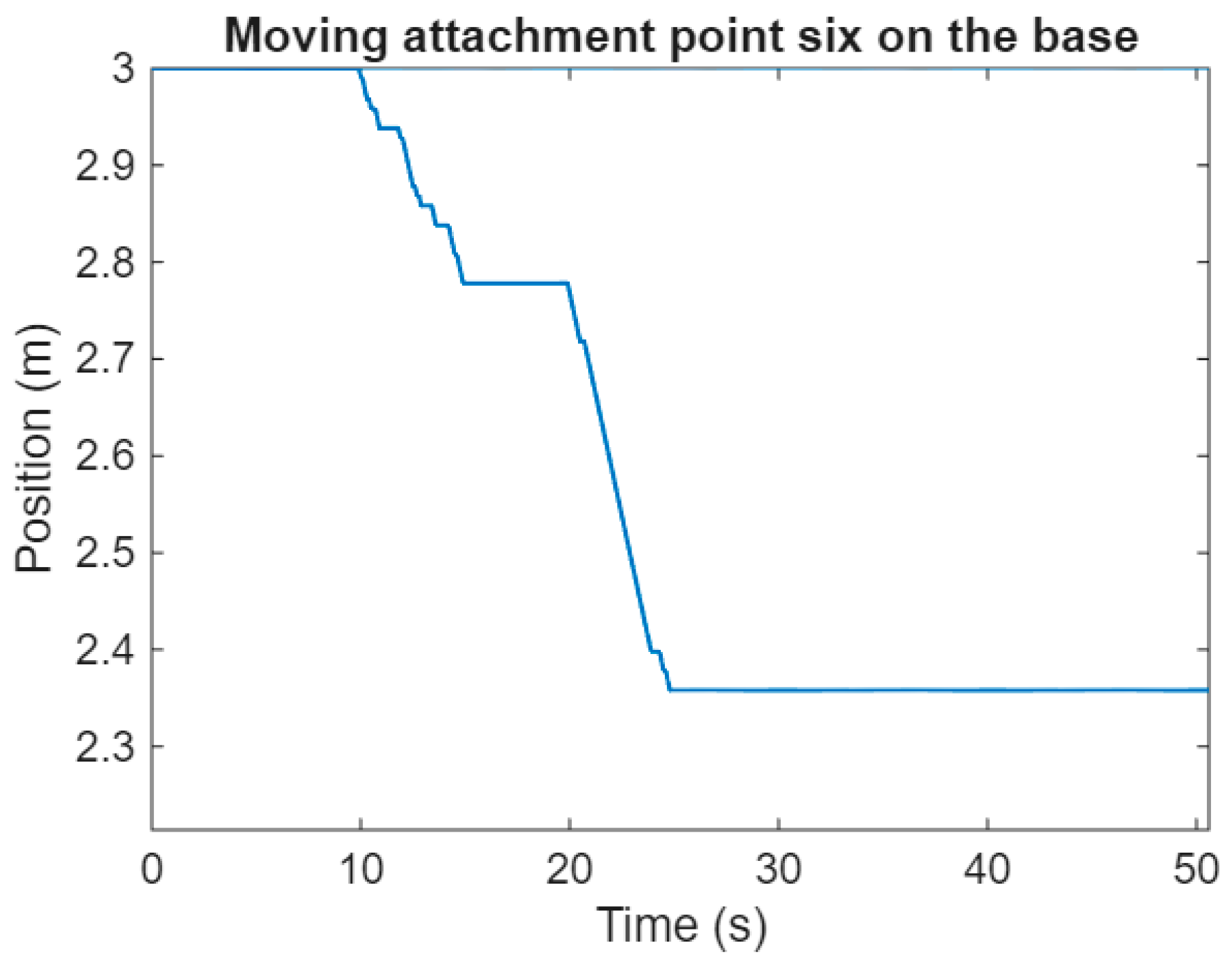
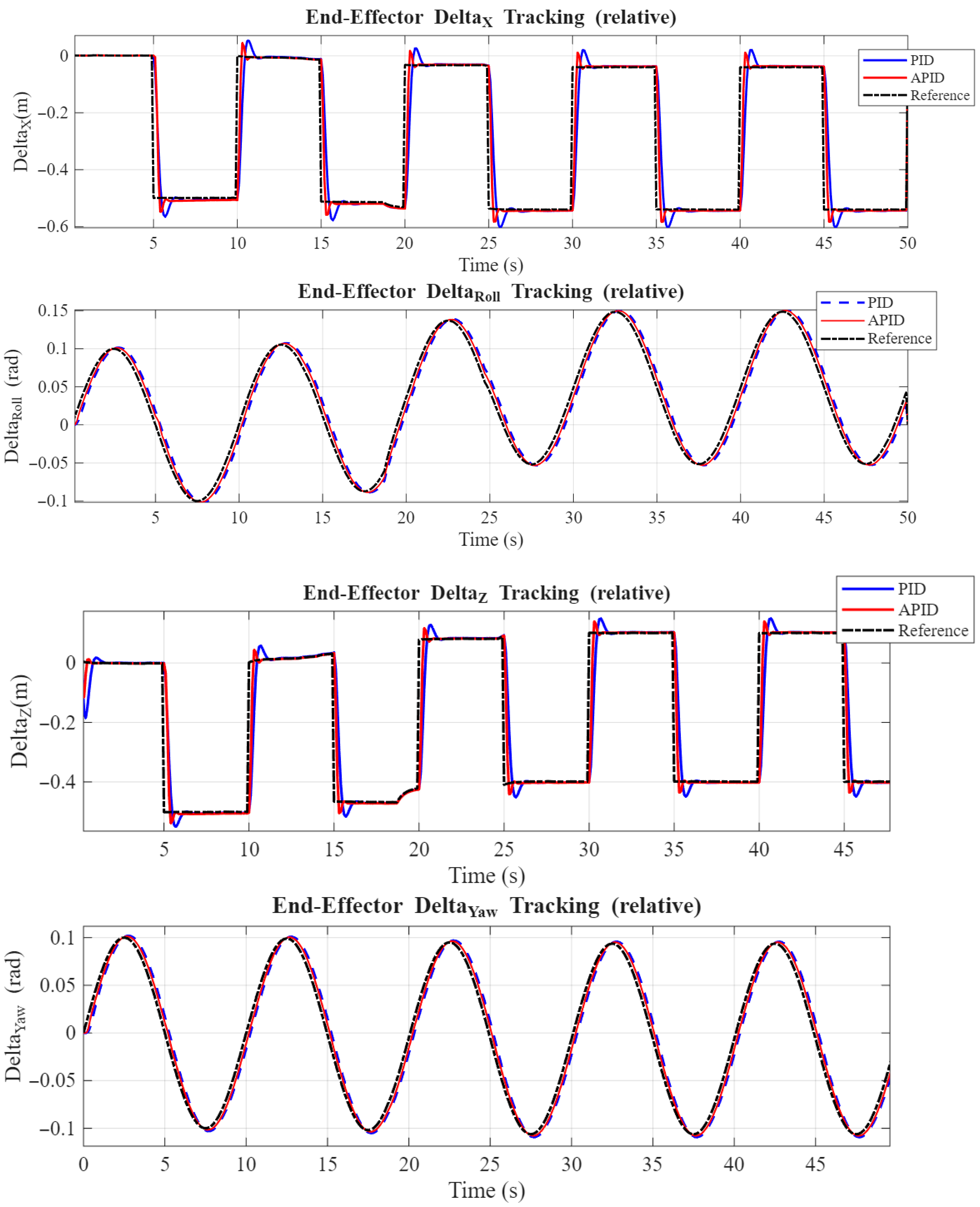
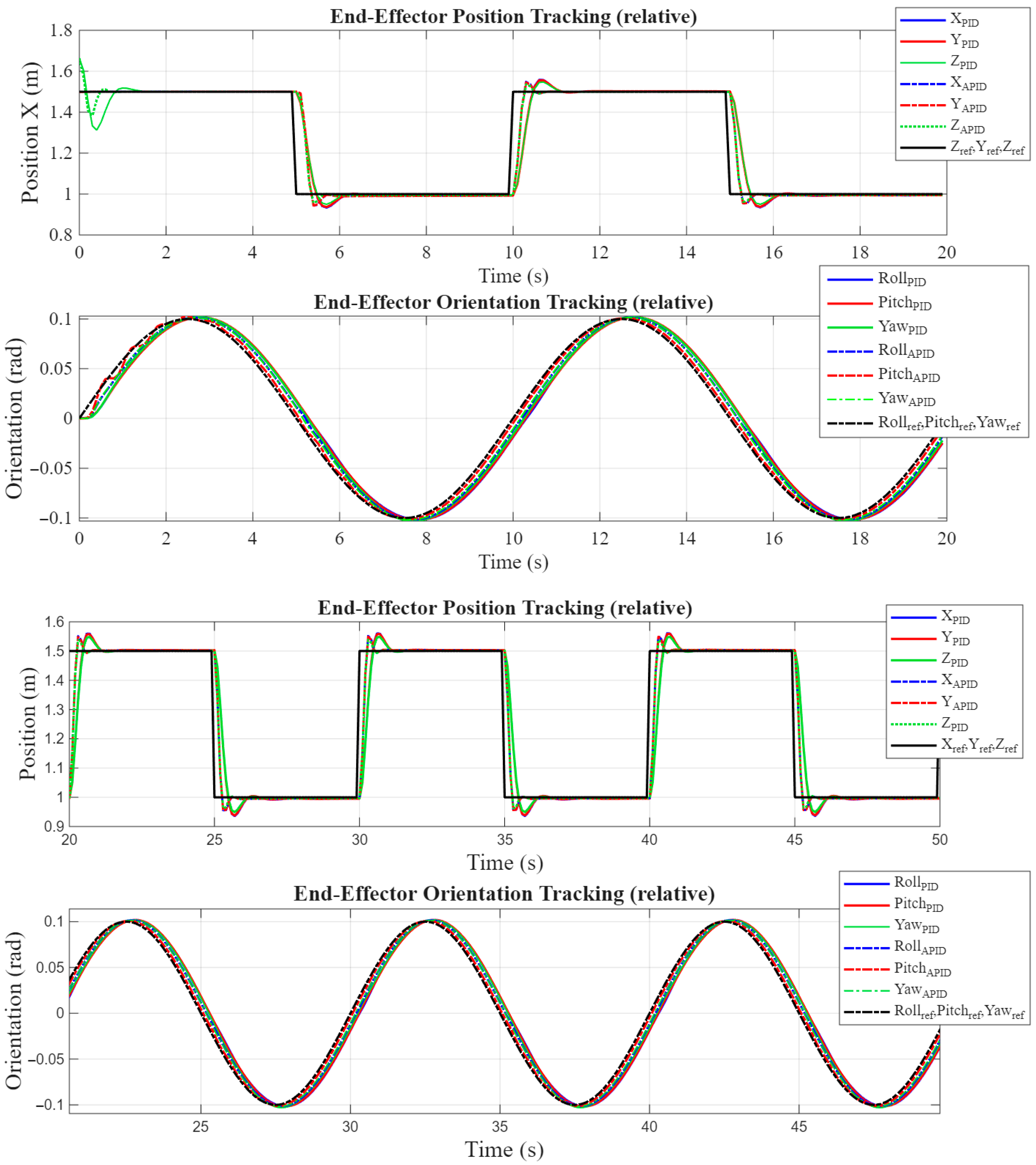
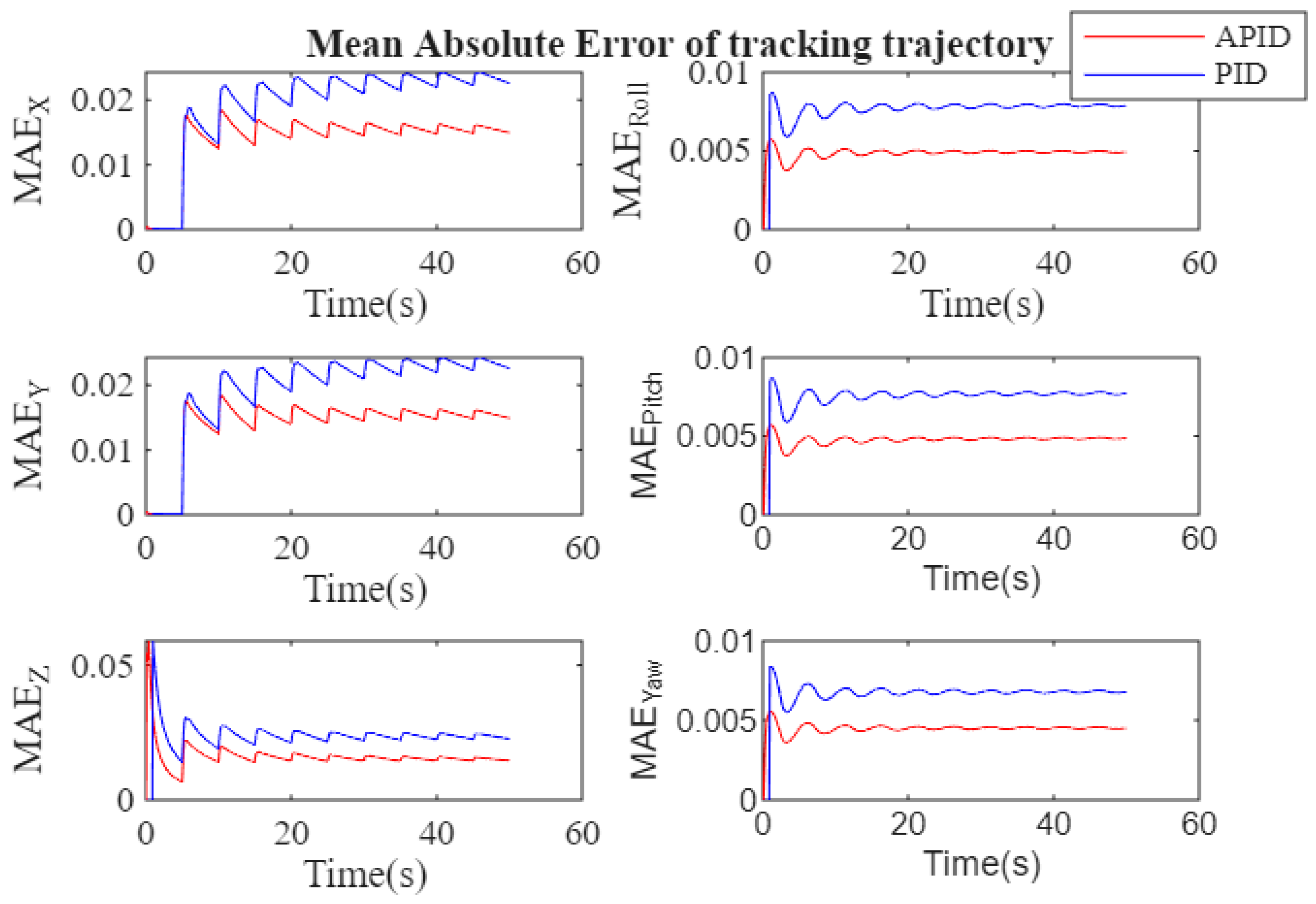
3.2.1. Scenario 1: Performance of Controllers in the Presence of Moving Attachment Points on the Base
3.2.2. Scenario 2: Performance of Controllers in the Presence of Moving Attachment Points on the Base and Disturbance
3.2.3. Scenario 3: Performance of Controllers in the Presence of Moving Attachment Points on the Base and Variation in Mass
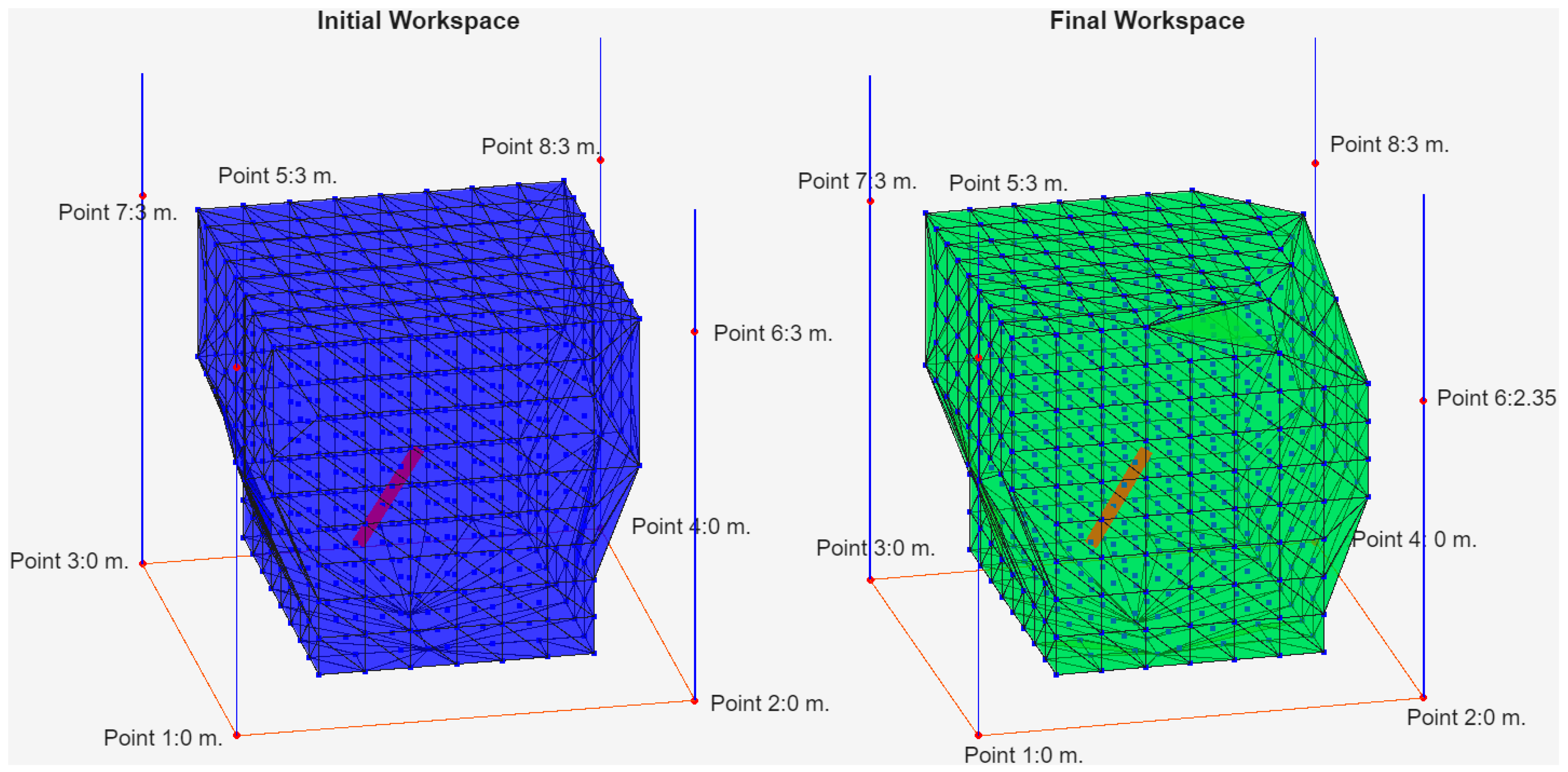
3.2.4. Workspace Analysis
4. Conclusions
Supplementary Materials
Author Contributions
Funding
Data Availability Statement
Conflicts of Interest
Abbreviations
| RCDPM | Reconfigurable Cable-Driven Parallel Robot |
| APID | Adaptive Proportional–Integral–Derivative |
| RLS | Recursive Least Squares |
Appendix A
Appendix A.1. Nonlinear Dynamic Modeling of CDPM
Appendix A.1.1. End Effector Dynamics
Appendix A.1.2. Actuator Dynamics
Appendix A.1.3. CDPM Dynamic (Actuator + End Effector Dynamic)
Appendix B
Linear Dynamic Modeling of CDPM
Appendix C

| Component | Dimension | Description |
|---|---|---|
| End effector pose vector (3 positions + 3 orientations). | ||
| Velocity vector. | ||
| Acceleration vector. | ||
| Orientation angles (subset of ). | ||
| Inertia matrix. | ||
| Coriolis, centrifugal, viscous, and Coulomb friction term. | ||
| Stiffness term from balancing springs. | ||
| Gravity term. | ||
| Twist transformation matrix (diagonal blocks: and ). | ||
| Mass and inertia of end effector (diagonal blocks: and ). | ||
| Effective input wrench | ||
| Jacobian matrix (cable velocities to end effector velocities). | ||
| Modified Jacobian matrix (motor velocities to end effector velocities). | ||
| Cable lengths vector. | ||
| , , , , | Diagonal actuator parameter matrices (friction, stiffness, inertia, radii). | |
| Position of the first and second groups of motor | ||
| Velocity of the first and second groups of motor | ||
| Cable tension vector. | ||
| Equilibrium point vector. | ||
| Initial position and rotation of the end effector vector. | ||
| Linear velocity vector | ||
| Angular velocity vector | ||
| Rigid body of mass matrix | ||
| Translational force vector | ||
| Initial attachment points position | ||
| N1 | Time horizon of the first layer | |
| N2 | Time horizon of the second layer | |
| Error between the estimated output and the measurement output vector | ||
| λ | Forgetting factor vector | |
| Regressor vector in the ARX model for the output |
References
- Rasheed, T.; Long, P.; Caro, S. Wrench-feasible workspace of mobile cable-driven parallel robots. J. Mech. Robot. 2020, 12, 031009. [Google Scholar] [CrossRef] [Scilit]
- Tho, T.P.; Thinh, N.T. An Overview of Cable-Driven Parallel Robots: Workspace, Tension Distribution, and Cable Sagging. Math. Probl. Eng. 2022, 2022, 2199748. [Google Scholar] [CrossRef] [Scilit]
- Pham, C.B.; Yeo, S.H.; Yang, G.; Kurbanhusen, M.S.; Chen, I.-M. Force-closure workspace analysis of cable-driven parallel mechanisms. Mech. Mach. Theory 2006, 41, 53–69. [Google Scholar] [CrossRef] [Scilit]
- Geng, X.; Li, M.; Liu, Y.; Li, Y.; Zheng, W.; Li, Z. Analytical tension-distribution computation for cable-driven parallel robots using hypersphere mapping algorithm. Mech. Mach. Theory 2020, 145, 103692. [Google Scholar] [CrossRef] [Scilit]
- Wang, K.; Hu, Z.H.; Zhang, C.S.; Han, Z.W.; Deng, C.W. Dynamic Modeling and Optimization of Tension Distribution for a Cable-Driven Parallel Robot. Appl. Sci. 2024, 14, 6478. [Google Scholar] [CrossRef] [Scilit]
- Diao, X.; Ma, O.; Lu, Q. Singularity analysis of planar cable-driven parallel robots. In Proceedings of the 2008 IEEE Conference on Robotics, Automation and Mechatronics, Chengdu, China, 21–24 September 2008; pp. 272–277. [Google Scholar]
- Diao, X. Singularity analysis of fully-constrained cable-driven parallel robots with seven cables. In Proceedings of the 2015 IEEE International Conference on Mechatronics and Automation (ICMA), Beijing, China, 2–5 August 2015; pp. 1537–1541. [Google Scholar]
- Lahouar, S.; Ottaviano, E.; Zeghoul, S.; Romdhane, L.; Ceccarelli, M. Collision free path-planning for cable-driven parallel robots. Robot. Auton. Syst. 2009, 57, 1083–1093. [Google Scholar] [CrossRef] [Scilit]
- Yang, G.; Yeo, S.H.; Pham, C.B. Kinematics and singularity analysis of a planar cable-driven parallel manipulator. In Proceedings of the 2004 IEEE/RSJ International Conference on Intelligent Robots and Systems (IROS) (IEEE Cat. No. 04CH37566), Sendai, Japan, 28 September–2 October 2004; pp. 3835–3840. [Google Scholar]
- Almenningen, E.O.; Grøterud, M.; Nørsterud, S. Design, Construction, and Control of a Cable-Driven Parallel Robot. Master’s Thesis, NTNU: Norwegian University of Science and Technology, Trondheim, Norway, 2024. [Google Scholar]
- Gueners, D.; Chanal, H.; Bouzgarrou, B.-C. Design and implementation of a cable-driven parallel robot for additive manufacturing applications. Mechatronics 2022, 86, 102874. [Google Scholar] [CrossRef] [Scilit]
- Cheng, H.H.; Lau, D. Cable Attachment Optimization for Reconfigurable Cable-Driven Parallel Robots Based on Various Workspace Conditions. IEEE Trans. Robot. 2023, 39, 3759–3775. [Google Scholar] [CrossRef] [Scilit]
- Khoshbin, E.; Youssef, K.; Meziane, R.; Otis, M.J.-D. Reconfigurable fully constrained cable-driven parallel mechanism for avoiding collision between cables with human. Robotica 2022, 40, 4405–4430. [Google Scholar] [CrossRef] [Scilit]
- Youssef, K.; Otis, M.J.-D. Reconfigurable fully constrained cable driven parallel mechanism for avoiding interference between cables. Mech. Mach. Theory 2020, 148, 103781. [Google Scholar] [CrossRef] [Scilit]
- Zake, Z.; Chaumette, F.; Pedemonte, N.; Caro, S. Robust 2½d visual servoing of a cable-driven parallel robot thanks to trajectory tracking. IEEE Robot. Autom. Lett. 2020, 5, 660–667. [Google Scholar] [CrossRef] [Scilit]
- Awais, M.; Park, J.-H.; Jung, J.; Choi, E.-P.; Park, J.-O.; Kim, C.-S. Real-time vision-based localization of planar cable-driven parallel robot. In Proceedings of the 2018 18th International Conference on Control, Automation and Systems (ICCAS), PyeongChang, Republic of Korea, 17–20 October 2018; pp. 462–465. [Google Scholar]
- Bayani, H.; Sadeghian, R.; Masouleh, M.T.; Kalhor, A. On the control of planar cable-driven parallel robot via classic controllers and tuning with intelligent algorithms. In Proceedings of the 2015 3rd RSI International Conference on Robotics and Mechatronics (ICROM), Tehran, Iran, 7–9 October 2015; pp. 623–628. [Google Scholar]
- Picard, E.; Caro, S.; Plestan, F.; Claveau, F. Control solution for a cable-driven parallel robot with highly variable payload. In Proceedings of the 2018 International Design Engineering Technical Conferences and Computers and Information in Engineering Conference, Quebec City, QC, Canada, 26–29 August 2018; American Society of Mechanical Engineers: New York, NY, USA, 2018. [Google Scholar]
- Jiesinuer, A.; Shangfeng, P.; Yang, C. Research on a 3-DOF Planar Cable-Driven Parallel Robot Based on Fuzzy Adaptive PD Computed Torque Control. J. Phys. Conf. Ser. 2021, 1986, 012124. [Google Scholar] [CrossRef] [Scilit]
- Zhou, B.; Wang, Y.; Zi, B.; Zhu, W. Fuzzy Adaptive Whale Optimization Control Algorithm for Trajectory Tracking of a Cable-Driven Parallel Robot. IEEE Trans. Autom. Sci. Eng. 2023, 21, 5149–5160. [Google Scholar] [CrossRef] [Scilit]
- Khalilpour, S.; Khorrambakht, R.; Taghirad, H.; Cardou, P. Dual space control of a deployable cable driven robot: Wave based approach. Int. J. Robot. Theory Appl. 2020, 6, 11–19. [Google Scholar]
- Khalilpour, S.; Khorrambakht, R.; Harandi, M.; Taghirad, H.; Cardou, P. Cascade terminal sliding mode control of a deployable cable driven robot. In Proceedings of the 2019 6th International Conference on Control, Instrumentation and Automation (ICCIA), Sanandaj, Iran, 30–31 October 2019; pp. 1–6. [Google Scholar]
- Khalilpour, S.; Khorrambakht, R.; Taghirad, H.; Cardou, P. Robust cascade control of a deployable cable-driven robot. Mech. Syst. Signal Process. 2019, 127, 513–530. [Google Scholar] [CrossRef] [Scilit]
- Khalilpour, S.; Khorrambakht, R.; Harandi, M.; Taghirad, H.; Cardou, P. Robust dynamic sliding mode control of a deployable cable driven robot. In Proceedings of the Electrical Engineering (ICEE), Iranian Conference on, Mashhad, Iran, 8–10 May 2018; pp. 863–868. [Google Scholar]
- Abdolshah, S.; Barjuei, E.S. Linear quadratic optimal controller for cable-driven parallel robots. Front. Mech. Eng. 2015, 10, 344–351. [Google Scholar] [CrossRef] [Scilit]
- Tho, T.P.; Thinh, N.T. Analysis and Evaluation of CDPR Cable Sagging Based on ANFIS. Math. Probl. Eng. 2021, 2021, 4776317. [Google Scholar] [CrossRef] [Scilit]
- Lu, Y.; Wu, C.; Yao, W.; Sun, G.; Liu, J.; Wu, L. Deep Reinforcement Learning Control of Fully-Constrained Cable-Driven Parallel Robots. IEEE Trans. Ind. Electron. 2022, 70, 7194–7204. [Google Scholar] [CrossRef] [Scilit]
- Kumar, A.A.; Antoine, J.-F.; Abba, G. Input-Output Feedback Linearization for the Control of a 4 Cable-Driven Parallel Robot. IFAC-PapersOnLine 2019, 52, 707–712. [Google Scholar] [CrossRef] [Scilit]
- Kiani, A.; Mashhadi, S.K.-e.-d.M. Lyapunov-based adaptive control of a cable-driven parallel robot. Int. J. Adv. Mechatron. Syst. 2017, 7, 193–201. [Google Scholar] [CrossRef] [Scilit]
- Yoon, J.; Hwang, S.W.; Bak, J.-H.; Park, J.H. Adaptive control for cable driven parallel robots. In Proceedings of the 2017 17th International Conference on Control, Automation and Systems (ICCAS), Jeju, Republic of Korea, 18–21 October 2017; pp. 416–419. [Google Scholar]
- Aghaseyedabdollah, M.; Abedi, M.; Pourgholi, M. Supervisory adaptive fuzzy sliding mode control with optimal Jaya based fuzzy PID sliding surface for a planer cable robot. Soft Comput. 2022, 26, 8441–8458. [Google Scholar] [CrossRef] [Scilit]
- Santos, J.C.; Chemori, A.; Gouttefarde, M. Model predictive control of large-dimension cable-driven parallel robots. In Proceedings of the 4th International Conference on Cable-Driven Parallel Robots, Krakow, Poland, 30 June–4 July 2019; Springer: Berlin/Heidelberg, Germany, 2019; pp. 221–232. [Google Scholar]
- Song, C.; Lau, D. Workspace-Based Model Predictive Control for Cable-Driven Robots. IEEE Trans. Robot. 2022, 38, 2577–2596. [Google Scholar] [CrossRef] [Scilit]
- Ji, H.; Shang, W.; Cong, S. Adaptive synchronization control of cable-driven parallel robots with uncertain kinematics and dynamics. IEEE Trans. Ind. Electron. 2020, 68, 8444–8454. [Google Scholar] [CrossRef] [Scilit]
- Tong, L.; Cui, D.; Wang, C.; Peng, L. A novel zero-force control framework for post-stroke rehabilitation training based on fuzzy-PID method. Intell. Robot. 2024, 4, 125–145. [Google Scholar] [CrossRef] [Scilit]
- Liang, X.; He, G.; Su, T.; Wang, W.; Huang, C.; Zhao, Q.; Hou, Z.-G. Finite-time observer-based variable impedance control of cable-driven continuum manipulators. IEEE Trans. Hum. Mach. Syst. 2021, 52, 26–40. [Google Scholar] [CrossRef] [Scilit]
- Lei, Y.; Du, F.; Song, H.; Zhang, L. Design and kinematics analysis of a cable-stayed notch manipulator for transluminal endoscopic surgery. Biomim. Intell. Robot. 2024, 4, 100191. [Google Scholar] [CrossRef] [Scilit]
- Raman, A.; Walker, I.; Krovi, V.; Schmid, M. Cable failure tolerant control and planning in a planar reconfigurable cable driven parallel robot. Front. Robot. AI 2023, 10, 1070627. [Google Scholar] [CrossRef] [Scilit]
- Raman Thothathri, A. Modeling, Control and Estimation of Reconfigurable Cable Driven Parallel Robots. Ph.D. Thesis, Graduate School of Clemson University, Clemson, SC, USA, 2022. [Google Scholar]
- Picard, E.; Plestan, F.; Tahoumi, E.; Claveau, F.; Caro, S. Control strategies for a cable-driven parallel robot with varying payload information. Mechatronics 2021, 79, 102648. [Google Scholar] [CrossRef] [Scilit]
- Zhang, B.; Shang, W.; Cong, S.; Li, Z. Dual-loop dynamic control of cable-driven parallel robots without online tension distribution. IEEE Trans. Syst. Man Cybern. Syst. 2022, 52, 6555–6568. [Google Scholar] [CrossRef] [Scilit]
- Sancak, C.; Yamac, F.; Itik, M. Position control of a planar cable-driven parallel robot using reinforcement learning. Robotica 2022, 40, 3378–3395. [Google Scholar] [CrossRef] [Scilit]
- Babaghasabha, R.; Khosravi, M.A.; Taghirad, H.D. Adaptive robust control of fully constrained cable robots: Singular perturbation approach. Nonlinear Dyn. 2016, 85, 607–620. [Google Scholar] [CrossRef] [Scilit]
- Rivera, D.E.; Jun, K.S. An integrated identification and control design methodology for multivariable process system applications. IEEE Control Syst. Mag. 2000, 20, 25–37. [Google Scholar]
- Khoshbin, E.; Martin, J.-D.; Meziane, R. Reconfigurable Cable Driven Parallel Robot—PID Controller. 2025. Available online: https://osf.io/b4563/overview (accessed on 3 November 2025).
- Bouaouda, A.; Pannequin, R.; Charpillet, F.; Martinez, D.; Boutayeb, M. Dynamic modeling and AI-based control of a cable-driven parallel robot. IFAC-PapersOnLine 2023, 56, 10021–10026. [Google Scholar] [CrossRef] [Scilit]
- Chellal, R.; Cuvillon, L.; Laroche, E. Model identification and vision-based H∞ position control of 6-DoF cable-driven parallel robots. Int. J. Control 2017, 90, 684–701. [Google Scholar] [CrossRef] [Scilit]
- Ghazali, R.; Sam, Y.M.; Rahmat, M.F. Open-loop and closed-loop recursive identification of an electro-hydraulic actuator system. In Proceedings of the 2010 IEEE Conference on Robotics, Automation and Mechatronics, Singapore, 28–30 June 2010; pp. 285–290. [Google Scholar]
- Bamieh, B.; Giarré, L. LPV models: Identification for gain scheduling control. In Proceedings of the 2001 European Control Conference (ECC), Porto, Portugal, 4–7 September 2001; pp. 3092–3097. [Google Scholar]


| Scenario | Conditions | Primary Goal |
|---|---|---|
| 1. Dynamic Variation | Attachment points are moving on the base (no external disturbance, no mass change yet). | To prove that adaptivity is necessary. Both fixed-gain controllers do not have perfect performance as the robot’s dynamics change. |
| 2. Disturbance Rejection | Attachment points are moving AND an external disturbance is applied. | To prove that APID’s adaptive gains plus the integral action make it superior for handling both variations and external forces. |
| 3. Model Uncertainty | Attachment points are moving AND the mass of the end effector is suddenly changed (e.g., ±0% mass). | To test the robustness of the APID’s RLS algorithm in estimating and compensating for unknown physical parameters. |
| RSME | MAE | ||||||
|---|---|---|---|---|---|---|---|
| PID | LQR | APID | PID | LQR | APID | ||
| X | 0.0603 | 0.061 | 0.051 | X | 0.0251 | 0.026 | 0.0151 |
| Y | 0.0589 | 0.057 | 0.048 | Y | 0.0254 | 0.024 | 0.0152 |
| Z | 0.0837 | 0.085 | 0.047 | Z | 0.022 | 0.0025 | 0.00134 |
| Roll | 0.02101 | 0.023 | 0.0136 | Roll | 0.0072 | 0.0087 | 0.0048 |
| Pitch | 0.0479 | 0.05 | 0.013 | Pitch | 0.0073 | 0.0084 | 0.0045 |
| Yaw | 0.0604 | 0.095 | 0.0134 | Yaw | 0.0068 | 0.0075 | 0.0046 |
| RSME | MAE | ||||||
|---|---|---|---|---|---|---|---|
| PID | LQR | APID | PID | LQR | APID | ||
| X | 0.083 | 0.092 | 0.061 | X | 0.036 | 0.039 | 0.019 |
| Y | 0.081 | 0.087 | 0.057 | Y | 0.034 | 0.036 | 0.017 |
| Z | 0.108 | 0.125 | 0.069 | Z | 0.042 | 0.049 | 0.023 |
| Roll | 0.035 | 0.041 | 0.019 | Roll | 0.012 | 0.014 | 0.0065 |
| Pitch | 0.054 | 0.061 | 0.018 | Pitch | 0.013 | 0.015 | 0.0058 |
| Yaw | 0.078 | 0.098 | 0.02 | Yaw | 0.011 | 0.016 | 0.0062 |
| Axis | PID (20%) | LQR (20%) | APID (20%) | PID (30%) | PID (30%) | APID (30%) |
|---|---|---|---|---|---|---|
| X | 0.0276 | 0.0293 | 0.0163 | 0.0301 | 0.0325 | 0.0174 |
| Y | 0.279 | 0.270 | 0.0164 | 0.0305 | 0.03 | 0.0174 |
| Z | 0.0275 | 0.034 | 0.0164 | 0.0319 | 0.039 | 0.00176 |
| Roll | 0.0081 | 0.0104 | 0.0053 | 0.0088 | 0.0113 | 0.0055 |
| Pitch | 0.0088 | 0.0105 | 0.005 | 0.0098 | 0.0112 | 0.0054 |
| Yaw | 0.0085 | 0.0098 | 0.0053 | 0.0099 | 0.0113 | 0.0058 |
Disclaimer/Publisher’s Note: The statements, opinions and data contained in all publications are solely those of the individual author(s) and contributor(s) and not of MDPI and/or the editor(s). MDPI and/or the editor(s) disclaim responsibility for any injury to people or property resulting from any ideas, methods, instructions or products referred to in the content. |
© 2025 by the authors. Licensee MDPI, Basel, Switzerland. This article is an open access article distributed under the terms and conditions of the Creative Commons Attribution (CC BY) license (https://creativecommons.org/licenses/by/4.0/).
Share and Cite
Khoshbin, E.; Otis, M.J.-D.; Meziane, R. Design an Adaptive PID Control Based on RLS with a Variable Forgetting Factor for a Reconfigurable Cable-Driven Parallel Mechanism. Robotics 2025, 14, 165. https://doi.org/10.3390/robotics14110165
Khoshbin E, Otis MJ-D, Meziane R. Design an Adaptive PID Control Based on RLS with a Variable Forgetting Factor for a Reconfigurable Cable-Driven Parallel Mechanism. Robotics. 2025; 14(11):165. https://doi.org/10.3390/robotics14110165
Chicago/Turabian StyleKhoshbin, Elham, Martin J.-D. Otis, and Ramy Meziane. 2025. "Design an Adaptive PID Control Based on RLS with a Variable Forgetting Factor for a Reconfigurable Cable-Driven Parallel Mechanism" Robotics 14, no. 11: 165. https://doi.org/10.3390/robotics14110165
APA StyleKhoshbin, E., Otis, M. J.-D., & Meziane, R. (2025). Design an Adaptive PID Control Based on RLS with a Variable Forgetting Factor for a Reconfigurable Cable-Driven Parallel Mechanism. Robotics, 14(11), 165. https://doi.org/10.3390/robotics14110165