Vinpocetine—An “Old” Drug with a New Face: Moving Toward a Better Understanding of Its Neuroprotective Mechanism of Action

Abstract
1. Introduction
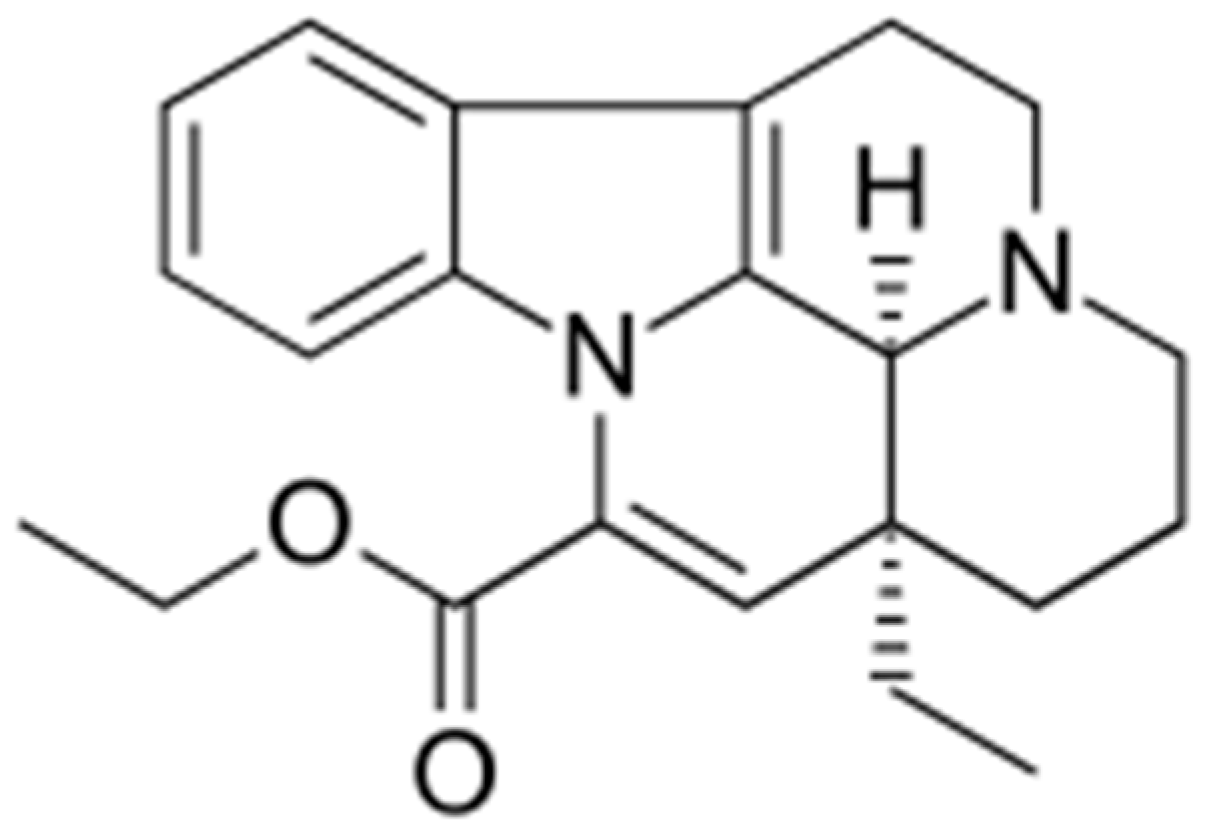
2. Vinpocetine
3. Early Pharmacological Studies
4. Molecular Targets of Vinpocetine
5. Neuroprotective Effects of Vinpocetine
5.1. Vinpocetine Inhibits Glutamate Excitotoxicity
5.2. Vinpocetine Inhibits Voltage-Dependent Na+-Channels (Nav)
5.3. Antioxidant Effects of Vinpocetine
5.4. Vinpocetine Inhibits Neuroinflammation
Vinpocetine Reduces Microglia and Astroglia Activation
5.5. Vinpocetine Inhibits Ca2+/Calmodulin-Dependent PDE1 Enzymes
5.6. Vinpocetine and the Purinergic System
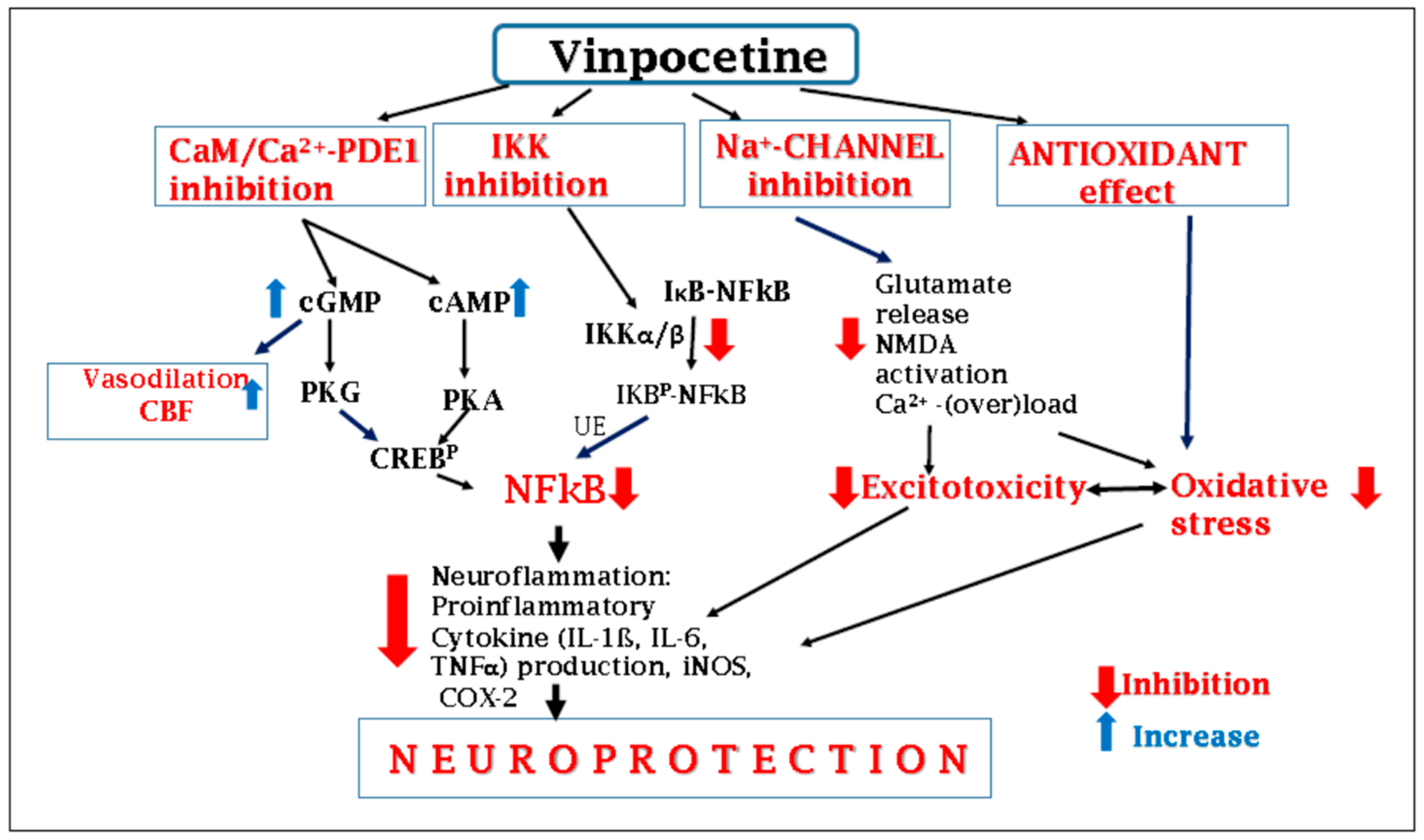
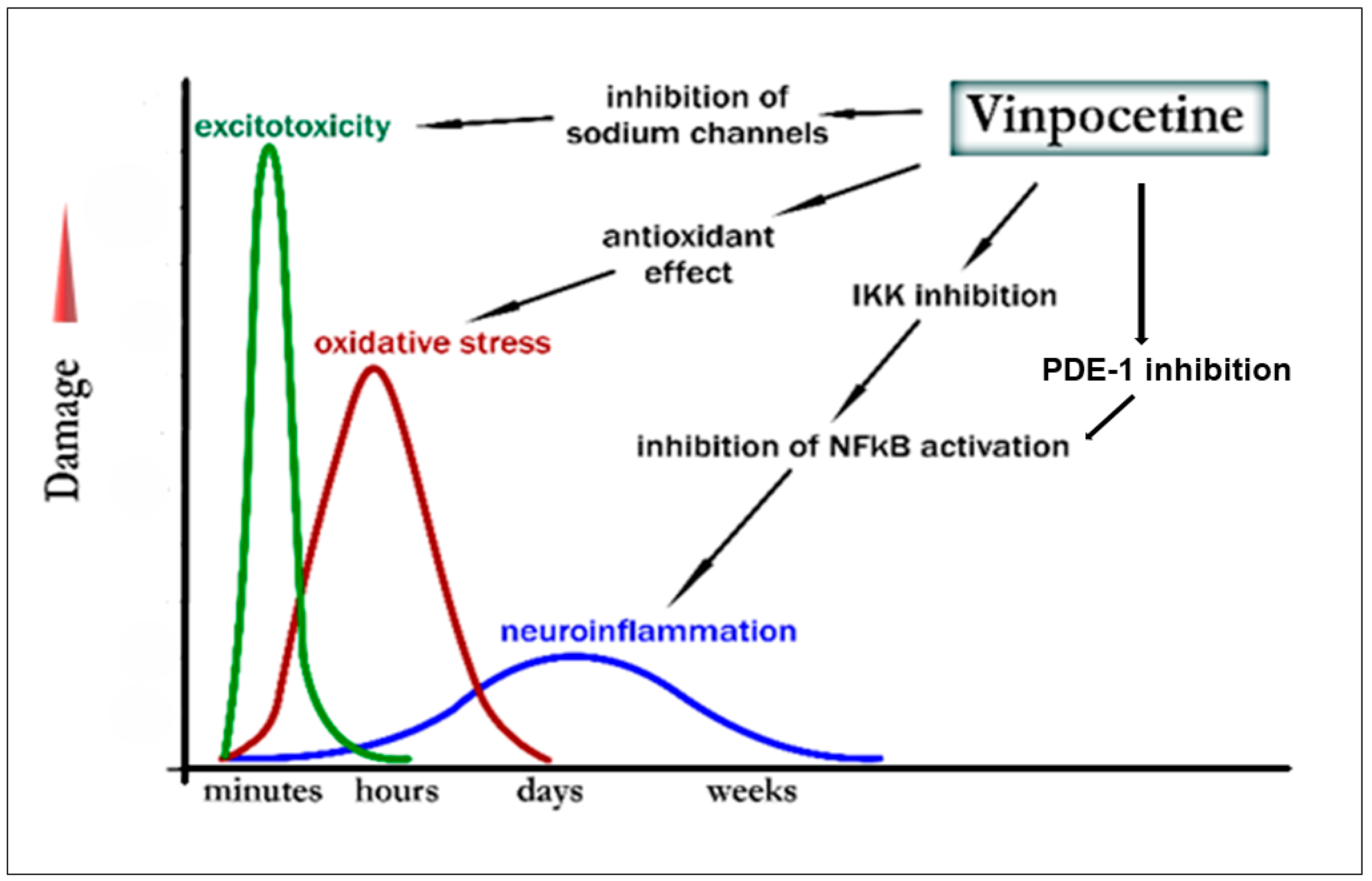
6. Summary—Mechanism of Action of Vinpocetine
- •
- Phosphodiesterase-1 inhibition, enhancing intracellular cAMP and cGMP signaling.
- •
- Voltage-gated sodium channel blockade, reducing excitotoxicity.
- •
- Antioxidant activity, attenuating oxidative stress.
- •
- Anti-inflammatory effects, primarily through inhibition of the IKK/NF-κB pathway, reducing the production of proinflammatory mediators in neuroinflammatory processes.
- •
- In various experimental in vitro systems in which the major individual effects of vinpocetine are investigated separately with respect to specific alterations, the compound’s action can generally be demonstrated at low micromolar concentrations. However, it is likely to be hypothesized that, under in vivo conditions (e.g., in cerebral ischemia and hypoxia), if the compound is present, its individual effects may act in an additive or synergistic manner; thus, its protective effect (e.g., against ischemic damage) may also be evident at lower concentrations.
7. Potential Clinical Applications
8. Conclusions
Author Contributions
Funding
Institutional Review Board Statement
Informed Consent Statement
Data Availability Statement
Conflicts of Interest
Abbreviations
| 4-AP | 4-aminopyridine |
| AMPA | α-amino-3-hydroxy-5-methyl-4-isoxazolepropionic acid |
| Bax | Bcl-2-associated X protein |
| Bcl-2 | B-cell lymphoma |
| BDNF | brain-derived neurotrophic factor |
| CBF | cerebral blood flow |
| CNS | central nervous system |
| COX-2 | cyclooxygenase 2 |
| Fas | cell surface receptor (called CD91 or APO-1) |
| GABA | γ-Aminobutyric acid |
| GSH | reduced glutathione |
| HO-1 | heme oxygenase-1 |
| ICAM-1 | intercellular adhesion molecule-1 |
| IKK | IκB kinase |
| IL-10 | interleukin-10 |
| IL-1β | interleukin-1β |
| IL-33 | interleukin 33 |
| IL-6 | interleukin-6 |
| iNOS | inducible nitrogen oxide synthase |
| iPSC | induced pluripotent stem cell |
| IκBα | inhibitor of κB alpha degradation |
| LDH | lactate dehydrogenase |
| MCP-1 | monocyte chemoattractant protein 1 |
| MDA | malondialdehyde |
| MIP-2 | macrophage inflammatory protein |
| NF-κB | nuclear factor kappa-light-chain-enhancer of activated B cells |
| NLRP+ | NOD-like receptor family, pyrin domain containing |
| NMDA | N-methyl-D-aspartate |
| NRF2 | Nuclear factor erythroid 2 related factor |
| NSAID | non-steroidal anti-inflammatory drug |
| p-AKT | phospho-protein kinase B |
| p-AKT/AKT | p-Cx43/Cx43 and phospho-protein kinase B/protein kinase B |
| pCREB | phosphorylated cAMP response element-binding protein |
| p-Cx43 | connexin 43 |
| PI3K | phosphatidylinositol kinase |
| PI3K/mTOR | phosphatidylinositol kinase/mechanistic Target Of Rapamycin |
| PKA | cAMP dependent protein kinase A |
| PKB | cGMP dependent protein kinase |
| TBARs | thiobarbituric reactive substances |
| TNFα | tumor necrosis alpha |
| TRAIL | tumor necrosis factor–related apoptosis-inducing ligand. |
| UE | ubiquitin enzyme |
| VCAM-1 | vascular cell adhesion protein 1 |
References
- Abu-Alghayth, M.H.; Al-Kuraishy, H.M.; Al-Gareeb, A.I.; Alexiou, A.; Papadakis, M.; Bahaa, M.M.; Afifi, M.; Al-Farga, A.; Wahsh, E.; Batiha, G.E.-S. Atheroprotective role of vinpocetine: An old drug with new indication. Inflammopharmacology 2024, 32, 3669–3678. [Google Scholar] [CrossRef]
- Alshehri, A.A.; Al-Kuraishy, H.M.; Al-Gareeb, A.I.; Jawad, S.F.; Khawagi, W.Y.; Alexiou, A.; Papadakis, M.; Assiri, A.A.; Elhadad, H.; El-Saber Batiha, G. The anti-inflammatory properties of vinpocetine mediates its therapeutic potential in management of atherosclerosis. J. Inflamm. 2024, 21, 19. [Google Scholar] [CrossRef]
- Al-Kuraishy, H.M.; Alexiou, A.; Papadakis, M.; Elhussieny, O.; Saad, H.M.; Batiha, G.E.-S. New insights on the potential effect of vinpocetine in Parkinson’s disease: One of the neglected warden and baffling topics. Metab. Brain Dis. 2023, 38, 1831–1840. [Google Scholar] [CrossRef]
- Puig, N.; Solé, A.; Aguilera-Simon, A.; Griñán, R.; Rotllan, N.; Camps-Renom, P.; Benitez, S. Novel therapeutic approaches to prevent atherothrombotic ischemic stroke in patients with carotid atherosclerosis. Int. J. Mol. Sci. 2023, 24, 14325. [Google Scholar] [CrossRef]
- Li, Y.; Cui, R.; Liu, S.; Qin, Z.; Sun, W.; Cheng, Y.; Liu, Q. The efficacy and safety of post-stroke cognitive impairment therapies: An umbrella review. Front. Pharmacol. 2023, 14, 1207075. [Google Scholar] [CrossRef]
- Gan, J.; Guo, L.; Zhang, X.; Yu, Q.; Yang, Q.; Zhang, Y.; Zeng, W.; Jiang, X.; Guo, M. Anti-inflammatory therapy of atherosclerosis: Focusing on IKKβ. J. Inflamm. 2023, 20, 8. [Google Scholar] [CrossRef]
- Panda, P.K.; Ramachandran, A.; Panda, P.; Sharawat, I.K. Safety and efficacy of vinpocetine as a neuroprotective agent in acute ischemic stroke: A systematic review and meta-analysis. Neurocrit. Care 2022, 37, 314–325. [Google Scholar] [CrossRef]
- Balaha, M.; Alahmari, A.; Kandeel, S.; Balaha, M. Vinpocetine’s immunomodulating, antioxidant, anti-inflammatory, anti-fibrotic, and PDE inhibiting potencies ameliorate bleomycin-induced pulmonary fibrosis. Iran. J. Basic Med. Res. 2023, 26, 13–22. [Google Scholar] [CrossRef]
- Sheng, J.; Zhang, S.; Wu, L.; Kumar, G.; Liao, Y.; GK, P.; Fan, H. Inhibition of phosphodiesterase: A novel therapeutic target for the treatment of mild cognitive impairment and Alzheimer’s disease. Front. Aging Neurosci. 2022, 14, 101987. [Google Scholar] [CrossRef] [PubMed]
- Al-Kuraishy, H.M.; Al-Gareeb, A.I.; Naji, M.T.; Al-Mamorry, F. Role of vinpocetine in ischemic stroke and poststroke outcomes: A critical review. Brain Circ. 2020, 6, 1–10. [Google Scholar] [CrossRef]
- Zhang, C.; Yan, C. Updates of recent vinpocetine research in treating cardiovascular diseases. J. Cell. Immunol. 2020, 2, 211–219. [Google Scholar] [CrossRef]
- Dubey, A.; Kumar, N.; Mishra, A.; Singh, Y.; Tiwari, M. Review on vinpocetine. Int. J. Pharm. Life Sci. 2020, 11, 6590–6597. [Google Scholar]
- Zuo, H.; Cattani-Cavalieri, I.; Musheshe, N.; Nikolaev, V.O.; Schmidt, M. Phosphodiesterases as therapeutic targets for respiratory diseases. Pharmacol. Ther. 2019, 197, 225–242. [Google Scholar] [CrossRef]
- Wu, Y.; Li, Z.; Huang, Y.-Y.; Wu, D.; Luo, H.-B. Novel Phosphodiesterase Inhibitors for cognitive Improvement in Alzheimer’s disease. Miniperspective. J. Med. Chem. 2018, 61, 5467–5473. [Google Scholar] [CrossRef] [PubMed]
- Zhang, Y.-S.; Li, J.-D.; Yan, C. An update on vinpocetine: New discoveries and clinical implications. Eur. J. Pharmacol. 2018, 819, 30–34. [Google Scholar] [CrossRef]
- Prickaerts, J.; Heckman, P.R.A.; Blokland, A. Investigational phosphodiesterase inhibitors in phase I and phase II clinical trials for Alzheimer’s disease. Expert. Opin. Investig. Drugs 2017, 26, 1033–1048. [Google Scholar] [CrossRef]
- Knott, R.; Assi, M.; Rao, S.N.R.; Ghosh, M.; Pearse, D.P. Phosphodiesterase inhibitors as a therapeutic approach to neuroprotection and repair. Int. J. Mol. Sci. 2017, 18, 696. [Google Scholar] [CrossRef] [PubMed]
- Yan, C. Cyclic nucleotide phosphodiesterase 1 and vascular aging. Clin. Sci. 2015, 129, 1077–1081. [Google Scholar] [CrossRef]
- Zhang, L.; Yang, L. Anti-Inflammatory effects of vinpocetine in atherosclerosis and ischemic stroke: A review of the literature. Molecules 2015, 20, 335–347. [Google Scholar] [CrossRef]
- Patyar, S.; Prakash, A.; Modi, M.; Medhi, B. Role of vinpocetine in cerebrovascular diseases. Pharmacol. Rep. 2011, 63, 618–628. [Google Scholar]
- Sitges, M. Antiepileptic drugs targeting cerebral presynaptic ion channels reduce cerebral excitability decreasing glutamate release. In Novel Treatment of Epilepsy; Foyaca-Sibat, H., Ed.; InTech: London, UK, 2011; pp. 111–132. [Google Scholar]
- Medina, A.E. Vinpocetine as a potent antiinflammatory agent. Proc. Natl. Acad. Sci. USA 2010, 107, 9921–9922. [Google Scholar] [CrossRef]
- Jeon, K.-I.; Xu, X.; Aizawa, T.; Lim, J.H.; Jono, H.; Kwon, D.-S.; Abe, J.I.; Berk, B.C.; Li, J.-D.; Yan, C. Vinpocetine inhibits NF-κB–dependent inflammation via an IKK-dependent but PDE-independent mechanism. Proc. Natl. Acad. Sci. USA 2010, 107, 9795–9800. [Google Scholar] [CrossRef]
- Bereczki, D.; Fekete, I.; Cochrane Stroke Group. Vinpocetine for acute ischaemic stroke. Cohrane Database Syst. Rev. 2008, 2008, CD000480. [Google Scholar] [CrossRef]
- Szatmári, S.; Whitehouse, P.J. Vinpocetine for cognitive impairment and dementia. Cochrane Database Syst. Rev. 2003, 2003, CD003119. [Google Scholar] [CrossRef]
- Vas, Á.; Gulyás, B.; Szabó, Z.; Bönöczk, P.; Csiba, L.; Kiss, B.; Kárpáti, E.; Pánczél, G.; Nagy, Z. Clinical and non-clinical investigations using positron emission tomography, near infrared spectroscopy and transcranial Doppler methods on the neuroprotective drug vinpocetine: A summary of evidences. J. Neurol. Sci. 2002, 203–204, 259–262. [Google Scholar] [CrossRef]
- Dézsi, L.; Kis-Varga, I.; Nagy, J.; Komlodi, Z.; Karpati, E. A vinpocetin neuroprotektív hatásai in vivo és in vitro. Acta Pharmaceutica Hungarica 2002, 72, 84–91. [Google Scholar]
- Bönöczk, P.; Gulyás, B.; Ádám-Vizi, V.; Nemes, A.; Kárpáti, E.; Kiss, B.; Kapás, M.; Szántay, C.; Koncz, I.; Zelles, T.; et al. Role of sodium channel inhibition in neuroprotection: Effect of vinpocetine. Brain Res. Bull. 2000, 53, 245–254. [Google Scholar] [CrossRef] [PubMed]
- Lőrincz, C.; Szász, K.; Kisfaludi, L. The synthesis of ethyl apovincaminate. Arzneim. Forsch. 1976, 26, 1907. [Google Scholar]
- Szántay, C.; Szabó, L.; Kalaus, G.; Kreidl, J.; Czibula, L.; Visky, G.; Nemes, A.; Farkas, M. Preparation of apovincaminic acid esters. Ger. Pat. Chem. Abstr. 1983, 98, 198530n. [Google Scholar]
- Kárpáti, E.; Szporny, L. General and cerebral hemodynamic activity of ethyl apovincaminate. Arzneim. Forsch. 1986, 26, 1909–1912. [Google Scholar]
- Bíró, K.; Kárpáti, E.; Szporny, L. Protective activity of ethyl apovincaminate on ischaemic anoxia of brain. Arzneim. Forsch. 1976, 26, 1918–1920. [Google Scholar]
- Kakihana, M.; Suno, M.; Shibota, M.; Hamajo, K.; Nagaoka, A. Protective effect of vinpocetine on experimental brain ischemia. Folia Pharmacol. Jpn. 1982, 80, 225–229. [Google Scholar] [CrossRef]
- King, G.A.; Narcavage, D. Comparison of the effects of vinpocetine, vincamine, phenytoin, and cinnarizine in a rat model of cerebral ischemia. Drug Dev. Res. 1986, 9, 225–231. [Google Scholar] [CrossRef]
- Lamar, J.-C.; Poignet, H.; Beughard, M.; Durend, G. Calcium antagonist activity of vinpocetine and vincamine in several models of cerebral ischaemia. Drug Dev. Res. 1988, 14, 297–304. [Google Scholar] [CrossRef]
- Groó, D.; Pálosi, É.; Szporny, L. Comparison of the effect of vinpocetine, vincamine, and nicergoline on the normal and hypoxia-damaged learning process in spontaneously hypertensive rats. Drug Dev. Res. 1988, 15, 75–85. [Google Scholar] [CrossRef]
- Sauer, D.; Rischke, R.; Beck, T.; Roßberg, C.; Mennel, H.-D.; Bielenberg, G.W.; Krieglstein, J. Vinpocetine prevents ischemic cell damage in rat hippocampus. Life Sci. 1988, 43, 1733–1739. [Google Scholar] [CrossRef]
- Koida, M.; Nakamuta, H.; Yasuda, K.; Muguruma, K.; Hiramatsu, Y.; Ogawa, Y.; Kato, Y. Carbon monoxide (CO)-induced hypoxia in mice: Evaluation as an experimental model of cerebral ischemia for drug screening. Jpn. J. Pharmacol. 1989, 51, 273–278. [Google Scholar] [CrossRef]
- Araki, H.; Karasawa, Y.; Nojiri, M.; Aihara, H. Effect of various classes of drugs on complete ischemia induced by decapitation and cyanide intoxication in mice. Methods Find. Exp. Clin. Pharmacol. 1988, 10, 349–356. [Google Scholar] [PubMed]
- Rischke, R.; Krieglstein, J. Protective effect of vinpocetine against brain damage caused by ischemia. Jpn. J. Pharmacol. 1991, 56, 349–356. [Google Scholar] [CrossRef] [PubMed]
- Solanki, P.; Prasad, D.; Mutruhaju, S.; Sharma, S.; Singh, S.B.; Ilavzhagan, G. Preventive effect of piracetam and vinpocetine on hypoxia-reoxygenation induced injury in primary hippocampal culture. Food Chem. Toxicol. 2011, 49, 917–922. [Google Scholar] [CrossRef] [PubMed]
- Rischke, R.; Krieglstein, J. Effects of vinpocetine on local cerebral blood flow and glucose utilization 7 days after forebrain ischemia in the rat. Pharmacology 1990, 41, 153–160. [Google Scholar] [CrossRef]
- Bönöczk, P.; Pánczél, G.; Nagy, Z. Vinpocetine increases cerebral blood flow and oxygenation in stroke patients: A near infrared spectroscopy and transcranial Doppler study. Eur. J. Ultrasound 2002, 15, 85–91. [Google Scholar] [CrossRef]
- Nivision-Smith, L.; Khoo, P.; Acosta, M.L.; Kallonaitis, M. Pre-treatment with vinpocetine protects against retinal ischemia. Exp. Eye Res. 2017, 154, 126–138. [Google Scholar] [CrossRef]
- Zaki, H.F.; Abdelsalam, M. Vinpocetine protects liver against ischemia-reperfusion injury. Canad. J. Physiol. Pharmacol. 2013, 91, 1064–1070. [Google Scholar] [CrossRef]
- Abbas, W.J.; Altemimi, M.L.; Al-Mudhafar, R.H.; Zigam, Q.A.; Hadi, N.R. Effects of vinpocetine on renal ischemia reperfusion injury in a male rat model. Sys. Rev. Pharm. 2020, 11, 2380–2389. [Google Scholar]
- Azouz, A.A.; Hersi, F.; Ali, F.E.M.; Hussein Elkelawy, A.M.M.; Omar, H. Renoprotective effect of vinpocetine against ischemia/reperfusion injury: Modulation of NADPH oxidase/Nrf2, IKKß/NF-κB p65, and cleaved caspase-3 expressions. J. Biochem. Mol. Toxicol. 2022, 36, e23046. [Google Scholar] [CrossRef]
- Pan, B.W.; Shi, Y.; Li, W.-C.; Wang, Q.; Pan, M.; Wu, Q.; Fu, H.-Z. Synthesis and biological evaluation of vinpocetine derivatives. Bioorganic Med. Chem. Lett. 2020, 30, 126472. [Google Scholar] [CrossRef]
- Dong, Z.-C.; Shi, Y.; Zheng, L.-L.; Tian, Y.-P.; Yang, J.; Wei, Y.; Zhou, Y.; Pan, B.-W. Synthesis and activity evaluation of vinpocetine-derived indole alkaloids. Molecules 2023, 29, 14. [Google Scholar] [CrossRef] [PubMed]
- Dong, Z.-C.; Shi, Y.; Liu, L.J.; Feng, T.T.; Zhou, Y. Synthesis and pharmacological activity of vinpocetine derivatives. RSC Adv. 2024, 14, 7981–7991. [Google Scholar] [CrossRef] [PubMed]
- Rosdy, B.; Balázs, M.; Szporny, L. Biochemical effects of ethyl apovincaminate. Arzneim. Forsch. 1976, 26, 1926–1929. [Google Scholar]
- Ahn, H.-S.; Crim, W.; Romano, M.; Sybertz, E.; Pitts, B. Effects of selective inhibitors on cyclic nucleotide phosphodiesterase of rabbit aorta. Biochem. Pharmacol. 1989, 38, 3331–3339. [Google Scholar] [CrossRef]
- Chiu, P.J.S.; Tetzloff, G.; Ahn, H.-S.; Sybertz, E. Comparative effects of vinpocetine and 8-Br-cyclic GMP on the contraction and 45Ca-fluxes in the rabbit aorta. Am. J. Hypertens. 1988, 1, 262–268. [Google Scholar] [CrossRef]
- Hagiwara, M.; Endo, T.; Hidaka, H. Effects of vinpocetine on cyclic nucleotide metabolism in vascular smooth muscle. Biochem. Pharmacol. 1984, 33, 453–457. [Google Scholar] [CrossRef]
- Yan, C.; Zhao, A.Z.; Bentley, J.K.; Beavo, J.A. The calmodulin-dependent phosphodiesterase gene PDE1c encodes several functionally different splice variants in a tissue-specific manner. J. Biol. Chem. 1996, 271, 25699–25706. [Google Scholar] [CrossRef]
- Souness, J.E.; Brazdil, R.; Diocee, B.K.; Jordan, R. Role of selective cyclic GMP phosphodiesterase inhibition in the myorelaxant actions M & B 22,948, MY-5445, vinpocetine and 1-methyl-3-isobutyl-8-(methylamino)xanthine. Br. J. Pharmacol. 1989, 98, 725–734. [Google Scholar]
- Erdõ, S.L.; Molnár, P.; Lakics, V.; Bence, J.Z.; Tömösközi, Z. Vincamine and vincanol are potent blockers of voltage gated-sodium channels. Eur. J. Pharmacol. 1996, 314, 69–73. [Google Scholar] [CrossRef]
- Molnár, P.; Erdő, S.L. Vinpocetine is as potent as phenytoin to block voltage-gated Na+-channels in rat cortical neurons. Eur. J. Pharmacol. 1995, 273, 303–306. [Google Scholar] [CrossRef] [PubMed]
- Gulyás, B.; Halldin, C.; Vas, Á.; Banati, R.B.; Shchukin, E.; Finnema, S.; Tarkainen, J.; Tihanyi, K.; Szilágyi, G.; Farde, L. 11C.vinpocetine: A prospective peripheral benzodiazepine receptor ligand for primate PET studies. J. Neurol. Sci. 2005, 229, 219–223. [Google Scholar] [CrossRef] [PubMed]
- Kaneko, S.; Takahashi, H.; Satoh, M. The use of Xenopus oocytes to evaluate drugs affecting brain Ca2+ channels: Effects of bifemelane and several nootropic drugs. Eur. J. Pharmacol. 1990, 189, 51–58. [Google Scholar] [CrossRef] [PubMed]
- Tretter, L.; Adam-Vizi, V. The neuroprotective drug vinpocetine prevents veratridine-induced Na+ i and Ca2+ i rise in synaptosomes. Neuroreport 1998, 9, 1849–1853. [Google Scholar] [CrossRef]
- Lee, D.K.H.; Geiger, G. Effect of vinpocetine on monoamine receptor binding and synaptosomal uptake in the rat brain. Drug Dev. Res. 1988, 14, 281–283. [Google Scholar] [CrossRef]
- Manda, V.K.; Avula, B.; Dale, O.R.; Chittaboyina, A.G.; Khan, I.A.; Walker, L.A.; Khan, S.I. Studies on pharmacokinetic drug interaction potential of vinpocetine. Medicines 2015, 2, 93–105. [Google Scholar] [CrossRef]
- Shen, Z.; Xiang, M.; Chen, C.; Ding, F.; Wang, Y.; Shang, C.; Xin, L.; Zang, Y.; Cui, X. Glutamate excitot oxicity: Potential therapeutic target for ischemic stroke. Biomed. Pharmacother. 2022, 151, 113125. [Google Scholar] [CrossRef]
- Jurcau, A.; Simion, A. Neuroinflammation in cerebral ischemia and ischemia/reperfusion injuries: From pathophysiology to therapeutic strategies. Int. J. Mol. Sci. 2022, 23, 14. [Google Scholar] [CrossRef]
- Mao, R.; Zong, N.; Hu, Y.; Chen, Y.; Xu, Y. Neuronal death mechanisms and therapeutic strategy in ischemic stroke. Neurosci. Bull. 2022, 38, 1229–1247. [Google Scholar] [CrossRef]
- Neves, D.; Salazar, I.L.; Almeida, R.D.; Silva, R. Molecular mechanisms of ischemia and glutamate excitotoxicity. Life Sci. 2023, 328, 121814. [Google Scholar] [CrossRef]
- Xu, H.; Wang, E.; Chen, F.; Xiao, J.; Wang, M. Neuroprotective phytochemicals in experimental ischemic stroke: Mechanisms and potential clinical applications. Oxidative Med. Cell. Longev. 2021, 2021, 6687386. [Google Scholar] [CrossRef] [PubMed]
- Erdő, S.L.; Cai, N.S.; Wolff, J.R. Vinpocetine protects against excitotoxic cell death in primary cultures of rat cerebral cortex. Eur. J. Pharmacol. 1990, 187, 551–553. [Google Scholar] [CrossRef] [PubMed]
- Kiss, B.; Cai, N.S.; Erdő, S.L. Vinpocetine preferentially antagonizes quisqualate/AMPA receptor responses: Evidence from release and ligand binding studies. Eur. J. Pharmacol. 1991, 209, 109–112. [Google Scholar] [CrossRef] [PubMed]
- Sitges, M.; Sanchez-Tafolla, B.M.; Chiu, M.L.; Aldana, B.I.; Guarneros, A. Vinpocetine inhibits glutamate release induced by the convulsive agent 4-aminopyridine more potently than several antiepileptic drugs. Epilepsy Res. 2011, 96, 257–266. [Google Scholar] [CrossRef] [PubMed]
- Sitges, M.; Chiu, L.M.; Guarneros, A.; Nekrassov, V. Effects of carbamazepine, phenytoin, lamotrigine, oxcarbazepine, topiramate and vinpocetine on Na+ channel-mediated release of 3H.glutamate in hippocampal nerve endings. Neuropharmacology 2007, 52, 598–605. [Google Scholar] [CrossRef]
- Nyakas, C.; Felszeghy, K.; Szabó, R.; Keijesr, J.N.; Luiten, P.G.M.; Szombathelyi, Z.; Tihanyi, K. Neuroprotective effects of vinpocetine and its major metabolite cis-apovincaminic acid on NMDA-induced neurotoxicity in a rat entorhinal cortex lesion model. CNS Neurosci. Ther. 2009, 15, 89–99. [Google Scholar] [CrossRef]
- Lenkey, N.; Károly, R.; Lukács, P.; Vizi, E.S.; Sunesen, M.; Fodor, L.; Mike, Á. Classification of drugs based on properties of sodium channel inhibition: A comparative automated patch-clamp study. PLoS ONE 2010, 5, e15568. [Google Scholar] [CrossRef]
- Zuliani, V.; Patel, M.K.; Fantini, M.; Rivara, M. Recent advances in the medicinal chemistry of sodium channel blockers and their therapeutic potential. Curr. Top. Med. Chem. 2009, 9, 396–415. [Google Scholar] [CrossRef]
- Mike, A.; Károly, R.; Vizi, E.S.; Kiss, J.P. A novel modulatory mechanism of sodium currents: Frequency-dependence without state-dependent binding. Neuroscience 2004, 125, 1019–1029. [Google Scholar] [CrossRef]
- Huang, C.J.; Harootunian, A.; Maher, M.; Quan, C.; Raj, C.D.; McCormack, K.; Numann, R.; Negulescu, P.A.; González, J.E. Characterization of voltage-gated sodium-channel blockers by electrical stimulation and fluorescence detection of membrane potential. Nat. Biotechnol. 2006, 24, 439–446. [Google Scholar] [CrossRef]
- Lounkine, E.; Keiser, M.J.; Whitebread, S.; Mikhailov, D.; Hamon, J.; Jenkins, J.; Lavan, P.; Weber, E.; Doak, A.K.; Coté, S.; et al. Large-scale prediction and testing of drug activity on side-effect targets. Nature 2012, 486, 361–367. [Google Scholar] [CrossRef]
- Mike, A.; Karoly, R.; Vizi, E.S.; Kiss, J.P. Inhibitory effect of the DA uptake blocker GBR 12909 on sodium channels of hippocampal neurons. Neuroreport 2003, 14, 1945–1949. [Google Scholar] [CrossRef] [PubMed]
- Cakulev, I.; Lacerda, A.E.; Khrestian, C.M.; Ryu, K.; Brown, A.M.; Valdo, A.L. Oral vanoxerine prevents reinduction of atrial tachyarrhythmias: Preliminary results. J. Cardiovasc. Electrophysiol. 2011, 22, 1266–1273. [Google Scholar] [CrossRef] [PubMed]
- Matsumoto, N.; Khrestian, C.M.; Ryu, K.; Lacerda, A.E.; Brown, A.M.; Valdo, A.L. Vanoxerine, a new drug for terminating atrial fibrillation and flutter. J. Cardiovasc. Electrophysiol. 2010, 21, 311–319. [Google Scholar] [CrossRef] [PubMed]
- Lukacs, P.; Földi, M.C.; Valánszki, L.; Casanova, E.; Biri-Kovács., B.; Nyitray, L.; Málnási-Csizmadia, A.; Mike, A. Non-blocking modulation contributes to sodium channel inhibition by a covalently attached photoreactive riluzole analog. Sci. Rep. 2018, 8, 8110. [Google Scholar] [CrossRef]
- Földi, M.C.; Pesti, K.; Zboray, K.; Toth, A.V.; Hegedűs, T.; Málnási-Csizmadia, A.; Lukács, P.; Mike, A. The mechanism of non-blocking inhibition of sodium channels revealed by conformational-selective photolabeling. Br. J. Pharmacol. 2021, 178, 1200–1217. [Google Scholar] [CrossRef]
- Huang, J.; Fan, X.; Jin, X.; Teng, L.; Yan, N. Dual-pocket inhibition of Nav channels by antiepileptic drug lamotrigine. Proc. Natl. Acad. Sci. USA 2023, 120, e2309773120. [Google Scholar] [CrossRef]
- Hollingworth, D.; Thomas, F.; Page, D.A.; Fouda, M.; Lopez-Rios De Castro, R.; Sula, A.; MykHaylyk, M.; Kelly, G.; Ulmschneider, M.D.; Ruben, P.; et al. Structural basis for the rescue of hyperexcitable cells by the amyotrophic lateral sclerosis drug riluzole. Nat. Commun. 2024, 15, 8426. [Google Scholar] [CrossRef]
- Tao, E.; Corry, B. Drugs exhibit diverse binding modes and access routes in the Nav1.5 cardiac sodium channel pore. J. Gen. Physiol. 2025, 157, e202413658. [Google Scholar] [CrossRef]
- Lakics, V.; Sebestyén, M.G.; Erdő, S.L. Vinpocetine is a highly potent neuroprotectant against veratridine-induced cell death in primary culture of rat cerebral cortex. Neurosci. Lett. 1995, 185, 127–130. [Google Scholar] [CrossRef]
- Lakics, V.; Molnár, P.; Erdő, S.L. Protection against veratrine toxicity in rat cortical cultures: Relationship to sodium channel blockade. Neuroreport 1995, 7, 89–92. [Google Scholar] [PubMed]
- Zelles, T.; Franklin, L.; Koncz, I.; Lendvai, B.; Zsilla, G. The nootropic drug vinpocetine inhibits veratridine-induced Ca2+.i increase in rat hippocampal CA1 pyramidal cells. Neurochem. Res. 2001, 26, 1095. [Google Scholar] [CrossRef] [PubMed]
- Sitges, M.; Nekrassov, V. Vinpocetine selectively inhibits neurotransmitter release triggered by sodium channel activation. Neurochem. Res. 1999, 24, 1585–1591. [Google Scholar] [CrossRef] [PubMed]
- Zhou, X.; Dong, X.-W.; Crona, J.; Maguire, M.; Priestley, T. Vinpocetine is a potent blocker of rat Nav1.8 tetrodotoxin-resistant sodium channels. J. Pharmacol. Exp. Ther. 2003, 306, 498–504. [Google Scholar] [CrossRef] [PubMed]
- Adam-Vizi, V. Neuroprotective effect of sodium channel blockers in ischemia: The pathomechanism of early ischemic dysfunction. Orv. Hetil. 2000, 141, 1279–1286. [Google Scholar]
- Sitges, M.; Chiu, L.M.; Nekrassov, V. Single and combined effects of carbamazepine and vinpocetine on depolarization-induced changes in Na+, Ca2+ and glutamate release in hippocampal isolated nerve endings. Neurochem. Int. 2006, 49, 55–61. [Google Scholar] [CrossRef]
- Wu, Q.; Huang, J.; Fan, X.; Wang, K.; Jin, X.; Huang, G.; Li, J.; Pan, X.; Yan, N. Structural mapping of Nav1.7 antagonists. Nat. Commun. 2023, 14, 3224. [Google Scholar] [CrossRef]
- Lendvai, B.; Zelles, T.; Rozsa, B.; Vizi, E.S. A vinca alkaloid enhances morphological dynamics of dendritic spines of neocortical layer 2/3 pyramidal cells. Brain Res. Bull. 2003, 59, 257–260. [Google Scholar] [CrossRef]
- Osteen, J.; Immani, E.S.; Tapley, E.T.L.; Indersmitten, E.T.; Hurst, E.N.; Healy, E.T.; Aergeerts, E.K.; Negulescu, E.P.A.; Lechner, E.S. Pharmacology and mechanism of action of suzetrigine, a potent and selective Nav1.8 pain signal inhibitor for the treatment of moderate to severe pain. Pain Ther. 2025, 14, 655–674. [Google Scholar] [CrossRef]
- Kingwell, K. NaV1.8 inhibitor poised to provide opioid-free pain relief. Nat. Rev. Drug Discov. 2025, 24, 3–5. [Google Scholar] [CrossRef]
- Jin, S.; Fredholm, B. Role of NMDA, AMPA and kainate receptors in mediating glutamate- and 4-AP-induced dopamine and acetylcholine release from rat striatal slices. Neuropharmacology 1994, 33, 1039–1048. [Google Scholar] [CrossRef]
- Vizi, E.S.; van Dijk, J.; Foldes, F.F. The effect of 4-aminopyridine on acetylcholine release. J. Neural Transm. 1977, 41, 265–274. [Google Scholar] [CrossRef]
- Sitges, M.; Galván, E.; Nekrassov, V. Vinpocetine blockade of sodium channels inhibits the rise in sodium and calcium induced by 4-aminopyridine in synaptosomes. Neurochem. Internatl. 2005, 46, 533–540. [Google Scholar] [CrossRef] [PubMed]
- Nekrassov, V.; Sitges, M. Additive effects of antiepileptic drugs and pentylenetetrazole on hearing. Neurosci. Lett. 2006, 406, 276–280. [Google Scholar] [CrossRef] [PubMed]
- El-Sayed, S.S.; El-Yamani, M.F.; Salem, H.A.; El-Sahar, A.E. New insights into the effects of vinpocetine against neurobehavioral comorbidities in a rat model of temporal lobe epilepsy via the downregulation of the hippocampal PI3K/mTOR signalling pathway. J. Pharm. Pharmacol. 2021, 73, 626–640. [Google Scholar] [CrossRef] [PubMed]
- Zhao, C.; Rollo, B.; Javaid, M.S.; Huang, Z.; He, W.; Xu, H.; Kwan, P.; Zhang, C. An integrated in vitro human iPSCs-derived neuron and in vivo animal approach for preclinical screening of anti-seizure compounds. J. Adv. Res. 2024, 64, 249–262. [Google Scholar] [CrossRef]
- Vohora, D.; Saraogi, P.; Yazdani, M.A.; Bhowmik, M.; Khanam, R.; Pillai, K.K. Recent advances in adjunctive therapy for epilepsy: Focus on sodium channel blockers as third generation antiepileptic drugs. Drugs Today 2010, 46, 265–277. [Google Scholar] [CrossRef]
- Meador, K.J.; Leeman-Markowski, B.; Medina, A.; Illamola, S.M.; Seliger, J.; Novak, G.; Lin, C.; Ivanisevic, M.; Razavi, B.; Marino, S.; et al. Vinpocetine, cognition, and epilepsy. Epilepsy Behav. 2021, 119, 107988. [Google Scholar] [CrossRef]
- Billakota, N.; Andresen, J.M.; Gay, B.C.; Stewart, G.R.; Fedorov, N.B.; Gerlach, A.C. Personalized medicine: Vinpocetine to reverse effects of GABRB3 mutation. Epilepsia 2019, 60, 2459–2465. [Google Scholar] [CrossRef]
- Gjerulfsen, C.; Mieszczanek, T.; Johanessen, K.; Lia, V.W.Y.; Chebib, M.; Norby, H.A.J.; Gardella, E.; Rubboli, G.; Ahring, P.; Moller, R.S. Vinpocetine improved neuropsychiatric and epileptic outcomes in a patient with a GABRA1 loss-of-function variant. Ann. Clin. Translat. Neurol. 2023, 10, 1493–1498. [Google Scholar] [CrossRef]
- Wu, L.; Xiong, X.; Wu, X.; Ye, Y.; Jian, Z.; Zhi, Z.; Gu, L. Targeting oxidative stress and inflammation to prevent ischemia-reperfusion injury. Front. Mol. Neurosci. 2020, 13, 28. [Google Scholar] [CrossRef]
- Trujillo-Rangel, V.Á.; Garcia-Valdés, L.; Mendez-del Villar, M.; Castaneda-Arellano, R.; Totsuka-Sutto, S.E.; Garcia-Benavides, L. Therapeutic targets for regulating oxidative damage induced by ischemia-reperfusion injury: A study from a pharmacological perspective. Oxidative Med. Cell. Longev. 2022, 2022, 8624318. [Google Scholar] [CrossRef] [PubMed]
- Oláh, V.A.; Balla, G.; Balla, J.; Szabolcs, A.; Karmazsin, L. An in vitro study of the hydroxyl scavenger effect of Cavinton. Acta Pediatr. Hung. 1990, 30, 309–316. [Google Scholar]
- Horváth, B.; Marton, Z.; Halmosi, R.; Alexy, T.; Szapáry, L.; Judit, V.; Bíró, Z.; Habon, T.; Késmárky, G.; Tóth, K. In vitro antioxidant properties of pentoxifylline, piracetam, and vinpocetine. Clin. Neuropharmacol. 2002, 25, 37–42. [Google Scholar] [CrossRef] [PubMed]
- Santos, M.S.; Duarte, A.I.; Moreira, P.I. Synaptosomal response to oxidative stress: Effect of vinpocetine. Free. Radic. Res. 2000, 32, 57–66. [Google Scholar] [CrossRef]
- Sitges, M.; Herrera-Mundo, N. Vinpocetine and α-tocopherol prevent the increase in DA and oxidative stress induced by 3-NPA in striatum isolated nerve endings. J. Neurochem. 2013, 124, 233–240. [Google Scholar] [CrossRef]
- Miyamoto, M.; Murphy, T.M.; Schnaar, R.L.; Coyle, J.T. Antioxidants protect against glutamate-induced cytotoxicity in a neuronal cell line. J. Pharmacol. Exp. Ther. 1989, 250, 1132–1140. [Google Scholar] [CrossRef] [PubMed]
- Al-Kuraishy, H.M.; Al-Gareeb, A.I.; Albuhadilly, A.K. Vinpocetine and pyritinol: A new model for blood rheological modulation in cerebrovascular disorders-a randomized controlled clinical study. BioMed Res. Int. 2014, 2014, 324307. [Google Scholar] [CrossRef]
- Svab, G.; Dóczi, J.; Gerencser, A.A.; Ambrus, A.; Gallyas, F.; Sümegi, B.; Tretter, L. The mitochondrial targets of neuroprotective drug vinpocetine on primary neuron cultures, brain capillary endothelial cells, synaptosomes, and brain mitochondria. Neurochem. Res. 2019, 44, 2435–2447. [Google Scholar] [CrossRef]
- Pereira, C.; Oliveira, R. Vinpocetine attenuates the metabolic dysfunction induced by amyloid ß-peptides in PC12 cells. Free Radic. Res. 2000, 33, 497–506. [Google Scholar] [CrossRef] [PubMed]
- Abdel Salam, O.M.E.; Khadrawy, Y.A.; Salem, N.A.; Sleem, A.A. Oxidative stress in a model of toxic demyelination in rat brain: The effect of piracetam and vinpocetine. Neurochem. Res. 2011, 36, 1062–1072. [Google Scholar] [CrossRef] [PubMed]
- Lourencio-Gonzales, Y.; Fattori, V.; Domiciano, T.P.; Rossaneis, A.C.; Borghi, S.M.; Zaninelli, T.H.; Bernardi, C.C.F.; Alves-Filho, J.C.; Cunha, T.M.; Cunha, F.Q.; et al. Repurposing of the nootropic drug vinpocetine as an analgesic and anti-inflammatory agent: Evidence in a mouse model of superoxide anion-triggered inflammation. Mediat. Inflamm. 2019, 2019, 6481812. [Google Scholar] [CrossRef]
- Ruiz-Miyazawa, K.W.; Zarpelon, A.C.; Pinho-Ribeiro, F.A.; Pavao-de-Souza, G.F.; Casgrande, R.; Veri, W.A. Vinpocetine reduces carrageenan-induced inflammatory hyperalgesia in mice by inhibiting oxidative stress, cytokine production and NF-κB activation in the paw and spinal cord. PLoS ONE 2015, 10, e0118942. [Google Scholar] [CrossRef]
- Ruiz-Miyazawa, K.W.; Pinho-Ribeiro, F.A.; Zarpelon, A.C.; Staurengo-Ferrari, L.; Silva, R.L.; Alves-Filho, J.C.; Cunha, T.M.; Cunha, F.Q.; Casagrande, R.; Verri, W.A., Jr. Vinpocetine reduces lipopolysaccharide-induced inflammatory pain and neutrophil recruitment in mice by targeting oxidative stress, cytokines and NF-kB. Chem. Biol. Interact. 2015, 237, 9–17. [Google Scholar] [CrossRef]
- Liu, R.; Pan, M.-X.; Tang, J.-C.; Liao, H.-B.; Zhuang, Y.; Zhao, D.; Wan, Q. Role of neuroinflammation in ischemic stroke. Neuroimmunol. Neuroinflamm. 2017, 4, 158–166. [Google Scholar] [CrossRef]
- Jayraj, R.L.; Azimullah, S.; Beiram, B.; Jalal, F.Y.; Rosenberg, G.A. Neuroinflammation: Friend and foe for ischemic stroke. J. Neuroinflamm. 2019, 16, 142. [Google Scholar] [CrossRef]
- Stuckey, S.M.; Ong, L.K.; Collins-Praino, L.E.; Turner, R.J. Neuroinflammation as a key driver of secondary neurodegeneration following stroke. Int. J. Mol. Sci. 2021, 22, 13101. [Google Scholar] [CrossRef]
- Levinson, S.; Pulli, B.; Heit, J.J. Neuroinflammation and acute ischemic stroke: Impact on translational research and clinical care. Front. Surg. 2025, 12, 1501359. [Google Scholar] [CrossRef] [PubMed]
- Elenkov, I.; Wilder, R.L.; Chrousos, G.P.; Vizi, E.S. The sympathetic nerve--an integrative interface between two supersystems: The brain and the immune system. Pharmacol. Rev. 2000, 52, 595–638. [Google Scholar] [CrossRef] [PubMed]
- Hou, B.; Li, D.; Wang, D.; Jiang, C.; Wang, G.; Wang, D.; Yan, G.; Guo, X.; Zhao, L.; Wan, Z.; et al. Neuroprotective effects of vinpocetine against ischemia-reperfusion injury via inhibiting NLRP3 inflammasome signaling pathway. Neuroscience 2023, 526, 74–84. [Google Scholar] [CrossRef]
- Wang, J.; Dong, T.; Zhang, Y.; Lu, Z.; Zhai, K.; Liu, X. Effects of vinpocetine and ozagrel on behavioral recovery of rats after global brain ischemia. J. Clin. Neurosci. 2014, 21, 661–663. [Google Scholar] [CrossRef]
- Wang, H.; Zhang, K.; Zhao, L.; Tang, J.; Gao, L.; Wei, Z. Anti-inflammatory effects of vinpocetine on the functional expression of nuclear factor-kappa B and tumor necrosis factor-alpha in a rat model of cerebral ischemia-reperfusion injury. Neurosci. Lett. 2014, 566, 247–251. [Google Scholar] [CrossRef] [PubMed]
- Zhang, F.; Yan, C.; Wei, C.; Yao, Y.; Ma, X.; Gong, Z.; Liu, S.; Zang, D.; Chen, J.; Shi, F.-D.; et al. Vinpocetine inhibits NF-κB-dependent inflammation in acute ischemic stroke patients. Transl. Stroke Res. 2017, 9, 172–184. [Google Scholar] [CrossRef]
- Wu, L.-R.; Liu, L.; Xiomg, X.-Y.; Zhang, Q.; Wang, F.-X.; Gong, C.-X.; Zhong, Q.; Rang, Y.-R.; Meng, Z.-Y.; Yang, Q.-L. Vinpocetine alleviate cerebral ischemia/reperfusion injury by down-regulating TLR4/MyD88/NF-κB signaling. Oncotarget 2017, 8, 80315–88324. [Google Scholar] [CrossRef]
- Zhao, M.; Hou, S.; Feng, L.; Shen, P.; Nan, D.; Zhang, Y.; Wang, F.; Ma, D.; Feng, J. Vinpocetine protects against cerebral ischemia-reperfusion injury by targeting astrocytic connexin43 via the PI3K/AKT signaling pathway. Front. Neurosci. 2020, 14, 223. [Google Scholar] [CrossRef]
- Zagrean, A.M.; Hermann, D.M.; Opris, I.; Zagrean, L.; Popa-Wagner, A. Multicellular crosstalk between exosomes and the neurovascular unit after cerebral ischemia. Therapeutic implications. Front. Neurosci. 2018, 12, 811. [Google Scholar] [CrossRef]
- Zang, J.; Wu, J.; Su, X.; Zhang, T.; Tang, X.; Ma, D.; Li, Y.; Weng, Z.; Liu, X.; Tsan Kwan, C.K.; et al. Inhibition of PDE1-B by vinpocetine regulates microglial exosomes and polarization through enhancing autophagic flux for neuroprotection against ischemic stroke. Front. Cell Dev. Biol. 2021, 8, 616590. [Google Scholar] [CrossRef]
- Yelkenci, H.; Degirmenci, Z.; Koc, H.I.; Bayirli, S.; Baltaci, S.B.; Altunay, S.; Oztekin, N.; Kocak, M.; Kilic, E.; Beker, M.C. Vinpocetine ameliorates neuronal injury after cold-induced traumatic brain injury in mice. Mol. Neurobiol. 2025, 2, 3956–3972. [Google Scholar] [CrossRef]
- Shui, X.; Chen, J.; Fu, Z.; Zhu, H.; Tao, H.; Li, Z. Microglia in ischemic stroke: Pathogenesis insights and therapeutic challenges. J. Inflamm. Res. 2024, 17, 3335–3352. [Google Scholar] [CrossRef] [PubMed]
- Rupprecht, R.; Papadopoulos, V.; Rammes, G.; Baghai, T.C.; Fan, J.; Akula, N.; Groyer, G.; Adams, D.; Schumacher, M. Translocator protein (18 kDa) (TSPO) as a therapeutic target for neurological and psychiatric disorders. Nat. Rev. Drug Discov. 2010, 9, 971–988. [Google Scholar] [CrossRef] [PubMed]
- Zhao, Y.Y.; Yu, J.Z.; Li, Q.Y.; Ma, C.G.; Lu, C.Z.; Xiao, B.G. TSPO-specific ligand vinpocetine exerts a neuroprotective effect by suppressing microglial inflammation. Neuron Glia Biol. 2011, 7, 187–197. [Google Scholar] [CrossRef] [PubMed]
- Gabryel, B.; Pudelko, A.; Malecki, A.; Trzeciak, H. Piracetam and vinpocetine exert cytoprotective activity and prevent apoptosis of astrocytes in vitro in hypoxia and reoxygenation. Neurotoxicology 2002, 23, 19–31. [Google Scholar] [CrossRef]
- Polli, J.W.; Kincaid, R.L. Expression of a calmodulin-dependent phosphodiesterase isoform (PDE1B1) correlates with brain regions having extensive dopaminergic innervation. J. Neurosci. 1994, 14, 1251–1261. [Google Scholar] [CrossRef]
- Truss, M.C.; Uckert, S.; Stief, C.G.; Schulz-Knappe, P.; Hess, R.; Forssmann, W.G.; Jonas, U. Porcine detrusor cyclic nucleotide phosphodiesterase isoenzymes: Characterisation and functional effects of various phosphodiesterase inhibitors in vitro. Urology 1995, 45, 893–901. [Google Scholar] [CrossRef]
- Goraya, T.A.; Cooper, D.M.F. Ca2+-calmodulin-dependent phosphodiesterase (PDE1): Current perspectives. Cell. Signal. 2005, 17, 789–797. [Google Scholar] [CrossRef]
- Lugnier, C. Cyclic nucleotide phosphodiesterase (PDE) superfamily: A new target for the development of specific therapeutic agents. Pharmacol. Ther. 2006, 109, 366–398. [Google Scholar] [CrossRef]
- Omori, K.; Kotera, J. Overview of PDEs and their regulation. Circ. Res. 2007, 100, 309–327. [Google Scholar] [CrossRef]
- Barbagallo, F.; Assenza, M.R.; Messina, A. In the brain of phosphodiesterases: Potential therapeutic targets for schiophrenia. Clin. Psychopharmacol. Neurosci. 2025, 23, 15–31. [Google Scholar] [CrossRef] [PubMed]
- Delhaye, S.; Bardoni, B. Role of phosphodiesterases in the pathophysiology of neurodevelopmental disorders. Mol. Psychiatry 2021, 26, 4570–4582. [Google Scholar] [CrossRef]
- Samidurai, A.; Xi, L.; Das, A.; Iness, A.N.; Vigneshwar, N.G.; Li, P.-L.; Singla, D.K.; Muniyan, S.; Batra, S.K.; Kukreja, R.C. Role of phosphodiesterase 1 in the pathophysiology of diseases and potential therapeutic opportunities. Pharmacol. Therap. 2021, 226, 1078580. [Google Scholar] [CrossRef]
- Roks, A.J.M. Phosphodiesterase-1 in the cardiovascular system. Cell. Signal. 2022, 92, 110251. [Google Scholar] [CrossRef]
- Nagel, D.J.; Aizawa, T.; Jeon, K.-I.; Liu, W.; Mohan, A.; Wei, H.; Miano, J.M.; Florio, V.A.; Gao, P.; Koshunov, V.A.; et al. Role of nuclear Ca2+/calmodulin-stimulated phosphodiesterase 1A in vascular smooth muscle cell growth and survival. Circ. Res. 2025, 98, 777–784. [Google Scholar] [CrossRef]
- Heckman, P.R.A.; Blokland, A.; Prickaerts, J. From age-related cognitive decline to Alzheimer’s disease: A translational overview of the potential role for phosphodiesterases. In Phosphodiesterases: CNS Functions and Diseases. Advances in Neurobiology; Zhang, H.T., Xu, Y., O’Donnell, J., Eds.; Springer: Berlin/Heidelberg, Germany, 2017; Volume 17, pp. 135–167. [Google Scholar] [CrossRef]
- Sanders, O.; Rajagopal, L. Phosphodiesterase Inhibitors for Alzheimer’s Disease: A systematic review of clinical trials and epidemiology with a mechanistic rationale. J. Alzheimer’s Dis. Rep. 2020, 4, 185–215. [Google Scholar] [CrossRef]
- Filgueiras, C.C.; Krahe, T.E.; Medina, A. Phosphodiesterase type 1 inhibition improves learning in rats exposed to alcohol during the third trimester equivalent of human gestation. Neurosci. Lett. 2010, 473, 202–207. [Google Scholar] [CrossRef] [PubMed]
- Lantz, C.L.; Wang, W.; Medina, A.E. Early alcohol exposure disrupts visual cortex plasticity in mice. Int. J. Dev. Neurosci. 2012, 30, 351–357. [Google Scholar] [CrossRef] [PubMed]
- Krahe, T.E.; Wang, W.; Medina, A.E. Phosphodiesterase inhibition increases CREB phosphorylation and restores orientation selectivity in a model of fetal alcohol spectrum disorders. PLoS ONE 2009, 4, e6643. [Google Scholar] [CrossRef]
- Nunes, F.; Ferreira-Rosa, K.; Preira, M.; Kubrushly, R.C.; Manhaes, A.C.; Abreu-Villac, Y.; Filgueiras, C.C. Acute administration of vinpocetine, a phosphodiesterase type 1 inhibitor, ameliorates hyperactivity in a mice model of fetal alcohol spectrum disorder. Drug Alcohol Depend. 2011, 119, 81–87. [Google Scholar] [CrossRef]
- Araujo, U.C.; Nunes, F.; Goncalves, B.S.; Gomes, R.A.A.; Moreira, M.F.R.; Nunes-Freitas, A.; Krahe, T.; de Abreu-Villaca, Y.; Manhaes, A.C.; Filgueiras, C.C. Vinpocetine, a phosphodiesterase type 1 inhibitor, mitigates locomotor hyperactivity in female mice exposed to lead during development. Brain Sci. 2025, 15, 150. [Google Scholar] [CrossRef]
- Luhach, K.; Kulkarni, G.T.; Singh, V.P.; Sharma, B. Vinpocetine ameliorates developmental hyperserotonemia induced behavioral and biochemical changes: Role of neuronal function, inflammation, and oxidative stress. Acta Neurobiol. Exp. 2022, 82, 35–51. [Google Scholar] [CrossRef]
- Sharma, N.; Luhach, K.; Golani, L.K.; Singh, B.; Sharma, B. Vinpocetine, a PDE1 modulator, regulates markers of cerebral health, inflammation, and oxidative stress in a rat model of prenatal alcohol-induced experimental attention deficit hyperactivity disorder. Alcohol 2022, 105, 25–34. [Google Scholar] [CrossRef]
- Ristic, J.; Folic, M.; Radonjic, K.; Rosic, M.; Bolevich, S.; Alisultanovic, O.I.; Draginic, M.; Jeremic, J.; Milosavljevic, I.; Zivkovic, V.; et al. Preconditioning with PDE1 inhibitors and moderate-intensity training positively affect systemic redox state of rats. Oxidative Med. Cell. Longev. 2020, 2020, 6361703. [Google Scholar] [CrossRef]
- Shekarian, M.; Komaki, A.; Shahidi, A.; Salehi, I.; Raoufi, S. The protective and therapeutic effects of vinpocetine, a PDE1 inhibitor, on oxidative stress and learning and memory impairment induced by an intracerebroventricular (ICV) injection of amyloid beta (aß) peptide. Behav. Brain Res. 2020, 383, 112512. [Google Scholar] [CrossRef]
- Shekarian, M.; Saleji, I.; Raoufdi, S.; Asadbegi, M.; Kourosh-Arami, M.; Komaki, A. Neuroprotective effects of vinpocetine, as a phosphodiesterase 1 inhibitor, on long-term potentiation in a rat model of Alzheimer’s disease. BMC Neurosci. 2023, 24, 20. [Google Scholar] [CrossRef]
- Gupta, S.; Sharma, B. Protective effects of phosphodiesterase-1 and ATP sensitive potassium (KATP) channel modulators against 3-nitropropionic acid induced behavioral and biochemical toxicities in experimental Huntington’s disease. Eur. J. Pharmacol. 2014, 732, 11–122. [Google Scholar] [CrossRef] [PubMed]
- Hayakawa, M. Comparative efficacy of vinpocetine, pentoxifylline and nicergoline on red blood cell deformability. Arzneim. Forsch. 1992, 42, 108–110. [Google Scholar]
- Goksel, E.; Ugurel, E.; Nader, E.; Boisson, C.; Muniansi, I.; Joly, P.; Renoux, C.; Gauthier, A.; Connes, P.; Yalcin, O. A preliminary study of phosphodiesterases and adenylyl cyclase signaling pathway on red blood cell deformability of sickle cell patients. Front. Physiol. 2023, 14, 1215835. [Google Scholar] [CrossRef] [PubMed]
- Hasko, G.; Pacher, P.; Vizi, E.S.; Illés, P. Adenosine receptor signaling in the brain immune system. Trends Pharmacol. Sci. 2005, 26, 511–516. [Google Scholar] [CrossRef]
- Sperlagh, B.; Zsilla, G.; Baranyi, M.; Illes, P.; Vizi, E.S. Purinergic modulation of glutamate release under ischemic-like conditions in the hippocampus. Neuroscience 2007, 149, 99–111. [Google Scholar] [CrossRef]
- Salmaso, V.; Menin, S.; Moro, S.; Spalluto, G.; Federico, S. Adenosine receptors in neuroinflammation and neurodegeneration. Cells 2025, 14, 1585. [Google Scholar] [CrossRef]
- Effendi, W.I.; Nagano, T.; Kobayashi, K.; Nishimura, Y. Focusing on adenosine receptors as a potential targeted therapy in human diseases. Cells 2020, 9, 785. [Google Scholar] [CrossRef]
- Fredholm, B.B.; Lindgren, E.; Lindström, K.; Vernet, L. The effect of some drugs with purported antianoxic effect on veratridine-induced purine release from isolated rat hypothalamic synaptosomes. Acta Pharmacol. Toxicol. 1983, 53, 236–244. [Google Scholar] [CrossRef]
- Milusheva, E.; Sperlágh, B.; Kiss, B.; Szporny, L.; Pásztor, E.; Papasova, M.; Vizi, E.S. Inhibitory effect of hypoxic condition on acetylcholine release is partly due to the effect of adenosine released from the tissue. Brain Res. Bull. 1990, 24, 369–373. [Google Scholar] [CrossRef]
- Krieglstein, J.; Rischke, R. Vinpocetine increases the neuroprotective effect of adenosine in vitro. Eur. J. Pharmacol. 1991, 205, 7–10. [Google Scholar] [CrossRef] [PubMed]
- Zhang, W.; Huang, Y.; Li, Y.; Tan, L.; Nao, J.; Hu, H.; Zhang, J.; Li, C.; Kong, Y.; Song, Y. Efficacy and safety of vinpocetine as part of treatment for acute cerebral infarction: A randomized, open-label, controlled, multicenter CAVIN (Chinese Assessment for Vinpocetine in Neurology) trial. Clin. Drug Investig. 2016, 36, 697–704. [Google Scholar] [CrossRef] [PubMed]
- Menon, B.K.; Buck, B.H.; Singh, N.; Deschaintre, Y.; Almekhlafi, M.A.; Coutts, S.B.; Thirunavukkarasu, S.; Khosravani, H.; Appireddy, R.; Moreau, F.; et al. Intravenous tenecteplase compared with alteplase for acute ischaemic stroke in Canada (AcT): A pragmatic, multicentre, open-label, registry-linked, randomised, controlled, non-inferiority trial. Lancet 2022, 400, 161–169. [Google Scholar] [CrossRef]
- Wang, Y.; Li, M.; Jiang, Y.; Ji, Q. Comparative efficacy of neuroprotective agents for improving neurological function and prognosis in acute ischemic stroke: A network meta-analysis. Front. Neurosci. 2004, 18, 1530987. [Google Scholar] [CrossRef]
- Ogunrin, A. Effect of vinpocetine (cognitol) on cognitive performances of a nigerian population. Ann. Med. Health Sci. Res. 2014, 4, 654–661. [Google Scholar] [CrossRef]
- Agarwal, S.; Patel, B. Is aura around citicoline fading? A systemic review. Indian J. Pharmacol. 2017, 49, 4–9. [Google Scholar] [CrossRef]
- Bornstein, N.M.; Guekht, A.; Vester, J.; Heiss, W.D.; Gusev, E.; Homberg, V.; Rahlfs, V.W.; Bajenaru, O.; Popescu, B.O.; Muresanu, D. Safety and efficacy of Cerebrolysin in early post-stroke recovery: A meta-analysis of nine randomized clinical trials. Neurol. Sci. 2018, 39, 629–640. [Google Scholar] [CrossRef]
- Wan, M.; Yang, K.; Zhang, G.; Yang, C.; Wei, Y.; He, Y.; Jiang, X. Efficacy, safety, and cost-effectiveness analysis of Cerebrolysin in acute ischemic stroke: A rapid health technology assessment. Medicine 2024, 103, e37593. [Google Scholar] [CrossRef]
- Malhotra, K.; Chang, J.J.; Khunger, A.; Blacker, D.; Switzer, J.A.; Goyal, N.; Hernandez, A.V.; Pasupuleti, V.; Alexandrov, A.V.; Tsivgoulis, G. Minocycline for acute stroke treatment: A systematic review and meta-analysis of randomized clinical trials. J. Neurol. 2018, 265, 1871–1879. [Google Scholar] [CrossRef]



| (2000–2025) | ||
|---|---|---|
| Author | Title | Journal |
| Abu Alghayt, MH. et al. [1] | Atheroprotective role of vinpocetine: an old drug with new indication. | Inflammopharmacology. 2024; 32:3669–3678, doi.org/10.1007/s10787-024-01529-5 |
| Alshehri, A. et al. [2] | The anti-inflammatory properties of vinpocetine mediates its therapeutic potential in management of atherosclerosis. | J Inflammation. 2024; 21:1–19. doi.org/10.1186/s12950-024-00394-x |
| Al-Kuraishy, HM. et al. [3] | New insights on the potential effect of vinpocetine in Parkinson’s disease: one of the neglected warden and baffling topics. | Metabolic Brain Disease. 2023; 38:1831–1840. doi.org/10.1007/s11011-023-01254-y |
| Puig, N. et al. [4] | Novel therapeutic approaches to prevent atherothrombotic ischemic stroke in patients with carotid atherosclerosis. | Int J Mol Sci; 2023; 24(14325):1–16. doi.org/10.3390/ijms241814325 |
| Li, Y. et al. [5] | The efficacy and safety of post-stroke cognitive impairment therapies: an umbrella review. | Front Pharmacol. 2023; 14(1207075). doi. 10.3389/fphar.2023.1207075 |
| Gan, J. et al. [6] | Anti-inflammatory therapy of atherosclerosis: focusing on IKKß. | Journal of Inflammation. 2023; 20, doi.org/10.1186/s12950-023-00330-5 |
| Panda, PK. et al. [7] | Safety and efficacy of vinpocetine as a neuroprotective agent in acute ischemic stroke: a systematic review and meta-analysis. | Neurocrit Care. 2022; 37:314–325. doi.org/10.1007/s12028-022-01499-y |
| Balaha, M. et al. [8] | Vinpocetine’s immunomodulating, anti-oxidant, anti-inflammatory, anti-fibrotic, and PDE inhibiting potencies ameliorate bleomycin- induced pulmonary fibrosis. | Iran J Basic Med Res. 2023; 26:13–22. doi: 10.22038/IJBMS.2022.64175.14130. |
| Sheng, J. et al. [9] | Inhibition of phosphodiesterase: A novel therapeutic target for the treatment of mild cognitive impairment and Alzheimer’s disease. | Front Aging Neurosci. 2022; 14:1019187. 10.3389/fnagi.2022.1019187 |
| Al-Kuraishy, HM. et al. [10] | Role of vinpocetine in ischemic stroke and poststroke outcomes: A critical review. | Brain Circulation. 2020; 6:1–10. doi: 10.4103/bc.bc_46_19 |
| Zhang, C. et al. [11] | Updates of recent vinpocetine research in treating cardiovascular diseases. | J Cell Immunol, 2020; 211–219 doi: 1033696/immunology.2.045. |
| Dubey, A. et al. [12] | Review on vinpocetine. | Int J Pharm Life Sci. 2020; 11:6590–6597 www.reserchgate.net/publication/344467105 |
| Zuo, H. et al. [13] | Phosphodiesterases as therapeutic targets for respiratory diseases. | Pharmacol Ther. 2019; 197:225–242 doi.org/10106/j.pharmthera.2019.02.002 |
| Wu, Y. et al. [14] | Novel phosphodiesterase inhibitorsfor cognitive improvement in Alzheimer’s disease. | J Med Chem. 2018; 61:5467–5473. doi.org/10.1021/acs.jmedchem.7b01370 |
| Zhang, Y-S. et al. [15] | An update on vinpocetine: New discoveries and clinical implications. | Eur J Pharmacol. 2018; 819:30–34, doi.org/10.1016/j.ejphar.2017.11.041 |
| Prickaerts, J. et al. [16] | Investigational phosphodiesterase inhibitors in phase I and phase II clinical trials for Alzheimer’s disease. | Exp Opin Investig Drugs. 2017; 26:1033–1048, doi.org/10.1080/13543784.2017.1364360 |
| Knott R, et al. [17] | Phosphodiesterase inhibitors as a therapeutic approach to neuroprotection and repair. | Int J Mol Sci. 2017; 18(696). doi:10.3390/ijms18040696 |
| Yan, OC. et al. [18] | Cyclic nucleotide phospho-diesterase 1 and vascular aging. | Clinical Science 2015; 129:1077–1081 doi: 10.1042/CS20150605 |
| Zhang, L. et al. [19] | Anti-Inflammatory effects of vinpocetine in atherosclerosis and ischemic stroke: a review of the literature. | Molecules. 2015; 20:335–347. doi:10.3390/molecules20010335 |
| Patyar, S. et al. [20] | Role of vinpocetine in cerebrovascular diseases. | Pharmacological Report. 2011; 63(3):618–628. |
| Sitges, M. [21] | Antiepileptic drugs targeting cerebral presynaptic ion channels reduce cerebral excitability decreasing glutamate release. | In: Novel Treatment of Epilepsy 2011; 111–132. ed. Humberto Foyaca-Sibat, InTech, |
| Medina, AE. [22] | Vinpocetine as a potent anti-inflammatory agent. | PNAS. 2010; 107(22):9921–9922, doi/10.1073/pnas.1005138107 |
| Jeon, K-I. et al. [23] | Vinpocetine inhibits NF-kB-dependent inflammation via an IKK-dependent but PDE-independent mechanism. | PNAS 107(21):9795–9800, 2010. doi/10.1073/pnas.0914414107 |
| Bereczki, D. et al. [24] | Vinpocetine for acute ischemic stroke. | Cohrane Database Syst Rev.2008 (Jan 23 (1): CD00480):2404–2405, 2008. doi: 10.1002/14651858.CD000480.pub2. |
| Szatmári, S. et al. [25] | Vinpocetine for cognitive impairment and Dementia. | Cochrane Database of Systematic Reviews 2003, Issue 1. Art. No.: CD003119. doi: 10.1002/14651858.CD003119 |
| Vas, Á. et al. [26] | Clinical and non-clinical investigations using positron emission tomography, near infrared spectroscopy and transcranial Doppler methods on the neuroprotective drug vinpocetine: a summary of evidences. | J Neurol Sci. 2002; 203–204:259–262, doi: 10.1016/s0022-510x(02)00301-5. |
| Dézsi, L. et al. [27] | A vinpocetin neuroprotektív hatásai in vivo és in vitro. | Acta Pharmaceutica Hungarica 2002; 72:84–91 |
| Bönöczk, P. et al. [28] | Role of sodium channel inhibition in neuroprotection: Effect of vinpocetine. | Brain Res. Bull. 2000; 53:245–254. doi: 10.1016/s0361-9230(00)00354-3 |
| Enzyme/Channel/ Receptor | Tissue/Cell | IC50 (µM) | Effect | References |
|---|---|---|---|---|
| Ca2+/Calmodulin PDE | rat, bovine aorta | 14–200 | cAMP, cGMP elevation | [23,48,49,51,52,53,54,55,56] |
| voltage-dependent Na+-channels | primary cell culture of rat brain | 44.7 | Na+-channel block | [57] |
| rat cortical neuron | 44.2 | blockade of Na+-currents | [58] | |
| [3H]-Batrachotoxin binding | rat cerebrocortical synaptosomes | 0.34 | NaV-channel binding | [57] |
| rat brain | 1.9 | Na+-channel | [59] | |
| Ca2+ channel | Xenopus oocytes | ~100 | inhibition of voltage-dependent Ca2+-channels | [60] |
| isolated nerve terminals | 1–20 | inhibition of Ca2+-induced depolarization | [61] | |
| Ca2+-channel, L-type | rat cerebral cortex | 2.1 | inhibition of Ca2+-induced depolarization | [59] |
| NFκB dependent transcriptional activity | vessel smooth muscle | 25 | inhibition of neuro- inflammation | [23] |
| IKK | vessel smooth muscle cells | 26 | inhibition of neuro- inflammation | [23] |
| Translocator protein (TSPO) | rat heart | 0.2 | steroidogenesis, apoptosis, oxidative stress | [59] |
Disclaimer/Publisher’s Note: The statements, opinions and data contained in all publications are solely those of the individual author(s) and contributor(s) and not of MDPI and/or the editor(s). MDPI and/or the editor(s) disclaim responsibility for any injury to people or property resulting from any ideas, methods, instructions or products referred to in the content. |
© 2026 by the authors. Licensee MDPI, Basel, Switzerland. This article is an open access article distributed under the terms and conditions of the Creative Commons Attribution (CC BY) license.
Share and Cite
Vizi, E.S.; Kiss, B. Vinpocetine—An “Old” Drug with a New Face: Moving Toward a Better Understanding of Its Neuroprotective Mechanism of Action. Biomolecules 2026, 16, 454. https://doi.org/10.3390/biom16030454
Vizi ES, Kiss B. Vinpocetine—An “Old” Drug with a New Face: Moving Toward a Better Understanding of Its Neuroprotective Mechanism of Action. Biomolecules. 2026; 16(3):454. https://doi.org/10.3390/biom16030454
Chicago/Turabian StyleVizi, E. Sylvester, and Béla Kiss. 2026. "Vinpocetine—An “Old” Drug with a New Face: Moving Toward a Better Understanding of Its Neuroprotective Mechanism of Action" Biomolecules 16, no. 3: 454. https://doi.org/10.3390/biom16030454
APA StyleVizi, E. S., & Kiss, B. (2026). Vinpocetine—An “Old” Drug with a New Face: Moving Toward a Better Understanding of Its Neuroprotective Mechanism of Action. Biomolecules, 16(3), 454. https://doi.org/10.3390/biom16030454