Ribosome Biogenesis and Translational Control in Skeletal Muscle Atrophy and Hypertrophy: Mechanisms and Therapeutic Perspectives



Abstract
1. Introduction
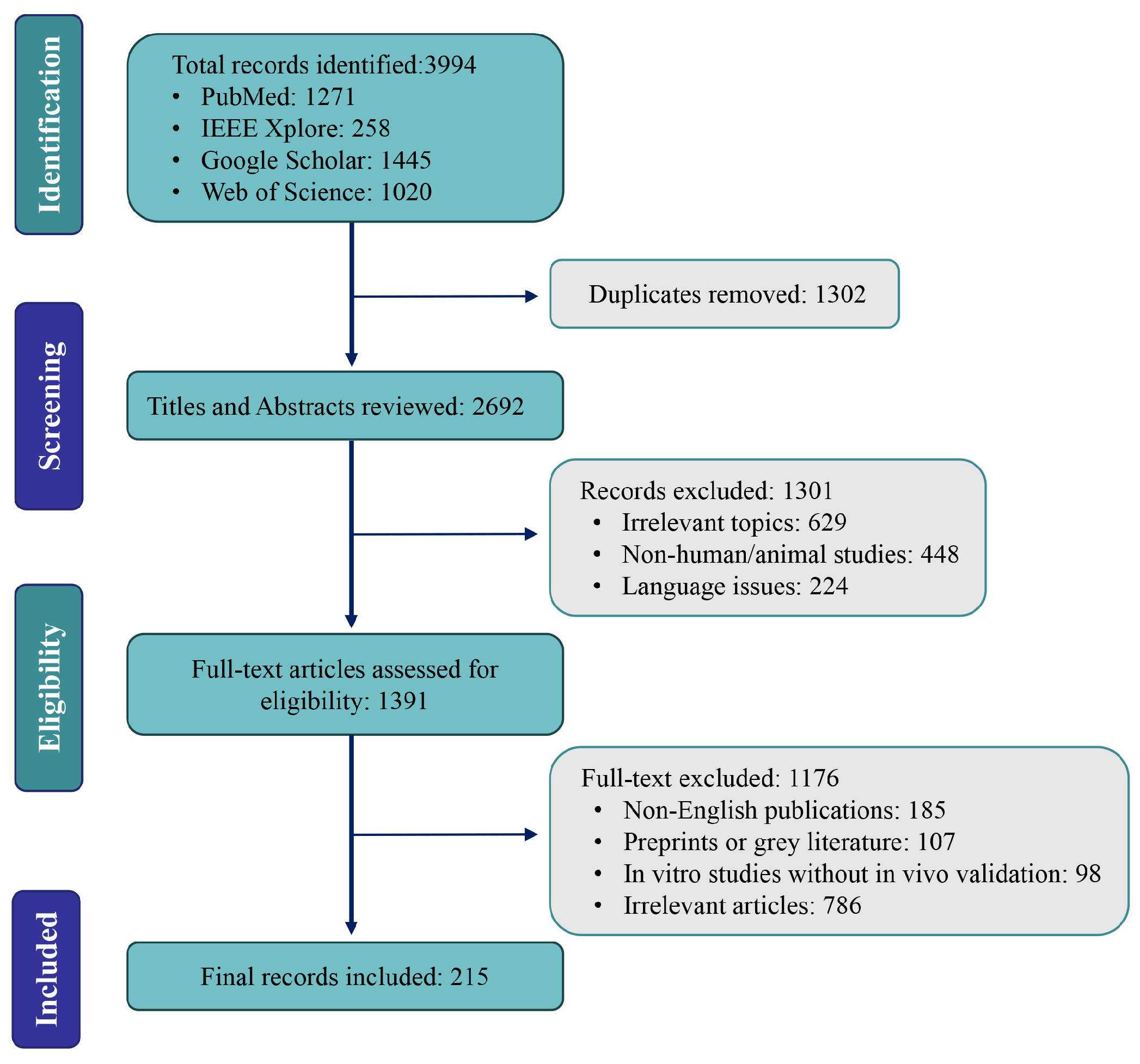
2. Methods
3. Ribosome Biogenesis in Skeletal Muscle: Molecular Basis
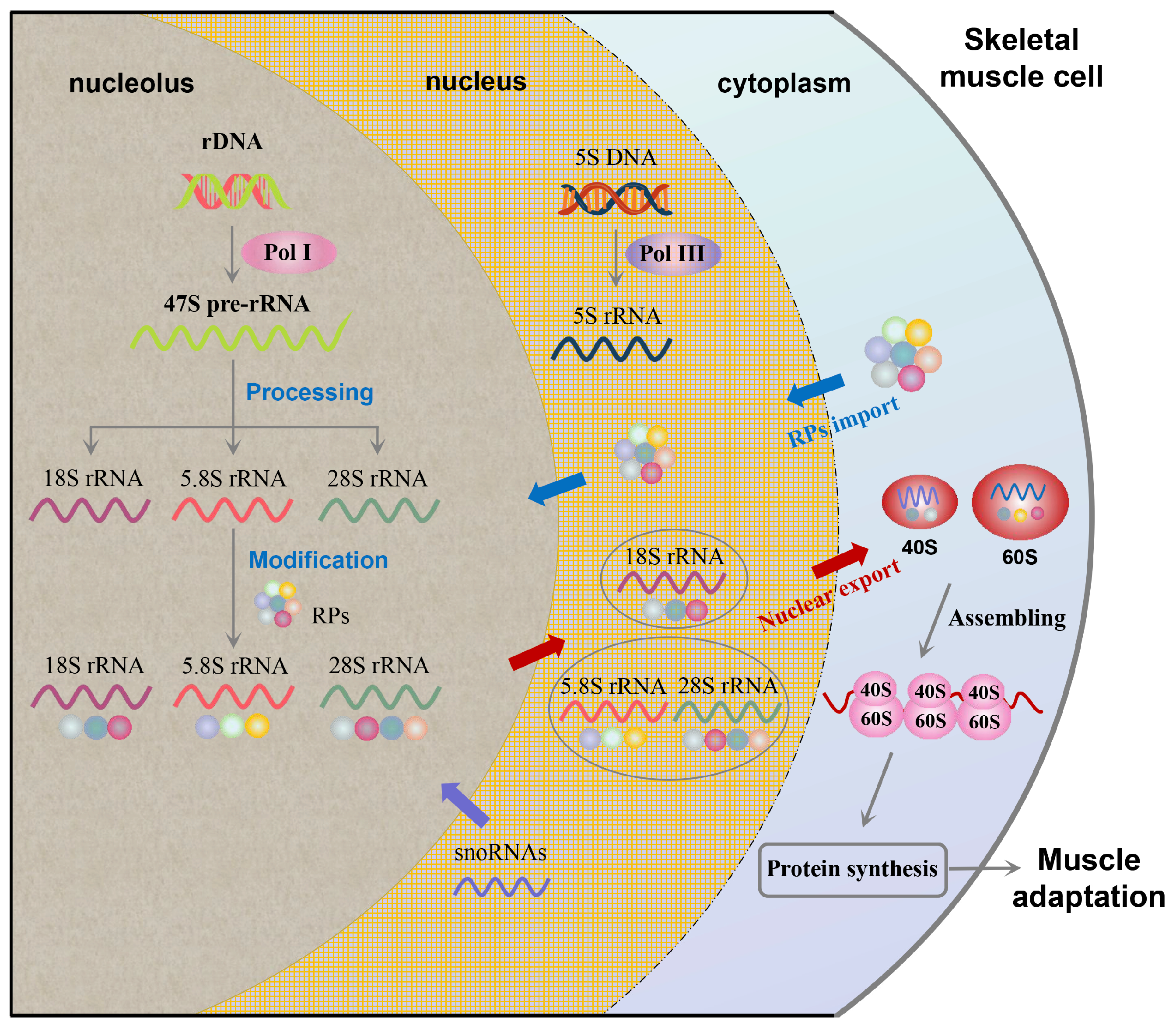
3.1. rRNA Transcription and Processing
3.2. Ribosomal Protein Synthesis and Nucleolar Assembly
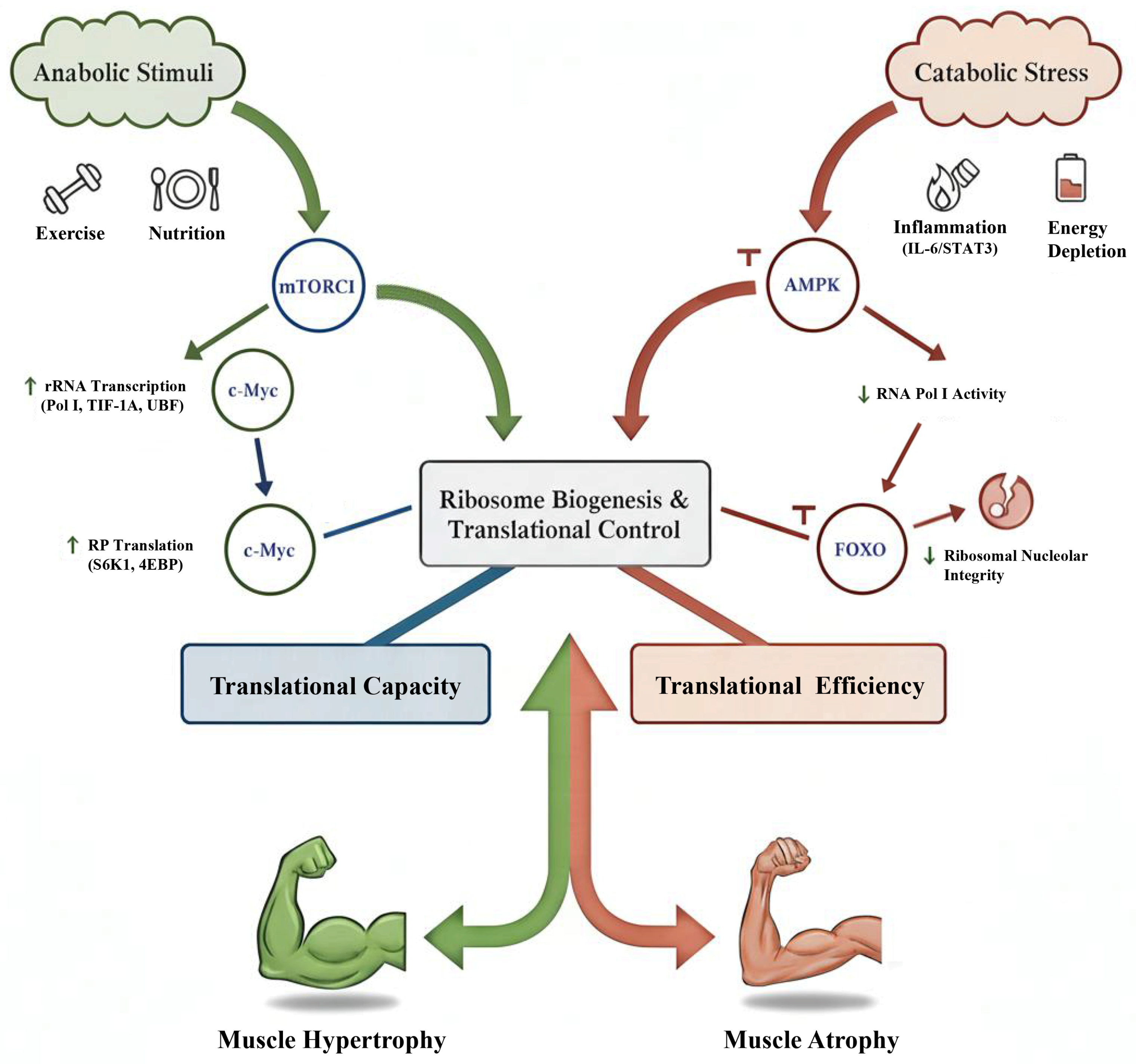
3.3. Signaling Regulation of Ribosome Biogenesis
3.4. Translational Capacity Versus Efficiency
3.5. Ribosome Biogenesis in Satellite Cells (SCs) and Synergistic Regulation of Hypertrophy
4. Ribosome Dysfunction in Muscle Atrophy
4.1. Disuse-Induced Atrophy
4.2. Disease-Associated Atrophy
4.3. Age-Related Atrophy
4.4. Integrative Perspective

| Context | Mechanisms and Features | Clinical Implications | References |
|---|---|---|---|
| Disuse-induced atrophy | Reduced 47S pre-rRNA transcription; downregulation of ribosomal protein genes; suppressed mTORC1–UBF/TIF-1A signaling; AMPK activation; activation of ribophagy (selective ribosome degradation); reduced nucleolar activity (reversible with reloading) | Early biomarker of immobilization-induced atrophy; monitoring ribosome recovery may guide rehabilitation strategies; potential therapeutic target for preventing muscle loss during bed rest or microgravity. | [23] |
| Disease-associated atrophy | Impaired rRNA transcription and processing; reduced ribosomal protein synthesis; activation of IL-6, TNF-α, STAT3, NF-κB, and FOXO; DNA damage and oxidative stress (chemotherapy); nucleolar disruption; ribosome stress; reduced translational fidelity | Prognostic biomarker in cancer cachexia; therapeutic target for anti-inflammatory or nucleolar-protective interventions; relevant to long-term weakness in CKD, heart failure, ICU patients, and cancer survivors. | [124] |
| Aging-related atrophy | Blunted rRNA induction after exercise or nutrition; reduced ribosomal protein transcripts; impaired mTORC1 sensitivity; FOXO activation; altered ribosome heterogeneity; fragmented nucleoli; defective rRNA modifications; reduced translational accuracy | Central contributor to sarcopenia; ribosome heterogeneity as a novel therapeutic frontier; diminished responsiveness to standard interventions; potential biomarker for individualized exercise–nutrition strategies. | [22,24] |
5. Ribosome Heterogeneity and Selective Translation
5.1. Structural Basis of Ribosome Specialization
5.2. Post-Translational Modifications and Associated Factors
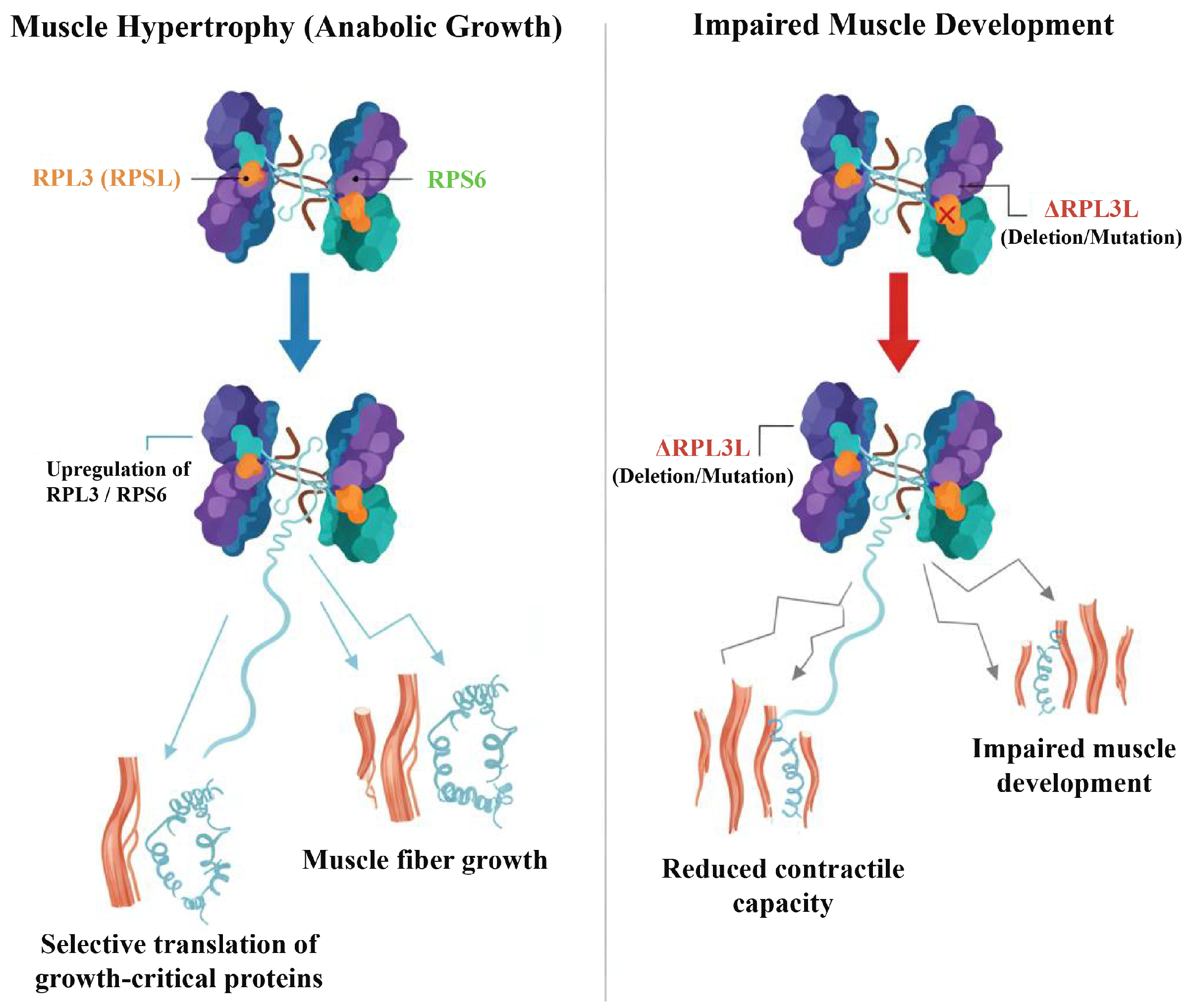
5.3. Functional Relevance in Skeletal Muscle Plasticity
6. Therapeutic Perspectives: Exercise, Nutrition, and Pharmacology
6.1. Exercise Training
6.2. Nutritional Strategies
6.3. Pharmacological Interventions
6.4. Clinical Translation and Ongoing Trials
| Therapeutic Approach | Key Mechanisms | Evidence & Clinical Translation | References |
|---|---|---|---|
| Exercise training | RE: Stimulates ribosome production and muscle growth. Endurance exercise: Primarily enhances mitochondrial biogenesis with limited impact on ribosome function. | Strong evidence: Proven effective in improving muscle mass and strength, widely recommended for sarcopenia. | [25,150] |
| Nutritional strategies | Protein supplementation: Enhances ribosome biogenesis, especially with leucine. Protein quality: Different proteins (whey vs. plant) affect ribosomal signaling. | Well-supported: High-protein, leucine-enriched diets activate mTORC1, beneficial for sarcopenia and cachexia. | [174] |
| Pharmacological interventions | Direct activators (e.g., mTORC1 agonists, c-Myc activators): Stimulate ribosome production during catabolic stress. Indirect modulators (e.g., anti-inflammatory, antioxidants): Preserve nucleolar integrity and reduce ribosome stress. | Preclinical and early clinical trials: Direct activators face safety concerns. Indirect agents (e.g., antioxidants, metformin) show promise, with safer profiles. | [19,22] |
7. Emerging Questions and Future Directions
7.1. Coupling of Ribosome Biogenesis and Mitochondrial Function
7.2. Ribosome Heterogeneity as a Therapeutic Target
7.3. Disease Cohorts for Precision Interventions
7.4. Biomarker Development and Detection Methods
8. Conclusions
Author Contributions
Funding
Institutional Review Board Statement
Informed Consent Statement
Data Availability Statement
Conflicts of Interest
References
- Richter, E.A.; Bilan, P.J.; Klip, A. A Comprehensive View of Muscle Glucose Uptake: Regulation by Insulin, Contractile Activity, and Exercise. Physiol. Rev. 2025, 105, 1867–1945. [Google Scholar] [CrossRef]
- Feng, L.; Chen, Z.; Bian, H. Skeletal Muscle: Molecular Structure, Myogenesis, Biological Functions, and Diseases. MedComm 2024, 5, e649. [Google Scholar] [CrossRef] [PubMed]
- Smith, J.A.B.; Murach, K.A.; Dyar, K.A.; Zierath, J.R. Exercise Metabolism and Adaptation in Skeletal Muscle. Nat. Rev. Mol. Cell Biol. 2023, 24, 607–632. [Google Scholar] [CrossRef] [PubMed]
- Naruse, M.; Trappe, S.; Trappe, T.A. Human Skeletal Muscle-Specific Atrophy with Aging: A Comprehensive Review. J. Appl. Physiol. 2023, 134, 900–914. [Google Scholar] [CrossRef] [PubMed]
- Deane, C.S.; Piasecki, M.; Atherton, P.J. Skeletal Muscle Immobilisation-Induced Atrophy: Mechanistic Insights from Human Studies. Clin. Sci. 2024, 138, 741–756. [Google Scholar] [CrossRef]
- Setiawan, T.; Sari, I.N.; Wijaya, Y.T.; Julianto, N.M.; Muhammad, J.A.; Lee, H.; Chae, J.H.; Kwon, H.Y. Cancer Cachexia: Molecular Mechanisms and Treatment Strategies. J. Hematol. Oncol. 2023, 16, 54. [Google Scholar] [CrossRef]
- Fhon, J.R.S.; Silva, A.R.F.; Lima, E.F.C.; dos Santos Neto, A.P.; Henao-Castaño, Á.M.; Fajardo-Ramos, E.; Püschel, V.A.A. Association between Sarcopenia, Falls, and Cognitive Impairment in Older People: A Systematic Review with Meta-Analysis. Int. J. Environ. Res. Public Health 2023, 20, 4156. [Google Scholar] [CrossRef]
- Jun, L.; Robinson, M.; Geetha, T.; Broderick, T.L.; Babu, J.R. Prevalence and Mechanisms of Skeletal Muscle Atrophy in Metabolic Conditions. Int. J. Mol. Sci. 2023, 24, 2973. [Google Scholar] [CrossRef]
- Beaudart, C.; Alcazar, J.; Aprahamian, I.; Batsis, J.A.; Yamada, Y.; Prado, C.M.; Reginster, J.-Y.; Sanchez-Rodriguez, D.; Lim, W.S.; Sim, M.; et al. Health Outcomes of Sarcopenia: A Consensus Report by the Outcome Working Group of the Global Leadership Initiative in Sarcopenia (GLIS). Aging Clin. Exp. Res. 2025, 37, 100. [Google Scholar] [CrossRef]
- Mariean, C.R.; Tiucă, O.M.; Mariean, A.; Cotoi, O.S. Cancer Cachexia: New Insights and Future Directions. Cancers 2023, 15, 5590. [Google Scholar] [CrossRef]
- Price, S.R.; Mitch, W.E.; Garibotto, G. Muscle Atrophy in CKD: A Historical Perspective of Advancements in Its Understanding. J. Ren. Nutr. 2023, 33, S88–S92. [Google Scholar] [CrossRef] [PubMed]
- Abou Sawan, S.; Nunes, E.A.; Lim, C.; McKendry, J.; Phillips, S.M. The Health Benefits of Resistance Exercise: Beyond Hypertrophy and Big Weights. Exerc. Sport. Mov. 2023, 1, e00001. [Google Scholar] [CrossRef]
- Currier, B.S.; Mcleod, J.C.; Banfield, L.; Beyene, J.; Welton, N.J.; D’Souza, A.C.; Keogh, J.A.J.; Lin, L.; Coletta, G.; Yang, A.; et al. Resistance Training Prescription for Muscle Strength and Hypertrophy in Healthy Adults: A Systematic Review and Bayesian Network Meta-Analysis. Br. J. Sports Med. 2023, 57, 1211–1220. [Google Scholar] [CrossRef] [PubMed]
- Lim, C.; Nunes, E.A.; Currier, B.S.; Mcleod, J.C.; Thomas, A.C.Q.; Phillips, S.M. An Evidence-Based Narrative Review of Mechanisms of Resistance Exercise–Induced Human Skeletal Muscle Hypertrophy. Med. Sci. Sports Exerc. 2022, 54, 1546–1559. [Google Scholar] [CrossRef]
- Joshi, A.S.; Tomaz da Silva, M.; Kumar, S.; Kumar, A. Signaling Networks Governing Skeletal Muscle Growth, Atrophy, and Cachexia. Skelet. Muscle 2025, 15, 29. [Google Scholar] [CrossRef]
- Pang, X.; Zhang, P.; Chen, X.; Liu, W. Ubiquitin-Proteasome Pathway in Skeletal Muscle Atrophy. Front. Physiol. 2023, 14, 1289537. [Google Scholar] [CrossRef]
- Sartori, R.; Romanello, V.; Sandri, M. Mechanisms of Muscle Atrophy and Hypertrophy: Implications in Health and Disease. Nat. Commun. 2021, 12, 330. [Google Scholar] [CrossRef]
- Jia, X.; He, X.; Huang, C.; Li, J.; Dong, Z.; Liu, K. Protein Translation: Biological Processes and Therapeutic Strategies for Human Diseases. Sig Transduct. Target. Ther. 2024, 9, 44. [Google Scholar] [CrossRef]
- Jiao, L.; Liu, Y.; Yu, X.-Y.; Pan, X.; Zhang, Y.; Tu, J.; Song, Y.-H.; Li, Y. Ribosome Biogenesis in Disease: New Players and Therapeutic Targets. Signal Transduct. Target. Ther. 2023, 8, 15. [Google Scholar] [CrossRef]
- Pertschy, B.; Zierler, I. Ribosomal Proteins in Ribosome Assembly. Biomolecules 2024, 15, 13. [Google Scholar] [CrossRef]
- Parker, M.D.; Karbstein, K. Quality Control Ensures Fidelity in Ribosome Assembly and Cellular Health. J. Cell Biol. 2023, 222, e202209115. [Google Scholar] [CrossRef]
- Chaillou, T.; Montiel-Rojas, D. Does the Blunted Stimulation of Skeletal Muscle Protein Synthesis by Aging in Response to Mechanical Load Result from Impaired Ribosome Biogenesis? Front. Aging 2023, 4, 1171850. [Google Scholar] [CrossRef] [PubMed]
- Figueiredo, V.C.; D’Souza, R.F.; Pelt, D.W.V.; Lawrence, M.M.; Zeng, N.; Markworth, J.F.; Poppitt, S.D.; Miller, B.F.; Mitchell, C.J.; McCarthy, J.J.; et al. Ribosome Biogenesis and Degradation Regulate Translational Capacity during Muscle Disuse and Reloading. J. Cachexia Sarcopenia Muscle 2021, 12, 130–143. [Google Scholar] [CrossRef] [PubMed]
- Brown, A.; Parise, G.; Thomas, A.C.Q.; Ng, S.Y.; McGlory, C.; Phillips, S.M.; Kumbhare, D.; Joanisse, S. Low Baseline Ribosome-related Gene Expression and Resistance Training-Induced Declines in Ribosome-Related Gene Expression Are Associated with Skeletal Muscle Hypertrophy in Young Men and Women. J. Cell. Physiol. 2024, 239, e31182. [Google Scholar] [CrossRef] [PubMed]
- Hammarström, D.; Øfsteng, S.J.; Jacobsen, N.B.; Flobergseter, K.B.; Rønnestad, B.R.; Ellefsen, S. Ribosome Accumulation during Early Phase Resistance Training in Humans. Acta Physiol. 2022, 235, e13806. [Google Scholar] [CrossRef]
- Jones, R.G.; Edman, S.; Serrano, N.; Wen, Y.; McCarthy, J.J.; Fry, C.S.; von Walden, F.; Murach, K.A. Making Sense of MYC in Skeletal Muscle: Location, Duration, and Magnitude. Am. J. Physiol. Cell Physiol. 2025, 329, C624–C629. [Google Scholar] [CrossRef]
- Smiles, W.J.; Ovens, A.J.; Kemp, B.E.; Galic, S.; Petersen, J.; Oakhill, J.S. New Developments in AMPK and mTORC1 Cross-Talk. Essays Biochem. 2024, 68, 321–336. [Google Scholar] [CrossRef]
- He, L.; Cho, S.; Blenis, J. mTORC1, the Maestro of Cell Metabolism and Growth. Genes. Dev. 2025, 39, 109–131. [Google Scholar] [CrossRef]
- Panwar, V.; Singh, A.; Bhatt, M.; Tonk, R.K.; Azizov, S.; Raza, A.S.; Sengupta, S.; Kumar, D.; Garg, M. Multifaceted Role of mTOR (Mammalian Target of Rapamycin) Signaling Pathway in Human Health and Disease. Signal Transduct. Target. Ther. 2023, 8, 375. [Google Scholar] [CrossRef]
- Guan, G.; Chen, Y.; Dong, Y. Unraveling the AMPK-SIRT1-FOXO Pathway: The in-Depth Analysis and Breakthrough Prospects of Oxidative Stress-Induced Diseases. Antioxidants 2025, 14, 70. [Google Scholar] [CrossRef]
- Pfister, A.S. An Update on Nucleolar Stress: The Transcriptional Control of Autophagy. Cells 2023, 12, 2071. [Google Scholar] [CrossRef] [PubMed]
- Tezze, C.; Sandri, M.; Tessari, P. Anabolic Resistance in the Pathogenesis of Sarcopenia in the Elderly: Role of Nutrition and Exercise in Young and Old People. Nutrients 2023, 15, 4073. [Google Scholar] [CrossRef] [PubMed]
- Deane, C.S.; Cox, J.; Atherton, P.J. Critical Variables Regulating Age-Related Anabolic Responses to Protein Nutrition in Skeletal Muscle. Front. Nutr. 2024, 11, 1419229. [Google Scholar] [CrossRef] [PubMed]
- Beavan, A.J.S.; Thuburn, V.; Fatkhullin, B.; Cunningham, J.; Hopes, T.S.; Dimascio, E.; Chan, T.; Zhao, N.; Norris, K.; Chau, C.; et al. Specialized Ribosomes: Integrating New Insights and Current Challenges. Philos. Trans. R. Soc. Lond. B Biol. Sci. 2025, 380, 20230377. [Google Scholar] [CrossRef]
- Gay, D.M.; Lund, A.H.; Jansson, M.D. Translational Control through Ribosome Heterogeneity and Functional Specialization. Trends Biochem. Sci. 2022, 47, 66–81. [Google Scholar] [CrossRef]
- Milenkovic, I.; Novoa, E.M. Dynamic rRNA Modifications as a Source of Ribosome Heterogeneity. Trends Cell Biol. 2025, 35, 604–614. [Google Scholar] [CrossRef]
- Cui, M.; Jannig, P.; Halladjian, M.; Figueiredo, V.C.; Wen, Y.; Vechetti, I.J.; Krogh, N.; Jude, B.; Edman, S.; Lanner, J.; et al. The rRNA Epitranscriptome and Myonuclear SNORD Landscape in Skeletal Muscle Fibers Contributes to Ribosome Heterogeneity and Is Altered by a Hypertrophic Stimulus. Am. J. Physiol. Cell Physiol. 2024, 327, C516–C524. [Google Scholar] [CrossRef]
- Milenkovic, I.; Santos Vieira, H.G.; Lucas, M.C.; Ruiz-Orera, J.; Patone, G.; Kesteven, S.; Wu, J.; Feneley, M.; Espadas, G.; Sabidó, E.; et al. Dynamic Interplay between RPL3- and RPL3L-Containing Ribosomes Modulates Mitochondrial Activity in the Mammalian Heart. Nucleic Acids Res. 2023, 51, 5301–5324. [Google Scholar] [CrossRef]
- Shiraishi, C.; Matsumoto, A.; Ichihara, K.; Yamamoto, T.; Yokoyama, T.; Mizoo, T.; Hatano, A.; Matsumoto, M.; Tanaka, Y.; Matsuura-Suzuki, E.; et al. RPL3L-Containing Ribosomes Determine Translation Elongation Dynamics Required for Cardiac Function. Nat. Commun. 2023, 14, 2131. [Google Scholar] [CrossRef]
- Ferrando, A.A.; Wolfe, R.R.; Hirsch, K.R.; Church, D.D.; Kviatkovsky, S.A.; Roberts, M.D.; Stout, J.R.; Gonzalez, D.E.; Sowinski, R.J.; Kreider, R.B.; et al. International Society of Sports Nutrition Position Stand: Essential Amino Acid Supplementation on Skeletal Muscle and Performance. J. Int. Soc. Sports Nutr. 2023, 20, 2263409. [Google Scholar] [CrossRef]
- Hirabara, S.M.; Marzuca-Nassr, G.N.; Cury-Boaventura, M.F. Nutrition and Exercise Interventions on Skeletal Muscle Physiology, Injury and Recovery: From Mechanisms to Therapy. Nutrients 2024, 16, 293. [Google Scholar] [CrossRef] [PubMed]
- Bishop, D.J.; Lee, M.J.-C.; Picard, M. Exercise as Mitochondrial Medicine: How Does the Exercise Prescription Affect Mitochondrial Adaptations to Training? Annu. Rev. Physiol. 2025, 87, 107–129. [Google Scholar] [CrossRef] [PubMed]
- de Smalen, L.M.; Handschin, C. Mitochondrial Maintenance in Skeletal Muscle. Cold Spring Harb. Perspect. Biol. 2025, 17, a041514. [Google Scholar] [CrossRef] [PubMed]
- Paoli, A.; Cerullo, G.; Bianco, A.; Neri, M.; Gennaro, F.; Charrier, D.; Moro, T. Not Only Protein: Dietary Supplements to Optimize the Skeletal Muscle Growth Response to Resistance Training: The Current State of Knowledge. J. Hum. Kinet. 2024, 91, 225–244. [Google Scholar] [CrossRef]
- Wang, Z.; Zhang, X.; Liu, C.; Duncan, S.; Hang, R.; Sun, J.; Luo, L.; Ding, Y.; Cao, X. AtPRMT3-RPS2B Promotes Ribosome Biogenesis and Coordinates Growth and Cold Adaptation Trade-Off. Nat. Commun. 2024, 15, 8693. [Google Scholar] [CrossRef]
- Dash, S.; Lamb, M.C.; Lange, J.J.; McKinney, M.C.; Tsuchiya, D.; Guo, F.; Zhao, X.; Corbin, T.J.; Kirkman, M.; Delventhal, K.; et al. rRNA Transcription Is Integral to Phase Separation and Maintenance of Nucleolar Structure. PLoS Genet. 2023, 19, e1010854. [Google Scholar] [CrossRef]
- Ayers, T.N.; Woolford, J.L. Putting It All Together: The Roles of Ribosomal Proteins in Nucleolar Stages of 60S Ribosomal Assembly in the Yeast Saccharomyces Cerevisiae. Biomolecules 2024, 14, 975. [Google Scholar] [CrossRef]
- Chen, X.; Ji, Y.; Liu, R.; Zhu, X.; Wang, K.; Yang, X.; Liu, B.; Gao, Z.; Huang, Y.; Shen, Y.; et al. Mitochondrial Dysfunction: Roles in Skeletal Muscle Atrophy. J. Transl. Med. 2023, 21, 503. [Google Scholar] [CrossRef]
- Johnston, R.; Aldrich, A.; Lyons, S.M. Roles of Ribosomal RNA in Health and Disease. Front. RNA Res. 2024, 1, 1331185. [Google Scholar] [CrossRef]
- Talyzina, A.; Han, Y.; Banerjee, C.; Fishbain, S.; Reyes, A.; Vafabakhsh, R.; He, Y. Structural Basis of TFIIIC-Dependent RNA Polymerase III Transcription Initiation. Mol. Cell 2023, 83, 2641–2652.e7. [Google Scholar] [CrossRef]
- Ding, H.; Liu, N.; Wang, Y.; Adam, S.A.; Jin, J.; Feng, W.; Sun, J. Implications of RNA Pseudouridylation for Cancer Biology and Therapeutics: A Narrative Review. J. Transl. Med. 2024, 22, 906. [Google Scholar] [CrossRef] [PubMed]
- Yelland, J.N.; Bravo, J.P.K.; Black, J.J.; Taylor, D.W.; Johnson, A.W. A Single 2′-O-Methylation of Ribosomal RNA Gates Assembly of a Functional Ribosome. Nat. Struct. Mol. Biol. 2023, 30, 91–98. [Google Scholar] [CrossRef] [PubMed]
- Wang, Y.; Fu, M.; Zheng, Z.; Feng, J.; Zhang, C. Small Nucleolar RNAs: Biological Functions and Diseases. MedComm 2025, 6, e70257. [Google Scholar] [CrossRef] [PubMed]
- Von Ruff, Z.D.; Kilroe, S.P.; Marchant, E.D.; Arentson-Lantz, E.J.; Widen, S.; Thompson, J.; Villasante-Tezanos, A.; Volpi, E.; Paddon-Jones, D.; Rasmussen, B.B. Transcriptomic Time Course of Skeletal Muscle Disuse and Rehabilitation in Middle-aged Adults. Physiol. Rep. 2025, 13, e70497. [Google Scholar] [CrossRef]
- Burke, B.I.; Ismaeel, A.; McCarthy, J.J. The Utility of the Rodent Synergist Ablation Model in Identifying Molecular and Cellular Mechanisms of Skeletal Muscle Hypertrophy. Am. J. Physiol. Cell Physiol. 2024, 327, C601–C606. [Google Scholar] [CrossRef]
- Roberts, M.D.; Hornberger, T.A.; Phillips, S.M. The Utility-and Limitations-of the Rodent Synergist Ablation Model in Examining Mechanisms of Skeletal Muscle Hypertrophy. Am. J. Physiol. Cell Physiol. 2024, 327, C607–C613. [Google Scholar] [CrossRef]
- Horwath, O.; Nordström, F.; von Walden, F.; Apró, W.; Moberg, M. Acute Hypoxia Attenuates Resistance Exercise-Induced Ribosome Signaling but Does Not Impact Satellite Cell Pool Expansion in Human Skeletal Muscle. FASEB J. 2023, 37, e22811. [Google Scholar] [CrossRef]
- Roberts, M.D.; McCarthy, J.J.; Hornberger, T.A.; Phillips, S.M.; Mackey, A.L.; Nader, G.A.; Boppart, M.D.; Kavazis, A.N.; Reidy, P.T.; Ogasawara, R.; et al. Mechanisms of Mechanical Overload-Induced Skeletal Muscle Hypertrophy: Current Understanding and Future Directions. Physiol. Rev. 2023, 103, 2679–2757. [Google Scholar] [CrossRef]
- Holwerda, A.M.; Weijzen, M.E.G.; Zorenc, A.; Senden, J.; Jetten, G.H.J.; Houben, L.H.P.; Verdijk, L.B.; van Loon, L.J.C. One Week of Single-Leg Immobilization Lowers Muscle Connective Protein Synthesis Rates in Healthy, Young Adults. Med. Sci. Sports Exerc. 2024, 56, 612–622. [Google Scholar] [CrossRef]
- Michel, J.M.; Godwin, J.S.; Plotkin, D.L.; McIntosh, M.C.; Mattingly, M.L.; Agostinelli, P.J.; Mueller, B.J.; Anglin, D.A.; Kontos, N.J.; Berry, A.C.; et al. Effects of Leg Immobilization and Recovery Resistance Training on Skeletal Muscle-Molecular Markers in Previously Resistance-Trained Versus Untrained Adults. J. Appl. Physiol. 2025, 138, 450–467. [Google Scholar] [CrossRef]
- Du, J.; Yun, H.; Wang, H.; Bai, X.; Su, Y.; Ge, X.; Wang, Y.; Gu, B.; Zhao, L.; Yu, J.-G.; et al. Proteomic Profiling of Muscular Adaptations to Short-Term Concentric versus Eccentric Exercise Training in Humans. Mol. Cell Proteom. 2024, 23, 100748. [Google Scholar] [CrossRef]
- Wong, J.P.H.; Ng, Y.-K.; Kjærgaard, J.; Blazev, R.; Deshmukh, A.S.; Parker, B.L. Skeletal Muscle Proteomics: Considerations and Opportunities. NPJ Metab. Health Dis. 2025, 3, 30. [Google Scholar] [CrossRef] [PubMed]
- D’Andrea, G.; Deroma, G.; Miluzio, A.; Biffo, S. The Paradox of Ribosomal Insufficiency Coupled with Increased Cancer: Shifting the Perspective from the Cancer Cell to the Microenvironment. Cancers 2024, 16, 2392. [Google Scholar] [CrossRef] [PubMed]
- Gutiérrez-Santiago, F.; Navarro, F. Transcription by the three RNA Polymerases under the Control of the TOR Signaling Pathway in Saccharomyces Cerevisiae. Biomolecules 2023, 13, 642. [Google Scholar] [CrossRef]
- Wang, Y.; Vandewalle, N.; De Veirman, K.; Vanderkerken, K.; Menu, E.; De Bruyne, E. Targeting mTOR Signaling Pathways in Multiple Myeloma: Biology and Implication for Therapy. Cell Commun. Signal. 2024, 22, 320. [Google Scholar] [CrossRef] [PubMed]
- Yong, J.; Kim, H.; Lee, E.; Jung, Y. Regulation of Transcriptome Plasticity by mTOR Signaling Pathway. Exp. Mol. Med. 2025, 57, 1623–1630. [Google Scholar] [CrossRef]
- Hwang, S.-P.; Denicourt, C. The Impact of Ribosome Biogenesis in Cancer: From Proliferation to Metastasis. NAR Cancer 2024, 6, zcae017. [Google Scholar] [CrossRef]
- Kim, J.; Huang, K.; Vo, P.T.T.; Miao, T.; Correia, J.; Kumar, A.; Simons, M.J.P.; Bai, H. Peroxisomal Import Stress Activates Integrated Stress Response and Inhibits Ribosome Biogenesis. PNAS Nexus 2024, 3, pgae429. [Google Scholar] [CrossRef]
- Sharifi, S.; Chaudhari, P.; Martirosyan, A.; Eberhardt, A.O.; Witt, F.; Gollowitzer, A.; Lange, L.; Woitzat, Y.; Okoli, E.M.; Li, H.; et al. Reducing the Metabolic Burden of rRNA Synthesis Promotes Healthy Longevity in Caenorhabditis Elegans. Nat. Commun. 2024, 15, 1702. [Google Scholar] [CrossRef]
- Sheu-Gruttadauria, J.; Yan, X.; Stuurman, N.; Vale, R.D.; Floor, S.N. Nucleolar Dynamics Are Determined by the Ordered Assembly of the Ribosome. bioRxiv 2024. [Google Scholar] [CrossRef]
- Lv, X.; Ding, S. Unraveling the Role of STAT3 in Cancer Cachexia: Pathogenic Mechanisms and Therapeutic Opportunities. Front Endocrinol 2025, 16, 1608612. [Google Scholar] [CrossRef]
- Pataky, M.W.; Heppelmann, C.J.; Sevits, K.J.; Asokan, A.K.; Kumar, A.P.; Klaus, K.A.; Dasari, S.; Kunz, H.E.; Strub, M.D.; Robinson, M.M.; et al. Aerobic and Resistance Exercise-Regulated Phosphoproteome and Acetylproteome Modifications in Human Skeletal Muscle. Nat. Commun. 2025, 16, 5700. [Google Scholar] [CrossRef]
- Maehama, T.; Nishio, M.; Otani, J.; Mak, T.W.; Suzuki, A. Nucleolar Stress: Molecular Mechanisms and Related Human Diseases. Cancer Sci. 2023, 114, 2078–2086. [Google Scholar] [CrossRef]
- McKendry, J.; Coletta, G.; Nunes, E.A.; Lim, C.; Phillips, S.M. Mitigating Disuse-induced Skeletal Muscle Atrophy in Ageing: Resistance Exercise as a Critical Countermeasure. Exp. Physiol. 2024, 109, 1650–1662. [Google Scholar] [CrossRef] [PubMed]
- Martin, A.; Gallot, Y.S.; Freyssenet, D. Molecular Mechanisms of Cancer Cachexia-related Loss of Skeletal Muscle Mass: Data Analysis from Preclinical and Clinical Studies. J. Cachexia Sarcopenia Muscle 2023, 14, 1150–1167. [Google Scholar] [CrossRef] [PubMed]
- Tharakan, R.; Ubaida-Mohien, C.; Piao, Y.; Gorospe, M.; Ferrucci, L. Ribosome Profiling Analysis of Human Skeletal Muscle Identifies Reduced Translation of Mitochondrial Proteins with Age. RNA Biol. 2021, 18, 1555–1559. [Google Scholar] [CrossRef] [PubMed]
- Kedlian, V.R.; Wang, Y.; Liu, T.; Chen, X.; Bolt, L.; Tudor, C.; Shen, Z.; Fasouli, E.S.; Prigmore, E.; Kleshchevnikov, V.; et al. Human Skeletal Muscle Aging Atlas. Nat. Aging 2024, 4, 727–744. [Google Scholar] [CrossRef]
- Saliu, T.P.; Goh, J.; Kang, G.; Burke, B.I.; Ismaeel, A.; McCarthy, J.J. Satellite Cell Dynamics during Skeletal Muscle Hypertrophy. Biochem. Soc. Trans. 2024, 52, 1921–1926. [Google Scholar] [CrossRef]
- Zhao, Y.-C. Dual Roles of mTOR in Skeletal Muscle Adaptation: Coordinating Hypertrophic and Mitochondrial Biogenesis Pathways for Exercise-Induced Chronic Disease Management. Front. Med. 2025, 12, 1635219. [Google Scholar] [CrossRef]
- Sharples, A.P.; Turner, D.C. Skeletal Muscle Memory. Am. J. Physiol. -Cell Physiol. 2023, 324, C1274–C1294. [Google Scholar] [CrossRef]
- Zaripova, K.A.; Bokov, R.O.; Sharlo, K.A.; Belova, S.P.; Nemirovskaya, T.L. IP3 Receptors Contribute to Muscle Atrophy and Maintain Ribosomal RNA Content during 3-Day Hind Limb Suspension in Rats. J. Transl. Genet Genom. 2025, 9, 243–256. [Google Scholar] [CrossRef]
- Eggelbusch, M.; Charlton, B.T.; Bosutti, A.; Ganse, B.; Giakoumaki, I.; Grootemaat, A.E.; Hendrickse, P.W.; Jaspers, Y.; Kemp, S.; Kerkhoff, T.J.; et al. The Impact of Bed Rest on Human Skeletal Muscle Metabolism. Cell Rep. Med. 2024, 5, 101372. [Google Scholar] [CrossRef] [PubMed]
- Kilroe, S.P.; Von Ruff, Z.; Arentson-Lantz, E.J.; Romsdahl, T.B.; Linares, J.J.; Kalenta, H.; Marchant, E.D.; Volpi, E.; Paddon-Jones, D.; Russell, W.K.; et al. Human Skeletal Muscle Disuse Atrophy Has Profound and Negative Effects on the Muscle Metabolome and Lipidome. Am. J. Physiol. Endocrinol. Metab. 2025, 328, E962–E978. [Google Scholar] [CrossRef]
- Rozhkov, S.V.; Sharlo, K.A.; Mirzoev, T.M.; Shenkman, B.S. Temporal Changes in the Markers of Ribosome Biogenesis in Rat Soleus Muscle under Simulated Microgravity. Acta Astronaut. 2021, 186, 252–258. [Google Scholar] [CrossRef]
- Uda, M.; Yoshihara, T.; Ichinoseki-Sekine, N.; Baba, T. Effects of Hindlimb Unloading on the Mevalonate and Mechanistic Target of Rapamycin Complex 1 Signaling Pathways in a Fast-Twitch Muscle in Rats. Physiol. Rep. 2024, 12, e15969. [Google Scholar] [CrossRef]
- Rozhkov, S.V.; Sharlo, K.A.; Shenkman, B.S.; Mirzoev, T.M. The Role of Glycogen Synthase Kinase-3 in the Regulation of Ribosome Biogenesis in Rat Soleus Muscle under Disuse Conditions. Int. J. Mol. Sci. 2022, 23, 2751. [Google Scholar] [CrossRef]
- Rozhkov, S.V.; Sharlo, K.A.; Shenkman, B.S.; Mirzoev, T.M. Inhibition of mTORC1 Differentially Affects Ribosome Biogenesis in Rat Soleus Muscle at the Early and Later Stages of Hindlimb Unloading. Arch. Biochem. Biophys. 2022, 730, 109411. [Google Scholar] [CrossRef]
- Bokov, R.O.; Sharlo, K.A.; Vilchinskaya, N.A.; Tyganov, S.A.; Turtikova, O.V.; Rozhkov, S.V.; Deviatiiarov, R.M.; Gusev, O.A.; Tomilovskaya, E.S.; Shenkman, B.S.; et al. Molecular Insights into Human Soleus Muscle Atrophy Development: Long-Term Dry Immersion Effects on the Transcriptomic Profile and Posttranslational Signaling. Physiol. Genom. 2025, 57, 357–382. [Google Scholar] [CrossRef]
- Murgia, M.; Ciciliot, S.; Nagaraj, N.; Reggiani, C.; Schiaffino, S.; Franchi, M.V.; Pišot, R.; Šimunič, B.; Toniolo, L.; Blaauw, B.; et al. Signatures of Muscle Disuse in Spaceflight and Bed Rest Revealed by Single Muscle Fiber Proteomics. PNAS Nexus 2022, 1, pgac086. [Google Scholar] [CrossRef]
- Gilmore, L.A.; Parry, T.L.; Thomas, G.A.; Khamoui, A.V. Skeletal Muscle Omics Signatures in Cancer Cachexia: Perspectives and Opportunities. J. Natl. Cancer Inst. Monogr. 2023, 2023, 30–42. [Google Scholar] [CrossRef]
- Wu, Q.; Liu, Z.; Li, B.; Liu, Y.; Wang, P. Immunoregulation in Cancer-Associated Cachexia. J. Adv. Res. 2023, 58, 45–62. [Google Scholar] [CrossRef]
- Thakir, T.M.; Wang, A.R.; Decker-Farrell, A.R.; Ferrer, M.; Guin, R.N.; Kleeman, S.; Levett, L.; Zhao, X.; Janowitz, T. Cancer Therapy and Cachexia. J. Clin. Invest. 2015, 135, e191934. [Google Scholar] [CrossRef] [PubMed]
- Bilski, J.; Szlachcic, A.; Ptak-Belowska, A.; Brzozowski, T. Physical Activity, Exerkines, and Their Role in Cancer Cachexia. Int. J. Mol. Sci. 2025, 26, 8011. [Google Scholar] [CrossRef] [PubMed]
- Huang, J.; Wen, T.; Wei, H.; Kang, J.; Lu, J.; Zhou, T.; Wen, Y.; Huang, H. Pathophysiological Mechanisms and Emerging Therapeutic Strategies for Muscle Wasting: An Integrative Review. Front. Physiol. 2025, 16, 1674892. [Google Scholar] [CrossRef] [PubMed]
- Neshan, M.; Tsilimigras, D.I.; Han, X.; Zhu, H.; Pawlik, T.M. Molecular Mechanisms of Cachexia: A Review. Cells 2024, 13, 252. [Google Scholar] [CrossRef]
- Imamura, R.; Yasuhara, T. Nucleolar Organization in Response to Transcriptional Stress. Cancer Sci. 2025, 116, 2649–2656. [Google Scholar] [CrossRef]
- Kim, H.-G.; Huot, J.R.; Pin, F.; Guo, B.; Bonetto, A.; Nader, G.A. Reduced rDNA Transcription Diminishes Skeletal Muscle Ribosomal Capacity and Protein Synthesis in Cancer Cachexia. FASEB J. 2021, 35, e21335. [Google Scholar] [CrossRef]
- Sun, Y.; Li, Y.; Zhang, A.; Hu, T.; Li, M. Prognostic Model Identification of Ribosome Biogenesis-Related Genes in Pancreatic Cancer Based on Multiple Machine Learning Analyses. Discov. Oncol. 2025, 16, 905. [Google Scholar] [CrossRef]
- Xie, Z.; Peng, S.; Wang, J.; Huang, Y.; Zhou, X.; Zhang, G.; Jiang, H.; Zhong, K.; Feng, L.; Chen, N. Multi-Omics Analysis Reveals the Role of Ribosome Biogenesis in Malignant Clear Cell Renal Cell Carcinoma and the Development of a Machine Learning-Based Prognostic Model. Front. Immunol. 2025, 16, 1602898. [Google Scholar] [CrossRef]
- Zhu, J.; Wen, N.; Chen, W.; Yu, H. Mitochondrial Ribosomal Proteins: Potential Targets for Cancer Prognosis and Therapy. Front. Oncol. 2025, 15, 1586137. [Google Scholar] [CrossRef]
- Liu, Y.-C.; So, E.C.; Wu, S.-N. Cannabidiol Modulates M-Type K+ and Hyperpolarization-Activated Cation Currents. Biomedicines 2023, 11, 2651. [Google Scholar] [CrossRef]
- Dalecká, M.; Sabó, J.; Backová, L.; Rösel, D.; Brábek, J.; Benda, A.; Tolde, O. Invadopodia Structure in 3D Environment Resolved by Near-Infrared Branding Protocol Combining Correlative Confocal and FIB-SEM Microscopy. Int. J. Mol. Sci. 2021, 22, 7805. [Google Scholar] [CrossRef] [PubMed]
- Pan, N.; Lin, L.-Z.; Nassis, G.P.; Wang, X.; Ou, X.-X.; Cai, L.; Jing, J.; Feng, Q.; Dong, G.-H.; Li, X.-H. Adherence to 24-Hour Movement Guidelines in Children with Mental, Behavioral, and Developmental Disorders: Data from the 2016–2020 National Survey of Children’s Health. J. Sport Health Sci. 2023, 12, 304–311. [Google Scholar] [CrossRef] [PubMed]
- Song, J.; Deng, T.; Yu, Q.; Luo, X.; Miao, Y.; Xie, L.; Mei, Y.; Xie, P.; Chen, S. Biomarkers for Intensive Care Unit-Acquired Weakness: A Systematic Review for Prediction, Diagnosis and Prognosis. Ann. Intensive Care 2025, 15, 86. [Google Scholar] [CrossRef] [PubMed]
- Kanova, M.; Kohout, P. Molecular Mechanisms Underlying Intensive Care Unit-Acquired Weakness and Sarcopenia. Int. J. Mol. Sci. 2022, 23, 8396. [Google Scholar] [CrossRef]
- Liu, J.; Ashuach, T.; Inoue, F.; Ahituv, N.; Yosef, N.; Kreimer, A. Optimizing Sequence Design Strategies for Perturbation MPRAs: A Computational Evaluation Framework. Nucleic Acids Res. 2024, 52, 1613–1627. [Google Scholar] [CrossRef]
- Al-Jourani, O.; Benedict, S.T.; Ross, J.; Layton, A.J.; van der Peet, P.; Marando, V.M.; Bailey, N.P.; Heunis, T.; Manion, J.; Mensitieri, F.; et al. Identification of D-Arabinan-Degrading Enzymes in Mycobacteria. Nat. Commun. 2023, 14, 2233. [Google Scholar] [CrossRef]
- Min, B.-D.; Hwang, C.Y.; Kim, D.; Kim, S.-Y.; Jayasinghe, J.N.C.; Tran, M.N.; Park, S.-M.; Kwon, K.-S. Advancing Muscle Aging and Sarcopenia Research through Spatial Transcriptomics. Osteoporos. Sarcopenia 2025, 11, 22–31. [Google Scholar] [CrossRef]
- Mittal, N.; Ataman, M.; Tintignac, L.; Ham, D.J.; Jörin, L.; Schmidt, A.; Sinnreich, M.; Ruegg, M.A.; Zavolan, M. Calorie Restriction and Rapamycin Distinctly Restore Non-Canonical ORF Translation in the Muscles of Aging Mice. Npj Regener. Med. 2024, 9, 23. [Google Scholar] [CrossRef]
- Heidari, D.; Shirvani, H.; Bazgir, B.; Shamsoddini, A. The Resistance Training Effects on Skeletal Muscle Stem Cells in Older Adult: A Systematic Review and Meta-Analysis. Cell J. 2023, 25, 513–523. [Google Scholar] [CrossRef]
- Careccia, G.; Mangiavini, L.; Cirillo, F. Regulation of Satellite Cells Functions during Skeletal Muscle Regeneration: A Critical Step in Physiological and Pathological Conditions. Int. J. Mol. Sci. 2023, 25, 512. [Google Scholar] [CrossRef]
- Gao, Y.; Wang, H. Ribosome Heterogeneity in Development and Disease. Front. Cell Dev. Biol. 2024, 12, 1414269. [Google Scholar] [CrossRef] [PubMed]
- Rothi, M.H.; Sarkar, G.C.; Haddad, J.A.; Mitchell, W.; Ying, K.; Pohl, N.; Sotomayor-Mena, R.G.; Natale, J.; Dellacona, S.; Gladyshev, V.N.; et al. The 18S rRNA Methyltransferase DIMT-1 Regulates Lifespan in the Germline Later in Life. Nat. Commun. 2025, 16, 6944. [Google Scholar] [CrossRef] [PubMed]
- Hua, L.; Yan, D.; Wan, C.; Hu, B. Nucleolus and Nucleolar Stress: From Cell Fate Decision to Disease Development. Cells 2022, 11, 3017. [Google Scholar] [CrossRef] [PubMed]
- Liu, Z.; Guo, Y.; Zheng, C. Type 2 Diabetes Mellitus Related Sarcopenia: A Type of Muscle Loss Distinct from Sarcopenia and Disuse Muscle Atrophy. Front. Endocrinol. 2024, 15, 1375610. [Google Scholar] [CrossRef]
- Russo, C.; Valle, M.S.; Cambria, M.T.; Malaguarnera, L. Inflammatory Crosstalk between Type 2 Diabetes and Sarcopenia: Insights from in Silico Evaluation. Int. J. Mol. Sci. 2025, 26, 7932. [Google Scholar] [CrossRef]
- Normand-Gravier, T.; Solsona, R.; Arnould, F.; Deriaz, R.; Bertrand-Gaday, C.; Borrani, F.; Bernardi, H.; Sanchez, A.M.J. Acute Effects of Heat Intervention and Hybrid Exercise on Protein Synthesis, Ribosome Biogenesis and Autophagy. J. Therm. Biol. 2025, 131, 104169. [Google Scholar] [CrossRef] [PubMed]
- Liu, G.; Jiang, S.; Xie, W.; Liu, X.; Yang, G.; Lu, W.; Li, H.; Liu, Z.; Xiao, W.; Li, Y. Biomarkers for Sarcopenia, Muscle Mass, Muscle Strength, and Physical Performance: An Umbrella Review. J. Transl. Med. 2025, 23, 650. [Google Scholar] [CrossRef]
- Kamal, K.Y.; Othman, M.A.; Kim, J.-H.; Lawler, J.M. Bioreactor Development for Skeletal Muscle Hypertrophy and Atrophy by Manipulating Uniaxial Cyclic Strain: Proof of Concept. Npj Microgravity 2024, 10, 62. [Google Scholar] [CrossRef]
- Marjot, T.; Armstrong, M.J.; Stine, J.G. Skeletal Muscle and MASLD: Mechanistic and Clinical Insights. Hepatol. Commun. 2025, 9, e0711. [Google Scholar] [CrossRef]
- Woodward, K.; Shirokikh, N.E. Translational Control in Cell Ageing: An Update. Biochem. Soc. Trans. 2021, 49, 2853–2869. [Google Scholar] [CrossRef] [PubMed]
- Edman, S.; Jones, R.G., III; Jannig, P.R.; Fernandez-Gonzalo, R.; Norrbom, J.; Thomas, N.T.; Khadgi, S.; Koopmans, P.J.; Morena, F.; Chambers, T.L.; et al. The 24-Hour Molecular Landscape after Exercise in humans Reveals MYC is Sufficient for Muscle Growth. EMBO Rep. 2024, 25, 5810–5837. [Google Scholar] [CrossRef] [PubMed]
- Solsona, R.; Pavlin, L.; Bernardi, H.; Sanchez, A.M. Molecular Regulation of Skeletal Muscle Growth and Organelle Biosynthesis: Practical Recommendations for Exercise Training. Int. J. Mol. Sci. 2021, 22, 2741. [Google Scholar] [CrossRef] [PubMed]
- Figueiredo, V.C.; McCarthy, J.J. Targeting Cancer via Ribosome Biogenesis: The Cachexia Perspective. Cell Mol. Life Sci. 2021, 78, 5775–5787. [Google Scholar] [CrossRef]
- Cisterna, B.; Malatesta, M. Molecular and Structural Alterations of Skeletal Muscle Tissue Nuclei during Aging. Int. J. Mol. Sci. 2024, 25, 1833. [Google Scholar] [CrossRef]
- Zhao, P.; Yao, R.; Zhang, Z.; Zhu, S.; Li, Y.; Ren, C.; Du, X.; Yao, Y. Eukaryotic Ribosome Quality Control System: A Potential Therapeutic Target for Human Diseases. Int. J. Biol. Sci. 2022, 18, 2497–2514. [Google Scholar] [CrossRef]
- Wang, J.; Zhang, G.; Qian, W.; Li, K. Decoding the Heterogeneity and Specialized Function of Translation Machinery through Ribosome Profiling in Yeast Mutants of Initiation Factors. Adv. Biol. 2024, 8, 2300494. [Google Scholar] [CrossRef]
- Singchat, W.; Ahmad, S.F.; Sillapaprayoon, S.; Muangmai, N.; Duengkae, P.; Peyachoknagul, S.; O’Connor, R.E.; Griffin, D.K.; Srikulnath, K. Partial Amniote Sex Chromosomal Linkage Homologies Shared on Snake W Sex Chromosomes Support the Ancestral Super-Sex Chromosome Evolution in Amniotes. Front. Genet. 2020, 11, 948. [Google Scholar] [CrossRef]
- Moreno-Justicia, R.; Van der Stede, T.; Stocks, B.; Laitila, J.; Seaborne, R.A.; Van de Loock, A.; Lievens, E.; Samodova, D.; Marín-Arraiza, L.; Dmytriyeva, O.; et al. Human Skeletal Muscle Fiber Heterogeneity beyond Myosin Heavy Chains. Nat. Commun. 2025, 16, 1764. [Google Scholar] [CrossRef]
- Brunchault, M.R.; Hesse, A.-M.; Schaeffer, J.; Fröhlich, A.; Saintpierre, A.; Decourt, C.; Combes, F.; Nawabi, H.; Couté, Y.; Belin, S. Proteomics-Based Characterization of Ribosome Heterogeneity in Adult Mouse Organs. Cell Mol. Life Sci. 2025, 82, 175. [Google Scholar] [CrossRef]
- Zhang, X.; Wen, T.; Chen, H.; Jiang, Z.; Gu, W.; Yuan, W.; Li, F.; Shi, S.; Shu, Q.; Yu, L. Novel Compound Heterozygous Missense Variants in RPL3L Gene Associated with Neonatal Dilated Cardiomyopathy. Am. J. Med. Genet. Part A 2026, 200, 199–204. [Google Scholar] [CrossRef] [PubMed]
- Kao, B.R.; Malerba, A.; Lu-Nguyen, N.B.; Harish, P.; McCarthy, J.J.; Dickson, G.; Popplewell, L.J. Knockdown of Muscle-Specific Ribosomal Protein L3-like Enhances Muscle Function in Healthy and Dystrophic Mice. Nucleic Acid. Ther. 2021, 31, 457–464. [Google Scholar] [CrossRef] [PubMed]
- Grimes, K.M.; Prasad, V.; Huo, J.; Kuwabara, Y.; Vanhoutte, D.; Baldwin, T.A.; Bowers, S.L.K.; Johansen, A.K.Z.; Sargent, M.A.; Lin, S.-C.J.; et al. Rpl3l Gene Deletion in Mice Reduces Heart Weight over Time. Front. Physiol. 2023, 14, 1054169. [Google Scholar] [CrossRef] [PubMed]
- Liu, X.; Fan, X.; Yan, J.; Zhang, L.; Wang, L.; Calnan, H.; Yang, Y.; Gardner, G.; Zhou, R.; Tang, Z. An InDel in the Promoter of Ribosomal Protein S27-like Gene Regulates Skeletal Muscle Growth in Pigs. J. Integr. Agric. 2024, 25, 1114–1124. [Google Scholar] [CrossRef]
- Kiparaki, M.; Baker, N.E. Ribosomal Protein Mutations and Cell Competition: Autonomous and Nonautonomous Effects on a Stress Response. Genetics 2023, 224, iyad080. [Google Scholar] [CrossRef]
- Lin, Y.; Lin, P.; Lu, Y.; Zheng, J.; Zheng, Y.; Huang, X.; Zhao, X.; Cui, L. Post-Translational Modifications of RNA-Modifying Proteins in Cellular Dynamics and Disease Progression. Adv. Sci. 2024, 11, 2406318. [Google Scholar] [CrossRef]
- Ni, J.; Li, S.; Lai, Y.; Wang, Z.; Wang, D.; Tan, Y.; Fan, Y.; Lu, J.; Yao, Y.-F. Global Profiling of Ribosomal Protein Acetylation Reveals Essentiality of Acetylation Homeostasis in Maintaining Ribosome Assembly and Function. Nucleic Acids Res. 2023, 51, 10411–10427. [Google Scholar] [CrossRef]
- Matsuura-Suzuki, E.; Shimazu, T.; Takahashi, M.; Kotoshiba, K.; Suzuki, T.; Kashiwagi, K.; Sohtome, Y.; Akakabe, M.; Sodeoka, M.; Dohmae, N.; et al. METTL18-Mediated Histidine Methylation of RPL3 Modulates Translation Elongation for Proteostasis Maintenance. eLife 2022, 11, e72780. [Google Scholar] [CrossRef]
- Khoshnevis, S.; Dreggors-Walker, R.E.; Marchand, V.; Motorin, Y.; Ghalei, H. Ribosomal RNA 2′-O-Methylations Regulate Translation by Impacting Ribosome Dynamics. Proc. Natl. Acad. Sci. USA 2022, 119, e2117334119. [Google Scholar] [CrossRef]
- Zhou, K.I.; Pecot, C.V.; Holley, C.L. 2′-O-Methylation (Nm) in RNA: Progress, Challenges, and Future Directions. RNA 2024, 30, 570–582. [Google Scholar] [CrossRef]
- Cui, L.; Zheng, J.; Lin, Y.; Lin, P.; Lu, Y.; Zheng, Y.; Guo, B.; Zhao, X. Decoding the Ribosome’s Hidden Language: RRNA Modifications as Key Players in Cancer Dynamics and Targeted Therapies. Clin. Transl. Med. 2024, 14, e1705. [Google Scholar] [CrossRef] [PubMed]
- Saba, J.A.; Huang, Z.; Schole, K.L.; Ye, X.; Bhatt, S.D.; Li, Y.; Timp, W.; Cheng, J.; Green, R. LARP1 Binds Ribosomes and TOP mRNAs in Repressed Complexes. EMBO J. 2024, 43, 6555–6572. [Google Scholar] [CrossRef] [PubMed]
- Pecoraro, V.; Rosina, A.; Polacek, N. Ribosome-Associated ncRNAs (rancRNAs) Adjust Translation and Shape Proteomes. Noncoding RNA 2022, 8, 22. [Google Scholar] [CrossRef] [PubMed]
- Diener, C.; Keller, A.; Meese, E. The miRNA–Target Interactions: An Underestimated Intricacy. Nucleic Acids Res. 2024, 52, 1544–1557. [Google Scholar] [CrossRef]
- Long, D.E.; Mantuano, A.J.; Confides, A.L.; Miller, B.F.; Kern, P.A.; Butterfield, T.A.; Dupont-Versteegden, E.E. Short-Term Repeated Human Biopsy Sampling Contributes to Changes in Muscle Morphology and Higher Outcome Variability. J. Appl. Physiol. 2023, 135, 1403–1414. [Google Scholar] [CrossRef]
- Barozzi, C.; Zacchini, F.; Asghar, S.; Montanaro, L. Ribosomal RNA Pseudouridylation: Will Newly Available Methods Finally Define the Contribution of This Modification to Human Ribosome Plasticity? Front. Genet. 2022, 13, 920987. [Google Scholar] [CrossRef]
- Janani, S.; Sedhunivas, R. Effectiveness of Exercise Interventions on Muscle Mass among Older Adults with Sarcopenic Obesity: A Scoping Review. Aging Med. 2024, 7, 115–120. [Google Scholar] [CrossRef]
- Najm, A.; Niculescu, A.-G.; Grumezescu, A.M.; Beuran, M. Emerging Therapeutic Strategies in Sarcopenia: An Updated Review on Pathogenesis and Treatment Advances. Int. J. Mol. Sci. 2024, 25, 4300. [Google Scholar] [CrossRef]
- Ely, I.A.; Phillips, B.E.; Smith, K.; Wilkinson, D.J.; Piasecki, M.; Breen, L.; Larsen, M.S.; Atherton, P.J. A Focus on Leucine in the Nutritional Regulation of Human Skeletal Muscle Metabolism in Ageing, Exercise and Unloading States. Clin. Nutr. 2023, 42, 1849–1865. [Google Scholar] [CrossRef]
- Mesquita, P.H.C.; Vann, C.G.; Phillips, S.M.; McKendry, J.; Young, K.C.; Kavazis, A.N.; Roberts, M.D. Skeletal Muscle Ribosome and Mitochondrial Biogenesis in Response to Different Exercise Training Modalities. Front. Physiol. 2021, 12, 725866. [Google Scholar] [CrossRef]
- D’Hulst, G.; Masschelein, E.; De Bock, K. Resistance Exercise Enhances Long-Term mTORC1 Sensitivity to Leucine. Mol. Metab. 2022, 66, 101615. [Google Scholar] [CrossRef]
- Godwin, J.S.; Michel, J.M.; Ludlow, A.T.; Frugé, A.D.; Mobley, C.B.; Nader, G.A.; Roberts, M.D. Relative rDNA Copy Number Is Not Associated with Resistance Training-Induced Skeletal Muscle Hypertrophy and Does Not Affect Myotube Anabolism in Vitro. Am. J. Physiol. -Regul. Integr. Comp. Physiol. 2024, 327, R338–R348. [Google Scholar] [CrossRef]
- Mølmen, K.S.; Almquist, N.W.; Skattebo, Ø. Effects of Exercise Training on Mitochondrial and Capillary Growth in Human Skeletal Muscle: A Systematic Review and Meta-Regression. Sports Med. 2025, 55, 115–144. [Google Scholar] [CrossRef]
- Mesquita, P.H.C.; Godwin, J.S.; Ruple, B.A.; Sexton, C.L.; McIntosh, M.C.; Mueller, B.J.; Osburn, S.C.; Mobley, C.B.; Libardi, C.A.; Young, K.C.; et al. Resistance Training Diminishes Mitochondrial Adaptations to Subsequent Endurance Training in Healthy Untrained Men. J. Physiol. 2023, 601, 3825–3846. [Google Scholar] [CrossRef] [PubMed]
- Zhao, Y.-C.; Gao, B.-H. Integrative Effects of Resistance Training and Endurance Training on Mitochondrial Remodeling in Skeletal Muscle. Eur. J. Appl. Physiol. 2024, 124, 2851–2865. [Google Scholar] [CrossRef] [PubMed]
- Lee, M.J.; Caruana, N.J.; Saner, N.J.; Kuang, J.; Stokes, T.; McLeod, J.C.; Oikawa, S.Y.; Bishop, D.J.; Bartlett, J.D.; Phillips, S.M. Resistance-only and Concurrent Exercise Induce Similar Myofibrillar Protein Synthesis Rates and Associated Molecular Responses in Moderately Active Men before and after Training. FASEB J. 2024, 38, e23392. [Google Scholar] [CrossRef] [PubMed]
- Shinkai, H.; Shirai, T.; Uemichi, K.; Iwai, R.; Iwata, T.; Tanimura, R.; Sugiyama, S.; Takemasa, T. Combined Effects of Mechanical Overload and High-intensity Interval Training on Skeletal Muscle Hypertrophy in Male Mice. Physiol. Rep. 2025, 13, e70542. [Google Scholar] [CrossRef]
- Lin, C.-H.; Cheng, Y.-J.; Hsu, C.-P.; Hu, G.-C.; Hsu, H.-Y.; Chien, Y.-N.; Lin, H.-H.; Hwang, L.-C.; Ma, H.-C.; Lin, F.-A.; et al. Enhancing Resistance Training Adherence in Older Adults with Sarcopenia or Osteoporosis: A Study on Referral Success Rates. Front. Public Health 2025, 13, 1632960. [Google Scholar] [CrossRef]
- Kim, D.; Morikawa, S.; Miyawaki, M.; Nakagawa, T.; Ogawa, S.; Kase, Y. Sarcopenia Prevention in Older Adults: Effectiveness and Limitations of Non-Pharmacological Interventions. Osteoporos. Sarcopenia 2025, 11, 65–72. [Google Scholar] [CrossRef]
- McColl, T.J.; Clarke, D.C. Kinetic Modeling of Leucine-Mediated Signaling and Protein Metabolism in Human Skeletal Muscle. iScience 2024, 27, 108634. [Google Scholar] [CrossRef]
- McKendry, J.; Lowisz, C.V.; Nanthakumar, A.; MacDonald, M.; Lim, C.; Currier, B.S.; Phillips, S.M. The Effects of Whey, Pea, and Collagen Protein Supplementation beyond the Recommended Dietary Allowance on Integrated Myofibrillar Protein Synthetic Rates in Older Males: A Randomized Controlled Trial. Am. J. Clin. Nutr. 2024, 120, 34–46. [Google Scholar] [CrossRef] [PubMed]
- D’Hulst, G.; Masschelein, E.; De Bock, K. Dampened Muscle mTORC1 Response Following Ingestion of High-Quality Plant-Based Protein and Insect Protein Compared to Whey. Nutrients 2021, 13, 1396. [Google Scholar] [CrossRef] [PubMed]
- Cameron, D.P.; Sornkom, J.; Alsahafi, S.; Drygin, D.; Poortinga, G.; McArthur, G.A.; Hein, N.; Hannan, R.; Panov, K.I. CX-5461 Preferentially Induces Top2α-Dependent DNA Breaks at Ribosomal DNA Loci. Biomedicines 2024, 12, 1514. [Google Scholar] [CrossRef] [PubMed]
- Mir, S.A.; Dar, A.; Alshehri, S.A.; Wahab, S.; Hamid, L.; Almoyad, M.A.A.; Ali, T.; Bader, G.N. Exploring the mTOR Signalling Pathway and Its Inhibitory Scope in Cancer. Pharmaceuticals 2023, 16, 1004. [Google Scholar] [CrossRef]
- Marafie, S.K.; Al-Mulla, F.; Abubaker, J. mTOR: Its Critical Role in Metabolic Diseases, Cancer, and the Aging Process. Int. J. Mol. Sci. 2024, 25, 6141. [Google Scholar] [CrossRef]
- Son, B.; Lee, W.; Kim, H.; Shin, H.; Park, H.H. Targeted Therapy of Cancer Stem Cells: Inhibition of mTOR in Pre-Clinical and Clinical Research. Cell Death Dis. 2024, 15, 696. [Google Scholar] [CrossRef]
- Gavrilova, A.A.; Neklesova, M.V.; Zagryadskaya, Y.A.; Kuznetsova, I.M.; Turoverov, K.K.; Fonin, A.V. Stress-Induced Evolution of the Nucleolus: The Role of Ribosomal Intergenic Spacer (rIGS) Transcripts. Biomolecules 2024, 14, 1333. [Google Scholar] [CrossRef]
- Salsi, V.; Losi, F.; Fosso, B.; Ferrarini, M.; Pini, S.; Manfredi, M.; Vattemi, G.; Mongini, T.; Maggi, L.; Pesole, G.; et al. Nucleolar FRG2 lncRNAs Inhibit rRNA Transcription and Cytoplasmic Translation, Linking FSHD to Dysregulation of Muscle-Specific Protein Synthesis. Nucleic Acids Res. 2025, 53, gkaf643. [Google Scholar] [CrossRef]
- Sorrenti, V.; Benedetti, F.; Buriani, A.; Fortinguerra, S.; Caudullo, G.; Davinelli, S.; Zella, D.; Scapagnini, G. Immunomodulatory and Antiaging Mechanisms of Resveratrol, Rapamycin, and Metformin: Focus on mTOR and AMPK Signaling Networks. Pharmaceuticals 2022, 15, 912. [Google Scholar] [CrossRef]
- Umekar, M.; Qutub, M.; Premchandani, T.; Tatode, A.; Taksansde, J.; Singanwad, P.; Kale, M.; Maniyar, M.; Hussain, U.M. Molecular Aspects of Metformin’s Anti-Aging Properties for Muscle Function and Longevity in Drosophila Melanogaster. Precis. Medicat. 2025, 2, 100051. [Google Scholar] [CrossRef]
- Ali, E.S.; Mitra, K.; Akter, S.; Ramproshad, S.; Mondal, B.; Khan, I.N.; Islam, M.T.; Sharifi-Rad, J.; Calina, D.; Cho, W.C. Recent Advances and Limitations of mTOR Inhibitors in the Treatment of Cancer. Cancer Cell Int. 2022, 22, 284. [Google Scholar] [CrossRef] [PubMed]
- Mertz, K.H.; Reitelseder, S.; Bechshoeft, R.; Bulow, J.; Højfeldt, G.; Jensen, M.; Schacht, S.R.; Lind, M.V.; Rasmussen, M.A.; Mikkelsen, U.R.; et al. The Effect of Daily Protein Supplementation, with or without Resistance Training for 1 Year, on Muscle Size, Strength, and Function in Healthy Older Adults: A Randomized Controlled Trial. Am. J. Clin. Nutr. 2021, 113, 790–800. [Google Scholar] [CrossRef] [PubMed]
- Li, M.-L.; Zhang, F.; Luo, H.-Y.; Quan, Z.-W.; Wang, Y.-F.; Huang, L.-T.; Wang, J.-H. Improving Sarcopenia in Older Adults: A Systematic Review and Meta-Analysis of Randomized Controlled Trials of Whey Protein Supplementation with or without Resistance Training. J. Nutr. Health Aging 2024, 28, 100184. [Google Scholar] [CrossRef] [PubMed]
- Rehman, S.U.; Ali, R.; Zhang, H.; Zafar, M.H.; Wang, M. Research Progress in the Role and Mechanism of Leucine in Regulating Animal Growth and Development. Front. Physiol. 2023, 14, 1252089. [Google Scholar] [CrossRef]
- Kaspy, M.S.; Hannaian, S.J.; Bell, Z.W.; Churchward-Venne, T.A. The Effects of Branched-Chain Amino Acids on Muscle Protein Synthesis, Muscle Protein Breakdown and Associated Molecular Signalling Responses in Humans: An Update. Nutr. Res. Rev. 2024, 37, 273–286. [Google Scholar] [CrossRef]
- Pathak, K.; Zhao, Y.; Calton, E.K.; James, A.P.; Newsholme, P.; Sherriff, J.; Soares, M.J. The Impact of Leucine Supplementation on Body Composition and Glucose Tolerance Following Energy Restriction: An 8-Week RCT in Adults at Risk of the Metabolic Syndrome. Eur. J. Clin. Nutr. 2024, 78, 155–162. [Google Scholar] [CrossRef]
- Li, G.; Li, Z.; Liu, J. Amino Acids Regulating Skeletal Muscle Metabolism: Mechanisms of Action, Physical Training Dosage Recommendations and Adverse Effects. Nutr. Metab. 2024, 21, 41. [Google Scholar] [CrossRef]
- Liu, S.; Zhang, L.; Li, S. Advances in Nutritional Supplementation for Sarcopenia Management. Front. Nutr. 2023, 10, 1189522. [Google Scholar] [CrossRef]
- Liu, X.; Chen, X.; Cui, J. Therapeutic Advances in Sarcopenia Management: From Traditional Interventions to Personalized Medicine. Clin. Nutr. 2025, 51, 187–197. [Google Scholar] [CrossRef]
- Maclachlan, K.H.; Gitareja, K.; Kang, J.; Cuddihy, A.; Cao, Y.; Hein, N.; Cullinane, C.; Ang, C.-S.; Brajanovski, N.; Pearson, R.B.; et al. Targeting the Ribosome to Treat Multiple Myeloma. Mol. Ther. Oncol. 2024, 32, 200771. [Google Scholar] [CrossRef]
- Peng, L.; Lin, M.; Tseng, S.; Yen, K.; Lee, H.; Hsiao, F.; Chen, L. Protein-enriched Soup and Weekly Exercise Improve Muscle Health: A Randomized Trial in Mid-to-old Age with Inadequate Protein Intake. J. Cachexia Sarcopenia Muscle 2024, 15, 1348–1357. [Google Scholar] [CrossRef] [PubMed]
- Meza-Valderrama, D.; Sánchez-Rodríguez, D.; Messaggi-Sartor, M.; Muñoz-Redondo, E.; Morgado-Pérez, A.; Tejero-Sánchez, M.; De Jaime-Gil, E.; Leiva-Banuelos, N.; Marco, E. Supplementation with β-Hydroxy-β-Methylbutyrate after Resistance Training in Post-Acute Care Patients with Sarcopenia: A Randomized, Double-Blind Placebo-Controlled Trial. Arch. Gerontol. Geriatr. 2024, 119, 105323. [Google Scholar] [CrossRef] [PubMed]
- He, W.; Connolly, E.D.; Cross, H.R.; Wu, G. Dietary Protein and Amino Acid Intakes for Mitigating Sarcopenia in Humans. Crit. Rev. Food Sci. Nutr. 2025, 65, 2538–2561. [Google Scholar] [CrossRef] [PubMed]
- Mourksi, N.; Dalban, C.; Colombe-Vermorel, A.; Odeyer, L.; Simioni, V.; Frenel, J.; Fabbro, M.; Bazan, F.; Abadie-Lacourtoisie, S.; Coquan, E.; et al. Ribosome Biogenesis-based Predictive Biomarkers in Endocrine Therapy (Anastrozole) Combined with mTOR Inhibitor (Vistusertib) in Endometrial Cancer: Translational Study from the VICTORIA Trial in Collaboration with the GINECO Group. Mol. Oncol. 2022, 17, 27–36. [Google Scholar] [CrossRef]
- Su, D.; Ding, C.; Qiu, J.; Yang, G.; Wang, R.; Liu, Y.; Tao, J.; Luo, W.; Weng, G.; Zhang, T. Ribosome Profiling: A Powerful Tool in Oncological Research. Biomark. Res. 2024, 12, 11. [Google Scholar] [CrossRef]
- Egan, B.; Sharples, A.P. Molecular Responses to Acute Exercise and Their Relevance for Adaptations in Skeletal Muscle to Exercise Training. Physiol. Rev. 2023, 103, 2057–2170. [Google Scholar] [CrossRef]
- Zhou, X.; Zhu, S.; Li, J.; Mateus, A.; Williams, C.; Gilthorpe, J.; Backman, L.J. Mechanical Loading Modulates AMPK and mTOR Signaling in Muscle Cells. J. Proteome Res. 2024, 23, 4286–4295. [Google Scholar] [CrossRef]
- Zoladz, J.A.; Majerczak, J.; Galganski, L.; Grandys, M.; Zapart-Bukowska, J.; Kuczek, P.; Kołodziejski, L.; Walkowicz, L.; Szymoniak-Chochół, D.; Kilarski, W.; et al. Endurance Training Increases the Running Performance of Untrained Men without Changing the Mitochondrial Volume Density in the Gastrocnemius Muscle. Int. J. Mol. Sci. 2022, 23, 10843. [Google Scholar] [CrossRef]
- Li, J.; Zhang, S.; Li, C.; Zhang, X.; Shan, Y.; Zhang, Z.; Bo, H.; Zhang, Y. Endurance Exercise-Induced Histone Methylation Modification Involved in Skeletal Muscle Fiber Type Transition and Mitochondrial Biogenesis. Sci. Rep. 2024, 14, 21154. [Google Scholar] [CrossRef]
- Aspden, J.; Faller, W.J.; Barna, M.; Lund, A. Ribosome Heterogeneity and Specialization. Phil. Trans. R. Soc. B 2025, 380, 20230375. [Google Scholar] [CrossRef]
- Genuth, N.R.; Shi, Z.; Kunimoto, K.; Hung, V.; Xu, A.F.; Kerr, C.H.; Tiu, G.C.; Oses-Prieto, J.A.; Salomon-Shulman, R.E.A.; Axelrod, J.D.; et al. A Stem Cell Roadmap of Ribosome Heterogeneity Reveals a Function for RPL10A in Mesoderm Production. Nat. Commun. 2022, 13, 5491. [Google Scholar] [CrossRef] [PubMed]
- Tomuro, K.; Mito, M.; Toh, H.; Kawamoto, N.; Miyake, T.; Chow, S.Y.A.; Doi, M.; Ikeuchi, Y.; Shichino, Y.; Iwasaki, S. Calibrated Ribosome Profiling Assesses the Dynamics of Ribosomal Flux on Transcripts. Nat. Commun. 2024, 15, 7061. [Google Scholar] [CrossRef] [PubMed]
- Helena-Bueno, K.; Kopetschke, S.; Filbeck, S.; Chan, L.I.; Birsan, S.; Baslé, A.; Hudson, M.; Pfeffer, S.; Hill, C.H.; Melnikov, S.V. Structurally Heterogeneous Ribosomes Cooperate in Protein Synthesis in Bacterial Cells. Nat. Commun. 2025, 16, 2751. [Google Scholar] [CrossRef]
- Li, H.-X.; He, Y.-M.; Fei, J.; Guo, M.; Zeng, C.; Yan, P.-J.; Xu, Y.; Qin, G.; Teng, F.-Y. The G-Quadruplex Ligand CX-5461: An Innovative Candidate for Disease Treatment. J. Transl. Med. 2025, 23, 457. [Google Scholar] [CrossRef] [PubMed]
- Feng, G.; Wu, Y.; Hu, Y.; Shuai, W.; Yang, X.; Li, Y.; Ouyang, L.; Wang, G. Small Molecule Inhibitors Targeting m6A Regulators. J. Hematol. Oncol. 2024, 17, 30. [Google Scholar] [CrossRef]
- Cetin, B.; Erendor, F.; Eksi, Y.E.; Sanlioglu, A.D.; Sanlioglu, S. Advancing CRISPR Genome Editing into Gene Therapy Clinical Trials: Progress and Future Prospects. Expert. Rev. Mol. Med. 2025, 27, e16. [Google Scholar] [CrossRef]
- Cui, K.; Liu, B.; Gong, L.; Wan, Q.; Tang, H.; Gong, Z.; Shen, R.; Wang, C.; Zhang, Q.; Li, Q.; et al. Targeting Ribosomes Reprograms the Tumour Microenvironment and Augments Cancer Immunotherapy. Br. J. Cancer 2025, 133, 756–770. [Google Scholar] [CrossRef]
- Puthucheary, Z.; Rooyackers, O. Anabolic Resistance: An Uncomfortable Truth for Clinical Trials in Preventing Intensive Care–Acquired Weakness and Physical Functional Impairment. Am. J. Respir. Crit. Care Med. 2022, 206, 660–661. [Google Scholar] [CrossRef]
- Pierre, A.; Favory, R.; Bourel, C.; Howsam, M.; Romien, R.; Lancel, S.; Preau, S. Muscle Weakness after Critical Illness: Unravelling Biological Mechanisms and Clinical Hurdles. Crit. Care 2025, 29, 248. [Google Scholar] [CrossRef]
- Uzun Ayar, C.; Güiza, F.; Derese, I.; Pauwels, L.; Vander Perre, S.; Pintelon, I.; Casaer, M.; Van Aerde, N.; Hermans, G.; Derde, S.; et al. Altered Muscle Transcriptome as Molecular Basis of Long-Term Muscle Weakness in Survivors from Critical Illness. Intensive Care Med. 2025, 51, 1062–1077. [Google Scholar] [CrossRef]
- Aging Biomarker Consortium; Huang, N.; Ge, M.; Liu, X.; Tian, X.; Yin, P.; Bao, Z.; Cao, F.; Shyh-Chang, N.; Dong, B.; et al. A Framework of Biomarkers for Skeletal Muscle Aging: A Consensus Statement by the Aging Biomarker Consortium. Life Med. 2024, 3, lnaf001. [Google Scholar] [CrossRef] [PubMed]
- El-Sebaie, M.; Elwakil, W. Biomarkers of Sarcopenia: An Unmet Need. Egypt. Rheumatol. Rehabil. 2023, 50, 45. [Google Scholar] [CrossRef]
- Güttsches, A.; Forsting, J.; Kneifel, M.; Rehmann, R.; De Lorenzo, A.; Enax-Krumova, E.; Froeling, M.; Vorgerd, M.; Schlaffke, L. Pre- and Post-skeletal Muscle Biopsy Quantitative Magnetic Resonance Imaging Reveals Correlations with Histopathological Findings. Eur. J. Neurol. 2024, 31, e16479. [Google Scholar] [CrossRef] [PubMed]
- Poncelet, L.; Richer, C.; Gutierrez-Camino, A.; Veres, T.; Sinnett, D. Long Circulating RNAs Packaged in Extracellular Vesicles: Prospects for Improved Risk Assessment in Childhood B-Cell Acute Lymphoblastic Leukemia. Int. J. Mol. Sci. 2025, 26, 3956. [Google Scholar] [CrossRef]
- Xie, C.; Chen, S.; Wang, C.; Si, W.; Wang, Z.; Luo, Q.; Qi, C. tRNA-Derived Small RNAs (tsRNAs) in Cardiovascular Diseases: Biogenesis, Functions, and Therapeutic Targets. Front. Cardiovasc. Med. 2025, 12, 1622248. [Google Scholar] [CrossRef]
- Sumi, K.; Yamazaki, K.; Nishii, R.; Sakuda, M.; Nakamura, K.; Ashida, K.; Tamura, K.; Higashi, T. Unique Advantages of Dynamic l-[11C]Methionine PET/CT for Assessing the Rate of Skeletal Muscle Protein Synthesis: A Pilot Trial in Young Men. PLoS ONE 2024, 19, e0305620. [Google Scholar] [CrossRef]
- McAteer, M.A.; McGowan, D.R.; Cook, G.J.R.; Leung, H.Y.; Ng, T.; O’Connor, J.P.B.; Aloj, L.; Barnes, A.; Blower, P.J.; Brindle, K.M.; et al. Translation of PET Radiotracers for Cancer Imaging: Recommendations from the National Cancer Imaging Translational Accelerator (NCITA) Consensus Meeting. BMC Med. 2025, 23, 37. [Google Scholar] [CrossRef]
- Martínez Mir, C.; Pisterzi, P.; De Poorter, I.; Rilou, M.; van Kranenburg, M.; Heijs, B.; Alemany, A.; Sage, F.; Geijsen, N. Spatial Multi-Omics in Whole Skeletal Muscle Reveals Complex Tissue Architecture. Commun. Biol. 2024, 7, 1272. [Google Scholar] [CrossRef]
- Schäfer, J.A.; Sutandy, F.X.R.; Münch, C. Omics-Based Approaches for the Systematic Profiling of Mitochondrial Biology. Mol. Cell 2023, 83, 911–926. [Google Scholar] [CrossRef]
- Caputo, V.; Letteri, I.; Santini, S.J.; Sinatti, G.; Balsano, C. Towards Precision in Sarcopenia Assessment: The Challenges of Multimodal Data Analysis in the Era of AI. Int. J. Mol. Sci. 2025, 26, 4428. [Google Scholar] [CrossRef]
- Kim, J.Y.; Gil, T.; Lee, H.G.; Shin, J.; Jang, D.; Kim, H.S.; Park, S.S.; Kim, S.W.; Shin, C.S.; Kong, S.H.; et al. Plasma Extracellular Vesicles Biomarkers Linked to Lower Muscle Mass, Function and Physical Performance in Sarcopenia. J. Cachexia Sarcopenia Muscle 2025, 16, e13784. [Google Scholar] [CrossRef]
- Glasgow, R.I.C.; Singh, V.; Peña-Pérez, L.; Wilhalm, A.; Moedas, M.F.; Moore, D.; Rosenberger, F.A.; Li, X.; Atanassov, I.; Saba, M.; et al. The Mitochondrial Methylation Potential Gates Mitoribosome Assembly. Nat. Commun. 2025, 16, 5388. [Google Scholar] [CrossRef]
- Kim, K.H.; Lee, C.B. Socialized Mitochondria: Mitonuclear Crosstalk in Stress. Exp. Mol. Med. 2024, 56, 1033–1042. [Google Scholar] [CrossRef]
- Surya, A.; Bolton, B.M.; Rothe, R.; Mejia-Trujillo, R.; Zhao, Q.; Leonita, A.; Liu, Y.; Rangan, R.; Gorusu, Y.; Nguyen, P.; et al. Cytosolic Ribosomal Protein Haploinsufficiency Affects Mitochondrial Morphology and Respiration. bioRxiv 2024. [Google Scholar] [CrossRef]
- Gitareja, K.; Chelliah, S.S.; Sanij, E.; Sandhu, S.; Kang, J.; Khot, A. Ribosome Biogenesis and Function in Cancer: From Mechanisms to Therapy. Cancers 2025, 17, 2534. [Google Scholar] [CrossRef]



Disclaimer/Publisher’s Note: The statements, opinions and data contained in all publications are solely those of the individual author(s) and contributor(s) and not of MDPI and/or the editor(s). MDPI and/or the editor(s) disclaim responsibility for any injury to people or property resulting from any ideas, methods, instructions or products referred to in the content. |
© 2026 by the authors. Licensee MDPI, Basel, Switzerland. This article is an open access article distributed under the terms and conditions of the Creative Commons Attribution (CC BY) license.
Share and Cite
Xu, M.; Liu, X. Ribosome Biogenesis and Translational Control in Skeletal Muscle Atrophy and Hypertrophy: Mechanisms and Therapeutic Perspectives. Biomolecules 2026, 16, 406. https://doi.org/10.3390/biom16030406
Xu M, Liu X. Ribosome Biogenesis and Translational Control in Skeletal Muscle Atrophy and Hypertrophy: Mechanisms and Therapeutic Perspectives. Biomolecules. 2026; 16(3):406. https://doi.org/10.3390/biom16030406
Chicago/Turabian StyleXu, Miaomiao, and Xiaoguang Liu. 2026. "Ribosome Biogenesis and Translational Control in Skeletal Muscle Atrophy and Hypertrophy: Mechanisms and Therapeutic Perspectives" Biomolecules 16, no. 3: 406. https://doi.org/10.3390/biom16030406
APA StyleXu, M., & Liu, X. (2026). Ribosome Biogenesis and Translational Control in Skeletal Muscle Atrophy and Hypertrophy: Mechanisms and Therapeutic Perspectives. Biomolecules, 16(3), 406. https://doi.org/10.3390/biom16030406