1. The Scenario of the Big Bang
The Big Bang theory of the Universe, associated with the interpretation of Hubble’s observations [
1], the foundations of which were laid by G. Gamov [
2] in the 1940s on the basis of assumptions about the transformations of elementary particles, was confirmed by the discovery of relic radiation [
3]. Estimates of the radiation density showed that it can be associated with an annihilation reaction of the type
, which left only
ordinary matter [
4].
L. Sedov [
5] presents many exact solutions to Newtonian gas dynamics; in particular, the solution of the problem of a strong explosion, in which the velocity distribution over the radius is very close to the linear one observed in general during the expansion of the Universe.
The conditions under which annihilation began could have occurred during the preliminary gravitational compression of a mixture of matter and antimatter. This scenario was indicated by M. Cahill and A. Taub [
6], who solved the self-similar problem of shock wave formation during the collapse of "dust" without annihilation reaction. Exact solutions of not self-similar problems with annihilation shock wave were given by us [
7,
8,
9,
10,
11] with the formation of homogeneous Friedman spread with the symmetry group
or a non-homogeneous Gutman–Bespalko radial acceleration with the group
.
However, modern observations indicate the presence of sufficiently large angular inhomogeneities of the order of
from the visible part of the Universe, both in terms of galaxy density and radiation density. So, in 1980, the Boötes Void was discovered [
12] with a galaxy density of
from the average; in 2004, the CMB cold spot [
13]; later, the Local Void, which, by the way, is our galaxy; the KBC Void [
14], which encompasses the Local, etc., which indicates the possibility of a number of subsequent explosions of antimatter remnants. However, the interaction of shock waves generates, in turn, areas of compaction of matter that are actually observed—for example, the Sloan Great Wall [
15] or the Hercules–Corona Borealis Great Wall [
16,
17]—in which the density of galaxies exceeds the average by an order of magnitude.
If we turn to Newtonian gas dynamics [
18], the solution of the problem of the collision of two flat strong (without significant counter pressures) shock waves gives a pressure gain coefficient equal to
where
is the pressure in the incident shock wave, and
is the pressure in the reflected shock wave. Additionally, compaction ratio
here
is the adiabatic index,
is the initial density and
is the density in the reflected shock wave. If
, we get
which corresponds to a density in galaxy superclusters and cosmic walls that usually exceed the average density of the Universe by 2–10 times [
19]. So, even in the Newtonian case, the collision of shock waves can lead to a 10-fold compaction, which makes the model at least partially suitable for use as a scenario for the formation of large cosmic walls, some of which are so large that they are not compatible with the cosmological principle according to all existing estimates.
In the framework of special relativity, as is known [
20], the compaction effect is enhanced: in a single shock wave by dividing by
or multiplying by temperature (they are related), and in a collision of shock waves, as can be expected, by dividing by the square of the same root (see below).
2. Relativistic Hydrodynamics of Perfect Gas and Radiation
The equations of dynamics of adiabatic motion of an ideal gas in the framework of special relativity have the following tensor form
where
is the tensor of energy-momentum, which is equal to
Here, —internal energy density calculated per unit of its own volume, p—pressure, —vector of velocity, normalized by 1, indices The second Equation is a differential law of conservation of rest mass with density (continuity equation).
Tensor
—Minkowski tensor defining the metric
where the speed unit is selected, equal to the speed of light
. In the inertial coordinates
, the covariant derivatives are reduced to quotients.
Below, we will consider the problem of propagation of flat waves in the plane
, where
is assumed. The conditions for the normalization of
velocity can be solved by introducing the usual; in this case, three-dimensional speed
v such that
Traditional conditions on the discontinuities of the variables included in Equations (3) and (4) are given by the formulas
where the square brackets denote the difference between the values on different sides of the shock wave,
represents the vector of 4—normal; its normalization is
—generally speaking, insignificant.
If
D is the three-dimensional shock wave velocity, then
and the denominator can obviously be reduced. There are only two types of discontinuities: a contact discontinuity frozen in a liquid with
and a shock wave
. The equation of state should also be added to these formulas. For a perfect gas with a constant adiabatic exponent
we have
Let us also discuss an important consequence of Equations (3). If we introduce the specific enthalpy
as a function of the canonical parameters
p and
S, where
S is the specific entropy, and consider the Gibbs identities
where
T is a temperature; then, if we convolve the first Equation (
3) with vector
and use the continuity equation, we get the law of conservation of entropy along the world line
If we enter any Lagrangian variable
, this means the dependence of
. However, there should always be
on the shock wave, if the jump means the difference of states behind and before the shock wave, respectively. The entropy integral can be used effectively by entering the specific internal energy
where
—specific heat at a constant volume,
C—some constant. Then,
Here, the presence of the rest mass density in the Formula (11) plays an important role. If the density
is absent—for example, the medium is radiation with
, or it can be ignored, then the number of unknowns is reduced, but there is still the ratio
resembling the continuity equation, which, if the dependence
is known, can be integrated using the Lagrangian coordinate
.
Consider the law of gas motion
, using the variables
Then
In these variables, we have
where
Then,
where
is the Kronecker symbol, and the subscripts represent partial derivatives of the law of motion.
This gives the equation
which is easy to integrate with an arbitrary function of
. In particular, for radiation, we get
The most convenient Lagrangian variable is the integral rest mass
m. To introduce it, consider the continuity Equation (
3) in the form
It is clear that, along the world line
. The Relations (18) allow us to proceed to writing the density and velocity in terms of derivatives of the law of motion
Now, when the continuity equation has been virtually eliminated, the equations of motion and energy (3) using formulaes (12) and (15) can be rewritten in the simplest form [
7], which is close to Newtonian mechanics,
In this form, the free index
i in (3) is not subjected to the tensor transformation law, but remains in the original system of inertial coordinates
. This technique is often used in Newtonian continuum mechanics—for example, in the nonlinear theory of elasticity [
21]. For equations of the form (20), it is easy to formulate integral representation and to the conditions (6) at the surface of discontinuity
in the form
The dot is the derivative of
t. The first relation (21) also implies the continuity of the derivative along the discontinuity surface. Or
3. Collision of Shock Waves
Let us consider the process of symmetric collision of two flat strong shock waves in the framework of special relativity. The solution of the relativistic gas dynamics equations is piece-wise constant, and the differential Equations (3) are satisfied identically.
We use the rest mass
m as the Lagrangian coordinate. Then the conditions on the discontinuity
have a fairly simple form (21) and (22), where, recall,
. For a perfect gas
The shock wave collision problem belongs to a series of problems about the decay of an arbitrary discontinuity. There are 10 different types of solutions to such problems in which all unknown functions depend only on the variable
[
22]. The theory of relativity does not provide anything new here. Moreover, the effect of a sufficiently smooth gravitational field can also be ignored locally. Discontinuities of the parameters of matter lead, by virtue of Einstein’s equations, to discontinuities of only the second derivatives of the gravitational field. Therefore, by choosing a geodesic coordinate system along the curve that lies on the surface of the discontinuity [
23], we can use special relativity. However, of course, at later stages, a significant increase in the density of the rest mass and energy-momentum leads to the need to take into account its influence for subsequent calculations of the gravitational fragmentation of matter.
The collision of shock waves, usually ultrarelativistic, is also used in the hydrodynamic theory of interaction of elementary particles [
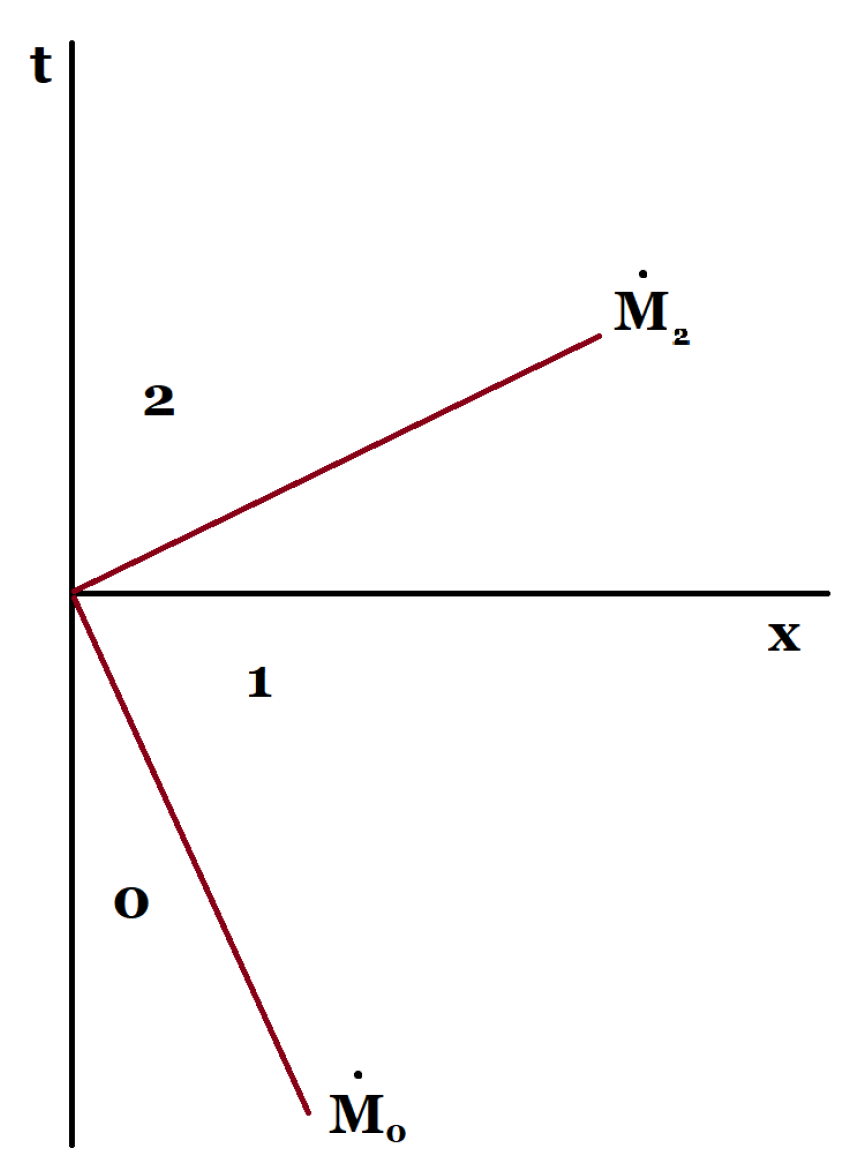
24]. A symmetric collision is equivalent to the problem of a wave hitting a stationary wall. In
Figure 1, three areas are highlighted:
1, and 2. In the region 0 equilibrium: the values
are set. In region 1—parameters of the incident wave, among them, due to the conditions at the discontinuity are (21) and (22)—only one can be set independently. Choose
, as in the statement of the piston problem. In the 2 area, the speed
other parameters are searched. In addition, we need to find the mass velocities of shock waves
and
. Thus, six conditions at the break allow you to define six parameters. For a perfect gas, this is possible due to the evolutionary nature of discontinuities. Note that the conditions (21) and (22), by virtue of
for both shock waves, are exactly the same, so excluding the variables
and
on each side, we obtain the same quadratic equation for the quantities
and
, which represent its solutions with different signs. The coefficients of this equation also depend on the parameters of the state of the incident wave
which are expressed in terms of
and
. For a perfect gas, we have
where
—the square of the speed of sound.
In principle, the coefficients of Equation (
24) can be rewritten in terms of the values
. Equation (
24) are not difficult to solve in a rather cumbersome, but visible form
Below, we investigate the cases of a weak incident relativistic shock wave defined by the inequalities , and a strong one when .
4. Weak Incident Shock Wave
Consider a weak shock wave incident on a wall whose parameters satisfy the inequalities
. Then, in the first approximation
we can assume
, that is, on the speed, we have the Newtonian approximation, but not for the temperature is
Further, from the conditions in the discontinuity (21) and (22) have
Solving the quadratic approximately Equation (
24), we get
In this case we recall that
and, therefore,
. Calculating the pressure gain coefficient
gives
Similarly, for compaction ratio
We can see that for a weak shock wave, the compaction effect is much smaller than in the Newtonian case. For the coefficient of heating,
will receive
Due to the negativity of , in each case the corresponding coefficient is greater than that obtained in the main approximation.
5. Strong Shock Wave
Let
, then
. Expressing
from the second Equation (
21) and substituting it into the third Equation (
21), we get a relation that does not depend on
[
7],
Note that, if
, the internal energy or temperature
, as well as the density
, is an effect associated with the device of the relativistic adiabat of A. Taub [
20]. In addition, there are the roots of the Equation (24):
which allows you to explicitly calculate all values.
Let us move on to calculating the gain coefficients of the pressure jump
and compaction
. In general, from the first condition
it follows that
Substituting
here, we get
where equality
is used. In the Newtonian limit, when
and
we have the formula
When have
Let us turn to the calculation of compaction. Calculations give
and finally
In the Newtonian limit, we have the formula
, in the ultrarelativistic
–
For a strong shock wave, the compaction effect can be much greater than in the Newtonian case, and it increases indefinitely with increasing velocity of the incoming flow. The heating coefficient is formally equal, obviously, to infinity.
6. A Strong Wave of Annihilation
Consider a symmetric collision of two strong annihilation shock waves or a wave falling on a wall. We assume that before the shock wave there is a stationary mixture of particles and antiparticles at zero pressure, the latter have a concentration of , where is the density of antimatter and is a matter density, and the total density of the mixture is . Let the annihilation reaction result in the complete destruction of antiparticles, so that the density comes to the conditions at the break with an incident wave consisting of only one particle , but the energy flow remains .
Thus, to analyze the situation, we can use the formulas of claim 3, putting the specific internal energy of the remaining particles after the reaction
. The mass velocity
refers specifically to these particles. This procedure is akin to the theory of relativistic detonation [
8], when a shock wave releases some internal specific energy
. In the early works of this author, this model was used to solve a number of problems of gravitational collapse, including the formation of equilibrium and homogeneous expansion by Friedman. In the absence of back pressure, the formula similar to (32) with the above
still holds. Additionally, assume that
that is
, which can be interpreted as almost complete annihilation. This mass loss probably occurred during the production of relic radiation:
. Under these assumptions, we will have large ultrarelativistic temperatures
,
small densities
,
,
and mass velocities
,
, and the gas velocity
and pressures
can be any.
are assumed to be set. As a result, we get
to determine
, the quadratic equation
only the larger solution of which
satisfies the condition
.
After that, the final density is determined
This checks that
for any
Mass velocity of shock waves is equal to
Using the obtained formulas, we can determine the coefficients of gain and “compaction” (in fact, the density is greatly reduced due to annihilation):