


Abstract
Stellar winds in high-mass X-ray binaries (HMXBs) are strongly modified by the presence of an accreting neutron star, yet the impact of X-ray photoionisation on the wind–acceleration profile remains difficult to quantify observationally. In this work, we combine the measured wind velocities at the neutron star orbital radius with spectroscopic terminal velocities in order to infer empirical -law parameters for six well-studied HMXBs. By inverting the -law, we reconstruct the individual acceleration curves and obtain revised estimates of the wind-acceleration parameters b and for each system. A suggestive trend emerges from the reconstructed profiles: systems with lower terminal velocities tend to exhibit systematically larger acceleration indices , consistent with the interpretation that dense, slowly accelerating winds may be more strongly affected by X-ray photoionisation. A secondary, weaker pattern is suggested between the orbital separation and , although, for our small sample, it is not statistically significant, suggesting that compact systems experience a more pronounced suppression of wind acceleration in the vicinity of the neutron star. Taken together, these indicative relations provide a coherent observational picture linking the global wind–velocity scale to the local radiative environment. The resulting acceleration profiles and system-to-system correlations offer a practical empirical foundation for modelling wind-fed accretion in HMXBs. The parameter set derived here can be directly incorporated into studies of quasi-spherical accretion, torque evolution, and the dynamical influence of X-ray photoionisation in massive binaries.
1. Introduction
High-mass X-ray binaries (HMXBs) host a magnetised neutron star accreting material from an early-type O–B or Oe–Be companion through its stellar wind. The terminal velocity and the radial acceleration profile of this wind play a central role in regulating the accretion rate, the resulting X-ray luminosity, and the long-term spin evolution of the neutron star [1,2]. In radiatively driven wind theory, the velocity structure is commonly described by the -law [3,4], where sets the overall shape of the acceleration and the parameter b controls the initial rise of the flow near the photosphere; b is a dimensionless coefficient fixed by the photospheric boundary condition (see Equation (2)). While terminal velocities can usually be determined from ultraviolet P Cygni profiles [5,6], the acceleration parameters remain poorly constrained because direct measurements of the wind speed close to the stellar surface and along the binary orbit are seldom available. Several studies have examined the -law and its determination from observations. For example, [7] questioned the applicability of the -law under certain conditions, and alternative methods for inferring from observational diagnostics have been proposed by [8,9].
Observations over the past decade have shown that winds in HMXBs often differ substantially from those of isolated massive stars. The neutron star modifies the surrounding wind through X-ray photoionisation and orbital-phase-dependent illumination, while the stellar wind itself is intrinsically clumped; these effects can weaken the effective line-driving force and reshape the velocity profile [10,11]. These processes directly affect both the local wind density and velocity at the neutron star orbit and, consequently, the efficiency of wind-fed accretion and the observed X-ray variability. Determining in a consistent manner across multiple systems is therefore essential for linking observed luminosity levels, column densities, and torque behaviour to the underlying wind dynamics.
However, previous studies of the -law have either relied on simplified wind models that neglect X-ray photoionisation effects or focused on individual systems only. As a result, they have not provided a quantitative assessment of the role of X-ray irradiation in regulating wind acceleration, thereby motivating the need for the systematic approach adopted in this work.
To address this problem, we combine multi-wavelength diagnostics of massive-star winds with direct or inferred measurements of the wind speed at the neutron star orbital radius. Terminal velocities are taken from UV spectroscopy (IUE/HST) and from optical analyses where available, while local wind speeds near the neutron star are derived from X-ray absorption modelling and accretion-based estimates reported in the literature [12,13,14,15]. Using these constraints together with measured stellar radii and orbital separations, we perform a reproducible numerical inversion of the -law to obtain updated acceleration curves for each system in the sample.
Although -type prescriptions are widely used in modelling radiatively driven winds, an empirical determination of for HMXBs based on modern observational data has remained limited [10,11,16]. The present study fills this gap by deriving system-specific acceleration profiles for a set of HMXBs spanning different spectral types and orbital configurations and by testing the applicability of the -law to a Be/X-ray system whose outflow is dominated by a decretion disc. The empirical parameter set obtained here provides improved constraints for hydrodynamic simulations of wind-fed accretion and contributes to refining models of neutron star spin evolution and wind–accretion coupling [11,17,18].
For clarity, we briefly outline the structure of the paper as follows: In Section 2, we describe the observational inputs used for the velocity–law inversion. Section 3 details the numerical procedure and the implementation of the -law inversion. The properties of the individual systems are summarised in Section 4. The derived acceleration parameters and their system-to-system variations are presented in Section 5, followed by a discussion of their physical implications in Section 6.
2. Observational Data
To provide a uniform physical context for the systems in our sample, the global properties of the donor stars and neutron stars—including the spin and orbital periods, X-ray luminosities, magnetic fields, and distances—are summarised in Table 1. These quantities establish the basic astrophysical environment in which the wind is launched and subsequently interacts with the compact object, and they help distinguish between different accretion regimes among HMXBs.
Table 1.
Key parameters of the HMXB systems considered in this study. Spin () and orbital () periods are rounded to two decimal places. The X-ray luminosity is given as a long-term average (18–50 keV, INTEGRAL, 14-year); note that some systems (e.g., GX 301–2) exhibit pronounced orbital-phase variations in due to their eccentric orbit [19].
For the reconstruction of the wind-acceleration profiles, we collected published measurements of the stellar radius , orbital separation a, terminal wind velocity , and the local wind speed at the neutron star orbit . These parameters were drawn from optical/UV spectroscopy, radial-velocity analyses, and X-ray diagnostics reported in the literature [12,13,14,15]. The compiled values, listed in Table 2, form the observational input dataset for the inversion of the -law.
Table 2.
Input parameters used to calculate b and for selected X-ray pulsars. Here, is a solar radii, a is a semimajor axis of the orbit in astronomical units, calculated by means of Third Kepler’s law, is the terminal velocity of stellar wind, and is the stellar wind velocity on the NS orbit.
The local wind velocities at the neutron star orbital radius, , adopted in this work are taken from [45], where they are inferred from the observed X-ray luminosities and long-term spin evolution of neutron stars in wind-fed HMXBs. In that approach, the relative velocity between the neutron star and the ambient wind, , is constrained by accretion and torque balance considerations, where is a relative velocity of a NS, is an orbital velocity, is a sound speed at stellar wind. The quantity thus represents an effective, phase-averaged wind speed in the immediate accretion region, rather than an instantaneous velocity at a specific orbital phase. This makes it a physically motivated diagnostic for reconstructing the wind acceleration profile relevant to wind-fed accretion.
The terminal velocities adopted in this work are taken from the literature and are not derived in a uniform manner across the sample. Some values come from the blue edge of UV P Cygni profiles, whereas others are inferred indirectly when suitable UV diagnostics are unavailable. Both approaches are affected by systematic uncertainties (e.g., clumping, ionisation effects, line saturation), and individual estimates may carry errors at the level of several hundred km s−1 (see, e.g., [52]). We therefore treat as an input potentially subject to systematic scatter and explicitly test the sensitivity of our results to plausible shifts in (Appendix A).
To ensure consistency across the sample, we relied on well-calibrated diagnostics from ultraviolet, optical, and X-ray observations, favouring measurements obtained with high spectral resolution. This multi-wavelength compilation minimises the systematic differences between diagnostic methods and provides a coherent set of observational inputs for deriving the empirical parameters b and . The resulting dataset in Table 2 therefore offers a robust foundation for reconstructing wind-acceleration laws in supergiant HMXBs.
3. Methodology
To describe the radial velocity structure of OB-supergiant winds, we adopt the empirical -law parametrisation [4],
with
which makes the near-photospheric boundary condition explicit. For a chosen photospheric wind speed , the coefficient b is fixed by the boundary condition and is therefore not treated as an independent physical parameter. This parametrisation does not modify the underlying CAK physics; it simply makes the photospheric lower boundary condition explicit within the empirical -law parametrisation [4].
In the commonly adopted limiting case of a quasi-static photosphere, , one recovers , which reduces the velocity law to the familiar form often used in the literature.
The parameter b controls the initial onset of the flow, while determines the global acceleration profile. Here, denotes the radius of the donor star, expressed in units of the solar radius .
Given and one or more wind speed measurements at known radii , we determine using a numerical inversion of the velocity law. The procedure uses a combination of bracketed one-dimensional root finding (Brent’s method) and constrained non-linear least-squares minimisation as implemented in scipy.optimize [53].
To exclude unphysical solutions, we restrict the search to and , which corresponds to the empirical range inferred for line-driven winds of OB supergiants and ensures numerical stability in the inversion. This interval is consistent with empirical values reported for Galactic OB supergiants (e.g., [54]). To assess the practical impact of this assumption, we repeated the inversion for two representative photospheric velocities, and , and report the corresponding solutions as and in Table 3.
Table 3.
Calculated parameters of the stellar wind -profile.
In our sample, the inferred values are only weakly sensitive to this choice: the typical change is ≲, with the largest difference for OAO 1657–415. Importantly, all qualitative trends and correlations discussed in this work remain unchanged between the two assumptions. We therefore retain b only as an auxiliary boundary-condition parameter and focus on as the primary diagnostic quantity of the wind acceleration profile.
3.1. Inversion Workflow
The calculation is carried out in four steps:
- The input quantities (, a, , ) are taken from Table 2.
- For a trial value of , we compute b from the surface boundary condition using an assumed photospheric wind speed . We adopt two representative values, 10 and 20 km s−1, which bracket the expected range of near-photospheric velocities in OB-supergiant winds and allow us to test the sensitivity of the inversion to this assumption.
- We solve for such that the predicted velocity at the neutron star orbital radius matches the observed , using root_scalar with an absolute tolerance and a maximum of 300 iterations. For systems where the least-squares formulation is preferable, we supplement the root finding with a constrained least_squares search.
- To estimate uncertainties and parameter covariances, we carry out Monte Carlo resampling in which , a, , and are perturbed according to the fractional uncertainties described below. Each realisation yields a pair , providing empirical confidence intervals and revealing the degree of parameter correlation.
3.2. Robustness to the Adopted Scale and Model Dependence
Because published values can be model dependent (and in some cases are obtained under assumptions that include a -law), we assess the possibility that our inferred indices are biased by the adopted literature values. We repeat the full inversion after rescaling with , i.e., a conservative systematic shift. The recovered values vary smoothly, while the qualitative trends and rank-based correlations reported in this work remain unchanged under these rescalings (Appendix A). We therefore interpret as an effective acceleration index consistent with the adopted observational inputs rather than as a uniquely determined physical parameter.
3.3. Neutron Star Feedback: Local Versus Global Interpretation
Our 1D -law inversion is not meant to imply that X-ray photoionisation acts uniformly over steradian. Instead, the inferred should be read as an effective acceleration index that reproduces the observed wind speed at the neutron star orbit, , together with the adopted .
In this sense, even if the X-ray impact is primarily local (e.g., confined to the sector of the wind irradiated by the neutron star and to the region around the orbit), it can still bias the acceleration inferred from a global, one-parameter description because our key constraint probes precisely that environment. Conversely, our analysis does not require the feedback to be global; it only indicates that the wind acceleration relevant for the orbital region is reduced compared to an unperturbed line-driven outflow. A detailed 3D treatment of anisotropic irradiation, shadowing, and photoionisation wakes is beyond the scope of this work, and the derived values should be interpreted accordingly.
3.4. Uncertainties and Perturbation Model
The published wind parameters (, , , a) are not reported with uniform error estimates. Terminal velocities derived from UV P Cygni profiles typically carry systematic uncertainties of order 10–15%, while local wind speeds inferred from X-ray absorption modelling often lack formal error bars.
To account for these limitations and to evaluate how uncertainties in the input parameters propagate into the derived acceleration indices, we performed a Monte Carlo resampling consisting of 1000 realisations. In each realisation, and a were perturbed by 10%, while and were perturbed by 15%, consistent with the typical scatter reported in observational studies of OB-supergiant winds. The quantities were varied independently using Gaussian deviates.
Each realisation yields an independent pair, allowing us to construct empirical parameter distributions and quantify the resulting scatter. The standard deviations derived from these distributions are adopted as uncertainty estimates and are reported in Table 3 as and .
3.5. Applicability and Limitations
For all supergiant HMXBs in our sample, the method converges robustly and the recovered velocity curves reproduce the measured local wind speeds within the adopted uncertainties. As expected, the inversion fails for X Per, whose wind is dominated by an equatorial decretion disc rather than a spherical, line-driven outflow. This behaviour agrees with the assumptions of the -law and highlights its limited use for Be/X-ray binaries, where disc-driven outflows dominate.
3.6. Sample Selection
The systems included in this study were selected according to two practical criteria. First, reliable measurements of both the terminal wind velocity and the local wind speed at the neutron star orbital radius must be available from UV spectroscopy, X-ray absorption modelling, or accretion diagnostics. Only a small subset of HMXBs satisfies this condition, since is rarely reported in the literature.
Second, the sample spans a representative range of donor spectral types, orbital separations, and wind-driving conditions. This makes it possible to examine how the acceleration index varies across different wind regimes—from relatively fast O-type winds (Cen X–3), which experience only moderate suppression of acceleration, to slow, highly ionised winds (GX 301–2 and OAO 1657–415).
These six systems therefore constitute the smallest set for which the -law inversion can be carried out uniformly with current observational constraints, while retaining enough diversity to investigate the physical drivers of wind acceleration in HMXBs.
4. Objects
The sample considered in this work comprises six wind-fed supergiant HMXBs and one Be/X-ray binary included for comparison. Below, we summarise the key properties of each system, highlighting the donor spectral type, orbital configuration, and wind parameters relevant for reconstructing the velocity profile. The key properties of these systems (spin period, orbital period, average X-ray luminosity, magnetic field strength and distance) are summarised in Table 1.
4.1. Cen X-3
Cen X-3 is a well-studied eclipsing HMXB discovered by Uhuru. It hosts an O6.5 II–III donor [21] with an estimated mass of ∼ [55], located at a distance of kpc [24]. The neutron star rotates with s [56] in a nearly circular 2.09-day orbit [57]. The donor drives a fast O-type wind with km s−1 [44]. Cen X-3 remains one of the benchmark systems for modelling wind-fed accretion and eclipse geometry.
4.2. OAO 1657–415
OAO 1657–415 contains an Ofpe/WN9 donor [28] at a distance of kpc. The orbital period is days with moderate eccentricity (), and the neutron star spins at s [25]. A cyclotron line indicates a magnetic field of G [27]. The donor exhibits a slow, dense wind with km s−1 [47], consistent with its transitional spectral type. The system shows persistent X-ray luminosities of – erg s−1 [22].
4.3. Vela X-1
Vela X-1 is a prototypical wind-fed pulsar orbiting the B0.5 Ia supergiant HD77581 at a distance of kpc. Its spin period is s [14] and the orbital period is 8.96 days [29]. UV diagnostics indicate km s−1 [58], and mass-loss rates of a few have been inferred from optical/UV studies [15,59]. Its stability and high luminosity make Vela X-1 a key reference source for wind–accretion interaction studies.
4.4. 4U 1538–52
4U 1538–52 contains the B0.2 Ia supergiant QV Nor at kpc. The neutron star spins at s [60] and orbits every 3.73 days [61]. Wind studies indicate –1500 km s−1 [49]. It is persistently bright at erg s−1 [22].
4.5. GX 301–2
GX 301–2 hosts the B1 Ia+ hypergiant BP Cru, one of the most massive donors known in Galactic HMXBs [35]. The system follows a highly eccentric 41.5-day orbit () [34]. The strong orbital variability is understood to result from the highly eccentric orbit of this system, which drives a dense, spiral-patterned gas stream in the stellar wind near periastron [19], rather than from random wind inhomogeneities.
4.6. X Per
X Per (HD 24534) is a long-period Be/X-ray system with a neutron star spinning at s [36] in a 250.3-day eccentric orbit [37]. Located at ∼0.8 kpc, it has relatively low luminosity (– erg s−1 [22]). UV studies indicate km s−1 with a very low mass-loss rate of ∼ [50]. Its outflow is dominated by a decretion disc, making it the only system in our sample whose mass-loss geometry is governed by a Keplerian disc rather than a stellar wind.
4.7. 2S 0114+650
2S 0114+650 hosts a B1 Ia donor at kpc [51]. The neutron star has an unusually long spin period, s [39], and a persistent spin-up trend [62]. Its orbital period is days [40]. Wind diagnostics yield km s−1 and [51]. The system is particularly valuable for studying wind dynamics in slowly rotating, luminous X-ray pulsars.
5. Results
Using the observed terminal velocities together with the measured wind speeds at the neutron star orbital radii, we determined the parameters b and for six supergiant HMXBs (Table 3). These values reveal a broad variety of wind–acceleration behaviours that reflect the diversity of stellar types, wind densities, and X-ray illumination levels across the sample.
A general consistency emerges in the parameter b, which remains close to unity for all systems. This indicates that the near-photospheric wind speed is much smaller than the terminal velocity, as expected for radiatively driven winds of OB supergiants. In contrast, the acceleration parameter varies significantly from system to system, pointing to real physical differences in wind structure and to the influence of X-ray photoionisation.
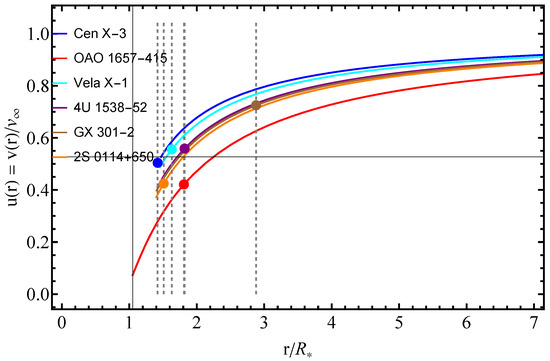
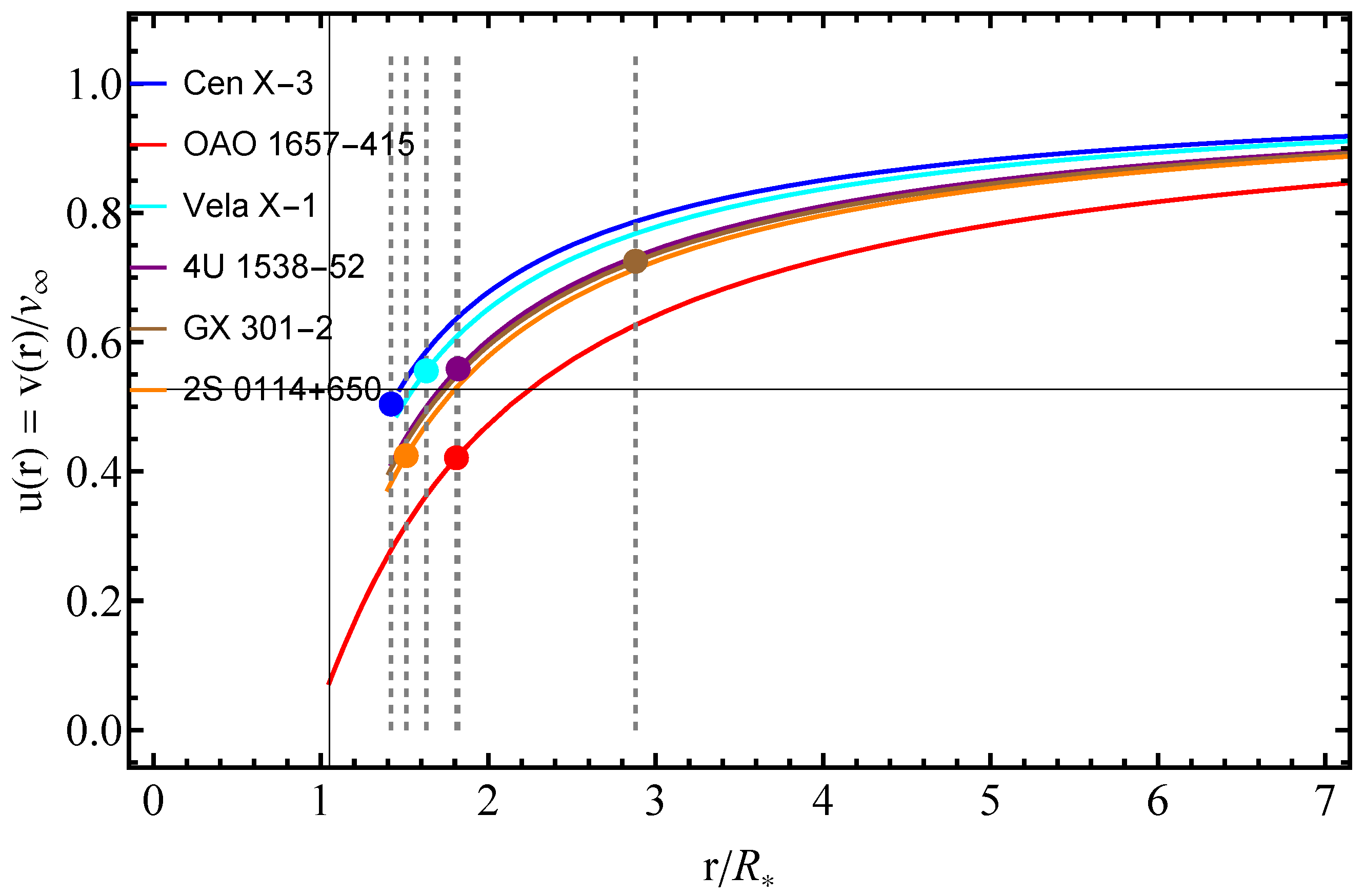
Figure 1 displays the reconstructed velocity profiles for each system. For convenience, we define , i.e., the wind velocity expressed as a fraction of the terminal speed. The filled circles indicate the measured wind speed at the neutron star orbital radius, while the vertical dashed lines show the corresponding positions. These curves form the basis for the system-by-system interpretation presented below and for the statistical trends analysed later in this section.
Figure 1.
Normalised wind velocity profiles of stellar winds for HMXBs in the sample, computed using the best-fit and parameters (assuming km s−1). Vertical dashed lines indicate the neutron star orbital radii, ; filled circles indicate the corresponding values . The horizontal solid line marks , indicating the radius at which the wind reaches half of its terminal velocity. For GX 301–2, two filled circles mark periastron and apastron separations.
5.1. Empirical Wind–Acceleration Profiles
The empirical wind–acceleration parameters obtained from the inversion procedure are listed in Table 3. Each velocity profile shown in Figure 1 was reconstructed directly from the corresponding pair.
Across the sample, the parameter b is confined to a narrow range, , regardless of whether a photospheric velocity of 10 or is adopted. As a result, the onset of the flow varies only weakly among these systems. Small differences in b are possibly associated with variations in the ionisation structure or mild clumping near the stellar surface. In practice, b is not an independent parameter but a derived boundary-condition quantity.
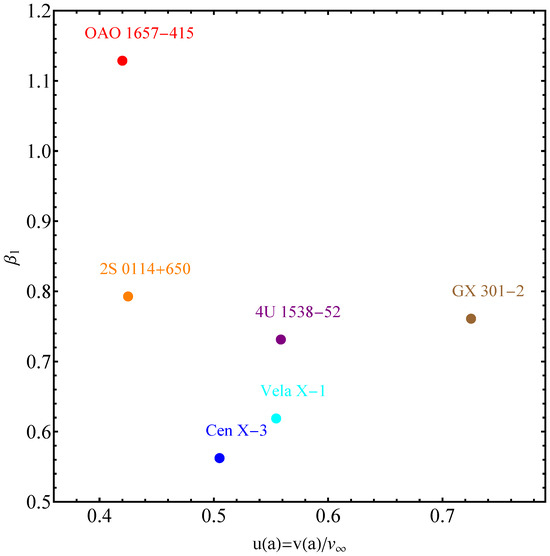
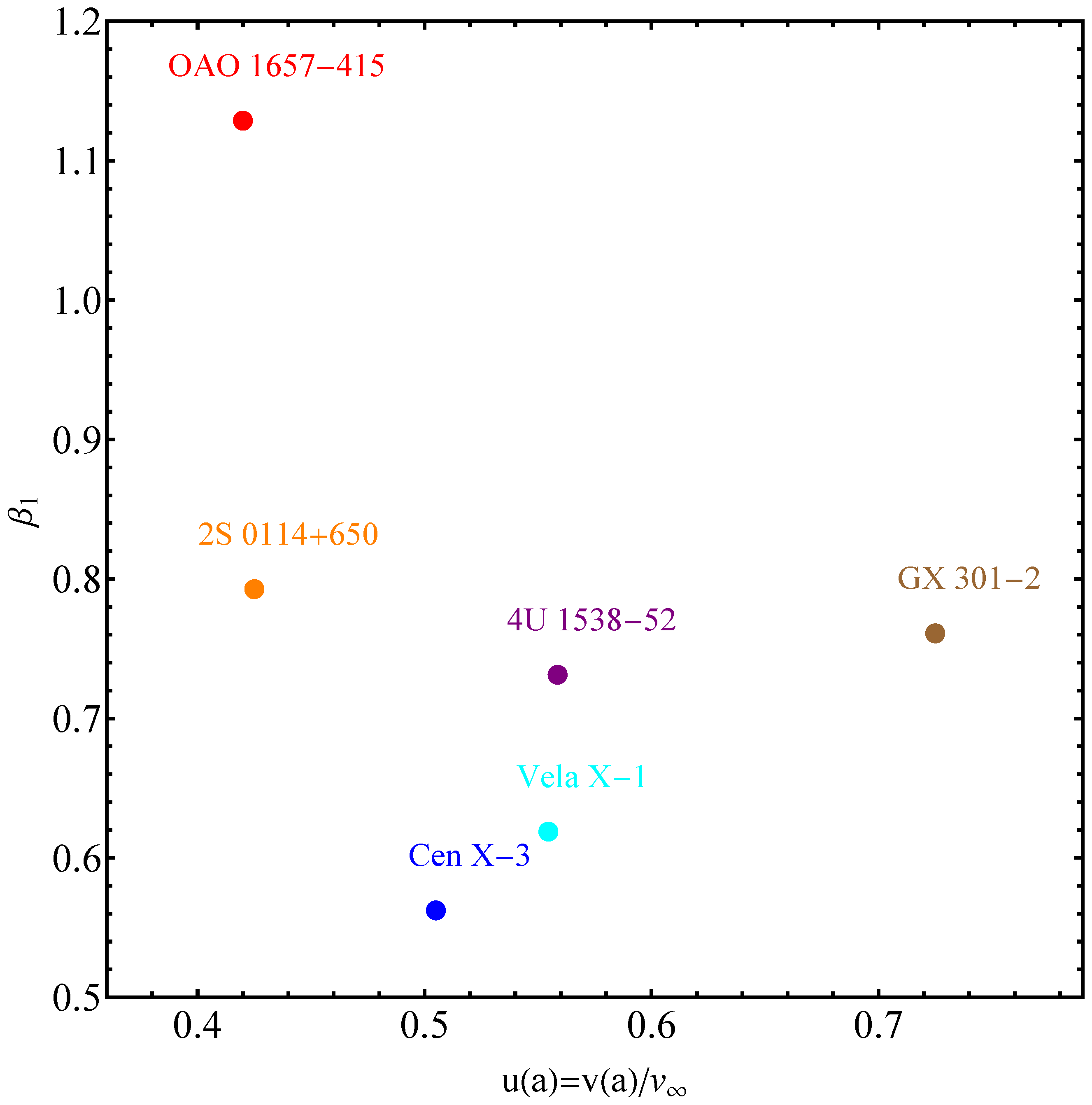
Unlike b, the acceleration index spans a factor of across the sample, ranging from relatively rapid acceleration (– for Cen X–3 and Vela X–1) to much more gradual acceleration ( for OAO 1657–415). This substantial spread demonstrates that is sensitive to a combination of intrinsic wind properties (e.g., density, ionisation balance) and external perturbations such as X-ray photoionisation from the neutron star. Fast, radiation-driven winds tend to favour smaller , while slower, denser, or partially ionised winds tend to exhibit larger values. The diversity of acceleration profiles shown in Figure 2 motivates the system-specific interpretation presented in Section 5.2.
Figure 2.
Empirical relation between the wind-acceleration index and the normalised orbital wind speed for the supergiant HMXBs in our sample. The values of are computed from the orbital wind speeds and terminal velocities listed in Table 2, while corresponds to the set reported in Table 3, assuming . Each point represents an individual system and the colour scheme is consistent with Figure 1. Error bars indicate 1 uncertainties on from the Monte Carlo propagation.
5.2. System-by-System Behaviour
The empirical acceleration indices reveal distinct wind–driving regimes across the systems in our sample. Although the parameter b varies only weakly, the values of differ substantially and provide a clear diagnostic of how rapidly the wind is accelerated away from the stellar surface. Below, we discuss each group of systems according to their inferred acceleration properties.
5.2.1. Rapid Acceleration: Cen X–3 and Vela X–1
Cen X–3 and Vela X–1 exhibit the smallest acceleration indices in the sample, with and , respectively. This indicates that their winds reach a significant fraction of the terminal velocity relatively close to the stellar surface. Such behaviour is characteristic of fast, radiatively driven winds in O and early B-type supergiants, where the line driving remains efficient and X-ray photoionisation leads only to moderate suppression of acceleration.
5.2.2. Moderate Acceleration in OB-Supergiant Winds: 4U 1538–52, 2S 0114+650, and GX 301–2
The winds in 4U 1538–52 and 2S 0114+650 accelerate efficiently, with and , respectively. At the neutron star orbit, the measured wind velocities correspond to a substantial fraction of , consistent with largely unperturbed line-driven winds. These systems therefore represent a canonical regime in which OB-supergiant winds follow a moderately compact acceleration profile. GX 301–2 also exhibits a comparable acceleration index (–), confirming that it falls in the same class by . Its donor is a B1, Ia+ hypergiant with a much lower terminal velocity (), so that the wind is intrinsically slower and denser. Consequently, the inner wind remains dense, favouring efficient Bondi–Hoyle accretion and persistent X-ray luminosity, while the system’s long, eccentric orbit () leads to strong orbital modulation of the observed flux via wind clumping and photoionisation. In summary, all three systems have –, indicating similar wind acceleration profiles, whereas GX 301–2’s differing donor type, wind speed and orbital geometry account for its distinct behaviour.
5.2.3. Intermediate Acceleration: OAO 1657–415
OAO 1657–415 shows markedly larger values, –, reflecting a more extended acceleration zone. This is consistent with the Ofpe/WN9 nature of the donor, whose wind is known to be dense, highly ionised, and slower than those of classical OB supergiants. The elevated is likely linked both to the intrinsic ionisation conditions in the donor’s atmosphere and to the strong, variable X-ray illumination from the neutron star.
5.2.4. Failure of the –Law Inversion: X Per
For X Per, no consistent solution for can be obtained. This outcome is entirely expected: the wind in Be/X-ray binaries is dominated by an equatorial decretion disc, which cannot be represented by a spherical line-driven flow. The observed velocities near the neutron star arise from disc viscosity, anisotropic mass ejection, and geometrical effects rather than from CAK-like acceleration. The failure of the inversion therefore correctly indicates that the -law is not applicable to systems of this class.
5.3. Correlations Across the Sample
The empirical parameters derived in this work reveal two trends that appear consistently across the systems in our sample. These correlations involve the terminal velocity , the orbital separation , and the acceleration index . Although the sample size is necessarily small, the trends are physically motivated and provide a coherent picture of how wind acceleration is shaped by both intrinsic stellar properties and the proximity of the neutron star. However, given the small sample size (), these trends should be regarded as suggestive; their statistical significance is quantified below using Spearman rank tests.
5.3.1. Normalised Orbital Wind Speed Versus Acceleration Index
Figure 2 shows the relation between the wind-acceleration index and the normalised orbital wind speed . Systems with smaller reach only a smaller fraction of by the neutron star orbit and tend to exhibit larger (more gradual acceleration), whereas larger corresponds to winds that have already accelerated more efficiently by . In particular, the high- outlier OAO 1657–415 also shows one of the smallest values, while systems with moderate (GX 301–2, 2S 0114+650, and 4U 1538–52) span intermediate values. However, we emphasise that the apparent ordering is largely driven by OAO 1657–415 and is sensitive to individual systems for such a small sample (). Consistently, the Spearman rank test does not support a statistically significant monotonic correlation: with (and shown only as a cross-check). We therefore treat this pattern as suggestive rather than conclusive and refrain from fitting a parametric relation.
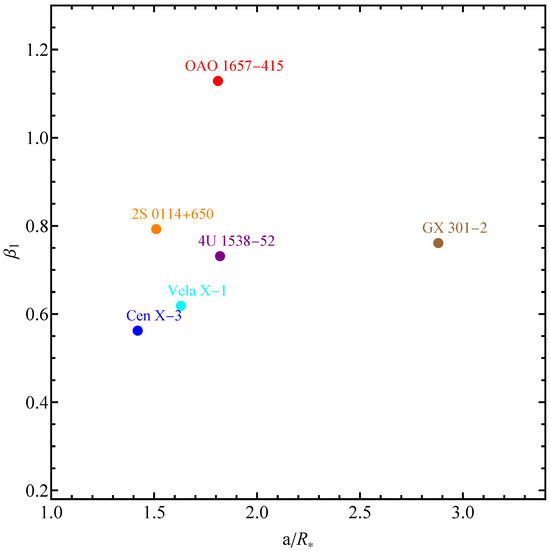
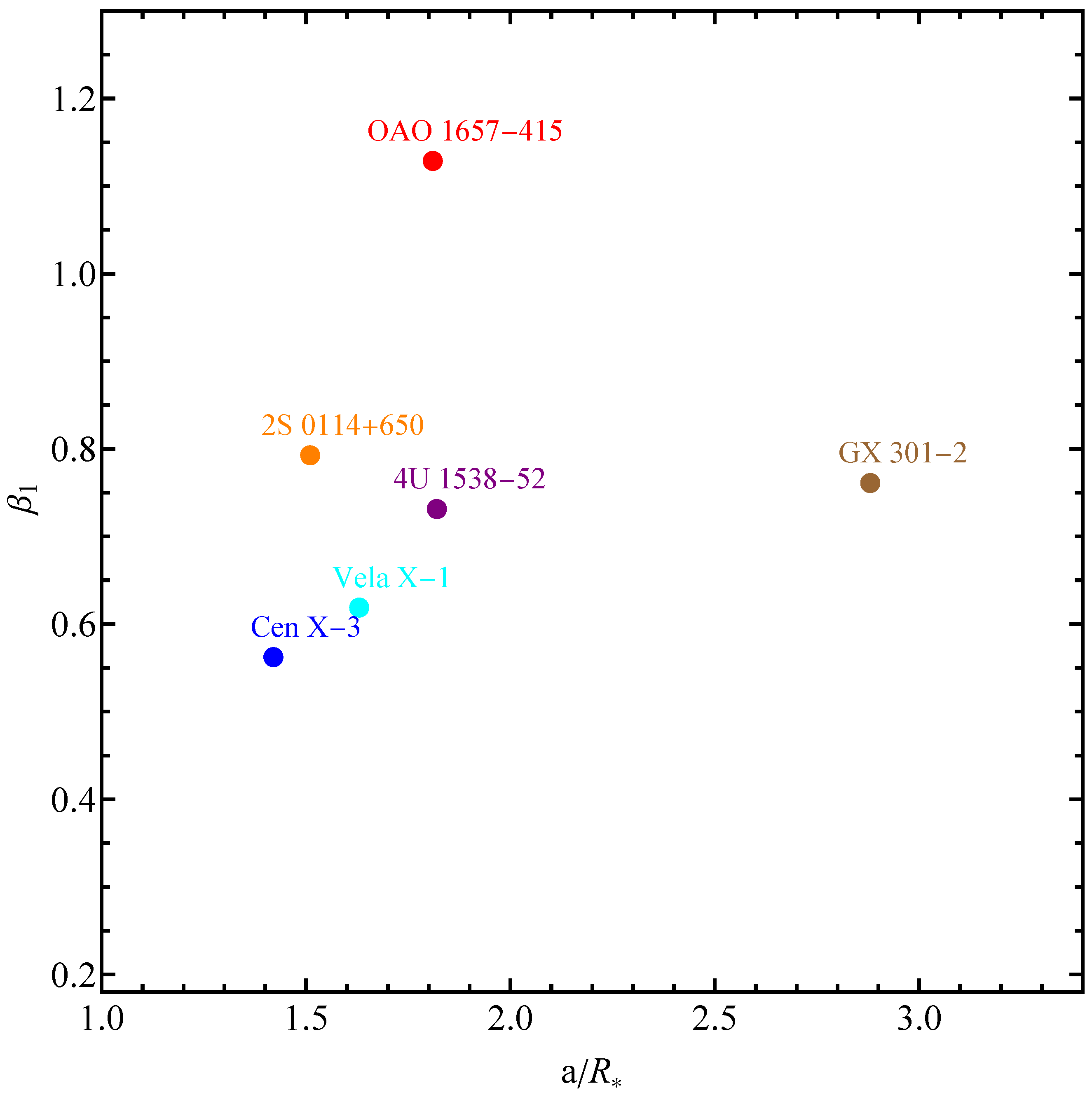
In Figure 3, the reduced acceleration (higher ) is most extreme for OAO 1657–415. GX 301–2 has a moderate (–), comparable to 2S 0114+650 and 4U 1538–52, indicating a similar acceleration index despite differences in donor type and orbital configuration. This underlines that is not controlled by alone, and is likely influenced by wind density, ionisation conditions, and X-ray feedback in the orbital region. Given our limited sample size, this pattern is suggestive rather than conclusive.
Figure 3.
Acceleration index versus orbital separation for the supergiant HMXBs in our sample. The values are taken from the set in Table 3, assuming , while is adopted from Table 2. Points are colour-coded consistently with Figure 1 and Figure 2. Error bars indicate 1 uncertainties on from the Monte Carlo propagation.
In Figure 3, the reduced acceleration (higher ) is most extreme for OAO 1657–415 (–). GX 301–2 has a moderately high (≈0.76–0.77), similar to 2S 0114+650 and 4U 1538–52, reflecting its relatively compact orbit. Wider systems like 2S 0114+650 show closer to the classical OB-supergiant value, indicating less wind suppression. Given our limited sample size, this pattern is suggestive rather than conclusive.
5.3.2. Statistical Assessment
To quantify these trends, we computed Spearman rank-correlation coefficients for the and pairs listed in Table 2 and Table 3. We exclude X Per from this test because the -profile parameters are not applicable for a Be-star disk+polar-wind geometry.
Given the small sample size (), we report two-sided p-values obtained from an exact permutation test (with the standard t-approximation shown as a cross-check). For the normalised orbital wind-speed–acceleration relation, we obtain
The relation between scaled orbital separation and the acceleration index is weaker,
As an additional sanity check given , we verified that the rank-based coefficients are sensitive to the inclusion of individual systems (as expected for such a small sample). Accordingly, we treat the inferred trends as indicative patterns rather than as statistically established relations and refrain from fitting parametric models.
5.3.3. Spearman Test and Interpretation
We briefly recall that the Spearman coefficient is the Pearson correlation of the rank-transformed variables, and it quantifies the strength of a monotonic (not necessarily linear) association (). We therefore report two-sided p-values from (i) the exact permutation test, , i.e., the probability under the null hypothesis of no monotonic association, to obtain a at least as large as observed, and (ii) the usual large-sample t-approximation, , shown only as a consistency check.
Given the very small sample size (), we interpret moderate values cautiously and focus on whether the trend is robust in sign and order of magnitude rather than claiming high-precision significance. For such a small N, the exact permutation distribution is necessarily coarse, so moderate values can correspond to non-small ; this is precisely why we rely on the exact test rather than on large-sample intuition.
In particular, the anti-correlation between and is not statistically significant under the exact test (), meaning that a coefficient as large as can readily arise from random rank scatter; we therefore regard this as a weak, suggestive trend only. Similarly, the relation with is also not statistically significant for (), so we treat it with comparable caution.
Finally, we note that, for , any rank-based statistic is sensitive to individual data points. As a basic robustness check, we verified that removing any single system can change the numerical value of at the level expected for such a small sample, while the qualitative conclusion remains the same: the present data do not support a statistically robust correlation under the exact test. Accordingly, we avoid over-interpreting the weaker – relation and do not attempt to fit a linear model to these data.
5.4. Sensitivity Tests
To assess the robustness of the inversion procedure, we examined how the derived parameters respond to variations in the assumed photospheric velocity and to perturbations in the input quantities (, a, , ). The results of these tests are summarised below.
Overall, since the inferred is effectively unchanged within this plausible range of , keeping b serves mainly as a transparent way to encode the photospheric boundary condition, rather than as an additional degree of freedom.
5.4.1. Dependence on the Assumed Photospheric Wind Speed
Table 3 lists two sets of values for each system, corresponding to assumed photospheric velocities of 10 and . The differences between and are at the level of a few percent, and the changes in rarely exceed . This behaviour reflects the fact that for all supergiant winds considered here, so the lower boundary condition exerts only a minor influence on the overall acceleration profile.
The most noticeable sensitivity occurs in GX 301–2, whose intrinsically slow wind makes the global velocity profile more responsive to the assumed surface velocity. Even in this case, however, the resulting pairs remain within the physically expected range for a B1 Ia+ hypergiant.
5.4.2. Perturbations of Stellar and Orbital Parameters
The resulting distributions are generally narrow and only mildly asymmetric. For systems with fast, radiation-driven winds (Cen X–3, Vela X–1), the scatter in remains small, indicating that acceleration profiles with relatively low are recovered reliably. For dense, partially ionised winds (OAO 1657–415, GX 301–2), the inferred values show somewhat larger dispersion, reflecting the weaker acceleration gradients and the stronger influence of on the inversion.
5.4.3. Consistency and Limitations
Taken together, the sensitivity tests demonstrate that the inversion method is stable across the range of wind conditions represented in our sample. The dominant source of uncertainty arises from the local wind speed at the neutron star orbit, which is often model-dependent and not directly measured. Nevertheless, the recovered acceleration parameters remain physically consistent for all OB-supergiant systems.
As expected, the method fails for X Per, where the dominance of a disc-fed, non-spherical outflow breaks the assumptions underlying the –law. The sensitivity analysis therefore confirms that the present approach is well suited to classical supergiant HMXBs, but not to Be-type systems.
6. Discussion
The wide range of acceleration indices obtained in this work shows that wind acceleration in HMXBs is influenced not only by the intrinsic properties of OB-supergiant winds, but also by the local environment created by the compact object. X-ray photoionisation, orbital separation, and the density of the ambient wind all contribute to how rapidly the radiative line force accelerates the flow. Systems in which the neutron star orbits close to the donor tend to exhibit larger values of , indicating that strong X-ray illumination suppresses the radiative force over an extended radial interval.
We stress that this conclusion should not be interpreted as a spherically symmetric () suppression of the entire wind. Because our inversion is constrained by at the neutron star orbit, the inferred is best understood as an effective acceleration index for the wind sector and radial range that feeds the accretor (roughly from to a along the line of centres and within the photoionised/perturbed region). A fully global statement about the wind would require multi-dimensional radiative-hydrodynamic modelling, which is beyond the scope of this work.
This interpretation is consistent with hydrodynamic calculations, which show that enhanced ionisation around the compact object reduces the local line-driving efficiency and naturally shifts the velocity profile toward higher values [10,11]. The resulting modification of the velocity gradient directly affects the density near the neutron star orbit and therefore changes both the accretion rate and the torque acting on the neutron star. The empirical correlations identified in Section 5—between and both and —are consistent with this physical picture.
The derived values also help us to clarify the accretion regimes in individual systems. Winds with large and modest terminal velocities maintain higher densities at the neutron star orbit for a given mass-loss rate, favouring efficient Bondi–Hoyle accretion and relatively steady X-ray emission. This behaviour matches the observational characteristics of GX 301–2 and OAO 1657–415, both of which show persistent luminosities and long-term spin stability. By contrast, systems with relatively small – accelerate the wind more rapidly, reducing the density at the location of the neutron star and allowing for lower or more variable accretion rates. Such conditions are typical of classical supergiant X-ray binaries and are consistent with the observed diversity in their X-ray variability [15,16].
The failure of the -law inversion for X Per underscores the limitations of applying a spherically symmetric, line-driven model to Be/X-ray binaries. In these systems, the outflow is dominated by an equatorial decretion disc, and the velocities near the neutron star reflect a combination of viscous transport, anisotropic mass ejection, and disc truncation rather than a radiatively driven wind. The non-convergence obtained here is therefore physically meaningful and illustrates the need for distinct modelling approaches for disc-fed systems.
Several caveats of the present analysis should be kept in mind. The -law assumes a smooth and stationary outflow, whereas real OB-star winds are clumped, time-dependent, and may show asymmetries induced by tidal interactions or anisotropic irradiation. Furthermore, using a single characteristic wind speed at the neutron star’s orbit ignores the phase-dependent variability that can be substantial in eccentric binaries. A more complete picture will require combining empirical constraints with multi-dimensional simulations that incorporate wind structure, clumping, and the dynamical impact of X-ray feedback. Orbit-resolved UV and X-ray spectroscopy would also be valuable for mapping the acceleration profile as a function of the orbital phase.
Overall, the empirical acceleration parameters derived in this work provide a system-by-system view of how OB-star winds respond to X-ray illumination and binary interaction. These results offer a useful foundation for future studies of wind-fed accretion and the long-term spin evolution of neutron stars in massive binaries. We caution that, given the small sample size, the statistical trends reported here should be interpreted with care. A larger sample will be needed to confirm and strengthen these conclusions.
The observed empirical relation between the acceleration index and the terminal wind velocity indicates that intense X-ray irradiation significantly suppresses wind acceleration. In particular, systems experiencing stronger X-ray photoionisation (characterised by lower ) exhibit systematically larger values, implying a reduced efficiency of radiative line driving. We note, however, that the adopted -law represents an idealised parametrisation of the wind acceleration. Effects such as wind clumping, orbital-phase dependence, and time variability are not explicitly included and may introduce additional systematic uncertainties in the inferred values of .
Given the very small sample size (), any correlations inferred from Figure 2 and Figure 3 should be interpreted with caution: the statistical significance is inherently fragile and may be sensitive to individual data points. In addition to small-number statistics, systematic uncertainties may arise from the simplified -law parametrisation and from wind inhomogeneity (clumping), orbital/phase-dependent structure, and possible time variability, which are not fully captured by the adopted description. Parameter uncertainties are partially accounted for via Monte Carlo propagation, yielding confidence intervals on the inferred values. We therefore treat the reported trends as suggestive rather than conclusive, and view them as preliminary patterns that motivate verification with larger and more homogeneous samples as additional constraints become available.
7. Conclusions
In this work we have derived empirical wind–acceleration parameters b and for a representative set of supergiant HMXBs by combining updated terminal velocities with direct measurements of the wind speed at the neutron star orbital radius. The resulting parameter sets reveal a noticeably wide range of acceleration behaviours, indicating that the structure of OB-supergiant winds in interacting binaries is shaped not only by the intrinsic stellar properties but also by the degree of X-ray illumination and the local density of the outflow.
The inferred values of the acceleration index span a factor of ∼2 across the sample, ranging from for Cen X–3 to for OAO 1657–415. Systems with fast, relatively undisturbed winds (Cen X–3, Vela X–1) yield relatively low acceleration indices, –, implying that their winds reach a significant fraction of the terminal velocity close to the stellar surface. In contrast, objects characterised by slow or dense winds tend to show larger , consistent with reduced line-driving efficiency in partially ionised flows. Throughout the sample, the parameter b remains close to unity, confirming that the near-surface wind speed is much smaller than .
Sensitivity tests based on two plausible photospheric wind speeds show that the inversion method is stable: variations of 10–20 km s−1 in introduce only modest changes in the recovered values. Monte Carlo perturbations of , a, , and further indicate that the derived solutions are robust within realistic uncertainty ranges and that the parameter covariance is well behaved for all supergiant systems. However, our analysis is limited by the availability of only six systems with reliable input data. As a result, the trends identified—while promising—require validation using a broader and more statistically robust sample.
The empirical acceleration profiles obtained here can be incorporated directly into models of wind-fed accretion, torque evolution, and X-ray feedback, where the shape of the velocity field plays a key role in determining the density at the neutron star orbit. By providing system-specific constraints on , this study offers a practical way to link observable wind properties to the physical conditions governing accretion in massive binaries.
Further progress will require extending this framework to non-spherical and time-dependent outflows, including Be/X-ray systems where disc geometry dominates. Phase-resolved UV and X-ray spectroscopy in particular would allow for the acceleration profile to be recovered as a function of orbital phase, offering a more complete picture of wind–neutron star interactions.
Overall, the results presented here contribute to a more detailed and empirically grounded understanding of wind acceleration in interacting massive binaries and provide a foundation for future observational and theoretical work in this area.
Finally, we emphasise that our analysis is purely empirical. A direct quantitative modelling of X-ray photoionisation effects on the line-driving mechanism (e.g., via modified line-force parameters) is beyond the scope of this study and remains a task for future work.
Author Contributions
Conceptualisation, S.T. and M.K.; methodology, Z.M. and A.T.; software, Z.M. and M.K.; validation, Z.M., S.T. and A.T.; formal analysis, S.T. and M.K.; investigation, Z.M. and S.T.; resources, Z.M. and A.T.; writing—original draft preparation, Z.M.; writing—review and editing, S.T. and M.K.; visualisation, Z.M., A.T. and M.K.; supervision, S.T.; project administration, S.T.; funding acquisition, S.T. All authors have read and agreed to the published version of the manuscript.
Funding
This research was funded by the Ministry of Science and Higher Education of the Republic of Kazakhstan (Grant No. AP23489541).
Data Availability Statement
The data supporting the findings of this study are available from the corresponding author upon reasonable request.
Acknowledgments
We extend our sincere appreciation to V. Kim for valuable discussions.
Conflicts of Interest
The authors declare no conflicts of interest.
Abbreviations
The following abbreviations are used in this manuscript:
| AU | Astronomical Unit |
| HMXBs | High-Mass X-ray Binaries |
| IUE/HST | International Ultraviolet Explorer/Hubble Space Telescope |
| XMM-Newton | X-ray Multi-Mirror Mission—Newton |
| INTEGRAL | INTErnational Gamma-Ray Astrophysics Laboratory |
| NS | Neutron Star |
| UV | Ultraviolet |
Appendix A
The terminal wind velocities adopted in this work are taken from the literature and were obtained using heterogeneous observational and modelling approaches (e.g., UV P Cygni diagnostics versus indirect X-ray based estimates). Both the magnitude of the systematic uncertainties and the potential model-dependence of published values could, in principle, bias the inferred indices and the correlations discussed in this paper. In particular, UV-based determinations can be affected by line saturation, ionisation stratification, and micro-/macro-clumping, while indirect estimates based on X-ray luminosity or accretion modelling inherit additional systematics from the assumed wind structure and accretion physics. Moreover, many wind models used to infer adopt a -law velocity profile, raising the concern of a circular dependence.
In this Appendix, we therefore perform an explicit sensitivity experiment to quantify how plausible systematic shifts in propagate into the inferred acceleration index , and to verify that the main qualitative trends remain robust.
Appendix A.1. Set-Up of the Sensitivity Test
For each system, the inversion procedure described in Section 3 determines by matching the measured wind speed at the neutron star orbital radius, , with the -law prediction. Working in normalised variables,
the constraint at the orbital radius can be written as
where the coefficient b encodes the near-photospheric boundary condition via
Hence, for fixed and fixed adopted photospheric speed , the inversion reduces to solving a one-dimensional root problem in :
To probe the impact of systematic uncertainties in the literature values of , we repeat the inversion after rescaling the terminal velocity by a multiplicative factor s,
while keeping the observational inputs and fixed. This directly modifies the normalised orbital speed, , and also changes b through Equation (A3). We adopt three representative scales,
corresponding to a conservative systematic shift in (using larger shifts produces the same qualitative conclusions, but the bracket already captures the relevant propagation of uncertainty for our sample and avoids over-interpreting the heterogeneous literature inputs).
Appendix A.2. Sensitivity of β to v ∞ Shifts
Table A1 summarises the resulting acceleration indices for each scale factor, together with the maximum absolute deviation
Across the full sample, the inferred values vary smoothly with the assumed and the shifts remain moderate. Importantly, these changes do not alter the qualitative ordering of systems by , and the main trends discussed in the paper are not driven by a single, finely tuned choice of .
Table A1.
Sensitivity of the inferred acceleration index to systematic rescalings of the terminal velocity . Here, is obtained by repeating the inversion (Equation (A4)) with . The last column reports the maximum absolute deviation with respect to the nominal case .
Appendix A.3. Robustness of Rank Correlations
To verify that the correlations presented in the Results remain robust, we evaluate the Spearman rank correlation coefficients between and two key dimensionless quantities used in this paper: the scaled orbital separation and the normalised orbital wind speed . For each scale factor s, we compute
using the values from Table A1. The resulting coefficients are
Thus, under systematic shifts in , the sign and overall magnitude of the rank-based trends are preserved: remains positively rank-correlated with and negatively rank-correlated with . Given the modest sample size, these coefficients should be interpreted as diagnostic rather than definitive; nevertheless, the stability of the rank-ordering under rescalings directly supports the robustness of the qualitative correlations discussed in the manuscript.
Appendix A.4. Interpretation and Limitations
The test above addresses two distinct concerns. First, it quantifies how systematic errors in propagate into the inferred . Second, it demonstrates that the correlations emphasised in the Results are not an artefact of a single adopted scale.
This does not eliminate all model-dependence in published values, and we therefore interpret the recovered as an effective acceleration index consistent with the adopted observational inputs. A fully homogeneous re-determination of from uniform UV spectroscopy (or a self-consistent multi-wavelength wind analysis) would be required to remove method-to-method systematics entirely. However, within plausible systematic shifts of , our results and their qualitative interpretation remain stable, supporting the main conclusions of this paper.
References
- Bondi, H.; Hoyle, F. On the mechanism of accretion by stars. Mon. Not. R. Astron. Soc. 1944, 104, 273–282. [Google Scholar] [CrossRef] [Scilit]
- Davidson, K.; Ostriker, J.P. Neutron-star accretion in a stellar wind: Model for a pulsed X-ray source. Astrophys. J. 1973, 179, 585–598. [Google Scholar] [CrossRef] [Scilit]
- Castor, J.I.; Abbott, D.C.; Klein, R.I. Radiation-driven winds in Of stars. Astrophys. J. 1975, 195, 157–174. [Google Scholar] [CrossRef] [Scilit]
- Puls, J.; Vink, J.S.; Najarro, F. Mass loss from hot massive stars. Astron. Astrophys. Rev. 2008, 16, 209–325. [Google Scholar] [CrossRef] [Scilit]
- Howarth, I.D.; Prinja, R.K. The stellar winds of 203 Galactic O stars: A quantitative ultraviolet survey. Astrophys. J. Suppl. Ser. 1989, 69, 527–592. [Google Scholar] [CrossRef] [Scilit]
- Prinja, R.K.; Barlow, M.J.; Howarth, I.D. Terminal velocities for a large sample of O stars and B supergiants, and Wolf-Rayet Stars. Astrophys. J. 1990, 361, 607–620. [Google Scholar] [CrossRef] [Scilit]
- Sander, A.A.C.; Hamann, W.R.; Todt, H.; Hainich, R.; Shenar, T. Coupling hydrodynamics with comoving frame radiative transfer. I. A unified approach for OB and WR stars. Astron. Astrophys. 2017, 603, A86. [Google Scholar] [CrossRef] [Scilit]
- Brown, J.C.; Richardson, L.L.; Cassinelli, J.P.; Ignace, R. Inference of steady stellar wind v(r) laws from optically thin emission lines. I. Idealised analysis for the profile of a single line. Astron. Astrophys. 1997, 325, 677–684. [Google Scholar]
- Lépine, S.; Moffat, A.F.J. Wind Inhomogeneities in Wolf-Rayet Stars. II. Investigation of Emission-Line Profile Variations. Astrophys. J. 1999, 514, 909–931. [Google Scholar] [CrossRef] [Scilit]
- Oskinova, L.M.; Feldmeier, A.; Kretschmar, P. Clumped stellar winds in supergiant high-mass X-ray binaries and photoionization. Mon. Not. R. Astron. Soc. 2012, 421, 2820–2831. [Google Scholar] [CrossRef] [Scilit]
- Martínez-Núñez, S.; Kretschmar, P.; Bozzo, E.; Oskinova, L.M.; Puls, J.; Sidoli, L.; Sundqvist, J.O.; Blay, P.; Falanga, M.; Fürst, F.; et al. Towards a Unified View of Inhomogeneous Stellar Winds in Isolated Supergiant Stars and Supergiant High Mass X-Ray Binaries. Space Sci. Rev. 2017, 212, 59–150. [Google Scholar] [CrossRef] [Scilit]
- Kaper, L.; Hammerschlag-Hensberge, G.; Zuiderwijk, E.J. Spectroscopic evidence for photo-ionization wakes in Vela X-1 and 4U 1700-37. Astron. Astrophys. 1994, 289, 846. [Google Scholar]
- van Loon, J.T.; Kaper, L.; Hammerschlag-Hensberge, G. Modelling the orbital modulation of ultraviolet resonance lines in high-mass X-ray binaries. Astron. Astrophys. 2001, 375, 498–526. [Google Scholar] [CrossRef] [Scilit]
- Fürst, F.; Pottschmidt, K.; Wilms, J.; Tomsick, J.A.; Bachetti, M.; Boggs, S.E.; Christensen, F.E.; Craig, W.W.; Grefenstette, B.W.; Hailey, C.J.; et al. NuSTAR Discovery of a Luminosity-dependent Cyclotron Line Energy in Vela X-1. Astrophys. J. 2014, 780, 133. [Google Scholar] [CrossRef] [Scilit]
- Giménez-García, A.; Shenar, T.; Torrejón, J.M.; Oskinova, L.M.; Martínez-Núñez, S.; Hamann, W.-R.; Rodes-Roca, J.J.; González-Galán, A.; Alonso-Santiago, J.; González-Fernández, C.; et al. Measuring the stellar wind parameters in IGR J17544–2619 and Vela X-1 constrains the accretion physics in supergiant fast X-ray transient and classical supergiant X-ray binaries. Astron. Astrophys. 2016, 591, A26. [Google Scholar] [CrossRef] [Scilit]
- Bozzo, E.; Falanga, M.; Stella, L. Are There Magnetars in High-Mass X-Ray Binaries? The Case of Supergiant Fast X-Ray Transients. Astrophys. J. 2008, 683, 1031–1044. [Google Scholar] [CrossRef] [Scilit]
- Shakura, N.I.; Postnov, K.A.; Kochetkova, A.Y.; Hjalmarsdotter, L. Theory of quasi-spherical accretion onto neutron stars. Mon. Not. R. Astron. Soc. 2012, 420, 216–236. [Google Scholar] [CrossRef] [Scilit]
- Shakura, N.; Postnov, K.; Sidoli, L.; Paizis, A. Bright flares in supergiant fast X-ray transients. Mon. Not. R. Astron. Soc. 2014, 442, 2325–2330. [Google Scholar] [CrossRef] [Scilit]
- Leahy, D.A.; Kostka, M. Stellar wind accretion in GX 301–2: Evidence for a high-density stream. Mon. Not. R. Astron. Soc. 2008, 384, 747–754. [Google Scholar] [CrossRef] [Scilit]
- Shirke, P.; Bala, S.; Roy, J.; Bhattacharya, D. A new measurement of the spin and orbital parameters of the high mass X-ray binary Centaurus X-3 using AstroSat. J. Astrophys. Astron. 2021, 42, 58. [Google Scholar] [CrossRef] [Scilit]
- Hutchings, J.; Crampton, D.; van Paradijs, J.; White, N. Centaurus X-3. Astrophys. J. 1979, 229, 1079–1084. [Google Scholar] [CrossRef] [Scilit]
- Sidoli, L.; Paizis, A. An INTEGRAL Overview of High-Mass X-ray Binaries: Classes or Transitions? Mon. Not. R. Astron. Soc. 2018, 481, 2779–2803. [Google Scholar] [CrossRef] [Scilit]
- Kim, V.; Izmailova, I.; Aimuratov, Y. Catalog of the Galactic Population of X-Ray Pulsars in High-mass X-Ray Binary Systems. Astrophys. J. Suppl. Ser. 2023, 268, 21. [Google Scholar] [CrossRef] [Scilit]
- Thompson, T.; Rothschild, R. The X-Ray Halo of Cen X-3. Astrophys. J. 2009, 691, 1744–1753. [Google Scholar] [CrossRef] [Scilit]
- Sharma, P.; Sharma, R.; Jain, C.; Dutta, A. Timing and spectral analysis of HMXB OAO 1657-415 with NuSTAR. Mon. Not. R. Astron. Soc. 2022, 509, 5747–5755. [Google Scholar] [CrossRef] [Scilit]
- Mason, A.B.; Clark, J.S.; Norton, A.J.; Crowther, P.A.; Tauris, T.M.; Langer, N.; Negueruela, I.; Roche, P. The evolution and masses of the neutron star and donor star in the high mass X-ray binary OAO 1657 415. Mon. Not. R. Astron. Soc. 2012, 422, 199–206. [Google Scholar] [CrossRef] [Scilit]
- Orlandini, M.; dal Fiume, D.; del Sordo, S.; Frontera, F.; Parmar, A.N.; Santangelo, A.; Segreto, A. The Broad-Band Spectrum of OAO 1657-415 with BeppoSAX: In Search of Cyclotron Lines. Astron. Astrophys. 1999, 349, L9–L12. [Google Scholar]
- Chakrabarty, D.; Wang, Z.; Lee, J.; Roche, P. The X-Ray Position and Infrared Counterpart of the Eclipsing X-Ray Pulsar OAO 1657-415. Astrophys. J. 2002, 573, 789–793. [Google Scholar] [CrossRef] [Scilit]
- Quaintrell, H.; Norton, A.J.; Ash, T.D.C.; Roche, P.; Willems, B.; Bedding, T.R.; Baldry, I.K.; Fender, R.P. The mass of the neutron star in Vela X-1 and tidally induced non-radial oscillations in GP Vel. Astron. Astrophys. 2003, 401, 313–323. [Google Scholar] [CrossRef] [Scilit]
- Falanga, M.; Bozzo, E.; Lutovinov, A.; Bonnet-Bidaud, J.M.; Fetisova, Y.; Puls, J. The ephemeris, orbital decay, and masses of 10 eclipsing HMXBs. Astron. Astrophys. 2015, 577, A130. [Google Scholar] [CrossRef] [Scilit]
- Sadakane, K.; Hirata, R.; Jugaku, J.; Kondo, Y.; Matsuoka, M.; Tanaka, Y.; Hammerschlag-Hensberge, G. Ultraviolet spectroscopic observations of HD 77581 (Vela X-1 = 4U 0900-40). Astrophys. J. 1985, 288, 284–291. [Google Scholar] [CrossRef] [Scilit]
- Hemphill, P.B.; Rothschild, R.E.; Cheatham, D.M.; Fürst, F.; Kretschmar, P.; Kühnel, M.; Pottschmidt, K.; Staubert, R.; Wilms, J.; Wolff, M.T. The First NuSTAR Observation of 4U 1538-522: Updated Orbital Ephemeris and a Strengthened Case for an Evolving Cyclotron Line Energy. Astrophys. J. 2019, 873, 62. [Google Scholar] [CrossRef] [Scilit]
- Nabizadeh, A.; Mönkkönen, J.; Tsygankov, S.S.; Doroshenko, V.; Molkov, S.V.; Poutanen, J. NuSTAR observations of wind-fed X-ray pulsar GX 301-2 during unusual spin-up event. Astron. Astrophys. 2019, 629, A101. [Google Scholar] [CrossRef] [Scilit]
- Sato, N.; Nagase, F.; Kawai, N.; Kelley, R.L.; Rappaport, S.; White, N.E. Orbital Elements of the Binary X-Ray Pulsar GX 301-2. Astrophys. J. 1986, 304, 241. [Google Scholar] [CrossRef] [Scilit]
- Kaper, L.; Lamers, H.J.G.L.M.; Ruymaekers, E.; van den Heuvel, E.P.J.; Zuiderwijk, E.J. Wray 977 (GX 301-2): A hypergiant with pulsar companion. Astron. Astrophys. 1995, 300, 446–452. [Google Scholar] [CrossRef] [Scilit]
- Maitra, C.; Raichur, H.; Pradhan, P.; Paul, B. Understanding the nature of the intriguing source X Persei: A deep look with a Suzaku observation. Mon. Not. R. Astron. Soc. 2017, 470, 713–722. [Google Scholar] [CrossRef] [Scilit]
- Delgado-Martí, H.; Levine, A.M.; Pfahl, E.; Rappaport, S.A. The Orbit of X Persei and Its Neutron Star Companion. Astrophys. J. 2001, 546, 455–468. [Google Scholar] [CrossRef] [Scilit]
- Bodaghee, A.; Tomsick, J.A.; Rodriguez, J.; James, J.B. Clustering between High-mass X-Ray Binaries and OB Associations in the Milky Way. Astrophys. J. 2012, 744, 108. [Google Scholar] [CrossRef] [Scilit]
- Wang, W. Long-Term Hard X-ray Monitoring of 2S 0114+65 with INTEGRAL/IBIS. Mon. Not. R. Astron. Soc. 2011, 413, 1083–1098. [Google Scholar] [CrossRef] [Scilit]
- Corbet, R.H.D.; Krimm, H.A. Superorbital Periodic Modulation in Wind-accretion High-mass X-Ray Binaries from Swift Burst Alert Telescope Observations. Astrophys. J. 2013, 778, 45. [Google Scholar] [CrossRef] [Scilit]
- Grundstrom, E.D.; Blair, J.L.; Gies, D.R.; Huang, W.; McSwain, M.V.; Raghavan, D.; Riddle, R.L.; Subasavage, J.P.; Wingert, D.W.; Levine, A.M.; et al. Joint H-alpha and X-ray Observations of Massive X-ray Binaries. I. The B-Supergiant System LS I +65 010 = 2S 0114+650. Astrophys. J. 2007, 656, 431–436. [Google Scholar] [CrossRef] [Scilit]
- Reig, P.; Roche, P.; Fabregat, J.; Coe, M.J. Spectral and luminosity classification of the optical counterpart to the massive X-ray binary 2S 0114+65. In Proceedings of the Roentgenstrahlung from the Universe; Zimmermann, H.U., Trümper, J., Yorke, H., Eds.; Max-Planck-Institut für Extraterrestrische Physik (MPE): Garching, Germany, 1996; pp. 181–182. [Google Scholar]
- Stoyanov, K.A.; Zamanov, R.K. Tidal interaction in High-Mass X-ray Binaries. Astron. Nachrichten 2009, 330, 727. [Google Scholar] [CrossRef] [Scilit]
- Day, C.S.R.; Stevens, I.R. An X-Ray Excited Wind in Centaurus X-3. Astrophys. J. 1993, 403, 322. [Google Scholar] [CrossRef] [Scilit]
- Beskrovnaya, N.; Ikhsanov, N.; Kim, V. Stellar Wind Parameters of Massive Stars in Accretion-Powered High-Mass X-Ray Binary Pulsars. Galaxies 2025, 13, 37. [Google Scholar] [CrossRef] [Scilit]
- Fortin, F.; García, F.; Simaz Bunzel, A.; Chaty, S. A catalogue of high-mass X-ray binaries in the Galaxy: From the INTEGRAL to the Gaia era. Astron. Astrophys. 2023, 671, A149. [Google Scholar] [CrossRef] [Scilit]
- Pasquali, A.; Schmutz, W.; Leitherer, C.; Nota, A.; Hubeny, I.; Langer, N.; Drissen, L.; Robert, C. Fundamental Properties of Ofpe/WN9 Stars from Ultraviolet HST Spectra1. In Proceedings of the Science with the Hubble Space Telescope—II; Benvenuti, P., Macchetto, F.D., Schreier, E.J., Eds.; Space Telescope Science Institute (STScI): Baltimore, MD, USA, 1996; p. 386. [Google Scholar]
- Watanabe, S.; Sako, M.; Ishida, M.; Ishisaki, Y.; Kahn, S.M.; Kohmura, T.; Nagase, F.; Paerels, F.; Takahashi, T. X-ray spectral study of the photoionized stellar wind in Vela X-1. Astrophys. J. 2006, 651, 421–437. [Google Scholar] [CrossRef] [Scilit]
- Kudritzki, R.P.; Puls, J. Winds from Hot Stars. Annu. Rev. Astron. Astrophys. 2000, 38, 613–666. [Google Scholar] [CrossRef] [Scilit]
- Bernacca, P.L.; Bianchi, L. IUE Observations of X Per, the Proposed Optical Counterpart of the X-ray Source 4U 0352+30. Astron. Astrophys. 1981, 94, 345–349. [Google Scholar]
- Reig, P.; Chakrabarty, D.; Coe, M.J.; Fabregat, J.; Negueruela, I.; Prince, T.A.; Roche, P.; Steele, I.A. Astrophysical parameters of the massive X-ray binary 2S 0114+650. Astron. Astrophys. 1996, 311, 879–888. [Google Scholar]
- Sundqvist, J.O.; Puls, J.; Owocki, S.P. Mass loss from inhomogeneous hot star winds. III. An effective-opacity formalism for line radiative transfer in accelerating, clumped two-component media, and first results on theory and diagnostics. Astron. Astrophys. 2014, 568, A59. [Google Scholar] [CrossRef] [Scilit]
- Virtanen, P.; Gommers, R.; Oliphant, T.E.; Haberland, M.; Reddy, T.; Cournapeau, D.; Burovski, E.; Peterson, P.; Weckesser, W.; Bright, J.; et al. SciPy 1.0: Fundamental Algorithms for Scientific Computing in Python. Nat. Methods 2020, 17, 261–272. [Google Scholar] [CrossRef] [Scilit]
- Kraus, M.; Kubát, J.; Krtička, J. On the importance of the wind emission to the optical continuum of OB supergiants. Astron. Astrophys. 2008, 481, 499–506. [Google Scholar] [CrossRef] [Scilit]
- Ash, T.D.C.; Reynolds, A.P.; Roche, P.; Norton, A.J.; Still, M.D.; Morales-Rueda, L. The Mass of the Neutron Star in Centaurus X-3. Mon. Not. R. Astron. Soc. 1999, 307, 357–364. [Google Scholar] [CrossRef] [Scilit]
- Giacconi, R.; Gursky, H.; Kellogg, E.; Schreier, E.; Tananbaum, H. Discovery of Periodic X-Ray Pulsations in Centaurus X-3 from UHURU. Astrophys. J. Lett. 1971, 167, L67. [Google Scholar] [CrossRef] [Scilit]
- Schreier, E.; Levinson, R.; Gursky, H.; Kellogg, E.; Tananbaum, H.; Giacconi, R. Evidence for the Binary Nature of Centaurus X-3 from UHURU X-Ray Observations. Astrophys. J. Lett. 1972, 172, L79. [Google Scholar] [CrossRef] [Scilit]
- McCray, R.A.; Shull, J.M.; Boynton, P.E.; Deeter, J.E.; Holt, S.S.; White, N.E. Einstein Observatory Pulse-Phase Spectroscopy of HER X-1. Astrophys. J. 1982, 262, 301–307. [Google Scholar] [CrossRef] [Scilit]
- Sander, A.A.C.; Fürst, F.; Kretschmar, P.; Oskinova, L.M.; Todt, H.; Hainich, R.; Shenar, T.; Hamann, W.R. Coupling hydrodynamics with comoving frame radiative transfer: II. Stellar wind stratification in the high-mass X-ray binary Vela X-1. Astron. Astrophys. 2018, 610, A60. [Google Scholar] [CrossRef] [Scilit]
- Tamang, R.; Ghising, M.; Tobrej, M.; Rai, B.; Paul, B.C. Long-Term Evolution of Cyclotron Line Energy in an Eclipsing Pulsar 4U 1538-522. Mon. Not. R. Astron. Soc. 2024, 527, 3164–3173. [Google Scholar] [CrossRef] [Scilit]
- Parkes, G.E.; Murdin, P.G.; Mason, K.O. The optical counterpart of the binary X-ray pulsar 4U 1538-52. Mon. Not. R. Astron. Soc. 1978, 184, 73P–77P. [Google Scholar] [CrossRef] [Scilit]
- Bonning, E.W.; Falanga, M. INTEGRAL high energy observations of 2S 0114+65. Astron. Astrophys. 2005, 436, L31–L34. [Google Scholar] [CrossRef] [Scilit]

Disclaimer/Publisher’s Note: The statements, opinions and data contained in all publications are solely those of the individual author(s) and contributor(s) and not of MDPI and/or the editor(s). MDPI and/or the editor(s) disclaim responsibility for any injury to people or property resulting from any ideas, methods, instructions or products referred to in the content. |
© 2026 by the authors. Licensee MDPI, Basel, Switzerland. This article is an open access article distributed under the terms and conditions of the Creative Commons Attribution (CC BY) license.