

Recovering Gamma-Ray Burst Redshift Completeness Maps via Spherical Generalized Additive Models


Abstract
1. Introduction
1.1. The Cosmological Principle and the Large-Scale Distribution of Gamma-Ray Bursts
1.2. The Problem of Sky Coverage Completeness for Redshifted GRBs
2. Data Description

3. The Kernel Density Estimation
Adaptive Spherical KDE Pilot Estimation and Bandwidth Selection
4. Methodology: Bayesian Preconditioning via Spherical GAMs
4.1. The Bayesian Approach: High-Statistics Priors
4.2. Structural Optimization
5. Statistical Analysis
5.1. Likelihood Analysis
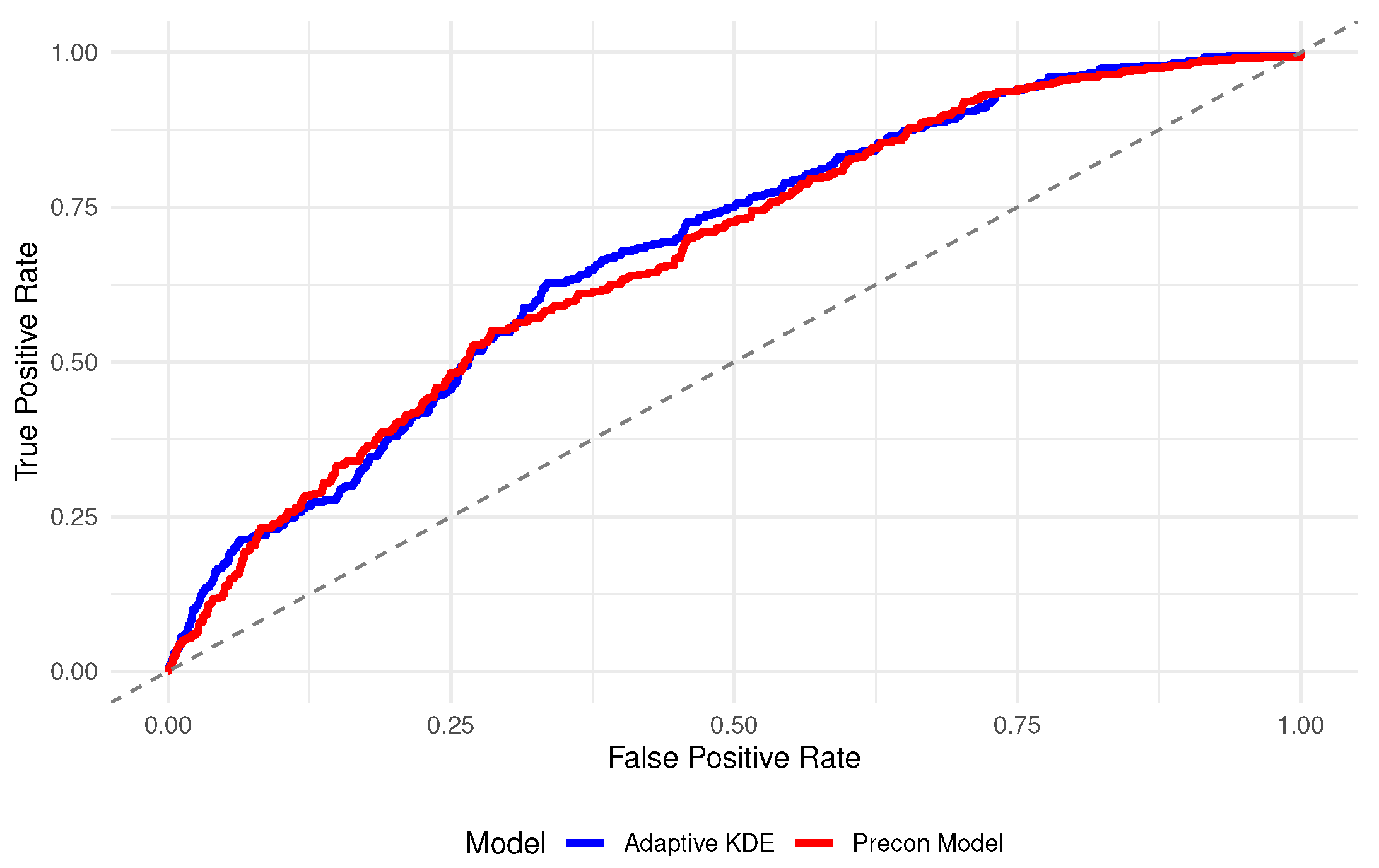
5.2. Discrimination Analysis (ROC/AUC)
6. Results and Discussion
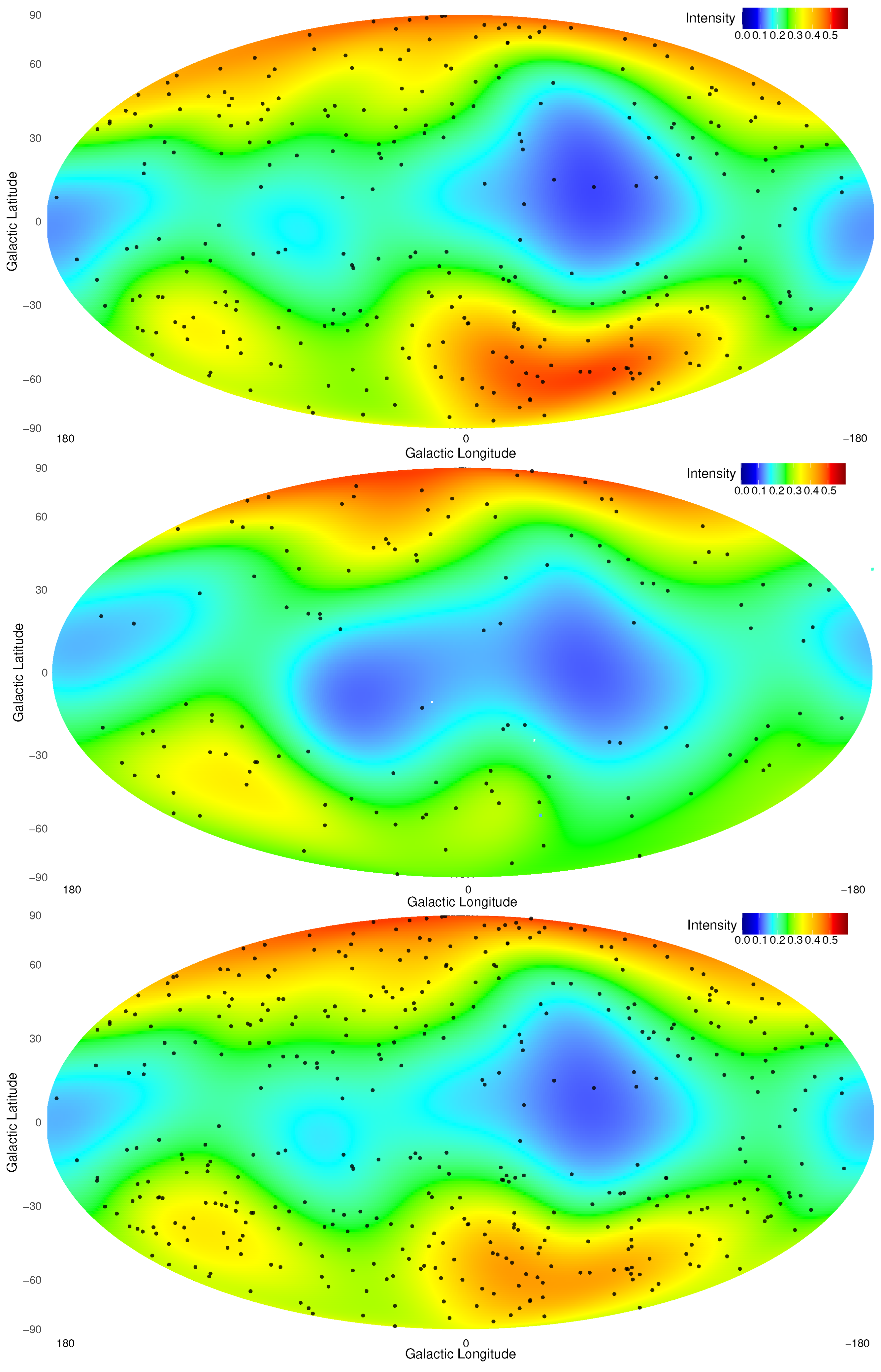
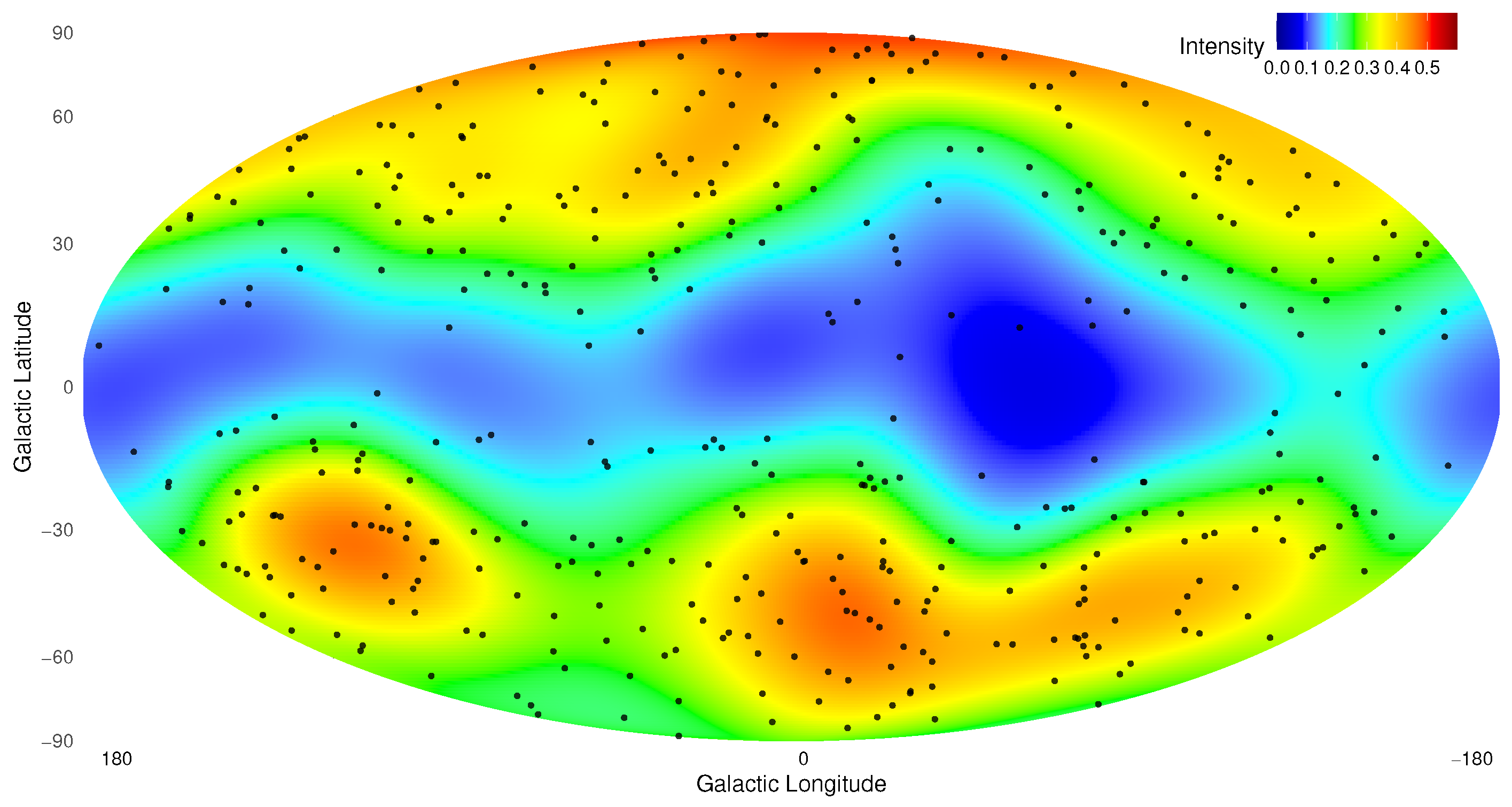
6.1. Results of Statistical Comparative Analysis
The Duality of Matching and Ranking
6.2. Subgroup Analysis and Validation of the Split Model


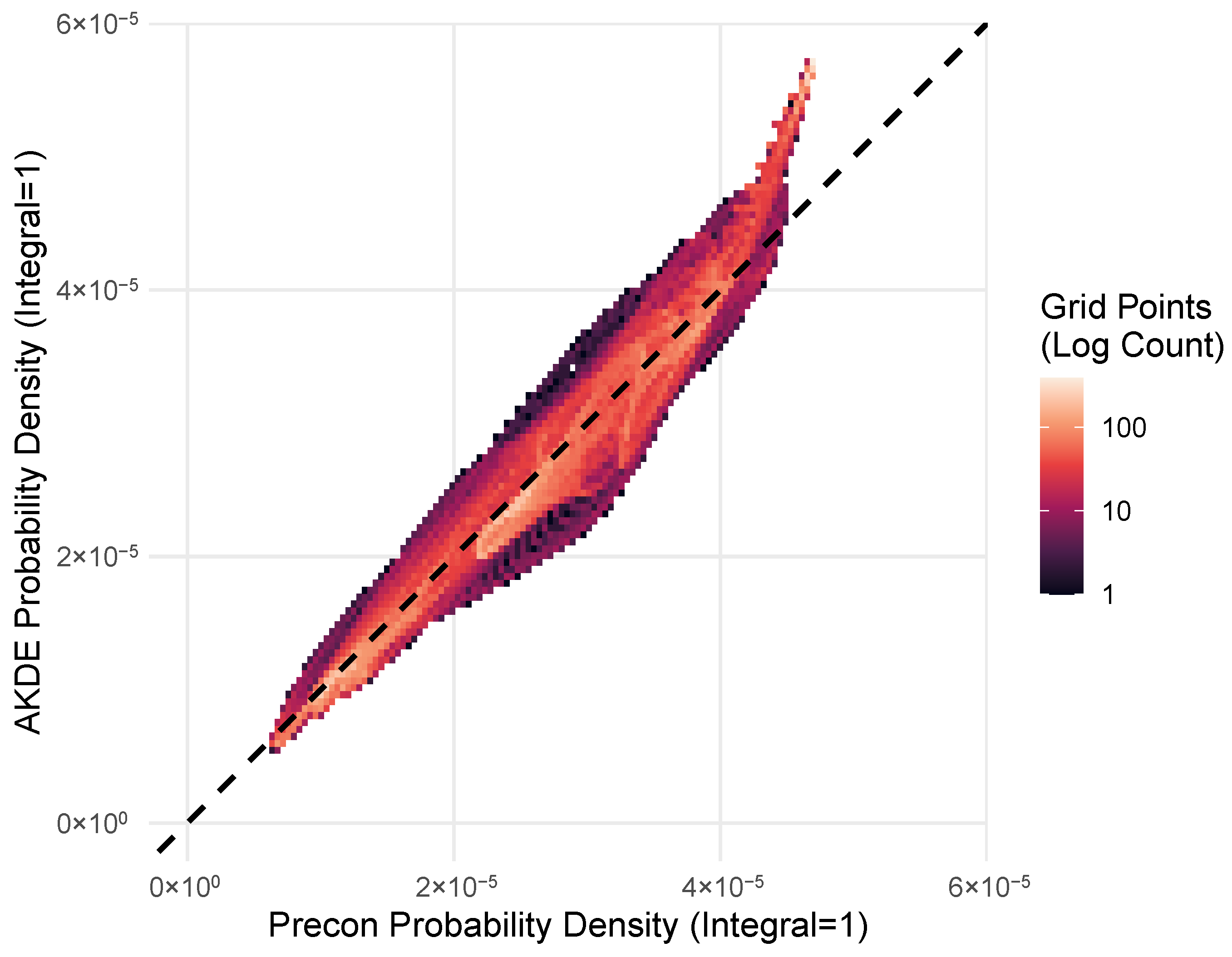
6.3. Pixel-to-Pixel Correlation Analysis
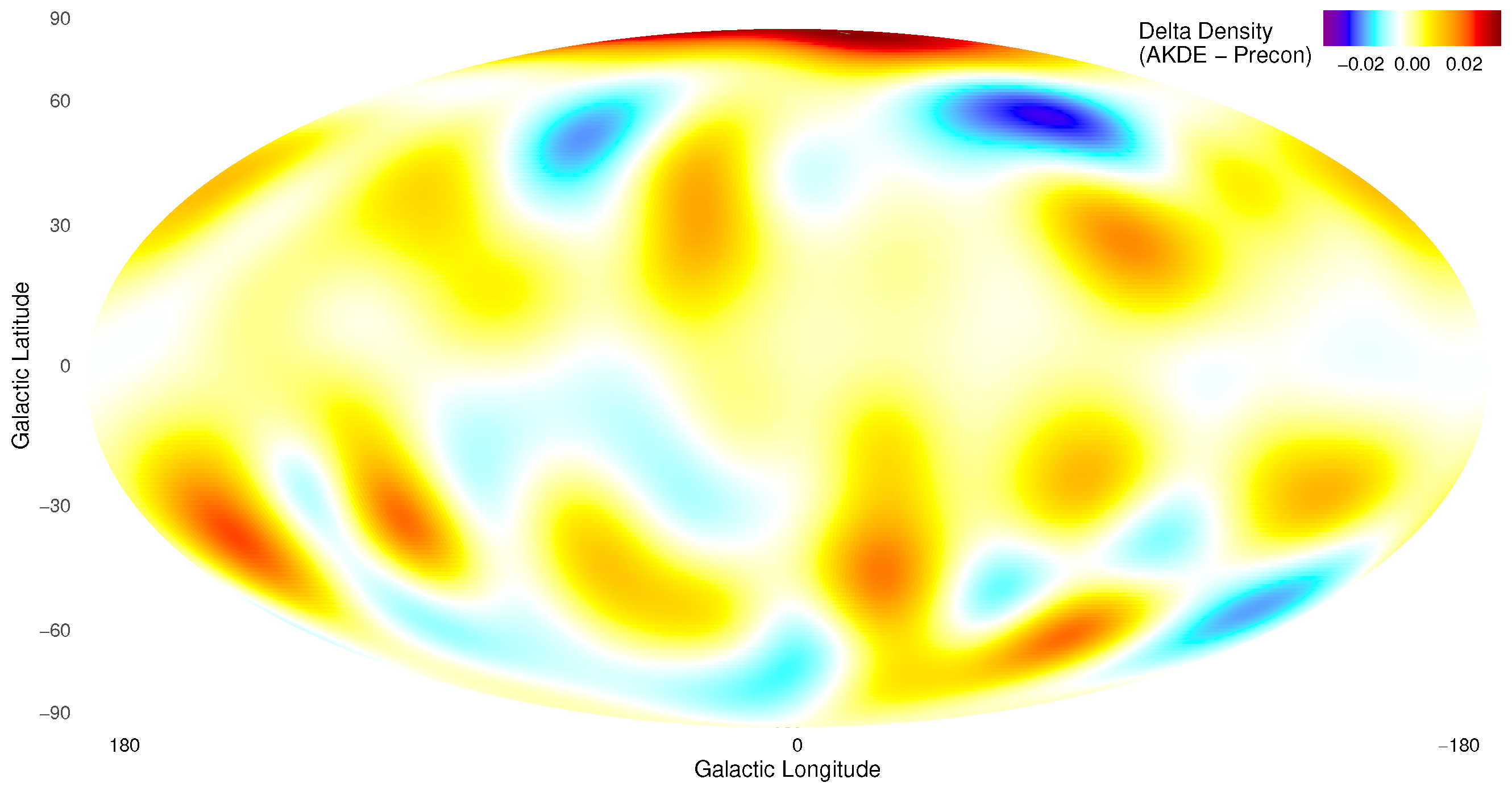
6.4. Spatial Artifact Analysis: Spurious Spikes and Signal Leakage
6.5. Limitations and Physical Biases
7. Summary and Conclusions
Author Contributions
Funding
Data Availability Statement
Acknowledgments
Conflicts of Interest
Appendix A. The Advantage of Factorized Density Estimation in GRB Angular Maps
Appendix A.1. Fidelity Versus Smoothing
Appendix A.2. The Bandwidth Limit and the Lower Pass Limit
Appendix A.3. Signal Processing Analysis: Spectral Bandwidth Extension with Modulation/Demodulation
Appendix A.4. Information Theory Approach
Appendix B. Methodology: The Spherical Generalized Additive Model
Appendix B.1. Spline on the Sphere
Appendix B.2. Bayesian Estimation and the Duality of Penalized Likelihood
Appendix B.3. Regularization and the Role of Gaussian Priors
Appendix B.4. The Restricted Maximum Likelihood Method
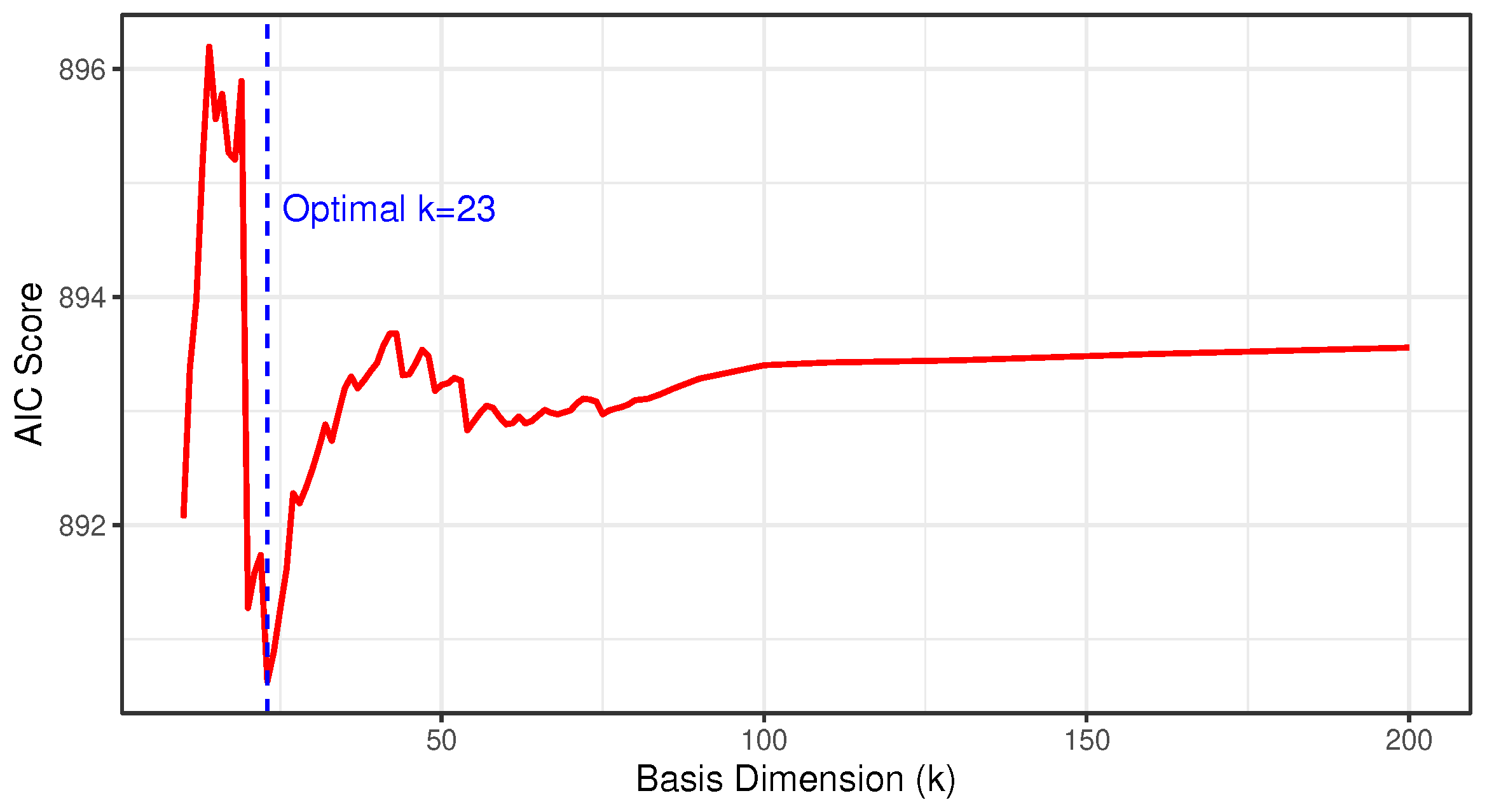
Appendix B.5. Model Selection and AIC
Appendix B.6. R Implementation
| 1 | |
| 2 | |
| 3 | |
| 4 |
References
- Feigelson, E.D.; Babu, G.J. Modern Statistical Methods for Astronomy; Cambridge University Press: Cambridge, UK, 2012. [Google Scholar]
- Mészáros, P. Gamma-ray bursts. Rep. Prog. Phys. 2006, 69, 2259–2321. [Google Scholar] [CrossRef]
- Mészáros, A.; Bagoly, Z.; Balázs, L.G.; Horváth, I. Redshift distribution of gamma-ray bursts and star formation rate. Astron. Astrophys. 2006, 455, 785–790. [Google Scholar] [CrossRef][Green Version]
- Tugay, A.; Tarnopolski, M. Continuous Filament Network of the Local Universe. Astrophys. J. 2023, 952, 3. [Google Scholar] [CrossRef]
- Wang, H.; Liang, N. Constraints from Fermi observations of long gamma-ray bursts on cosmological parameters. Mon. Not. R. Astron. Soc. 2024, 533, 743–755. [Google Scholar] [CrossRef]
- Greiner, J.; Iyudin, A.; Kanbach, G.; Zoglauer, A.; Diehl, R.; Ryde, F.; Hartmann, D.; Kienlin, A.V.; McBreen, S.; Ajello, M.; et al. Gamma-ray burst investigation via polarimetry and spectroscopy (GRIPS). Exp. Astron. 2009, 23, 91–120. [Google Scholar] [CrossRef]
- Liu, T.; Kim, K.T.; Yoo, H.; Liu, S.y.; Tatematsu, K.; Qin, S.L.; Zhang, Q.; Wu, Y.; Wang, K.; Goldsmith, P.F.; et al. Star Formation Laws in Both Galactic Massive Clumps and External Galaxies: Extensive Study with Dust Coninuum, HCN (4-3), and CS (7-6). Astrophys. J. 2016, 829, 59. [Google Scholar] [CrossRef]
- Dainotti, M.G.; Petrosian, V.; Bowden, L. Cosmological Evolution of the Formation Rate of Short Gamma-Ray Bursts with and without Extended Emission. Astrophys. J. 2021, 914, L40. [Google Scholar] [CrossRef]
- Dong, X.F.; Li, X.J.; Zhang, Z.B.; Zhang, X.L. A comparative study of luminosity functions and event rate densities of long GRBs with non-parametric method. Mon. Not. R. Astron. Soc. 2022, 513, 1078–1087. [Google Scholar] [CrossRef]
- Dong, X.F.; Huang, Y.F.; Zhang, Z.B.; Geng, J.J.; Deng, C.; Zou, Z.C.; Hu, C.R.; Amat, O. A Statistical Study of the Gamma-Ray Burst and Supernova Association. Astrophys. J. 2025, 993, 20. [Google Scholar] [CrossRef]
- Yadav, J.K.; Bagla, J.S.; Khandai, N. Fractal dimension as a measure of the scale of homogeneity. Mon. Not. R. Astron. Soc. 2010, 405, 2009–2015. [Google Scholar] [CrossRef]
- Balázs, L.G.; Bagoly, Z.; Hakkila, J.E.; Horváth, I.; Kóbori, J.; Rácz, I.I.; Tóth, L.V. A giant ring-like structure at 0.78 < z < 0.86 displayed by GRBs. Mon. Not. R. Astron. Soc. 2015, 452, 2236–2246. [Google Scholar] [CrossRef]
- Balázs, L.G.; Rejtó, L.; Tusnády, G. Some statistical remarks on the giant GRB ring. Mon. Not. R. Astron. Soc. 2018, 473, 3169–3179. [Google Scholar] [CrossRef]
- Horváth, I.; Hakkila, J.; Bagoly, Z. Possible structure in the GRB sky distribution at redshift two. Astron. Astrophys. 2014, 561, L12. [Google Scholar] [CrossRef]
- Horváth, I.; Bagoly, Z.; Hakkila, J.; Tóth, L.V. New data support the existence of the Hercules-Corona Borealis Great Wall. Astron. Astrophys. 2015, 584, A48. [Google Scholar] [CrossRef][Green Version]
- Horvath, I.; Szécsi, D.; Hakkila, J.; Szabó, Á.; Racz, I.I.; Tóth, L.V.; Pinter, S.; Bagoly, Z. The clustering of gamma-ray bursts in the Hercules-Corona Borealis Great Wall: The largest structure in the Universe? Mon. Not. R. Astron. Soc. 2020, 498, 2544–2553. [Google Scholar] [CrossRef]
- Horvath, I.; Bagoly, Z.; Balazs, L.G.; Hakkila, J.; Horvath, Z.; Joo, A.P.; Pinter, S.; Tóth, L.V.; Veres, P.; Racz, I.I. Mapping the Universe with gamma-ray bursts. Mon. Not. R. Astron. Soc. 2024, 527, 7191–7202. [Google Scholar] [CrossRef]
- Horvath, I.; Bagoly, Z.; Balazs, L.G.; Hakkila, J.; Koncz, B.; Racz, I.I.; Veres, P.; Pinter, S. Scanning the Universe for Large-Scale Structures Using Gamma-Ray Bursts. Universe 2025, 11, 121. [Google Scholar] [CrossRef]
- Baumgartner, W.H.; Tueller, J.; Markwardt, C.B.; Skinner, G.K.; Barthelmy, S.; Mushotzky, R.F.; Evans, P.A.; Gehrels, N. The 70-Month Swift-BAT All-sky Hard X-ray Survey. Astrophys. J. Suppl. Ser. 2013, 207, 19. [Google Scholar] [CrossRef]
- Sakamoto, T.; Barthelmy, S.D.; Barbier, L.; Cummings, J.R.; Fenimore, E.E.; Gehrels, N.; Hullinger, D.; Krimm, H.A.; Markwardt, C.B.; Palmer, D.M.; et al. The First Swift BAT Gamma-Ray Burst Catalog. Astrophys. J. 2008, 175, 179–190. [Google Scholar] [CrossRef]
- Okabe, A.; Boots, B.; Sugihara, K.; Chiu, S.N. Spatial Interpolation. In Spatial Tessellations: Concepts and Applications of Voronoi Diagrams; John Wiley & Sons, Inc.: Hoboken, NJ, USA, 2008. [Google Scholar]
- Schaap, W.E.; van de Weygaert, R. Continuous Fields and Discrete Samples: Reconstruction through Delaunay Tessellations. Astron. Astrophys. 2000, 363, L29–L32. [Google Scholar]
- Garcia-Quintero, C.; Noriega, H.E.; de Mattia, A.; Aviles, A.; Lodha, K.; Chebat, D.; Rohlf, J.; Nadathur, S.; Elbers, W.; Aguilar, J.; et al. Cosmological implications of DESI DR2 BAO measurements in light of the latest ACT DR6 CMB data. Phys. Rev. D 2025, 112, 083529. [Google Scholar] [CrossRef]
- Euclid Collaboration; Scaramella, R.; Amiaux, J.; Mellier, Y.; Burigana, C.; Carvalho, C.S.; Cuillandre, J.C.; Da Silva, A.; Derosa, A.; Dinis, J.; et al. Euclid preparation. I. The Euclid Wide Survey. Astron. Astrophys. 2022, 662, A112. [Google Scholar] [CrossRef]
- Bagoly, Z.; Balázs, L.G.; Horváth, I.; Rácz, I.; Tóth, L.V.; Hakkila, J. The GRB’s Sky Exposure Function. In Proceedings of the PoS (SWIFT 10)060, Swift: 10 Years of Discovery, Proceedings of Science, Rome, Italy, 2–5 December 2014. [Google Scholar] [CrossRef]
- Bernardini, M.G.; Cordier, B.; Wei, J. The SVOM Mission. Galaxies 2021, 9, 113. [Google Scholar] [CrossRef]
- Yuan, W.; Zhang, C.; Chen, C.; Ling, Z.; Lu, Y.; Osborne, J.P.; O’Brien, P.; Willingale, R.; Guainazzi, M.; Sodari, S.; et al. Science objectives of the Einstein Probe mission. Sci. China Phys. Mech. Astron. 2025, 68, 229502. [Google Scholar] [CrossRef]
- Amati, L.; O’Brien, P.; Götz, D.; Boella, G.; Schanne, S.; Vermeulen, G.; Blain, A.; Tanvir, N.; Ghirlanda, G.; Castro-Tirado, A.J.; et al. The THESEUS space mission concept: Science case, design and expected performances. Adv. Space Res. 2018, 62, 191–244. [Google Scholar] [CrossRef]
- Rácz, I.I.; Hortobagyi, A.J. Studying the variability of the X-ray spectral parameters of high-redshift GRBs’ afterglows. Astron. Nachrichten 2018, 339, 347–351. [Google Scholar] [CrossRef]
- Barthelmy, S.D.; Barbier, L.M.; Cummings, J.R.; Fenimore, E. The Burst Alert Telescope (BAT) on the SWIFT Midex Mission. Space Sci. Rev. 2005, 120, 143–164. [Google Scholar] [CrossRef]
- Gehrels, N.; Chincarini, G.; Giommi, P.; Mason, K.O.; Nousek, J.A.; Wells, A.A.; White, N.E.; Barthelmy, S.D.; Burrows, D.N.; Cominsky, L.R.; et al. The Swift Gamma-Ray Burst Mission. Astrophys. J. 2004, 611, 1005–1020. [Google Scholar] [CrossRef]
- Goad, M.R.; Tyler, L.G.; Beardmore, A.P.; PEvans, A.; Rosen, S.R.; Osborne, J.P.; Starling, R.L.C.; Marshall, F.E.; Yershov, V.; Burrows, N.D.; et al. Accurate early positions for Swift GRBs: Enhancing X-ray positions with UVOT astrometry. Astron. Astrophys. 2007, 476, 1401–1409. [Google Scholar] [CrossRef]
- Evans, P.A.; Beardmore, A.P.; Page, K.L.; Osborne, J.P.; O’Brien, P.T.; Willingale, R.; Starling, R.L.C.; Burrows, D.N.; Godet, O.; Vetere, L.; et al. Methods and results of an automatic analysis of a complete sample of Swift-XRT observations of GRBs. Mon. Not. R. Astron. Soc. 2009, 397, 1177–1201. [Google Scholar] [CrossRef]
- Horvath, I.; Racz, I.I.; Bagoly, Z.; Balázs, L.G.; Pinter, S. Does the GRB Duration Depend on Redshift? Universe 2022, 8, 221. [Google Scholar] [CrossRef]
- Bagoly, Z.; Horvath, I.; Racz, I.I.; Balázs, L.G.; Tóth, L.V. The Spatial Distribution of Gamma-Ray Bursts with Measured Redshifts from 24 Years of Observation. Universe 2022, 8, 342. [Google Scholar] [CrossRef]
- Abramson, I.S. On Bandwidth Variation in Kernel Estimates—A Square Root Law. Ann. Stat. 1982, 10, 1217–1223. [Google Scholar] [CrossRef]
- Silverman, B.W. Density Estimation for Statistics and Data Analysis; Chapman and Hall: London, UK, 1986. [Google Scholar] [CrossRef]
- Ruppert, D.; Wand, M.P.; Carroll, R.J. Semiparametric Regression; Cambridge Series in Statistical and Probabilistic Mathematics; Cambridge University Press: Cambridge, UK, 2003. [Google Scholar]
- Kerscher, M.; Szapudi, I.; Szalay, A.S. A comparison of estimators for the two-point correlation function. Astrophys. J. 2000, 535, L13. [Google Scholar] [CrossRef]
- Hastie, T.; Tibshirani, R.; Friedman, J. The Elements of Statistical Learning: Data Mining, Inference, and Prediction, 2nd ed.; Springer: Berlin/Heidelberg, Germany, 2009. [Google Scholar] [CrossRef]
- Shimazaki, H.; Shinomoto, S. Kernel bandwidth optimization in spike rate estimation. J. Comput. Neurosci. 2010, 29, 171–182. [Google Scholar] [CrossRef] [PubMed]
- Hall, P.; Watson, G.S.; Cabrera, J. Kernel density estimation with spherical data. Biometrika 1987, 74, 751–762. [Google Scholar] [CrossRef]
- Fisher, R.A. Dispersion on a sphere. Proc. R. Soc. Lond. Ser. Math. Phys. Sci. 1953, 217, 295–305. [Google Scholar] [CrossRef]
- Mardia, K.V.; Jupp, P.E. Directional Statistics; John Wiley & Sons: Chichester, UK, 2008. [Google Scholar]
- Stone, M. Cross-Validatory Choice and Assessment of Statistical Predictions. J. R. Stat. Soc. Ser. B 1974, 36, 111–133. [Google Scholar] [CrossRef]
- Kass, R.E.; Raftery, A.E. Bayes factors. J. Am. Stat. Assoc. 1995, 90, 773–795. [Google Scholar] [CrossRef]
- Phillips, S.J.; Anderson, R.P.; Schapire, R.E. Maximum entropy modeling of species geographic distributions. Ecol. Model. 2006, 190, 231–259. [Google Scholar] [CrossRef]
- Fawcett, T. An introduction to ROC analysis. Pattern Recognit. Lett. 2006, 27, 861–874. [Google Scholar] [CrossRef]
- Burnham, K.P.; Anderson, D.R. Model Selection and Multimodel Inference: A Practical Information-Theoretic Approach, 2nd ed.; Springer: New York, NY, USA, 2002. [Google Scholar]
- Pinter, S.; Balazs, L.G.; Bagoly, Z.; Toth, L.V.; Racz, I.I.; Horvath, I. Some statistical remarks on GRBs jointly detected by Fermi and Swift satellites. Mon. Not. R. Astron. Soc. 2024, 527, 8931–8940. [Google Scholar] [CrossRef]
- Driscoll, J.R.; Healy, D.M. Computing Fourier Transforms and Convolutions on the 2-Sphere. Adv. Appl. Math. 1994, 15, 202–250. [Google Scholar] [CrossRef]
- Jaynes, E.T. Information Theory and Statistical Mechanics. Phys. Rev. 1957, 106, 620. [Google Scholar] [CrossRef]
- Hastie, T.J.; Tibshirani, R.J. Generalized Additive Models; Chapman and Hall/CRC: Boca Raton, FL, USA, 1990. [Google Scholar]
- Fahrmeir, L.; Kneib, T.; Lang, S.; Marx, B. Regression: Models, Methods and Applications; Springer: Berlin/Heidelberg, Germany, 2013. [Google Scholar]
- Berger, A.L.; Della Pietra, V.J.; Della Pietra, S.A. A maximum entropy approach to natural language processing. Comput. Linguist. 1996, 22, 39–71. [Google Scholar]
- Ivezić, Ž.; Connolly, A.J.; VanderPlas, J.T.; Gray, A. Statistics, Data Mining, and Machine Learning in Astronomy; Princeton University Press: Princeton, NJ, USA, 2014. [Google Scholar]
- Ng, A.Y.; Jordan, M.I. On discriminative vs. generative classifiers: A comparison of logistic regression and naive bayes. Adv. Neural Inf. Process. Syst. 2002, 14, 841–884. [Google Scholar]
- Eilers, P.H.C.; Marx, B.D. Flexible smoothing with B-splines and penalties. Stat. Sci. 1996, 11, 89–121. [Google Scholar] [CrossRef]
- Duchon, J. Splines minimizing rotation-invariant semi-norms in Sobolev spaces. In Constructive Theory of Functions of Several Variables; Springer: Berlin/Heidelberg, Germany, 1977; pp. 85–100. [Google Scholar] [CrossRef]
- Wahba, G. Spline interpolation and smoothing on the sphere. SIAM J. Sci. Stat. Comput. 1981, 2, 5–16. [Google Scholar] [CrossRef]
- Wood, S.N. Thin plate regression splines. J. R. Stat. Soc. Ser. B (Stat. Methodol.) 2003, 65, 95–114. [Google Scholar] [CrossRef]
- Li, Y.; Ye, Z. Boosting in Univariate Nonparametric Maximum Likelihood Estimation. IEEE Signal Process. Lett. 2021, 28, 623–627. [Google Scholar] [CrossRef]
- Yanagihara, H.; Ohtaki, M. On Avoidance of the Over-fitting in the B-Spline Non-parametric Regression Model. Jpn. J. Appl. Stat. 2004, 33, 51–69. [Google Scholar] [CrossRef]
- Coolen, A.C.C.; Sheikh, M.; Mozeika, A.; Aguirre-Lopez, F.; Antenucci, F. Replica analysis of overfitting in generalized linear regression models. J. Phys. A 2020, 53, 365001. [Google Scholar] [CrossRef]
- Tikhonov, A.N.; Arsenin, V.Y. Solutions of Ill-Posed Problems; V. H. Winston & Sons: Washington, DC, USA; New York, NY, USA, 1977; p. xiii+258. [Google Scholar]
- Wood, S.N. Fast stable restricted maximum likelihood and marginal likelihood estimation of semiparametric generalized linear models. J. R. Stat. Soc. Ser. B (Stat. Methodol.) 2011, 73, 3–36. [Google Scholar] [CrossRef]
- Marra, G.; Wood, S.N. Practical variable selection for generalized additive models. Comput. Stat. Data Anal. 2011, 55, 2372–2387. [Google Scholar] [CrossRef]
- Bailer-Jones, C.A.L. Bayesian inference of stellar parameters and interstellar extinction using parallaxes and multiband photometry. Mon. Not. R. Astron. Soc. 2011, 411, 435–452. [Google Scholar] [CrossRef]
- Patterson, H.D.; Thompson, R. Recovery of inter-block information when block sizes are unequal. Biometrika 1971, 58, 545–554. [Google Scholar] [CrossRef]
- Kelsall, J.E.; Diggle, P.J. Non-parametric estimation of spatial variation in relative risk. Stat. Med. 1995, 14, 2335–2342. [Google Scholar] [CrossRef]
- Caticha, A. Entropic Inference. In Proceedings of the Bayesian Inference and Maximum Entropy Methods in Science and Engineering; American Institute of Physics Conference Series; Mohammad-Djafari, A., Bercher, J.F., Bessiére, P., Eds.; AIP Publishing: Melville, NY, USA, 2011; Volume 1305, pp. 20–29. [Google Scholar] [CrossRef]
- Akaike, H. A new look at the statistical model identification. IEEE Trans. Autom. Control 1974, 19, 716–723. [Google Scholar] [CrossRef]


Disclaimer/Publisher’s Note: The statements, opinions and data contained in all publications are solely those of the individual author(s) and contributor(s) and not of MDPI and/or the editor(s). MDPI and/or the editor(s) disclaim responsibility for any injury to people or property resulting from any ideas, methods, instructions or products referred to in the content. |
© 2026 by the authors. Licensee MDPI, Basel, Switzerland. This article is an open access article distributed under the terms and conditions of the Creative Commons Attribution (CC BY) license.
Share and Cite
Bagoly, Z.; Racz, I.I. Recovering Gamma-Ray Burst Redshift Completeness Maps via Spherical Generalized Additive Models. Universe 2026, 12, 31. https://doi.org/10.3390/universe12020031
Bagoly Z, Racz II. Recovering Gamma-Ray Burst Redshift Completeness Maps via Spherical Generalized Additive Models. Universe. 2026; 12(2):31. https://doi.org/10.3390/universe12020031
Chicago/Turabian StyleBagoly, Zsolt, and Istvan I. Racz. 2026. "Recovering Gamma-Ray Burst Redshift Completeness Maps via Spherical Generalized Additive Models" Universe 12, no. 2: 31. https://doi.org/10.3390/universe12020031
APA StyleBagoly, Z., & Racz, I. I. (2026). Recovering Gamma-Ray Burst Redshift Completeness Maps via Spherical Generalized Additive Models. Universe, 12(2), 31. https://doi.org/10.3390/universe12020031