1. Introduction
The fundamental incompatibility between general relativity and quantum mechanics has motivated the development of various quantum gravity theories, many of which predict a potential violation of Lorentz invariance at energies near or above the Planck scale [
1,
2,
3,
4,
5,
6]. Such Lorentz invariance violation (LIV) could induce energy-dependent modifications to the vacuum dispersion relationship of particles, potentially altering the speed of light and producing observable experimental signatures. This renders the search for LIV effects one of the most promising approaches to investigating quantum gravity phenomenology.
The manifestation of LIV effects is particularly favorable at high energies and over cosmological distances, making high-energy photons from distant astrophysical sources ideal probes for LIV signatures [
7,
8,
9,
10,
11,
12,
13,
14,
15,
16,
17,
18,
19,
20]. Previous studies have employed various astrophysical detectors and analytical techniques to investigate different LIV manifestations, including energy-dependent photon velocity [
7,
8,
9,
10,
11,
21,
22,
23,
24,
25,
26,
27,
28], photon decay or splitting [
13,
15], and modifications to pair production thresholds [
29,
30], yielding stringent constraints on the LIV energy scale.
The recent observation of GRB 221009A at redshift z = 0.151, the most luminous long gamma ray burst, has provided good opportunities for new physics studies. In 2022, the Large High Altitude Air Shower Observatory (LHAASO) detected numerous high-energy photon events ranging from 0.2 TeV to approximately 13 TeV using both its WCDA and KM2A [
31,
32] detectors, offering an excellent dataset to investigate potential LIV effects at these energies. Several investigations have already utilized these observations to set stringent constraints on LIV parameters [
17,
18,
19,
20].
In this study, we employ the dispersion cancellation (DisCan) algorithm [
33] to investigate possible LIV effects [
20,
34] in the LHAASO observational data of GRB 221009A. If LIV exits, high energy photons emitted from the source exhibit energy-dependent velocities during their propagation, potentially distorting the observed temporal profile of the burst. We can reconstruct the time profile of photons reflecting the initial temporal properties of the emission at the source. The correct LIV parameters should correspond to a reasonable initial time profile characterized by specific structures, which do not necessarily require prior knowledge for determination and can be evaluated using Shannon entropy [
33]. We utilize the minimum Shannon entropy to explore potential LIV effects and establish constraints on the LIV parameters. In our analysis, we incorporate observations from both the WCDA and KM2A detectors, which span a wide energy range, where LIV effects may be substantially manifested. To set constraints on the LIV parameters, we also take into account the impacts of energy resolution and temporal binning effects.
This paper is organized as follows. In
Section 2, we provide a brief overview of the LIV effects and introduce the DisCan algorithm. We demonstrate its feasibility through simulated photon data. In
Section 3, we apply the DisCan algorithm to the LHAASO observations of GRB221009A to constrain the LIV parameters. We also consider the impacts of energy resolution and temporal binning effects on the results. In
Section 4, we provide a summary.
2. Lorentz Invariance Violation Effects and the Dispersion Cancellation Algorithm
The conventional dispersion relation of photons in vacuum, expressed as
, holds with high precision at low energies. However, this relation may undergo significant modifications at extremely high energy due to quantum gravitational effects, which can be expressed as [
14]:
where
and
represent the subluminal and superluminal cases, respectively. Here,
denotes the
n-th order quantum gravity energy scale, which is typically associated with the Planck energy. This modification implies that the group velocity of photons is no longer a constant but instead becomes energy-dependent as:
Given that higher-order effects can often be negligible, we restrict our analysis to the first-order (1st-order) () and second-order (2nd-order) () LIV scenarios.
To explore potential LIV effects, we analyze high-energy photons emitted from a cosmological source and subsequently detected on Earth. Let
denote the observed arrival time of the
i-th photon subjected to the
n-th order LIV effect, while
represents the corresponding arrival time under the assumption of Lorentz invariance. They are related through:
where
denotes the redshift of the source,
represents the energy of the
i-th photon,
is a parameter that incorporates both
and
. The Hubble parameter
is given by
, where
is the Hubble constant, and
and
are the current matter and dark energy density parameters [
35], respectively. For practical calculations, we define the following dimensionless parameters:
and
, where
denotes the Planck energy scale. For GRB 221009A with a redshift of
, we derive
and
, where
represents the photon energy in units of TeV.
If LIV exists, the observed photon arrival time profile of
would include LIV effects, while the derived profile of
would reflect the intrinsic temporal structure of the emission at the source. The appropriate LIV parameters should yield a physically plausible initial time profile, whereas incorrect parameters may introduce artificial structures in the reconstructed time profile [
33]. For this analysis, we employ the DisScan algorithm [
33], designed for the analysis of time-energy tagged photon data, to investigate LIV effects and impose constraints. This algorithm operates by scanning the LIV parameter space to maximize the temporal sharpness of the reconstructed photon arrival time profile
, thereby recovering possible energy-dependent time delays.
In this analysis, we do not account for potential intrinsic energy-dependent emission mechanisms at the source. Furthermore, we neglect astrophysical processes that could introduce energy-dependent time delays, including dispersion effects from propagation through the intergalactic medium and interactions with background radiation fields. Our assumption is that the observed time delays originate exclusively from LIV effects. Incorporating alternative astrophysical delay mechanisms require more sophisticated modeling and could potentially relax the derived constraints on LIV parameters.
Given photon data with time and energy measurements, along with a photon dispersion model, the algorithm primarily involves the following steps: 1. Construct the time profile of from the observed photon data. 2. Define the Shannon entropy to quantify the sharpness of the reconstructed time profile. 3. Determine the optimal LIV parameters by minimizing the Shannon entropy, corresponding to the physically meaningful time profile.
In our analysis, we construct the time profile
utilizing observations from LHAASO of GRB 221009A. For a given LIV parameter
, we calculate
using Equation (
3). We consider a count-based profile of photons defined as:
where
represents the photon count in the n-th time bin, and
denotes the width of the time bin. Since higher energy photons are more sensitive to LIV parameters, we enhance their contribution by assigning them larger weights, thereby improving the overall sensitivity. Therefore, we also consider an energy-weighted profile defined as [
33]
where the summation runs over all photons in the
n-th time bin, and
denotes the energy of the
k-th photon in this bin.
To evaluate the quality of the derived profile, we employ Shannon entropy. This concept, originally introduced by Claude Shannon in 1948 [
36], serves as a measure of uncertainty within a system in the field of information theory and has broad applications across various disciplines. In physics, Shannon entropy is closely connected to thermodynamic entropy, as both concepts describe the degree of disorder or randomness within a system. The Shannon entropy is calculated as
where
denotes the normalized value of
. For a given
, we obtain the corresponding Shannon entropy. Generally, a high Shannon entropy indicates a random and featureless distribution, suggesting incorrect LIV values that significantly distort the intrinsic source profile [
33]. Conversely, a low Shannon entropy implies a structured temporal profile, revealing optimal LIV parameters that effectively recover the initial emission characteristics. Thus, by minimizing the Shannon entropy across the LIV parameter space, we can determine the physically plausible LIV parameters that align with the observed data.
To demonstrate the efficacy of this methodology, we present three test cases employing simulated photon data. First, we generate a mock sample comprising
photons distributed uniformly across a time interval from 0 to 100 s, incorporating LIV effects with a parameter value of
. The energies of the photons are randomly generated within a uniform range of 0 to 100 TeV. Subsequently, we employ the DisCan algorithm to scan the LIV parameters with this data sample. The resulting distributions of Shannon entropy are displayed in
Figure 1 for three distinct time bin widths. The blue and red curves represent the results corresponding to the energy-weighted and count-based profiles, respectively. We observe that both profiles correctly identify the input LIV parameter through their respective entropy minima, thereby validating the algorithm’s capability to reconstruct sharply distributed temporal profiles. Furthermore, the final results are not significantly concerned with time bin intervals in this case.
We also generate another sample where the photon arrival times follow a normal distribution with a mean of zero and a standard deviation of 100 s, representing a more gradual temporal profile. The corresponding results are illustrated in
Figure 2. We observe that the reconstruction in
Figure 2 is less precise compared to the previous case. In this case, the initial time profile has a less sharp edge, which diminishes the algorithm’s ability to identify specific features crucial for the entropy minimization procedure. Nevertheless, the algorithm still converges toward the vicinity of the true LIV parameter, thereby demonstrating its validity.
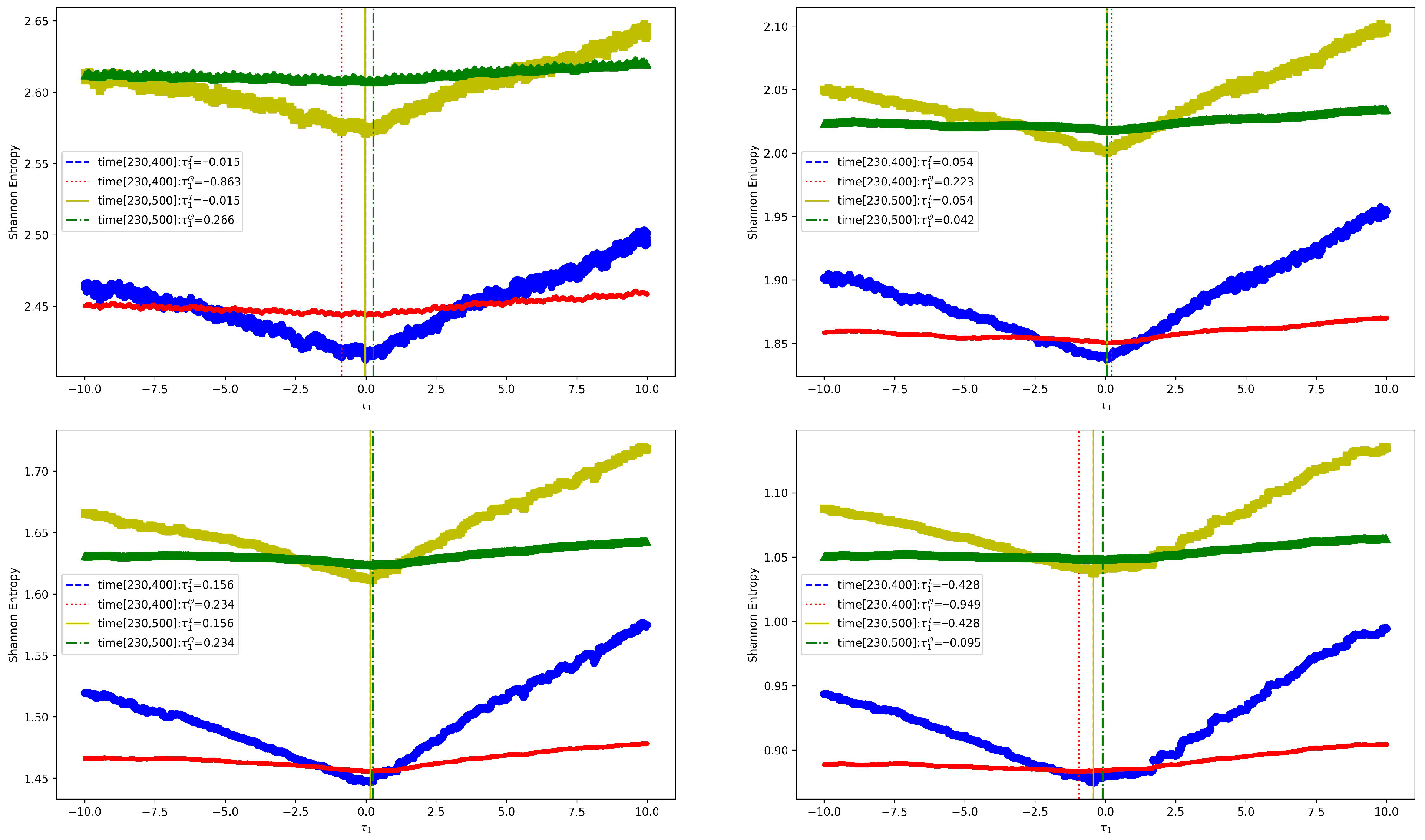
To further illustrate the feasibility of this method for LHAASO photon observations, we generate a sample of
photons based on the time profile and energy spectrum of GRB 221009A reported by LHAASO. The time profile
is expressed as follows [
31]:
where the parameters
are chosen as
, respectively. The energy spectrum is adopted as a power-law form as
. Spectral evolution is expected to have a minor impact compared to the dominant LIV effects and is not considered in this test. We employ rejection sampling and inverse transform sampling to generate photon arrival times within [230, 400] sand energies within [0.3, 10] TeV, respectively.
Figure 3 shows the resulting distributions of Shannon entropy for time bin widths of 0.3 s, 3 s and 15 s. We can see that the optimal value of
aligns well with the input
for the time bin width of 3 s.
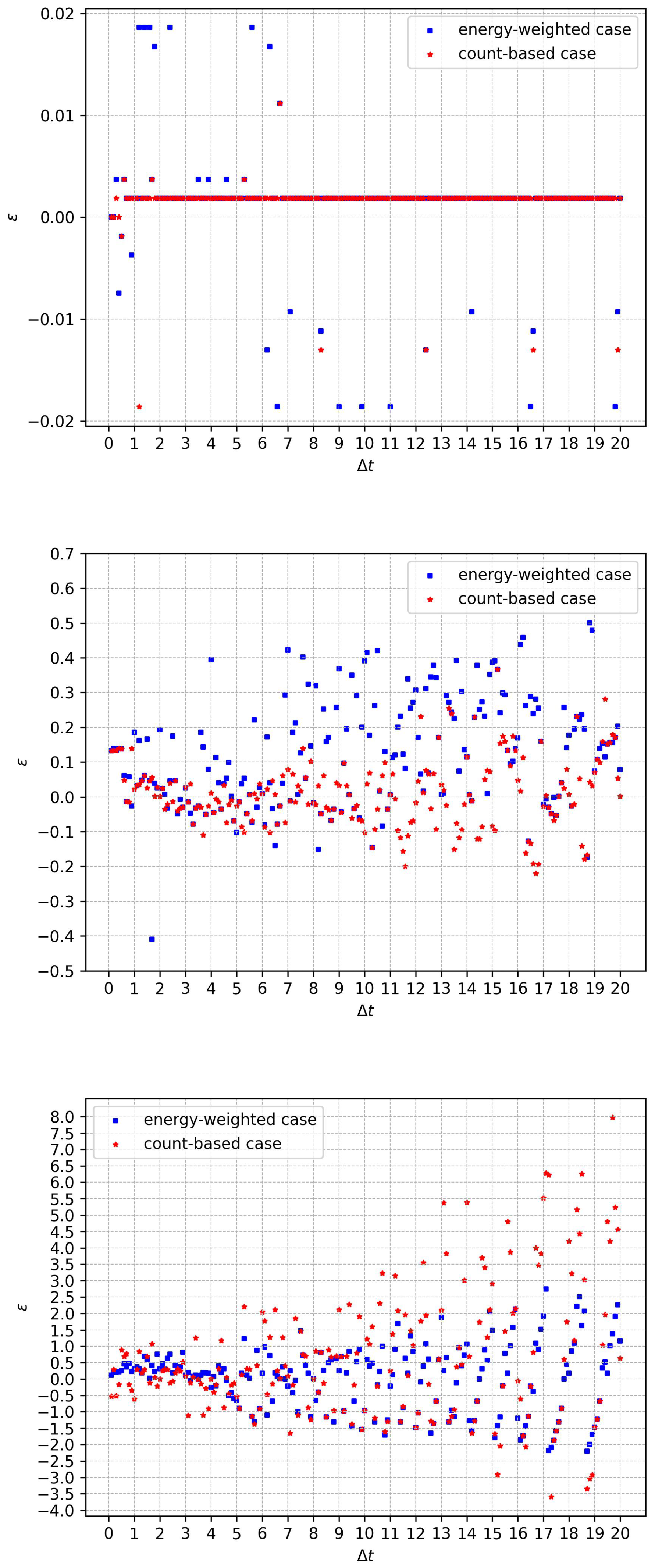
We quantify the reconstruction accuracy using the relative error
, where
denotes the optimal value minimizing Shannon entropy.
Figure 4 presents the dependence of
on the time bin width
for the three generated samples. Our results indicate that for the sample generated with the reported time profile from LHAASO, the energy-weighted estimator for
yields more precise results compared to the count-based estimator. Furthermore, smaller time bin widths provide better results.
3. Exploring LIV Effects Using the Observational Data of GRB221009A from LHAASO
In order to investigate the potential LIV effects, we utilize the LHAASO data of GRB 221009A, collected from both the KM2A and WCDA detectors. The KM2A detector provides high-precision measurements of the arrival time and energy of each photon [
32]. In contrast, the WCDA dataset features a coarser photon resolution [
31]. Photons detected by the WCDA detector are classified according to their
values, which correspond to the energy and size of secondary particle showers generated by high-energy photon interactions in the atmosphere [
31]. Consequently,
serves as a proxy for estimating the energy of the original photon. The WCDA
values are grouped into the following intervals: [30, 33], [33, 40], [40, 63], [63, 100], [100, 250], and [250,
) [
31]. For simplicity, we assume that photons within a given
interval share the same energy. For instance, photons in the [30, 33] interval are assigned an energy of 0.35 TeV [
31]. Furthermore, the WCDA timing data are recorded in 0.1-s bins, with each bin containing the corresponding photon count rate. Although this temporal resolution is relatively coarse compared to the KM2A data, it remains sufficient for our analysis.
As indicated by Equation (
2), a greater disparity in photon energies leads to more pronounced differences in photon velocities, consequently inducing more significant distortions in the temporal profile of the photon signal. To maximize sensitivity to potential LIV effects, our study employs both the KM2A and WCDA datasets, which collectively span a wide energy range. The WCDA and KM2A detectors share a synchronized timing system, ensuring temporal consistency between their measurements. The KM2A detector provides high-precision energy measurements across an energy range of approximately 1–13 TeV, covering an order of magnitude higher than that of the WCDA. We restrict our analysis to the WCDA photons within the
bin of [30, 33], corresponding to the lowest energy photons.
We focus on photons detected within the time interval of [230, 400] s after the trigger time
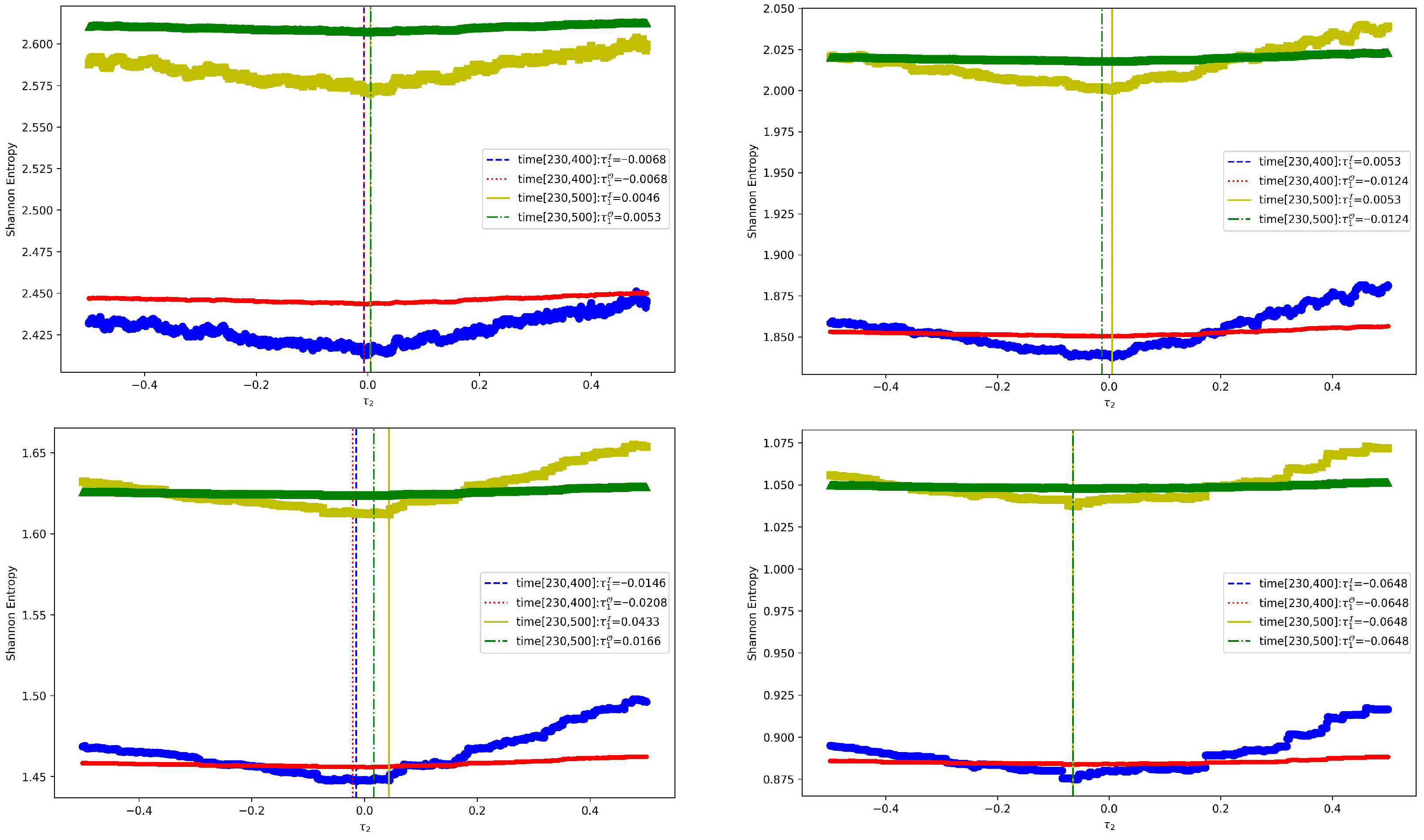
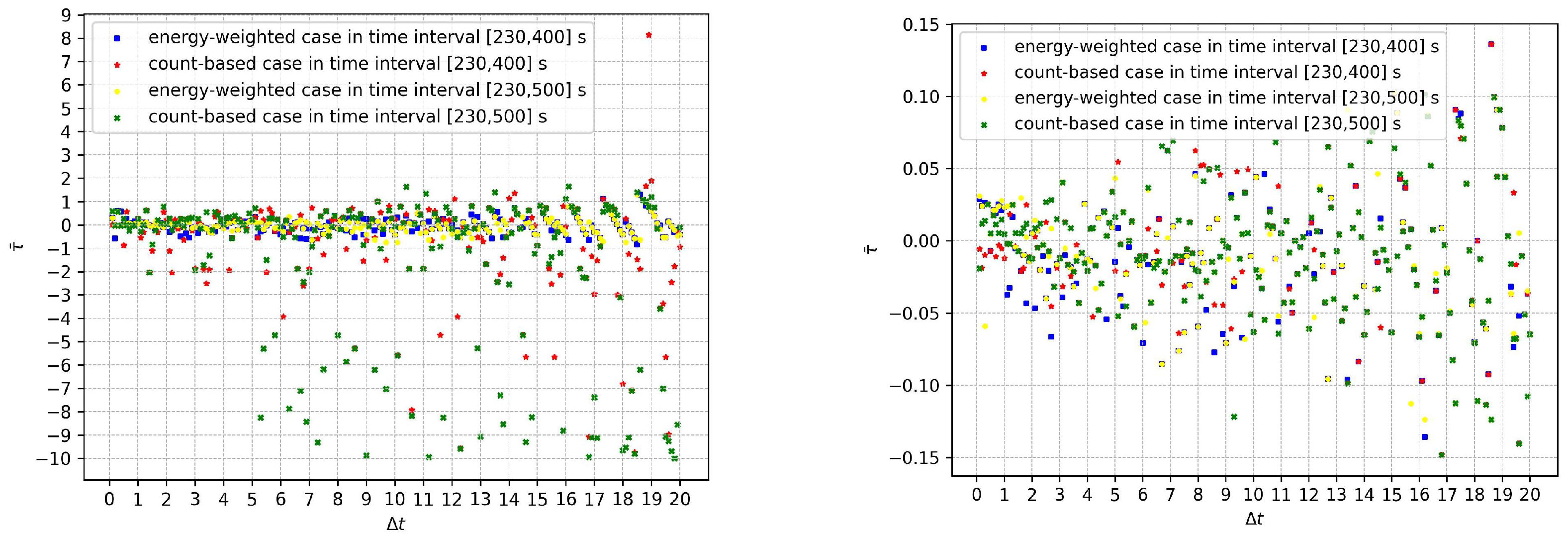
, as this temporal window exhibits the highest photon flux and the dominant population of high-energy events. To assess potential selection biases, we also examine an extended time interval of [230, 500] s. The variations of Shannon entropy with the 1st-order and 2nd-order LIV parameters are illustrated in
Figure 5 and
Figure 6, respectively. The red (blue) and green (yellow) curves represent the results derived using the count-based (energy-weighted) profile in the [230, 400] s and [230, 500] s intervals, respectively. Furthermore, the dependence of the optimal parameter
on
for both profile types, temporal selections, and LIV scenarios is shown in
Figure 7. Note that our method is different from that used for WCDA photons in [
20]. They subtract the Shannon entropy of the KM2A and WCDA photons from that of the WCDA photons to obtain the final entropy, while we use the joint entropy of both the KM2A and WCDA photons. Furthermore, we use the fixed time bin width in our analysis, while the Knuth binning method is adopted in [
20]. In our analysis, we employ fixed time bin widths to ensure consistent treatment throughout the parameter scan. This choice allows us to systematically vary the bin width and incorporate its effect as a source of uncertainty in the final LIV constraints. A strict comparison between binning methods would require careful consideration of temporal correlations and is not considered in this work.
Our results show that the energy-weighted profile more effectively characterizes the correlation between Shannon entropy and the LIV parameters compared to the count-based profile, thereby enhancing the precision of parameter estimation. We also observe that the different temporal selections for photons have little impact on the results for the 1st-order LIV parameter derived via the energy-weighted profile, as well as for the 2nd-order LIV parameter using both profiles. However, the choice of temporal binning significantly influences the results. Excessively narrow time bins (too small ) yield significant oscillations. This artifact arises because photons with almost identical arrival times may be assigned to different time bins under varying parameter configurations, thereby introducing fluctuations in the calculations of Shannon entropy. Conversely, overly wide time bins also degrade accuracy due to information loss. When multiple photons are grouped within a single bin, their individual temporal signatures are effectively averaged, thereby obscuring distinctive features. This effect becomes increasingly severe with wider bins, systematically increasing errors in parameter estimation.
Given the inherent energy resolution limitations of ground-based detector arrays, we incorporate uncertainties in photon energy into our analysis through a Monte Carlo approach. We focus on photons in time interval [230, 400] s. For each photon detected by the KM2A detector, we generate randomized energy values following a composite probability distribution comprising two truncated normal distributions. These two distributions are centered on the mean value of the observed energy, with standard deviations corresponding to the reported left and right energy uncertainties [
32], respectively. This double-normal approximation accurately captures the asymmetric energy resolution reported by LHAASO. All generated energies are restricted to exceed 1 TeV. For photons detected by the WCDA within the
bin of [30, 33], we generate energies using a single normal distribution with a mean value of 0.35 TeV and a standard deviation of 0.35 TeV that reflects the associated uncertainty. The generated energies are restricted to lie between 0.1 TeV and 0.7 TeV. The Gaussian distribution is a simple assumption. To assess the systematic uncertainties associated with this approximation, we also consider a photon energy distribution obtained by convolving a power-law spectrum with a Gaussian detector response. Taking
s as an example, we find that the absolute values of
and
derived from the convolved spectrum are slightly smaller than those obtained from the pure Gaussian spectrum, by
and
respectively. The reduction in the absolute values of
and
indicates stronger restrictions. This arises because convolving a power-law spectrum causes the photon energies to be more concentrated in the low-energy range, resulting in a larger energy contrast between the WCDA and KM2A photons and thereby enhancing the constraining power. Since we adopt conservative constraints throughout this work, this effect does not affect our final results.
We generate a set of
simulated datasets to assess the impact of energy measurement uncertainties and statistical fluctuations on the determination of the LIV parameter. For each dataset, we identify the optimal LIV parameter
corresponding to the minimum Shannon entropy. This procedure yields a probability distribution of
values that accounts for the systematic uncertainty introduced by the energy reconstruction.
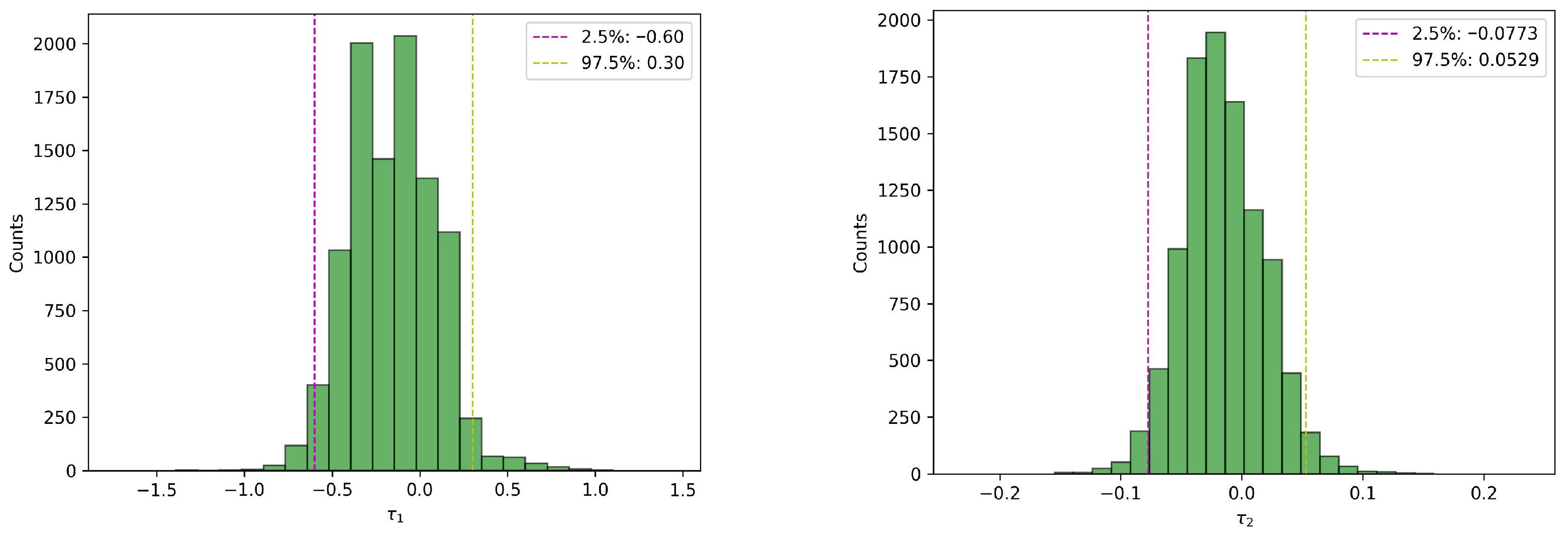
Figure 8 shows the distributions of
and
with a time bin width
s. From these distributions, we extract the 2.5th and 97.5th percentiles of
, denoted as
and
, respectively, which can be converted into constraints on the quantum gravity energy scale
. As noted previously, the determination of
exhibits a significant dependence on the chosen time bin width
. To systematically evaluate this effect, we perform our analysis across a range of bin widths
from 0.1 s to 10 s in 0.1 s increments, calculating
and
for each time bin width.
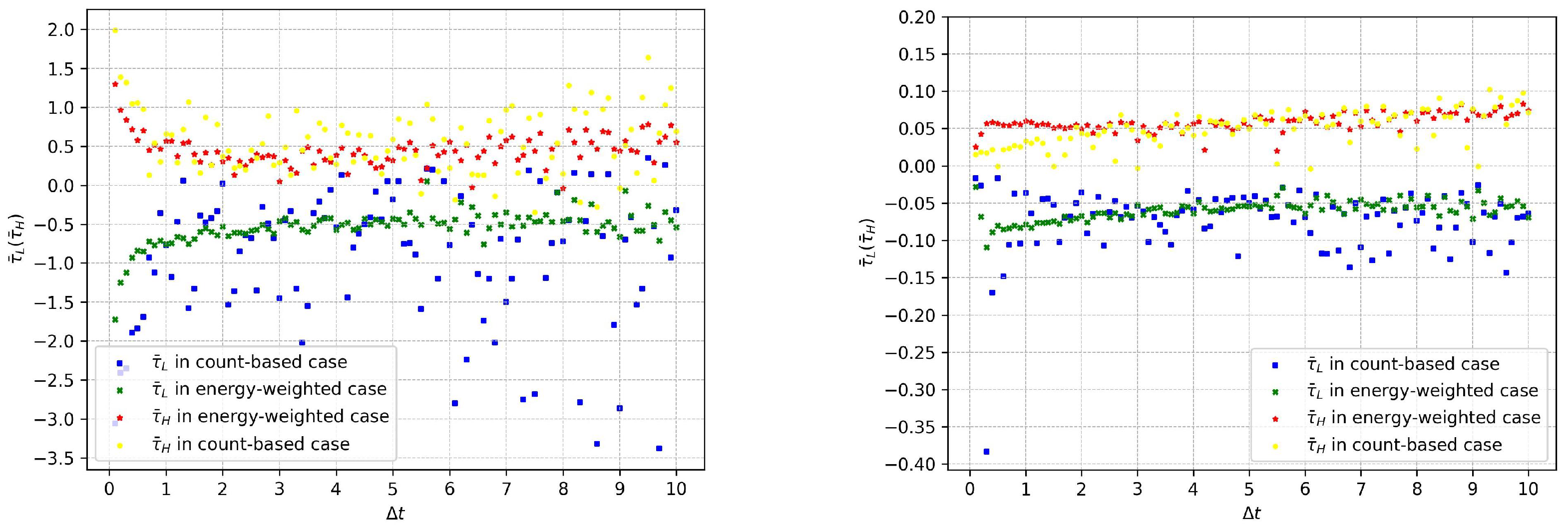
Figure 9 illustrates the dependence of these confidence bounds for both the energy-weighted and count-based profiles on
for the 1st-order and 2nd-order LIV effects, respectively. Our results show that both
and
for both the 1st-order and 2nd-order LIV scenarios exhibit less dispersion for the energy-weighted profile compared to the count-based profile. Furthermore, we observe a long tail at small
values and large dispersion at large
values for the energy-weighted profile. These features confirm our earlier discussions regarding the effects of temporal binning. Our analysis suggests an optimal bin width in the range of approximately 1 to 6 s, where the parameter estimates exhibit enhanced stability and precision.
Since the energy-weighted profile shows greater efficiency than the count-based profile, we restrict our subsequent analysis to the energy-weighted profile. The final results are shown in
Table 1. We provide two distinct sets of limits:
Stringent constraints: These are derived from the mean values of the and distributions obtained from Monte Carlo simulations. They represent the most probable values corresponding to the 95% confidence lower limits of the LIV parameters under ideal conditions.
Conservative constraints: These are based on the 95% confidence intervals (i.e., the 2.5th and 97.5th percentiles) of the and distributions. This approach provides a more robust assessment by incorporating systematic uncertainties arising from energy resolution, temporal binning selection, and others.
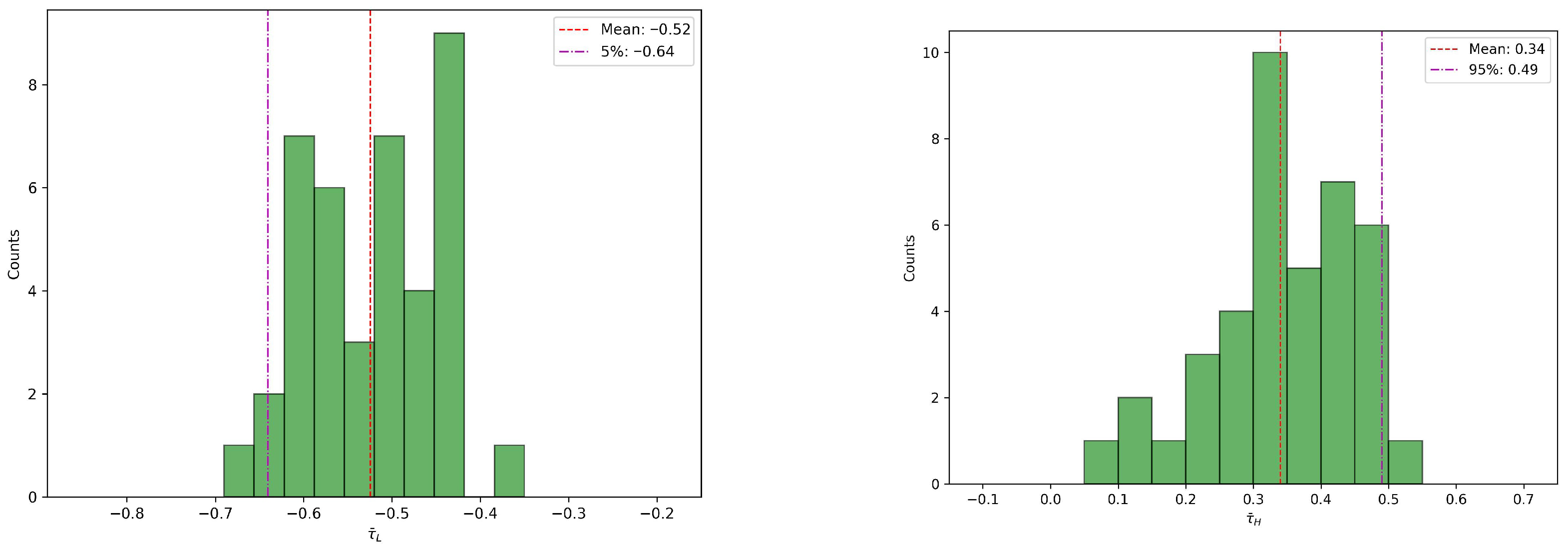
In our 1st-order LIV analysis, we examine time bin widths spanning 1.5 to 5.4 s in increments of 0.1 s.
Figure 10 illustrates the distributions of
(left panel) and
(right panel). From these distributions, we calculate both the mean values (“stringent” in
Table 1) and
confidence intervals (“conservative” in
Table 1) for both parameters. Using the mean values of
and
as thresholds, we establish the
confidence-level constraints on the quantum gravity energy scale
, yielding results of
and
for the superluminal (
) and subluminal (
) cases, respectively. By employing the boundaries of the
confidence interval of the
(left panel) and
(right panel) distributions as thresholds, we obtain more loose constraints:
and
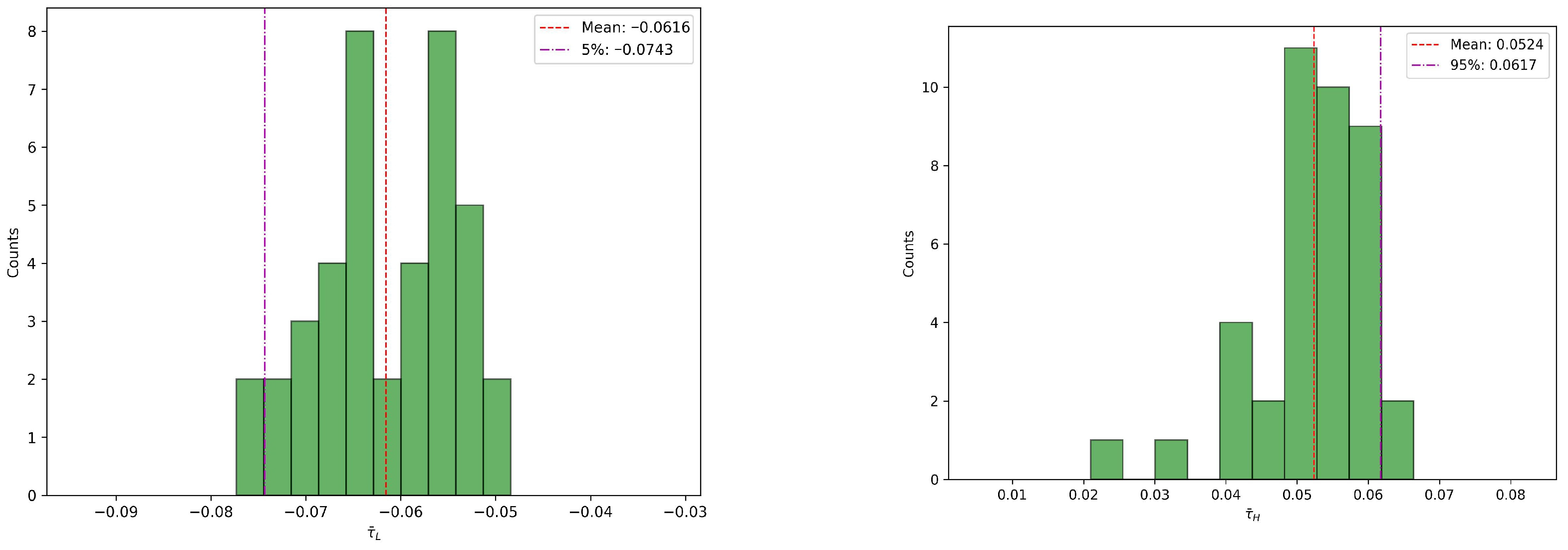
the respective cases. The 2nd-order LIV analysis follows an analogous procedure, examining the same bin widths from 1.5 to 5.4 s in increments of 0.1 s. The corresponding parameter distributions are shown in
Figure 11. Based on the mean values (
intervals) of the
and
distributions, we impose the
constraints on
as
(12.5) and
(13.7) for the superluminal and subluminal cases, respectively. We provide the conservative constraints as the primary findings due to their enhanced reliability against potential systematic biases.
Finally, taking the first-order LIV as an example, we compare our derived constraints with other 95% confidence-level constraints obtained from GRB 221009A. For ease of comparison, all results are converted into units of GeV. [
17] derived superluminal (subluminal) constraints of
GeV by fitting the WCDA-observed light curve and spectrum. Similarly, the LHAASO collaboration reported constraints based solely on WCDA observation [
19], obtaining limits of
GeV using the cross-correlation function method, and
GeV using the maximum likelihood method, for the superluminal (subluminal) cases, respectively. Furthermore, by jointly using WCDA and KM2A observations, Ref. [
18] obtained limits of
GeV via the pair-view method, and
GeV through a maximum likelihood analysis, for the superluminal (subluminal) cases, respectively. In addition, Ref. [
20] adopted a similar DisCan method as used in this work, yielding constraints of
GeV for the superluminal (subluminal) scenarios. Although the constraints obtained using different analysis methods exhibit some variations, they are consistent at the order-of-magnitude level. Our derived constraints are also comparable to these previous results.