


Abstract
We investigated an exact solution in a conformal invariant Randall-Sundrum 5D warped brane world model on a time dependent Kerr-like spacetime. The singular points are determined by a quintic polynomial in the complex plane and fulfills Cauchy’s theorem on holomorphic functions. The solution, which is determined by a first-degree differential equation, shows many similarities with an instanton. In order to describe the quantum mechanical aspects of the black hole solution, we apply the antipodal boundary condition. The solution is invariant under time reversal and also valid in Riemannian space. Moreover, CPT invariance in maintained. The vacuum instanton solution follows from the 5D as well as the effective 4D brane equations, only when we allow the contribution of the projected 5D Weyl tensor on the brane (the KK-‘particles’). The topology of the effective 4D space of the brane is the projective (elliptic space) by identifying antipodal points on . The 5D is completed by applying the Klein bottle embedding and the symmetry of the RS model. This model fits very well with the description of the Hawking radiation, which remains pure. We have also indicated a possible way to include fermions. Our 5D space admits a double cover of and after fibering to the , we obtain the effective black hole horizon. The connection with the icosahedron discrete symmetry group is investigated. It seem that Bekenstein’s conjecture that the area of a black hole is quantized, could be applied to our model.
Keywords:
Kerr black hole; conformal invariance; brane-world models; Klein surface; antipodicity; Hawking radiation; instantons PACS:
04.20.-q; 04.50.-h; 04.62.+v; 02.40.-k; 04.70.Dy; 02.40.Dr; 03.65.Ud; 03.65.Ta; 03.65.Vf; 02.30.Jr
1. Introduction
Following the pioneering work of Hawking [1] on the evaporation of black holes, many scientists began to study the quantum-gravitational properties of black holes. However, there are some profound unsolved problems as one approaches the Planck scale. Due to the extremely high curvature, quantum effects can no longer be denied. It is conjectured that knowledge of the quantum effects near the horizon of a black hole will eventually lead to a consistent quantum gravity model. The properties of the black hole, i.e., its entropy, mass and the emission of radiation, need to be revised because there are some serious paradoxes. These paradoxes involve the problems that arise with the quantum effects that occur at the horizon. In particular, the information-, complementarity- and firewall paradoxes. Furthermore, there is the issue of unitarity of the S-matrix. Another amazing conclusion on black hole physics concerns the amount of information that can be stored in a black hole. It is proportional to the area (A) of the sphere. It is expressed by the famous Bekenstein-Hawking (BH) entropy of a black hole [2], i.e., . This phenomenon can be related to the holographic principle, first mentioned by ’t Hooft [3]. A famous application of this principle is the AdS/CFT correspondence. It refers to the astonishing dualities between field theories with and without gravitation. It is also referred to as the gauge theory-gravity correspondence. There is a relationship between d-dimensional gravitation and a local field theory without gravitation in dimensions. Famous is the equivalence between type IIB string theory on and four-dimensional super Yang-Mills (YM) theory [4,5]. An other well known concept is the adiabatic invariant of black holes which can be used to derive the quantized entropy spectrum of the black hole. Even the horizon area could be an adiabatic invariant using the quasi-normal modes. Bekenstein claimed already 50 years ago [6], that a black hole in the GRT plays the same role as an atom in the emerging QM. Would a black hole therefore also have a discrete emission spectrum [7,8] and perhaps observable? But then the surface area and entropy will also be discrete.
However, one must keep in mind that a rigorous quantum discussion of black holes must await the development of a complete quantum theory of gravitation. Nevertheless, it is possible to consider heuristically some quantum features of black holes by means of well-understood principles and arguments from ordinary quantum theory. It is then a natural step to consider the principle in a more general context. BH’s do not have eternal life. They will finally evaporate. What will then the ultimate remain? Will the spacetime of these quantum-like primordial black holes (PBH’s) revert to Euclidean spacetime of a gravitational instanton? These mini black holes could eventually be produced at CERN and could be placed at the end of the elementary particle spectrum. PBH’s have been theorized for decades [9] and could even be ever-elusive dark matter, the invisible matter that accounts for 85% of the universe’s total mass. A connection with quantum black holes can then quickly be made.
We will use the Randall-Sundrum (RS) [10,11] five dimensional warped brane-world model. The model is a simplification of the full string model. The extra-dimensional bulk space has a negative cosmological constant. The dilution of gravity by the presence of the bulk effectively weakens gravity on the brane. The result is that the true higher dimensional Planck scale can be much lower than the effective 4D Planck scale, possibly down to the electroweak scale. It also extends the range of graviton modes that can be felt on the brane, the so-called Kaluza-Klein (KK) modes1. The model does not rely on compactification to localize gravity on the brane, but on the curvature of the bulk. One calls it a ’warped’ compactification. The most simple model is given by the metric , with the curvature radius of the , related the the bulk cosmological constant and the bulk coordinate. Some physicists believe that a partial solution of the quantum gravity issue, can be found in topology. One can apply Poincaré’s theorem, i.e., every three-dimensional topological manifold which is closed, connected and has a trivial fundamental symmetry group, is homeomorphic to the three-sphere . It came out that the theorem is only valid for the 3-sphere, by using complex coordinates. The proof was based on the group of rotational symmetries of the icosahedron, isomorphic to the alternating group . We conjecture for our new solution for the Kerr-like black hole that the adiabatic invariants of the area of the black hole, resulting in a discrete spectrum, will be related to the discrete representation of the zero’s of the quintic in the 5D conformal invariant vacuum black hole solution in the Randall-Sundrum model. We need, however, a conformal invariance (CI) Lagrangian. Local conformal invariance is then spontaneously broken, comparable with the Higgs mechanism in the Standard Model (SM), which has no intrinsic mass scale without the Higgs field. It would be natural if gravity also had no length or mass scale. CI could ensure this. The conformal transformations on the metric and scalar field are
The scalar field can be accompanied by a dilaton field , by writing [14]. Moreover, one should like to consider Riemannian geometry in stead of pseudo-Riemannian spacetimes. This can be done by the Wick rotation together with . The reason is twofold. First, quantum computations can be easily done and secondly, on very small scales, the dilaton can be treated on equal footing as the quantum scalar field. can then we treated ‘classically’. The basis of our model relies on the elliptic interpretation of the manifold, already introduced by Schrödinger [15,16,17]. The topology of the 5D RS model is written as and we apply the antipodal identification on the 3-sphere my means of the stereographic projection , together with the Hopf fibration. Further, the use of the Klein bottle () structure fits very well in the RS model, because it can be embedded in without obstruction. Further, it is the direct sum of two projected planes, .
The structure of this letter is as follows. In Section 2 we present the new model. In Section 3 we summarized the new topology described by the embedding of the Klein surface in the 5D model and the related Hopf fibrations. In Section 4 we make the connection with the instanton and a possible treatment of the Hawking particles.
2. The Model
Recently, we studied a model which relies on the RS model in a conformal invariant dilaton-gravity theory [18,19,20,21,22], on the spacetime,
where is the fifth coordinate, the bulk dimension and is a warp factor, reinterpreted as a dilaton field. We write and . An ’unphysical’ spacetime is thus separated. Here is the unit normal to the brane. Again we write . The Lagranian under consideration is
where is the gauge covariant derivative and F the Abelian field strength. Furthermore, and we applied the Wick rotations , with , to ensure that the field has the same unitarity and positivity properties as the scalar field. The model is invariant under Equation (1). The freedom is used by the in-falling observer to describe his experience of the vacuum. Since we are working in a RS warped brane world model, one solves the 5D and the effective 4D equations simultaneously, with the contribution of the projected bulk Weyl tensor appearing in the latter. The 4D and 5D equations must be solved simultaneously, i.e.,
where is the contribution from the dilaton (which also appears in 5D form in the 5D equations), because we use the ’un-physical’ metric,
It is the contribution from the projected Weyl tensor from the bulk on the brane which makes the system consistent. In conform invariant form, they become respectively,
From these field equations, we obtain the partial differential equations (PDE)’s,
The values for n are 4 and 5 for the 4D and 5D solutions respectively. The solutions are2
with constants . Furthermore, is a arbitrary function determined by a constraint equation. The equations are invariant for . The value determines the solution for our situation. The solution is separable and we write . The r-dependent part fulfills the first order equation
In general, the metric component is quintic polynomial, with in general five zero’s. For the zeros are at with multiplicity and at . For and varying , one obtains a distribution of the zero’s which are related to the stereographic projection of the icosahedron. The general solution of the quintic can be found by means of elliptic curves [24]. For and there are 4 zeros, as in the BTZ solution, two of them negative. For and there is still a real solution. For we surprisingly get two horizons . This solution is also found from Equation (10) for constant . The differential equation for N becomes , with solution .
Because we have to solve the 5D and 4D equations simultaneously, we get two constraint equations with the cosmological constants and . By eliminating the r-dependent part. one obtains a ‘fine tuning’,
This proves once again that the 5D and 4D effective equations must be solved together, and that the cosmological constants can be fine tuned. The situations changes, when we incorporate a scalar field. Cauchy’s theorem on holomorphic functions on an open set of the complex plane, tells us that within a simply-connected region with no singularities inside a loop C, that
Our solution for can also be written as
So we have . One applies Cauchy’s integral theorem
with z inside C. So the values of an analytic function are determined by the values on the boundary. This is also true for the higher derivatives in our situation, i.e., for and . It turns out that are removable singularities; they lie on the real axis and one calculates Cauchy’s principal values. By the antipodal map, there are no fixed points, so the quintic determines the singular points on inside C and delivers no problems when C shrinks to a point. No crossing with the singular points occurs, due to the extra bulk dimension. We still have the freedom of Equation (1) in order to make the outside observer experience a Kerr-like black hole. The effective 4D spacetime in suitable coordinates becomes
with
The sum it taken over the roots of and , i.e., and . We also defined the azimuthal angle coordinate , which can be used when an incoming null geodesic falls on the horizon, i.e., in a coordinate system that rotates about the z-axis relative to the Boyer-Lindquist coordinates. In the GRT, the Boyer-Lindquist coordinates are a generalization of the coordinates used for the metric of a Schwarzschild black hole, which can be used to express the metric of a Kerr black hole [25]. We are mainly interested in the solution for a local observer. In Kruskal–Szekeres lightcone coordinates [25] we have
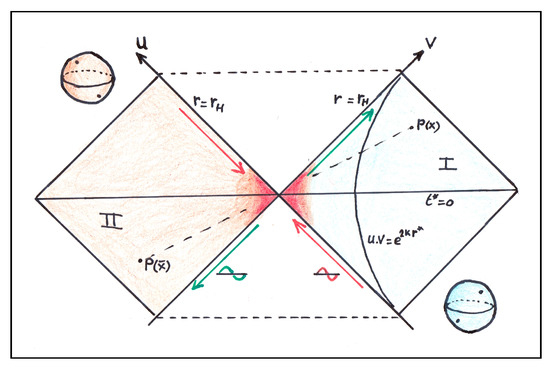
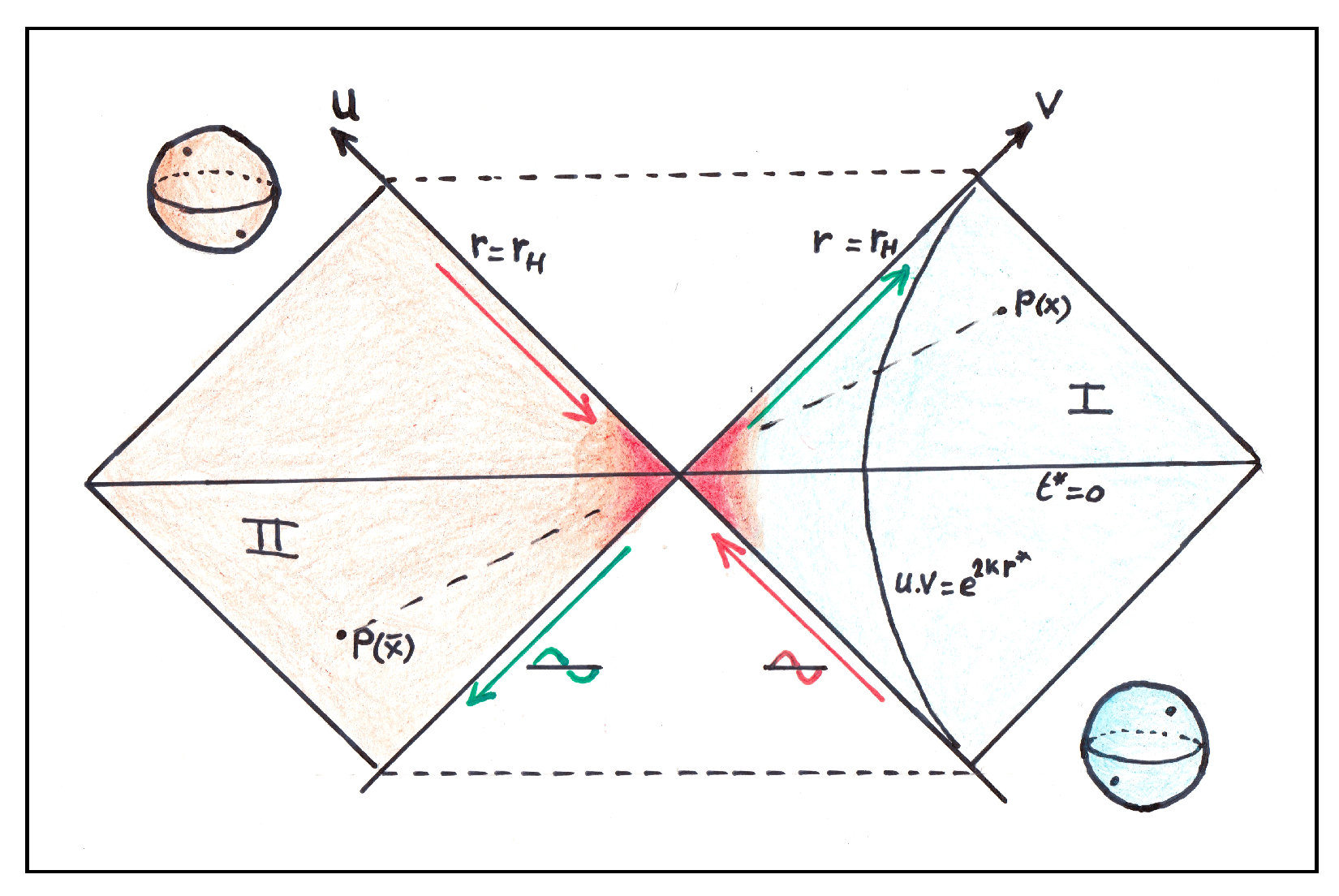
where can be expressed in and contain a constant related to the surface gravity at the horizon. Furthermore . In Figure 1 we drew the Penrose diagram for our model.
Figure 1.
Penrose diagram for our 5D model, stereographic projected from . The antipodal points and are identified. Particles entering the black hole will create waves that approach the horizon from the outside, and those that pass the horizon will emerge from the ‘other side’ of the black hole. Note that ∼. In this approach, I and II are CPT invariant. This means that time runs backwards in II. We have also indicated two antipodal points . The red and green arrows represent incoming and outgoing Hawking particles.
If we omit the contribution of the projected Weyl tensor in the effective 4D Einstein equations, we obtain the Baňados-Teitelboim-Zanelli 3D solution [26,27]. This is equivalent to the substitution in Equation (11). We also found a remarkable connection with the icosahedral Möbius group when inscribed in . The isometry group is of order 5 and has three orbits which are invariant under the antipodal map. Our general polynomial of is a quintic, which cannot be a coincident [19]. If we include a complex scalar-gauge , we find from the superfluous dilaton equation, that the scalar-dilaton potential satisfies
with some constants. So we get a quartic conformal invariant matter coupling ∼ for , where is the vacuum expectation. We have used in this case, a constant gauge field.
Some Conjectures
Before we proceed, we formulate some conjectures.
1.
The zeros of the fifth degree polynomial, an exact solution of a black hole in a conformally invariant 5D warped spacetime, lie in the stereographically projected complex plane of the Riemann sphere around an icosahedron. During the evaporation of the black hole by Hawking radiation, the zero points undergo a transformation, because the Riemann sphere shrinks. The transformation complies with the symmetry group of the icosahedron and shows similarities with the flexibility of the construction of the icosahedron. The final shape arises from the special case , on both sides of , i.e., a with multiplicity 4, and . This means in the Penrose diagram for the black hole, that the central singularity is absent. Using Cauchy’s theorems and the antipodicity, one proves that there are no essential singularities. In general, during the evaporation, the five zero points will tend to a symmetrical distribution.
This conjecture is plausible, because because the symmetry group of the icosahedron is discrete and related to the theory of elliptic functions. These functions provide a solution to our quintic, a meromorphic polynomial [28]. However, the ultimate proof will have to be provided by looking at the spectrum of Hawking radiation.
2.
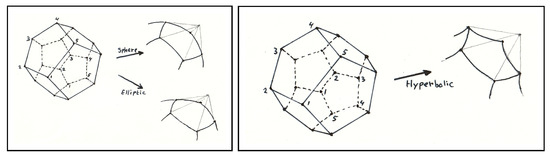
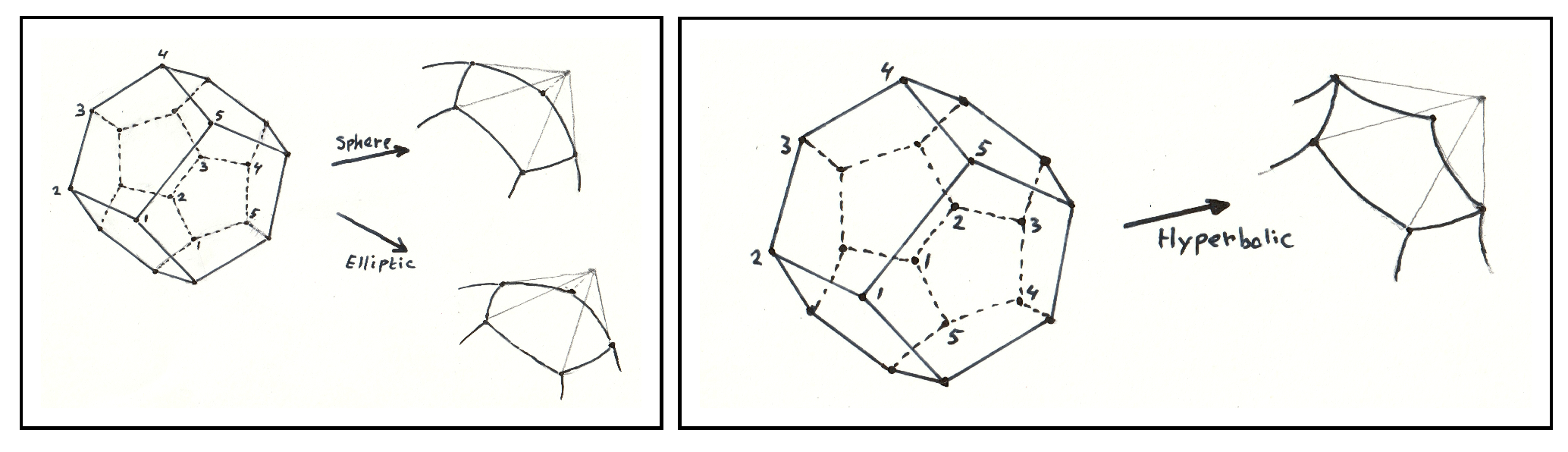
We discussed the properties of the three sphere in relation to the inscribed dodecahedron and icosahedron. The five vertices can now represent the zero points of our polynomial . It turns out that the geometric structure of can change from spherical Euclidean to elliptic (by identifying antipodal points) and to hyperbolic (Figure 2), by changing the dimension of the dodecahedron. Our differential equations were elliptic and became hyperbolic (Riemann space) by switching from t to . This is therefore equivalent to allowing the antipodicity. The change in the topology that we described with the three-sphere and the dodecahedron yields the transition from 5 zero points to 2, one of which is a horizon. This change is triggered by Hawking radiation. The two parameters in our polynomial must therefore also be related to the mass and a second ‘charge’, related to the topology. This second parameter is not related to the angular momentum. The angular momentum is given by .
Figure 2.
The two different glued Poincaré dodecahedron spaces. Left the spherical situation (and elliptic) and right the hyperbolic (Seifert-Weber space). The numbers indicate the five vertices of the pentagon, together with the antipodal points.
We have made a start on the evidence. A strong argument is that the two constants are related to the mass and topology of space. Furthermore, it appears that the fifth-degree equation for the zero points is directly related to our 5D RS model. If we were to neglect the contribution of the bulk, we would arrive at the well-known BTZ solution! See also conjecture 5.
3.
The special case in the quintic, which can be written as , represents an instanton.
The complete proof could be provided by solving the equations using spin connections and the Cartan-Mauer forms. One can then prove whether the solution is self-dual. The big advantage is that the differential equations are first order. Instantons are localized excitations in Euclidean space-time and approach the vacuum at infinity. Self-dual solutions occur in the Yang-Mills field and play an important role in the Standard Model. A connection with the gravitational counterpart is therefore welcome. However, finding an orthonormal Vierbein basis is no easy task, because the vacuum equations contain the dilaton field. This topic is currently under investigation by the author.
4.
We conjecture that the zero’s of our model can discretely change during the formation and evaporation of the black hole. This conjecture, as we will see, is based on the description of the zero’s by means of the torsion points on elliptic curves. For some special values of the parameter c, we found the five roots lying in almost symmetrical regular pentagon. Using the elliptical curve method, one could find this configuration. The last non-regular situation could result in our instanton configuration. This discretely feature could be seen as a kind of a hydrogen atom, one old idea of Bekenstein.
The full proof could be delivered by studying the spectrum of the Hawking radiation. In any case, our model yields an integer k in Equation (13).
5.
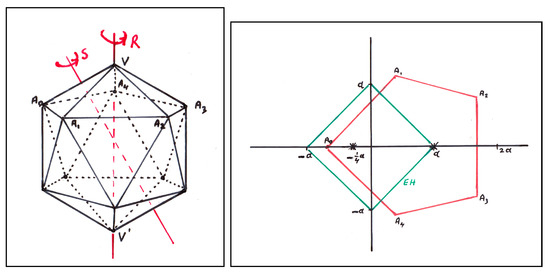
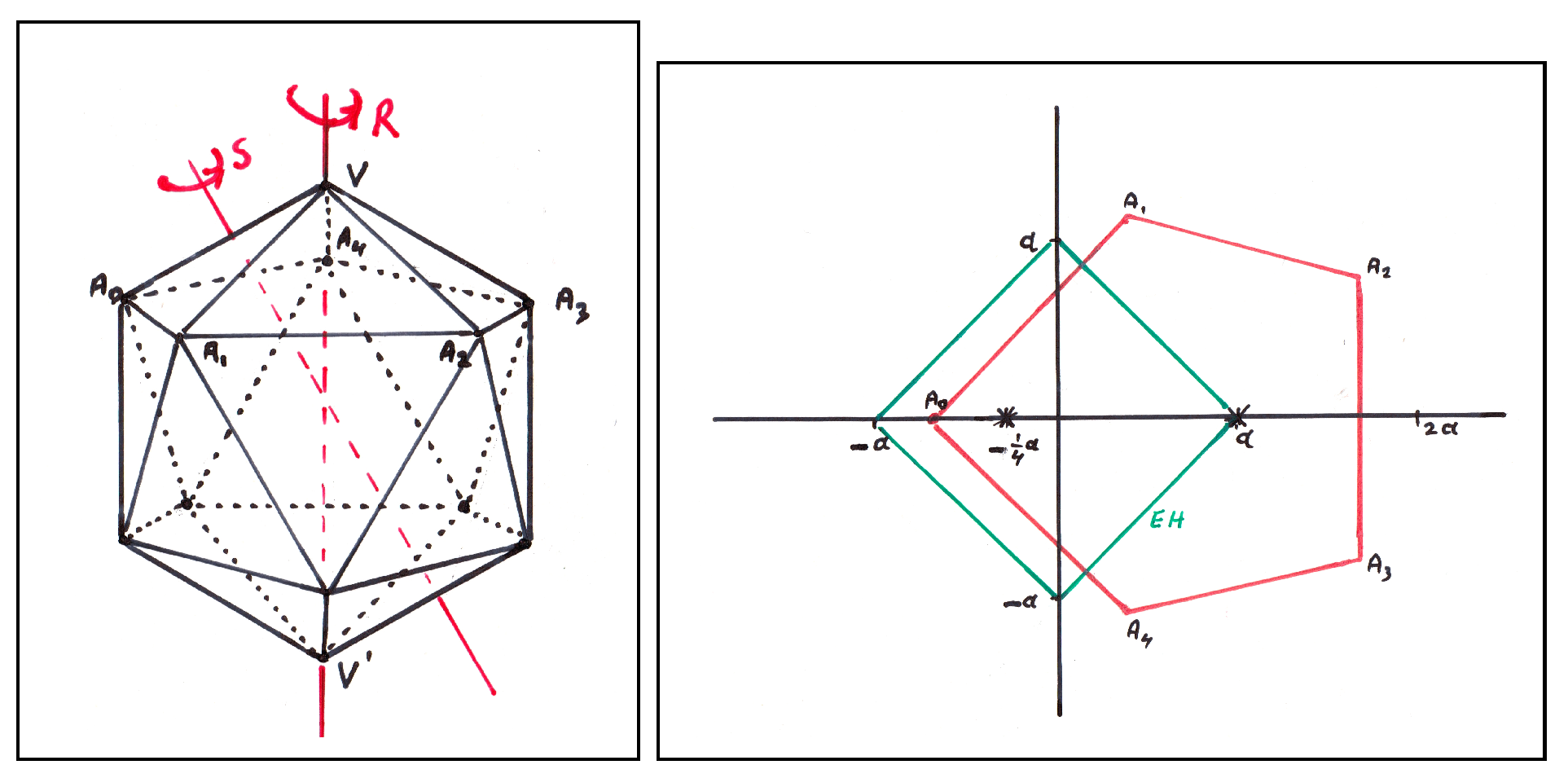
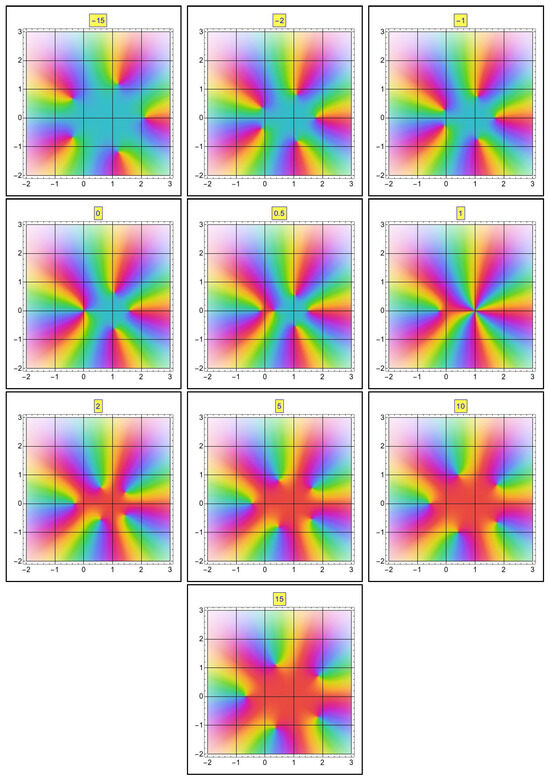
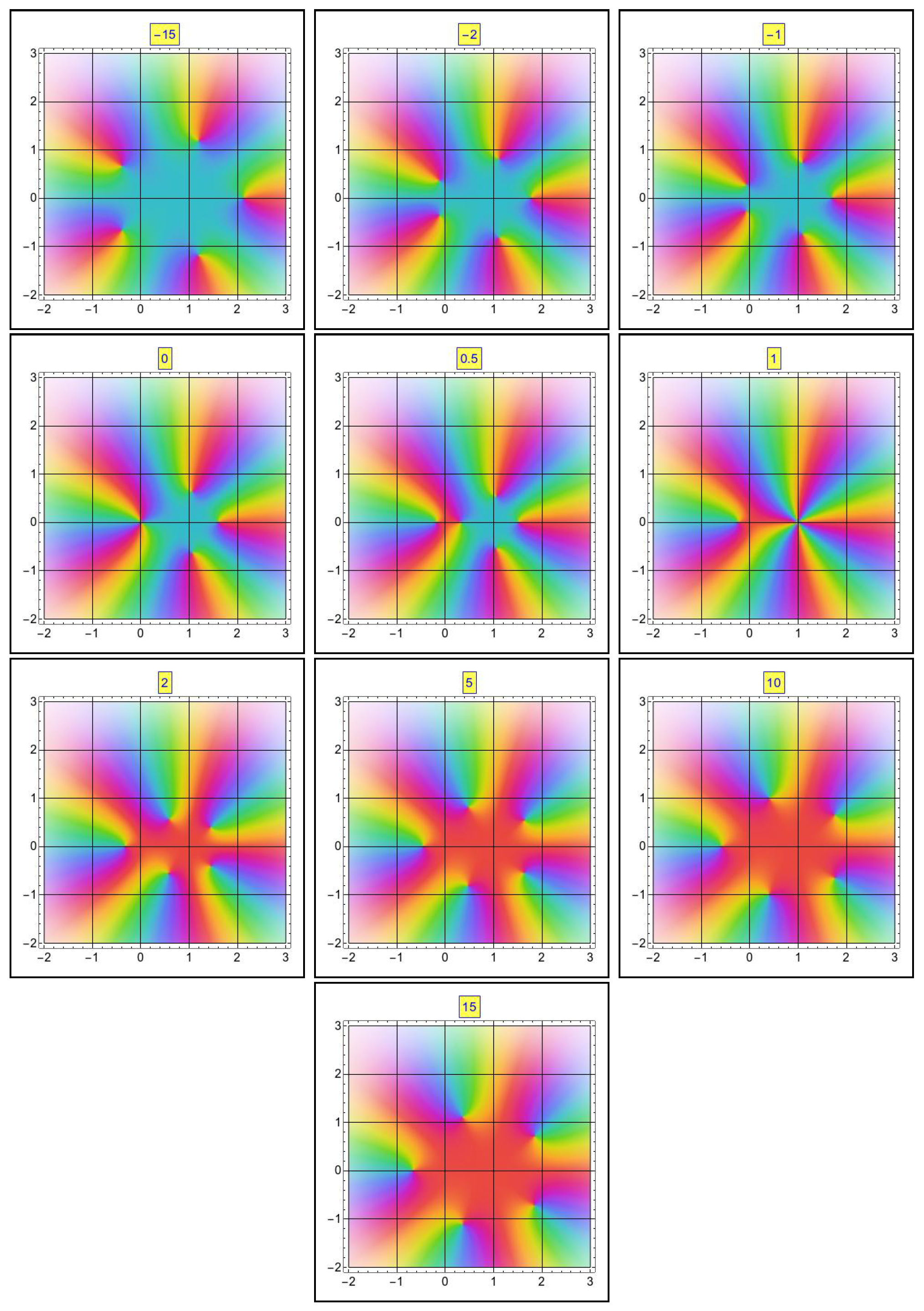
The zero’s of the quintic can be found by finding the ’torsion’ point of an elliptic curve. The most interesting correspondence occurs when the discriminant of the quintic is zero, i.e., singular curves. In Figure 3 we plotted this case. Specially the double periodic elliptic curves are interesting, because the icosahedron has two rotations, i.e., over and π. In Figure 4 we also plotted the location of the zeros for and c running from to . The parameter c is obviously related to the topology of the icosahedron. The case is exceptional. There is of course, a singular point at with multiplicity 2, one real zero and two complex zeros. It seems to be an unstable ‘ground state’.
Figure 3.
(Left): The icosahedron. It has 20 faces, 12 vertices, and 30 edges. There are 60 rotations that leave the figure invariant. We have rotations through over (R) and rotations through (S). (Right): In red the five zeros for the case . The two stars indicate the case . In green we have drawn for comparison, the four zero points for the self-dual Eguchi-Hanson (EH) instanton solution [29]. See also Section 4.
Figure 4.
‘Dance of the roots’ of in the original form, for and c varies from (from top left to bottom right). The dots represents the zeros and the colors arg(z). The first and last one are rotated configurations about 180°. The case is exceptional. There is of course, a singular point at with multiplicity 2, one real zero and two complex zeros. It seems to be an unstable ‘ground state’. When c switches from a small negative to a positive value, then two complex zeros switch to two real values and immediately afterwards to one real negative zero point. The complex plot uses a cyclic color function over arg(z) to identify features such as zeros, poles and essential singularities. The color function goes from to counterclockwise around zeros, clockwise around poles and infinite cycles near essential singularities.
In Section 3.1, we describe the embedding of the Klein surface in a complex space. This is useful when constructing a complex Hilbert space, which is necessary to describe the connection with a quantum black hole.
6
There is a relation with the Riemann zeta function and the ‘dance’ of the zeros of the quintic. The non-trivial zeros of the Riemann zeta function have a geometrical interpretation [30]. The eigenfunctions of the Laplace-Beltrami operator are automorphic with respect to a discrete group of fractional Möbius transformations. The Riemann hypothesis encompasses that a meromorphic function ζ shows fluctuations of spacing between the zeros and can be seen as a ‘spectrum’ with energy levels with of a quantum Hermitian operator. One can construct a quantization condition, generating Riemann zeros with the antipodal geometric application, using conformal symmetry of the hyperbolic (or elliptic in our case) dynamical system and the finite dihedral group . The boundary conditions for the automorphic functions is compatible with the topology of the projective plane . Due to the twist, the boundary conditions can serve as quantization conditions, generating a discrete spectrum of the Hamiltonian
The same route can be applied for our using the Klein construction in 5D. However, the difference is that in the original treatment, the antipodal map can be performed by two homotopy classes, depending on whether the final point is reached via a product of even or odd number of reflections on . The determinant is , i.e., reversing or preserving the orientation. In our model the group of order two of the covering space is replaced by the symmetry of the bulk space.
This is the essence of our model. The topology of Klein’s bottle fits better into the antipodal model. The obstructions found in the 4D counterpart model can be avoided. It is quite possible that the problem of the r = 0 singularity can be solved.
3. The New Topology and
3.1. Summary of Earlier Treatments
One can treat the black hole paradoxes, which one encounters in the quantum area, by a revision of the topology. We chose for the antipodal boundary condition, investigated by several researchers [16,17,31,32,33,34,35]. This approach differs significantly from other approaches to attack the paradoxes, i.e., the information-, the firewall and the complementarity paradox and last but not least, the unitarity of the S-matrix. When fields are quantized on a manifold, one needs a one-to-one map between the entire asymptotic domain of the maximally extended Penrose diagram. In order to maintain CPT invariance by utilizing the spherical harmonics when calculating the commutation relations, one encounters some obstructions [34,35]. We will see that in our model they disappear.
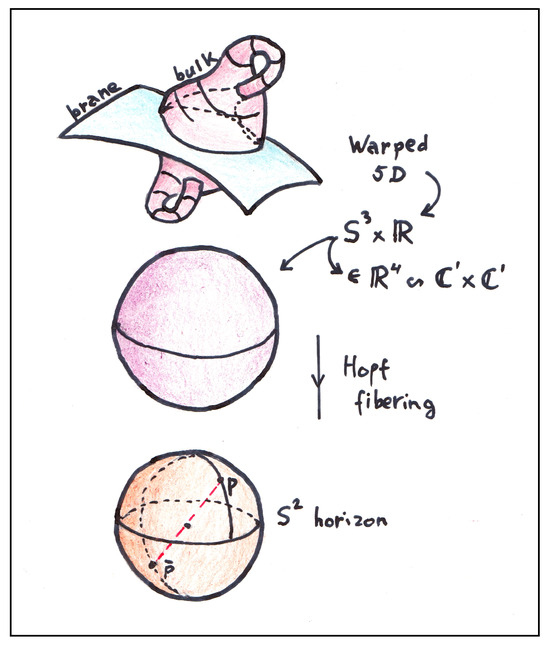
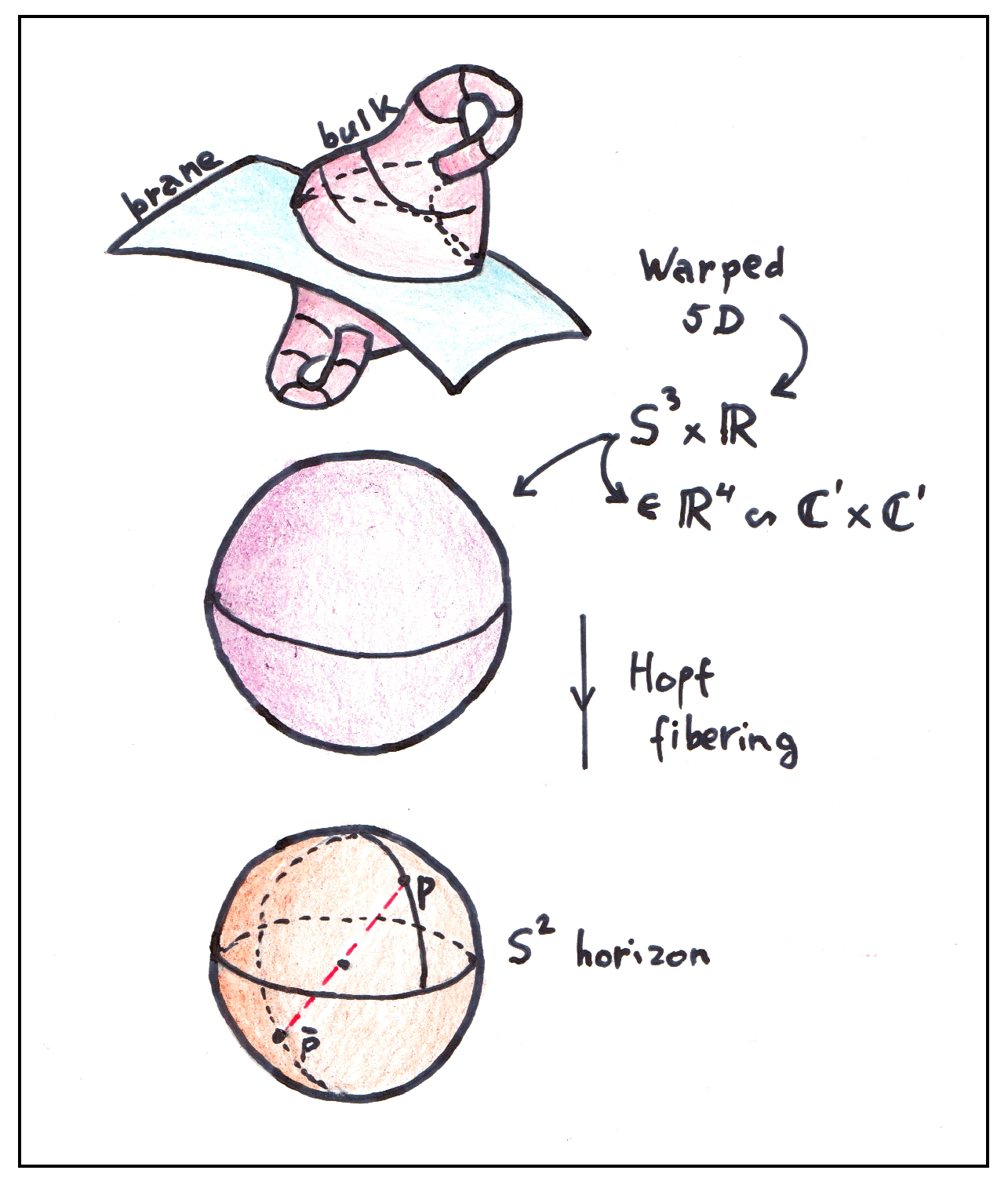
We consider a Hilbert space on as a real vector space with components and . The normalization condition is , i.e., the . We write the 3-sphere . See Figure 5 and the diagram of Equation (23). We have used the embedding of the Klein bottle in the warped 5D spacetime in our model. To get back to our black hole in the effective 4D spacetime, we can use the Hopf fibration of ∼ and apply the antipodal map [17] to get the of our black hole horizon. The Hawking particle created near the horizon at , travels on the Klein surface one or two times and leaves the horizon at the antipode after a finite proper time.
There are two basic compact self-dual manifolds, the round metric on and the Fubini-Study metric on . In our situation we are mainly interested in the quantization on the latter. It is possible to construct a complex two-dimensional Hilbert space . The density matrix is and we can construct a quantization of [19,36]. On the non-orientable Klein surface, meromorphic functions remain constant and our quintic is meromorphic. It is also homeomorphic to the connected sum of two projected planes. It is also possible to construct geodesics and a minimum surface needed to follow the particles. You can use the torus, on which the orbits are easy to find. Note that the orbit is still in 4D space. However, the geodesics on the Klein surface will never intersect each other because of the non-orientability.
Figure 5.
Fibering the . One can view the 3-sphere as the union of two massive tori (or Klein bottles in our case) that are connected at their edges. This boundary is the torus of fibers over the equator on . One solid torus is formed by the fibers over the southern hemisphere and the other over the northern hemisphere. The is represented as a 3D ball, where the boundary in 4 dimensions must be folded into a single point without folding the inside. The geodesics in the congruence are called Hopf circles. There is another Hopf fibration with the opposite rotation that we will use in our model.See the text for the explanation.
3.2. Treatment of the Hawking Particles
We have taken a slightly different approach to the antipodal map, in order to overcome some obstructions, as already mentioned before. To revise the information, firewall and complementarity paradoxes, ’t Hooft used the antipodal map on , where the non-orientability is provided by the Möbius strip. His method would restore quantum purity and CPT invariance. The particles remain entangled. The incoming particles return at the antipode and the particles remain entangled. There is no inside of the black hole, i.e., region II is not ‘really there’ for the observer inside by the cut-and-paste procedure.
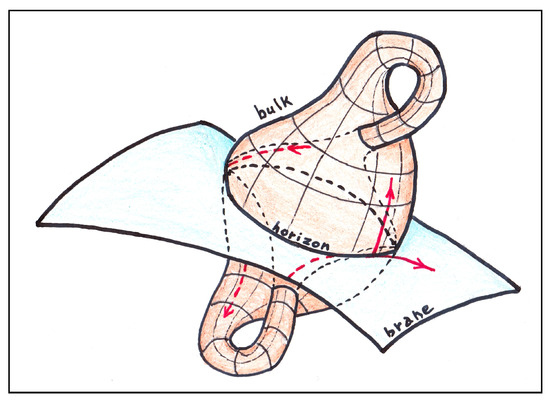
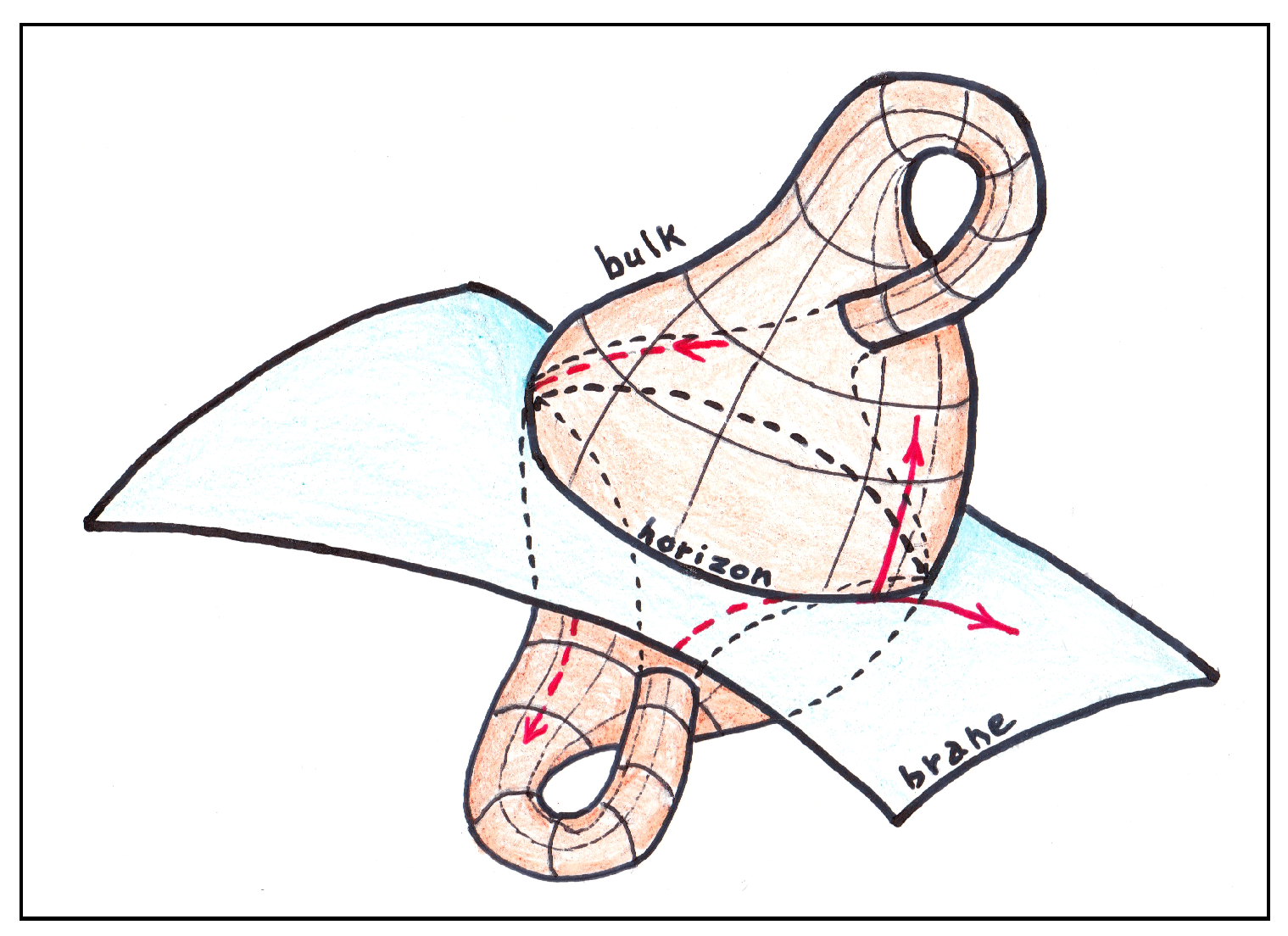
In our model we use the Klein surface . Our conjecture is that our solution can be seen as a dynamical solution embedded in our dimensional spacetime. More precisely, if is the sub-manifold with metric g, i.e., the metric on our effective 4D spacetime and the 5D manifold, then is diffeomorphic to the hyperbolic 5D spacetime: . The Riemannian manifold is conformally flat. Now physicists are interested in the topology of moduli spaces of self-dual connections on vector bundles over Riemannian manifolds. One reason was that on these spaces the instanton approximation to the Green functions of Euclidean quantum gravity can be expressed in terms of integrals over moduli spaces. One then needs the metric and volume form of the moduli spaces. We suspect that we can consider as a 4-sphere in our hyperbolic pseudo-Riemannian spacetime. A note must be made about the symmetry in the original description of the antipodal mapping [35]. At the boundary of regions I and II in the Penrose diagram, the antipodes were glued together on a 3-sphere, and the transverse part is a projected 2-sphere. In our model it is replaced by the projected 3-sphere using the symmetry of the bulk space . We ‘blow up’ the 4-manifold to 5D, to handle the singularities in the curvature and to apply the antipodal map. In Figure 6 we drew our 5D case.
Figure 6.
The symmetry for the bulk represented as Klein surfaces, with the Hawking particles.
One can mathematically formulate the topology of a 4-manifold using self-dual connections over de Riemannian [37]. It depends only on the conformal class of the Riemannian metric. This self-dual connection can be interpreted by the conformal map: as a self-dual connection or instanton. We interpret the Riemannian 5D warped spacetime, an open 5-ball, as an instanton on . In the pseudo-Riemannian spacetime, the boundary is the non-orientable Klein surface, which we used for the antipodicity to preserve the pure states of the Hawking particles. It is known that a static solution in m space dimensions is completely equivalent to an instanton in m space-time dimensions.
Furthermore, the evolution of the wave function of the incoming particle must be unitary, i.e., it must satisfy the Schrödinger equation and must be bijective. It is thought that information about the quantum state is preserved during black hole evaporation. The loss of information is incompatible with unitarity. Thus, ’t Hooft’s method resolves the controversy between the pure quantum state of the incoming particles and the mixed state property of the Hawking radiation. The information is retrieved by the outgoing particles. They carry the information of the incoming particles. In quantum mechanical terms, the incoming position of the wave packet is imprinted on the outgoing momentum. The positions are then highly de-localised. This is how long-wavelength Hawking particles are produced from short-wavelength waves. In our model, the Hawking particles don’t jump infinitely fast to the antipode, but stay on the Klein surface for a while. Moreover, the complementarity in the different notion of the dilaton used by the inside and outside observer is formulated by the invariance of Equation (1).
Then we have the problem of handing over the hard gravitons. ’t Hooft uses the Shapiro delay method [17] to describe the gravitational interaction near the horizon. Hard particles become soft by taking into account the equations in the transverse spherical harmonics . The firewall decays due to the identification . The dynamics is factorized in .
In our case, the dilaton is written as
where the cylindrical harmonics. It is the general form of the expression , with the elliptic Jacobi function. Further, the shape of the probability function makes the gravitons hard in the bulk [11] and soft on the brane. The presence of the bulk causes the KK contribution of the Weyl tensor on the brane, leading to our new solution. The spherical harmonics are replaced by the cylindrical . The second quantum number is provided by the winding number, because the dilaton behaves as an ordinary quantum field with axial symmetry, just like a scalar field. Furthermore, we obtained PDE’s in with exact solutions. There will be a time delay between the incoming and outgoing waves or particles depending on , which can be expressed in the parameters of our model. Thus, experimental data could provide an estimate of the bulk dimension. ’t Hooft’s method requires high wave numbers when approaching the Planck region, and the cut-off is then determined by the number of microstates. In our model we don’t need a cut-off. We have the elapsed time on the Klein surface in the bulk, which delivers the degree of ‘hardness’. In our model the wavelength increases with time. This would imply that the particles gain momentum and the quanta become blue-shifted. However, our process takes place in the bulk, so it is not visible from the brane. One can also apply Schrödinger’s original treatment of the Klein-Gordon equation on a hypersurface [15]. He finds conditions for the values of the quantum numbers 3 when the lines of constant phase on the hypersurface will close. In our case we can have the situation where the phase lines spiral around the Klein surface many times without the possibility of intersecting. It should be noted that the antipodal map is obligatory in order to make the mapping of the coordinates in regions I and II one-to-one, and yet they are distinct because they are spatially separated. There is no summation over ‘invisible’ quantum states to form the density matrix. We still have pure states. If you sum over the other states, which are far away in the antipodal region and unobservable to the local observer, you would conclude that these particles have the Hawking temperature. But the state is not thermal at all. The Hawking particles on one hemisphere are entangled with the antipode. To the outside observer, the Hartle-Hawking wave function is no longer a thermally mixed state, but a single pure state. In general, the antipodes are completely entangled. From the outside, the black hole is not in a stationary Hartle-Hawking quantum state. In other words, there is no complete heat bath.
The antipodal boundary condition is necessary in order to maintain unitarity of the S-matrix. To overcome obstacles in the 4D description, such as the need for quantum clones and infinite speed of the jump from the Hawking particle to the antipode, we will use a simpler antipodal mapping in our RS model. The description of Hawking radiation remains the same as in ’t Hooft’s method. A local observer sees a vacuum, the Hartle-Hawking (HH) state
and uses the creation and annihilation operators. All these states remain pure by the antipodal identification. However, he loses the entanglement of the HH state. So he observes a perfect thermal mixture with Hawking’s temperature. The outside observer concludes that the vacuum contains states in regions I and II of the Penrose diagram. His Hawking particles are not exactly thermal, since there is a strong entanglement between the particles emitted at the opposite hemispheres of the horizon. Moreover, region II is not ‘really there’. It represents the inside (‘vacuola’) of the black hole. The only problem is the that the information seems to travel infinitely fast to the antipodal point. In our warped spacetime, we have already noticed that the cut-and-part identification can be replaced by the Klein surface: there is no need for instantaneously transport of information. Furthermore, when traveling in the bulk for a while in local time (or in the tortoise coordinate system) close to the brane, the gravitons become ‘hard’, i.e., massive, due to the shape of the gravitational probability function. This caused the back reaction on the brane. In addition, on the way back to the brane, we do not encounter any problems with the firewall caused by the hardness of the particles4. In Section 3.3 we will describe the advantages of the antipodal map in the RS model.
Finally, we can study the surface gravity of our model. In the coordinate it becomes
Our solution lookes like an ‘extremal’ black hole, i.e., the surface gravity is zero, for
In general, the black hole never becomes extremal in coordinates.
3.3. The New Antipodal Map and CPT Invariance
We explained in the foregoing sections that in our 5D model the topological changes are different with respect to the standard antipodal application. We already remarked that there is no causality problem: the particles stay on the Klein surface for a while. Moreover, we have no cusp singularity, because of the mirror symmetry in the bulk dimension. No closed timelike curves will appear. Let us summarize again the new topology of the 5D warped spacetime using the Klein surface. In the case of the Schwarzschild spacetime in Kruskal-Szekeres coordinates, one could write , which resulted in an obstruction [35]. The coordinates , where , are given by . The time parameter appears in the exponent. Our antipodal map was in polar coordinates , where we can use, for example, the twofold change on the Klein surfaces. One has the possibility that the particle reappears after one loop on a Klein surface, or two loops, after a successive loop on the copy. The sign change in z causes no problem, it is the axis of rotation of the black hole. We also mentioned that in our case, we could use the cylindrical harmonics . The same holds for the expression of and . In the spherical symmetric Schwarzschild case, changes sign from region I to region II and we have . This is not the case for our model. We have the freedom . Moreover, the commutation rules for will not cause the obstruction.
We know that a quantum Hamiltonian captures the near horizon dynamics of S-matrix for a black hole [33]. One should also have CPT symmetry, at least as a local symmetry, obtained by symmetry breaking from a global discrete spacetime symmetry. The latter requires the specification of a choice of time, i.e., a choice of gauge, because there are no global symmetries in quantim gravity. Our new antipodal boundary condition, relates points across the two sides of the Penrose diagram. We also found that is invariant under . The basis can be used to describe the outgoing and in ingoing modes of the wave functions. The are conjugated variables. One can perform the calculations using the ratio of the Planck- and black holes masses and , i.e., the parameter on the state formed between the times later then the time of formation and earlier than the time of evaporation [33,34]. But what about the situation just at the formation time? Our exact model can handle this situation.
The initial obstruction occurs due to impossibility to formulate the commutation relations between U and V, where the time dependency is a priori defined by [33,35]. The contradiction occurs upon the rotation invariance to the antipodal points, when applying the expansion in spherical harmonics . The even l modes are then forbidden. This resulted in a single spacetime exterior. The obstruction could be avoided by the right interpretation of the central causal diamond for the wave functions. Points in the plane close to the origin, are not sharply defined due to Heisenberg’s uncertainty relation. So one can define a set of discrete conformal inversions by the Möbius transformations. It turns out [30,34] that the transformations generate a finite group, i.e., the dihedral group with eight elements. One uses that . The result is that CPT is maintained on the complete wave functions, by using two with complementary antipodal identifications. This is just what we found in our 5D model, where the dihedral group was replaced by the and the double complementary Klein surfaces in one dimension higher.
One can apply a complex two level Hilbert space [36]. They form the state vectors. Pure states live on the Bloch sphere , where antipodal points form a qubit state. Mixed states are located in the interior. Running point on are related to its stereographic images on the equatorial plane . The map is non-orientable and conformal, as required. In order to apply this model on the warped 5D spacetime, we need the Klein surface [20,21]. A striking feature of the 3-sphere is that it also contains Killing vector fields, in contrast to the 2-sphere. Every vector field on must have a fixed point somewhere, however, not for the 3-sphere. It is noteworthy that all streamlines of the Killing vector field are also geodesics. One can make the connection with a 4-dimensional dodecahedron and icosahedron (already noted by Poincaré). This ‘Poincaré ball’ can be seen as a dodecahedron space where we use . The group describes the symmetries. The space is a manifold, because it is locally homeomorphic to Euclidean space, even in the vicinity of the vertices and points on the edges. There is another advantage. We can apply easily the spinor mathematics for fermions. They are the carriers of the representation of the . It was Dirac who presented a visualization by his ‘dish’ model (or ‘scissors’ model). In mathematical language, the of rotations in a 3-space is double covered by the group of 3-spheres of quaternions in a 4-space. The configuration space is denoted as . What Dirac tells us is that a loop in that corresponds to a rotation of is not homotopically trivial, but that the loop that corresponds to a rotation by is homotopic to the trivial loop. Every rotation of can be uniquely specified by a rotation axis, an angle, and a direction of rotation around the axis. All this information can be encoded in a single object, namely a vector in of at most magnitude . The rotation axis is then the line along , the rotation angle is and the direction is determined by the right-hand rule. Note that a rotation along by an angle with is equal to a rotation along over , so the restriction on is necessary to ensure that the correspondence between rotations and vectors is 1-to-1. The set of vectors in with is simply the closed sphere with radius around the origin. However, a rotation about by is the same as a rotation about by . So antipodal points on the boundary of this sphere represent the same rotation and must therefore be identified, in order that this correspondence with rotations is bijective. Performing this identification yields the real projective 3-space (topologically, the radius of the sphere is of course irrelevant). We can write out the one-to-one correspondence we just described geometrically to show that it is in fact continuous as a mapping from to . Further, ∼, so . Because is compact and a continuous image of , we find that is homeomorphic to . In particular, . So . In order to get back to the , we applied the Hopf fibering (Figure 5). The real or complex projective plane and in n dimensions can be created by a set of ‘lines’ through the origin in and respectively. Remember that can be seen as unit sphere in . The Hopf map is then a map ∼, with generators of the dihedral group. Finally, we note once again that our time symmetry follows directly from the PDE’s (both on the pseudo-Riemannian and Riemannian spacetimes) and is not generated by a separated Hamiltonian. So we can avoid the assumption that region II in the extended Penrose diagram is the interior which contains nothing but quantum clones of the real physical variables. Moreover, one maintains unitarity directly for the in and out particles.
4. The Instanton
The notion of an instanton, or pseudoparticle, was introduced by ’t Hooft and represents a localized finite action topological invariant in field theory. It was first developed in Yang-Mills theory, in particular in gauge theories. The classical field equations with self-dual field strength then gave rise to a new non-perturbative treatment. The Minkowski spacetime was replaced by a Wick rotation , where is a special parameterization of the favoured tunneling path through the configuration space. Feynman’s path-integral approach to quantization is then unambiguous. Solutions are concentrated around a point in four-dimensional Euclidean space, and at one instant there is a ‘bump’ in the field strength, which quickly dies away. It turns out that self-duality in the Yang-Mills model, leads to first-order differential equations. They played a fundamental role in non-abelian gauge theories. See, for example, the textbook of Felsager [38].
There are striking similarities between these instantons and their gravitational counterparts. They are obtained in general relativity by a Wick rotation on Riemannian spacetime. The field equations then lead to first order differential equations [39].
It is now known that there are Euclidean self-dual instanton solutions in gravity theory. The self-duality is then expressed in terms of the Riemann curvature tensor. They are thought to play a role in understanding quantum gravitational effects near the horizon of BH’s, such as the evaporation process and the formation of Planck-sized BH’s5. Well-known examples are the Eguchi-Hanson (EH) solution [29] and the Fubini-Study solution, which can be described on a Kähler manifold [40].
Let us return to our solution. If we switch to Riemannian space with , we get the same solution as in Equations (9) and (10). The line element can be written in the stationary case and for as
with
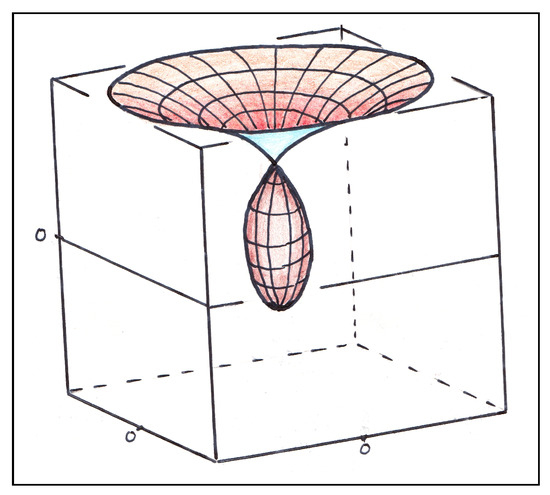
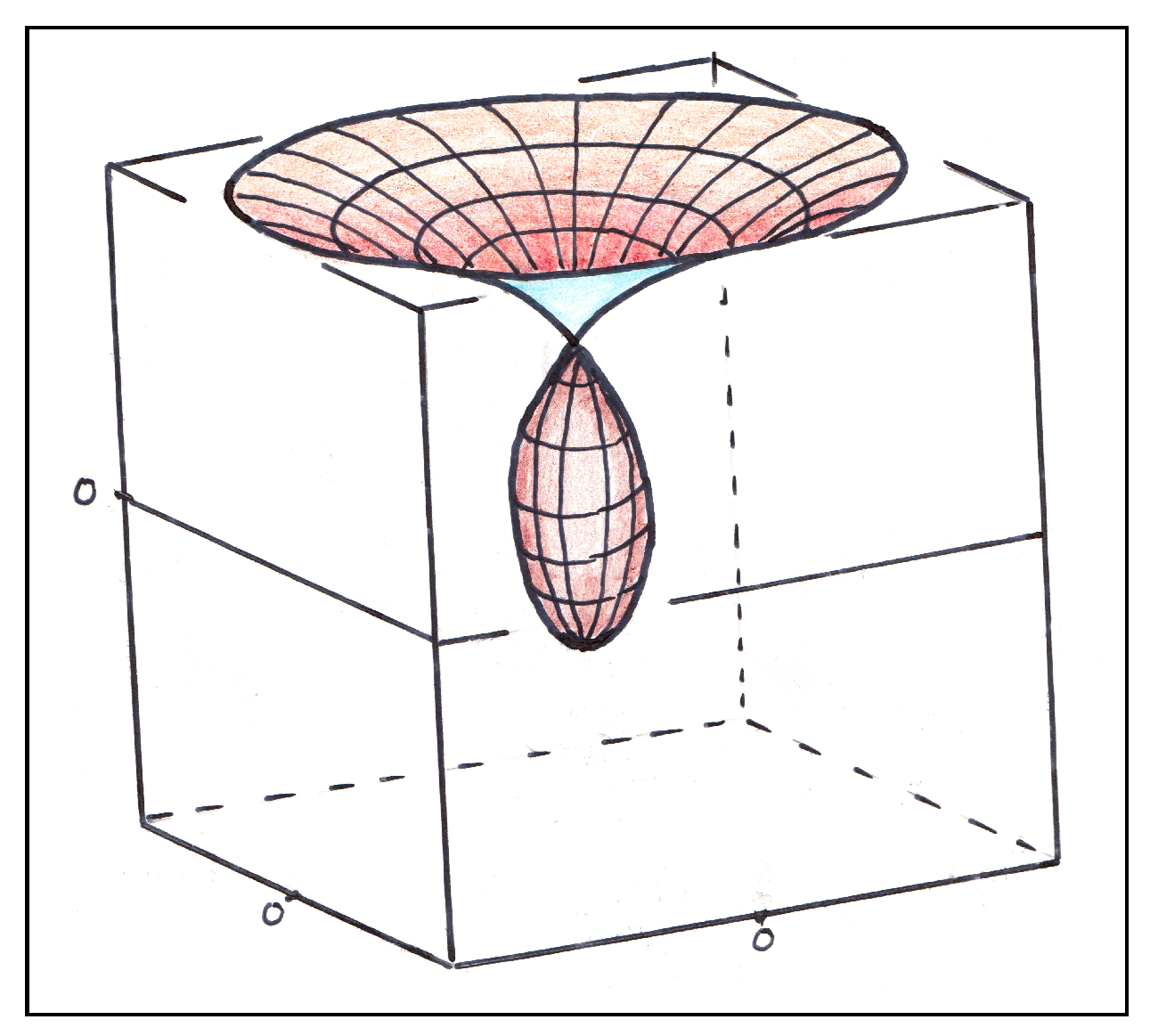
and . It describes the interior of the black hole. In Figure 7 we have plotted , valid only inside the horizon , for . We will also change the azimuthal variable by .
Figure 7.
Shape of the inside of the black hole, plotted as surface of revolution. , with a the horizon. There is no singularity.
The region is inaccessible. It would be challenging to consider large values of k. We will then get a horizon and the singularity for will never be reached. It became quite clear that Euclidean self-dual solutions in Einstein’s theory play a role in quantum gravity. These solutions have vanishing classical action and non-trivial topological invariants. Moreover, there is a similarity with the YM Euclidean self-dual solutions [29]. Despite their Euclidean origin, instantons, like solitons, play a fundamental role in quantum theories. Their importance arises, for example, in tunneling effects using the WKB approximation. Instanton-like solutions are expected to be all self-dual, localized in Euclidean spacetimes and free of singularities. They give a dominant contribution to the path integral that is as important as that of the flat metric itself. They also have time-parity inversion. However, gravitational instantons do not contribute to the zero-frequency modes of a spin-1/2 Dirac particle, while they produce zero-frequency solutions of spin-3/2 particles. It is conjectured ([39,40,41]) that there is a deep connection between the gravitational instanton and the alternating discrete symmetry group which serves as a discrete subgroup of of its boundary. A gravitational instanton is a four-dimensional regular spacetime M, self-dual Ricci curvature and asymptotically local Euclidean, whose boundary has a symmetry6. In fact, every finite subgroup of ∼, is either cyclic or conjugate to these binary subgroups. For our 5D warped spacetime, our boundary is the Klein surface, embedded in ∼ and the symmetry the double cover group I of the icodahedral. An interesting study has also been done by Gibbons [39]. He studied, on , a gravitational instanton surrounded by an event horizon and compared the solution with the Yang-Mills instanton. This study is based on the Riemannian solution of the Einstein equations with a cosmological constant on by applying the Hopf-fibering. The Weyl tensor is then anti-self dual and they conclude that there is no Lorentzian counterpart connection, i.e., it cannot be related to a real 4-dimensional manifold. Our model can.
Finally, we comment on the notion of a quantum black hole, compared with a hydrogen atom. It is a bold statement [6]. In atomic physics, emission spectra show a hierarchy of level splitting caused by the breaking of different symmetries. For the hydrogen the symmetry of the Coulomb problem is broken, resulting in the fine structure splitting of the Rydberg-Bohr spectrum, caused by the relativistic spin-orbit interaction and Thomas precession. And we have the hyperfine splitting by the Lamb shift and the vacuum polarization effects. The question is if one can compare this viewpoint with the -fold degeneracy of the H-atom. Moreover, will there room for considering a kind of symmetry breaking, analogous to the H-atom, which could split the black hole ‘lines’? And what about the construction of the operators for the black hole, , i.e., the mass, area, charge, magnetic charge, and angular momentum respectively.
But eigenstates of the black hole is of a different quantum mechanical order. However, we found in our model a remarkable discretization of the black hole’s ‘eigenstates’ of the distribution of the zero’s, stereographically projected on . This subject is currently under study by the author.
5. Conclusions
We discussed the exact solution of a conformally invariant Randall-Sundrum 5D warped Kerr-like spacetime. We applied the topological antipodal boundary condition for the 3-sphere. The vacuum solution found on the conformal invariant 5D warped spacetime, where the metric is determined by a quintic polynomial, can be described by a Laplace-type equation on a Klein surface. The zeros of this quintic polynomial depend on the constraints on the parameters of the model under consideration. In a special case, the zeros can be expressed analytically as ∼ where k is an integer and C a constant. They are related to the eigenvalues of the Laplacian on the Klein surface.
The antipodal mapping of regions I and II in the Penrose diagram is accompanied by the continuous transition in the extra bulk dimension by means of the non-orientable Klein surface embedded in ∼ by means of a Hopf fibration. Measuring the elapsed time that the Hawking particles spend on the Klein surface could give an estimate of the dimension of the bulk.
The vacuum solution describes an instanton in Riemannian space. The need for a mechanism for the formation of primordial black holes at Planck-scale dimensions is urgently demanded by the discovery of black holes and mature galaxies in the early universe. Instantons could trigger this mechanism. In suitable coordinates, the inside of the black hole shows no central singularity, by applying Cauchy’s theorem.
The information problem could be solved by the antipodal boundary condition, i.e., by removing the inside of the black hole. The result was that the black hole is not thermal. The reason is that there is no ‘hidden sector’ anymore to produce the thermodynamically mixed state of the Hawking radiation. All states remain pure for the outside observer. In our model, the antipodal map on the brane is accompanied by the symmetry in the bulk in the Randall-Sundrum model. No ‘cut-and-past’ is required. This means that there is no infinitely fast transport to the other side of the hemisphere. The Hawking particles remain on the Klein surface for a while, as seen by the outside observer. A local observer will not notice the singularity in a suitably chosen coordinate system for the , which is conformal flat. There is no need for quantum clones in the extended Penrose diagram, in order to overcome some obstruction in constructing of a quantum version, i.e., quantizing the position and momentum distributions using commutation relations. Unitarity and CPT invariance can be maintained in our axially symmetric Kerr spacetime. The near horizon region described in Kruskal–Szekeres coordinates , with . Because , there exist minimal size causal diamonds for each harmonic around . No forbidden even modes of spherical harmonics applies and the map can be used. No approximation with a Regge-Wheeler potential is needed. Moreover, in our model we need cylindrical harmonics without a restriction on the quantum numbers. The axial symmetry becomes manifest by the stereographic projection of the 3-sphere on the hyperplane given by . Our Klein surface possesses the right antipodal topology, to obtain quantization conditions and to generate a discrete spectrum of the Hamiltonian. The covering space is the symmetry of the bulk space.
A geometric quantization of our Klein surface can be constructed using a two-level Hilbert space on the complex hyper-surface .
A possible relation is stipulated between Beckenstein’s quantum black hole and our solution. Using Galois group structure, we observed that the ordered roots of the quintic are related to to points on the icosahedron. Written in the Brioschi form7, the ‘dance of the roots’ is described by a permutation of the roots. The relation with the fractional Möbius transformations can be made. The discrete ‘chaotic’ spectrum for the black hole microstates could be related to the Riemann zeta functions.
Funding
This research received no external funding.
Data Availability Statement
The original contributions presented in this study are included in the article. Further inquiries can be directed to the corresponding author.
Conflicts of Interest
The author is employed by the Astronomisch Fysisch Onderzoek Nederland. The author declares that the research was conducted in the absence of any commercial or financial relationships that could be construed as a potential conflict of interest.
Notes
| 1 | Kaluza and Klein were the first physicists to consider a 5-dimensional space-time in an attempt to combine Einstein’s GRT with the electromagnetic field [12,13]. In the braneworld model of RS, the effect of compactification on the brane is commonly referred to as KK particles. |
| 2 | On a FLRW spacetime, the dilaton field is then considered as a warp factor, which can also be expressed exactly in , where the bulk part becomes ([23]). You will need these solutions when the Hawking particles become hard. |
| 3 | Schrödinger applies the case of an expanding universe. |
| 4 | Note that there are two possible paths for the Hawking particle in the bulk, due to the symmetry. |
| 5 | Recently, primordial BHs have been observed, which could not be formed by contracting matter. |
| 6 | These are the dihedral, Möbius, tetrahedral, octahedral and icosahedral groups respectively. |
| 7 | The study of fifth-degree equations written in various forms, goes back a long way. See, for example, Klein’s classic book [42]. |
References
- Hawking, S. Particle creation by black holes. Comm. Math. Phys. 1975, 43, 199. [Google Scholar] [CrossRef] [Scilit]
- Bekenstein, A. Black holes and the second law. Lett. Nuovo C. 1972, 4, 99. [Google Scholar] [CrossRef] [Scilit]
- ’t Hooft, G. Dimensional reduction in quantum gravity. arXiv 1993, arXiv:Gr-qc/9310026. [Google Scholar]
- Maldacena, J.M. The large-N limit of superconformal field theories and supergravity. Int. J. Theor. Phys. 1999, 38, 1113. [Google Scholar] [CrossRef] [Scilit]
- de Boer, J. Introduction to the AdS/CFT correspondence. Les Houches Lect. Notes 2015, 97, 163. [Google Scholar]
- Bekenstein, A. The quantum mass spectrum of the Kerr black hole. Lett. Nuovo C 1974, 11, 467. [Google Scholar] [CrossRef] [Scilit]
- Bekenstein, A. Advances in the Interplay Between Quantum and Gravity Physics; Bergmann, P.G., De Sabbata, V., Eds.; Kluwer: Dordrecht, The Netherlands, 2002. [Google Scholar]
- ’t Hooft, G. The quantum black hole as a theoretical lab, a pedagogical treatment of a new approach. arXiv 2019, arXiv:Grqc/ 190210469. [Google Scholar]
- Hawking, S.W. Gravitationally collapsed objects of very low mass. Mon. Not. R. Astron. Soc. 1971, 152, 75. [Google Scholar] [CrossRef] [Scilit]
- Randall, L.; Sundrum, R. A large mass hierarchy from a small extra dimension. Phys. Rev. Lett. 1999, 83, 3370. [Google Scholar] [CrossRef] [Scilit]
- Randall, L.; Sundrum, R. An alternative to compactification. Phys. Rev. Lett. 1999, 83, 4690. [Google Scholar] [CrossRef] [Scilit]
- Kaluza, T. Zum Unitätsproblem der Physik Sitzungsber. Preuss. Akad. Wiss (Math. Phys.) 1921, 1921, 966–972. [Google Scholar]
- Klein, O. Quantentheorie und fünfdimensionale Relativitätsthe- orie. Z. Phys A 1926, 37, 859. [Google Scholar]
- ’t Hooft, G. Local conformal symmetry: The missing symmetry component for space and time. Int. J. Mod. Phys. D 2015, 24, 1543001. [Google Scholar] [CrossRef] [Scilit]
- Schrödinger, E. Expanding Universe; Cambridge University Press: Cambridge, UK, 1957. [Google Scholar]
- Gibbons, G.W. The elliptic interpretation of black holes and quantum mechanics. Nucl. Phys. B 1986, 271, 497. [Google Scholar] [CrossRef] [Scilit]
- ’t Hooft, G. Black hole unitarity and antipodal entanglement. Found. Phys. 2016, 46, 1185. [Google Scholar] [CrossRef] [Scilit]
- Slagter, R.J. Alternative for black hole paradoxes. Int. J. Mod. Phys. A 2022, 37, 2250176. [Google Scholar] [CrossRef] [Scilit]
- Slagter, R.J. Quantum black holes in conformal dilaton—Higgs gravity on warped spacetimes. Universe 2023, 9, 383. [Google Scholar] [CrossRef] [Scilit]
- Slagter, R.J. Primordial black holes and instantons: Shadow of an extra dimension. Int. J. Mod. Phys. A 2024, 40, 2450148. [Google Scholar] [CrossRef] [Scilit]
- Slagter, R.J. Black Holes and Cosmic Strings Revisited; Amazon Publishing: Seattle, WA, USA, 2024. [Google Scholar]
- Slagter, R.J. Everything You Need to Know About Black Holes: Shadow of an Extra Dimension; Cambridge Scholar Publications: Newcastle upon Tyne, UK, 2025. [Google Scholar]
- Slagter, R.J.; Pan, S. A new fate of a warped 5D FLRW model with a U(1) scalar gauge field. Found. Phys. 2016, 46, 1075. [Google Scholar] [CrossRef] [Scilit]
- Bartlett, B. The quintic, the icosahedron, and elliptic curves. Not. Amer. Math. Soc. 2024, 71, 444. [Google Scholar] [CrossRef] [Scilit]
- Hartle, J.B. Gravity; Pearson Education, Inc.: London, UK, 2003. [Google Scholar]
- Baňados, M.; Teitelboim, C.; Zanelli, T. The black hole in three dimensional space time. Phys. Rev. Lett. 1992, 69, 849. [Google Scholar] [CrossRef] [Scilit] [PubMed]
- Compère, G. Advanced Lectures on General Relativity; Lecture notes in Physics; Springer: Berlin/Heidelberg, Germany, 2019. [Google Scholar]
- King, R.B. Beyond the Quartic Equation; Birkhauser: Boston, MA, USA, 1996. [Google Scholar]
- Eguchi, T.; Hanson, J. Self-dual solutions to euclidean gravity. Ann. Phys. 1979, 120, 82. [Google Scholar] [CrossRef] [Scilit]
- Aneva, B. Symmetry of the Riemann operator. arXiv 1998, arXiv:08041618V1. [Google Scholar] [CrossRef] [Scilit]
- Sanchez, N.; Whiting, B.F. Quantum field theory and the antipodal identification of black-holes. Nucl. Phys. B 1987, 283, 605. [Google Scholar] [CrossRef] [Scilit]
- Gibbons, G.W. Topology and topology change in general relativity. Class. Quantum Grav. 1993, 10, S75. [Google Scholar] [CrossRef] [Scilit]
- Betzios, P.; Gaddam, N.; Papadoulaki, O. Black holes, quantum chaos, and the Riemann hypothesis. CsiPost Phys. Core 2021, 4, 32. [Google Scholar] [CrossRef] [Scilit]
- Betzios, P.; Gaddam, N.; Papadoulaki, O. The black hole S-matrix from quantum mechanics. J. High Energy Phys. 2021, 11, 131. [Google Scholar] [CrossRef] [Scilit]
- ’t Hooft, G. The black hole firewall transformation and realism in quantum mechanics. Universe 2021, 7, 298. [Google Scholar] [CrossRef] [Scilit]
- Urbantke, U. Two-level quantum systems: States, phases, and holonomy. Am. J. Phys. 1990, 59, 503. [Google Scholar] [CrossRef] [Scilit]
- Freed, D.S.; Uhlenbeck, K.K. Instantons and Four-Manifolds; Springer: New York, NY, USA, 1984. [Google Scholar]
- Felsager, B. Geometry, Particles and Fields; Springer: New York, NY, USA, 1998. [Google Scholar]
- Gibbons, G.W.; Hawking, S.W. Euclidean Quantum Gravity; World Scientific: Singapore, 1993. [Google Scholar]
- Joyce, D.D. Explicit construction of self-dual-manifolds. Duke Math. J. 1995, 77, 519. [Google Scholar] [CrossRef] [Scilit]
- Atiyah, M.F.; Hitchin, N.J.; Singer, I.M. Selfduality in four-dimensional riemannian geometry. Proc. R. Soc. Lond. A 1978, 362, 425. [Google Scholar]
- Klein, F. Lectures on the Icosahedron and the Solution of Equations of the Fifth Degree; Trübner and Co.: London, UK, 1888. [Google Scholar]
Disclaimer/Publisher’s Note: The statements, opinions and data contained in all publications are solely those of the individual author(s) and contributor(s) and not of MDPI and/or the editor(s). MDPI and/or the editor(s) disclaim responsibility for any injury to people or property resulting from any ideas, methods, instructions or products referred to in the content. |
© 2026 by the author. Licensee MDPI, Basel, Switzerland. This article is an open access article distributed under the terms and conditions of the Creative Commons Attribution (CC BY) license.