


Strength Ratios of Diffuse Interstellar Bands in Slightly Reddened Objects


Abstract
1. Introduction
2. Sample Selection and Spectra
- UVES (Ultraviolet and Visual Echelle Spectrograph) fed by the 8-m Kueyen VLT mirror [18]. The spectral resolution is up to R = = 80,000 in the blue range.1 The telescope size allows us to obtain high SNR spectra of even pretty faint stars. Some of the selected spectra have been collected in the frame of the Large Program EDIBLES (ESO Diffuse Interstellar Bands Large Exploration Survey).
- ESPRESSO—Echelle Spectrograph for Rocky Exoplanets and Stable Spectroscopic Observations [19] is a highly-stabilized fiber-fed echelle spectrograph that can be fed with light from either a single or up to four unit telescopes (UTs) simultaneously.2 The instrument is installed at the incoherent combined Coudé focus (ICCF) of the VLT. The spectrograph is fed by two fibers, one for the scientific target and the other one for simultaneous reference (either the sky or a simultaneous drift reference, the Fabry–Pérot). The light from the two fibers is recorded onto a blue (380–525 nm) and a red (525–788 nm) CCD mosaic. The spectral resolution is either 190,000, 140,000 or 70,000 and does not influence the spectral range covered.
- MIKE spectrograph [20] fed by 6.5-m Magellan telescope at Las Campanas Observatory (Chile). Spectra were observed with a 0.35 × 5 arcs slit. We estimated the resolving power using the solitary Thorium lines. The resolution is ∼56,000 (v∼5.4 km s−1) in the blue branch (3600–5000 Å) of the spectrograph.
- FEROS spectrograph, which is fed by the 2.2-m ESO La Silla telescope [21]. It allows to record in a single exposure the spectral range from 3600 to 9200 Å, divided into 39 Echelle orders. The resolution of Feros spectra is R = 48,000. We used the ESO archive as well as data of our own runs. If having a choice we used our own observations because of the higher SNR.
- ESPaDOnS—Echelle Spectropolarimetric Device for the Observation of Stars3, is a bench-mounted high resolving power echelle spectrograph/spectropolarimeter, attached to the 3.58-m Canada-France-Hawaii telescope at Mauna Kea (Hawaii, USA). It is designed to obtain a complete optical spectrum in the range of 3700 to 10,050 Å [22]. The whole spectrum is divided into 40 echelle orders. The resolving power is about 81,000.
3. Results
4. Conclusions
Author Contributions
Funding
Data Availability Statement
Acknowledgments
Conflicts of Interest
| 1 | For details see https://www.eso.org/sci/facilities/paranal/instruments/uves.html; accessed on 6–10 October 2014. |
| 2 | https://www.eso.org/sci/facilities/paranal/instruments/espresso.html; accessed on 9 November 2018. |
| 3 | https://www.cfht.hawaii.edu/Instruments/Spectroscopy/Espadons; accessed on 21 May 2005. |
References
- Herbig, G.H. The Diffuse Interstellar Bands. Annu. Rev. Astron. Astrophys. 1995, 33, 19. [Google Scholar] [CrossRef]
- Fan, H.; Hobbs, L.M.; Dahlstrom, J.A.; Welty, D.E.; York, D.G.; Rachford, B.; Snow, T.P.; Sonnentrucker, P.; Baskes, N.; Zhao, G. The Apache Point Observatory Catalog of Optical Diffuse Interstellar Bands. Astrophys. J. 2019, 878, 151. [Google Scholar] [CrossRef]
- Cami, J.; Sonnentrucker, P.; Ehrenfreund, P.; Foing, B.H. Diffuse Interstellar Bands in single clouds: New families and constraints on the carriers. Astron. Astrophys. 1997, 326, 822. [Google Scholar]
- Herbig, G.H. The Diffuse Interstellar Bands. IX. Constraints on the Identification. Astrophys. J. 1993, 407, 142. [Google Scholar] [CrossRef]
- Krełowski, J.; Walker, G.A.H. Three Families of Diffuse Interstellar Bands? Astrophys. J. 1987, 312, 860. [Google Scholar] [CrossRef]
- Krełowski, J.; Westerlund, B.E. High-resolution profiles of diffuse interstellar bands as functions of the structure of the interstellar medium. Astron. Astrophys. 1988, 190, 339. [Google Scholar]
- Fan, H.; Welty, D.E.; York, D.G.; Sonnentrucker, P.; Dahlstrom, J.A.; Baskes, N.; Friedman, S.D.; Scott, D.; Hobbs, L.M.; Jiang, Z.; et al. The Behavior of Selected Diffuse Interstellar Bands with Molecular Fraction in Diffuse Atomic and Molecular Clouds. Astrophys. J. 2017, 850, 194. [Google Scholar] [CrossRef]
- Vos, D.A.I.; Cox, N.L.J.; Kaper, L.; Spaans, M.; Ehrenfreund, P. Diffuse interstellar bands in Upper Scorpius: Probing variations in the DIB spectrum due to changing environmental conditions. Astron. Astrophys. 2011, 533, A129. [Google Scholar] [CrossRef]
- Lai, T.S.Y.; Witt, A.N.; Alvarez, C.; Cami, J. Are the carriers of diffuse interstellar bands and extended red emission the same? Mon. Not. R. Astron. Soc. 2020, 492, 5853. [Google Scholar] [CrossRef]
- Fan, H.; Schwartz, M.; Farhang, A.; Cox, N.L.J.; Ehrenfreund, P.; Monreal-Ibero, A.; Foing, B.H.; Salama, F.; Kulik, K.; MacIsaac, H.; et al. Families and clusters of diffuse interstellar bands: A data-driven correlation analysis. Mon. Not. R. Astron. Soc. 2022, 510, 3546. [Google Scholar] [CrossRef]
- Krełowski, J.; Galazutdinov, G.; Bondar, A. On the σ and ζ type translucent interstellar clouds. Mon. Not. R. Astron. Soc. 2019, 486, 3537. [Google Scholar] [CrossRef]
- Friedman, S.D.; York, D.G.; McCall, B.J.; Dahlstrom, J.; Sonnentrucker, P.; Welty, D.E.; Drosback, M.M.; Hobbs, L.M.; Rachford, B.L.; Snow, T.P. Studies of Diffuse Interstellar Bands V. Pairwise Correlations of Eight Strong DIBs and Neutral Hydrogen, Molecular Hydrogen, and Color Excess. Astrophys. J. 2011, 727, 33. [Google Scholar] [CrossRef]
- Weselak, T. The relation between 5780 and 5797 diffuse interstellar bands, CH/CH+ molecules, and atomic or molecular hydrogen. Astron. Astrophys. 2019, 625, A55. [Google Scholar] [CrossRef]
- Ebenbichler, A.; Smoker, J.V.; Lallement, R.; Farhang, A.; Cox, N.L.J.; Joblin, C.; van Loon, J.T.; Linnartz, H.; Przybilla, N.; Ehrenfreund, P.; et al. The EDIBLES Survey. VIII. Band profile alignment of diffuse interstellar bands. Astron. Astrophys. 2024, 686, 50. [Google Scholar] [CrossRef]
- Merrill, P.W.; Sanford, R.F.; Wilson, O.C.; Burwell, C.G. Intensities and Displacements of Interstellar Lines. Astrophys. J. 1937, 86, 274. [Google Scholar] [CrossRef]
- Hobbs, L.M. A comparison of interstellar Na I, Ca II, and K I absorption. Astrophys. J. 1974, 191, 381. [Google Scholar] [CrossRef]
- Merrill, P.W. Unidentified Interstellar Lines. Publ. Astron. Soc. Pac. 1934, 46, 206. [Google Scholar] [CrossRef]
- Dekker, H.; D’Odorico, S.; Kaufer, A.; Delabre, B.; Kotzlowski, H. Design, construction, and performance of UVES, the echelle spectrograph for the UT2 Kueyen Telescope at the ESO Paranal Observatory. Proc. SPIE 2000, 4008, 534. [Google Scholar]
- Pepe, F.; Molaro, P.; Cristiani, S.; Rebolo, R.; Santos, N.C.; Dekker, H.; Mégevand, D.; Zerbi, F.M.; Cabral, A.; Di Marcantonio, P.; et al. ESPRESSO: The next European exoplanet hunter. Astron. Nachr. 2014, 335, 8. [Google Scholar] [CrossRef]
- Bernstein, R.; Shectman, S.A.; Gunnels, S.M.; Mochnacki, S.; Athey, A.E. MIKE: A Double Echelle Spectrograph for the Magellan Telescopes at Las Campanas Observatory. Proc. SPIE 2003, 4841, 1694. [Google Scholar]
- Kaufer, A.; Stahl, O.; Tubbesing, S.; Nørregaard, P.; Avila, G.; Francois, P.; Pasquini, L.; Pizzella, A. Commissioning FEROS, the new high-resolution spectrograph at La-Silla. The Messenger 1999, 95, 8. [Google Scholar]
- Donati, J.-F.; Catala, C.; Landstreet, J.D.; Petit, P. ESPaDOnS: The New Generation Stellar Spectro-Polarimeter. Performances and First Results. Astron. Soc. Pac. Conf. 2006, 358, 362. [Google Scholar]
- Fitzpatrick, E.L.; Massa, D. An Analysis of the Shapes of Interstellar Extinction Curves. V. The IR-through-UV Curve Morphology. Astrophys. J. 2007, 663, 320. [Google Scholar] [CrossRef]
- Wenger, M.; Ochsenbein, F.; Egret, D.; Dubois, P.; Bonnarel, F.; Borde, S.; Genova, F.; Jasniewicz, G.; Laloë, S.; Lesteven, S.; et al. The SIMBAD astronomical database. The CDS reference database for astronomical objects. Astron. Astrophys. Suppl. Ser. 2000, 143, 9. [Google Scholar] [CrossRef]

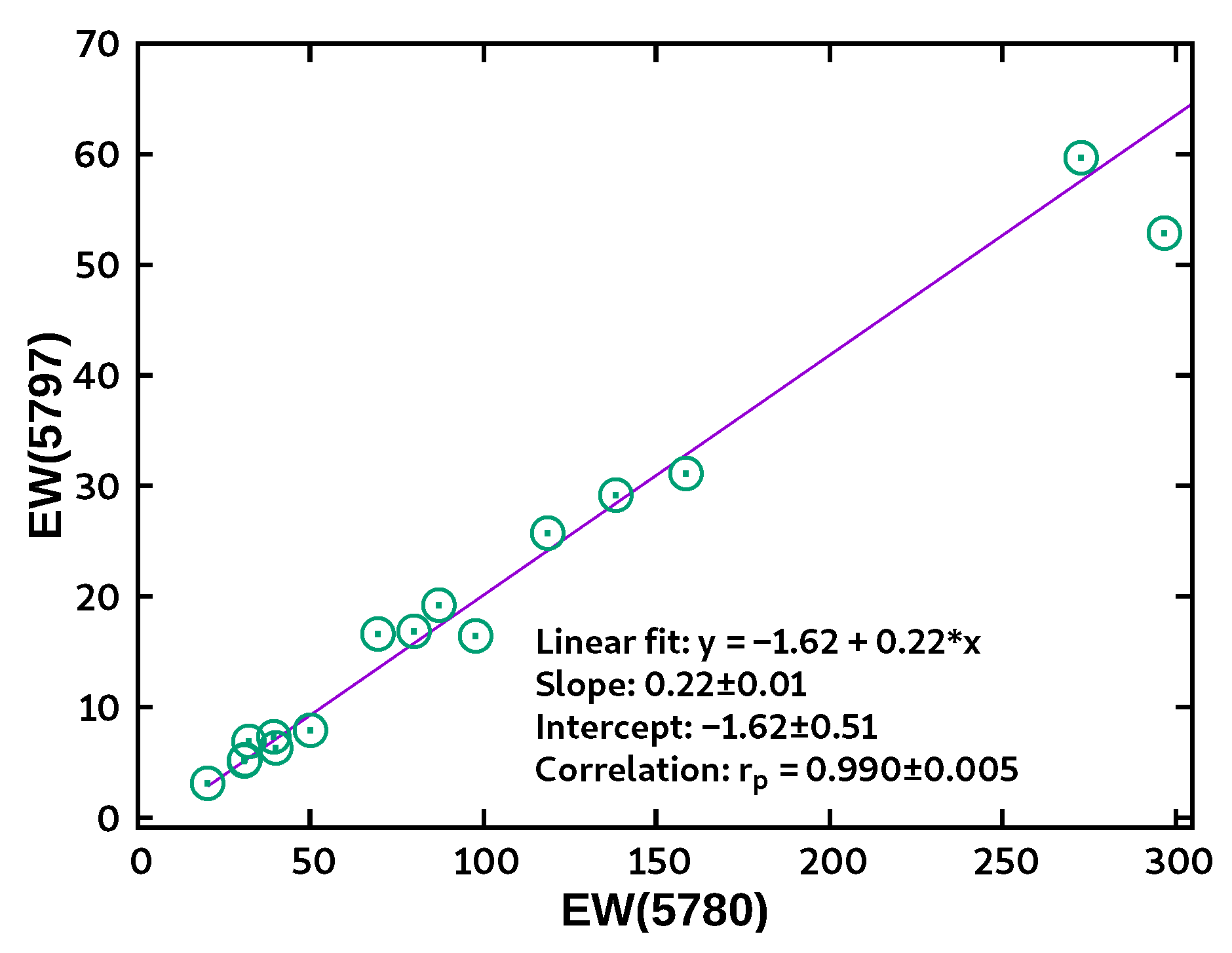
| Object | SpL | V | B-V | E (B-V) | EW (5780) | EW (5797) | SR | Instr. |
|---|---|---|---|---|---|---|---|---|
| HD 23441 | A0V | 6.42 | −0.02 | 0.08 | 31.1 ± 6.6 | 5.4 ± 2.6 | 5.8 ± 3.0 | mike |
| HD 23850 | B8III | 3.63 | −0.09 | 0.03 | 39.5 ± 6.9 | 7.6 ± 3.8 | 5.2 ± 2.8 | mike |
| HD 36486 | O9.5II | 2.41 | ⋯ | ⋯ | 20.5 ± 13.9 | 3.4 ± 3.6 | 6.0 ± 7.6 | UVES |
| HD 36822 | B0III | 4.41 | −0.15 | 0.08 | 97.8 ± 23.2 | 16.7 ± 7.9 | 5.9 ± 3.1 | UVES |
| HD 37128 | B0Ia | 1.69 | −0.18 | 0.04 | 31.3 ± 18.5 | 5.5 ± 5.0 | 5.7 ± 6.2 | UVES |
| HD 37742 a | O9.2Ib | 1.90 | −0.11 | 0.12 | 21.1 ± 14.5 | 1.1 ± 1.4 | ⋯ | ESPR |
| HD 38771 | B0.5Ia | 2.06 | −0.18 | 0.02 | 32.4 ± 16.7 | 7.2 ± 4.4 | 4.5 ± 3.6 | UVES |
| HD 55879 | O9.7III | 6.30 | −0.18 | 0.05 | 80.1 ± 21.7 | 17.1 ± 8.7 | 4.7 ± 2.7 | Feros |
| HD 57061 | O9II | 4.40 | −0.15 | 0.09 | 50.2 ± 18.3 | 8.2 ± 6.0 | 6.1 ± 5.0 | UVES |
| HD 57682 | O9.2IV | 6.43 | −0.19 | 0.08 | 87.3 ± 23.3 | 19.5 ± 9.5 | 4.5 ± 2.5 | Feros |
| HD 93632 | O5I | 9.10 | ⋯ | ⋯ | 296.8 ± 41.7 | 53.1 ± 17.7 | 5.6 ± 2.0 | UVES |
| HD 96264 | O9.5III | 7.62 | −0.08 | 0.16 | 138.3 ± 19.2 | 29.4 ± 8.4 | 4.7 ± 1.5 | Feros |
| HD 141318 | B2III | 5.77 | −0.01 | 0.18 | 158.6 ± 24.7 | 31.4 ± 10.2 | 5.1 ± 1.8 | UVES |
| HD 148605 | B3V | 4.79 | −0.07 | 0.11 | 40.2 ± 3.6 | 6.6 ± 1.2 | 6.1 ± 1.2 | UVES |
| HD 152590 | O7.5V | 9.29 | −0.18 | 0.11 | 272.8 ± 23.4 | 59.9 ± 11.5 | 4.6 ± 1.0 | Feros |
| HD 164353 | B5Ib | 3.93 | 0.03 | 0.11 | 118.7 ± 18.2 | 26.0 ± 6.4 | 4.6 ± 1.3 | UVES |
| HD 214680 | O9V | 4.88 | −0.21 | 0.07 | 69.7 ± 18.1 | 16.9 ± 5.6 | 4.1 ± 1.7 | ESPaDOnS |
Disclaimer/Publisher’s Note: The statements, opinions and data contained in all publications are solely those of the individual author(s) and contributor(s) and not of MDPI and/or the editor(s). MDPI and/or the editor(s) disclaim responsibility for any injury to people or property resulting from any ideas, methods, instructions or products referred to in the content. |
© 2025 by the authors. Licensee MDPI, Basel, Switzerland. This article is an open access article distributed under the terms and conditions of the Creative Commons Attribution (CC BY) license (https://creativecommons.org/licenses/by/4.0/).
Share and Cite
Krełowski, J.; Bondar, A. Strength Ratios of Diffuse Interstellar Bands in Slightly Reddened Objects. Universe 2025, 11, 181. https://doi.org/10.3390/universe11060181
Krełowski J, Bondar A. Strength Ratios of Diffuse Interstellar Bands in Slightly Reddened Objects. Universe. 2025; 11(6):181. https://doi.org/10.3390/universe11060181
Chicago/Turabian StyleKrełowski, Jacek, and Arkadii Bondar. 2025. "Strength Ratios of Diffuse Interstellar Bands in Slightly Reddened Objects" Universe 11, no. 6: 181. https://doi.org/10.3390/universe11060181
APA StyleKrełowski, J., & Bondar, A. (2025). Strength Ratios of Diffuse Interstellar Bands in Slightly Reddened Objects. Universe, 11(6), 181. https://doi.org/10.3390/universe11060181

