


Abstract
Although photon–photon scattering does not exist at the tree level, this is no longer the case at loop order and was first calculated by Euler and Heisenberg. The existence of this phenomenon has now been confirmed experimentally by the ATLAS collaboration and plays a small but important role in the calculation of -2. We show how the low-energy form of the scattering amplitude can be determined via causal (on-shell) methods using Compton scattering helicity amplitudes as input for the case of charged S = 0, S = , and S = 1 intermediate state fields.
1. Introduction
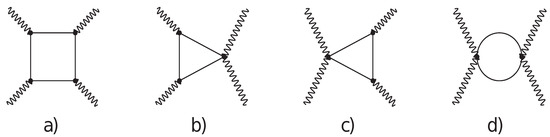
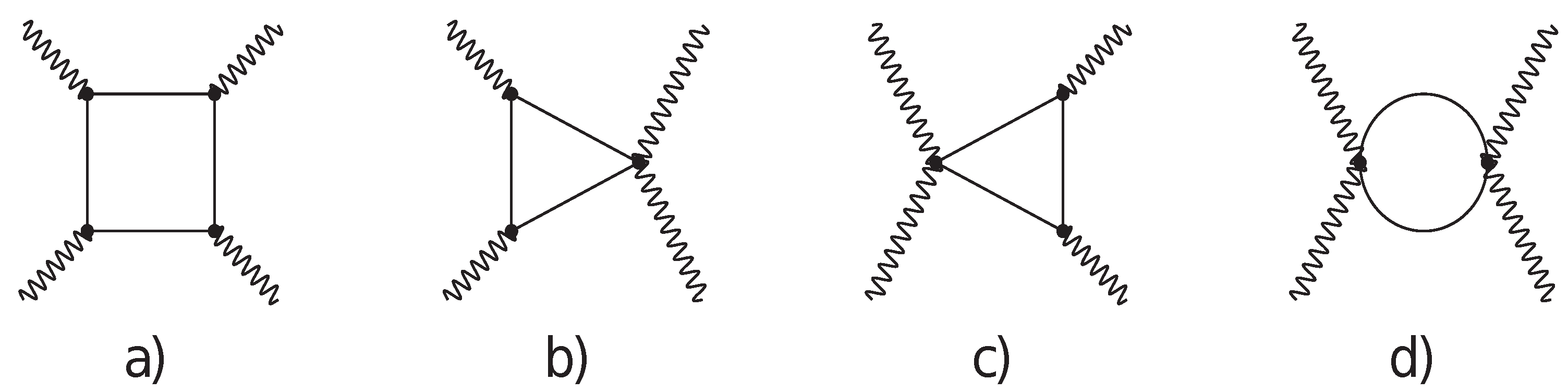
As every physicist knows, there exists no tree-level photon–photon scattering since a photon couples to charge but is itself uncharged. Nevertheless, at the loop level, there arises a nonzero amplitude on account of diagrams such as those shown in Figure 1.
Figure 1.
Shown are the box (a), triangle (b), (c) and bubble (d) diagrams contributing to low-energy photon–photon scattering. Here, the solid lines represent massive charged particles, while the wiggly lines are photons.
From Lorentz, parity, and gauge invariance, it is clear that the general low-energy form of an effective interaction describing such a phenomenon must be
where is the electromagnetic field tensor and is its dual. The existence of such a phenomenon was clear to Heisenberg soon after Dirac published his hole theory for a spin particle, and he assigned a student Hans Euler to this problem, which became his PhD thesis [1]1. The coefficients were found by Euler and Heisenberg to be [5]
where is the fine structure constant and m is the mass of the charged spin- field. Since that time the Euler–Heisenberg coefficients have also been determined for the case of a charged scalar— [6] and a charged vector system— [7]. Photon–photon scattering has been seen experimentally at the LHC by the ATLAS collaboration [8], and an off-shell extension has been used by theorists in order to calculate a small but important contribution to the anomalous magnetic dipole moment of the muon [9].
Various methods have been used to obtain these results. The original Euler–Heisenberg paper was a tour-de-force evaluation using solutions of the Dirac equation, though a later calculation by Weisskopf was able to obtain the result using only the spectrum [6]. Recently, a Czech masters thesis was able to obtain these forms from a direct diagrammatic evaluation, although computer algebra was used to manipulate the many hundreds of diagrams that were involved [10,11]. Because of its importance, a straightforward and simple derivation is clearly of interest, and below, we show how this can be achieved by the use of forward scattering dispersion relations, the input to which are on-shell Compton scattering helicity amplitudes. The advantage offered by such on-shell techniques has been shown recently in the context of electromagnetic and gravitational scattering [12,13], and the present work offers a further indication of the simplification that such methods can provide.
In Section 2, then we establish our formalism and show how to connect with an effective Lagrangian of the Euler–Heisenberg form. In Section 3, we perform the calculation using Compton helicity amplitudes for targets with spin 0,, and 1 and reproduce the corresponding Euler–Heisenberg coefficients. We close with a summary in Section 6.
2. Calculation
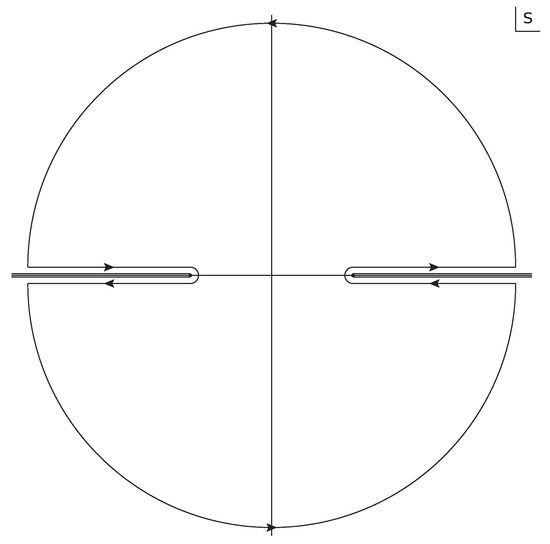
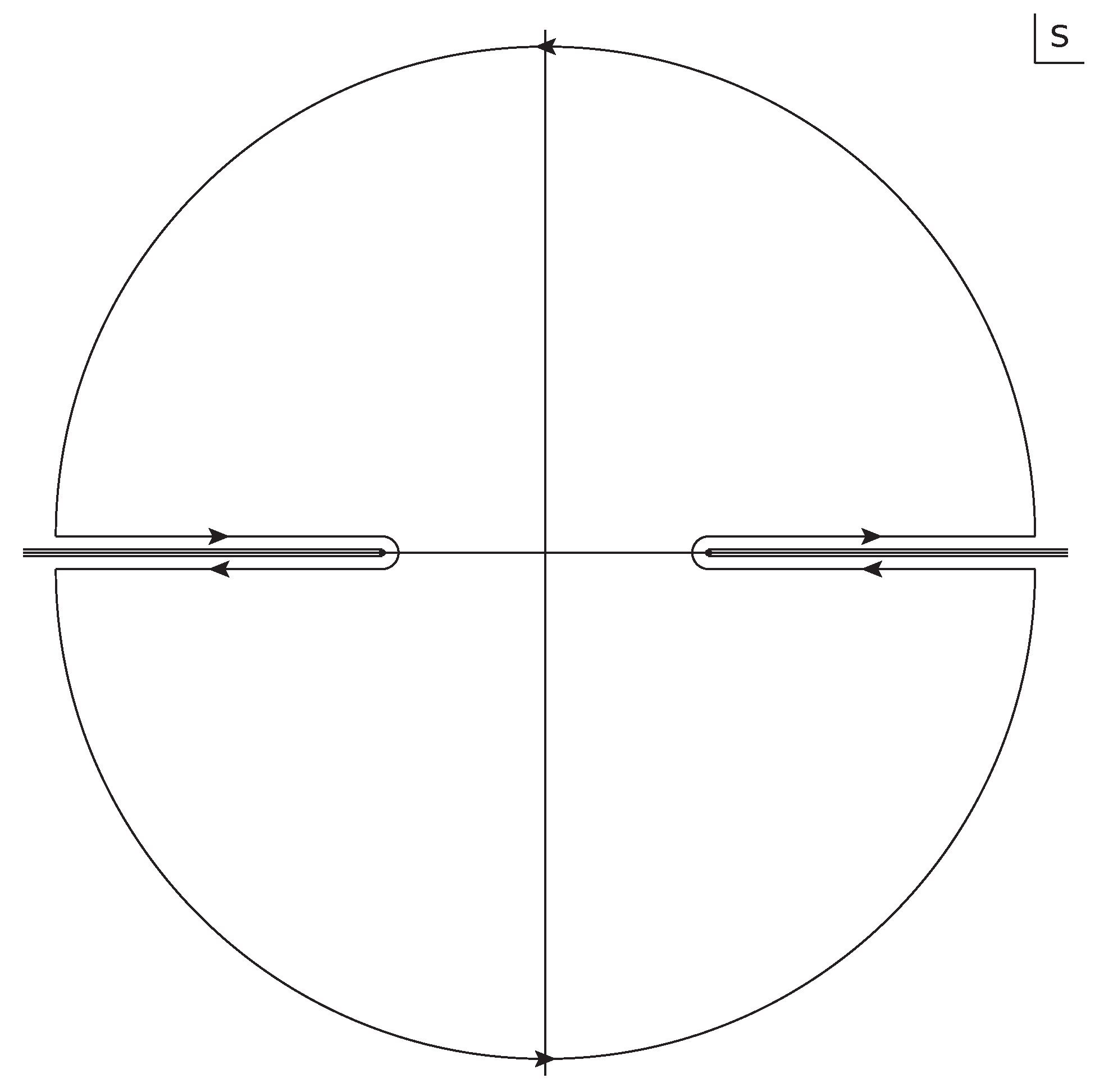
The calculation of light by light scattering is performed by use of a forward scattering dispersion relation. as done by Schwinger [14]. The analytic structure of the forward amplitude is shown in Figure 2, which indicates the presence of s- and u-channel cuts from to and from to . Using the contour shown in the figure, we can then reproduce the Euler–Heisenberg forms.
Figure 2.
Shown is the contour used in generating the dispersion relation.
Contact between the photon–photon scattering and the Euler–Heisenberg Lagrangian can be made by noting that the very low-energy photon–photon forward scattering amplitude must have the general form
where
Since, in terms of helicity amplitudes
we have
so that
Using crossing symmetry and defining [15,16]
we require , and we can take the remaining amplitude to be
Defining the total helicity cross-sections in the center of mass frame as
where is the relative velocity of the meson pair, then using unitarity, we reproduce the optical theorem
where is the annihilation-channel Compton amplitude for the reaction and is the total scattering cross section for the process. Considering first the amplitude we see that along the right-hand cut, since
where is the scattering cross section in the channel with total helicity H, we have
However, because of the condition there exists an identical discontinuity across the left-hand cut
The corresponding dispersion relation then reads
In the case of , because of the condition the dispersion relation becomes
However, from the low-energy scattering form given in Equation (1), we see that the scattering amplitude must begin at , meaning we must subtract the dispersion relation for , yielding
Finally, in the case of it is necessary to look at linearly polarized cross-sections
Subtracting, we find
i.e., after integration over a solid angle, only the first term survives since the other three terms involve differing initial and final state helicity change. We have then
Again we must subtract, since the scattering amplitude begins at , so that the dispersion relation reads
On the other hand, if we write the general effective Lagrangian for low-energy photon–photon scattering as in Equation (1)
then the general low-energy photon–photon scattering amplitude has the center of mass form [17]
so that the forward scattering amplitude is
That is
or
Matching to the corresponding subtracted dispersive forms we have, then the identities
where we have used the feature that the total cross-section can be written either as the sum of parallel/perpendicular or as the sum of total helicity 0/2 cross-sections—
We find then the three sum rules [18]
The first two integrals represent a procedure by which to determine the Euler–Heisenberg coefficients . The third relation, derived previously by Gerasimov and Moulin [19] and by Brodsky and Schmidt [20], can be considered to be simply the Gerasimov-Drell-Hearn (GDH) sum rule in the case of Compton scattering on a photon target [21,22]. Indeed, since the GDH sum rule relates a cross-section integral to the anomalous magnetic moment of the target, the vanishing of the third integral implies that the photon has no anomalous magnetic moment.
Equivalently, if we look at forward scattering with parallel linear polarization——we have
while if we look at the perpendicular case——we have
With this background in place, we can now proceed to determine the Euler–Heisenberg coefficients for general spin.
3. Spin 0
We begin with the simple case of spin 0, wherein the annihilation-channel Compton scattering helicity amplitudes are [23]
We have then, along the right-hand cut
where we have defined the Mandelstam variables . Working in the CM frame of the annihilation channel, these become where is the velocity and we find
where
We can now place these discontinuities into a doubly subtracted dispersion relation to yield the threshold values of the photon–photon scattering amplitudes. Changing the variable of integration from to we find [14] 2
For the Euler–Heisenberg coefficients, we have then
which agree with the well-known values [24].
We can also check the validity of the “GDH” sum rule, which, at this order, reads
Changing variables as above, the integral becomes
so that this requirement is also satisfied.
4. Spin
We can similarly determine the Euler–Heisenberg coefficients for the case of spin-. We begin with the annihilation-channel Compton scattering helicity amplitudes, which are found to be [25]
We have then
Specifically, along the right-hand cut
Please note that Equation (43) can be written in the form
where
We have then
For the Euler–Heisenberg coefficients, we have then
which agree with the well-known values [5].
Again, we can also check the validity of the “GDH” sum rule, which now reads
Changing variables, the integral becomes
so that this requirement is also satisfied.
5. Spin 1
Finally, we find the Euler–Heisenberg coefficients for an ideal (with gyromagnetic ratio g = 2) spin-1 system, for which the annihilation-channel Compton Scattering helicity amplitudes are [26]
We have then, along the right-hand cut
Please note that Equation (51) can be written in the form
where
We have then
so that for the Euler–Heisenberg coefficients, we find
which agree with the well-known values [7].
Finally, we can also check the validity of the "GDH" sum rule, which now reads
Changing variables, the integral becomes
so that this requirement is also satisfied.
6. Conclusions
The use of on-shell methods, which exploit the stricture of unitarity combined with dispersion relations, provides an interesting alternative to the conventional Feynman diagram procedure for the calculation of loop effects in quantum field theory. Previous use of such techniques in the case of electromagnetic [27] and gravitational scattering [12] have been shown to be an efficacious way both to reproduce known results and to derive new ones. The procedure is particularly useful in determining the long-range behavior of electromagnetic and/or gravitational scattering, where power-law dropoff in coordinate space appears as a nonanalytic contribution to the momentum space amplitude [28]. An obvious advantage of these methods is that only on-shell—physical—amplitudes are needed. Consequently, gauge invariance is automatic, meaning that one need not deal with the many Feynman diagrams that are required in order to guarantee gauge invariance. The price that is paid is the need to know the unitarity discontinuity all the way from the threshold to the highest energies in order to perform the dispersive integration. Above, we have demonstrated an additional application—the evaluation of the Euler–Heisenberg coefficients for fields of spin 0,, and 1. These numbers characterize low-energy photon–photon scattering, and the on-shell determination is simpler and more direct than a recent Feynman diagram evaluation, which requires the manipulation of literally hundreds of diagrams [10]. In principle, this technique can also be used to evaluate additional higher-order coefficients. However, this is a subject for future work.
Funding
This research received no external funding.
Data Availability Statement
The original contributions presented in this study are included in the article. Further inquiries can be directed to the author.
Acknowledgments
It is a pleasure to acknowledge very helpful discussions with Vladimir Pascalutsa and Marc Vanderhaeghen.
Conflicts of Interest
The author declares no conflict of interest.
Notes
| 1 | A very useful history and summary of applications of the Euler–Heisenberg relation is given by Dunne in [2]. Alternative derivations are given in [3,4] among other sources. |
| 2 | A similar approach was taken by Schwinger in [14]. |
References
- Euler, H. On the Scattering of Light by Light in Dirac’s Theory. Ph.D. Thesis, University of Leipzig, Leipzig, Germany, 1936. [Google Scholar]
- Dunne, G.V. The Euler-Heiseberg Effective Action: 75 Years On. Int. J. Mod. Phys. Conf. Ser. 2012, 14, 42–56. [Google Scholar] [CrossRef] [Scilit]
- Dittrich, W. Some Remarks on the Use of Effective Lagrangians in QED and QCD. Int. J. Mod. Phys. 2015, A30, 1530046. [Google Scholar] [CrossRef] [Scilit]
- Holstein, B.R. Evaluating the Effective Action. Found. Phys. 2000, 30, 413–437. [Google Scholar] [CrossRef] [Scilit]
- Heisenberg, W.; Euler, H. Consequences of Dirac’s Theory of Positrons. Z. Phys. 1936, 98, 714–732. [Google Scholar] [CrossRef] [Scilit]
- Weisskopf, V. The Electrodynamics of the Vacuum based on the Quantum Theory of the Electron. Kong. Dans. Vid. Selsk. Math-Phys. Med. 1936, 14N6, 1–39. [Google Scholar]
- Vanyashin, V.S.; Terent’ev, M.V. The Vacuum Polarization of a Charged Vector Field. Sov. Phys. JETP 1965, 21, 375. [Google Scholar]
- Aaboud, M. et al. [ATLAS Collaboration] Evidence for Light-by-Light Scattering in Heavy-Ion Collisions with the ATLAS Detector at the LHC. Nat. Phys. 2017, 13, 852–858. [Google Scholar] [CrossRef] [Scilit]
- Jegerlehner, F.; Nyffeler, A. The Muon g-2. Phys. Rept. 2009, 477, 1. [Google Scholar] [CrossRef] [Scilit]
- Preucil, F. Effective Interactions of the Euler-Heisenberg Type in Models of Quantum Field Theory. Master’s Thesis, Charles University, Staré Město, Czech, 2014. [Google Scholar]
- Preucil, F.; Horejsi, J. Effective Euler-Heisenberg Lagrangian in Models of QED. arXiv 2017, arXiv:1717.08106. [Google Scholar]
- Bjerrum-Bohr, N.E.J.; Donoghue, J.F.; Vanhove, P. On-shell Techniques and Universal Results in Quantum Gravity. J. High Energy Phys. 2014, 2014, 111. [Google Scholar] [CrossRef] [Scilit]
- Bjerrum-Bohr, N.E.J.; Damgaard, P.H.; Festuccia, G.; Planté, L. Pierre Vanhove General Relativity from Scattering Amplitudes. arXiv 2018, arXiv:1806.04920. [Google Scholar]
- Schwinger, J. Particles, Sources, and Fields; Addison-Wesley: Reading, MA, USA, 1973; Volume II. [Google Scholar]
- Pascalutsa, V.; Pauk, V.; Vanderhaeghen, M. Light-by-Light Scattering Sum Rules Constraining Meson Transition Form Factors. Phys. Rev. 2012, D85, 116001. [Google Scholar] [CrossRef] [Scilit]
- Pascalutsa, V. Causality Rules, a Light Treatise on Dispersion Relations and Sum Rules; IOP Publishing: Bristol, UK, 2018. [Google Scholar]
- Akhiezer, A.I.; Berestetskii, V.B. Quantum Electrodynamics; Wiley Interscience: New York, NY, USA, 1965. [Google Scholar]
- Pascalutsa, V.; Vanderhaeghen, M. Sum Rules for Light-by-Light Scattering. Phys. Rev. Lett. 2010, 105, 201603. [Google Scholar] [CrossRef] [Scilit] [PubMed]
- Gerasimov, S.B.; Moulin, J. Check of Sum Rules for Photon Interaction Cross-Sections in Quantum Electrodynamics and Mesodynamics. Yad. Fiz. 1976, 23, 142–153. [Google Scholar]
- Brodsky, S.J.; Schmidt, I. Classical Photoabsorption Sum Rules. Phys. Lett. 1995, B351, 344–348. [Google Scholar] [CrossRef] [Scilit]
- Gerasimov, S.B. A Sum Rule for Magnetic Moments and the Damping of the Nucleon Magnetic Moment in Nuclei. Yad. Fiz. 1965, 2, 598, Sov. J. Nucl. Phys.1966, 2, 430–433. [Google Scholar]
- Drell, S.D.; Hearn, A.C. Exact Sum Rule for Nucleon Magnetic Moments. Phys. Rev. Lett. 1966, 16, 908–911. [Google Scholar] [CrossRef] [Scilit]
- See, E.G.; Holstein, B.R. Graviton Physics. Am. J. Phys. 2006, 74, 1002–1011. [Google Scholar]
- Itzykson, C.; Zuber, J.-B. Quantum Field Theory; Dover: New York, NY, USA, 2005. [Google Scholar]
- Abarbanel, H.D.I.; Goldberger, M.L. Low-Energy Theorems, Dispersion Relations, and Superconvergence Sum Rules for Compton Scattering. Phys. Rev. 1968, 165, 1594–1609. [Google Scholar] [CrossRef] [Scilit]
- Bjerrum-Bohr, N.E.J.; Holstein, B.R.; Planté, L.; Vanhove, P. Graviton-Photon Scattering. Phys. Rev. 2015, D91, 064008. [Google Scholar] [CrossRef] [Scilit]
- Holstein, B.R. Analytical On-shell Calculation of Low-Energy Higher Order Scattering. J. Phys. 2017, G44, 01LT01. [Google Scholar] [CrossRef] [Scilit]
- Bjerrum-Bohr, N.E.J.; Donoghue, J.F.; Holstein, B.R. Quantum Gravitational Corrections to the Nonrelativistic Scattering Potential of Two Masses. Phys. Rev. 2003, D67, 084033. [Google Scholar] [CrossRef] [Scilit]
Disclaimer/Publisher’s Note: The statements, opinions and data contained in all publications are solely those of the individual author(s) and contributor(s) and not of MDPI and/or the editor(s). MDPI and/or the editor(s) disclaim responsibility for any injury to people or property resulting from any ideas, methods, instructions or products referred to in the content. |
© 2025 by the author. Licensee MDPI, Basel, Switzerland. This article is an open access article distributed under the terms and conditions of the Creative Commons Attribution (CC BY) license (https://creativecommons.org/licenses/by/4.0/).