Abstract
We apply extended local hidden-gauge formalism to study meson–meson interactions with the quark constituents , , , , and , in which the exchanged mesons are the fully heavy vector mesons , and . We solve the coupled-channel Bethe–Salpeter equation to derive two poles in the system and two poles in the system. There are also four charge-conjugated poles in the and systems. In the system, one pole corresponds to a sub-threshold bound state when the cutoff momentum is set to . The other pole in this system corresponds to a sub-threshold bound state when . In the system, the two poles correspond to sub-threshold bound states only when and . This makes them difficult to identify as deeply bound hadronic molecules. We propose investigating the two poles of the system in the channel at the LHC.
1. Introduction
In recent decades, the study of exotic hadrons has gradually become a focal point in hadron physics. Some exotic hadrons exhibit multiquark compositions, such as the compact tetraquark states and the meson-meson molecular states [1,2,3,4,5,6,7]. The picture of hadronic molecules has achieved significant success in the light-quark sector [8,9,10,11,12,13,14], which can be used to explain many resonances, such as and , etc. Additionally, many hidden-charm pentaquark states observed in the past decade can be interpreted as hadronic molecules that are dynamically generated through the meson–baryon interactions within the local hidden-gauge framework [15,16,17,18,19,20,21,22]. In recent years, several exotic structures in the di--invariant mass spectrum have been reported through the LHCb, CMS, and ATLAS collaborations [23,24,25], including , , , and . These structures are good candidates for fully charmed tetraquark states. Extensive theoretical investigations have been performed to elucidate their nature [26,27,28,29,30,31,32,33,34,35,36,37,38,39,40,41,42,43,44,45,46,47,48,49,50,51,52,53,54,55,56,57,58,59,60,61,62,63,64,65,66,67,68], some of which have attempted to explore their nature as molecular states [69,70,71,72,73,74,75], but a definitive and conclusive understanding of their nature remains elusive.
Previous theoretical studies on fully heavy tetraquark states mainly focus on the interpretation of compact tetraquark states, while there are not so many studies based on the interpretation of hadronic molecular states. This is because the exchanged hadrons of these systems have quite large masses, such as the fully heavy vector mesons , , and exchanged in the system within extended local hidden-gauge formalism, so their induced interactions are significantly suppressed. In Ref. [76], we studied the system to explore the existence of fully heavy hadronic molecules . Within the extended local hidden-gauge framework, we found that the two fully heavy mesons and are able to form a bound state by exchanging the relatively lighter meson .
In this paper, we apply extended local hidden-gauge formalism to further investigate the fully heavy hadronic molecules that exist in , , , , and systems. By solving the coupled-channel Bethe–Salpeter equation, we evaluate the hadronic molecules generated via the meson–meson interactions in these systems. Our results indicate the possible existence of two bound states in the system, along with two charge-conjugated states in the system. However, their manifestation depends on the cutoff momentum, as a result of which they may appear as threshold effects. Both structures share the same spin-parity quantum number , and they can potentially be observed in the channel at LHC. Additionally, we find two poles in the system (with two charge-conjugated poles in the system), but it is difficult to identify them as deeply bound hadronic molecules.
This paper is organized as follows. In Section 2, we apply local hidden-gauge formalism to derive the potentials for the interactions of the , , , , and systems. Based on the obtained results, we solve the coupled-channel Bethe–Salpeter equation in Section 3 to extract the poles, some of which may qualify as fully heavy hadronic molecules. A brief summary is provided in Section 4.
2. Formalism
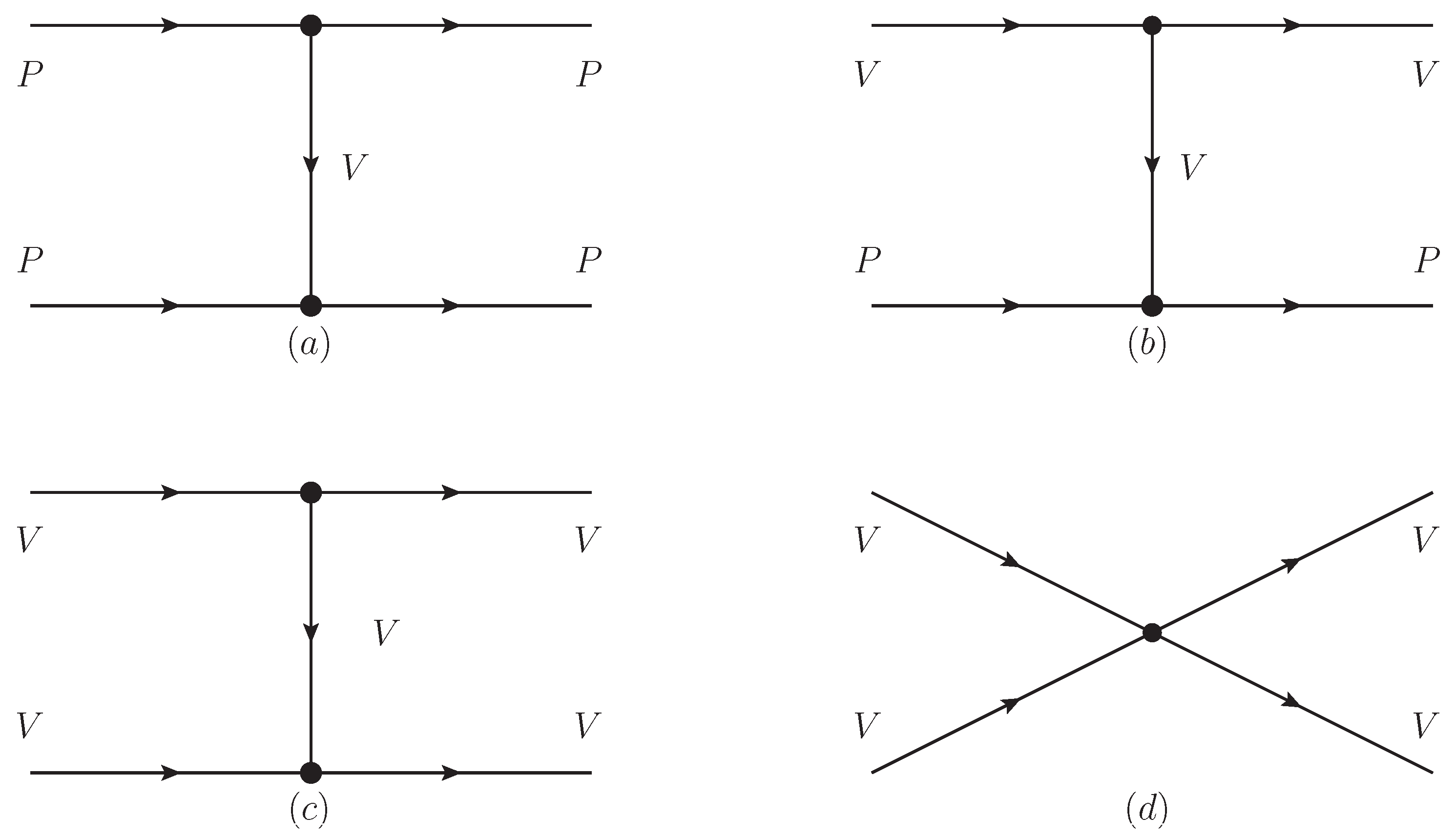
In Ref. [76], we applied extended local hidden-gauge formalism to study the interactions of the system. In this section, we follow the same approach to study the , , , , and systems. Note that the validity of extended local hidden-gauge formalism in these systems is still questionable. Within the framework of local hidden-gauge formalism [77,78], the vector mesons are considered to act as gauge bosons, transmitting interactions. This mechanism successfully describes many low-energy interactions [15,79,80,81,82], especially in processes dominated by the exchange of light vector mesons. Unfortunately, it is not clear whether this mechanism remains effective in the heavy flavor region. An extension of this method has also been developed to study molecular state candidates containing heavy quarks [15,20,83]. In these cases, generally, the exchange of light vector mesons and heavy vector mesons is allowed simultaneously. When the vector meson–vector meson interaction in the system is taken as an example, this system involves two coupling channels: and . In the channel, the exchange of and occurs simultaneously. Compared to the exchange, the exchange is considered to be secondary due to its larger mass. However, things are somewhat different in the channel. The minimal constituents for the exchanged meson should be , which we do not consider in local hidden-gauge formalism. Such a type of exchange mechanism should also be suppressed due to its involvement in the exchange of four quarks. On the other hand, the channel can couple with the channel, which allows for the exchange of the heavy vector meson between these two channels. Although the exchange of heavy vector mesons should be relatively minimal, it plays a role in this scenario. Under this assumption, results consistent with experiments can be obtained [83]. So, the present study, as well as Ref. [76], serve as pioneering research investigating fully heavy hadronic molecules. Within this framework, the interactions are primarily contributed via the vector meson exchange, as depicted in Figure 1. The corresponding Lagrangians are written as follows:
where
The coupling constant g is generally defined as , with being the mass of the exchanged vector meson and being the decay constant of its corresponding pseudoscalar meson. Since the charm and bottom quarks do not form a flavor symmetry, , we cannot use an overall parameter. For the exchange of the , , and mesons, we respectively use [84], [85], [86], [87], [84], [87]. Additionally, we use for the contact term, with denoting the four connected vector mesons.
Figure 1.
The meson–meson interactions arising from the vector meson exchange: (a) between two pseudoscalar mesons, (b) between one vector meson and one pseudoscalar meson, and (c) between two vector mesons. The subfigure (d) describes the contact term connecting four vector mesons.
We derive the following interaction potential from the Lagrangians given in Equation (1):
where and are four-momenta of the incoming mesons, and are four-momenta of the outgoing mesons, and are polarization vectors of the incoming mesons, and and are polarization vectors of the outgoing mesons. We use the subscripts , , and to denote the pseudoscalar–pseudoscalar, vector–pseudoscalar, and vector–vector sectors, respectively. We use the superscripts t, u, and to denote the vector meson exchange in the t and u channels, as well as the contact term, respectively. Note that the coefficient is zero because we only consider the vector meson exchange in the present study. Actually, there also exists the pseudoscalar meson exchange. As evaluated in detail in Refs. [88,89], the contribution of the pseudoscalar meson exchange is negligible near the threshold compared to the vector meson exchange. This is because the amplitude of the vector meson exchange is proportional to the energy of the external meson, while the amplitude of the pseudoscalar meson exchange is proportional to the three-momentum of the external meson, which is always negligible near the threshold.
We further derive the scattering amplitudes from Equations (3)–(6) by solving the Bethe–Salpeter equation as
where is the diagonal loop function, whose expression for the ith channel is
In the above expression, are the masses of the two mesons involved in this channel, and with p is the total four-momentum. We apply the cutoff method to regularize it as
where , , and is the cutoff momentum.
We shall calculate the coefficient matrices in the following subsections separately for the , , , , and systems. Before doing this, we summarize their relevant coupled channels in Table 1.
Table 1.
Coupled channels considered for the , , , , and systems.
2.1. The System
In the system, the interaction involves only one channel, , the interaction involves only one channel, , and the interaction also involves only one channel, . Additionally, the system can be similarly investigated.
Since the two vertices are both zero, and , the interactions in this system all vanish within the extended local hidden-gauge framework:
The system and the system exhibit very similar dynamic properties, with the only distinction being their mass differences. Consequently, they share the same coefficients listed in Equation (10), implying that the interactions within the system also vanish.
Therefore, our results do not support the existence of hadronic molecules in the and systems. Moreover, our conclusions do not actually depend on the value of the coupling constant g. As long as the near-threshold interactions in these systems are dominated by vector meson exchange and can be described by the Lagrangian in Equation (1), the validity of the conclusions can be maintained. Let us examine the specific form of the t-channel exchange potential in Equation (3):
where and are four-momenta of the incoming mesons, and are four-momenta of the outgoing mesons, q is a four-momentum of the exchanged meson and and are two coupling constants corresponding to the top and bottom vertices in Figure 1a. When the three-momenta of the particles are ignored and t is approximated as 0, the following simplification can be obtained:
It can be found that, if the particles in the channels are identical, i.e., , the interaction will be repulsive. Similar derivations also apply to the exchange potential in the u-channel. This indicates that the existence of near-threshold molecular states in channels similar to is difficult to support. The experimentally observed states in these systems are, therefore, good candidates to be tetraquark states.
2.2. The and Systems
The results for the and systems are the same, so we only need to study the system. Additionally, the and systems can be similarly investigated. In the system, the interaction involves only one channel, , whose coefficients are
The reduction factor existing in the u channel, is introduced to account for the large mass difference between the initial meson and the final meson (or between the initial meson and the final meson ). Following Ref. [90], numerically, we use
The coefficient is positive, indicating that the interaction due to the exchange of the meson is repulsive; hence, hadronic molecules in the PP sector are not expected to exist.
The interaction involves two coupled channels, and , whose coefficients are
Diagonalizing this matrix, we obtain two decoupled channels:
whose coefficient is
Hence, the interaction due to the exchange of the meson in the channel turns out to be attractive, so there may exist a hadronic molecule of in the sector.
The interaction involves only one channel, , whose coefficients are
The relevant contact term is
After performing the spin projection, we find the channel to be attractive, so there may exist a hadronic molecule of in the sector.
2.3. The and Systems
The results for the and systems are the same, so we only need to study the system. In this system, the interaction involves only one channel, , whose coefficients are
The interaction involves only one channel, , whose coefficient are
The interaction also involves only one channel, , whose coefficients are
The relevant contact term is
In sectors other than the sector, the coefficients are positive, corresponding to repulsive interactions. As for the sector, although the contact term provides an attractive potential of , the repulsive potential generated via the exchange of vector mesons is approximately at the threshold, resulting in an overall repulsive interaction. Therefore, in these sectors, the exchange of vector mesons cannot bind mesons together; hence, the above coefficients do not support the existence of hadronic molecules in the system.
3. Numerical Results
In the previous section, we studied the interactions of the , , , , and systems. In this section, we numerically study their properties. As shown in Equation (9), the loop function is regularized using the cutoff method, with the cutoff momentum describing the dynamical scale to be integrated out. Its value is quite uncertain for the exchange of fully heavy vector mesons, and we follow Ref. [76] in choosing a broad region, , to perform numerical analyses, since the authors of Refs. [91,92] have already found that the requirement of heavy quark symmetry demands the use of the same cutoff momentum in the charm and bottom sectors. We note that the value of this important parameter is quite uncertain for the exchange of fully heavy vector mesons, so the present study, as well as Ref. [76], serves as pioneering research investigating the fully heavy hadronic molecules, but there do exist large theoretical uncertainties.
Within the extended local hidden-gauge framework, the resonances are dynamically generated as poles of the scattering amplitudes . We find the existence of eight poles that may lead to some singular structures on the invariant mass spectrum. There exist two poles in the system and two poles in the system, which we shall discuss in detail later. We summarize their positions in Table 2 with respect to the cutoff momentum . Additionally, there exist four charge-conjugated poles in the and systems.
Table 2.
Pole positions with respect to the cutoff momentum in units of MeV. We only list the poles that correspond to the sub-threshold bound states.
We find two poles in the system: one pole in the sector and the other in the sector. However, both of them correspond to virtual states when the cutoff momentum is set to , so they can only result in some threshold effects. The pole in the sector corresponds to the sub-threshold bound state with , and the pole in the sector corresponds to the sub-threshold bound state with . We generally consider the cutoff momentum to be consistent with the chiral unitary approach, which takes MeV. This value reflects certain non-perturbative properties of QCD. However, it is important to note that the parameter also functions as a free parameter, absorbing some implicitly considered interactions, and as a result, it may deviate from 1200 MeV in practical applications. Empirically, is usually taken to fall within the range of 400 to 700 MeV. Given the uncertainties inherent to our work, we believe it is appropriate to extend this range to 400 to 1400 MeV. Therefore, our results do not support the existence of deeply bound hadronic molecules in the system.
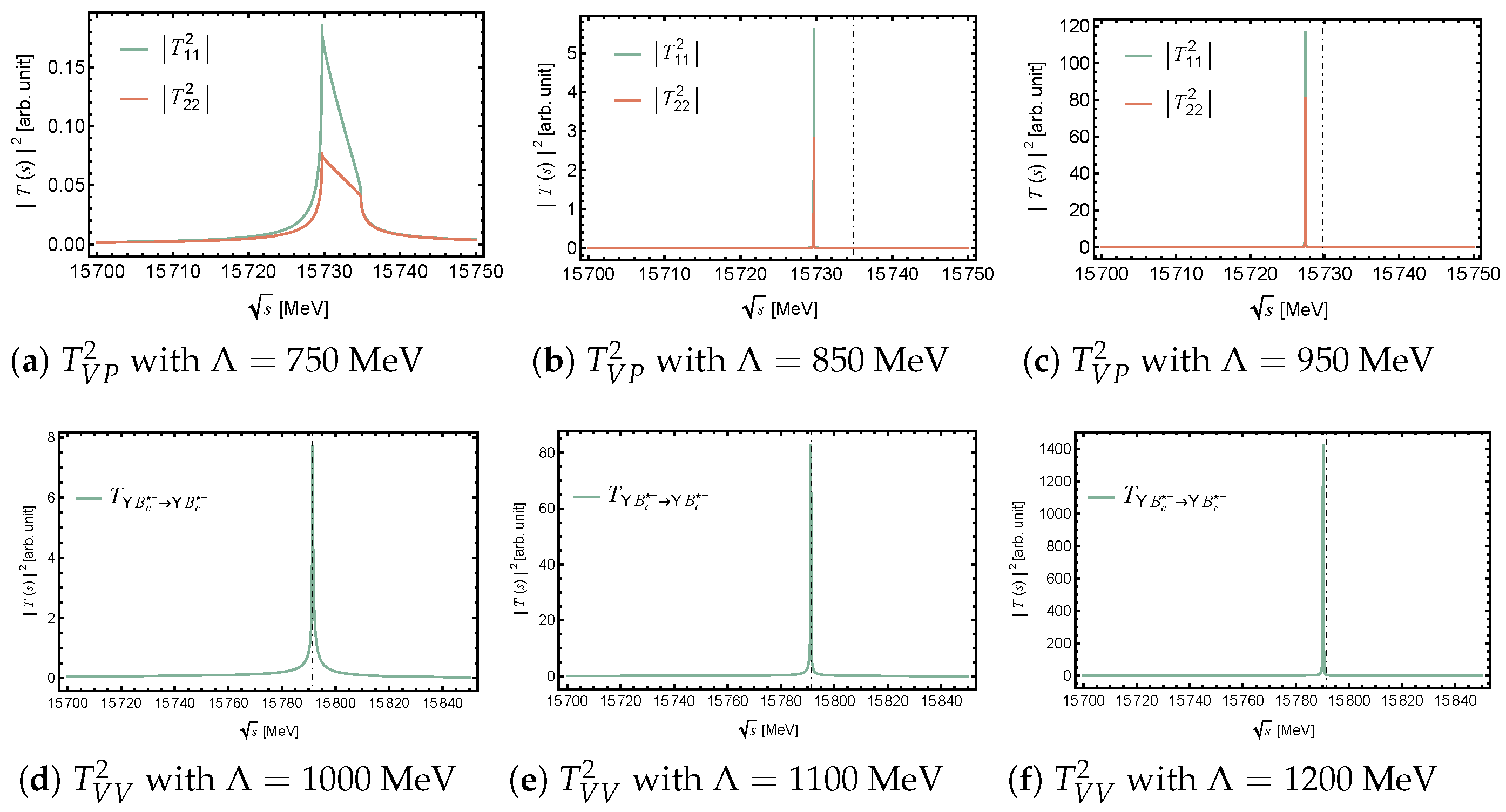
We also find two poles in the system: one pole in the sector and the other in the sector. The pole in the sector corresponds to the sub-threshold bound state when is set, making it possible to be identified as a hadronic molecule. This pole transfers to a virtual state and results in the threshold effect when is set. The pole in the sector corresponds to the sub-threshold bound state with . To illustrate these two poles, we present, in Figure 2, the transition amplitudes using several different values of the cutoff momentum .
Figure 2.
Line shapes of the transition amplitudes for the cutoff momentum (a) 750 MeV, (b) 850 MeV, and (c) 950 MeV in the sector, as well as (d) 1000 MeV, (e) 1100 MeV, and (f) 1200 MeV in the sector of the system. The relevant thresholds are indicated by dashed lines. In subfigures (a–c), the green line labeled and the red line labeled represent and , respectively.
4. Conclusions
In this paper, we have studied fully heavy meson–meson interactions with the quark constituents , , , , and through extended local hidden-gauge formalism. After solving the coupled-channel Bethe–Salpeter equation, we searched for poles on both the first (physical) and second Riemann sheets. The obtained results are summarized in Table 2 with respect to the cutoff momentum . We found two poles in the system (and two charge-conjugated poles in the system): the pole generated in the sector corresponds to the sub-threshold bound state when the cutoff momentum is set, and the pole generated in the sector corresponds to the sub-threshold bound state with . These two poles are potential fully heavy hadronic molecules, and we propose to investigate them in the channel at LHC. However, our results do not support the existence of hadronic molecules in the , , , and systems.
Additionally, the system has already been investigated in our previous study [76], where we found the existence of the fully heavy hadronic molecules , , and , as well as the possible existence of . We further proposed in Ref. [76] that a lower-mass fully heavy meson may be able to bind two higher-mass fully heavy hadrons. The results obtained in the present study are consistent with this proposal: the exchanged mesons of the and systems are both the meson, but the larger mass of the system facilitates the formation of bound states. It is a topic of considerable interest whether the interaction of the heavy meson exchange is strong enough to form hadronic molecules. This question serves as a crucial test for the extensively investigated interaction of the light meson exchange. Therefore, the present study, as well as Ref. [76], both of which concentrate on the interaction of the fully heavy meson exchange, are of particular interest.
Author Contributions
Conceptualization, W.-Y.L. and H.-X.C.; methodology, W.-Y.L. and H.-X.C.; software, W.-Y.L.; validation, W.-Y.L.; formal analysis, W.-Y.L.; investigation, W.-Y.L.; resources, W.-Y.L.; data curation, W.-Y.L.; writing—original draft preparation, W.-Y.L. and H.-X.C.; writing—review and editing, W.-Y.L. and H.-X.C.; visualization, W.-Y.L.; supervision, H.-X.C.; project administration, H.-X.C.; funding acquisition, H.-X.C. All authors have read and agreed to the published version of the manuscript.
Funding
This project is supported by the National Natural Science Foundation of China under Grant No. 12075019, the Jiangsu Provincial Double-Innovation Program under Grant No. JSSCRC2021488, and the Fundamental Research Funds for the Central Universities.
Data Availability Statement
No new data were created or analyzed in this study.
Conflicts of Interest
The authors declare no conflicts of interest.
References
- Liu, Y.R.; Chen, H.X.; Chen, W.; Liu, X.; Zhu, S.L. Pentaquark and Tetraquark States. Prog. Part. Nucl. Phys. 2019, 107, 237–320. [Google Scholar] [CrossRef]
- Chen, H.X.; Chen, W.; Liu, X.; Liu, Y.R.; Zhu, S.L. An updated review of the new hadron states. Rep. Prog. Phys. 2023, 86, 026201. [Google Scholar] [CrossRef]
- Guo, F.K.; Hanhart, C.; Meißner, U.G.; Wang, Q.; Zhao, Q.; Zou, B.S. Hadronic molecules. Rev. Mod. Phys. 2018, 90, 015004. [Google Scholar] [CrossRef]
- Brambilla, N.; Eidelman, S.; Hanhart, C.; Nefediev, A.; Shen, C.P.; Thomas, C.E.; Vairo, A.; Yuan, C.Z. The XYZ states: Experimental and theoretical status and perspectives. Phys. Rep. 2020, 873, 1–154. [Google Scholar] [CrossRef]
- Esposito, A.; Pilloni, A.; Polosa, A.D. Multiquark resonances. Phys. Rep. 2017, 668, 1–97. [Google Scholar] [CrossRef]
- Lebed, R.F.; Mitchell, R.E.; Swanson, E.S. Heavy-quark QCD exotica. Prog. Part. Nucl. Phys. 2017, 93, 143–194. [Google Scholar] [CrossRef]
- Ali, A.; Lange, J.S.; Stone, S. Exotics: Heavy pentaquarks and tetraquarks. Prog. Part. Nucl. Phys. 2017, 97, 123–198. [Google Scholar] [CrossRef]
- Oller, J.A.; Oset, E. Chiral symmetry amplitudes in the S wave isoscalar and isovector channels and the σ, f0(980), a0(980) scalar mesons. Nucl. Phys. A 1997, 620, 438–456. [Google Scholar] [CrossRef]
- Oller, J.A.; Oset, E.; Pelaez, J.R. Meson meson interaction in a nonperturbative chiral approach. Phys. Rev. D 1999, 59, 074001, Erratum in Phys. Rev. D 1999, 60, 099906; Phys. Rev. D 2007, 75, 099903. [Google Scholar] [CrossRef]
- Oset, E.; Ramos, A. Nonperturbative chiral approach to s wave anti-K N interactions. Nucl. Phys. A 1998, 635, 99–120. [Google Scholar] [CrossRef]
- Jido, D.; Oller, J.A.; Oset, E.; Ramos, A.; Meissner, U.G. Chiral dynamics of the two Lambda(1405) states. Nucl. Phys. A 2003, 725, 181–200. [Google Scholar] [CrossRef]
- Bruns, P.C.; Mai, M.; Meissner, U.G. Chiral dynamics of the S11(1535) and S11(1650) resonances revisited. Phys. Lett. B 2011, 697, 254–259. [Google Scholar] [CrossRef]
- Garcia-Recio, C.; Lutz, M.F.M.; Nieves, J. Quark mass dependence of s wave baryon resonances. Phys. Lett. B 2004, 582, 49–54. [Google Scholar] [CrossRef]
- Hyodo, T.; Nam, S.I.; Jido, D.; Hosaka, A. Flavor SU(3) breaking effects in the chiral unitary model for meson baryon scatterings. Phys. Rev. C 2003, 68, 018201. [Google Scholar] [CrossRef]
- Wu, J.J.; Molina, R.; Oset, E.; Zou, B.S. Prediction of Narrow N* and Λ* Resonances with Hidden Charm above 4 GeV. Phys. Rev. Lett. 2010, 105, 232001. [Google Scholar] [CrossRef] [PubMed]
- Wu, J.J.; Molina, R.; Oset, E.; Zou, B.S. Dynamically generated N* and Λ* resonances in the hidden charm sector around 4.3 GeV. Phys. Rev. C 2011, 84, 015202. [Google Scholar] [CrossRef]
- Chen, H.X.; Geng, L.S.; Liang, W.H.; Oset, E.; Wang, E.; Xie, J.J. Looking for a hidden-charm pentaquark state with strangeness S = −1 from decay into J/ψK−Λ. Phys. Rev. C 2016, 93, 065203. [Google Scholar] [CrossRef]
- He, J. and interactions and the LHCb hidden-charmed pentaquarks. Phys. Lett. B 2016, 753, 547–551. [Google Scholar] [CrossRef]
- Xiao, C.W.; Nieves, J.; Oset, E. Combining heavy quark spin and local hidden gauge symmetries in the dynamical generation of hidden charm baryons. Phys. Rev. D 2013, 88, 056012. [Google Scholar] [CrossRef]
- Roca, L.; Nieves, J.; Oset, E. LHCb pentaquark as a Σc − molecular state. Phys. Rev. D 2015, 92, 094003. [Google Scholar] [CrossRef]
- Liu, X.H.; Wang, Q.; Zhao, Q. Understanding the newly observed heavy pentaquark candidates. Phys. Lett. B 2016, 757, 231–236. [Google Scholar] [CrossRef]
- Uchino, T.; Liang, W.H.; Oset, E. Baryon states with hidden charm in the extended local hidden gauge approach. Eur. Phys. J. A 2016, 52, 43. [Google Scholar] [CrossRef]
- Aaij, R. et al. [LHCb Collaboration] Observation of structure in the J/ψ-pair mass spectrum. Sci. Bull. 2020, 65, 1983–1993. [Google Scholar] [CrossRef]
- Aad, G. et al. [ATLAS Collaboration] Observation of an Excess of Dicharmonium Events in the Four-Muon Final State with the ATLAS Detector. Phys. Rev. Lett. 2023, 131, 151902. [Google Scholar] [CrossRef] [PubMed]
- Hayrapetyan, A. et al. [CMS Collaboration] Observation of new structure in the J/ψJ/ψ mass spectrum in proton-proton collisions at = 13 TeV. arXiv 2023, arXiv:hep-ex/2306.07164. [Google Scholar]
- Liu, M.S.; Liu, F.X.; Zhong, X.H.; Zhao, Q. Full-heavy tetraquark states and their evidences in the LHCb di-J/ψ spectrum. arXiv 2020, arXiv:hep-ph/2006.11952. [Google Scholar]
- Tiwari, R.; Rathaud, D.P.; Rai, A.K. Spectroscopy of all charm tetraquark states. arXiv 2021, arXiv:hep-ph/2108.04017. [Google Scholar] [CrossRef]
- Lü, Q.F.; Chen, D.Y.; Dong, Y.B. Masses of fully heavy tetraquarks in an extended relativized quark model. Eur. Phys. J. C 2020, 80, 871. [Google Scholar] [CrossRef]
- Faustov, R.N.; Galkin, V.O.; Savchenko, E.M. Masses of the tetraquarks in the relativistic diquark-antidiquark picture. Phys. Rev. D 2020, 102, 114030. [Google Scholar] [CrossRef]
- Zhang, J.R. 0+ fully-charmed tetraquark states. Phys. Rev. D 2021, 103, 014018. [Google Scholar] [CrossRef]
- Li, Q.; Chang, C.H.; Wang, G.L.; Wang, T. Mass spectra and wave functions of tetraquarks. Phys. Rev. D 2021, 104, 014018. [Google Scholar] [CrossRef]
- Bedolla, M.A.; Ferretti, J.; Roberts, C.D.; Santopinto, E. Spectrum of fully-heavy tetraquarks from a diquark+antidiquark perspective. Eur. Phys. J. C 2020, 80, 1004. [Google Scholar] [CrossRef]
- Weng, X.Z.; Chen, X.L.; Deng, W.Z.; Zhu, S.L. Systematics of fully heavy tetraquarks. Phys. Rev. D 2021, 103, 034001. [Google Scholar] [CrossRef]
- Liu, F.X.; Liu, M.S.; Zhong, X.H.; Zhao, Q. Higher mass spectra of the fully-charmed and fully-bottom tetraquarks. Phys. Rev. D 2021, 104, 116029. [Google Scholar] [CrossRef]
- Giron, J.F.; Lebed, R.F. Simple spectrum of states in the dynamical diquark model. Phys. Rev. D 2020, 102, 074003. [Google Scholar] [CrossRef]
- Karliner, M.; Rosner, J.L. Interpretation of structure in the di-J/ψ spectrum. Phys. Rev. D 2020, 102, 114039. [Google Scholar] [CrossRef]
- Zhao, Z.; Xu, K.; Kaewsnod, A.; Liu, X.; Limphirat, A.; Yan, Y. Study of charmoniumlike and fully-charm tetraquark spectroscopy. Phys. Rev. D 2021, 103, 116027. [Google Scholar] [CrossRef]
- Mutuk, H. Nonrelativistic treatment of fully-heavy tetraquarks as diquark-antidiquark states. Eur. Phys. J. C 2021, 81, 367. [Google Scholar] [CrossRef]
- Wang, G.J.; Meng, L.; Oka, M.; Zhu, S.L. Higher fully charmed tetraquarks: Radial excitations and P-wave states. Phys. Rev. D 2021, 104, 036016. [Google Scholar] [CrossRef]
- Wang, Z.G. Tetraquark candidates in the LHCb’s di-J/ψ mass spectrum. Chin. Phys. C 2020, 44, 113106. [Google Scholar] [CrossRef]
- Ke, H.W.; Han, X.; Liu, X.H.; Shi, Y.L. Tetraquark state X(6900) and the interaction between diquark and antidiquark. Eur. Phys. J. C 2021, 81, 427. [Google Scholar] [CrossRef]
- Zhu, R. Fully-heavy tetraquark spectra and production at hadron colliders. Nucl. Phys. B 2021, 966, 115393. [Google Scholar] [CrossRef]
- Jin, X.; Xue, Y.; Huang, H.; Ping, J. Full-heavy tetraquarks in constituent quark models. Eur. Phys. J. C 2020, 80, 1083. [Google Scholar] [CrossRef]
- Yang, G.; Ping, J.; Segovia, J. Exotic resonances of fully-heavy tetraquarks in a lattice-QCD insipired quark model. Phys. Rev. D 2021, 104, 014006. [Google Scholar] [CrossRef]
- Albuquerque, R.M.; Narison, S.; Rabemananjara, A.; Rabetiarivony, D.; Randriamanatrika, G. Doubly-hidden scalar heavy molecules and tetraquarks states from QCD at NLO. Phys. Rev. D 2020, 102, 094001. [Google Scholar] [CrossRef]
- Albuquerque, R.M.; Narison, S.; Rabetiarivony, D.; Randriamanatrika, G. Doubly hidden 0++ molecules and tetraquarks states from QCD at NLO. Nucl. Part. Phys. Proc. 2021, 312-317, 15289. [Google Scholar] [CrossRef]
- Wu, R.H.; Zuo, Y.S.; Wang, C.Y.; Meng, C.; Ma, Y.Q.; Chao, K.T. NLO results with operator mixing for fully heavy tetraquarks in QCD sum rules. arXiv 2022, arXiv:hep-ph/2201.11714. [Google Scholar]
- Asadi, Z.; Boroun, G.R. Masses of fully heavy tetraquark states from a four-quark static potential model. Phys. Rev. D 2022, 105, 014006. [Google Scholar] [CrossRef]
- Yang, B.C.; Tang, L.; Qiao, C.F. Scalar fully-heavy tetraquark states in QCD sum rules. Eur. Phys. J. C 2021, 81, 324. [Google Scholar] [CrossRef]
- Feng, F.; Huang, Y.; Jia, Y.; Sang, W.L.; Xiong, X.; Zhang, J.Y. Fragmentation production of fully-charmed tetraquarks at LHC. arXiv 2020, arXiv:hep-ph/2009.08450. [Google Scholar]
- Ma, Y.Q.; Zhang, H.F. Exploring the Di-J/ψ Resonances around 6.9 GeV Based on ab initio Perturbative QCD. arXiv 2020, arXiv:hep-ph/2009.08376. [Google Scholar]
- Maciuła, R.; Schäfer, W.; Szczurek, A. On the mechanism of T4c(6900) tetraquark production. Phys. Lett. B 2021, 812, 136010. [Google Scholar] [CrossRef]
- Gonçalves, V.P.; Moreira, B.D. Fully-heavy tetraquark production by γγ interactions in hadronic collisions at the LHC. Phys. Lett. B 2021, 816, 136249. [Google Scholar] [CrossRef]
- Wang, X.Y.; Lin, Q.Y.; Xu, H.; Xie, Y.P.; Huang, Y.; Chen, X. Discovery potential for the LHCb fully-charm tetraquark X(6900) state via annihilation reaction. Phys. Rev. D 2020, 102, 116014. [Google Scholar] [CrossRef]
- Esposito, A.; Manzari, C.A.; Pilloni, A.; Polosa, A.D. Hunting for tetraquarks in ultraperipheral heavy ion collisions. Phys. Rev. D 2021, 104, 114029. [Google Scholar] [CrossRef]
- Zhuang, Z.; Zhang, Y.; Ma, Y.; Wang, Q. The lineshape of the compact fully heavy tetraquark. arXiv 2021, arXiv:hep-ph/2111.14028. [Google Scholar] [CrossRef]
- Zhao, J.; Shi, S.; Zhuang, P. Fully-heavy tetraquarks in a strongly interacting medium. Phys. Rev. D 2020, 102, 114001. [Google Scholar] [CrossRef]
- Becchi, C.; Ferretti, J.; Giachino, A.; Maiani, L.; Santopinto, E. A study of tetraquark decays in 4 muons and in at LHC. Phys. Lett. B 2020, 811, 135952. [Google Scholar] [CrossRef]
- Sonnenschein, J.; Weissman, D. Deciphering the recently discovered tetraquark candidates around 6.9 GeV. Eur. Phys. J. C 2021, 81, 25. [Google Scholar] [CrossRef]
- Zhu, J.W.; Guo, X.D.; Zhang, R.Y.; Ma, W.G.; Li, X.Q. A possible interpretation for X(6900) observed in four-muon final state by LHCb—A light Higgs-like boson? arXiv 2020, arXiv:hep-ph/2011.07799. [Google Scholar]
- Wan, B.D.; Qiao, C.F. Gluonic tetracharm configuration of X(6900). Phys. Lett. B 2021, 817, 136339. [Google Scholar] [CrossRef]
- Gordillo, M.C.; De Soto, F.; Segovia, J. Diffusion Monte Carlo calculations of fully-heavy multiquark bound states. Phys. Rev. D 2020, 102, 114007. [Google Scholar] [CrossRef]
- Liu, M.Z.; Geng, L.S. Is X(7200) the heavy anti-quark diquark symmetry partner of X(3872)? Eur. Phys. J. C 2021, 81, 179. [Google Scholar] [CrossRef]
- Majarshin, A.J.; Luo, Y.A.; Pan, F.; Segovia, J. Bosonic algebraic approach applied to the tetraquarks. Phys. Rev. D 2022, 105, 054024. [Google Scholar] [CrossRef]
- Kuang, Z.; Serafin, K.; Zhao, X.; Vary, J.P. All-charm tetraquark in front form dynamics. Phys. Rev. D 2022, 105, 094028. [Google Scholar] [CrossRef]
- Wang, Q.N.; Yang, Z.Y.; Chen, W. Exotic fully-heavy tetraquark states in color configuration. Phys. Rev. D 2021, 104, 114037. [Google Scholar] [CrossRef]
- Chen, W.; Chen, H.X.; Liu, X.; Steele, T.G.; Zhu, S.L. Hunting for exotic doubly hidden-charm/bottom tetraquark states. Phys. Lett. B 2017, 773, 247–251. [Google Scholar] [CrossRef]
- Czarnecki, A.; Leng, B.; Voloshin, M.B. Stability of tetrons. Phys. Lett. B 2018, 778, 233–238. [Google Scholar] [CrossRef]
- Guo, Z.H.; Oller, J.A. Insights into the inner structures of the fully charmed tetraquark state X(6900). Phys. Rev. D 2021, 103, 034024. [Google Scholar] [CrossRef]
- Cao, Q.F.; Chen, H.; Qi, H.R.; Zheng, H.Q. Some remarks on X(6900). Chin. Phys. C 2021, 45, 103102. [Google Scholar] [CrossRef]
- Gong, C.; Du, M.C.; Zhao, Q.; Zhong, X.H.; Zhou, B. Nature of X(6900) and its production mechanism at LHCb. Phys. Lett. B 2022, 824, 136794. [Google Scholar] [CrossRef]
- Dong, X.K.; Baru, V.; Guo, F.K.; Hanhart, C.; Nefediev, A.; Zou, B.S. Is the existence of a J/ψJ/ψ bound state plausible? Sci. Bull. 2021, 66, 1577. [Google Scholar] [CrossRef] [PubMed]
- Ortega, P.G.; Entem, D.R.; Fernández, F. Exploring Tψψ tetraquark candidates in a coupled-channels formalism. Phys. Rev. D 2023, 108, 094023. [Google Scholar] [CrossRef]
- Wang, G.J.; Meng, Q.; Oka, M. S-wave fully charmed tetraquark resonant states. Phys. Rev. D 2022, 106, 096005. [Google Scholar] [CrossRef]
- Zhou, Q.; Guo, D.; Kuang, S.Q.; Yang, Q.H.; Dai, L.Y. Nature of the X(6900) in partial wave decomposition of J/ψJ/ψ scattering. Phys. Rev. D 2022, 106, L111502. [Google Scholar] [CrossRef]
- Liu, W.Y.; Chen, H.X. Fully-heavy hadronic molecules bound by fully-heavy mesons. arXiv 2023, arXiv:hep-ph/2312.11212. [Google Scholar]
- Bando, M.; Kugo, T.; Yamawaki, K. Nonlinear Realization and Hidden Local Symmetries. Phys. Rep. 1988, 164, 217–314. [Google Scholar] [CrossRef]
- Meissner, U.G. Low-Energy Hadron Physics from Effective Chiral Lagrangians with Vector Mesons. Phys. Rep. 1988, 161, 213. [Google Scholar] [CrossRef]
- Oset, E.; Ramos, A. Dynamically generated resonances from the vector octet-baryon octet interaction. Eur. Phys. J. A 2010, 44, 445–454. [Google Scholar] [CrossRef]
- Aceti, F.; Bayar, M.; Oset, E.; Martinez Torres, A.; Khemchandani, K.P.; Dias, J.M.; Navarra, F.S.; Nielsen, M. Prediction of an I = 1 state and relationship to the claimed Zc(3900), Zc(3885). Phys. Rev. D 2014, 90, 016003. [Google Scholar] [CrossRef]
- Geng, L.S.; Oset, E. Vector meson-vector meson interaction in a hidden gauge unitary approach. Phys. Rev. D 2009, 79, 074009. [Google Scholar] [CrossRef]
- Nagahiro, H.; Roca, L.; Hosaka, A.; Oset, E. Hidden gauge formalism for the radiative decays of axial-vector mesons. Phys. Rev. D 2009, 79, 014015. [Google Scholar] [CrossRef]
- Molina, R.; Oset, E. The Y(3940), Z(3930) and the X(4160) as dynamically generated resonances from the vector-vector interaction. Phys. Rev. D 2009, 80, 114013. [Google Scholar] [CrossRef]
- Workman, R.L. et al. [Particle Data Group] Review of Particle Physics. Prog. Theor. Exp. Phys. 2022, 2022, 083C01. [Google Scholar] [CrossRef]
- Bečirević, D.; Duplančić, G.; Klajn, B.; Melić, B.; Sanfilippo, F. Lattice QCD and QCD sum rule determination of the decay constants of ηc, J/ψ and hc states. Nucl. Phys. B 2014, 883, 306–327. [Google Scholar] [CrossRef]
- Mathur, N.; Padmanath, M.; Mondal, S. Precise predictions of charmed-bottom hadrons from lattice QCD. Phys. Rev. Lett. 2018, 121, 202002. [Google Scholar] [CrossRef] [PubMed]
- McNeile, C.; Davies, C.T.H.; Follana, E.; Hornbostel, K.; Lepage, G.P. Heavy meson masses and decay constants from relativistic heavy quarks in full lattice QCD. Phys. Rev. D 2012, 86, 074503. [Google Scholar] [CrossRef]
- Aceti, F.; Bayar, M.; Dias, J.M.; Oset, E. Prediction of a Zc(4000) state and relationship to the claimed Zc(4025). Eur. Phys. J. A 2014, 50, 103. [Google Scholar] [CrossRef]
- Oset, E.; Roca, L. Exotic molecular meson states of B(*)K(*) nature. Eur. Phys. J. C 2022, 82, 882, Erratum in Eur. Phys. J. C 2022, 82, 1014. [Google Scholar] [CrossRef]
- Yu, Q.X.; Pavao, R.; Debastiani, V.R.; Oset, E. Description of the Ξc and Ξb states as molecular states. Eur. Phys. J. C 2019, 79, 167. [Google Scholar] [CrossRef]
- Lu, J.X.; Zhou, Y.; Chen, H.X.; Xie, J.J.; Geng, L.S. Dynamically generated JP = 1/2−(3/2−) singly charmed and bottom heavy baryons. Phys. Rev. D 2015, 92, 014036. [Google Scholar] [CrossRef]
- Ozpineci, A.; Xiao, C.W.; Oset, E. Hidden beauty molecules within the local hidden gauge approach and heavy quark spin symmetry. Phys. Rev. D 2013, 88, 034018. [Google Scholar] [CrossRef]
Disclaimer/Publisher’s Note: The statements, opinions and data contained in all publications are solely those of the individual author(s) and contributor(s) and not of MDPI and/or the editor(s). MDPI and/or the editor(s) disclaim responsibility for any injury to people or property resulting from any ideas, methods, instructions or products referred to in the content. |
© 2025 by the authors. Licensee MDPI, Basel, Switzerland. This article is an open access article distributed under the terms and conditions of the Creative Commons Attribution (CC BY) license (https://creativecommons.org/licenses/by/4.0/).