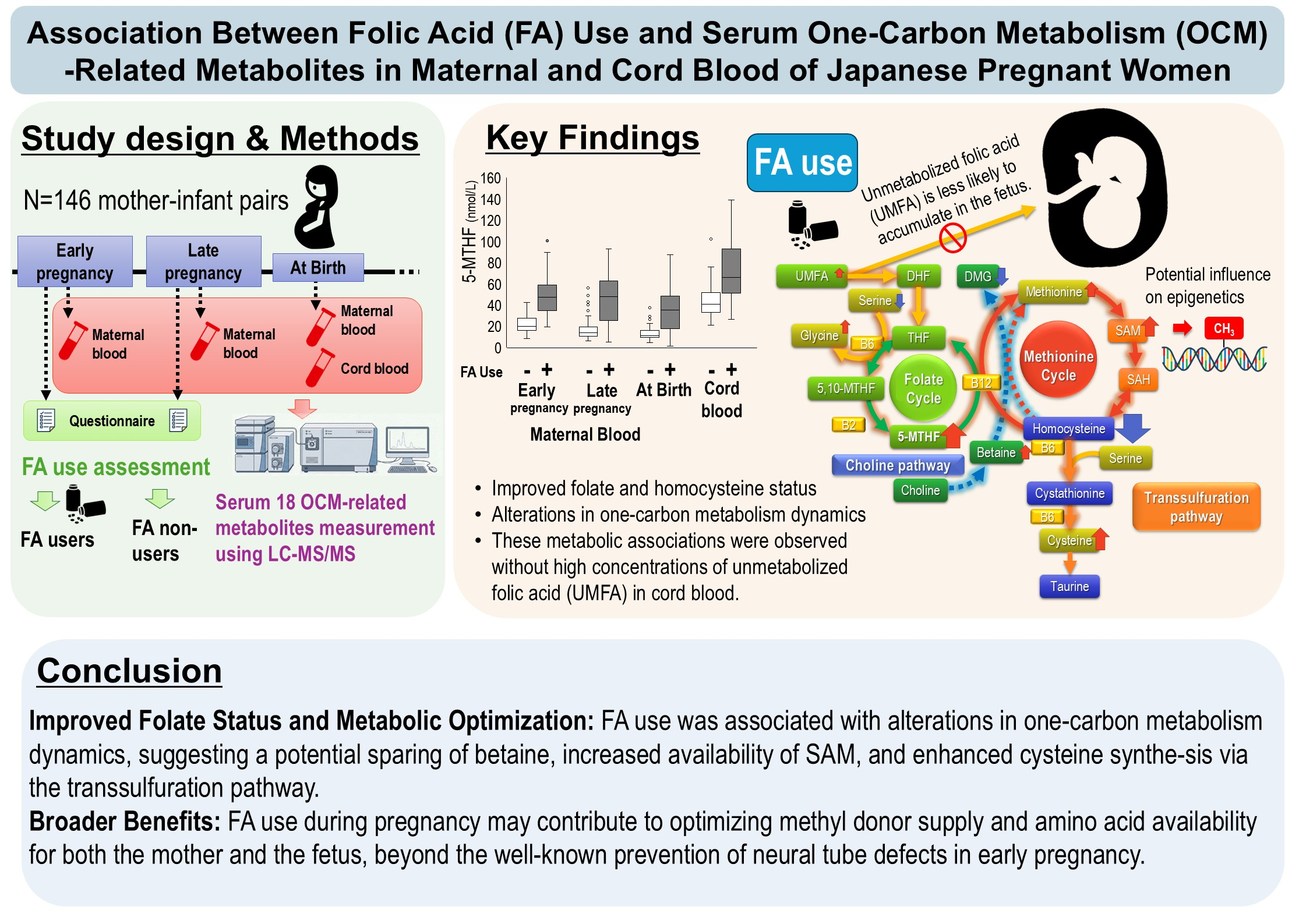

Association Between Folic Acid Use and Serum One-Carbon Metabolism-Related Metabolites in Maternal and Cord Blood of Japanese Pregnant Women

 ,
,  , , , and
Abstract
1. Introduction
2. Materials and Methods
2.1. Participants
2.2. Study Design
2.3. Measurement of Serum OCM-Related Metabolites
2.4. Dietary Assessment and Definition of Folic Acid Users
2.5. Dietary Folate Intake Assessment
2.6. Maternal and Neonatal Information
2.7. Statistical Analysis
3. Results
3.1. Characteristics of Study Participants
3.2. Folic Acid and Dietary Folate Intake
3.3. Serum OCM-Related Metabolite Concentrations
3.3.1. Folate Cycle
3.3.2. Choline Metabolic Pathway
3.3.3. Methionine Cycle
3.3.4. Transsulfuration Pathway
3.3.5. Vitamins
3.4. Correlations Between Maternal Blood at Delivery and Cord Blood
3.5. Cord Blood to Maternal Blood Ratios
4. Discussion
5. Conclusions
Supplementary Materials
Author Contributions
Funding
Institutional Review Board Statement
Informed Consent Statement
Data Availability Statement
Acknowledgments
Conflicts of Interest
Abbreviations
| 5-MTHF | 5-methyl tetrahydrofolate |
| BDHQ | Brief-type self-administered diet history questionnaire |
| BHMT | Betaine–homocysteine methyltransferase |
| BMI | Body mass index |
| C-MACH | Chiba study of Mother and Child Health |
| DMG | Dimethylglycine |
| DOHaD | Developmental Origins of Health and Disease |
| FA | Folic acid |
| Hcy | Homocysteine |
| LC-MS/MS | Liquid chromatography-tandem mass spectrometry |
| MS | Methionine synthase |
| NCDs | Non-communicable diseases |
| OCM | One-carbon metabolism |
| SAH | S-adenosylhomocysteine |
| SAM | S-adenosylmethionine |
| SHMT | Serine hydroxymethyltransferase |
| tCys | Total cysteine |
| tHcy | Total homocysteine |
| UMFA | Unmetabolized folic acid |
References
- Steegers-Theunissen, R.P.; Twigt, J.; Pestinger, V.; Sinclair, K.D. The periconceptional period, reproduction and long-term health of offspring: The importance of one-carbon metabolism. Hum. Reprod. Update 2013, 19, 640–655. [Google Scholar] [CrossRef]
- Godfrey, K.M.; Lillycrop, K.A.; Burdge, G.C.; Gluckman, P.D.; Hanson, M.A. Epigenetic mechanisms and the mismatch concept of the developmental origins of health and disease. Pediatr. Res. 2007, 61, 5R–10R. [Google Scholar] [CrossRef]
- Waterland, R.A.; Michels, K.B. Epigenetic epidemiology of the developmental origins hypothesis. Annu. Rev. Nutr. 2007, 27, 363–388. [Google Scholar] [CrossRef]
- Reik, W.; Walter, J. Genomic imprinting: Parental influence on the genome. Nat. Rev. Genet. 2001, 2, 21–32. [Google Scholar] [CrossRef]
- Bortz, J.; Obeid, R. The Shuttling of Methyl Groups Between Folate and Choline Pathways. Nutrients 2025, 17, 2495. [Google Scholar] [CrossRef]
- Zeisel, S.H. Importance of methyl donors during reproduction. Am. J. Clin. Nutr. 2009, 89, 673S–677S. [Google Scholar] [CrossRef]
- Tibbetts, A.S.; Appling, D.R. Compartmentalization of Mammalian folate-mediated one-carbon metabolism. Annu. Rev. Nutr. 2010, 30, 57–81. [Google Scholar] [CrossRef]
- Hoffbrand, A.V.; Weir, D.G. The history of folic acid. Br. J. Haematol. 2001, 113, 579–589. [Google Scholar] [CrossRef]
- Stover, P.J.; Field, M.S. Trafficking of intracellular folates. Adv. Nutr. 2011, 2, 325–331. [Google Scholar] [CrossRef]
- Fox, J.T.; Stover, P.J. Folate-mediated one-carbon metabolism. Vitam. Horm. 2008, 79, 1–44. [Google Scholar] [CrossRef]
- Clare, C.E.; Brassington, A.H.; Kwong, W.Y.; Sinclair, K.D. One-Carbon Metabolism: Linking Nutritional Biochemistry to Epigenetic Programming of Long-Term Development. Annu. Rev. Anim. Biosci. 2019, 7, 263–287. [Google Scholar] [CrossRef]
- Kubo, Y.; Fukuoka, H.; Kawabata, T.; Shoji, K.; Mori, C.; Sakurai, K.; Nishikawa, M.; Ohkubo, T.; Oshida, K.; Yanagisawa, N.; et al. Distribution of 5-Methyltetrahydrofolate and Folic Acid Levels in Maternal and Cord Blood Serum: Longitudinal Evaluation of Japanese Pregnant Women. Nutrients 2020, 12, 1633. [Google Scholar] [CrossRef]
- Kubo, Y.; Fukuoka, H.; Shoji, K.; Mori, C.; Sakurai, K.; Nishikawa, M.; Oshida, K.; Yamashiro, Y.; Kawabata, T. Longitudinal Analysis of One-Carbon Metabolism-Related Metabolites in Maternal and Cord Blood of Japanese Pregnant Women. Nutrients 2024, 16, 1765. [Google Scholar] [CrossRef]
- Kubo, Y.; Shoji, K.; Tajima, A.; Horiguchi, S.; Fukuoka, H.; Nishikawa, M.; Kagawa, Y.; Kawabata, T. Serum 5-Methyltetrahydrofolate Status Is Associated with One-Carbon Metabolism-Related Metabolite Concentrations and Enzyme Activity Indicators in Young Women. Int. J. Mol. Sci. 2023, 24, 10993. [Google Scholar] [CrossRef]
- Scaglione, F.; Panzavolta, G. Folate, folic acid and 5-methyltetrahydrofolate are not the same thing. Xenobiotica 2014, 44, 480–488. [Google Scholar] [CrossRef]
- Saini, R.K.; Nile, S.H.; Keum, Y.S. Folates: Chemistry, analysis, occurrence, biofortification and bioavailability. Food Res. Int. 2016, 89, 1–13. [Google Scholar] [CrossRef]
- Delchier, N.; Herbig, A.-L.; Rychlik, M.; Renard, C.M.G.C. Folates in Fruits and Vegetables: Contents, Processing, and Stability. Compr. Rev. Food Sci. Food Saf. 2016, 15, 506–528. [Google Scholar] [CrossRef]
- Konings, E.J.; Roomans, H.H.; Dorant, E.; Goldbohm, R.A.; Saris, W.H.; van den Brandt, P.A. Folate intake of the Dutch population according to newly established liquid chromatography data for foods. Am. J. Clin. Nutr. 2001, 73, 765–776. [Google Scholar] [CrossRef]
- Visentin, M.; Diop-Bove, N.; Zhao, R.; Goldman, I.D. The intestinal absorption of folates. Annu. Rev. Physiol. 2014, 76, 251–274. [Google Scholar] [CrossRef]
- Melse-Boonstra, A.; Verhoef, P.; Konings, E.J.; Van Dusseldorp, M.; Matser, A.; Hollman, P.C.; Meyboom, S.; Kok, F.J.; West, C.E. Influence of processing on total, monoglutamate and polyglutamate folate contents of leeks, cauliflower, and green beans. J. Agric. Food Chem. 2002, 50, 3473–3478. [Google Scholar] [CrossRef]
- Indrawati; Arroqui, C.; Messagie, I.; Nguyen, M.T.; Van Loey, A.; Hendrickx, M. Comparative study on pressure and temperature stability of 5-methyltetrahydrofolic acid in model systems and in food products. J. Agric. Food Chem. 2004, 52, 485–492. [Google Scholar] [CrossRef]
- Caudill, M.A. Folate bioavailability: Implications for establishing dietary recommendations and optimizing status. Am. J. Clin. Nutr. 2010, 91, 1455S–1460S. [Google Scholar] [CrossRef] [PubMed]
- Mnkeni, A.P.; Beveridge, T. Thermal Destruction of Pteroylglutamic Acid in Buffer and Model Food Systems. J. Food Sci. 1982, 47, 2038–2041. [Google Scholar] [CrossRef]
- Paine-Wilson, B.; Chen, T.S. Thermal destruction of folacin: Effect of pH and buffer ions. J. Food Sci. 1979, 44, 717–722. [Google Scholar] [CrossRef]
- Steindal, A.H.; Juzeniene, A.; Johnsson, A.; Moan, J. Photodegradation of 5-methyltetrahydrofolate: Biophysical aspects. Photochem. Photobiol. 2006, 82, 1651–1655. [Google Scholar] [CrossRef]
- Melse-Boonstra, A.; Verhoef, P.; West, C. Quantifying folate bioavailability: A critical appraisal of methods. Curr. Opin. Clin. Nutr. Metab. Care 2004, 7, 539–545. [Google Scholar] [CrossRef]
- Ohrvik, V.E.; Witthoft, C.M. Human folate bioavailability. Nutrients 2011, 3, 475–490. [Google Scholar] [CrossRef]
- Berti, C.; Fekete, K.; Dullemeijer, C.; Trovato, M.; Souverein, O.W.; Cavelaars, A.; Dhonukshe-Rutten, R.; Massari, M.; Decsi, T.; Van’t Veer, P.; et al. Folate intake and markers of folate status in women of reproductive age, pregnant and lactating women: A meta-analysis. J. Nutr. Metab. 2012, 2012, 470656. [Google Scholar] [CrossRef]
- West, A.A.; Yan, J.; Perry, C.A.; Jiang, X.; Malysheva, O.V.; Caudill, M.A. Folate-status response to a controlled folate intake in nonpregnant, pregnant, and lactating women. Am. J. Clin. Nutr. 2012, 96, 789–800. [Google Scholar] [CrossRef]
- Plumptre, L.; Masih, S.P.; Ly, A.; Aufreiter, S.; Sohn, K.J.; Croxford, R.; Lausman, A.Y.; Berger, H.; O’Connor, D.L.; Kim, Y.I. High concentrations of folate and unmetabolized folic acid in a cohort of pregnant Canadian women and umbilical cord blood. Am. J. Clin. Nutr. 2015, 102, 848–857. [Google Scholar] [CrossRef]
- Obeid, R.; Kasoha, M.; Kirsch, S.H.; Munz, W.; Herrmann, W. Concentrations of unmetabolized folic acid and primary folate forms in pregnant women at delivery and in umbilical cord blood. Am. J. Clin. Nutr. 2010, 92, 1416–1422. [Google Scholar] [CrossRef]
- McNulty, B.; McNulty, H.; Marshall, B.; Ward, M.; Molloy, A.M.; Scott, J.M.; Dornan, J.; Pentieva, K. Impact of continuing folic acid after the first trimester of pregnancy: Findings of a randomized trial of Folic Acid Supplementation in the Second and Third Trimesters. Am. J. Clin. Nutr. 2013, 98, 92–98. [Google Scholar] [CrossRef]
- Fernandez-Roig, S.; Cavalle-Busquets, P.; Fernandez-Ballart, J.D.; Ballesteros, M.; Berrocal-Zaragoza, M.I.; Salat-Batlle, J.; Ueland, P.M.; Murphy, M.M. Low folate status enhances pregnancy changes in plasma betaine and dimethylglycine concentrations and the association between betaine and homocysteine. Am. J. Clin. Nutr. 2013, 97, 1252–1259. [Google Scholar] [CrossRef]
- Stam, F.; Smulders, Y.M.; van Guldener, C.; Jakobs, C.; Stehouwer, C.D.; de Meer, K. Folic acid treatment increases homocysteine remethylation and methionine transmethylation in healthy subjects. Clin. Sci. 2005, 108, 449–456. [Google Scholar] [CrossRef]
- Steegers-Theunissen, R.P.; Obermann-Borst, S.A.; Kremer, D.; Lindemans, J.; Siebel, C.; Steegers, E.A.; Slagboom, P.E.; Heijmans, B.T. Periconceptional maternal folic acid use of 400 microg per day is related to increased methylation of the IGF2 gene in the very young child. PLoS ONE 2009, 4, e7845. [Google Scholar] [CrossRef]
- Sakurai, K.; Miyaso, H.; Eguchi, A.; Matsuno, Y.; Yamamoto, M.; Todaka, E.; Fukuoka, H.; Hata, A.; Mori, C.; Chiba Study of Mother and Children’s Health Group; et al. Chiba study of Mother and Children’s Health (C-MACH): Cohort study with omics analyses. BMJ Open 2016, 6, e010531. [Google Scholar] [CrossRef]
- Bailey, R.L.; Dodd, K.W.; Gahche, J.J.; Dwyer, J.T.; McDowell, M.A.; Yetley, E.A.; Sempos, C.A.; Burt, V.L.; Radimer, K.L.; Picciano, M.F. Total folate and folic acid intake from foods and dietary supplements in the United States: 2003–2006. Am. J. Clin. Nutr. 2010, 91, 231–237. [Google Scholar] [CrossRef] [PubMed]
- Kobayashi, S.; Honda, S.; Murakami, K.; Sasaki, S.; Okubo, H.; Hirota, N.; Notsu, A.; Fukui, M.; Date, C. Both comprehensive and brief self-administered diet history questionnaires satisfactorily rank nutrient intakes in Japanese adults. J. Epidemiol. 2012, 22, 151–159. [Google Scholar] [CrossRef]
- Ministry of Health, Labour and Welfare. Dietary Reference Intakes for Japanese, 2015; Daiichi Shuppan Publ. Co., Ltd.: Tokyo, Japan, 2015.
- Shiraishi, M.; Haruna, M.; Matsuzaki, M.; Murayama, R.; Sasaki, S. The biomarker-based validity of a brief-type diet history questionnaire for estimating eicosapentaenoic acid and docosahexaenoic acid intakes in pregnant Japanese women. Asia Pac. J. Clin. Nutr. 2015, 24, 316–322. [Google Scholar] [CrossRef]
- Ishikawa, T.; Obara, T.; Nishigori, H.; Nishigori, T.; Metoki, H.; Ishikuro, M.; Tatsuta, N.; Mizuno, S.; Sakurai, K.; Nishijima, I.; et al. Update on the prevalence and determinants of folic acid use in Japan evaluated with 91,538 pregnant women: The Japan Environment and Children’s Study. J. Matern. Fetal Neonatal Med. 2020, 33, 427–436. [Google Scholar] [CrossRef] [PubMed]
- Saragih, I.D.; Dimog, E.F.; Saragih, I.S.; Lin, C.J. Adherence to Iron and Folic Acid Supplementation (IFAS) intake among pregnant women: A systematic review meta-analysis. Midwifery 2022, 104, 103185. [Google Scholar] [CrossRef]
- Zheng, W.; Zhang, Y.; Zhang, P.; Chen, T.; Yan, X.; Li, L.; Shao, L.; Song, Z.; Han, W.; Wang, J.; et al. Gestational diabetes mellitus is associated with distinct folate-related metabolites in early and mid-pregnancy: A prospective cohort study. Diabetes Metab. Res. Rev. 2024, 40, e3814. [Google Scholar] [CrossRef]
- Maulik, D.; van Haandel, L.; Allsworth, J.; Chaisanguanthum, K.S.; Yeast, J.D.; Leeder, J.S. The effect of race and supplementation on maternal and umbilical cord plasma folates. J. Matern. Fetal Neonatal Med. 2021, 34, 3057–3065. [Google Scholar] [CrossRef]
- Stark, K.D.; Pawlosky, R.J.; Sokol, R.J.; Hannigan, J.H.; Salem, N., Jr. Maternal smoking is associated with decreased 5-methyltetrahydrofolate in cord plasma. Am. J. Clin. Nutr. 2007, 85, 796–802. [Google Scholar] [CrossRef]
- Stark, K.D.; Pawlosky, R.J.; Beblo, S.; Murthy, M.; Flanagan, V.P.; Janisse, J.; Buda-Abela, M.; Rockett, H.; Whitty, J.E.; Sokol, R.J.; et al. Status of plasma folate after folic acid fortification of the food supply in pregnant African American women and the influences of diet, smoking, and alcohol consumption. Am. J. Clin. Nutr. 2005, 81, 669–677. [Google Scholar] [CrossRef]
- Raghavan, R.; Selhub, J.; Paul, L.; Ji, Y.; Wang, G.; Hong, X.; Zuckerman, B.; Fallin, M.D.; Wang, X. A prospective birth cohort study on cord blood folate subtypes and risk of autism spectrum disorder. Am. J. Clin. Nutr. 2020, 112, 1304–1317. [Google Scholar] [CrossRef]
- Bodnar, L.M.; Himes, K.P.; Venkataramanan, R.; Chen, J.Y.; Evans, R.W.; Meyer, J.L.; Simhan, H.N. Maternal serum folate species in early pregnancy and risk of preterm birth. Am. J. Clin. Nutr. 2010, 92, 864–871. [Google Scholar] [CrossRef] [PubMed]
- Sweeney, M.R.; McPartlin, J.; Weir, D.G.; Daly, S.; Pentieva, K.; Daly, L.; Scott, J.M. Evidence of unmetabolised folic acid in cord blood of newborn and serum of 4-day-old infants. Br. J. Nutr. 2005, 94, 727–730. [Google Scholar] [CrossRef] [PubMed]
- Cochrane, K.M.; Elango, R.; Devlin, A.M.; Mayer, C.; Hutcheon, J.A.; Karakochuk, C.D. Supplementation with (6S)-5-methyltetrahydrofolic acid appears as effective as folic acid in maintaining maternal folate status while reducing unmetabolised folic acid in maternal plasma: A randomised trial of pregnant women in Canada. Br. J. Nutr. 2024, 131, 92–102. [Google Scholar] [CrossRef]
- Sulistyoningrum, D.C.; Sullivan, T.R.; Skubisz, M.; Palmer, D.J.; Wood, S.; Ueland, P.M.; McCann, A.; Makrides, M.; Green, T.J.; Best, K.P. Maternal serum unmetabolized folic acid concentration following multivitamin and mineral supplementation with or without folic acid after 12 weeks gestation: A randomized controlled trial. Matern. Child. Nutr. 2024, 20, e13668. [Google Scholar] [CrossRef] [PubMed]
- Murphy, M.S.Q.; Muldoon, K.A.; Sheyholislami, H.; Behan, N.; Lamers, Y.; Rybak, N.; White, R.R.; Harvey, A.L.J.; Gaudet, L.M.; Smith, G.N.; et al. Impact of high-dose folic acid supplementation in pregnancy on biomarkers of folate status and 1-carbon metabolism: An ancillary study of the Folic Acid Clinical Trial (FACT). Am. J. Clin. Nutr. 2021, 113, 1361–1371. [Google Scholar] [CrossRef]
- Plumptre, L.; Tammen, S.A.; Sohn, K.J.; Masih, S.P.; Visentin, C.E.; Aufreiter, S.; Malysheva, O.; Schroder, T.H.; Ly, A.; Berger, H.; et al. Maternal and Cord Blood Folate Concentrations Are Inversely Associated with Fetal DNA Hydroxymethylation, but Not DNA Methylation, in a Cohort of Pregnant Canadian Women. J. Nutr. 2020, 150, 202–211. [Google Scholar] [CrossRef]
- Wright, A.J.; Finglas, P.M.; Dainty, J.R.; Wolfe, C.A.; Hart, D.J.; Wright, D.M.; Gregory, J.F. Differential kinetic behavior and distribution for pteroylglutamic acid and reduced folates: A revised hypothesis of the primary site of PteGlu metabolism in humans. J. Nutr. 2005, 135, 619–623. [Google Scholar] [CrossRef] [PubMed]
- Patanwala, I.; King, M.J.; Barrett, D.A.; Rose, J.; Jackson, R.; Hudson, M.; Philo, M.; Dainty, J.R.; Wright, A.J.; Finglas, P.M.; et al. Folic acid handling by the human gut: Implications for food fortification and supplementation. Am. J. Clin. Nutr. 2014, 100, 593–599. [Google Scholar] [CrossRef] [PubMed]
- Nijhout, H.F.; Reed, M.C.; Lam, S.L.; Shane, B.; Gregory, J.F., 3rd; Ulrich, C.M. In silico experimentation with a model of hepatic mitochondrial folate metabolism. Theor. Biol. Med. Model. 2006, 3, 40. [Google Scholar] [CrossRef]
- Holm, P.I.; Ueland, P.M.; Vollset, S.E.; Midttun, O.; Blom, H.J.; Keijzer, M.B.; den Heijer, M. Betaine and folate status as cooperative determinants of plasma homocysteine in humans. Arterioscler. Thromb. Vasc. Biol. 2005, 25, 379–385. [Google Scholar] [CrossRef]
- Dasarathy, J.; Gruca, L.L.; Bennett, C.; Parimi, P.S.; Duenas, C.; Marczewski, S.; Fierro, J.L.; Kalhan, S.C. Methionine metabolism in human pregnancy. Am. J. Clin. Nutr. 2010, 91, 357–365. [Google Scholar] [CrossRef]
- Lee, H.S. Impact of Maternal Diet on the Epigenome during In Utero Life and the Developmental Programming of Diseases in Childhood and Adulthood. Nutrients 2015, 7, 9492–9507. [Google Scholar] [CrossRef]
- Pauwels, S.; Ghosh, M.; Duca, R.C.; Bekaert, B.; Freson, K.; Huybrechts, I.; Langie, S.A.S.; Koppen, G.; Devlieger, R.; Godderis, L. Maternal intake of methyl-group donors affects DNA methylation of metabolic genes in infants. Clin. Epigenet. 2017, 9, 16. [Google Scholar] [CrossRef] [PubMed]
- Fryer, A.A.; Nafee, T.M.; Ismail, K.M.; Carroll, W.D.; Emes, R.D.; Farrell, W.E. LINE-1 DNA methylation is inversely correlated with cord plasma homocysteine in man: A preliminary study. Epigenetics 2009, 4, 394–398. [Google Scholar] [CrossRef]
- Levonen, A.L.; Lapatto, R.; Saksela, M.; Raivio, K.O. Human cystathionine gamma-lyase: Developmental and in vitro expression of two isoforms. Biochem. J. 2000, 347, 291–295. [Google Scholar] [CrossRef]
- Gaull, G.; Sturman, J.A.; Raiha, N.C. Development of mammalian sulfur metabolism: Absence of cystathionase in human fetal tissues. Pediatr. Res. 1972, 6, 538–547. [Google Scholar] [CrossRef] [PubMed]
- Heinonen, K.; Raiha, N.C. Induction of cystathionase in human foetal liver. Biochem. J. 1974, 144, 607–609. [Google Scholar] [CrossRef]
- Shew, S.B.; Keshen, T.H.; Jahoor, F.; Jaksic, T. Assessment of cysteine synthesis in very low-birth weight neonates using a [13C6]glucose tracer. J. Pediatr. Surg. 2005, 40, 52–56. [Google Scholar] [CrossRef]
- Sturman, J.A.; Gaull, G.; Raiha, N.C. Absence of cystathionase in human fetal liver: Is cystine essential? Science 1970, 169, 74–76. [Google Scholar] [CrossRef]
- Vina, J.; Vento, M.; Garcia-Sala, F.; Puertes, I.R.; Gasco, E.; Sastre, J.; Asensi, M.; Pallardo, F.V. L-cysteine and glutathione metabolism are impaired in premature infants due to cystathionase deficiency. Am. J. Clin. Nutr. 1995, 61, 1067–1069. [Google Scholar] [CrossRef]
- Ripps, H.; Shen, W. Review: Taurine: A “very essential” amino acid. Mol. Vis. 2012, 18, 2673–2686. [Google Scholar]
- Kilb, W.; Fukuda, A. Taurine as an Essential Neuromodulator during Perinatal Cortical Development. Front. Cell Neurosci. 2017, 11, 328. [Google Scholar] [CrossRef] [PubMed]
- Dawson, P.A. Sulfate in fetal development. Semin. Cell Dev. Biol. 2011, 22, 653–659. [Google Scholar] [CrossRef] [PubMed]
- Dawson, P.A.; Richard, K.; Perkins, A.; Zhang, Z.; Simmons, D.G. Review: Nutrient sulfate supply from mother to fetus: Placental adaptive responses during human and animal gestation. Placenta 2017, 54, 45–51. [Google Scholar] [CrossRef]
- Livingstone, M.B.; Black, A.E. Markers of the validity of reported energy intake. J. Nutr. 2003, 133, 895S–920S. [Google Scholar] [CrossRef]
- McGowan, C.A.; McAuliffe, F.M. Maternal nutrient intakes and levels of energy underreporting during early pregnancy. Eur. J. Clin. Nutr. 2012, 66, 906–913. [Google Scholar] [CrossRef]
- Willett, W.C.; Howe, G.R.; Kushi, L.H. Adjustment for total energy intake in epidemiologic studies. Am. J. Clin. Nutr. 1997, 65, 1220S–1228S; discussion 1229S-1231S. [Google Scholar] [CrossRef]
- Fredriksen, A.; Meyer, K.; Ueland, P.M.; Vollset, S.E.; Grotmol, T.; Schneede, J. Large-scale population-based metabolic phenotyping of thirteen genetic polymorphisms related to one-carbon metabolism. Hum. Mutat. 2007, 28, 856–865. [Google Scholar] [CrossRef] [PubMed]
- Pfeiffer, C.M.; Sternberg, M.R.; Fazili, Z.; Yetley, E.A.; Lacher, D.A.; Bailey, R.L.; Johnson, C.L. Unmetabolized folic acid is detected in nearly all serum samples from US children, adolescents, and adults. J. Nutr. 2015, 145, 520–531. [Google Scholar] [CrossRef] [PubMed]
- Hao, L.; Yang, Q.H.; Li, Z.; Bailey, L.B.; Zhu, J.H.; Hu, D.J.; Zhang, B.L.; Erickson, J.D.; Zhang, L.; Gindler, J.; et al. Folate status and homocysteine response to folic acid doses and withdrawal among young Chinese women in a large-scale randomized double-blind trial. Am. J. Clin. Nutr. 2008, 88, 448–457. [Google Scholar] [CrossRef]
- Crider, K.S.; Devine, O.; Qi, Y.P.; Yeung, L.F.; Sekkarie, A.; Zaganjor, I.; Wong, E.; Rose, C.E.; Berry, R.J. Systematic Review and Bayesian Meta-analysis of the Dose-response Relationship between Folic Acid Intake and Changes in Blood Folate Concentrations. Nutrients 2019, 11, 71. [Google Scholar] [CrossRef] [PubMed]



| Early Pregnancy | Late Pregnancy | |||||||||||||||
|---|---|---|---|---|---|---|---|---|---|---|---|---|---|---|---|---|
| FA Non-Users (n = 59) | FA Users (n = 71) | p-Value b | FA Non-Users (n = 78) | FA Users (n = 38) | p-Value b | |||||||||||
| n | % a | Variable b | n | % a | Variable b | n | % a | Variable b | n | % a | Variable b | |||||
| Maternal Characteristics | ||||||||||||||||
| Maternal age at delivery (years) | 59 | 31.8 (4.9) | 71 | 32.6 (4.4) | 0.288 | 78 | 32.1 (4.6) | 38 | 32.4 (5.0) | 0.743 | ||||||
| <20 | 0 | 0.0 | 1 | 1.4 | 0.418 | 0 | 0.0 | 1 | 2.6 | 0.753 | ||||||
| 20 to <25 | 4 | 6.8 | 1 | 1.4 | 4 | 5.1 | 1 | 2.6 | ||||||||
| 25 to <30 | 16 | 27.1 | 18 | 25.4 | 22 | 28.2 | 11 | 28.9 | ||||||||
| 30 to <35 | 21 | 35.6 | 27 | 38.0 | 27 | 34.6 | 12 | 31.6 | ||||||||
| 35 to <40 | 13 | 22.0 | 21 | 29.6 | 20 | 25.6 | 11 | 28.9 | ||||||||
| ≥40 | 5 | 8.5 | 3 | 4.2 | 5 | 6.4 | 2 | 5.3 | ||||||||
| Pre-pregnancy BMI (kg/m2) | 59 | 21.1 (19.5, 24.0) | 71 | 20.8 (19.9, 23.5) | 0.868 | 78 | 21.0 (19.5, 23.4) | 38 | 20.8 (20.4, 23.9) | 0.389 | ||||||
| <18.5 | 6 | 10.2 | 5 | 7.0 | 0.605 | 7 | 9.0 | 3 | 7.9 | 0.600 | ||||||
| 18.5 to <25 | 43 | 72.9 | 57 | 80.3 | 62 | 79.5 | 28 | 73.7 | ||||||||
| ≥25 | 10 | 16.9 | 9 | 12.7 | 9 | 11.5 | 7 | 18.4 | ||||||||
| Missing | 0 | - | 0 | - | 0 | - | 0 | - | ||||||||
| Marital status | ||||||||||||||||
| Married | 58 | 98.3 | 71 | 100.0 | 0.271 | 77 | 98.7 | 38 | 100.0 | 0.483 | ||||||
| Unmarried | 1 | 1.7 | 0 | 0.0 | 1 | 1.3 | 0 | 0.0 | ||||||||
| Divorced/widowed | 0 | 0.0 | 0 | 0.0 | 0 | 0.0 | 0 | 0.0 | ||||||||
| Missing | 0 | 0.0 | 0 | 0.0 | 0 | 0.0 | 0 | 0.0 | ||||||||
| Parity | 55 | 1 (1, 1) | 61 | 1 (0, 1) | 0.027 | 74 | 1 (0, 1) | 33 | 1 (0, 1) | 0.052 | ||||||
| 0 | 11 | 20.0 | 25 | 41.0 | 0.050 | 19 | 25.7 | 16 | 48.5 | 0.067 | ||||||
| 1 | 31 | 56.4 | 26 | 42.6 | 40 | 54.1 | 12 | 36.4 | ||||||||
| ≥2 | 13 | 23.6 | 10 | 16.4 | 15 | 20.3 | 5 | 15.2 | ||||||||
| Missing | 4 | - | 10 | - | 4 | - | 5 | - | ||||||||
| Educational attainment (years) | ||||||||||||||||
| 9 | 1 | 2.2 | 1 | 1.7 | 0.467 | 2 | 3.0 | 0 | 0.0 | 0.646 | ||||||
| 12 | 13 | 28.9 | 12 | 20.0 | 14 | 20.9 | 10 | 27.8 | ||||||||
| 13 to <16 | 20 | 44.4 | 24 | 40.0 | 29 | 43.3 | 14 | 38.9 | ||||||||
| ≥16 | 11 | 24.4 | 23 | 38.3 | 22 | 32.8 | 12 | 33.3 | ||||||||
| Missing | 14 | - | 11 | - | 11 | - | 2 | - | ||||||||
| Annual household income (JPY) | ||||||||||||||||
| <2 million | 0 | 0.0 | 0 | 0.0 | 0.174 | 0 | 0.0 | 0 | 0.0 | 0.202 | ||||||
| 2 to <4 million | 12 | 24.0 | 10 | 15.6 | 17 | 22.7 | 5 | 13.9 | ||||||||
| 4 to <6 million | 15 | 30.0 | 17 | 26.6 | 25 | 33.3 | 8 | 22.2 | ||||||||
| 6 to <8 million | 13 | 26.0 | 19 | 29.7 | 19 | 25.3 | 12 | 33.3 | ||||||||
| 8 to <10 million | 4 | 8.0 | 11 | 17.2 | 7 | 9.3 | 6 | 16.7 | ||||||||
| ≥10 million | 3 | 6.0 | 7 | 10.9 | 4 | 5.3 | 5 | 13.9 | ||||||||
| I don’t know | 3 | 6.0 | 0 | 0.0 | 3 | 4.0 | 0 | 0.0 | ||||||||
| Missing | 9 | - | 7 | - | 3 | - | 2 | - | ||||||||
| Alcohol consumption c | ||||||||||||||||
| Never drank | 52 | 100.0 | 63 | 95.5 | 0.297 | 76 | 98.7 | 36 | 94.7 | 0.312 | ||||||
| Drinkers during pregnancy | 0 | 0.0 | 3 | 4.5 | 1 | 1.3 | 2 | 5.3 | ||||||||
| Missing | 7 | - | 5 | - | 1 | - | 0 | - | ||||||||
| Smoking habits c | ||||||||||||||||
| Never smoked | 47 | 90.4 | 55 | 77.5 | 0.982 | 71 | 91.0 | 35 | 92.1 | 0.182 | ||||||
| Ex-smokers who quit before pregnancy | 4 | 7.7 | 14 | 19.7 | 6 | 7.7 | 2 | 5.3 | ||||||||
| Smokers during pregnancy | 1 | 1.9 | 2 | 2.8 | 1 | 1.3 | 1 | 2.6 | ||||||||
| Missing | 7 | - | 0 | - | 0 | - | 0 | - | ||||||||
| Passive smoking | 0.183 | 0.364 | ||||||||||||||
| No | 40 | 67.8 | 57 | 80.3 | 62 | 79.5 | 32 | 84.2 | ||||||||
| Yes | 12 | 20.3 | 9 | 12.7 | 16 | 20.5 | 5 | 13.2 | ||||||||
| Missing | 7 | 11.9 | 5 | 7.0 | 0 | 0.0 | 1 | 2.6 | ||||||||
| Neonatal Characteristics | ||||||||||||||||
| Sex | ||||||||||||||||
| Male | 27 | 52.9 | 28 | 43.1 | 0.291 | 40 | 53.3 | 16 | 42.1 | 0.259 | ||||||
| Female | 24 | 47.1 | 37 | 56.9 | 35 | 46.7 | 22 | 57.9 | ||||||||
| Missing | 8 | - | 6 | - | 3 | - | 0 | - | ||||||||
| Birth weight (g) | 51 | 3121(400) | 65 | 3177 (366) | 0.440 | 75 | 3165 (401) | 38 | 3100 (295) | 0.332 | ||||||
| <2500 | 3 | 5.9 | 2 | 3.1 | 0.716 | 4 | 5.3 | 1 | 2.6 | 0.471 | ||||||
| 2500–3999 | 47 | 92.2 | 60 | 93.8 | 69 | 92.0 | 37 | 97.4 | ||||||||
| ≤4000 | 1 | 2.0 | 2 | 3.1 | 2 | 2.7 | 0 | 0.0 | ||||||||
| Missing | 8 | - | 7 | - | 3 | - | 0 | - | ||||||||
| Birth length (cm) | 51 | 49.6 (2.0) | 65 | 49.8 (1.7) | 0.504 | 75 | 49.7 (1.9) | 38 | 49.7 (1.6) | 0.988 | ||||||
| Gestational age at birth (weeks) | 51 | 39.4 (38.7, 40.4) | 65 | 39.7 (38.6, 40.3) | 0.938 | 75 | 39.6 (38.7, 40.4) | 38 | 39.3 (38.4, 40.2) | 0.189 | ||||||
| Preterm births (<37 weeks) | 2 | 3.9 | 0 | 0.0 | 0.107 | 2 | 2.7 | 0 | 0.0 | 0.310 | ||||||
| Term births (37 to <42 weeks) | 49 | 96.1 | 65 | 100.0 | 73 | 97.3 | 38 | 100.0 | ||||||||
| Postterm births (≥42 weeks) | 0 | 0.0 | 0 | 0.0 | 0 | 0.0 | 0 | 0.0 | ||||||||
| Missing | 8 | - | 6 | - | 3 | - | 0 | - | ||||||||
| Type of delivery | ||||||||||||||||
| Vaginal | 41 | 87.2 | 45 | 86.5 | 0.919 | 61 | 91.0 | 24 | 80.0 | 0.127 | ||||||
| Caesarean | 6 | 12.8 | 7 | 13.5 | 6 | 9.0 | 6 | 20.0 | ||||||||
| Missing | 12 | - | 19 | - | 11 | - | 8 | - | ||||||||
| Early Pregnancy | Late Pregnancy | |||
|---|---|---|---|---|
| FA Intake, µg/Day a | n | % | n | % |
| 0 | 59 | 45.4 | 78 | 67.2 |
| >0 to <100 | 6 | 4.6 | 3 | 2.6 |
| 100 to <200 | 3 | 2.3 | 6 | 5.2 |
| 200 to <300 | 14 | 10.8 | 5 | 4.3 |
| 300 to <400 | 7 | 5.4 | 0 | 0.0 |
| 400 to <500 | 32 | 24.6 | 22 | 19.0 |
| 500 to <600 | 3 | 2.3 | 2 | 1.7 |
| ≥600 | 6 | 4.6 | 0 | 0.0 |
| Early Pregnancy (n = 130) | Late Pregnancy (n = 116) | ||||||||||||||
|---|---|---|---|---|---|---|---|---|---|---|---|---|---|---|---|
| FA Non-Users (n = 59) | FA Users (n = 71) | FA Non-Users (n = 78) | FA Users (n = 38) | ||||||||||||
| n | Median | (25th, 75th) | n | Median | (25th, 75th) | p-Value c | n | Median | (25th, 75th) | n | Median | (25th, 75th) | p-Value c | ||
| Energy-adjusted dietary folate intake d (µg) | |||||||||||||||
| Overall e | 51 | 204 | (237, 163) | 63 | 205 | (253, 169) | 0.482 | 76 | 228 | (269, 180) | 36 | 244 | (292, 187) | 0.328 | |
| Exclude underreporters f | 43 | 217 | (256, 179) | 59 | 218 | (262, 180) | 0.858 | 65 | 239 | (293, 190) | 31 | 251 | (305, 196) | 0.413 | |
| BDHQ Unanswered | 8 | - | - | 8 | - | - | - | 2 | - | - | 2 | - | - | - | |
| FA Non-Users | FA Users | p-Value b | |||||
|---|---|---|---|---|---|---|---|
| Analytes and Metabolic Indicators | Samples | n | Median (25th, 75th) | n | Median (25th, 75th) | ||
| Folate Cycle | 5-MTHF, nmol/L | Maternal blood in early pregnancy | 59 | 19.8 (16.2, 27.5) | 71 | 47.2 (35.0, 58.8) | <0.0001 |
| Maternal blood in late pregnancy | 78 | 13.7 (10.8, 19.2) | 38 | 47.9 (25.7, 62.7) | <0.0001 | ||
| Maternal blood at delivery | 72 | 11.2 (9.4, 16.2) | 36 | 35.5 (17.8, 48.7) | <0.0001 | ||
| Cord blood | 76 | 41.0 (33.1, 51.6) | 37 | 66.0 (51.0, 93.1) | <0.0001 | ||
| UMFA, nmol/L | Maternal blood in early pregnancy | 59 | 0.545 (0.000, 0.910) | 71 | 0.715 (0.145, 1.706) | 0.033 | |
| Maternal blood in late pregnancy | 78 | 0.599 (0.000, 1.195) | 38 | 0.792 (0.364, 1.249) | 0.104 | ||
| Maternal blood at delivery | 72 | 0.434 (0.000, 0.799) | 36 | 0.450 (0.000, 1.521) | 0.407 | ||
| Cord blood | 76 | 0.530 (0.139, 1.098) | 37 | 0.543 (0.000, 1.016) | 0.961 | ||
| Choline Metabolic Pathway | Choline, µmol/L | Maternal blood in early pregnancy | 59 | 6.94 (6.05, 8.84) | 71 | 7.60 (6.64, 9.06) | 0.149 |
| Maternal blood in late pregnancy | 78 | 7.78 (6.88, 9.73) | 38 | 8.90 (6.78, 10.06) | 0.582 | ||
| Maternal blood at delivery | 72 | 11.58 (9.96, 12.76) | 36 | 11.10 (9.10, 13.51) | 0.789 | ||
| Cord blood | 76 | 28.70 (25.15, 31.79) | 37 | 27.90 (23.93, 33.58) | 0.833 | ||
| Betaine, µmol/L | Maternal blood in early pregnancy | 59 | 21.4 (17.0, 25.5) | 71 | 21.2 (17.3, 25.5) | 0.870 | |
| Maternal blood in late pregnancy | 78 | 13.1 (11.7, 15.2) | 38 | 14.9 (11.8, 18.4) | 0.021 | ||
| Maternal blood at delivery | 72 | 13.5 (11.8, 15.7) | 36 | 15.2 (11.6, 17.4) | 0.181 | ||
| Cord blood | 76 | 26.4 (23.4, 31.5) | 37 | 27.6 (25.0, 31.0) | 0.373 | ||
| DMG, µmol/L | Maternal blood in early pregnancy | 59 | 1.83 (1.24, 2.54) | 71 | 1.72 (1.17, 2.43) | 0.583 | |
| Maternal blood in late pregnancy | 78 | 1.57 (1.09, 2.45) | 38 | 1.71 (1.03, 2.17) | 0.674 | ||
| Maternal blood at delivery | 72 | 2.38 (1.72, 3.75) | 36 | 1.85 (1.51, 2.75) | 0.096 | ||
| Cord blood | 76 | 3.33 (2.68, 4.21) | 37 | 2.89 (2.10, 3.56) | 0.037 | ||
| Betaine/DMG | Maternal blood in early pregnancy | 59 | 11.5 (9.5, 16.1) | 71 | 12.5 (9.1, 17.4) | 0.486 | |
| Maternal blood in late pregnancy | 78 | 8.4 (6.0, 11.4) | 38 | 8.5 (6.6, 15.3) | 0.213 | ||
| Maternal blood at delivery | 72 | 5.6 (3.9, 8.1) | 36 | 7.1 (5.2, 9.1) | 0.011 | ||
| Cord blood | 76 | 8.3 (6.3, 10.7) | 37 | 10.2 (6.9, 13.6) | 0.055 | ||
| Methionine Cycle | Methionine, µmol/L | Maternal blood in early pregnancy | 59 | 18.7 (16.4, 22.8) | 71 | 19.7 (16.5, 25.8) | 0.287 |
| Maternal blood in late pregnancy | 78 | 19.0 (16.6, 22.9) | 38 | 19.6 (17.0, 22.6) | 0.410 | ||
| Maternal blood at delivery | 72 | 20.2 (17.8, 23.4) | 36 | 20.8 (18.1, 24.6) | 0.623 | ||
| Cord blood | 76 | 29.4 (27.3, 32.2) | 37 | 30.4 (28.9, 36.0) | 0.040 | ||
| SAM, nmol/L | Maternal blood in early pregnancy | 59 | 56.1 (48.6, 64.2) | 71 | 59.8 (53.5, 71.6) | 0.050 | |
| Maternal blood in late pregnancy | 78 | 56.3 (48.9, 63.6) | 38 | 62.3 (52.5, 70.5) | 0.019 | ||
| Maternal blood at delivery | 72 | 58.3 (49.6, 66.9) | 36 | 63.2 (51.1, 71.7) | 0.186 | ||
| Cord blood | 76 | 112.0 (96.7, 128.3) | 37 | 119.5 (106.0, 138.8) | 0.060 | ||
| SAH, nmol/L | Maternal blood in early pregnancy | 59 | 11.1 (9.0, 13.9) | 71 | 11.1 (9.5, 13.4) | 0.654 | |
| Maternal blood in late pregnancy | 78 | 12.4 (9.8, 14.0) | 38 | 12.5 (9.7, 14.7) | 0.709 | ||
| Maternal blood at delivery | 72 | 22.1 (18.6, 28.4) | 36 | 25.9 (19.7, 33.7) | 0.158 | ||
| Cord blood | 76 | 42.4 (37.3, 50.4) | 37 | 46.1 (38.1, 62.9) | 0.132 | ||
| SAM/SAH | Maternal blood in early pregnancy | 59 | 5.35 (3.97, 6.25) | 71 | 5.41 (4.33, 6.42) | 0.449 | |
| Maternal blood in late pregnancy | 78 | 4.76 (3.87, 5.61) | 38 | 4.78 (4.31, 6.48) | 0.319 | ||
| Maternal blood at delivery | 72 | 2.68 (1.90, 3.41) | 36 | 2.59 (1.79, 3.13) | 0.747 | ||
| Cord blood | 76 | 2.63 (2.09, 3.25) | 37 | 2.52 (1.76, 3.10) | 0.567 | ||
| Transulfuration Pathway | tHcy, µmol/L | Maternal blood in early pregnancy | 59 | 5.73 (4.87, 6.49) | 71 | 5.18 (4.44, 5.83) | 0.008 |
| Maternal blood in late pregnancy | 78 | 5.76 (4.93, 7.34) | 38 | 4.92 (4.16, 6.33) | 0.004 | ||
| Maternal blood at delivery | 72 | 7.46 (6.50, 9.30) | 36 | 5.91 (4.85, 7.69) | 0.001 | ||
| Cord blood | 76 | 6.29 (5.42, 7.89) | 37 | 5.28 (4.06, 6.55) | 0.0004 | ||
| Cystathionine, nmol/L | Maternal blood in early pregnancy | 59 | 105 (82, 133) | 71 | 100 (73, 130) | 0.682 | |
| Maternal blood in late pregnancy | 78 | 218 (178, 288) | 38 | 195 (162, 272) | 0.373 | ||
| Maternal blood at delivery | 72 | 219 (183, 315) | 36 | 198 (143, 261) | 0.044 | ||
| Cord blood | 76 | 324 (238, 405) | 37 | 318 (259, 358) | 0.764 | ||
| tCys, µmol/L | Maternal blood in early pregnancy | 59 | 233 (214, 258) | 71 | 242 (219, 262) | 0.229 | |
| Maternal blood in late pregnancy | 78 | 210 (198, 222) | 38 | 221 (207, 239) | 0.008 | ||
| Maternal blood at delivery | 72 | 232 (216, 262) | 36 | 250 (219, 263) | 0.181 | ||
| Cord blood | 76 | 211 (195, 225) | 37 | 218 (200, 238) | 0.066 | ||
| tHcy/tCys × 102 | Maternal blood in early pregnancy | 59 | 2.41 (2.14, 2.88) | 71 | 2.14 (1.8, 2.38) | 0.0002 | |
| Maternal blood in late pregnancy | 78 | 2.79 (2.51, 3.38) | 38 | 2.18 (1.94, 2.73) | < 0.0001 | ||
| Maternal blood at delivery | 72 | 3.10 (2.82, 3.68) | 36 | 2.36 (2.13, 3.01) | < 0.0001 | ||
| Cord blood | 76 | 3.09 (2.7, 3.56) | 37 | 2.35 (1.83, 2.99) | < 0.0001 | ||
| Taurine, µmol/L | Maternal blood in early pregnancy | 59 | 64.1 (52.2, 90.0) | 71 | 79.3 (55.5, 103.0) | 0.132 | |
| Maternal blood in late pregnancy | 78 | 61.1 (49.9, 78.8) | 38 | 55.6 (48.7, 77.3) | 0.420 | ||
| Maternal blood at delivery | 72 | 72.0 (49.7, 105.3) | 36 | 76.6 (55.0, 103.2) | 0.720 | ||
| Cord blood | 76 | 183.3 (148.9, 226.1) | 37 | 185.5 (139.0, 235.0) | 0.785 | ||
| Amino Acid | Serine, µmol/L | Maternal blood in early pregnancy | 59 | 100 (89, 113) | 71 | 96 (86, 107) | 0.076 |
| Maternal blood in late pregnancy | 78 | 104 (91, 117) | 38 | 103 (91, 110) | 0.459 | ||
| Maternal blood at delivery | 72 | 116 (101, 130) | 36 | 110 (98, 128) | 0.434 | ||
| Cord blood | 76 | 153 (142, 164) | 37 | 158 (138, 172) | 0.653 | ||
| Glycine, µmol/L | Maternal blood in early pregnancy | 59 | 152 (131, 167) | 71 | 154 (141, 183) | 0.202 | |
| Maternal blood in late pregnancy | 78 | 145 (127, 171) | 38 | 154 (136, 175) | 0.296 | ||
| Maternal blood at delivery | 72 | 172 (139, 205) | 36 | 179 (148, 208) | 0.390 | ||
| Cord blood | 76 | 256 (235, 275) | 37 | 264 (238, 285) | 0.373 | ||
| Serine/Glycine | Maternal blood in early pregnancy | 59 | 0.681 (0.554, 0.756) | 71 | 0.605 (0.531, 0.680) | 0.001 | |
| Maternal blood in late pregnancy | 78 | 0.701 (0.602, 0.806) | 38 | 0.661 (0.601, 0.732) | 0.056 | ||
| Maternal blood at delivery | 72 | 0.663 (0.580, 0.758) | 36 | 0.622 (0.554, 0.732) | 0.250 | ||
| Cord blood | 76 | 0.605 (0.554, 0.654) | 37 | 0.604 (0.540, 0.627) | 0.535 | ||
| Co-factor | Riboflavin, nmol/L | Maternal blood in early pregnancy | 59 | 7.84 (0.00, 14.30) | 71 | 13.69 (5.05, 25.45) | 0.007 |
| Maternal blood in late pregnancy | 78 | 5.59 (0.00, 12.53) | 38 | 13.07 (3.97, 24.21) | 0.011 | ||
| Maternal blood at delivery | 72 | 4.95 (0.00, 12.34) | 36 | 10.06 (7.10, 21.04) | 0.003 | ||
| Cord blood | 76 | 50.85 (32.00, 69.58) | 37 | 60.60 (37.03, 102.68) | 0.039 | ||
| Pyridoxamine, nmol/L | Maternal blood in early pregnancy | 59 | 0.218 (0.168, 0.276) | 71 | 0.223 (0.175, 0.271) | 0.768 | |
| Maternal blood in late pregnancy | 78 | 0.203 (0.174, 0.267) | 38 | 0.236 (0.188, 0.282) | 0.146 | ||
| Maternal blood at delivery | 72 | 0.228 (0.187, 0.302) | 36 | 0.253 (0.213, 0.306) | 0.109 | ||
| Cord blood | 76 | 0.287 (0.251, 0.409) | 37 | 0.371 (0.299, 0.465) | 0.004 | ||
| Pyridoxine, nmol/L | Maternal blood in early pregnancy | 59 | 0.108 (0.070, 0.180) | 71 | 0.138 (0.097, 0.212) | 0.052 | |
| Maternal blood in late pregnancy | 78 | 0.121 (0.066, 0.191) | 38 | 0.148 (0.092, 0.186) | 0.189 | ||
| Maternal blood at delivery | 72 | 0.122 (0.071, 0.166) | 36 | 0.132 (0.064, 0.171) | 0.679 | ||
| Cord blood | 76 | 0.191 (0.117, 0.302) | 37 | 0.242 (0.150, 0.431) | 0.137 | ||
| FA Non-Users (n = 78) | FA Users (n = 38) | |||
|---|---|---|---|---|
| Analytes | ρ | p-Value | ρ | p-Value |
| 5-MTHF | 0.406 | 0.0004 | 0.821 | <0.0001 |
| UMFA | 0.459 | <0.0001 | 0.244 | 0.157 |
| Choline | 0.351 | 0.003 | 0.579 | 0.0003 |
| Betaine | 0.335 | 0.004 | 0.417 | 0.013 |
| DMG | 0.808 | <0.0001 | 0.811 | <0.0001 |
| Methionine | 0.449 | <0.0001 | 0.428 | 0.010 |
| SAM | 0.449 | <0.0001 | 0.334 | 0.050 |
| SAH | 0.316 | 0.007 | 0.453 | 0.006 |
| tHcy | 0.771 | <0.0001 | 0.770 | <0.0001 |
| Cystathionine | 0.622 | <0.0001 | 0.486 | 0.003 |
| tCys | 0.684 | <0.0001 | 0.352 | 0.038 |
| Taurine | 0.054 | 0.651 | 0.301 | 0.079 |
| Serine | 0.269 | 0.022 | 0.508 | 0.002 |
| Glycine | 0.548 | <0.0001 | 0.559 | 0.0005 |
| Riboflavin | 0.607 | <0.0001 | 0.707 | <0.0001 |
| Pyridoxamine | 0.227 | 0.056 | 0.279 | 0.105 |
| Pyridoxine | 0.422 | 0.0002 | 0.379 | 0.025 |
| FA Non-Users (n = 78) | FA Users (n = 38) | ||||
|---|---|---|---|---|---|
| Median | (25th, 75th) | Median | (25th, 75th) | p-Value a | |
| 5-MTHF | 3.65 | (2.78, 4.56) | 2.12 | (1.63, 2.77) | <0.0001 |
| UMFA | 1.02 | (0.47, 1.46) | 0.64 | (0.18, 2.16) | 0.559 |
| Coline | 2.48 | (2.18, 3.06) | 2.58 | (2.14, 2.95) | 0.819 |
| Betaine | 1.98 | (1.70, 2.28) | 1.90 | (1.56, 2.18) | 0.179 |
| DMG | 1.28 | (1.15, 1.68) | 1.46 | (1.06, 1.89) | 0.403 |
| Methionine | 1.44 | (1.32, 1.66) | 1.49 | (1.32, 1.75) | 0.511 |
| SAM | 1.94 | (1.71, 2.30) | 1.89 | (1.66, 2.16) | 0.570 |
| SAH | 1.87 | (1.57, 2.25) | 1.84 | (1.60, 2.34) | 0.666 |
| tHcy | 0.87 | (0.77, 0.95) | 0.84 | (0.73, 0.90) | 0.273 |
| Cystathionine | 1.31 | (1.07, 1.58) | 1.52 | (1.31, 2.02) | 0.023 |
| tCys | 0.91 | (0.82, 0.96) | 0.87 | (0.82, 1.01) | 0.845 |
| Taurine | 2.53 | (1.73, 3.81) | 2.65 | (1.75, 3.63) | 0.876 |
| Serine | 1.33 | (1.21, 1.52) | 1.35 | (1.22, 1.50) | 0.607 |
| Glycine | 1.50 | (1.32, 1.71) | 1.52 | (1.29, 1.65) | 0.760 |
| Riboflavin | 5.39 | (3.40, 9.56) | 6.07 | (3.36, 9.20) | 0.961 |
| Pyridoxamine | 1.24 | (1.00, 1.86) | 1.40 | (1.08, 1.78) | 0.408 |
| Pyridoxine | 1.71 | (1.09, 3.05) | 2.11 | (1.21, 4.44) | 0.355 |
Disclaimer/Publisher’s Note: The statements, opinions and data contained in all publications are solely those of the individual author(s) and contributor(s) and not of MDPI and/or the editor(s). MDPI and/or the editor(s) disclaim responsibility for any injury to people or property resulting from any ideas, methods, instructions or products referred to in the content. |
© 2026 by the authors. Licensee MDPI, Basel, Switzerland. This article is an open access article distributed under the terms and conditions of the Creative Commons Attribution (CC BY) license.
Share and Cite
Kubo, Y.; Fukuoka, H.; Shoji, K.; Mori, C.; Sakurai, K.; Yamamoto, M.; Nishikawa, M.; Oshida, K.; Kawabata, T. Association Between Folic Acid Use and Serum One-Carbon Metabolism-Related Metabolites in Maternal and Cord Blood of Japanese Pregnant Women. Metabolites 2026, 16, 215. https://doi.org/10.3390/metabo16040215
Kubo Y, Fukuoka H, Shoji K, Mori C, Sakurai K, Yamamoto M, Nishikawa M, Oshida K, Kawabata T. Association Between Folic Acid Use and Serum One-Carbon Metabolism-Related Metabolites in Maternal and Cord Blood of Japanese Pregnant Women. Metabolites. 2026; 16(4):215. https://doi.org/10.3390/metabo16040215
Chicago/Turabian StyleKubo, Yoshinori, Hideoki Fukuoka, Kumiko Shoji, Chisato Mori, Kenichi Sakurai, Midori Yamamoto, Masazumi Nishikawa, Kyoichi Oshida, and Terue Kawabata. 2026. "Association Between Folic Acid Use and Serum One-Carbon Metabolism-Related Metabolites in Maternal and Cord Blood of Japanese Pregnant Women" Metabolites 16, no. 4: 215. https://doi.org/10.3390/metabo16040215
APA StyleKubo, Y., Fukuoka, H., Shoji, K., Mori, C., Sakurai, K., Yamamoto, M., Nishikawa, M., Oshida, K., & Kawabata, T. (2026). Association Between Folic Acid Use and Serum One-Carbon Metabolism-Related Metabolites in Maternal and Cord Blood of Japanese Pregnant Women. Metabolites, 16(4), 215. https://doi.org/10.3390/metabo16040215