


Abstract
Hyaluronidase and its modified analogs are clinically significant enzyme-based pharmaceuticals used to treat fibrosis, increase tissue permeability, and improve drug diffusion. While pharmacopeial quality control methods are well defined, scientific literature provides limited information about the physicochemical evaluation of such enzyme pharmaceuticals, necessitating a more holistic analytical approach. Commercial pharmaceuticals of hyaluronidase and its modified analog were analyzed using a combination of dynamic light scattering, infrared spectroscopy, and detection of intrinsic radiothermal emission (RTE). Dimensional characteristics were studied using a Zetasizer Nano ZSP (ZetasizerNano ZSP, Malvern Instruments, Malvern, UK) confirmed theoretical diameters of 5–8 nm, consistent with experimental values (6–8 nm). Fourier-Transform infrared spectroscopy (FTIR) (Agilent Cary 630, Agilent Technologies, Santa Clara, CA, USA) revealed characteristic transmission bands for the modified enzyme at 1464, 1448, 1326, 1158, and 1010 cm−1, confirming structural modification. RTE measurements using a TES-92 detector (TES Electrical Electronic Corp., Taipei, Taiwan) demonstrated a correlation between emission intensity and shelf life: 12.8 ± 0.8 µW/m2 for proper shelf-life samples, 8.3 ± 0.8 µW/m2 for six-month-expired, and 5.1 ± 1.0 µW/m2 for one-year-expired pharmaceuticals. The study offers a promising supplementary tool for pharmaceutical quality control of hyaluronidase-based drugs.
1. Introduction
1.1. Structure, Biochemistry, and Physiological Role of Hyaluronic Acid: A Bridge Between Health and Disease
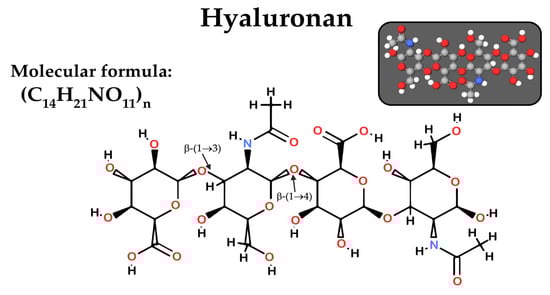
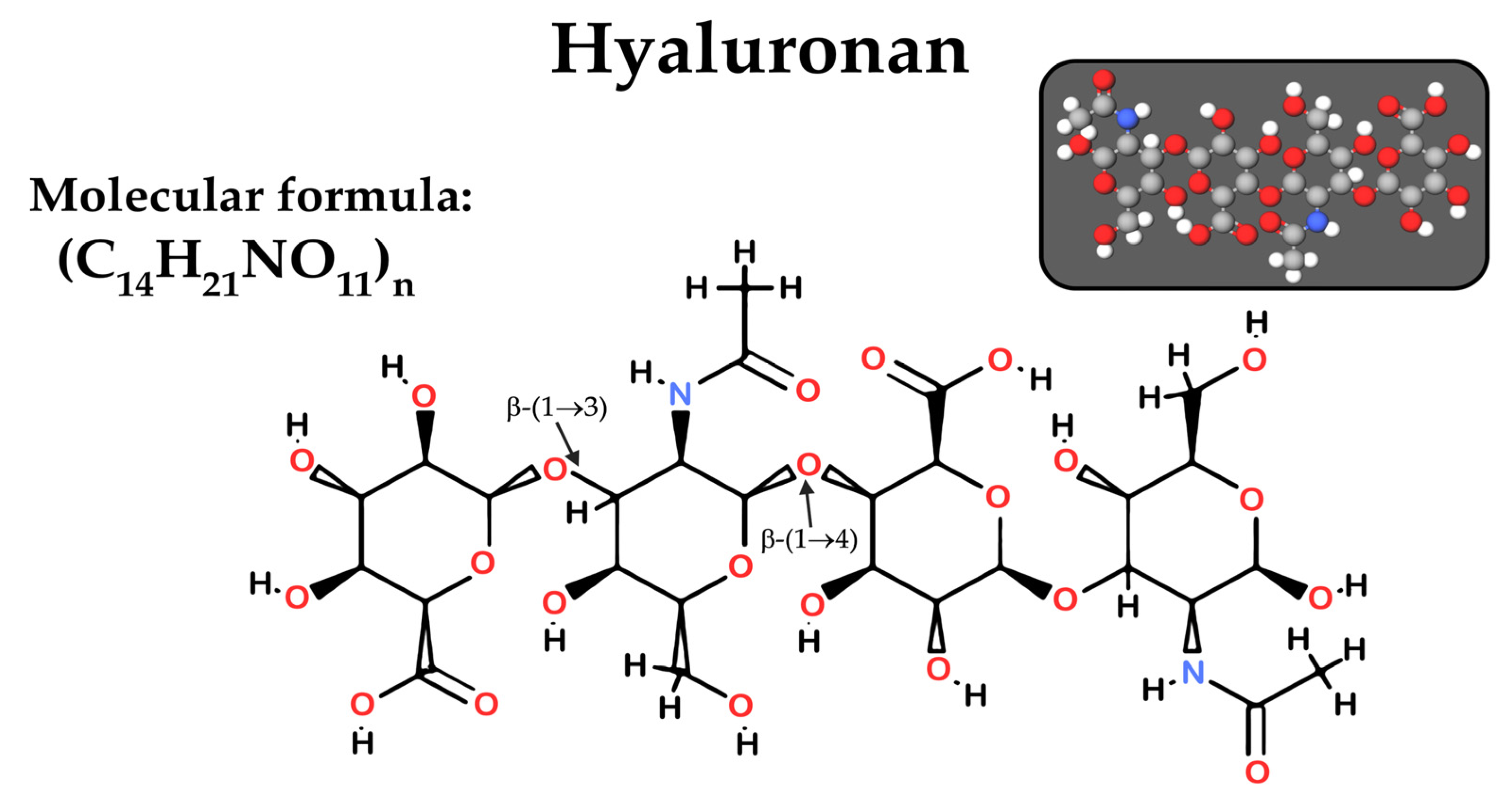
Hyaluronic acid (HA), otherwise referred to in scientific literature as hyaluronan, represents a significant biochemical structure in the human body, contributing to a variety of biological processes. Analyzing its chemical structure, the compound is categorized as a non-sulfated glycosaminoglycan, whose macromolecule is formed by repeating disaccharide units, specifically N-acetyl-D-glucosamine and D-glucuronic acid. These monomeric units are sequentially linked together by alternating β-(1→4) and β-(1→3) glycosidic bonds [1,2] (Figure 1).
Figure 1.
Structural and molecular formula of hyaluronic acid.
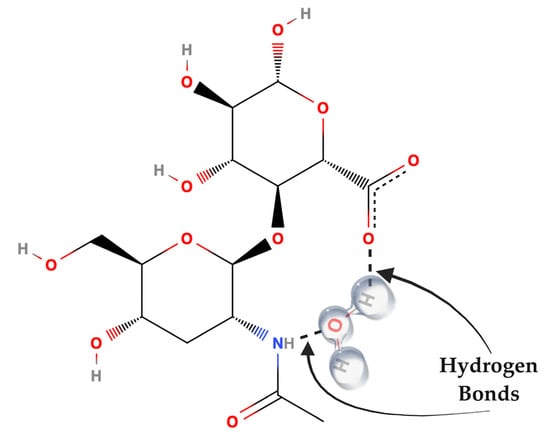
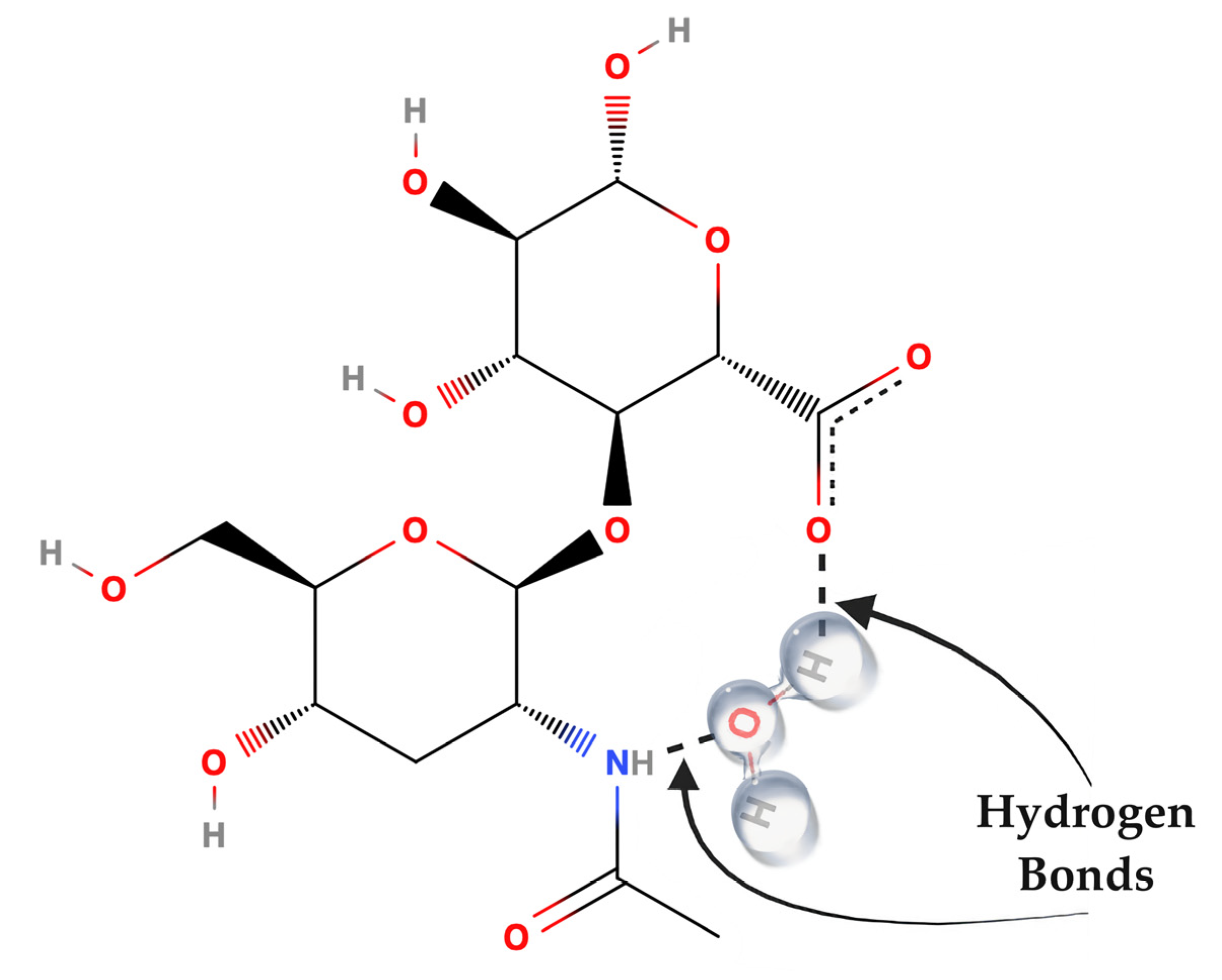
From a biochemical perspective, the hallmark of hyaluronan is its high molecular weight, which can fluctuate within a substantial range—from 103 to 107 Da. A well-illustrated example of this phenomenon is hyaluronan in human synovial fluid, which has a molecular weight of approximately 7 × 10⁶ Da [3]. These high molecular weights directly determine the unique rheological characteristics of this biopolymer, among which its high viscosity and ability to bind water are particularly noteworthy [4]. The hydrophilicity of HA is contingent upon its chemical structure, specifically the prevalence of hydrophilic functional groups, including hydroxyl, carboxyl, and acetamide groups, within its molecular structure. The mechanism of hydration is characterized by the effective formation of multiple intermolecular hydrogen bonds between H2O molecules and carboxyl and acetamide groups of the polymer chain [5] (Figure 2).
Figure 2.
Visualization of hyaluronic acid’s mechanism of hydration (the chemical formula of hyaluronan was obtained using MolView® software version 2.4. https://molview.org (accessed on 9 December 2025).
Moreover, molecular weight is also a factor determining the diversity of physiological and biological functions of hyaluronan. A marked “structure–property” relationship is observed. High-molecular-weight HA fractions with a mass exceeding 1 × 10⁶ Da have been shown to possess significant anti-inflammatory [6], barrier [7], and antioxidant properties [8]. Conversely, low-molecular-weight fragments (<500 kDa) formed as a consequence of biodegradation exhibit distinctly divergent biological activity. These molecules have been demonstrated to stimulate processes such as cell proliferation and migration [9,10], induce angiogenesis [11], and act as ligands for Toll-like receptors, thereby potentiating the activation of both the innate and adaptive immune responses [12,13].
An imbalance between the synthesis and catabolism of hyaluronan has been demonstrated to play a significant role in the development of a wide range of pathologies, including fibrotic conditions, oncology, osteoarthritis, and various autoimmune diseases. In certain cases, the pathogenesis of the condition has been linked to excessive hyaluronan synthesis. Consequently, in fibrotic conditions (liver, lungs, kidneys), increased expression of hyaluronan synthases and a simultaneous decrease in the activity of endogenous hyaluronidases capable of cleaving β-1,4 glycosidic bonds of HA have been identified [12,14,15] (Figure 3). This results in the accumulation of high-molecular-weight forms of HA and the formation of an excessive extracellular matrix. This, in turn, disrupts tissue architecture, impedes the normal diffusion of oxygen, nutrients, and drugs, and contributes to the activation of fibroblasts and the progression of fibrosis [16]. In idiopathic pulmonary fibrosis, increased hyaluronan content has been demonstrated to correlate with the degree of alveolar septal thickening and the severity of respiratory failure [17,18], and in liver cirrhosis, serum HA levels have been utilized as a biomarker of disease stage and fibrogenesis activity [19].
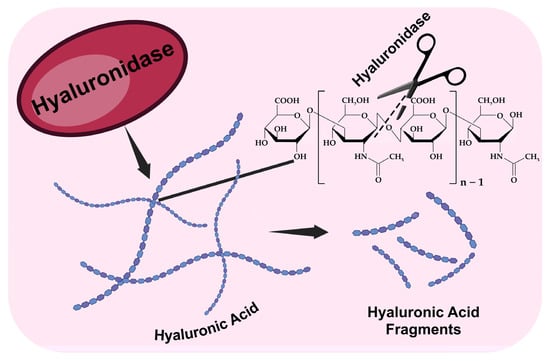
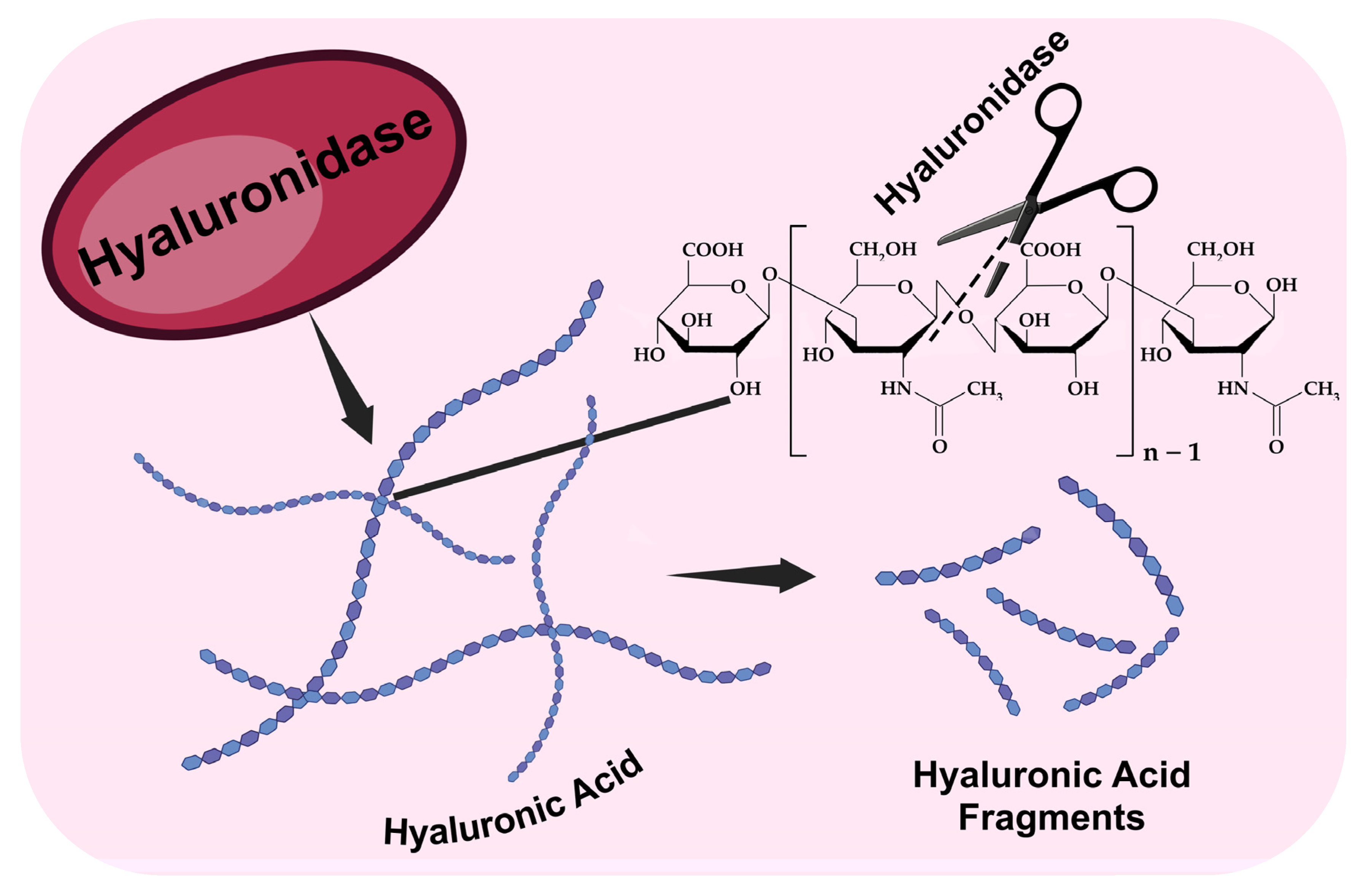
Figure 3.
The mechanism of interaction between hyaluronidase and hyaluronic acids, which involves the cleavage of the β-1,4 glycosidic bond and the formation of disaccharide fragments.
Analogous processes have been observed in the field of oncology, where high expression of hyaluronidase and accumulation of HA in the tumor microenvironment create a barrier for immune cells and anticancer drugs, increasing resistance to therapy [20,21]. In particular, excess hyaluronan has been observed to be associated with an invasive tumor phenotype, increased angiogenesis, and an unfavorable prognosis in breast and pancreatic cancer [22,23]. Furthermore, the accumulation of HA in the tumor matrix contributes to hypoxic remodeling of the microenvironment, enhancing the expression of hypoxia-inducible factor-1α and promoting the progression of the malignant process [12,24]. In this context, the application of hyaluronidase enzymes as a component of combination therapy is regarded as a promising pharmacological approach for the destruction of the pathological matrix, the enhancement of tissue permeability, and the augmentation of the effectiveness of cytostatics [25,26,27].
In contrast, an excessive degradation of hyaluronan has been observed in cases of hyperactivation of endoglycosidases or alterations in the local inflammatory microenvironment. The most characteristic example is osteoarthritis, in which hyaluronan in the synovial fluid is destroyed, leading to a decrease in its molecular weight and concentration [28,29]. This is accompanied by a decrease in the viscoelastic properties of the synovium, a decrease in the lubricating function of the joints, activation of pro-inflammatory cytokines, and increased pain syndrome [29]. A comparable process has been observed in rheumatoid arthritis, where low-molecular-weight fragments of HA act as “danger molecules,” activating Toll-like receptors and perpetuating chronic inflammation [30]. In addition, despite the previously described oncological processes mediated by excessive HA synthesis in vivo, there are a number of scientific studies noting the effect of hyaluronan degradation by endoglycosidase cleavage, which in turn is associated with the development of glioblastoma, the most aggressive oncological disease of the central nervous system [31].
Contemporary therapeutic strategies are designed to address both of these pathogenetic scenarios. In cases of excessive hyaluronan synthesis, enzyme therapy with hyaluronidase pharmaceuticals is used to destroy the pathological matrix and restore tissue permeability. Conversely, in instances of deficiency, replacement therapy employing sodium hyaluronate preparations is implemented [32,33]. Consequently, pharmacological strategies aimed at regulating hyaluronan levels can be considered a pathogenetically justified approach for correcting disturbed tissue processes and restoring extracellular matrix homeostasis.
1.2. Contemporary Biopharmaceuticals Based on Hyaluronidase
The present pharmaceutical industry employs the enzyme hyaluronidase as an excipient due to its properties, such as increasing tissue permeability and improving the absorption of drugs. The utilization of hyaluronidase as an adjuvant in the context of infiltration anesthesia has been documented [34]. Since the 2010s, the effectiveness of hyaluronidase as a delivery agent for cytostatics has been the subject of extensive research. At the present time, a number of antineoplastic pharmaceutical preparations containing hyaluronidase as an additional active ingredient are commercially available on the pharmaceutical market [35,36]. This enzyme has also gained the most popularity in the field of aesthetic medicine. The necessity for hyaluronidase emerged in response to the established demand for hyaluronan-based aesthetic fillers, which resulted in a number of complications, including oedema, infections, and, in certain cases, tissue necrosis [34].
However, the use of hyaluronidase extends beyond its application as an adjuvant, a drug delivery agent, or a form of “first aid” within the domain of aesthetic medicine. The contemporary pharmaceutical market proffers pharmaceuticals comprising hyaluronidase, wherein the enzyme functions as the primary active ingredient. These include lyophilized hyaluronidase of animal origin and modified by azoximer hyaluronidase (Table 1).
Table 1.
Comparative characteristics of hyaluronidase pharmaceutical and its conjugate with azoximer.
Lyophilized conventional hyaluronidase is a purified enzyme with a molecular weight range of 60 to 200 kDa (depending on the synthesis method), with a short therapeutic action, and sensitivity to changes in pH and temperature [37].
Modified hyaluronidase is an enzyme covalently bound to a biocompatible water-soluble polymer, azoximer (1,4-ethylenepiperazine N-oxide and (N-carboxymethyl)-1,4-ethylenepiperazinium bromide) [38]. In this case, the polymer plays a protective role, shielding the active substance from biodegradation and the effects of high temperatures. As a consequence, the therapeutic effect of the drug is prolonged, and its stability during storage is increased.
1.3. Quality Control of Hyaluronidase Pharmaceuticals: Contemporary Approaches and Challenges
A review of contemporary scientific literature reveals a notable absence or paucity of scientific studies on the quality control of hyaluronidase-based drugs. The principal studies concentrate on the enzymatic activity, apyrogenicity, and the absence of impurities in finished dosage forms. One scientific paper describes a study of the quality characteristics of a hyaluronidase-based nano-object. The paper discusses approaches such as dynamic light scattering (DLS), ζ-potential, UV–visible spectroscopy, and transmission electron microscopy [39]. However, it would be incorrect to assert that these methodologies are directed towards the study of native hyaluronidase, given that the study itself described hyaluronidase immobilized on the surface of silicon nanoparticles. A number of articles also mention the use of IR spectroscopy to study the effect of the enzyme on proteins [40,41].
In the contemporary context of pharmaceutical chemistry, ensuring the high efficacy and safety of the final pharmaceutical products constitutes a fundamental task. In light of the limited number of scientific papers dedicated to the direct quality control of hyaluronidase-based drugs, this paper puts forward a contemporary combined approach to controlling the quality characteristics of classical and modified hyaluronidase drugs. This approach combines DLS, IR spectroscopy analysis, and an express quality control method based on the detection of the intrinsic RTE activity of drugs. Notably, the last method allows us to perform analysis without the need to open the primary packaging, which is a significant advantage.
2. Materials and Methods
2.1. Pharmaceuticals Based on Hyaluronidase
Registered hyaluronidase-based drugs were selected as samples for this study:
- A drug containing hyaluronidase, registration number: LP-(006291)-(RG-RU), (LLC “Samson-Med”, Saint-Petersburg, Russia), which is a lyophilizate for preparing solutions for injection and topical application, with a dosage of 1280 IU.
- A hyaluronidase-based drug, registration number: LP-(000276)-(RG-RU), (JSC “NPO Microgen”, Moscow, Russia), which is a lyophilizate for preparing solutions for injection and topical application, with a dosage of 1280 IU.
- A drug based on azoximer-conjugated hyaluronidase, registration number: LP-(009351)-(RG-RU), (“NPO Petrovax Pharm LLC”, Moscow, Russia), which is a lyophilizate for preparing solutions for injection, with a dosage of 3000 IU. The finished dosage form contains the excipient mannitol—up to 20 mg.
High-resistance water (18.2 MΩ × cm, Milli-Q) was used for sample preparation for the DLS method.
2.2. Dynamic Light Scattering
The proposed method is a quality control approach that utilizes the detection of dimensional spectra of samples, as measured by the DLS (ZetasizerNano ZSP, Malvern Instruments, Malvern, UK). This method facilitates the determination of the size characteristics of particles in a heterogeneous medium in the range from 1 to 10,000 nm. The principle of DLS is based on the analysis of fluctuations in the intensity of scattered light arising from the Brownian motion of particles in the sample [42]. When coherent laser emission passes through the sample, fluctuations in the intensity of scattered light are recorded over time. This process enables the estimation of the diffusion coefficient of the particles, and consequently, their effective hydrodynamic radius can be calculated using the Stokes–Einstein equation [43]. For each sample, measurements were taken a minimum of seven times.
2.3. FTIR Spectroscopy
FTIR is a highly sensitive analytical method used for qualitative and quantitative analysis of organic and inorganic compounds based on their vibration spectra [44]. The samples were analyzed using an Agilent Cary 630 FTIR instrument (Agilent Technologies, Santa Clara, CA, USA). The spectra were recorded in the range from 4000 to 650 cm−1 with a resolution of 2 cm−1, in attenuated total reflectance (ATR) mode. The ATR module was utilized with a diamond prism as the crystal. Each measurement was performed a minimum of six times. The samples were measured in their native form, without additional sample preparation. Prior to the recording of each spectrum, background correction was performed.
2.4. Measurement of Intrinsic Radiothermal Emission
The emission characteristics of hyaluronidase samples were the subject of investigation using a TES-92 electromagnetic emission flux density detector (TES Electrical Electronic Corp., Taipei, Taiwan). The orientation of the device sensor in the Z-axis direction, perpendicular to the sample, ensured anisotropic registration of emission strictly from the object. During the experiment, the maximum average values of the emission flux density emanating from the sample were recorded [42,43].
The samples’ intrinsic RTE was stimulated by heating them to a temperature of 37 °C and by exposing them to monochromatic light. The thermal activation process was conducted utilizing a solid-state thermostat equipped with Peltier elements (model MK200-2, Hangzhou Allsheng Instruments Co., Ltd., Hangzhou, China). Temperature was monitored remotely using a non-contact infrared thermometer (model Benetech GM320, Shenzhen, China). The evaluation of photoinduced activation was conducted utilizing LEDs with a wavelength of 412 nm and a spectral width of 2–4 nm, operating at a power density of up to 50 mW/cm2 (models AA3528LVBS/D and C503B-BCN-CV0Z0461, manufactured by CreeLED, Durham, NC, USA). Prior to the measurement of each sample, the background values of the emission signal were recorded. These background values did not exceed 1.0 ± 0.2 µW/m2. In all series of experiments, the reproducible geometry of the measuring setup was strictly observed. Each measurement was performed a minimum of seven times to enhance the statistical reliability of the results.
2.5. Statistics
The results of the analyses are presented as mean ± standard deviation (n = 7). All calculations and statistical processing were conducted using OriginPro 21 software (OriginLab, Northampton, MA, USA).
3. Results and Discussion
3.1. Study of the Dimensional Characteristics of Hyaluronidase Pharmaceuticals
A review of contemporary scientific literature revealed no reliable results concerning the dimensional characteristics of hyaluronidase. However, further research on hyaluronidase molecules revealed their molecular weight (>60 kDa for hyaluronidase obtained from cattle [45,46] and from 100 to 180 kDa for azoximer-conjugated hyaluronidase with copolymer [47]). It is possible to calculate the estimated diameter of the molecule theoretically, based on the available data. In Harold P. Erickson’s work, a formula (Formula (1)) is proposed for the theoretical calculation of the minimum radius (Rmin, nm) of a protein molecule, given its molecular weight (M, Da) [48]:
Prior to the practical study of the size spectrum of hyaluronidase-based drugs, theoretical calculations of the estimated minimum diameter (dmin, nm) were performed using the following formula (Formula (2)):
The results of the theoretical calculation are presented in Table 2.
Table 2.
Theoretical calculation of the minimum diameter of hyaluronidase and azoximer-conjugated hyaluronidase molecules.
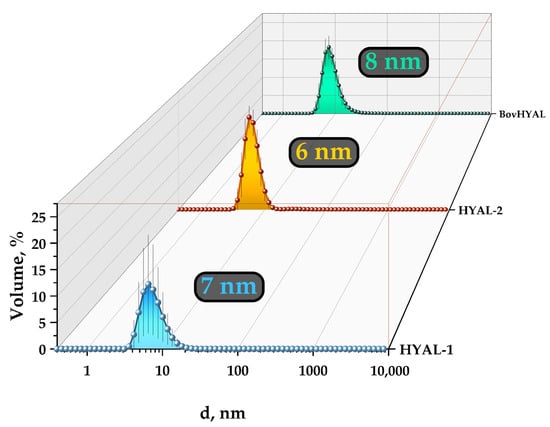
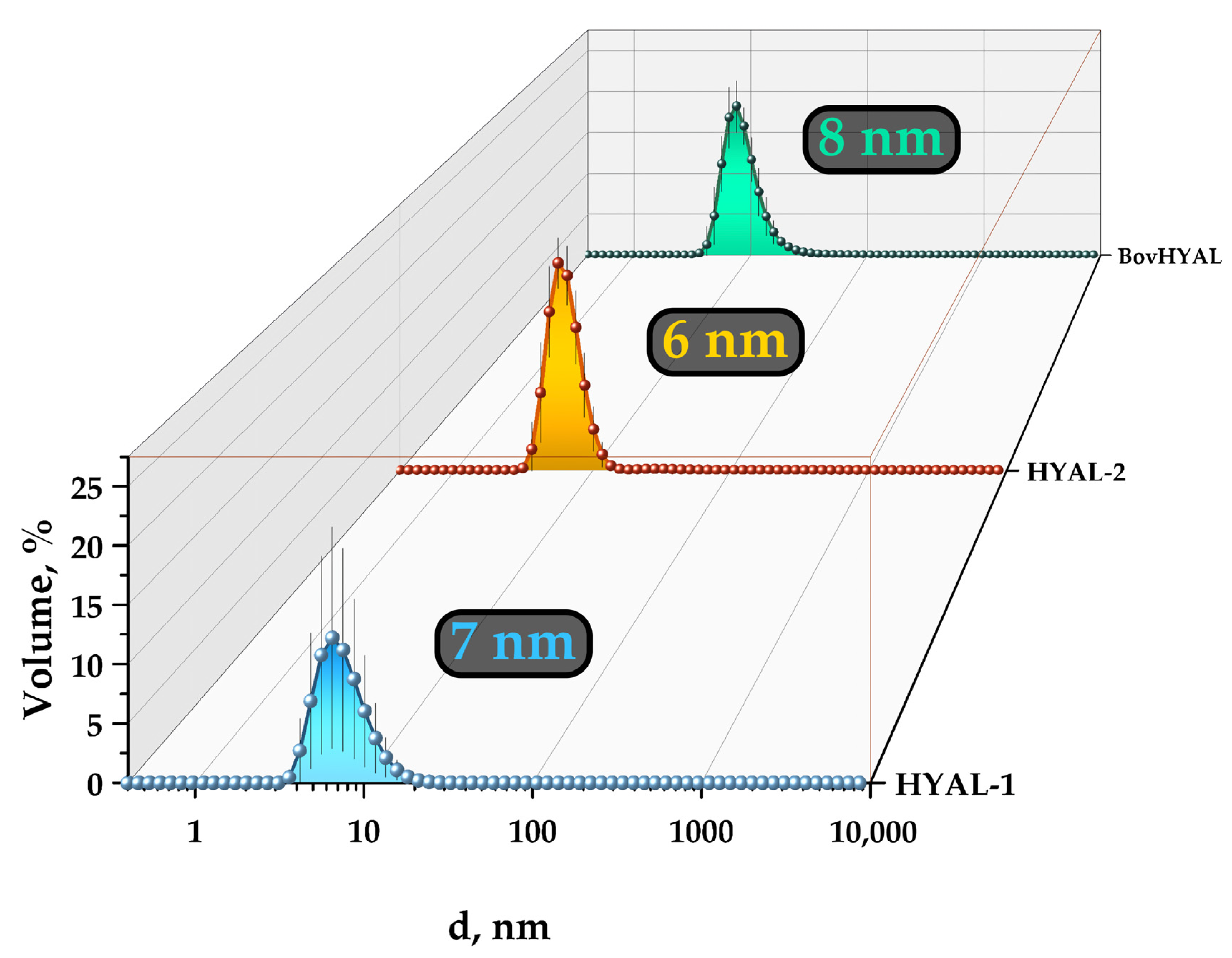
Based on the theoretical data obtained, the dimensional spectrum ranges for native hyaluronidase were demonstrated, which allow for correlation with the practical results obtained. Additionally, the presumed dimensional characteristics of enzymatic biopharmaceuticals were evaluated in a bibliographic analysis of data contained in the Protein Data Bank for hyaluronidase obtained from an expression system based on Trichoplusia ni (1FCU). As demonstrated in the scientific paper, the approximate diameter size ranges from 52 Å (approximately 5.2 nm), a finding that aligns with the results of mathematical calculations [49]. The distribution of size spectra, as measured by the DLS method, is illustrated in Figure 4.
Figure 4.
Comparison of the size spectra of hyaluronidase pharmaceuticals by volume distribution.
Two lyophilizate solutions containing 1280 IU of classical hyaluronidase (HYAL-1 and HYAL-2) have a size range from 6 to 7 nm, which correlates with theoretical calculations (from 5.2 to 7.8 nm). For a solution of azoximer–hyaluronidase lyophilizate combined with a copolymer (BovHYAL) with a concentration of 3000 IU, the diameter of the molecule was 8 nm, which slightly exceeds the calculated values (up to 7.4 nm). This discrepancy can be considered permissible, given that the calculation was conducted for native hyaluronidases and did not consider the content of excipients utilized in the manufacture of pharmaceuticals. Reproducible values of the size spectra of pharmaceuticals based on hyaluronidase and azoximer-conjugated hyaluronidase were obtained, allowing for monitoring of their qualitative characteristics.
3.2. IR Spectroscopy of Hyaluronidase Conjugated with Azoximer
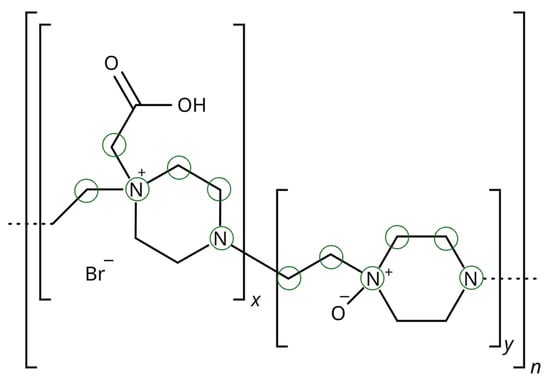
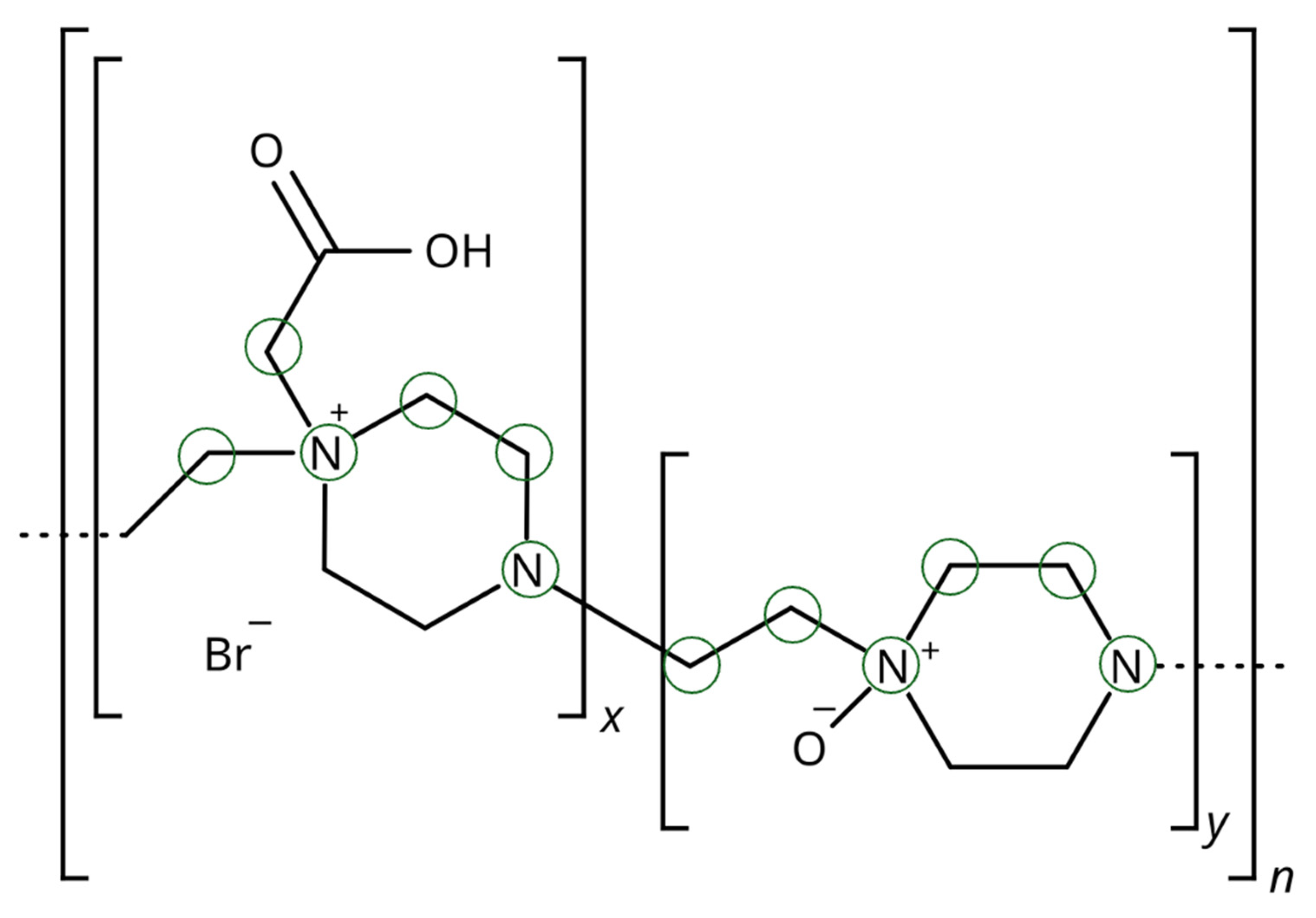
One of the proposed methods for controlling the quality of modified hyaluronidase preparations is mid-range IR spectroscopy. In the case of BovHYAL-based samples, it is of interest to identify only the characteristic azoximer bands, since the hyaluronidase fragment produces O-H, C=O, C-H, and C-O bands in the valence vibration region, and this precludes the nature and specific position of these functional groups from being distinguished. Guided by the characteristic bands of azoximer as described in patent [47], it was decided to decipher the azoximer component of the active molecule in the region below 1750 cm−1 (Figure 5).
Figure 5.
The chemical formula of azoximer is 1,4-ethylene piperazine-N-oxide and N-carboxymethyl-1,4-ethylene piperazine bromide. Green circles are used to denote atoms that have the potential to participate in vibrations that are characteristic of azoximer.
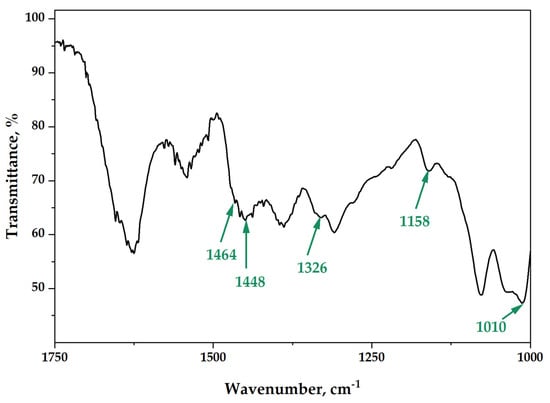
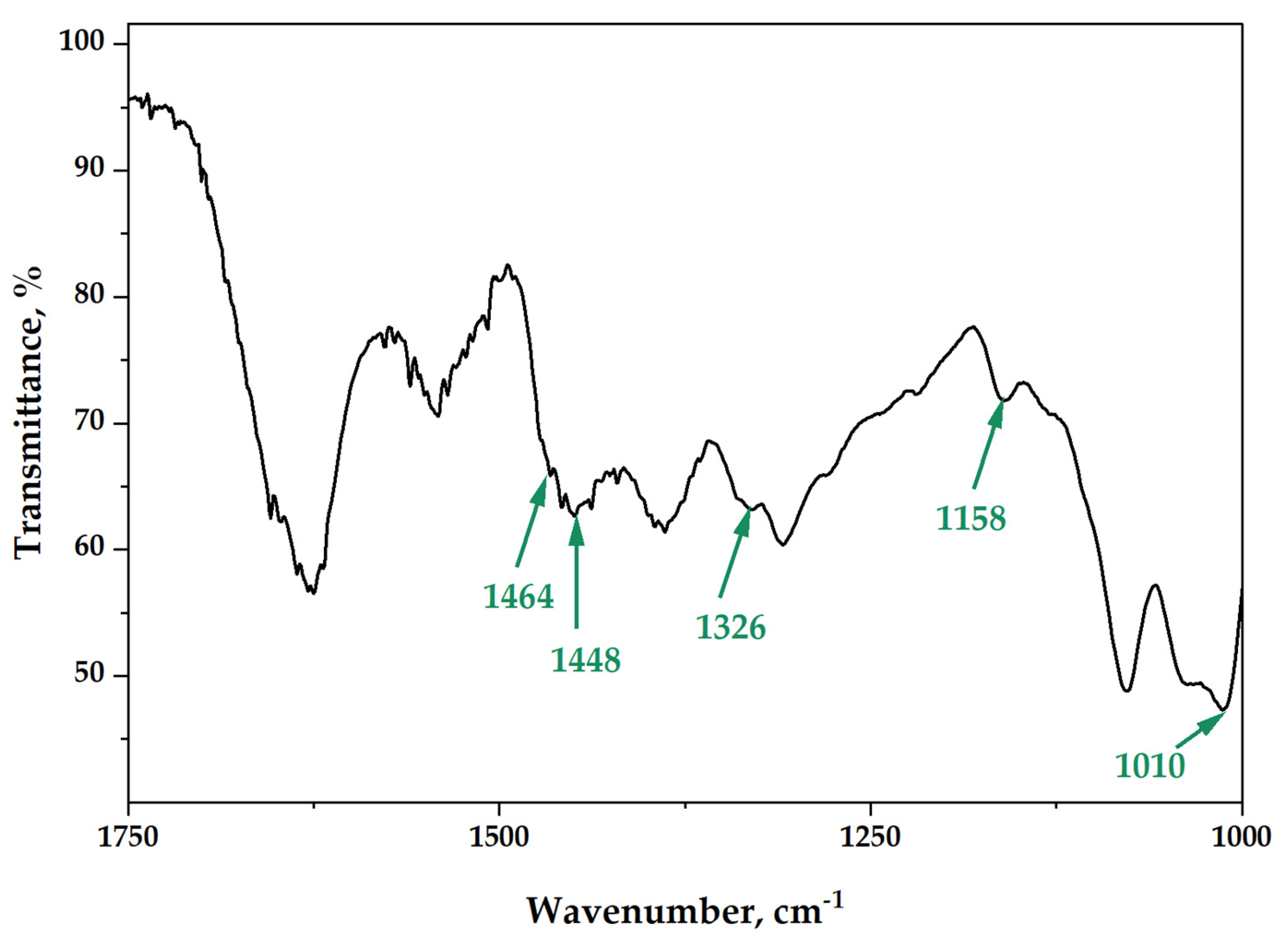
The IR spectrum obtained by the ATR method with a selected spectral range of 1750–1000 cm−1 is presented below (Figure 6). The characteristic band at 1625 cm−1 is not of interest, as it corresponds to the C=O group, which can be found both in the structure of hyaluronidase itself and in the side chain of azoximer.
Figure 6.
IR spectrum of the BovHYAL sample in the range of 1750–1000 cm−1.
The interpretation of the spectrum is presented in Table 3. The vibrations observed at wave numbers 1464, 1448, and 1326 cm−1 correspond to C-H deformation vibrations within the CH2 group of azoximer. Conversely, the vibrations at 1448 cm−1 correspond to a band that is characteristic of the side chain, while those at 1464 and 1326 cm−1 correspond to the piperazine cycle. The presented spectral region is also characterized by C-N valence vibrations in the piperazine cycles, corresponding to 1158 and 1010 cm−1.
Table 3.
Decoding of the IR spectrum of the azoximer component of the BovHYAL sample.
In accordance with the data presented in patent work [47], it can be concluded that the obtained IR spectrum of azoximer-conjugated hyaluronidase reliably reflects the chemical structure of azoximer.
The application of IR analysis for the direct identification of the complex structure of BovHYAL is subject to fundamental limitations. Firstly, all enzymes, irrespective of their amino acid sequence and biological function, exhibit similar bands in the amide bond region (~1650 cm−1, ~1550 cm−1). The spectrum of azoximer–hyaluronidase will show the same amide bands as the spectrum of any protein (e.g., albumin), which makes such bands non-specific for the identification of hyaluronidase [50]. Secondly, the precise position and configuration of amide bands are contingent on enzyme hydration and secondary structure. These parameters introduce variability into the spectrum, making it difficult to create a reference “fingerprint” for a specific enzyme [51]. In contrast, the identification of a drug based on BovHYAL using the characteristic azoximer bands is highly specific, reproducible, and methodologically correct for the following reasons. The presence in the IR spectrum of a combination of bands corresponding specifically to the N-oxide, carboxymethyl, and piperazine components provides irrefutable proof that the sample being analyzed is indeed a stabilized preparation of azoximer-conjugated hyaluronidase, and not some other protein or unstabilized enzyme. In addition to the aforementioned points, the polymeric nature of azoximer renders its IR spectrum more stable and less dependent on subtle changes in the conformation of the structure. This ensures better reproducibility of results between different series of analyses [52].
3.3. Non-Invasive Control of the Quality Characteristics of Hyaluronidase Biopharmaceuticals
The method of detecting intrinsic RTE represents a novel approach to the control of the qualitative and quantitative characteristics of pharmaceutical products. The basis of this phenomenon is the detection of emission activity in the millimeter wave range (75 GHz, EHF, W-Band) emanating from quasi-plasma clouds formed on the surface of nano-objects [53]. The formation of quasi-plasma regions on the surface of nanoparticles and nanomaterials occurs under two principal conditions: the presence of a factor stimulating emission activity (temperature activation/light activation), and the object must be a non-spherical structure [54,55]. This method has previously been used to control the qualitative and quantitative characteristics of drugs and immunobiological pharmaceuticals, demonstrating the ability to distinguish between samples with different shelf lives [43], samples subjected to artificial aging (heating, freezing, and UV irradiation) [42], and to control the quantitative protein content in immunobiological pharmaceuticals without opening the primary packaging [56].
3.3.1. Development of a Methodology for Activating Hyaluronidase Samples
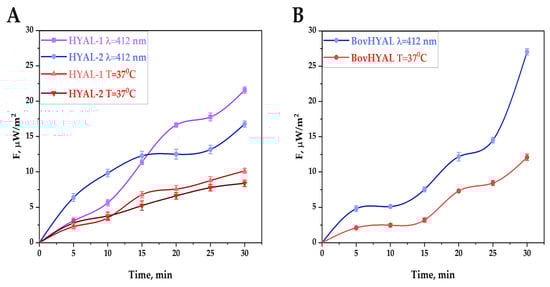
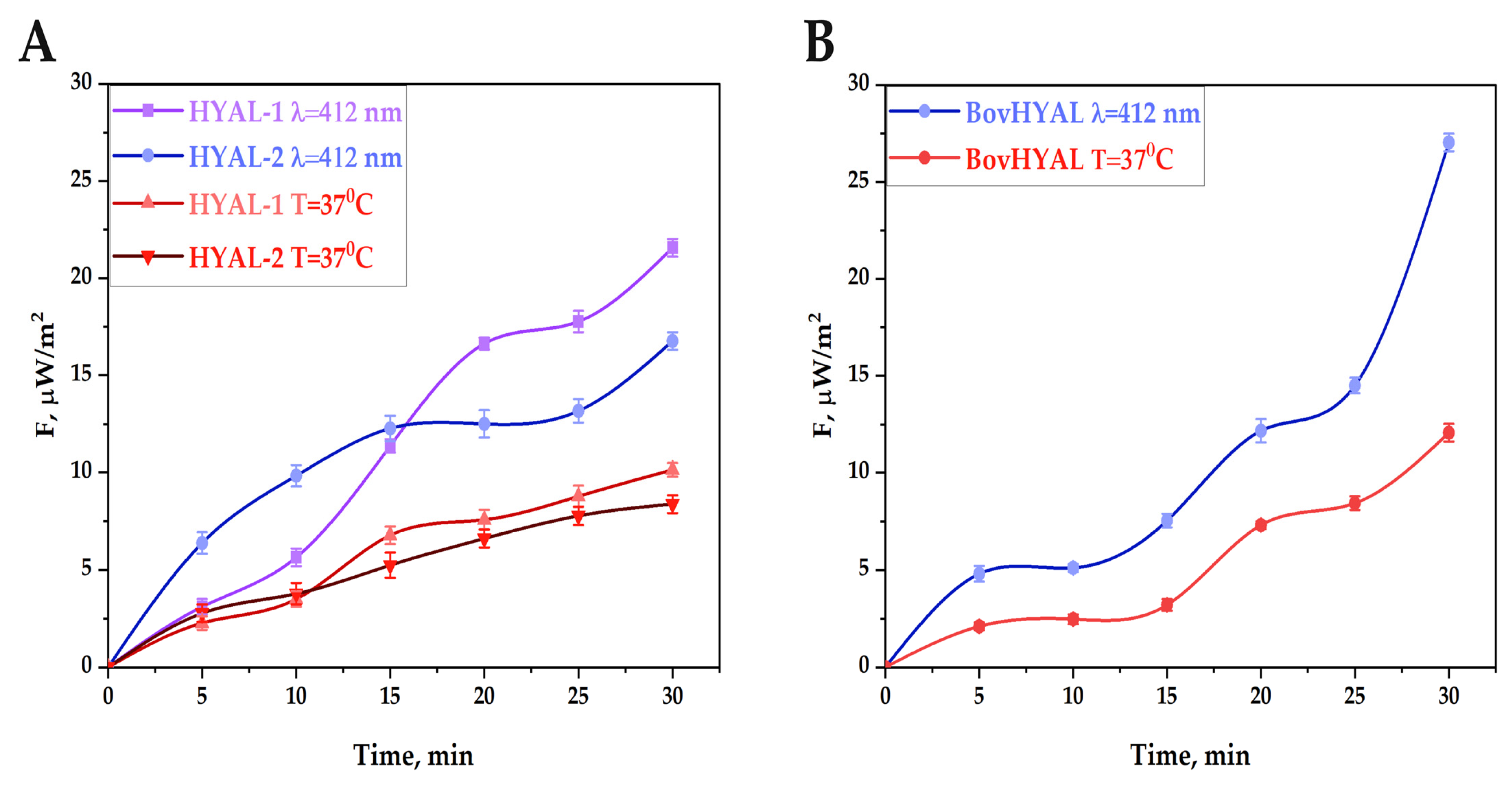
The approach outlined above was also applied in the context of the control of quality characteristics of hyaluronidase samples and their modified analogs. Since an external activation source is required to enhance emissive activity, namely temperature (T = 37 °C) or light irradiation (λ = 412 nm), it was first necessary to determine the most effective method for activating the experimental samples. The results of detecting the intrinsic RTE from solutions of hyaluronidase drugs (HYAL-1 and HYAL-2) and modified hyaluronidase (BovHYAL) after activation using the methods described above are shown in Figure 7.
Figure 7.
Results of emission flux density detection using two methodologies of activating intrinsic RTE (temperature and light) of hyaluronidase samples (A) and azoximer-conjugated hyaluronidase (B). The standard deviation is within the limits of the figures.
During the selection of the activation method, experimental analysis revealed that light irradiation at a wavelength of 412 nm exerted the most significant effect on the emission activity of the samples. Consequently, for HYAL-1, HYAL-2, and BovHYAL preparations, the flux density at 30 min was determined to be 21.6 ± 0.5, 16.8 ± 0.5, and 27.0 ± 0.5 μW/m2, respectively. This is twice the value obtained during activation by heating and several times higher than the background value (1.0 ± 0.2 μW/m2). Subsequent measurements of the intrinsic RTE of the samples were carried out using this methodology.
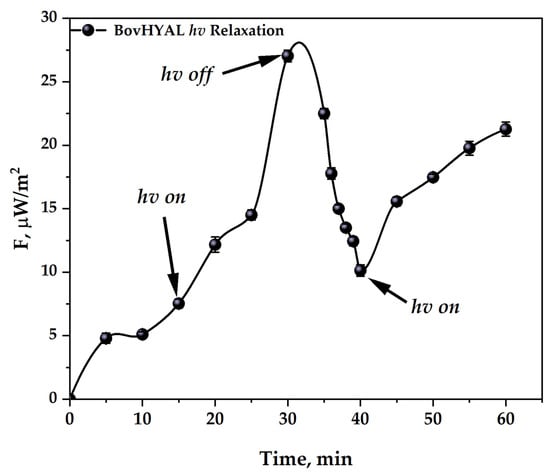
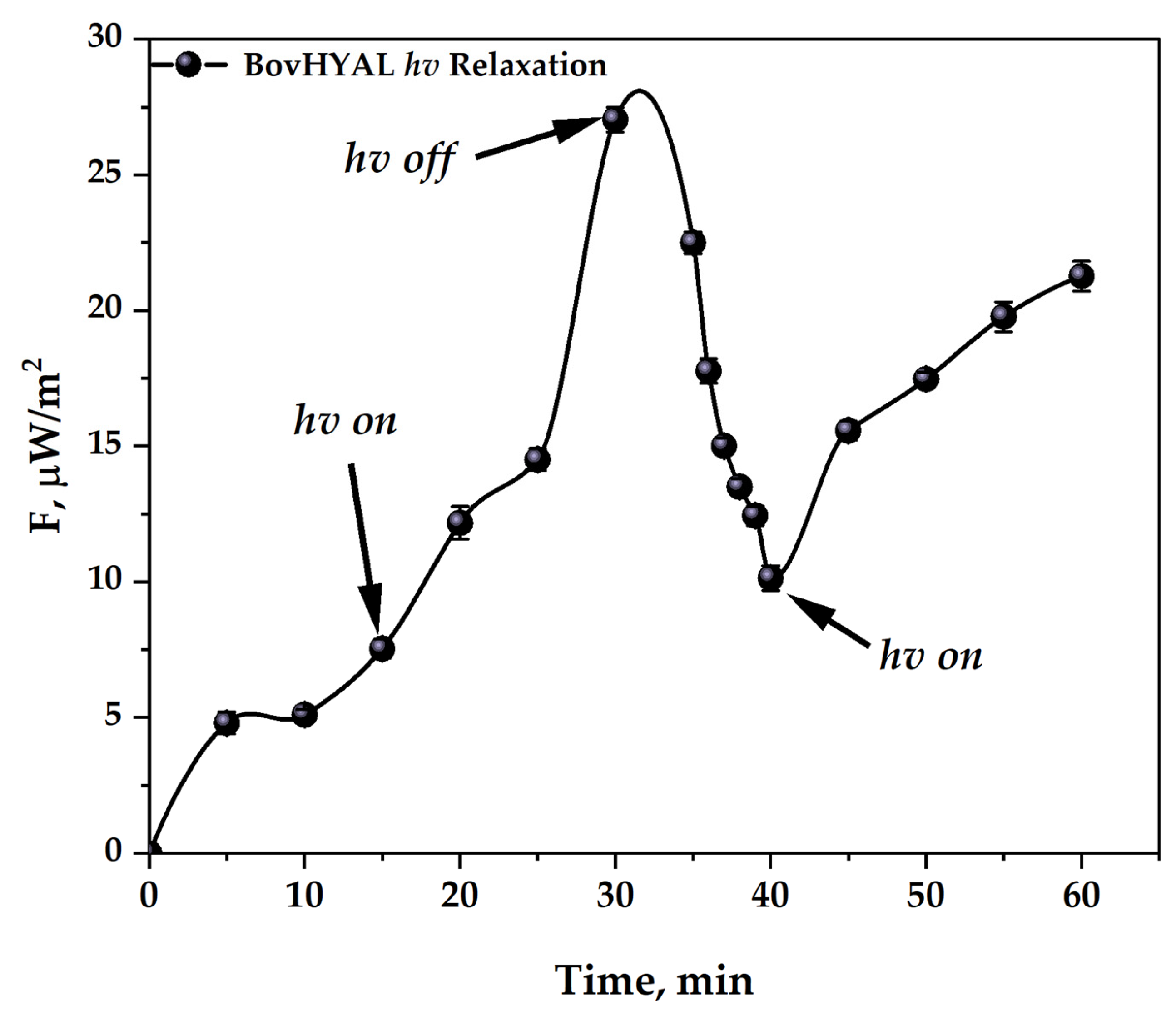
In order to illustrate the impact of external energy factors on emissive activity, a kinetic curve of increase and relaxation of intrinsic RTE was obtained using the example of a modified hyaluronidase sample (Figure 8).
Figure 8.
Kinetics of increase and relaxation of intrinsic RTE of BovHYAL. Standard deviations are within the figures.
These kinetics demonstrate that fluctuations in flux density values are non-monotonic and respond to the presence or absence of an external stimulus, in this case, light exposure.
3.3.2. Quality Control of Hyaluronidase Pharmaceuticals
The method of detecting intrinsic RTE enables the non-invasive control of the qualitative characteristics of samples. A comparison was made of the emission activity of lyophilized samples enclosed in primary packaging (glass ampoules) and of the same samples without primary packaging (Table 4).
Table 4.
Comparison of the emission activity of HYAL-1, HYAL-2, and BovHYAL pharmaceuticals in and without primary packaging (n = 7).
The results demonstrate that all preparations exhibit similar emission activity, whether in their primary packaging or in the absence of packaging. It is noteworthy that the density of the intrinsic RTE flux exceeds the background values by several folds, indicating the potential for conducting quality control of hyaluronidase samples without opening the primary packaging.
A further valuable analysis would be a comparison of the results obtained from sample solutions and lyophilized preparations. A comparison of Figure 7, which presents the measurement of 100 µL of hyaluronidase and azoximer-conjugated hyaluronidase pharmaceuticals, with the results in Table 4 reveals that the lyophilized forms exhibit a lower flow density value. This phenomenon is consistent with theoretical knowledge about the phenomenon of intrinsic RTE [55]. The most intense emissive activity is generated in aqueous solutions of nanopharmaceuticals. This phenomenon elucidates the observed discrepancy in values by several folds.
Following the analysis of the data obtained, a decision was reached to conduct a comparative analysis of pharmaceutical preparations characterized by divergent quality properties, without compromising the integrity of the packaging.
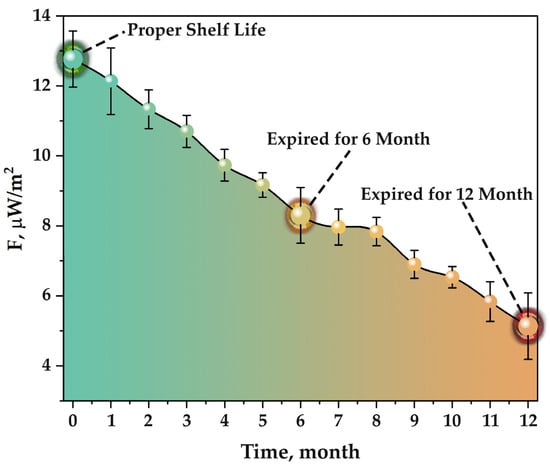
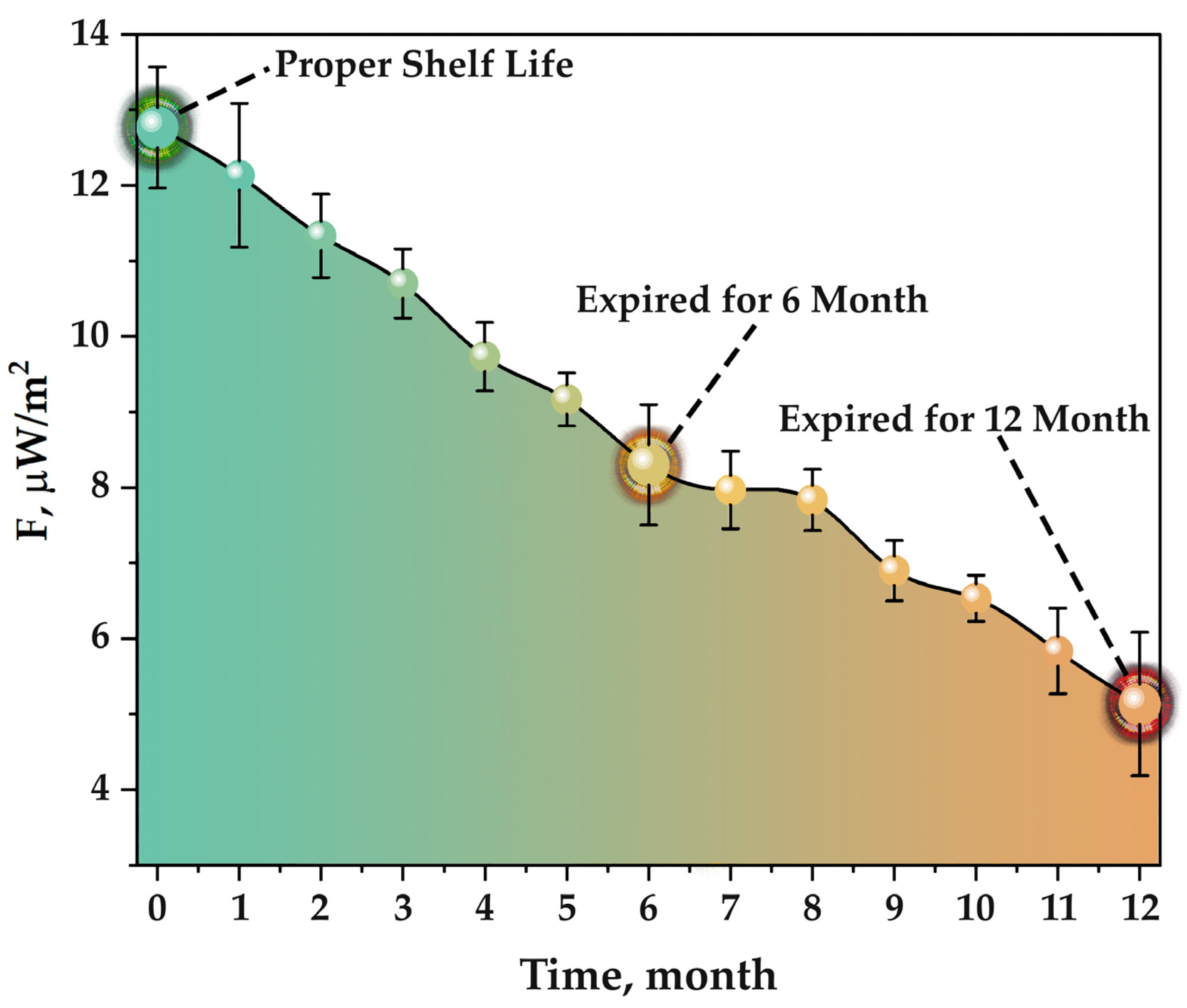
The expediency of studying the ageing processes of hyaluronidase preparations using the example of azoximer-conjugated hyaluronidase (BovHYAL) is due to its more complex structure and multifactorial degradation pathways. In contrast to the native hyaluronidase, the modified analog is an enzyme–polymer conjugate, which is characterized by more subtle changes in conformational stability and interactions within the macromolecule [57]. Due to the fact that the behaviour of such systems during the ageing process is more variable, BovHYAL is considered to be a more informative model for detecting a decrease in activity. This renders it a preferred object for studying the change in quality characteristics. Azoximer-conjugated hyaluronidase samples with an appropriate shelf life, expired for six months and one year, were selected for the study (Figure 9).
Figure 9.
Kinetics of changes in the density of intrinsic RTE from BovHYAL samples depending on their quality properties (changes in shelf life).
The data obtained revealed a steady decrease in the emission activity of the modified hyaluronidase sample, which is dependent on its shelf life. Consequently, for a drug with an appropriate shelf life, a flux density value of 12.8 ± 0.8 µW/m2 was found. However, samples with expired shelf life exhibited a decrease in emissive activity by 1.5 (expired for six months) and 2.5 times (expired for one year). This phenomenon can be explained by the fact that, after the expiration date, drugs begin to undergo various physicochemical changes, including oxidation, hydrolysis, chemical degradation, coagulation, and denaturation [58]. The application of the method for detecting intrinsic RTE enables the real-time tracking of the aforementioned processes (Figure 9).
3.4. From Pharmacopeial Standards to Innovative Quality Control Strategies for Enzymatic Pharmaceuticals
The challenge of ensuring and controlling the quality of biopharmaceuticals remains one of the most significant and critical issues in contemporary pharmaceutical chemistry, due to their intricate structure and high sensitivity to external influences [59]. In contrast to low-molecular-weight drugs, whose structure can be precisely characterized, enzyme pharmaceuticals such as hyaluronidase are heterogeneous mixtures. For such preparations, even minor deviations in the production, purification, or storage process can lead to critical changes in their functional characteristics [60,61]. The primary challenges associated with the standardization of enzyme substances pertain to the heterogeneity of glycosylation [46] and the tendency to form inactive aggregates or fragments with altered activity and/or immunogenicity [62,63]. The latter requires special attention and careful control, since the body’s immune response to the administration of a therapeutic agent can lead not only to its complete neutralization, i.e., a reduction or complete absence of therapeutic effect, but also to cross-reactivity with endogenous proteins, as has been described for some L-asparaginase-based drugs [64,65,66]. An incident involving heparin, a glycosaminoglycan, which was contaminated with suprasulfated chondroitin sulfate, is a case in point. This led to anaphylactoid reactions and even lethal outcomes [67]. The development and implementation of comprehensive quality control systems for enzyme preparations is not merely a formal requirement stipulated by regulatory authorities (FDA, EMA, and EAEU), but rather a pressing necessity that ensures the predictability of clinical effects and patient safety.
Contemporary quality control approaches for pharmaceutical substances, encompassing enzyme-derived drugs, emphasize a comprehensive evaluation of a diverse array of critical indicators that determine the efficacy and safety of the final pharmaceutical product. In particular, for hyaluronidase drugs, the determination of hyaluronidase activity, regulated by the European Pharmacopoeia and implemented using turbidimetric and viscometric methods, is critical and methodologically mandatory [68]. Additionally, all parenteral forms must undergo testing for bacterial endotoxins using the LAL-test, which facilitates quantitative assessment of pyrogenic substances [69]. Nevertheless, in accordance with prevailing pharmacopeial stipulations, these approaches are the limit range of recommended methodologies for quality control of hyaluronidase pharmaceuticals.
From the perspective of pharmaceutical chemistry, such a narrowing of the range of analytical tools appears to be deficient, as it excludes the possibility of a comprehensive analysis of physicochemical parameters, including the structural and dimensional characteristics of the finished product. The most appropriate instrument for the analysis of these parameters is high-performance liquid chromatography, which, due to its high accuracy and reproducibility, facilitates not only the identification of the structural features of the substance, but also the quantitative assessment of the sample [70,71]. In recent years, there has been an increasing focus on the use of mass spectrometry analysis, which is employed to monitor enzyme conformational changes as well as enzyme–substrate interactions [72]. This approach facilitates a comprehensive evaluation of the stability, activity, and immunogenicity of the pharmaceutical agent.
Nonetheless, despite the indisputable informative value and fundamental importance of such methods, they are subject to significant limitations. The labor-intensive nature of sample preparation and the invasive nature of the analysis process render them unsuitable for rapid testing. This aspect underscores the necessity to explore and implement novel non-invasive quality control instruments that could augment the prevailing regulated array of analytical methodologies, thereby ensuring more comprehensive and dependable support for the “life cycle” of enzyme pharmaceuticals.
In view of the limitations of conventional methods referenced above, it is particularly important to identify supplementary analytical instruments that can facilitate a more comprehensive and, concomitantly, non-invasive investigation of the properties of enzyme samples. In this context, the comprehensive approach proposed in this work, combining DLS, FTIR, and detection of the intrinsic RTE methods, can be considered as a promising complementary strategy for overcoming existing barriers in the pharmaceutical quality control of enzyme pharmaceuticals.
The DLS method, a widely applied approach for the characterization of the dimensional parameters of nanoparticles and biopharmaceutical substances [43,73,74], provided substantiation for theoretical assumptions concerning the hydrodynamic radius and size distribution of hyaluronidase samples. Determining these parameters is essential for the evaluation of the stability and homogeneity of the aforementioned pharmaceuticals. FTIR spectroscopy demonstrated high efficiency in identifying and verifying chemical structure by confirming the presence of an azoximer fragment in the modified form of the drug.
Special emphasis should be placed on the method of detecting intrinsic RTE, which is a comparatively novel analytical instrument. As previously demonstrated in works such as [42,55], the intensity of intrinsic RTE from biopharmaceuticals can be directly associated with their physicochemical state and the processes of their nanoscale degradation. The data obtained in this study, indicating an inverse relationship between the emission flux density and the shelf life of BovHYAL, demonstrate the high sensitivity of this method to structural changes.
4. Conclusions
The primary objective of contemporary pharmaceutical chemistry is to ensure the reliable quality control of all pharmaceutical products to guarantee their stability, efficacy, bioavailability, reduced toxicity, and, most importantly, safety. Considering the limited data available on the qualitative analysis of pharmaceuticals based on hyaluronidase and its modified analog, this study proposes a comprehensive approach to quality control using modern analytical instruments. The dimensional characteristics (DLS) of the HYAL-1, HYAL-2, and BovHYAL samples (7, 6, and 8 nm, respectively) were determined and found to correlate with theoretical calculations of their diameter. An IR spectrum was obtained for BovHYAL, which provided information about its azoximer fragment with characteristic bands: 1464, 1448, 1326, 1158, and 1010 cm−1. A contemporary rapid approach to the control of the quality characteristics of hyaluronidase pharmaceuticals was also proposed. This approach is based on their intrinsic RTE, thus allowing for real-time monitoring of physicochemical changes in the structure of the samples without the need to open their primary packaging. For BovHYAL with an appropriate shelf life, the flux density was in the range of 12.8 ± 0.8 µW/m2, for drugs expired by six months—8.3 ± 0.8 µW/m2, expired by one year—5.1 ± 1.0 µW/m2, with background values equal to 1.0 ± 0.2 µW/m2. This approach to the quality control of enzyme pharmaceuticals ensures rapid results and facilitates efficient conclusions regarding the quality of the samples.
Author Contributions
Conceptualization, G.V.P. and A.V.S.; methodology, G.V.P.; formal analysis, G.V.P., A.A.N. and A.M.K.; investigation, A.A.N., G.V.P. and A.M.K.; data curation, G.V.P. and A.V.S.; writing—original draft preparation, G.V.P.; writing—review and editing, G.V.P. and A.M.K.; visualization, G.V.P.; supervision, A.V.S.; project administration, A.V.S. and G.V.P.; funding acquisition, A.V.S. All authors have read and agreed to the published version of the manuscript.
Funding
This publication is supported by the RUDN University Scientific Projects Grant System, project № 033323-2-000, and the RUDN University Scientific Projects Grant System project № 002093-0-000.
Institutional Review Board Statement
Not applicable.
Informed Consent Statement
Not applicable.
Data Availability Statement
The original contributions presented in the study are included in the article; further inquiries can be directed to the corresponding author.
Acknowledgments
This paper is supported by the RUDN University Strategic Academic Leadership program.
Conflicts of Interest
The authors declare no conflicts of interest.
References
- Graça, M.F.P.; Miguel, S.P.; Cabral, C.S.D.; Correia, I.J. Hyaluronic Acid—Based Wound Dressings: A Review. Carbohydr. Polym. 2020, 241, 116364. [Google Scholar] [CrossRef] [Scilit] [PubMed]
- Knopf-Marques, H.; Pravda, M.; Wolfova, L.; Velebny, V.; Schaaf, P.; Vrana, N.E.; Lavalle, P. Hyaluronic Acid and Its Derivatives in Coating and Delivery Systems: Applications in Tissue Engineering, Regenerative Medicine and Immunomodulation. Adv. Healthc. Mater. 2016, 5, 2841–2855. [Google Scholar] [CrossRef] [Scilit] [PubMed]
- Fraser, J.R.E.; Laurent, T.C.; Laurent, U.B.G. Hyaluronan: Its Nature, Distribution, Functions and Turnover. J. Intern. Med. 1997, 242, 27–33. [Google Scholar] [CrossRef] [Scilit] [PubMed]
- Cowman, M.K.; Lee, H.-G.; Schwertfeger, K.L.; McCarthy, J.B.; Turley, E.A. The Content and Size of Hyaluronan in Biological Fluids and Tissues. Front. Immunol. 2015, 6, 261. [Google Scholar] [CrossRef] [Scilit] [PubMed]
- Fallacara, A.; Baldini, E.; Manfredini, S.; Vertuani, S. Hyaluronic Acid in the Third Millennium. Polymers 2018, 10, 701. [Google Scholar] [CrossRef] [Scilit] [PubMed]
- Litwiniuk, M.; Krejner, A.; Speyrer, M.S.; Gauto, A.R.; Grzela, T. Hyaluronic Acid in Inflammation and Tissue Regeneration. Wounds 2016, 28, 78–88. [Google Scholar]
- Lee, Y.; Sugihara, K.; Gillilland, M.G.; Jon, S.; Kamada, N.; Moon, J.J. Hyaluronic Acid–Bilirubin Nanomedicine for Targeted Modulation of Dysregulated Intestinal Barrier, Microbiome and Immune Responses in Colitis. Nat. Mater. 2020, 19, 118–126. [Google Scholar] [CrossRef] [Scilit]
- Xu, Z.; Liu, G.; Liu, P.; Hu, Y.; Chen, Y.; Fang, Y.; Sun, G.; Huang, H.; Wu, J. Hyaluronic Acid-Based Glucose-Responsive Antioxidant Hydrogel Platform for Enhanced Diabetic Wound Repair. Acta Biomater. 2022, 147, 147–157. [Google Scholar] [CrossRef] [Scilit]
- Kobayashi, T.; Chanmee, T.; Itano, N. Hyaluronan: Metabolism and Function. Biomolecules 2020, 10, 1525. [Google Scholar] [CrossRef] [Scilit]
- Wang, R.; Zhou, W.; Wang, J.; Liu, Y.; Chen, Y.; Jiang, S.; Luo, X.; Stupack, D.G.; Luo, N. Role of Hyaluronan and Glucose on 4-Methylumbelliferone-Inhibited Cell Proliferation in Breast Carcinoma Cells. Anticancer Res. 2015, 35, 4799–4805. [Google Scholar]
- Liu, X.; Wu, C.; Zhang, Y.; Chen, S.; Ding, J.; Chen, Z.; Wu, K.; Wu, X.; Zhou, T.; Zeng, M.; et al. Hyaluronan-Based Hydrogel Integrating Exosomes for Traumatic Brain Injury Repair by Promoting Angiogenesis and Neurogenesis. Carbohydr. Polym. 2023, 306, 120578. [Google Scholar] [CrossRef] [Scilit] [PubMed]
- Jiang, D.; Liang, J.; Noble, P.W. Hyaluronan as an Immune Regulator in Human Diseases. Physiol. Rev. 2011, 91, 221–264. [Google Scholar] [CrossRef] [Scilit] [PubMed]
- Johnson, P.; Arif, A.A.; Lee-Sayer, S.S.M.; Dong, Y. Hyaluronan and Its Interactions With Immune Cells in the Healthy and Inflamed Lung. Front. Immunol. 2018, 9, 2787. [Google Scholar] [CrossRef] [Scilit] [PubMed]
- Kim, J.; Seki, E. Hyaluronan in Liver Fibrosis: Basic Mechanisms, Clinical Implications, and Therapeutic Targets. Hepatol. Commun. 2023, 7, e0083. [Google Scholar] [CrossRef] [Scilit]
- Albeiroti, S.; Soroosh, A.; de la Motte, C.A. Hyaluronan’s Role in Fibrosis: A Pathogenic Factor or a Passive Player? Biomed. Res. Int. 2015, 2015, 790203. [Google Scholar] [CrossRef] [Scilit]
- Tzouvelekis, A.; Harokopos, V.; Paparountas, T.; Oikonomou, N.; Chatziioannou, A.; Vilaras, G.; Tsiambas, E.; Karameris, A.; Bouros, D.; Aidinis, V. Comparative Expression Profiling in Pulmonary Fibrosis Suggests a Role of Hypoxia-Inducible Factor-1α in Disease Pathogenesis. Am. J. Respir. Crit. Care Med. 2007, 176, 1108–1119. [Google Scholar] [CrossRef] [Scilit]
- Sime, P.J.; O’Reilly, K.M.A. Fibrosis of the Lung and Other Tissues: New Concepts in Pathogenesis and Treatment. Clin. Immunol. 2001, 99, 308–319. [Google Scholar] [CrossRef] [Scilit]
- Hirawat, R.; Jain, N.; Aslam Saifi, M.; Rachamalla, M.; Godugu, C. Lung Fibrosis: Post-COVID-19 Complications and Evidences. Int. Immunopharmacol. 2023, 116, 109418. [Google Scholar] [CrossRef] [Scilit]
- Rockey, D.C.; Bell, P.D.; Hill, J.A. Fibrosis—A Common Pathway to Organ Injury and Failure. N. Engl. J. Med. 2015, 372, 1138–1149. [Google Scholar] [CrossRef] [Scilit]
- Misra, S.; Hascall, V.C.; Markwald, R.R.; Ghatak, S. Interactions between Hyaluronan and Its Receptors (CD44, RHAMM) Regulate the Activities of Inflammation and Cancer. Front. Immunol. 2015, 6, 201. [Google Scholar] [CrossRef] [Scilit]
- Vo, G.; Rao, K.; Chung, I.; Ha, C.-S.; An, S.; Yun, Y. Derivatization of Hyaluronan to Target Neuroblastoma and Neuroglioma Expressing CD44. Pharmaceutics 2024, 16, 836. [Google Scholar] [CrossRef] [Scilit] [PubMed]
- Roma-Rodrigues, C.; Mendes, R.; Baptista, P.V.; Fernandes, A.R. Targeting Tumor Microenvironment for Cancer Therapy. Int. J. Mol. Sci. 2019, 20, 840. [Google Scholar] [CrossRef] [Scilit] [PubMed]
- Toole, B.P. Hyaluronan: From Extracellular Glue to Pericellular Cue. Nat. Rev. Cancer 2004, 4, 528–539. [Google Scholar] [CrossRef] [Scilit] [PubMed]
- Heldin, P.; Basu, K.; Olofsson, B.; Porsch, H.; Kozlova, I.; Kahata, K. Deregulation of Hyaluronan Synthesis, Degradation and Binding Promotes Breast Cancer. J. Biochem. 2013, 154, 395–408. [Google Scholar] [CrossRef] [Scilit]
- Murugaiah, V.; Agostinis, C.; Varghese, P.M.; Belmonte, B.; Vieni, S.; Alaql, F.A.; Alrokayan, S.H.; Khan, H.A.; Kaur, A.; Roberts, T.; et al. Hyaluronic Acid Present in the Tumor Microenvironment Can Negate the Pro-Apototic Effect of a Recombinant Fragment of Human Surfactant Protein D on Breast Cancer Cells. Front. Immunol. 2020, 11, 1171. [Google Scholar] [CrossRef] [Scilit]
- Provenzano, P.P.; Cuevas, C.; Chang, A.E.; Goel, V.K.; Von Hoff, D.D.; Hingorani, S.R. Enzymatic Targeting of the Stroma Ablates Physical Barriers to Treatment of Pancreatic Ductal Adenocarcinoma. Cancer Cell 2012, 21, 418–429. [Google Scholar] [CrossRef] [Scilit]
- Jacobetz, M.A.; Chan, D.S.; Neesse, A.; Bapiro, T.E.; Cook, N.; Frese, K.K.; Feig, C.; Nakagawa, T.; Caldwell, M.E.; Zecchini, H.I.; et al. Hyaluronan Impairs Vascular Function and Drug Delivery in a Mouse Model of Pancreatic Cancer. Gut 2013, 62, 112–120. [Google Scholar] [CrossRef] [Scilit]
- Russo, F.; D’Este, M.; Vadalà, G.; Cattani, C.; Papalia, R.; Alini, M.; Denaro, V. Platelet Rich Plasma and Hyaluronic Acid Blend for the Treatment of Osteoarthritis: Rheological and Biological Evaluation. PLoS ONE 2016, 11, e0157048. [Google Scholar] [CrossRef] [Scilit]
- Chen, L.-K.; Yu, Q.-M. Effect of Sodium Hyaluronate Combined with Rehabilitation Training on Knee Joint Injury Caused by Golf. World J. Clin. Cases 2024, 12, 4543–4549. [Google Scholar] [CrossRef] [Scilit]
- Petrey, A.C.; de la Motte, C.A. Hyaluronan, a Crucial Regulator of Inflammation. Front. Immunol. 2014, 5, 101. [Google Scholar] [CrossRef] [Scilit]
- Pibuel, M.A.; Poodts, D.; Díaz, M.; Hajos, S.E.; Lompardía, S.L. The Scrambled Story between Hyaluronan and Glioblastoma. J. Biol. Chem. 2021, 296, 100549. [Google Scholar] [CrossRef] [Scilit] [PubMed]
- Bannuru, R.R.; Osani, M.C.; Vaysbrot, E.E.; Arden, N.K.; Bennell, K.; Bierma-Zeinstra, S.M.A.; Kraus, V.B.; Lohmander, L.S.; Abbott, J.H.; Bhandari, M.; et al. OARSI Guidelines for the Non-Surgical Management of Knee, Hip, and Polyarticular Osteoarthritis. Osteoarthr. Cartil. 2019, 27, 1578–1589. [Google Scholar] [CrossRef] [Scilit] [PubMed]
- Bowman, S.; Awad, M.E.; Hamrick, M.W.; Hunter, M.; Fulzele, S. Recent Advances in Hyaluronic Acid Based Therapy for Osteoarthritis. Clin. Transl. Med. 2018, 7, 6. [Google Scholar] [CrossRef] [Scilit] [PubMed]
- Buhren, B.A.; Schrumpf, H.; Hoff, N.-P.; Bölke, E.; Hilton, S.; Gerber, P.A. Hyaluronidase: From Clinical Applications to Molecular and Cellular Mechanisms. Eur. J. Med. Res. 2016, 21, 5. [Google Scholar] [CrossRef] [Scilit]
- Shpilberg, O.; Jackisch, C. Subcutaneous Administration of Rituximab (MabThera) and Trastuzumab (Herceptin) Using Hyaluronidase. Br. J. Cancer 2013, 109, 1556–1561. [Google Scholar] [CrossRef] [Scilit]
- Hill, S.L.; Davies, A. Subcutaneous Rituximab with Recombinant Human Hyaluronidase in the Treatment of Non-Hodgkin Lymphoma and Chronic Lymphocytic Leukemia. Future Oncol. 2018, 14, 1691–1699. [Google Scholar] [CrossRef] [Scilit]
- Belem-Gonçalves, S.; Tsan, P.; Lancelin, J.-M.; Alves, T.L.M.; Salim, V.M.; Besson, F. Interfacial Behaviour of Bovine Testis Hyaluronidase. Biochem. J. 2006, 398, 569–576. [Google Scholar] [CrossRef] [Scilit]
- Gatina, A.; Trizna, E.; Kolesnikova, A.; Baidamshina, D.; Gorshkova, A.; Drucker, V.; Bogachev, M.; Kayumov, A. The Bovhyaluronidase Azoximer (Longidaza®) Disrupts Candida Albicans and Candida Albicans-Bacterial Mixed Biofilms and Increases the Efficacy of Antifungals. Medicina 2022, 58, 1710. [Google Scholar] [CrossRef] [Scilit]
- Scodeller, P.; Catalano, P.N.; Salguero, N.; Duran, H.; Wolosiuk, A.; Soler-Illia, G.J.A.A. Hyaluronan Degrading Silica Nanoparticles for Skin Cancer Therapy. Nanoscale 2013, 5, 9690. [Google Scholar] [CrossRef] [Scilit]
- Schwaighofer, A.; Ablasser, S.; Lux, L.; Kopp, J.; Herwig, C.; Spadiut, O.; Lendl, B.; Slouka, C. Production of Active Recombinant Hyaluronidase Inclusion Bodies from Apis Mellifera in E. Coli Bl21(DE3) and Characterization by FT-IR Spectroscopy. Int. J. Mol. Sci. 2020, 21, 3881. [Google Scholar] [CrossRef] [Scilit]
- Vidal, B.d.C.; Mello, M.L.S. FT-IR Microspectroscopy of Rat Ear Cartilage. PLoS ONE 2016, 11, e0151989. [Google Scholar] [CrossRef] [Scilit] [PubMed]
- Nazarov, A.A.; Ledenev, O.V.; Petrov, G.V.; Levitskaya, O.V.; Syroeshkin, A.V. New Method of Quality and Quantity Control of the Insulin Glulisine Pharmaceuticals Based on Intrinsic Radiothermal Emission. J. Drug Deliv. Ther. 2025, 15, 116–125. [Google Scholar] [CrossRef] [Scilit]
- Petrov, G.V.; Galkina, D.A.; Koldina, A.M.; Grebennikova, T.V.; Eliseeva, O.V.; Chernoryzh, Y.Y.; Lebedeva, V.V.; Syroeshkin, A.V. Controlling the Quality of Nanodrugs According to Their New Property—Radiothermal Emission. Pharmaceutics 2024, 16, 180. [Google Scholar] [CrossRef] [Scilit] [PubMed]
- Morozova, M.A.; Koldina, A.M.; Maksimova, T.V.; Marukhlenko, A.V.; Zlatsky, I.A.; Syroeshkin, A.V. Slow Quasikinetic Changes in Water-Lactose Complexes During Storage. Int. J. Appl. Pharm. 2021, 13, 227–232. [Google Scholar] [CrossRef] [Scilit]
- Weber, G.C.; Buhren, B.A.; Schrumpf, H.; Wohlrab, J.; Gerber, P.A. Clinical Applications of Hyaluronidase. In Advances in Experimental Medicine and Biology; Springer: Singapore, 2019; Volume 1148, pp. 255–277. [Google Scholar]
- Bordon, K.C.F.; Wiezel, G.A.; Amorim, F.G.; Arantes, E.C. Arthropod Venom Hyaluronidases: Biochemical Properties and Potential Applications in Medicine and Biotechnology. J. Venom. Anim. Toxins Incl. Trop. Dis. 2015, 21, 43. [Google Scholar] [CrossRef] [Scilit] [PubMed]
- Titenok, K.V. Methods for The Synthesis of Poly-1,4-Ethylene Piperazine, A Copolymer of 1,4-Ethylene Piperazine N-Oxide and (N-Carboxymethyl)-1,4-Ethylene Piperazine Bromide and Their Derivatives, Products Obtained by These Methods, and the Reactor Synthesis. RU 2 776 181 C2, 14 October 2020. [Google Scholar]
- Erickson, H.P. Size and Shape of Protein Molecules at the Nanometer Level Determined by Sedimentation, Gel Filtration, and Electron Microscopy. Biol. Proced. Online 2009, 11, 32–51. [Google Scholar] [CrossRef] [Scilit]
- Marković-Housley, Z.; Miglierini, G.; Soldatova, L.; Rizkallah, P.J.; Müller, U.; Schirmer, T. Crystal Structure of Hyaluronidase, a Major Allergen of Bee Venom. Structure 2000, 8, 1025–1035. [Google Scholar] [CrossRef] [Scilit]
- Barth, A. Infrared Spectroscopy of Proteins. Biochim. Biophys. Acta (BBA)-Bioenerg. 2007, 1767, 1073–1101. [Google Scholar] [CrossRef] [Scilit]
- van de Weert, M.; Haris, P.I.; Hennink, W.E.; Crommelin, D.J.A. Fourier Transform Infrared Spectrometric Analysis of Protein Conformation: Effect of Sampling Method and Stress Factors. Anal. Biochem. 2001, 297, 160–169. [Google Scholar] [CrossRef] [Scilit]
- Ling, S.; Qi, Z.; Watts, B.; Shao, Z.; Chen, X. Structural Determination of Protein-Based Polymer Blends with a Promising Tool: Combination of FTIR and STXM Spectroscopic Imaging. Phys. Chem. Chem. Phys. 2014, 16, 7741–7748. [Google Scholar] [CrossRef] [Scilit]
- Wu, T.Y. Accurate Measurement of Millimeter-Wave Attenuation from 75GHz to 110GHz Using a Dual-Channel Heterodyne Receiver. Measurement 2012, 45, 1105–1110. [Google Scholar] [CrossRef] [Scilit]
- Petrov, G.V.; Koldina, A.M.; Ledenev, O.V.; Tumasov, V.N.; Nazarov, A.A.; Syroeshkin, A.V. Nanoparticles and Nanomaterials: A Review from the Standpoint of Pharmacy and Medicine. Pharmaceutics 2025, 17, 655. [Google Scholar] [CrossRef] [Scilit] [PubMed]
- Syroeshkin, A.V.; Petrov, G.V.; Taranov, V.V.; Pleteneva, T.V.; Koldina, A.M.; Gaydashev, I.A.; Kolyabina, E.S.; Galkina, D.A.; Sorokina, E.V.; Uspenskaya, E.V.; et al. Radiothermal Emission of Nanoparticles with a Complex Shape as a Tool for the Quality Control of Pharmaceuticals Containing Biologically Active Nanoparticles. Pharmaceutics 2023, 15, 966. [Google Scholar] [CrossRef] [Scilit] [PubMed]
- Levitskaya, O.V.; Petrov, G.V.; Ledenev, O.V.; Yakunin, D.Y.; Grebennikova, T.V. Non-Destructive Remote Determination of Total Native Protein Concentration in Virus-Like Particle Vaccine Preparations. J. Drug Deliv. Ther. 2025, 15, 95–100. [Google Scholar] [CrossRef] [Scilit]
- Pakhomova, A.; Pershina, O.; Bochkov, P.; Ermakova, N.; Pan, E.; Sandrikina, L.; Dagil, Y.; Kogai, L.; Grimm, W.-D.; Zhukova, M.; et al. Anti-Inflammatory and Antifibrotic Potential of Longidaze in Bleomycin-Induced Pulmonary Fibrosis. Life 2023, 13, 1932. [Google Scholar] [CrossRef] [Scilit]
- Arioua, A.; Shaw, D. Use of Expired Drugs: Patients Benefits versus Industry Interest. JMA J. 2024, 7, 1–4. [Google Scholar] [CrossRef] [Scilit]
- Gervais, D. Quality Control and Downstream Processing of Therapeutic Enzymes. In Therapeutic Enzymes: Function and Clinical Implications. Advances in Experimental Medicine and Biology; Springer: Singapore, 2019; Volume 1148, pp. 55–80. [Google Scholar]
- Kheirollahi, A.; Sadeghi, S.; Orandi, S.; Moayedi, K.; Khajeh, K.; Khoobi, M.; Golestani, A. Chondroitinase as a Therapeutic Enzyme: Prospects and Challenges. Enzyme Microb. Technol. 2024, 172, 110348. [Google Scholar] [CrossRef] [Scilit]
- Ariga, K.; Ji, Q.; Mori, T.; Naito, M.; Yamauchi, Y.; Abe, H.; Hill, J.P. Enzyme Nanoarchitectonics: Organization and Device Application. Chem. Soc. Rev. 2013, 42, 6322. [Google Scholar] [CrossRef] [Scilit]
- Fernandez, L.; Bustos, R.H.; Zapata, C.; Garcia, J.; Jauregui, E.; Ashraf, G.M. Immunogenicity in Protein and Peptide Based-Therapeutics: An Overview. Curr. Protein Pept. Sci. 2018, 19, 958–971. [Google Scholar] [CrossRef] [Scilit]
- Zarei, M.; Nezafat, N.; Rahbar, M.R.; Negahdaripour, M.; Sabetian, S.; Morowvat, M.H.; Ghasemi, Y. Decreasing the Immunogenicity of Arginine Deiminase Enzyme via Structure-based Computational Analysis. J. Biomol. Struct. Dyn. 2019, 37, 523–536. [Google Scholar] [CrossRef] [Scilit]
- Fonseca, M.H.G.; da Silva Fiúza, T.; de Morais, S.B.; Trevizani, R. Circumventing the Side Effects of L-Asparaginase. Biomed. Pharmacother. 2021, 139, 111616. [Google Scholar] [CrossRef] [Scilit] [PubMed]
- De Morais, S.; De Souza, T. Human L-asparaginase: Acquiring Knowledge of Its Activation (Review). Int. J. Oncol. 2021, 58, 11. [Google Scholar] [CrossRef] [Scilit] [PubMed]
- Andrade, K.C.R.; Homem-de-Mello, M.; Motta, J.A.; Borges, M.G.; de Abreu, J.A.C.; de Souza, P.M.; Pessoa, A.; Pappas, G.J.; de Oliveira Magalhães, P. A Structural In Silico Analysis of the Immunogenicity of L-Asparaginase from Penicillium Cerradense. Int. J. Mol. Sci. 2024, 25, 4788. [Google Scholar] [CrossRef] [Scilit] [PubMed]
- Liu, H.; Zhang, Z.; Linhardt, R.J. Lessons Learned from the Contamination of Heparin. Nat. Prod. Rep. 2009, 26, 313. [Google Scholar] [CrossRef] [Scilit] [PubMed]
- European Pharmacopoeia, 11th ed.; Council of Europe, European Directorate for the Quality of Medicines and Healthcare: Strasbourg, France, 2022; ISBN 9789287191052.
- Tindall, B.; Demircioglu, D.; Uhlig, T. Recombinant Bacterial Endotoxin Testing: A Proven Solution. Biotechniques 2021, 70, 290–300. [Google Scholar] [CrossRef] [Scilit]
- Hamada, J.S. Large-Scale High-Performance Liquid Chromatography of Enzymes for Food Applications. J. Chromatogr. A 1997, 760, 81–87. [Google Scholar] [CrossRef] [Scilit]
- Börner, T.; Grey, C.; Adlercreutz, P. Generic HPLC Platform for Automated Enzyme Reaction Monitoring: Advancing the Assay Toolbox for Transaminases and Other PLP-dependent Enzymes. Biotechnol. J. 2016, 11, 1025–1036. [Google Scholar] [CrossRef] [Scilit]
- Habibi, Y.; Thibodeaux, C.J. A Hydrogen-Deuterium Exchange Mass Spectrometry (HDX-MS) Platform for Investigating Peptide Biosynthetic Enzymes. J. Vis. Exp. 2020, 159, e61053. [Google Scholar] [CrossRef] [Scilit]
- Wang, J.; Zhang, Y.; Liu, C.; Zha, W.; Dong, S.; Xing, H.; Li, X. Multifunctional Lipid Nanoparticles for Protein Kinase N3 ShRNA Delivery and Prostate Cancer Therapy. Mol. Pharm. 2022, 19, 4588–4600. [Google Scholar] [CrossRef] [Scilit]
- Stetefeld, J.; McKenna, S.A.; Patel, T.R. Dynamic Light Scattering: A Practical Guide and Applications in Biomedical Sciences. Biophys. Rev. 2016, 8, 409–427. [Google Scholar] [CrossRef] [Scilit]

Disclaimer/Publisher’s Note: The statements, opinions and data contained in all publications are solely those of the individual author(s) and contributor(s) and not of MDPI and/or the editor(s). MDPI and/or the editor(s) disclaim responsibility for any injury to people or property resulting from any ideas, methods, instructions or products referred to in the content. |
© 2025 by the authors. Published by MDPI on behalf of the Österreichische Pharmazeutische Gesellschaft. Licensee MDPI, Basel, Switzerland. This article is an open access article distributed under the terms and conditions of the Creative Commons Attribution (CC BY) license.